The principle of positive non-interventionism, a phrase coined in the 1970s by Sir Philip Haddon-Cave, Hong Kong's then financial secretary, has come to dominate perceptions of Hong Kong's successful post-war economic development. The deliberate effort by the state not to intervene in the allocation of productive resources but instead to rely on market forces drew plaudits from free-market enthusiasts such as Milton Friedman in the 1980s and was a marked contrast to the “governed market” that prevailed in other East Asian newly industrializing economies such as South Korea and Taiwan.Footnote 1 The death of positive non-interventionism has been announced several times: as early as 1992 by Financial Secretary Hamish Macleod, then by Chief Executive Donald Tsang 曾蔭權 in September 2006, and again in August 2015 by his successor Leung Chun-ying 梁振英.Footnote 2 The slogan has nevertheless persisted despite a turn to “big market-small government” in the mid-2000s.
The extent of liberal market norms in colonial Hong Kong has, however, been challenged: after all, the state held important powers over the distribution of land, subsidized housing (and therefore real disposable income) and, from the 1970s, became more active in providing a range of social services.Footnote 3 Even Haddon-Cave drew a distinction at the time between laissez-faire and non-interventionism, noting that there was a positive role for government where market failure existed, i.e. when the public good was not served by unfettered market forces.Footnote 4 Leo Goodstadt has claimed that rather than promoting a competitive environment, non-interventionism left the Hong Kong public ripe for exploitation by “business cartels and other anticompetitive practices.”Footnote 5 For him, the banking system was a prime example of where this monopoly power was exercised, particularly by HSBC. But the dynamics of the relationship between the government and banking elites remains to be fully explored.
Financial regulation is a particularly interesting sector in which to test positive non-interventionism. The international financial centre became a crucial part of Hong Kong's economy during this period owing to low tax and open capital markets. At the same time, open markets meant that this part of the economy was vulnerable to global influences beyond the state's control. Moreover, the Hong Kong case is important to understand the components of effective regulatory reform. While many states struggled with banking regulation in the new era of integrating capital markets in the 1970s, Hong Kong carved its own path to establish a regional and then global international financial centre, in the absence of deposit insurance (until 2010) or a central bank (the Hong Kong Monetary Authority was formed in 1993). To what extent was the success of Hong Kong's international financial centre owing to the territory's distinctive policy stance?
There is a growing literature on the history of Hong Kong's banking and monetary systems, but it has tended to focus on established banksFootnote 6 and either ignore or engage superficially the non-bank financial sector.Footnote 7 Josephine Chesterton and Tushkar Ghose describe a subset of deposit-taking companies (DTCs) in their review of merchant banks in Hong Kong, noting that “it is perhaps easier to comprehend rather than to define merchant banking.”Footnote 8 Goodstadt traces the origins of non-bank DTCs to the intensification of regulation and anti-competitive measures in the mid-1960s, but does not pursue in detail the implications of this development.Footnote 9 John Greenwood draws parallels between the fringe banking crisis in the City of London in 1973–1974 and the Hong Kong banking crisis of 1982–1983.Footnote 10 The similarities include the vulnerability of inadequately capitalized financial institutions to volatile property markets, the surge of monetary and credit expansion that preceded these crises, and the sharp rise in interest rates that prompted illiquidity and collapse of “fringe” financial institutions. However, the non-banking sector is not central to Greenwood's critique of the monetary policy in the 1970s.
From the 1950s onwards, the Hong Kong colonial state had autonomy from London over most legislation, including financial services.Footnote 11 The Bank of England was invited to give advice in times of crisis in the 1960s and 1980s, but London showed little interest in Hong Kong's financial system in the 1970s. Nor did Hong Kong's governors; the financial secretary was the key state actor. Local autonomy was, however, constrained because the state relied on the private sector to help design policy, particularly in banking, through the Exchange Banks’ Association, the Banking Advisory Group and advice from individual banks.Footnote 12 Nevertheless, the struggle over financial regulation described below shows that the state was not always captured by bankers. It thus challenges corporatist interpretations of the Hong Kong state that emphasize shared interests of government and business. Ngok Ma has argued that in the post-war years, corporatism was “informal, not well institutionalised and relatively restricted,” but was used to “maintain legitimacy and stability.”Footnote 13 Goodstadt, on the other hand, makes the case that by the 1970s, the influence of business elites in colonial government receded because labour and welfare representatives were increasingly appointed to Hong Kong's governing councils.Footnote 14 Looking beyond the public arguments in the Legislative and Executive Councils to the internal correspondence between elites and the financial secretary, it is clear that relations between the state and bankers were close and that bankers expected their views to be influential. But these negotiations over non-interventionism also demonstrate the limits of informal elite influence during the 1970s and early 1980s.
This paper uses new archival evidence to address a historic episode during which a rapid rise of non-bank financial intermediation had a complex impact on Hong Kong's financial system in the heyday of positive non-interventionism. This evidence reveals how incumbent banks unsuccessfully lobbied the financial secretary to curtail the operations of competitors in order to protect their funding base. When new regulations were finally (and reluctantly) introduced in 1981, they squeezed DTCs out of the retail deposit sector but they did not prevent the interlinked bank and non-bank sector from contributing to a series of banking and financial crises. Incomplete and piecemeal interventions and weak implementation created damaging distortions that culminated in fresh legislation in 1986 that was inspired by Bank of England advice rather than by local interest groups.
Regulations Create Opportunities for Finance Companies, 1964–1973
From 1948, institutions that used the title “bank” to solicit deposits from the public had to register with the Financial Secretariat and pay a licence fee.Footnote 15 However, prudential supervision was almost completely absent until the banking crises of 1961 and 1965. As noted by both Goodstadt and Catherine Schenk, the turning point in the introduction of financial repression in Hong Kong was the 1961 banking crisis during which several established banks suffered liquidity and solvency shocks that destabilized the rest of the banking system.Footnote 16 The diagnosis was that there were too many banks and that a hyper-competitive environment had encouraged excessively risky lending. The solution was to restrict competition through regulatory and self-regulatory controls. The 1964 Banking Ordinance introduced minimum reserve requirements against liabilities, restricted the share of loans that could be allocated to the stock market or property market, and prohibited insider lending to bank directors. Encouraged by incumbent banks, the state also imposed a moratorium on new bank licences in the same year, hoping both to restrict entry and to encourage foreign acquisition of local banks to improve their governance.Footnote 17 The Exchange Banks’ Association operated an Interest Rate Agreement that set maximum interest rates that could be offered for deposits, thus removing this form of competition. Just as these controls were imposed, however, the demand for financial services in South-East and East Asia began to increase.
Tight controls on the banking sector, combined with the increasing demand for financial services, explain the increase in unregulated shadow banking in Hong Kong. With no new banking licences on offer, entrepreneurs opened non-bank financial companies that took deposits from the public, provided commercial and local property loans, traded in the local equity markets and offered consultancy services to companies in Hong Kong and the wider region seeking to raise capital. They registered under the Companies Ordinance but were not subject to the minimum capital or liquidity requirements of banks and therefore were essentially unregulated and unsupervised competitors that were able to operate on more profitable margins than the banks.Footnote 18 By the early 1970s, it was estimated that about 1,500–2,000 DTCs had opened in Hong Kong.Footnote 19 At the same time, the monetary and financial system in Hong Kong also became much more liquid. Capital flowed into Hong Kong as a regional safe haven and monetary expansion was given a huge boost by innovations in the currency board that broke the monetary anchor to the US dollar in November 1974.Footnote 20
What were Deposit-taking Companies?
There were several categories of finance company that accepted deposits from the public. Established local banks in Hong Kong opened DTC subsidiaries in order to evade the reserve requirements of the Banking Ordinance and the interest rate cartel. Foreign banks opened DTCs to evade the moratorium on new bank licences. DTCs with foreign participation tended to be engaged in a mixture of local and offshore foreign currency lending. Most DTCs were not connected with licensed banks but still provided a range of local and international services. All DTCs operated outside the Interest Rate Agreement when bidding for deposits, and were therefore in direct competition with commercial banks without the costly regulatory requirements of the Banking Ordinance.
Trident International Finance Ltd is an example of a joint venture among three foreign banks: Barclays, Merrill Lynch and Nomura Securities. It opened in 1973, quickly building up a loan portfolio of US$20 million by September 1974. Trident's annual report for 1975 claimed that “providing short term and medium term financing is one of Trident's most important activities,” and it competed directly with established banks for deposits.Footnote 21 This DTC made losses in two out of its first three years of operation and Merrill Lynch sold its share to Barclays in 1976, by which time it had $15 million in call deposits and $400 million in time deposits, with total assets of $472 million.
At the other extreme were small sole proprietor-ships. An example is Uptrend Finance Ltd, also opened in 1973, which appeared bankrupt in 1978 after allegedly engaging in fraudulent transactions with a property-developing affiliate, Asia Lands. Uptrend Finance Ltd was part of a group of three DTCs (including Aldwych Ltd and Canwin Investments Ltd) controlled by Foong Weng Tat, the wealthy heir of the owner of Kwangtung Oil Co.Footnote 22 Yee Kwok Kee was a director, and explained to investigators from the Financial Secretariat that:
[H]e thought that since Foong Weng Tat was very rich, it would be harmless to become his business associate. So he quitted Hong Kong Chinese Bank for which he had worked for 17 years and formed Uptrend Finance Ltd with Foong. Foong asked him to take care of Canwin and Aldwych for him as well. He agreed to this, seeing no harm in it. He did not know that Foong was a crook until the inquiry into Asia Lands. He said Foong gambled a lot, on commodities and in Macau.Footnote 23
Clearly, a variety of firms came under the category of DTC.
Financial Secretary Sir John Cowperthwaite's legacy to Haddon-Cave was a set of regulations that created loopholes for a large number of unsupervised and unregulated financial institutions. The competition posed by DTCs soon led bankers to call on the state to force these companies onto a more equal footing.
The Regulation of Deposit-taking Companies Debated, 1973–1976
In the first quarter of 1973, the Bretton Woods pegged exchange rate regime collapsed, global equity markets plummeted and, in October 1973, the OPEC oil crisis struck, further destabilizing international markets. The repercussions in Hong Kong were severe with a dramatic boom and then collapse in share prices. In early June 1973, J.L. Boyer at HSBC noted that competition from finance companies was drawing deposits out of the banking system and channelling them to the short-term offshore market in Singapore, where rates were relatively attractive. He called for a “short, forceful document explaining to Government that unless they take measures to put all financial institutions on the same footing as banks they are in grave danger of demonetising the Hong Kong dollar or, alternatively, raising the cost to industry so as to make them uncompetitive.”Footnote 24 Two weeks later, the Interest Rate Agreement Sub-committee increased the rates offered on deposits in Hong Kong by three-quarters of a per cent to stem the flow.
The banks complained that DTCs threatened monetary and financial stability. With respect to the “mushrooming of finance companies which were not covered by the Banking Ordinance,” the chairman of the Interest Rate Sub-committee, Michael Sandberg of HSBC, remarked that “the failure of any one small company could still have far reaching effects upon the Colony's economy.”Footnote 25 He noted that previous efforts to curb DTCs through the industry–government Banking Advisory Council had “been to no avail.” Members of the Exchange Banks’ Association agreed collectively to send a strongly worded message to the financial secretary pointing out the dangers to the public and to the banking system from unregulated deposit-taking companies.
The bankers’ call for protection from competition was rebuffed by Haddon-Cave. He was less supportive of the Interest Rate Agreement or the moratorium on new bank licences than his predecessor (Cowperthwaite) and he hoped to encourage banks to compete for deposits to the benefit of their customers.Footnote 26 There was, however, a public interest incentive for intervention. The initial draft proposal for DTCs was called the Protection of Depositors Bill, although Haddon-Cave was at pains to state in the Legislative Council “most emphatically” that the final bill aimed to protect only small depositors and not “wealthy depositors of large amounts of money.”Footnote 27 He sought to push DTCs out of the reach of small savers while allowing them to compete with established banks in large-scale wholesale business. Haddon-Cave's resistance to the bankers’ pressure contradicts Goodstadt's verdict that HSBC and other banks dominated the financial secretary before the currency and banking crises of the 1980s.Footnote 28 But progress towards reform was checked when the stock market was rocked by a fresh crisis in mid-1973.
The secondary banking crisis in London at the end of 1973 gave fresh impetus to the dispute, when the Bank of England and leading clearing banks had to launch a collective “lifeboat” to support illiquid DTCs in London. This episode made it clear that DTCs could destabilize even the sophisticated London market.Footnote 29 To make Hong Kong's DTCs more robust, Sandberg (HSBC) suggested minimum capital requirements (he proposed $10 million or half of that of banks) and restricting them to deposits of 12 months or over (rather than Haddon-Cave's suggestion of three months).Footnote 30 These limits favoured HSBC's own DTC subsidiary, Wardley, which was by far the largest company in the DTC sector.
The first iteration of Hong Kong's current three-tier banking system (eventually introduced in September 1981) came out of this debate. Antony Ockenden, the banking commissioner, devised a scheme to distinguish “limited licensed banks” from “full licensed banks” and established a third category of Registered Finance Companies.Footnote 31 No new full banking licences would be issued “in the foreseeable future” but there would now be an opportunity for new institutions to enter the wholesale market without competing with incumbents in the retail market by restricting the minimum size of deposit. Ghose has suggested that the main rationale for the introduction of the three-tier system in 1981 was the need to enforce the Interest Rate Agreement, given that interest rates were a more important monetary tool once the exchange rate was floating.Footnote 32 This was clearly not the rationale for the development of the scheme in the summer of 1974, when the exchange rate was still fixed to the dollar and Haddon-Cave was critical of the Interest Rate Agreement. But, Ockenden's plan was in the end postponed in the maelstrom of global market instability and the float of the HK dollar in November 1974. The time was not ripe for a dramatic restructuring of the Hong Kong banking system.
I have elsewhere described 18 months of negotiation between Ockenden, Haddon-Cave, banks and DTCs which culminated in new legislation that formalized the operations of DTCs in January 1976.Footnote 33 The 1976 Deposit-taking Companies Act required DTCs to register, to show that they had minimum paid-up capital of HK$2.5 million (equivalent to US$500,000 – one quarter of HSBC's proposal), and prohibited them from accepting deposits smaller than HK$50,000 (equivalent to US$10,000). The law was clearly aimed at protecting small depositors from accessing unsupervised institutions but still left DTCs able to compete with banks for large deposits. The DTCs had no statutory liquidity requirements or prudential supervision. When putting the bill to the Legislative Council in November 1975, Haddon-Cave cited John Bremridge (his successor as financial secretary in 1981) that “the extent to which any Government should legislate to prevent a fool and his money from being easily parted is open to a wide ranging philosophical debate. We are not via this bill trying to legislate for the complete protection of all fools.”Footnote 34 In 1976, 176 DTCs were registered and the number climbed steadily. Haddon-Cave had successfully fought off calls from the Exchange Banks’ Association to put the DTCs on an equal footing with banks, and he instead focused on protecting small depositors rather than constraining competition in the investment and commercial markets. This was in line with his concept of positive non-interventionism; however, the new system was soon under pressure.
The Ongoing Battle for Control of DTCs, 1978–1981
The first rumbles of instability in the DTC sector began in November 1978. Confidence in Sun Hung Kai Finance Company was rocked by losses reported by its sister company, SHK Securities (17 per cent of which was owned by Paribas). Also in this business group was an insurance company and a property developer (Sun Hung Kai Properties Ltd). The situation was only stabilized through a line of credit from SHK Finance Company's major shareholders: HSBC, Bank of China and Paribas. This episode should have raised prudential concerns about interlinked financial and property companies and insider lending using deposits from the public; however, these were not the focus of Haddon-Cave's reforms.
Instead, the crisis prompted reconsideration of the minimum deposit threshold to further restrict public access to DTCs. This appeared to be “unfair” to those foreign banks that had opened DTCs in Hong Kong to contribute to the development of the international financial centre. If they were to leave, the Banking Advisory Committee warned, this would undermine the reputation of this important part of Hong Kong's economy.Footnote 35 Haddon-Cave was torn between protecting incumbent banks or the newly established foreign-focused DTC sector. Instead, he chose a modest enhancement in prudential supervision of DTCs so that, from the end of 1978, the (now re-named) banking and DTC commissioner required monthly balance sheet returns, and consolidated data for the industry as a whole started to be published in the Hong Kong Monthly Statistical Bulletin. However, physical inspections of DTCs did not begin until January 1980, delayed by the recruitment and training of staff. In June 1980, in a speech entitled “Caveat emptor,” the-then banking commissioner, Colin Martin, admitted publicly that he had no discretion over who successfully registered a DTC so long as they complied with the basic legal requirements.Footnote 36 Three months later, Martin reported to the Basel Committee on Banking Supervision in Switzerland that although there were 150 staff in his office, this was not sufficient to inspect the DTCs effectively and that “it will be some time before we are able to recruit and train sufficient staff to enable us to be confident that we are adequately supervising the activities of the 300 [deposit-taking] companies on the register.”Footnote 37 A gap was emerging between statutory requirements and their implementation because of the lack of resources allocated to supervision.
From 1979 to 1981, a surge in liquidity in the Hong Kong market resulted in a dramatic increase in credit and a property boom. In this context, incumbent banks launched a fresh campaign to tighten up the regulation and supervision of DTCs. In August 1979, Sandberg told Haddon-Cave that HSBC and “the older and more public-spirited members of the Exchange Banks’ Association” had been trying to restrain credit, but “we cannot much longer sit idly by watching our business being snatched from us by organisations with a weaker commitment to the well-being of Hong Kong.”Footnote 38 He urged Haddon-Cave to put a ceiling on the banks’ and DTCs’ borrowing abroad to stem the capital inflow; Haddon-Cave resisted. Peter Graham of Chartered Bank claimed that “as a matter of basic principle, Standard Chartered Bank has always stood in favour of a competitive atmosphere and against monopoly constraints,” but he also warned Haddon-Cave that “one has to ask whether they [independent DTCs not linked to banks] are really performing a useful function or whether they are fuelling speculation.”Footnote 39 Haddon-Cave's unwillingness to act clearly frustrated both HSBC and Chartered Bank, and they returned to the charge six months later as their deposit base eroded further.
At a lunch with Haddon-Cave in January 1981, Thomas Welsh (HSBC's general manager in Hong Kong) renewed the bank's arguments about the dangers of DTCs, and sent a follow up memorandum setting out HSBC's position.Footnote 40 The memo noted that about one-quarter of Hong Kong deposits were with DTCs, and he expected that they would come to dominate the domestic market before long. Welsh predicted dire consequences for Hong Kong's international reputation if unregulated DTCs exploited their advantageous cost position and ability to compete with banks for deposits outside the Interest Rate Agreement to dominate the financial system. Welsh estimated that between 80 and 90 per cent of DTC deposits were short term, while most lending was over five to ten years and “this, clearly is a classic formula for financial instability – as was demonstrated during the secondary-banking crisis in the United Kingdom in 1974. Unless something is done soon, a secondary-banking crisis in Hong Kong seems inevitable. It follows that the longer remedial measures are delayed, the greater will be the crisis.”Footnote 41 The memo concluded dramatically that “it is clear that some measures are immediately necessary to stem the growth of DTCs and to retain for the banks their primary and central role in the financial economy of the Colony. Only by these measures can the financial stability of the Colony be assured and the expansion in money supply brought under some sort of control.”Footnote 42
HSBC was not the only bank lobbying Haddon-Cave. At the end of January 1981, as deposits shifted from banks to DTCs, Peter Graham, group managing director for Chartered Bank, wrote to Haddon-Cave from London also protesting about the “continuing rapid and unregulated growth of DTCs in Hong Kong and at the threat which this poses to the financial stability of the Colony and its longer term development.”Footnote 43 He had three areas of concern: first, over-expansion of the money supply; second, the premise that “many of the DTCs are commercial banks in thin disguise, conducting a whole-sale and corporate business,” lending at prime rates in competition with banks but funding through the money market so that “they are liable to severe financial hazards through interest exposure”; and third, there was no regulation to ensure prudent maturity transformation between deposits and lending or capital adequacy to cover the risk exposures and “general over-trading tendencies.” Like Welsh, he also raised the spectre of the secondary banking crisis in London in 1974. He warned that “proportionately, the problem in Hong Kong could be much worse because of the larger share of total deposits that have been attracted into the money market and to the DTCs.”Footnote 44 Mike Sandberg, chairman of HSBC, followed up in early February 1981, noting that “there may be room for argument in the saying that slow horses and fast women lead to personal ruin … but there is no disputing the adage that borrowing short and lending long is a sure way to corporate disaster.”Footnote 45 He called on Haddon-Cave to reconsider the redefinition of banking to push DTCs out of the short-term deposit market.
Despite these repeated representations from the leading banks in the colony, Haddon-Cave was resolute in resisting further intervention. His immediate response to Sandberg was to accept that redefining banking along the lines of Ockenden's proposals “has been, either a non-subject … or such an awkward subject as to be unmentionable (which may or may not amount to procrastination, but it has certainly involved much cantankerous argument).”Footnote 46 He later remarked that Graham's letter had raised his blood pressure and gently rebuked Sandberg's and Graham's contention that the DTCs’ practices of borrowing short and lending long were dangerous by quoting from a Citicorp and Citibank booklet that asserted that this “gapping” (maturity transformation) was the very source of bank profits, although it needed to be carefully managed.Footnote 47 Haddon-Cave added that he felt “fairly certain that if [the DTC commissioner] thought any DTC was gapping on too large a scale and, therefore, the liquidity risk it was taking was too high that he would take steps to have the position corrected.” Given that Martin had confessed that his officers were unable to supervise adequately, this was an optimistic claim. Haddon-Cave went on to suggest, as he had in the 1970s, that “Is it not possible that the banks are losing business to the DTCs because your spreads between borrowing and lending rates are too high?”Footnote 48 Consistent with his model of non-intervention, Haddon-Cave remained averse to anti-competitive measures. But rising inflationary pressure soon turned him to new reforms to defend his indirect control over interest rates, which he considered the main tool of monetary policy.Footnote 49
An investigation in early 1981 showed that banks were using their associated DTCs to offer high rates to attract deposits that were then loaned on to the parent bank, thereby evading efforts to constrain the growth of the money supply.Footnote 50 On 17 March 1981, the DTC commissioner suspended all new registrations, since the number had increased by about 61 in the previous year, bringing the total to 330.Footnote 51 The moratorium was subsequently relaxed for DTCs that were 50 per cent owned by licensed banks on the basis that since the parent institution was supervised by the authorities, it could be trusted that the operations of the subsidiary were secure. But, the greater freedom for licensed banks to open DTCs increased the vulnerability of the retail banking system to risks in the wholesale market and promoted the evasion of the Interest Rate Agreement by these banks. Clearly, the moratorium did not halt growth in the sector since a further 17 DTCs had registered by July 1981.
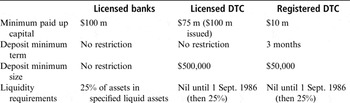
In April 1981, Haddon-Cave introduced a new DTC bill and a new banking bill to restructure the industry along the lines of the three-tier system, seven years after it was first proposed by Ockenden. A new category of “licensed” DTC had higher minimum capital and higher minimum deposits but could compete with banks for short-term deposits. Other DTCs were pushed out of the short-term demand deposit market and the banks regained their local funding base. But, the wholesale business of DTCs was not deemed to require prudential liquidity requirements to cover losses. Wealthy people depositing large sums were expected to exercise caution or pay the consequences of unwise investments. At the same time the minimum paid-up capital for locally incorporated banks was increased from $10 million to $100 million.Footnote 52 The details are summarized in Table 1.
Three-tier System, September 1981

John Bremridge was appointed financial secretary from June 1981. Bremridge had been chairman of the John Swires Group and had previously been on the board of HSBC; he was the first financial secretary who was not a career civil servant. In 1975, Bremridge was publicly critical of the government's delayed efforts to stem the stock exchange boom and bust of 1973, noting that “minimum interference nevertheless does not mean no interference at all.”Footnote 53 In a speech to the Hong Kong Association of Banks in August 1981, just before the new framework was implemented, Bremridge embraced non-interventionism but warned that the light hand of the state depended on bankers themselves exercising prudence in the creation of credit: “while I share Sir Philip [Haddon-Cave]’s commitment to non-interventionism, I would add my own firm belief in the corollary – the exercise of prudent freedom, which for your industry inter alia touches upon your freedom to create credit.”Footnote 54 He went on to explain that non-interventionism was not merely an economic philosophy but rather reflected his lack of faith in the ability of governments to curb market risk effectively:
I accept that a persuasive argument against intervention is not that in many cases it is not philosophically decent, but that governments often cannot predict accurately what the end effects of new controls will be. The world indeed is littered with economic disasters created by well-meaning interference with those free market mechanisms which have served Hong Kong so well.Footnote 55
The new framework for DTC regulation was to prove just such a case. Bremridge's comments “emboldened” Sandberg, who quickly wrote to try again to get controls on bank and DTC foreign borrowing.Footnote 56 He noted that “I myself would be the last person to find fault with the basic philosophy of non-intervention,” but “inactivity by Government on this front [credit expansion] could result in its being regarded as an ally to the speculative and irresponsible ambitions of our entrepreneurs, to the detriment of the longer-term interests of Hong Kong.” Bremridge rejected this proposal on the grounds that it would discriminate against foreign banks and DTCs, which relied more on international liquidity, and that it would also damage Hong Kong's reputation “as a financial centre based on stable policies.”Footnote 57 William C.L. Brown of Chartered Bank also wrote to Bremridge, but he preferred relying on interest rates to curtail credit creation, noting that “like Sandberg I endorse a non-intervention policy, but if Government does have to intervene then it is vital the effects are confined to the target area.”Footnote 58
The squeezing out of the DTCs from the retail deposit sector happened just as the monetary expansion of the previous two years came to an end with a contraction in credit and a collapse of property prices. This left both the DTCs and the banking system in an illiquid, fragile situation. In addition, in February 1982, the government agreed to remove the 10 per cent tax on interest earned from foreign deposits, further adding to the incentive to switch out of Hong Kong dollar deposits. The environment was ripe for a further round of crisis.
Impact of the Three-tier System
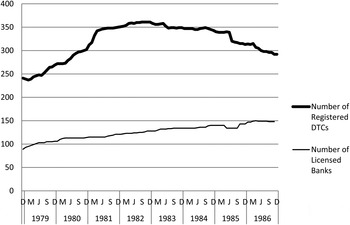
The minimum capital requirements did not come into force until 30 June 1983, and only a few failed to meet the requirements by this date.Footnote 59 The first new licensed DTC was Baring Brothers Asia Ltd in February 1982; by the end of 1983, there were 29 licensed DTCs (all subsidiaries of local and foreign banks), compared with 350 registered DTCs. The three-tier system was one of Haddon-Cave's last major contributions as financial secretary. Figure 1 shows that the number of DTCs almost doubled in the three years from the end of 1978, but the 1981 framework slowed the number of new registrations.
Number of Reporting DTCs and Banks (monthly, December 1978–December 1986

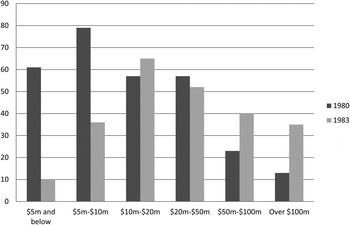
Figure 2 shows that the majority of the registered DTCs in 1980 were at the small end of the distribution, almost half with shareholders’ funds of less than HK$10 million (US$2 million) and just over one-fifth of institutions with HK$5 million or less at a time when the minimum paid-up capital was HK$2.5 million.Footnote 60 Among the smallest were DTCs associated with local and overseas banks (such as Kwong On Finance Ltd, OCBC Finance (Asia) and JP Morgan (HK) Ltd). These subsidiaries would have had the resources of their parent company to draw on in case of liquidity problems. The largest DTC by far was the HSBC subsidiary, Wardley Ltd, with paid-up capital of HK$250 million, shareholders’ funds of HK$388 million and total assets of HK$5.515 billion.
DTCs by Shareholder Funds, 1980 and 1983

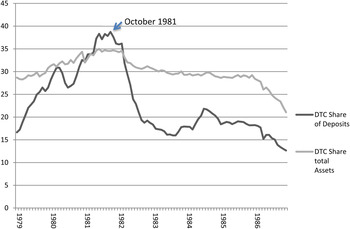
It is clear from Figure 3 that DTCs were very successful in attracting deposits away from the formal banking sector until September 1981. Almost all of the increase in deposits was in Hong Kong dollars, thus they were directly competing with banks in the home market. After the restrictions on duration and size of deposit in September 1981, retail deposits flowed back to banks, and the share of DTCs in total assets and liabilities subsided to about 30 per cent. After being pushed out of the Hong Kong market, DTCs shifted towards attracting foreign currency deposits, particularly from foreign banks. It is clear that the September 1981 reforms changed the business model for the DTCs, which shifted from the domestic market to the offshore market just when risks in global capital markets were about to intensify.
Registered Deposit-taking Companies’ Share of Customer Deposits and Total Assets (monthly, December 1978–December 1986)

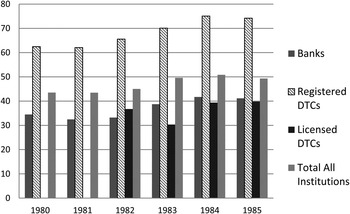
Figure 4 shows that registered DTCs were more concentrated in foreign currency loans and advances than banks or licensed DTCs. At the end of 1980, half of all loans and advances for use outside Hong Kong were from DTCs, rising to a peak of 59 per cent at the time of the financial crisis of September 1982, before steadily declining to 28 per cent by 1986.
Loans and Advances in Foreign Currency as a Share of Total (%)

It is clear from these data that the three-tier system did affect the financial sector, but not necessarily in ways that improved resilience. The balance sheets of the DTCs remained at about 30 per cent of that of the total financial institutions in Hong Kong, but they were increasingly driven towards overseas markets and inter-bank funding while they operated with only minimal supervision.
DTC–Bank Links and the 1982 Crisis
Despite Haddon-Cave's hopes, the new framework did not allow the state to stabilize either inflation or the banking system. The crisis, when it came, can be traced back to institutions in the deeper shadow: the gold market. A prominent chain of retail gold shops, Tse Lee Yuen Jewellery, with ten branches, accepted deposits against gold certificates (future claims of physical gold). The company used these funds to speculate in the gold market but losses were accumulated by selling low at a time when the gold price increased in August 1982. When customers sought to withdraw their deposits, the company's insolvency was revealed. Hang Lung Bank was the firm's bankers and they began to close overdraft accounts to recapture liquidity. This signal prompted a crisis of confidence among depositors and a run on the bank in September 1982, which coincided with political uncertainty as the UK prime minister, Margaret Thatcher, arrived to negotiate the return of Hong Kong to China.Footnote 61 Chartered Bank's promise to provide Hang Lung Bank with liquidity eventually stemmed the run, but the market remained fragile.
A few months later, in November 1982, a prominent DTC, Dollar Credit and Financing Ltd, was closed after ten years of operation, with liabilities of around HK$650 m to 39 mainly foreign banks and other DTCs. This DTC had expanded quickly in the absence of liquidity requirements: in June 1980, it reported total assets of HK$380,000 against shareholders’ funds of only HK$60,000, including paid-up capital of only HK$30,000. Dollar Credit had close links to Hang Lung Bank – its board of directors included two directors of Hang Lung Bank and it was located on the 13th floor of the Hang Lung Bank Building in Causeway Bay.Footnote 62 Illiquidity again spread to the commercial bank sector and Hang Lung Bank (with 28 branches) was soon in difficulty again. In June 1983, Chartered Bank denied further support and the government had to use the Exchange Fund to take over the bank on 27 September 1983, in the midst of a collapse in the Hong Kong dollar. In the ensuing months, several property companies, for example Eda and Carrian, suffered from cash flow problems as property prices fell and their associated DTCs (including HSBC's Wardley) faltered.Footnote 63 The unwillingness of Chartered Bank to continue to provide liquidity to Hang Lung Bank shifted the lender of last resort directly to the Exchange Fund.
Once again, non-interventionism was challenged by HSBC. Just after the Dollar Credit DTC debacle at the end of 1982, Sandberg revived his proposals to curb banks and DTCs from borrowing overseas; however, Bremridge resisted, concluding, rather fatalistically, that “‘when in doubt, do nothing’ seems the least foolish policy for Government.”Footnote 64 In February 1983, J.M. Gray of HSBC noted that while foreign banks and DTCs were not the only sources of excessive credit, “they led the way, encouraged by Government's policy on land sales and the absence of effective liquidity controls.”Footnote 65 He also claimed DTCs were not amenable to moral suasion to constrain lending in the way that local banks were, and that:
they [DTCs] were under heavy pressure from their Head Offices to cover their overheads as quickly as possible. They soon discovered that the fastest way to do this was to take on property loans, undercutting the local banks’ spreads – and fuelling further credit expansion in the process – in order to secure the business. Reluctantly, the local banks had little choice but to follow.Footnote 66
Clearly, Gray blamed the deterioration of market discipline on the DTCs. Sandberg concurred and complained to Bremridge: “If I may be bold enough to say so, I feel the real stumbling block is one of doctrine and I believe if the Government can steel themselves to accept the principle of some form of monetary control it would not be too difficult” to adopt Sandberg's suggested controls.Footnote 67
After the government was forced to bail out Hang Lung Bank, Bremridge summoned advisers from the Bank of England's supervision team (C.L. Mann and Brian Gent). They prepared a secret 50-page report in April 1984, which was very critical of the processes operating in Hong Kong.Footnote 68 Even after the carefully negotiated 1981 Banking and DTC Ordinances, there were serious weaknesses in the regulatory and supervisory frameworks. Mann and Gent were particularly critical of the banking and DTC commissioner's office for sticking too strictly to its remit of “mere technical compliance” with the governing ordinance and not concerning themselves with the quality of assets and management and thus failing to identify “bad, imprudent or indeed fraudulent management” as a “major task of supervision generally.”
Faced with a steady rise in the value of security on the back of a booming economy and the generally pervasive attitude in Hong Kong in favour of minimal intervention in the interests of the benefits of free enterprise, it is perhaps not too surprising that the view came to be held – as it seems widely to be in the banking community – that it was not the job of supervision to delve too deeply into the purposes of loans nor the reality with which the requirements of the Ordinances were actually being met.Footnote 69
Even when “faced with identified shortcomings in the management system of individual banks, examiners feel able to do little more than to complain to bank management and to hope that matters will be improved before the next examination.” After the expensive Hang Lung collapse, the banking and DTC commissioner had not led any investigation of his office's operations to determine how to improve prudential control of banks. Indeed, the commissioner did not routinely see the reports on individual institutions: they were summarized by senior bank examiners and then reported to the assistant commissioner. Mann and Gent also noted “a general reluctance at senior management level [within the commissioner's office] to record any of the critical meetings which take place with bank management.”Footnote 70
Their other main recommendation was that DTCs should have minimum capital requirements somewhat higher than the banks (15 per cent rather than 10 per cent), although capital adequacy was “generally more of an art than a science” because it depended on both the riskiness of assets and the quality of management.
Most ambitiously, Mann and Gent recommended that all DTCs should re-register and prove their sound management as well as capitalization in order to get rid of unsound incumbent DTCs. It was expected that the 79 DTCs owned by foreign banks would be able to achieve this threshold without difficulty. They believed the 36 DTCs associated with local banks were only in business to evade the Interest Rate Agreement, so if interest rates were liberalized on deposits over HK$50,000, then these DTCs would lose their raison d’être and disappear quietly. The real target was the 115 independently owned DTCs, which the Bank of England advisors “believe[d] bring few benefits to Hong Kong to offset the risk many of them pose to her reputation.”Footnote 71
These proposals were met with a mixed reception in Hong Kong, although further reform began to be discussed. In the meantime, the government formally took over three failed banks and provided financial assistance to facilitate the take-overs of four others. After two years of negotiations with banks and DTCs, Bremridge announced a new banking bill in March 1986. It first set a wider remit for the commissioner to ensure the honesty and prudence of DTC and bank management in words that closely followed the Bank of England's 1984 recommendation.Footnote 72 The bill also adopted the Bank of England advisors’ suggestions on liquidity and capital adequacy, although at lower thresholds than they had recommended. Breaches of capital requirements were not an offence, but were required to be reported to the commissioner. The result was a decline in DTCs’ share of assets and a gradual reduction in the number of DTCs as their advantages over banks contracted.
The final reading of the banking bill marked Bremridge's last appearance in the Legislative Council after 12 years as a member (five years as financial secretary). Goodstadt describes Bremridge's term in office as a journey from being “a stout ally” of colonial non-interventionism to “a thorough-going reformer, introducing legislation to restore prudence and integrity to the financial markets that marked a clear break with the cynicism and compromises of the past.”Footnote 73 Certainly, the archive evidence shows he was resolute in resisting pressure from HSBC to impose controls on foreign borrowing, but his reforms, when they came, originated in the Bank of England (the colonial metropole), took two years to come to fruition, and were tempered by 171 amendments at committee stage.Footnote 74
Conclusion
Hong Kong's politicians have repeatedly declared the end of positive non-interventionism, although the academic literature has pointed to the inconsistent application of this core principle of Hong Kong's economic policy. Previous studies have mainly focused on administration of social and labour policies while the financial sector is traditionally viewed as more influenced by free market forces. Even here, however, the rationale of public interest in cases of market failure drew the state into regulation. This paper has traced the reluctant and incremental nature of this intervention and has shown how this approach created incentives for the evasion of regulations, which further destabilized the system. It has also shown how positive non-interventionism was negotiated between financial secretaries and incumbent banking interests, particularly (but not exclusively) HSBC and Chartered Bank. The bankers themselves persistently urged greater intervention to protect their competitive position, to promote financial stability or to curb inflation. Not surprisingly, these motivations often over-lapped. The financial secretaries developed their own ideological positions that guided their attitudes to the pressures from banks for more intervention, but these ideologies were then challenged by successive banking crises.
From the 1960s to the 1980s, each financial secretary had to face financial crises that challenged the non-interventionist stance of the government, and each left a legacy of new regulations for his successor to implement. The banking crises of the 1960s forced Cowperthwaite to abandon his complete “laissez-faire” approach by introducing minimal prudential rules for banks in the 1964 Banking Ordinance, supporting self-regulation through the Interest Rate Agreement and protecting incumbent banks through the moratorium on new licences. But, this had the perverse effect of promoting a fringe sector of dangerous competitors.
Haddon-Cave then struggled to preserve positive non-interventionism under pressure from the banking community. In March 1981, on the eve of presenting the bill setting up the three-tier system and three months before his departure from office, he remarked to the famous Hong Kong entrepreneur, Li Ka-shing 李嘉誠:
the way in which so many in the market place, in these scratchy times, damn us if we even suggest something and simultaneously damn us if we do nothing is beginning to get me down! I am determined, for as long as I am here, to keep the economy, and all the markets within it, free and that means free from unnecessary and clumsy Government intervention, free from fiscal discrimination, free from the stifling effects of excessive taxation and an over-large public sector and free from all other influences which inhibit competitive forces.Footnote 75
While the financial sector boomed under the opportunities that this new environment offered, it threatened the interests of both the public and incumbent banks.
Bremridge embraced positive non-interventionism with a call to banks to act prudently under the new framework, but he, too, was quickly under pressure from HSBC and Chartered Bank to introduce new controls even before the three-tier system came into force. He resisted their suggestions in the belief that they were discriminatory, would undermine Hong Kong's reputation for open, stable policy, and could not be relied on to be effective. He then presided over a surge of liquidity, a rash of fraud scandals and bank failures before finally introducing prudential regulations for DTCs in his last appearance in the Legislative Council in 1986. This finally closed most of the loopholes served by DTCs: by 2016, there were only 18 DTCs and 24 restricted-licence banks.
The evidence presented here also demonstrates the importance of assessing the practice as well as the form of intervention. The banking commissioner's office was under-resourced and struggled to perform its supervisory duties while a culture of minimal inspection developed that allowed weak governance and poor management to infect the financial sector. The inadequacy of resources devoted to supervision was identified within the commissioner's office in the early 1980s and by the Bank of England in the wake of another round of bank failures.
The international financial centre in Hong Kong survived the turmoil of the 1980s and by the time Chinese sovereignty resumed in 1997, it had become the territory's main economic activity. The evidence has shown that the role of the state was highly contested during the period when Haddon-Cave developed his approach of positive non-interventionism, and that he himself felt embattled by the bankers’ pushes for greater regulation. His interactions with bankers show that he was not ignorant about the functioning of the banking system, but rather that he took a principled stance to minimize regulation and promote competition. At the same time, his stance facilitated weak supervision that contributed to instability. Under Bremridge, the concept evolved towards a policy of “when in doubt, do nothing,” based on his view that state intervention often made matters worse; he then presided over a costly banking crisis. It seems likely from the archival evidence that the financial sector flourished despite weak and incremental regulation and supervision rather than as a direct result of the light hand of the state.
Acknowledgement
Part of this research was conducted while the author was research fellow at the Hong Kong Institute for Monetary Research, and it was supported by ESRC Grant ES/H026029/1.
Biographical note
Catherine Schenk FRHistS, FAcSS is professor of international economic history at the University of Glasgow. She gained her PhD at the London School of Economics and has held academic posts at Royal Holloway, University of London, and Victoria University of Wellington, and visiting positions at the International Monetary Fund and the Hong Kong Monetary Authority, as well as at the University of Hong Kong and Nottingham Business School campus in Seminyeh Malaysia. She is an associate fellow in the international economics department at Chatham House in London. Her research focuses on international monetary and financial relations after 1945, with a particular emphasis on East Asia and the United Kingdom. She is the author of several books including International Economic Relations since 1945 (2011) and The Decline of Sterling: Managing the Retreat of an International Currency (2010). She is co-editor of Oxford Handbook of Banking and Financial History (2016). Her current research interests include the development of international banking regulation since the 1960s and the causes of the sovereign debt crisis of the 1980s. She is project leader for UPIER (Uses of the Past in International Economic Relations), an EU/UK-funded international research programme.