The area of second language (L2) lexical processing has been the object of a large body of research, much of which has focused on the activation of native (first) language (L1) information (e.g., phonological, semantic, etc.) in the processing of L2 words (e.g., Jared & Kroll, Reference Jared and Kroll2001; Marian & Spivey, Reference Marian and Spivey2003; Weber & Cutler, Reference Weber and Cutler2004). Less common, however, is research seeking to establish whether L2 learners can learn to use L2 information that does not play a significant role in the activation of L1 words (e.g., Dupoux, Sebastián-Gallés, Navarrete, & Peperkamp, Reference Dupoux, Sebastián-Gallés, Navarrete and Peperkamp2008). For example, stress is typically word-final in Canadian French (e.g., Charette, Reference Charette1991; Goad & Buckley, Reference Goad and Buckley2006). As a result, it does not contribute information that may help the listener distinguish between competing word candidates early in the word recognition process (e.g., chaGRIN “sorrow,” chaLEUR “heat,’ chaPEAU “hat,” etc., where primary stress is represented with capital letters). By contrast, stress falls on different syllables across words in English. Hence, for words beginning with segmentally nearly identical but prosodically distinct syllables (e.g., MYStery vs. misTAKE), the suprasegmental properties of word stress can be used in early word recognition to help distinguish between competing word candidates (e.g., Cooper, Cutler, & Wales, Reference Cooper, Cutler and Wales2002).Footnote 1 To process English words like native speakers of English do (i.e., rapidly and efficiently), French Canadian L2 learners of English must therefore not only learn where stress is located in the word, but also use that information for distinguishing between competing word candidates in the activation stage of the word recognition process.
The purpose of this study is twofold: (a) to determine whether native speakers of Canadian French at different proficiencies in English can use the suprasegmental properties of primary word stress for recognizing English words and (b) to specify how the L2 learners' (surface-level) knowledge of stress placement influences their use of primary stress in L2 word recognition. These two questions are investigated by way of, respectively, a cross-modal word identification task and a vocabulary production task. The findings of previous research suggest that French-speaking L2 learners cannot use word stress for L2 lexical access, because they cannot use an abstract phonological representation of word stress during L2 lexical processing (e.g., Dupoux et al., Reference Dupoux, Sebastián-Gallés, Navarrete and Peperkamp2008). The data presented herein will show that the difficulty that many native speakers of (Canadian) French experience is indeed at the level of lexical processing. Because this is (to my knowledge) the first study that concurrently investigates (a) and (b) with L2 learners at different proficiency levels, its findings will be relevant for understanding both the role of word stress in L2 lexical access, including whether (and if so, how) the latter changes as proficiency increases, and the relationship between L2 processing and L2 knowledge.Footnote 2
The paper is organized as follows: first, a review is presented of some of the literature on the use of word stress in L1 word recognition; second, research that examines the role of word stress in L2 word recognition, including the processing of L2 word stress by native French speakers, is discussed; third, the methodology and results of the cross-modal word identification task and the vocabulary production task are presented and discussed; fourth and finally, the paper is concluded with a general discussion of the reported findings.
WORD STRESS IN L1 WORD RECOGNITION
Research on lexical processing suggests that the word recognition process involves the activation of multiple word candidates (e.g., Connine, Blasko, & Wang, Reference Connine, Blasko and Wang1994; Connine, Titone, Deelman, & Blasko, Reference Connine, Titone, Deelman and Blasko1997; Marslen-Wilson, Reference Marslen-Wilson and Altmann1990; Zwitserlood, Reference Zwitserlood1989), competition between the candidates for word selection (e.g., Gaskell & Marslen-Wilson, Reference Gaskell and Marslen-Wilson2002; Goldinger, Luce, & Pisoni, Reference Goldinger, Luce and Pisoni1989; McQueen, Norris, & Cutler, Reference McQueen, Norris and Cutler1994), and rapid integration of information to distinguish between the competing word candidates (e.g., Marslen-Wilson & Warren, Reference Marslen-Wilson and Warren1994; McQueen, Norris, & Cutler, Reference McQueen, Norris and Cutler1999). One type of information that has been proposed to constrain lexical access in a variety of languages is prosodic information. For example, lexical tones have been found to play a role in the recognition of Cantonese words (e.g., Chen & Cutler, Reference Chen, Cutler and Chen1997), and pitch accents have been reported to influence the activation and selection of Japanese words (e.g., Cutler & Otake, Reference Cutler and Otake1999; Sekiguchi & Nakajima, Reference Sekiguchi and Nakajima1999). In these languages, prosodic information constrains lexical access, because tones and pitch accents are independent from segmental information (i.e., they are represented lexically). Similarly, word stress has been found to help distinguish between competing word candidates in Dutch (e.g., Cutler & Donselaar, Reference Cutler and Donselaar2001; Donselaar, Koster, & Cutler, Reference Donselaar, Koster and Cutler2005) and Spanish (e.g., Soto-Faraco, Sebastián-Gallés, & Cutler, Reference McQueen, Norris and Cutler2001). Word stress constrains word recognition in these languages, because it is partially independent from segmental information: syllable shape contributes to determining stress placement, but unstressed syllables do not always (Dutch) or ever (Spanish) contain a phonologically reduced vowel (for details, see Booij, Reference Booij1995, for Dutch, and Harris, Reference Harris1983, for Spanish).
Conversely, English word stress is highly dependent on segmental information, given the general tendency in the language for stressed syllables to contain nonreduced vowels, on the one hand, and for unstressed syllables to contain reduced vowels, on the other hand (for a discussion of exceptions to this tendency, see Burzio, Reference Burzio1994). The suprasegmental properties of word stress (higher pitch, increased amplitude, and greater duration; e.g., Fry, Reference Fry1958; Grimson, Reference Grimson1980; Lehiste, Reference Lehiste1976) may therefore not play a significant role in the recognition of English words. Early research investigating this issue seemed to confirm this prediction. For example, Cutler and Clifton (Reference Cutler, Clifton, Bouma and Bouwhuis1984) and Fear, Cutler, and Butterfield (Reference Fear, Cutler and Butterfield1995) found that stress had a much smaller effect on word recognition in the absence of vowel reduction; Small, Simon, and Goldberg (Reference Small, Simon and Goldberg1988) reported that mis-stressing had little effect on the recognition of noun–verb homographs (e.g., CONvert vs. conVERT); and Cutler (Reference Cutler1986) found that segmentally near-identical word pairs differing in stress placement (e.g., FORbear vs. forBEAR) primed each other.
However, it was recently hypothesized that the methods used in the previous research may not have been sufficiently sensitive to capture the effect that the suprasegmental properties of word stress may have on word recognition (e.g., limited power because of the small number of English words that differ prosodically but not segmentally; see Cooper et al., Reference Cooper, Cutler and Wales2002 for discussion). Moreover, in the above studies, responses were typically collected after the complete word had been heard. Because English has few segmentally near-identical but prosodically distinct words, it is possible that the suprasegmental properties of word stress no longer influence word recognition once all the necessary segmental information is available to the listener. Yet, English has several words that begin with segmentally near-identical but prosodically distinct first syllables (e.g., MYStery vs. misTAKE). It is therefore possible that the suprasegmental properties of word stress are used early in the word recognition process to help English listeners distinguish between competing lexical items. If so, upon hearing the first syllable of such words (e.g., MIS-), all the words whose first syllable matches the input segmentally and prosodically (e.g., MYStery, MISter, etc.) should receive a higher level of activation than the words whose first syllable matches the input only segmentally (e.g., misTAKE, mysTErious, etc.), and should therefore be at an advantage when competing with the latter.
Cooper et al. (Reference Cooper, Cutler and Wales2002) tested this hypothesis with native speakers of Australian English. The participants completed two cross-modal priming tasks and a word identification task. In the first cross-modal priming task, word pairs were selected such that their first two syllables would be segmentally near identical but prosodically distinct: the first syllable in the word pairs had primary or secondary stress, and the second syllable was unstressed (e.g., ADmiral vs. admiRAtion). The participants listened to sentences ending with the first two syllables of these word pairs (i.e., the prime) (e.g., We were sure the word was ADmi-), and then saw a prosodically matching (e.g., “admiral”) or mismatching (e.g., “admiration”) word on the computer screen. They were instructed to decide as quickly as possible if the word they saw was a real English word. The experiment included a control condition in which the segmental content of the prime did not match the first two syllables of the experimental word on the screen (e.g., expla- for explaNAtion). It was predicted that if word stress constrained lexical access in English, the participants would recognize prosodically matching words faster than prosodically or segmentally mismatching words. The second cross-modal priming task was identical, except that the primes were monosyllabic, and the first syllable of the selected word pairs either had primary stress or was unstressed (e.g., MUsic vs. muSEum). In the word identification task, the participants listened to the monosyllabic primes from the second cross-modal priming task without its carrier sentence (e.g., MU-), and identified on a questionnaire which of the two experimental words (e.g., “music” vs. “museum”) the prime belonged to.
The results of the first and second cross-modal priming tasks revealed significantly shorter response times to prosodically matching words than to prosodically or segmentally mismatching words, suggesting that the suprasegmental properties of word stress indeed constrain lexical access in English. The word identification task showed significantly higher accuracy rates on words following stressed primes than on words following unstressed primes. The authors proposed that the participants selected the words with initial stress more often than the words without initial stress, because those with initial stress that were chosen for the experiment happened to be more frequent in English. Thus, contrary to what earlier research had suggested, Cooper et al.'s findings indicate that the suprasegmental properties of word stress can help native speakers of English distinguish between competing lexical items. Because the first syllable of the primes in the first cross-modal priming task had secondary stress when it did not have primary stress (e.g., ADmiral vs. admiRAtion), the results also indicate that English listeners can distinguish primary stress from secondary stress in lexical processing.
Word stress has been found to play a role not only in the activation of English words, but also in the segmentation of speech into words. A large body of research has shown that English listeners tend to assign word-initial boundaries at the onset of stressed syllables (e.g., Cutler & Butterfield, Reference Cutler and Butterfield1992; Cutler & Norris, Reference Cutler and Norris1988; McQueen et al., Reference McQueen, Norris and Cutler1994; Norris, McQueen, & Cutler, Reference Norris, McQueen and Cutler1995), even if the trochaic (i.e., stressed–unstressed) foot responsible for primary stress in English is typically analyzed as being aligned with the right edge of the word (e.g., Halle & Vergnaud, Reference Halle and Vergnaud1987; Hammond, Reference Hammond1999; McCarthy & Prince, Reference McCarthy, Prince, Booij and van Marle1993).Footnote 3 Similarly, English-acquiring infants presented with strings of continuous speech have been found to rely on stress as a cue to word-initial boundaries (e.g., Jusczyk, Houston, & Newsome, Reference Jusczyk, Houston and Newsome1999; Morgan & Saffran, Reference Morgan and Saffran1995; Myers et al., Reference Myers, Jusczyk, Kemler Nelson, Charles-Luce, Woodward and Hirsh-Pasek1996). These findings have been attributed largely to the high frequency of word-initial primary stress in English (e.g., Clopper, Reference Clopper2002). These studies provide further evidence that word stress contributes information pertinent for lexical access in English. Models of English word recognition therefore need to account for the use of both segmental and suprasegmental information in the activation of lexical candidates that compete for word selection (see Norris et al., Reference Norris, McQueen and Cutler1995, for an attempt to capture the effect of prosodic cues in the Shortlist model).
WORD STRESS IN L2 WORD RECOGNITION
Prosodic information, for example, the suprasegmental properties of word stress, allows native English speakers to select the correct lexical item among competing word candidates more rapidly than if that information was not available or could not be used for lexical access. To process English words efficiently, L2 learners should therefore learn to use the suprasegmental properties of word stress early in the word recognition process. Research on L2 (sentence) processing has shown that L2 learners generally process the target language more slowly than native speakers do (see Frenck-Mestre, Reference Frenck-Mestre, Herrida and Altarriba2002, for discussion). We may thus wonder whether L2 learners can learn to use prosodic information such as word stress sufficiently rapidly (i.e., before additional segmental information becomes available) for selecting the correct lexical item. Cooper et al.'s (Reference Cooper, Cutler and Wales2002) study provides an answer to this question.
In addition to testing native speakers of English, Cooper et al. (Reference Cooper, Cutler and Wales2002) recruited Dutch L2 learners of English at an advanced level of proficiency in English. Dutch is similar to English, in that stress also falls on different syllables across words (e.g., OCtopus “octopus” vs. okTOber “October”). Furthermore, the suprasegmental properties of word stress can potentially play a more important role in Dutch word recognition than in English word recognition, because unstressed vowels are not necessarily reduced in Dutch (e.g., Booij, Reference Booij1995), whereas they tend to be in English. The L2 learners completed the same two cross-modal priming tasks and the word identification task that the native speakers completed. Recall that in the cross-modal priming tasks, the participants heard sentences ending with the first or first two syllable(s) of a word, and then saw a prosodically or segmentally matching or mismatching word, which they identified as a real English word or nonce word; in the word identification task, they heard the first syllable of a word, and decided whether it belonged to a prosodically matching or mismatching word.
The L2 learners' results paralleled those of the native speakers, with significantly shorter response times to prosodically matching words than to prosodically or segmentally mismatching words in the cross-modal priming tasks and significantly higher accuracy rates on words following stressed primes than on words following unstressed prime in the word identification task. This suggests that the suprasegmental properties of word stress also constrain lexical access for these L2 learners. These findings are not completely surprising, given that stress has been found to prosodically constrain word recognition in L1 Dutch (e.g., Cutler & Donselaar, Reference Cutler and Donselaar2001; Donselaar et al., Reference Donselaar, Koster and Cutler2005). It is of interest that the L2 learners outperformed the native speakers in the word identification task (72 vs. 59%, respectively). The authors proposed that native speakers of Dutch may rely more on the suprasegmental cues to stress in word recognition than native speakers of English do, because vowel reduction is not as frequent in Dutch as it is in English.
Cooper et al.'s (Reference Cooper, Cutler and Wales2002) findings indicate that Dutch L2 learners of English can transfer their ability to use the suprasegmental properties of stress from Dutch to English word recognition, and they are able to do so sufficiently rapidly for selecting the correct word candidate. This suggests that speed of L2 processing is not an issue for L2 lexical access when word stress helps the listener distinguish between competing lexical items in the L1 and when stress placement is similar in the two languages. What is unclear is whether L2 learners can learn to use the suprasegmental properties of stress in L2 word recognition when stress does not contribute useful information for L1 lexical access.Footnote 4 A recent study conducted by Dupoux et al. (Reference Dupoux, Sebastián-Gallés, Navarrete and Peperkamp2008) with French L2 learners of Spanish sheds some light on this question.
Like in Canadian French, stress in European French is typically word-final, but it can also be phrase-final in rapid speech (e.g., Jun & Fougeron, Reference Jun, Fougeron and Botinis2000). Hence, stress does not provide information that may help French listeners distinguish between competing word candidates. Instead, it performs a demarcative function, marking the right edge of the word or the phrase (Dupoux et al., Reference Dupoux, Sebastián-Gallés, Navarrete and Peperkamp2008). Conversely, stress in Spanish can fall on different syllables across words, and its placement can be used to distinguish between segmentally near-identical words (e.g., PApa “potatoes” vs. paPÁ “daddy”; HAblo “I speak” vs. haBLÓ “s/he spoke”). Moreover, unstressed vowels are not phonologically reduced in Spanish. The suprasegmental properties of word stress may therefore play a more important role in Spanish than in Dutch, which has some vowel reduction, and English, in which vowel reduction is very frequent. As mentioned in the previous section, native Spanish listeners have been found to use the prosodic correlates of stress for recognizing Spanish words (e.g., Soto-Faraco et al., Reference Soto-Faraco, Sebastián-Gallés and Cutler2001). Spanish is thus an ideal target language for determining whether French-speaking L2 learners can learn to use the suprasegmental properties of word stress for L2 lexical access.
Native speakers of European French at beginning, intermediate, and advanced proficiencies in Spanish and native speakers of Castillian Spanish completed a speeded lexical decision task (among other experiments). Word–nonword minimal pairs were selected such that the nonwords in the experimental condition would be incorrectly stressed (e.g., ROpa “clothing” vs. *roPA; caFÉ “coffee” vs. *CAfé; POlen “pollen” vs. *poLEN; meLÓN “melon” vs. *MElón) and those in the control condition would contain one incorrect segment (e.g., cielo “sky” vs. *cieto; voz “voice” vs. *vuz). The participants heard each individual stimulus and were instructed to indicate as quickly and accurately as possible if the stimulus was a Spanish word. If French L2 learners of Spanish do not use word stress for lexical access, they should have poor accuracy rates on the test items in the experimental condition, but not on the test items in the control condition, and we may expect their acceptance rate for nonwords to be higher than their rejection rate for real words in the experimental condition.
The results indicate that the L2 learners' overall accuracy rates on the test items in the experimental condition were only slightly above chance level (beginner: 56%; intermediate: 58%; advanced: 64%; cf. 96% for the Spanish speakers), whereas their overall accuracy rates on test items in the control condition were much higher (beginner: 85%; intermediate: 90%; advanced: 94%; cf. 98% for the Spanish speakers). Further analyses revealed a significant effect of lexical status, with the L2 learners' performance being worse on the nonwords than on the real words, especially for the test items in the experimental condition (42 vs. 76%, respectively). A significant interaction was also found between lexical status and proficiency level, with the L2 learners' accuracy rates in the experimental condition improving with proficiency only for the real words. These findings suggest that even advanced L2 learners have difficulty using word stress for lexical access (at least, as a group), as they tend to accept both correctly stressed and incorrectly stressed test items. It is nevertheless possible that some of the individual L2 learners performed better on the task, as the standard errors reported by the authors indicate considerable variation in the results.
Dupoux et al.'s (Reference Dupoux, Sebastián-Gallés, Navarrete and Peperkamp2008) study shows that for most French L2 learners of Spanish, the suprasegmental properties of word stress do not constrain L2 lexical access. In light of these findings, we may wonder whether this problem stems from the L2 learners' acoustic perception rather than from their lexical processing. Theoretically, it could be the case that native French speakers do not use stress to recognize Spanish words because they cannot perceive it acoustically. However, it has been found that French (Canadian) listeners have little difficulty performing identification tasks (e.g., AXB in Tremblay, Reference Tremblay2007) and do not differ significantly from Spanish speakers in sequence recall tasks (e.g., AABA, ABBA, BABA, etc., in Dupoux, Peperkamp, & Sebastián-Gallés, Reference Dupoux, Peperkamp and Sebastián-Gallés2001) when the stimuli differing in stress placement do not show any phonetic variability; that is, when Stimulus X is the exact same token as Stimulus A or B in AXB tasks, and when every instance of A and B is the same token of, respectively, A and B in sequence recall tasks. This suggests that native French listeners are able to use an acoustic representation of word stress for performing perception experiments. By contrast, if phonetic variability is increased, for example, by presenting prosodically distinct stimuli articulated different speakers (see Dupoux et al., Reference Dupoux, Peperkamp and Sebastián-Gallés2001, for other manipulations of phonetic variability), French listeners can discriminate between, identify, or recall stimuli differing in stress placement only when no more than two stimuli are kept at a time in short-term memory (e.g., Dupoux et al., Reference Dupoux, Peperkamp and Sebastián-Gallés2001, Reference Dupoux, Sebastián-Gallés, Navarrete and Peperkamp2008; Dupoux, Pallier, Sebastián, & Mehler, Reference Dupoux, Pallier, Sebastian and Mehler1997). Dupoux et al. (Reference Dupoux, Sebastián-Gallés, Navarrete and Peperkamp2008) interpret these findings as evidence that French speakers cannot use an abstract phonological representation of word stress during lexical processing (otherwise, phonetic variability would not pose a problem for short-term memory). The data presented below provide further support for such a proposal.
The present study thus adds to the literature on the processing of L2 word stress by native French speakers. In contrast to the research conducted by Dupoux and colleagues, the participants in this study are French Canadian L2 learners of English. Because stress placement does not vary across words in Canadian French, these L2 learners are also expected to have difficulty using stress for L2 lexical access. Note, however, Canadian French differs from European French in that stress tends to fall on the right edge of the word rather than the phrase (e.g., Walker, Reference Walker1984; for evidence from perceptual data, see Paradis & Deshaies, Reference Paradis and Deshaies1990), and the former has a greater contrast between strong and weak syllables than the latter, with high vowels being optionally lax in unstressed open syllables but not in stressed open syllables (e.g., [fini], [fɪni], but *[finɪ], *[fɪnɪ] fini “finished”; for details, see Walker, Reference Walker1984). Canadian French speakers may therefore become easily tuned to the segmental correlates of English stress, resulting perhaps in greater ability than the French-speaking L2 learners of Spanish in Dupoux et al. (Reference Dupoux, Sebastián-Gallés, Navarrete and Peperkamp2008) to use the suprasegmental properties of L2 word stress for L2 lexical access. This research also focuses on the development of L2 processing, namely, whether (and if so, how) the ability of French Canadian L2 learners of English to use primary stress in word recognition changes with increasing L2 proficiency. The findings of Dupoux et al. (Reference Dupoux, Sebastián-Gallés, Navarrete and Peperkamp2008) suggest that proficiency has little effect on the L2 learners' ability to use word stress for L2 lexical access, but because this research uses a different constellation of native language and target language, as well as a different experimental paradigm, diverging results may be found. Finally, this study investigates the relationship between L2 learners' use of primary stress in word recognition and their (surface-level) knowledge of L2 stress placement. Establishing a connection between the two may prove revealing for our understanding of the development of L2 lexical processing.
METHOD
Participants
Seventy-six French Canadian L2 learners of English with little knowledge of other languages and 31 native speakers of Canadian or American English with little knowledge of French participated in this study. Because stress placement is generally the same in Canadian and American English, dialectal differences between Canadian and American English were judged to be irrelevant for this research. The participants were recruited from McGill University, Université du Québec à Montréal, Université de Montréal, Concordia University, the Centre linguistique du Collège de Jonquière à Ottawa, and the Montreal YMCA. They were given two movie tickets in exchange for their participation in the present and other experiments. None of them had vision or hearing problems at the time of testing.
The L2 learners were placed into three levels on the basis of two proficiency tests: a cloze test and a read-aloud task. The cloze test was used to assess the L2 learners' morphosyntactic, lexical, and discourse competence. The particular cloze test that the L2 learners completed (Brown, Reference Brown1980) was administered for a few years as part of the Guangzhou English Language Test at the Guangzhou English Language Center (Guangdong, China), and later as part of the English Language Institute Placement Test at the University of Hawai'i (J. D. Brown, personal communication, April 28, 2007). Because it has been the object of much research, the test is regarded as a valid and reliable measure of global English proficiency. The read-aloud task was used to assess the L2 learners' phonological competence (for a similar procedure, see Colantoni & Steele, Reference Colantoni and Steele2007). The L2 learners were audio recorded while reading aloud a short excerpt from a newspaper article. The recorded productions were then rated by three native speakers of Canadian English and two native speakers of American English on a scale from 1 to 5 (1 = very strong foreign accent, 2 = strong foreign accent, 3 = noticeable foreign accent, 4 = mild foreign accent, 5 = no foreign accent).
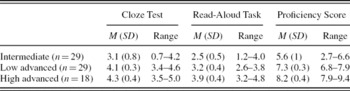
The L2 learners' total proficiency scores were calculated out of 10. For each L2 learner, half of the proficiency score came from the cloze test (i.e., the number of acceptable answers provided out of 50 was divided by 10), and half came from the read-aloud task (i.e., the five ratings received out of five were averaged). Equal weight was given to the two proficiency measures, because it was judged that a measure of proficiency including not only morphosyntactic, lexical, and discourse competence, but also phonological competence was necessary. The means (M), standard deviations (SD), and ranges for each of the two proficiency tests and for the overall proficiency scores are presented in Table 1. The cutoff points between the proficiency levels were decided semiarbitrarily: enough participants were included per group for statistical purposes, but fewer participants were included in the most advanced group based on the author's intuition that few L2 learners were highly proficient in English. The final groups consisted of 29 intermediate, 29 low-advanced, and 18 high-advanced L2 learners.
Mean results (standard deviations) on the proficiency tests

Given that this study investigates the processing and production of English word stress, there is a possibility that the use of a read-aloud task as a measure of phonological competence becomes circular if the native English speakers who rated the L2 learners' foreign accents attended to stress when doing so. However, the use of a read-aloud task becomes less likely to be circular as the correlation between it and the cloze test increases, because the latter assessed the L2 learners' morphosyntactic, lexical, and discourse competence. A Pearson correlation conducted on the ratings of the read-aloud task and the scores of the cloze test indeed reveals a significant positive correlation (r = .43, p < .001), suggesting that the measure of phonological competence used in this study is appropriate.
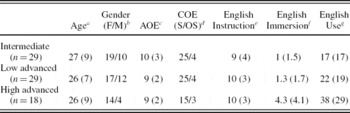
The L2 learners filled out a language background questionnaire in French, in which they specified biographical information such as their age, gender, age of first exposure to English, context of first exposure to English, number of years of English instruction, number of years immersed in an English environment, and percentage of daily use of English (among other things). This information is presented for each of the L2 groups in Table 2. As can been seen from their biographical information, the L2 learners were between 9 and 10 years of age when they were first exposed to English, and for most of them, school was the context of first exposure to English. French-speaking children who attended Québec elementary schools before 2004 received approximately 2 hr of English instruction per week between Grade 4 and Grade 6. The L2 learners who were exposed to English before the age of 9 indicated on the language background questionnaire that they were taught single vocabulary words by their parents or occasionally watched Sesame Street in English. Table 2 also shows a great deal of variation in the number of years that L2 learners spent immersed in an English environment and in their percentage of daily use of English, as indicated by the high standard deviations.
Biographical information of the L2 learners

aAge: mean (standard deviation).
bGender: females/males.
cAge of first exposure to English: mean (standard deviation).
dContext of first exposure to English: school/outside school.
eNumber of years of English instruction: mean (standard deviation).
fNumber of years immersed in an English environment: mean (standard deviation).
gPercent daily use of English: mean (standard deviation).
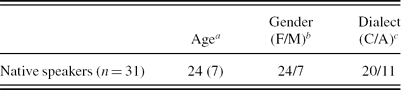
The native speakers filled out a similar language background questionnaire in English. They all reported that English was the only language that they spoke at home during the first 5 years of their lives, and continued to be their dominant language at the time of testing. The native speakers' age, gender, and English dialect are summarized in Table 3.
Biographical information of the native speakers
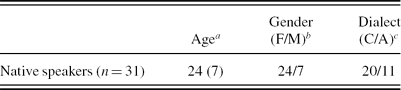
aAge: mean (standard deviation).
bGender: females/males.
cDialect of English: Canadian/American.
All the participants completed a cross-modal word identification task, and the L2 learners completed a vocabulary production task. We begin with the cross-modal word identification task, a partial replication of Cooper et al.'s (Reference Cooper, Cutler and Wales2002) word identification task, the purpose of which was to determine if French Canadian L2 learners of English and native English speakers can use primary stress to recognize English words.
Cross-modal word identification task
Materials. The participants heard semantically nonconstraining, prosodically neutral sentences ending with the article the and the first syllable of a word (e.g., Very few still remember the MYS-). The truncated words (i.e., the primes) came from experimental word pairs whose first syllables were segmentally near identical but prosodically distinct (e.g., MYStery vs. misTAKE). The visual stimuli (i.e., the targets) were the experimental word pairs (e.g., “mystery” vs. “mistake”) or one of the two experimental words and a control word (e.g., “mystery” vs. “journey”). They appeared on the computer screen immediately after the auditory stimuli. The experiment included four conditions, shown in Example 1, where P stands for prime and T for targets.
- 1.
a. stress contrast, stressed prime (e.g., P: MYS-; T: “mystery” vs. “mistake”)
b. stress contrast, unstressed prime (e.g., P: mis-; T: “mystery” vs. “mistake”)
c. segmental contrast, stressed prime (e.g., P: MYS-; T: “mystery” vs. “journey”)
d. segmental contrast, unstressed prime (e.g., P: mis-; T: “divorce” vs. “mistake”)
In the stress contrast conditions, the initial syllable of the targets differed only in whether or not it had primary stress; in the segmental contrast conditions, the first syllable of the targets differed segmentally. Stressed and unstressed primes were used to determine if the participants could use both the presence and the absence of stress to recognize English words. The segmental contrast conditions served as a control condition to check that any inability to choose the word to which the prime belonged in the experimental conditions was not because of a problem with the task, but to the participants' inability to use stress in word recognition. In other words, all the participants should be able to select the target that matched the prime segmentally.
Sixteen experimental noun pairs with segmentally near-identical but prosodically distinct first syllables were selected in part from Cooper et al.'s (Reference Cooper, Cutler and Wales2002) study and in part from the CELEX database (Baayen, Piepenbrock, & van Rijn, Reference Baayen, Piepenbrock and van Rijn1993). Primary stress was on either the first or the second syllable of the words.Footnote 5 The lemmas in each experimental pair were balanced for spoken frequency to ensure that this factor would not inadvertently affect the participants' responses. Thirty-two segmentally different, semantically unrelated control nouns which closely matched the experimental nouns in spoken frequency, word length, and stress pattern were also selected (see Appendix A for a list of the experimental and control words and their spoken frequency). The sentences ending with the experimental and control word pairs were evaluated for contextual bias by a native speaker of Canadian English and a native speaker of American English. Sentences whose context was biased toward one of the two experimental words or the corresponding control word were rewritten until they were no longer biased. The participants heard a total of 64 critical sentences (4 conditions × 16 tokens). In contrast to the methodology used in Cooper et al.'s study, the primes were not removed digitally from the carrier sentence and presented in isolation (e.g., MYS- was not removed from the sentence Very few still remember the MYS-), because the prosodic information provided by the article preceding the prime is crucial for determining whether or not the prime receives primary stress. The participants heard and saw each of the critical prime–target combinations once in the experiment. The repeated primes occurred in different sentences, and none of the participants heard the same sentence more than once.
The experimental and control sentences were interspersed with 64 distracter sentences (total = 128 test items). The control words were used again in the distracter sentences so that the participants would also see them more than once in the experiment. Some of the distracter words always co-occurred with the same control or distracter word so that the same word pairs occurred twice in the experiment, and these pairs sometimes began with the same consonant (and vowel). These measures were taken to ensure that the experimental word pairs, which were seen together more than once in the experiment, would not stand out. The length of the sentences was kept relatively short to minimize processing difficulty. Because some of the target words appeared more than once in the experiment, the experiment was divided into two blocks, with only one experimental sentence and the corresponding control sentence but with the opposite prime occurring in each block. The order in which the conditions were presented within each block was the same for all the participants (e.g., filler, filler, control, filler, experimental, filler, etc.), but the particular test items that appeared in each of the conditions were randomized across participants to prevent possible word-order effects. To avoid block effects, two lists were created: Block 1 was completed first in List 1, whereas it was completed second in List 2. Roughly half of the participants in each group were assigned to List 1, and the other half to List 2.
The sentences were recorded by a phonetically trained male native speaker of American English with no noticeable regional accent. The recordings were done with a Marantz PMD 660 solid-state recorder and a Rode NT 1-A condenser microphone at a sampling rate of 44,100 kHz and 32 bit. The last word of the sentences was recorded with a pitch accent on its stressed syllable. For the experimental sentences, it was recorded such that the pitch and length of its first syllable would be greater when stressed than the pitch and length of the preceding article and similar to it when unstressed. The article therefore served as a comparison point for the participants to determine whether or not the prime was stressed. The sentence-final word pairs that began with segmentally near-identical first syllables were recorded such that the quality of the vowel in the first syllable would be very similar whether the syllable was stressed or unstressed.
The recordings were then transferred digitally onto a notebook computer. The experimental sentences were evaluated for naturalness by a native speaker of Canadian English, and unnatural sentences were recorded again until they sounded natural. The sentence-final words were then truncated digitally such that only their first syllable remained in the sentence. The truncations were done using the audio editor software Audacity (www.audacity.sourceforge.net). For the experimental words, the syllables were segmented slightly before the syllable-initial boundary of the second syllable to ensure that coarticulatory information would not indicate the word to which the prime belonged (e.g., the second syllable of answer and antique had to be cut before the spectrum contained information revealing the quality of the next segment, /s/ and /t/, respectively).
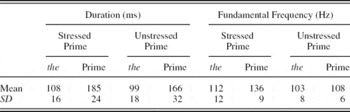
All the sentences ended with the and a monosyllabic prime (i.e., the first syllable of the truncated words). The duration and mean fundamental frequency of the article and of the experimental primes were calculated using the phonetic analysis software Praat (Boersma & Weenink, Reference Boersma and Weenink2007). The syllables were segmented from the rest of the sentence by looking at formant transitions (for a similar procedure, see Turk, Nakai, & Sugahara, Reference Turk, Nakai, Sugahara, Sudhoff, Lenertová, Meyer, Pappert, Augurzky, Mleinek, Richter and Schließer2006). The acoustic analyses of the article and of the experimental primes are provided in Table 4.
Acoustic analyses of the and the experimental primes

Paired samples t tests conducted on the duration and fundamental frequency of the primes indicate a significant effect of stress, with stressed primes being longer and higher in pitch than unstressed primes, t (31) = 4.079, p < .001, and t (31) = 13.160, p < .001, respectively. The same t tests performed on the duration and fundamental frequency of the also reveal a significant effect of stress, with the articles preceding stressed primes being longer and higher in pitch than those preceding unstressed primes, t (31) = 2.112, p < .043, and t (31) = 3.324, p < .002. This means that the duration and fundamental frequency of the may contribute to the perception of the primes as being stressed or unstressed. Because stress is also relative, ratios were computed between the acoustic properties of the and those of its following prime. Paired samples t tests conducted on these ratios indicate that the difference in pitch between the and stressed primes is greater than the difference in pitch between the and unstressed primes, t (31) = 8.559, p < .0001. This effect was not found for length (t > −1, t < 1), however. This may be because many of the experimental words required digitally removing their second (and remaining) syllable(s) slightly before the syllable boundary of the second syllable so that coarticulatory information would not indicate the word to which the prime belonged. Thus, besides differences in absolute duration and fundamental frequency, listeners could use the proportional difference between the pitch of the and of the following prime as a cue to stress.
Procedures. The experiment was administered using E-Prime (Psychology Software Tools, Inc., www.pst.com). The participants were tested individually in a quiet room. They completed the experiment on a notebook computer with a Genuine Intel Core Duo T2300 CPU at 1.66 GHz, to which a 19-in. CRT monitor was connected. The auditory materials were heard over JVC HA-G101 headphones. The instructions and target words were presented on the CRT monitor at a resolution of 640 × 480 pixels. The instructions were provided in English for the native speakers and in French for the L2 learners. The participants were told that when two words appeared on the computer screen, they should decide as quickly as possible the word to which they thought the sentence-final syllable belonged, and press the appropriate response key accordingly (word 1 = 1, word 2 = 2). The targets became visible at the offset of the auditory sentences. The participants' reaction times and accuracy rates were recorded as they entered their answer, with no time-out interval. Reaction times were measured from the target onset. The next experimental sentence was presented 2,000 ms after the word identification to give the participants time to rest between each sentence. There was a practice session of 10 sentences prior to the beginning of the experiment, during which the participants received feedback on the accuracy of their responses. No feedback was provided during the rest of the experiment. The duration of the cross-modal word identification task was approximately 20 min.
Data analysis. After completing all the experiments, the L2 learners filled out a vocabulary questionnaire in which they rated their degree of familiarity with the experimental and control words used in the cross-modal word identification task, as well as with other words used in other experiments. The questionnaire contained a total of 123 words presented in alphabetical order. The words were rated on a scale from 0 to 3 (0 = I have never seen/heard this word; 1 = I have seen/heard this word, but I don't know what it means; 2 = I have seen/heard this word and I know what it means in context, but I cannot provide a definition for it; 3 = I have seen/heard this word, I know what it means, and I can provide a definition for it). For every word with which a given L2 learner was unfamiliar (i.e., the words receiving ratings of 0 and 1), the test items containing that word (e.g., mystery) and those containing the corresponding experimental (e.g., mistake) and control (e.g. journey and divorce; see Appendix A) words were excluded from the analyses. This resulted in the exclusion of 1.6% of the L2 learners' data. No L2 learner rated more than two critical words as unfamiliar.
The dependent variables in this experiment are the reaction times and the accuracy rates. The within-subject independent variables are the type of contrast (stress, segmental) and the prime (stressed, unstressed), and the between-subject independent variable is the group (intermediate L2, low-advanced L2, high-advanced L2, native speakers). For the reaction times, between-subject outliers were trimmed at three standard deviations from the mean, resulting in the replacement of 0.9% of the remaining data.
Predictions. The participants were predicted to respond more slowly to words in the stress contrast conditions than to words in the segmental contrast conditions, and they were expected to perform more poorly on the former than on the latter, because in the stress contrast conditions, the segmental content of the targets' first syllables was identical. Nonetheless, the participants who could use the presence and absence of stress on the primes to recognize English words should perform above chance level on words in the stress contrast conditions, whereas those who could not should perform at chance.
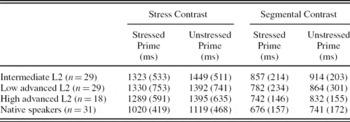
Results. Table 5 presents the L2 learners and native speakers' mean reaction times. Repeated-measures analyses of variance (ANOVAs) conducted on the reaction times reveal a significant effect of contrast type, with all the groups responding more slowly to test items in the stress contrast conditions than to test items in the segmental contrast conditions, F 1 (1, 103) = 134.790, p < .001; F 2 (1, 60) = 589.697, p < .001. This indicates that it was more difficult for the participants to select one of the two targets when these had segmentally near-identical first syllables. There was also a significant effect of prime, with the participants responding faster to words following stressed primes than to words following unstressed primes, F 1 (1, 103) = 51.754, p < .001; F 2 (1, 60) = 21.081, p < .001. However, the interaction between contrast type and prime stress was not significant, F 1 (1, 103) = 1.408, p < 0.238; F 2 < 1. This suggests that stressed primes also facilitated the recognition of the control words. A significant effect of group and a significant interaction between group and contrast type were also found, but only in the item analysis: group, F 1 (3, 103) = 2.476, p < .066; F 2 (3, 60) = 24.236, p < .001; Group × Contrast Type, F 1 (3, 103) = 1.203, p < .313; F 2 (3, 60) = 4.500, p < .006. This effect is likely because of the native speakers, whose reaction times were faster than the L2 learners' and for whom the difference between the reaction times in the stress and segmental contrast conditions was smaller.
Mean reaction times (standard deviations) on the cross-modal task

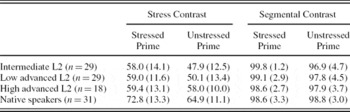
Table 6 presents the L2 learners' and native speakers' percent accuracy rates on the task. Repeated-measures ANOVAs conducted on the accuracy rates reveal a significant effect of contrast type, with the participants being significantly less accurate on words in the stress contrast conditions than on words in the segmental contrast conditions, F 1 (1, 103) = 1661.108, p < .001; F 2 (1, 60) = 1096.344, p < .001. Words following stressed primes were recognized significantly more accurately than words following unstressed primes, but only in the subject analysis, F 1 (1, 103) = 28.642, p < .001; F 2 (1, 60) = 2.428, p < .124. Similarly, the interaction between contrast type and prime stress was significant only in the subject analysis, F 1 (1, 103) = 14.121, p < .001; F 2 (1, 60) = 1.270, p < .264. This suggests that the difference between the participants' performance on words following stressed versus unstressed primes showed a tendency to be greater in the stress contrast conditions than in the segmental contrast conditions. A significant effect of group and a significant interaction between group and contrast type were also found in both the subject and item analyses: group, F 1 (3, 103) = 13.689, p < .001; F 2 (3, 60) = 7.450, p < .001; Group × Contrast Type, F 1 (3, 103) = 15.489, p < .001; F 2 (3, 60) = 8.747, p < .001. Again, this effect seems to be because of the native speakers, whose accuracy rates were higher than the L2 learners' and for whom the difference between the accuracy rates in the stress and segmental contrast conditions was smaller.
Mean percent accuracy rates (standard deviations) on the cross-modal task

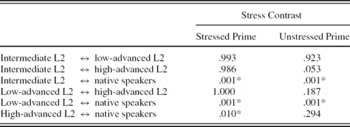
Given that the group performances differed only in the stress contrast conditions, a post hoc Scheffé test was conducted on words following stressed versus unstressed primes in that condition. The p values for each comparison are provided in Table 7. As the Scheffé test shows, on words following stressed primes, the L2 learners differ from the native speakers but not from each other, whereas on words following unstressed primes, the intermediate L2 learners and the low-advanced L2 learners (but not the high-advanced L2 learners) differ from the native speakers and the L2 groups do not differ from each other. This confirms that the effect of group and the interaction of group by contrast type found in the accuracy rates is largely due to the native speakers.
Post hoc Scheffé analyses on the participants' percent accuracy rates

*p<.05.
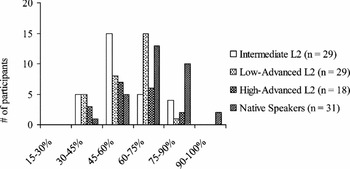
Because the L2 learners' accuracy rates hovered around chance level, additional analyses were conducted on the individual results to determine if some L2 learners were able to use stress in word recognition, as opposed to all L2 learners performing at chance level. The high standard deviations reported in Table 6 suggest that such an analysis is indeed necessary. The participants were grouped on the basis of the consistency with which they were able to use stressed and unstressed primes for recognizing English words. Six sets of accuracy ranges were created: 15–30, 30–45, 45–60, 60–75, 75–90, and 90–100%; the lowest percentage in each range is exclusive, and the highest is inclusive. Above-chance level performances were established at >60%. The participants whose accuracy rates were in the 60–75, 75–90, and 90–100% ranges in any condition were considered to have performed above chance level on the task. The participants whose accuracy rates were in the 45–60% range were at chance level, and the participants whose accuracy rates were in the 15–30 and 30–45% ranges performed below chance level.
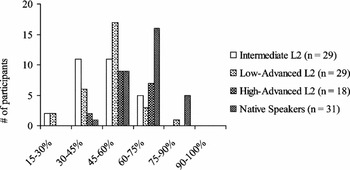
Figure 1 shows the number of participants who fell into each of these ranges for words following a stressed prime in the stress contrast condition. As can be seen from these individual results, 9 intermediate L2 learners (31%), 16 low-advanced L2 learners (55%), 8 high-advanced L2 learners (44%), and 25 native speakers (81%) performed at an accuracy rate higher than 60% on the test items containing a stressed prime in the stress contrast condition. It is clear from these results that at least some L2 learners (i.e., 33, or 44%) can use the presence of primary stress to identify English words. Although the performance of the native-speaker group was lower than expected, the great majority of native speakers also performed above chance level on the task.
The distribution of participants by accuracy rates for words followed by a stressed prime in the stress contrast condition.

Figure 2 shows the distribution of participants in each of the ranges for words following an unstressed prime in the stress contrast condition. The individual results indicate that fewer participants can use unstressed primes to recognize English words: 5 intermediate L2 learners (17%), 4 low-advanced L2 learners (14%), 7 high-advanced L2 learners (39%), and 21 native speakers (68%) perform at an accuracy rate higher than 60% on test items containing an unstressed prime in the stress contrast condition. Notably, further analyses indicate even fewer participants performed above chance level both on words following stressed primes and on words following unstressed primes: 4 intermediate L2 learners (14%), 3 low-advanced L2 learners (10%), 2 high-advanced L2 learners (11%), and 18 native speakers (58%). This suggests that even for native speakers, the presence and absence of primary stress are not consistently used together as cues to word recognition.
The distribution of participants by accuracy rates for words followed by an unstressed prime in the stress contrast condition.

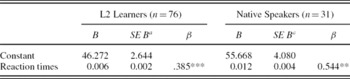
The participants were explicitly told to enter their responses as quickly as possible. It is therefore possible that their low accuracy rates were because of the time pressure under which they completed the experiment. If this is correct, their reaction times should be a good predictor of their accuracy rates on the task: the slower their responses, the more accurate they should be. To investigate this possibility, regression analyses were conducted on the accuracy rates of the L2 learners and native speakers (separately). The dependent variable was the average accuracy rates on words in the stress contrast conditions. The predictor was the average reaction times on words in the stress contrast conditions. Table 8 provides the results of the regression analyses for the L2 learners and native speakers.
Regression analysis on the percent accuracy rates with reaction times as predictor

Note: L2 learners R2 = .148 and native speakers R 2 = .296.
aStandard error of B.
**p < .01. ***p < .001.
As shown by the regression analyses, the speed with which the L2 learners and native speakers responded to the test items contributed to determining their accuracy rates on the task: the faster they responded, the worse their performance. Given this trade-off, the accuracy rates on the task may underestimate the L2 learners' and native speakers' ability to use primary stress for recognizing English words, with the participants being more likely to select the incorrect response when prompted to make a quick decision.
Discussion. The above results indicate that both French Canadian L2 learners of English and native English speakers recognized words in the stress contrast conditions significantly more slowly than words in the segmental contrast conditions. These findings are expected: because the words in the stress contrast conditions had segmentally near-identical first syllables, they initially competed for lexical access, therefore slowing down the participants' response times. In addition, both L2 learners and native speakers recognized words following stressed primes more rapidly than words following unstressed primes, even in the segmental contrast conditions. These findings are not completely surprising, given that stressed syllables have been found to facilitate the recognition of words with initial stress in English (e.g., Cutler & Butterfield, Reference Cutler and Butterfield1992; Cutler & Norris, Reference Cutler and Norris1988; McQueen et al., Reference McQueen, Norris and Cutler1994; Norris et al., Reference Norris, McQueen and Cutler1995). The fact that L2 learners displayed the same asymmetry as native speakers suggests that they are likewise sensitive to the high incidence of word-initial stress in English (e.g., Clopper, Reference Clopper2002).Footnote 6
The results also show that all the participants were better at recognizing words following stressed primes than words following unstressed primes in the stress contrast conditions. Cooper et al. (Reference Cooper, Cutler and Wales2002) reported a similar asymmetry in their word identification task, but they attributed it to frequency differences between the words with versus without initial primary stress in their experiment. Because frequency was controlled for in this experiment, it cannot explain why higher accuracy rates were obtained on words following stressed primes. The present asymmetry may instead be because the unstressed primes in the stress contrast condition contained a nonreduced vowel (as opposed to a schwa) so that it would be segmentally near identical to the stressed primes. The participants' accuracy rates were lower on words following unstressed primes than on words following stressed primes, possibly because the nonreduced vowels in the unstressed primes were misperceived as stressed given the correlation in English between full vowels and stressed syllables on the one hand, and between reduced vowels and unstressed syllables on the other hand. This may explain why fewer L2 learners and native speakers were able to use both the presence and the absence of primary stress to recognize English words. The fact that the L2 learners showed the same asymmetry as the native speakers suggests that they also have some knowledge of this phonological property of English.Footnote 7
More worrisome are the participants' less than stellar accuracy rates in the stress contrast conditions, even on words following stressed primes. The overall accuracy rates of the L2 learners in this study are much lower than those of the L2 learners in Cooper et al.'s (Reference Cooper, Cutler and Wales2002) word identification task (55 vs. 72%, respectively), and they are very similar to those of the L2 learners in Dupoux et al.'s (Reference Dupoux, Sebastián-Gallés, Navarrete and Peperkamp2008) lexical decision task (55 vs. 59%, respectively). This difference is likely due to the L2 learners' native language, with Dutch stress but not Canadian or European French stress being very similar to English stress and, thus, playing a similar role in L1 lexical processing. By contrast, the overall accuracy rates of the native English speakers in this study are substantially higher than those of the native English speakers in Cooper et al. (69 vs. 59%, respectively), but notice that they are much lower than those of the native Spanish speakers in Dupoux et al. (69 vs. 96%). This can be attributed to the experimental design used in this study: the first difference is likely due to the contextualized (as opposed to isolated) presentation of the primes in this experiment but not in Cooper et al.’s, with the article preceding the prime providing a comparison point for determining if the prime was stressed; the second difference probably arose as a result of the difficulty level of the present experiment, which is greater, even for native speakers, than that of Dupoux et al.'s lexical decision task.Footnote 8 The regression analyses further suggest that time pressure may have contributed to decreasing the participants' performance on the task (including the native speakers'), resulting in a speed–accuracy trade-off. The fact that most native speakers and almost half of the L2 learners were nevertheless able to perform above chance level on test items following stressed primes indicates that they were indeed able to use the suprasegmental properties of primary stress in word recognition, although this ability did not improve much with increasing L2 proficiency. These findings also underscore the importance of reporting individual results in L2 research rather than drawing conclusions solely on the basis of group results.
We now turn to the vocabulary production task, which was designed to specify how the L2 learners' (surface-level) knowledge of stress placement in English influences their use of primary stress in L2 word recognition. The knowledge tapped by the vocabulary production task is said to be at the surface level, because it is inferred from the L2 learners' production of real English words rather than nonsense words. Although the accurate stress patterns that L2 learners produce in real English words tell us little about the generalizations that underlie the L2 learners' stress system (because stress can have been lexicalized on a word by word basis), the errors that L2 learners make can be revealing in that respect. For the purpose of this paper, it is the L2 learners' surface-level knowledge of stress placement that is examined, because the experimental words used in the vocabulary production task are exactly the same as those used in the cross-modal word identification task, thus allowing a stronger connection between the two experiments (but see Tremblay, Reference Tremblay2007, for an examination of the L2 learners' abstract prosodic representations from nonsense words).
The L2 learners completed the vocabulary production task after the cross-modal word identification task. The native speakers did not complete this experiment, because it was assumed that their production of primary stress in real English words would be accurate.
Vocabulary production task
Materials. The L2 learners produced the words listed in the vocabulary questionnaire immediately before rating their degree of familiarity with them (for details on the vocabulary questionnaire, see the “Data Analysis” section of the cross-modal word identification task). Only the productions of the 16 experimental word pairs selected for the cross-modal word identification task (see Appendix A) were analyzed. They included the words in which primary stress should fall on the first syllable (e.g., MYStery) and those in which primary stress should fall on the second syllable (e.g., misTAKE).
Procedures. The L2 learners were told in French to read the words in the questionnaire and produce them in the sentence frame “Say _____ again.” They were recorded on an Olympus WS-300M digital voice recorder at a sampling rate of 44,100 kz with a Uni-Tex UM300 condenser microphone as they produced the words. The total duration of the experiment was approximately 3 min. The recordings were transferred digitally onto a notebook computer for the data analysis.
Data analysis. The participants' productions were analyzed for stress placement by the author. For each word, the primarily stressed syllable was identified and an accuracy rate was computed. The words that the L2 learners rated as unfamiliar in the vocabulary questionnaire (i.e., the words receiving ratings of 0 and 1) were excluded from the analyses. This resulted in the exclusion of 0.8% of the data. The dependent variable in this task is the accuracy rates of the production patterns. The within-subject independent variable is the target stress of the words (primary stress on the first syllable, primary stress on the second syllable), and the between-subject independent variable is the L2 learners' proficiency level (intermediate L2 learners, low-advanced L2 learners, high-advanced L2 learners).
Predictions. If there is a close relationship between the L2 learners' use of primary stress in L2 word recognition and their (surface-level) knowledge of stress placement in English, we should find a significant correlation between the L2 learners' accuracy rates in the cross-modal word identification task and their accuracy rates in the vocabulary production task. Because it is unlikely for L2 learners to be able to use primary stress for lexical access without first knowing where stress falls in the word, we may also expect L2 learners' accurate stress placement to be a prerequisite for their use of primary stress in word recognition (and not the reverse).
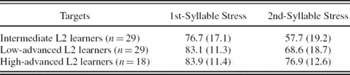
Results. Table 9 shows the L2 learners' mean percent accuracy rates on the vocabulary production task. A repeated-measures ANOVA conducted on the accuracy rates reveals a significant effect of word type, with stress placement being more accurate on target words with first-syllable stress than on target words with second-syllable stress, F 1 (1, 73) = 20.122, p < .001; F 2 (1, 45) = 12.038, p < .001. A significant effect of proficiency level was also found, with the L2 learners' accuracy rates improving as proficiency level increases, F 1 (2, 73) = 12.223, p < .001; F 2 (1, 45) = 6.542, p < .003, especially for target words with stress on the second syllable. However, no interaction was found between the two variables, F 1 (2, 73) = 1.207, p < .305; F 2 < 1. This suggests that the effect of word type was similar across all proficiency levels.
Mean percent accuracy rates (standard deviations) on the vocabulary production task

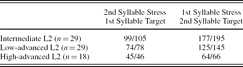
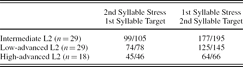
An analysis of the incorrect stress patterns was carried out to identify the generalizations that underlie the L2 learners' stress system. Table 10 presents the number of words that were incorrectly stressed on the second syllable out of all the words that should have been stressed word-initially, and the number of words that were incorrectly stressed on the first syllable out of all the words that should have been stressed on the second syllable. As shown in the results, the most typical errors that L2 learners made was to stress the second syllable of target words with initial stress and to stress the first syllable of target words with second-syllable stress. The high number of target words stressed on the first syllable instead of the second, together with the higher accuracy rates on target words with initial stress, suggests that L2 learners generally prefer stressing the first syllable of English words.
Analysis of incorrect stress patterns on the vocabulary production task
The accuracy rates presented in Table 9 and the incorrect stress patterns summarized in Table 10 include both disyllabic and longer words. It is also relevant to examine the L2 learners' accuracy rates on the disyllabic words only, because the second syllable is also the last syllable of these words. Because stress is word-final in Canadian French, we might expect the L2 learners to be more targetlike on disyllabic words requiring final stress than on disyllabic words requiring initial stress. Contrary to expectations, however, analyses of the disyllabic words (7 with initial stress, 10 with final stress) indicate that the L2 learners are more accurate on target words with initial stress than on target words with final stress: 66.9 versus 57.4% for the intermediate L2 learners; 81.2 versus 68.2% for the low-advanced L2 learners; and 84.4 versus 68.6% for the high-advanced L2 learners. These findings are in line with those presented in Tables 9 and 10, thus confirming that the L2 learners have a preference for word-initial stress.
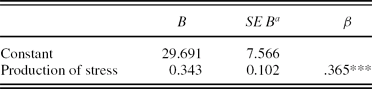
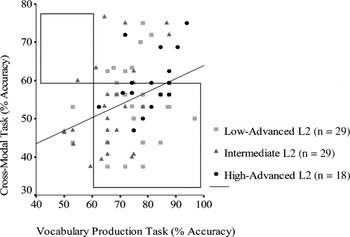
To establish if there is a close relationship between the L2 learners' use of primary stress in L2 word recognition and their (surface-level) knowledge of stress placement in English, a regression analysis was conducted. Given that the participants show little improvement across proficiency levels in their ability to recognize English words following stressed primes and in their ability to produce English words with initial stress accurately, the accuracy rates in each task were averaged across stress conditions. The dependent variable in the analysis is the L2 learners' accuracy rates in the experimental conditions of the cross-modal word identification task. The predictor is the L2 learners' accuracy rates in the vocabulary production task. The regression analysis is provided in Table 11, and the linear regression is presented visually in Figure 3.
Regression analysis on the L2 learners' use of stress in word recognition with accurate production of stress as predictor
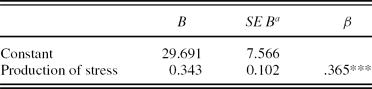
Note: R 2 = .133.
aStandard error of B.
***p < .001.
Linear regression on the L2 learners' use of stress in word recognition.

As can be seen from the results, the more accurate L2 learners are in their production of English stress, the more likely they are to use primary stress for recognizing English words. The area in the top left corner of Figure 11 shows that only one participant performed above chance level (>60%) on the cross-modal task but not on the vocabulary production task. Conversely, the area in the bottom right corner shows that a substantial proportion of L2 learners performed above chance level (>60%) on the vocabulary production task but not on the cross-modal task. The virtual absence of participants in the first area suggests that it is necessary for the L2 learners to know which syllable in English words receives primary stress to use that information for L2 lexical access. The high number of participants in the second area, however, indicates that knowledge of L2 stress placement is not sufficient for primary stress to be used in L2 word recognition.
The L2 learners' lower accuracy rates on target words with second-syllable stress in the vocabulary production task coincides with their lower accuracy rates on words following unstressed primes in the stress contrast condition of the cross-modal task. One could argue on the basis of these results that the L2 learners were not able to use unstressed primes to recognize English words because their knowledge of stress placement for these words, inferred from the vocabulary production task, was incorrect, as opposed to attributing the L2 learners' lower accuracy rates on words following unstressed primes to their knowledge that nonreduced vowels in English tend to be stressed. This hypothesis makes two predictions. First, if L2 learners incorrectly assumed that words such as misTAKE are stressed on the first syllable, which is the typical error they made, then upon hearing the stressed prime MYS-, they should select “mistake” just as often as they select “mystery.” That is, the L2 learners who performed at/below chance level on target words with second-syllable stress in the vocabulary production task should also perform at/below chance level on words following stressed primes in the stress contrast condition of the cross-modal task. Second, if L2 learners produced words such as MYStery and misTAKE equally well, then their performance on words following the stressed MYS- should be as good as their performance on words following the unstressed mis-. In other words, those who show no asymmetry between their accuracy rates on target words with first- versus second-syllable stress in the vocabulary production task should also show no asymmetry between their accuracy rates on words following stressed versus unstressed primes in the stress contrast conditions of the cross-modal task.
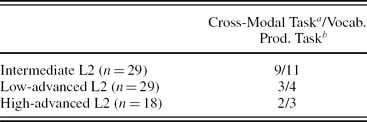
In an attempt to determine if the first prediction is correct, the number of L2 learners who performed at/below chance level (≤60%) on words following stressed primes in the stress contrast condition of the cross-modal task was calculated out of all the L2 learners who performed at/below chance level (≤60%) on target words with second-syllable stress in the vocabulary production task, with the numerator being a subset of the denominator. The proportions are shown in Table 12. It is clear from the results that almost all of those who incorrectly stressed the first syllable of target words with second-syllable stress also performed poorly on words following stressed primes in the cross-modal task. This confirms that knowledge of L2 stress placement is necessary for stress to be used in L2 word recognition.
At or below chance-level performances on the cross-modal and vocabulary production tasks
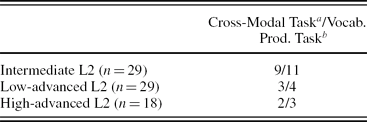
aNumber of participants who perform at or below chance (≤60%) on words following stressed primes in the stress contrast condition of the cross-modal task.
bNumber of participants who perform at or below chance (≤60%) on words with second-syllable stress in the vocabulary production task.
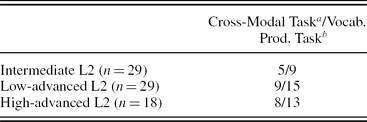
To test the second prediction, the number of L2 learners who did as well on words following stressed versus unstressed primes in the cross-modal task was calculated out of all the L2 learners who did as well on target words with first- versus second-syllable stress in the vocabulary production task, with the numerator being again a subset of the denominator. For the purpose of this analysis, participants were considered to show no asymmetry between the two stress conditions of each task if their accuracy rates were no more than 15% apart. The proportions are provided in Table 13.
Similar performances on the stress conditions of the cross-modal and vocabulary production task
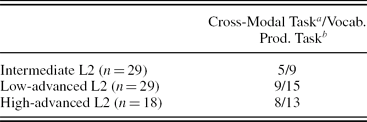
aNumber of participants who show no asymmetry (≤15%) between words following stressed versus unstressed primes in the stress contrast conditions of the cross-modal task.
bNumber of participants who show no asymmetry (≤15%) between words with first- versus second-syllable stress in the vocabulary production task.
The results indicate that over half of the participants who did not show any asymmetry between words with first- versus second-syllable stress in the vocabulary production task also did not show any asymmetry between words following stressed versus unstressed primes in the stress contrast condition of the cross-modal task. Yet, the remaining participants continued to show an asymmetry between words following stressed versus unstressed primes in the cross-modal task despite producing stress equally well on target words with first- versus second-syllable stress in the vocabulary production task. It therefore appears that the L2 learners' knowledge of L2 stress placement for target words with first- versus second-syllable stress is not sufficient to explain their differential performance on words following stressed versus unstressed primes in the cross-modal task. Similar results would have most certainly been obtained for the native speakers if they had completed the vocabulary production task, as their stress patterns would have been close to perfect for both words types.
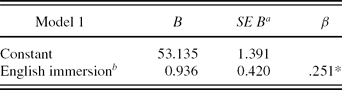
Finally, if (surface-level) knowledge of stress placement in English is not sufficient for L2 learners to be able to use primary stress for L2 lexical access, then one might wonder what is needed for that ability to develop. The Canadian French speakers in this study differed considerably in the amount of time they spent immersed in an English environment and in their percentage of daily use of English (see Table 2). A stepwise multiple-regression analysis was therefore conducted to determine if either of these variables was a good predictor of the L2 learners' ability to use primary stress in L2 word recognition. The dependent variable was the L2 learners' average accuracy rates in the stress contrast conditions of the cross-modal word identification task. The predictor was the number of years they reported having spent in an English environment and the percentage of English they reported using on a daily basis. The results in Table 14 indicate that only the number of years that L2 learners spent in English immersion is a good predictor of their ability to use primary stress in L2 word recognition. Being in an input-rich environment for a sustained period of time thus appears to be necessary for word stress to constrain L2 lexical access.
Stepwise multiple-regression analysis on the L2 learners' percent accuracy rates in the stress contrast conditions of the cross-modal task
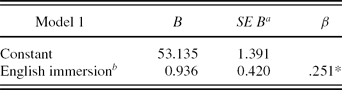
Note: R 2 = .063.
aStandard error of B.
bNumber of years immersed in an English environment.
*p < .05.
Discussion. The results of the vocabulary production task indicate that French Canadian L2 learners of English produced more accurate stress patterns with target words requiring initial stress than with target words requiring second-syllable stress. When they made errors on the latter, they typically stressed the first syllable instead. It is interesting to note that the group results showed little evidence of L1 transfer, as we would perhaps have expected the L2 learners to stress the last syllable of English words instead of the first one. These findings can be interpreted in two ways: (a) L2 learners stress the first syllable of English words, because stress falls on the first syllable of the overwhelming majority of English words (e.g., Clopper, Reference Clopper2002), providing further evidence that L2 learners can extract this regularity from the English input; and/or (b) L2 learners stress the first syllable of English words, because, like Canadian French, the resulting system of stress placement is one in which primary stress falls at one edge of the word (i.e., the left edge instead of the right edge). It is likely that both (a) and (b) are responsible for the L2 learners' incorrect generalizations. As proficiency improves, however, the L2 learners' production of target words with second-syllable stress becomes increasingly accurate; in fact, it is eventually almost as accurate as target words with first-syllable stress. This suggests that native French speakers can learn the target stress patterns of English words.
The results also indicate that there is a close relationship between the L2 learners' (surface-level) knowledge of L2 stress placement and their use of primary stress in L2 word recognition. It was shown that French Canadian L2 learners need to know which syllable in English words is stressed to use that information for recognizing English words. This indicates that knowledge of L2 word stress should be in place before stress can constrain L2 lexical access. Yet, such knowledge is not sufficient for primary stress to be used in L2 word recognition, as several of the participants who produced accurate stress patterns in English could not use primary stress for recognizing English words. These findings provide further support for the claim that many (though not all) native French speakers have difficulty using an abstract phonological representation of L2 word stress during L2 lexical processing. A regression analysis suggested that native speakers of Canadian French are more likely to be able to use such a representation as their degree of aural exposure to English increases. Being immersed in an environment that provides qualitatively and quantitatively rich input may therefore be beneficial for L2 learners, as it will provide them with more opportunities to develop procedures for parsing the target language rapidly and efficiently.
Finally, the results of the vocabulary production task showed that the L2 learners' (surface-level) knowledge of stress placement in English could not, on its own, explain the asymmetry found in the cross-modal word identification task between words following stressed versus unstressed primes. It is therefore argued that the L2 (and native) participants' poorer performance on words following unstressed primes in the contrast condition of the cross-modal task is because of their misperception of unstressed syllables as stressed, which is hypothesized to stem from the correlation in English between stressed syllables and nonreduced vowels.
GENERAL DISCUSSION AND CONCLUSION
The first objective of this study was to determine if native speakers of Canadian French at different English proficiencies could use the suprasegmental properties of primary stress for recognizing English words. The above results indicated that several French Canadian L2 learners of English were able to use the presence of primary stress to distinguish between competing L2 word candidates, and some could also use the absence of primary stress to do so. This suggests that English stress constrains L2 lexical access for these learners. At this point, it is not clear how much these findings differ from those of Dupoux et al. (Reference Dupoux, Sebastián-Gallés, Navarrete and Peperkamp2008), because the authors did not provide the L2 learners' individual results. In view of the rather high standard errors they report, it is likely that Spanish word stress also constrains L2 lexical access for at least some of the L2 learners in their study. It could also be the case that speakers of Canadian French have less difficulty than speakers of European French using L2 word stress for L2 lexical access, given the greater contrast in Canadian French between strong and weak syllables. All in all, we may conclude that it is possible, although perhaps not typical, for French-speaking L2 learners to learn to use L2 information that does not play a significant role in the activation of L1 words to process L2 words rapidly and efficiently. These findings are important, because they provide evidence against the generalization that all French-speaking L2 learners are “stress deaf,” hence underscoring the need for L2 researchers to provide an account of the L2 learners' individual performances.
The present study also focused on the development of L2 lexical processing, namely, whether the ability of French Canadian L2 learners of English to use the suprasegmental properties of primary stress in L2 word recognition changes with increasing L2 proficiency. The results showed little evidence of development in the L2 learners' ability to process English stress. It thus appears that L2 learners can gain global proficiency without necessarily being able to use primary stress for L2 lexical access. Importantly, word stress can constrain L2 word recognition only once the L2 learners have received sufficient aural exposure to the target language, whether or not they are very proficient in that language. A large number of L2 learners in this study had learned English in a classroom environment (see Table 2).Footnote 9 It is therefore not surprising that a discrepancy was found between the number of years that these L2 learners' had spent in an English environment and their global English proficiency, which can develop in the classroom even with a limited amount of aural exposure to English. How much aural exposure to the target language is needed for L2 word stress to constrain L2 lexical access is a question that is open for investigation.
Finally, this research aimed to specify how the L2 learners' (surface-level) knowledge of stress placement in English influenced their use of primary stress to recognize English words. An implicational relationship was found between knowledge and processing, with targetlike knowledge of L2 stress placement being a prerequisite to but not guaranteeing the use of primary stress in L2 word recognition. The fact that several advanced L2 learners produced accurate stress patterns for target words with first- and second-syllable stress without necessarily being able to use primary stress to recognize English words suggests that the problem that many French-speaking L2 learners experience is at the level of L2 lexical processing. The findings of this study also suggest that not only knowledge stress placement, but also knowledge of the tendency for nonreduced vowels to be stressed in English, influenced the L2 (and native) participants' use of stress in English word recognition, resulting in their misperception of nonreduced vowels as stressed. This, however, is an issue that requires further research, as the present experimental design was not set up to investigate the role of reduced versus nonreduced vowels in word recognition.
APPENDIX A
Experimental and control words

Note: The spoken frequency is from CELEX (Baayen et al., Reference Baayen, Piepenbrock and van Rijn1993).
aLog values.
bThe word mocha is commonly used among coffee drinkers in North America. It was selected because there are very few words that could match motel in word length and frequency.
ACKNOWLEDGMENTS
Funding for this research was provided in part by the Social Sciences and Humanities Research Council of Canada (Doctoral Fellowship 752-2006-0178), the Fonds de la Recherche sur la Société et Culture du Québec (Doctoral Fellowship 89243), the Department of Second Language Studies at the University of Hawaii (Elizabeth Holmes-Carr scholarships and Ruth Crymes scholarship), and the Graduate Student Organization at the University of Hawaii (research grant). Many thanks to the following: Robert Bley-Vroman, Kamil Deen, Patricia Donegan, Heather Goad, William O'Grady, Amy Schafer, and Bonnie D. Schwartz, two anonymous reviewers from Applied Psycholinguistics, and the audiences of the 20th Annual CUNY Conference on Human Sentence Processing and of the 8th Annual Tokyo Conference on Psycholinguistics for their valuable comments on this work; James Dean Brown, Martyn Clark, John Norris, and Jeffrey Steele for their advice on proficiency testing; the Department of Linguistics at McGill University for welcoming me as a visiting student and making their research facilities available; Gerald Bullock, David Faulhaber, Jason Price, and Stéphane Trouillet for their help with various aspects of the experimental setup and data analysis; Erik Hill, Mark Messer, Dustin Price, Jason Price, and Dana Wong for rating the L2 learners' accents; Shirley Black, Lynne Champoux-Williams, Marise Duquette, Peter Enns, Mary Gauthier, Ginette Gendron, Pascal Labbé-Thibault, Aimée Lévesque, Donna Lisney, Jennifer Mah, Kristina Maiorino, Richard Martel, Robert Myles, Irene Nasim, Heather Newell, Carolyn Samuel, Marion Steff, Georges St-Laurent, Silvia Ursini, and Joannie Vienneau for their help with the recruitment of participants; and the participants from McGill University, Université du Québec à Montréal, Université de Montréal, Centre linguistique du Collège de Jonquière à Ottawa, and the downtown Montreal YMCA, without whom the present data would not exist.