INTRODUCTION
The caridean shrimps inhabiting tropical waters exhibit characteristic patterns in their life history traits, shown by their growth and reproduction. Aspects of fecundity, size at first maturity, reproductive output and spawning frequency are of great importance in establishing the reproductive potential of a species and constitute essential input parameters in determining yield or fecundity per recruit (Caddy, Reference Caddy1977; Somerton, Reference Somerton1980; Campbell, Reference Campbell1985). These parameters also provide insights into the reproductive strategy of an individual species (Adiyodi & Adiyodi, Reference Adiyodi and Adiyodi1970). Reproductive investments vary considerably in marine invertebrates, as does reproductive output, due to environmental factors like temperature, food availability, competition etc. (Clarke et al., Reference Clarke, Hopkins and Nilssen1991). Reproductive output of a species reflects the biomass investment in its eggs. In contrast, investment per offspring indicates energy allocations targeted for enabling newly hatched larvae. Energy allocated in terms of egg production is characteristic of many caridean species (Corey & Reid, Reference Corey and Reid1991; Lardies & Wehrtmann, Reference Lardies and Wehrtmann1997; Wehrtmann & Lardies, Reference Wehrtmann and Lardies1999). Higher energy investment in embryos through increased nutrient content and large egg size has been identified in species inhabiting higher latitudes (Clarke, Reference Clarke1993a, Reference Clarkeb; Wehrtmann & Kattner, Reference Wehrtmann and Kattner1998). Clarke (Reference Clarke1987) has reported variations in reproductive investment of polar and temperate species of caridean families such as Pandalidae, Hippolytidae and Crangonidae. In general, species inhabiting higher latitudes are known to exert reproductive investment. Many caridean species inhabiting higher latitudes and depths are adapted with large size of egg and hatched larva, increased larval development, low fecundity and mortality (Clarke, Reference Clarke1993b; Wehrtmann & Kattner, Reference Wehrtmann and Kattner1998; Thatje & Bacardit, Reference Thatje and Bacardit2000; Anger et al., Reference Anger, Moreira and Ismael2002). In tropical waters, increase in egg size and seasonality and low brood size were reported in pandalid shrimps inhabiting greater depth ranges (King & Butler, Reference King and Butler1985; Company & Sarda, Reference Company and Sarda1997).
Information on reproductive strategies, egg production and reproductive effort are important aspects of life history characteristics of decapod crustaceans which throw light on their adaptations to specific habitats. Deep-sea habitats provide adverse ecological conditions such as lack of seasonality of temperature, photoperiod, food availability which lead to low reproductive success (Bauer, Reference Bauer2004). Studies on marine decapods inhabiting the deep sea indicated higher female body sizes, large egg sizes and longer reproductive lifespan to overcome adversities of depth (King & Butler, Reference King and Butler1985). In such habitats, many of these species are known to adopt abbreviated larval development (Gurney, Reference Gurney1942). Further, reduced numbers of embryos and larval stages developing from large sized eggs is a characteristic of many mesopelagic species (Omori, Reference Omori1974; Wenner, Reference Wenner1978).
Deep-sea armoured shrimps (Glyphocrangonidae Smith, Reference Smith1884) inhabit depth ranges of 200–6500 m (Holthuis, Reference Holthuis1971; Gore, Reference Gore1985; Komai, Reference Komai2011). Many species of Glyphocrangon (Milne-Edwards, Reference Milne-Edwards1881) inhabiting mesopelagic realms are known to produce large eggs (Dobkin, Reference Dobkin1965; Wenner, Reference Wenner1978). Glyphocrangon investigatoris (Wood-Mason & Alcock, Reference Wood-Mason and Alcock1891) has been reported from depths ranging between 200–803 m (Alcock & Anderson, Reference Alcock and Anderson1894; McArdle, Reference McArdle1901; Komai, Reference Komai, Marshall and Richer de Forges2004; Pillai & Thirumilu, Reference Pillai and Thirumilu2013). Information on reproductive traits of this species has not been reported so far and data on other species of the same genus are scanty (Mendez, Reference Mendez1981; Corey & Reid, Reference Corey and Reid1991; Quiroga & Soto, Reference Quiroga and Soto1997). Glyphocrangon investigatoris described here, was obtained from deep-sea trawl catches from the Bay of Bengal along with deep-sea pandalid shrimp Heterocarpus woodmasoni (Alcock, Reference Alcock1901) and the nephropid lobster Nephropsis stewarti (Wood-Mason, 1872). Jose et al. (Reference Jose, Rozario, Benjamin and Harikrishnan2015) reported morphological description and molecular barcoding of G. investigatoris collected from Bay of Bengal. This paper gives the first detailed description of embryo number, embryo size, brood chamber volume, size at first maturity and reproductive output of G. investigatoris inhabiting Bay of Bengal, Indian Ocean.
MATERIALS AND METHODS
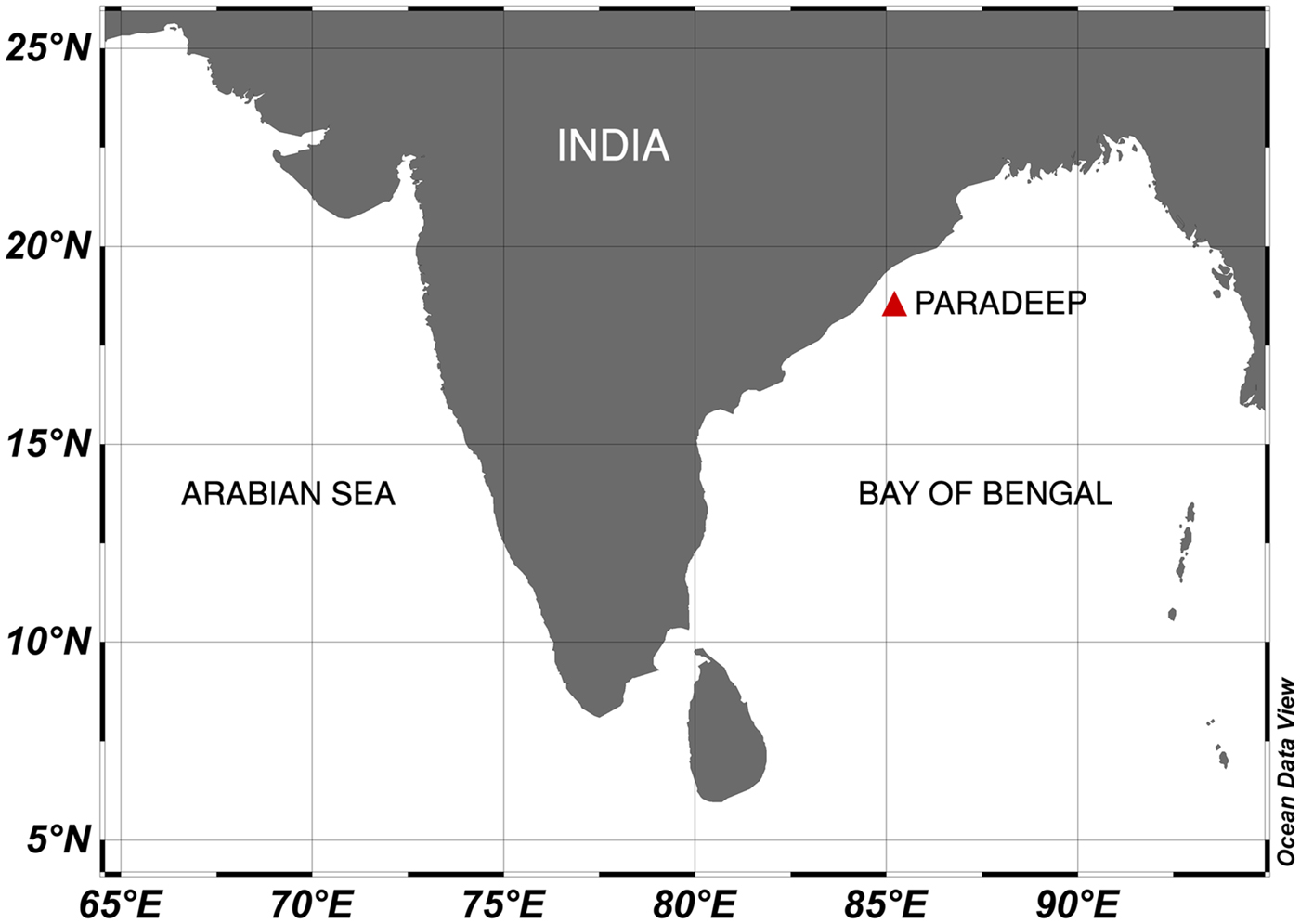
Specimens were collected from trawl collections of cruise no. 291 onboard FORV ‘Sagar Sampada’ off Paradeep, Orissa from 18°48′.708N, 85°21′.605E to 18°54′.189N, 85°26′.898E (Figure 1), during 29 October 2011. All individuals were captured at depths between 633–655 m with EXPO trawl (Crustacean Version). The specimens were identified following Komai (Reference Komai, Marshall and Richer de Forges2004). Samples were fixed in 4% neutralized formalin for a day and then transferred to 70% alcohol for storage. Total length (TL) was measured from tip of the rostrum to the tip of the telson along the mid dorsal line to the nearest 0.01 mm using Mitutoyo CD-8′ PSX Digimatic calliper. Carapace length (CL) was measured from the shortest distance between the posterior margin of the orbit and the mid-dorsal posterior edge of the carapace. Specimens were weighed (on wet weight basis) on an electronic balance with a sensitivity of 0.01 g. The deviation of regression coefficients from isometry was examined using Student's t-test (Zar, Reference Zar1999). The size at first maturity (CLm) was estimated by fitting a logistic curve for the proportion of sexually mature females (P) by carapace length (CL) following Campbell (Reference Campbell1985), P = 1/{1 + exp[−(a+bCL)]}, where a and b are parameters and using CLm = −(a/b).
Map siting sampling locations of Glyphocrangon investigatoris (Wood-Mason & Alcock, Reference Wood-Mason and Alcock1891).

Prior to being preserved and stored, the characteristic colour patterns of embryos were noted. The females bearing embryos in brood chambers were individually packed in polythene bags and transported to the laboratory to avoid embryo loss. Brood chamber volume was calculated using equation BCV = 1/6LWD; where L, W and D were maximum length, width and depth of brood chamber (Nazari et al., Reference Nazari, Simoes-Costa, Muller, Ammar and Dias2003). The embryo mass was carefully separated from the brood chamber and weighed to the nearest 0.001 g using Sartorius CPA225D analytical balance. The embryos were counted and measured for long axis (l) and short axis (h) using Motic SMZ-168 stereo microscope. The embryo volume was calculated using the formula EV = (π* l* h2/6) (Odinetz-Collart & Rabelo, Reference Odinetz-Collart and Rabelo1996). The mean embryo volume (EV) was multiplied by embryo number (EN) to determine the embryo batch volume for each female (Nazari et al., Reference Nazari, Simoes-Costa, Muller, Ammar and Dias2003). From the total mass of preserved embryos in each shrimp, three subsamples were taken. Embryos in each subsample were counted after taking wet weight. These were dried for ~12 h and were weighed again. From the remaining embryo mass, only wet and dry mass were calculated. The same process was applied for the females in order to calculate the reproductive output by applying the formula RO = wet mass of the total embryo batch of the female/wet mass of the female without the embryo (Clarke et al., Reference Clarke, Hopkins and Nilssen1991). The RO was estimated only for females with newly extruded embryos (stage I). Per cent embryo water content was calculated for all three embryonic developmental stages by the following formula: (embryo wet weight – embryo dry weight × 100)/embryo wet weight (Lardies & Wehrtmann, Reference Lardies and Wehrtmann2001; Lara & Wehrtmann, Reference Lara and Wehrtmann2009; Wehrtmann et al., Reference Wehrtmann, Miranda, Hernaez and Mantelatto2012). A small sample of embryo was inspected under a compound microscope in order to identify the stage of embryonic development and to measure embryo size (longest and shortest diameter, to the nearest 5 µm; N = 10 embryos per female). Embryo maturation was classified in three stages following Company & Sarda (Reference Company and Sarda1997) and Chilari et al. (Reference Chilari, Legaki and Petrakis2005) as ‘stage I’ embryos with intense colour and no eye pigments, ‘stage II’ embryos with pale colour and slight eye pigmentation and ‘stage III’ embryos with visible eye pigmentation and developed embryos. Mean embryo volume and mean embryo mass volume in different embryo development stages were compared by ANOVA with Tukey analysis as post hoc method (Zar, Reference Zar1999).
RESULTS
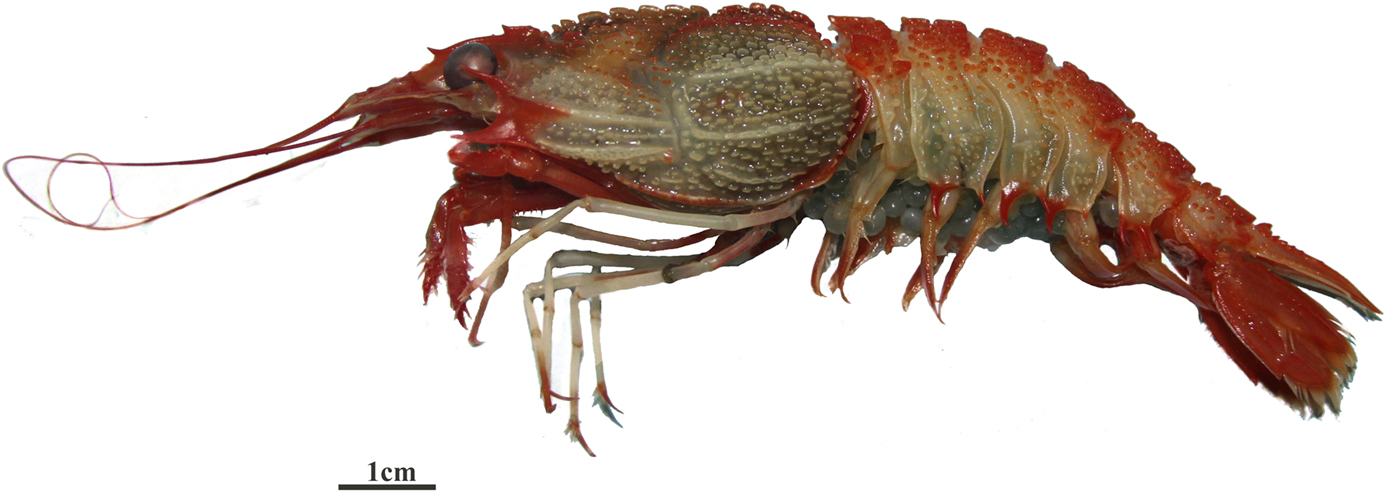
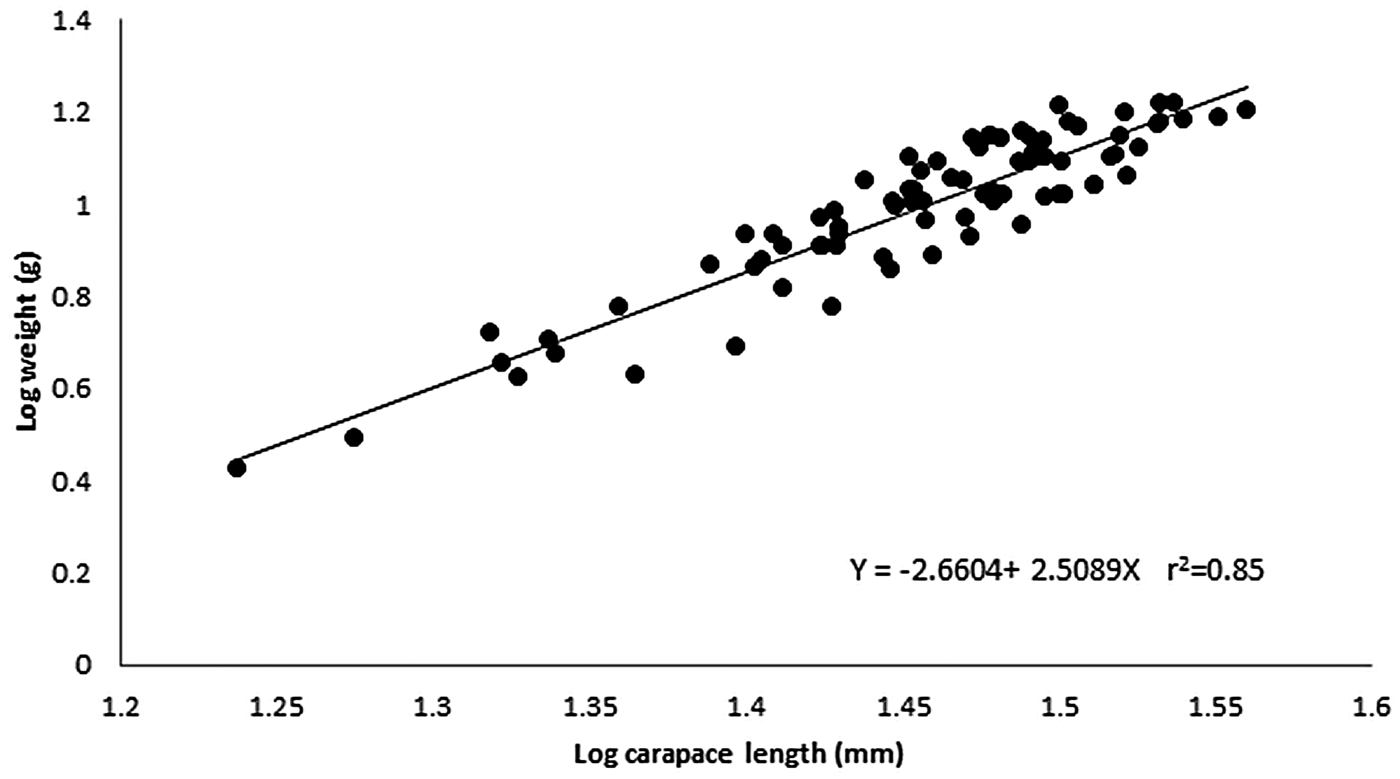
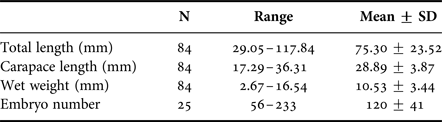
Glyphocrangon investigatoris (Figure 2); 84 female specimens were collected from 633 m depth, weighing 7.73% of total trawl catch. Individuals ranged from 29.00–117.80 mm in total length while their carapace length varied between 17.29–36.31 mm with 28.90 ± 3.87 mm as mean carapace length (Table 1). The body weights ranged from 2.28 to 16.54 g with a mean of 10.53 ± 3.43 g. Regression of weight of females on carapace length (Figure 3) showed a positive linear correlation (r 2 = 0.85) and revealed negatively allometric growth (standard error of b = 0.12; t = 4.08; P < 0.01).
Glyphocrangon investigatoris (Wood-Mason & Alcock, Reference Wood-Mason and Alcock1891) lateral view.

Glyphocrangon investigatoris (Wood-Mason & Alcock, Reference Wood-Mason and Alcock1891), Regression of log weight of females on log carapace length.

Range, mean ± SD of morphometric measurements and embryo number of Glyphocrangon investigatoris (Wood-Mason & Alcock, Reference Wood-Mason and Alcock1891) collected from Bay of Bengal.

Reproduction
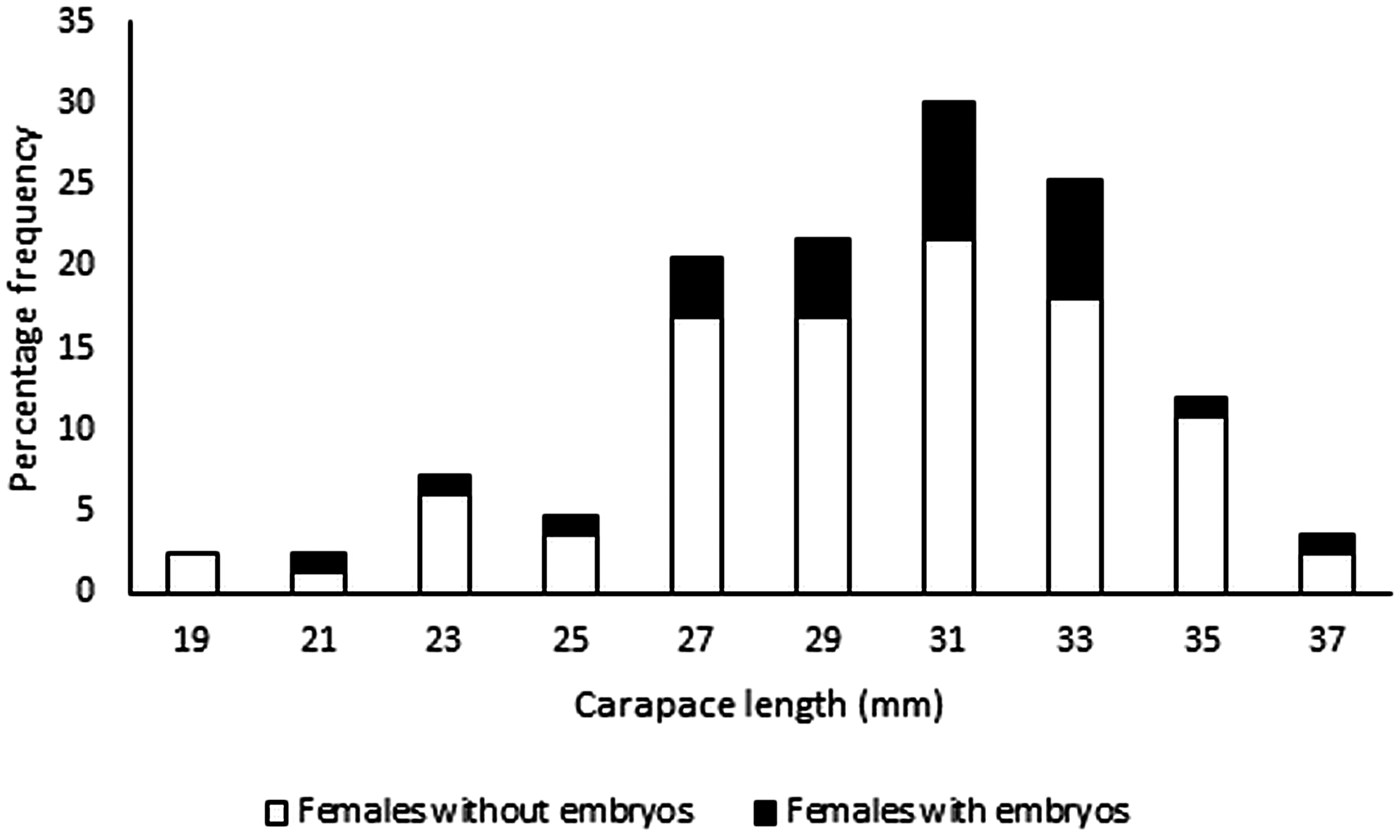
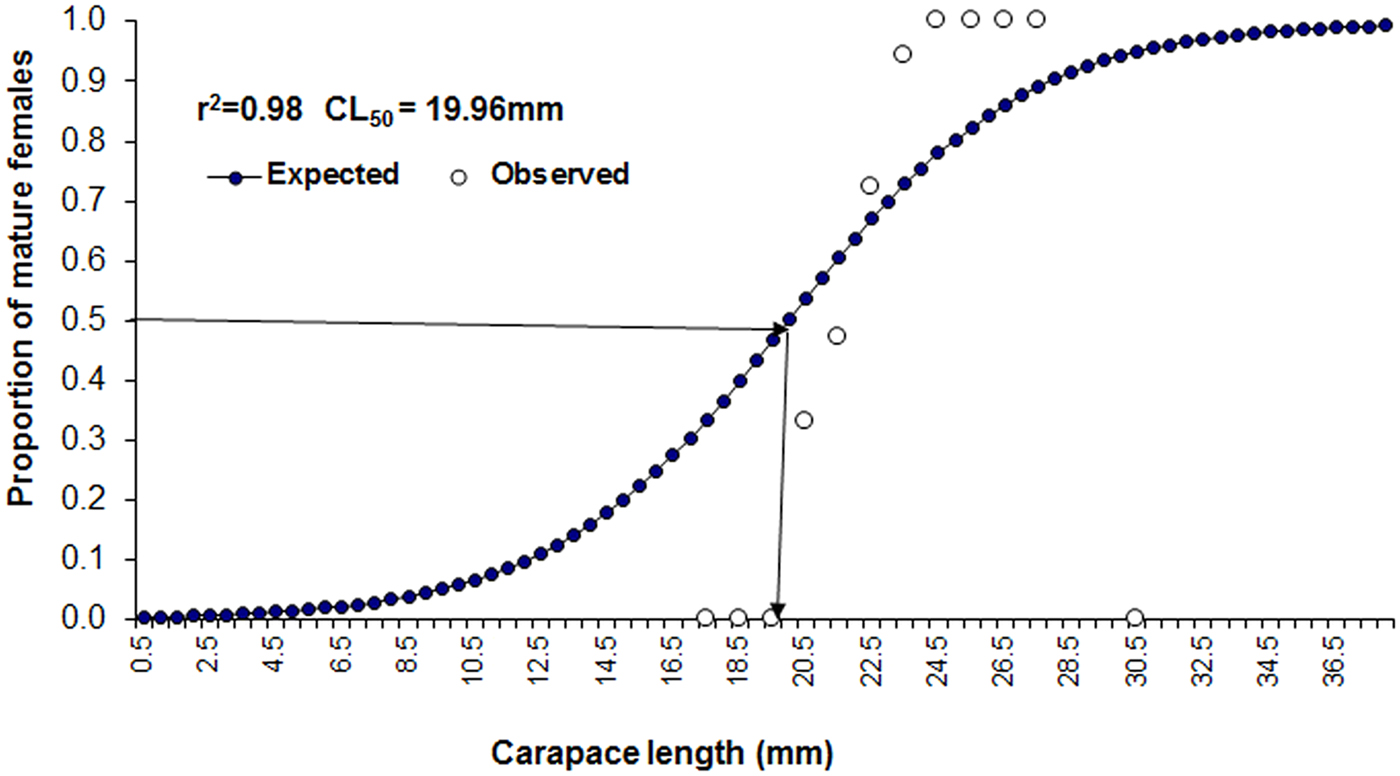
Embryo-bearing individuals constituted 30% of total females collected. The smallest and the largest embryo-bearing females were 20.80 and 35.57 mm in carapace length. Higher proportions of such females was noticed in sizes ranging from 28.0 to 34.0 mm (Figure 4). Their proportion to total females belonging to 1 mm carapace length groups was calculated by fitting a logistic function to size specific maturity data as P = 1/(1 + exp(5.56–0.28CL)). The size at 50% of females attaining maturity was estimated as 19.96 mm (Figure 5).
Glyphocrangon investigatoris (Wood-Mason & Alcock, Reference Wood-Mason and Alcock1891), percentage frequency of females with and without embryos in various size classes.

Glyphocrangon investigatoris (Wood-Mason & Alcock, Reference Wood-Mason and Alcock1891), logistic function fitting proportion of matured females to carapace length.

Embryo number, embryo size and reproductive output
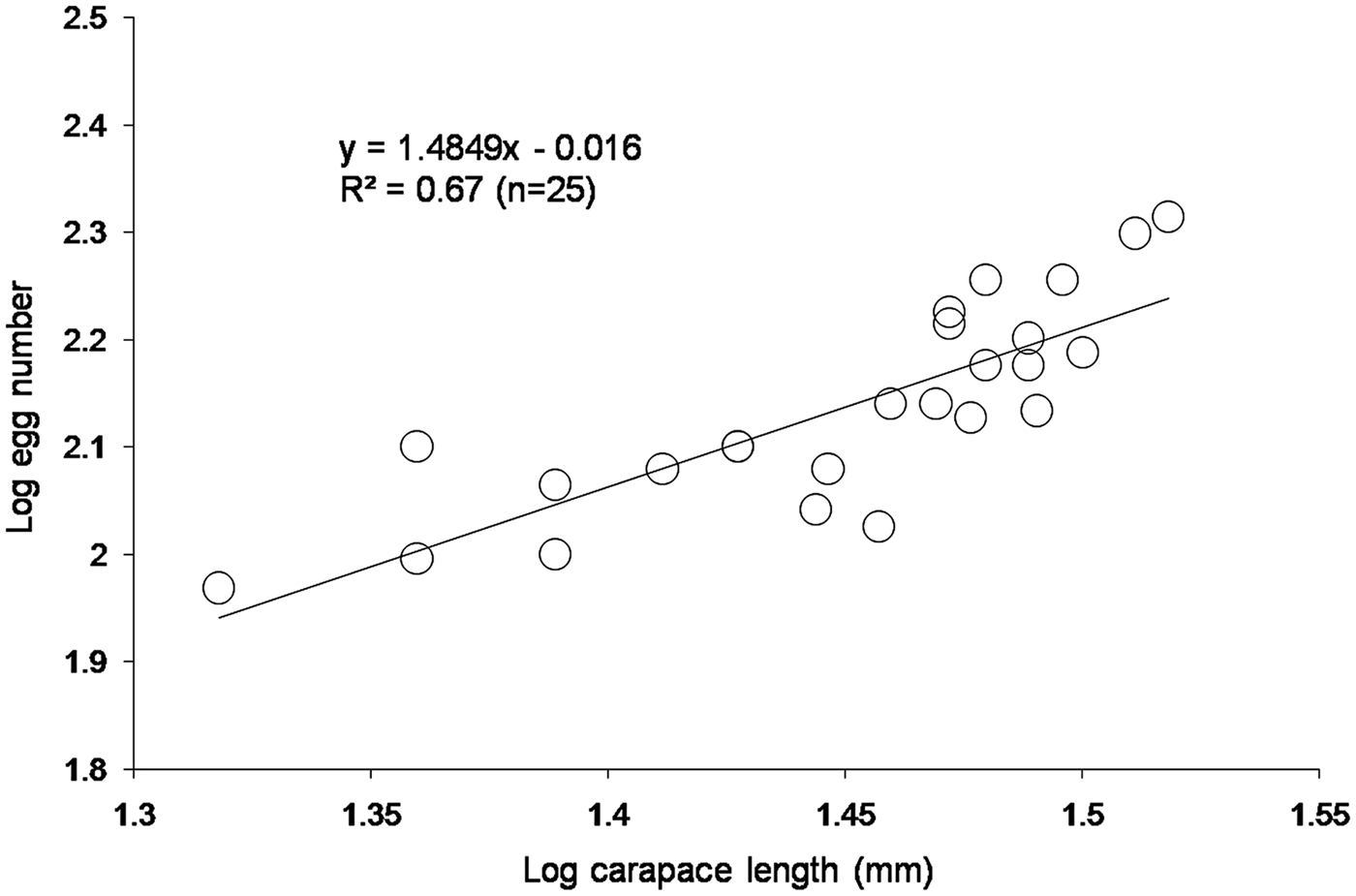
The number of embryos in brood chambers varied from 56 in females having 20.8 mm CL to 233 in females having 35.57 mm CL (mean 120 ± 41). The embryo number revealed a positive linear relationship with carapace length (Figure 6). The majority of embryos were in stage I of embryonic development with yolk occupying more than two thirds of volume and having no eye pigments or no differentiation of embryo. However, within a brood, the embryos showed asynchronous development and not all the eggs in one batch were at the same stage. Out of 822 embryos examined, 51% were at stage I while stage II and stage III constituted 26 and 23% respectively. The carapace lengths of females bearing three different embryo maturation stages did not reveal any significant difference (Kruskal–Wallis, P = 0.808). However, significantly different embryo volume could be noted between embryo maturation stages (Kruskal–Wallis, H = 60.88, P < 0.0001). The mean embryo volumes in stage I, II and III were 0.3141 ± 0.10, 0.7046 ± 0.13 and 1.1359 ± 0.16 mm3 respectively. Results of ANOVA conducted on embryo volume (F = 226, P < 0.0001) and embryo mass volume (F = 46, P < 0.0001) estimated at three different maturation stages revealed statistically significant differences (Table 2).
Glyphocrangon investigatoris (Wood-Mason & Alcock, Reference Wood-Mason and Alcock1891), regression of log egg number on log carapace length.

Mean egg size, egg volume and egg mass volume estimated in Glyphocrangon investigatoris (Wood-Mason & Alcock, Reference Wood-Mason and Alcock1891) inhabiting Bay of Bengal.

Superscripts represent significant variation at P < 0.0001.
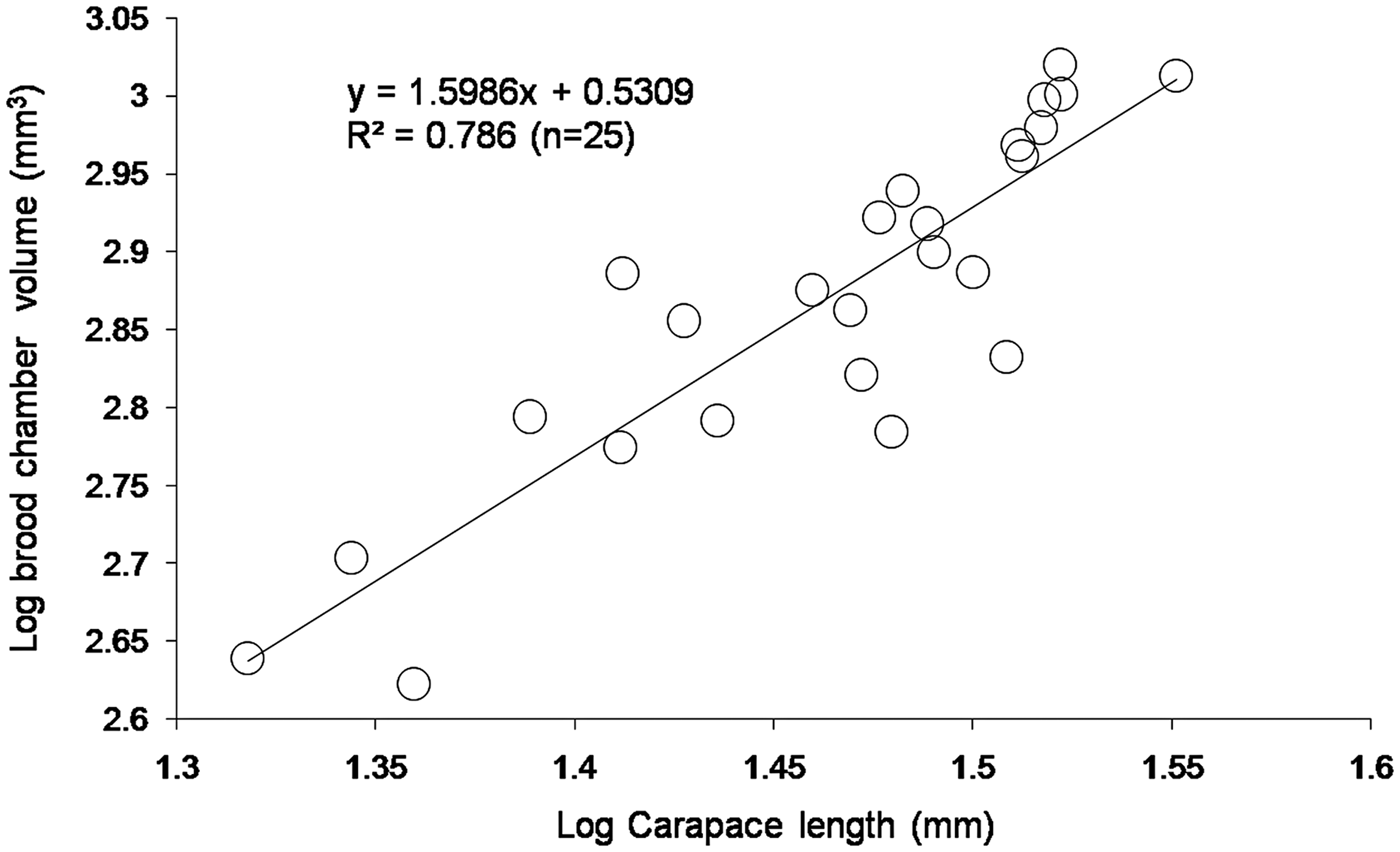
Brood chamber volume was calculated in 30 females which ranged from 420 to 1259 mm3 in individuals having carapace lengths 22.9 and 31.32 mm respectively. The brood chamber volume revealed a linear relationship with increase in carapace length (Figure 7). However, the regression coefficient deviated significantly from 3 (t = 6.02, P < 0.01), indicating an allometric relationship with increase in carapace length. The mean brood chamber volume was 763.12 ± 179.79 mm3 (Table 1). The water content of embryos ranged from 57.6 to 76.8% with a mean of 63.8 ± 5.3%. Further, the dry embryo mass formed 9.78–26% of dry female body weight. The mean reproductive output estimated from ovigerous females was 0.17 ± 0.05. Regression of reproductive output with carapace length did not reveal any significant relationship (r 2 = 0.02, P = 0.57, N = 15) indicating that female body size does not influence energy expenditure on embryo production.
Glyphocrangon investigatoris (Wood-Mason & Alcock, Reference Wood-Mason and Alcock1891), regression of log brood chamber volume on log carapace length.

DISCUSSION
In the present study, 84 female samples were collected from 600 m depth while no males were encountered. Pillai & Thirumilu (Reference Pillai and Thirumilu2013) reported collection of a non-ovigerous female of 24 mm carapace length and a smaller male of 14.8 mm CL from commercial trawl catches from 200–400 m in Bay of Bengal. This shrimp is not generally represented in trawl catches in India, as most fishing boats confine their operation within 200 m depth. Opportunities for collecting a large number of samples and observing larval forms were major limitations in the present study. The size at first maturity was worked out with only a limited number of matured females, however, a best fit was depicted in the proportions of matured females to size classes as is evident from its high correlation coefficient (r 2 = 0.98). Considering the largest size encountered and estimated size at first maturity in the present study, it appears that the shrimp starts egg production only at attaining 52% of its maximum size. This may be attributed to slow gonad maturation and slow reproduction owing to the lower temperature profile prevailing in higher depths, as reported in deep-sea decapods inhabiting latitudinal gradient geographic conditions (Hines, Reference Hines1989; Clarke et al., Reference Clarke, Hopkins and Nilssen1991; Rivadeneira et al., Reference Rivadeneira, Hernáez, Baeza, Boltaña, Cifuentes, Correa, Cuevas, del Valle, Hinojosa, Ulrich, Valdivia, Vásquez, Zander and Thiel2010). Kim & Hong (Reference Kim and Hong2004) reported that a rise in temperature accelerated gonad maturation and resulted in early size at first maturity.
The number of embryos per brood encountered in the present study was low, ranging from 56 to 233. Glyphocrangon alata, inhabiting 470–700 m depth has been reported to produce embryos numbering between 17 to 179 (Mendez, Reference Mendez1981; Quiroga & Soto, Reference Quiroga and Soto1997). Low embryo number has also been reported in other deep-sea carideans (Gorny et al., Reference Gorny, Armtzl, Clarke and Gore1992), sergestid shrimps (Amin et al., Reference Amin, Arshad, Bujang and Siraj2009) and hydrothermal vent shrimp Mirocaris fortunate (Llodra et al., Reference Llodra, Tyler and Copley2000). It is known that many deep-water decapods with fewer number of embryos have large eggs and abbreviated larval development (Gurney, Reference Gurney1942; Wear, Reference Wear1974; Wenner, Reference Wenner1978) in contrast to Heterocarpus ensifer (Briones-Fourzán et al., Reference Briones-Fourzán, Barradas-Ortíz, Negrete-Soto and Lozano-Álvarez2010) and Nematocarcinids (Wenner, Reference Wenner1979). Nakamura et al. (Reference Nakamura, Chen and Mitarai2015) assumed the possibility of lecithotrophic development and long-distance larval dispersal from large sized eggs in Munidopsis spp. inhabiting hydrothermal vents. Deep-sea environments are characterized by reduced food availability which presumably decreases vitellogenic activities, causing considerable reduction in egg production rate (Eckelbarger & Walting, Reference Eckelbarger and Walting1995; Llodra et al., Reference Llodra, Tyler and Copley2000). According to Clarke (Reference Clarke1982, Reference Clarke1987) organisms inhabiting higher latitudes usually have increased development duration and advanced larval stages at hatching. This is further supported by the larger embryo size observed in the present study. Dobkin (Reference Dobkin1965, Reference Dobkin1969) have reported large embryo size of 2–4 mm in Glyphocrangonidae. The higher proportion of yolk filled early embryo maturation stage in most broods and asynchronous embryonic development as observed in the present study may point to abbreviated embryonic development with fewer non-feeding larval stages (Bauer, Reference Bauer2004) or hatching into more advanced larval stages with stalked eyes and pleopods as reported in Glyphocrangon spinicauda (Dobkin, Reference Dobkin1965). It may be possible that this species produces larger larvae which are capable of withstanding the adversities of the deep sea such as low temperature, high pressure, lack of food etc.
In the present study, body size and embryo number indicated a positive linear correlation as reported in G. alata (Quiroga & Soto, Reference Quiroga and Soto1997) and in many carideans (Jensen, Reference Jensen1958; Price, Reference Price1962; Natsukari & Iwasaki, Reference Natsukari and Iwasaki1987; Hines, Reference Hines1989; Corey & Reid, Reference Corey and Reid1991; Anger & Moreira, Reference Anger and Moreira1998; Oh & Kim, Reference Oh and Kim2008). However, the regression coefficient significantly departed from 3 (t = 7.01 P < 0.01) which indicated that embryo number did not increase in relation to female size. The low correlation coefficient (r 2 = 0.67) in the present study points to high individual variability in embryo number as reported by Zare et al. (Reference Zare, Naderi, Eshghi and Anastasiadou2011) in Atyid shrimps. It can be noted that G. investigatoris has higher relative fecundity (5 eggs mm−1) when compared with G. alata inhabiting northern Chile (Quiroga & Soto, Reference Quiroga and Soto1997). However, availability of resources for embryo production varies considerably in different geographic regions whereby interspecific comparisons become difficult (King & Butler, Reference King and Butler1985). A number of morphological and physiological adaptations to environmental conditions influence embryo production (Corey & Reid, Reference Corey and Reid1991; Hines, Reference Hines1991; Oh et al., Reference Oh, Suh, Park, Ma and Lim2002). Zare et al. (Reference Zare, Naderi, Eshghi and Anastasiadou2011) noted abdominal volume among other factors affecting fecundity of decapods. In the present study, brood chamber volume revealed a positive linear relationship with female size which provided more space for accommodating an increased brood number.
Increase of embryo size during maturation is common for decapod crustaceans and has been attributed to increased water content and changes in biochemical composition (Clarke, Reference Clarke1993a; Pandian, Reference Pandian, Adiyodi and Adiyodi1994). The uptake of water during embryogenesis is considered as the principal cause of embryo volume increase observed in decapods (Balasundaram & Pandian, Reference Balasundaram and Pandian1982; Lardies & Wehrtmann, Reference Lardies and Wehrtmann1997; Wehrtmann & Kattner, Reference Wehrtmann and Kattner1998; Müller et al., Reference Muller, Ammar and Nazari2004; Lara & Wehrtmann, Reference Lara and Wehrtmann2009). In the present study, water content of embryos of G.investigatoris was estimated at 63%, which is in agreement with levels reported for decapods by Pandian (Reference Pandian1970). In his study, during embryonic development, 70–80% volume increase in benthic decapod eggs was observed. The embryo volume in late maturation stage recorded in the present study increased by three times from the early stage. Such an increase in embryo volume during embryonic development has also been reported in Hippolytidae (Terossi et al., Reference Terossi, Wehrtmann and Mantelatto2010). However, the embryo volume and embryo mass volume reported in the present study are on the lower side compared with G. alata (Quiroga & Soto, Reference Quiroga and Soto1997). The substantial increase in embryo volume probably can result in increased embryo loss due to lack of sufficient space for the brood as they grow in volume (Kuris, Reference Kuris, Wenner and Kuris1991).This may cause embryos being prone to shedding off due to abnormal female behaviour or external physical impact, as reported by Thatje et al. (Reference Thatje, Lovrich and Anger2004). Embryo loss and embryo mortality also result in reduction in reproductive output. However, it is noted in the present study that G. investigatoris invests 9–26% (mean 16.7%) of their body weight in embryo production which agrees with the levels reported in other carideans (Clarke et al., Reference Clarke, Hopkins and Nilssen1991). Embryo size is another factor influencing reproductive output (Mantelatto & Fransozo, Reference Mantelatto and Fransozo1997; Hines, Reference Hines1982). As G. investigatoris is exposed to severe uncertainties of larval success, it is possible that it invests more per offspring. Higher energy investment in embryos through increased nutrient content and large egg size has been characterized in species inhabiting higher latitudes (Clarke, Reference Clarke1993a, Reference Clarkeb; Wehrtmann & Kattner, Reference Wehrtmann and Kattner1998), while tropical freshwater carideans generally produce thousands of small-sized embryos and exhibit only low energy investment in embryo production, as reported in Atya scabra (Herrera-Correal et al., Reference Herrera-Correal, Mossolin, Wehrtmann and Mantelatto2013).
The present results on reproductive traits and strategies of G. investigatoris inhabiting the Bay of Bengal revealed their adaptations to deep-sea habitat. This species invests high energy in production of a low number of large sized embryos which substantially increase in volume in the late maturation stages so as to give rise to more developed embryos that can sustain the adversities of depth.
ACKNOWLEDGEMENTS
The authors are very grateful to the Director, School of Industrial Fisheries, Cochin University of Science and Technology for providing facilities for the study.
FINANCIAL SUPPORT
This study has been done as part of Department of Ocean Development (DOD) – Marine Living Resources (MLR) Project, funded by Centre for Marine Living Resources & Ecology (CMLRE), Ministry of Earth Sciences (MoES), Government of India. The authors appreciatively acknowledge the financial assistance.