New technologies to detect cervical dysplasia are being developed as screening tools or follow-up tests for positive screening results, including optical spectroscopy, human papilloma virus testing, and quantitative cytology. A first step in assessing patient receptivity to these emerging technologies is to learn which characteristics of cervical cancer screening and diagnostic tests are important to women. If, in the future, patients could choose among testing modalities, test characteristics might affect their choice of a test or their decision about whether to undergo screening and diagnostic follow-up.
Although overall cervical cancer screening rates in the United States are quite high, the rates are lower in some subgroups, for example, older women and women of lower socioeconomic status (Reference Hewitt, Devesa and Breen8). Many barriers to cervical cancer screening and follow-up arise from poor access to health care, yet others are a function of patients' perceptions of the test per se. A range of test-related barriers such as pain and discomfort, embarrassment, and perceptions of inaccuracy are related to women's willingness to undergo cervical cancer screening (Reference Byrd, Peterson and Chavez2;Reference Eaker, Adami and Sparen5;Reference Ferris, Dickman and Litaker6;Reference Jennings9;Reference Lerman, Caputo and Brody11).
While overall screening rates are high, failure to present for follow-up evaluation after abnormal Papanicolaou (Pap) smear findings is a serious problem. Reviews indicate that nonadherence to initial colposcopy and subsequent treatment range from 10 percent to more than 40 percent (Reference Khanna and Phillips10;Reference Yabroff, Kerner and Mandelblatt28). Nonadherence to follow-up has been shown to be related to the inconvenience of repeat appointments or forgetting appointments (Reference Miller, Siejak and Schroeder17;Reference Yauger, Rodriguez and Parker29), lack of communication about the importance of follow-up care and the meaning of abnormal Pap test results (Reference Khanna and Phillips10;Reference McKee, Lurio and Marantz14), and psychological distress and fear of cancer resulting from receiving an abnormal Pap result (Reference Lerman, Miller and Scarborough13;Reference Palmer, Tucker and Warren18;Reference Richardson, Doherty and Wolfe20). Furthermore, many women report pain and anxiety during the colposcopy exam itself, and fear of the procedures may pose an additional barrier (Reference Basen-Engquist, Shinn and Warneke1;Reference Shinn, Basen-Engquist and Le24).
Collectively, these results indicate that technologies used for screening and diagnosis of cervical dysplasia and related clinical procedures are one factor affecting patient adherence. As new technologies for cervical cancer detection are developed, they should have characteristics that are perceived favorably by women, so that adoption of emerging technologies increases, or at least does not reduce, adherence.
Several methods exist that could be used to study patients' evaluation of test characteristics. One approach is to simply have women rate their importance. However, ratings of various attributes are often insufficiently different to determine the most important characteristic. Another technique is conjoint analysis, which originated in marketing research but has spread to many other research applications, including health care (Reference Ryan22;Reference Sassi, McDaid and Ricciardi23;Reference Singh, Cuttler and Shin25). In conjoint analysis, respondents rate or rank examples of a product (in this case, screening or diagnostic tests) whose preselected attributes vary systematically. The tasks require respondents to “trade off” more and less desirable attributes by indicating a preference between two or more “products” (test scenarios) that comprise combinations of the attributes.
In this study, we aimed to test the relative importance women attach to the characteristics of tests for detection of cervical dysplasia after an abnormal screening test, so that the information may be applied to the development of new technologies. In particular, we contrasted attributes of usual care procedures (Papanicolaou smear and follow-up of abnormalities with colposcopically directed biopsy) with those of optical spectroscopy, an emerging technology for screening and diagnosis of cervical dysplasia. In optical spectroscopy, a small fiber-optic probe is placed against the cervix to gather fluorescence and reflectance spectra, which differ between normal and abnormal tissue. The probe light exam takes a few minutes and is less invasive than colposcopically directed biopsy. In addition to measuring the importance of the test attributes, we explored whether there were identifiable subgroups of women who value test attributes differently, and whether these subgroups differ in demographic characteristics and level of distress, including anxiety, procedural pain, and cancer worry.
METHODS
Participants
We recruited two groups of women who volunteered for a clinical trial of optical spectroscopy. One group consisted of 457 women who had a history of abnormal Papanicolaou smear (the diagnostic sample); of this group, 40.7 percent were patients in a colposcopy clinic who recently had received an abnormal result and 59.3 percent were volunteers who had a history of abnormal Papanicolaou smear results and were recruited from the community for the clinical trial. The second group, the screening sample, were 449 women who volunteered for the trial but had no history of an abnormal Papanicolaou smear. Volunteers were recruited through television and radio news stories, advertisements, billboards, and word of mouth.
Procedures
Both the clinical trial and the interview portions of the study were approved by The University of Texas M.D. Anderson Institutional Review Board and participants gave informed consent for both. The participant was interviewed by a female interviewer before and after the examination to assess demographic variables and psychological distress. The interviewer accompanied the participant into the examination room, where, as part of her participation in the optical spectroscopy trial, she received a pelvic examination, Papanicolaou smear, colposcopy, optical spectroscopy, and a biopsy. After each procedure the interviewer asked the participant to rate her pain and anxiety.
Participants completed ratings of test scenarios either after the examination (clinical trial volunteers) or at a second visit during which they received the results of their tests (colposcopy clinic patients).
Measures
Test Scenario Comparison Questionnaire
The conjoint analysis Test Scenario Comparison Questionnaire is a twelve-item scale, developed for this study, on which respondents rated their preference for one of two hypothetical test scenarios on each of twelve pairs. The test scenarios varied as a function of four attributes that were identified based on differences between optical spectroscopy and usual care, colposcopically directed biopsy. The first attribute identified was pain, which had two levels: moderate pain (similar to that reported by most women undergoing cervical biopsy) and no pain (similar to that reported during optical spectroscopy [1]). The second attribute on which optical spectroscopy differs from colposcopically directed biopsy is in the timing of receiving test results and treatment. We used three levels of the timing attribute: waiting 2 to 4 weeks to receive results and then receiving treatment at a later appointment, receiving immediate feedback of the results and treatment at a later appointment, and receiving immediate feedback of results and immediate treatment. The third and fourth attributes were sensitivity and specificity of the test. We used extreme values for sensitivity and specificity (95 percent and 50 percent), because we needed a large range to maintain the trade-off function (e.g., are women willing to accept a more painful test for higher accuracy?) and because, in pretesting, respondents did not seem to clearly differentiate among smaller differences in sensitivity and specificity.
Combination of attributes and selection of test scenarios for the questionnaire was accomplished using Conjoint Value Analysis (CVA) System software (v. 2.0, Sawtooth Software, Sequim, WA). Because using all possible combinations of attributes would create an excessively long questionnaire, this program applies an algorithm for generating conjoint analysis designs that maximize balance (ensuring that each level within an attribute is included an equal number of times) and orthogonality (independence of attributes). In the design of a conjoint analysis questionnaire, the levels within each attribute are given a priori rankings when there is information to support the ranking, which avoids having participants compare two test scenarios at extreme ends of a positive-to-negative continuum (e.g., comparing a test that is moderately painful and has low sensitivity and specificity to one that is painless and has high sensitivity and specificity). For this study, the levels of the attributes of sensitivity, specificity, and pain were given a priori rankings. Based on the input of the four attributes, a priori rankings of attribute levels, and the desired number of pairs (Reference Lerman, Daly, Masny and Balshem12), the CVA design algorithm specified twelve pairs of hypothetical test scenarios forming the Test Scenario Comparison Questionnaire.
Psychological Distress and Pain
Anxiety before and after the examination was assessed using the Spielberger State-Trait Anxiety Inventory (STAI), a reliable and valid 40-item scale that assesses a person's usual and current level of anxiety (Reference Spielberger, Gorsuch and Lushene26). Anxiety and pain during the procedures was assessed using numeric (range, 0–10) ratings. Such single-item scales have been found to differentiate between experimental conditions designed to reduce anxiety and pain (Reference Rodney, Huff and Euans21); they are sensitive to changes in anxiety and pain over the course of a colposcopic examination (Reference Clifton, Shaughnessy and Andrew4;Reference Miller and Mangan16). Cancer worry was measured using a three-item scale that had an internal consistency of .70 in the original study (Reference Lerman, Daly, Masny and Balshem12).
Distress specific to diagnosis and treatment of cervical dysplasia was measured using the Cervical Dysplasia Distress Questionnaire (CDDQ) (Reference Shinn, Basen-Engquist and Le24). The CDDQ yields four subscales that demonstrated good concurrent validity with other validated measures of distress and high internal consistency: embarrassment during the medical procedures (.76), discomfort/tension during the procedures (.86), concern about sexual and reproductive issues (.85), and concern about health consequences (.90) in the original study.
Analysis
Standard descriptive analyses were conducted to characterize the participants demographically. Independent samples t-tests and Chi-squared analyses were used to identify differences between the samples on the background variables. For the conjoint analysis of the ratings on the Test Scenario Comparison Questionnaire, we used the CVA Software ordinary least-squares utility calculation module to compute for each participant the partworth utilities of each level of the four attributes. Paired t-tests and repeated-measures analysis of variance (ANOVA) were used to detect between-level differences in the partworth utilities within each attribute. These analyses provide an empirical test of the a priori rankings of levels within each attribute as well as information on the relative valuing of timing for which no a priori rankings were input into the CVA design module. To characterize the relative importance of each attribute to each participant, we calculated the difference between maximum and minimum partworth utilities for each attribute (i.e., the range in an attribute's partworth utility values as evaluated by each participant). The relative importance of each attribute was then calculated as the ratio of attribute range to the sum of ranges over all attributes for an individual. Relative importance values for each individual were calculated for each attribute, the sum of relative importance values across attributes equaling 100 for each participant. Paired t-tests were used to contrast the relative importance of each attribute.
We used K-means cluster analysis to identify subgroups of participants who had similar attribute preference patterns. The number of clusters was based on the size of F (variance ratio) statistics in the K-means one-way ANOVA, distances between clusters, and the percentage of participants in each cluster (we considered solutions where the percentage of participants in each cluster was ≥ 8 percent). Multivariate analyses of variance of the relative-importance weights were used to validate the cluster analysis solution. We tested specific hypotheses about differences between clusters using contingency Chi-squared tests, logistic regression, and analysis of covariance procedures.
RESULTS
Demographic Information
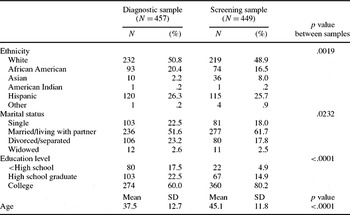
A total of 916 participants completed questionnaires. Because 10 participants gave the same response on all items and were eliminated from the conjoint analysis, the final sample size was 906 (457 diagnostic participants and 449 screening participants). Demographic information is shown in Table 1.
Demographic Characteristics of Participants by Sample

Conjoint Analysis Results
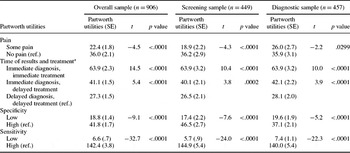
Table 2 displays the partworth utilities from the conjoint analysis. Partworth utilities represent the participant's evaluation of the level of an attribute, with a higher partworth utility indicating a more positive evaluation. Statistically significant differences were observed among the partworth utilities for each attribute (p < .0001), indicating that all attributes influenced the participants' ratings of the test scenarios. Furthermore, consistent with the a priori rankings, study participants showed a preference for no pain, high specificity, and high sensitivity. Analyses of the timing attribute showed that, in general, there was a preference for immediate diagnosis and treatment, followed by immediate diagnosis and delayed treatment, with delayed diagnosis and treatment being the least preferred level of timing.
Partworth Utilities of Attribute Levels from Conjoint Analysis

a Immediate diagnosis, immediate treatment vs. immediate diagnosis, delayed treatment: t = 9.02, p < .0001 for overall sample; t = 6.65, p < .0001 for screening sample; t = 6.11, p < .0001 for diagnostic sample.
SE, standard error; ref., reference group.
Overall and in each sample, the sensitivity attribute was by far the most important; it accounted for 40 percent of the total relative importance rating. The timing attribute constituted 27 percent of the total relative importance rating. Specificity and pain attributes seemed to be equally important and accounted for 17 percent and 16 percent of the total relative importance rating, respectively, although to participants in the screening sample, specificity had a significantly higher importance than pain (17.6 versus 15.3). Pairwise comparisons between the relative importance ratings of attributes were statistically significant (p < .0001), except for the comparison of specificity and pain in the overall sample and in the diagnostic sample (overall, p = .5744; screening, p = .0481; diagnostic, p = .2527).
Cluster Analysis
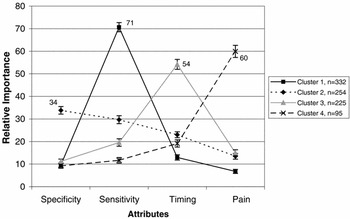
Participants were cluster-analyzed according to their attribute importance ratings to identify groups with similar preference patterns. The four-cluster solution was the most compelling for these data, based on the size of F statistics in the K-means one-way ANOVA procedures. Figure 1 presents the attribute importance ratings of each cluster. Cluster 1, the largest group, represents 37 percent of respondents (n = 332). This cluster placed priority on the sensitivity attribute; test sensitivity constituted 71 percent of the total relative importance score for participants in this cluster. Other attributes had significantly less importance (approximately 7 percent to 13 percent of the total relative importance scores). Cluster 2, consisting of 28 percent of respondents (n = 254), gave the highest importance ratings to specificity, which accounted for 34 percent of the total relative importance score. Its relative importance was significantly higher than that of the other attributes (13 percent to 30 percent), although this group of participants placed more balanced importance on the four attributes than did those in the other three clusters. Cluster 3 accounted for 25 percent of the respondents (n = 225). This group's pattern was dominated by concerns about the timing of test results and treatment; 54 percent of the total relative importance score was focused on the timing attribute, the other attributes accounting for 11 percent to 20 percent of total relative importance. Cluster 4 represented only 10 percent of respondents (n = 95), who based their preferences primarily on the pain that a test causes; the pain attribute accounted for 60 percent of the total relative importance. Other importance weights ranged from 9 percent to 19 percent.
Importance ratings for each of the four clusters were dominated by a particular attribute, although cluster 2 has a more balanced profile than the others. Error bars represent 95 percent confidence intervals.

To further examine the validity of the clusters as distinct groups, we compared their demographic and psychological variables. Education and ethnicity showed statistically significant associations with cluster membership (Chi-squared(Reference Jennings9) = 86.5, p < .0001, for education; Chi-squared(Reference Jennings9) = 60.6, p < .0001, for ethnicity). In the pain cluster, 25 percent had less than a high school education, compared with 4 percent to 14 percent in the other clusters. In contrast, a greater percentage of participants in cluster 1 (sensitivity) had at least a college degree (53 percent), compared with 26 percent to 32 percent in other clusters, and more of them were white, non-Hispanic. No statistically significant associations were seen between age or marital status and cluster membership (F 3,902 = .74; p = .5302, for age; Chi-squared(Reference Jennings9) = 4.5; p = .8782, for marital status).
After the clusters were identified, we made a priori predictions about the psychosocial differences among the clusters. We expected the diagnostic sample would be more likely than the screening sample to be in clusters 3 (timing) and 4 (pain). These issues would be more salient to diagnostic patients, as they are more likely to have additional examinations and follow-up than the others. Similarly, we predicted that participants in cluster 4 (pain) would have experienced more pain and distress during the examination than participants in the other clusters. We also predicted that participants in clusters 1 (sensitivity) and 3 (timing) would report more anxiety and worry about health consequences than participants in cluster 2 (specificity).
Belonging to either the screening or diagnostic sample was not associated with membership in cluster 3 (timing; Chi-squared = .006; p = .9379). However, participants in the diagnostic sample were 1.7 times more likely to be in cluster 4 (pain) than those in the screening sample (Chi-squared = 5.77; p = .0162), although after adjustment by ethnicity, education, and age as covariates, the p value for this association was slightly higher than .05 (Chi-squared = 2.95; p = .0861).
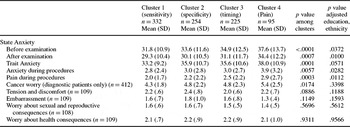
Consistent with our predictions, participants in cluster 4 (pain) reported higher levels of pain and anxiety during the examination than participants in the other clusters (F 1,903 = 11.66; p = .0007; F 1,895 = 8.58; p = .0035 after adjustment for education, ethnicity, and age for anxiety; F 1,901 = 6.22; p = .0003, F 1,895 = 6.24; p = .0126 after adjustment for education, ethnicity, and age for pain). Statistically significant differences were found among the clusters in state anxiety, trait anxiety, anxiety and pain during procedures, and cancer worry (see Table 3). After education, ethnicity, and age were controlled in the model, significant differences persisted among the clusters in state anxiety, anxiety during procedures, and pain during procedures. For most psychosocial variables, in the pairwise cluster comparisons, responses in cluster 4 (pain) were significantly different from those of the other clusters. Additionally, the participants in cluster 3 (timing) reported higher state anxiety before examination (t 901=−3.08; p = .0021), state anxiety after examination (t 898=−1.93; p = .0534), trait anxiety (t 901=−2.40; p = .0066), pain during procedures (t 901=−2.74; p = .0063), and cancer worry (t 857=−2.65; p = .0083), than the participants in cluster 1 (sensitivity). We found no statistically significant differences among clusters in the CDDQ variables.
Differences in Selected Psychosocial Variables among Clusters

SD, standard deviation.
DISCUSSION
On average, participants in this study placed more importance on test sensitivity than on the discomfort of the procedure or the time frame for receiving results and treatment. This is consistent with the findings of Ferris et al. (Reference Ferris, Dickman and Litaker6;Reference Ferris, Kriegel and Cote7), that test accuracy is the most highly valued test characteristic of cervical cancer screening and follow-up tests. Note, too, that specificity was less important than either sensitivity or timing of the results and treatment, which indicated that women in our sample may have been willing to undergo some unnecessary follow-up or treatment if it meant that fewer lesions would be missed and their diagnosis and treatment could proceed in a timely manner. Although the pain of the test was not a heavily weighted attribute, it should be noted that only two levels of the pain attribute were included in the conjoint design: no pain and moderate pain. Moderate pain was chosen as the most painful level to be included because most women do not report severe pain with biopsy (Reference Basen-Engquist, Shinn and Warneke1). Had we included a more severe level of pain, that attribute might have influenced the participants' preferences to a greater degree.
Although the majority of the participants placed the most importance on sensitivity, this ordering of attributes was not universal, as results of the cluster analysis demonstrated. We identified four distinct clusters of participants that varied according to demographic profiles and psychological variables as well as their preferences of test attributes. The largest cluster of respondents valued sensitivity highly, but two clusters emerged whose members found timing and degree of pain to be the most important attributes, and one cluster in which the importance of the four attributes was fairly balanced but specificity was the most highly valued. Participants in these clusters differed not only on scores of attribute importance, but in education level and ethnicity, as well as level of general distress and distress during colposcopy. While most participants indicated that the absence of pain was of relatively little importance, pain caused by new tests should not be ignored, as a subgroup of women with low educational levels found it highly important, and they constitute the demographic at increased risk of not adhering to cervical cancer screening and follow-up of abnormal Papanicolaou smears (Reference Carey and Gjerdingen3;Reference Hewitt, Devesa and Breen8;Reference Michielutte, Diseker and Young15;Reference Peterson, Han and Freund19). Furthermore, the study by Ferris et al. indicates that, in the screening setting, the discomfort caused by the test may influence patient decision making (Reference Ferris, Dickman and Litaker6).
Overall, participants preferred the scenarios in which they learned the results of their tests during the same visit, and they had an even higher preference for receiving the test, the results, and treatment for any problems during one visit. This finding is important in light of the problems of nonadherence to follow-up after abnormal Papanicolaou smear, particularly among women who are poor (Reference Michielutte, Diseker and Young15), inadequately insured, younger than 30 (Reference Peterson, Han and Freund19), and African American (Reference Carey and Gjerdingen3). The high nonadherence rate cited in reviews on the topic (Reference Khanna and Phillips10;Reference Yabroff, Kerner and Mandelblatt28) may be addressable by a technology with adequate specificity to allow a see-and-treat strategy, given that the inconvenience of repeat appointments, forgetting appointments, and delays between appointments are frequently cited reasons for nonadherence to follow-up (Reference Miller, Siejak and Schroeder17;Reference Yauger, Rodriguez and Parker29).
Conjoint analysis was a useful method for isolating and determining the relative importance of different attributes of cervical cancer detection tests. For example, through the use of this method, we were able to determine that, in the overall sample, sensitivity of the test was significantly more important to participants than pain caused by the test, specificity, or when test results and treatment are received; this finding contrasts with a study that had patients rate the importance of concerns about gynecologic examinations separately, which found that pain and accuracy received equally high importance ratings (Reference Ferris, Dickman and Litaker6). Although differences in conclusions may be due to sample differences, it is also possible that our methods were more sensitive to the effect. However, conjoint analysis does have limitations (Reference Wainwright27), primarily because only a few attributes and levels can be included in any given study to avoid an excessively long questionnaire. Had we included different levels of the attributes (e.g., low, moderate, and high pain levels) or other attributes (e.g., out-of-pocket costs, physician endorsement, availability of test close to home), the attributes might have had different weights of importance. To address these limitations, we used attributes on which we expected usual-care procedures and optical spectroscopy to differ and which have been documented in the literature as barriers to screening and diagnosis of cervical cancer; nonetheless we acknowledge that conclusions about the relative importance of attributes are specific to the levels and attribute set considered in this study.
POLICY IMPLICATIONS
In summary, the most important attribute to women overall was sensitivity, which should be a primary concern in the design of new screening and diagnostic technologies. Timing of results and treatment also heavily influenced women's choice of test scenarios, and specificity and pain were important to certain subgroups. Awareness of attributes such as these in the development of cervical cancer screening and diagnostic tests may produce new technologies that increase adherence to screening and diagnostic follow-up, and further reduce morbidity and mortality from cervical cancer.
CONTACT
Karen Basen-Engquist, PhD (kbasenen@mdanderson.org), Associate Professor, Department of Behavioral Science, The University of Texas M.D. Anderson Cancer Center, 1155 Pressler Street—Unit 1330, Houston, Texas 77030
Rachel T. Fouladi, PhD (rfouladi@sfu.ca), Assistant Professor, Department of Psychology, Simon Fraser University, 8888 University Drive, Burnaby, British Columbia V5A 1S6, Canada
Scott B. Cantor, PhD (sbcantor@mdanderson.org), Associate Professor, Department of Biostatistics and Applied Mathematics, The University of Texas M.D. Anderson Cancer Center, 1515 Holcombe Boulevard—Unit 447, Houston, TX 77030-4009
Eileen Shinn, PhD (eshinn@mdanderson.org), Instructor, Dawen Sui, MS (dawensui@mdanderson.org), Statistical Analyst, Department of Behavioral Science, The University of Texas M.D. Anderson Cancer Center, 1155 Pressler Street—Unit 1330, Houston, Texas 77030
Mathilde Sharman, BA, Coordinator, Research Data, Michele Follen, M.D., Ph.D. (mfollen@mdanderson.org), Biomedical Engineering Center, The University of Texas M.D. Anderson Cancer Center, 1515 Holcombe Boulevard—Unit 193, Houston, Texas 77030