INTRODUCTION
The white-beaked dolphin (Lagenorhynchus albirostris) inhabits cold temperate and sub-Arctic waters and is commonly found throughout the North Sea and the shelf waters of the North Atlantic (Northridge et al., Reference Northridge, Tasker, Webb, Camphuysen and Leopold1997; Kinze et al., Reference Kinze, Addink, Smeenk, Hartmann, Richards, Sonntag and Benke1997; Reeves et al., Reference Reeves, Smeenk, Kinze, Brownell and Lien1999). It is the second most frequently reported cetacean around the UK (Evans, Reference Evans1992) and the predominant dolphin species recorded in the North Sea (Hammond et al., Reference Hammond, Berggren, Benke, Borchers, Collet, Heide-Jørgensen, Heimlich, Hiby and Leopold2002). In the UK, most sightings are from around Scotland and the east coast of England (Evans, Reference Evans, Harris and Corbet1990; Northridge et al., Reference Northridge, Tasker, Webb and Williams1995; Reid et al., Reference Reid, Evans and Northridge2003), although a change in distribution has been reported on the west coast of Scotland in recent years (Evans et al., 2003; MacLeod et al., Reference MacLeod, Bannon, Pierce, Schweder, Learmonth, Reid and Herman2005). White-beaked dolphins have been sighted around Britain throughout the year, although with a dramatic increase in frequency during the summer months when the animals move inshore (Evans, Reference Evans1992; Northridge et al., Reference Northridge, Tasker, Webb and Williams1995; Weir et al., Reference Weir, Stockin and Pierce2007).
Although group sizes of up to 1500 have been reported (Tomlin, Reference Tomlin and Heptner1967; Fraser, Reference Fraser1974; Katona et al., Reference Katona, Rough and Richardson1983), most reports refer to groups of ten animals or less (Evans, Reference Evans1992; Kinze et al., Reference Kinze, Addink, Smeenk, Hartmann, Richards, Sonntag and Benke1997; Reid et al., Reference Reid, Evans and Northridge2003). Stomach contents' analysis has shown that white-beaked dolphins are feeding on a wide range of fish and squid species including cod, whiting and hake (Kinze et al., Reference Kinze, Addink, Smeenk, Hartmann, Richards, Sonntag and Benke1997; Reeves et al., Reference Reeves, Smeenk, Kinze, Brownell and Lien1999). In the field, they have been observed to be associated with herring (Harmer, 1927; Fraser, 1946; Evans, Reference Evans1980) and mackerel shoals (Evans, Reference Evans, Anderwald and Baines1987) on the west coast of Scotland and anecdotal evidence from east coast fishermen suggests inshore sightings may coincide with mackerel appearing in coastal waters.
While much is known about the general distribution of this species, little is known about their behaviour, particularly in the coastal waters around Britain and Ireland. The main purpose of this paper is to bring together, for the first time, different sources of information regarding the distribution and behaviour of white-beaked dolphins in UK waters. Stranding data were analysed with reference to inter-annual, seasonal and geographical trends in distribution around the British Isles and stomach content analysis provides new information on diet in Scottish waters. In addition, sightings data gathered from boat surveys performed off north-east Scotland were analysed to examine the habitat use of this species in coastal waters.
MATERIALS AND METHODS
Data collection
HISTORICAL STRANDING RECORDS
Stranding records for white-beaked dolphins in Great Britain and Ireland collected between 1907 and 2003 were assembled for analysis of yearly, seasonal and geographical trends. Prior to 1992, British strandings were collected and published by the Natural History Museum in London (Harmer, Reference Harmer1927; Fraser, Reference Fraser1934, Reference Fraser1946, Reference Fraser1953, Reference Fraser1974; Sheldrick, Reference Sheldrick1989; Sheldrick et al., Reference Sheldrick, Chimonides, Muir, George, Reid, Kuiken, Iskjare-Ackley and Kitchener1994). A more systematic recording programme began in 1992, with the Museum continuing to collect information for England and Wales and the Scottish Agricultural College (SAC) Veterinary Services collecting the Scottish data. All UK strandings data are collated and stored in a central database held by the Natural History Museum. The Irish data are collected, verified and published by the Irish Whale and Dolphin Group (www.iwdg.ie).
STOMACH CONTENTS' ANALYSIS
When the condition of a stranded animal permits, a full post-mortem is carried out to try to establish cause of death, as well as to collect the samples needed to gather information on the age, diet and reproductive status of the animal. Hard remains of fish and cephalopods were removed from the stomachs of white-beaked dolphins stranded around Scotland between 1992 and 2003 by SAC Veterinary Services in Inverness (Figure 1) and identified using reference material and published guides (Clarke, Reference Clarke1986; Härkönen, Reference Härkönen1986; Watt et al., Reference Watt, Pierce and Boyle1997). Original prey size was estimated from measurements on otoliths and beaks using published regression relationships. For stomachs in which one fish species was represented by >30 otoliths, a random sample of 30–50 otoliths was measured: see Santos et al. (Reference Santos, Pierce, Learmonth, Reid, Ross, Patterson, Reid and Beare2004) for a full description of the methods. Note that no corrections were made for possible loss or reduction of size of prey remains due to digestion. Cephalopod beaks are relatively robust, but otoliths are subject to some digestive erosion (Tollit et al., Reference Tollit, Steward, Thompson, Pierce, Santos and Highes1997).
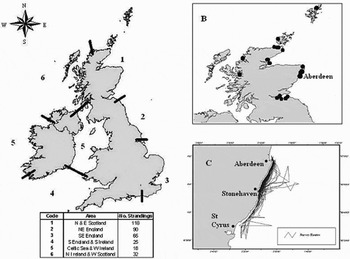
Map of the British Isles, showing boundaries of the geographical regions used for analysis of distribution based on strandings data. Inset B, stranding locations of white-beaked dolphins used in stomach contents analysis. Inset C, summary of boat survey routes along the north-east Scottish coast for analysis of habitat use.

BOAT SURVEYS
Boat surveys were carried out along the south-east Grampian coastline, Scotland to explore relationships between white-beaked dolphin presence, group size and habitat type. Using a 10 m long fishing vessel, surveys were conducted in all months of the year except January, normally at least once per month, on days when wind speed was less than 15 mph. The primary survey route travelled was between Stonehaven and Aberdeen (39 km round trip, Figure 1). Additional surveys were carried out between Stonehaven and St Cyrus (45 km), and evening surveys were performed during the summer between Catterline and Newtonhill (20 km round trip). Surveys were generally within 7 km of shore and a Global Positioning System was used to record the position, speed and direction of travel of the boat at 15-min intervals. The sea state, swell height and visibility were recorded at the same time. The position of the boat was then noted at the start of every cetacean sighting and at 15-min intervals for the duration of the sighting. Species, group size, composition and behaviour of the animals were also recorded. Additional sightings recorded by the boat skipper when out on other business were also used for some of the analysis.
Data analysis
GEOGRAPHICAL AND TEMPORAL PATTERNS IN STRANDINGS
The strandings data (N = 349) were grouped according to body length, sex, geographical location, year, month and season of stranding. Geographical location was assigned by dividing the coastline into six regions (Figure 1) and seasons were defined as winter (January–March), spring (April–June), summer (July–September) and autumn (October–December).
Frequencies of strandings were calculated and compared for individual regions around the British Isles and for each coast (east = region 1–3, west = region 4–6, Figure 1) using chi squared tests. In order to factor in a value for effort, the numbers of white-beaked dolphins reported stranded during each decade between 1910 and 2003 were expressed as a proportion of all reported stranded cetaceans (for that decade) and examined for temporal and geographical variation in occurrence using regression analysis and Friedman's Tests.
Generalized additive models (GAM) were fitted to quantify relationships between the presence of stranded white-beaked dolphins and the explanatory variables year, region, length and sex. Region and sex were entered as nominal values. Zeros were entered for year/region combinations with no stranding records and the response variable was thus expressed as presence/absence. A binomial distribution was assumed and the final model was chosen based on the lowest AIC value obtained (providing that all explanatory variables included had individually significant effects). The analyses were carried out using Brodgar v. 2.4.8 (Highland Statistics, www.brodgar.com).
The information available with each stranding report varied, particularly in the early years, but body length was recorded for 82% of stranded animals, and sex for 52% of the animals. Animals smaller than 160 cm in length were classified as calves and those greater than 240 cm as mature adults (Kinze et al., Reference Kinze, Addink, Smeenk, Hartmann, Richards, Sonntag and Benke1997). Seasonal and spatial patterns in the size and sex data were analysed using GAMs and χ2-tests.
HABITAT USE
A total of 95 boat surveys was carried out between May 2002 and September 2005, covering a distance of 4123 km (Figure 1). Thirty of these surveys were summer evening trips, seven followed the St Cyrus route, and the remaining surveys followed the Aberdeen route. Fifty-one white-beaked dolphin sightings were recorded in total and the boat skipper recorded an additional 33 sightings, which were included for the second part of the analysis.
The boat survey data were entered into a GIS (ArcView 3.1, Environmental Systems Research Institute, Inc.) and data were extracted to quantify the characteristics of habitats used by white-beaked dolphins (see below). Generalized additive models were used to quantify factors affecting dolphin presence. Due to the large number of zero values, a two-stage modelling approach was applied (McCullagh & Nelder, Reference McCullagh and Nelder1989; Barry & Welsh, Reference Barry and Welsh2002; Cañadas et al., Reference Cañadas, Sagarminaga, Stephanis, de Urquiola and Hammond2005; Canning, Reference Canning2007):
Model 1
To examine the relationship between white-beaked dolphin presence/absence and physical environmental characteristics within the survey area, the area was divided into 500 m grid-squares using MapInfo Professional 5.0 and ArcView 3.1. The explanatory variables examined were depth, slope, aspect, sediment type and survey effort, with a value for each variable calculated for all grid squares. Depth was assigned using the DigiBath 250 dataset and sediment type was determined from British Geological Survey sediment data. Aspect, slope, survey effort and dolphin presence/absence were calculated using ArcView. Aspect was divided into north and east components to avoid use of a circular variable. Bearings in degrees were converted to radians. Northerly and easterly components of aspect are then given by cos (bearing) and sin (bearing) respectively. Sediment type was assigned nominal values to allow its input into the model. A binomial GAM was fitted using dolphin presence as the response variable. Cross validation was applied and the best model was selected using a forwards and backwards selection procedure, based on the lowest AIC, ensuring that all explanatory variables retained in the final model were individually statistically significant.
Model 2
A second model was applied to look for relationships between dolphin abundance (given presence) and temporal and physical variables. Since each presence (as opposed to absence) record was associated with a specific time and location it was possible to examine effects of additional environmental variables. Depth, slope, aspect and sediment type were calculated as before, based on the starting position for each sighting. Depth was then adjusted for the tidal height at the time of the sighting. The direction of tidal flow at that time (expressed as north or south) and the strength of that stream (knots) were calculated using Admiralty Total Tide v. 5.1 (UK Hydrographic Office). Time of sighting was expressed as the number of continuous minutes since midnight.
To look at the impact of fresh water entering the system, the distance of each sighting to the nearest large river was calculated using ArcView. The number of days to the nearest full or new moon for each sighting was also included to examine the possibility that sightings were associated with the tidal front, the distance of which from the shore would be affected by the lunar cycle. A mean daily value for sea surface temperature for each sighting was also included (recorded by Fisheries Research Services at a recording station in Findon, halfway between Stonehaven and Aberdeen). Aspect had to be omitted from the modelling process, as there was not enough variation in this dataset. Sediment type and direction of tidal flow were entered as nominal values. The response variable was number of adults per sighting and a Poisson distribution was assumed. Cross validation was applied and the best model was again selected based on the lowest AIC and significant values for individual explanatory variables.
GROUP SIZE
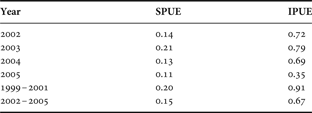
The boat survey sighting data were examined for monthly and yearly variations in median group size (number of adults) using Kruskal–Wallis tests. Variation between group size in relation to the presence or absence of calves was also examined using a Kruskal–Wallis test. The number of sightings per unit effort (SPUE) and total number of individual animals per unit effort (IPUE) were calculated for the years 2002–2005 to allow comparison with previous data collected in the area (Weir et al., Reference Weir, Stockin and Pierce2007), regression analysis was used to look for trends.
DIETARY ANALYSIS
Twenty-two of the white-beaked dolphins stranded around Scotland were of a suitable condition to allow dietary analysis. Seventeen were recovered from the east coast, two from the west coast and the rest from the Northern Isles (Figure 1). Nearly half of the dolphins whose stomach contents were examined had stranded during the summer (June–August). The overall importance of each prey type in the diet was summarized using three standard measures: (1) frequency of occurrence (i.e. the number of stomachs in which a prey category occurred); (2) proportion of the total number of prey; and (3) proportion of total prey wet mass.
Although prey mass provides the best proxy for the energetic importance of each prey type, not all prey remains could be used to estimate prey size and the mass data are therefore slightly less complete than data on prey numbers or presence (see results). No explicit ‘weighting’ was applied to individual stomach samples. Thus when calculating the overall diet, the contribution of each stomach is proportional to the total estimated number or reconstructed mass of the prey contained therein.
RESULTS
Geographical and temporal patterns in strandings
The majority of white-beaked dolphins stranded in the UK are found around Scotland and along the east coast of England. There were fewer strandings in the south compared to the north and central areas along both coasts, although this difference is not statistically significant (χ2 = 3.6, 2df, P = 0.17). If these data are broken down according to season, significantly fewer white-beaked dolphins were stranded along the southern coastal areas during the summer months and significantly more during the winter (χ2 = 28.12, 15df, P = 0.02).
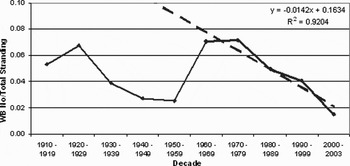
Considering the number of white-beaked strandings per decade as a proportion of all strandings, there was a dip during the 1940–1950s and then a steady decline in relative numbers since the 1970s. A linear regression fitted to the latter data shows a significant negative trend (number of strandings = –0.014 × decade, + 0.163, R2 = 0.92; Figure 2).
Number of white-beaked dolphins reported stranded around the UK and Ireland each decade between 1920 and 2003, expressed as a proportion of all cetacean stranding reports. The dashed line represents the regression curve for the decades 1970–2000 showing a steady decline in reports of this species during that time.

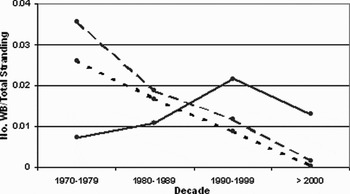
When the geographical regions were grouped according to latitude, a strong decline in numbers reported since the 1970s was observed in the central and southern regions while a small increase was observed in the northern region (Figure 3).
Number of stranded white-beaked dolphins since the 1970s, grouped according to latitude showing an increase in reports in the north and a decrease in the southern areas. Solid line, north (regions 1 and 6); dashed line, central (regions 2 and 5); dotted line, south (regions 3 and 4; refer to Figure 1).

Friedmans tests indicated that there was a significant difference in the numbers of strandings reported by latitude (S = 7.4, 2df, P = 0.025) but not by decade (S = 12.67, 9df, P = 0.178). If the data from the 1970s are looked at in isolation by geographical region, the number of strandings for all regions except region 1 (north-east Scotland) goes down, although this effect is not significant for either region or decade.
The GAM fitted to data on presence/absence of reported strandings by year and by region explained 16.5% of deviance and showed a strong non-linear inter-annual trend (5.6df, P < 0.001). This trend was generally upwards, with a dip around 1950, but is uncorrected for changing effort (since annual, by-region effort indices are not available). Although the effect of region was not significant, there was a significant year–region interaction for north-east Scotland (region 1, P = 0.005) indicating that this region has a different temporal trend when compared to the other regions.
There is a slight bias towards females in the strandings data: for all the stranding data combined, the sex ratio is 1.22. Among animals >240 cm in length, the sex ratio is 1.11 females per male for Scotland and 1.36 for England. The sex ratio for the east coast of Britain is 1.13 as compared to 1.46 for the west coast.
Of the stranded animals smaller than 160 cm length (calves), 67% were found in Scotland and 81% on the east coast of Britain. Seventy-one per cent of all calves were stranded between June and September. The calves that stranded outside this time period were all greater than 130 cm in length except for one reported in May (100 cm) and another in October (120 cm). Considering data for Scotland (where the majority of calves are reported) alone, these trends are stronger, with 82% of calves stranding between June and September and all but one calf stranded outside of this period being greater than 140 cm in length. A GAM fitted to length data for stranded animals explained 12.5% of deviance and indicated a significant linear decline in length with year (P < 0.001) as well as significant regional differences: average length of stranded animals in regions 2, 3, 5 and 6 was significantly greater than in region 1, consistent with this region having a higher proportion of calves among the strandings. No satisfactory GAM could be fitted to the sex data (i.e. there were no significant interannual or regional trends).
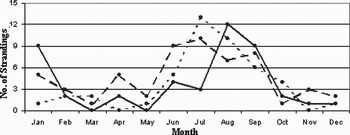
When the month-to-month patterns of occurrence for strandings of (a) males, (b) females and (c) calves are compared, there is a significant difference (χ2 =41.92, 22df, P = 0.006) with adult female (>240 cm) and calf strandings peaking in July and adult male (>240 cm) strandings peaking in August (Figure 4).
Number of stranded white-beaked dolphins found around Britain and Ireland in each calendar month according to length and sex. Dotted line, calf (<160 cm long); solid line, male (>240 cm long); dashed line, female (>240 cm long). The peak in occurrence for each of the three size groups was significantly different (χ2 =41.92, P = 0.006, 22df).

Temporal trends in sightings
Although boat surveys were conducted all through the year, all white-beaked dolphin sightings were reported between June and August except for a single sighting in September 2004. Group size ranged from 1 to 18 with an overall average of 4.2 (N = 84, SD 2.77). The median group size did not vary significantly between months (Kruskal–Wallis H = 4.46, 2df, P = 0.098), or between years (H = 3.26, 3df, P = 0.35). Calves were recorded only during July and August, with 30% of the sightings from these months including calves. Median group size for groups with and without calves was not significantly different (H = 1.62, 1df, P = 0.205).
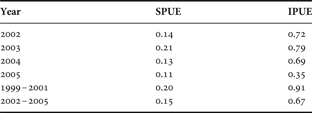
Overall SPUE did not vary greatly between years or studies (Table 1) but a steady decrease in the IPUE was observed for the duration of this study and when compared to the previous study (see Table 1: IPUE = –0.12 × year + 1.04, R2 = 0.76).
Sightings per unit effort (SPUE) and number of individuals per unit effort (IPUE) for the years 2002–2005. Unit effort is 60 minutes. Data collected during 1999–2001 (Weir et al., Reference Weir, Stockin and Pierce2007) are also included for comparison. Regression analysis suggested a steady decline in the number of animals sighted between 1999 and 2005 (IPUE = 0.12 × year + 1.04, R2 = 0.76).
Habitat use
Using the 51 sightings recorded during the boat surveys, the final model for white-beaked dolphin presence in relation to habitat type (model 1) explained 31.6% of deviance and included effects of slope (P = 0.02), northerly aspect (P = 0.04), easterly aspect (P = 0.01) and survey effort (P = <0.01). Slope, northerly and easterly aspects showed linear relationships with dolphin presence and so were included as parametric terms. The trend was for steeper north-facing slopes to have a negative effect on dolphin presence and for east facing slopes to have a positive effect.
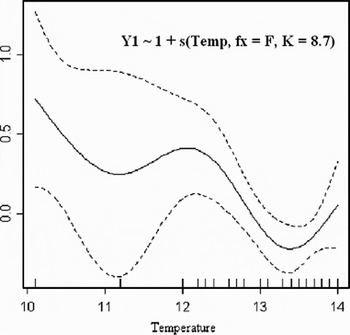
All 84 sightings were included in the second model (for group size) and the final model explained 43.7% of the variation between group sizes, with temperature being the only significant explanatory variable (χ2 = 61.79, 8.7df, P = <0.01). The trend, although non-linear, was for smaller group sizes to be seen at higher temperatures (Figure 5).
Formula used to obtain the optimal group size model and the partial plot showing the relationship between group size and temperature. While the first half of the graph is uninformative due to a lack of data points, the overall trend is for a decline in group size with increasing temperature. (Dotted lines represent 95% confidence limits. Note: graph was further smoothed to allow easier interpretation).

Dietary analysis
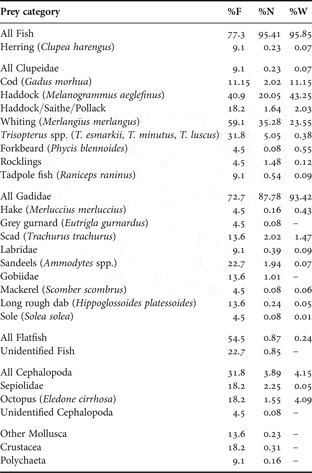
A wide variety of prey species were identified, with fish representing more than 95% of the diet by number and by reconstructed weight (Table 2). Haddock and whiting were the most important prey species in the diet, representing 43% and 24% respectively of the total reconstructed weight. Cod comprised 11% of the total weight while herring and mackerel together make up less than 1%. Most of the haddock eaten were estimated to be of 265–285 mm total body length (although haddock in stomachs ranged from 105 to 485 mm) as compared to 155–165 mm for whiting (total fish length ranged from 65 to 365 mm).
Overall importance of the prey categories identified from the stomachs of white-beaked dolphins stranded around Scotland 1992–2003. Importance is expressed as % frequency of occurrence (%F), % number (%N) and %-reconstructed weight (%W).

DISCUSSION
The summer peak in the stranding data coincides with the increase observed in inshore sightings (this study and Reid et al., Reference Reid, Evans and Northridge2003) and in both cases the vast majority of reports are from the North Sea. Stranding data for the eastern edge of the North Sea have suggested a segregation of the sexes (Kinze et al., Reference Kinze, Addink, Smeenk, Hartmann, Richards, Sonntag and Benke1997). The same cannot be said for the UK and Irish stranding data, although the overall sex ratio was slightly female-biased. There is however, a significant difference in the months of peak occurrence of strandings for males and females, suggesting that females may move inshore first with males following later.
The distribution of calf strandings, and the pattern of sightings recorded during the boat surveys, reinforce the summer calving theory first described in 1974 by Fraser. Calves were recorded only during the boat surveys in July and August and nearly all of the stranded calves were reported between June and September. The few calves that stranded outside this period were greater than 130 cm in length, indicating that they were several months old. The peak in calf strandings coincides with the peak in female strandings, leading us to suggest that the females may be coming inshore to give birth. Neither haddock nor whiting (the predominant prey species in the stomach contents) exhibit an in/offshore migration suggesting that white-beaked dolphins are not following a prey source into coastal waters during the summer months. Calving in coastal waters would presumably offer greater protection to the mothers with there still being plenty of prey available, as suggested for bottlenose dolphins (Scott et al., Reference Scott, Wells, Irvine, Leatherwood and Reeves1990; Wilson et al., Reference Wilson, Thompson and Hammond1997). Male bottlenose dolphins are also known to form separate groups from females and calves (Wells et al., Reference Wells, Irvine, Scott and Herman1980; Wells, Reference Wells, Pryor and Norris1991; Connor et al., Reference Connor, Wells, Mann, Read and Mann2000; Möller et al., Reference Möller, Beheragaray, Krützen and Harcourt2001) with the males moving between female groups in order to mate (Wells et al., Reference Wells, Irvine, Scott and Herman1980). Little is known about the reproduction behaviour of the white-beaked dolphin but it may be that the males follow the females inshore in order to mate after they have calved. Only a small number of stranded animals around Scotland have been examined for reproductive state and of these, only two were sexually mature and reproductively active (J. Learmonth, personal communication). These were both male and they stranded in july and August.
Initial examination of the geographical distribution of the strandings data pointed to a possible link with sea depth, as fewer white-beaked dolphins were reported stranded around the south of England where the adjacent waters are generally shallow. However, when season is taken into consideration a different pattern emerges, with significantly fewer strandings in the south during the summer than in the winter, suggesting that white-beaked dolphin distribution may be linked to sea temperature rather than a physical factor such as depth. The habitat study in north-east Scotland highlighted temperature as having a significant effect on local abundance, with smaller group sizes being associated with higher sea surface temperatures. The waters to the south of Britain (particularly in the North Sea where the majority of sightings occur) are always warmer than those in the north, particularly during the summer when the temperature variation is more extreme (Becker & Pauly, Reference Becker and Pauly1996). White-beaked dolphin distribution around the UK may thus be generally restricted to cooler more northerly areas, especially during the summer months.
Regression analysis, taking into account changes in observer effort, suggested a steady decline in white-beaked dolphin strandings around the UK since the 1970s. The dip in incidence of strandings during the 1940s and 1950s can probably be attributed to the Second World War. The GAM results highlighted a difference in the inter-annual trend in incidence of white-beaked dolphin strandings between north-east Scotland and other UK regions. The number of strandings in north-east Scotland has been going up since the 1970s while the numbers in all other areas have gone down. A decline in white-beaked dolphin abundance on the west coast of Scotland has previously been reported (MacLeod et al., Reference MacLeod, Bannon, Pierce, Schweder, Learmonth, Reid and Herman2005), with a suggested link to rising sea temperatures. Results from the present study suggest that this decline is more widespread, with the number of reported strandings declining in recent decades for all regions except the north-east of Scotland. The increase here, where seawater temperatures tend to be colder than elsewhere around the UK, may reflect displacement of animals from other UK regions.
The strandings data series analysed did not extend beyond 2003 but the decline in IPUE (individuals sighted per unit effort) observed during the boat surveys off north-east Scotland since 1999, suggests that abundance may now also be declining in this region. As discussed by MacLeod et al. (Reference MacLeod, Bannon, Pierce, Schweder, Learmonth, Reid and Herman2005), global warming may ultimately have a dramatic effect on the distribution and abundance of this species.
A previous study based on the Aberdeenshire coast (Weir et al., Reference Weir, Stockin and Pierce2007), reported a significant effect of sea depth on presence of this species. In contrast, this study found slope and aspect to be more important. The present study area is characterized by a predominantly sandy seabed, with relatively shallow water depths, although Aberdeen Bay is shallower than the area immediately to the south of Aberdeen. Significant effects of depth, seabed slope and aspect on dolphin presence may indicate that white-beaked dolphins favour particular locations. Continued survey effort, increasing the sample size for observations, would allow clarification of the direct or indirect effect of habitat type on white-beaked dolphin sightings in this area. Ultimately, however, it may be more informative to study the distribution of their prey. Haddock and whiting, the two predominant prey species found in the stomach contents analysed here, are both widespread in the study area, suggesting that the dolphins may be following prey rather than targeting specific habitats.
Earlier observations have suggested an association between white-beaked dolphins and herring and mackerel (Harmer, 1927; Fraser, 1946; Evans, Reference Evans1980, Reference Evans, Anderwald and Baines1987), at least on the west coast of Scotland, although neither species was frequent in the stomachs analysed here. Herring abundance in the North Sea has recently returned to levels not seen since the 1970s (ICES, 2005) and, although mackerel are presently regarded as overexploited (ICES, 2005), the mackerel stock is still very large (close to 2 million tonnes). In 2004, the haddock spawning stock in the North Sea was relatively large (around 290,000 tonnes). In contrast, whiting abundance appears to have decreased markedly since 1990 with the North Sea stock believed to be at or near an all-time low (ICES, 2005). These figures, however, describe the overall stock situation and are not informative about the local spatial distribution of fish populations. At present it is not possible to say which species of fish the dolphins actually encountered. Feeding strategies may differ between the east and west coast, but again the present dataset precludes a more detailed analysis (only two of the stomachs examined originated on the west coast). It is also possible that white-beaked dolphins feed on herring and mackerel mainly in offshore waters, where any animals that die are less likely to appear in the strandings record than animals which have been living and feeding closer to the shore.
The analysis here suggests that white-beaked dolphin distribution is restricted by temperature and that their distribution around the UK has steadily been shrinking northward, very probably as a response to rising sea temperatures. Bearing in mind recent changes in their distribution on the west coast of Scotland, the possible effects of sea temperature implied by our and previous findings and the generally observed rises in sea temperature, particularly in recent years, there is an urgent need to obtain a clearer understanding of the distribution and ecology of this species. The suggestion that they are using inshore areas to breed requires further confirmation and the small-scale diet and habitat studies reported here highlight the need for robust biological information to inform the processes of inshore management so as to mitigate adverse anthropogenic affects.
ACKNOWLEDGEMENTS
Boat surveys were conducted as part of the Aberdeenshire Dolphin Project, funded jointly by Total E&P UK Plc, Talisman Energy (UK) Ltd and Kerr McGee North Sea Ltd. Thanks go to Brian Bartlett and members of the South Grampian Sea Watch group, in particular Ian Sim and Kevin Hepworth, for their help during the surveys. The UK Stranding Project and all work undertaken by the SAC and NHM on strandings research is funded by the UK Department for Environment, Food and Rural Affairs (Defra). Stomach contents analysis up to 1997 was funded by the Commission of the European Communities under contracts ERB 4001 GT 93/3630 and ERB FMBI CT96 1373. Sample collection and analysis during 1998–2000 and 2001–2003 was funded under CEC DG XIV Study Project 97/089 and CEC Project EVK3-CT-2000-00027 respectively. We also thank Dougal Lichtman for the Findon temperature time series, which is collected by the Fisheries Research Services, an agency of the Scottish Executive, as part of their coastal long term monitoring programme.