Fomesafen is a protoporphyrinogen oxidase inhibitor and has the potential to be used as an alternative mechanism of action for PRE weed control in Florida small fruit and vegetable production. Fomesafen inhibits the conversion of protoporphyrinogen IX (Proto IX) to protoporphyrin IX as part of the biosynthesis of tetrapyrroles (Duke et al. Reference Duke, Lydon, Becerril, Sherman, Lehnen and Matsumoto1991; Scalla and Matringe Reference Scalla and Matringe1994). The accumulation of Proto IX in the presence of light leads to lipid peroxidation and cell death (Becerril and Duke Reference Becerril and Duke1989; Scalla and Matringe Reference Scalla and Matringe1994). Fomesafen PRE treatments have shown the ability to suppress or control yellow nutsedge (Cyperus esculentus L.) growth (Dowler Reference Dowler1987; Monday et al. Reference Monday, Foshee, Blythe, Wehtje and Gilliam2015; Wilcut et al. Reference Wilcut, Jordan, Vencill and Richburg1997). However, limited fomesafen efficacy on purple nutsedge has been demonstrated in Florida plasticulture production. For example, Miller and Dittmar (Reference Miller and Dittmar2014) reported PRE applications of fomesafen at 0.42 kg ai ha−1 reduced a mix of purple and yellow nutsedge by 50% at 28 d after treatment, whereas Boyd (Reference Boyd2015) and Boyd and Reed (Reference Boyd and Reed2016) found that fomesafen application alone did not reduce purple nutsedge density in strawberry (Fragaria virginiana Duchesne) and tomato (Solanum lycopersicum L.) production systems in Florida.
Fomesafen photodecomposes readily under relatively low sunlight conditions and degrades rapidly under anaerobic conditions, with a half-life of less than 3 wk (Shaner Reference Shaner2014). Fomesafen is a weak acid with increased sorption at low pH. Bioavailability and solubility of fomesafen in soil is affected by pH, with a logarithmic acid dissociation constant (pKa) equal to 2.7 and acid solubility in water of 50 mg L−1 at pH 7 and less than 1 mg L−1 at pH 1 (Shaner Reference Shaner2014; Weber Reference Weber1993a, Reference Weber1993b). Organic matter and pH are significantly correlated to fomesafen adsorption, and fomesafen has exhibited greater mobility in sandier soils (Guo et al. Reference Guo, Zhu, Shi and Sun2003; Weber Reference Weber1993b). Fomesafen open field production half-life was reported to be from 28 to 66 d, after 0.18 kg ai ha−1 alone or 0.09 followed by 0.18 kg ai ha−1 applications with residue still detectable 350 d after treatment in a Madalin silty clay loam (Rauch et al. Reference Rauch, Bellinder, Brainard, Lane and Thies2007). Mueller et al. (Reference Mueller, Boswell, Mueller and Steckel2014) reported fomesafen half-life over 3 experimental years on a loam soil averaged 46 d. It is likely that fomesafen persistence will be greater in plasticulture production, in which photodecomposition and leaching are limited due to the plastic mulch.
Plastic mulches are used in Florida small fruit and vegetable production to protect raised beds from erosion, decrease soil moisture evaporation, improve fumigant efficacy, extend weed control, and alter soil temperature in the root zone. Pesticide dissipation is affected by plastic mulch by limiting sunlight, leaching by rainfall, and affecting biological activity (Bond and Walker Reference Bond and Walker1989; Jensen et al. Reference Jensen, Kimball and Ricketson1989). Bond and Walker (Reference Bond and Walker1989) determined dissipation of linuron, pendimethalin, chlorobromuron, and flurochloridone was reduced when applied to soil under perforated polyethylene covers compared with bare soil. It took twice the amount of time for S-metolachlor to dissipate 50% under low-density polyethylene mulch (LDPE) than bare ground (Grey et al. Reference Grey, Vencill, Mantripagada and Culpepper2007). Delayed dissipation of pesticides applied to soil under black polyethylene covers compared with bare ground has been previously established; however, there is a lack of research on fomesafen dissipation in plasticulture production and dissipation of herbicides under virtually impermeable film (VIF) and totally impermeable film (TIF). In Florida production systems, VIF and TIF mulches are most widely used and are multilayer films that contain barrier polymers such as polyamide (nylon) or ethylene vinyl alcohol (EVOH) compressed between other layers of polymer that bind the polyethylene outer layer to the barrier layer. Films containing an EVOH barrier layer are currently referred to as TIF (Qin et al. Reference Qin, Gao, Ajwa, Sullivan, D. Wang and Hanson2011). Films containing barrier polymers are significantly less permeable to fumigants than LDPE and high-density polyethylene (HDPE) mulches (Chellemi et al. Reference Chellemi, Ajwa, Sullivan, Alessandro, Gilreath and Yates2011; Gamliel et al. Reference Gamliel, Grinstein, Klein, Cohen and Katan1998; Ou et al. Reference Ou, Thomas, Allen, Vu and Dickson2007; Qin et al. Reference Qin, Gao, Ajwa, Sullivan, D. Wang and Hanson2011; Santos et al. Reference Santos, Gilreath and Siham2007; Wang et al. Reference Wang, Yates and Jury1998). Gamliel et al. (Reference Gamliel, Grinstein, Klein, Cohen and Katan1998) reported a 100-μm-thick LDPE film was more than 150-fold more permeable to methyl bromide than a 30-μm mulch containing an EVOH barrier layer.
Many growers in Florida plant more than one different crop(s) each year, and fomesafen’s potential to persist at a high concentration under plastic may dissuade producers from using the herbicide to avoid limitations on which fruit or vegetable crops can be planted back into beds without fear of injury. Investigation into herbicide dissipation in plasticulture systems is needed to determine best management practices for future production. The objective of this research was to evaluate fomesafen efficacy, squash tolerance, and the effect of different plastic mulches on fomesafen dissipation.
Material and Methods
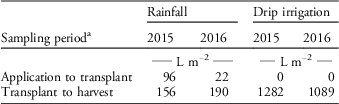
Field experiments were conducted at the University of Florida Gulf Coast Research and Education Center (GCREC), Balm, FL (27.76°N, 82.23°W), in 2015 and 2016. Soil was a Myakka series fine sand (sandy, siliceous, hyperthermic Aeric Alaquods) with 1.0% organic matter, a pH of 6.8, and sand, silt, and clay content of 95%, 4%, and 1%, respectively, at the 2015 experiment site and 1.5% organic matter, a pH of 6.0, and a sand, silt, and clay content of 98%, 1%, and 1%, respectively, at the 2016 site. Treatments included fomesafen (Reflex® 2L Liquid Herbicide, Syngenta Crop Protection, Greensboro, NC) at 0.42 kg ai ha−1 under no plastic mulch, clear mulch (0.02-mm thickness, Poly Expert, Laval, QC, Canada), LDPE mulch (0.02-mm thickness, FilmTech, Allentown, PA), VIF (0.03-mm thickness, Blockade, Berry Plastics, Evansville, IN), and TIF (0.03-mm thickness, Guardian Ag Plastics, Tampa, FL). The applied fomesafen rate is currently labeled for use in Florida tomato and pepper (Capsicum annuum L.) production. Raised beds with 1.2-m centers, a height of 0.3 m, and a bed top width of 0.7 m were formed with bed-pressing equipment. Beds were fumigated with Pic-Clor® 60 (Soil Chemicals, Hollister, CA), a combination of 39% 1,3-dichloropropene and 59.6% chloropicrin at 336 kg ha−1 prior to fomesafen application. Fumigant was injected with a three-shank fumigation applicator (Kennco Manufacturing, Ruskin, FL) at a 0.2-m depth. Fomesafen applications were made with CO2-pressurized backpack sprayer (Bellspray, Opelousa, LA) calibrated to deliver 187 L ha−1 with a single 8002VS nozzle (TeeJet®, Spraying Systems Company, Wheaton, IL) to the top of the preformed beds. Each bed was covered with plastic mulch of the appropriate treatment immediately after herbicide application. LDPE, VIF, and TIF were black/white mulches. Fumigation and herbicide applications were made August 21, 2015, and February 16, 2016. Fertigation was applied through two rows of drip tape separated by 0.2 m and buried just beneath the surface of the bed with emitters every 0.3 m and a flow rate of 0.95 L min−1 per 30.0 m (Jain Irrigation, Haines City, FL). Rainfall and drip-irrigation amounts are listed in Table 1. Rainfall data were acquired from University of Florida Institute of Food and Agricultural Sciences Florida Automated Weather Network from a weather station located at GCREC. Soil volumetric moisture (Soil Moisture Smart Sensor S-SMC-M005, Onset Computer, Bourne, MA) and soil temperature (12-Bit Temperature Smart Sensor, Onset Computer, Bourne, MA) measurements at a 0.1-m depth were data logged hourly (HOBO® Micro Station, Onset Computer, Bourne, MA) throughout the trial in each plot.
Rainfall and drip-irrigation volume between soil sampling dates during field experiments in 2015 and 2016 in Balm, FL.

a Application, transplant, and harvest were 0, 19, and 103 d after treatment (2015) and 0, 22, and 83 days after treatment (2016), respectively.
The experiment was a randomized complete block with four replications of 7.6-m plots. Three 0.1-m-depth core samples were collected in each plot at day of application (August 21, 2015, and February 16, 2016), transplant (September 21, 2015, and March 9, 2016), and at the end of the trial (December 2, 2015, and May 9, 2016). The soil corer diameter was 2.0 cm with each sample having a volume of 31.4 cm3. In each plot, the three samples were combined and mixed to form a single homogeneous sample. Samples were frozen at −20 C until analysis. Sample extractions, high-performance liquid chromatography (HPLC), and mass spectrometry analyses were conducted similar to Syngenta protocols for determining residues of fomesafen in soil (Leung Reference Leung1997; Lin Reference Lin2009). The extraction solution consisted of 10 ml of HPLC water, 0.1 ml of glacial acetic acid, and 10 ml of methylene chloride for 10 g of air-dried soil sample. Preparation of samples for analysis involved the following steps: hand shaking the solution, determining the pH level was at or below 4.5, 60 min of machine shaking, 10 min of centrifugation at 5,000 rpm to separate the phases, collection of methylene chloride layer with fomesafen residue, addition of 0.1 g of sodium sulfate to remove moisture, vacuum evaporation of 2 ml of methylene chloride with fomesafen residue through 3-ml silica tubes (SampliQ Solid Phase Extraction, Agilent Technologies, Santa Clara, CA), subsequent rinsing with 10 ml of ethyl acetate and collection, placement in a 60 C water bath with nitrogen gas to dry, and addition of 1 ml of methanol placed on vortex for 1 min alternating with 15 min of sonication for three repetitions before transfer to vials for analysis.
Analysis was performed using the Surveyor HPLC System (Thermo Fisher Scientific, Waltham, MA). Each 25-µl sample was injected directly onto a Zorbax Eclipse plus-C18 (3.5 µm×2.1 mm×100 mm) analytical column (Agilent Technologies, Santa Clara, CA) at 25 C. A gradient liquid chromatography method used mobile phases A (0.1% formic acid in water) and B (0.1% formic acid in methanol) at a flow rate of 0.3 ml min−1. For mass spectrometry detection, the electrospray ionization source was operated in the negative ion mode and run with Xcalibur v. 2.0 software (Thermo Fisher Scientific, Waltham, MA). High-purity nitrogen was used as the sheath (41 unitless) and auxiliary (25 unitless) gas, and high-purity argon was used as the collision gas (1 mTorr). The parameters were as follows: spray voltage, 4.6 kV; capillary temperature, 280 C; scan width for selected reaction monitoring (SRM), 0.1 m/z; and scan time, 0.2s. The peak width settings for both Q1 and Q3 were 0.7 m/z. The SRM ion pair transitions and collision energy (CE) levels of each component were: parent, 437 m/z; quantifier product, 195 m/z, 40 CE; and qualifier product 222 m/z, 33 CE. Recoveries from fortified nontreated soil samples indicated that recovery was 94±2%. The limit of detection for fomesafen was approximately 2.5 μg kg−1.
Hybrid ‘Sunburst’ yellow scallop squash (Siegers Seed, Holland, MI) was transplanted in the bed in a single row with 0.6-m spacing with 10 plants plot−1. Production and pest management practices were in accordance with industry standards and University of Florida Institute of Food and Agricultural Sciences recommendations (Freeman et al. Reference Freeman, McAvoy, Dittmer, Ozores-Hampton, Paret, Wang, Miller and Webb2015). Squash visual injury evaluations on a percent scale where 0 equaled no visible chlorosis and 100 equaled complete desiccation were taken at 2, 4, and 8wk after transplanting (WAT). Squash heights were taken 2 and 4 WAT and were an average of 3 plants plot−1. Counts and weights per plot of squash yield were taken at a single harvest. Purple nutsedge density was taken at transplant and harvest. Purple nutsedge that pierced through the plastic mulch or that was present in the no-mulch treatment was counted and taken as an average of three densities per plot using a 0.6-m2 grid.
Data were subjected to ANOVA at the 0.05 probability level in SAS (v. 9.4, SAS Institute, Cary, NC) using the PROC MIXED with block as random factor. Data were checked for normality and constant variance prior to analysis. Means were compared using the least-squares means statement with the Tukey adjustment at P=0.05. Squash heights, purple nutsedge counts, and fomesafen concentration for each treatment were collected on multiple dates and were analyzed using the repeated statement. Fomesafen concentration data were described by growing season. Growing season by treatment interaction was not detected for squash injury (P=0.4410), squash height (P=0.3378), and nutsedge density (P=0.3259), and seasons were therefore combined. Growing season by treatment interaction was detected for squash fruit number per hectare (P=0.0478) and squash kilograms per hectare yield (P=0.0343), and seasons were analyzed separately.
Results and Discussion
Fomesafen Dissipation
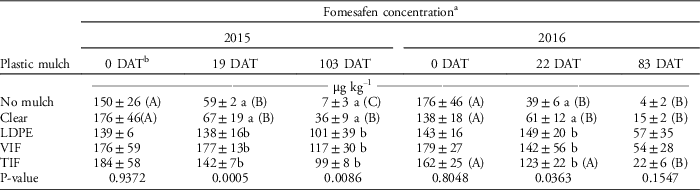
Fomesafen concentration for all treatments was similar at application, ranging from 139 to 184 μg kg−1 and 138 to 176 μg kg−1 in 2015 and 2016, respectively (Table 2). Fomesafen concentrations under LDPE, VIF, TIF, and clear mulches and for the no-mulch treatment were similar on all sampling dates. At transplant in both growing seasons, treatments with LDPE, VIF, and TIF black/white mulch had greater than 2-fold the fomesafen concentrations than treatments with clear or no mulch. At harvest in 2015, LDPE, VIF, and TIF treatments had greater fomesafen concentrations than clear and no-mulch treatments; however, concentrations in 2016 were similar for all treatments. Clear and no-mulch treatments had less than half the fomesafen concentrations at transplant than application. Black/white mulch had similar fomesafen concentrations across all sampling dates in both growing seasons, with the exception of TIF at harvest in 2016. Fomesafen can persist at high concentrations throughout the growing season in Florida plasticulture production and may limit growers on what upcoming crops can be planted in the treated area.
Fomesafen concentrations in soil after preemergence applications of fomesafen at 0.42 kg ai ha−1 under assorted plastic mulches from field experiments in 2015 and 2016 in Balm, FL.

a Values given with standard error of the mean (±). For each year, means within rows for each treatment followed by different capital letters in parentheses are significantly different at P<0.05 using Tukey’s adjusted means comparisons. In 2015, P-values were 0.0045, 0.0344, 0.4813, 0.3895, and 0.1964 for no-mulch and clear, LDPE, VIF, and TIF mulch treatments, respectively. In 2016, P-values were 0.0027, 0.0043, 0.0722, 0.1813, and 0.0027 for no-mulch and clear, LDPE, VIF, and TIF mulch treatments, respectively. Means within columns followed by different lowercase letters are significantly different at P<0.05 using Tukey’s adjusted means comparison.
b Abbreviation: DAT, days after treatment.
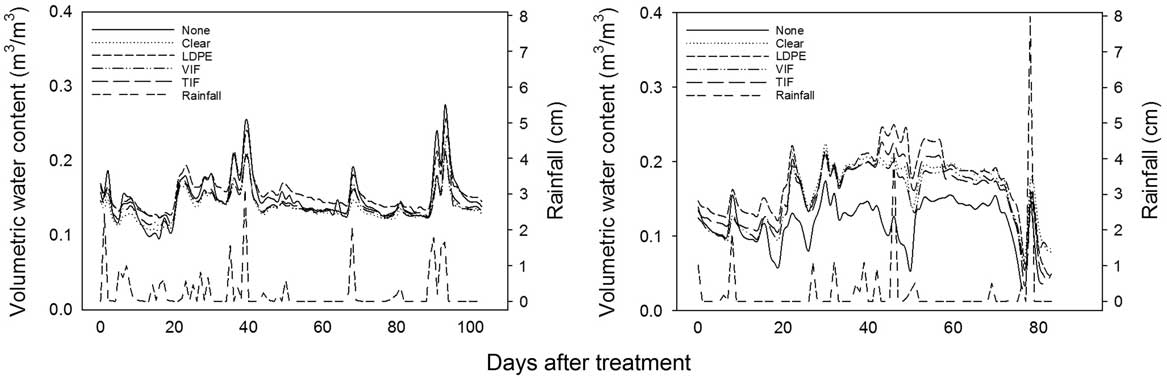
Fomesafen persisting at greater concentrations under black/white plastic mulch was reported previously (Bond and Walker Reference Bond and Walker1989; Grey et al. Reference Grey, Vencill, Mantripagada and Culpepper2007). Black/white mulch treatments may have reduced fomesafen dissipation by limiting sunlight penetration compared with no-mulch treatment from bare-ground treatments. Fomesafen readily photodecomposes, and bed top applications leave the herbicide exposed to sunlight (Shaner Reference Shaner2014). Greater fomesafen dissipation for bare-ground treatment may have been further influenced by rainfall leaching (Figure 1). Fomesafen potential for leaching in sandy soils has been established (Weber Reference Weber1993b; Weissler and Poole 1982). In 2016 rainfall may have influenced fomesafen concentrations at harvest across mulch treatments. Before the harvest sampling date, a period of 26 d with less than 1 cm of rainfall was followed by 7.98 cm of rainfall in 1 d that caused flooding. Throughout both growing seasons volumetric water content in the top center of the bed was affected by rainfall.
Daily average volumetric water content at 0.1-m depth under assorted plastic mulches and rainfall during the experimental period in 2015 and 2016 in Balm, FL.

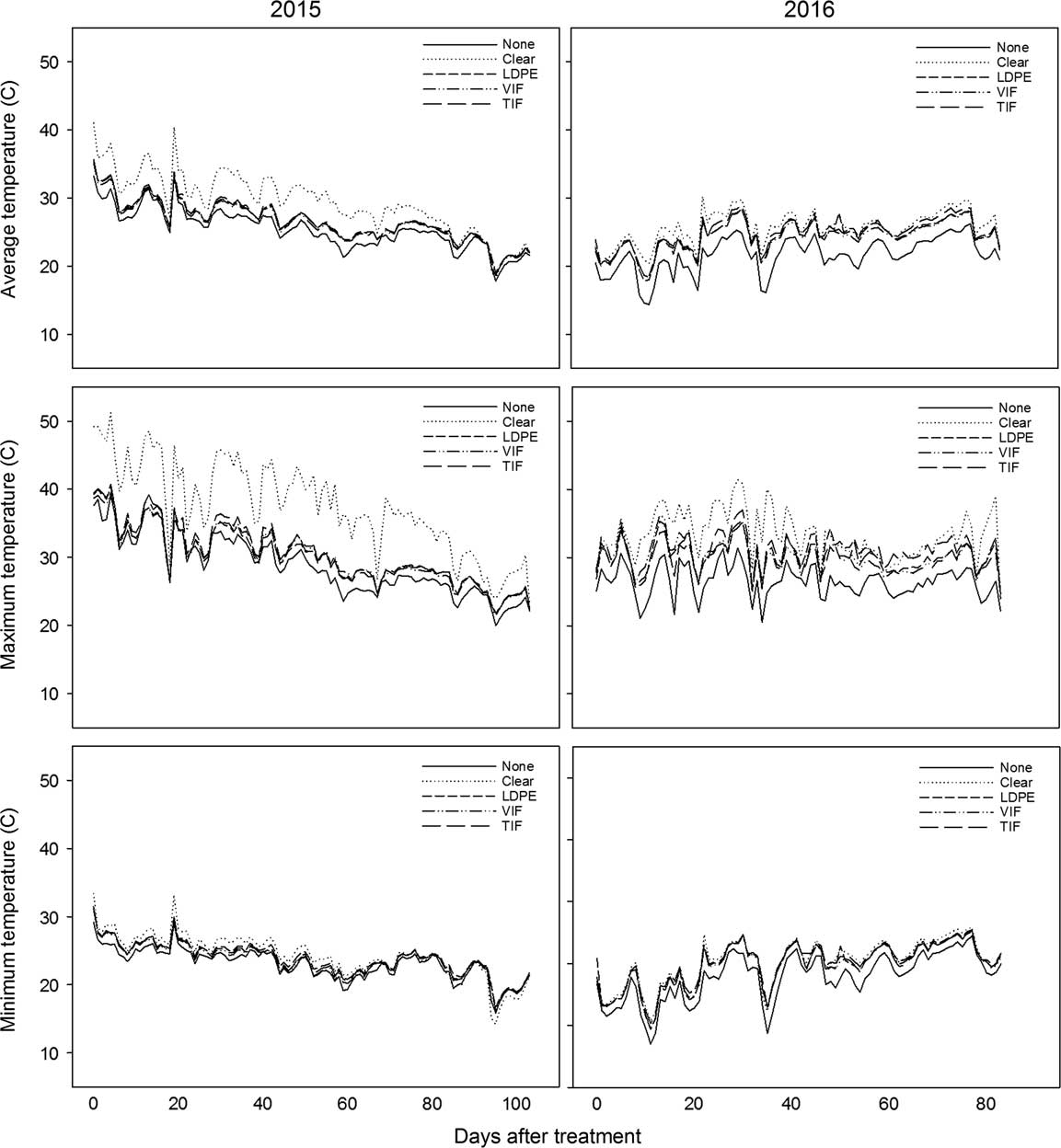
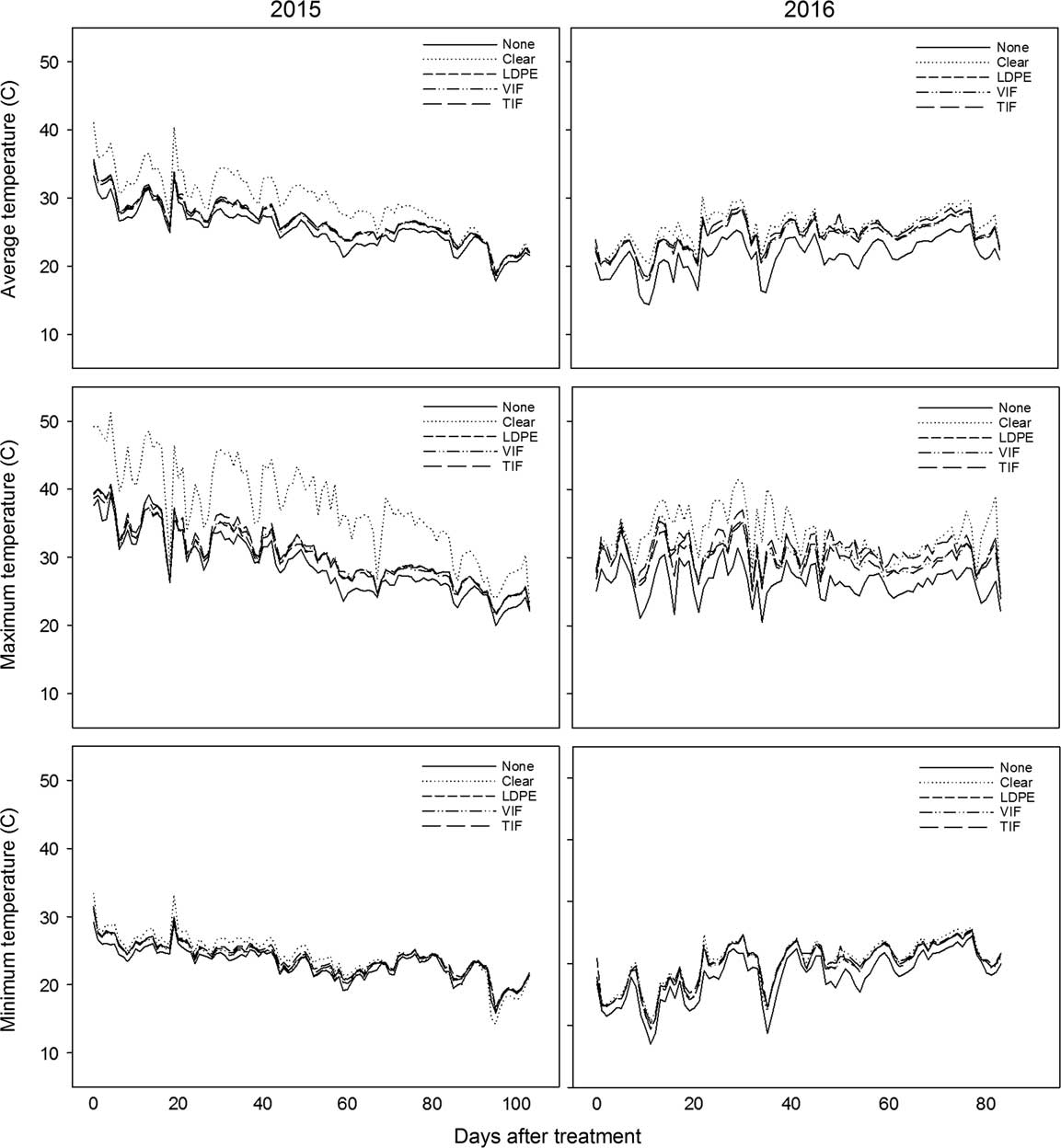
Degradation of herbicides in soil can be influenced by temperature and soil moisture content. Typically, rates of herbicide loss increase with greater temperature and moisture (Bond and Walker Reference Bond and Walker1989). The no-mulch and clear mulch treatments had the most extreme cool and warm temperatures, respectively (Figure 2). In 2015 the clear mulch had daily maximum temperatures reaching 40 C on 40% of experimental days. In 2016 the treatment without mulch had 90% of average daily temperatures below 25 C. The type of black/white mulch did not influence fomesafen concentrations on sampling dates and appeared to have had similar soil moisture and temperature.
Daily average soil temperatures at 0.1-m depth under assorted plastic mulches during the experimental period in 2015 and 2016 in Balm, FL.
Squash Tolerance
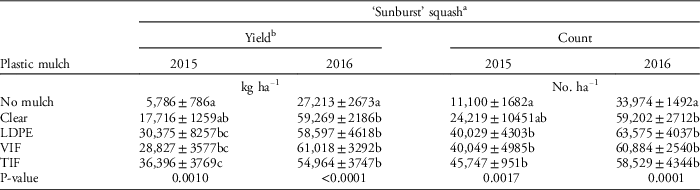
Fomesafen applications caused similar injury to squash (P=0.7349) across all treatments averaging 3±1% at 2 WAT, and no injury was observed at later evaluation dates. Squash height measurement date by treatment interaction was not significant (P=0.4498) and was averaged over evaluations. Squash height was similar across treatments (P=0.1309), averaging 27±1 cm. Squash yield in yield in kilograms per hectare and fruit number per hectare was greater in LDPE, VIF, and TIF mulch treatments than in the no-mulch treatment in the 2015 and 2016 growing seasons. Squash fruit number per hectare was similar across treatments with plastic mulch in both growing seasons (Table 3). Squash yield in kilograms per hectare was similar across treatments with mulch in the 2016 growing season. However, TIF mulch treatment had greater yield in kilograms per hectare than the clear treatment in the 2015 growing season. The squash yield in the clear treatment in 2015 may have been reduced due to limited squash plants surviving to harvest. Squash survival in all treatments was greater than 95%, except for squash grown in clear mulch in the 2015 season, which had 30% survival (unpublished data). High soil temperatures observed with the clear mulch treatment likely contributed to limited squash survival in 2015 growing season (Figure 2). Early transitory injury to summer and winter squash (Cucurbita maxima Duchesne) with no impact on yield has been previously observed with PRE fomesafen applications at 0.28 to 0.35 kg ai ha−1 (Peachey et al. Reference Peachey, Doohan and Koch2012). Fomesafen has the potential to be used for weed control in squash production.
‘Sunburst’ squash counts and yield from PRE fomesafen applications at 0.42 kg ai ha−1 under assorted plastic mulches in field experiments in 2015 and 2016 in Balm, FL.

a Values given with standard error of the mean (±). Means within columns followed by different letters are significantly different at P<0.05 using Tukey’s adjusted means comparisons.
b Yield calculations based on single row with 0.6-m spacing between plants.
Nutsedge Control
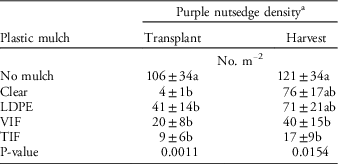
Evaluation date by treatment interaction was significant (P≤0.0001) for nutsedge density, and dates were analyzed separately (Table 4). The use of any plastic mulch reduced purple nutsedge density by 60% from no-mulch treatment at transplant. Treatments with TIF and VIF reduced nutsedge density greater than 60% compared with the no-mulch treatment at harvest. TIF and VIF mulches have low fumigant vapor permeation and are more resistant to stretching, tearing, and puncturing compared with LDPE and HDPE mulches (McAvoy and Freeman Reference McAvoy and Freeman2013; Qian et al. Reference Qian, Kamel, Stafford, Nguyen, Chism, Dawson and Smith2011; Qin et al. Reference Qin, Gao, Ajwa, Sullivan, D. Wang and Hanson2011).
Purple nutsedge density from preemergence fomesafen applications at 0.42 kg ai ha−1 under assorted plastic mulches in field experiments in 2015 and 2016 in Balm, FL.

a Evaluations at transplant and harvest were approximately 1 and 3 mo after fomesafen application, respectively. Values given with standard error of the mean (±). Means within columns followed by different letters are significantly different at P<0.05 using Tukey’s adjusted means comparisons.
Plasticulture production with black/white mulches decreases fomesafen dissipation compared with open field production. Potential fomesafen persistence may limit grower options of crops and rotations. However, squash tolerance of fomesafen may give producers an additional weed management tool if efficacy can be established. Additional research is necessary to determine the half-life of fomesafen in Florida vegetable plasticulture production and to identify the mechanisms of dissipation.