Letters are the basic building blocks of writing, and learning about letters and their properties is an important foundation for reading and spelling (Snow, Burns, & Griffin, Reference Snow, Burns and Griffin1998). Particularly important is learning about the links between letters and the sounds they represent. Letter–sound knowledge is critical for decoding of words, and differences among children in reading comprehension often reflect skill differences at the word level (Perfetti, Reference Perfetti2007). Supporting these ideas, research shows that children who are poor at providing the sounds of visually presented letters are at elevated risk of reading problems (e.g., Hulme, Bowyer-Crane, Carroll, Duff, & Snowling, Reference Hulme, Bowyer-Crane, Carroll, Duff and Snowling2012; Schatschneider, Fletcher, Francis, Carlson, & Foorman, Reference Schatschneider, Fletcher, Francis, Carlson and Foorman2004). These children’s reading skills improve when they are explicitly taught about the links between letters and sounds (e.g., McArthur et al., Reference McArthur, Sheehan, Badcock, Francis, Wang, Kohnen and Castles2018).
Building on the idea that knowledge of letter sounds is important for reading, we asked in the present study whether and why children perform better on some letter sounds than others. This is an important topic, because findings can shed light on the factors that influence children’s letter–sound learning and can help in the design of phonics instruction. For example, if children have particular difficulty learning the sounds of vowel letters, as Stuart and Coltheart (Reference Stuart and Coltheart1988) suggested, then teachers might be advised to spend more time on these correspondences.
Among the relatively few studies that have investigated differences across letters in letter–sound knowledge in learners of English, most involve children in the United States and Canada. The order in which letters are taught varies widely across schools and classrooms in these countries, making it difficult to control for order of teaching when testing hypotheses about other factors that may cause children to perform better on some letter sounds than others. The present study was conducted with children in England at a time when schools generally taught the sounds of letters in an order specified by a government-mandated curriculum (Department for Education and Skills, 2001). In this curriculum, letter sounds are taught through drill and repetition starting from the beginning of Reception Year (around age 5), and children learn to decode words using the taught sounds. By including the government-mandated order of teaching in our statistical models, we could control for effects of school instruction in a way that has not been possible in most previous studies. We could determine whether children perform better on some kinds of letter–sound correspondences than predicted given order of teaching and worse on others.
We tested five hypotheses about the factors that contribute to variations across letters. According to the own-name advantage hypothesis, children perform better than otherwise expected on the letters in their name, reflecting their special interest in these personally important letters and their greater exposure to them in informal learning situations. Given the salience of the initial letter of the first name, most investigations of the own-name advantage hypothesis have focused on this letter. Several studies have found an advantage in letter–sound knowledge for the initial letter of the first name (Huang, Tortorelli, & Invernizzi, Reference Huang, Tortorelli and Invernizzi2014, for US children; Levin & Aram, Reference Levin, Aram, Ravid and Shyldkrot2005, and Treiman, Levin, & Kessler, Reference Treiman, Levin and Kessler2012, for Hebrew-speaking children). Other studies, however, found little or no evidence for such an effect (Piasta, Phillips, Williams, Bowles, & Anthony, Reference Piasta, Phillips, Williams, Bowles and Anthony2016, and Treiman & Broderick, Reference Treiman and Broderick1998, for US children). The present study was the first to examine whether, in the letter–sound task, children from England perform better on the initial letter of their first name than expected based on other factors.
The letter–sound task of the present study used lowercase letters, some of which are visually confusable with others. For example, ‹d› is similar in shape to ‹b›, ‹p›, and ‹q›. When asked to name visually presented letters, US and Australian children perform more poorly on lowercase letters that are quite visually similar to other letters than on those that are more distinctive (Bowles, Pentimonti, Gerde, & Montroy, Reference Bowles, Pentimonti, Gerde and Montroy2013; Huang & Invernizzi, Reference Huang and Invernizzi2014; Treiman & Kessler, Reference Treiman, Kessler and Kail2003). We do not know of any studies that have tested the visual confusability hypothesis for lowercase letters of the Latin alphabet in the letter–sound task, and we did so here.
The acrophonicity hypothesis states that children perform better on the letter–sound task on letters for which the sound appears in the first position of the letter’s name than on letters for which this is not the case. For example, ‹v› is acrophonic in that its sound, /v/, is at the beginning of its name. The letters ‹l› and ‹w› are not acrophonic, for the sound of ‹l› appears at the end of its name and the sound of ‹w› is not in its name. Many studies show that US and Canadian children perform better on acrophonic than non-acrophonic letters in the letter–sound task (Ellefson, Treiman, & Kessler, Reference Ellefson, Treiman and Kessler2009; Evans, Bell, Shaw, Moretti, & Page, Reference Evans, Bell, Shaw, Moretti and Page2006; Huang et al., Reference Huang, Tortorelli and Invernizzi2014; Kim, Petscher, Foorman, & Zhou, Reference Kim, Petscher, Foorman and Zhou2010; McBride-Chang, Reference McBride-Chang1999; Treiman & Broderick, Reference Treiman and Broderick1998; Treiman & Kessler, Reference Treiman, Kessler and Kail2003; Treiman, Tincoff, Rodriguez, Mouzaki, & Francis, Reference Treiman, Tincoff, Rodriguez, Mouzaki and Francis1998). The only study to have addressed this issue with children from England did not find an effect of acrophonicity (Ellefson et al., Reference Ellefson, Treiman and Kessler2009). This result, if replicable, may reflect the fact that, when children in England enter Reception Year, they are taught letter sounds but not letter names. The names are typically taught at school at the end of Reception Year or even in the following school year, Year 1. If letter–name knowledge is weak or nonexistent when sounds are introduced, children may not use letters’ names to help learn and remember the sounds, resulting in no benefit for acrophonicity.
The order of speech sound acquisition hypothesis states that letter–sound correspondences for which the sound is mastered at an early age are easier for children to learn than those for which the sound is acquired later. According to this hypothesis, the ‹m›–/m/ correspondence should be easier than the ‹v›–/v/ correspondence because children learn to pronounce /m/ at a younger age than /v/. Justice, Pence, Bowles, and Wiggins (Reference Justice, Pence, Bowles and Wiggins2006) found modest support for the order of speech sound acquisition hypothesis in their study of US 4-year-olds, but their analyses were restricted to a subset of consonant letters and to the letter–name task. To our knowledge, no previous study has tested the order of speech sound acquisition hypothesis for the letter–sound task, and we did so here.
We also tested a hypothesis put forward by Stuart and Coltheart (Reference Stuart and Coltheart1988) according to which children perform better in the letter–sound task on letters that correspond to phonemes that occur at the boundaries of syllables than letters that correspond to phonemes that tend to occur closer to the middles of syllables. The reason for this, according to the syllable position hypothesis, is that phonemes at the boundaries of syllables are more easily segmented from the rest of the syllable and more easily treated as separate phonemes. Obstruent consonant phonemes, which include stop consonants such as ‹p›, fricative consonants such as ‹s›, and affricates such as  , typically occur at the edges of syllables. Sonorant consonants, such as /m/, /l/, and /w/, tend to occupy the interior positions of consonant clusters and so tend to be closer to the middles of syllables. According to Stuart and Coltheart, sonorant consonants are therefore harder to connect to letters than are obstruents. Vowels often occur in the middle of syllables and are, according to Stuart and Coltheart’s syllable position hypothesis, most difficult for children to link to letters. In the letter–sound task of Stuart and Coltheart, English Reception Year and Year 1 pupils performed better on letters with obstruent consonant sounds than on letters with sonorant consonant or vowel sounds, in line with the syllable position hypothesis. However, the only other study to have tested this hypothesis did not find consistent evidence in favor of it (Treiman et al., Reference Treiman, Tincoff, Rodriguez, Mouzaki and Francis1998).
Researchers have used different methods to test hypotheses about why children perform better on some letter sounds than others. Some studies have compared mean levels of performance on different groups of letters. The only two studies to date to have analyzed data from children in England, Ellefson et al. (Reference Ellefson, Treiman and Kessler2009) and Stuart and Coltheart (Reference Stuart and Coltheart1988), used this approach when they compared acrophonic letters to non-acrophonic letters and letters that correspond to obstruents to letters that correspond to other phonemes. A drawback of this approach is that letters in different groups could potentially differ in other characteristics that influence children’s performance. In the present study, we used a different approach: mixed-effects logistic regression with data at the level of individual children’s responses to individual letters. This approach, which has been used in some previous studies of US children (e.g., Huang et al., Reference Huang, Tortorelli and Invernizzi2014; Kim et al., Reference Kim, Petscher, Foorman and Zhou2010; Piasta & Wagner, Reference Piasta and Wagner2010), allows us to ask whether each letter characteristic affects performance when other characteristics are statistically controlled. We included the order in which the letter was taught in the government-mandated curriculum as a control variable, and we tested for effects of variables pertaining to visual confusability, acrophonicity, order of speech sound acquisition, and syllable position, as well as whether a letter was the initial letter of the child’s first name. Although letter-related rather than child-related factors were the primary focus of the study, our statistical models also included children’s year in school: Nursery, Reception Year, or Year 1. We explored whether the effects of other variables differed as a function of children’s year in school by testing for interactions.
To summarize, we used data from Nursery, Reception Year, and Year 1 children in England to test hypotheses about why children show better knowledge of some letter sounds than others. Specifically, we tested the own-name advantage hypothesis, the visual confusability hypothesis, the acrophonicity hypothesis, the order of speech sound acquisition hypothesis, and the syllable position hypothesis. Findings should shed light on the factors that are associated with letter–sound knowledge and should have implications for how this body of knowledge should be taught and for how children learn to decode words.
Method
Participants
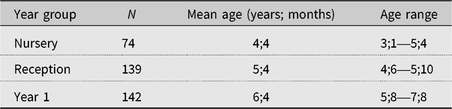
The participants were 355 (175 female) English students in Nursery, Reception Year, and Year 1. They were tested during the course of standardizing the York Assessment of Reading for Comprehension Early Reading Test (Hulme et al., Reference Hulme, Stothard, Clark, Bowyer-Crane, Harrington, Truelove and Snowling2009). Twenty-two schools in different areas of England were chosen to take part in the study. Twenty-one of them were state-funded schools (9 suburban, 6 rural, and 6 inner city), and 1 was a fee-paying independent school. (Schools from Northern Ireland and Wales also participated in the standardization, but we did not include these data in the present analyses because literacy teaching in these areas differs in some respects from literacy teaching in England.) The proportion of children who received free meals at school, an indication of pupils’ socioeconomic status, ranged from 0% to 58% across schools (this information was not available for 6 of the schools). Within each school, children were randomly selected to take part based on their date of birth. Table 1 provides information about the number of students at each grade level and their ages. The lower number of pupils in Nursery than in other years reflects the fact that some of the selected schools did not have nurseries. Of the 322 students whose racial background was reported, 73% were White, 15% Asian, and 5% Black. The remaining 7% had another background or were of mixed backgrounds. Twenty percent of the students were reported to have a first language other than English.
Descriptive information for children in each year group

Procedure
We used data from the extended letter–sound knowledge test of the York Assessment of Reading for Comprehension Early Reading Test. For this test, which took about 5 min, children received a booklet in which each lowercase letter appeared on a separate page in black print on a white background. The letters were in a scrambled order, not alphabetical, in a font commonly used in English schools. Children were asked to say the sound of each letter. The examiner scored the child as correct or incorrect following the sounds that are taught for letters in England. These include the “short” sounds of vowels and the “hard” sounds of ‹c› and ‹g›. The booklet included six digraphs, but we did not include these in our analyses.
Coding
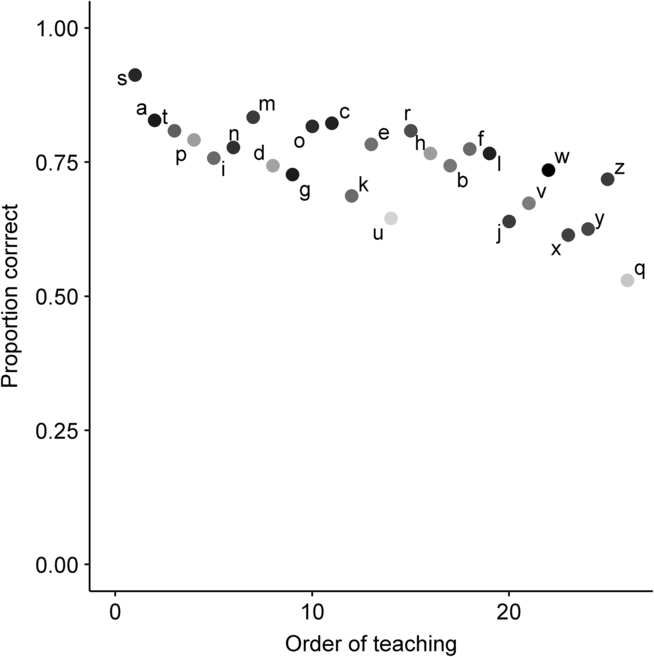
A correct response on a trial was coded as 1 and an incorrect response as 0. The letter presented on each trial was coded for the order in which it is taught in the government-mandated national literacy curriculum that, at the time of the study, was used in most schools in England (Department for Education and Skills, 2001). Letter order ranged from 1 for ‹s› to 26 for ‹q› (see Figure 1 for information about the position of each letter in the teaching order). We centered these values for use in the statistical analyses.
Proportion of correct responses pooled across all children as a function of order in which letters are taught in the government-mandated curriculum. Darker points correspond to letters that are less visually confusable with other letters and lighter points correspond to letters that are more visually confusable.

To test the own-name advantage hypothesis, we coded whether the letter on each trial appeared in the first position of the child’s first name. We did not have access to information about the letters of children’s first names beyond the initial letter.
To test the visual confusability hypothesis, we coded the visual confusability of each letter with other lowercase letters using data from a study in which 65 US children with a mean age of approximately 5.5 years judged which of two lowercase letters matched a target letter (Popp, Reference Popp1964). We calculated the mean number of confusions of each letter with each of the other 25 letters, and we used the centered values in our analyses. Among the most confusable letters by this measure are ‹b›, ‹d›, ‹p›, and ‹q›. The letters ‹h› and ‹u› are also high in visual confusability because children sometimes confuse them with each other and with ‹n›.
Each letter was also coded for whether it is acrophonic, that is, whether its name begins with the sound that is taught for it in the government-mandated literacy curriculum. We classified ‹b›, ‹d›, ‹j›, ‹k›, ‹p›, ‹t›, ‹v›, and ‹z› as acrophonic and other letters as nonacrophonic.
To evaluate the order of speech sound acquisition hypothesis, we coded letters that correspond to vowels and to the eight consonant phonemes listed by Shriberg (Reference Shriberg1993) as being acquired early (/m/, /b/, /j/, /n/, /w/, /d/, /p/, /h/) as corresponding to earlier acquired phonemes. Letters that correspond to consonants in Shriberg’s middle and late groups were coded as later acquired; ‹q› and ‹x› were also so coded because their taught sounds include consonant clusters.
To test the syllable position hypothesis, we coded each letter as corresponding to an obstruent phoneme (a stop, fricative, or affricate) or a sonorant phoneme (a nasal, liquid, glide, or vowel). We did not code ‹q› and ‹x› for sonority because they do not map to a single phoneme.
The only statistically significant correlations among the letter-related predictor variables were those between sonority and acrophonicity (no acrophonic letters correspond to sonorant phonemes) and between sonority and order of acquisition (sonorants are more likely to be in the early acquired category). We did not include sonority in the same analyses as acrophonicity or order of acquisition, avoiding the problems that can result from use of correlated predictors.
Results
We carried out mixed-effect model analyses using the software package lme4 (Bates, Mächler, Bolker, & Walker, Reference Bates, Mächler, Bolker and Walker2015) within the R environment (R Core Team, 2018; R version 3.5.0), selecting generalized mixed-effects models with a logit link function and including random intercepts for children. The analyses were conducted at the level of individual children’s responses to individual letters. The data and analysis scripts may be found at (https://osf.io/kn365/).
Our first model included the variables that were defined for all letters of the alphabet (order of teaching, acrophonicity, visual confusability, and order of sound acquisition) as well as initial position of child’s first name and child’s year in school. As expected, we found a main effect of order of teaching, such that children tended to perform more poorly on letters that are later in the teaching sequence than letters that are earlier (b = –0.10, SE = 0.01, p < .001, odds ratio [OR] = 0.90; note that a statistically significant OR of greater than 1 indicates a positive association with the outcome variable while a statistically significant OR of less than 1 indicates a negative association). The effect of order of teaching is shown in Figure 1, which plots the proportion of correct responses pooled across all children as a function of the order of the letter in the government-mandated curriculum. Supporting the own-name advantage hypotheses, we found that children tended to perform better on the first letter of their first name than expected on the basis of other factors (b = 0.89, SE = 0.23, p < .001, OR = 2.44). To illustrate, the mean proportion of correct responses was .83 when a letter was the first letter of a child’s first name and .74 when it was not. Visual similarity also had a significant effect. If a letter was more visually similar to other letters, children tended to perform more poorly than expected on the basis of other factors (b = –0.94, SE = 0.11, p < .001, OR = 0.39). We illustrate this effect in Figure 1 by scaling the darkness of the points by the measure of visual confusability, with lighter points for letters that are more visually similar to others and darker points for letters that are more visually distinctive. As the figure shows, some of the letters on which children performed more poorly than anticipated given the order of teaching, including ‹u› and ‹q›, were quite visually confusable with others. Acrophonic letters (coded as 1) were not easier than nonacrophonic letters (coded as 0; b = –0.14, SE = 0.08, p = .09, OR = 0.87), a finding that does not support the acrophonicity hypothesis. In addition, letters that correspond to earlier acquired sounds (coded as 1) did not give rise to significantly better performance than letters that correspond to later acquired sounds (coded as 0; b = –0.01, SE = 0.08, p = .94, OR = 0.99). It is not surprising that there were statistically reliable differences across year groups, with the proportion of correct responses being .21, .84, and .93 for children in Nursery, Reception Year, and Year 1, respectively. Treating Nursery as the reference level, the model showed a significant superiority for Reception (b = 4.87, SE = 0.30, p < .001, OR = 130.26) and Year 1 students (b = 6.19, SE = 0.31, p < .001, OR = 489.76).
We carried out two additional analyses to probe the acrophonicity hypothesis. One concern about the preceding analysis stems from the fact that ‹h› was counted as nonacrophonic because its name as standardly pronounced does not begin with /h/, its sound. This decision may be questioned, however, because the letter’s name is sometimes pronounced with an initial /h/ in colloquial speech in England. We therefore ran a model that did not include data from ‹h›. The effect of acrophonicity remained nonsignificant. Given that US children appear to derive some benefit from letter names that have the sound of the letter at the end (e.g., Huang et al., Reference Huang, Tortorelli and Invernizzi2014; Piasta & Wagner, Reference Piasta and Wagner2010; Treiman et al., Reference Treiman, Tincoff, Rodriguez, Mouzaki and Francis1998), we conducted another analysis that omitted letters of this sort (‹f›, ‹l›, ‹m›, ‹n›, ‹s›, and ‹x›) and that also omitted ‹h›. In this analysis, which contrasted letters with the sound at the beginning of the name to letters without the sound in the name, the effect of acrophonicity was again not significant.
In another model, we tested the syllable position hypothesis by asking whether the sonority of the phoneme to which a letter corresponded was influential. This model excluded data for ‹q› and ‹x›, which as discussed earlier were not coded for sonority. In addition to the effect of sonority, we included the effects that were significant in the preceding analyses, namely order of teaching, initial letter of child’s first name, visual confusability, and year group. The syllable position hypothesis predicts that obstruents (coded as 1) should be easier than sonorants (coded as 0), but we did not find a significant effect of sonority (b = 0.09, SE = 0.08, p = .28, OR = 1.09).
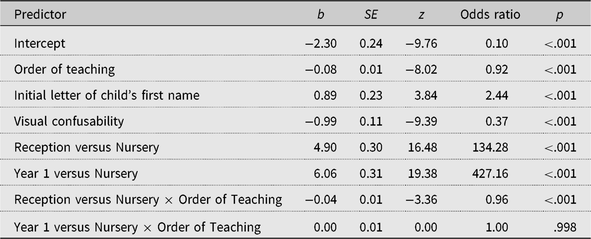
To determine whether the effects of other variables depended on year group, we fitted a model that included the interaction of each of order of teaching, initial letter of child’s first name, and visual similarity with year group. According to a likelihood-ratio test, the model that included the interactions was a significantly better fit than a model that included the main effects of order of teaching, initial letter of name, visual similarity, and year group but not the interactions (p < .001). This reflected the presence of a significant interaction between order of teaching and the contrast between Nursery and Reception Year, such that order of teaching had a stronger impact in Reception Year than in Nursery. We simplified the model by removing the nonsignificant interactions of order of teaching with initial letter of name and visual similarity, and we confirmed that this did not weaken the model significantly by a likelihood-ratio test. Table 2 shows the details of the fixed-effect predictors in the final model. According to the method of Nakagawa and Schielzeth (Reference Nakagawa and Schielzeth2013), the proportion of variance accounted for by the fixed effects was .48 and the proportion of variance accounted for by the fixed and random effects was .74.
Results of final mixed-model analysis

Discussion
Learning the sounds of letters is a crucial step in learning to read an alphabetic writing system, and one that is problematic for some children. In the present study, we tested a number of hypotheses about the factors that influence letter–sound learning by examining data from English children who were taught the sounds of letters of the alphabet in a prescribed order, before they learned the letters’ names.
As we anticipated, knowledge of letter sounds was better for letters that were earlier in the government-recommended teaching sequence than for letters that were later. Order of teaching was especially influential during Reception Year, when much of the teaching about letter sounds takes place. Statistically controlling for teaching order in our analyses permitted a more sensitive examination of other factors that influence children’s learning than has been possible in previous studies.
We found a significant advantage for the initial letter of the child’s first name, which did not weaken reliably across the age range covered by our study. Previous studies, as discussed above, have found mixed evidence on whether US children perform better on the initial letter of their first name than otherwise expected in the letter–sound task. Our results provide evidence for such an effect for children from England. Children’s elevated performance on the initial letter of their first name is likely to reflect special attention to this letter and additional exposure to its oral and written form outside of school. According to studies conducted in the United States (we are not familiar with any such studies from England), letter-related talk between parents and their young children often focuses on the initial letter of words and of children’s names in particular, and children sometimes refer to the first letter of their name as “my letter” (Treiman et al., Reference Treiman, Schmidt, Decker, Robins, Levine and Demir2015; Welsch, Sullivan, & Justice, Reference Welsch, Sullivan and Justice2003). Interestingly, we found a significant advantage for the initial letter of the first name even though we presented the letters to the children in lowercase rather than uppercase, the form in which they appear at the beginnings of printed names. This result, which is similar to that of Treiman and Kessler (Reference Treiman and Kessler2004) for the letter–name task, suggests that children’s knowledge about the initial letter of their first name is not limited to a particular case but is more abstract. Developing abstract letter identities is an important part of literacy development (Thompson, Reference Thompson2009), and the findings point to early emergence of such knowledge for at least the first letter of the name.
Items that are confusable with one another cause difficulty for learning in a number of domains, and we saw effects of visual confusability in the present study. When order of teaching was statistically controlled, letters that were more visually confusable with others led to poorer performance on the letter–sound task than letters that were less visually confusable. These results extend previous findings with the letter–name task (Bowles et al., Reference Bowles, Pentimonti, Gerde and Montroy2013; Huang & Invernizzi, Reference Huang and Invernizzi2014; Treiman & Kessler, Reference Treiman, Kessler and Kail2003) to the letter–sound task, and they show that visual confusability is problematic throughout the age range examined here. Some of the errors that children make when decoding words reflect the visual confusability of letters, and these errors may persist for many years in children with reading difficulties (Liberman, Shankweiler, Orlando, Harris, & Berti, Reference Liberman, Shankweiler, Orlando, Harris and Berti1971; Werker, Bryson, & Wassenberg, Reference Werker, Bryson and Wassenberg1989).
In a previous study of children from England, Ellefson et al. (Reference Ellefson, Treiman and Kessler2009) found that children did not perform better on the letter–sound task on letters whose names begin with their sounds than on letters for which this is not the case. The present study found null results regarding acrophonicity using better statistical controls. This finding, which contrasts with the strong support for the acrophonicity hypothesis that has been found in studies of US and Canadian children (Evans et al., Reference Evans, Bell, Shaw, Moretti and Page2006; Huang et al., Reference Huang, Tortorelli and Invernizzi2014; Kim et al., Reference Kim, Petscher, Foorman and Zhou2010; McBride-Chang, Reference McBride-Chang1999; Treiman & Broderick, Reference Treiman and Broderick1998; Treiman & Kessler, Reference Treiman, Kessler and Kail2003; Treiman et al., Reference Treiman, Tincoff, Rodriguez, Mouzaki and Francis1998), can be explained by the fact that the literacy curriculum in England at the time of this study taught the sounds of the letters before the names. If children do not know a letter’s name when they learn its sound, they cannot use the name to help learn and remember the sound. Thus, there can be cross-cultural differences in letter–sound learning even within the same language. An advantage in the letter–sound task for letters with acrophonic names is found in some cultures but not others, depending on whether letter sounds are taught when children already have an entrenched knowledge of letter names.
Two hypotheses pertaining to the characteristics of the sounds that letters represent were not supported in our study. One of these was the order of speech sound acquisition hypothesis (Justice et al., Reference Justice, Pence, Bowles and Wiggins2006), which states that children find it easier to learn the sounds of letters that correspond to earlier acquired speech sounds than the sounds of letters that correspond to later acquired speech sounds. Another was the syllable position hypothesis (Stuart & Coltheart, Reference Stuart and Coltheart1988), which states that it is harder for children to learn the sounds of letters that correspond to vowels and sonorant consonants than to learn the sounds of letters that correspond to obstruent consonants. This lack of support for the syllable position hypothesis suggests that English-speaking children’s well-documented difficulties in decoding vowels (e.g., Fowler, Liberman, & Shankweiler, Reference Fowler, Liberman and Shankweiler1977) do not reflect a special difficulty in learning correspondences that involve vowel phonemes. Rather, children’s difficulties in decoding vowels probably reflect the fact that vowels sometimes do not have their taught correspondences in English words.
To summarize, we found that, when letter sounds are explicitly taught in advance of letter names, two factors contribute to differences in performance across letters beyond order of teaching. The first is the presence of the letter in the initial position of a child’s first name, an index of informal exposure and interest. The second is the visual similarity of the letter to others. Factors related to the types of sounds that the letters represent in words do not appear to be influential.
Explicit teaching of letter–sound correspondences is “the fastest, most efficient way of making children efficient readers, both for pronunciation and for comprehension purposes” (Dehaene, Reference Dehaene, Battro, Dehaene and Singer2001, p. 23), and our results have some implications for how this body of knowledge should be taught. It makes sense to teach commonly used letters before less common ones, but what other factors should be considered when designing letter–sound instruction? It has been suggested that the order of teaching of letter–sound correspondences, especially for younger children, should consider the age at which children acquire the speech sounds (Dechant, Reference Dechant1970; Jones, Clark, & Reutzel, Reference Jones, Clark and Reutzel2013; Lehr, Reference Lehr1996). Our failure to support the order of speech sound acquisition hypothesis casts doubt on this idea. In addition, our findings do not support the idea (Earle & Sayeski, Reference Earle and Sayeski2017) that the sonority of the phoneme to which a letter corresponds should be considered when designing an order for letter teaching. Some discussions of letter–sound learning that are directed at educators imply that acrophonicity influences children in all cultures and have made recommendations that are based on this assumption, such as that letters with acrophonic names be taught before those with nonacrophonic names (Jones et al., Reference Jones, Clark and Reutzel2013). However, our results point to cross-cultural differences in the effects of acrophonicity. Our results do suggest that more time should be spent on lowercase letters that are visually very similar to other letters, perhaps using additional instructional techniques. Separating visually similar letters from one another in the sequence of instruction may also be helpful (Earle & Sayeski, Reference Earle and Sayeski2017; Groff, Reference Groff1972). Our results further suggest that it may be useful to take advantage of the letters in children’s names when teaching letter–sound correspondences (Jones et al., Reference Jones, Clark and Reutzel2013). For example, a child may be more motivated to learn about a letter when a teacher points out that the letter is in a classmate’s name.
Some limitations of the present study must be considered when drawing conclusions. There were fewer children at the Nursery level than the other levels, and the letters were presented in the same order to all children. We did not conduct observations in classrooms to examine the degree to which teachers adhered to the government-mandated teaching sequence and the time they spent on each letter. In addition, we did not consider the possible influence of letters in the child’s name beyond the initial letter of the first name. It would be valuable to address these limitations in future work and to collect the longitudinal data that would be needed to examine learning across time.
Despite some limitations, the present results have some important implications for the learning and teaching of alphabet knowledge. Even when a set of letters is fairly small, as it is with the Latin alphabet, learning about letter sounds can be difficult for some children. An understanding of the factors that cause certain letters to be especially difficult can help educators address these problems. Learning about the symbols of a writing system is more protracted when the number of symbols is larger (e.g., Nag, Snowling, Quinlan, & Hulme, Reference Nag, Snowling, Quinlan and Hulme2014), and further work will be needed to determine the applicability of the principles examined here to other symbol systems.
Author ORCIDs
Rebecca Treiman, 0000-0002-6819-8338
Acknowledgments
This research was supported in part by NICHD Grant HD051610 and by a Leverhulme Visiting Professorship (to R.T.).