When the facts change, I change my mind. What do you do, sir?
—John Maynard Keynes
In 1987 Irish employers agreed to the adoption of centralized wage bargaining, an institutional innovation they had previously resisted strenuously.1
In 1993 Italian employers accepted a nationally coordinated bargaining system that officially allowed firm-level bargaining, which they had previously rejected categorically as an unacceptable institutional arrangement.2Trentin 1994.
Rationalist political scientists emphasize that the changes of mind exhibited by Irish and Italian organized employers must result from a change in their strategic situation, not a change in their underlying material preferences.3
For example, Clark 1998. Rationalists stress that a change in preferences over institutional outcomes means a change in “induced preferences over strategies of how to achieve basic ends” (Weingast 2005, 162), rather than any change in fundamental material preferences. The term institutional preferences as used throughout this article refers to preferences over institutional outcomes, not to fundamental preferences. See Hall 2005, 131–32 for a critique of this binary distinction.
See Ruggie 1998; Wendt 1999; and Bially Mattern 2005 for different constructivist approaches to the politics of identity.
Chwe 2001.
Wendt 1999.
Katzenstein, Keohane, and Krasner 1998, 680–82.
Over the past twenty years, Ireland and Italy are two of a number of European countries that have used social pacts to attempt to move from disorganized, conflictual bargaining institutions toward the sort of coordinated arrangements characteristic of the “small states in world markets” described by Katzenstein.9
Unlike in most of these countries, though, the Irish and Italian social pacts actually led to durable moves to more highly coordinated wage bargaining institutions. Social pacts are centralized agreements among governments, unions, and employers' associations that trade off government reforms of fiscal and labor market policy for wage moderation from employers and unions. Such pacts typically emerge from coalitions between weak governments facing economic crisis and battered union federations confronting membership losses, and they have rarely led to long-term institutional changes in domestic economies.10 In the conclusion I show how the process of common knowledge creation has implications well beyond Ireland and Italy. In countries that confront the challenge of adjusting to international market competition—and most countries today face this challenge—the ability to adopt economic institutions of nonmarket coordination depends to some extent on the ability to establish agreement over the potential gains to such coordination.The political act of creating common knowledge between rival social groups has much in common with processes of persuasion studied by constructivist scholars of international institutions.11
The approach to persuasion developed in this article gives primacy to the use of reasoned argument about cause and effect in a context of shared experience.12 Unions and employers will shift their shared models of the economy—both their causal models of its functioning and their beliefs about the motivations of the other bargaining partner—only when their existing model has shown itself to be flawed, usually through a period of economic crisis or stagnation. They find themselves, therefore, in a period of institutional experimentation, and the uncertainty endemic to such periods influences the sort of ideas that can emerge as the new basis of shared economic understandings between them. The ideas most likely to form the basis of new shared understandings will be those that have analytical and distributive appeal to both parties: they will respond to the failures of the preexisting institutions, but they will also yield potential benefits for unions as for employers. The act of collective interpretation of shared experience is thus firmly anchored in the material preferences of these competing actors, even as it is governed by the cognitive search for solutions to real-world problems.13The emergence of shared ideas in a highly contested area such as wage bargaining must be ratified in public agreements, which I call common knowledge events. Sewell proposed the “event” concept to describe “that relatively rare subclass of happenings that significantly transform structures.”14
Sewell 1996, 262.
Risse 2000.
I develop these propositions about the process of common knowledge formation in the following two sections before examining them empirically in the episodes of wage-bargaining negotiation in Ireland (1986–87) and Italy (1989–93). In both countries, union and employer bargaining at the beginning of the period was conflictual and decentralized.16
Baccaro 2003.
Common Knowledge Creation and Institutional Change
Common knowledge does not mean that you and I each know that a given ball is blue. It means that one knows that the other knows the ball is blue, and that the other knows that the other knows the ball is blue, and so forth.18
Geanakoplos 1992.
Wendt 1999, 161.
Most constructivists, including Wendt, have a much more expansive conception of the influence of shared ideas on social action. Searle identifies this distinction as separating individual from collective intentionality. Collective intentionality cannot be reduced to individual intentionality, because under it, “I intend only as part of our intending.”20
Searle 1995, 26.
Ibid., 23.
Ruggie 1998, 871.
The approach I take in this article is different. I demonstrate that even on the assumption of individual intentionality, the establishment of common knowledge still affects the ordering of favored institutional outcomes and has an independent impact on the bargaining power of actors. When the negotiating parties representing employers and unions jointly accept certain features of the economy as being correct, this common knowledge influences their future options. Because it is out of their individual control, it can result in their adopting institutional outcomes that they once denounced.
In wage bargaining, as in other institutions of the economy, the process of institutional change can usefully be divided into three distinct stages: crisis, experimentation, and consolidation.23
The problem of common knowledge creation in wage bargaining is that the representatives of unions and employers need to agree on a convergent diagnosis of the economy and some of the features of the solution to that problem. In normal times, these models of the economy are not easily called into question. Common knowledge creation happens only after periods of institutional crisis, once the “the taken-for-grantedness of the old institution [is] called into question” by a wide number of players.24Aoki 2001, 241.
Ibid., 242–43. A rationalist approach typically emphasizes the coordinative side of institutional “taken for grantedness.” Adler's constructivist approach emphasizes instead the importance of legitimacy in the process of how institutions come to be taken for granted. See Adler 2005, 105–9.
The analytical utility of disaggregating the process of institutional change into three stages is to highlight the preeminence of uncertainty during the second stage: that of institutional experimentation. Compelling recent accounts of institutional change emphasize that actors in such cases have material preferences that they pursue through processes of political change.26
These same accounts show, however, that the process of change is heavily influenced by the uncertainty of the players. How to reconcile these stable material preferences with the pervasive uncertainty characteristic of institutional experimentation is a major challenge for theories of institutional change. The first stage of change, that of institutional crisis, lays bare the fact that existing ways of thinking have a declining ability to predict the outcomes of joint interactions. As Blyth argues, ideas during this phase are often used instrumentally, as weapons to delegitimize existing institutions.27Blyth 2001.
Beckert 1996, 819.
Common knowledge creation, if it happens at all, takes place during the period of institutional experimentation, and the process of persuasion is central to it. During this phase, agreement between the actors emerges from the interplay of their well-defined preferences and their heightened uncertainty about some features of the world they inhabit. This is a point on which rationalists and constructivists remain far apart, analytically. For rationalists such as Weingast, the politics of persuasion is only about Bayesian updating: faced with uncertainty, “events beyond the direct control of the political entrepreneurs advocating the new idea help confirm the entrepreneur's views.”29
Weingast 2005, 163.
Blyth 2002, 38.
During the period of institutional experimentation, I posit that economic actors have some idea of the distributive consequences of any given institutional choice, but the uncertainty characteristic of institutional experimentation creates its own dynamic, such that neither is in complete control of the direction of the conversation. With both actors somewhat uncertain about the consequences of all potential solutions, the course of their argument is unpredictable; the victorious ideas are not simply those instrumentally deployed by the strongest actor. Instead, the uncertainty of experimentation increases the relative importance of Risse's logic of arguing over the logic of consequentialism.32
Risse 2000.
Winning ideas are selected through a process of winnowing. Both actors want to set the new shared understandings in a way that favors them. Winning ideas will have two features: they will respond to the most salient features of an old dilemma, and they will have crossover appeal to both negotiating partners. As Hall argued about Keynesian ideas, “the persuasiveness of economic ideas depends, in part at least, on the way those ideas relate to the economic and political problems of the day. In other words, persuasiveness is an inherently relational concept, determined as much by the shape of current economic and political circumstances as by the shape of the ideas themselves.”33
Hall 1989, 369–70.
I have highlighted that there are clear differences between the approach to ideational emergence taken in this article and those employed by prominent constructivists. It is important to note, too, the significant differences between this approach and other rationalist approaches to this topic. Notably, I do not follow the approach of Garrett and Weingast in conceptualizing ideas as constructed focal points.34
Garrett and Weingast 1993.
Schelling 1960, 69.
A focal point is an institutional solution on which actors interested in coordination, but uncertain how to achieve it, converge. Common knowledge, I will argue, plays a more substantial role in resolving the uncertainty of institutional experimentation. Among competing actors, common knowledge establishes certain assumptions of the world, including their organizational roles in it, as a shared fact. Prior to the establishment of such common knowledge, there is no clear mutual interest in a coordinated solution, because the assumptions of the game being played and the payoffs to different choices are unclear. Focal points are meaningless in the absence of common knowledge of the game being played. Common knowledge events reset shared expectations, creating the potential for gains from coordination that make focal points possible.
Schelling's insight about the importance of conspicuousness in situations of uncertainty remains important. The characteristic of conspicuousness matters for the selection of ideas because of its ability—established post hoc—to crowd out alternatives. What the representatives of employers' associations and unions like to do is bargain about wages, not argue about the world they inhabit. These interest-driven but uncertain actors will therefore gravitate quickly to solutions that allow them to resolve their shared uncertainty and get back to the game of bargaining. Writing about American politics, Kingdon distinguished between how ideas acquire support in the community of policy experts and with politicians: the first process is governed by persuasion, the second by bargaining. What is distinctive about processes of institutional experimentation in the economy is that the social actors play both roles; the “policy experts” are also the same social actors who must agree.36
This is the reason that epistemic communities—groups of experts “with an authoritative claim to policy-relevant knowledge” (Haas 1992, 3)—are not central players in processes of common knowledge formation. Ideas emerge as winning ideas not because authoritative experts say they are the right ideas, but because each actor considers the ideas against the evidence available to them and decides on their plausibility as well as their fit with existing interests. Once potential ideas emerge, however, epistemic communities may play the role of honest brokers as social actors debate the implications of alternative arrangements.
How Common Knowledge Events Influence Strategic Interaction
Observing how ideas become shared is much like watching grass grow: nothing seems to be happening in the short term, but one day a former patch of mud is suddenly green. The empirical marker of common knowledge creation is the moment when unions and employers step back and agree, publicly and mutually, that what has emerged from the mud is a lawn. Following the work of Sewell,37
Sewell 1996.
What are the empirical consequences of a common knowledge event? A common knowledge event tells each actor what the other actor knows about the way the economy works and the role of the social actors in it. Common knowledge thus creates social facts, and these facts can alter the payoff structures facing bargaining parties. If the economic worldview established through the event is one in which there is a gain to coordination—that is, to a bargained agreement—then the relative appeal of the best alternative to a negotiated agreement declines. Prior to the event, at least one of the partners was not publicly sold on the value of coordinated institutions. When the common knowledge event establishes those benefits with clarity, the partner reluctant to sign a deal based on these principles suddenly realizes there is more to lose by walking away from the bargaining table than by signing an imperfect deal.
In the empirical cases explored below, I show that the ideas eventually accepted by the two bargaining partners as the new reality—their new common knowledge—involved recognition of the goal of international wage competitiveness as central to wage bargaining. In this respect, unions moved further in their views than did employers' associations, which had long clamored for a more internationally oriented process of bargaining. In each case, unions rejected the initial claims of employers over long periods of time. The ideas eventually established as common knowledge were not those originally fashioned by employers. They were narratives that connected the recognition of the actors that they operated in an open economy to a changed perception of the role of organized bargainers in that economy.38
See Hall (2005, 135–37), for a discussion of how narratives link past experiences to present institutional preferences.
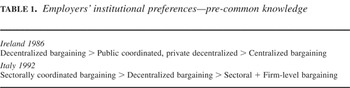
Like most hard-bitten rationalists, the representatives of employers' groups probably believed these agreements were nothing more than public declarations that would not affect their freedom of maneuver in future negotiations with unions. However, the narratives articulated in those agreements included assumptions about the reliability of unions as bargaining partners. This changed the way these employers thought about the value of coordinated outcomes. As depicted in Table 1, prior to the establishment of common knowledge in 1986, centralized bargaining was the least preferred institutional alternative for organized employers in Ireland, who feared wage drift would erode nationally bargained restraint.39
Roche 1994.
Pérez 2000.
Employers' institutional preferences—pre-common knowledge

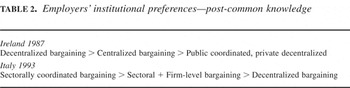
Common knowledge events in the two countries established a shared set of ideas as true. One of those ideas was that unions were committed to wage restraint in pursuit of competitiveness, and both sides knew that both sides knew this. By tying unions to a bargaining norm based on international competitiveness, the common knowledge event increased the appeal to employers of a set of bargaining institutions—their least favored alternative in the pre-common knowledge ordering—relative to the alternatives (as illustrated in the revised institutional ranking in Table 2). Before the common knowledge event, they would have walked away rather than accept their worst alternative. After the event, the acceptance by unions of international wage competitiveness as the orienting idea of bargaining changed employers' preference orderings; enough employers were enticed by the possible prospects of coordinated negotiations over wage restraint that a failure to agree to some new institutions of coordinated bargaining had become more costly. The establishment of social facts through common knowledge changed their strategic situation.
Employers' institutional preferences—post-common knowledge

Recall that the common knowledge event does not establish new institutions; it merely establishes shared understandings with clarity. Thus, the actors are still in a period of institutional experimentation, which means that the logic of arguing still has weight in their negotiations over new institutional rules. This creates a second mechanism through which common knowledge events influence institutional negotiations. Actors are constrained, logically, by the fact that they share the same view of the economy. Their disagreements, like those of social scientists, become subject to empirical resolution rather than mired in ideological dispute. Unless negotiating in bad faith, institutional solutions they might not have favored previously become not only palatable—there becomes no plausible alternative to them. In the case of the institutional orderings of employers in the wake of the common knowledge event, employers lacked any plausible argument as to why their first-best arrangement should be preferred, if indeed unions agreed about the principle of wage restraint. Employers preferred their second-best option to no negotiated agreement, and their reasons for opposition—distrust of the bargaining behavior of unions—no longer made sense according to the shared view established in the common knowledge event.
Even if one accepts the logic of argument up to this point, there is a potential objection to my claim that by signing up to new institutions, employers were in some sense constraining themselves. Wage restraint is an empirically observable phenomenon, so why could employers not conditionally agree to their second-best option but reverse their decision if it turned out later that unions really did not exercise wage restraint? In the long run, surely, this is exactly what employers would do: absent wage restraint, they would withdraw from the new bargaining institutions. But this sort of objection ignores the periodization of institutional change discussed in the previous section. Having reconsolidated institutions—that is, having returned to a world in which the basic shared expectations and rules of the game are taken for granted—neither employer nor union leaders will rush to return to the uncertainty of institutional experimentation. Although wage bargainers are constantly arguing, they are not constantly arguing about the institutions of wage bargaining. They would rather argue about wages and working conditions. One of the robust findings from the common pool resource dilemmas studied by Ostrom is that individuals would rather use punishment within an existing set of coordinating institutions than eliminate the transgressor from further potential cooperative possibilities or destroy the institutions.41
Social actors do not change institutions frequently, because institutions serve an important coordinative function, and coordinative institutions work best when they are taken for granted. Accepting a new set of wage bargaining institutions usually means accepting them for a period of years before revisiting their fundamental rules of operation. They are not discarded casually.The next two sections consider these propositions in light of the empirical experiences of Ireland and Italy. The first part of each section explains the process by which ideas for common knowledge about the economy emerged in each country and identifies the common knowledge event. The precondition for the common knowledge that emerged in each case was the ability to solve cognitive puzzles created by the failures of old institutions. Yet winning ideas had not only to satisfy this condition, but also to provide crossover appeal to both parties. The second part of each section then shows how the common knowledge event led employers to agree to coordinated bargaining outcomes they had previously opposed, both by changing their expectations about the future bargaining behavior of unions while also rendering them unable to defend their first-best preferences with compelling arguments.
Institutional Change in Ireland
The dramatic change in Irish industrial relations institutions is now widely known, though how unlikely it seemed at the time has been lost in the glare of discussion of the startling rise of the Celtic Tiger.42
The Program for National Recovery (PNR), signed in October 1987, moved Ireland to highly centralized bargaining institutions, shortly after British Prime Minister Margaret Thatcher had moved in the opposite direction in the neighboring United Kingdom. Both observers43Hardiman 2002.
O'Donnell 1998.
Hardiman 2002, 8.
Institutional Experimentation and the NESC Paper
By the middle of the 1980s, employers and unions in Ireland both perceived existing institutions of industrial relations as broken: employers because they were not delivering the pay restraint they had hoped for, unions because the existing institutions marginalized them. Ireland had previously experimented with centralized bargaining institutions in the late 1970s, which had collapsed when private-sector employers repudiated them in 1981. Irish employers had withdrawn from centralized bargaining institutions because they disagreed with union leaders about the causes of high unemployment: employers attributed unemployment to excessive wage agreements, unions to deficient demand stimulus.46
Roche 1994, 170.
Ibid., 178.
Irish Times, 4 July 1986, 11, 18. The peak federation of Irish Trade Unions explicitly rejected the suggested trade-off of the FUE campaign; see Irish Times, 26 July 1986, 1.
Union leaders publicly dismissed this view, claiming that the only plausible source of job creation was increased government spending, especially in capital investment and construction.49
Irish Times, 30 January 1986, 11.
Irish Times, 19 March 1986, 1.
Roche 1994, 178.
See Roche 1994; and Irish Times, 3 May 1986, 7.
The employer vision—a strategy of economic recovery based on international competitiveness through wage restraint—had no appeal to union leaders. The union strategy based on high public-sector employment growth in a period of national indebtedness had no appeal to employers. Yet throughout 1986, these leaders were negotiating together with other interest groups through the National Economic and Social Council (NESC), an advisory body that had previously produced only short-term reports on economic and social policy. The chair of the NESC, Pádraig Ó hUiginn, pushed the social partners to abandon past NESC practice and instead to produce a medium-term report with a “comprehensive analysis of the challenges” facing the Irish economy.54
Ó hUiginn's stated concern was to develop a plan that dealt with high levels of government debt. There is little evidence available from negotiating participants, but it would appear that Ó hUiginn had no well-established views about the appropriate solution to conflicts between unions and employers. See MacSharry 2000, 124.
What is crucial for the attainment of sustained economic growth in an economy such as Ireland's is the capacity of the internationally trading sectors to produce goods and services and to sell them competitively on export markets…. In the short-term this can be achieved by securing the maximum degree of cost-competitiveness and in the medium-term by defending competitive advantage while at the same time expanding the productive capacity of the economy.55
NESC 1986, 148.
Moreover, the report committed union leaders and employers to a diagnosis that broke with the Irish unions' previously stated view of the sources of economic growth: “those sectors of the economy which exclusively or predominantly serve the domestic market … cannot be regarded as independent sources of sustained economic growth…. Secondly, domestic demand cannot be regarded as an independent source of sustainable growth.”56
Ibid., 147.
Roche 1994, 170.
Yet the NESC report was not an outright union capitulation to the position of employers—that competitiveness depended on the private sector. Instead, the report publicly committed both sides to an economic interpretation that linked the sources of GNP growth to the traded sector. The NESC report thus enshrined what one might call a “small states in world markets” view of the economy.58
Katzenstein 1985.
Hardiman 1988, 234. Peter Cassells, Assistant General Secretary of the peak association of Irish trade unions, summarized the changed union perspective after the return to centralized bargaining in 1987: “We took the view that the most acceptable models on which to base a Programme for National Recovery should be successful European countries such as Austria, Denmark, Finland, Norway, and Sweden. These countries have rejected the confrontationist approach of the New Right and have lower levels of unemployment than the United States or the United Kingdom”; Irish Times, 17 October 1987, 16.
For readers unfamiliar with the history of Ireland, it is worth pausing here to underline how unlikely it was that the Irish social partners in 1986 chose Austria, Sweden, and Norway as the cases to which they would compare themselves. Such a choice undermines two potential alternative explanations—one European, one materialist—for the content of the common view adopted through the NESC report. The claim that membership in the European Community (EC) was the driving force behind the Irish outcome is unsupported by any evidence. These comparison countries did not belong to the EC at the time, and the intellectual action in the Community in 1986 was in the movement toward a single market, not toward the building of centralized bargaining. There is no plausible causal chain linking Irish membership in Europe, which had been constant since 1973, to the rather sudden emergence of the “small state” common knowledge in Ireland in 1986. Certainly the material crisis profoundly influenced the negotiations, but it is implausible to claim that this country with high debt, high unemployment, and net emigration was “forced” by the crisis to compare itself to prosperous Sweden. If the crisis had “forced” the social partners to latch onto the most obvious available alternative model, that would surely have been its largest trading partner and neighbor, the United Kingdom.
Only through the lens of the theory of idea winnowing developed here is the Irish choice of the “small states” view easily comprehensible. Given the durably high level of unemployment, Irish employers were in a stronger position than unions, and so it was predictable that in the common knowledge event unions would move further toward the position of employers than vice versa. That shared position, though, was distinct from the one advocated by employers, which held no attraction to unions. Despite their labor market strength, employers were unable to impose that view unilaterally. The “small states” framing, engineered through the negotiations of the NESC, was the only one that linked a diagnosis of the current crisis with an ideational program that could draw support from both employers (who wanted to be internationally competitive and cut the deficit) and unions (who wanted to bolster their organizational role and cut unemployment).
The NESC report was nothing more than a statement of common views, and it was a statement without the formal power to bind anyone. The document, moreover, made no commitment to a particular set of wage bargaining institutions. As a common knowledge event, though, the publicly shared understandings it ratified would become pivotal to future negotiations over wage bargaining arrangements.
Employers and the Establishment of New Bargaining Institutions
After the NESC agreement in 1986, Irish trade union leaders made repeated public statements that they were willing to make a multiyear commitment to wage moderation as part of a national tripartite agreement covering social and economic policy reforms. As late as June 1987—eight months after the release of the NESC report—Irish employers reiterated their opposition to institutions of centralized bargaining.60
Hardiman 1988, 236–37.
The shift of the position of Irish employers is attributable to two mechanisms. First, their institutional preference ordering was reshuffled by virtue of the adoption of the “small states in world markets” perspective of the NESC report. Prior to the report, centralized bargaining was the worst possible outcome for organized employers, because they had expected it would create substantial wage drift.61
MacSharry 2000, 126–27.
Hardiman 1988, 237.
Union leader Peter Cassells, writing in the Irish Times after the agreement, made very clear that the PNR was a compromise, not a change of fundamental material preferences: “Employers are concerned about their profits, farmers with their own self-interest and trade unions with the interests of workers and their families, the unemployed and those on social welfare”; Irish Times, 17 October 1987, 16.
In this way, the NESC report changed the evaluation of institutional outcomes from an employer perspective. It also undermined employers' credibility in arguing for decentralized bargaining in light of the new cooperative approach to policymaking that the NESC report had introduced. This point was publicly recognized by critics of the return to centralized bargaining within the Irish business community, after the signing of the PNR. The cooperative policymaking among the government, employers, and unions in the wake of the NESC report had made it increasingly implausible for organized employers to withdraw from a cooperative institutional solution: the leadership of organized employers “reached the stage where, if the present government sought their support in achieving something they considered important, they would have no real option but to grant it.”64
Business and Finance, 8 October 1987, 12.
Business and Finance, 15 October 1987, 1.
Eighteen months prior to this institutional change, the agreement of employers was unforeseeable. In the absence of the agreed set of interpretations reached in the NESC report, it is unlikely that organized employers would have accepted centralized bargaining institutions in October 1987, as observed by leading scholars of the Irish political economy.66
“It would be misleading to suggest that a return to centralized negotiation linking pay with other policy objectives was in any sense inevitable….[T]he possibility of negotiating a new centralized pay agreement had emerged from discussions publicly conducted in the mid-1980s over how best to plan for medium-term economic recovery.”67Hardiman 1988, 217.
Institutional Change in Italy
The central institution of Italian wage setting during the 1980s was the scala mobile—the wage escalator—which automatically increased wages in response to increases in inflation. Employers detested the scala mobile because it imposed wage increases that rendered them internationally uncompetitive; unions claimed that any other arrangement would undermine the purchasing power of workers, whose wages would not keep up with inflation.68
Mania and Orioli 1993, 13–35.
Institutional Experimentation and the Rise of “Forecast Inflation”
Italian unions and employers sought different guarantees from any new institution that would replace the scala mobile: employers wanted to restrain inflation, while union leaders wanted to preserve the real incomes of their members. Given the new constraints imposed by the loss of exchange rate flexibility, each partner recognized that inflation was detrimental to international competitiveness, but they held different views about the sources of inflation. This difference came down to a set of beliefs about automatism and the sources of inflation in the Italian economy. From the perspective of employers, moving to coordinated institutions required a new norm of bargaining that would break the automatic link between past inflation and future pay demands from unions. Confindustria therefore sought to replace the scala mobile with national sectoral bargaining and to eliminate firm-level bargaining.69
While Italian employers in the internationally traded sectors had initially pushed for the decentralization of wage bargaining during the 1980s, they had discovered that the internationally sheltered sectors dictated the rate of inflation in such a system (see Pérez 2000, 451). They therefore preferred nationally coordinated sectoral bargaining, led by the traded sectors, to decentralized bargaining.
The government, as both an employer and a setter of the prices of goods such as electricity, was perceived by both partners as a potential source of inflation outside their control.
Mania and Orioli 1993.
Given this divergence of views, how did employers and unions come to a jointly agreed convention for bargaining? The large cognitive movement between 1989 and the agreement of 1992 was the emergence of the government's official inflation forecast, which had never previously been considered credible, as the new basis of bargaining. Starting from virtually nowhere, this coordinating idea became so prominent that it had crowded out any other alternative by early 1992. After denouncing the scala mobile in 1989, the paramount concern of employers was to end automatic adjustment; what would replace it was unclear to all parties. The idea of basing negotiations on the government's inflation forecast did not emerge fully formed from the heads of employers, as a weapon to bludgeon the unions into submission.72
Instead, it was an idea that picked up steam only after being the centerpiece of a government proposal in mid-1991—championed by a former moderate union leader, Franco Marini—which steadily gained traction as the wage partners sought a shared framework that would respond to the failures of the scala mobile.73The scala mobile and forecast inflation are not merely two different standards for bargaining over inflation. The scala mobile was not about bargaining at all—it automatically adjusted inflation into future bargaining rounds. The debate was thus over whether to have automatic adjustment in some modified form and what norm to use as the basis of inflationary expectations for future bargaining rounds.
To track the evolution of the expressed views of the wage-bargaining partners, I undertook an extensive search of the leading Italian newspapers between 1989 and 1993.74
The search involved more than 1,600 articles from the official Italian news agency, ANSA, and more than 800 articles from La Repubblica, as well as a smaller number of articles from Il Corriere della Sera, L'Unità, La Stampa, Il Manifesto (the paper closest to the CGIL union leadership), and Il Sole 24 Ore (the paper owned by Confindustria). ANSA, Repubblica, and Corriere, which were electronically searchable, were the sources used most heavily to track changes in opinion over time.
Repubblica is considered a voice of the center-left, while ANSA is considered a voice of the center-right. The correlation between the frequency of citations in the two independent sources was .97 for the search term “scala mobile”; .99 for the joint search terms “scala mobile” and “inflazione programmata” (forecast inflation); and .85 for the joint search terms “CGIL” and “inflazione programmata.”

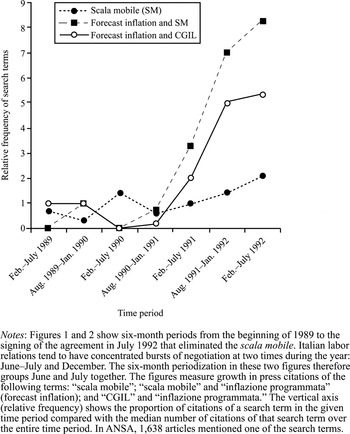
Growth of forecast inflation references (ANSA)

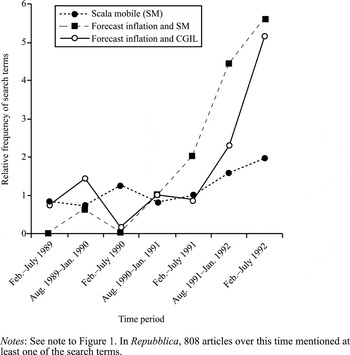
The growth of forecast inflation references (Repubblica)
As both graphs show, however, the number of references linking the discussion of the scala mobile to the government's inflation forecast increased dramatically in 1991, once Marini had suggested it as a possible baseline for bargaining. Between February and July 1990, there were no articles in either ANSA or in Repubblica that used the term “forecast inflation” together with “scala mobile”; between February and July 1992, there were thirty-three such articles in ANSA and twenty-eight such articles in Repubblica. Articles using the terms CGIL and forecast inflation show the same steep acceleration during this time. Such joint references do not prove that the CGIL liked the idea of forecast inflation. Indeed, the union's leadership opposed it for a long time, as discussed below. But they were forced to talk about it because of their leadership's inability to propose an alternative bargaining norm that could be persuasive to employers. How did “forecast inflation” become the only game in town?
Prior to summer 1991, the government's inflation forecast had simply not been credible as a baseline for negotiation.76
Repubblica, 26 May 1991, 8.
Repubblica, 10 July 1991, 39.
Repubblica, 20 September 1991, 5.
ANSA, 11 November 1991.
The union leaders had resisted the emergence of forecast inflation as a bargaining baseline, if there were to be no post hoc adjustments, because it often underpredicted real inflation. As such, it was a point that employers would be more likely to favor as the starting point for negotiations. The CGIL leadership, though, was unable to devise an alternative norm for bargaining that did not rely on automatic adjustment, and it was clear that any system based on automatic adjustment would not overcome the primary difficulty of the old wage-setting system: inability to maintain inflation rates at the levels of the European competitor countries such as France and Germany.80
Repubblica, 26 May 1991.
What it could, and did argue, was that predicting inflation was simply too complex a task for the government to perform.81
ANSA, 28 February 1992.
Repubblica, 5 June 1992, 47.
Corriere della Sera, 2 June 1992.
Corriere della Sera, 29 July 1992, 17.
What was crucial to this exchange is that unions were unwilling to sign the accord before a technical group (central bank economists), accepted by both sides, came up with an evaluation of the facts that was jointly accepted.85
The bank's economists could be said to function here as an epistemic community, a point drawn to my attention by the editors. The high technical standards and impartiality ascribed to the economists of the Bank of Italy was indeed the source of their authority in regulating this dispute (on the development of this community, see Quaglia 2005). The bank's intervention, though, was important for illustrating the dominance of the logic of arguing over the logic of consequentialism in this process. The bank did not propose the standard of forecast inflation—a moderate union leader had done that, one year earlier. Yet the inability of the CGIL to enunciate an alternative bargaining norm meant that its only oppositional strategy was to take up factual argumentation about forecast inflation: did it correctly predict inflation?
Corriere della Sera, 30 July 1992, 19.
Cipolletta 2002.
Mania and Orioli 1993, 166.
Clearly, the leadership of the CGIL preferred some sort of coordinated bargaining outcome to no agreement at all.89
Unità, 6 August 1992, 3.
Manifesto, 6 August 1992, 3.
The common knowledge event of 1992 reset the shared expectations of wage bargainers around the norm of forecast inflation. The emergence of that norm was the product of an environment in which the winning idea would have to persuade all participants of its viability, and forecast inflation was the only norm that proved able to meet that requirement. The CGIL leadership failed to generate alternative proposals that could persuade other players, and so left space for the experimental role of bargaining based on forecast inflation to become the only game in town.
Employers and the Establishment of New Bargaining Institutions
The 1992 agreement was by almost any measure a victory for Confindustria, which finally succeeded in burying the scala mobile. The agreement shifted the terms of wage bargaining discourse from a norm of automatic adjustment to one of bargaining between employers and unions on the basis of the forecast inflation rate. It thus established the expectations of employers about the framework within which unions would pose their future wage bargaining demands. The 1992 agreement abolished the old institution only; it did not establish new wage-bargaining institutions. Postagreement, therefore, Italian employers and unions remained in a situation of institutional experimentation, where the logic of arguing continued to have important influence on outcomes. What blocked a shift to new institutions was the contentious issue of firm-level bargaining. Unions, which had been challenged throughout the 1980s by independent “grassroots committees” (COBAS) and autonomous union groups, wanted an agreement that both reinforced their plant-level structures and allowed for firm-level bargaining on top of the sectoral agreement, to allow for productivity-tied increases.92
Locke and Baccaro 1996, 297–300.
Confindustria initially opposed the institutionalization of supplementary firm-level bargaining for two reasons. First, Italian employers viewed a single national (sectoral) agreement as the best way to control labor costs.93
Pérez 2000, 451.
Prior to the 1992 agreement, allowing firm-level bargaining on top of sectoral bargaining had been the worst possible outcome for employers. The public commitment of unions to the norm of bargaining based on forecast inflation changed the attractiveness of this arrangement, making it preferable to decentralized bargaining, which employers had previously found incapable of delivering wage restraint.94
Author's interview with Innocenzo Cipolletta, Director General of Confindustria from 1990 to 2000, Milan, Italy, 18 July 2003.
Cipolletta 2002.
The 1992 agreement had established common expectations among only the national unions and Confindustria. The agreement did not apply to unaffiliated labor militants like the COBAS. Thus, in the 1993 institutional agreement that consolidated the new institutions of wage bargaining, Confindustria insisted that the competent local bargaining units have appointed representation from those unions that had signed the national agreement, thus linking firm-level bargaining to groups that had signaled their agreement with the new pay norm.96
This provision makes sense only in the light of the common understandings about the bargaining partners established in 1992. The representatives of organized employers would enter such an institutional arrangement—their second-best outcome—only if they could be sure that the firm-level bargainers understood the new norms in the same way as the national bargainers.This institutional feature highlights the way the common expectations created by 1992 were the only possible cognitive basis on which Italian employers would have agreed to allow firm-level bargaining on top of the sectorally negotiated bargain. Without the agreement on firm-level bargaining, the national unions would never have agreed to the terms of the compromise of 1993. This arrangement would have retained a functionally decentralized system, in which firm-level bargains varied widely. The 1993 institutional change became possible only when employers and unions established common knowledge about the functioning of bargaining without the scala mobile.
Conclusion
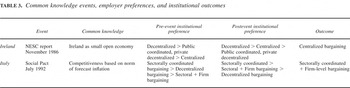
This article has demonstrated how common knowledge formation influences the process of domestic institutional change through the cases of Irish and Italian wage bargaining. Common knowledge events transform the character of subsequent bargaining by changing shared models of the economy and thereby the shared understandings of the motivations of the bargaining partners. In these cases, the major change in views of the economy took place among unions: union leaders accepted a view of wage bargaining as disciplined by the constraints of international competition. The fact that union leaders altered their stated views of the functioning of the economy changed the institutional preference ordering of employers, as summarized in Table 3. In neither case, though, was the eventual outcome the one most preferred by employers. Their arguments for their preferred outcomes were premised on a view of union negotiating behavior—unwillingness to restrain wages—that was inconsistent with the newly established common knowledge, and thus difficult to sustain in negotiations. As a result, they eventually accepted second-best outcomes they had previously rejected.
Common knowledge events, employer preferences, and institutional outcomes

Constructivist analysis recognizes better than most rationalist work that the outcomes of social change are not entirely foreordained by the structure and power resources of interest groups.97
As Herrera notes, this is not an issue that divides rationalism from constructivism as much as one that divides essentialism (which admits no art of interpretation in defining material preferences) from constructivism (Herrera 2005, 77–85).
This uncertainty magnifies the importance of arguments that are not only self-interested but also capable of persuading other parties. The shared frameworks that emerge during such periods—such as that of the governmental inflation forecast in Italy as a basis for nonautomatic wage bargaining—would have been difficult to predict a priori. Neither governments nor social partners are likely to be able to impose such ideas. The very process of arguing about them winnows the field of plausible candidates. As Italian unions discovered, once a candidate emerges from the field of competing ideas, the acceleration of a plausible coordinating idea becomes difficult to stop. As the experiences of Irish and Italian employers also show, even powerful actors are weakened in bargaining situations when they are unable to adduce compelling arguments on behalf of their most preferred institutional arrangement.
Many readers will have considered European integration as a more parsimonious explanation for these outcomes. That is incorrect. There is no doubt that the entry of Italy into the narrow bands of the EMS influenced the timing of the institutional crisis in Italy. However, the dissatisfaction of Italian employers with the existing system of domestic wage bargaining had roots that ran much deeper than EMS commitments.99
Pérez 2000.
The Irish case even more manifestly rejects an interpretation based on European constraints. There is no convincing argument for why membership in the European Community precipitated the institutional crisis there or dictated the institution that emerged from the bargaining of the partners. In fact, most of the small states in world markets that were central to the discussion of change in Ireland were not members of the EC in 1986. The Irish decision to join in the Economic and Monetary Union (EMU) initiative in the 1990s may have stabilized the wage bargaining institutions first established in 1987,100
Hardiman 2002, 7.
The Irish and Italian cases are particular instances of a more general question: How do social actors bargain and puzzle their way to new institutions during periods of economic change? Ireland and Italy succeeded in adopting more coordinated institutions of wage bargaining; that is, they changed their model of capitalism, but not by following neoliberal institutional prescriptions. Authors writing from differing theoretical perspectives agree that institutions of nonmarket coordination often provide robust alternatives to market regulation in the areas of corporate governance and finance, education and training, and intercompany research and development, in addition to the area of industrial relations.101
Ireland and Italy, like many countries in the globalized economy, faced economic crises—characterized by fiscal imbalances, high unemployment, and problems of competitiveness for export sectors—that had roots in both domestic institutions and changing international market conditions. These crises were real and apparent to major actors in both countries—not, as some constructivist scholars have argued, conditions that were recognizable as a “crisis” only once a new economic framework had been adopted.102 The solution of decentralized bargaining was certainly a possible outcome to these crises. Employers in both countries had, however, experimented with decentralized bargaining and were not uniformly persuaded it could deliver the wage restraint they sought. As in other countries that face changing conditions of international competition, employers and unions disagreed with each other's prescriptions but recognized their past institutions were no longer delivering the outcomes they wanted.The adoption of decentralized bargaining does not require the emergence of common knowledge. It merely requires that an actor favoring liberalization possess the political or market power to impose such regulation on any opponents to it, as Margaret Thatcher and her conservative government did in the United Kingdom. Coordinated bargaining, however, requires that unions and employers perceive potential gains to coordination. Organized employers, for example, will see no gain in coordination if it does not hold out the prospect of a better settlement (wage restraint combined with reduced strike activity) than they might achieve under an alternative institutional arrangement. The agreement between union and employer representatives established that the shared game between these actors was taking place in an open economy, where failure to restrain wages would damage competitiveness and employment, thereby creating the possibility of a game in which a coordinated solution was preferred by both parties. The small open economy framing was no focal point on which these actors stumbled to achieve their already established interest in coordination; it created the intersubjective understandings that solidified their interest in coordination.
In showing that common knowledge can be created in the presence of past histories of conflictual industrial relations, this article departs decisively from more deterministic elements of the varieties of capitalism literature. Hall and Soskice argue that the difficulty of creating common knowledge between bargaining partners with divergent views is a large barrier to any institutional change that increases the level of coordination in wage bargaining institutions, as happened in Ireland and Italy.103
Hall and Soskice 2001, 63.
Baccaro 2003.
The prominence of the “small states in world markets” reference point in the Irish case also invites a reassessment of the historical emphasis in Katzenstein's classic account of adjustment strategies in European small states. For Katzenstein, the institutions of corporatist coordination grew up in conscious reaction to the bitter social conflict of the interwar period.105
Katzenstein 1985, 136–90.