Over the last several decades, a perennial question for journalists and pundits as the United States approaches a presidential election is whether this will be the year that the Religious Left (RL) finally comes into its own as a political force. A variety of political groups and candidates are plumbed for their ability to both resonate with politically liberal religious people and mobilize resources; columnists present their appeal for a religiously-motivated politics on the left to political elites and average voters alike. From a revitalized Poor People's Campaign (Booker Reference Booker2018) to “Moral Mondays” at the NC state legislature (Wootson Reference Wootson2017), to 2020 presidential candidate Pete Buttigieg's explicit calls for a religiously-oriented liberal politics and its attendant news coverage (Burke Reference Burke2019), there seems to be a hunger among some group of liberals, and Democrats, for a faith-based approach to politics that is not conservative, not Republican, and not linked to the Christian Right.
Scholars of religion and politics in both sociology and political science have offered a number of reasons why the RL has not achieved the same political status as that of the Christian Right in contemporary American politics (Cox Reference Cox2017; Kellstedt et al. Reference Kellstedt, Smidt, Green and Guth2007; Olson Reference Olson2007; Baker and Martí Reference Baker and Martí2020) Most of these accounts rely on explanations that link the failure of the RL to its characteristics as a social movement, i.e., the motivation, social location, and history of the movement itself. These are undoubtedly important reasons for its lack of contemporary influence, but one critical and explicitly political facet remains unexplored, the link between movement action and individual response. There is a host of research on this phenomenon for the Christian Right, but little linkage between movement and politics at the individual level on the RL.
In this paper, I look at this piece of the puzzle: is the RL able to mobilize supporters to political activity? Clearly religious liberals were able to do so in earlier incarnations of the movement during the Civil Rights era. But most studies of the contemporary movement offer a variety of reasons why the current incarnation of the RL has seemingly not been able to mobilize average citizens to its cause. Combining data from both the individual and movement level, this paper tests whether activity at the movement level of the RL can translate into individual supporters' political activity. Based on a new data collection concerning the perceptions of RL influence in state-level politics, I examine the links among this influence and individual liberal and religious voters' political engagement and mobilization. While these links provide the groundwork for RL influence, they are not consistent across time and so suggest a more powerful political context at work.
THE RELIGIOUS LEFT IN AMERICAN POLITICS
While the roots of the movement stretch back far into the 20th and even 19th century, the modern incarnation of the RL has little of the visibility and influence its predecessors had in the middle part of the last century. Many scholars link social and political reform movements of the 1940s, 50s, and 60s to the efforts of religiously-motivated liberal activists and organizations such as Dorothy Day, the Industrial Areas Foundation, and the African-American Civil Rights movement (Olson Reference Olson2011; Fuist, Braunstein, and Williams Reference Fuist, Braunstein and Williams2017). In this period, many liberal religious believers were explicitly engaged with progressive social and political change as an expression of their religious practice (Beyerlein and Joseph Reference Beyerlein, Joseph, Braunstein, Fuist and Williams2017). And the dominant cultural norms of increasing liberalism in both social and economic spheres of life—the legalization of birth control and then abortion, the turn toward civil and social rights for blacks, women, and eventually sexual minorities, and long-term economic growth based on government and business in partnership—gave many religious liberals the confidence that their religious values were becoming dominant across American society (Lichterman and Williams Reference Lichterman, Williams, Braunstein, Fuist and Williams2017). Religious, social, and political changes over the last three decades, however, have made it more difficult for the RL to present a religiously-motivated view of politics and for the movement to mobilize average citizens.
A portion of these challenges is religious in nature. Many difficulties stem from the decline of membership and attendance in the Mainline Protestant denominations that formed the backbone of many of these religious progressive movements. There are simply fewer people in the pews ready to hear about and work through the role of a liberal faith in impacting American politics (Ammerman Reference Ammerman2002; Lichterman and Williams Reference Lichterman, Williams, Braunstein, Fuist and Williams2017). Catholics as well have undergone changes that have impacted the role and appeal of the RL, though in more complicated ways. Catholic engagement with politics in the United States has undergone a bifurcation, with some congregants and organizations focusing more on pro-life and conservative social issues, and others focusing more directly on social justice issues, such as poverty, racism, and the environment (Prendergast Reference Prendergast1999; Yamane Reference Yamane2005; Sullivan Reference Sullivan2008). And while Black Protestants remain active in Civil Rights efforts, the racial divides in American politics hamper the ability for white and black Protestant groups to work together toward a broader RL consensus. These changes across the primary constituencies for the RL are exacerbated by the steady increase in people who identify with no religious tradition at all: the “nones.” While it is not clear that the label truly signifies a move to no religious belief—rather a willingness to describe oneself as a “none” after many years of behaving as one—what is clear is that these religious groups seem to have lost many more self-identifiers in the process (Hout and Fischer Reference Hout and Fischer2002; Reference Hout and Fischer2014).
Another part of the movement's challenge is political. Along with a smaller footprint in the religious marketplace, the RL also faced a more generally conservative political arena in the years after 1980 (Lichterman and Williams Reference Lichterman, Williams, Braunstein, Fuist and Williams2017). This altered the underlying policy preferences of many voters, and ushered in a period of Republican victories. Partisan polarization over the last 30 years, in addition to the support of a growing religious conservative faction, has created a Republican party whose policies and goals are diametrically opposed to the preferences of people within the RL. While earlier incarnations of the movement could not necessarily rely on Republican support across the board, the presence of many Mainline Protestants within Republican ranks and the less ideological nature of party politics made a religiously progressive view of politics more attractive to some factions of Republican elites. The contemporary RL has no such appeal to contemporary Republican elites.
A third challenge for the RL has to do with how their religious convictions translate into politics. Lichterman and Williams (Reference Lichterman, Williams, Braunstein, Fuist and Williams2017) describe this as a challenge of “temperament.” The religious liberalism of many supporters of the RL is expressed as less certainty about the absolute rightness of their positions. This is not a lack of conviction Lichterman and Williams say, but rather a positive commitment to an open stance toward ideas and being right. This stands in stark contrast to the political and moral pronouncements of the Christian Right, which claim ultimate authority through Biblical bases. This difference can impact the RL negatively as they seem to have less conviction and authority for their positions. For example, “Mainline or liberal Protestants prefer to speak more ‘quietly’ and subtly about religious authority” (Lichterman and Williams Reference Lichterman, Williams, Braunstein, Fuist and Williams2017, 126). This reality poses both religious and political challenges for RL activists and supporters; their brand of religiously-motivated political activism looks different from that of the right, and its witness carries less weight in the contemporary political climate.
These challenges, and the inevitable comparisons with the Christian Right, have impacted scholarly treatments of the RL as well. One key challenge for both political scientists and sociologists seeking to understand the movement is how to define its apparent constituency, especially as scholars seek to identify grassroots mobilization in the movement. Many scholars who are more interested in the broader social movement field of the RL tend to approach it through the lens of religious liberalism, thus defining the RL's constituency as those who hold liberal views in both the religious and political realms. In several recent evaluations of the RL, Olson (Reference Olson2007; Reference Olson2011) focuses on that group of people who are both theologically and politically liberal and suggests that they are the best place to look for a grassroots component of the RL. Those whose focus is on the political impact of the RL tend to adopt the lens of political liberalism, defining the RL's constituency as any religiously-motivated voter or activist who is liberal in their political positions. Kellstedt et al. (Reference Kellstedt, Smidt, Green and Guth2007) take this approach in evaluating the possible constituency of the RL.
Regardless of definition, however, previous research has found little evidence of RL impact on voters and politics at large. Kellstedt et al. (Reference Kellstedt, Smidt, Green and Guth2007) address the potential extent of grassroots support available to the movement. They find that while there is an identifiable group of religiously-motivated citizens that could be mobilized by RL elites, it is not clear that they have been or can be mobilized by religiously-motivated liberal sentiments. Liberals focus on the idea of a separation of church and state, and they suggest that generically liberal appeals may be more effective, even with religiously-observant citizens. Olson (Reference Olson2011) finds that while the elite organizations exist for possible RL influence, this has not translated to political mobilization or power. In further research, Olson (Reference Olson2016) also examines the notion that the RL lacks influence because its activists and supporters lack unity. She finds this not to be the case, but does find that many potential RL supporters are unwilling to identify either with the movement as a whole or particular interest groups or social movement organizations.
These realities suggest an RL movement with few resources and little opportunity for mobilization or impact. But, as Olson (Reference Olson2011) points out, there are not only RL organizations and interest groups that can trace their advent to the first half of the 20th century, but newer organizations formed in pursuit of specifically religious, specifically liberal, goals. So where, and who, are RL organizations mobilizing? Can we connect the elite activities of RL organizations with the political activities of an RL constituency? Can we find evidence of impact even in the midst of such challenges?
In the following data analysis, I evaluate the relationship between the perceived strength of the RL and the political mobilization of possible constituencies at the level of the American states. More specifically, I hypothesize that an individual's reaction to RL mobilization attempts will be based both on their own religious commitments and their level of church attendance. Because my concern is primarily with the political mobilization of individuals and their political activities, I focus on politically liberal people of any faith. This mirrors Kellstedt et al.'s (Reference Kellstedt, Smidt, Green and Guth2007) approach by including not just White Protestants, Black Protestants, and Catholics, but also politically liberal Evangelicals and those of non-Christian faiths. This better reflects the actual constituency of the RL, which has never been as clearly linked to one religious group as the Christian Right is to American Evangelicals. As will become obvious, the story of RL mobilization is both more complicated and more straightforward than previous research on the movement and the theories of social movements in general would have us expect. RL mobilization along with liberal politics and religious service attendance matters, but only in specific political contexts.
DATA AND METHODS
In order to understand whether the RL is able to mobilize individuals to political action, we need to measure both the movement's influence and the mobilization of voters based on that influence. First, the measurement of RL influence. There are a number of ways we might do this: counting RL organizations, donations to these organizations, or mentions of the organizations in the media. These approaches each miss the entirety of a movement's efforts in different ways. What we really care about is the amount of influence a particular group or leader has in the political arena; something that might not be captured in a simple count of any of these characteristics. Here I use the more subjective, but ultimately more appropriate measure of the perceived influence of the RL as a movement. This measure is based on observers' perceptions of the visibility of the RL, its ability to mobilize voters, and its general influence in state politics.
In order to gauge the political influence of the RL on American politics, I utilize a large national sample of political observers conducted both in late 2008 and late 2016, following each election.Footnote 1 Following earlier attempts to gauge the influence of the RL (Conger Reference Conger2014), I compiled a sample of “political observers” from each state that included RL and Christian Right activists, leadership in both the Republican and Democratic parties, academic observers, members of the political media, and political consultants affiliated with both major parties. While this is certainly not a random-sample survey of the possible universe of political observers in each state, great care was taken to ensure that every legitimate observer was contacted. Contact information was gathered primarily through organizational directories and the Internet. For RL observers, the publicly available Faith in Public Life list of religiously-motivated progressive groups was used (Faithinpubliclife.org), in addition to other listings of religious left organizations around the country (Lugo et al. Reference Lugo, Cooperman, O'Connell and Stencel2011). For the Christian Right observers, religious conservative organizations, their staff, and supporters were included. For political party observers, the staff and leadership from each state were included. Media included were the political reporters from newspapers and television stations in the three or four largest cities or towns in each state. Political consultants were identified through their membership in the American Association of Political Consultants. In all cases, the most appropriate people in every organization were identified and contacted.
The vast majority of respondents were contacted by email and participated in the survey through an online survey interface. A few others were collected by fax or U.S. mail. For 2008, 1,112 responses were collected from an initial contact list of 4,664 people. Accounting for bad contact information, these responses represent a 24% overall response rate. For 2016, 463 responses were collected from 2,880 initial contacts, a response rate of 16%. Participants were asked to complete a survey concerning their assessment of the visibility and influence of the RL movement among other questions about religious activism in their state. While the use of an expert sample may suggest caution in the interpretation of data analysis, the high degree of agreement on movement influence among different groups of expert observers suggests that most were observing and gauging the movements in a similar way.Footnote 2
Measuring Influence
This measure of RL movement influence is a state-level measure. For both 2008 and 2016, the measurement of the perceived influence of the RL in state politics is based on four questions. The first assesses respondents' overall perception of the movement's impact on their states' politics, the second measures respondents' perceptions of the movement's ability to mobilize their supporters to vote, and the third gauges the percent of the state Democratic committee that can be identified with the RL. The fourth question is an assessment of respondents' perception of the movement's visibility. In all cases, these questions were converted to scale 0 (low) to 4 (high) measurement and averaged across each respondent. These questions fit together well as an index (2008 α = 0.84, 2016 α = 0.83).
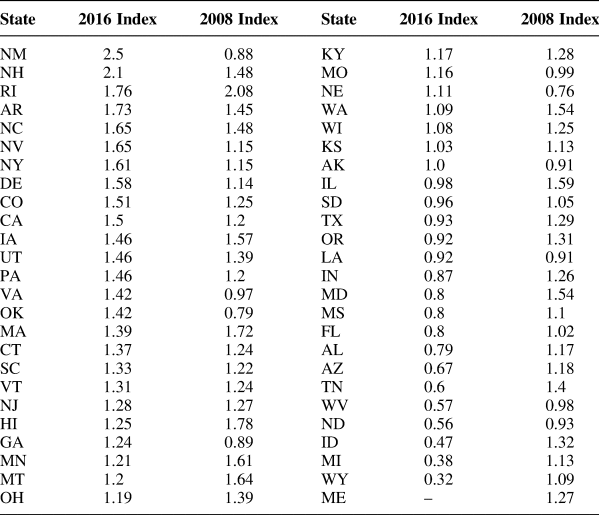
Table 1 reports the influence scores for each state for both 2008 and 2016 rank ordered by 2016 scores.Footnote 3 While scores vary, it is worthwhile to note that the index has the potential to have the highest score of 4.0. In 2008, RI scored the highest RL index score of 2.08, and it was the only state to receive a score higher than 2.0 and in 2016, NM scored 2.5, with only two states receiving a score higher than 2.0. Overall, while most observers noted some influence by the movement in their states, most observers did not perceive the RL to have a significant influence in any state in either year. Further, most states (NM excluded) received similar scores in both years, an important finding given that there are 8 years between to the two measures.
Religious Left influence index scores by state

Ordered highest to lowest influence for 2016.
Measuring Mobilization
What this measure of RL influence does not tell us is the ways in which these activities serve to encourage mobilization among supporters and constituents of the RL. We need a measure of how active these individuals are in the political issues important to the movement and in politics as a whole. Therefore, we need to have electoral mobilization data at the state level. And even more important, we need a data source that appropriately identifies the religious beliefs, adherence, and communities of respondents. These characteristics are admirably fulfilled in the Cooperative Congressional Election Study (CCES) (Ansolabehere Reference Ansolabehere2011, Reference Ansolabeher and Schaffner2017). This set of cross-sectional surveys has the benefit of contacting significant numbers of respondents in every U.S. Congressional district; thus ensuring a large enough number of respondents in each state to make causal inference at the state level. The CCES also uses the standard Pew/Steensland (Steensland et al. Reference Steensland2000) questions to identify the religious tradition of each respondent, which allows isolation of specific religious groups. In order to identify those individuals who are potential constituents of the RL, I created a dummy variable for “religious liberals” that includes all Mainline, Evangelical, and Black Protestants as well as Catholics and Jews that self-identified as politically liberal. This is used as the main identifier for those individuals who could be impacted by the state-level influence of the RL movement.
To operationalize mobilization, I use the survey questions that determine the amount of political activity accomplished by each respondent in an election cycle. For 2008, the measure includes respondent self-reports of donating money, attending a meeting, making calls or going door to door for a candidate, trying to persuade a friend or acquaintance to vote for a preferred candidate, or putting signs in their yard. The 2016 measures omit the attempt to persuade a friend or acquaintance (question not asked in 2016).
A straightforward additive measure best captures the extent of citizens' involvement and I created an index of these activities that ranges from 0 to 5 for 2008 and 0 to 4 for 2016. While it might make sense to control for the number of times each of these activities were engaged, the CCES does not contain a measure for the extent or intensity of political activities. But an additive measure of these activities should serve as a reasonable reflection of the intensity of citizens' mobilization. A more highly engaged person is likely to do more types of activity in addition to doing more activities in general. This mobilization index serves as the dependent variable for my analysis.
It is important to examine the mechanism of connection between the movement and individual supporters. Traditionally, social movement scholars have explained this mechanism as “frame alignment” (Snow et al. Reference Snow, Rochford, Worden and Benton1986). Frame alignment is more than just helping people understand that there is a problem, it adds the dimension of appropriate action to solve the problem. Attendance at religious services provides the main avenue for frame alignment in almost all religious movements (Snow et al. Reference Snow, Rochford, Worden and Benton1986; Snow and Benford Reference Snow and Benford1988) and will likely impact the degree to which the RL movement can mobilize voters. In nearly every circumstance, the level of religious attendance—even among non-Christian religions—impacts individuals' political opinions and engagement (Smidt et al. Reference Smidt2010; Claassen Reference Claassen2018).
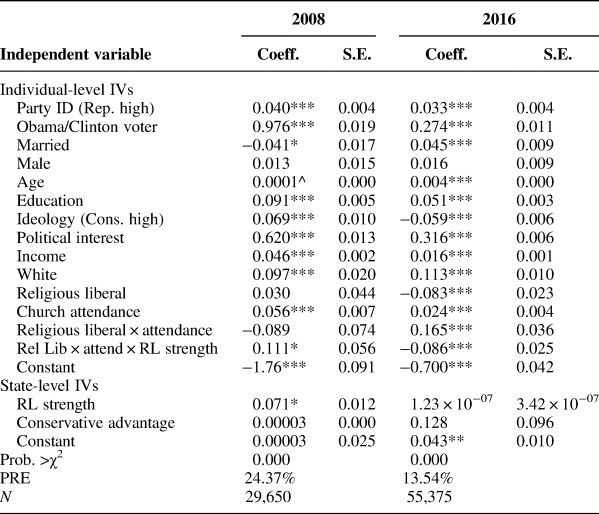
Individual-level control variables accounting for the varied sources of citizen mobilization are taken from the CCES data including, age, sex, education, income, ideology, and partisanship. One state-level control variable is drawn from state-level data measuring general conservatism in each year (Gallup) in order to gauge the ideological climate of the state—a good proxy for the general political environment faced by the movement and its supporters in each state. Because my goal is to try to explain individual-level political activity using a state-level measure, I use hierarchical linear modeling (HLM) which allows me to gauge the impact of both individual and state-level factors on an individual-level dependent variable. In this way, I can discern the impact of the state-level RL efforts on an individual's political mobilization over and above the individual characteristics such as income and education that we know are vital to a citizen's decision to engage in political activity. The results for both years of this analysis are presented in Table 2.
Religious Left movement influence on political activity—HLM coefficients

Dependent variable—Index of Individual Political Activities.
^p < 0.1, *p < 0.05, **p < 0.01, ***p < 0.001; two-tailed.
RESULTS
Because the dependent variable is at the individual level, individual political activity, all the independent variables we would expect to be significant for personal political activity are significant in both years. Being a Republican identifier or a Democratic presidential candidate voter increased individuals' level of activity. Sex did not seem to matter, but being older, white, and with higher education and income increased individuals' political activity. Espousing conservative ideology made you more likely to be active in 2008, but less likely in 2016. Church attendance was significant in both years. These are fairly standard results we might see in any study of individual-level political mobilization.
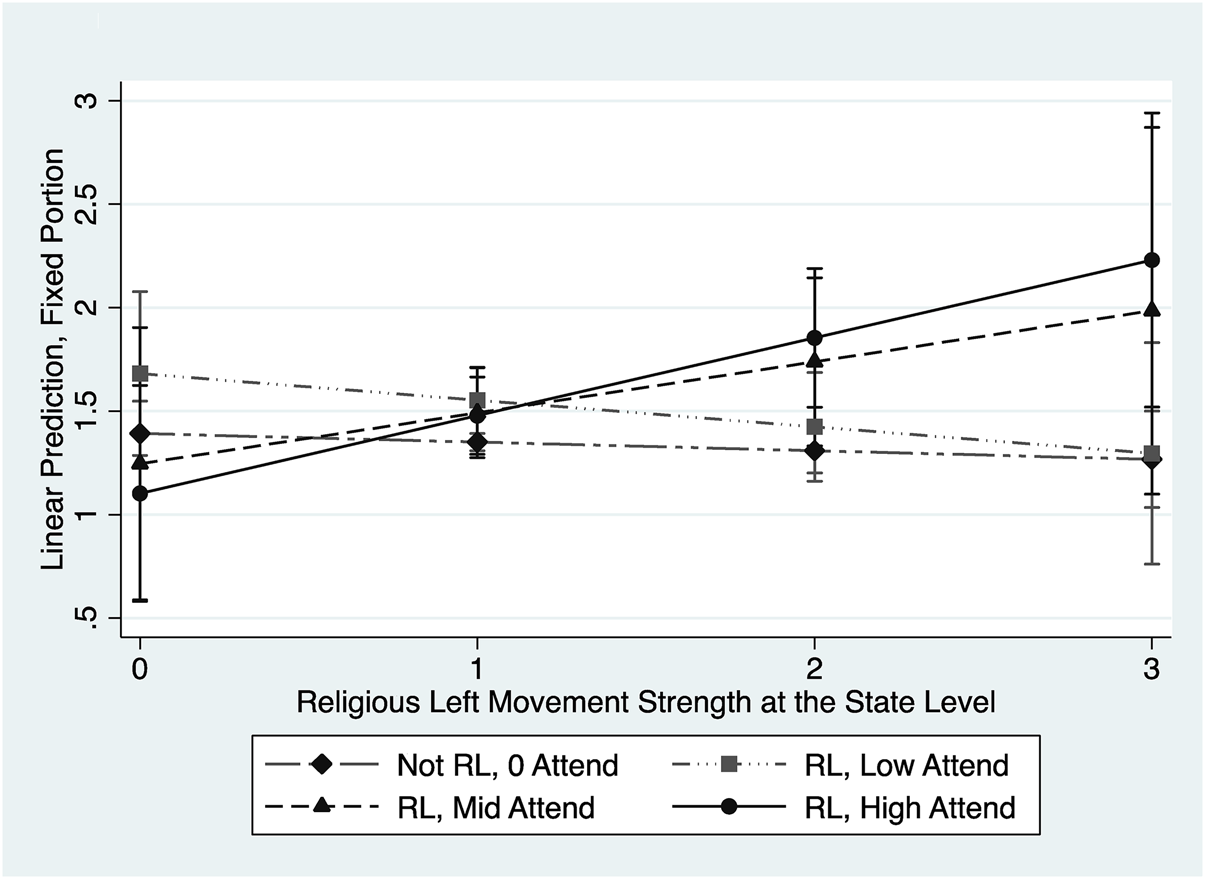
The results get more complicated and interesting when we examine the impact of religion and state-level RL movement influence. For religious liberals, their identity did not matter on its own in 2008, but significantly decreased their likelihood of political activity in 2016. Interacting religious liberalism with church attendance reverses that effect for 2016 but makes no impact for 2008. This suggests that attendance activated religious liberals' political activities in 2016 in ways that were not visible in 2008. Most important, however, is the triple interaction among religious liberalism, church attendance, and the state-level variable of RL influence. For religious liberals in 2008, higher church attendance combined with a more influential RL movement in their state made them significantly more likely to be politically active. The marginal impact of these interactions can be more clearly examined in Figure 1.
Predictive margins of religious liberal attendance 2008.

As demonstrated in Figure 1, as religious left influence in a state in 2008 goes up, the more impact higher levels of church attendance have on an individual's likelihood of being politically active. For religious adherents with lower levels of church attendance, residing in a state with more significant RL influence has basically no impact. This means that there is an important link between a liberal religious person's attendance and the overall impact of the RL movement in their state with the amount of religious activity chosen by the individual. Mobilization messages from the RL to voters seem to be getting through in the 2008 cycle. The story for 2016 is markedly different (Figure 2).
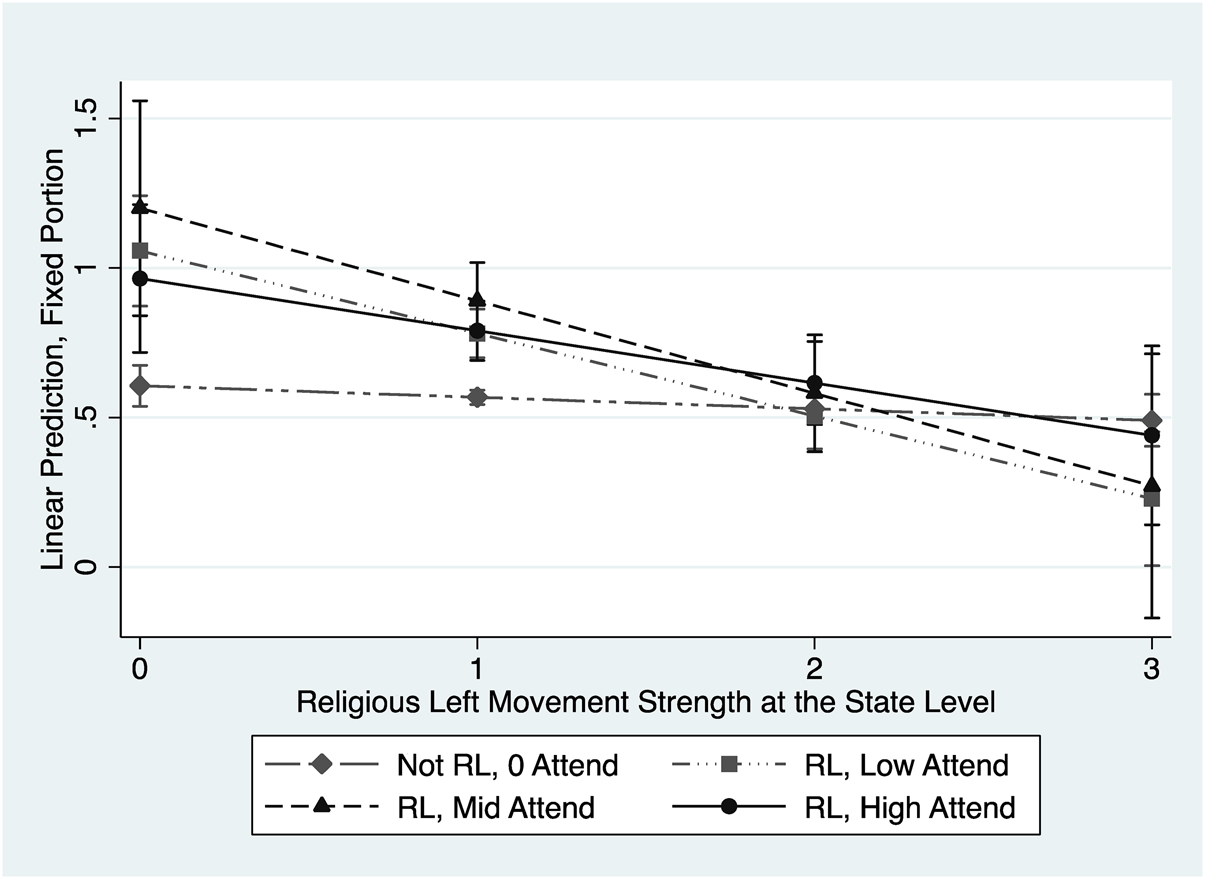
Predictive margins of religious liberal attendance 2016.

The marginal impact of RL influence in 2016 was actually reversed. For every level of church attendance (0 = no attendance with or without a religious liberal identity), an individual's likelihood of being politically active actually went down as the perception of RL influence increased in their state. These results are not statistically significant for 2016 and largely demonstrate no effect of the interaction of these variables on an individual's political activity. These two figures demonstrate the interactions among religious liberal identity, church attendance, and state-level RL movement influence can have a substantive impact on individual activity, but it is only demonstrated in 2008.Footnote 4
DISCUSSION
The results from 2016 seem to clearly demonstrate scholarly expectations, that there is no real ability for the RL movement to mobilize individual supporters. When accounting for the likely mechanism of connection, church attendance in 2016 was important for political activity among liberal and religious people, the combination of attendance and RL movement influence was insignificant in explaining individual political activity. But 2008 demonstrates a different pattern, suggesting the importance of the interactions among politically liberal religiosity, attendance, and RL movement strength. While all the individual-level independent variables were similarly important for political activity, there is a clear interaction among religious liberal individual church attendance and RL movement influence in explaining individual political activity. What accounts for the seemingly anomalous results from 2008?
One likely explanation comes from the context of the 2008 presidential election itself. While most popular reflections on the 2008 election point to the importance of the global recession that began in October 2008, earlier evaluations of the election and the efforts by the Obama campaign to bring religious people into the Democratic fold pointed to a growing sense of the real role religiously-motivated people could play within Democratic politics (CNN 2008). Several important voices within the party, including Nancy Pelosi and James Clyburn, claimed that the party was overlooking religiously-motivated voters who were more liberal in their ideology. Moreover, they claimed that there were many who would have voted for John Kerry in the 2004 election if a more articulate approach, or any approach, to religious voters had been attempted (Sullivan Reference Sullivan2008). A variety of organizations formed to test this idea, and the Obama campaign hired religious outreach directors in every state (Hagerty Reference Hagerty2008). In 2008 then, the Democratic party specifically targeted religious voters in ways that had not been present in earlier elections. And, perhaps most important, Democrats nominated Barack Obama, a person who arguably had more experience and connections with liberal religious people than any of his predecessors since Jimmy Carter.
This evidence suggests the possibility that the RL movement characteristics and messages may be less important than the attention of the Democratic party in mobilizing religious and liberal voters to political activity. In 2008, the Obama campaign had organizers in every state and made specific outreach to liberal people of faith. The 2016 campaign of Hillary Clinton did not have religious community organizers or a focus on faith issues. It seems that political context may play a much greater role than previously realized in the ability of the RL to translate its “influence” into action. This makes more sense, however, when we compare the RL to the Christian Right.
The rise of the Christian Right can be told as a story of a social movement rising from the grassroots of discontent over moral and social changes within American society (Oldfield Reference Oldfield1996; Martin Reference Martin2005; Conger Reference Conger2010). But it can also be told with equal credibility as a story of the Republican party mobilizing an overlooked constituency whose leaders were looking for avenues to power (Balmer Reference Balmer2014; Claassen Reference Claassen2015). In both versions, however, the Republican party has been a key player in the movement's influence attempts and successes. Christian Right activists realized early on that work in local and state levels of the Republican party pays off in terms of representation (Green and Guth Reference Green and Guth1988; Green, Guth, and Wilcox Reference Green, Guth and Wilcox1998; Conger Reference Conger2009). The role of the Christian Right in Republican party politics has driven significant mobilization among rank and file members of both the movement and party (Green and Guth Reference Green and Guth1988; Campbell, Green, and Layman Reference Campbell, Green and Layman2011), an influence multiplier that has wide-ranging impacts on Republicans success in both national and state-level politics.
Thus, it makes sense that the RL was able to mobilize its constituents when the Democratic party was paying it attention. But the RL face a very different landscape of power inside the Democratic party. Democrats are a coalition-based party with groups vying for power within the larger organization (Freeman Reference Freeman1986; Grossmann and Hopkins Reference Grossmann and Hopkins2015). The frequent outcome of this process is alliances among groups to achieve mutually beneficial ends. This is not necessarily compromise behavior, rather it is a rotating set of converging interests that govern party goals and policies. Further, modern ideological liberals who make up the Democratic party are less likely to see religious appeals as legitimate; this is true for religious Democrats as well as non-religious ones (Kellstedt et al. Reference Kellstedt, Smidt, Green and Guth2007). So, the very religious nature of the RL's approach to politics can conflict with supporters' general approach to politics. This suggests that there really was something different about 2008, a concerted effort to appeal religious voters by Democratic elites. My data analysis demonstrates that the effort paid off in terms of religious liberals' political mobilization and activity. It is unclear when or if similar circumstances will emerge in the Democratic party in the future, regardless of activists' desires.
CONCLUSION
Religious social movements have been a feature of the American political landscape since almost the beginning of the Republic. Their ability to impact the politics and policy of cities, states, and the nation as a whole has depended upon both internal and organizational characteristics such as membership and resources and the external characteristics such as the political climate and partisan structure of the country at the time. The contemporary RL stands in an awkward place: with a history of relevance to draw on, but weakness in its current internal characteristics. These challenges were somewhat overcome in the 2008 election cycle through the intervention of an outside force, the Obama presidential campaign. While other movements have leveraged such attention to long-term growth, the RL was not able to sustain the momentum provided by the Democratic party's attention into the 2016 election cycle.
In this paper, I have evaluated the ability of the RL to mobilize its constituents into political activity. Following previous scholarly explorations, I have found empirical evidence that the movement seems to have difficulty connecting its organizations and messaging with individual religious liberal voters. But, there is also evidence that political party attention—in line with the scholarly consensus about the advent and power of the Christian Right—can help to overcome the challenges faced by the movement and align RL influence with individual political activity. More in-depth, likely qualitative, investigation needs to be pursued in order to better understand how the Democrats' attention translated into RL mobilization and how the movement might position itself to take advantage of the party's structure and interests in the future.
Supplementary material
To view supplementary material for this article, please visit https://doi.org/10.1017/S1755048321000043.