Introduction
Senna species are members of the family Fabaceae found worldwide (NPGS, 2008). The most important species is tinnevelly senna (Senna alexandrina Mill.) currently used in various laxatives. Little is known about the agronomic characteristics of Senna species because they have primarily been considered as weeds. Several phytochemicals exist in Senna with potential to be used as human medicines. The flavonol quercetin found in coffee senna roots (ILDIS, Reference Bisby1994) has been clinically proven to play a role for the prevention of pancreatic cancer in humans, who smoke (Nothlings et al., Reference Nothlings, Murphy, Wilkens, Henderson and Kolonel2007). The flavonoid, kaempferol found in Senna alata (L.) Roxb. leaves has successfully shown to contain an anti-pancreatic cancer property as well (Nothlings et al., Reference Nothlings, Murphy, Wilkens, Henderson and Kolonel2007). The terpenoid, betulinic acid found in Senna obtusifolia roots has been used to develop an anti-HIV drug currently undergoing clinical trials (Qian et al., Reference Qian, Nakagawa-Goto, Yu, Morris-Natschke, Nitz, Kilgore, Allaway and Lee2007). Interestingly, the drug bevirimat contains betulinic acid and has been clinically shown to be antiretroviral for use in HIV therapy regimens (Martin et al., Reference Martin, Blum, Doto, Galbraith and Ballow2007; Smith et al., Reference Smith, Ogundele, Forrest, Wilton, Salzwedel, Doto, Allaway and Martin2007). S. alata has recently been shown to strongly inhibit acne inducing bacteria (Chomnawang et al., Reference Chomnawang, Surassmo, Nukoolkarn and Gritsanapan2005). Only sennosides are extracted exclusively from S. alexandrina (previousely known as Senna angustifolia). Coffee senna is well known for its medicinal properties; however, additional Senna species contain useful secondary metabolites for potential use as pharmaceuticals to treat various ailments in humans. However, most of these species at present are not commercial sources of the phytochemicals that they possess due to low concentrations. It is therefore important to identify and develop genotypes having significantly higher concentrations of the relevant phytochemical to become an economically viable source.
The objective of this study was to characterize variability among regenerated medicinal Senna species for some important agronomic traits.
Experimental
Coffee senna, S. alata (L.) Roxb., S. alexandrina Mill., Senna angulata (Vogel) [H.S. Irwin and Barneby], Senna corymbosa (Lam.) [H.S. Irwin and Barneby], Senna covesii (A. Gray) [H.S. Irwin and Barneby] and Senna uniflora (Mill.) [H.S. Irwin and Barneby] were regenerated at the USDA, ARS, Plant Genetic Resources Conservation Unit. Seedlings of 25–50 from each Senna accession were transplanted in field plots. Data recorded were based on a rating of 1–9 for branching and foliage, where 1 = 91–100%; 2 = 81–90%; 3 = 71–80%; 4 = 61–70%; 5 = 51–60%; 6 = 41–50%; 7 = 31–40%; 8 = 21–30%; 9 = 1–20% of the plants are producing branches and foliage. Plant height and width (cm) were recorded at 50% flowering. A similar protocol for plant maturity within each plot was used where 1 = 120–180 d; 5 = 210 d; and 9 = 240 d after greenhouse planting until 50% or more of the plants per plot produced mature seeds. Mature seeds were harvested from each Senna accession 2–8 months after transplanting in field plots. A principal component analysis was used to characterize variability among coffee senna accessions regenerated in one environment for morphological and reproductive components.
Discussion
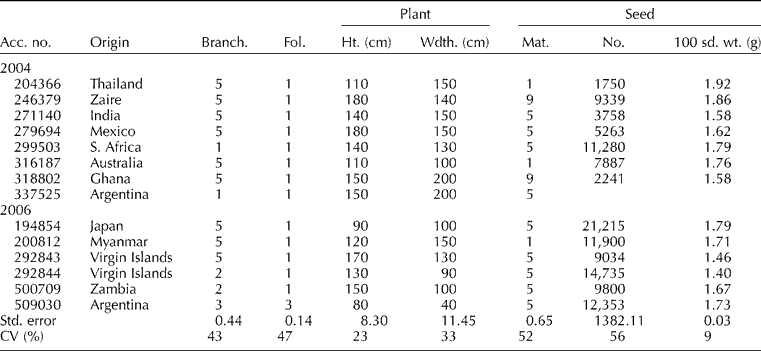
Most of the coffee senna accessions produced branching and foliage indices averaging 5 and 1, respectively (Table 1). Plant height and width ranged from 80 to 180 cm and 40 to 200 cm, respectively, among accessions. Three accessions reached 50% maturity in 4–6 months after planting. However, most reached 50% maturity after 7 months of planting. Variable seed numbers and 100 seed weights were observed among coffee senna accessions. Seed numbers ranged from 1750 to 21,215 with 100 seed weights per accession ranging from 1.40 to 1.92 g for both years.
Morphological and reproductive traits of Senna occidentalis evaluated from 2004 to 2006

Acc. no., accession number; Branch., branching; Fol., foliage; Ht., height; Wdth., width; Mat., maturity; sd. wt., standard weight; Std. error, standard error; CV, coefficient of variation.
The first five principal components for coffee senna had eigenvalues >0.69, and together they explained 93% of the total variation for this group of phenotypic and reproductive traits. The first principal component had an eigenvalue of 2.5926, explaining 37% of the entire variation. Plant height and width contributed greatly to variation for this principal component, with eigenvectors equal to 0.52. The second principal component's eigenvalue was 1.4603 and it explained 21% of the total variation. Maturity, 100 seed weight and branching contributed greatly to variation for this principal component, with eigenvectors above 0.46. The third principal component's value was 0.9282 and it explained 13% of the total variation. Branching and foliage eigenvectors equal to and above 0.55 contributed greatly to its variation. The fourth principal component had 0.8694 as its eigenvalue and it explained 12% of the total variation. One hundred seed weight contributed the greatest amount to its variation. The fifth principal component had an eigenvalue of 0.6904 explaining 10% of the total variation. Branching, foliage and seed number contributed greatly to its variation with eigenvectors equal to or above 0.49.
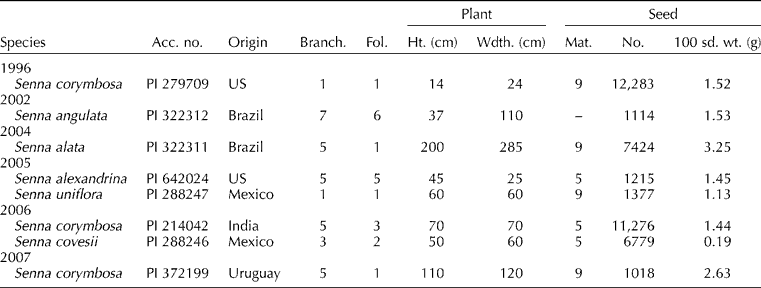
Accessions of six wild Senna allies were successfully regenerated also (Table 2). Interestingly, the US-originating accession PI 279709 (S. corymbosa) produced the smallest plants, highest seed number (12,283), but matured late, while the Indian accession PI 214042 produced larger plants and 11,276 seeds. The majority of the Senna species produced an average 100 seed weight of 1.62 g.
Morphological and reproductive traits of Senna species regenerated in 1996, 2002 and 2004–2007

Acc. no., accession number; Branch., branching; Fol., foliage; Ht., height; Wdth., width; Mat., maturity; sd. wt., standard weight; Std. error, standard error; CV, coefficient of variation.
The relatively low variability observed among coffee senna populations for the traits studied suggests a need for further strengthening of the germplasm collection as well as additional evaluations in multiple locations and years. Future studies could implement the use of molecular marker technology as well to explore the available Senna resources for identification of genotypes carrying the desired traits efficiently and correctly.
Acknowledgements
The author thanks the University of Georgia for partial support of this research and Ken Manley for his excellent assistance.