

Introduction
The topic of old age has been relatively neglected in archaeology. The elderly were first the subject of a research paper in Reference Welinder2001 by Stig Welinder, and there have been a small, but significant, number of further papers in the decade and a half since then that concentrate on the old to a greater or lesser degree (Appleby Reference Appleby2010; Reference Appleby2011; Fahlander Reference Fahlander2013; Gowland Reference Gowland2007; Reference Gowland2015; Reference Gowland, Tilley and Schrenk2016; Ross & Oxenham Reference Ross, Oxenham, Buckley and Oxenham2015; Smith et al. Reference Smith, Atkin and Cutler2017); however, in comparison to other aspects of social identity (childhood, gender, ethnicity, status, kinship and so on), the old remain very under-studied. Archaeology is not alone in failing to consider the elderly (feminist scholarship, for example, has come late to the theorization of ageing (Twigg Reference Twigg2004)) and it may be that our failure to engage with the old is rooted in modern Western ambivalence about growing old and its inevitable end-point of death as much as it is in the theoretical and methodological difficulties that I will present below. Whilst this reluctance to engage with ageing is therefore understandable, I argue here that it is not tenable if we want to move forward in our understanding of the past: understanding the process of ageing, in all its aspects, is critical to our ability to understand past societies (Appleby Reference Appleby2010; Reference Appleby2011). Firstly, investigating the specifics of ageing in a given context allows us to build more nuanced models of past social structures, rather than relying on uncritical ideas of the elderly as either irrelevant, or as revered elders. Secondly, we currently have a poor knowledge of the history of the ageing process itself. This is something that appears through a complex interaction of genetics, biology, culture and society (cf. Lock Reference Lock1993), rather than being simply rooted in biology. With its ability to access varied forms of evidence, archaeology (and especially bioarchaeology) has an important part to play in developing such knowledge.
In this paper, I will begin by discussing some of the underlying reasons for the neglect of ageing in archaeology. I will then move on to explore how this might be addressed by examining how ageing emerges through the body through the analysis of four specific areas: appearance, function, disease, and skill. In this sense, it is inevitably a rather generalizing paper, but I hope it will not be taken as a ‘cook book’ for how identifying ‘the old’. Rather, I want to make some suggestions, and give some examples, of how we might approach the ageing bodies of the past to generate understandings of ageing as a process that is highly contextual and variable.
Before moving on to a methodological and theoretical discussion of ageing from an archaeological perspective, it is worth posing the question ‘what, actually, is ageing?’. This is a complex question. In its ‘World Report on Ageing and Health’, the World Health Organization takes a page to define the concept, and includes everything from the strictly biological (‘the gradual accumulation of a wide variety of molecular and cellular damage . . . a gradual decrease in physiological reserves, an increased risk of many diseases and a general decline in the capacity of the individual’ (WHO 2015, 25), through ‘shifts in roles and social positions and the need to deal with the loss of close relationships’, to the changing of ‘goals, motivational priorities and preferences’ and other ‘psychosocial changes’ (WHO 2015, 25). This complexity underlies many of the individual sections of this paper, and goes some way towards explaining why archaeology in general has struggled to engage with the idea of old age: ageing is related to chronology, physiology and social meanings, but the nature of the relationships between all of these factors is complex and stable neither in time nor space. It also highlights something that can be understood as a moral problem in the study of ageing: the desire to avoid portraying ageing as a necessarily negative process, whilst at the same time acknowledging the fact of bodily decline.
Complex interrelationships between social and biological ageing have underlain much of the archaeological discussion of older age to date. Archaeologists and osteologists tend to cite Arber and Ginn's (Reference Arber, Ginn, Arber and Ginn1995) division into its chronological, physiological and social aspects. This work has been extensively discussed elsewhere (e.g. Appleby Reference Appleby2010; Reference Appleby2011; Sofaer Reference Sofaer2006; Reference Sofaer, Agarwal and Glencross2011) and I do not intend to go into detail here, but it usefully emphasizes that age is not solely about chronology. In fact, emphasis on (and probably even knowledge of) chronological age is a property of post-enlightenment societies and is mostly situated in the need for the State to control access to particular statuses by age. Interestingly, the focus on chronological age is beginning to break down even in the present day, where discussions of ‘third’ and ‘fourth’ age stages, which are not straightforwardly linked to chronology, are taking more prominence (see below). Whilst acknowledging that physiological, chronological and social aspects of ageing are all potentially important, though, we must not forget that individuals do not experience these aspects separately. Rather, ageing is a process that is understood, negotiated and experienced through the body.
The missing elderly?
It has often been assumed that numbers of the elderly in the past, and especially the prehistoric past, were very low (and consequently of minor interest). This is partly due to the (mis)understanding that life expectancy in past populations was around 30 years, and hence that there were few old people. This idea has been widely critiqued by bioarchaeologists, palaeodemographers, anthropologists and historians (e.g. Agarwal & Grynpas Reference Agarwal and Grynpas1996; Chamberlain Reference Chamberlain2006, 53–4; Smith et al. Reference Smith, Atkin and Cutler2017; Thane Reference Thane2005), but remains a widely held belief even within archaeology. There are a number of reasons for the apparent deficit of the old in past populations. The most widely discussed is the difficulty in ageing older adult individuals (Buckberry Reference Buckberry2015; Smith et al. Reference Smith, Atkin and Cutler2017). Due to difficulties in accurately assigning age to people who died beyond middle age, older individuals tend to be grouped into a general category of 45+ or 50+. This has the function of artificially depressing the apparent ‘average’ age of skeletons, since by definition the maximum age is not particularly old. A second reason for the apparent low life expectancy of individuals in the past is the high levels of infant mortality: large numbers of people probably died in early childhood (Goodman & Armelagos Reference Goodman and Armelagos1989). This leads to low life expectancy at birth, but does not imply that large numbers of people died in early adulthood: those individuals who survived the vulnerable early years would actually have had a reasonable chance of surviving to old age. Smith et al. note in reference to these two factors that:
The mean age attained—which by definition will normally be superseded by a substantive portion of the population—is misread as a modal average, that is, the age at which most people might be expected to die. (Smith et al. Reference Smith, Atkin and Cutler2017, 71)
Historical demography, ethnographic research and recent osteological studies support the view that a substantial number of individuals would have reached old age in the past: Laslett (Reference Laslett1991) has suggested that between the mid sixteenth and late nineteenth century, the over 65s made up 7–10 per cent of the population. Gurven and Kaplan (Reference Gurven and Kaplan2007) suggest that, on average, 20 per cent of people lived beyond 65 in hunter-gatherer societies. A recent re-evaluation of Anglo-Saxon skeletal evidence from Worthy Park used a model-based approach along with dental seriation to suggest that 37 per cent of adult individuals were over 65 at death (Cave & Oxenham Reference Cave and Oxenham2016). In contrast, application of Kaplan Meier survival analysis to two medieval British populations suggested that around 10 per cent survived to 65 and over (Walter & DeWitte Reference Walter and DeWitte2017). These differences emphasize the fact that old age survivorship is highly variable, and some periods would have had more or fewer elderly people than others. Changes in demographic structure have been associated with changing subsistence patterns, population size and migration. Emerging infectious diseases would also have had an effect. In early agricultural populations, increasing susceptibility to infectious disease and shorter inter-birth intervals may have led to child-dominated populations. There is some evidence for such structures in the early Neolithic (Bocquet Appel Reference Bocquet-Appel2011). Similar changes may have been associated with other periods (for example, episodes of urbanization or colonization); however, even under these circumstances, many of those who survived childhood probably survived to older age. Whilst we should therefore be wary of a ‘one size fits all’ interpretation of the numbers of older individuals in the past, we also need to acknowledge that older people were not rare. As Smith et al. (Reference Smith, Atkin and Cutler2017, 92) note, if very few people survived to old age in the past, it ‘would raise the question “How the human life course as it now exists had ever evolved at all?”’.
Archaeology has an age problem
The difficulties associated with ageing older skeletons reflect underlying variability in the biology of ageing, rather than mere methodological imprecision, and will probably never be fully overcome (Buckberry Reference Buckberry2015; Mays Reference Mays2015). Whilst there is certainly some correlation between chronological and physiological age overall, there is very significant variation both within and between populations in overall rates of ageing and in the ageing of specific bodily systems (Rissech et al. Reference Rissech, Estabrook, Cunha and Malgosa2007). Older individuals are particularly affected by this, since the relationship between skeletal ‘age indicators’ and chronological age becomes more variable as people get older. Statistical methods have been designed to help overcome problems in ageing older skeletons, but tests with known-age skeletons have often given disappointing results (e.g. Milner & Boldsen Reference Milner and Boldsen2012).
A literature survey by Simon Mays (Reference Mays2015) has shown that c. 60 per cent of variation in anatomical features used for skeletal age estimation is not caused by age. This is consistent with previous estimates by Nawrocki (Reference Nawrocki, Latham and Finnegan2010) and Jackes (Reference Jackes, Katzenberg and Saunders2000). Mays identified a number of factors affecting age indicators, including inherent tendency towards bone formation, vitamin D status, hormonal and reproductive factors, energy balance, biomechanical variables and genetic factors (Mays Reference Mays2015). Other factors that are known to have effects on skeletal ageing include exercise, nutrition, socioeconomic status, climate, medication and drugs, physical labour, pregnancy and body mass index (Márquez Grant Reference Márquez-Grant2015, 315). The implications are clear: people's skeletons age at different rates and in different ways (Buckberry Reference Buckberry2015; Mays Reference Mays2015; Tayles & Halcrow Reference Tayles, Halcrow, Oxenham and Buckley2015).
Recently, Roksandic and Armstrong (Reference Roksandic and Armstrong2011) and Tayles and Halcrow (Reference Tayles, Halcrow, Oxenham and Buckley2015) have suggested modifications to osteological ageing categories so that they are explicitly based in human life history and the biology of senescence. Roksandic and Armstrong propose this as a ‘life history’ model, whilst Tayles and Halcrow (Reference Tayles, Halcrow, Oxenham and Buckley2015) move one step further and suggest that skeletal age categories are expressed as ‘functional age’. This, they suggest, will allow researchers to ‘acknowledge the relationship between biological status and the ability to contribute physically to one's community’ (Tayles & Halcrow Reference Tayles, Halcrow, Oxenham and Buckley2015, 233). This seems a step in the right direction, and has similarities with suggestions I have previously made about how we should understand skeletal ageing categories (Appleby Reference Appleby2010; Reference Appleby2011; Wilson Reference Wilson2008). However, there are still difficulties. The concept of functional age is one that has existed in sociology and medicine for at least three decades (e.g. Sharkey Reference Sharkey1987). It refers to the ability of an individual to function in a specific context and is explicitly distinguished from physiological age. In contrast, the skeletal features that are used to calculate age are not straightforwardly associated with any particular functional deficiency (as Tayles and Halcrow acknowledge). Functional age also may not be the same in all domains: there is no a priori reason why age-related changes in the skeleton can be ‘mapped onto’ other aspects of bodily or cognitive functionality (or that what is considered to be or experienced as ‘functional’ will be the same in all societies). Thus, whilst Tayles and Halcrow's careful explanation of the methods that they have used in ageing is to be welcomed, there is still work to be done. In particular, rather than a ‘one size fits all’ approach to skeletal ageing of older individuals, we may have to take different approaches according to the research question being asked. If the question we are asking is ‘how was the ageing body understood in a particular society’, then we need to engage with, rather than seek to overcome, its complexity. This complexity of the ageing body is something that has recently been addressed in the field of social gerontology.
Theorizing age and the body: sociology and social gerontology
In recent years, the ageing body has become a focus of study in social gerontology, and this literature gives some interesting ideas about the questions that might be asked about ageing and the body. Before I move on to discuss such approaches to the body, though, it is worth noting that these have developed in response to the very unusual circumstances of the contemporary world, in particular the ageing of the world's population and the rise of consumer culture. On this basis it is not possible to look for an approach to ageing that can be simply ‘applied’ to an archaeological context. Instead, approaches to ageing and the body can be used as a source of inspiration about the ways in which bodies can be experienced, valued and worked on, which can in turn help us to come up with contextual understandings about how bodies may have been experienced, valued and worked on in the past.
The ‘turn to the body’ was a late development in sociological thought (cf. Shilling Reference Shilling1993; Turner Reference Turner1984), and has been even more so in social gerontology. Whilst the body might legitimately be expected to be a central concern in any discipline focusing on ageing, it has in fact been absent from many theoretical approaches. It was not until Öberg's influential 1996 paper that the absence of the body in gerontological sociology was recognized for the first time (Öberg Reference Öberg1996). Öberg's article criticized social gerontology for leaving the study of the body to geriatrics, noting that ‘within geriatrics the body has been studied as thing, product and diagnosis . . ., the body has been ignored as meaning, symbol and cultural construction’ (Öberg Reference Öberg1996, 703–4). This lack of attention to the body was seen as deeply rooted in Platonic philosophy that positioned the body as imprisoning the soul and where the body was hierarchically placed below the mind.
In the 20 years since Öberg's article, social gerontologists have engaged with the body in a variety of ways. A number of aspects of the ageing body have been considered (see references in Clarke & Korotchenko Reference Clarke and Korotchenko2011). These include body image, embodied experiences of illness, sexuality and the body, management of the body, appearance work and embodied identity. Whilst there is not room to discuss these in detail here, many of these aspects have potential relevance to the study of ageing in archaeology.
Several social theorists have had a great influence on the social gerontology of the ageing body, and I want to discuss briefly two of particular relevance: Norbert Elias and Pierre Bourdieu. Whilst neither Elias nor Bourdieu explicitly sets out to discuss old age, their ideas have been taken up and reworked by social gerontologists. Elias’ work on the ‘civilising process’ (Reference Elias and Jephcott1978) has been repeatedly cited as a reason why old bodies are seen as problematic (e.g. Gilleard & Higgs Reference Gilleard and Higgs2013; Tulle Reference Tulle and Twigg2015). Over the last few centuries, codes of bodily engagement, which originated in court circles and worked their way down to the general populace, have required individuals to exercise more restraint and control over both physical and emotional urges. Physical changes, such as incontinence, that are associated with old age are seen as contravening such codes of restraint, leading to potential social sanctions, including marginalization. Following the ideas of Julia Lawton (Reference Lawton1998) on dying, the bodies of the elderly (at least the dependent elderly) have been seen as ‘unbounded’ and dirty, meaning that they need to be kept physically separate from bounded and hygienic younger bodies (Tulle Reference Tulle and Twigg2015). Such attitudes underlie the development of specific locations (care homes and nursing homes) for the bodies of the dependent old. Of course, such concerns do not apply to all ageing bodies, and in fact one of the major difficulties of seeking ‘a’ social gerontology of the embodied old is that ageing bodies are typically separated out into two consecutively occurring states. ‘Third agers’ (Laslett Reference Laslett1991), or the ‘young old’ (Neugarten Reference Neugarten1974), are highly functional and are examined in terms of their embodied agency. They have the potential to age ‘successfully’ through participation in consumer culture and involvement in community social life (Gilleard & Higgs Reference Gilleard, Higgs, Rees Jones, Higgs and Ekerdt2009). In contrast, people in the ‘fourth age’ (or the ‘old old’) are highly dependent, lack agency and can be consigned to the class of the abject (Gilleard & Higgs Reference Gilleard and Higgs2011; Higgs & Gilleard Reference Higgs and Gilleard2014; Kristeva Reference Kristeva1982). Marshall and Katz (Reference Marshall and Katz2012) have argued that this division into third and fourth ages, rather than addressing age-restrictive identities through the development of a positive model of ageing (as was its intention), has reinforced ageist approaches by creating conceptual boundaries between ‘health and decline, nature and culture’ (2012, 227). One question for an archaeology of old age is the extent to which the leaky, dirty body of old age existed as a contrast to the ‘normal’ (and by extension young) body in the past, and the extent to which this can be seen as a modern phenomenon.
Research into both the third and the fourth ages and their embodiment has often been influenced by the phenomenological approach of Merleau-Ponty (Reference Merleau-Ponty and Smith1962) and the habitus of Bourdieu (Reference Bourdieu and Nice1977; Reference Bourdieu and Nice1984). The latter is often approached alongside ideas of inter-related physical and cultural capital (cf. Bourdieu Reference Bourdieu and Nice1977; Reference Bourdieu and Nice1984). The habitus is defined as ‘[a] set of, mostly unconscious, practices and forms of being that arise from and help shape the fields in which they are co-assembled’ (Gilleard & Higgs Reference Gilleard, Higgs, Rees Jones, Higgs and Ekerdt2009; cf. Bourdieu Reference Bourdieu and Nice1977). It is by definition embodied, and incorporates action, dress etc. Sociologists of ageing have increasingly used the concept of habitus in the last decade and a half to explore the embodied subjectivities of ageing, but have done so in some intriguingly different ways. Firstly, there are specific age-related habituses, differently defined. For example, Gilleard and Higgs (Reference Gilleard, Higgs, Rees Jones, Higgs and Ekerdt2009) define a ‘generational habitus’ of the present third-age generation, which emerges through engagement with consumer culture. Gilleard and Higgs identify five historical factors underlying the habitus of this group. Firstly, the development of youth culture in the 1960s means that this group have always defined themselves oppositionally to the old. Secondly, there is a belief in consumption and choice. Thirdly, third agers make an explicit link between the personal and the political (the politics of recognition). Fourthly, there has been a transformation of urban life during the lifetimes of current ‘third agers’: old poor-standard housing was replaced by new family homes with modern appliances, each occupied by a single generation. This has had the effect of emphasizing generational divides. Finally, the ‘hollowing out of work as a dominating enculturating force’ (Gilleard & Higgs Reference Gilleard, Higgs, Rees Jones, Higgs and Ekerdt2009, 29) has led third agers to construct their identities in other ways. Within this historical setting, the self has become increasingly commodified and the third-age habitus is shaped through consumption and age denial.
An alternative approach to the third-age habitus has been developed by Emmanuelle Tulle (Reference Tulle2007), who has investigated the practices of elite veteran runners. In Tulle's analysis, the typical age-related habitus associated with bodily decline can be challenged through the disciplining and training of the ageing body by veteran athletes.
Whilst the third-age habitus is seen as positively constructed, researchers take a very different approach to the idea of habitus in the fourth age. Researchers using the term with the dependent elderly are concerned to promote the continuation of pre-existing habituses in the face of major physical, or more commonly mental, decline. This is most marked in the study of dementia, where researchers have set out to demonstrate the continuity of ways of dressing (e.g. Twigg Reference Twigg2004), creative activity (e.g. Kontos Reference Kontos2003), or performing (e.g. Kontos Reference Kontos2004), even in individuals with advanced dementia.
In modern western societies there are thus two, radically different and not entirely compatible, ways of seeing old-age habituses. On the one hand, there is the ‘third-age habitus’ in which social expectations of later life are used to shape age-appropriate behaviour. On the other hand, people maintain existing habituses even in the face of severe cognitive and physical decline. Despite their apparent incompatibility, many people seem to be capable of assimilating both, and of emphasizing one over the other depending on context. This tension between continuity and change, and of how this emerges through the body, also offers a way of examining ageing in an archaeological context. In order to do this, it is necessary to investigate both the biological changes that we can see in the body with age, environmental contributions to such change, and the ways in which these changes are emphasized or denied socially, whether that is in the treatment of individual bodies, in the understanding of bodies in general, or in what ageing bodies do.
Building archaeologies of ageing
How might archaeologies of ageing be constructed through understandings of the body? This discussion builds upon previous approaches both I and others have taken to the subject and incorporates four key assumptions about how ageing may have been articulated in the past. Firstly, whilst it is very variable, ageing is rooted in the body and cannot be separated from it. Secondly, decline in the body is an inescapable part of the ageing process, but the nature of bodily decline is not fixed and universal, but locally contingent (cf. Lock Reference Lock1993). It is therefore necessary to incorporate analysis of, and both theoretical and methodological engagement with, different types of bodily decline into investigations of ageing. Thirdly, whilst ageing involves decline in a physiological sense, this does not always translate into understanding of the elderly as less than or as only decline. Fourthly, at the same time, ageing is also about the construction of difference—moral interpretation of the changes of ageing has to follow, rather than precede, analysis.
The following discussion examines four different bodily aspects of ageing: changes in appearance; bodily decline; the development of age-related disease; and the relationship of ageing with skill.
Ageing and changes in appearance
Changes in physical appearance with age are most marked in body surfaces, and it is these that we see under normal circumstances. These include changes to hair (greying, balding), skin (wrinkles, crows’ feet, sagging jowls, liver spots) and potentially also in clothing and hairstyles. Other changes are not situated in surfaces, but are visible through them, through the body's contours and through the movement of the body; for example, changes in posture (dowager's hump) or changes in movement (slowing of gait, loss of fine motor control due to arthritis, etc.). The presence and development of these features are age-related, but they are not straightforwardly mapped onto chronology.
By definition, most of the visible changes of ageing are not visible on most archaeological bodies, since these tend to be skeletons. Still, there are exceptions to this rule. Bog bodies and mummies may preserve the physical appearance of ageing (wrinkles can already be seen on the face of Tollund Man, even though he probably died in his 30s, whilst the mummy of Ramses II, who died at 91, shows thinning hair). Depictions on art or ceramics may indicate how particular societies chose to represent the ageing body. The Cupisnique culture of Peru regularly depicted wrinkled elderly faces (Burger Reference Burger1995, 96); similarly there are examples of Moche necklaces with beads showing old men with wrinkled faces (Alva & Donnan Reference Alva and Donnan1993, 199) and some mummy portraits from Roman Egypt show elderly individuals with wrinkled faces and necks, crows’ feet and greying hair (e.g. mummy portrait 1890,0921.1 in the British Museum). Systematic analysis of how some archaeological societies chose to depict older individuals in different material forms (painting, ceramics etc.) may give insights into which aspects of the aged appearance (if any) were highlighted in those societies; however, the ability to do this will depend entirely on the use of figurative depiction within a particular cultural context. For some societies, such evidence may be limited or absent. In such cases, we may be left with sporadic evidence from well-preserved bodies, or with no direct evidence at all.
Skeletonized bodies may also retain features that give insights into appearance (Appleby Reference Appleby2010). These have the potential to allow us systematically to examine differences in ageing between and within groups. The only part of the skeleton that is directly on show during life is the dentition. Toothlessness has been regularly associated with old age in both contemporary and past cultures. Tooth loss is not specifically caused by ageing, but rather is associated with it because of the way that risk accumulates over the life course: the teeth do not remodel, so tooth loss is progressive and will always be more prevalent in older individuals than younger ones. Tooth loss is not merely a matter of appearance: a minimum of 20 teeth are required for good mastication, and edentulism is a significant mortality risk in modern populations (Gil-Montoya et al. Reference Gil-Montoya, de Mello, Barrios, Gonzalez-Moles and Bravo2015). In archaeological populations, the association of tooth loss with ageing may be complicated by practices such as filing, or deliberate ablation (Robb Reference Robb, Hamilakis, Pluciennik and Tarlow2002). It may also be gendered (for example, where there are gendered dietary differences which cause differences in risk of tooth loss between males and females).
The example of tooth loss helps to show how, whilst changes in appearance are associated with ageing, they are not the same in all contexts. They are mediated by practice and lead to not to a universal ‘aged’ body, but to the emergence of particular trajectories of ageing that themselves interweave with other aspects of the person, such as status and gender, which act to produce specific bodies. They are also amenable to being deliberately worked on. In the present day, for example, maintenance of a non-aged physical appearance, or ‘ageless self’ (cf. Kaufman Reference Kaufman1994), is strongly tied into ideals of age denial. Such a ‘non-aged’ old age habitus is seen as being a recent phenomenon, but age denial can be identified in a number of archaeological contexts, with aspects of the ageing body being either covered up or deliberately reworked. For example, the mummy of Ramses II, who died at 91, has dyed red hair (analysis shows that this reproduced his earlier hair colour) rather than the grey hair one would expect in an individual of this age. A 50–60-year-old female from Egypt who had suffered an amputation of her big toe wore a prosthetic replacement during life (Nerlich et al. Reference Nerlich, Zink, Szeimies and Hagedorn2000). This could be seen as a functional response to her injury, and indeed testing of a replica showed that it worked well (Finch et al. Reference Finch, Heath, David and Kulkarni2012); however, it is notable that the toe is modelled to look anatomically correct, complete with beautifully carved toenail. Although a single case study, this shows a concern with maintaining physical appearance in a woman who must have been post-menopausal and suggests that, in Egypt, maintaining the visible integrity of the lived body did not become less important with age, at least for some people.
Clothing can be regarded as an extension of (or even part of) the body and thus is potentially important for understanding the inter-relationship between appearance and ageing. Examination of clothing from Moche burials (Donnan & Donnan Reference Donnan, Donnan, Donnan and Cock1997) shows that, whilst older people's clothing was of the same type as that of younger people, it was significantly more worn and torn. This could be related to several factors: perhaps people had a single set of clothes that was designed to last a lifetime. Alternatively, older people may not have had the resources to replace worn-out clothes. In either case, however, there is a continuity between the physiological processes of decline affecting the body and the same processes made visible in clothing: in this case, person and clothing would have grown old together.
Another aspect of appearance which can sometimes be inferred from the skeleton is posture. Some age-related changes to posture may be indicated by specific bony pathologies. For example, ageing is frequently associated with osteoporosis, which can cause vertebral compression fractures. Individuals with such fractures would have changes to their physical appearance including potential ‘squaring’ of the trunk and/or the development of kyphosis (forward bending of the spine). Such changes may also be indicated indirectly in figurative representations of the elderly and hints at the ways in which ageing may have been categorized. For example, Hohokam art showing hunchbacked figures has been interpreted as depicting the elderly (Haury Reference Haury1976, 240), suggesting an understood relationship between ageing and bodily contours in this society (rather than, for example, a focus on changes in facial texture or in hair colour). Archaeologically, it is also possible to trace changes to the outer, visible contours of the body that are caused by osteoarthritis: osteoarthritis of the hand is associated with the development of bony protuberances (Heberden's nodes and Bouchard's nodes), which cause the fingers to become misshapen. The presence of these in life can be inferred from osteophytosis (outgrowths of bone around the joint margins) in skeletal remains. Movement, as well as posture, changes with ageing, although how this happens will be related to patterns of activity within particular groups. In modern contexts, there are noticeable changes in walking with age: older people show changes in both gait stability and gait pattern (Kenny Reference Kenny and Johnson2008). Between 20 and 40 per cent of those aged 65+ and 40–50 per cent of individuals 85+ have a measurable gait problem. Changes to gait and changes to posture are often inter-related. In general, older individuals lean forward more, bend more from the hip, and have a more posterior hip action than younger individuals (Woodhull-McNeal Reference Woodhull-McNeal1992). Changes in gait may also be associated with specific diseases of old age: Alzheimer's disease is associated with a variety of changes in step patterns, step length and frequency, causing an overall decrease in walking speed. At the same time, individuals with Alzheimer's sway more as they walk than healthy controls. These changes are all related to changes in the brains of Alzheimer's patients (Kenny Reference Kenny and Johnson2008). Parkinson's disease, another disease primarily associated with old age, causes the development of a ‘shuffling’ gait.
It is likely that the relationship between age and gait will have been very variable in past societies, but whether age-related changes in gait could be captured from analysis of archaeological skeletons is open to question. The analysis of gait in hominins is a well-established field (see references in Lovejoy Reference Lovejoy2005a,Reference Lovejoyb; Reference Lovejoy2007), while various aspects of long bone size and shape have been used to infer levels of mobility within and between populations; however, the majority of differences in these features is related to ontogeny (i.e. growth and development) and activity rather than changes in posture or gait in senescence. A recent paper by Stevens and Viđarsdóttir (Reference Stevens and Viđarsdóttir2008) investigating changes in the morphology of the knee joint with age in three modern populations shows that, whilst age-related change is present, it is subtle and considerably overshadowed by change related to sexual dimorphism and between-group differences. Whilst further research is required, it may therefore not prove possible to detect age-related gait patterns in older individuals from their skeletons alone.
Ageing and change in function
The next aspect of age-related change in the body that I wish to discuss is age-related change in function. Of course, most age-related changes in physical appearance are outcomes of such decline (for example, wrinkles are associated with age-related loss of skin elasticity), but it is worth maintaining a distinction for the purposes of discussion, and for the purposes of exploring how each might be visible in archaeological bodies. In this section, I will briefly outline the processes of decline in four domains: the musculo-skeletal system; the senses; cognitive function; and immune function.
Age-related change in the musculo-skeletal system affects muscle, bone and articular cartilage. As individuals age, they lose both muscle mass and muscle quality (Goodpaster et al. Reference Goodpaster, Park and Harris2006), although the extent and pattern of this change probably varies both due to genetics and activity patterns. Muscle strength is often measured in terms of grip strength, and a study by Kallman et al. (Reference Kallman, Plato and Tobin1990) has shown that in modern western populations this begins to decrease in the 40s and then proceeds at an accelerating rate. Related to changes in muscle mass and strength, and also to changing hormone regimes in post-menopausal women, bone mass decreases in old age (although Agarwal et al. Reference Agarwal, Dumitriu, Tomlinson and Grynpas2004 note some interesting complications to the latter in a medieval context). This can lead to bone failure and fracture even under relatively normal loads (see below). In archaeological skeletons, loss of bone mass can be measured by a number of techniques, and studies of changing bone mass over the life course have been common for some time (e.g. Brickley & Howell Reference Brickley and Howell1999; Kneissel et al. Reference Kneissel, Boyde, Hahn, Teschler-Nicola, Kalchhauser and Plenk1994; Mays et al. Reference Mays, Lees and Stevenson1998; Reference Mays, Turner-Walker and Syversen2006). These show that patterns of bone loss are variable between populations, and that differences in the culturally mediated lifecourse can have a significant effect (Agarwal Reference Agarwal2016). Interestingly, low bone mass in some past populations is not associated with fractures in the way it is in today (Agarwal Reference Agarwal2016; Mays et al. Reference Mays, Turner-Walker and Syversen2006). This may relate to different activity patterns, but also to different lifestyles that meant that people did not face similar risks.
Changes in the musculoskeletal system are not limited to muscle and bone, but also affect articular cartilage in joints (WHO 2015). As an individual ages, cartilage tends to degenerate, becoming thinner and more fragile. This reduces the cushioning effect it provides. Some degree of protection from cartilage degeneration is provided by exercise (Novelli et al. Reference Novelli, Costa and Souza2012), so it may be that this process was less marked in those past societies where people were more active than many people today. Degeneration of articular cartilage alone will not be visible in skeletal remains, although if such degeneration is associated with osteoarthritis, it will cause skeletal changes.
Perhaps some of the most critical age-related changes in the body relate to the senses. As it is through our senses that we experience the world, changes in these will have a dramatic effect on our embodiment (cf. Hamilakis Reference Hamilakis2014; Skeates Reference Skeates2010), and this will be discussed further below. All of the five senses are affected by ageing, with differing effects on the individual. In modern, western populations, sight undergoes decline in several ways. Long-sightedness (presbyopia) develops from the mid 40s onwards. Colour perception also changes. Again, in modern western populations, colour vision declines from a peak around age 20, whilst a decline in contrast sensitivity begins in the third decade. The dark adaptation function (the time it takes the eyes to reach their maximum sensitivity) increases by approximately three minutes per decade; absolute light sensitivity decreases threefold over the lifetime and temporal perception (the frequency at which a flickering light can be detected) also declines with age (Margrain & Boulton Reference Margrain, Boulton and Johnson2008). The degree to which visual changes vary between populations is currently unclear: deterioration in vision is universal, but lack of standardized methods makes potential differences in the age of onset and rate of decline difficult to understand (Holden et al. Reference Holden, Fricke and Ho2008).
Although it has sometimes been assumed that the age-related decline in vision is most significant in literate societies, in fact presbyopia can cause serious problems in many aspects of life, including food preparation, sewing, weeding crops and dressing children (Patel & West Reference Patel and West2007), all of which would have been as vital in the past as they are today.
Hearing loss is commonly associated with old age, although in modern populations, only about 10 per cent of variance in hearing thresholds is directly age-related (Margrain & Boulton Reference Margrain, Boulton and Johnson2008). Environmental factors are also heavily implicated in much hearing loss, and the effects of these will be magnified with increasing age. Rather than being experienced as a simple decline in volume, people whose hearing worsens as they age report difficulty in making sense of certain sound combinations (Margrain & Boulton Reference Margrain, Boulton and Johnson2008).
The sensitivity of both taste and smell decrease with increasing age, and there may also be distortions in the in perception of different chemicals. As individuals age, the threshold at which things can be tasted or smelt increases, whilst the intensity of smells and flavours diminishes (Margrain & Boulton Reference Margrain, Boulton and Johnson2008). Interestingly, the rate at which the sense of smell decreases is not uniform between different odours: some are more affected than others (Wysocki & Pelchat Reference Wysocki and Pelchat1993).
The sense of touch is not immune from the effects of ageing. The intensity of sensation diminishes with age, and there is a higher threshold for touch. This is associated with a higher pain threshold (perhaps an unrecognized advantage of old age!). In addition, younger adults are able to detect vibration at a higher frequency than older adults (Margrain & Boulton Reference Margrain, Boulton and Johnson2008).
In combination with changes to the musculoskeletal system and changes in cognitive processing, the decline in the sense of touch contributes to diminished manual dexterity with ageing (Carmeli et al. Reference Carmeli, Patish and Coleman2003). Studies of western populations suggest that compensatory mechanisms can keep hand function stable until around age 65, but after this, function also declines (Carmeli et al. Reference Carmeli, Patish and Coleman2003). This has implications archaeologically for how material culture was created and manipulated by older individuals. For example, declines in dexterity might affect how and to what standard an older potter or metalworker produced objects. This will be discussed further below. Declines in dexterity may also affect people's ability to use objects, especially where they are small and/or complex (Carmeli et al. Reference Carmeli, Patish and Coleman2003).
None of the senses is amenable to direct investigation from archaeological human remains, situated as they are in subjective and culturally mediated self-experience, but recent studies have shown that sensory archaeologies are possible (Hamilakis Reference Hamilakis2014; Skeates Reference Skeates2010); however, whilst such archaeologists have noted that the senses may become dulled with age, this idea has yet to be explored in any detail, or its implications considered. Changes in the senses are likely to be highly important for embodied understandings of old age and as such will be considered further below.
A further area that has a popular association with decline in old age is cognitive function, and there do seem to be declines in some areas which are independent of specific diseases of cognition (dementia). It is important to note that different areas of cognition do not decline at the same rate or from the same age, leading to increasing heterogeneity of cognitive function with increasing age (WHO 2015). Deterioration in memory is frequently associated with old age, but this is not associated with a decrease in concentration capacity or ability to avoid distraction (WHO 2015). Certain cognitive abilities seem to remain stable across the life-course, including many language features, factual memory, memory of the personal past and procedural memory. In contrast, others, such as the ability to learn tasks involving ‘active manipulation, integration or anticipation of various memory items’ (WHO 2015, 55), decline. There is also some suggestion that theory of mind may become impaired with age, making it harder for older people to understand others’ feelings and motivations (Cavallini et al. Reference Cavallini, Lecce, Bottiroli, Palladino and Pagnin2013). As with the senses, declines in cognition are not visible in archaeological bodies, and they are also not directly represented in material culture. However, they do have implications for the ways in which older people were involved in the life of past societies.
A final aspect of old age-related decline that I wish to mention is the decrease in immune function. This process of ‘immunosenescence’ renders older people more vulnerable to infections such as influenza and pneumonia, and may also be implicated in higher rates of cancer in the elderly (Castle Reference Castle2000). Archaeologically, there are some ways to explore possible implications of changes in immune function with age. Skeletons, by definition, do not have immune systems, but in some cases they are able to show signs of infectious disease. A limited range of infectious diseases have direct effects on the skeleton (for example TB and leprosy) and analysis of the relationship between infection and age in difference contexts might be interesting here. In some cases it is possible to recover DNA from disease-causing bacteria in archaeological bodies of different sorts (e.g. Santiago-Rodriguez et al. Reference Santiago-Rodriguez, Fornaciari, Luciani, Dowd, Toranzos, Marota and Cano2015), but this is a complex and emerging field. There is also a question whether modern observations of changes in immune systems are equally applicable to archaeological populations. Modern antibiotic treatments currently (although perhaps not for much longer) mean that individuals with poorer immune responses are not selected out of the gene pool in earlier life. In contrast, on average in archaeological populations, individuals who survived to older life probably had a better peak immune response than individuals who died young (decreased frailty; cf. Armelagos et al. Reference Armelagos, Goodman, Harper and Blakey2009; Wood et al. Reference Wood, Milner and Harpending1992). This might indicate that populations from archaeological cemeteries would show less age-related variation in immune function than a modern Western population.
Ageing and disease
The end result of certain forms of functional decline is the development of age-related diseases and defined medical conditions (for example, blindness and deafness), while some diseases and conditions are not specifically caused by age, but affect older adults disproportionately (for example, osteoarthritis and certain cancers). We know that the diseases of ageing affected people in the past because we find skeletons with evidence of osteoarthritis and osteoporosis-related fractures; however, the ways in which these diseases played out will certainly have been contextual, varying across time and space, for example as is illustrated by work on osteoporosis (e.g. Agarwal & Grynpas Reference Agarwal and Grynpas1996). In order to understand such variability, it is helpful to turn to Margaret Lock's (Reference Lock1993) concept of local biology. This was born out of Lock's investigations into the experiences of menopause between Japanese and North American women. Whilst the cessation of menstruation occurred in both cases, only North American women defined menopause in relation to this. In contrast, Japanese women recognized a general process (konenki) affecting women from around 45–60, which led to a number of symptoms, but which was not specifically related to the end of menstruation. Reported symptoms of menopause and konenki also varied, with North American women most likely to report hot flushes, whereas the most frequent finding in Japanese women was stiff shoulders. Lock attributes differences in the experience of menopause not simply to genetics or to environment, but to complex interplays between culture, biology and behaviour, none of which is logically prior to the other:
It cannot be assumed, therefore that dialectics exist between an infinity of cultures and a local biology, but rather between cultures and local biologies, both of which are subject to transformation in evolutionary, historical and life cycle time bytes, and to movement through space. (Lock Reference Lock1993, 146)
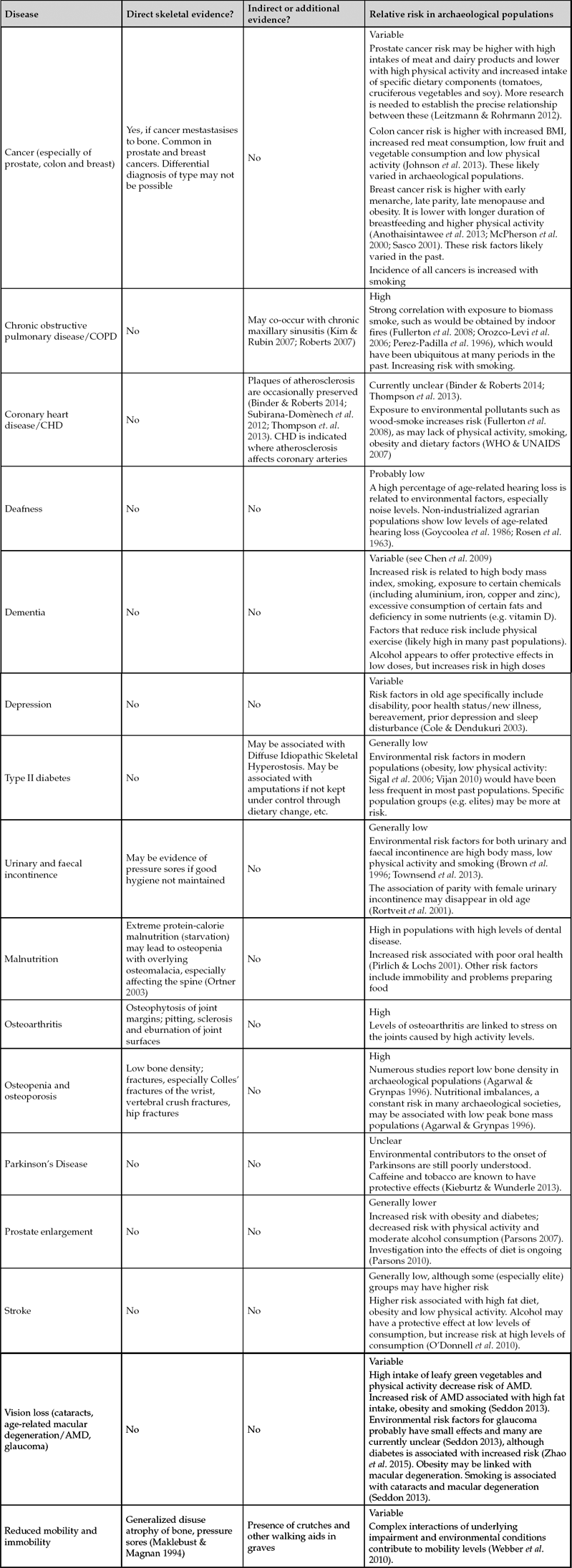
In past populations, then, diseases of ageing must be interpreted in light of this inter-relation of culture and biology. Detailed understanding will only emerge through specific contextual study, but it is possible to begin to suggest some lines of research based upon the inter-relationships between biology and behaviour in the past. In Table 1 I have listed a number of conditions associated with age, along with a suggestion of their identifiability from archaeological contexts and some initial thoughts on whether they may have been more or less common in past societies. Whilst this falls some way short of a ‘local biology’ in itself, I hope it will at least allow us to start to think about the ways in which the embodied understandings of ageing and disease may have emerged in past societies. It should be noted that, whilst not all of these conditions can be directly identified from preserved human remains, their presence may be able to be inferred based upon environmental conditions and social and cultural practices.
Common diseases of old age and their potential identification in archaeological contexts. N.B. Only risk factors likely to be different between ancient and modern populations are listed here. The influence of genetics and of changing population age structures are not included (i.e. risk is not considered ‘lower’ simply because of smaller numbers of older individuals in some past populations).

Table 1 suggests that there are several risks that are likely to apply disproportionately to past populations. The environmental factor that comes up in almost all cases is tobacco use. This suggests that, from an archaeological perspective, we might expect to see major differences in the experience and rate of age-related disease in tobacco-using populations compared to those populations who did not use tobacco. However, a second very significant environmental factor is biomass fuel sources (dung, crop detritus and wood) used in poorly ventilated domestic spaces. These were probably very widespread in most archaeological societies and are associated with many of the same adverse health outcomes as tobacco smoke. On that basis, the difference between tobacco-using and non-tobacco-using populations may not be as significant as those between smokers and non-smokers in modern Western societies. Biomass fuel sources were probably one of the most significant causes of ill health in general in the past, and probably represent a common feature in many ‘local’ biologies of ageing.
Nutrition is also likely to have had a significant impact: malnutrition is very common in the contemporary elderly, even in wealthy Western cultures with no deficiency in the food supply, and is also likely to have occurred at high rates in the past. This is not just due to questions of food supply or poor understanding of nutrition. The decline in the sensory experience of eating also plays a significant role in undernutrition in present-day elderly people (Brownie Reference Brownie2006), and probably did so in the past. Finally, activity levels are likely to have been strongly related to the health of older people in many archaeological settings. Whilst these would have been highly variable, it should be possible to bring in a variety of archaeological evidence (for example about subsistence practices or variations in status- or gender-related practices) that will give us clues about potential activity levels in old age and contribute to our ability to understand ageing in a variety of contexts.
As well as understanding the complexities of archaeological context, in order to understand exactly how the diseases of ageing affected the bodies of the past, we will need to engage with recent advances in knowledge about skeletal biology, at both a macroscopic and microscopic level (cf. Klaus Reference Klaus2014) and to interrogate the complexities of epigenetic effects upon ageing (cf. Agarwal Reference Agarwal2016). Whilst some will be more amenable to analysis than others, a variety of approaches from palaeoepidemiology (Milner & Boldsen Reference Milner and Boldsen2017) to detecting DNA methylation (Briggs et al. Reference Briggs, Stenzel, Meyer, Krause, Kircher and Pääbo2010) have the potential to inform future analyses.
Ageing and skill
Whilst appearance, function and disease can at least to some extent be investigated directly through bodies, other aspects of the ageing body need to be explored through material culture. This applies particularly to craft skill and production. Archaeologists have been increasingly interested in the development of craft skill (e.g. Crown Reference Crown2001; Reference Crown2007; Garrido-Pena & Herrero-Corral Reference Garrido-Pena, Herrero-Corral, Sánchez Romero, Alarcón Garcia and Aranda Jimenez2015; Kamp Reference Kamp2001; Kuijpers Reference Kuijpers, Sørensen and Rebay-Salisbury2012; papers in Wendrich Reference Wendrich2013), which is frequently discussed in relation to childhood and apprenticeship. Ideas of skilled crafts(wo)manship in old age, in contrast, are rarely explored and in those rare cases where they are mentioned, this tends to be in passing (e.g. Crown Reference Crown2001, 452; Hasaki Reference Hasaki and Wendrich2013, 194). In contrast, social gerontology includes regular discussion of the significance of crafting, but this tends to be in a leisure or therapeutic context, at best involving the elderly as skilled amateurs and often discussing crafting as creating entertainment or meaning for individuals who have few other options. Discussion of ageing and mastery of skill is much less frequent. There is, though, a small literature investigating ageing in connection with fine art (e.g. Freundlich & Shively Reference Freundlich and Shively2006; Lindauer Reference Lindauer2003; Lindauer et al. Reference Lindauer, Orwoll and Kelley1997). Whilst the relationship between art and craft is complex, this literature does at least begin to explore the relationship between old age and skill.
The nature of the relationship between craft skill, ageing and the body is complex. On the one hand, decline may affect dexterity, vision and other senses, subsequently reducing ability (Carmeli et al. Reference Carmeli, Patish and Coleman2003; Margrain & Boulton Reference Margrain, Boulton and Johnson2008). On the other, old age represents the zenith of a lifetime of learning, which may be associated with a true mastery of technique and creativity (cf. Lindauer Reference Lindauer2003; Lindauer et al. Reference Lindauer, Orwoll and Kelley1997). The way in which the inter-relationships between these two aspects are played out will vary both with cultural context, with the specific body and with the trajectory of ageing. This means that objects produced by elderly crafts(wo)men will vary according to their specific circumstances, but there may be aspects of the work that can help us to identify them. I will briefly explore these ideas with two case studies taken from Sofaer and Budden (Reference Sofaer, Budden, Sørensen and Rebay-Salisbury2012) and Sofaer (Reference Sofaer2015). I propose that elderly craft specialists may have been involved in each case, but that very different experiences of embodied ageing were involved.
Sofaer and Budden (Reference Sofaer, Budden, Sørensen and Rebay-Salisbury2012) examine the level of skill exhibited in the production of ceramics from the Bronze Age tell at Szazhalombatta, Hungary. Different attributes of vessels are investigated to determine the overall skill level for each vessel, with low-skilled vessels identified as possibly produced by apprentice potters. Whilst the vast majority of vessels demonstrate a consistent skill level (poor, moderate or good), there is a small sub-set of vessels that show differences between different attributes (for example, clay preparation, wall thickness and decoration). These ‘mixed message’ pots are seen as possible examples of collaborative work, with skilled potters ‘scaffolding’ the development of apprentice potters (cf. Vygotsky Reference Vygotsky1978). One illustrated example (Sofaer & Budden Reference Sofaer, Budden, Sørensen and Rebay-Salisbury2012, fig. 12.8) shows a well-made, thin-walled pot, but with poorly judged decoration. The decoration consists of three incised bands around the pot neck, from the lowest of which incised triangles point downwards. Each triangle is filled with incised lines parallel to the right side of the triangle. The incised lines seem somewhat hesitant and irregular, and in places they overshoot the edges of the triangles. Many of the triangles overlap one another at the top. Equally, the three ‘bands’ surrounding the pot's circumference are rather uneven.
I would like to propose a possible alternative explanation for the poor quality of decoration on this otherwise well-made pot: that it was made by an older potter who was experiencing a decline in manual function and hence in embodied skill. The possibility of older potters producing inconsistent work has been considered by Crown (Reference Crown2001, 454); however, she discounted this idea for her study area, based on ethnographic evidence that ageing potters would choose to give up potting when their functional capabilities began to wane. There is, though, ethnographic evidence that in some contexts potters continue to make pots (and to be respected for their craftsmanship), even when the standard of their work begins to decline due to ageing (Kramer Reference Kramer1985, 84; Thompson Reference Thompson1958, 15). Thompson (Reference Thompson1958) illustrates the work of an ageing potter from Lerma in the Yucatan Peninsula. Whilst this individual was regarded as a master craftsman by his fellow potters, photographs of his work (as well as Thompson's own assessment) show that it is less precise than that of younger potters, with a poorer-quality finish. Studies of ageing artists show that they often continue to create in the face of considerable impairment (e.g. Freundlich & Shively Reference Freundlich and Shively2006; Jeffri et al. Reference Jeffri, Spiller, Heckathorn and Simon2007; Kowalski & Chung Reference Kowalski and Chung2012; Mazzucchi et al. Reference Mazzucchi, Sinforiani, Boller, Finger, Zaider, Boller and Bogousslavsky2013; Pinker Reference Pinker2002); however, where hand function is impaired this may involve alterations in their technique, media or subject matter. One elderly artist in an article by Lindauer et al. (Reference Lindauer, Orwoll and Kelley1997, 139) described how she adopted a more impressionistic technique as compensation for age-related decline in dexterity and vision. Such adaptations may have been less available to potters working within a specific, culturally mediated crafting tradition, meaning that their finished work would have included obvious flaws. Interestingly, studies of visual perception in older people show that older adults may be both less accurate in drawing complex shapes and in recognizing that such shapes are inaccurate (Plude et al. Reference Plude, Milberg and Cerella1986). Thus, changes both in dexterity and in visualization may contribute to inaccurate decoration. Such an observation fits in well with the flawed decoration in the pot from Szazhalombatta, with its lack of both accuracy and precision. This may therefore represent the work of a potter at the point of transition between skilled ceramicist (as shown by the overall construction) and impaired older person (as shown by the decoration).
Whilst loss of function is one possible trajectory for the ageing craft producer, many craft specialists and artists suggest that it is only in old age that they realize the true height of their abilities (Lindauer et al. Reference Lindauer, Orwoll and Kelley1997). There is good evidence that some artists are able to continue to produce high-quality work even in the face of severe age-related degeneration (e.g. Kowalski & Chung Reference Kowalski and Chung2012). Cross-culturally, the most skilled ceramic production is often undertaken by older women (Frink Reference Frink2009), and older potters are often responsible for producing larger and more complex vessels (Kramer Reference Kramer1985). Older artists discussing their old age refer both to the skill achieved as the culmination of a life-long learning process and to a greater sense of artistic freedom (Lindauer et al. Reference Lindauer, Orwoll and Kelley1997). They often feel under less pressure than younger individuals to conform in terms of what is seen as socially desirable or ‘saleable’ (Lindauer et al. Reference Lindauer, Orwoll and Kelley1997). Such a combination of virtuoso craft skill and social non-conformity can be traced in a reconstructed vessel from Tumulus 5 at the Late Bronze Age site of Lapus, northwest Romania, described by Sofaer (Reference Sofaer2015, 158–62, fig. 8.3A). Sofaer notes that this was a virtuoso object, sophisticated and showy, in which the potter ‘flaunted’ their skill. Skill is shown in a number of different ways: the vessel is large (67.5 cm high) and high necked; it is expertly burnished; the modelling shows much fine detail, including four realistic animal-head protomes; and it shows excellent control of the firing process. In addition to the skill shown in this vessel, it is also somewhat unconventional—it has similarities with three other vessels from Lapus, but also notable differences in its form and decoration. Its difference particularly lies in its decoration, which uses a distinctive ‘clay carving’ (kerbschnitt) technique. Bands of interlocking triangles ‘flow’ down the vessel, drawing the eye with them (Sofaer Reference Sofaer2015, 161). The kerbschnitt technique is known from other clay traditions in the neighbouring area, but the vessels in that case take a different form (Sofaer Reference Sofaer2015, 161). This, then, represents a highly skilled product, but one that does not conform to social conventions (Sofaer suggests that the lack of close parallels indicates that, socially, it can be seen as a failure). Such a combination of skill and non-conformity is often the work of older artists/craftspeople in modern contexts. Perhaps what we are seeing here is an individual in old age at the peak of their embodied skill, relatively unaffected by the physiological decline of old age and with a sense of confidence in their abilities and their design that enables them to transcend the boundaries of local craft tradition.
Of course, it cannot be proven definitively that these pots were produced by older potters. Rather, these are potential explanations that fit the available evidence and therefore need to be actively researched as possibilities. The two examples presented here emphasize that ageing and skill are not straightforwardly correlated, but that they are strongly interlinked. Decline of the ageing body may compromise skilful crafting, or ageing may allow the embodied expression of the very highest levels of craft skill, whether or not that conforms to given social expectations. Such approaches are not limited to ceramics, and future research is clearly needed into how ageing might affect other skilled craft practices, for example metal, textile or lithic production. Throughout this paper, I have emphasized the ways in which we can explore the ageing body through a variety of archaeological approaches. Whilst bioarchaeological approaches offer considerable potential, I hope it has become clear that the ageing body is not accessible only through direct study of skeletons. In fact, many sub-disciplines of archaeology have something to contribute, and understanding the affordances of particular material culture, structures, settlements and landscapes may all enable a better understanding of ageing in the past. In addition, we cannot simply assume a cause-and-effect relationship between particular kinds of physiological decline and the status of the elderly in past societies: research shows that impairment and disability cannot automatically be conflated and the interplay between age-related impairment and disability in particular is complex (see extensive discussion in Gowland Reference Gowland, Tilley and Schrenk2016): detailed contextual analysis is necessary to understand both how people aged and how ageing was understood in each archaeologically known society.
Equally importantly, ageing is not a topic that archaeology can investigate in a vacuum. Multidisciplinary approaches are key, whether this involves collaborating with biomedical scientists, anthropologists or historians (limitations of space have prevented me from bringing in the rich historical literature on ageing here, but there is considerable potential for collaboration between historians and archaeologists with an interest in ageing). Only through such collaborations will we be able to understand fully the complex inter-relationships between the biology of ageing, particular experiences of ageing in the past and social understandings of both functional and dysfunctional aspects of ageing.
A final point is that, in its focus on the ageing body, there has been little opportunity in this article to discuss the roles taken on by the elderly, and their potential social contribution. Given the potential evolutionary importance of grandparents (Hawkes et al. Reference Hawkes, O'Connell, Blurton Jones, Standen and Foley1989; Reference Hawkes, O'Connell, Blurton Jones, Alvarez and Charnov1998; cf. Appleby forthcoming), this also remains an important area for future work.
Conclusion
The few previous articles that have addressed old age from an archaeological perspective have so far related it to questions of categorization, social status and gender. Whilst these are all very valid approaches, they do not consider the complexity of processes of bodily ageing. In this article I have illustrated some different ways in which we might approach the study of ageing through the body itself in the four areas of appearance, function, disease and skill. In discussing these areas I have considered how ageing is an important consideration for many different archaeological topics, including archaeologies of the senses and archaeologies of craft production. Whilst ageing itself is a universal, I have also tried to show how the specific processes and trajectories of ageing are highly variable, and rooted in local biologies in which environment, culture, society and biological processes constantly interact to produce particular ageing bodies. This in turn has implications for how we approach ageing archaeologically. The extreme variability of ageing means that there is very little to be gained from trying to construct a single archaeology of ageing and old age. Instead, only detailed studies of specific archaeological contexts are possible. Exploring the variability of ageing in the past is important, not just to allow us to build richer archaeological narratives, but it will also help us to understand better what ageing is in the present, and how it has come to be that way.
Acknowledgements
Ollie Harris and Grahame Appleby both read and commented on earlier drafts of this article, and their comments significantly influenced its direction. I would like to thank the two anonymous reviewers for their insightful and unusually constructive comments. This article was largely written whilst on a period of academic study leave granted by the University of Leicester.