Introduction
Cognitive changes that follow the aging process are among the most important public health issues around the globe. The looming epidemics of mild cognitive impairment and dementia add to this concern – the number of patients with dementia is expected to grow by 100% between 2001 and 2040, and in Asian countries, by 300% (Kim et al., Reference Kim, Han, So, Seo, Kim and Kim2014). These increases entail tremendous societal burden in regards to economic costs and quality of life among the elderly as well as their caregivers (Alzheimer's Association, 2009). Because dementia is a progressive condition that worsens over the course of the disease, most current studies in cognitive aging have focused on early detection of cognitive impairment, which could enable early treatment strategies to delay progression of disease (Barnes and Yaffe, 2009).
Dementia has a long pre-clinical period (Brookmeyer et al., Reference Brookmeyer, Gray and Kawas1998; Wilson et al., Reference Wilson, Peters, Ritchie and Ritchie2011; Baumgart et al., Reference Baumgart, Snyder, Carrillo, Fazio, Kim and Johns2015). For example, a previous finding from a community-based longitudinal study suggested that delaying the onset of symptoms by five years will decrease the risk of dementia by 50% (Seshadri et al., Reference Seshadri2006). It is thus critical to identify older adults who do not exhibit dementia symptoms but have a high risk of developing the condition so that they can be monitored for disease prevention and treatment.
A continuous challenge for contemporary cognitive aging research is finding appropriate norms applicable to the specific population. As it was pointed out in a previous normative study published by Au et al. (Reference Au2004), additional normative data from large community-based studies are needed, and this request has been met in papers such as Dore et al. (Reference Dore, Elias, Robbins, Elias and Brennan2007). The need for additional normative data is pertinent especially in aging studies since cognitive aging is a life-long process that requires not only a normative data but also a pre-morbid functioning data. Without appropriate norms, the division between “not impaired” and “impaired” become vague, which results in increased propensity for false positives or false negatives (Bornstein, Reference Bornstein1986; Heaton et al., Reference Heaton, Ryan, Grant, Grant and Adams2009). This error can be very costly to patients especially those at risk for Alzheimer's disease or other neurological diseases. A decline in cognitive function comes with normal aging but the task is to differentiate that from neurological deficits. There may be no full-proof method to discern the two but an increase in accuracy can be achieved by considering the characteristics of the cohort at study. The evaluation requires the researchers to consider education level, gender, and age (Weinderholt et al., Reference Wiederholt, Cahn, Butters, Salmon, Kritz-Silverstein and Barrett-Connor1993; Farmer et al., Reference Farmer, Kittner, Rae, Bartko and Regier1995; Vanderploeg et al., Reference Vanderploeg, Axlerod, Sherer, Scott and Adams1997; Cagney and Lauderdale, Reference Cagney and Lauderdale2002; Dore et al., Reference Dore, Elias, Robbins, Elias and Brennan2007; Elias and Wagster, Reference Elias and Wagster2007)
The Framingham Heart Study (FHS) and the Maine-Syracuse Longitudinal Study (MSLS) have provided normative data from their samples of 1,841 and 945 subjects, respectively (Elias et al., Reference Elias, Elias, D'Agostino, Silbershatz and Wolf1997; Au et al., Reference Au2004; Dore et al., Reference Dore, Elias, Robbins, Elias and Brennan2007). Norms for various widely used psychometric instruments were provided by stratifying participants by age, education, and gender. In response to their attempts to examine the associations of health and age with cognitive functioning and contribute to the global effort in constructing indices of cognitive deficits or declines, the current study also presents normative data from the Korean Genome and Epidemiology Study (KoGES). While there has been a lack of normative studies in non-Caucasian populations, data from a Korean epidemiologic sample would contribute to the current understanding of normative data in Asian populations (Gupta et al., Reference Gupta2011; Wang et al., Reference Wang2011; Yang et al., Reference Yang2012). In particular, our findings would complement findings from pre-existing population-based cognitive aging studies in Koreans (i.e. the Korean Longitudinal Study on Health and Aging (KLoSHA), the Korean Longitudinal Study of Ageing), Memory and Aging Study of Koreans (MASK)) in understanding cognitive aging process of the Korean population (Lyu, Lee, and Dugan, Reference Lyu, Lee and Dugan2014; Jang and Kim, Reference Jang and Kim2015). KoGES provides unique data in that its study population consists of middle-aged and older population, which allowed us to capture performance from a pre-symptomatic population.
Higher education has been consistently found to be positively correlated with performance on cognitive tests (Birren and Morrison, Reference Birren and Morrison1961; Cagney and Lauderdale, Reference Cagney and Lauderdale2002). Education had a strong main effect on almost all tests encompassing memories and attention, as well as in executive functioning and language processing. These findings are in line with the cognitive reserve theory proposed by Stern (Reference Stern2002), which states that education attainment builds resilience in the progression and development of age-related or neurodegenerative pathology. It can also be interpreted that similar decrease in cognition among elderly population would result in differential diagnosis of dementia depending on the level of educational attainment; low educated individuals may display lower cognition throughout life and even a small decrease in cognitive scores would result in a major disability (Lopez and DeKosky, Reference Lopez and DeKosky2003).
Notably, participants in the current study are less educated when compared with those from previously published normative studies (post-secondary education 20.5% in KoGES vs. 31.9% in FHS Original Cohort, 64.1% in FHS Offspring Cohort, and 69.94% in MSLS). Age range of the participants were comparable with that of the FHS Offspring Cohort (mean age 60.4 ± 7.3 vs. 60.6 ± 9.4, respectively) but were generally older than those in the MSLS (mean age 53.0 ± 14.5). Variability in demographic characteristics highlights the need for representative normative data from different populations. We anticipate that findings from the current study will provide performance norms in lower educated middle-aged and older adults in Korea. Furthermore, these ethnic-based norms may lead to enhanced assessment of Korean immigrants and strengthen diagnostic power among under-represented ethnic minorities in the U.S. society.
Methods
Participants
Participants of the current study were recruited as part of the KoGES, a population-based study which started in 2001 in Ansan city of South Korea. Detailed description of the participant procedure has been presented previously (Kim et al., Reference Kim2013). Neuropsychological test protocol was added to the KoGES core examinations as ancillary study on aging, which was introduced in Exam 6 (years 2011 and 2012), was administered to 1,556 participants aged 49 to 79. For the current analyses, we eliminated subjects who had prevalent stroke (N=23), dementia (N=2), or traumatic brain injury (N=1). Two additional people were excluded for missing educational attainment information, resulting in a total study sample of 1,528 participants. Signed informed consent was obtained from each participant, and the study procedures were approved by the institutional review board of the Korea University Ansan Hospital.
Test battery
The neuropsychological test battery used in KoGES consists of the tests given to the participants of the FHS Original and Offspring cohorts, and test procedures and methods were adapted from the FHS protocol (Elias et al., Reference Elias, Elias, D'Agostino, Silbershatz and Wolf1997; Au et al., Reference Au2004). Although most of the neuropsychological tests were available in Korean versions, which were translated in Korean language and validated in the Korean population, we adapted some of the original tests from Wechsler Adult Intelligent Scale-Revised (WAIS-R) and Wechsler Memory Scale-III (WMS-III), because this strategy would help us compare findings between Framingham and KoGES. For the same reason, we also continued to use the older versions of the tests that have been administered across different cohort populations of Framingham (i.e. Original, Offspring, and Third generation cohorts). These original English versions were translated and back-translated by two Korean-English bilingual translators. Whereas we adapted this procedure for the tests that primarily measured visual processing or visual memory, we used Korean versions for language-based tests, such as tests that measured verbal memory and verbal fluency. The KoGES neuropsychological test battery was modified from the original English version as described below.
KoGES neuropsychological protocol modification
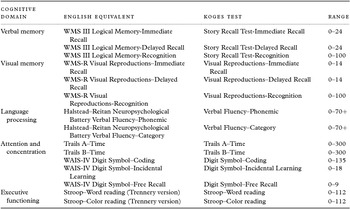
Table 1 describes neuropsychological tests in the KoGES battery, along with their English equivalent tests and the cognitive domains they are purported to measure.
Range of scores on neuropsychological test battery

WMS-III: Wechsler's Memory Scale, Third Edition; WMS-R: Wechsler's Memory Scale-Revised; WAIS-IV: Wechsler Adult Intelligence Scale, Fourth Edition; *Trennery et al., Reference Trenerry, Crosson, DeBoe and Leber1989.
Story Recall Test – Immediate and delayed recall and recognition
In the KoGES test battery, the Story Recall Test developed by An and Chey (Reference An and Chey2004) was administered in place of the Story Recall Test subtest from the WMS-III in the current study due to the lack of familiarity with English language and different cultural considerations in the Korean culture. The Story Recall Test has been standardized and has been recognized to be analogous to the Story Recall Test in WMS-III (An and Chey, Reference An and Chey2004), and the administration of this test includes immediate recall, delayed recall, and recognition, which measure short-term memory, long-term memory, and delayed recognition memory, respectively.
Visual reproduction – Immediate, delayed recall and recognition
In the Framingham test battery, visual memory is measured using the protocol from Visual Reproduction Test from the Wechsler Memory Scale-Revised (WMS-R). The test stimuli were identical in the KoGES test battery with modifications in test directions for Korean language.
Verbal fluency
Verbal fluency test in the KoGES test battery contains animal naming (category fluency) and phonemic fluency from the Controlled Oral Word Association Test (COWAT), which is part of the Halstead–Reitan Neuropsychological Battery. In Korea, a Korean version of the COWAT has been developed with replaced suffixes in English (i.e. “F,” “A,” and “S”) with Korean suffixes (i.e. gi-euk (“⌝”), eeh-eung (“○”), and si-ot (“⋏”)) for phonemic fluency (Lee et al., Reference Lee2002). The verbal fluency test protocols used in the KoGES test battery is the same as the COWAT protocol from the Seoul Neuropsychological Screening Battery (SNSB) (Kang and Na, Reference Kang and Na2003).
Trail making tests A and B
The trail making test is divided into two parts, with part A measuring simple attention and part B measuring executive function. Seo et al. (Reference Seo2006) have developed a Korean version of Trail B, where English alphabets were substituted by Korean ones on corresponding sequence and arrangement.
Digit Symbol–Coding, Incidental Learning, and Free Recall
In KoGES, the original test stimuli of the Digit Symbol test were adapted to the test battery and were administered according to the WAIS-IV protocol with modifications in test directions for Korean language.
Korean-Color Word Stroop Test–Word reading and color reading
The standardized version of the Korean-Color Word Stroop Test was used as the basis for the KoGES battery, in which words on stimulus pages have been modified for Korean language (Lee et al., Reference Lee2002; Seo et al., Reference Seo2008). The test was administered corresponding to the directions presented in the SNSD battery (Kang and Na, Reference Kang and Na2003).
Procedure
Study participants were administered the above-described neuropsychological assessment battery during the regular examination cycle, as part of the baseline measurement of the aging study. Standard administration protocols were used for each testing session by well-trained and experienced psychological examiners. Ranges of total scores for each test are presented in Table 1. Generally, better performance is indicated by higher total scores, with the exception of timed measures, such as Trails A and B and the Stroop subtests, which indicate the total time of completion and where a lower score is considered better performance.
Health variables (HV), such as body mass index (BMI; kg/m2), hypertension, diabetes mellitus, current smoking status, and heavy drinking (≥15g/day) were measured during a health examination and a questionnaire-based interview that were held onsite. Hypertension was defined by having self-reported antihypertensive medication or measured systolic blood pressure ≥140mm Hg. Diabetes mellitus was defined as reported taking insulin or hypoglycemic medication or having fasting glucose ≥125 mg/dL. Depression symptoms were measured with the Beck's Depression Index (BDI), a 21-item questionnaire that has been widely used as a valid measure of self-reported depression (Beck, Reference Beck1988).
Statistical analysis
In the first phase of our analysis, we compared age and education distribution by gender using the χ 2 test. In concordance with Elias et al.’s study (Reference Elias, Elias, D'Agostino, Silbershatz and Wolf1997) and Au et al.’s study (Reference Au2004), we replicated the analyses examining the main effects of age, gender, and education on the neuropsychological tests included in the KoGES battery by using an analysis of variance (ANOVA) using the Type III Sums of Squares from SAS Proc GLM. Multivariate effects of age, sex, education, HV, and BDI were obtained using multivariate multiple regression analysis.
Additionally, we present normative tables that describe the distributional properties of each cognitive measure stratified by age and educational groups in men and women. Data are described in regards to mean, standard deviation, the first (25%) and third (75%) quartile scores, and the 5th percentiles scores. All statistical analyses were performed using SAS Version 9.1 (SAS Institute Inc., Cary, NC), and p < 0.05 was considered to be statistically significant.
Results
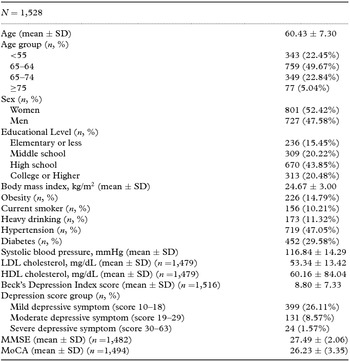
Descriptive and clinical characteristics of the current study sample are presented in Table 2. Overall, participants were of a mean age of 60.43 ± 7.30, and 47.58% of the individuals were men.
Demographic characteristics of the study sample

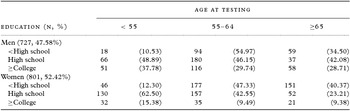
Age and education distributions were different by gender, with men having slightly greater mean age (60.62 ± 7.02 as compared with 60.26 ± 7.54 in women, p = 0.003) and a shift toward higher level of education. Specifically, 76.48% of men attained high school education or above, while 53.31% of women went beyond high school (p = 0 < 0.0001) (Table 3).
Age and education distribution by gender

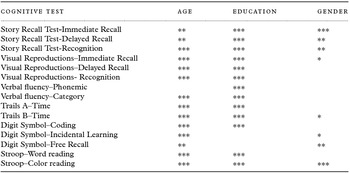
Table 4 displays the summary of significant main effects of cognitive measures by age, education, and gender. Main effects were determined from multivariate models where each main effect was adjusted for interactive terms. With education and gender adjusted, age was significantly associated with almost all cognitive measures, with the exception of Verbal Fluency-Phonemic fluency. Education was significantly associated with a majority of tests, with exceptions occurring from the memory portions of the Digit Symbol Test (Incidental Learning and Free Recall). In contrast, gender was only significantly related to three parts of Visual Reproductions–Immediate Recall, Trails B, memory portions of the Digit Symbol Test, and Stroop-Color Reading part (p's > 0.05).
Summary of significant main effects of age, education, and gender

*p < 0.05; **p < 0.01; ***p < 0.0001.
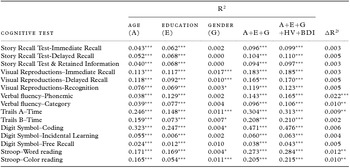
Proportions of variance accounted for by age, education, and gender are represented as R 2 values on Table 5. Each factor's R 2 value was first calculated separately and together from the combined Age + Education + Gender model, along with further addition of health variables and depression symptoms. When each main effect was considered, main effect of the interaction of age, education, and gender were not adjusted for each other, and R 2 values were calculated uniquely for that variable alone. For instance, age alone accounted for 4.3% of the variance in the Story Recall Test-Immediate Recall, with education uniquely contributing 6.2%, and gender accounting for no significant proportion alone. Age had an overall a significant contribution to all cognitive measures, as much as 32.3% of the variance on Digit Symbol-Coding and 24.6% variance on Trail A. Education also had a small but significant R 2 values on all cognitive measures, with some as much as 24.7% of the variance (e.g. Digit Symbol-Coding.) In contrast, gender had significant contributions on some tests on Visual Reproductions, Trails, Digit Symbol Coding, and Stroop tests, although the increments were small. Combining age, education, and gender in the model yielded an improvement in the predictions afforded by each factor separately for all cognitive measures (column 4), and further inclusion of health variables and depression symptoms in the model also resulted in improvement in the model, with the greatest improvement in Verbal Fluency-Phonemic test (ΔR 2=0.022, p < 0.001).
Proportion variance (R 2) in the cognitive test measures accounted for by age, education, and gender separately and together

HV= health variables (diabetes mellitus, hypertension, smoker, obesity, heavy drinking).
BDI= Beck's depression index.
ǂ:ΔR 2= R 2 differences between A+E+G model and A+E+G+HV+BDI model.
*p < 0.05; **p < 0.01; ***p < 0.0001.
Cognitive performance norms are presented in Table 6, with data stratified into different education, age, and gender groups. Results for each neuropsychological test are displayed in regards to mean, standard deviations, upper and lower quartiles, and 5th percentile scores.
Means and standard deviations (SD) of neuropsychological variables by education × gender in different age groups

SRT = story recall test; IR=immediate recall; DR=delayed recall; VR=visual reproductions; VF=verbal fluency; TMA= trail making test A; TMB= trail making test B; DS1=digit symbol-coding; DS2= digit symbol-incidental learning; DS3=digit symbol-free recall; STROOP1=stroop test word-reading; STROOP2=stroop test-color naming.
† Higher values on TMA and TMB represent slower reaction time (poorer performance).
Discussion
The current study looked at the effects of age, education, and gender on cognitive functioning of Korean population aged 49 to 79 years and provided normative data for performance scores on various cognitive measures included in the KoGES neuropsychological test battery. In general, higher level of education was associated with male gender and younger age.
Our results indicated that the majority of cognitive tests were associated with expected predictor variables-age, education, and gender when each factor was adjusted for in the multivariate analysis. More specifically, age and education were associated with all tests, but this association was not significant for gender for more than half of the tests. These findings are similar to those reported by the FHS (Au et al., Reference Au2004), except for the effect of gender; in KoGES, the main effect for gender was significant for visual memory (Visual Reproductions), whereas in FHS, it was significant for verbal memory (the Story Recall Test). Unlike FHS data, our data additionally indicated that Trails B was also shown to be affected by gender.
Detailed inspection of the KoGES normative data suggests a trend of lower test scores with increasing age and fewer years of education. Statistically significant main effects were also observed for majority of the cognitive tests for both age and education when the effects of the variables were accounted for each other. Unlike the findings from MSLS, we found statistically significant Age x Education x Gender interaction on the Stroop-Word Reading Test, and significant Age x Education interaction on Trails A and Verbal Fluency-Phonemical condition, which are characterized as frontal functioning (Baldo and Shimamura, Reference Baldo and Shimamura1998; Zakzanis et al., Reference Zakzanis, Mraz and Graham2005) One possible explanation for interaction in these sociodemographic factor is a discrepancy in education attainment between men and women across different age groups. For example, access to formal education was limited among older Korean adults (until 1959) and there were limited education opportunities for women. Different characteristics of samples from the USA and Korea also resulted in risk factors for cognitive impairment that are unique for each society (Lyu et al., Reference Lyu, Lee and Dugan2014).
Although education is a well-established predictor of cognitive performance, results suggest that some of the test measures were not fully accounted for by this factor. Multiple multivariate analysis showed that the effect of education was not significant in predicting scores for Incidental Learning and Free Recall parts of the Digit Symbol Test. Likewise, education, without the adjustment of age and gender, accounted for less than 2% of the performance on those two measures. One possible explanation for this finding is the low education level in the current sample which may have weakened the association between education and some cognitive measures. Socio-culturally, overall education attainment is low in middle-aged and older adults of South Korea due to a lack of emphasis on tertiary education (≥college) until the recent decades, particularly in women and those who were in the low socio-economic status (Kye et al., Reference Kye, Arenas, Teruel and Rubalcava2014). While low education in the current sample may not be reflective of their true pre-morbid cognitive performance, it is plausible that education level had a weaker impact on some cognitive measures, particularly for the two memory portions of the Digit Symbol Test, where the range of scores is limited.
In a model combining age, education, and gender, we found that all tests were significantly explained by the model. It was also notable that combining the three variables together explained significantly more variance as compared to that explained by each factor alone. These findings are consistent with the results reported by Dore et al. (Reference Dore, Elias, Robbins, Elias and Brennan2007), and this phenomenon has been widely accepted and established. Replicating the analyses done by Dore et al. (Reference Dore, Elias, Robbins, Elias and Brennan2007), we also added health variables (i.e. presence of diabetes mellitus, hypertension, smoker, obesity, and heavy drinking) as well as depression score to our model and found a small improvement in R 2 for Verbal Fluency, Trails A, Digit Symbol-coding part, and both parts of the Stroop Test (ΔR 2 ranging from 0.009 to 0.022, p's < 0.05). The most variance was accounted for the Category fluency test. We also had some notable discrepancies. Our results did not find significant ΔR 2 for any memory test (Story Recall Test and Visual Reproduction) or Trails B, whereas Dore et al. (Reference Dore, Elias, Robbins, Elias and Brennan2007) found statistical significance with those measures. Overlapping findings across both normative studies included small but significant improvements in variance with Trails A, Digit Symbol Substitution, and Verbal Fluency (ΔR 2 < 0.04, p's < 0.05), and both studies indicated that addition of health variables or depressive scores made only a modest increase in the variance explained by the model.
The relatively small effect of health variables, compared to age and education has been well-established in previous findings (Salthouse et al., Reference Salthouse, Kausler and Saults1990; Dore et al., Reference Dore, Elias, Robbins, Elias and Brennan2007). These consistent findings may be explained by subject sampling bias. Generally, individuals suffering from medical conditions are less likely to participate in research studies, as compared with healthy individuals, and longitudinal nature of KoGES exams could have also resulted in a healthy cohort effect (Salthouse et al., Reference Salthouse, Kausler and Saults1990).
The strength of the current study is its relatively large Korean population of community-dwelling individuals who are free from stroke, dementia, or any other neurological disorders that might affect cognitive test measures. We also included neuropsychological measures that have been validated for use in the Korean population. For those measures that were directly employed from the test battery from the FHS (i.e. Visual Reproductions and Digit Symbols Test), we corroborated that translation of these tests to Korean language produced results that strongly correlate with established Korean versions of similar tests. Scores on the Visual Reproductions measure showed strong positive correlations with those of Immediate and Delayed Recall of the Rey Complex Figure Test (RCFT), a widely used measure of visual memory in Korean population (Kang and Na, Reference Kang and Na2003) (Immediate Recall r = 0.57 and Delayed recall r = 0.61, p's < 0.0001) (Supplementary Table 1). However, the correlation between Recognition on both tests were weak and not statistically significant (r = 0.22, p = 0.61), which may be attributed to a vast difference in response options (4 options in Visual Reproduction Recognition vs. 12 options in RCFT Recognition) and resultant difficulty level. Additionally, scores from the Digit Symbol Coding test used in the KoGES battery yielded a very strongly positive correlation with the Digit Symbol Coding from the SNSB (r = 0.88, p = 0.61), although error rates were not significantly correlated due to small instances of errors in both measures (n’s < 5) (Supplementary Table 1)
Despite its strengths, one limitation of this study is that there are small sample sizes for some Age x Education groups, and thus, more careful attention needs to be paid when interpreting normative data of these sub-groups (Table 3). For example, there were only 64 individuals within the <55 age and ≤high school group, and sub-dividing this group by gender resulted in less than 20 observations in men. This was particularly evident for Trails B, which had the biggest drop rate due to inability to memorize the sequence of the Korean alphabets; the sample size was as small as five for some sub-groups. Another limitation is that the presence of dementia was determined by self-reported medical history, rather than from an internal review process performed by a panel of neuropsychologist and physicians. Thus, we lack information on whether dementia criteria followed the Diagnostic and Statistical Manual of Mental Disorders, Fifth edition (DSM-5) and National Institute of Neurological and Communicative Disorders and Stroke and the Alzheimer's Disease and Related Disorders Association (NINCDS-ADRDA) Alzheimer's Criteria. Despite this limitation, we are confident that the data is reflective of the general population given that most of our participants were within the normal ranges of the Mini-Mental State Exam (MMSE) (MMSE>24 in 96.12% of the sample). Scores below 5% may reflect neurological deficits or true cognitive impairment.
The current study provides normative data for a community based sample of dementia and stroke-free lower educated middle-aged and older Korean adults. The comprehensive nature of the battery in this study will add a valuable set of norms to the existing literature works and provide adequate reference to studies that use various cognitive measures in middle-aged and older adults.
Conflict of interest
Dr. Thomas reports: (1) A co-inventor an ECG-based method to assess sleep quality and sleep apnea; this software is licensed for Royalties by the Beth Israel Deaconess Medical Center to MyCardio, LLC. (2) Patent (unlicensed) for a device to modulate CO2 for central/complex sleep apnea. (3) Auto CPAP algorithm developed with and licensed to DeVilbiss-DRIVE. (4) General sleep medicine consulting with GLG councils. The other authors declare no conflict of interest.
Description of authors’ roles
Hyun Kim developed the study concept. All authors contributed to the study design. Hyun Kim and Seung Ku Lee contributed to data analysis under the supervision of Rhoda Au, Robert J. Thomas, Chang-Ho Yun, Changsu Han, and Chol Shin. Hyun Kim drafted the paper, and all other authors provided critical revisions.
Acknowledgments
The authors thank all research technicians at the Institute of Human Genomic Study for their contribution to data collection. This study was supported by grants from the Korean Centers for Disease Control and Prevention and the Korean Ministry for Health and Welfare (Grant 2011-E71004-00 & 2012-E71005-00). The study was performed at Korea University Ansan Hospital, Ansa, Republic of Korea.
Supplementary material
To view supplementary material for this article, please visit https://doi.org/10.1017/S1041610217000990