Introduction
Plant genetic resources and their diversity constitute the basis for food production and represent an opportunity in the face of the impacts of climate change and adverse factors such as drought, heat, frost, floods, pests and diseases (FAO, 2011, 2018); Furthermore, they are indispensable for food security, sustainable development, resilience and the supply of vital ecosystem services (FAO, 2019).
Chile peppers are part of the native plant genetic resources of Mexico, which are the second economically important crop in this country, after maize (SIAP-SADER, 2019). During the process of domestication and continuous selection in the Capsicum genus, fruit characteristics such as size, shape, mass, colour, appearance, flavour and spiciness have been modified (Kraft et al., Reference Kraft, Brown, Nabhan, Luedeling, Luna, d'Eeckenbrugge, Hijmans and Gepts2014; Pickersgill, Reference Pickersgill, Lira, Casas and Blancas2016; Barchenger et al., Reference Barchenger, Naresh, Kumar, Ramchiary and Kole2019). Domestication generated a large number of morphological variants and diversification within and between species (Massot et al., Reference Massot, Vasconcelos, Branco, Valgas and Barbieri2016; Carvalho et al., Reference Carvalho, Bianchett, Ragassi, Ribeiro, Reifschneider, Buso and Faleiro2017; Velázquez-Ventura et al., Reference Velázquez-Ventura, Márquez-Quiroz, Cruz-Lázaro, Osorio-Osorio and Preciado-Rangel2018). In addition to domestication, Taitano et al. (Reference Taitano, Bernau, Jardón-Barbolla, Leckie, Mazourek, Mercer, McHale, Michel, Baumler, Kantar and Van der Knaap2019) indicate that the genetic diversity in landraces of chile pepper C. annuum L. and C. frutescens are related to the techniques of its cultivation and fresh or dry use.
Capsicum annuum L., whose centre of domestication and genetic diversity is Mexico (Kraft et al., Reference Kraft, Brown, Nabhan, Luedeling, Luna, d'Eeckenbrugge, Hijmans and Gepts2014; Pickersgill, Reference Pickersgill, Lira, Casas and Blancas2016), has more than 50 cultivated morphotypes (C. annuum var. annuum) and their wild relatives (C. annuum var. glabriusculum) in this country (Pickersgill, Reference Pickersgill, Lira, Casas and Blancas2016; Martínez et al., Reference Martínez, Vargas-Ponce, Rodríguez, Chiang and Ocegueda2017). In particular, the ancho chile peppers are cultivated on 31 thousand hectares, whose production corresponds to 15% of the national green chile pepper production, and 24.5% of the national dried chile pepper production (SIAP-SADER, 2019). In general, these chile peppers have economic and culinary importance in Mexico, since traditional dishes are prepared with them, such as ‘chiles en nogada’, ‘mole poblano’, ‘mole negro’ of Oaxaca, ‘adobos’, sauces, among others (Aguilar et al., Reference Aguilar, Corona, López, Latournerie, Ramírez, Villalón and Aguilar2010; Vera-Guzmán et al., Reference Vera-Guzmán, Aquino-Bolaños, Heredia-García, Carrillo-Rodríguez, Hernández-Delgado, Chávez-Servia and Justino2017). It makes necessary its assessment and preservation.
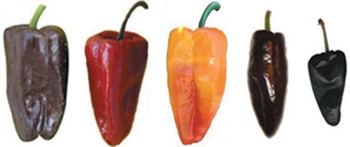
The ancho morphotypes considers several subtypes (Fig. 1) called mulatos (brown at ripen), anchos (red), cristalinos (orange-red), huacles (dark brown), miahuatecos (brown), Sweet Bell of Yucatan (red) and pasilla (brown) of Oaxaca. In the states of Guanajuato, Durango, Zacatecas, Querétaro, Aguascalientes, San Luis Potosí (SLP) and Puebla mulatos can be found as landraces. In Zacatecas, Durango, SLP and to a lesser extent in Puebla the ancho subtype can be found. In Guanajuato and Durango, cristalinos are grown. The huacles and pasilla are exclusive to the state of Oaxaca. The miahuatecos are originally from Miahuatlán, Puebla. The sweet bell peppers are located in the states of Yucatán, Campeche and Tabasco (Aguilar et al., Reference Aguilar, Corona, López, Latournerie, Ramírez, Villalón and Aguilar2010).
Ancho chile peppers of México. From left to right: mulato (brown), ancho (red), cristalino (orange-red), miahuateco (brown) and huacle (dark-brown).

The several morphological diversity studies in cultivated and wild chile peppers from Mexico have been developed locally or regionally (Ballina-Gómez et al., Reference Ballina-Gómez, Latournerie-Moreno, Ruíz-Sánchez, Pérez-Gutiérrez and Rosado-Lugo2013). Cultivated and wild chile peppers from Tabasco (Narez-Jiménez et al., Reference Narez-Jiménez, Cruz-Lázaro, Gómez-Vázquez, Castañón-Nájera, Cruz-Hernández and Márquez-Quiroz2014). Cultivated and wild chile peppers from Oaxaca (Castellón et al., Reference Castellón, Carrillo-Rodríguez, Chávez-Servia and Vera-Guzmán2014). Poblano chile pepper landraces (Toledo-Aguilar et al., Reference Toledo-Aguilar, López-Sánchez, López, Guerrero-Rodríguez, Santacruz-Varela and Huerta-de la Peña2016). Wild chile peppers from Tabasco (Velázquez-Ventura et al., Reference Velázquez-Ventura, Márquez-Quiroz, Cruz-Lázaro, Osorio-Osorio and Preciado-Rangel2018). Piquín chile pepper from Querétaro and Guanajuato (Ramírez et al., Reference Ramírez, Cervantes, Montes, Raya, Cibrián and Andrio2018). Guajillo chile peppers from Zacatecas, Durango and Puebla (Moreno-Ramírez et al., Reference Moreno-Ramírez, Santacruz-Varela, López, López-Sánchez, Córdova-Téllez, González-Hernández, Corona-Torres and López-Ortega2019). Chile pepper landraces from Yucatan Peninsula (Castillo-Aguilar et al., Reference Castillo-Aguilar, López, Pacheco, Cuevas-Bernardino, Garruña and Andueza-Noh2021). However, a study that encompasses the existing subtypes of chile ancho peppers of Mexico to determine their morphological diversity has not been carried out; consequently, the traits with the greatest contribution to the total variation in these chile peppers are unknown. Therefore, the objectives of the present research were (i) to characterize the morphological diversity of ancho chile peppers landraces of Mexico using morphological descriptors, (ii) to visualize the degree of diversity, (iii) to identify morphologically similar groups, (iv) to relate the diversity with the seed collection region and (v) to define the traits that provide more diversity to these chile pepper populations.
Materials and methods
Plant material
A total of 86 landraces were collected in six states of Mexico. It included the ancho, mulato, miahuateco, cristalino and huacle subtypes (Fig. 1). We used the commercial hybrids Capulín and Abedul (Harris Moran Seed Company®) as controls (Table 1).
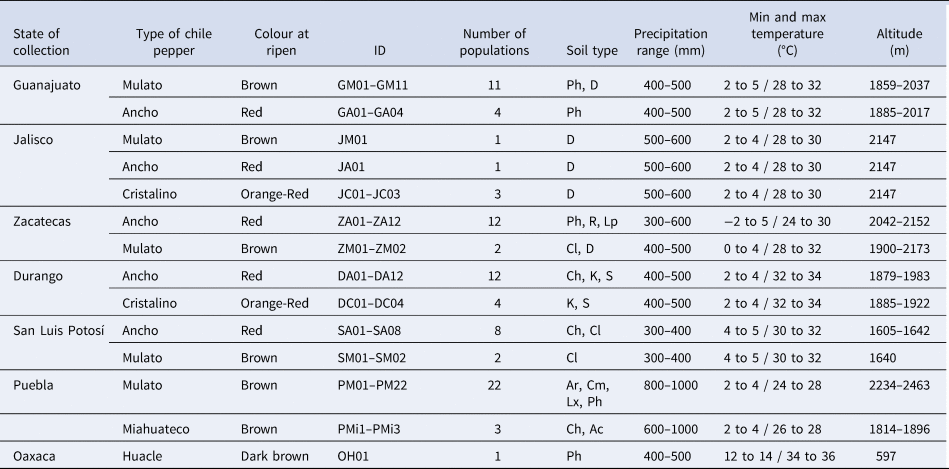
Ancho chile peppers landraces of Mexico and the ecological information of their seed collection plot

Soil type. Ph, phaeozem; D, durisol; R, regosol; Lp, leptosol; Cl, calcisol; Ch, chernozem; K, kastañozem; S, solonetz; Ar, arenosol; Cm, cambisol; Lx, lixosol; Ac, acrisol. The seed of hybrids Abedul and Capulín were not collected.
Ecological information
The ecological information of Table 1 was integrated by climate and soil type. Climate information for the seed collection plot was obtained from the official website of the National Commission for the Knowledge and Use of Biodiversity (CONABIO, for its acronym in Spanish) (CONABIO, 2023). From this page, files in vector format were downloaded for the averages of total annual precipitation, and minimum, average and maximum temperatures for the period 1910–2009. For soil type, the vector layer of the National Soil Data Set Series II of the National Institute of Statistics and Geography (INEGI, for its acronym in Spanish) (INEGI, 2023) was downloaded. Seed collection plot in each locality was geographically located. The map with the plots was elaborated using the QGIS 3.22.14 program (QGIS Development Team, 2023). The overlapping of the vector layers of climate and soils made it possible to identify the values of the variables for each plot.
Experimental design, localities of evaluation and experimental unit
The sowing was carried out in styrofoam trays of 200 cavities. The seedling production was carried out in a greenhouse. The seedlings were transplanted 66 and 69 days after sowing (das) in the fields of cooperating farmers. Treatments were evaluated in a randomized complete block experimental design, with two replications. The localities of evaluation were (a) Rancho Grande, Fresnillo, Zacatecas, located at 23° 27' N and 02° 57' W, with an altitude of 2024 m, phaeozem soil type, mean annual rainfall 400–500 mm, minimum annual temperature 2–4°C, mean annual temperature 16–18°C and maximum annual temperature 28–30°C, and (b) Santa Cruz, Nombre de Dios, Durango, located at 25° 50' N and 104° 10' W, with an altitude of 1840 m, kastañozem soil type, mean annual rainfall 400–500 mm, minimum annual temperature 2–4°C, mean annual temperature 16–18°C and maximum annual temperature 32–34°C. The experimental unit consisted of 52 plants, distributed in two rows with a length of 3.6 m and a separation of 0.9 m. The density was 80,246 plants per ha.
Registration of morphological traits
A total of 76 morphological and agronomic traits were recorded, of which 67 correspond to the manual for Capsicum descriptors (IPGRI et al., 1995). Additionally, the following traits were recorded: immature fruit colour (dark green, medium green and lemon green), number of branches after the first bifurcation, number of bifurcations, number of primary branches, number of petals and seed weight per fruit. Moreover, we estimated the indices (length/width) of cotyledonous leaf, mature leaf, plant and fresh fruit. Traits were recorded in 10 plants selected during plant maturity, inflorescence, fruiting and fruits of the second harvest (Supplementary Table S1).
Statistical analysis
Using the SAS V9.4 program (SAS Institute, 2012), we carried out a combined analysis of variance through localities (Ρ ≤ 0.05), Pearson's correlation coefficient between traits with statistical significance (P < 0.05 and r ≥ 0.7 or r ≥ −0.7) and discriminant analysis with Stepdisc. These analyses allowed a reduction of traits with a greater contribution to the total variation. The resulting variables were used in the analysis of principal components and conglomerates, that was performed with R Statistical Software V4.2.0 (R Core Team, 2022) and the factoextra package (Kassambara and Mundt, Reference Kassambara and Mundt2022). Dendrogram was performed with Euclidean distances and Unweighted Pair Group Method with Arithmetic Mean method (UPGMA).
Results
Morphological diversity of ancho chile peppers landraces
We detected 10 invariable characteristics among all the populations and individuals analysed, that were not included in the analysis of variance. The traits were green cotyledonous leaf, cylindrical stem, scarce pubescence in mature leaves, one flower per axil, pale blue anthers, white filament, null male sterility, absence of annular constriction of the calyx, absence of the neck at the base of the fruit and persistence of the pedicel in the fruit.
In the combined analysis of variance across localities, we identified statistically significant differences in 67% of the traits recorded between populations. The highest number of significant traits has relation to the fruits, while the flower traits have less variation. In general, there is little pubescence in the hypocotyl, leaves and stems, with the exception of the huacle chile pepper landrace of Oaxaca. Regarding flower traits, their arrangement on the plant can be erect, intermediate and sloping, with an open or bell-shaped corolla, with an exerted stigma and a mostly toothed calyx. Likewise, there is variation in the coloration of the fruit in immature, intermediate and mature stage, shape of the fruit, shape of the base and apex of the fruit, type of epidermis and transverse wrinkling. In addition, there is anthocyanin presence in the hypocotyl, stem, plant nodes, flowers, green fruits and calyx, mostly detected in collections from Puebla (Supplementary Table S2).
Relationship between populations
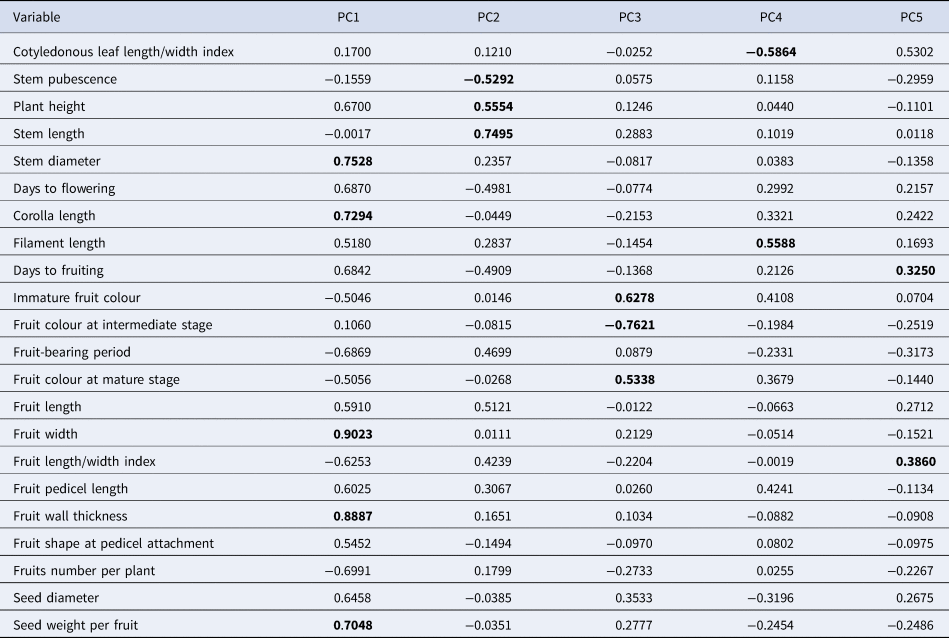
With Pearson's correlation analysis (r ≥ 0.7) and the Stepdisc discriminant analysis model, 31 traits with the greatest contribution to morphological variation in ancho chile peppers morphotypes were obtained. Of the 31 variables 22 of them showed a greater association with the first five principal components (PC) that contain 61.8% of the total variation. PC1, with 30.6% of the total variation, was mainly composed of fruit width, fruit wall thickness, stem diameter, corolla length and seed weight per fruit. PC2, which contributed with 10.4%, was mainly influenced by stem length, plant height and stem pubescence. PC3 contributed 8.0% of the total variation and was made up of traits of fruit coloration in immature, intermediate and mature stage. PC4, with 6.8% of the total variation, was made up of the cotyledonous leaf length-width index and filament length. PC5, with 6.0% of the total variation, was composed of fruit length/width index and days to fruiting (Table 2).
Eigenvectors of first five principal components (PC) of morphological diversity analysis of ancho chile peppers landraces of Mexico

Bold numbers in the table indicate the largest contribution of the original variables on each principal component.
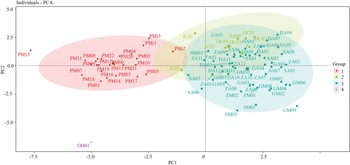
The dispersion of the populations, according to the first two principal components, shows that the mulato chile peppers of Puebla, miahuatecos and huacle (Groups 1 and 4) are separated from the rest of the populations of the north and Bajío parts of Mexico (Fig. 2). The mulato chile peppers from Puebla presented a lower fruit wall and plant stem thickness, shorter corolla length, related to smaller fruit size and lower seed weight per fruit. With regard to these traits, the opposite was observed in the mulato, ancho and cristalino chile peppers collected in northern states and Bajío (Group 2). On the other hand, and in relation to PC2, within the cristalino and ancho chile peppers there is variation in plant height, stem height and null pubescence in the stem. The mulato chile peppers from the north of Mexico (Group 3) showed less plant size and greater pubescence. The miahuateco chile peppers obtained higher plant and stem height than the mulatos of Puebla (Group 1). In the same sense, the population from Oaxaca presents wider chile peppers than the poblanos, but with thinner fruit wall, lower plant size and very pubescent stem.
Dispersion of ancho chile pepper landraces of Mexico in the first two principal components.

The separation in terms of the coloration of the fruits in immature, intermediate and mature stage is observed in PC3 (not shown), which are the traits with the greatest influence on this PC.
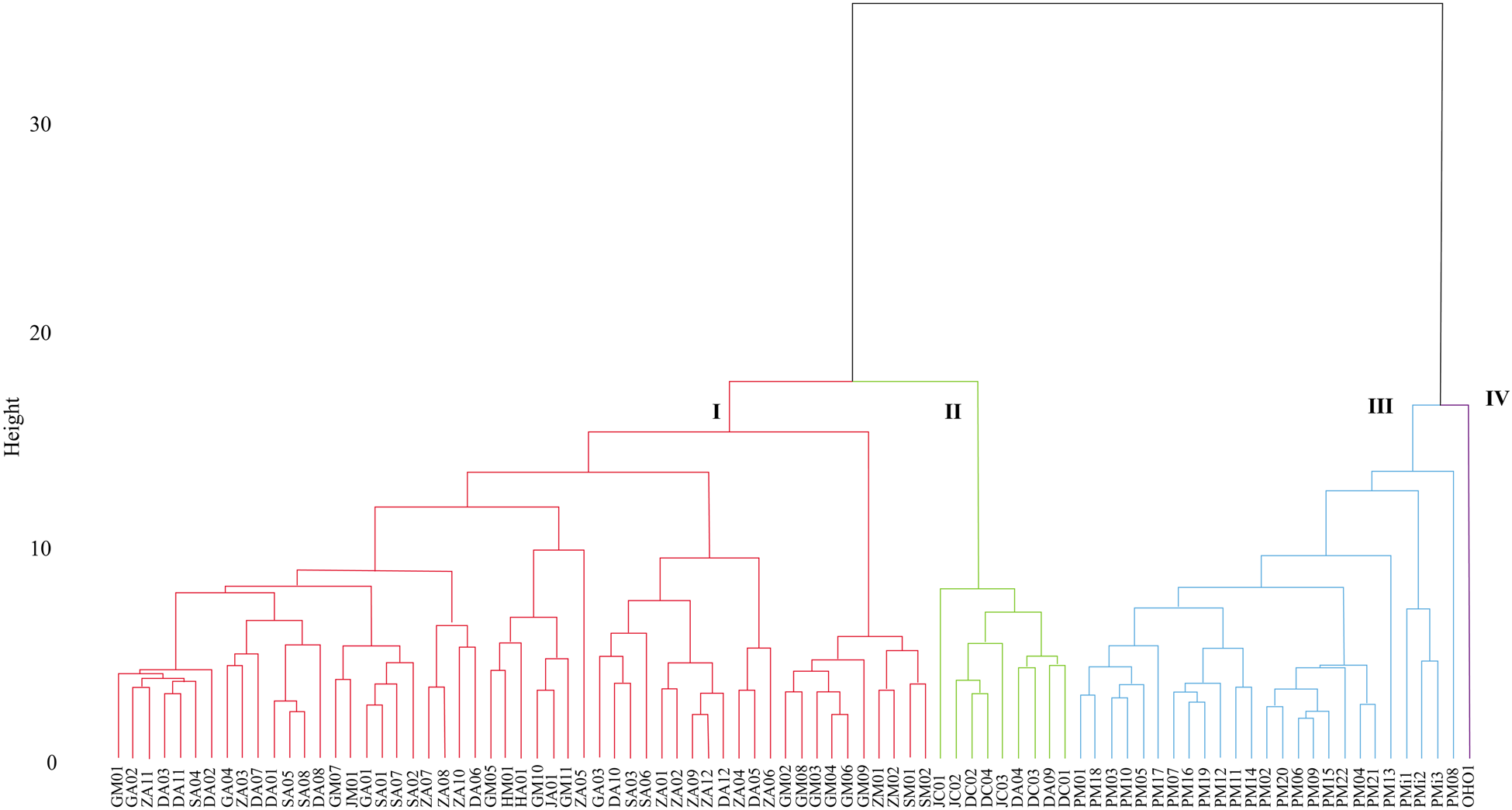
The association between the ancho chile peppers of the present study is shown in Fig. 3. Four groups were delimited from the generated dendrogram. As with the principal component analysis, this analysis also shows a differentiation with the mulato chile peppers from Puebla (Group III).
Groups of ancho chile pepper landraces from Mexico generated with Euclidean distances and UPGMA grouping method.

Group I was integrated by 53 populations of mulato and red ancho chile peppers from Guanajuato, Zacatecas, San Luis Potosí and Durango along with two commercial hybrids (Capulín and Abedul). The commercial hybrids showed morphological similarities with mulato chile peppers of Guanajuato. The characteristics of this group are fruits of 6.2 cm wide, 3.44 mm of fruit wall thickness, medium and dark green colour in immature and intermediate stage and red and brown in mature stage. Stem diameter of 9.9 mm, with scant pubescence, corolla length of 13.1 mm, filament length of 4.11 mm, dry seed weight per fruit of 1.86 g, plant and stem height of 74.0 and 26.8 cm and cotyledonous leaf length/width index of 4.51.
Group II, made up of nine populations of cristalino and ancho chile peppers from Durango, has fruits of 5.6 cm wide, 3.20 mm of fruit wall thickness, lemon green colour in immature stage, orange in intermediate stage and red at maturity. Stem diameter of 10.1 mm, scant pubescence, plant and stem height of 71.1 cm and 25.6 cm, corolla length of 13.0 mm, filament length of 4.05 mm, weight of dry seed per fruit of 1.68 g and cotyledonous leaf length/width index of 4.52.
Group III, made up of 25 populations of mulato and miahuateco chile peppers from Puebla, has fruits of 5.6 cm wide, 3.20 mm of fruit wall thickness, lemon-green colour in immature stage, orange in intermediate stage and red at maturity. Stem diameter of 10.1 mm, with little pubescence, plant and stem height of 71.1 cm and 25.6 cm, length of corolla of 13.0 mm, filament length of 4.05 mm, weight of dry seed per fruit of 1.68 g and length/width index of the cotyledonous leaf of 4.52.
The huacle chile pepper population has distinct morphological characteristics from the other three groups described and was located in group IV. This chile pepper has fruits 5.4 cm wide, with a very thin fruit wall (1.95 mm), very dark green colour in immature and intermediate stage and black at maturity. Stem diameter of 8.3 mm, with medium pubescence (the most pubescent in this study). Plant and stem height of 56.1 cm and 21.2 cm, corolla length of 12.2 mm, filament length of 3.56 mm, weight of dry seed per fruit of 1.59 g and length/width index of the cotyledonous leaf of 3.56.
Geographical distribution of the landraces groups
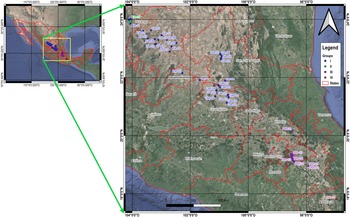
The map of the geographic distribution of the groups is presented in Fig. 4. According to Table 1, the ecological conditions associated with the four groups are different.
Map of the landraces seed collection plots and their groups.

Group I, comprising 53 landraces, covers the largest geographical area. Four types of soils predominate in this area: phaeozem in Guanajuato, calcisol in San Luis Potosí and regosol and leptosol in Zacatecas. Additionally, in Guanajuato, the annual variation in rainfall is 400 to 500 mm, minimum temperature 2 to 5, average 16 to 18 and maximum 28 to 32; in San Luis Potosi rainfall is 300 to 400 mm, minimum temperature 4 to 5, average 16 to 20 and maximum 30 to 32; in Zacatecas rainfall is 300 to 600 mm, minimum temperature −2 to 5, average 14 to 18 and maximum 24 to 32. In the Group II, comprising nine landraces, the predominant soils are kastañozem and solonetz. In this area, the annual variation in rainfall is 400 to 600 mm, minimum temperature 2 to 4, average 16 to 18 and maximum 28 to 34. In the Group III, comprising 25 landraces, the predominant soil is arenosol. In this area, the annual variation in rainfall is 800 to 1000 mm, minimum temperature 2 to 4, average 14 to 16 and maximum 24 to 28. Finally, in the group IV the soil type is phaeozem, the annual variation in rainfall is 400 to 500 mm, minimum temperature 12 to 14, average 16 to 18 and maximum 34 to 36.
Discussion
The major morphological diversity in ancho chile pepper landraces
In chile peppers, the domestication and selection process have mainly modified fruit traits (Pickersgill, Reference Pickersgill, Lira, Casas and Blancas2016). In ancho chile peppers, the conical shape of the fruit, width, colour and pungency are important characteristics due to the uses of this fruit in food dishes. The variation in the coloration found in immature fruits (light green to dark green), intermediate (green and orange) and mature (shades of red, brown and black), is related to processes of mutation and selection (Guzman et al., Reference Guzman, Hamby, Romero, Bosland and O'Connell2010; Li et al., Reference Li, Wang, Gui, Chang and Gong2013). The brown or black coloration of the ripe fruit is the result of the presence of chlorophyll and carotenoids or only carotenoids in red fruits (Lippert et al., Reference Lippert, Smith and Bergh1966). The presence of anthocyanin in mulato chile pepper plants of Puebla (Toledo-Aguilar et al., Reference Toledo-Aguilar, López-Sánchez, López, Guerrero-Rodríguez, Santacruz-Varela and Huerta-de la Peña2016) is due to the fact that these populations are sown at altitude above 2100 m and this characteristic is probably a mechanism to adapt to conditions of low temperatures or ultraviolet rays (da Ferreira et al., Reference da Ferreira, Paulo, Barbafina, Elisei, Quina and Macanita2012; Luo et al., Reference Luo, Li, Zhang, Deng, Xu, Hou, Pang, Zhang and Zhang2019).
The major variability in fruit traits has been reported in studies of domesticated chile peppers of the C. annuum L. species in Mexico (Castellón et al., Reference Castellón, Carrillo-Rodríguez, Chávez-Servia and Vera-Guzmán2014; Toledo-Aguilar et al., Reference Toledo-Aguilar, López-Sánchez, López, Guerrero-Rodríguez, Santacruz-Varela and Huerta-de la Peña2016; Moreno-Ramírez et al., Reference Moreno-Ramírez, Santacruz-Varela, López, López-Sánchez, Córdova-Téllez, González-Hernández, Corona-Torres and López-Ortega2019). Another characteristic associated with the fruit is the persistence of the fruit with the pedicel, which does not occur in the wild populations of C. annuum var. glabriusculum, where the fruit is easily detached from the pedicel to facilitate its dispersal by birds (Pickersgill, Reference Pickersgill, Lira, Casas and Blancas2016; Kumar et al., Reference Kumar, Shieh, Lin, Schafleitner, Kenyon, Srinivasan, Wang, Ebert, Chou, Mandal, Shukla and Siddiqui2018).
Differences in the morphological diversity among ancho chile pepper groups
Within ancho chile pepper landraces of Mexico, the width fruit trait is one of the characteristic with the greatest importance in PC1. For example, there are differences between chile peppers of Puebla and Oaxaca with those from the north and Bajío of Mexico. Chile peppers from the north and Bajío show greater fruit thickness and seed weight, which is desirable by producers to obtain higher yields. In regard to the plant, the chile pepper of the north and Bajío have the greater diameter of the stem, a characteristic related to support greater weight of the fruits and avoid lodging or tearing of the plants. The flower traits had the lowest variation in this study. The empirical selection that farmers have been carried out on ancho chile peppers in their niche has given rise to the morphological variability found in landraces (Nicolaï et al., Reference Nicolaï, Cantet, Lefebvre, Sage-Palloix and Palloix2013), process that have facilitated their adaptation to specific environments.
Ecological influence on morphological diversity among ancho chile pepper groups
The genetic diversity of ancho chile in Mexico has been generated under different soil and climate conditions. The most restrictive soils (calcisol, regosol and leptosol) are in the northern part of the country, a region associated to Group I. On the other hand, Phaeozems soils (associated to Group III and IV), Cambisols and Arenosols (associated to Group III) and Kastañozems (associated to Group II) are very fertile and suitable for cultivation. Research on how soil influences the generation of genetic diversity has been focused only on microbial activity associated with plants (Bashan and Holguin, Reference Bashan and Holguin1995; Dalmastri et al., Reference Dalmastri, Chiarini, Cantale, Bevivino and Tabacchioni1999; Carelli et al., Reference Carelli, Gnocchi, Fancelli, Mengoni, Paffetti, Scotti and Bazzicalupo2000; Manoharan et al., Reference Manoharan, Kushwaha, Ahrén and Hedlund2017); so it is necessary to generate research on the influence of soil on plant genetic diversity.
In regard to climate, this also presents differences in the regions where the genetic diversity of ancho chile has been generated. With respect to rainfall, the region with the least amount is associated with Group I and the highest amount with Group III. The lowest temperature has been recorded in the region associated with Group I and the highest in the region associated with Group IV. When comparing some morphological characteristics of landraces between both groups, we see that in group I there is a greater expression in plant height, fruit width and thickness and seed weight. The way in which climate influences the generation of genetic diversity is through the direct effect on physiological processes, that condition plant growth and development (Shao and Halpin, Reference Shao and Halpin1995), manifested by variation in phenotypic plasticity (Akman et al., Reference Akman, Carlson and Latimer2020). Nooryazdan et al. (Reference Nooryazdan, Serieys, Baciliéri, David and Bervillé2010) and Moles et al. (Reference Moles, Perkins, Laffan, Flores-Moreno, Awasthy, Tindall, Sack, Pitman, Kattge, Aarssen, Anand, Bahn, Bionder, Cavender-Bares, Cornelissen, Cornwell, Díaz, Dickie, Freschet, Griffiths, Gutiérrez, Hemmings, Hickler, Hitchcock, Keighery, Kleter, Kurokawa, Leishman, Liu, Niinemets, Onipchenko, Onoda, Peñuelas, Pillar, Reich, Shiodera, Siefert, Sosinski, Soudsilvskaia, Swaine, Swenson, van Bodegom, Warman, Waihler, Wright, Zhang, Zobel and Bonser2014) have demonstrated the effect of climate on plant morphology. In this regard, Romero-Higareda et al. (Reference Romero-Higareda, Hernández-Verdugo, Pacheco-Olvera, Retes-Manjarrez, Osuna-Enciso and Valdéz-Ortiz2023) found a positive correlation between climate and vegetative variables, fruit shape, larger reproductive traits, earlier flowering, specific leaf area, fruit shape and smaller plants of C. annuum var. glabriusculum. It is important to emphasize that not only ecological conditions influence the generation of morphological diversity; ethnobotany also influences plant morphological diversity.
Ethnobotany associated with the genetic diversity of ancho chile pepper
Chiles are fundamental in Mexican food, where their use is widely diversified (Aguilar-Meléndez et al., Reference Aguilar-Meléndez, Vásquez-Dávila, Katz and Hernández2018; Lascurain-Rangel et al., Reference Lascurain-Rangel, Avendaño-Reyes, Tan, Caballero, Cortés-Zárraga, Linares-Mazari, Bye-Boettler, López-Binnqüist and De Ávila2022). They have been used as a condiment, medicine and in ceremonies (Janick, Reference Janick2013). The cultural and traditional practices of farmers have a direct impact on the current gene pool in Mesoamerican crops, including chiles (Güemes and Aguilar-Meléndez, Reference Güemes, Aguilar-Meléndez, Aguilar-Meléndez, Vásquez-Dávila, Katz and Hernández-Colorado2018). In addition, a strong cultural connection has been established with chile, which is even considered a sacred plant for communicating with the gods in religious ceremonies of native peoples. Indigenous and rural farmers are the custodians of that biocultural heritage, for continuing to cultivate traditional morphotypes and promoting genetic variability (Aguilar-Meléndez et al., Reference Aguilar-Meléndez, Vásquez-Dávila, Katz and Hernández2018).
Ancho chile peppers grown in the North (Zacatecas and Durango) and Bajío of Mexico (Guanajuato and Jalisco) (Groups I and II) have a commercial connotation, which has probably led to the selection of genotypes with larger and heavier fruits. Dried chiles are marketed mainly in Mexico City. Chile mulato is grown in Puebla State in a traditional production system, characterized by less than 1 ha under cultivation, inadequate use of technology and, consequently, low fruit yields (Herrera, Reference Herrera2016; Lozano et al., Reference Lozano, Kuri and Prado2021). The green fruit is used in the food dish ‘chiles en nogada’ and the ripe and dry fruit in the ‘mole poblano’, a food dish widely used in social and religious celebrations in the region (Pérez et al., Reference Pérez, Tornero, Escobedo and Sandoval2017). The seeds and knowledge of the traditional cultivation system are inherited from generation to generation (Rodríguez et al., Reference Rodríguez, Peña, Gil, Martínez, Manzo and Salazar2007).
The miahuateco chile is cultivated in the Tecamachalco-Tehuacán region of Puebla State. Traditional practices are also carried out on this type of chile. Its main use is in the dishes ‘mole’ and ‘chile relleno’ (Aguilar et al., Reference Aguilar, Corona, López, Latournerie, Ramírez, Villalón and Aguilar2010). Huacle chile is grown in the canyon region of Oaxaca, located in the Tehuacán-Cuicatlán Biosphere Reserve. This chile is cultivated by ‘Chinantecas’ and ‘Cuicatecas’ indigenous people, also in a traditional system. Its selection and the environment in which it is grown have given it unique characteristics in flavour, colour, aroma and fruit shape. The fruit is the main ingredient of Oaxaca ‘mole negro’, a regional food of Oaxaca. It is also offered in religious ceremonies, such as Day of the Dead and social festivities (García-Gaytán et al., Reference García-Gaytán, Gómez-Merino, Trejo-Téllez, Baca-Castillo and García-Morales2017).
As conclusions, the morphological diversity present in the populations of ancho chile peppers landraces of Mexico is expressed mostly by characteristics of fruit width, fruit wall thickness, stem diameter, corolla length, seed weight per fruit, plant height, stem length and stem pubescence. These characteristics allowed the separation of the red ancho chile peppers of the Bajío and north of Mexico from the peppers of Puebla and Oaxaca, according to divergent patterns. The morphological diversity in landraces of ancho chile peppers of Mexico suggests that human selection exerted on these populations is related to the different ecological niches where they have been cultivated, since they show morphological differences according to the type of chile pepper and its seed collection regions.
Supplementary material
The supplementary material for this article can be found at https://doi.org/10.1017/S1479262123000783.
Acknowledgements
We are grateful with Sistema Nacional de Recursos Fitogenéticos, Fundación Produce Durango, Fundación Produce Zacatecas and Fundación Produce Puebla, for the financial support of our research.