a. Event Type: Chemical Fire Explosion
b. Event Onset Date: August 12, 2015
c. Location of Event: Tianjin Port, Binhai New District, China
d. Geographic Coordinates: 39.0037° N, 117.7105° E
e. Dates of Observations Reported: August 13, 2015-August 19, 2015
f. Response Type: Medical Response
Introduction
With the progress in science and technology, chemical products are commonly present in industrial and agricultural production and daily life. A certain proportion of chemical products are hazardous chemicals. According to Article III of the “Dangerous Chemical Safety Regulations,” hazardous chemicals refer to chemicals that are toxic, corrosive, explosive, or combustive and pose hazards to the human body, facilities, and environment. Reference Qian1–Reference Bin4 Due to subjective and objective factors, the production, transport, handling, storage, and use of hazardous chemicals may cause fires, explosions, poison leaks, and other types of accidents. Hazardous chemical explosions can trigger a chain of catastrophic incidences, causing casualties, property damage, and environmental pollution that threaten lives and property. Therefore, emergency medical rescue in response to hazardous chemical explosions is particularly important. Reference Lei, Right and Chong5–Reference Yi8 Using the “8–12” explosion of the Ruihai Logistics warehouse of hazardous chemicals in Tianjin Port (Binhai New District, China) as an example, the characteristics of injury and emergency medical rescue operations were analyzed following a hazardous chemical fire accident. The goals of this study were to improve emergency medical assistance, save people’s lives, and ensure the harmony and well-being of society.
Overview of the Accident
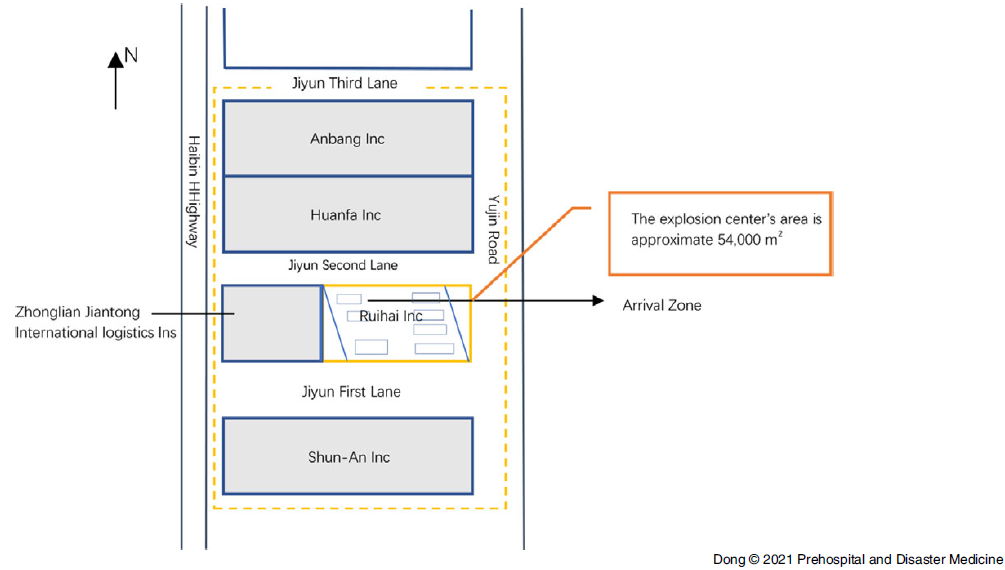
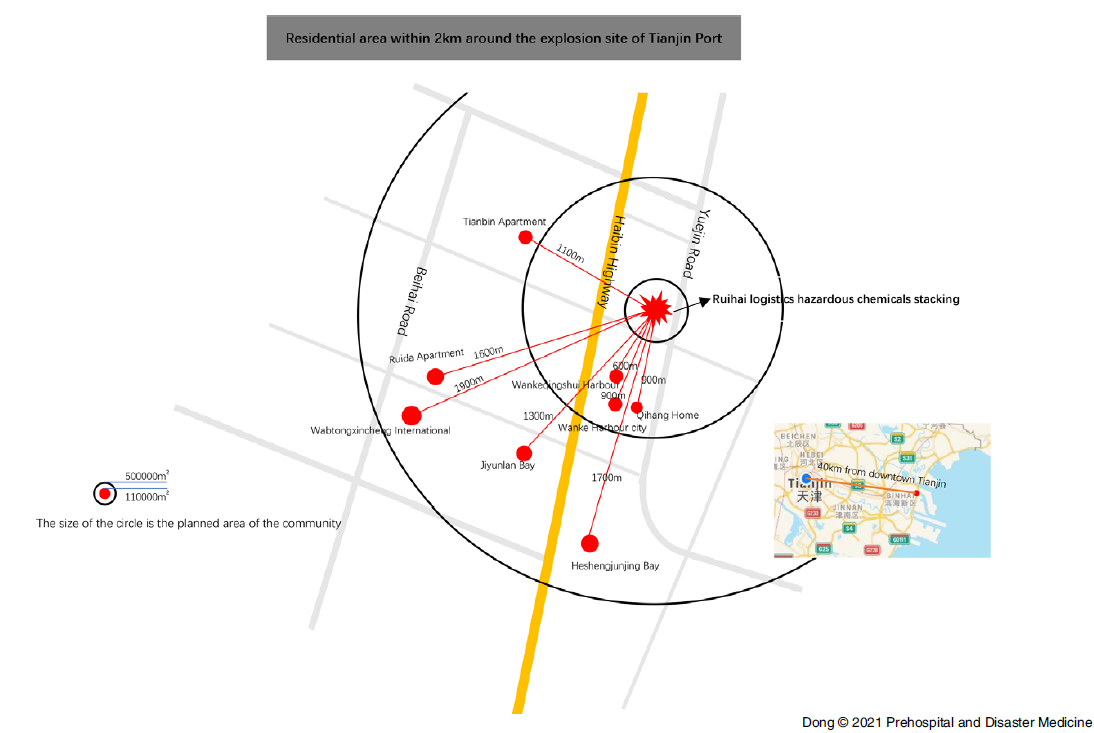
At 23:34 on August 12, 2015, a dangerous goods warehouse of Ruihai International Logistics Co., Ltd, located in the Tianjin Tanggu Dongjiang Tax Protection zone of Tianjin Binhai New District, had a fire explosion (Figure 1). An investigation team of the State Council concluded that the accident was a significant safety accident. The accident caused a total of 165 causalities (110 firefighters involved in the rescue and 55 civilians, including residences and employees of the company and nearby companies; Figure 2); eight missing people (five firefighters of the Tianjin Port and three employees and family members of firefighters); and 798 injuries (58 wounded and heavily wounded and 740 lightly wounded). This accident resulted in a direct economic loss of 6.866 billion RMB (1.051 billion USD).
A Schematic Diagram of the Explosion Center.

A Schematic Diagram of the Blast Center.

Features of the Injuries
Hazardous chemicals have toxic, hazardous, flammable, explosive, and other characteristics. This accident involved various species and large quantities of hazardous chemicals. Sodium cyanide and a variety of flammable and explosive chemicals were scattered in the field. There were many uncertain risk factors, all roads at the scene were blocked, and the poisonous gases posed a great threat. These facts posed enormous challenges for the rescue. Reference Tai, Bing and Zhaofan9–Reference Qizhen and Xuejian12 The injuries of this accident had the following characteristics.
Group Incidence
Two explosions occurred on that night. The first explosion occurred at 23:34 and had a magnitude of approximately 2.3, which was the equivalent of three tons of TNT. The second explosion occurred 30 seconds later and had a magnitude of approximately 2.9, which was the equivalent of 21 tons of TNT. The explosions caused a huge blast of energy that resulted in a high-speed over-pressure air stream. The damage to the human body included: (1) a direct effect on the human body, causing compression injuries in multiple body organs; (2) bruises on the body following a throw caused by the dynamic pressure of the high-speed air stream; and (3) harmful expulsion of collapsed buildings, glass, and other objects in the shock waves. The accident occurred at midnight when most of the nearby residents were sleeping or about to sleep, making it difficult to respond effectively to the sudden accident.
Multiple Injuries
Flames and shock waves at the hazardous chemical explosion site caused multiple blast-based injuries. In this accident, the treated injuries included traumatic tympanic membrane perforation, deafness due to a sudden knock, traumatic fractures, inhalation injuries, penetrating injuries, organ injuries, concussions, and severe brain injuries. Some patients rescued by search and rescue personnel experienced a deep coma, dehydration, fever, and other symptoms. Most of the patients had several injuries of varying severity and requested specialists in burns, orthopedics, intensive care, general surgery, otolaryngologists (ear/nose/throat), pediatrics, and other departments. There was a large age span among the patients, making the rescue work difficult.
Hazardous Chemical Poisoning
Hazardous chemical leaks can cause a wide range of air, water, and ground contamination, including local contamination and diffusion to areas downwind and downstream of rivers. These contaminations affect the health of local residents and the environment, and can also pose hazards to the rescue crew. Ruihai had stocks of calcium carbide, sodium cyanide, toluene diisocyanate, methyl ethyl ketone, and other inflammable and explosive materials. In particular, there were two storage units with a total of 700 tons of sodium cyanide. The environmental protection department detected cyanide in excess of eight-times the standard from a blocked underground pipeline in the accident area. A small amount of cyanide leaked and had a chemical reaction with rain. Chemical poisoning has diverse routes, including air, water, and soil. Humans can be poisoned through various channels, including the respiratory tract, eyes, skin, food, and wounds. Secondary poisoning can also occur due to ineffective decontamination. The most difficult part of this accident rescue effort was that the substance that caused combustion and explosion was not determined. Hence, it was difficult to develop a clear plan for the targeted treatment of toxic substances.
Post-Trauma Disorders
The sudden accident, physical injury, and the pain of losing loved ones resulted in psychological problems in some patients. Shock, anxiety, sadness, and other acute stress responses were common among the patients. Among these patients, most experienced anxiety, a lack of hunger, insomnia, dizziness, eye pain, back pain, blurred vision, and other symptoms. Some patients had psychomotor inhibition and showed silent, slow responses, hysteresis in vision, and indifference. The Affiliated Hospital of the Logistics University of Chinese People’s Armed Police Force (PAPF) in Tianjin formed a counseling group and opened a counseling telephone line to evaluate the psychological conditions of the patients in depth, to perform psychological screening, and to provide an early positive means of psychological intervention.
Characteristics and Effects of the Medical Rescue
Advantage of the Ability of Hospital to Perform Medical Rescue
According to missions and tasks assigned to the State Armed Police Force, the police force is responsible for the emergency rescue during major emergencies, such as sudden incidence and stability maintenance.
As the only hospital of its kind, the Affiliated Hospital of the Logistics University of Chinese PAPF has set up China’s first Institute of Rescue Medicine and a clinical center. This hospital is a designated rescue medicine training center approved by the National Health and Family Planning Council (Beijing, China) and has an experienced Armed Police Force National Emergency Medical Rescue Team. The team is responsible for all types of emergency medical rescue missions in Tianjin and across the country and has an admirable mission and great responsibility.
Additionally, from a geographical perspective, this hospital is located at the junction of Hedong District and Dongli District. Thus, it was the closest comprehensive hospital to the scene of the accident. From 01:00 on August 13, it began to receive patients and started to treat them throughout the night, which helped to save lives.
In-Hospital Treatment of the Wounded Patients
After the accident, the hospital received instructions from a high-level officer to initiate an emergency response health service mechanism. The green channel was launched immediately and four responsible teams command, treatment, care, and protection were set up at the same time. There was an emergency allocation of medicines, supplies, medical equipment, and other related departments; vacated wards; and allocated emergency department treatment areas. The hospital established a triage, a decontamination protection zone, a minor injury zone, a trauma area, a severe rescue zone, an infusion therapy zone, and a disposal zone in an open area in front of the emergency. After triage, patients received an internationally accepted triage card on their chests.
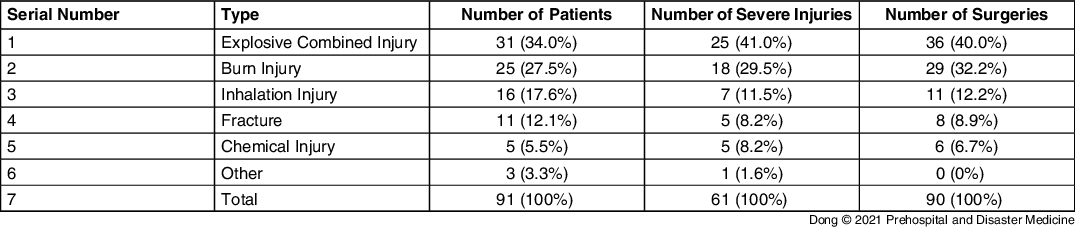
According to the characteristics of the explosion, emergency plans for in-house treatment and chemical poisoning were initiated, notifying the emergency and burn departments, intensive care unit (ICU), and 21 additional departments, opening a green channel for patient admission throughout the night, and gathering hospital medical staff to treat and rescue. Experts in orthopedics, neurosurgery, burns, chest surgery, emergency, poisoning, ICU, and other related specialties formed a group to provide joint consultations and joint treatment to the wounded patients. A total of 860 hospital medical staff participated in the treatment. Overall, 322 patients were admitted, including 231 out-patients, 91 hospitalized patients (one patient died upon arrival in emergency department), and 90 surgeries. Moreover, a number of experts from across the country came to the hospital to provide guidance and worked with the hospital staff to provide first-line treatment.
Burn patients are classified as critically injured, withing the percentage of the total body surface area affected more than 50%, third-degree burns of more than 20%, or burns associated with chemical poisoning, shock, or severe trauma injuries. The hospital burn treatment center in Tianjin admitted the highest number of critically injured patients; treated were 61 critically burned patients, with most of the wounded experiencing third-degree burns. Five critically burned patients were different from the other wounded patients because their burns showed a blue-gray color. Chemical contamination was suspected, and their skin tissues were severely damaged. One critically burned patient had respiratory tract burns, blast injuries in both lungs, open head and face trauma, soft tissue contusions, and multiple fractures. According to convention, extensive burns should receive surgery three days after incidence. However, in this case, an unusual approach was taken. Within 18 hours after injury, an escharectomy was performed and allogeneic skin covering while administering symptomatic treatment, blood purification, and other measures to effectively control the progression of the situation. After this accident, the wounded patients were treated in a centralized facility. There were many critical injuries. One day after the accident, 19 surgeries were performed. Altogether, 91 patients were admitted and 90 surgeries were performed (Table 1).
Injury Statistics of Patients in Hospital due to the Tianjin Port “8-12” Incident

Psychological Treatment of Patients
Recently, post-disaster trauma counseling and psychotherapy have received increasing attention from experts and scholars.
In 2011, following the approval of the Red Cross Society of China (Beijing, China), the Chinese Red Cross psychological rescue team was established. Team members have extensive experience, such as providing psychological relief during the Ya’an Earthquake (2013). This team is one of the important emergency rescue units of the Armed Police Force.
On August 13, when the patients arrived at the hospital, the psychological rescue team was immediately involved in psychological counseling and comforting. The hospital quickly set up psychological intervention teams for the patients, families, firefighters, and police officers. Each team was equipped with psychiatrists and counselors. The hospital also opened a psychological assistance hotline for people affected by the explosion that was free-of-charge to the public. The psychiatrists were responsible for the physical and psychological evaluations and issued guidance for medication; counselors were primarily responsible for assessing the psychological status of the affected persons and providing timely psychological counseling.
In the early stages, psychological symptoms are presented as acute stress, such as fear, anxiety, and insecurity. For patients with more serious symptoms at the initial stage, such as patients with poor sleep and severe insomnia, medications were administered to relieve the symptoms for a short time. During the later stages, the focus was on providing psychological comfort to address grief in those who were seriously injured and to the families of the victims.
Set Up of the Rescue Scene Tent and On-Site Treatment
At 20:00 on August 18th, the Affiliated Hospital of the Logistics University of Chinese PAPF received a command from the frontline headquarters to dispatch the National Emergency Medical Rescue Team. The team arrived at the center area of the explosion at 07:30 on the 19th to perform on-site medical rescue and support services.
After receiving the order, the hospital quickly formed the National Emergency Medical Rescue Team, consisting of 22 experts in cardiology, brain and neurology, psychology, lab testing, digestion, emergency, poisoning, rescue nursing, pharmacy, protection, and other specialties. A mobile hospital was dispatched formed by ambulances, a surgery shelter, and medical command camping cars and trucks that carried over 100 types of medicines and equipment to the center area of the explosion. The rescue team members were equipped with a full set of anti-chemical suits and other equipment. Depending on the hazardous chemical conditions on-site, they could provide accompanying support to the troops at the deep core zone of the explosion. After arriving at the Tianjin Economic-Technological Development Area (TEDA) campus of Tianjin University of Technology (Tianjin, China) at 08:40 on the 19th, the rescue team quickly set up tent hospitals and immediately started to perform patient classification, site decontamination and treatment, accompanying protection at the center area of the explosion, and medical evacuation tasks. Reference Furong and Xiuping13,Reference Youzhong14 The highlights included the following measures.
Rescue Personnel Training and On-Site Triage
The National Emergency Medical Rescue Team immediately trained the traffic headquarters rescue officers responsible for explosion cleanup tasks at the core area. The training included how to use gas masks, protective clothing, and first aid; prevention of poisoning; and isolation of the hazard from the outside world to the highest degree. The rescue team quickly classified the injured patients according to their injuries and tagged them appropriately to ensure that medical professionals offered the quickest treatment to those who were seriously wounded. At the same time, the team members observed the generally wounded patients, provided periodic inspections, and gave necessary treatment to avoid delayed treatment. When conducting on-site treatment, medical personnel worked in strict accordance with zoning and did not enter the contaminated area. The medical personnel wore appropriate personal protective equipment according to the actual situation. After rescue, the victims were quickly transferred to a security zone upstream of the wind to limit further poisoning.
Preliminary Decontamination
If skin was contaminated by chemical agents, the contaminated clothing was immediately removed, including underwear, socks, and gloves. The skin was rinsed with plenty of water, and contaminated hair was cleaned. The use of hot water was avoided. If the chemical was splashed into the eyes, timely and adequate flushing was the most important measure to reduce tissue damage. Tap water was used in the absence of clean water sources. The rinsing time was more than 10–15 minutes. Patients with inhalation poisoning were immediately sent to an area with fresh air and allowed to rest quietly. The patients’ airways were cleaned and oxygen was administered, if necessary.
Emergency Rescue
Once the patient was rescued from the scene, cardiopulmonary resuscitation was performed immediately if there was heart or respiratory arrest. Patients with loss of consciousness were monitored for changes in the pupils, breathing, pulse, and blood pressure. All foreign bodies in the mouth were removed in a timely manner. If the patient had a seizure, the physician applied symptomatic treatment, such as diazepam or phenobarbital antispasmodic agents, in a timely manner.
Treatment of Combined Injuries
For patients with blast injuries or chemical contamination together with burns, the physician focused on combined injuries, such as brain trauma, fractures, or blood loss. The poison latency and evolution of the disease was noted. A single cause of an injury should not be considered while complex injuries are ignored.
Application of Detoxification Drugs
For certain poisoning effects of drugs, more rapid detoxification treatment provides a better outcome. An excess amount of cyanide was detected at the accident scene. When the patient showed signs of nausea, vomiting, headache, dizziness, weakness, lethargy or irritability, and other symptoms or when the patient’s breath had an almond odor, the physician considered the possibility of cyanide poisoning.
Once diagnosed, the patient received immediate inhalation of amyl nitrite together with a slow intravenous injection of 10-15ml of 3% sodium nitrite or intramuscular injection of 2ml of 4-dimethylaminopyridine, followed by a slow intravenous injection of 20ml of 50% sodium thiosulfate. Urgent cyanide poisoning symptoms will lead to coma and convulsions in a patient with severe exposure, followed by death.
Timely Evacuation
After the initial on-site rescue, the patients were transferred to the hospital for further treatment under the close monitoring of the medical staff.
Reflection on this Disaster Relief Experience
Enormous challenges were faced during this process of treating wounded patients from the hazardous chemical explosion. One challenge was that there was a large number of seriously wounded patients, and the second was that their conditions changed quickly. A third challenge was that it was hard to treat burns, chemical injuries, and combined injuries.
Handling such a sudden accident requires the integration of a number of hospitals and multiple departments in rescue operations. On the night of the accident, the 120 emergency centers kept 10 to 20 intensive care team units. As the nearest hospital to the accident scene, Tianjin TEDA Hospital opened a green channel to all wounded patients. The Affiliated Hospital of the Logistics University of Chinese PAPF, General Hospital of Tianjin Medical University, and many other hospitals performed rescue work. The major hospitals and blood centers always maintained close communications. Beijing, Tianjin, and Hebei centralized medical resources to support the rescue. All medical staff devoted themselves to this rescue operation, which was a race against time to save lives. Reference Huining, Yahua and Liu15
As a large-scale, comprehensive, three levels of treatment hospital relatively close to the scene, the Affiliated Hospital of the Logistics University of Chinese PAPF fully participated in the entire accident rescue process. It admitted a large number of sick and wounded patients as a supporting hospital and sent a National Emergency Medical Rescue Team to implement site protection and evacuation missions. The establishment of the hospital led to the treatment of the most urgent patients and the most complicated cases. The effects of the treatment of wounded patients, especially those who were critically wounded, is due to the specialty in disaster relief combined with nearly 10 years of experience in emergency medical rescue.
Rationalized Rescue
Medical rescue after hazardous chemical explosions follows three levels of treatment. Level one treatment refers to treatment at the accident scene, level two treatment refers to treatment at a mobile hospital on the scene, and level three treatment refers to treatment performed in a hospital. This accident occurred in an urban area, and the scene of the explosion was very dangerous. There was a large number of patients with severe injuries. Therefore, level three treatment was directly applied. This situation also showed that classification of treatment was not static and changed to adapt to local and specific circumstances.
Collaborative Rescue
For large-scale accident rescue, it is not possible to rely on one unit or department to rescue a large number of wounded patients in a short period of time. The rescue must occur through scientific, reasonable coordination between hospitals, departments, specialties, and professionals. This is the essence and characteristic of disaster relief medicine. Reference Huining, Yahua and Liu15
Application of the Information Command Platform
After the accident, a joint emergency rescue headquarters was formed immediately with experts in explosion, fire, medical, chemical, and environmental protection. A plan of action was developed in a timely manner, cleared the responsibilities of every party, and maintained audio-visual connections 24/7 through a new-generation Information Command Platform. This set up allowed the sharing of information between a command center (headquarters); on-site rescue teams (People’s Liberation Army, armed police, firefighters, rescue forces, and biochemical forces); and hospitals and health service forces. This information sharing established close and efficient cooperation, improved the command system, and greatly ensured the successful completion of the mission.
Pollution Control of Hazardous Chemicals
If the wounded patient was contaminated with chemicals, the patient was promptly washed and decontaminated. If the patient was identified as poisoned on-site, the patient received primary decontamination before being sent to a hospital for level three treatment. The patient received a second decontamination after arriving at the hospital. A sample was gathered as soon as possible from the wounded patient and used as evidence to identify the type of poison for diagnosis and treatment. At the scene, clean up occurred as soon as possible, and the site and the surrounding environment was closely monitored to effectively prevent secondary accidents.
Practice
Practice is an important means to improve the ability of a hospital’s emergency medical support. Its main contents include a system plan, organization and direction, personnel training, disposal procedures, and professional rescue. A hospital should focus on strengthening the following rescue capabilities. Firstly, establish an efficient emergency medical rescue information system that provides fast, accurate, and comprehensive information to decision makers. Secondly, practice outside of the hospital setting. Field search, rescue, and on-site processing of batches of wounded patients should be practiced in harsh outdoor environments. Thirdly, gain experience and train for rescues after special hazardous chemical, nuclear, and biochemical incidences.
Advocating
Use various communication forms and channels to advocate emergency responses and basic medical knowledge of fires, explosions, and hazardous chemicals to improve self-help and mutually aid the general public.
Conflicts of interest/funding
Funding was received from The Natural Science Fund of Tianjin (16JCQNJC12800) and The National Key Research and Development Program of China “Research on simulation technology of medical rescue of large-scale casualties after the earthquake” (2018YFC1504405-3). The authors declare no conflicts of interest.