Distal forearm fractures which involve the wrist-end of the radius and ulna are the most common fractures of childhood (Reference Bohm, Bubbar, Yong and Dzus3) and are estimated to occur in approximately 16 per 1000 children in the United Kingdom (Reference Abraham, Handoll and Khan1). Depending on the amount of force at the time of impact, injury to the distal forearm results in either buckle, greenstick, or complete fractures (Reference Do, Strub, Foad and Mehlman8) and treatment depends on the type of fracture and the degree of displacement. Treatment varies on the degree of displacement, but treatment practices and standards of care also vary by practice, hospital, and jurisdiction. The mainstay of treatment for minimally angulated greenstick/complete distal radius fractures in many centers has been with a short or long arm cast for 4 to 6 weeks and several follow-up visits to an orthopedic surgeon (Reference Al-Ansari, Howard and Seeto2). However, a cast complicates hygiene for a child, there may be risks and complications (Reference Hawkins and Bays12;Reference Oakley, Ooi and Barnett18), and a need for specialized resources for application and removal of the cast. Any of the latter issues results in costs especially if there are expensive materials used in casting (Reference Waters, Beaty and Kasser28) and added burden to the health care settings that manage these children. Because the overall rate of long-term complications from these childhood distal forearm fractures is exceptionally low (Reference Pershad, Williams, Wan and Sawyer19;Reference Randsborg and Sivertsen22), it would be desirable to have a more convenient alternative than casting that offers comparable immobilization and symptom relief.
Recent studies have examined removable splints as an alternative in comparable adult fractures and in stable pediatric buckle fractures. Preliminary adult evidence suggests that splint management may offer a safe alternative to casting, with earlier resumption of usual activities (Reference Ferris, Thomas, Dewar and Simpson10;Reference Sarmiento, Zagorski and Sinclair23). Studies that included pediatric stable distal radius buckle fractures (Reference Abraham, Handoll and Khan1;Reference Davidson, Brown, Barnes and Bruce7;Reference Firmin and Crouch11;Reference Oakley, Ooi and Barnett18;Reference Plint, Perry, Correll, Gaboury and Lawton20) observed considerable advantages associated with splinting over casting. For example, Firmin and Crouch (Reference Firmin and Crouch11) found that splints were better than casts in terms of clinical outcome, physical functioning, patient preference and costs, while Davidson et al. (Reference Davidson, Brown, Barnes and Bruce7) documented considerable cost savings and reduced utilization of health care services in the splint group. While this growing body of evidence suggests that splinting could be a more convenient alternative to casting by offering comparable immobilization and symptom relief at reduced costs, this treatment modality needed to be compared with the traditional casting management in the pediatric population with acceptably angulated and potentially unstable greenstick/complete distal radius fractures before it could be recommended for clinical practice, To date, no study has yet examined the cost-effectiveness of splint management with traditional casting management in children with these common fractures.
The present study provides an economic evaluation conducted alongside a clinical trial that compared routine casting with commercially available wrist splints in children who presented with acceptably angulated distal radius greenstick or transverse factures. The main objective of the study was to determine the cost-effectiveness of splint compared with cast management where cast management is the standard of care or considered routine care.
METHODS
Trial Design
The design, baseline characteristics and clinical results of the trial have been published elsewhere (Reference Boutis, Willan, Babyn, Goeree and Howard4). In brief, the trial was a randomized controlled, noninferiority, single (evaluator) blinded trial, conducted at the Hospital for Sick Children, an urban tertiary care pediatric center. Patients were eligible if they were skeletally immature, between 5 and 12 years of age, and if they presented to an emergency department with a minimally angulated greenstick/complete distal radius fracture. The minimum required sample size was seventy-six patients based on testing the null hypothesis that the splint is less effective than a cast by at least seven points on the Activities Scale for Kids-performance (ASKp) score at 6 weeks. A seven-point difference in effectiveness was chosen because this represents the difference between patients with normal ability and those considered to be mildly disabled on the performance version of the ASKp (Reference Boutis, Willan, Babyn, Goeree and Howard4). In addition, the sample size was inflated by 20 percent to account for dropouts, crossovers and patient lost to follow-up.
Enrollment took place from April 2007 to September 2009, resulting in 100 patients being randomized to either splint or short arm cast. Four were excluded post randomization due to diagnostic errors and four were lost to follow-up of the primary outcome. The mean age for all patients was 9.3 years, and the qualifying event was an acceptably angulated and minimally displaced acute distal metaphyseal radius greenstick or complete fracture. Both groups were immobilized for 4 weeks and advised to avoid activities that may re-injure the wrist for a further 2 weeks. All patients attended fracture clinic at the study institution at 1 and 4 weeks after the injury. At each visit, the children had clinical assessments and parents completed clinical and expense diaries. Six weeks after the injury, patients completed the ASKp questionnaire, strength and range of motion of the injured wrist were measured, and parents completed the clinical and expense diaries. We carried out the economic analysis on data from ninety-two patients according to per protocol analysis.
Resource Use Measurement
Resource utilization estimates were collected in week 1, 4, and 6 at protocol scheduled clinical assessments. Supplementary Table 1, which can be viewed online at www.journals.cambridge.org/thc2011006, shows resource utilization identified in this study, their units of measurement and respective sources. Parents completed an expense diary, which included questions on health care utilization and privately paid resource use related to the wrist injury. Types of resources recorded were as follows: healthcare visits, tests/procedures/surgeries, medicines, time off work and/or school, hours of paid child care, unpaid work, and transportation. This information was supplemented by provincial statistical reports and local administrative data sources.
Valuing Resource Use
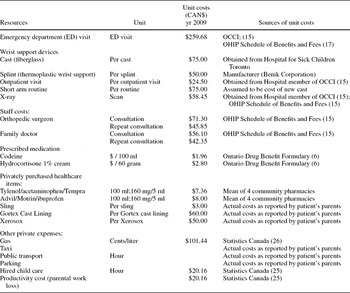
The cost of managing each patient was estimated by applying relevant unit cost data to the resource profile compiled for each patient in the study. Costs were calculated from the societal perspective and included healthcare provider expenses, patient and family resources, and productivity costs incurred from initial treatment up to 6 weeks. Table 1 shows unit costs of the key resources included in the study and their sources. Unit costs were estimated from local administrative data sources and expense diaries. The cost of prescribed medication was calculated by adding a standard 10 percent (14) pharmacy mark-up charge and the average Ontario dispensing fee of CAN$9.50 (6) to the costs listed under the Ontario Drug Benefit (ODB) Formulary (16). Costs were assessed for the year 2009. Where 2009 costs were not available, values for other years were inflated using the Canadian Consumer Price Index for Health and Personal Care (24).
Unit Costs and Sources of the Key Resources Measured in the Study

Health Outcomes (Effectiveness)
The effectiveness of the alternative forms of wrist support devices were assessed in terms of physical function measured using the ASKp (Reference Young, Williams, Yoshida, Bombardier and Wright30–Reference Young, Yoshida, Williams, Bombardier and Wright33). The modified ASKp is a self-reported measure of a child's current physical function based on activities performed during the week before completing the questionnaire. The questionnaire has thirty items representing nine domains that reflect clinician and child perspectives on pediatric daily activities (Reference Young, Williams, Yoshida and Wright31) and eight additional questions related more specifically to wrist activity. Patients completed the ASKp at baseline to assess baseline physical function in the week before the injury and at 6 weeks after the injury.
Analysis
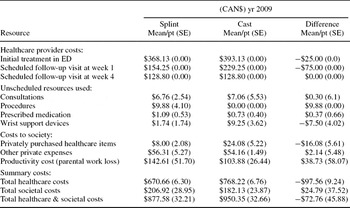
All statistics were performed using SAS Version 9.1 (Statistical Analysis Systems, Cary, NC). Given the time horizon of 6 weeks, cost and effects remained undiscounted. A gamma model was used to estimate means and standard errors for the total costs given in Table 2. Mean ASKp scores were estimated at week 6. To quantify the uncertainty due to sampling and measurement error, a cost-effectiveness acceptability curve (CEAC) was plotted. The CEAC is a plot of the probability that splint management is cost-effective (i.e., that the incremental net benefit is greater than zero) as a function of the threshold value society might be willing to pay for a one-unit increase in the ASKp scale. A CEAC accounts for the uncertainty in observed costs and effects in the study and shows whether the relative cost-effectiveness attractiveness of treatments changes as society values the outcome of interest more.
Comparison of Costs by Key Resources Used by Treatment Group

pt, patient; SE, standard error; ED, emergency department.
RESULTS
Fifty patients were randomized to each arm. Of these, four were excluded due to diagnostic errors and four were lost to follow-up of the primary outcome, leaving a total of ninety-two patients on whom cost and effectiveness data were collected.
Resource Use
Supplementary Table 2, which can be viewed online at www.journals.cambridge.org/thc2011006, provides a comparison of the key resources used across each treatment arm of the trial. For health care resource utilization, the main differences between the splint and the cast groups related to the number of unscheduled outpatient visits to see an orthopedic surgeon and to have an X-ray (five visits in the splint group versus zero in the cast group), the number of additional wrist support devises used (three casts and five splints in the cast group versus one cast in the splint group) and an additional cast removal and replacement for assessment purposes at week 1. For other societal resources used (patient and family resources and productivity costs), the main differences between the two groups related to the number of hours of parental work loss (282.5 hr in the splint groups versus 235 hr in the cast group) and the number of hours of unpaid lost productivity (42.50 in the splint group versus 98 hr in the cast group).
Costs
Table 2 shows the comparison of costs by key resources used and treatment group. The mean total healthcare provider costs for a patient in the splint group was $670.66, whereas for a patient in the cast group, it was $768.22, estimating that splint management cost the health care system $97.56 less per patient than traditional casting. The main difference between the splint and cast groups related to the cost of removing and replacing the cast as part of routine assessment at week 1 (higher mean cost for cast patients of $75). Other marked differences were the lower acquisition cost of a splint versus a cast (mean difference $25), the greater number of unscheduled X-rays in the splint group (mean difference $9.88), and the higher cost for additional wrist support devices used in the cast group (mean difference $7.50). The mean total costs for other societal resources used (patient and family resources and productivity costs) was $206.92 for a patient in the splint group and $182.13 for a patient in the cast group, indicating that splint management cost society a mean of $24.79 more per patient than traditional cast management. The main difference between the two groups related to the higher cost of parental work loss in the splint group (mean difference of $38.73). Another marked difference was the greater number of privately purchased healthcare items acquired in the cast group (e.g., slings, Gortex cast linings, and Xerosox) (mean difference, $16.08). Combining total healthcare provider costs and other societal costs yielded a mean difference of $72.76 in favor of the splint compared with the cast group.
Health Outcomes (Effectiveness)
Patients in the splint group had a mean ASKp at 6 weeks of 92.8 compared with 91.4 in the cast group (Reference Boutis, Willan, Babyn, Goeree and Howard4), with a mean difference favoring splint of 1.439 (SE 1.585). The study was a noninferiority trial, and the null hypothesis that splint is inferior by 7 percent or more was rejected at a level of significance of p < .0001.
Cost-Effectiveness
Five parameter estimates were required for a cost-effectiveness analysis. The estimated difference (splint – cast) in mean effectiveness was 1.439, with a corresponding estimated variance of 2.5135. The estimated difference in mean cost was −72.76, with a corresponding estimated variance of 2105.2. The estimated covariance between the estimated mean differences was 3.2094. Therefore, the estimated incremental net benefit is b(λ) = 1.439λ + 72.76, where λ is the threshold value for a unit increase in ASKp, and where the variance of b(λ) is given by v(λ) = 2.5135λ2 + 2105.2 – 2λ3.2094. The CEAC is simply a plot of  , where Φ(·) is the cumulative probability distribution for a standard normal random variable. The CEAC is given in Supplementary Figure 1, which can be viewed online at www.journals.cambridge.org/thc2011006, and illustrates the probability that splint management is cost-effective, compared with conventional casting, as a function of the threshold value. The figure shows that the probability that splint management is cost-effective when the threshold value is zero is 94 percent. If the threshold value is CAN$20 per unit gain in ASKp score, the probability that splint management is cost-effective is 97 percent. Supplementary Figure 1 shows that even after accounting for uncertainty in costs and effects observed across patients in the trial, that management with a splint is the most cost-effective treatment for patients. Furthermore, as the relative value of the clinical outcome (i.e., ASKp) increases, management with a splint remains cost-effective for all willingness to pay thresholds. The probability that splint management is dominant (i.e., less costly and more effective) is 73.8 percent.
DISCUSSION
In this trial, splint management was observed to be less costly and more effective. The reduction in cost was mainly due to replacing the cast as part of routine assessment at week 1 and the lower acquisition cost of a splint versus a cast. The societal perspective (including healthcare provider costs, patient and family resources used, and productivity costs) resulted in a small difference in costs between the splint and cast groups. The probability that splint management is cost-effective, compared with cast management, is greater than 82 percent for all threshold values and greater than 95 percent for all plausible threshold values (i.e., less that $50 per unit on the ASKp scale). Furthermore, the probability that splint dominates cast is 73.8 percent.
To our knowledge, this is the first study to compare the cost-effectiveness of casting versus splint management in children with acceptably angulated distal radius fractures. Studies for pediatric buckle fractures, have observed considerable reductions in costs associated with splint management over casting (Reference Davidson, Brown, Barnes and Bruce7;Reference Symons, Rowsell, Bhowal and Dias27). However, none of the studies were formal cost-effectiveness analyses, as differences in costs were not compared with the difference in effects in an incremental analysis. Davidson et al. (Reference Davidson, Brown, Barnes and Bruce7) found that splint was cheaper than cast management by US$51.23 (US$116.98 versus US$65.75 per patient [2001 prices]). According to Davidson et al. (Reference Davidson, Brown, Barnes and Bruce7), the main reason for the cost difference was the need for specialized healthcare services in the cast group. Patients in the cast group were initially placed in a splint in the emergency department (ED) and had to go for follow-up visits to the fracture clinic for cast placement and removal.
Lower costs associated with splint use in buckle fractures were further supported by Symons et al. (Reference Symons, Rowsell, Bhowal and Dias27), who suggested that splint management could reduce the number of fracture clinic visits. Their study found that removal of the splint by parents at home was as safe and effective as removal of the splint at the fracture clinic. In our study, we did not study the impact of reduced fracture clinic visits because timelines for placement and removal of splint and cast were standardized across groups and coincided with scheduled clinic assessments. Notably, fewer visits to the fracture clinic could result in cost savings in terms of health care provider expenses, parents’ time off work, transport costs, and the patients themselves would not have to miss school.
Other studies have focused on the cost savings that could be made by limiting the number of (unnecessary) follow-up radiographs in the management of fractures. Farbman et al. (Reference Farbman, Vinci, Cranley, Creevy and Bauchner9) found that multiple post cast radiographs of buckle fractures are unnecessary and that relying on a single follow-up radiograph study could translate into cost savings of over US$10,000 for 70 patients. In a study by Michelson et al. (Reference Michelson, Ahn and Magid13) of serial radiographs used in the management of stable, adult ankle fractures, an average of 4.5 radiographs per patient were obtained, none of which showed any change in fibular alignment. They calculated cost savings in the United States of over $35 million annually by eliminating with multiple routine follow-up radiographs. Due to the absence of serious complications observed in our patient group in this, and other studies (Reference Al-Ansari, Howard and Seeto2;Reference Do, Strub, Foad and Mehlman8;Reference Wilkins29), a reduction in the number of radiographs might also be appropriate. However, in our analysis, radiographs were standardized across groups and coincided with follow-up clinical assessments. Hence, definitive recommendations regarding radiography rates cannot be made.
LIMITATIONS
There are limitations to this study that warrant consideration. Unit costs were obtained from provincial cost data of Ontario, which might not be representative of costs at hospitals outside this province. In addition, our cost-effectiveness results cannot function as reference for funding decisions across different health care programs. Because the ASKp is a condition-specific non–preference-based health measure, its capacity to assess relative efficiency of interventions is limited. In the case of dominance, where one intervention is less costly and more effective than its comparator, it is straight-forward to assess relative efficiency because it is simply a question of choosing the treatment with the better effectiveness outcome and with the lower costs. However, when incremental costs and effects are in the same direction (common scenario is a new intervention being more effective and more costly), the implication for the efficient use of resources is less clear and a judgment is needed regarding whether a treatment is more or less efficient relative to some reference such as a threshold. However, there is no information on how much society (or healthcare decision makers) would be willing to pay for a one-unit gain in the ASKp score. Finally, non–preference-based health measures do not satisfy several assumptions (notably the equal interval and the representation of utility assumptions) necessary to be a health economic outcomes measure that is commonly used in economic evaluations (Reference Brazier, Ratcliffe, Salomon and Tsuchiya5) and can be applied across a variety of health programs.
CONCLUSION
To our knowledge, this cost-effectiveness analysis provides the best data available to date on the cost-effectiveness of splints versus casting in acceptably angulated distal radius fractures in children. As casting is the standard of care for these injuries in most centers (Reference Al-Ansari, Howard and Seeto2;Reference Price and Morrissy21;Reference Waters, Beaty and Kasser28), this study has shown that decision makers can be confident that splinting is a cost-effective method compared with casting in the management of pediatric greenstick and complete fractures with minimal angulation (Reference Al-Ansari, Howard and Seeto2). It is hoped that this study will help to change clinical practice in this patient population for regions where casting is the standard of care.
SUPPLEMENTARY MATERIAL
Supplementary Table 1
Supplementary Table 2
Supplementary Figure 1
CONTACT INFORMATION
Camilla von Keyserlingk, MA (vonkeys@mcmaster.ca), Research Associate, Programs PATH Research Institute, St. Joseph's Healthcare Hamilton, 50 Charlton Avenue East, Hamilton, Ontario L8N 4A6, Canada
Kathy Boutis, MD, MSc (Kleanthi.boutis@sickkids.ca), Assistant Professor, Department of Pediatrics, University of Toronto, 1 King's College Circle, Toronto, Ontario M5S 3H7, Canada; Staff Emergency Physician, Department of Pediatrics, Hospital for Sick Children, 555 University Avenue, Toronto, Ontario M5G 1X8, Canada
Andrew R. Willan, PhD (andy@andywillan.com), Professor, Dalla Lana School of Public Health, University of Toronto, 155 College Street, Toronto, Ontario M5T 3M7, Canada; Senior Scientist, CHES, SickKids Research Institute, 555 University Avenue, Toronto, Ontario M5G 1X8, Canada
Robert Borden Hopkins, MBA, MA (hopkinr@mcmaster.ca), Research Biostatistician, Department of Clinical Epidemiology & Biostatistics, McMaster University, 25 Main Street West, Suite 2000, Hamilton, Ontario L8P 1H1, Canada; PATH Research Institute, St. Joseph's Healthcare Hamilton, 50 Charlton Avenue East, Hamilton, Ontario L8N 4A6, Canada
Ron Goeree, MA (vonkeys@mcmaster.ca), Associate Professor, Department of Clinical Epidemiology & Biostatistics, McMaster University, 25 Main Street West, Suite 2000, Hamilton, Ontario L8P 1H1, Canada; Director, PATH Research Institute, St. Joseph's Healthcare Hamilton, 50 Charlton Avenue East, Hamilton, Ontario L8N 4A6, Canada
CONFLICT OF INTEREST
For this work, K Boutis has received a grant from the Sick-Kids Foundation and AR Willan from Physician's Service Inc. Foundation. The other authors do not report any potential conflicts of interest.