Introduction
Early intervention in the context of Alzheimer's disease (AD) and dementia can involve intervention during the early presymptomatic, early mild cognitive impairment (MCI) or intermediate MCI stages (Jack et al., Reference Jack2010; Hampel et al., Reference Hampel2011). A number of medications have been studied for the treatment of AD (Ihl et al., Reference Ihl, Frölich, Winblad, Schneider, Burns and Möller2011); Ginkgo biloba extract is one of these and was recently summarized by Kasper and Schubert (Reference Kasper and Schubert2009). Research into early intervention has taken two approaches: (i) using cohort data from larger epidemiological trials and (ii) using data from large intervention trials designed specifically for this purpose (Andrieu et al., Reference Andrieu2003; Reference Andrieu, Ousset, Coley, Ouzid, Mathiex-Fortunet and Vellas2008; Dartigues et al., Reference Dartigues, Carcaillon, Helmer, Lechevallier, Lafuma and Khoshnood2007; Dodge et al., Reference Dodge, Zitzelberger, Oken, Howieson and Kaye2008; DeKosky et al., Reference DeKosky2008; Vellas et al., Reference Vellas2010). A review of these studies forms the basis of this paper.
Epidemiological studies
Cohort data are available from two large studies in France:
• Epidemiology of Osteoporosis (EPIDOS) study (Andrieu et al., Reference Andrieu2003)
• Personnes Agées Quid (PAQUID) study (Dartigues et al., Reference Dartigues, Carcaillon, Helmer, Lechevallier, Lafuma and Khoshnood2007).
EPIDOS study
The EPIDOS study was a prospective, multicenter study that investigated the epidemiology of osteoporosis over seven years in 7,598 women older than 75 years (Andrieu et al., Reference Andrieu2003). Cognitive data were available for a subgroup of 714 patients from Toulouse, with 110 of these going on to develop dementia of the Alzheimer type (DAT). Analysis of the data showed that the women who went on to develop dementia had a significantly lower use of nootropics or Ginkgo biloba. It is important to bear in mind that this is an epidemiological sample and that adherence was not monitored closely.
PAQUID study
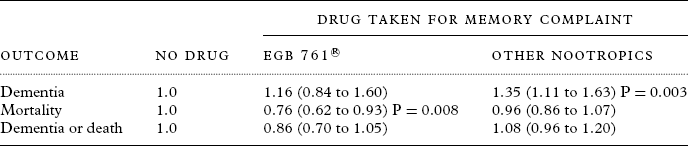
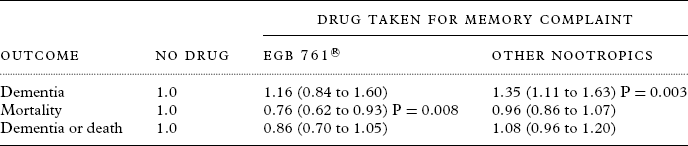
The PAQUID study was a prospective, multicenter trial over 13 years in 3,534 men and women older than 65 years old (Dartigues et al., Reference Dartigues, Carcaillon, Helmer, Lechevallier, Lafuma and Khoshnood2007). Outcomes of this study included the incidence of dementia, mortality, and dementia-free survival. Of the 3,534 patients, 225 took Ginkgo biloba EGb 761 and 888 took other nootropics for “memory complaints”. The risk of disease was set at 1 for participants who did not take any medication, which means that the relative risk was, by nature, higher in those who developed memory problems while taking a drug for memory complaints. Interestingly, the use of Gingko biloba extract EGb 761 was significantly advantageous for dementia, death, and dementia or death compared with the use of other nootropics (Table 1). This could indicate that EGb 761 works not only in dementia paradigms but potentially also in cardiovascular paradigms.
Relative risk of outcomes with no drug, EGb 761® or other nootropics taken for memory complaints in the PAQUID study.
Reproduced with permission from Dartigues et al., 2011.
Intervention trials
Three large trials with Gingko biloba extract have been undertaken:
• Oregon trial (Dodge et al., Reference Dodge, Zitzelberger, Oken, Howieson and Kaye2008)
• Gingko Evaluation of Memory (GEM) trial (DeKosky et al., Reference DeKosky2008)
• GuidAge study (Andrieu et al., Reference Andrieu, Ousset, Coley, Ouzid, Mathiex-Fortunet and Vellas2008; Vellas et al., Reference Vellas2010).
The results of a further smaller intervention study in Latvia have also been published (Grass-Kapanke et al., Reference Grass-Kapanke, Busmane, Lasmanis, Hoerr and Kaschel2011).
Oregon trial
The Oregon trial was a randomized, placebo-controlled, double-blind study in 118 cognitively intact elderly people (Dodge et al., Reference Dodge, Zitzelberger, Oken, Howieson and Kaye2008). Patients were randomized to receive 240 mg/day of a Ginkgo biloba extract similar but not identical to EGb 761 or placebo and were monitored for 3.5 years. The main outcome measure was progression from a score of 0 to a score of 0.5 on the Clinical Dementia Rating (CDR) scale.
Initial analysis of the data was in favor of the Ginkgo biloba extract for the main outcome measure of progression from CDR score 0 to 0.5 but did not reach statistical significance (hazard ratio (HR) 0.43, P = 0.066). However, only 65% of patients took more than 80% of the dosage, and a statistical significant difference in favor of the extract was identified (HR 0.33, P < 0.05) when a reanalysis took adherence into account. This emphasizes the importance of measuring medication adherence within trials and taking into account that the clinical reality is imperfect adherence.
GEM study
The GEM study was a randomized, placebo-controlled, double-blind, multicenter trial in 3,072 patients aged ≥75 years with normal cognition (n=2,587) or MCI (n=482) (DeKosky et al., Reference DeKosky2008). Patients were randomized to receive 240 mg/day EGb 761 or placebo for an average of 6.1 years. The main outcome measure was incident dementia or DAT.
The results of this study have been published elsewhere and are well known (DeKosky et al., Reference DeKosky2008; Snitz et al., Reference Snitz2009). In brief, however, dementia incidence was surprisingly low (below 1% in the first year vs. expected 4%), and no cognitive decline was detectable in those participants who did not develop dementia. The hazard ratios for dementia and DAT consequently were not significant (1.12 (95% confidence interval (CI) 0.94 to 1.33), P = 0.21, and 1.13 (0.90 to 1.42), P = 0.30, respectively), although the HR for vascular dementia did reach statistical significance (0.36 (0.13 to 1.00, P = 0.05)). This study essentially failed due to the unusually healthy nature and stability of the cognitive status of the included population.
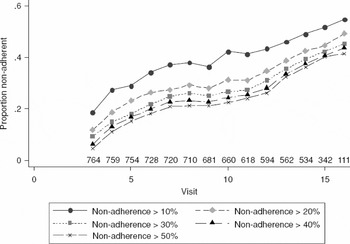
Furthermore, a recent publication noted another major drawback with the GEM data relating to the problem of adherence described above for the Oregon study (Jerant et al., Reference Jerant, Chapman, Duberstein, Robbins and Franks2011). Adherence was evaluated only through the crude measurement of pill count every six months, with no measures to support adherence between these visits. Unsurprisingly, therefore, the rate of non-adherence increased throughout the study until it was in excess of 40% (Figure 1). The more sophisticated methods available to monitor adherence thus need to be incorporated into the design of modern trials.
Proportion of individuals non-adherent at each follow-up assessment by non-adherence threshold. Reproduced with permission from Jerant et al., Reference Jerant, Chapman, Duberstein, Robbins and Franks2011.

GuidAge study
The GuidAge study was a randomized, placebo-controlled, double-blind, multicenter trial in 2,854 patients aged ≥70 years (Andrieu et al., Reference Andrieu, Ousset, Coley, Ouzid, Mathiex-Fortunet and Vellas2008; Vellas et al., Reference Vellas2010; Reference Vellas2011). Patients were randomized to receive 240 mg/day EGb 761® or placebo for five years. The main outcome was incident DAT. A pre-specified analysis was planned when treatment duration was ≥4 years. This study differed from the GEM study in that it was a cooperation between GPs and memory centers, so patients were seen between trial visits and medication adherence was therefore 93% in the intent-to-treat (ITT) population. Lower than expected dementia incidence resulted in a type II error: the authors had calculated for 80% power to detect a 3.4% absolute difference in dementia incidence (10.4% vs. 13.8%), but the actual rates of dementia were only 5.2% in the placebo group and 4.3% in the EGb 761® group (P = 0.31 for between-group difference). However, the incidence of DAT still differed between the two groups in the pre-defined analysis after ≥4 years of treatment (EGb 761® 1.6% vs placebo 3.0%, P = 0.03) and the long-term safety profile was favorable.
Gingko biloba extract in patients with very mild cognitive impairment
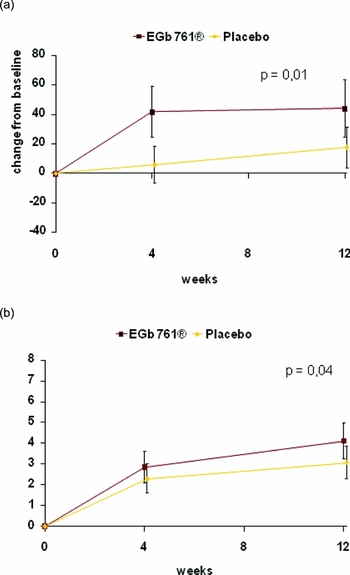
A randomized, placebo-controlled, double-blind, multicenter trial has also been undertaken in 296 patients with very mild cognitive impairment (Grass-Kapanke et al., Reference Grass-Kapanke, Busmane, Lasmanis, Hoerr and Kaschel2011). Patients predominantly had subjective complaints of cognitive impairment for more than three months; at least one standard deviation below average in at least one of the Wechsler Memory Scale (WMS) III Faces I and III Subtest, Vienna test system sustained attention score (ALS) and determination test (DT), and appointment test; Mini-Mental State Examination score >23; intact activities of daily living (ADL); and no dementia. Patients were randomized to receive 240 mg/day EGb 761® or placebo for 12 weeks. Endpoints were attention, memory, and quality of life. After 12 weeks, statistically significant improvements in attention and memory were observed, even in patients with very mild impairment (Figure 2). The safety profile was also excellent.
Change from baseline in Vienna test system sustained attention score (ALS) (a) and WMS III Faces I test (b) for Gingko biloba EGb 761 or placebo. Reproduced with permission from Grass-Kapanke et al., Reference Grass-Kapanke, Busmane, Lasmanis, Hoerr and Kaschel2011.

Cross-trial neuropsychological comparison of Gingko biloba
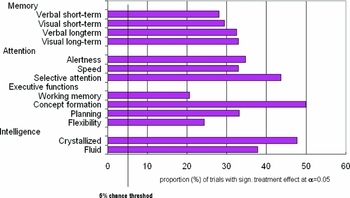
The neuropsychological profile of Gingko biloba preparations was assessed in an analysis of data from 29 placebo-controlled trials (Kaschel, Reference Kaschel2009). For this purpose, data were extracted from all trials that reported results in defined neuropsychologic cognitive functions after at least four weeks' treatment. Two-hundred-and-nine Ginkgo–placebo comparisons in 14 neuropsychological functions from four cognitive domains could be identified. At a 0.05 level of significance, 5% of these comparisons would favor Ginkgo by chance. This analysis found that 20% to 50% of Ginkgo–placebo comparisons showed a significant treatment effect for Gingko biloba extract in important areas such as memory, attention, executive function, and intelligence (Figure 3).
Neuropsychological profile of standardized Ginkgo biloba extracts according to a pooled analysis of 29 randomized controlled trials. Adapted from Kaschel, Reference Kaschel2009.

Summary
When considering the use of Gingko biloba extract for slowing of cognitive decline, benefits can be expected only with sufficient medication adherence and treatment duration, with the results of the GEM study being inconclusive because of poor medication adherence. The most encouraging signals so far have been from studies with Gingko biloba extract EGb 761, which may be a useful option for long-term intervention on the basis of the decades of previous experience and excellent safety record. Clear evidence of a disease-modifying benefit of this extract is needed from adequately designed trials.
Conflict of interest
Dr. Kasper has received grant/research support from Bristol Myers-Squibb, Eli Lilly, GlaxoSmithKline, Lundbeck, Organon, Sepracor and Servier; has served as a consultant or on advisory boards for AstraZeneca, Bristol-Myers Squibb, Eli Lilly, GlaxoSmithKline, Janssen, Lundbeck, Merck Sharp and Dome (MSD), Novartis, Organon, Pfizer, Schwabe, Sepracor, and Servier; and has served on speakers' bureaus for Angelini, AstraZeneca, Bristol Myers-Squibb, Eli Lilly, Janssen, Lundbeck, Pfizer and Pierre Fabre.