1. Introduction
Generation and evolution of the continental nucleus of an ancient cratonic block can provide important information about crustal accretion and the early evolution of continental crust. The South China and North China cratons are two of the largest and oldest blocks in China (Zhang et al. Reference Zhang, Zheng, Wu, Zhao, Gao and Wu2006a; Wu et al. Reference Wu, Zhang, Yang, Xie and Yang2008). They collided along the Qinling–Dabie–Sulu orogenic belt at the Triassic or earlier (Hacker et al. Reference Hacker, Ratschbacher, Webb, Ireland, Walker and Dong1998, and references therein). The Yangtze craton is one part of the South China block. Compared to the North China craton, it is characterized by thick Phanerozoic sedimentary strata, resulting in poor exposures of the early Precambrian basement. This accounts for our relatively limited knowledge of its early evolution, including both basement extent and continental accretion processes. Recent studies have implied that the Yangtze craton might have experienced episodic orogenic events since the Neoarchaean (Wu et al. Reference Wu, Gao, Gong, Xiang, Jiao, Yang, Liu and Yuan2009; Qiu et al. Reference Qiu, Ling, Liu, Kusky, Berkana, Zhang, Gao, Lu, Kuang and Liu2011, Reference Guo, Wu, Gao, Jin, Zong, Hu, Chen, Chen and Liu2015a,c; Peng et al. Reference Peng, Kusky, Jiang, Wang, Wang and Deng2012; Guo et al. Reference Guo, Wu, Gao, Jin, Zong, Hu, Chen, Chen and Liu2015). Thus, to fully understand the evolutional history and generation of the Yangtze craton, it is necessary to clarify the compositions of the subdivided individual crustal blocks which make up the craton.
The Kongling metasedimentary rocks had been thought to have been deposited in the Archaean and metamorphosed in the Palaeoproterozoic (e.g. Qiu et al. Reference Qiu, Gao, Mcnaughton, Groves and Ling2000). However, more and more geochronological studies in recent years have indicated that they might actually have been deposited in the Palaeoproterozoic (e.g. Yin et al. Reference Yin, Lin, Davis, Zhao, Xiao, Li and He2013; Qiu et al. Reference Qiu, Yang, Lu, Zhang, Duan and Du2016). They are the major constituents of the Precambrian metamorphic complexes in the nucleus of the Yangtze craton, consisting mainly of sillimanite–garnet gneisses and mafic granulites together with quartzites and marbles (Jiang, Reference Jiang1986; Yan et al. Reference Yan, Zhou, Zeng, Jiang, Zhou and Chen2006). These rocks, characterized by containing Al-rich minerals, have long been considered to have formed during the early stages of the evolution of continental crust. Thus they can provide new evidence for understanding early and coeval continental composition as well as accretion of the Precambrian metamorphic basement. However, geochemical features of these metamorphic supracrustal rocks, and the nature of their protoliths are still poorly known. This hampers our understanding of the depositional setting of the khondalite protoliths and the early tectonic evolution of the Yangtze craton. Multi-elemental and Sm–Nd isotope geochemistry of metaclastic sediments from different parts of the world has been widely used to constrain the tectonic settings of the provenance and identify the origin of source rocks (Condie et al. Reference Condie, Boryta, Liu and Qian1992; Nesbitt, Young & Bosman, Reference Nesbitt, Young and Bosman2009; Bai et al. Reference Bai, Ling, Duan, Qiu, Liu, Kuang, Gao, Zhou, Chen and Lu2011; Roy & Roser, Reference Roy and Roser2013). These studies operate on the assumption that the detrital metasedimentary rocks are derived from pre-existing continental blocks through weathering, erosion, transportation, and deposition into basins, with diagnostic low-mobile elemental and Nd isotopic compositions of fine-grained rocks of continental provenance.
In this study, we present elemental geochemical and Sm–Nd isotopic composition data of garnet–sillimanite gneisses from the Kongling complex situated in the nucleus of the Yangtze craton, South China block. These new data, combined with documented geochronological data from the literature, are used to: (1) characterize the natures of the khondalite protoliths and provenance; (2) understand the tectonic setting of the source rocks; and (3) constrain the Palaeoproterozoic evolution of the Yangtze craton within the context of the contemporary global orogenic event.
2. Geological setting
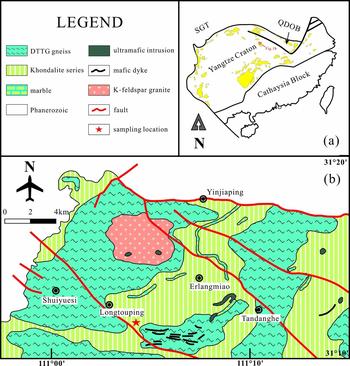
The South China block (SCB) is surrounded by the Qinling–Dabie orogen to the north, the Songpan–Ganze terrain to the west, and the Pacific Ocean block to the southeast. It is divided into the Yangtze craton to the northwest and the Cathaysia block to the southeast (Fig. 1a). The Kongling complex, covering an area of ~360 km2, is a typical tectonic dome where the oldest rocks of the SCB are outcropped. It consists predominantly of Archaean dioritic, tonolitic- trondhjemitic-and granitic (DTTG) gneisses and Palaeoproterozoic Al-rich metasedimentary rocks, with minor amphibolites, mafic granulites and S-type garnet-bearing granites (Gao et al. Reference Gao, Ling, Qiu, Zhou, Hartmann and Simon1999; Yin et al. Reference Yin, Lin, Davis, Zhao, Xiao, Li and He2013; Guo et al. Reference Guo, Gao, Wu, Li, Chen, Hu, Liang, Liu, Zhou and Zong2014; Qiu et al. Reference Qiu, Yang, Lu, Zhang, Duan and Du2016). These rocks, characterized by intense deformation and upper amphibolite- to granulite-facies metamorphism, are intruded by the less metamorphosed Palaeoproterozoic A-type granites (Xiong et al. Reference Xiong, Zheng, Yu, Su, Tang and Zhang2009; Peng et al. Reference Peng, Kusky, Jiang, Wang, Wang and Deng2012; Qiu et al. Reference Qiu, Yang, Lu, Ling, Zhang, Tan and Wang2015b), mafic dikes (Peng et al. Reference Peng, Wu, Wang, Jiao, Liu and Yang2009; Li et al. Reference Li, Lin, Xiao, Yin, Davis and Xing2014) and Neoproterozoic (~850–800 Ma) Huangling intrusive complex (Zhang et al. Reference Zhang, Zheng, Zhao, Wu and Yuan2008; Zhao, Zhou & Zheng, Reference Zhao, Zhou and Zheng2013), and are unconformably overlain by late Neoproterozoic to Phanerozoic unmetamorphosed sedimentary rocks (Ma, Li & Zhang, Reference Ma, Li and Zhang1984; Qiu et al. Reference Qiu, Ling, Liu, Kusky, Berkana, Zhang, Gao, Lu, Kuang and Liu2011) (Fig. 1b).
(a) Simplified geological map of Precambrian basement of the Yangtze craton and location of study area in the South China block. Yellow areas denote the Precambrian outcrops of the Yangtze craton. (b) Simplified geological map of the Kongling region. Modified after Gao et al. (Reference Gao, Ling, Qiu, Zhou, Hartmann and Simon1999). QDOB: Qinling–Dabie Orogenic Belt; SGT: Songpan–Ganze Terrain.

The Al-rich metasedimentary rocks and the associated quartzites and marbles are together referred to as the ‘Kongling khondalite series’ in Chinese publications (e.g. Jiang, Reference Jiang1986; Yan et al. Reference Yan, Zhou, Zeng, Jiang, Zhou and Chen2006), comprising the supracrustal rocks of the Kongling complex. They can be divided into three parts: the bottom part consists mainly of garnet–sillimanite gneiss, with minor garnet–biotite schist and amphibolite; the middle part is dominated by graphite–biotite schist, olivine–diopside marble, calc-silicate rock and quartzite; whereas the top part is composed of banded biotite–plagioclase gneiss, locally including banded iron formations (BIF), calc-silicate rock, mafic granulite and amphibolite lenses and/or boudins (Yin et al. Reference Yin, Lin, Davis, Zhao, Xiao, Li and He2013). Contacts between the khondalite series and the underlying TTG-dominated crystalline basements are ductile shear zone or faults.
As the oldest basement rocks of the SCB, the Kongling TTG gneisses and amphibolites have been the subject of many geochronological studies (e.g. Jiang, Reference Jiang1986; Ling et al. Reference Ling, Gao, Zheng, Zhou and Zhao1998; Gao et al. Reference Gao, Yang, Zhou, Li, Hu, Guo, Yuan, Gong, Xiao and Wei2011; Guo et al. Reference Guo, Gao, Wu, Li, Chen, Hu, Liang, Liu, Zhou and Zong2014, Reference Guo, Wu, Gao, Jin, Zong, Hu, Chen, Chen and Liu2015). The available isotopic ages suggest that most TTG gneisses and amphibolites in the Kongling complex were emplaced during the period 3.4–2.7 Ga and metamorphosed at 2.6–2.5 Ga and 2.0–1.9 Ga (Ling et al. Reference Ling, Gao, Zheng, Zhou and Zhao1998, Reference Ling, Gao, Zhang, Zhou and Xu2001; Gao et al. Reference Gao, Ling, Qiu, Zhou, Hartmann and Simon1999, Reference Gao, Yang, Zhou, Li, Hu, Guo, Yuan, Gong, Xiao and Wei2011; Qiu et al. Reference Qiu, Gao, Mcnaughton, Groves and Ling2000; Zhang et al. Reference Zhang, Zheng, Wu, Zhao, Gao and Wu2006a,b; Wu et al. Reference Wu, Gao, Gong, Xiang, Jiao, Yang, Liu and Yuan2009; Chen et al. Reference Chen, Gao, Wu, Guo, Hu, Liu, Zong, Liang and Geng2013; Guo et al. Reference Guo, Gao, Wu, Li, Chen, Hu, Liang, Liu, Zhou and Zong2014, Reference Guo, Wu, Gao, Jin, Zong, Hu, Chen, Chen and Liu2015; Qiu, Ling & Liu, Reference Qiu, Ling and Liu2014). Unfortunately, compared to the basement rocks of the Kongling complex, depositional and metamorphic ages of the supracrustal rocks have not yet been well constrained. Qiu et al. (Reference Qiu, Gao, Mcnaughton, Groves and Ling2000) reported that all the concordant detrital zircons from the metasedimentary rocks are older than 2.6 Ga. Coupled with the same grade metamorphism for the TTG gneisses and the metasedimentary rocks, they further implied that both metamorphism and deposition of the sedimentary rocks occurred prior to 2.5 Ga (Gao et al. Reference Gao, Ling, Qiu, Zhou, Hartmann and Simon1999; Qiu et al. Reference Qiu, Gao, Mcnaughton, Groves and Ling2000). However, recent studies have revealed that the metamorphic time of the metasedimentary rocks might be Palaeoproterozoic (Ling et al. Reference Ling, Gao, Zhang, Zhou and Xu2001; Zhang et al. Reference Zhang, Zheng, Wu, Zhao, Gao and Wu2006b; Wu et al. Reference Wu, Gao, Gong, Xiang, Jiao, Yang, Liu and Yuan2009; Yin et al. Reference Yin, Lin, Davis, Zhao, Xiao, Li and He2013; Qiu et al. Reference Qiu, Yang, Lu, Zhang, Duan and Du2016). For instance, Ling et al. (Reference Ling, Gao, Zhang, Zhou and Xu2001) obtained whole-rock Sm–Nd isochron ages of 1939±44 Ma from a paragneiss. Zhang et al. (Reference Zhang, Zheng, Wu, Zhao, Gao and Wu2006b) reported zircon U–Pb metamorphic ages of 1.97±0.03 Ga from the metapelites and amphibolite from the Kongling complex. Yin et al. (Reference Yin, Lin, Davis, Zhao, Xiao, Li and He2013) obtained metamorphic ages of ~2.0 Ga from the metapelites from the Kongling complex by the laser ablation–inductively coupled plasma–mass spectrometry (LA-ICP-MS) zircon U–Pb method. Moreover, recently obtained data on the youngest detrital zircon from the garnet–sillimanite gneiss in the lower part of the Kongling khondalites gave an age of c. 2131 Ma, which further constrained the maximum depositional age of the Kongling khondalites to be ~2.1 Ga (Yin et al. Reference Yin, Lin, Davis, Zhao, Xiao, Li and He2013).
3. Sample descriptions and analytical methods
Samples in this study were collected from relatively fresh road cuts or quarries near the Laolingou area to the southeast of Longtouping village (Fig. 1b). Garnet–sillimanite gneisses were chosen for analysis for the following reasons: (1) they are the most representative and widespread samples in the khondalites; (2) their protoliths are pelites or fine-grained siltstones, which can minimize the possible effect of mineral sorting during transportation and deposition on chemical composition in coarse-grained sandstones (Meyer, Davies & Stuut, Reference Meyer, Davies and Stuut2011); (3) they are the lowermost strata in the Kongling khondalite series, which constrain the maximum depositional age of the khondalites and thus carry the most primitive information of the detritus.
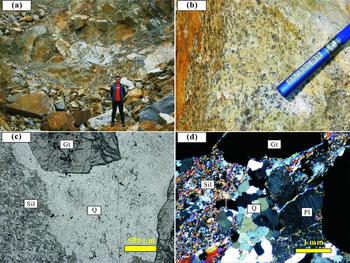
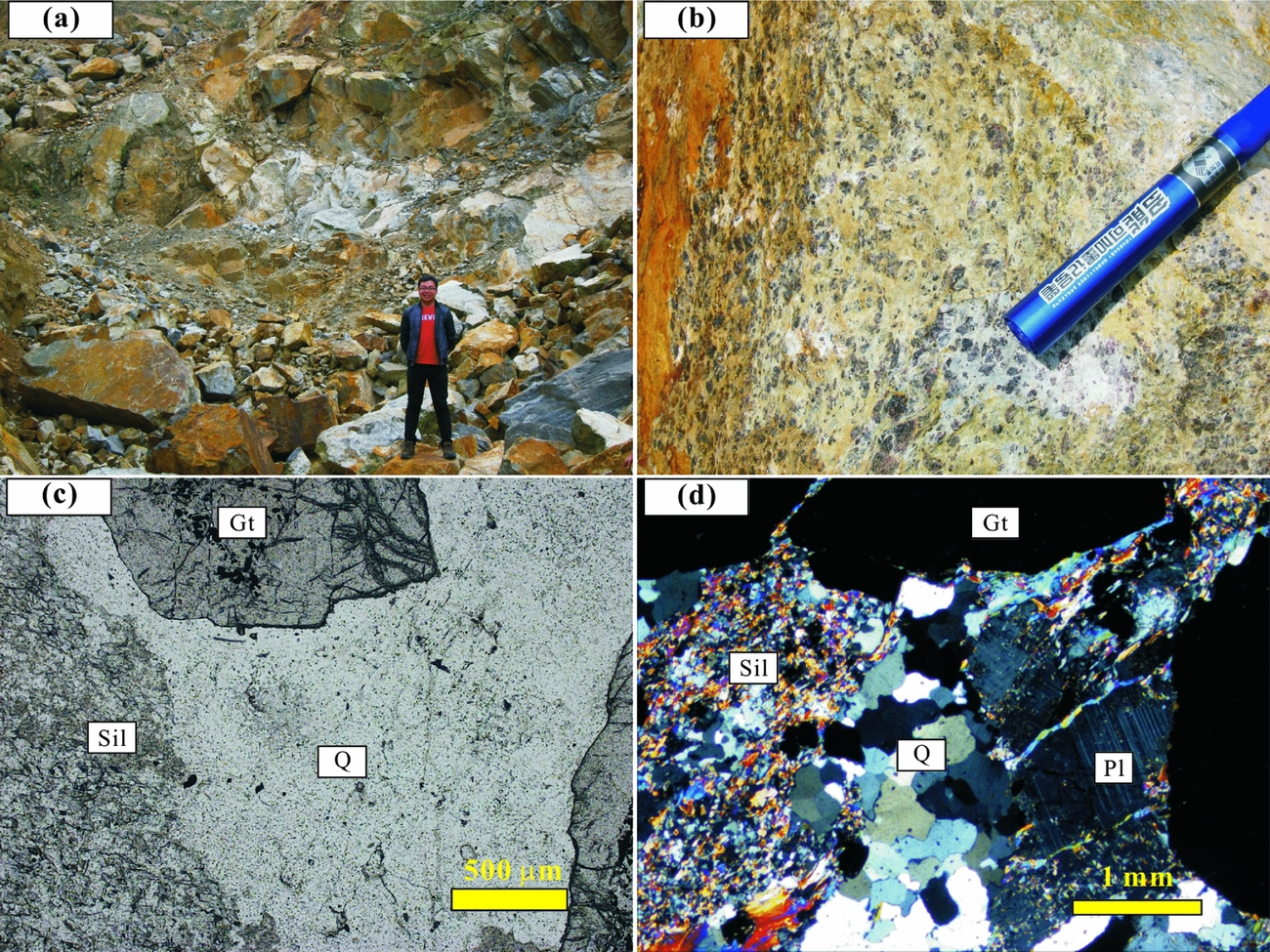
All the samples are grey, and exhibit fine-grained lepidoblastic to porphyroblastic texture and gneissic structure (Fig. 2). They consist mainly of garnet (30–45%), sillimanite (20–30%) and quartz (10–15%) with minor (<8%) plagioclase and biotite. The rocks experienced upper amphibolite- to granulite-facies metamorphism, consistent with previous studies constraining the P–T conditions at 7–8 kbar and 750–800°C (Wu et al. Reference Wu, Gao, Gong, Xiang, Jiao, Yang, Liu and Yuan2009; Yin et al. Reference Yin, Lin, Davis, Zhao, Xiao, Li and He2013).
Photographs of garnet–sillimanite gneisses from the Kongling complex. (a, b) Field outcrops of the garnet–sillimanite gneisses. (c, d) Photomicrographs under polarized light and cross-polarized light for the garnet–sillimanite gneisses, showing gneissic structure. Gt=garnet; Sil=sillimanite; Q=quartz; Pl=plagioclase.
Major element contents of whole rocks were determined by the fused glass disc method using a Panalytical Axios max X-ray fluorescence spectrometer (XRF) at Zhongnan Mineral Resources Supervision and Test Center, Ministry of Land and Resources of China (MRSTC). Analytical precision is better than 0.5% for SiO2 (absolute error) and 3% for other oxides (relative error) based on US Geological Survey (USGS) standards AGV-1 and duplicate analyses, whereas analytical accuracy is better than 3% (relative error) based on standards AGV-1 and BCR-2. Trace elements were analysed using an Agilent 7700a ICP-MS at the State Key Laboratory of Geological Processes and Mineral Resources of China University of Geosciences (Wuhan) and a Thermo Fisher X series-2 ICP-MS at the MRSTC. The USGS standard analyses of AGV-1, AGV-2, GSR-3, BHVO-2 and BCR-2 indicate that accuracy and precision are better than 3–5% (RSD) for most elements and c. 5% for some transition elements (Qiu et al. Reference Qiu, Ling, Liu, Kusky, Berkana, Zhang, Gao, Lu, Kuang and Liu2011). The detailed analytical procedure has been described elsewhere (Liu et al. Reference Liu, Gao, Hu, Gao, Zong and Wang2010).
Sm–Nd isotopic analyses were carried out at the Laboratory of Isotope Geochemistry, Wuhan Center of Geological Survey, using a Finnigan Triton Ti mass spectrometer. Two portions of ~100 mg powder (200 meshes) from each sample were weighted. One for the measurement of contents of Sm and Nd was mixed with the spake mixture of 149Sm+145Nd, and the other was used to determine 143Nd/144Nd ratios. During chemical digestion, samples were put into Teflon bombs with mixture acids of HNO3+HF+HClO4 for c. 48 h at a temperature of ~190°C, until they were completely dissolved. The separation and purification of Sm and Nd for each sample were performed using the HDEHP method. Blanks of the whole procedure are Sm of 7×10⁻¹¹ and Nd of 9×10⁻¹¹, respectively. All 143Nd/144Nd ratios were normalized to 146Nd/144Nd=0.721900. Analysis of the ZkbzNd (JMC) standard during the run gives 143Nd/144Nd=0.511550±0.000005 (average, n=7). Analysis of the BCR-2 and GBW04419 (national standard material of China for Sm–Nd geochronology) gives 143Nd/144Nd=0.512633±0.000003 (n=10), Sm=6.637×10⁻⁶, Nd=29.32×10⁻⁶ and 143Nd/144Nd=0.512715±0.000005 (n=4), Sm=3.032×10⁻⁶, Nd=10.07×10⁻⁶, respectively. Uncertainties of Sm and Nd concentrations and 147Sm/144Nd are better than 5‰. It is notable that some heterogeneity in rare earth element (REE) contents is discovered between the ICP-MS and isotope dilution (ID) analyses. The description is to explain the possible reason why the two aliquots for ID-TIMS (ID thermal ionization mass spectrometry) and ICP-MS analyses show some differences in concentrations of Sm and Nd. As the powders for two analyses are from two different pieces of hand specimens, which were collected from the same outcrop in the field, they may be inhomogeneous in terms of REE contents.
4. Results
4.a. Major and trace element
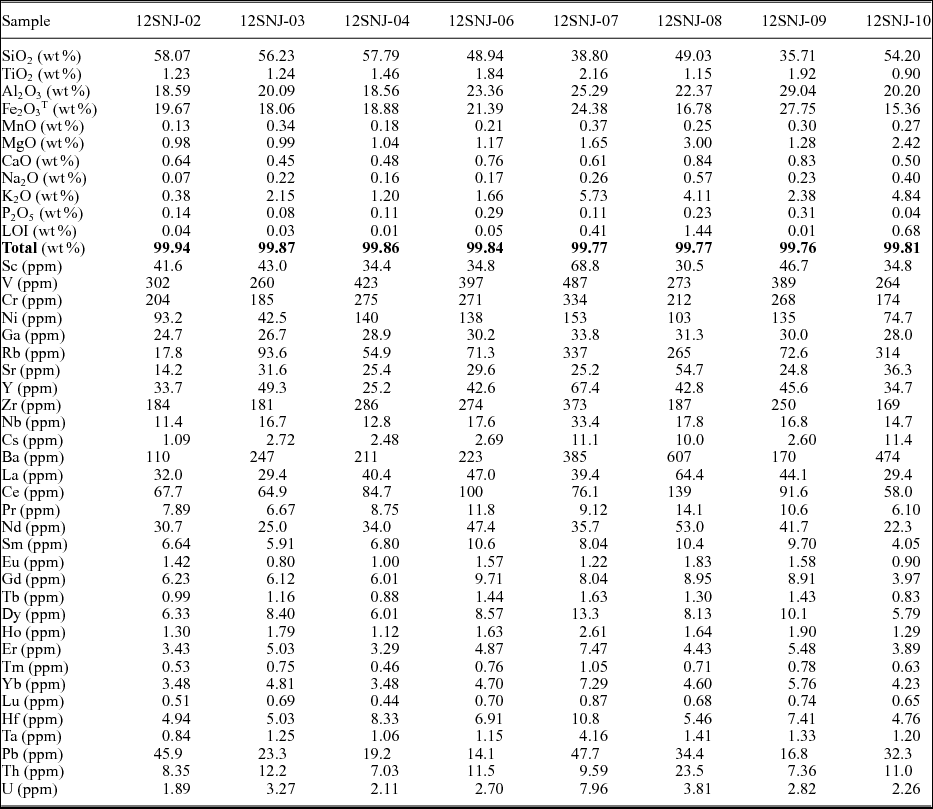
Major and trace element data for whole-rock samples are presented in Table 1. Average compositions of Post-Archaean Australian Shale (PAAS; Taylor & McLennan, Reference Taylor and McLennan1985) are also listed for comparison. The rocks show variable SiO2 (35.71–58.07 wt%), low CaO (0.45–0.84 wt%) and Na2O (0.07–0.57 wt%) but high Fe2O3T (15.36–27.75 wt%) and Al2O3 (18.56–29.04 wt%) contents, correlating with the dominant almandine, sillimanite and minor quartz without feldspar. Extremely low LOI (loss on ignition) and CaO contents also indicate that carbonates and phosphate are rather scarce in these samples. Unlike PAAS, most of the gneisses display lower SiO2, CaO and Na2O but significantly higher Fe2O3T contents. Two samples (12SNJ07 and 12SNJ09) have evidently low SiO2 but high Al2O3 and Fe2O3T contents, correlating with a relatively high proportion of garnet (mainly almandine) observed in these samples. The other samples have similar SiO2 and Al2O3 contents to those khondalite rocks found in the Jiamusi massif (Jiang, Reference Jiang1993) and the North China craton (Condie et al. Reference Condie, Boryta, Liu and Qian1992; Li, Qian & Liu, Reference Li, Qian and Liu2000).
Major (wt%) and trace (ppm) elemental compositions of the garnet–sillimanite gneisses from the Kongling complex

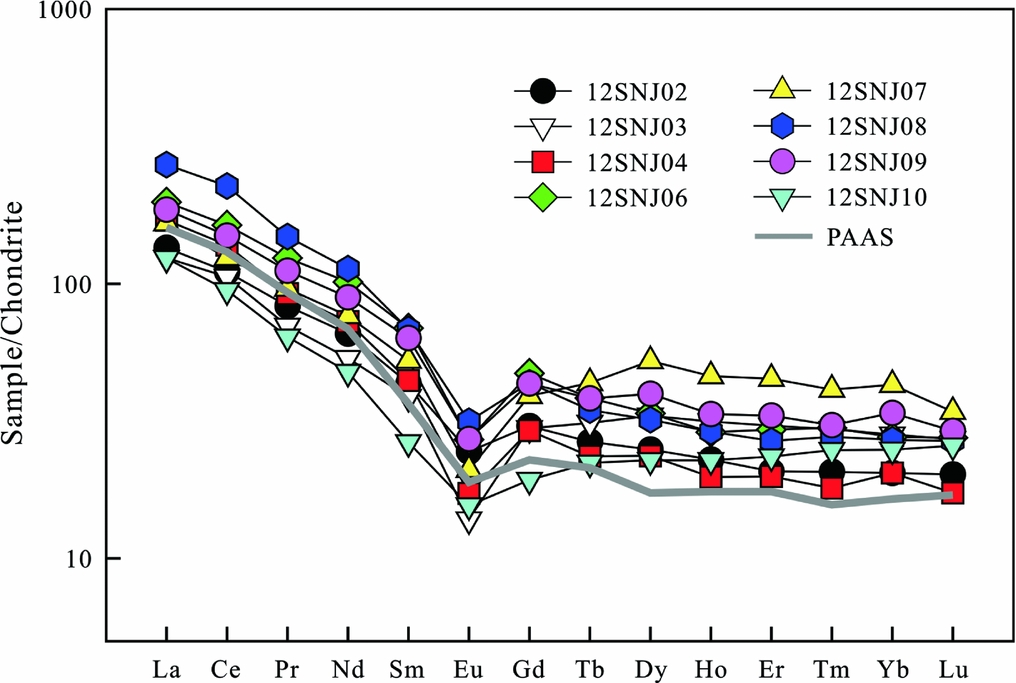
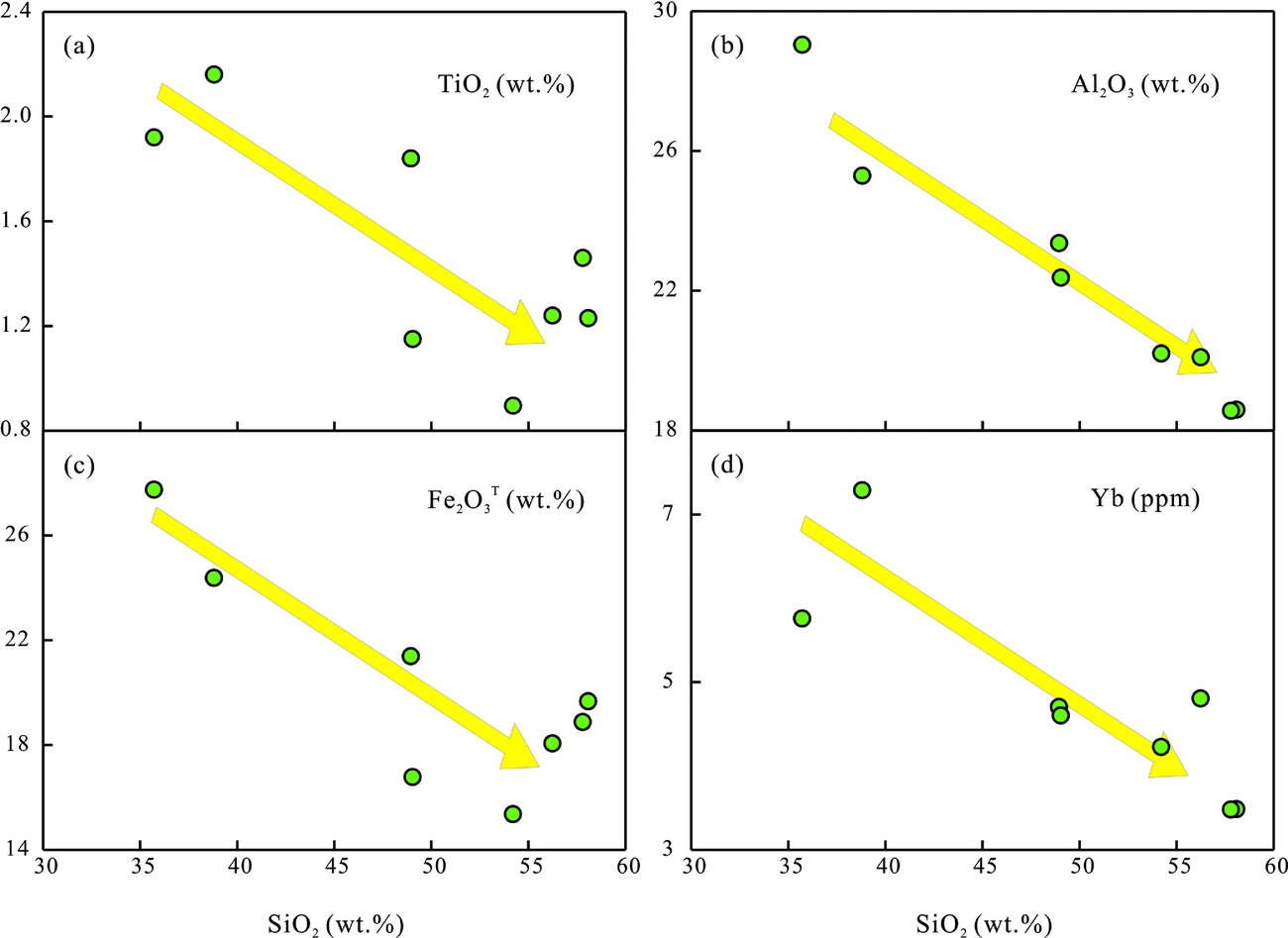
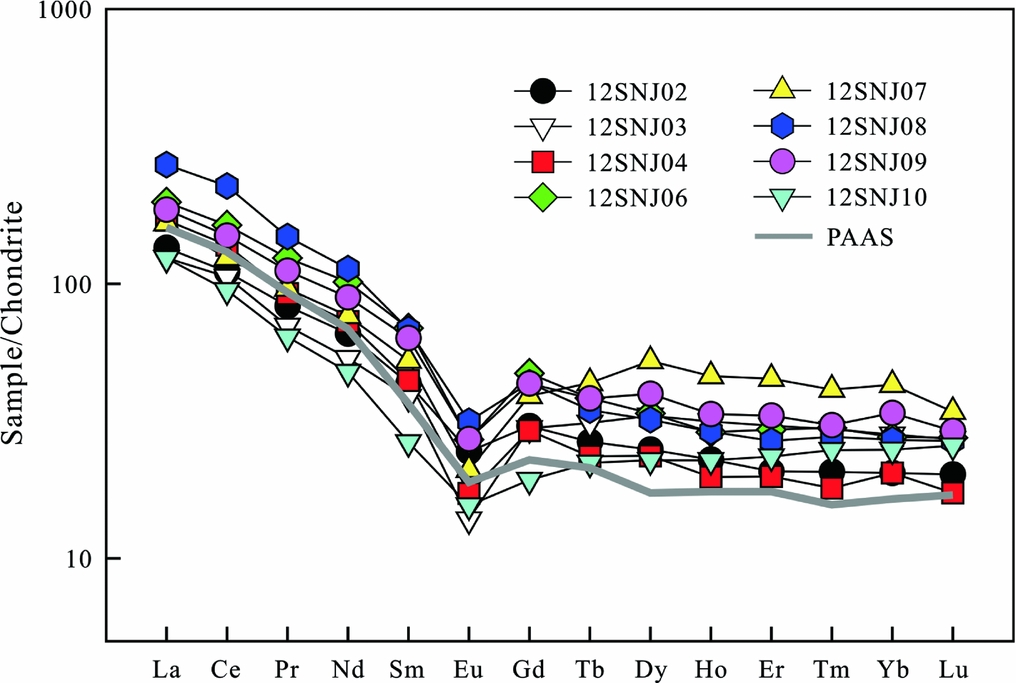
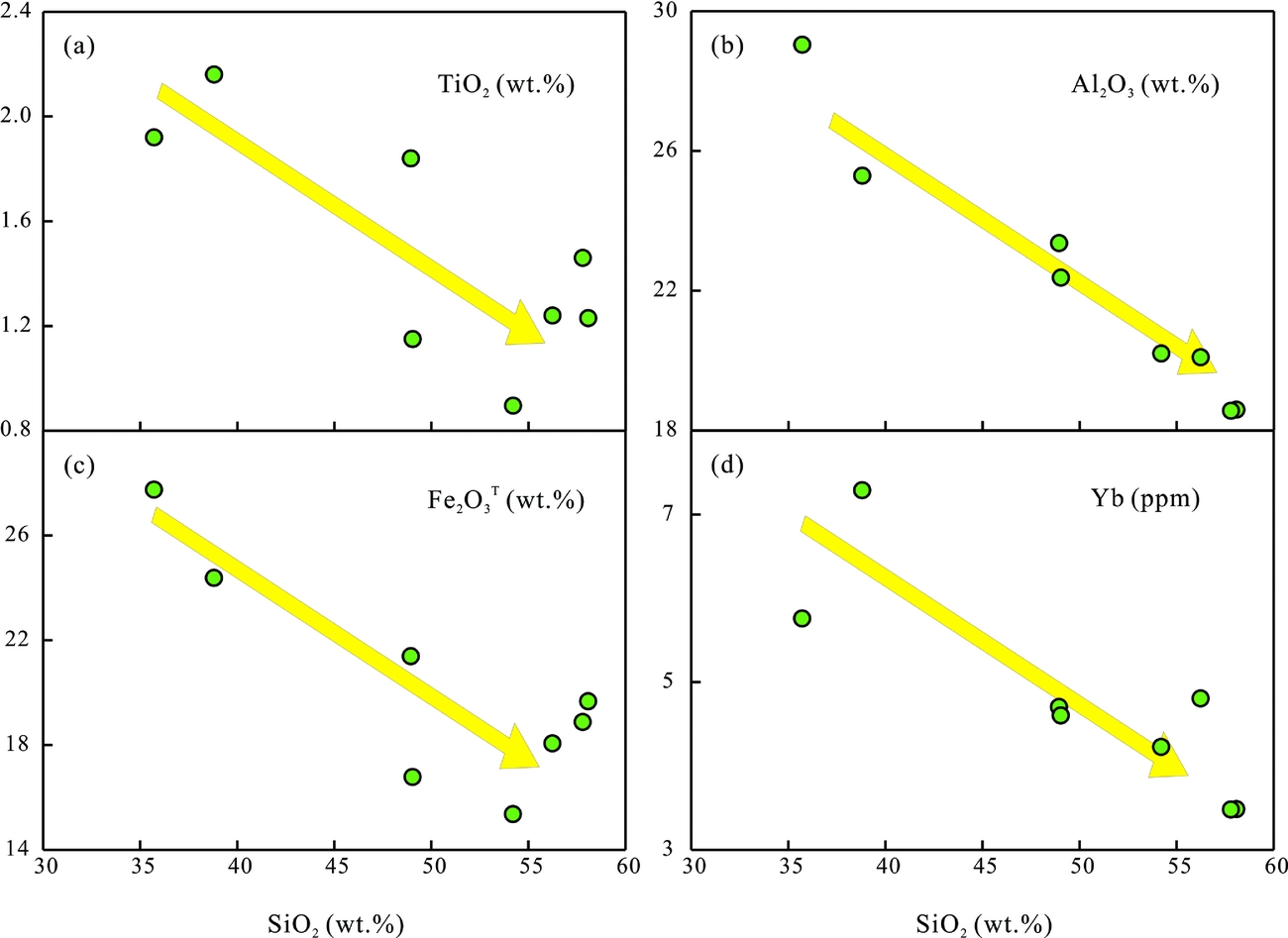
The ΣREE contents range from 142 to 313 ppm. All the samples show light rare earth elements (LREE) enrichment and relatively flat heavy rare earth elements (HREE) patterns with negative Eu anomalies (Eu/Eu*=0.40–0.68) (Fig. 3). They also have negligible to weak positive Ce anomalies (Ce/Ce*=0.95–1.09). Compared to PAAS, most of the samples show higher transition elements (e.g. Cr, Ni, Sc and V), HREE but lower Th contents. It is notable that HREE (e.g. Yb), TiO2, Al2O3 and Fe2O3T abundances decrease with increasing SiO2 (Fig. 4), indicating the garnet and Ti–Fe oxides in the rocks decrease due to the increase in mineralogical maturity (Bhatia, Reference Bhatia1983).
Chondrite normalized REE patterns for the garnet–sillimanite gneisses from the Kongling complex. Chondrite normalized values are from Sun & McDonough (Reference Sun, McDonough, Saunders and Norry1989), and average value of PAAS is from Taylor & McLennan (Reference Taylor and McLennan1985).
Bivariate plots of selected major elements and HREE against SiO2 for the garnet–sillimanite gneisses from the Kongling complex.
4.b. Nd isotope
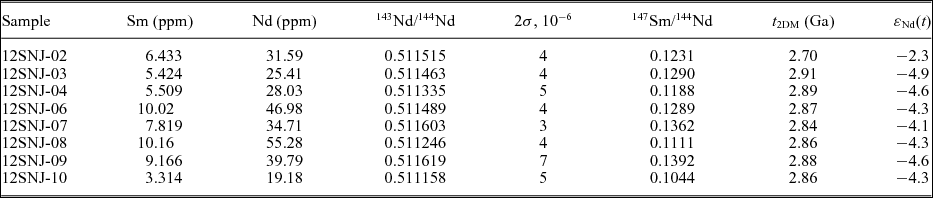
The Sm–Nd isotopic compositions and corresponding calculated data for the samples are listed in Table 2. The gneisses have 143Nd/144Nd and 147Sm/144Nd ratios ranging from 0.511158 to 0.511619 and 0.1044 to 0.1392, respectively. It is noted that some extent of Sm/Nd fractionation may occur between the source rocks and sediments via weathering, erosion and transportation, typical of a geological process suitable for application of two-stage Nd model age (T 2DM). Such a calculation can minimize the effect of Sm/Nd fractionation and yield a model age more reasonably reflecting time-integrated crustal residence time of provenance (Depaolo, Linn & Schubert, Reference Depaolo, Linn and Schubert1991; Bai et al. Reference Bai, Ling, Duan, Qiu, Liu, Kuang, Gao, Zhou, Chen and Lu2011). Depositional ages of the khondalites are estimated at 2.0 Ga based on Yin et al. (Reference Yin, Lin, Davis, Zhao, Xiao, Li and He2013) (see discussions below). The garnet–sillimanite gneisses in this study show relatively homogeneous ε Nd(t) values ranging from −.6 to −3.0, corresponding to the T 2DM from 2.90 to 2.70 Ga.
Sm–Nd isotopic compositions of the garnet–sillimanite gneisses from the Kongling complex

Notes: Sm, Nd contents are calculated by ID-TIMS, and their uncertainties are better than 5‰. In t 2DM calculation, ratios of (147Sm/144Nd)DM=0.2137, (143Nd/144Nd)DM=0.51315 and (147Sm/144Nd)cc=0.118 (cc stands for continental crust), while t=2.0 Ga. In ε Nd(t) calculation, ratios of (147Sm/144Nd)CHUR and (143Nd/144Nd)CHUR are 0.1967 and 0.512638 respectively, while t=2.0 Ga.
4.c. Effects of metamorphism and migmatization
The Kongling khondalites experienced upper amphibolite- to granulite-facies metamorphism. It is thus necessary to assess element mobilities during metamorphism before we use them to characterize the protoliths. Most studies on the effects of granulite-facies metamorphism on geochemical composition of metamorphic rocks have concluded that although certain large ion lithophile elements (LILE; e.g. U, Rb, Sr, Ba, Cs and Pb) can be strongly depleted, other elements including most major elements (e.g. Al2O3, TiO2), transition elements (e.g. Sc, Cr), high field strength elements (HFSE) and REE are relatively immobile (Weaver & Tarney, Reference Weaver and Tarney1981; Condie et al. Reference Condie, Boryta, Liu and Qian1992; Zhang et al. Reference Zhang, Wang, Chen, Sun, Santosh and Ba2014). In this study, the gneisses have relatively uniform distributions of REE, HFSE and most transition elements as well as homogeneous initial Nd isotopic compositions (Tables 1, 2), suggesting that these elements and Nd isotopic compositions do not appear to have been influenced by the regional metamorphism. The fact that the rocks have not undergone significant secondary alteration and/or been influenced by metamorphism is further supported by their low LOI values of 0.01–1.44. We noticed that migmatization is ubiquitous in the Kongling khondalites, so it is possible that the gneisses have undergone some melt extraction. However, a large amount of melt removal from the rocks can be ruled out since none of the samples display depletion of LREE and enrichment of HREE patterns, which are characteristic of pelitic rocks that have undergone extensive melt extraction (Dostal, Reference Dostal1975).
Anyway, to minimize the effects of metamorphism and migmatization, in the discussion we focused only on those elements that are least susceptible to metamorphic remobilization for protolith identification. Samples with obvious migmatization or partial melting were precluded for geochemical and Nd isotopic analyses.
5. Discussion
5.a. Intensity of chemical weathering
It is generally believed that the chemical weathering process causes the depletion of alkali and alkaline earth elements and the enrichment of Al2O3 and TiO2 (Wronkiewicz & Condie, Reference Wronkiewicz and Condie1987; Nesbitt, Young & Bosman, Reference Nesbitt, Young and Bosman2009). The Chemical Index of Weathering (CIW=−[Al2O3/(Al2O3+CaO*+Na2O)]×100; Harnois, Reference Harnois1988) has been proposed based on contents of mobile and immobile major oxides to quantify the degree of source weathering. In the equation, CaO* denotes the content of CaO incorporated in the silicate fraction and all major oxides are expressed in molar proportions. It is difficult to distinguish and quantify the contents of CaO belonging to silicate from the non-silicate (carbonates and phosphates) fraction. However, in this study carbonate and phosphate contribution to CaO is negligible considering the low LOI and P2O5 values, so the CIW values can be determined assuming the entire CaO content of the samples as that of the silicate fraction.
The CIW values of the samples in this study range from 90.4 to 94.7, indicating considerable source area weathering. A high level of weathering is further supported by the broadly positive correlation between Al2O3 and TiO2 and the slightly positive Ce anomalies in most gneisses. It is widely accepted that under weathering conditions the Ce3+ can be oxidized to Ce4+, which is less mobile than the other LREE ions with +3 charges. Thus, the oxidation leads to positive Ce anomalies under surface conditions (McLennan, Reference McLennan1989).
5.b. Nature of the source rocks
It is important to investigate the nature of the provenance of the Kongling metasedimentary rocks in order to understand their depositional tectonic setting. Based on Archaean inherited zircons and high CIW values, the Kongling supracrustal rocks were thought in previous studies to be erosion products of the underlying TTG basement (Gao et al. Reference Gao, Ling, Qiu, Zhou, Hartmann and Simon1999; Qiu et al. Reference Qiu, Gao, Mcnaughton, Groves and Ling2000; Yan et al. Reference Yan, Zhou, Zeng, Jiang, Zhou and Chen2006). However, zircons are common in felsic igneous rocks but rare within mafic–ultramafic rocks (Wu & Zheng, Reference Wu and Zheng2004), so the detrital zircon data show the contributions of felsic rocks rather than the whole picture of the source region. Besides, the intensity of chemical weathering of source rocks is not only controlled by source rock composition, but also by duration of weathering, climatic conditions and rates of tectonic uplift of the source region (Wronkiewicz & Condie, Reference Wronkiewicz and Condie1987). Therefore, it is necessary to find alternative independent methods that can reveal significant information to further constrain the sedimentary provenance.
It is agreed that immobile elements can better preserve information about compositional characteristics of the source rocks and thus can be used to interpret the evolution of the provenance of a sedimentary basin (Cullers, Reference Cullers1995; Payne, Barovich & Hand, Reference Payne, Barovich and Hand2006; Ghosh & Sarkar, Reference Ghosh and Sarkar2010; Xie et al. Reference Xie, Wu, Gao, Liu, Zhou, Zhao and Hu2012; Li et al. Reference Li, Chen, Wei, Wang and Han2015). Compared to mafic rocks, felsic rocks are distinguished by evident enrichment of LREE and Th, and depletion of transition elements such as Sc, Ni, Cr and V (Holland & Turekian, Reference Holland and Turekian2014). Thus, the ratios of the two groups of elements can be used to characterize the source rocks from which the investigated metasedimentary rocks were derived (Fralick & Kronberg, Reference Fralick and Kronberg1997). For instance, the Late Palaeozoic to Mesozoic fine-grained clastic rocks in the Western Hills of Beijing, North China, have relatively high La/Sc, Th/Sc, La/Co and Th/Co but low Cr/Th ratios, which were interpreted to be derived from erosion of mostly intermediate to acidic source materials (Xie et al. Reference Xie, Wu, Gao, Liu, Zhou, Zhao and Hu2012). Cullers, Basu & Suttner (Reference Cullers, Basu and Suttner1988) summarized that the sediments from felsic sources should have La/Sc, Th/Sc and Cr/Th ratios of 2.50–16.3, 0.84–20.5 and 4.00–15.0, respectively, whereas those from mafic sources should be 0.43–0.86, 0.05–0.22 and 25.0–500. In this study, the samples are characterized by high transition elements and low Th contents, with evidently higher Cr/Th (9.04–39.1) and Cr/Zr (0.90–1.13) but lower Th/Sc (0.14–0.77) and La/Sc (0.57-2.11) ratios than the PAAS (Cr/Th=7.53, Cr/Zr=0.52, Th/Sc=0.91 and La/Sc=2.38), indicating their derivation from weathering and erosion of mostly mafic source materials. It is notable that one sample (12SNJ08) in our study has higher Th and lower transition element contents than the others. It has geochemical features close to the PAAS, which are not compatible with those of typical mafic source rocks and may indicate some felsic input. However, significant amounts of involvement of felsic rocks in the source area are precluded for the high Cr, V and Ni contents in most of the rocks. This is further supported by their uniform Nd isotopic compositions. Such a conclusion is also supported by studies of the geochemical compositions of representative metapelitic rocks from other locations within the Kongling complex (Yan et al. Reference Yan, Zhou, Zeng, Jiang, Zhou and Chen2006; Li et al. Reference Li, Zheng, Xiong, Wang, Ping, Li and Tang2016). For example, the graphite-bearing plagiogneisses, garnet-bearing quartzic amphibole gneisses, garnet sillimenite quartzites and graphite–garnet bearing granulites from the Kongling complex have relatively high Cr (115–238 ppm) and Ni (69.5–143 ppm) and low La (7.10–48.2 ppm) and Th (0.19-22.7 ppm) contents, with high Cr/Th (10.2–1073, average value 323) and low La/Sc ratios (0.24–3.26, average value 1.09), suggesting that these metasedimentary rocks were mainly derived from a mafic provenance. Most recently, Li et al. (Reference Li, Zheng, Xiong, Wang, Ping, Li and Tang2016) collected four metapelitic rocks from the Kongling complex; in their study, apart from one sample (11WD43) which had a moderately low Cr content of 108 ppm and Cr/Th ratio of 5.37, the remaining samples from three different parts of the complex had high Cr (237–748 ppm) and Sc (12.7–45.9 ppm) but low Th (4.90–12.4 ppm) and La (34.9–39.7 ppm) contents, with Cr/Th ratios ranging from 20.5 to 153 and Sc/Th ratios from 2.59 to 3.70, obviously higher than those sediments from felsic sources (Cullers, Reference Cullers1995).
To summarize, all the geochemical provenance signatures discussed above point to the protoliths of the Palaeoproterozoic garnet–sillimanite gneisses in the Kongling complex being derived from intense weathering of a source dominated by mafic rocks with minor felsic components, rather than the ancient TTG basement rocks as previously thought (Gao et al. Reference Gao, Ling, Qiu, Zhou, Hartmann and Simon1999; Qiu et al. Reference Qiu, Gao, Mcnaughton, Groves and Ling2000; Yan et al. Reference Yan, Zhou, Zeng, Jiang, Zhou and Chen2006).
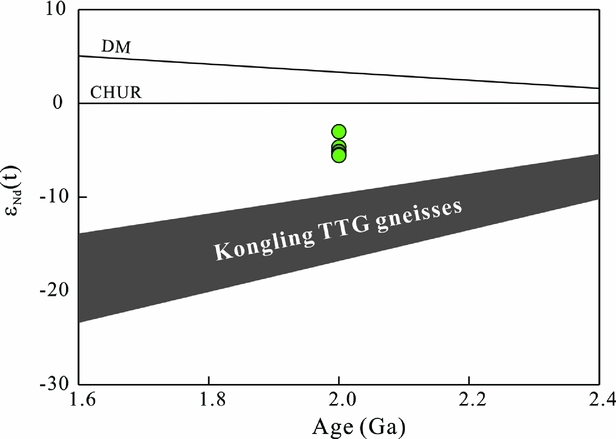
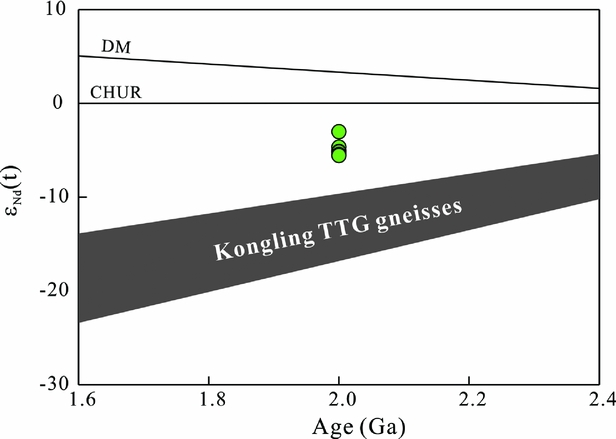
This conclusion is further supported by the whole-rock Nd isotopic and zircon Hf isotopic compositions of the paragneisses. The Kongling garnet–sillimanite gneisses have less negative ε Nd(2.0 Ga) values (−5.6 to −3.0) than the TTG gneisses in the region (−16.6 to −8.6; Ling et al. Reference Ling, Gao, Zheng, Zhou and Zhao1998; Gao et al. Reference Gao, Ling, Qiu, Zhou, Hartmann and Simon1999; our unpublished data) (Fig. 5), suggesting that the provenance of the metasedimentary rocks was relatively juvenile. Moreover, whole-rock Nd model ages and the documented zircon Hf model ages for the paragneisses range from 2.82 to 2.80 Ga and 2.90 to 2.70 Ga, respectively (Yin et al. Reference Yin, Lin, Davis, Zhao, Xiao, Li and He2013; this study). These ages are even younger than the time interval of 3.4−2.9 Ga representing the most voluminous TTG event in the Yangtze block (Gao et al. Reference Gao, Ling, Qiu, Zhou, Hartmann and Simon1999, Reference Gao, Yang, Zhou, Li, Hu, Guo, Yuan, Gong, Xiao and Wei2011; Qiu et al. Reference Qiu, Gao, Mcnaughton, Groves and Ling2000, Reference Qiu, Ling and Liu2014; Chen et al. Reference Chen, Gao, Wu, Guo, Hu, Liu, Zong, Liang and Geng2013; Guo et al. Reference Guo, Gao, Wu, Li, Chen, Hu, Liang, Liu, Zhou and Zong2014, Reference Guo, Wu, Gao, Jin, Zong, Hu, Chen, Chen and Liu2015), precluding erosion of large amounts of TTG rocks. Inherited zircons with Archaean ages in some of the kondalites were reported in a previous study (e.g. Qiu et al. Reference Qiu, Gao, Mcnaughton, Groves and Ling2000), indicating minor ancient TTG rocks may well be involved. If so, the mafic source is required to have ages of <2.7 Ga through mixing with the TTG rocks. Most recently, we recognized a continental arc-related meta-andesitic suite from the Kongling complex. SHRIMP U–Pb geochronology of zircons from the rocks suggests these rocks were formed at 2183±17 Ma (the authors’ unpublished data). Unfortunately, we still notice that the 2.7–2.1 Ga mafic igneous rocks have not been widely reported in the Kongling complex, except for minor amphibolites in the region with young T 2DM from 2.4 to 2.2 Ga (Ling et al. Reference Ling, Gao, Zheng, Zhou and Zhao1998; Wei & Jing, Reference Wei and Jing2013). One possibility is that they may once have existed in the inferred continental arc and have been eroded to form part of the khondalite protoliths due to intense weathering. This is supported by the existence of detrital zircons with ages of 2.3–2.1 Ga in the metasedimentary rocks (Yin et al. Reference Yin, Lin, Davis, Zhao, Xiao, Li and He2013), and some of the amphibolites have T 2DM of 2.4–2.2 Ga (Ling et al. Reference Ling, Gao, Zheng, Zhou and Zhao1998; Wei & Jing, Reference Wei and Jing2013).
ε Nd(t) vs age diagram for the garnet–sillimanite gneisses compared with TTG gneisses from the Kongling complex. Epsilon Nd values for the metasedimentary rocks are calculated at 2.0 Ga. Nd isotopic fields for the TTG gneisses are according to data from Ling et al. (Reference Ling, Gao, Zheng, Zhou and Zhao1998), Gao et al. (Reference Gao, Ling, Qiu, Zhou, Hartmann and Simon1999) and the authors’ unpublished data.
5.c. Tectonic setting
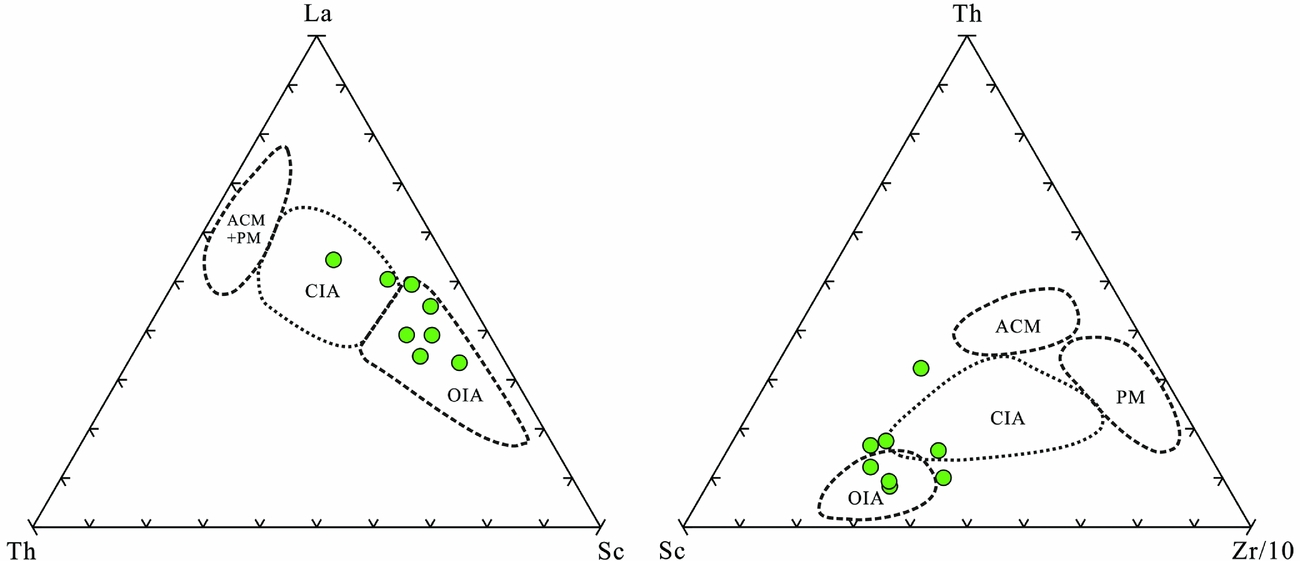
The khondalites have long been interpreted as metamorphosed platform or cratonic sediments, and their protoliths are thought to be deposited in passive margin type basins during stable conditions (Shackleton, Reference Shackleton and Windley1976; Condie et al. Reference Condie, Boryta, Liu and Qian1992). On the other hand, some workers argue that they could also be deposited in arc-related settings (Daly et al. Reference Daly, Balagansky, Timmerman, Whitehouse, Jong, Guise, Bogdanova, Gorbatschev and Bridgwater2001; Dan et al. Reference Dan, Li, Guo, Liu and Wang2012). In this study, the similar trace element distributions between the garnet–sillimanite gneisses and those of khondalite rocks from the Lapland granulite belt (Baltic Shield) with protoliths of calc-alkaline volcanics (Barbey, Capdevila & Hameurt, Reference Barbey, Capdevila and Hameurt1982) do not favour a cratonic setting for these rocks. Besides, immobile trace elements rarely change during erosion and transportation processes, so systematic study of them in sedimentary rocks can be useful to provide a set of discrimination schemes to understand different tectonic settings such as oceanic arcs, continental arcs, active continental margins and passive continental margins (Bhatia, Reference Bhatia1985; Bhatia & Crook, Reference Bhatia and Crook1986; Crichton & Condie, Reference Crichton and Condie1993). Of these, the most commonly used are La–Th–Sc and Th–Sc–Zr/10 diagrams (Bhatia & Crook, Reference Bhatia and Crook1986). In these diagrams, the para-gneisses straddle the continental arc and oceanic arc domains (Fig. 6). However, it is widely accepted that areas of crust with high proportions of juvenile material can be found in oceanic island arcs. Considering that the metasedimentary rocks yielded Nd model ages of 2.90–2.70 Ga, indicating mostly recycled material, the Nd isotopic data are best explained as evidence for a sedimentary provenance in a mafic juvenile Andean-type continental arc situated on Archaean basement. If this is correct, our study argues against the traditional viewpoint of previous studies that the Kongling khondalite suites were deposited at a passive continental margin (Gao et al. Reference Gao, Ling, Qiu, Zhou, Hartmann and Simon1999; Yan et al. Reference Yan, Zhou, Zeng, Jiang, Zhou and Chen2006; Yin et al. Reference Yin, Lin, Davis, Zhao, Xiao, Li and He2013).
Geochemical discrimination of (a) La–Th–Sc and (b) Th–Sc–Zr/10 diagrams (after Bhatia & Crook, Reference Bhatia and Crook1986). OIA: oceanic island arc; CIA: continental island arc; ACM: active continental margin; PCM: passive continental margin.

This is further supported by newly published U–Pb dating results for the Kongling garnet–sillimanite gneisses (Yin et al. Reference Yin, Lin, Davis, Zhao, Xiao, Li and He2013). Recent geochronological study of the detrital zircons in the garnet–sillimanite geneisses reveals that the maximum depositional ages of at least some of the khondalite protholiths should be c. 2.1 Ga (Yin et al. Reference Yin, Lin, Davis, Zhao, Xiao, Li and He2013). Combined with their metamorphic ages of c. 2.0 Ga (Zhang et al. Reference Zhang, Zheng, Wu, Zhao, Gao and Wu2006b; Wu et al. Reference Wu, Gao, Gong, Xiang, Jiao, Yang, Liu and Yuan2009; Yin et al. Reference Yin, Lin, Davis, Zhao, Xiao, Li and He2013), the depositional ages of the khondalite protoliths are constrained to be ~2.1–2.0 Ga, indicative of a rapid depositional rate. The zircon U–Pb dating and geochemical features are similar to those of sedimentary rocks which are deposited at a continental arc setting. Those rocks would be expected to be immature due to short transportation paths and intermediate storage because of rapid erosion of newly exposed potential source rocks (Bolhar et al. Reference Bolhar, Weaver, Whitehouse, Palin, Woodhead and Cole2008; Bouihol et al. Reference Bouilhol, Schaltegger, Chiaradia, Ovtcharova, Stracke, Burg and Dawood2011).
In summary, we thus hypothesize that the Kongling khondalite protoliths were probably deposited in a continental arc setting. Subduction of oceanic slab causes dramatic crustal uplift, resulting in rapid erosion of the surface igneous rocks.
6. Implication for the Palaeoproterozoic tectonic evolution of the Yangtze craton
The SCB was formed during the Neoproterozoic through collision and welding of the Yangtze and Cathaysia continental blocks. However, pre-collision histories of the two blocks are relatively scarce (Qiu et al. Reference Qiu, Ling, Liu, Kusky, Berkana, Zhang, Gao, Lu, Kuang and Liu2011; Cawood et al. Reference Cawood, Wang, Xu and Zhao2013). For the Yangtze craton, most studies have so far focused on the late Mesoproterozoic to Neoproterozoic tectonic events relating to the assembly and break-up of the Rodinia supercontinent (e.g. Qiu et al. Reference Qiu, Ling, Liu, Kusky, Berkana, Zhang, Gao, Lu, Kuang and Liu2011, Reference Qiu, Yang, Lu, Ling, Zhang, Tan and Wang2015a; Cawood et al. Reference Cawood, Wang, Xu and Zhao2013). Palaeoproterozoic tectonic events relating to evolution of the Columbia supercontinent have been more tenuous.
Recently, with increasing high-precision geochronological studies for the Precambrian massif in the Yangtze craton, more and more Palaeopreterozoic metamorphic or magmatic rocks have been reported in the Kongling complex. For instance, Zhang et al. (Reference Zhang, Zheng, Wu, Zhao, Gao and Wu2006b) obtained two LA-ICP-MS U–Pb metamorphic zircon ages of 1948±46 Ma and 1979±22 Ma from two metapelites. In addition, zircon U–Pb geochronology for two metasedimentary rocks in the Kongling complex revealed a metamorphic event at 2010±13 Ma (Wu et al. Reference Wu, Gao, Gong, Xiang, Jiao, Yang, Liu and Yuan2009). Such an event is also recorded in the basement of the Kongling complex (Qiu et al. Reference Qiu, Gao, Mcnaughton, Groves and Ling2000; Gao et al. Reference Gao, Yang, Zhou, Li, Hu, Guo, Yuan, Gong, Xiao and Wei2011; Chen et al. Reference Chen, Gao, Wu, Guo, Hu, Liu, Zong, Liang and Geng2013). Wei & Jing (Reference Wei and Jing2013) carried out an integrated geochronological and geochemical study of the amphibolites in the Kongling complex. The metamorphic zircon U–Pb analysis yielded a discordia with upper intercept at 2043±51 Ma, which was interpreted as the timing of a thermal metamorphic event. Yin et al. (Reference Yin, Lin, Davis, Zhao, Xiao, Li and He2013) presented zircon U–Pb ages for mafic granulites, metapelitic rocks and high-grade marbles from the Kongling complex. The results also pointed to a ~2.0 Ga granulite-facies metamorphism in the region. S-type garnet-bearing granitoids of ~2.0 Ga have also been reported by several researchers (Yin et al. Reference Yin, Lin, Davis, Zhao, Xiao, Li and He2013; Li et al. Reference Li, Lin, Xiao, Yin, Davis and Xing2014; Guo et al. Reference Guo, Wu, Gao, Jin, Zong, Hu, Chen, Chen and Liu2015). Based on these new geochronological data, together with the mineral assemblages and clockwise P–T paths of the metamorphic rocks, these authors proposed that the Kongling complex might have experienced high-pressure granulite-facies metamorphism during the Palaeoproterozoic, most likely caused by arc-collision and/or continent–continent collision events (e.g. Zhang et al. Reference Zhang, Zheng, Wu, Zhao, Gao and Wu2006b; Wu et al. Reference Wu, Gao, Gong, Xiang, Jiao, Yang, Liu and Yuan2009).
Khondalites are common in many orogenic belts worldwide, which have been considered to record the metamorphism resulting from collision of individual continental blocks (e.g. Santosh, Morimoto & Tsutsumi, Reference Santosh, Morimoto and Tsutsumi2006). For example, the Palaeoproterozoic Khondalite Belt in the Western Block of the North China craton, which is composed of schists and gneisses together with marbles and some mafic granulites, has been interpreted as resulting from collision between the Ordos block to the south and the Yinshan block to the north (Zhao et al. Reference Zhao, Sun, Wilde and Li2005; Wan et al. Reference Wan, Song, Liu, Wilde, Wu, Shi, Yin and Zhou2006). Meanwhile, zircon U–Pb and Lu–Hf isotopic data for khondalite suites in the Korla complex, Tarim craton, suggested that the khondalites might be related to a late Palaeoproterozoic collision event in the northern Tarim craton (Ge et al. Reference Ge, Zhu, Wu, He and Zheng2013). A Phanerozoic example comes from the Late Pan-African (~500 Ma) >1300 km long basement rocks in northeast China, named as the ‘NE China Khondalite Belt’. They were considered to be formed by amalgamation of a series of microcontinents, including the Erguna, Xing'an, Jiamusi and Khanka blocks (Zhou & Wilde, Reference Zhou and Wilde2013). Besides, based on zircon and monazite Th–U–Pb ages, the granulite-facies metamorphism in the Khondalite belt in the Trivandrum block of southern India was probably the product of the final assembly of the Gondwana supercontinent (Santosh, Morimoto & Tsutsumi, Reference Santosh, Morimoto and Tsutsumi2006). The Palaeoproterozoic supracrustal rocks in the Kongling complex, which consists mainly of garnet–sillimanite gneisses, schists, and marbles with minor mafic granulites, have similar rock assemblages to those khondalites in orogenic belts worldwide (Santosh et al. Reference Santosh, Tsunogae, Li and Liu2007). They thus support the existence of a Palaeoproterozoic orogenic event in the nucleus of the Yangtze craton.
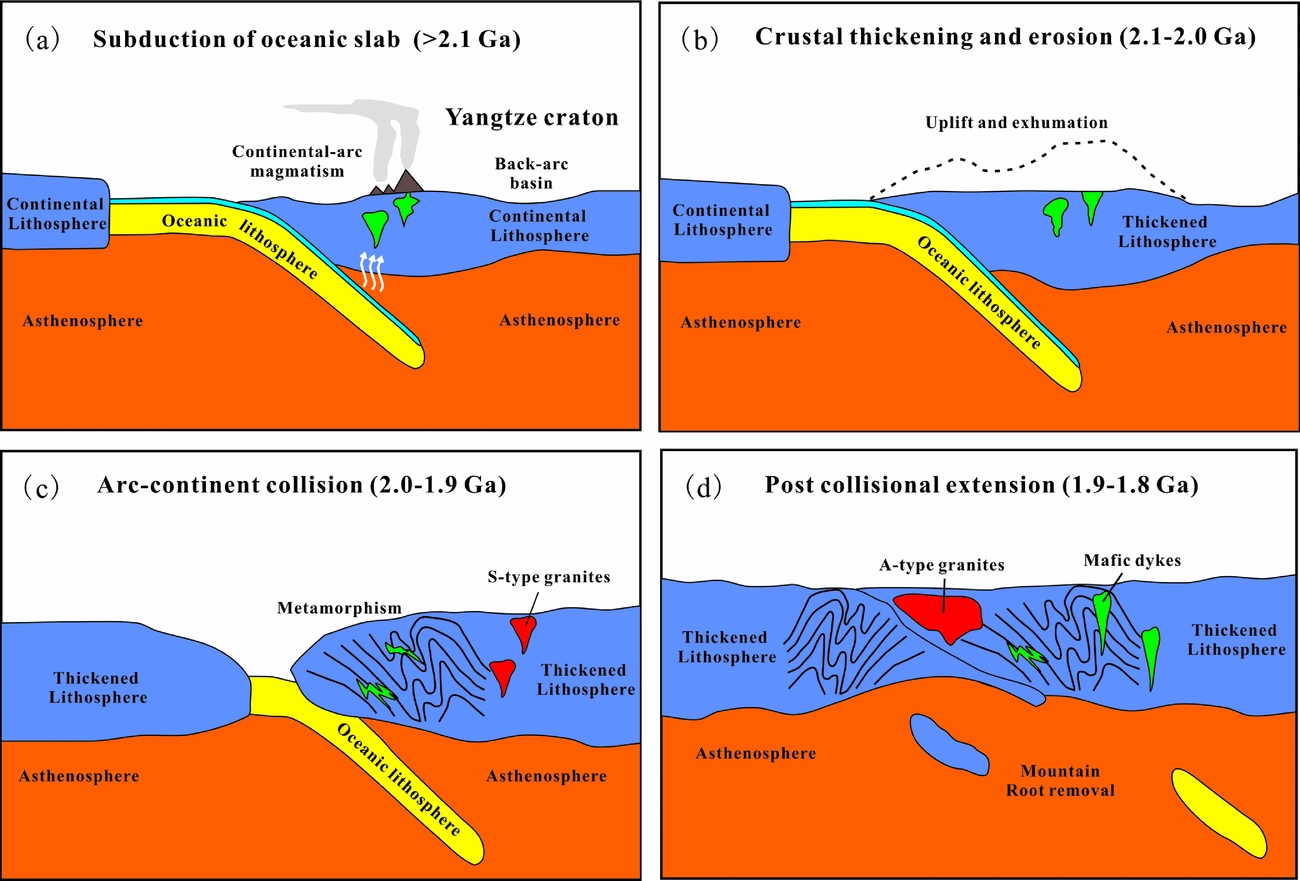
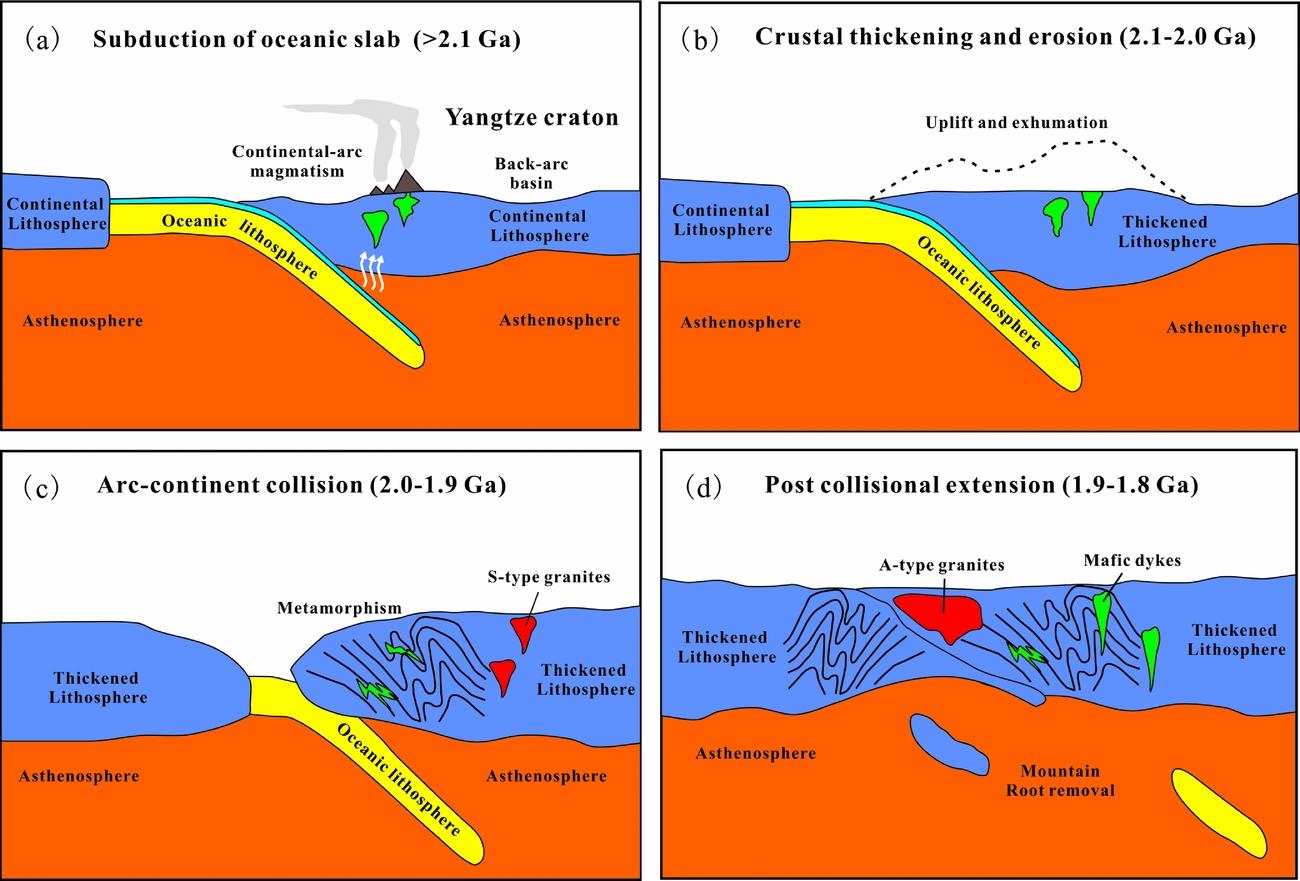
In view of the above arguments, an integral Palaeoproterozoic orogenic cycle from accretionary process to a continental collisional belt for the Yangtze craton is outlined as follows (Fig. 7). (1) Subduction of oceanic crust might occur before 2.1 Ga (perhaps at 2.3–2.1 Ga), leading to arc magmatisms. (2) Rapid erosion and deposition of these arc-derived materials at 2.1–2.0 Ga in a continental arc setting, caused by crustal uplift. (3) Following the closure of back-arc basins, arc–continent collision and perhaps continent–continent collision occurred at c. 2.0-1.9 Ga, resulting in high-grade metamorphism and anatectic melting of ancient crustal rocks, and generating abundant khondalites and garnet-bearing S-type granitoids. (4) Tectonic collapse of the collision-thickened orogen occurred at c. 1.9–1.8 Ga, causing post-collisional extension with intrusion of mafic dykes (Peng et al. Reference Peng, Wu, Wang, Jiao, Liu and Yang2009) and A-type granitoid (Xiong et al. Reference Xiong, Zheng, Yu, Su, Tang and Zhang2009; Peng et al. Reference Peng, Kusky, Jiang, Wang, Wang and Deng2012; Qiu et al. Reference Qiu, Yang, Lu, Ling, Zhang, Tan and Wang2015b).
The cartoon model for Palaeoproterozoic tectonic evolution of the nucleus of the Yangtze craton (abstracted from Zhang et al. Reference Zhang, Zheng, Wu, Zhao, Gao and Wu2006b; Peng et al. Reference Peng, Wu, Wang, Jiao, Liu and Yang2009; Wu et al. Reference Wu, Gao, Gong, Xiang, Jiao, Yang, Liu and Yuan2009; Yin et al. Reference Yin, Lin, Davis, Zhao, Xiao, Li and He2013; Qiu et al. Reference Qiu, Yang, Lu, Ling, Zhang, Tan and Wang2015b). It hypothesizes that (a) continental arc magmatism occurred at c. 2.3–2.1 Ga, followed by (b) crustal thickening and erosion. (c) An arc–continent collision is then emphasized to take place at ~2.0–1.9 Ga, resulting in high-grade metamorphism and reworking of pre-existing crustal rocks. Finally, (d) local lithospheric extension is assumed to trigger extension-related magmatism at ~1.9–1.8 Ga.
We noticed that the 2.1–1.8 Ga tectonic evolution of the Yangtze craton was consistent with the contemporaneous worldwide collision events which have been correlated with the assembly of the Columbia supercontinent (e.g. Rogers & Santosh, Reference Rogers and Santosh2002; Zhao et al. Reference Zhao, Cawood, Wilde and Sun2002). For example, the 1.95–1.80 Ga Trans-Hudson Orogen in North America was considered to be formed by an Andean-type collision between the Slave–Rae–Hearne and Superior cratons (Hoffman, Reference Hoffman1988). In Australia, the Yilgarn and Pilbara cratons collided along the 2.0–1.9 Ga Capricorn Orogen (Cawood & Tyler, Reference Cawood and Tyler2004). In South Africa, the main phase of collision between the Zimbabwe and Kaapvaal cratons occurred between 2.0 and 1.9 Ga along the Limpopo Belt (Kröner et al. Reference Kröner, Jaeckel, Brandl, Nemchin and Pidgeon1999). The 1.95–1.85 Ga Trans-North China Orogen and associated khondalites in the North China craton represent the assembly of its Eastern and Western Blocks (Zhao et al. Reference Zhao, Sun, Wilde and Li2004; Wan et al. Reference Wan, Song, Liu, Wilde, Wu, Shi, Yin and Zhou2006). Combined with our study and previously published data for the Palaeoproterozoic rocks in the Kongling complex, these new results lead to the conclusion that the Yangtze craton is one of the important components in reconstruction of the Columbia supercontinent.
7. Conclusions
From our study we were able to arrive at the following conclusions:
(1) The garnet–sillimanite gneisses in the Kongling khondalite suites were derived from a provenant source dominated by mafic igneous rocks with involvement of minor Archaean felsic basement rocks. The source materials suffered intense weathering, uplift, erosion, deposition and metamorphism within a short time interval of ~100 Ma.
(2) The khondalites from the Kongling complex were probably deposited in a continental arc setting at ~2.1–2.0 Ga instead of parts of the Archaean basement.
(3) The genesis of khondalites supports an integral Palaeoproterozoic orogenic cycle from accretionary process to a continental collision for the Yangtze craton, indicating it is an important component in reconstruction of the Columbia supercontinent.
Acknowledgements
Editor Chad Deering and two anonymous reviewers are thanked for their thorough reviews and constructive criticisms. We sincerely appreciate Profs. Lian-Hong Peng and Yun-Xu Wei of the Wuhan Center of China Geological Survey for their generous and valuable help during the two months’ field work. This study was financially supported by National Science Foundation of China (Grants 41303026), and the funded project of the China Geological Survey (Nos. 1212011220512, 1212011121102, DD20160030).