Introduction
How common is the experience of a mental disorder? How many individuals in the population will experience a diagnosable mental disorder during their lifetimes? The answer to this perennial question of the lifetime population prevalence of mental disorder has many implications: for etiological theories, for service-delivery policy, for public perceptions of the stigma of mental disorder, and for understanding the burden of mental disorder on economic productivity (Insel & Fenton, Reference Insel and Fenton2005). Important information about the lifetime population prevalence of mental disorder in the USA has been provided by epidemiological surveys such as the Epidemiological Catchment Area (ECA) study (Robins & Regier, Reference Robins and Regier1991), the National Comorbidity Survey (NCS; Kessler et al. Reference Kessler, McGonagle, Zhao, Nelson, Hughes, Eshleman, Wittchen and Kendler1994), the National Comorbidity Survey Replication (NCS-R; Kessler et al. Reference Kessler, Berglund, Demler, Jin, Merikangas and Walters2005a) and the National Epidemiologic Survey on Alcohol and Related Conditions (NESARC; Compton et al. Reference Compton, Thomas, Stinson and Grant2007; Hasin et al. Reference Hasin, Stinson and Grant2007). Surveys offer a key advantage over official mental-health service records for estimating population prevalence because they are able to count individuals who experience disorder but never use mental-health services. However, surveys have the disadvantage of estimating lifetime prevalence using the retrospective method, in which respondents retrospect over past years of their lives to recall whether they have ever experienced mental disorder symptoms. Such retrospective ascertainment is known to undercount lifetime prevalence (Kessler et al. Reference Kessler, Berglund, Demler, Jin, Merikangas and Walters2005a) because respondents under-report past disorder symptoms (Simon & VonKorff, Reference Simon and VonKorff1995), but the extent of this undercounting is unknown.
Longitudinal cohort studies provide an alternative, complementary method for ascertaining lifetime prevalence. Like surveys, longitudinal studies count cases of disorder irrespective of service use. However, they estimate lifetime prevalence of disorder using the prospective method, in which researchers follow a representative cohort of individuals over their life course while undertaking repeated diagnostic assessments. The proportion of cohort members who experience disorder is counted as it accumulates. Because the prospective method reduces the undercounting that results from the retrospective method, there is reason to expect that prospective ascertainment could yield lifetime prevalence estimates that are higher than the existing retrospective ascertainments, and more representative of true lifetime prevalence (Costello et al. Reference Costello, Mustillo, Erkanli, Keeler and Angold2003; Wells & Horwood, Reference Wells and Horwood2004; Jaffee et al. Reference Jaffee, Harrington, Cohen and Moffitt2005; Moffitt et al. Reference Moffitt, Harrington, Caspi, Kim-Cohen, Goldberg, Gregory and Poulton2007).
The extent of undercounting by retrospective studies could be estimated by comparing results from retrospective and prospective methods. The ideal design would compare prospective versus retrospective lifetime prevalence measures of common disorders in the same cohort followed longitudinally from childhood to adulthood. To our knowledge no such study has been undertaken, and completing one could take years. As such, we report a comparison of lifetime prevalence rates derived from a prospective longitudinal study versus from three retrospective surveys. Furthermore, for depression, studies show that half of respondents with a documented prior episode do not recall it when interviewed years later (Kendler et al. Reference Kendler, Neale, Kessler, Heath and Eaves1993; Andrews et al. Reference Andrews, Anstey, Brodaty, Issakidis and Luscombe1999; Wells & Horwood, Reference Wells and Horwood2004), but it is not known if this finding applies to other disorders. Thus, we studied anxiety and substance disorders in addition to depression.
The question of the lifetime prevalence of mental disorders in the population has continued unanswered for many years. After the ECA study revealed rates of mental disorder that were higher than expected by many mental-health professionals, this surprising information prompted concerns about the true rate of disorder in the population and raised questions about the validity of ascertaining disorders using standardized interviews in household surveys (Regier et al. Reference Regier, Kaelber, Rae, Farmer, Knauper, Kessler and Norquist1998; Brugha et al. Reference Brugha, Bebbington and Jenkins1999). The NCS and NCS-R were carefully designed to address many of these concerns, but their prevalence rates still seemed too high to many experts (Pincus et al. Reference Pincus, Zarin and First1998; Regier, Reference Regier2000; Narrow et al. Reference Narrow, Rae, Robins and Regier2002). The NCS-R lifetime prevalence of 46% prompted questions about how many of the identified cases were trivially mild (Insel & Fenton, Reference Insel and Fenton2005), but analyses attested that nearly 60% were serious or moderate (Kessler et al. Reference Kessler, Chiu, Demler, Merikangas and Walters2005b).
Vigorous debates have been stimulated by survey reports that a higher than expected number of individuals in the population have a diagnosable mental disorder during their lifetime. Some researchers perceive a large unmet need for mental-health care (NAMHC, 1993; Mechanic, Reference Mechanic2003; Insel & Fenton, Reference Insel and Fenton2005), whereas others counter that DSM definitions over-medicalize normal behavior (Horwitz & Wakefield, Reference Horwitz and Wakefield2007; Parker, Reference Parker2007). Some researchers propose to correct too-high prevalences downward by requiring more evidence of severity (Narrow et al. Reference Narrow, Rae, Robins and Regier2002) whereas others counter that diagnosing mild disorders constitutes a prevention opportunity (Kessler et al. Reference Kessler, Merikangas, Berglund, Eaton, Koretz and Walters2003b; Hickie, Reference Hickie2007).
However, in the heat of the debate little attention has been paid to a disconcerting possibility: that the higher than expected lifetime rate of disorder derived through retrospective surveys may represent an undercount. Based on this realization, the provocative hypothesis has recently been put forward that if individuals were followed for enough years through their lives, almost everyone in the population might have at least one episode of a common disorder such as depression (Andrews et al. Reference Andrews, Poulton and Skoog2005). To date, progress toward resolving ongoing debates about the lifetime prevalence of mental disorder is hampered because the epidemiological evidence base relies solely on retrospective surveys. This article aims to add prospective data to the evidence base.
We report the cumulative prevalence of DSM-defined (APA, 1994) disorders during the 15-year period from age 18 to 32 years in the prospective longitudinal Dunedin (New Zealand) Study, as compared to retrospective lifetime prevalence for the same age group in the NCS, the NCS-R and the New Zealand Mental Health Survey (NZMHS; Oakley Browne et al. Reference Oakley-Browne, Wells and Scott2006). We chose these comparisons for the following reasons. First, we compare the Dunedin Study to the NZMHS because both represent the same nation (yet differ on method of ascertaining lifetime prevalence). Second, we compare the Dunedin Study to the NCS-R, because the NCS-R is considered a contemporary gold-standard source on prevalence. We present NZMHS and NCS-R data to show that the USA and New Zealand do not differ on disorder prevalence (both used the same measure and methods as part of the World Mental Health Surveys; Degenhardt et al. Reference Degenhardt, Chiu, Sampson, Kessler, Anthony, Angermeyer, Bruffaerts, de Girolamo, Gureje, Huang, Karam, Kostyuchenko, Lepine, Mora, Neumark, Ormel, Pinto-Meza, Posada-Villa, Stein, Takeshima and Wells2008). Third, we include the NCS because the NCS-R and NZMHS prevalence rates for substance disorders have been criticized (Hasin & Grant, Reference Hasin and Grant2004; Grant et al. Reference Grant, Compton, Crowley, Hasin, Helzer, Li, Rounsaville, Volkow and Woody2007; Kessler & Merikangas, Reference Kessler and Merikangas2007); thus the NCS rates remain a key standard of comparison for substance disorders.
Depression, anxiety disorders, alcohol dependence and cannabis dependence were chosen for study because they are common in the population and they had been diagnosed in all four studies. Age 18 years was our starting point because the youngest participants in the NCS and NCS-R were aged 18 when diagnosed for adult disorders. Age 32 was our ending point because it is the oldest age that the Dunedin cohort has been diagnosed for adult disorders so far. In addition, under-reporting of past disorder probably affects older survey respondents most. By examining the youngest participants of the surveys we used the surveys' best lifetime prevalence estimates for our comparison. Although age 18–32 does not represent the entire life course, it constitutes the peak age-of-onset window for common disorders.
The Dunedin Study's prospective estimate of lifetime prevalence represents a cumulative count of cases diagnosed during the course of the study, each of which was ascertained in a past-year assessment. Therefore, an essential first step in this research was to compare past-year prevalence rates from the Dunedin Study to those from the NZMHS, NCS-R and NCS. If past-year rates seemed similarly accurate across the three studies but the prospective method yielded higher lifetime rates than the retrospective method, the data would support initial inferences about how much lifetime disorder is underestimated when diagnosis relies on long-term recall.
Method
Samples
Longitudinal participants were members of the Dunedin Multidisciplinary Health and Development Study (Moffitt et al. Reference Moffitt, Caspi, Rutter and Silva2001). Of infants born in Dunedin, New Zealand, between April 1972 and March 1973, 1037 children (91% of eligible births; 52% male) participated in the first follow-up at age 3, constituting the base sample for the longitudinal study. Participants represent the full range of socio-economic status in the general population of New Zealand's South Island and were primarily white. Participants attended the Research Unit for a full day of individual data collection. The Otago Ethics Committee approved each phase of the study. Study members gave written informed consent before participating. Assessments were undertaken at ages 3, 5, 7, 9, 11, 13, 15, 18, 21, 26 and most recently at age 32 when we assessed 96% of the 1015 Study members still alive in 2004–2005. This article examines participants who were assessed for mental disorders at ages 18 (n=930), 21 (n=961), 26 (n=976) and 32 years (n=962).
Detailed sample descriptions are available elsewhere for the NCS (Kessler et al. Reference Kessler, McGonagle, Zhao, Nelson, Hughes, Eshleman, Wittchen and Kendler1994), NSC-R (Kessler et al. Reference Kessler, McGonagle, Zhao, Nelson, Hughes, Eshleman, Wittchen and Kendler1994, Reference Kessler, Berglund, Chiu, Demler, Heeringa, Hiripi, Jin, Pennell, Walters, Zaslavsky and Zheng2004) and NZMHS (Oakley-Browne et al. Reference Oakley-Browne, Wells and Scott2006; Wells et al. Reference Wells, Oakley Browne, Scott, McGee, Baxter and Kokaua2006; Degenhardt et al. Reference Degenhardt, Chiu, Sampson, Kessler, Anthony, Angermeyer, Bruffaerts, de Girolamo, Gureje, Huang, Karam, Kostyuchenko, Lepine, Mora, Neumark, Ormel, Pinto-Meza, Posada-Villa, Stein, Takeshima and Wells2008; www.hcp.med.harvard.edu/wmh). All three were national stratified multistage clustered area probability samples of household residents. Numbers of participants are shown in Tables 1 and 2.
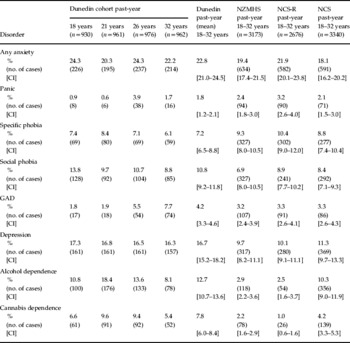
Past-year prevalence of common adult mental disorders, by age at diagnostic interview, for informants aged 18 to 32 years. The Dunedin Study is compared to the New Zealand Mental Health Survey (NZMHS) and the two US National Comorbidity Surveys (NCS and NCS-R)

GAD, Generalized anxiety disorder; CI, confidence interval.
n's for NCS-1, NCS-R and NZMHS are unweighted.
Certain anxiety disorders were only assessed in Part II of the NZMHS (the long form), thus the total n for any anxiety is reduced to 2057. Certain anxiety disorders, alcohol dependence and cannabis dependence were only assessed in Part II of the NCS-R (the long form), thus the total n for these variables is reduced to 1728.
Diagnoses followed DSM-III-R in Dunedin at ages 18 and 21 and in the NCS. Diagnoses followed DSM-IV in Dunedin at ages 26 and 32 and in the NCS-R and NZMHS. The DSM version does not seem to affect prevalence in this 18–32 years age group.
Dunedin any anxiety includes panic, specific or social phobia, GAD, agoraphobia, obsessive–compulsive disorder (OCD) and post-traumatic stress disorder (PTSD). NZMHS any anxiety includes panic, specific or social phobia, GAD, agoraphobia, OCD and PTSD (identical to the Dunedin composite). NCS-R any anxiety includes panic, specific or social phobia, GAD, agoraphobia, PTSD and adult/child separation anxiety disorder (according to Kessler et al. Reference Kessler, Berglund, Demler, Jin, Merikangas and Walters2005). NCS any anxiety includes panic, specific or social phobia, GAD and agoraphobia (according to Kessler et al. Reference Kessler, McGonagle, Zhao, Nelson, Hughes, Eshleman, Wittchen and Kendler1994).
Dunedin and NZMHS cannabis dependence includes only cannabis. NCS and NCS-R variables available in the public domain files are for drug dependence, which includes primarily cannabis cases, but also a very small minority of cases dependent on other drugs.
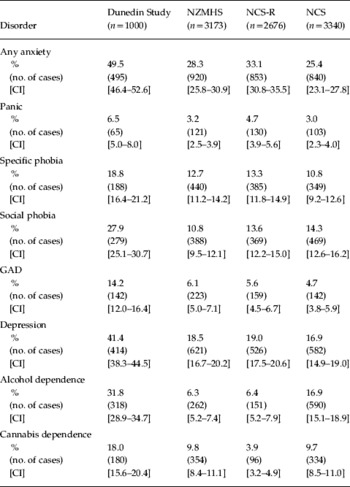
Cumulative lifetime prevalence of common adult mental disorders from age 18 to 32 years. Adult disorders accumulated across four prospective assessments at ages 18, 21, 26 and 32 in the Dunedin Study are compared against lifetime prevalence up to age 32 based on retrospective recall in the New Zealand Mental Health Survey (NZMHS) and the two US National Comorbidity Surveys (NCS and NCS-R)

GAD, Generalized anxiety disorder; CI, confidence interval.
n's for NCS-1, NCS-R and NZMHS are unweighted. The Dunedin Study denominator is n assessed at one or more of four study phases=1000.
Certain anxiety disorders were only assessed in Part II of the NZMHS (the long form), thus the total n for any anxiety is reduced to 2057. Certain anxiety disorders, alcohol dependence and cannabis dependence were only assessed in Part II of the NCS-R (the long form), thus the total n for these variables is reduced to 1728.
Lifetime prevalence in Dunedin was the sum of past-year cases from assessments at ages 18, 21, 26 and 32. This period thus covered 15 years. Lifetime prevalence in the NZMHS, NCS-R and NCS was based on retrospective recall by respondents aged 18–32 years. The 18–32 years group were able to recall disorder back to childhood. Presuming that the survey respondents could recall back to age 10; then 18-year-olds could recall an 8-year period, 19-year-olds could recall a 9-year period, and so forth, until 31-year-olds could recall a 21-year period and 32-year-olds could recall a 22-year period. Therefore, the average recall period for the three surveys was 15 years, which is the same as the Dunedin Study period.
Measures
Disorder at ages 18, 21, 26 and 32 years in the Dunedin cohort was measured using the Diagnostic Interview Schedule (DIS-III, DIS-IV; Robins et al. Reference Robins, Helzer, Cottler and Goldring1989, Reference Robins, Cottler, Bucholz and Compton1995). The DIS was administered in private at the research unit, by trained interviewers with tertiary qualifications and clinical experience in a mental health-related field such as family medicine, clinical psychology or psychiatric social work (i.e. not lay interviewers). Interviewers were kept blind to cohort members' prior data. At ages 18 and 21, diagnoses were made according to the then-current DSM-III-R (APA, 1987) and at ages 26 and 32 diagnoses were made according to the DSM-IV (APA, 1994). In addition to symptom criteria, diagnosis required impairment ratings >2 on a scale from 1 (some impairment) to 5 (severe impairment). Each disorder was diagnosed regardless of the presence of other disorders. Variable construction details, reliability and validity, and evidence of life impairment for diagnoses have been reported previously (Feehan et al. Reference Feehan, McGee, Nada Raja and Williams1994; Newman et al. Reference Newman, Moffitt, Caspi, Magdol, Silva and Stanton1996; Kim-Cohen et al. Reference Kim-Cohen, Caspi, Moffitt, Harrington, Milne and Poulton2003; Moffitt et al. Reference Moffitt, Harrington, Caspi, Kim-Cohen, Goldberg, Gregory and Poulton2007). The reporting period at each assessment was the past 12 months.
Disorder among respondents aged 18–32 years in the NZMHS, NCS-R and NCS was assessed as described previously (Kessler et al. Reference Kessler, McGonagle, Zhao, Nelson, Hughes, Eshleman, Wittchen and Kendler1994, Reference Kessler, Berglund, Chiu, Demler, Heeringa, Hiripi, Jin, Pennell, Walters, Zaslavsky and Zheng2004, Reference Kessler, Berglund, Demler, Jin, Merikangas and Walters2005a; Oakley-Browne et al. Reference Oakley-Browne, Wells and Scott2006; Wells et al. Reference Wells, Oakley Browne, Scott, McGee, Baxter and Kokaua2006). NCS-R and NZMHS used CIDI version 3.0 to make DSM-IV diagnoses. NCS used CIDI version 1.1 to make DSM-III-R diagnoses. NZMHS data were provided by the New Zealand Ministry of Health and accessed by author J.K. Public domain data were downloaded from www.icpsr.umich.edu/cocoon/SAMHDA/STUDY/06693.xml for NCS-1 and www.icpsr.umich.edu/cocoon/cpes/ncsr/sections/all/sections.xml for NCS-R. (Past-year and lifetime diagnosis variables accessed from websites are given in the online Appendix for readers who use NCS and NCS-R data.)
Statistical analyses
Past-year and lifetime prevalence rates and the confidence intervals (CIs) around them are reported for all four studies. NZMHS CIs were calculated by Taylor Series Linearization using surveyfreq in SAS 9.1.3 (SAS Institute, 2004). NCS-R and NCS CIs were estimated using Stata 9.1 (StataCorp, 2005), taking into account their sampling designs as stipulated by the disseminator of the data sets to match methods previously published from these studies (ICPSR, 2006, 2007). The Dunedin Study's past-year prevalence was calculated as the mean past-year prevalence averaged across the four assessment years (ages 18, 21, 26 and 32). NZMHS, NCS-R and NCS past-year prevalence represented groups of respondents aged 18–32 years. Dunedin lifetime prevalence was calculated as the percentage of cohort members ever past-year diagnosed, among cohort members who were interviewed at any of the four assessments (n=1000). NZMHS, NCS-R and NCS lifetime prevalence represented retrospective diagnoses among the group of respondents aged 18–32 years. Past-year prevalence from Table 1 was divided by lifetime prevalence from Table 2 to generate the ratio of individuals in each study who ever had the disorder at any time during the 15-year assessment window to individuals who were also diagnosed in the past year.
Results
Past-year prevalence (Table 1)
For the composite category of any anxiety disorder and for individual anxiety disorders of panic, specific phobia, social phobia and generalized anxiety, point prevalence estimates were similar and CIs for all anxiety disorders generally overlapped. This suggested no notable discrepancies among the four studies (Cummings & Finch, Reference Cummings and Finch2005). For example, the last four columns of Table 1 show that the mean past-year prevalence of any anxiety disorder was 22.8% in the Dunedin cohort, 19.4% in NZMHS, 21.9% in NCS-R and 18.1% in NCS.
For depression and substance disorders, Dunedin cohort past-year rates generally exceeded NZMHS, NCS-R and NCS rates. One partial explanation is sample completeness. The Dunedin Study assesses 96% of an identified birth cohort whereas the three surveys had much less complete samples. The Dunedin Study identifies disordered individuals who are missing from surveys because they are in prison, in hospital, institutionalized, homeless, not found, or refuse surveys. By contrast, NZMHS, NCS-R and NCS excluded individuals in institutions, and approximately 30% of community respondents approached refused these surveys. Such difficult-to-recruit groups are known to have elevated rates of disorder. We tested this by quantifying the ‘level of effort’ required to locate and recruit each Dunedin Study member for assessment at age 32 (operationalized as the number of contacts). The rate of depression was 20% among the 20% most difficult-to-recruit cohort members as compared to 14% among the 80% who were relatively easier to recruit. Likewise, rates of alcohol dependence were 12% versus 7%, and rates of cannabis dependence were 10% versus 5%. (Of note, the prevalence of anxiety disorders was unaffected by sample completeness, which is consistent with no difference between Dunedin and the surveys in past-year anxiety prevalence.) Sample completeness implies that it is reasonable for Dunedin past-year rates of depression and substance disorders to exceed survey rates somewhat.
For substance dependence the NZMHS and NCS-R rates were much below the Dunedin rates. However, in part, low rates of substance dependence in NZMHS and NCS-R (1–3%) have been attributed to CIDI 3.0 gate questions that inadvertently stopped the interview too early for some respondents (Grant et al. Reference Grant, Compton, Crowley, Hasin, Helzer, Li, Rounsaville, Volkow and Woody2007; Kessler & Merikangas, Reference Kessler and Merikangas2007). By contrast, for example, the past-year prevalence of alcohol dependence for this age group is similar in NCS (10%), Dunedin, (12%) and NESARC (9%) (Hasin et al. Reference Hasin, Stinson and Grant2007). Finally, another reason that the Dunedin past-year rate of cannabis dependence exceeded the surveys' rates is that longitudinal study members may be more forthcoming about drug-use behaviors that are illegal, as compared to research-naive survey participants interviewed for the first time, because participants who have been interviewed repeatedly learn to trust the study's confidentiality guarantee. Dunedin's prevalence of cannabis dependence has been verified by the Christchurch New Zealand longitudinal study (Boden et al. Reference Boden, Fergusson and Horwood2006). Taken together, these explanations imply reasonable confidence in the Dunedin past-year rates of substance disorders.
Lifetime prevalence (Table 2)
Lifetime prevalence rates in the prospective Dunedin Study were approximately double the retrospective NZMHS and NCS prevalence rates, for every disorder. Dunedin lifetime prevalence rates were also double the NCS-R rates, for every disorder except panic and specific phobia (even for those, prospective prevalence exceeded retrospective prevalence). CIs for the prospective rates did not overlap with those for retrospective rates, indicating that the discrepancies were statistically significant at p<0.01 (Cummings & Finch, Reference Cummings and Finch2005).
Past-year-to-lifetime ratio (Table 3)
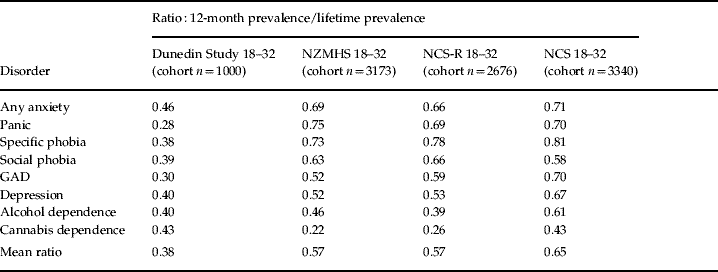
In the NZMHS, NCS-R and NCS, one-half to two-thirds of respondents who ever had an episode of disorder also had an episode during the year they were interviewed for the survey (NZMHS and NCS-R mean ratio=0.57; NCS mean ratio=0.65). In the Dunedin cohort, the corresponding ratio was lower; approximately one-third of participants (mean ratio=0.38).
Ratios of past-year prevalence to lifetime prevalence of adult disorders up to age 32. Prospective 12-month-to-lifetime ratios in the Dunedin Study are compared against retrospective 12-month-to-lifetime ratios from the New Zealand Mental Health Survey (NZMHS) and the two US National Comorbidity Surveys (NCS and NCS-R)

GAD, Generalized anxiety disorder.
Discussion
We found that prospective estimates of the lifetime prevalence of DSM-defined disorders markedly exceed retrospective estimates. Our comparison of prospective versus retrospective data held constant the 15-year age window from 18 to 32 years, and the historical period when data were collected, from 1990 to 2005. Lifetime prevalence was almost identical in the NZMHS and the NCS-R, ruling out the possibility that cultural or ethnic differences between New Zealand and the USA could account for our findings.
Three findings suggest that lifetime prevalence of disorder is higher than previously estimated by retrospective surveys. First, the percentage of people who experienced lifetime disorder to age 32 was approximately doubled in prospective data as compared to retrospective data. Second, prospective assessment resulted in a mean of only 38% of lifetime cases having disorder during the past year whereas retrospective measurement of lifetime disorder resulted in higher means of 57% (NZMHS, NCS-R) and 65% (NCS) of lifetime cases having disorder during the past year. Third, prospective measurement yielded lifetime estimates that suggest the experience of certain DSM-defined disorders by age 32 may be very common indeed: anxiety disorder (49.5%), depression (41.4%), alcohol dependence (31.8%) and cannabis dependence (18.0%).
We initially compared past-year prevalence rates in the Dunedin Study versus past-year prevalence rates in the NZMHS, NCS-R and NCS (Table 1). This comparison was required because only if past-year prevalences in the Dunedin cohort seemed reasonably valid could we later infer that the lifetime prevalences derived as a count of past-year cases were likewise reasonable. There were methodological differences among the studies but despite these differences, the past-year prevalence of disorder in the Dunedin Study was similar to the past-year prevalence in the NZMHS, NCS-R and NCS, or somewhat higher for expected reasons (such as the Dunedin Study's more complete sample). Dunedin lifetime prevalence rates from age 18 to 32 reflect a cumulative count of these past-year cases.
The Dunedin Study's cumulative prevalence of individuals experiencing disorder between ages 18 and 32 years was approximately double the counterpart prevalence in the NZMHS, NCS-R and NCS (Table 2). For example, a count of individuals ever diagnosed at any Dunedin Study assessment revealed that 41.4% of the cohort experienced at least one episode of depression between ages 18 and 32 versus 18.5% in the NZMHS, 19.0% in the NCS-R and 16.9% in the NCS. This discrepancy does not arise from cultural differences between the USA and New Zealand because the NCS-R and NZMHS lifetime depression rates match. However, even if the Dunedin Study's past-year depression data are doubted, the identical prospective/retrospective discrepancy was observed for anxiety and substance disorders. Past-year rates of anxiety disorders were almost the same in all four studies, but the prospective lifetime rates were double the rates from the three retrospective surveys. Furthermore, past-year rates of substance disorders were similar in Dunedin and NCS, but Dunedin prospective lifetime rates were double NCS retrospective rates.
If the past-year diagnoses added up to yield the Dunedin cohort's lifetime prevalence are acceptably valid, then the surviving explanation for the discrepancy must implicate the fundamental difference between prospective versus retrospective measurement: recall failure. Research into depression supports the notion that recall failure is substantial. Studies show that half of hospitalized depression cases ceased to be lifetime cases when interviewed with the CIDI 25 years later (Andrews et al. Reference Andrews, Anstey, Brodaty, Issakidis and Luscombe1999), 10% of depression cases diagnosed at baseline ceased to be lifetime cases when reinterviewed only 3 years later (Newman & Bland, Reference Newman and Bland1998), and half of longitudinal cohort members who previously reported depression did not recall their episodes by age 21 years (Wells & Horwood, Reference Wells and Horwood2004). Another indicator of recall failure is that, among primary-care patients interviewed up to age 65, most recalled their first depression episode as occurring within 5 years of the interview, which was deemed implausible given depression's peak age of onset in young adulthood (Simon et al. Reference Simon, VonKorff, Uston, Gater, Gureje and Sartorius1995). One analysis indicated that plausible rates of recall failure (concealing 2–4% of depression cases per year) accumulated across the lifetime could account for retrospective surveys' low prevalence (Patten, Reference Patten2003). An analysis that modeled Dutch and Australian national surveys to correct for recall failure estimated the lifetime prevalence of depression to be 30% in men and 40% in women (Kruijshaar et al. Reference Kruijshaar, Barendrecht, Vos, de Graaf, Spijker and Andrews2005). Our findings suggest that this amount of recall failure applies beyond depression, to other disorders.
Who are all these people who experience disorder and then forget it? It is possible that people who under-report have only mild disorder, but this is unlikely to be the full explanation because marked under-reporting occurs among individuals hospitalized for depression (Andrews et al. Reference Andrews, Anstey, Brodaty, Issakidis and Luscombe1999). A check of the data for Dunedin cohort members with lifetime disorder revealed that many had not experienced disorder that was chronic or recurrent, at least not up to age 32. Of lifetime cases, 53% of those with anxiety, 60% of those with depression, 61% of those with alcohol dependence and 57% of those with cannabis dependence had been diagnosed with the disorder at only one of our past-year assessments. (Of lifetime cases, the percentages of cases diagnosed twice and diagnosed three or more times were respectively: 47% and 22% for anxiety disorder, 40% and 12% for depression, 39% and 12% for alcohol, and 42% and 18% for cannabis.) That half of lifetime cases were diagnosed only once in our longitudinal study suggests a hypothesis: retrospective surveys may undercount primarily individuals who have relatively short-term disorder or single episodes. Testing this hypothesis requires undertaking retrospective interviews in a prospectively studied cohort, to reveal which prospectively diagnosed cases go undetected retrospectively. Lacking retrospective lifetime interviews in the Dunedin Study, we could not carry out this test. However, our comparison of prospective versus retrospective past-year-to-lifetime ratios is relevant (Table 3). In prospective studies, many more respondents have lifetime disorder than have past-year disorder, yielding a low past-year-to-lifetime ratio. This finding is expected. By contrast, in many retrospective surveys almost as many respondents have past-year disorder as have lifetime disorder, yielding a higher past-year-to-lifetime ratio. It is implausible that most respondents who report that they ever in their lives had an episode also happen to have an episode during the year they are interviewed for a survey (Kessler et al. Reference Kessler, Andrade, Bijl, Offord, Demler and Stein2002). This implausible result from retrospective surveys could be explained if respondents who have long-standing, chronic or recurrent disorder are particularly likely to remember and report symptoms from the long-distant past, whereas respondents who experienced short-term, single episodes of disorder are likely to forget them, regardless of severity (Simon & VonKorff, Reference Simon and VonKorff1995). Supporting evidence comes from a two-wave study of depression that revealed that short illness duration is associated with unreliable reporting of lifetime depression (Foley et al. Reference Foley, Meale and Kendler1998).
Limitations
The data we used to estimate prospective prevalence come from one cohort in New Zealand. However, similarly high cumulative prevalence rates have been reported by researchers who have followed adolescent cohorts to young adulthood while conducting repeated diagnostic assessments (using different standardized interview instruments) in North Carolina (Costello et al. Reference Costello, Mustillo, Erkanli, Keeler and Angold2003), New York (Jaffee et al. Reference Jaffee, Harrington, Cohen and Moffitt2005) and Oregon (Lewinsohn et al. Reference Lewinsohn, Hops, Roberts, Seeley and Andrews1993), and in a 25-year longitudinal study of Australian teachers (Wilhelm et al. Reference Wilhelm, Mitchell, Niven, Finch, Wedgwood, Scimone, Blair, Parker and Schofield2006). That lifetime prevalence accumulates with repeated longitudinal measurement was confirmed by follow-ups in the ECA study (Regier et al. Reference Regier, Kaelber, Rae, Farmer, Knauper, Kessler and Norquist1998) and the NCS (Kessler et al. Reference Kessler, Gruber, Hettema, Hwang, Sampson and Yonkers2007). For example, when the NCS-1 sample was followed up, NCS-1 lifetime depression prevalence was 21%, but this rose to 29% by adding NCS-2 (Kessler et al. Reference Kessler, Gruber, Hettema, Hwang, Sampson and Yonkers2007).
Our study has three additional design limitations. However, all three indicate that the true lifetime prevalence of mental disorder may in fact be higher than we have been able to estimate in the Dunedin Study. First, NZMHS, NCS-R and NCS 18–32-year-old respondents could retrospectively report disorder they recalled as having occurred before age 18, whereas our Dunedin Study cumulative lifetime count began only at age 18. (The three surveys did not have respondents under age 18 to make Table 1's comparisons of past-year prevalence. Therefore, although the Dunedin Study has juvenile diagnoses we could not include them in this article.) As an example, adding depression diagnoses made before age 18 increases the Dunedin lifetime prevalence of depression from 41% to 44%. This limitation has the net effects of lowering the Dunedin Study's estimates of lifetime prevalence and narrowing the prospective versus retrospective discrepancy we reported here.
A second limitation is that gaps between the Dunedin Study's four 12-month assessment windows did not allow us to count individuals who experienced an episode of disorder only between windows. We previously reported that our ‘net’ of 1-year DIS diagnoses at ages 18, 21, 26 and 32 has captured all but eight of the cohort members who reported treatment for mental-health or substance-use problems between assessment windows (Moffitt et al. Reference Moffitt, Harrington, Caspi, Kim-Cohen, Goldberg, Gregory and Poulton2007). Nevertheless, the number of cohort members we failed to count here because their only episodes of disorder occurred between study windows and went untreated is unknown. This limitation has the net effects of lowering our estimate of lifetime prevalence and narrowing the prospective versus retrospective discrepancy.
A third reason why Dunedin's lifetime rates are underestimates is that Dunedin data are right-hand censored at age 32. Retrospective surveys suggest that many new cases should be expected after age 32 (Kessler et al. Reference Kessler, Berglund, Demler, Jin, Koretz, Merikangas, Rush, Walters and Wang2003a). On the one hand, the number of new-onset cases after age 32 has probably been overestimated because survey respondents often recall their onset age as older than it was, and forget episodes from early life (Simon et al. Reference Simon, VonKorff, Uston, Gater, Gureje and Sartorius1995). On the other hand, new cases will be diagnosed as the Dunedin cohort ages. Our estimate to age 32 is an underestimate of lifetime prevalence for the full life course.
Implications
We compared retrospective versus prospective methods of ascertaining lifetime prevalence while holding constant the use of the DSM definitional approach to diagnosis in both types of studies. Therefore, this article is uninformative (and agnostic) about the validity of diagnoses of depression, anxiety and substance dependence as defined by DSM-IV. That is a separate debate (Horwitz & Wakefield, Reference Horwitz and Wakefield2007). Our rather more modest aim was to point out that objections voiced to surveys' higher than expected lifetime prevalence of disorder are objections to prevalence that is only half what it could be in reality, because a very great deal of disorder has been lost to recall failure. Limitations of our research are such that we cannot here provide an estimate of the true prevalence of lifetime psychiatric disorders, but the findings can be taken as evidence that existing and oft-cited retrospective prevalence rates undercount not trivially, but substantially. This substantial undercounting is consequential because it can generate misleading findings in etiological research (Kendler et al. Reference Kendler, Neale, Kessler, Heath and Eaves1993; Foley et al. Reference Foley, Meale and Kendler1998) and misleading estimates of economic disease burden (Tang & Lopez, Reference Murray and Lopez1997). It is time for critical thinking about retrospective data.
It is not a new idea that retrospective surveys underdetect mental disorder (Kramer et al. Reference Kramer, von Korff and Kessler1980). However, despite repeated demonstrations that this underdetection is real, resources are still invested in collecting retrospective data and journals continue to publish them as epidemiological information. In addition, peer reviewers still recommend rejection of papers from longitudinal studies on the basis that their cumulative number of prospectively diagnosed cases is far too high, as compared to survey prevalence rates. Survey researchers have taken care to explain that their surveys' prevalence estimates are lower than they could be (Kessler et al. Reference Kessler, McGonagle, Zhao, Nelson, Hughes, Eshleman, Wittchen and Kendler1994, Reference Kessler, Berglund, Demler, Jin, Koretz, Merikangas, Rush, Walters and Wang2003a, Reference Kessler, Berglund, Demler, Jin, Merikangas and Walters2005a) but paradoxically, much criticism continues to stem from the widespread belief that surveys' prevalence rates are higher than they should be. If the much-higher-than-expected lifetime prevalence now emerging from prospective studies is correct, then this widespread belief is a myth. If lifetime prevalence rates are as high as those we report here (or higher), debates may shift. It may be time to stop asking how surveys can achieve acceptably low rates of disorder. Instead, researchers might begin to ask why so many people experience a DSM-defined disorder at least once during their lifetimes, and what this prevalence means for etiological theory, the construct validity of the DSM approach to defining disorder, service-delivery policy, the economic burden of disease, and public perceptions of the stigma of mental disorder.
Acknowledgements
This research was supported by the New Zealand Health Research Council, the US National Institute of Health (grants MH45070, MH49414, MH077874, AG032282), and the UK Medical Research Council (grants G0100527, G0601483). A. Caspi is a Royal Society Wolfson Merit Award holder. We thank Dunedin Study founder P. Silva, study staff, the study members and their families.
Declaration of Interest
None.
Note
Supplementary material accompanies this paper on the Journal's website (http://journals.cambridge.org/psm).