More than any other place in the world, Jerusalem embodies the hope and dream of dialogue between cultures, civilizations and spiritual traditions, a dialogue through which mutual understanding between peoples may flourish.
UNESCO director-general, 26 January 2005Footnote 1Metaphorically, the holy sites in Jerusalem's Old City are ground zero of the Israeli-Palestinian conflict.
M. H. Ross, 2007Footnote 2Heritage claims whether based in the practice of archaeology or the preservation of cultural artifacts, have long been recognised to bolster discourses of nationalism (Trigger, 1984), identity (Meskell, 2002), belonging and exclusion (Silverman, 2005).Footnote 3 The recent proliferation of internationally recognised ‘World Heritage Sites’ (WHS) presents a number of unique challenges concerning the designation and management of heritage in shifting urban and global contexts. A wide body of literature has begun to probe the inherent tensions surrounding WHS – from the vagaries of heritage definitions (Smith, 2006) and the politics of selection (Leask and Fyall, 2006), to the dynamic production of conflicting and competing senses of place and ethnic/cultural identities (Switzer, 2005), and the growing strain between authentic conservationism and the ‘touristification’ of historic districts (Pendlebury, Short, et al., 2009; Evans, 2002).Footnote 4 In Jerusalem's Old City, religious sites and excavation projects have become increasingly significant scenes for political confrontation, as Israelis and Palestinians contest historical narratives, legal authority and territorial rights. Although much academic attention has been given to the politicisation of Jerusalem's heritage,Footnote 5 less interest has been directed at the role and impact of the international community, particularly in the shape of work of the UN Educational, Scientific and Cultural Organization (UNESCO) in safeguarding Jerusalem's unique cultural legacy. This article, seeks to address this empirical lacuna, examining how UNESCO interventions have been affected by the ongoing Israeli-Palestinian conflict and how it has dealt with competing attempts to use heritage to legitimate national discourses and justify hegemonic control? How has UNESCO attempted to protect some of Judaism, Christianity and Islam's most sacred and controversial sites? And what role should UNESCO have in any future peace agreement?
An evaluation of UNESCO's role as guardian of heritage in Jerusalem, provides an important frame for exploring wider issues such as the constraints of international agency in divided and contested cities, as well as testing the efficacy of the concept ‘world heritage’ in producing shared narratives and reconciliatory approaches to disputed pasts and volatile presents. These issues must be addressed, with recourse to three factors which continue to problematise UNESCO's assignment in Jerusalem. Firstly, there is the inherent tension between the universal and inclusive values that the conventions and protocols of UNESCO aspire to and the nationalist and chauvinistic agendas of the state in whose territory such sites are located. In this sense the disagreements between Israel and UNESCO are not unique, but have been replicated in various contexts, such as China's controversial Sinification policies in TibetFootnote 6 and Cambodia's questionable strategy of inscribing Khmer Temples (Preah Vihear in July 2008 and Prasat Ta Moan Thom currently pending) along the much disputed Thai border.Footnote 7 Secondly, the fact that Jerusalem is an ethnically and politically divided city and the legitimacy of the role of the dominant state, Israel, is contested brings additional complications to UNESCO's role in the city. There is not a single polity or ‘address’ for it to work with. Thirdly, despite attempts to contextualise its work, there can be a tendency in UNESCO to prioritise sites rather than the culture within which they are located. In this way its projects act as a blunt instrument amid the delicate fabric of social and economic relations that give the site meaning. These elements become all the more complex when set amidst the dynamic backdrop of regional politics and international diplomacy and impinge upon its operational effectiveness. One result of this penetration of international politics into UNESCO operations can be the influence of key players and the reluctance of UNESCO's central Headquarters in Paris to alienate its main funders. This often results in the weak implementation of Council decisions and the recommendations of its inspection teams to Jerusalem.
The article comprises four sections. The first surveys some of the historical and political issues which constitute the contested heritage of Jerusalem; the second examines UNESCO's scope and specific involvement in Jerusalem's Old City; while the third consists of a comparative analysis of its work in cities which share a rich architectural heritage, such as Aleppo and Fez and its post-conflict intervention in cities and regions which share a similar legacy of ethnic violence, like Mostar and Kosovo. Finally the article considers future challenges and possibilities for UNESCO projects within Jerusalem, as well as the wider implications for the World Heritage program.
Politicising heritage in Jerusalem
Palestinians and Israelis have vied for control of the Old City of Jerusalem over many decades; each looking to the sites of their religious traditions as a source of inspiration and a symbol of legitimacy. The key sites in this respect are for Jews the Temple Mount (Har Habayit) and for Muslims the Noble Sanctuary (Haram al-Sharif). Jews believe the ruins of the first and second temples lie underneath the Haram compound, with the Western/Wailing Wall (ha-kotel) now the only visible remainder of the destruction of Temple Mount in 70 CE. Muslims however revere the Haram as Islam's third holy site, following Mecca and Medina. It contains the Dome of the Rock and Al-Aqsa mosque and the al-Buraq Wall (the same Western Wall) thought to be from where Muhammad made his legendary night journey to Heaven. Over time, both sites have become intrinsically tied to each groups' sense of political, religious and national identity.
Infused with ideological significance these sites have become sites of contestation. As a result, the Old City of Jerusalem has been repeatedly demolished, excavated, rebuilt and restored to serve political agendas and to justify historical narratives. For example, during the Jordanian annexation of the Old City (1949–67), parts of the area which has become known as the Jewish quarter were demolished and many traces of a Jewish presence there were erased despite the protestations of the Israeli government.Footnote 8 Yet, in 1967 Israel marked their control and annexation of the Old City by demolishing an ancient residential area known as the Moroccan quarter in front of the Wailing Wall, expropriating over a thousand properties, housing 6,000 Palestinians, as well as destroying the Buraq and Afdali mosques to create a new Plaza for Jewish worship and prayer.Footnote 9 This was followed by massive excavations led by Benjamin Mazar (1968) and Nahman Avigad (1969) on the southern slopes of the Haram al-Sharif and the heart of the new Jewish quarter involving a wide spectrum of Israeli volunteers and media coverage. Such ‘mythological digs’ according to Nadia Abu el-Haj, ‘both promoted and embodied the cultural significance of archaeology in and for Israeli society and colonial-national culture.’Footnote 10 Indeed archaeological excavations in the post-1967 period became crucial for reimagining and reclaiming Israel's past;Footnote 11 for affirming Jewish historical roots in the land and for reworking old national myths such as Massada.Footnote 12 While Mazar and Avigad's Old City excavations were concerned primarily with uncovering evidence of the First and Second Temple period – the historic birth of the Jewish nation – discoveries of the Herodian City were matched by finds of a Byzantine Cardo, Nea Church and Muslim Umayyad Palace. This unearthing of Jerusalem's ‘other pasts’Footnote 13 may attest to the limitations of nationalist archaeology and the persistence of the city's multi-religious cultural heritage, however, it cannot be mistaken for a shared or common history but one firmly embedded within the dominant Zionist discourse of an ‘eternal capital’ for a Jewish State.
Beyond symbolism and patriotic discourses, archaeology has also become a pretext for recreating Jerusalem's historic landscapes, often at the expense of existent Palestinian communities. The ongoing transformation of the East Jerusalem suburb of Silwan into an Archeological-tourist site, come Israeli national theme park, the ‘City of David’ (Ir David) is a case in point.Footnote 14 The Jewish Settler organisation Elad,Footnote 15 responsible for both the administration and tourism of the site are also complicit in an aggressive campaign to resettle Jewish families in the Silwan district of Wadi Hilweh, while financially supporting the ongoing excavations and tunneling beneath Palestinian residents' homes. This politicisation of archaeology in the service of Ultra-orthodox religious ideology and strategic expansionist interest threatens, according to some internal opponents and critics to ‘promote a distorted version of history – merging myth and legend with archaeological fact.’Footnote 16
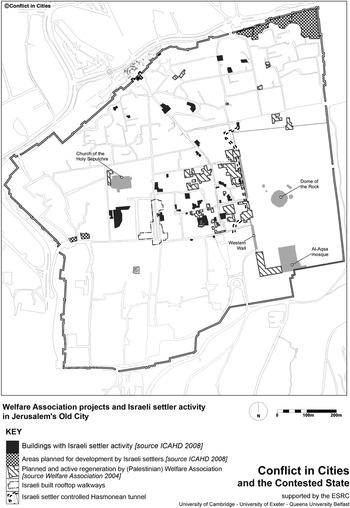
The Palestinian response, alternatively, has been to draw on renovation and restoration programmes to encourage the permanent residence of Palestinian Muslims in the Old City. An early project in the 1980s, under the auspices of the Jordanian controlled Waqf Administration, set about preserving historic Islamic buildings (mosques, schools, homes) and resisting Israeli attempts to marginalise Palestinian communities.Footnote 17 This is further demonstrated in the work of the leading Palestinian NGO, the Welfare Association, who has mapped all the historic buildings in the Old City as part of the Old City of Jerusalem Revitalisation project (1996). The main aim of this project is not just physical restoration, but also training in conservation and the establishment of social outreach programmes in an attempt to support the surrounding community. In this way we can see how the politics of heritage comprises an encompassing political agenda. For Israel, on the one hand, it revolves around attempts to legitimise a specific Jewish historical perspective, and justify the current status of Israeli control and political authority; yet for Palestinians, on the other hand, it is part of the struggle to preserve their cultural heritage and therefore is more often about recent history and the protection of living communities in the Old City. Heritage preservation in Jerusalem's Old City therefore remains not only the loci for cultural and ideological confrontation, the ‘field on which the desired pasts battle for hegemony’,Footnote 18 but continues to be a pragmatic tool for securing and legitimising physical presence, ownership and right to the land (see Map 1). Within this context of the ideological contest for heritage preservation, it is important to understand the legal foundations and current practices surrounding Jerusalem's holy places and its excavated sites. The latter part of this first section will examine the legal framework, the role of the main actors and the main issues of contestation in the post-1967 period.
Welfare Association projects and Israeli settler activity in the Old City.

Legalising the past
Following the occupation of East Jerusalem by Israel in 1967, the approach of the Israeli government to cultural heritage is based primarily on three main legislative pillars: these are the inherited legal framework, the 1967 ‘Protection of Holy Places Law’ and the 1978 ‘Antiquities Law’. Despite passing a series of laws which incorporated East Jerusalem into the Israeli state,Footnote 19 the Israeli government also recognised a number of precedents concerning the holy sites of Jerusalem which had been set by the Ottoman authorities and followed by the British Mandate and Jordanian authorities. These are referred to as the status quo Footnote 20 and offered, in the first instance, the Christian communities a degree of autonomy over the administration of their holy sites. The British and Jordanian authorities later extended the term to include Jewish and Muslim sites. The status quo also clarified to some extent issues of access and conduct within the sites themselves. In connection with this the British Mandate government passed the 1924 Order in Council (Holy Places), which had far-reaching consequences. It excluded from the civil courts all cases concerning the holy sites themselves and the rights of worshippers or members of religious groups. Instead jurisdiction over these cases was transferred to the British High Commissioner. The current Waqf (al-Awqaf) Administration, claim ownership over the Haram al-Sharif, partly based on the fact that the holy sites are not within the jurisdiction of the civil courts and partly claiming to be the successor to the Supreme Muslim Council which was set up in the Mandate period to oversee the property and religious activities of the Muslim community.
The second legal pillar, the 1967 ‘Protection of Holy Places Law’ ensures that ‘Holy Places’ will be ‘protected from desecration and any other violation and anything likely to violate the freedom of access of the members of the different religions to the places sacred to them or their feelings with regard to those places.’Footnote 21 This legislation affirms that freedom of access and physical protection (and punishment for desecrating the Holy Sites) is the sole responsibility of the Israeli Minister of Religious Affairs. This authoritative power, following the disbandment of the Religious Affairs ministry in 2004, ultimately now resides with the Prime Minister. On the other hand, the third pillar, the Antiquities Law, passed in 1978, plays a key role in determining Israel's heritage development and establishing ownership of antiquity sites. This law defines an antiquity as any object, whether detached or fixed, which was made by man prior to 1700, including anything subsequently added which forms an integral part of the property. This includes buildings as well as archeological sites. Such an ambiguous definition has serious implications for the Old City's current urban fabric, which is built upon layers of ancient civilisation. Furthermore, the law provides for state ownership of all newly discovered antiquities, as well as empowering the Israel Antiquity Authority (IAA) with responsibility for the country's ancient artifacts, antiquity sites, their excavation, preservation, conservation, study and publication.Footnote 22 This remit extends to public policy decisions with regard to preservation and development and urban planning around heritage sites. The IAA is also responsible for preventing damage in and around the holy sites. Indeed any change at these sites (excavation, construction, preservation, renovation of walls) requires not only the permission of the director-general, but the approval of a Ministerial Committee for Holy Places.Footnote 23
The Palestinian community and authorities resisted the imposition of the Israeli legislation. They have opposed Israel's attempts to control and regulate activities involving the holy sites and archeological digs which they feel threaten the integrity of their religious and cultural heritage referring to the 1924 Palestine Order in Council in support of their position. Israel however, continues to sees itself as the natural inheritor of the rights of the British High Commissioner, and therefore claims it has ultimate jurisdiction over holy sites. Consequently it has not wished to compromise its authority in Jerusalem, in any way, in case such a compromise would undermine its political claim to the whole city and its de facto annexation in 1967.
To a large extent this consideration may also explain Israel's reluctance to concede a role to UNESCO in the city. By conferring a significant role to UNESCO, there is the possibility that international acceptance of its jurisdiction, already questioned, would be further reduced and thus its negotiating position with the Palestinians and the Arab world weakened. Although Israel has tacitly ceded limited administrative autonomy over the Haram compound to the Waqf Administration, importantly, this does not involve physical control or security arrangements surrounding the site.Footnote 24 Indeed, the Israeli government continues to consider East Jerusalem as an integral part of Israel and the IAA has embarked upon new excavations in 2007, such as ‘The Mount Zion Hillside’ (Byzantine towers on the North side of the city wall) and ‘The City of David and The Spring House’, an excavation of the ancient Shiloh Pool in Silwan valley.
One example of how the Waqf Administration sought to challenge Israel's policies has been the excavation work on Marwani Hall/Solomon's Stables (1996–99) without the coordination or approval of the IAA or UNESCO. The rehabilitation of these underground chambers in the southeast corner of the Haram al-Sharif, led to a public Israeli outcry and an attempt to stop the construction by means of legal injunction. The ensuing Israeli High Court of Justice ruling again affirmed the complexity and ambiguity surrounding status quo arrangements. The attempt to halt the Waqf Administration's renovations was duly dismissed by the court, who instead warned of the dangers of legal interference given the political and religious sensitivity of the site. Yet according to Jon Seligman, chief archaeologist of the IAA, these excavations not only ‘violated professional principles for treatment of historic buildings’ thus ‘causing serious damage to antiquities’, but they marked a more severe deterioration and systemic break down, in what had once been a pragmatic informal working relationship between the Waqf Staff and the Israeli Antiquity Authorities.Footnote 25 In the years which have followed, and despite the peace negotiations between the PLO and the Israeli government, there has been limited coordination and consultation between the IAA and the Waqf Administration regarding issues of heritage. For example, the Oslo protocols may have called for joint expert committees on heritage and freedom of access to archaeological sites, yet within Jerusalem this has never been achieved.Footnote 26
The main-point that needs to be emphasised is that although in this situation of contested jurisdiction, the government of Israel has ultimate power of enforcement, nevertheless, it has refrained from exercising it fully over all cultural and religious sites. This is partly due to its recognition of the value of the inherited legal framework and partly a strategic reluctance to provoke the sensitivities of the Muslim world. Indeed the terms of Israel's 1994 Peace Treaty with Jordan, goes as far as confirming the ‘special role of the Hashemite Kingdom of Jordan in Muslim holy shrines in Jerusalem’;Footnote 27 a tacit acknowledgement of Jordan's position, via the Waqf Authorities, in the Old City. In addition, Israel remains aware that in a ‘united Jerusalem’ where one-third of the inhabitants are non-Israeli, the maintenance of public order is essential and enhances its claim to being the legitimate authority in the city. The intervention of an international agency such as UNESCO in such a volatile and sensitive arena is clearly one that is subject to intense scrutiny and circumscription.
UNESCO's involvement in the Old City of Jerusalem
Since its inception in 1945, UNESCO has played a central role in encouraging the protection and preservation of cultural and natural heritage from around the world considered to be of ‘outstanding universal value’.Footnote 28 UNESCO's ‘Hague Convention for the Protection of Cultural Property in the event of Armed Conflict’ (1954) and ‘World Heritage Convention’Footnote 29 (1972) provide the legal framework and basis for international cooperation and coordination on the protection of heritage sites, while empowering the World Heritage Committee (WHC) with the role of implementing its overarching objectives. Advisory bodies to the WHC, include the International Council on Monuments and Sites (ICOMOS), a professional and scientific non – state organisation who monitor, inspect and report on the state of sites on the World Heritage List; and the International Center for the Study of the Preservation and Restoration of Cultural Property (ICCROM), an intergovernmental body which provides expertise in restoration techniques, while promoting and raising global awareness concerning the importance of preserving cultural heritage.
Normative action is effected by the elaboration of a number of international instruments which have been adopted by UNESCO's 185 member states. These include: a) declarations, which constitute moral and political commitments; b) recommendations, which provide encouragement for states to adopt a specific heritage approach; and c) conventions, which establish legally binding agreements concluded by two or more states.Footnote 30 Such operational guidelines are strengthened by a physical UNESCO presence, whether in the form of a national office, a regional ‘cluster’ office, or a specialised network of NGO partners and consultative committees and councils. Permanent internal UNESCO delegations and national commissions ensure adequate liaison between state governments and UNESCO central authority. It is important to note that UNESCO has adopted an inclusive approach to heritage sites, utilising broad definitionsFootnote 31 such as Cultural property, Natural Heritage, Historic Areas and Cultural landscapes to include: ‘monuments of architecture, art or history’; ‘groups of buildings’; ‘historic quarters in urban or rural built-up areas’ and ‘structures and open spaces including archaeological and palaeontological sites’.Footnote 32
From these conventions and protocols we can see how UNESCO's approach has emanated from technical and historical criteria and are attempts to be inclusive. They do not privilege the monuments or artefacts of one cultural group over any other. Nevertheless, despite this panoply of instruments, there is a contingency to the operational capacity of the WHC which can impede its work: the nomination of a site is in the hands of the state in whose territory the site is located. Thus the conventions do not take into account the political status of a territory under occupation. Indeed they are inadequate in addressing the issues arising from contested cities such as Jerusalem. In turning to UNESCO's role in Jerusalem it is important to examine both the legal limitations on its activities and the operational constraints under which it is working. What the following analysis shows is that in the attempt to intervene effectively UNESCO has transformed itself from a severe critic of Israeli policy in Jerusalem to an engaged partner. Whether this transformation has proved to be more effective in preserving the cultural heritage of the city in the inclusive manner set out in the UNESCO conventions will be discussed in the concluding section.
Legal framework
Initial involvement by UNESCO in Jerusalem's Old City, dates back to 1967Footnote 33 amidst growing Arab concern over the Israeli demolition of the Mughrabi quarter and the commencement of large scale excavations in the Jewish quarter and the southern edge of the Haram al-Sharif. UNESCO's formal response was based on two key international treaties concerning World Heritage (1954 ‘Hague Convention’ and the 1972 ‘World Heritage Convention’), and in this regard a number of significant developments should be highlighted. The fifteenth session of the UNESCO General Conference (1968) issued a strong condemnation of Israeli archaeological excavations in the Old City, along with any attempt to alter its ‘features or its cultural and historical character, particularly with regard to Christian and Islamic religious sites’.Footnote 34 The significance of this censure was not only that it affirmed Jerusalem's status as ‘an occupied city’, but it also acted as a reminder of the illegality of archaeological excavations in occupied territories. This public warning was followed up by a controversial reprimand in 1974, in which UNESCO suspended all forms of assistance to Israel due to its ‘persistent non-compliance’ and blatant disregard towards preserving ‘the historical features of the City of Jerusalem’.Footnote 35 These ‘Israel Resolutions’ provoked strong Western reaction, with criticism aimed at UNESCO's politicisation and heavy handed application of the ‘Hague Convention’, which lacks binding enforceability and indeed the status of customary international law. This failed attempt to assert pressure on Israel's heritage policy in Jerusalem, instead rather exposed UNESCO's legal frailties and vulnerable dependence on Member State financial support and goodwill.Footnote 36
A further important milestone in UNESCO's involvement took place in 1981 when Jerusalem's Old City and walls were officially added to the UNESCO World Heritage List (WHL). It was listed as an example of ‘a masterpiece of human creative genius’, which bear ‘a unique or at least exceptional testimony to a cultural tradition or a civilization which is living or which has disappeared’.Footnote 37 Although this was a positive attempt to bring the Old City under the remit of UNESCO's conservation guidelines and legal framework, Israel refused to endorse the WHC, instead protesting Jordan's (an external state) entitlement to nominate the Old City to the WHL, given that it was not the responsible power.Footnote 38 This dispute further politicised the whole process and led to the growing alienation between UNESCO and its main funder, the US.
Despite Israel's subsequent acceptance of the World Heritage Convention in 1999, commentators remain sceptical of its willingness to submit to international guidelines and regulatory authorities which conflict with their national agenda.Footnote 39 For some researchers, the fundamental issue is less to do with Israel's failure to comply with UNESCO's legal provisions, but rather the inherent weakness of international law which offers oversight and guidance but lacks any substantive means of enforcement.
Praxis – UNESCO interventions in the Old City
In turning to UNESCO's practical contribution to Jerusalem's historic legacy, while there has been limited ‘on the ground’ interventions, UNESCO has played an important part in publicly highlighting the threats and risks to the cultural heritage of the Old City sites. For example, since 1982, Jerusalem has been on UNESCO's List of World Heritage Sites in Danger (LWHSD). Repeated reports and resolutions have warned of the risk to historic buildings posed by overcrowding; poor economic services; illegal and unsuitable housing construction; and the ever changing social composition of the population.Footnote 40 One should note that not all dangers can be attributed to the Israeli occupation and its attempt to enhance Jewish sites in the Old City. Monuments and Holy Sites, such as Church of Holy Sepulchre and the Haram al-Sharif are also threatened by the sheer number of religious pilgrims and tourists and the lack of substantive maintenance.
UNESCO however continues to operate in the Old City under several logistical constraints. Although the national UNESCO office for the Palestinian Authority is based in Ramallah, controversially its mandate does not extend to Jerusalem. This is despite the fact that Jerusalem is included in the Arab States Unit of the WHC.Footnote 41 Instead, UNESCO activities in Jerusalem come under the direct supervision of the office of the Director of the WHC which tends to rely on situational reports and the inspections of a Special Representative. Simone Ricca has identified three main phases in UNESCO's engagement with Jerusalem since 1967. The first phase, 1967–71, saw a breakdown in relations between UNESCO and the Israeli government after the Israeli refusal to cooperate with UNESCO on the management of the heritage of the city. The second phase, 1971–90, involved rapprochement, with a new Special Representative, Professor Raymond Lemaire rebuilding relations with the Israeli government but possibly to the extent that the UNESCO mission to safeguard the Old City of Jerusalem was compromised. In the third phase, 1990–99, the views of the Special Representative was circumvented as the UNESCO Executive Board tried to play a more active role in protecting the cultural heritage of the city.It is possible to delineate a fourth and current phase, since the start of the 2nd Intifada in 2000, in which UNESCO is attempting to involve all the parties in the resolution of disputes but is nevertheless determined to maintain good relations with the Israeli state.Footnote 42 As a result UNESCO-Israeli relations have strengthened, largely by the broadening out of the range of sites over which formal cooperation is taking place. Since 2000, for example, a number of historical sites in Israel have been inscribed as World Heritage sites. These include the Old City of Acre (2001), the fort of Masada (2002) the hundreds of Bauhaus buildings in Tel Aviv's White City (2004) and the ancient cities of the Negev desert as part of the designated Incense Route (2007). This enhanced cooperation was most recently demonstrated with the signing of a ‘Memorandum of Understanding on Cooperation between UNESCO and Israel’ recognising and acknowledging existing partnerships and heritage commitments.Footnote 43 To Israelis this is a proper recognition of their role in the city; from the Palestinian perspective, UNESCO has been coopted into the political normalisation process and thereby is legitimising the Israeli occupation of the city.
It is noteworthy that, during most of the period under review Israel refused to allow inspection teams to visit the city or to meet with responsible officials, possibly the only World Heritage List site to be subjected to this treatment.Footnote 44 Similarly the Waqf Administration, which since 2000 has been firmly under the control of the Jordanian government, has sought to reconfirm its status as guardian of Palestinian sites in the Old City and objected to what it and Palestinians perceive as UNESCO attempts to ‘normalise’ the Israeli occupation of the city. Despite these competing and conflicting interests, UNESCO has more recently attempted to create a new platform for consensus, through an ‘Action Plan’ (2007) to safeguard the Old City of Jerusalem's cultural heritage and through its mediation work over the controversial reconstruction of the Mughrabi Gate Ascent. These two activities will now be studied in more detail.
a. The Action Plan
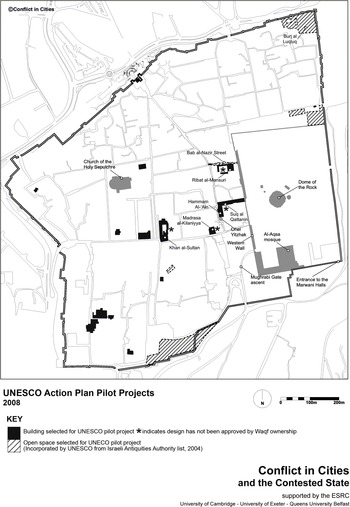
The two phase ‘Action Plan’ began in January 2005 with a consultation of a Committee of Experts and the compilation of a conservation database and an Old City inventory. The recently emerging proposals include 19 conservation projects, involving Churches (St John the Baptist) Yeshivas (Etz Hayim), Islamic schools (Madrasa al-Kilaniyya) and Souks (Suq al-Qattanin); rehabilitation manuals for residential housing; training of local crafts; micro-financing schemes and cultural activities (see Map 2). While such plans outline desperately needed interventions, it remains to be seen whether these projects will receive adequate support from the Israeli municipal authorities or the Waqf Administration. Indeed, in certain places, the ‘Action Plan’ remains a programme without reference to the political context, outlining, for example the need to rejuvenate spaces such as the Muslim Burj al-LuqLuq neighbourhood but ignoring recent Israeli settler appropriations and plans for a synagogue in the same area.Footnote 45 Likewise, although the issue of rehabilitating residential housing is meticulously addressed in a 153 page manual detailing ‘pathologies of structures, roofing, facades, joinery, ironworks, installations’;Footnote 46 the sensitive aspect of legal ownership, building permission, and political control is not taken into account. The rehabilitation of the Suq al-Qattanin, ‘The Cotton Merchant Market’ (Project 13, pp. 118–25) highlights a crucial conservation intervention, but fails to adequately deal with the practical challenges of security blocks, closure of the Haram as-Sharif entrance, and the restrictive laws governing commercial licenses. Perhaps most significantly the ‘Action Plan’ chooses feasibility over exigency, offering pragmatic schemes but few solutions or even attempts to address controversial ongoing heritage issues, such as the construction at the Mughrabi Gate ascent, the excavations and tunnels at the Ohel Yitzhak synagogue, off al-Wad Street,Footnote 47 Israeli Settler expansion in the Muslim and other quarters,Footnote 48 access to the Temple Mount/Haram al-Sharif, and the contentious archaeological digs just outside the city walls in Silwan. In choosing to sideline these underlying sources of confrontation, the ‘Action Plan’ delineates a programme of civic revitalisation and cultural renewal in the Old City which fails to confront the structural impediments to such activities. Thus the Plan makes little reference to the city's social division, security presence (checkpoints and closures), economic regulations and the impact of the Separation barrier. WHC officials argue that these strictly political issues are not within its remit to solve and expectations that it should do so are ill-grounded. In the words of UNESCO Director General Koichiro Matsuura, UNESCO ‘doesn't want to deal with political issues – we are duty-bound to preserve the authenticity of Jerusalem.’Footnote 49
It should be noted however, that the Action Plan was initiated at a time in the post-1967 period when the most detailed discussion over the future of the city was taking place, with pressures on the Israeli government to withdraw from significant parts of the city and with similar pressures on the Palestinian Authority to make concessions over sovereignty and security over the Holy sites. Despite its obvious shortcomings, the Action Plan offers important contributions in two key areas: first it has assembled an invaluable database upon which all future conservation work can be based, and secondly, through discussion, dialogue and engagement with the main parties and leading stakeholders in the Old City, the Action Plan has positioned UNESCO and the WHC to be able to take more effective action at a more politically propitious occasion.Footnote 50
UNESCO Action Plan Projects 2008.

b. The Mughrabi Gate ascent
While it may be too early to judge the success of UNESCO's ‘Action Plan’,Footnote 51 the recent dispute over the construction of a new ascent to the Mughrabi Gate, illustrates well both the opportunities and limitations of the organisation's role in Jerusalem's Old City. Israel's renovation of the Mughrabi pathway in February 2007 provoked much local opposition and international concern. Claiming remedial action was urgently required to restore a collapsed pathwayFootnote 52 to the Mughrabi gate; one of the main access points to the Haram as-Sharif, Israel began a detailed archaeological exploration, with plans to build a larger ramp structure.Footnote 53 These moves were met with fierce criticism in both the Arab worldFootnote 54 and most notably from inside Israel. Eighteen of Israel's most prominent archaeologists wrote a critical letter to the Antiquities Authority (IAA) condemning the illegality and lack of transparency of the scheme. However, it is noteworthy for this study that the most significant external intervention was led by UNESCO. In the thirtieth session of the World Heritage Committee, UNESCO not only reiterated its objections and concerns over the plans for reconstruction, but also in February 2007, commissioned a technical team to assess and report on the work. The subsequent report,Footnote 55 while acknowledging the professionalism of the IAA, nonetheless called on Israel to cease the excavations and to approve a modest plan for the restoration of the pathway after consultation with the relevant stakeholders (the Waqf Administration and the Jordanian government). UNESCO further recommended that excavations should only resume after the plan was finalised and under the supervision of international experts coordinated by UNESCO. Beyond these responses, UNESCO has developed a two track approach to handling this controversy. Firstly, they have initiated a ‘Reinforced Monitoring Mechanism’ which establishes periodic (bi-monthly) updated reports by the WHC on the endangered site.Footnote 56 Secondly, they have encouraged consultation events or ‘Professional encounters’ to facilitate engagement, ‘at the technical level between Israeli, Jordanian and Waqf experts to discuss the detailed proposals for the proposed final design of the Mughrabi ascent, prior to any final decision.’Footnote 57 Two encounters took place on 13 January and 24 February 2008, in an attempt to achieve a consensual solution, in line with WHC recommendations. It remains difficult to gauge the success of such events, given Israeli's continuation with excavations at the site up until early May, and indeed their ongoing determination to unilaterally process the planning scheme through their own municipal authorities. The original plan, despite 14 public objections was approved by the Jerusalem District Planning and Construction Commission, on August 2008, albeit subject to a few amendments. A further appeal to the National Council for Planning and Construction is still pending, although there is growing pressure from the Israeli security forces, to complete the project and strengthen the main access route to the Haram al-Sharif compound.Footnote 58
For Palestinians this inability of UNESCO, despite the close attention paid to Israeli actions through the reinforced monitoring mechanism, to materially affect the excavations and the proposals for the design of the ramp illustrate the weakness and limitations of UNESCO in Jerusalem and its cooptation by Israel. However this controversy suggests at least three conflicting observations on UNESCO's role in the Old City. Firstly, it underlines the importance and potential of UNESCO's role as an international and independent mediator in issues of heritage preservation. This position is all the more crucial given the increasing polarisation of both Israeli and Palestinian heritage authorities. Each accuse the other of radical agendas whether it be through the influence and collusion of Settler groups, such as those linked to Western Wall Heritage Foundation or the rise of Sheikh Ra'ad Salah of the Northern branch of the Islamic Movement within Israel, and his mobilisation of public protests and involvement in Waqf excavations.Footnote 59 Secondly, it demonstrates that despite UNESCO's attempts to cooperate with the responsible power, Israel, the inherent weaknesses of UNESCO's involvement in Old City is its limited powers of enforcement. The World Heritage List may provide an international platform for ‘naming and shaming’ states who have failed to fulfil their responsibilities, yet it does not provide the necessary legal provisions or penal measures to compel compliance or prevent the deliberate destruction of cultural heritage.Footnote 60 The only tool in its armoury is the threat of ‘de-listing’. The case of Dresden is a good example of this limitation. The decision to de-list the Dresden Elbe Valley by the WHC was taken after the construction of a four lane bridge in the heart of the designated cultural landscape. Here, the threat of delisting by UNESCO was insufficient to prevent the construction of the bridge.Footnote 61 UNESCO therefore exists as a form of international oversight, an agency which can provide assistance, but one that is limited by the fact that ‘world heritage’ remains subject to the power of the State and subservient to nationalist discourses and cultural agendas. Thirdly, these events, again illustrate the divided nature of Jerusalem and the continuing struggle for power, which places UNESCO in untenable position, undermining its objectives of safeguarding the cultural heritage of the city. Perhaps these failings could be addressed by a stronger and permanent UNESCO presence in Jerusalem which could promote a more proactive coordinated strategy rather than the current reactive approach to preserving sites. The perception by the Israeli government that such a presence would undermine its claims to the city make this unlikely at this stage.
UNESCO therefore must chart a difficult course between being bypassed or assimilated by Israeli authorities keen to bolster a predominantly Jewish historical tradition; and being rejected or manipulated by Palestinian groups, who seek to redress the power imbalances in the city, with the protection of heritage becoming another form and means of political resistance. Within this context, without a broad agreement between the parties over a comprehensive approach and strategy in dealing with Jerusalem's cultural heritage, UNESCO's approach will remain fragmented, reactive and unbalanced. To more fully evaluate and assess UNESCO's prospective participation in Jerusalem, it is important to observe and compare its work both in cities within the region and cities similarly affected by ethnic division and conflict. The following section gives a brief overview of UNESCO's work in relevant areas from which some lessons may be learned.
UNESCO in comparative analysis
Regional restoration: Aleppo and Fez
Projects in the Middle East and North Africa to which UNESCO has contributed and which lend themselves to aspects of comparison with its work in Jerusalem are the Old City of Aleppo in Syria and the Jewish ‘Mellah’Footnote 62 of Fez in Morocco. It must be stressed however, that the comparison is mostly on the level of technical assistance and strategy. The clear difference between Jerusalem, as a divided city within the territory of a contested state power and Aleppo and Fez, has a clear impact upon the management and scope of the work possible. In addition it is interesting but incidental that both Aleppo and Fez involve the restoration of Jewish quarters in traditionally Arab-Islamic cities being historically home to some of the world's oldest Jewish communities. However waves of successive emigration to Israel after 1948, has not only brought deterioration to these residential quarters but the challenge of how best to integrate Jewish heritage, whether synagogues, monuments and other religious and cultural sites, into the fabric of a modern Arab city. Taking them both together, UNESCO's participation appears to fall into a pattern of focusing on four main areas: the mobilisation of the residents in the renovation and rehabilitation programme; the cohesiveness of design and planning; targeting infrastructure, particularly sanitation and finally ameliorating but also accommodating regime ideology. Furthermore, the involvement of UNESCO has provided a conduit for international financial support for such cultural projects.
In the case of Aleppo, in a wide sweeping project to create a new commercial district in the Bab al-Faraj area (1976–77) the Syrian government erased most of the Jewish neighbourhood. These initial demolitions nevertheless provoked local opposition, which in turn led to calls for international expertise and UNESCO involvement. Successive exploratory missions in 1980 and 1982, led to the suggestion that alternative plans should be adopted that focused on the revitalisation of the Old City and its heritage. These proposals were accepted by the Syrian authorities and the ‘Old City Rehabilitation Project’ was established under the support and funding of the GTZFootnote 63 (Gesellschaft für Technische Zusammenarbeit – German Agency for Technical Cooperation) and the Arab Fund for Economic and Social Development (AFESD) of Kuwait in 1992.
Unlike UNESCO's recent involvement in Old City of Jerusalem, the Aleppo project aims to mobilise the inhabitants of the Old City in order to ‘share the rehabilitation efforts by providing them with professional staff to assist with the restoration process.’Footnote 64 In this regard small loans have been made available to local residents for housing renovations and private business enterprises, both of which must blend harmoniously with the urban fabric and ethos of the Old City's revitalisation. This scheme has enabled 20 per cent of the city's endangered buildings to be restored by actual inhabitants, under the supervision and guidance of technicians.Footnote 65 Moreover, 90 per cent of the loan recipients continue to reside in their own houses within the Old City, which is helping to reverse the mass exodus and economic drain from the ancient centre.Footnote 66 Although such interventions have not taken place in Jerusalem, they are anticipated under the new UNESCO ‘Action plan’ which aims to train and equip technical personnel and local inhabitants, with the skills and small loans needed to rehabilitate housing. Yet additionally, the Aleppo project is understood as part of a wider strategy to develop ‘methods and solutions to stop the social decline and the deterioration of the historic fabric of the city’;Footnote 67 whereas Jerusalem reconstruction projects tend to be more piecemeal, focusing mainly on architectural solutions, and incorporating a variety of sponsors and agendas. In Aleppo the city government formed an interdisciplinary administrative team (Directorate of the Old City) to gradually take over running of the whole restoration project, while also guaranteeing substantive public involvement and consultation. It is clear that while mobilisation of residents and the comprehensiveness of project design are integral parts of such UNESCO supported projects, the geographic, social and political divisions in the Old City of Jerusalem render such activities being undertaken by the state party, in this case, the Israeli Municipality of Jerusalem almost impossible.
The Aleppo project has furthermore prioritised the rehabilitation of the Old City's water and sanitation network, helping to improve the supply of safe drinking water and stop underground leaks which were undermining housing foundations. GTZ's latest report revealed that around 70 per cent of the water network has been renovated. In the Old City of Jerusalem this similar problem of inadequate water and sewage networks, has not been comprehensively addressed by municipal authorities or NGO agencies. Instead, as a 2005 report for the Canadian ‘Jerusalem Old City Initiative’ indicates, dampness, dirty water and leaks continue to blight the health of local residents (particularly those living in the densely populated Muslim quarter) and threaten the structural integrity of many older buildings and walls.Footnote 68 Again the situation in Jerusalem is quite clearly too different for a simple transfer of best practice. The marginalisation of the inhabitants of East Jerusalem from the Israeli imposed political process – they are barred from participation in national elections, boycott municipal elections and thus have no representatives on any of the key municipal or state institutions concerning the city – combined with the promotion of exclusivist planning and service policies which reflect the dominant Zionist ideology of the Israeli state inevitably leads to the neglect of service provision and infrastructural development. UNESCO is therefore confronted not with just an under-developed and under-resourced urban environment but a politically engineered one which it is not mandated to address.
A final crucial lesson which emerges from the Aleppo rehabilitation plan is again the danger of ‘ideological’ and politicised approaches to heritage. For the Syrian government Aleppo's revitalisation project invariably is infused with the promotion of an Arab nationalist history and identity, and the complete erasure of any traces of Aleppo's Jewish past. This is not only confirmed in the destruction of the Jewish residential quarter, but also in the scant acknowledgement of its very historical existence. A recently published guide to the Historic Monuments of Aleppo devotes an illuminating 4 lines out of 169 pages to the Jewish heritage of the city.Footnote 69 Although this is hardly a surprise given the sensitivity of Syrian-Israeli relations, it is perhaps more worrying that one of the leading architects advising on the Bab al-Faraj design, also failed to make any reference to the Jewish history of the site. The reports of the leading architect in this project, Stefano Bianca, which greatly contributed to the new conservation approach to the Old City of Aleppo, were undoubtedly influenced by international sensitivities and the pressures of local politics.Footnote 70 This ideological framework also prevails in Jerusalem and was discussed in the first section of the article.
The restoration of the Mellah of Fez stands in stark contrast to the Syrian conservation approach. However, the same pattern of community mobilisation, comprehensive design, focus on infrastructure and external technical and financial support that guided the work in Aleppo can be seen. The Jewish quarter of the Old City of Fez, the first of its kind in Morocco, was built under the orders of Sultan Abu Sa'id in 1438, and has become a national symbol celebrating Moroccan inclusiveness and the continuing presence of a small Jewish community. The renovation of the Mellah, which contains four synagogues and a small museum, formed just a part of a wider international initiative to safeguard the entire Medina of Fez.Footnote 71 The medina of Fez, founded in 808 AD is a rich labyrinth of alleys, packed with historic mosques, madrasas (Islamic schools), suqs, monumental fountains and grand palaces, enclosed within eight kilometers of ancient fortified walls. The initial rehabilitation schemes emerged in 1989 as a direct response to modernist plans to construct a road network straight through the heart of Old City. After almost five years of extensive study and deliberation, the Moroccan government and UNESCO finally concluded plans for the renovation of the city's monuments, dwellings, urban amenities and economic life. Similar to Aleppo, Fez was aided by a centralised authority Ader-Fes (Agence de Dédensification et de Réhabilitation de la Medina de Fés) responsible for carrying out and coordinating the overall programme, as well as multiple agency cooperation and funding: UNESCO, the World Bank, and the Moroccan Ministry of Cultural Affairs.
Around fifty monuments were listed for restoration, and local craftsmen were employed to replicate original architectural techniques, woodwork styles and even elaborate coloured tiles or zellij. The project was also sensitive to the popular needs of the residents of Fez, who voiced a desire that restoration should serve practical purposes. In the words of Abdel-latif el Hajjami, director-general of Ader-Fes, ‘People here do not venerate art for art's sake. They attach more importance to a hammam than to a monument. If restoration is to be accepted, a new social function must be found in the monuments.’Footnote 72 Therefore the project included the creation of a training institute in traditional building crafts; a carpenters' suq which was transformed into a woodwork museum and a restoration laboratory; and the restoration of the seventeenth century Dar Adyel Palace, the former residence of the governor of Fez, which when complete will become a conservatory of Andalusian music. Interestingly one particular project, the rehabilitation of the Ibn Danan Synagogue (listed as a World Monument to be safeguarded in 1996)Footnote 73 has not only attempted to involve local actors, but has been based on the collaboration of the Jewish Community of Fez and the Judeo-Moroccan Heritage foundation. Such interreligious alliances sharply distinguish the restoration of heritage sites in Fez, with that of Old City of Jerusalem.
It is important to note that Fez's restoration, like that of Aleppo has incorporated critical work on housing, roads and water supply. A massive computerised survey has listed over 10,000 dwellings of historic value in need of restoration, with emergency measures being taken on 200 homes on the verge of collapse. The improvement to the city's drainage system, involves even more radical intervention with the transfer of the most polluting activities – tanneries, copper work, oil works – to Ain Nokbi, a new craftsmen's district outside the main medina. This attention to the social and economic context of the sites in Fez is lacking in UNESCO proposals for Jerusalem. Indeed, the Old City of Jerusalem would greatly benefit from the instigation of more novel approaches to safeguard local crafts and industries, and the rather cursory and vague proposals of ‘craft workshops’ outlined in the Action Plan (Doc. III 6) are a missed opportunity to implement a more comprehensive and effective platform for supporting the overall restoration project.
In summary UNESCO's successful interventions in Fez are the culmination of substantive Moroccan consultation, international and private investment, and the tacit agreement that ‘UNESCO will assume responsibility for the scientific management of the restoration operation with the framework of the campaign for the safeguarding of the City of Fez’.Footnote 74 Projects in Fez such as the encouragement and co-sponsorship of cross-community activities projects could be to be applied to a limited extent to the Israeli-Palestinian context, nevertheless, Jerusalem and Fez represent very different sociopolitical situations and environments. The lessons that can be learned from Aleppo or Fez can only be transferred in a radically different political context.
Post-conflict reconstruction and reconciliation: Kosovo and Mostar
With regard to UNESCO's involvement in post-conflict situations, there is an increasing spectrum and array of international operations to safeguard and protect heritage and cultural artifacts at risk. Such cases include the protection of the archaeological sites of Samarra in Iraq; the preservation of the National Museum in Kabul, the rehabilitation of the Old City of Dubrovnik in Croatia, and the reconstruction of the Ottoman bridge in Mostar. In analysing UNESCO's contribution to a post-conflict scenario, the most recent comparable example to Jerusalem is that of Kosovo, where numerous historic Serbian religious sites continue to be found in areas controlled by the Albanian Kosovar majority. The ethnic violence in the Balkans,Footnote 75 like the Palestinian-Israeli conflict has not only resulted in death and mass displacement, but the deliberate destruction of religious buildings, ethnic markers and sacred sites. Robert BevanFootnote 76 terms this ‘Iconoclasm’, SmithFootnote 77 prefers ‘Ethnocide’, but for UNESCO director-general, Koïchiro Matsuura quite simply it goes ‘Beyond monuments and heritage, it is memory and cultural identity that are being destroyed.’Footnote 78 In this example of UNESCO engagement, two main points should be underlined: the degree to which the work of UNESCO is supported by the international transitional regime and UNESCO's commitment to reconciliation in its activities.
UNESCO's intervention in Kosovo dates back to 2003 with preliminary reports on a ‘Multi-ethnic culture in danger’ followed up by technical missions to assess the nature and extent of damage to buildings of heritage value.Footnote 79 The final report listed: 48 Byzantine Serbian Orthodox monuments, mostly monasteries such as Dečani, Gračanica near Priština and the Peć Patriarchate Monastery; 14 Islamic Ottoman monuments such as the Hadum (Khadim) Mosque in Gjakovë and the Red Mosque in Peć and 13 buildings of general historic value.Footnote 80 UNESCO subsequently was able to begin a restoration programme of selected priority projects, under the authority of UNMIK, the interim UN civilian administration for Kosovo.
Perhaps the most relevant issue to note is that unlike UNESCO's involvement in Jerusalem, operations were aided by a strong partnership between the Council of Europe, European Commission and UNMIK. Focus and continuity was further bolstered by the establishment of a permanent committee of UNESCO members in Kosovo, who over a five year period were tasked with the monitoring of all activities of restoration work and educational projects. Perhaps even more significantly, heritage projects were given substantial international attention and funding opportunities through a UNESCO Donors Conference for the Protection and Preservation of Cultural heritage in Kosovo held in Paris, May 2005. This conference was hugely successful in mobilising wide-ranging financial support and engaging both governments and humanitarian agencies, in establishing the integral role of heritage preservation plays in the process of communal reconciliation and peace-building. Such a Donors Conference would clearly be beneficial in the case of Old City of Jerusalem as it would help draw international attention to heritage projects that are often overshadowed by the volatile political situation, while at the same time fostering greater organisational collaboration and strengthening UNESCO's supervisory role.
Mostar is similarly an important comparison for Jerusalem, as each city has not only suffered ethno-national violence, experienced spatially division and partition, but each faces unique challenges of rehabilitating culturally diverse and antagonistic historic pasts. During the early nineties, back to back civil conflicts enveloped Mostar, polarising Serb, Croat and Bosniak communities and resulting in death, displacement and the almost complete destruction of the city's historic urban fabric.Footnote 81 From 1996, UNESCO, have played a significant role in Mostar's post-war recovery through the reconstruction of the entire ‘Old City’ and the reopening of its famous Ottoman bridge, the ‘Stari Most’ in 2004. The bridge's destruction had symbolised the fragmentation of the City, the deliberate division of Catholic Croat West Mostar and Muslim Bosniak East; its rehabilitation was therefore hoped to signify the prospect of future reintegration. These UNESCO driven projects, successfully incorporated and trained young architects and urban planners from Mostar, while encouraging a wider focus on urban conservation schemes, resulting in the creation of the Stari grad Agency responsible for building restoration projects and promoting Mostar as a cultural and tourist destination. These post-war achievements must be tempered against the city's continuing social and ethnic division, which impacts transport, education, commerce and residential patterns. Questions therefore must be raised in relation to UNESCO focus on restoring Mostar's multi-cultural heritage while ignoring the political context of segregation and contested power. Turkish and Austro-Hungarian architecture may serve as a symbol of Mostar's united past, inspiring a renewed sense of multiculturalism, yet as architect Andrew Herscher suggests the meaning of the Old City will not solely be derived from ‘the lineage of its architecture’ but also ‘according to the politics of its rebuilding’.Footnote 82 In reference to UNESCO's involvement in Mostar, Herscher warns of the dangers of heritage projects embedding post-war realities, ‘if this rebuilding proceeds in the framework of a divided city, without the involvement of citizens of both sides of the city, then the Old City [Mostar] can only convey the image that was imposed on it during the war.’Footnote 83 This is a pertinent issue also facing UNESCO in Jerusalem, how to reconcile both the practice and object of cultural rehabilitation. If cultural heritage interventions are not conceived and carried out in culturally diverse contexts, how far can they go in expressing cultural diversity or affirming plural accommodation?
However an emerging aspect of UNESCO's role in post-conflict situations has been its increasing commitment to reconciliation and mediation. Intercommunal programmes have been established in Iraq, Afghanistan North and South Korea, Cyprus, East Timor; yet specific projects between Israelis and Palestinians remain conspicuously absent. In the Balkan States UNESCO programmes have been initiated since the late nineties, involving the distribution of literary works to contribute to intercultural awareness, the use of media to promote pluralism and the explanation of all communities' contribution to national history and culture. One such project entitled, ‘Towards a plural identity in areas of intercommunity tension’, has established training workshops to develop the awareness and intercultural skills of young people, and encourage them to become ‘cultural mediators, living and practising cultural diversity and day-to-day dialogue’.Footnote 84 Clearly learning from this kind of experience UNESCO has sought to introduce a programme of dialogue in the Palestine-Israel context. Yet in the context of Jerusalem, there has been a tendency to focus on macro level dialogue events, such as The Roads of Faith project,Footnote 85 which have been open to criticism with regard to their effectiveness, sustainability and their use of elitist non-mainstream religious participants.Footnote 86 Greater emphasis could be placed on creating spaces and mechanisms for an on-going dialogue and discussion at all levels of civil society. Perhaps a more positive development in this regard, has been a Jerusalem-based project aimed at helping to encourage dialogue between Palestinian and Israeli journalists. During 2007, UNESCO in collaboration with the Israeli Palestinian Media Forum (IPMF) funded Hebrew language courses for Palestinian journalists, with the aim to help them cultivate Hebrew language sources and contacts. A further significant initiative is the creation of four UNESCO ‘Dream centres’ (Dance, Read, Express, Art and Music) in the Old City, aimed at providing extra-curricular activities for local youth. Such centres are hoped to provide new opportunities for creative skills and cultural expression, as well as provide awareness programmes dealing with drugs, health and social issues; yet sadly they lack little in the way of cross-community opportunities. Indeed, such projects are viewed in many quarters as merely cosmetic, a superficial tinkering with the structures of the political realities of occupation, a failure to adequately confront the lack of empowerment experienced by the Palestinian community.
The limits of international agency
An assessment of UNESCO's current and potential role in Jerusalem
In evaluating UNESCO's role as global guardian of cultural heritage in perhaps the world's most religiously sensitive historic city, Jerusalem, it is crucial to firstly recognise that it operates in a situation of unresolved conflict, not post-war conflict. Jerusalem remains both an occupied and a contested city claimed by two national groups. Therefore unlike the political power vacuum that exists at the local level in Kosovo, where UNESCO could function with the support of the international community with relative freedom and effectiveness, Jerusalem remains a veritable minefield, subject to dynamic regional trends and global strategic interests. Heritage has becoming an increasing important weapon in the ongoing battle for Jerusalem; for Israelis it is a means of consolidating power and hegemonic control, for Palestinians it has become a rallying call for resistance and state-building. UNESCO is caught between two highly politicised agendas, and is therefore struggling to forge for itself an independent mediating role or indeed convince either side of the ‘World Heritage’ vision of ‘unity in diversity’ and ‘the promotion of mutual understanding and solidarity among peoples’.Footnote 87
Yet there are positive signs, particularly in the form of the long-awaited ‘Action Plan’, that suggest UNESCO is articulating a proactive comprehensive strategy for dealing with Jerusalem's cultural heritage needs. The Plan draws on UNESCO's comparative conservation interventions, prioritising the need for international expertise, local knowledge and communal participation. It also envisions and contributes to longer term Old City preservation objectives, through the compilation of a unified heritage database based on a digital inventory and mapping of historic buildings, monuments, sites and spaces. Although the plan fails to clearly establish a permanent executive body to oversee the implementation of the projects; it does outline UNESCO's responsibility and commitment to mobilise international support (moral, political and financial) to ensure the ‘sustainability of the programme’ and the potential for ‘additional projects’.Footnote 88
The true test for UNESCO, however, is whether this plan is actually realisable, given the current climate of political intransigence and growing communal polarisation. Cooperation and collaboration between Israeli and Palestinian authorities, has become increasingly strained by sporadic acts of violence within Jerusalem and as a result of internal political power struggles. Questions are also being raised, as to whether the Plan can quantifiably impact the daily life and urban and social environment of the city's inhabitants. Beyond the preservation of monuments and religious sites, heritage conservation must be linked to urban revitalisation, with the improvement of social amenities such as housing, sanitation and water supply. Greater emphasis perhaps should have been placed on the economic benefits and possibilities of cultural tourism in the context of conservation. Likewise attention should have been directed towards the importance of heritage education as a means of promoting a shared understanding of the city, and also the capacity of restoration projects to provide spaces for bridging religious and cultural divides through joint work schemes and local partnerships.Footnote 89
Regardless of these strategic flaws, the ultimate challenge facing UNESCO remains the issue of Israeli compliance and its own rather limited powers of enforcement. Despite the development of an international framework for the preservation of world heritage (The World Heritage Convention) and emergence of a comprehensive body of legal principles,Footnote 90 UNESCO remains, in Jerusalem, largely dependent on the goodwill of Israel and its ally the US, with regards to observance and operational authority. There simply remains no effectual means of enforcing regulations or implementing strategic policy without the cooperation of the Israeli government, which is unlikely to endorse any actions which it perceives as undermining the Jewishness of the city or its political claims to it. This inherent weakness cannot be remedied by organisational reform or strategic reappraisal, but strikes at the very heart of the concept and workings of ‘World Heritage’. UNESCO's universal vision based on a meta-heritage narrative and centred on shared cultural resources and common stewardship is difficult to reconcile with the obvious realities and structural limitations of territorial sovereignty, property rights and nationalist agendas. As historian, David Lowenthal, suggests perhaps ‘too much is asked of heritage. In the same breath, we commend national patrimony, regional and ethnic legacies and a global heritage shared and sheltered in common. We forget that these aims are usually incompatible.’Footnote 91 This ambiguity and tension leads some commentators to question whether the World Heritage List is any more than a ‘beauty contest’ for competing nationsFootnote 92 or a commercial showcase for ‘theme-parking’ history and the past.Footnote 93
In contexts of contested States, UNESCO's effectiveness is all too often contingent upon political resolution and international consensus. In Jerusalem it remains to be seen whether UNESCO can help facilitate the stalled peace process, with a prominent role being given to the organisation in various formulas for bridging the divide between the two parties whether it be the ‘Holy Basin’ or ‘Special Regime’ variant. Or, will it simply become entangled and compromised in the multifarious politics of heritage. The recent controversy surrounding the World Heritage inscription of the Cambodian Temple at Preah Vihear highlights such dangers. Despite UNESCO's facilitation of a ‘Joint Communiqué’ between Cambodia and Thailand prior to the heritage sites' listing in July 2008, consensus quickly unravelled under internal protest and political opposition in Bangkok. The ensuing military build-up and cross border violence in the vicinity of the site, left UNESCO in an untenable position as both mediators in a territorial dispute, yet protectors of the status quo.Footnote 94 Preah Vihear, like Jerusalem has become a political stage for contesting sovereignty, land ownership, territorial boundaries, security and national narratives. With greater hindsight UNESCO may have avoided this situation, by deferring Cambodia's unilateral proposal, or encouraging the listing of Preah Vihear as a joint heritage site, incorporating the surrounding Thai ‘cultural landscape’, as part of a ‘transnational boundary’ site which has worked in the case of the historic Belfries of France and Belgium. Yet Preah Vihear, like Jerusalem requires a broader political settlement and lasting agreement, which could enable UNESCO to realise both its vision and its goals. In the context of Jerusalem's Holy sites, while there is a definite need for UNESCO to forge a new role as independent mediators and heritage guardians, it is less certain if there is the necessary political will or diplomatic pressure to make this a present reality. In such situations of unresolved conflict, perhaps UNESCO should understand its position as less, a facilitator of mediated solutions, and more a component of future peace consolidation processes. In Jerusalem, therefore UNESCO's time is still very much to come; a time when cultural heritage is not just used as a political weapon, but instead becomes a platform for shared existence and understanding.