Introduction
Jupiter's icy moon Europa is one of the most promising target objects for astrobiological exploration in the Solar System. Europa is suspected to host an ocean between its geodynamically active icy crust and its silicate mantle, where the main conditions for habitability may be fulfilled (Carr et al. Reference Carr1998; Pappalardo et al. Reference Pappalardo1999; Kargel et al. Reference Kargel, Kaye, Head, Marion, Sassen, Crowley, Ballesteros, Grant and Hogenboom2000). Faults and cracks in the ice of Europa indicate a history of material upwelling from below by the influence of tidal forces (Sotin et al. Reference Sotin, Head and Tobie2002) and cryovolcanism (Fagents Reference Fagents2003), perhaps carrying liquid water to the near surface. Chaotic terrain resembling Arctic pack ice suggests regular reworking and recycling of the icy crust (Carr et al. Reference Carr1998). It is likely that the suspected liquid ocean extends down to the silicate mantle where minerals and heat from hydrothermal vents may create ambient conditions suitable for biochemical reactions. The low number of impact craters indicates a geologically young surface, continuously remodelled by geological activity (Ruiz & Tejero Reference Ruiz and Tejero2003). Protected from the vacuum and radiation from the space, conditions that favoured the origin and evolution of life on Earth may also exist on Europa and the production of prebiotic key compounds has already been demonstrated in laboratory experiments for a simulated Europa-like environment (Kempe & Kazmierczak Reference Kempe and Kazmierczak2002).
Pioneer, Ulysses, Voyager, Galileo, Cassini and the recent New Horizons flyby have provided valuable insights into the Jupiter system and Europa. Taking into consideration the present knowledge available, future missions are required to reveal how the Jupiter system works and whether Europa is really habitable or not (Blanc et al. Reference Blanc2009). Thus Europa has been defined as a high priority target in the NASA Space Science Enterprise Strategic Plan and the European Space Agency's (ESA's) ‘Cosmic Vision 2015–2025’ strategic document (NRC 1999; ESA 2005).
In order to assess the habitability of Europa, several different mission proposals currently exist and are under development. Both the Europa Geophysical Explorer and Europa Astrobiology Lander NASA mission concepts are proposals focusing on elemental geological and astrobiological questions. The Laplace mission is part of ESA's Cosmic Vision programme between 2015 and 2025. It will deploy a triad of orbiting platforms in order to perform coordinated measurements of Europa and the Jovian satellites with regards to the magnetosphere, the atmosphere, the interior of Jupiter and the surface and internal structure of Europa (Blanc et al. Reference Blanc2009). Previously published Europa mission concepts adhere to a single exploration strategy focusing either on exploration from an orbiter or on a well-equipped lander. In the present paper, a new mission to Europa is proposed that combines several strategies to create a multifunctional platform for an efficient surface and sub-surface investigation of Europa with an emphasis on habitability and the potential for life. The HADES Europa (High Altitude and Direct Environmental Sampling of Europa) mission concept comprises three main mission elements: an orbiter for precise mapping of surface and subsurface geological features, a lander for a more detailed geophysical characterization and a cryobot to penetrate the crust and analyse the subsurface ice.
Science objectives
The HADES mission will focus on an astrobiological investigation of the Jovian moon Europa. Its primary scientific goal is to assess the habitability of Europa and to search directly for signs of complex organic chemistry that could be indicators of past or present life. The estimation of Europa's habitability will mainly be based on the presence of a putative subsurface ocean. Characterizing and understanding its structure, its formation and the dynamic processes that sustain it, such as the strong geological activity triggered by Jupiter tidal forces, is of prime importance. These geological and gravitational characteristics of the Jovian moon have been considered to be crucial factors in the possible development of life on Europa. Thus the primary science objectives are to:
I. search for the presence of a liquid subsurface ocean;
II. characterize the depth and laminar structure of Europa's icy crust and putative subsurface ocean;
III. search for geological activity; and
IV. detect and profile organic molecules present in upwelled ice at different depths.
Several strategies are combined to meet these goals. These include global mapping strategies as well as in-situ analysis:
1. precise gravity field measurement (Objective I and II);
2. ice layer and ice/liquid water interface detection (Objective I and II);
3. accurate topographic data (Objective III);
4. high resolution identification of geological features (Objective III);
5. characterization of the surface mineral composition (particular emphasis at sites with evidence of upwelling) (Objective III);
6. direct analysis of organic molecules, gaseous inclusions and biomarkers in the ice at varying depths (Objective IV).
Although an orbital study can provide valuable insights into many aspects concerning habitability, a lander would provide in-situ geophysical data and is indispensable for accurate chemical ice sample analysis. These in-situ measurements are necessary to gain insights into the organic inventory of Europa's icy crust and its putative subsurface ocean. Only these experiments can finally address the question of whether a biosphere actually is or has been present on Europa. If there are no indications of an existing or extinct biosphere, it would be of great value for the debate on the origin of life to estimate Europa's stage of prebiotic evolution. However, the harsh radiation environment on the surface of Europa reaching over 100 kGy/year (NRC 2000) will extensively modify and destroy potential biomarkers and complex organic molecules. The main source of this radiation is high-energy electrons and ions from Jupiter's magnetosphere. As the radiation dose strongly declines with increasing depth in the ice mantle, pristine material is expected to be accessible at sites that indicate recent upwelling of material from below the surface. With latest upwelling events 107 years ago, the accumulated radiation dose may decrease several meters below the surface to less than 500 kGy. At this dose potential biomarkers or prebiotic organic molecules should be preserved (McKay Reference McKay2002). At depths of 10–25 m the dose could be low enough even to preserve some intact cells of a potential subsurface biosphere. Thus, for an astrobiological survey of Europa, a subsurface tool will be necessary to access pristine material.
Science instruments
HADES science instruments have been carefully selected to meet the science objectives as detailed above. All proposed instrumentation is based on spaceflight heritage or on existing technology, thus providing high operational reliability and involving minor development effort.
Orbiter instruments
Radio science
Radio science experiments utilize the built-in spacecraft radio communication system and a network of antennas on Earth to measure signal deviations, such as refractions and Doppler shifts, resulting from bodies crossing the signal emitted from the High Gain Antenna (HGA). This will provide detailed data on the masses and ephemerides of Europa and additionally can be used to study Jupiter. An ultra-stable oscillator must be added to the orbiter payload to stabilize power and frequency of the radio signal and increase the resolution for a Europa study (Iess & Boscagli Reference Iess and Boscagli2001). By utilizing the accurate position of the spacecraft, determined by radio tracking, along with accelerometer data (orbiter engineering payload), information about the variation of the gravitational field of Europa will be retrieved. This should lead to improved estimations of the internal structure of Europa and the putative subsurface ocean.
Laser altimeter
Based on the Mercury Laser Altimeter, on board the Messenger Mission to Mercury (Gold Reference Gold2001), the HADES altimeter will provide topographic information and permit 3D modelling of the surface morphology, including the consequences of tidal deformation. Tidal effects are due mainly to the gravitational attraction of Jupiter and can provide evidence for the presence of a subsurface ocean (Pappalardo et al. Reference Pappalardo1999). If Europa has an ocean, a tidal bulge of about 30 meters is expected and will easily be detected with a resolution of 0.3 m; in the absence of an ocean the deformation would be less than 3 m (Edwards et al. Reference Edwards1997).
To gain accurate topographic information, the exact location of the spacecraft and its orientation have to be determined by the complementary use of the radio science system. The performance of the altimeter can be evaluated during Venus flybys while studying the clouds. Altimeter-derived surface morphology (rapid analysis after Europa orbit insertion) will constrain the location of the landing site.
Surface Spectral Imaging System
Europa's surface will be comprehensively imaged and surveyed for general tectonic features and cratering, with spatially resolved spectroscopy allowing investigation of ice crystallinity and mixture, mineral composition, and potential organic materials in areas of recent cryovolcanism. The orbiter will carry a compact Surface Spectral Imaging System (SSIS), akin to the SIMBIO-SYS package developed for the ESA/Jaxa BepiColombo mission to Mercury (Schulz Reference Schulz2004). This package comprises a High Spatial Resolution Imaging Channel (HRIC) (Colangeli et al. Reference Colangeli, Marra, Mazzotta Epifani, Palumbo, Flamini and Debei2006), a Stereo Channel (STC) (Sgavetti et al. Reference Sgavetti, Pompilio, Carli, de Sanctis, Capaccioni, Cremonese and Flamini2007), and a Visible and Infrared Hyperspectral Imager (VIHI) (Sgavetti et al. Reference Sgavetti, Pompilio, Carli, de Sanctis, Capaccioni, Cremonese and Flamini2007). Required adaptations involve larger apertures compensating for lower photon flux levels (roughly a factor of two with consideration to orbit altitude and surface albedo differences) and increased shielding to protect from higher radiation doses. The STC will include an extended spectral range to 0.4–1.0 μm and the global stereo mapping will be improved by using 5 instead of 3 bands.
The hyperspectral imager will enable mapping and identification of mineralogical species, ice composition, grain size distribution and crystallinity. With its spectral range extended to at least 3.5 μm, the detection of characteristic organic molecule absorption bands can be achieved. Correlated with surface features from high spatial resolution imaging, the stereo mapping, and radar sounding data, the imager can yield information on the most suitable investigation site for the lander and cryobot. Furthermore, mapping the distribution of organic molecules at the surface may yield sites of special astrobiological interest, enabling the very detailed but locally restricted in-situ analysis of the cryobot to be set within a more global context. The mineral composition of the surface may point towards geological activity below the surface and imply ecological niches and potential energy sources for a putative biosphere.
Europa Ice-Penetrating Radar
The Europa Ice-Penetrating Radar (EIPR) will enable the study of the thickness and potential layering of the icy crust. Models including flexure analysis of Europa's icy crust have shown that the ice thickness can range between <1 km and >30 km (Billings & Kattenhorn Reference Billings and Kattenhorn2005). Considerations of different ice composition and formation models, respectively, have resulted in a 50 MHz optimal frequency for ice-penetrating radar on Europa. Depths of 20 km can be reached (Blankenship et al. Reference Blankenship1999) and within the expected orbiter lifetime of 60 days a total radar surface coverage of up to 75% can be achieved (ESA 2004). Estimations of layering and thickness of the icy crust will be of prime importance for the assessment of the habitability of Europa and the definition of further astrobiological exploration strategies.
Magnetometer
A three-axial fluxgate magnetometer will allow accurate mapping of Europa's magnetic field. The instrument is appended to a deployed boom to separate it as far as possible from the spacecraft's internal electromagnetic fields. Two sensors with different sensitivities will be applied: one for the high-energetic field of Jupiter (0.5–20 mT) and a second one for the weaker induced field of Europa (20–500 nT) (Kivelson et al. Reference Kivelson, Khurana, Means, Russell and Snare1992). Data regarding structure and intensity of the induced magnetic field can provide more detailed information on a putative subsurface ocean.
Lander instruments
Geophone
Seismic analysis of Europa is to be provided by a geophone-based technology device, an equally reliable but safer approach than current seismographic systems that are unable to withstand strong decelerations.
Four sensors, attached to the landing quadropod, will provide a square-shaped contact frame to the ice, enabling three-dimensional location of sound sources. Direct contact of all four sensors with the surface is necessary to permit detection of original sound wave amplitudes. This will be enabled by the insertion into the surface of the sensors, either by melting into the ice or by a pointed sensor design that will penetrate the ice. Spontaneous noisy features are expected to occur often on Europa's surface due to reforming processes in cracks in the icy crust and by impacting asteroids (Lee et al. Reference Lee, Zanolin, Thode, Pappalardo and Makris2003). Fine resolution cartographic assessment of the nearby ice is achievable by using high sampling rates up to 50 kHz. Notwithstanding the difficulties in spatial resolution due to small-scale sensor frame aberrations, a high sampling rate approach can be a means of increasing the reliability and resolution of measurements. The geophone will reveal the thickness of Europa's icy crust and the depth of its potential subsurface ocean, making it an optimal tool for a detailed survey of the habitability of Europa.
Descent Imaging and Tracking System
The Descent Imaging and Tracking System (DITS) includes a descent camera, an inertial measurement unit and a laser altimeter. The laser altimeter and the inertial measurement unit will monitor the descent trajectory and control thrusting. The descent imager will provide high-resolution images (1000×1000 pixels) of the landing site at high frequency. Combined, this data will accurately characterize the geomorphology in the vicinity of the landing site, which is essential for an accurate interpretation of the results from the geophysical and chemical analysis of lander and cryobot.
HADES Environmental Package
The HADES Environmental Package (HEP) comprises sensors to determine physical properties during lander descent and later on the surface, such as temperature and pressure, and a radiometer for direct environmental sensing. The radiometer will use heritage of the MARIE instrument (Martian Radiation Environment Experiment) of the Mars Odyssey spacecraft and provide data on the overall radiation flux of energetic particles in Jupiter's vicinity and on Europa's surface (Zeitlin et al. Reference Zeitlin, Cleghorn, Cuccinotta, Saganti, Andersen, Lee, Pinsky, Atwell and Turner2003). HEP will help to investigate characteristics of Europa's thin atmosphere and to establish a profile of its diurnal changes. The results will put constraints on the stability of organic compounds (including putative biomarkers) near the surface, the radiolytic surface chemistry and the loss rates of surface material.
Cryobot instruments
The cryobot instruments will analyse pristine ice core samples recovered by a deployable drill. Sampling is scheduled every 5 m during the cryobot melting its way into the subsurface.
Gas Chromatograph Mass Spectrometer
The Gas Chromatograph Mass Spectrometer (GC-MS) is proposed as the main analytical instrument of the cryobot for investigating the organic inventory of Europa's icy crust, assessing chirality and isotopic ratios and determining gaseous compounds within the ice. The instrument can be adapted from COSAC, the GC-MS of ROSETTA Mission's Philae Lander, that has been developed for the purpose of ice sample analysis of the comet 67P/Churyumov-Gerasimenko (Goesmann et al. Reference Goesmann, Rosenbauer, Roll, Szopa, Raulin, Sternberg, Israel, Meierhenrich, Thiemann and Munoz-Caro2007).
Samples taken from a retrieved ice core can be either heated gradually from −100°C to +600°C in a pyrolyser device or reacted with N,N-Dimethylfomamide dimethylacetal at 100°C to derivatize less volatile compounds like amino acids and preserve their stereochemical information (Goesmann et al. Reference Goesmann, Rosenbauer, Roll and Böhnhardt2005). Vaporized compounds are separated via a set of gas chromatography (GC) columns differing in selectivity and analysed by a time of flight (TOF) mass analyser. The columns for the GC will be chosen respecting the astrobiological goal of the mission and differ from those of the COSAC experiment. The MS will generate 10,000 spectra (each 16 bit) per minute during a 17-minute run per column. For each ice sample, eight columns will be run in two replicates.
Apart from the chemical structure, potential biosignatures can be detected by isotopic discrimination and an enantiomeric excess of one stereoisomer of chiral compounds. While deviations in isotopic ratios can be derived directly from mass spectra of appropriate resolution, the use of chiral GC columns (Skelley & Mathies Reference Skelley and Mathies2003) allows the separation of even enantiomers, and the analysis of their abundances from peak integration.
Antibody array
Antibody arrays have been proven to provide a powerful and highly sensitive tool for biomarker detection on Earth and have been proposed in many studies for astrobiological exploration in the Solar System. Complementary to the GC-MS analysis, the antibodies can cover a broad range of complex organic structures and extend the sensitivity of detection down to part-per-billion (ppb) levels (Fernandez-Calvo et al. Reference Fernandez-Calvo, Nake, Rivas, García-Villadangos, Gomez-Elvira and Parro2006; Parro et al. Reference Parro, Rivas and Gómez-Elvira2007). The proposed HADES system is based on the SOLID 2 system, a multi-array competitive immunoassay currently under final development by the Centro de Astrobiologia INTA-CSIC (Parro et al. Reference Parro, Rivas and Gómez-Elvira2007), with target molecules comprising widespread biomarkers of extant life, prebiotic compounds and paleomolecular remnants of ancient life forms. Antibody species will be carefully selected to be focused on molecules that are considered to be of exobiological relevance (e.g. hopanes, sugars, amino acids, nucleobases, lipids and polycyclic aromatic hydrocarbons).
Sample sterility and clean distribution into the antibody array system is of prime importance for the quality of the experiments. Thus, three equal arrays are suggested to be used at each sample acquisition, providing duplicates for every sample and a reference array, which is loaded with a well-defined standard for internal performance control.
Mission overview
HADES will have an expected flight duration of 6 years to reach the Jupiter system. During the first 3 years, inner Solar System flybys will allow instrument calibration and the completion of additional scientific goals. For instance, communications procedures, imaging and spectral analysis will be acquired from the Venus cloud system. During the cruise to Jupiter, distant imaging of the Galilean satellites and a survey of atmospheric variations of Jupiter will be carried out by the orbiter (imaging, radio science) until the Jupiter Orbit Insertion (JOI) and finally, the Europa Polar Orbit Insertion (EPOI) sequences.
The HADES mission timeline follows two different phases for the study of Europa, the first being the remote sensing of the surface from orbit. Orbiter instruments will be active during the entire mission, to obtain a maximum spatial coverage. Due to the harsh radiation environment around Jupiter, the survival time of the spacecraft around Europa is estimated to be between 60 and 90 days (Blanc et al. Reference Blanc2009). The second phase is the direct measurements of the ice surface and subsurface. The intended payload, lander and cryobot will consist of proven technologies adapted for the environmental conditions of this Jovian moon.
Upon EPOI at Europa, the orbiter will begin to map the surface, prioritizing the pre-selected landing site. The site pre-selection, using datasets from previous missions, is based on the assumption that recent geological activity has resulted in areas where liquid water and/or warm ice has upwelled and solidified on the surface (Fagents Reference Fagents2003). Areas characterized as ‘strike-slip’ faults, chaotic terrain, lineae and lenticulae are preferred for site selection because they involve upwelled material. The final selection will be based on the results of the geomorphology analysis from the HADES imaging and altimetry.
Environmental measurements and imaging are recorded during the probe descent. In order to characterize surface conditions and to study the molecular composition of samples of ice, access to the Europan surface and subsurface is necessary. A geophone network will monitor ice and meteoric sonic activity during lander lifetime to infer physical properties of the icy crust and determine the interface ice/liquid. This would be best achieved by a soft landing and then boring/melting to at least several meters below the surface using the cryobot. During descent into the ice, fresh samples protected from high-energy particles within Jupiter's environment are made available for chemical analysis. Pristine samples will be acquired by drilling parallel to the surface and delivered to the GC-MS and the antibody array.
During the cruise, the dataset collected by all the instruments will be transferred to Earth-based antennas using the HGA of the orbiter. Once in orbit around Europa, a polar orbit with its plane always facing Earth is chosen to maximize the transmission time. Connection with Earth will be within 50 of the ~60 days of the mission; there will be no connection for at least 10 days because Europa appears behind Jupiter during its rotation seen from Earth.
Trajectory analysis
The HADES baseline mission is proposed for a launch in February 2020. Two launcher rockets, Proton or AtlasV, can be considered for direct escape from Earth's gravity field without applying a transfer orbit. The transfer from Earth to Jupiter will be achieved by a series of gravity assisted manoeuvres during a 6-year cruise. Mission analysis revealed that for a liquid bipropellant propulsion system the best performance is obtained with a Venus-Earth-Earth Gravity Assist (VEEGA) sequence. The 2020 launch window will involve a relatively low deep-space manoeuvre budget with a ΔV of 86 m s−1 for the launch plus VEEGA transfer and a ΔV of 1273 m s−1 for the JOI. The cruise is achieved by accelerating in deep space and reducing speed upon arrival at Jupiter (in 2026). This approach requires more propellant than a gravity assist manoeuvre in the Jovian System, but reduces the transit time (Atzei Reference Atzei2007).
The final trajectory will be a polar orbit around Europa with an inclination of 93° at a height of 200 km above the surface and an orbital period of 136.7 min, resulting in a ground track repeat every 3.55 days. This enables a line-of-sight (LOS) connection to Earth for data transmission for 83% of the mission time. The EPOI sequence requires a ΔV of 700 m s−1 and the landing a ΔV of 1300 m s−1. The final sequence employs hazard avoidance technology in order to safely deliver the payload to the surface. A laser altimeter and imaging camera (see above) will help to detect hazards in the landing zone during descent. An autonomous on-board evaluation and control system will in this case be able to select a safer place and subsequently manoeuvre the lander to the new site.
The HADES spacecraft, lander, and cryobot design
Design drivers
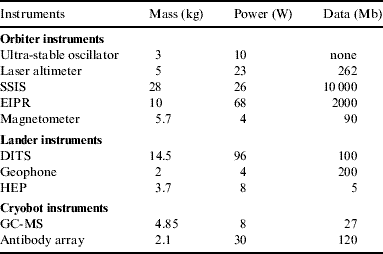
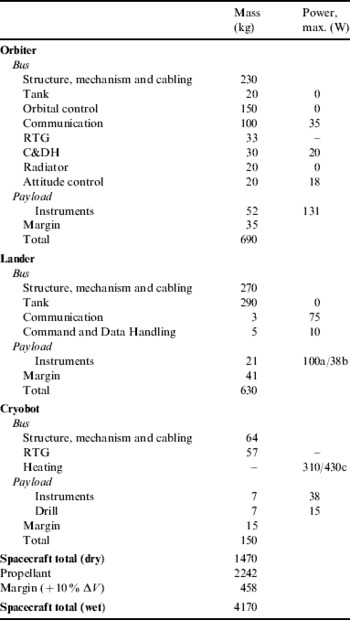
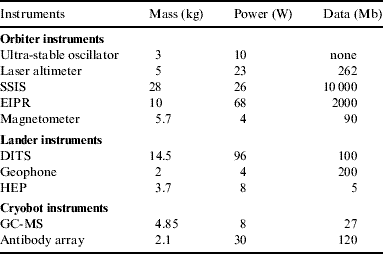
For the preferred launch window in 2020 an optimal performance can be achieved using AtlasV as carrier rocket. This allows a maximum payload mass of 1962 kg. The spacecraft, lander and cryobot are designed respecting the corresponding mass and size constraints of AtlasV, which was chosen as launcher for the mission baseline option. Table 1 shows the mass, power and data requirements for the scientific instrumentation. An overview on the overall mass budget and a detailed breakdown for orbiter, lander and cryobot is given in Table 2. The use of hardened components resulting from ongoing ESA research and development activities is anticipated. The procurement, handling and launch of radioisotope thermoelectric generators (RTGs) will require the participation or collaboration of NASA or ROSCOSMOS.
Science instruments for the orbiter, the lander and the cryobot
Power and mass budget table for the orbiter and the lander

a During descent.
b After landing.
c Day/night operations.
In order to survive the harsh radiation environment around Europa, the spacecraft will carry 8 mm aluminium shielding and individual hardware hardened to tolerate an accumulation of 10 kGy over 60 days.
Planetary protection
Although ionizing radiation on Europa may reduce the probability of contamination, any astrobiological investigation of Europa and its subsurface should achieve the highest reasonable level of safeguard on forward contamination (NRC 2000). Although the COSPAR planetary protection guidelines do not yet address an astrobiological survey of Europa in detail, the guidelines recommend missions to Europa with an orbiter as category III and a lander as category IV. We suggest handling the HADES lander for Europa with astrobiological purpose as a category IVb mission according to the COSPAR classification system for Mars, while the orbiter may be considered to be category III. Sterilization to a total bio-burden analogous to that of the Viking landers' pre-sterilization levels for the HADES orbiter, as well as post-sterilization levels for the HADES lander and cryobot, will be required, in addition to a comprehensive contamination risk analysis.
For in-situ ice sampling and analysis, the bio-burden reduction will have to be greater than for a category IV mission. Any additional organic load has to be minimized for the sample drawing device (i.e. the drill) and all parts that may be in contact with the analytical instruments of the cryobot. Furthermore, the overall organic inventory has to be characterized and documented. The implementation of the planetary protection plan can be adapted from the ESA/EXOMARS strategy.
Orbiter
Structure
The spacecraft – consisting of an orbiter, a lander, and a cryobot – has a height of 3 m, a diameter of 2.5 m, and a mass of 4.2 t (including margins). The outer structure is aligned to fit into the fairing of an AtlasV rocket. The magnetometer boom and the RTGs are deployed after launch.
Attitude and orbital control
Attitude and orbital control are achieved using sensors and actuators on the spacecraft. An inertial guidance system tracks the current position and angle, based on earlier position and acceleration. The perpendicular to the plane of the orbit will be determined by a gyrocompass, while a sun sensor and three star trackers will provide information about the spacecraft orientation. A monopropellant thruster system allows orbital correction. Control of the spacecraft orientation is achieved using a set of reaction/momentum wheels and a cold gas thruster system. For the final orbit around Europa, altitude control is provided by an additional nadir-pointing thruster. An innovative horizon sensor for accurate positioning around Europa will be required.
Thermal control
Optimal operations of instruments require a well-regulated thermal household which will be established by outsourcing of the RTGs radiators (RTGs deployed via booms); using the HGA as thermal protection; applying 5 m2 of additional radiator area; the implementation of heater, heatpipes and heatswitches; and multilayer insulation.
Communications
The HGA (D=4 m, G=47.5 dB, P=35 W, Θ=0.656°, η=0.6) is the main communication link from the orbiter to Earth. In order to maximize the transmission time to Earth, a polar orbit with its orbital plane facing the Earth was chosen, resulting in a LOS connection within 50 of 60 days. A data volume of about 15 GB is transmitted in the X-band at 8 GHz, with a data rate of 30 kbps during 60 days in orbit around Europa. Five Low Gain Antennas (LGAs) are used for redundancy of the signal and for communication with the ground stations when the HGA is depointed from the LOS – this problem will not arise while orbiting Europa. A helix antenna pointing towards Europa's surface is provided for communication with the lander in the UHF-band. Finally, three ground stations on Earth are required for optimum coverage of HADES data transfer and communication capacities.
Power supply
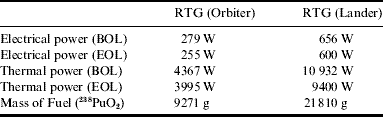
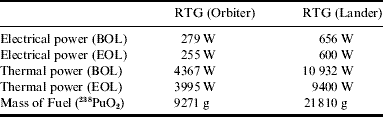
Several constraints, such as mission objectives or environmental conditions, influenced the choice of the electrical power system (EPS) device for HADES. The EPS is required to supply a high-power current during the whole duration of the mission (5 years) for the purpose of maintaining ambient temperatures for the spacecraft systems and the scientific payload, and at the same time, enabling the Cryobot to melt through the Europan icy crust (to a depth of about 25 m). Considering these requirements, together with the EPS lifetime limitation, the application of RTGs appears to be the most favourable option for the HADES mission concept (Table 3).
RTG beginning-of-life (BOL) and end-of-life (EOL) power budget table for the orbiter and the lander
During the launch, the heat transfer from the RTG will be controlled using a Xe insulation system. In addition, the alpha radiation emitted by the RTGs can easily be shielded and will not adversely affect the general spacecraft and science operations.
Charge control
A device controlling the charge of the spacecraft is of special importance regarding the high radiation environment in the Jupiter system. Photoemission-based sensors will control the internal and external electrical charge distribution throughout the spacecraft (Oh Reference Oh2001), in order to avoid interfering effects of charge accumulations within the payload.
Lander
Thermal control
Due to the cold conditions on the surface of Europa (approximately 100 K), the lander module has to be heated during the entire duration of the mission.
Communications
The patch antenna (size 40×40 cm2, P=75 W, Θ=120°; second antenna as redundancy) onboard the lander transmits data at a rate of 120 kbps in the UHF-band. This high data rate is required due to a limited LOS time for the orbiter of only 5 min every 1.8 days. Therefore, this results in a total transmission time of 170 min within the 60 days of the expected lifetime for the lander.
Cryobot
The cryobot is a large structure including at its front end an RTG providing heat to melt the ice, and energy for both the instruments and the lander. Attached to the far end, there is a cable spool containing more than 50 m of cable used as a connection to the lander for power and data transfer. The main scientific goal of the cryobot is the in-situ analysis and profiling of the ice layer up to a potential depth of 25 m. To estimate the rate of melting into the ice for the given cryobot geometry, we used a simple, thermally conductive ice layer model to retrieve the temperature profile (Biele et al. Reference Biele, Ulamec, Garry, Sheridan, Morse, Barber, Wright, Tüg and Mock2002), and an energy balance approximation. In addition, estimations of sublimation effects have to be taken into account (Kömle et al. Reference Kömle, Kargl and Steller2002) resulting in the reduction of the initial probe velocity by a factor of 7.7. Calculations using the model of Biele et al. (Reference Biele, Ulamec, Garry, Sheridan, Morse, Barber, Wright, Tüg and Mock2002) reveal that the HADES cryobot will reach a depth of 10.5 m after only 2 days. The final target depth is expected to be 25 m, stopping every 5 m for sampling.
Technology needs
Although current technology already allows an exploration mission to Europa, the development and experimental validation of a variety of new technological advances may reduce the risk of several of the mission's stages as well as increase the quality and amount of scientific data. These include, for example, advances in communication technology and data storage and transfer, which will most likely occur in forthcoming years and are expected to occur at the latest during the preparation phase of the mission. Alternative power sources may reduce problems associated with the use of RTGs. Advancement of onboard analysis systems, such as antibody array systems, may also provide a wider range of possible operations to be held in-situ, in the near future.
Cost estimations
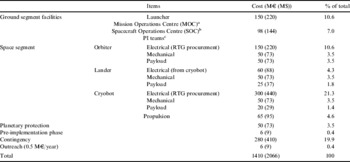
The overall mission costs are within the range of typical Class L planetary missions. The values presented in Table 4 were estimated according to general recommendations and extrapolations of previous mission proposals, considering that internal costs are included. For the EPS, a reference value of about one million US dollars (approximately 0.7 M€) per 50 W of power supply was considered.
Overall mission cost analysis

a Mission planning, orbiter monitoring and control, orbit and attitude determination and control, communications with spacecraft, data downlink.
b Coordination of the long- and short-term scientific planning of the mission, preparing with PI teams the detailed operational timelines and delivering them to the MOC.
c Interacting with the SOC, to prepare operational timelines for their instrument and to provide high-level scientific data for long-term archiving.
Conclusion
The exploration of the Jovian System, and particularly of the satellite Europa, is of considerable astrobiological relevance. Previous results suggesting the presence of a subsurface ocean make Europa one of the most interesting planetary bodies for the search for life in our Solar System. High priority has therefore been assigned to Europa exploration missions in ESA's ‘Cosmic Vision’ strategy (ESA 2005) and NASA's strategic plans (NRC 1999). Recently proposed missions have a variety of solutions, including orbiter and lander options. Constraints related to power and budget require cost-effective strategies to be considered. A scientifically and economically comprehensive coupling of the necessary instrumentation to answer a sequence of relevant questions, in one single mission instead of several separate missions, raises the cost-effectiveness of such a mission to Europa in a significant manner. The HADES mission, coupling an orbiter, a lander and a cryobot, is specifically designed to safely overcome the technical difficulties known to exist. The HADES mission concept ensures an answer to the primary question of whether there actually exists a liquid ocean beneath the icy crust, but also allows for immediate in-situ analysis of possible organic molecules or biomarkers present in the ice. Combined, this makes HADES an unprecedented compact experimental platform for a comprehensive astrobiological investigation of Europa. Although this mission relies on existing technology, near-future technological advances and optimizations may provide the possibility of alternative power sources, as well as considerable reductions in power demand, total mass and budget, further increasing the cost-effectiveness of this mission.
Acknowledgements
The HADES mission concept study was initiated during the Alpbach Summer School in 2007 focused on astrobiology, and further developed by the authors in the following years. The Alpbach Summer School is a training scheme for international groups of graduate students and was organized by ESA and FFG. The authors wish to thank the Alpbach crew, and especially Dr. Michel Viso, for his helpful contribution to this project, and Prof. Dr. Bernard Foing for his valuable recommendations. The authors gratefully acknowledge financial support by CNES, DLR, Enterprise Ireland, FFG, GRICES, PPARC, SANW, SNSB, and the University of Florence.