The schism of professional philosophy into distinct discursive communities—analytic and Continental philosophy—was a defining event in twentieth-century intellectual history. Analytic philosophers identify with a tradition rooted in the study of logic and language, pioneered by thinkers such as Gottlob Frege, Bertrand Russell, G. E. Moore, and Ludwig Wittgenstein. In general terms, analytic philosophers are concerned with the clarity and validity of arguments, frequently employing symbolic logic to avoid ambiguity and provide rigor. Analytic philosophers take science seriously. Analytic philosophers generally avoid speculation and immanent critique, presenting their work as rational and nonideological. By contrast, European “Continental” philosophy is rooted in investigations of experience and existential themes. A variety of nineteenth- and twentieth-century philosophical schools, methods, and traditions, ranging from Hegelianism to post-structuralism and the Frankfurt school, are widely identified as “Continental.” However, near the center of this constellation of ideas are existentialism and phenomenology—the latter a methodology for analyzing experience first described by Edmund Husserl, and subsequently developed by others, such as Martin Heidegger and Jean-Paul Sartre.
In postwar America, analytic philosophy became the dominant program of professional philosophy, limiting other methods to a token role in all but a few idiosyncratic philosophy departments. At many institutions, American undergraduates remain more likely to encounter Continental philosophy as “theory” in other disciplines than in a context in which it was treated as philosophy and taught by philosophers. Division in philosophy, even along such stark lines, is hardly remarkable. However, typical disagreements have led to dispute and debate—tracts and tomes of savage critique and rebuttal. By comparison, the analytic–Continental divide is a gulf of silence. During the second half of the twentieth century most analytic and Continental philosophers simply ignored each other and, insofar as they did engage their counterparts, did so with invective rather than argument. For many Continental philosophers, analysts were “narrow and sterile,” interested more in mathematics and word games than in understanding our lived existence. To many analysts, Continental thought was “fuzzy-minded” and “illogical,” obscure, likely obscurantist, and irrelevant to contemporary debates.Footnote 1 Although recent years have seen increasing efforts at rapprochement between these rivals, the divide between them went essentially unchallenged until the waning decades of the twentieth century. In 1964 Stanley Cavell observed, “At the moment, analytic philosophy is the dominant mode of academic philosophizing in America and England, while existentialism (together with phenomenology) dominates the philosophizing of Western Europe; and there seems to be no trade across the English Channel. Mutual incomprehension and distrust between them is one of the facts of contemporary philosophical life.”Footnote 2 Little change was apparent in a 2003 assessment by Neil Levy: “Since the early twentieth century, Western philosophy has been split into two apparently irreconcilable camps: the ‘analytic’ and the ‘Continental.’ Philosophers who belong to each camp respond to their fellows almost exclusively; thus, each stream develops separately, and the differences become more entrenched. Relations between the camps are characterized largely by mutual incomprehension and not a little hostility.”Footnote 3
Despite the divide's importance to twentieth-century intellectual history, its origins remain misunderstood—misinformed by conventional wisdom that naturalizes these movements as mutually incomprehensible, possibly incommensurable, products of different national cultures.Footnote 4 This narrative is appealing both because it provides intellectual grounds that justify the predominance of analysts in American philosophy, and because the imagined contrast between the rational American and ideological European minds on which it relies affirms postwar ideas about an American culture of liberal consensus. For instance, the Davos encounter, which many consider a seminal event in the divide's history, has, according to Peter Gordon, “come to serve as a philosophical allegory, a dramatization for all manner of concerns, not only philosophical but also cultural and, perhaps most of all, political.”Footnote 5 Recent works, such as Gordon's Continental Divide and Michael Friedman's Parting of the Ways have sought to bridge this gap, rebutting the presumption of incommensurability by stressing the common origins of analytic and Continental movements. These works made a significant step forward in understanding this puzzling feature of twentieth-century intellectual history. However, their focus on a single encounter between Carnap, Cassirer, and Heidegger has given rise to a new myth, which renders “the thoroughgoing intellectual estrangements of these two traditions” as a wholly European phenomenon, forged in Davos and made geographically concrete by the intellectual migration of analysts from Nazi-dominated Europe.Footnote 6 This story obscures the opportunities for philosophical engagement that remained open, particularly on the American shores to which a significant number of Husserl and Heidegger's followers fled between 1933 and 1941. Thus, I argue, the story of the analytic–continental divide must be reconsidered from the other side of the Atlantic, recovering a lost history of interwar encounters and revealing the institutional changes within postwar American academia that solidified philosophy's division.
Historians of philosophy have traditionally employed their craft to unravel dialogues, uncover developments and connections between texts or thinkers, valorize unexpected insight, or investigate moments when new technologies or social problems demanded novel thought to reorient an unstable world. While philosophy has had occasional triumphs and tragedies that did not take place between the covers of a book, most notable events in its history have occurred on the page. Thus most histories of philosophy take texts as their subject and rely on a mode of explanation that appeals to the rational or rhetorical power of these works to account for their influence and endurance. Careful analysis of the logic and interplay of arguments is essential to intellectual history. However, if we simply appeal to the intellectual force of the field's most influential writings to explain its development, we risk preemptively discounting the philosophical road less traveled as an obvious intellectual dead end and overlooking the vectors of influence in the innumerable points of contact between philosophers and the institutions in which their labor is situated. This risk is particularly acute for a history of the analytic–Continental divide, which was expressed not through the interplay of arguments but through a failure to engage in such interplay.
To explore one of these uncharted roads, this essay takes a different approach to the history of philosophy. It is a social history of ideas that combines archival research with quantitative techniques to examine what I call philosophy's reproductive capacities. The reproductive capacities of philosophy comprise the infrastructure that allow it to endure as a collective endeavor. They are located within the institutions through which philosophy is conducted, including universities, journals, professional organizations, and grant programs. These institutions mediate the practice of philosophy by providing standards by which someone is accredited as a philosopher, determining whether ideas are taught or published, or serving as a forum in which a particular sort of work might receive attention. In comparison to the primarily autonomous labor of authoring texts, philosophy's reproductive functions are substantially collaborative. For instance, students of philosophy are not trained by the fiat of individual professors, but in accordance with a curriculum and expectations set out by a department. Likewise, professors are hired by departments in response to the needs of their faculties and academic institutions. These points of contact between philosophers and institutions provide a medium of influence for a complex of administrative, political, and cultural power. Accordingly, this article examines philosophy's reproductive capacities during the 1930–80 period to identify the forces that divided its “analytic” and “Continental” practitioners and explain the spread of new norms within philosophy's leading institutions that foreclosed engagement between these groups.
* * *
At least two oversights have allowed America's role in philosophy's twentieth-century schism to go unnoticed. First, the conventional narrative begs the question by uncritically stipulating an inherent opposition between analytic and Continental philosophy. Not all early analytic thinkers viewed Continental philosophers as pretenders to the name. The Oxford philosopher of language Gilbert Ryle, for instance, gave the methods and development of phenomenology considerable attention in a 1928 review of Heidegger's Sein und Zeit that showed a sustained engagement with the movement. While Ryle had serious concerns about the work, he wrote that he had “nothing but admiration for [Heidegger's] special undertaking and for such of his achievements in it as I can follow, namely the phenomenological analysis of the root workings of the human soul.”Footnote 7 Further, the meaning and boundaries of analytic philosophy remained under negotiation as the movement gained strength in the United States. In fact, “analytic philosophy” was never a stable doctrine or consciously created community. Rather, in the late nineteenth and early twentieth centuries certain philosophers began to use the words “analysis” or “analytical” to identify practices aimed at clarifying complex ideas by logically reconstructing them in terms of philosophically primitive concepts.Footnote 8 However, these philosophers were describing their work rather than naming it. They produced no manifesto or platform, as had other groups such as the neo-realists, and made little effort to specify what analysis was or was not. Instead, they saw themselves as logicians, ideal-language philosophers, or logical positivists, or in other terms that identified their influences and networks of discourse.
The idea of an analytic philosophy—a separate species of homo philosophicus distinct from other branches of the family tree—only began to emerge in the 1930s, decades after the movement's first canonical texts were published. This change was not, primarily, the result of conscious efforts to identify or create an “analytic” philosophical movement. Rather, language evolved to describe the material reality of a broad discursive community that emerged from the practical and professional activities of logicians and linguistic philosophers. Whereas “analytic” had previously functioned adjectivally, “analytic philosophy” became a compound noun. No particular moment, decision, or text brought this new idea of “analytic philosophy” into being. Rather, it gradually crystalized as philosophers prescribed norms and created a canon of texts through actions such as the founding of a new journal named Analysis in 1933.Footnote 9 The phrase “analytic philosophy” also proved useful for describing the transnational crosscurrents in which philosophers and philosophy of logic and language moved in the twentieth century. One of the earliest instances in which “analytic philosophy” is clearly used as a name is Ernest Nagel's 1936 article “Impressions and Appraisals of Analytic Philosophy in Europe,” which describes the philosophies Nagel encountered during a year's travel in England, Austria, and Poland.Footnote 10 These were, he asserted, not a distinct philosophical school, but he found that “there is much they have in common, methodologically and doctrinally,” first and foremost a “preoccupation . . . with philosophy as analysis.”Footnote 11 Yet, Nagel wrote, “I am very conscious that in this paper I am reporting less what certain European schools of philosophy profess, and more what I got out of a year's study abroad,” and “any Weltanschauung such as the one I am indicating would never be asserted by these men as a formal part of their philosophy.”Footnote 12 Thus analytic philosophy was a community first imagined not by its canonical originators, but by those whose geographic and intellectual mobility gave them access to its various constituent discourses. However, once the word was in play it was a powerful discursive formation that identified a community by creating a framework for their works to be viewed together in publications, organizations, and classrooms.
Analytic philosophers were only beginning to identify themselves as participants in a shared tradition when the rise of Nazism drove the Continent's leading logicians and logical positivists to seek refuge in the United States. As a consequence, American universities became the principal sites for the construction of analytic philosophy at the moment when its geolinguistic unity both facilitated the creation of an identifiable body of analytic discourses and practices, and linked together the community that the framework of analytic philosophy had begun to imagine. The result was remarkably durable and fundamentally American. During the second half of the twentieth century most American philosophers, including a majority of the nation's most talented philosophers, saw their work as analytic philosophy, viewing the method as sound and as generally successful in providing answers to philosophical problems. However, as it grew, analytic discourse incorporated a variety of methods and subjects that eschewed the limitations constructed by its early luminaries. When Richard Rorty wrote his 1982 account of “Philosophy in America Today” after a tumultuous tenure as president of the American Philosophical Association, he argued that there was “no more consensus about the problems and methods of [analytic] philosophy in America today than there was in Germany in 1920.”Footnote 13 As the programmatic commitments of logical positivism were abandoned, interest in providing a “coherent metaphilosophical account” of analysis waned. The result, Rorty provocatively claimed, was analytic philosophy's evolution into a family of practices now unified only by “stylistic and sociological” features.Footnote 14 Yet, as analytic philosophers abandoned the project of defining explicit rules of philosophical discourse, they had become increasingly hostile to something they were confident lay beyond them: Continental philosophy. Accordingly, a meaningful account of philosophy's division must explain what the idea of an analytic philosophy did for philosophers that allowed it to persist as a useful framework for understanding contemporary thought, and why it continued to foreclose engagement with Continental philosophy even as analytic practices grew to engage with other philosophical traditions.
The second and most significant flaw in the conventional narrative of the analytic–Continental divide is its erasure of the serious consideration that phenomenology garnered from some of America's leading philosophers during the first half of the twentieth century. Because the historiography of Continental philosophy has focused on figures such as Heidegger and Sartre, whose influence on America was greatest in the postwar era, America's engagement with the works of Edmund Husserl during the first half of the twentieth century has gone almost unnoticed. Yet during this era Harvard University, America's most important philosophical institution, was also the center of phenomenological studies in the United States. Beginning with W. E. Hocking, who studied with Husserl in Göttingen during 1902, no fewer than twelve students would study with Husserl and Heidegger in Germany under the auspices of Harvard fellowships before the outbreak of World War II: W. E. Hocking, Albert Chandler, Marvin Farber, Charles Hartshorne, Dorion Cairns, V. J. McGill, Paul Weiss, Evertt John Nelson, William Frankena, Charles Malik, Robert Trayhern, and H. B. Veatch. Most received the Sheldon Travelling Fellowship, which was the university's highest graduate award and required a nomination from the recipient's department. Winthrop Pickard Bell and John Wild, both of whom served on Harvard's faculty, studied phenomenology in Germany as well, though not under the auspices of a Harvard fellowship.Footnote 15 Far from obscure or irrelevant, many of these philosophers saw phenomenology as an important addition to American philosophical discourse.Footnote 16 Harvard offered a course titled “Husserl and the ‘Phenomenological’ Movement” in the spring of 1927. In 1930 Hocking reported to his former mentor Husserl, “Philosophy flourishes vigorously at Harvard, and the interest in Phenomenology is keen.”Footnote 17 Harvard's philosophy department would even press the university to include Heidegger among the distinguished scholars who would take part in its 1936 tercentenary conference and receive an honorary degree from the university.Footnote 18 This evidence makes the myth that Continental philosophy was inherently unsuited to the American philosophical climate untenable. Thus any effort to explain philosophy's division cannot be premised on the assumption that there was no audience for such works among American philosophers and must account for the change in American attitudes towards European philosophy after World War II.
* * *
In 1940 the annual meeting of philosophy's most important professional organization, the Eastern Division of the American Philosophical Association, featured a symposium on phenomenology.Footnote 19 The phenomenological movement's prospects for acceptance in mainstream American philosophy were nearing their high-water mark. Over the previous decade Hitler's rise had made refugees of dozens of philosophers, including many of Husserl's most promising disciples. Among those who immigrated to the United States were Maximilian Beck, Moritz Geiger, Aron Gurwitsch, Gerhardt Husserl, Felix Kaufmann, Fritz Kaufmann, Alfred Schütz, Herbert Spiegelberg, and Dietrich von Hildebrand. For Husserl's followers, this migration was not only a matter of personal salvation, but also an effort to rescue their mentor's legacy. Husserl's Jahrbuch für Philosophie und phänomenologische Forschung, which had served as the major organ of phenomenological philosophy since its founding in 1912, published its last issue in 1930 and effectively dissolved in 1933. The Jahrbuch, which had been created as an ecumenical vehicle for phenomenological investigations, collapsed under pressure from factional disputes, the rise of Nazism, and Husserl's diminishing scholarly output.Footnote 20
For those dedicated to continuing Husserl's vision, the combined impact of the journal's collapse and Heidegger's rejection of Husserl had been catastrophic. However, in coming to America these philosophers found an ally in Marvin Farber, one of the itinerant Harvard philosophers who had studied with Husserl during the 1920s. Working with Alfred Schütz and Fritz Kaufmann, Farber established the International Society for Phenomenology and the journal Philosophy and Phenomenological Research in 1939.Footnote 21 To their founders, the establishment of institutions for the study and dissemination of phenomenology outside Europe was essential to the movement's survival. As Marvin Farber wrote in a 1943 article titled “The Significance of Phenomenology for the Americas,” “It was obviously impossible for a philosophical movement devoted to the cause of constructing philosophy as a rigorous science,” as Husserl described his project, “to exist in totalitarian Germany. Such a movement could only be international in character.”Footnote 22 Modelled after Husserl's Jahrbuch (even adopting its cumbersome name), Philosophy and Phenomenological Research published its first issue in 1940. Taking the ecumenicism of the Jahrbuch ecumenicism even further by publishing works by analytic philosophers such as Alfred Tarski and Ernest Nagel, the new journal quickly became one of America's premier philosophical publications.Footnote 23 While Marvin Farber administered the movement's professional activities from Buffalo, another nexus of phenomenological teaching and scholarship was forming in New York City. In 1933 the New School for Social Research established a graduate division as part of an effort to provide refuge for European scholars threatened by the Nazi regime. By 1943 the faculty of the New School for Social Research included Felix Kaufmann, Alexandre Koyré, and Alfred Schütz, making it one of the world's leading centers for phenomenological studies.Footnote 24 Thus, in the midst of World War II, phenomenologists succeeded in establishing a beachhead in the United States, and creating institutions that they would control in order to ensure the phenomenological program's continuation on American soil.
However, at the war's conclusion, enthusiasm for a different strand of European thought struck American popular culture. Popularizers and scholars in various fields had whet American appetites for existentialism. Unlike the interwar years, when young American philosophers found themselves in German lecture halls, and participating in discussions with Husserl and Heidegger, most postwar American philosophers encountered twentieth-century European philosophy on their own shores. There it was a foreign import, considered either as a subject of historical interest or for its suitability to an American environment. Accordingly, the reception of existentialism in American academia was shaped both by the intermediaries who took on the task of its transmission, and by the departmental and administrative decisions that determined how, where, and by whom courses on it would be taught.
Before World War II it had made little sense to think of a distinct “Continental philosophy” in twentieth-century Europe. The phrase had a long-standing use, describing the eighteenth- and nineteenth-century opposition of British empiricism and German idealism. However, when used to describe contemporary philosophy during the first half of the twentieth century, the phrase carried only geographic meaning. Indeed, even in 1948 an article in the journal Nineteenth Century and After referred to the logical positivists Hans Reichenbach and Rudolf Carnap as “continental philosophers.”Footnote 25 However, the flight of the Berlin and Vienna circles of positivists to America gave credence to an imagined geography that separated the thought and culture of the Anglo-American world from Continental Europe. One of the first recorded instances in which the idea of a modern “Continental” tradition was invoked to separate European Marxist, phenomenological, and existentialist tendencies from other philosophical methods was a 1949 course at Harvard, titled “Hegel and His Influences on European Thought.” Taught by John Ladd, the course was described as a “study of present-day continental philosophies, particularly dialectical materialism and existentialism, in the light of their essentially Hegelian setting” that promised to stress “the fundamental assumptions underlying the whole development of recent continental thought.”Footnote 26 Ladd was scheduled to give another new course in the fall of 1950, titled “Recent European Philosophy.” This would cover Dilthey, Husserl, Heidegger, Jaspers, and Sartre, and emphasize “those traits that differentiate continental from Anglo-Saxon thought—especially historicism, the phenomenological movement, anti-naturalistic humanism, and existentialism.”Footnote 27 Ladd's departure for a position at Brown forced the course's cancellation, but the framework he introduced would continue to resurface as Harvard and other universities struggled to determine where and how contemporary European philosophy would be incorporated into their curricula.Footnote 28
During the first half of the 1950s most references to “Continental philosophy” appeared in introductory pieces on existentialist thought. For instance, Frederick Copleston wrote in a 1950 article “The Human Person in Contemporary Philosophy,”
I can well imagine some British philosophers rejecting many of the theories which I have narrated as meaningless nonsense. But I think that it would be a mistake to allow one's natural impatience with vague or unfamiliar language to lead one into rejecting the modern continental philosophers unheard, that is, without one's making many real attempt to understand what they are getting at.Footnote 29
A 1953 review of James Collins's “The Existentialists” by James Gordon Clapp praises the work, stating,
In general the reader will find that this book presents these existentialists in a way that is plausible and intelligible to the American reader. One primary reason for this seems to be that the author has managed fidelity to his subject while avoiding the Hegelian heritage of formal dialectic which is still so common to the continental style and which we distrust so deeply.Footnote 30
This too appealed to a sort of mystifying Hegelian influence that would obscure continental European works for the American reader. However, it did not endorse their rejection or dismiss them as irrelevant.
Despite the notoriety of the encounter between Heidegger, Cassirer, and Carnap in 1929 at Davos, it was instead memories of the 11th International Congress of Philosophy, held in Brussels during 1953, that comprised the mortar in the foundation of an Anglo-American vision of “Continental philosophy.” The Journal of Philosophy and the Philosophical Review both published summaries of the proceedings, prompting a subsequent comment in the journal Philosophy East and West.Footnote 31 To report on the congress these journals turned to Max Rieser and Walter Cerf. As refugees from Nazism who had established themselves as philosophers in America, Rieser and Cerf held a privileged status as trusted interpreters of European philosophical traditions.Footnote 32 However, writing for an American audience that saw itself at the center of the postwar world, they fused the idea of “Continental philosophy” with anti-Catholicism and classic orientalist tropes, inverted to testify against their German and French progenitors.
Rieser's review of the congress observed a “deep cleavage between Anglo-American philosophy on the one side and continental philosophy on the other,” describing philosophers “intellectually not on speaking terms but rather uttering soliloquies in a vacuum.”Footnote 33 He continued,
The Continentals do their philosophizing by themselves without any reference to or interest in the Anglo-American group, and vice versa; the two groups move in parallels that never meet. The history of philosophy can show few examples of such a cleavage since philosophy became an international enterprise in the West. There is no real discussion between these two groups, and at the Congress there was none.Footnote 34
Rieser placed the blame for this on “Continental philosophers, steeped in the idiom of phenomenology and its existentialist stepchild, [who] use as a matter of course an array of notions which arouse bewilderment and incredulity among the English-speaking philosophers.”Footnote 35 Further, he argued, while Anglo-American philosophy was a “cognitive enterprise,” Continental philosophy was “at bottom largely an emotional Stimmungsphilosophy, the exhibition of a mood totally alien to the more sober thinkers in the Atlantic sphere.”Footnote 36 The remainder of the review would cast the “continental” philosophers as steeped in the dogmatism of “the historical categories of the past.” Indeed, Rieser concluded, Continental philosophy “has a strong flavor of Orientalism, despite its Western origin; it seems closer to Hindu contemplation than to rational analysis.”Footnote 37
Like Rieser, Cerf portrayed the congress as a failure. In the first paragraph of his essay Cerf declared, “If the Lord could make rhyme and reason out of the Brussels Congress, he would indeed be of infinite intelligence.”Footnote 38 With the Lord otherwise occupied, Cerf offered himself the lesser task of summarizing the works presented and providing suggestions for future endeavors. As Cerf saw it,
The main philosophical opportunity offered by such a congress remains unduly neglected. I mean the opportunity of becoming acquainted with philosophies different from those of one's own national traditions and fashions. This disturbing lack of communication is not due to a difference of tongues. Even if there were only one official language, mutual ignorance and contempt would still prevail, existentialists flocking around existentialists and empiricists around empiricists.Footnote 39
Cerf's article indulged in the same orientalist tropes as Rieser's, depicting the Brussels conference as outside the norms of rational civilization: “Cranks, exhibitionists, odd females, and black-frocked dogmatists are, I suppose, a curse on any congress; but I have never seen more and worse examples of these groups than at Brussels.”Footnote 40 The proclamations of existentialists were, likewise, “prophetic and orphic monologues,” whose eschewal of clarity “makes us rightly suspicious of their ideas.”Footnote 41 However, Cerf claimed his motive to be philosophical rapprochement (a cause he feared lost in advance).Footnote 42 Thus, unlike Rieser's article, Cerf's was a call for continued dialogue, albeit one that placed the onus of reconciliation on the Continental side of the divide. As Cerf concluded his essay, “Let our next International Congress of Philosophy be a meeting ground of empiricists and existentialists. As long as there is a chance of being enriched by existentialist thinking, let us give the existentialist a chance to make his experiences clear to us—and to himself.”Footnote 43
Throughout this report and other articles, Cerf used the new framework of an analytic–Continental divide to illustrate an orientalized vision of European thought, to which he was an essential conduit. German philosophy might seem “unfathomable and ridiculous” but, he intimated, it held “positive characteristics of new beginnings, of a powerful new tackle of old questions.”Footnote 44 Such insight that might elude the rational empiricist minds of his readers became accessible through the intermediary efforts of this graduate of both Bonn and Princeton. For instance, a 1940 piece in which Cerf set out “to build a bridge from Anglo-Saxon empiricism to Heidegger's existential analysis,” he characterized Heidegger as “one of ‘those deep and German metaphysicians’,” claiming, “I believe Heidegger's voice would be able to carry new life and greater depth into the shallow and insipid philosophy of today.” However, he also reported that Heidegger's “books belong indeed to the hardest reading in philosophy,” stating, “this voice will sound so exceedingly strange to anybody educated in the Anglo-Saxon philosophical tradition that my task today can only be to lead the reader from his own philosophical training and background to a point from which Heidegger's thought may sound more comprehensible, or at least less incomprehensible.”Footnote 45
Another article, a 1951 piece titled “Logical Positivism and Existentialism,” called the two schools in question “the two most antagonistic schools in contemporary Western philosophy . . . having nothing in common but the name of philosophy, and even that they deny each other.” This piece also explicitly appealed to racial logic, stating “Although, ironically enough, both Logical Positivism and modern Existentialism originated in German speaking countries, the split between the two goes vaguely parallel with, and may have found some ready echo in, the different cultural inheritance of the Anglo-Saxon and Latin races.”Footnote 46
Concurrent with his report on the International Congress of Philosophy, Cerf published an essay of his reflections on two months he had spent attending lectures in West Germany during 1953. His account was bleak, describing a nation in which Heideggerian existentialism was taught in schools as dogma, and in which the “degenerate romanticism of the recent past apparently has made the students prefer deep-sounding nonsense in philosophy to rational communication.”Footnote 47 Indeed, he claimed, existentialist irrationality and relativism threatened to weaken the German people's “intellectual and moral resistance” to the rise of a new Hitler.Footnote 48 “In a decade or two,” he wrote, “hundreds of thousands of educated Germans could form a marvelous echo for the shouts of another passionate political adventurer.”Footnote 49 This account of German intellectual life prompted a scathing reply from Ludwig Landgrebe, a philosophy professor at the University of Cologne, who wrote, “I can say unconditionally that no proof of such predominance of existentialism can be found.”Footnote 50 Indeed, analytic philosophers could have found few allies more dedicated in the fight against irrationalism and obscurity than many Husserlian phenomenologists, whose philosophical project aimed to make the discipline a “rigorous science.” For instance, Marvin Farber had written in 1945, “The ‘Philosophy of Existence’ is a type of philosophy which can only alienate one for whom the canons and ideals of logic are meaningful, and especially one for whom the ideal of philosophy as a rigorous science is definitive.” Farber also made an argument that would later be embraced by analytic philosophers, describing Heidegger as an “international danger” who “promoted obscurantism in his systematic thought,” and remarking, “The ease with which [Heidegger's] ‘Existentialism’ could accommodate itself to Nazi Germany is noteworthy.”Footnote 51 However, the framework of “Continental philosophy” did not allow for such distinctions between European intellectual movements. Husserlians in America would fare no better than followers of Heidegger or Sartre. Indeed, despite the many differences between existentialists, Marxists, phenomenologists, Hegelians, and the many other cousins, nephews and step-siblings of the “Continental” family, most mainstream American philosophers would regard all of these movements with reflexive disdain in the following decades, treating them only as subjects of historical interest, or refusing to acknowledge them as proper philosophy entirely.Footnote 52
Yet, even at the 11th International Congress, not all American philosophers had been hostile to European thought. For instance, Richard McKeon, an influential philosopher at the University of Chicago, gave a talk (mentioned by Rieser as promoting “tolerance,” but dismissed for “a lack of clarity, precision, and determination in thought”) in which he defended an “all-inclusive” view of experience as action that he associated with Dewey and Sartre. Rather than taking European philosophers to task for their obscurity, McKeon argued that analytic and Continental philosophers found themselves at odds with one another because the distinctions that an inclusive philosophy of experience denied (“subject and object, theory and practice, art and science, emotion and knowledge”) were the same concepts to which philosophers of language appealed “to differentiate cognitive, emotive, persuasive, and evocative uses of discourse.”Footnote 53 This cast the divide between analysts and their peers on the Continent as a normal philosophical dispute, not as a contest between incommensurable views of the discipline itself.
Thus opportunities for engagement between Anglo-American and Continental European philosophers remained available in the early postwar years. However, these opportunities were ephemeral as, in the two decades following the war's conclusion, the boundaries of the philosophical world were redrawn to reflect an imagined geography that divided rational Anglo-American analysis from the mystifying pronouncements emanating from the European continent. Even if this vision of Continental philosophy were drawn from legitimate critiques of Heidegger and Sartre, it bore no resemblance to Husserl, Marx, or any number of the other philosophers who were subsumed within it. Given this, the idea of Continental philosophy is fundamentally misunderstood if it is treated merely as an empty framework through which philosophers organized and evaluated contemporary European thought. Rather, it was a concept that was constructed in the postwar era to redefine the relationship between the Anglo-American and European philosophical worlds, one that required American philosophers to forget their earlier engagement with phenomenology and other European philosophical traditions. Its success can only be understood by mapping the geography of this divide against the tectonic institutional changes affecting higher education in postwar America.
* * *
World War II was a point of rupture in the history of the American university. At the war's conclusion, the federal government enacted a series of reforms that altered the university's relationship with American society. First, the state made increasing use of the university as a site for the development of economic, military, and technocratic resources. As Rebecca Lowen has argued, the regime of federal grants changed the balance of power between academic departments and university administration, as administrators worked to make their universities competitive for research funds. This was most profoundly transformative in the sciences, where departmental balance and teaching were subordinated to research and “decisions about hiring and about which fields of research to emphasize, then, implicitly included estimations of their significance to federal patrons.” These effects were less dramatic in the humanities, where there were fewer “steeples of excellence” in which a university might position itself for federal patronage. However, in some institutions these same dynamics also prevailed upon philosophers. At Stanford, for instance, Joel Isaac has argued that government and private contracts were “crucial to the [philosophy] department's viability,” orienting it towards research in “logic, applied mathematics, and problems in econometrics and psychological scaling” in which analysts tended to predominate.Footnote 54 At the same time, an agreement between the federal government and American veterans that the opportunity for a college education would be available at the government's expense brought a wave of new students into the university system. These changes had important ramifications for the practice of professional philosophy, as departments expanded and adapted to their new environment. They also acted as a catalyst for the emergence of analytic philosophy as the dominant philosophical standpoint in America, overcoming barriers of both institutional culture and demographics that had inhibited any one philosophical school or viewpoint from becoming orthodoxy during the first half the twentieth century.
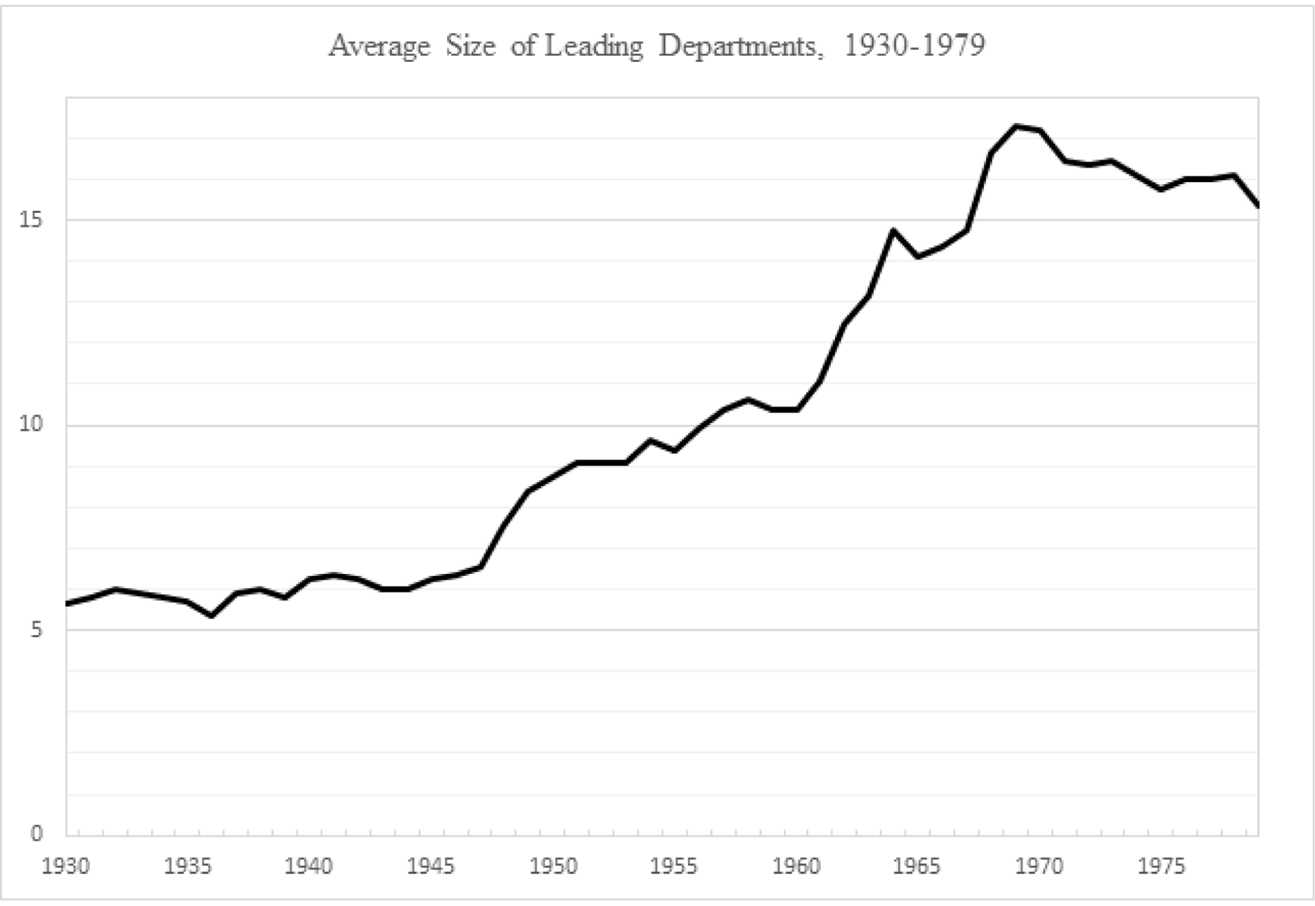
Increasing federal spending on education and surging enrollments fostered a hiring boom in American universities. To examine how this affected the philosophical ecosystem, I have compiled a database of philosophy faculties for eleven of the discipline's most prestigious mid-century departments: Berkeley, Chicago, Columbia, Cornell, Harvard, Michigan, Pennsylvania, Princeton, Stanford, UCLA, and Yale.Footnote 55 In 1945 a total of sixty-nine assistant professors, associate professors, and professors comprised the faculties of these departments—an average size of 6.3 regular positions.Footnote 56 The largest department was at the University of Chicago, which had ten members. The smallest departments had five members. Harvard was the second-largest department with eight. In 1969, 190 philosophers held positions of the same rank in those departments—an average size of 17.3 regular positions. The largest department was Yale, which had swollen to twenty-nine (this would fall to twenty-one by 1972), and the smallest was the University of Pennsylvania, which only had eleven philosophers. Harvard's department was now the second-smallest with only fourteen philosophers on its faculty. By comparison to the 1930–44 period, during which these departments hired new faculty, on average, only once every 3.5 years, during the 1945–69 period each hired an average of 1.2 philosophers per year. This change was immediate and so dramatic that R. B. Perry would respond to a 1946 letter inquiring about faculty candidates from Allegheny College's Horace T. Lavely, “As you are doubtless aware, such candidates are rapidly becoming an extinct species at the moment.”Footnote 57
By year, the average number of assistant professors, associate professors, and professors (excluding visiting faculty) with appointments in philosophy (and those appointed by elsewhere, but performing significant work, including graduate education, within the philosophy department) for the following eleven philosophy departments: Berkeley, University of Chicago, Columbia, Cornell, Harvard, University of Michigan, University of Pennsylvania, Princeton, Stanford, UCLA, and Yale.

Moreover, because of lagging hiring during the Depression and the war, faculties in these departments were advanced in age by the end of World War II. Only twelve of their rank from 1945 remained on their faculties in 1969 (of 190 total). Of those 190, 149 or 78.4 percent, had received their Ph.D. (or highest degree) in 1945 or later. Some 134, or 70.5 percent, had received their degrees in 1950 or later, and 91, or 47.9 percent, had received their degrees in the past ten years (1960 or later). Thus, by the end of the 1960s, a demographic revolution had taken place, filling the profession's ranks with philosophers who had been educated in the postwar era.
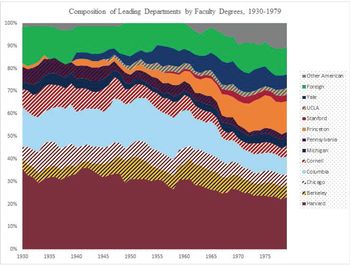
Although this selection of departments comports well with contemporary graduate rankings, it was not based on them. Rather, it reflects an effort to determine which philosophy departments exerted the most influence over the field by identifying where members of elite departments received their philosophical training. Beginning with one such department, I compiled a list of all assistant professors, associate professors, and professors who served on Princeton's faculty from 1930 to 1979 and determined where each of these philosophers received their Ph.D. or highest degree in philosophy.Footnote 58 I then repeated this procedure for all schools whose graduates comprised a significant portion of Princeton's faculty. I continued to repeat this procedure for each of those departments until all universities that placed a significant number of graduates at these schools had been surveyed. This produced a portrait of a caste of eleven elite departments that hired almost exclusively from within their own ranks. Harvard was alone at the center of this network. Although entry to this caste was not altogether impossible, the group remained remarkably stable during the fifty-year period from 1930 to 1979, even as the discipline underwent its dramatic expansion.
By year, where the faculties of the following eleven philosophy departments received their Ph.D. or highest degree in philosophy: Berkeley, University of Chicago, Columbia, Cornell, Harvard, University of Michigan, University of Pennsylvania, Princeton, Stanford, UCLA, and Yale. This includes only assistant professors, associate professors, and professors (and excludes visiting faculty) with appointments in philosophy (and those appointed by elsewhere, but performing significant work, including graduate education, within the philosophy department).

Graduates of all other American philosophy programs had virtually no prospect of employment in the leading departments. Accordingly, the faculties of the elite caste were united, almost entirely, by common educational experiences within a small number of institutions. This regime of exclusion facilitated their convergence on common pedagogical practices, styles, and norms—ones shaped first and foremost at Harvard University, which dominated the group. Because of this sociological reality, philosophers trained at these institutions in the early postwar years could see the common influences in their colleagues’ work, recognize their style, and evaluate their arguments by shared standards.
To be clear, the “regime of exclusion” that I identify was neither explicitly constituted nor intentionally upheld. There was no conspiratorial scheme to preserve the power and prestige of certain departments, or unethical arrangement to place pedigree before merit. Rather, under the prevailing norms of faculty appointments this was the profession's homeostatic condition. As the Harvard-trained philosopher Robert Paul Wolff explained,
The old boy network was not merely alive and well [in 1957]; it was the only mechanism for placing new Ph.D.’s in entry-level teaching positions. When a department had an opening, the Chair would write to the handful of graduate departments known to be turning out philosophers, and would ask whether they had anyone suitable at the moment. A few phone calls or a note to a friend would lead to an interview, and the young aspirant would be placed.Footnote 59
There was a rationality to this system. Elite departments distinguished themselves by monopolizing the discipline's most esteemed scholars. Accordingly, promising students were often channeled to them for the opportunity to study under such eminences as W. V. O. Quine, Rudolf Carnap, Saul Kripke, and David Lewis. Most importantly, the long-standing professional and personal relations between members of these faculties meant that peer institutions could be relied upon for accurate assessments of faculty candidates by common standards.Footnote 60 However, there were also flaws in this logic. Because the leading departments prioritized research, their members taught fewer classes with more support than most American philosophers. Thus their scholarly achievements reflect a combination of ability and opportunity, complicating comparisons of talent with individuals whose institutional obligations were an impediment to focused research. Outstanding scholars could also be mediocre teachers, meaning that an elite pedigree did not necessarily imply a superior education. Finally, some number of brilliant students were invariably denied admission by leading departments, while others chose to pursue graduate education outside their ranks because of proximity, curriculum, or funding. Therefore prevailing hiring practices predetermined that appointments were constrained not just by talent or ideology, but by the limits of a philosopher's professional world—a network of pupils, mentors, and former colleagues defined the range who might be considered for a position. As Wolff concluded, this system was “easy, efficient, comfortable, and thoroughly unfair.”Footnote 61
On average, from 1945 to 1969 graduates of the eleven leading departments accounted for 87 percent of assistant, associate, and full professors on their own faculties. Some 11.5 percent of their faculties were educated at foreign universities. Only 1.6 percent of their faculties received doctorates from American departments outside their own ranks. For associate and full professors this number drops to 0.6 percent. The caste of leading departments can also be divided into core and peripheral departments. The first group consists of Harvard and the six other most influential departments: Berkeley, Chicago, Columbia, Cornell, Princeton, and Yale. Their students alone account for 77.4 percent of the faculty at the top eleven schools in this period. The second tier of four schools, Michigan, Pennsylvania, Stanford, and UCLA, thus accounts for 9.6 percent of their faculty. Even excluding all philosophers hired by the university at which they received their doctorate, eliminating this as a possible source of institutional bias towards one's own students, 79.1 percent of faculty of the top eleven schools came from within their own ranks between 1945 and 1969, with only 2.4 percent coming from all other American universities combined.
Harvard held a metropolitan position within this network of departments. Its singular influence over the discipline's norms and agenda was ensured by the overwhelming prevalence of its graduates in its leading departments.Footnote 62 In total, Harvard-trained philosophers accounted for 29.5 percent of all faculty and 32.2 percent of associate professors and professors at these eleven programs between 1945 and 1969.Footnote 63 Indeed, in the decade following the conclusion of World War II, there was no year in which Harvard graduates constituted less than 29.3 percent of the overall composition of these departments. Further, if we exclude those hired by their own universities, in order to highlight the influence of departments outside their own institution, we find that Harvard graduates accounted for 36.8 percent of faculty during 1945–1969.
Of course, not all Harvard graduates would find employment in the leading departments and few would begin their careers there. Thus Harvard extended its influence throughout the field of philosophy, with its faculty seeing the evangelism of Harvard thought as an important aspect of their philosophical work. Indeed, when Dean Clifford Moore suggested limiting the number of graduate students in philosophy in 1927 so that resources could be dedicated to the best rather than the “pretty good,” C. I. Lewis replied,
The next generation will receive the bulk of the college instruction from “pretty good” men. There are the state universities, for instance. I should like to think that a goodly portion of such men will form their scholarly ideals and their conception of what a university ought to be under Harvard auspices. That is one great thing Harvard may do for this country.Footnote 64
The placement of its students was not the only means through which Harvard's influence extended. New philosophy departments and those attempting to revise their curricula also appealed to Harvard for guidance directly. For instance, when philosophers at Brown debated whether to institute comprehensive examinations for their students, C. J. Ducasse, himself a Harvard graduate, wrote to his alma mater requesting past copies of their exams, explaining that Harvard's example would “be of a good deal of help to us.”Footnote 65
By my analysis, Columbia was America's next most prominent philosophy department, accounting for 16.4 percent of faculty within the leading departments between 1945 and 1969. However, more than half of those philosophers were employed by Columbia itself. Thus, unlike Harvard, this number drops significantly if we exclude those hired by their own university. In comparison to Harvard's 36.8 percent, Columbia graduates only accounted for 11.3 percent of outside hires. However, no other school accounted for more than 8 percent of overall faculty (or 7 percent of outside hires), so Columbia represented the most significant counterweight to Harvard's influence in the early decades of postwar America. It was only in the 1970s that Princeton surpassed Harvard as the largest source of new hires. Still, since Harvard graduates comprised 43.3 percent of Princeton's faculty from 1960 to 1979, Princeton's ascendance was more akin to a colonial uprising than a repudiation of Harvard's leadership in the field.
Princeton's rise also directs our attention to UCLA and Stanford, which were not considered leading departments during the first half of the twentieth century, but became elite departments during the 1950s and 1960s. Both had strong ties to Harvard during the interwar period. From 1930 to 1945 Harvard graduates €accounted for 57.4 percent of UCLA's faculty and 36.3 percent of Stanford's faculty. Thus they were well connected with the elite caste even if they were not members. Following the war's conclusion, Stanford hired from Harvard in highly disproportionate numbers. Between 1945 and 1969, Harvard graduates accounted for 47.8 percent of Stanford's philosophy faculty, reaching a maximum in 1959 when 75 percent of its department came from Harvard. UCLA, on the other hand, became a center of American analytic philosophy primarily because of the hiring of Hans Reichenbach and Rudolf Carnap. However, Harvard graduates remained a substantial portion of UCLA's faculty, accounting for 30.7 percent of its department from 1945 to 1969. When Hilary Putnam was hired by Princeton in 1954 he became the first graduate of UCLA to be hired by an established leading department. Putnam would later join Harvard's faculty in 1965. Ernest Adams, hired by Berkeley in 1957, was Stanford's first. Between 1963 and 1979, thirteen other graduates of UCLA and Stanford would be hired by Berkeley, Chicago, Columbia, Cornell, Michigan, Pennsylvania, and Princeton.
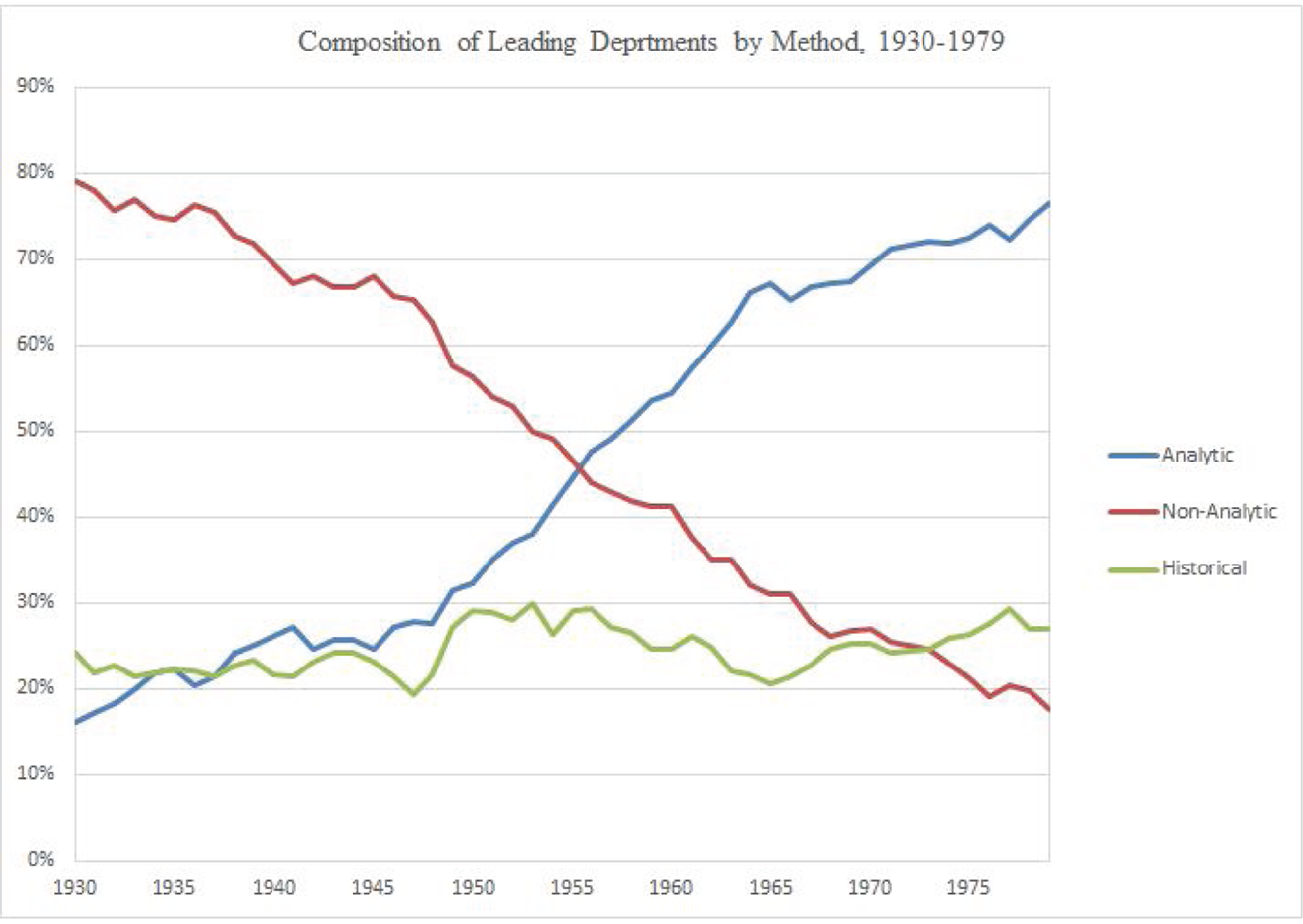
Harvard graduates also comprised the core of the American analytic movement at the beginning of the postwar era. I have labeled philosophers in the caste of leading departments as “Analytic,” “Non-analytic,” or “Historical,” allowing individual philosophers to receive multiple classifications. I must stress that I am not identifying these men and women as analytic or non-analytic philosophers. Rather, I am identifying those whose work included significant engagement with these discourses. In other words, these philosophers are participants in, if not necessarily members of, the groups with which they are identified.Footnote 66 Of the sixty-nine philosophers on the faculties of the leading departments in 1945 I have identified seventeen (24.6 percent) as working, either in part or entirely, on analytic subjects (seven of the seventeen participated in both analytic and non-analytic discourses). Among these, eight (47.1 percent) had received their Ph.D. at Harvard.Footnote 67 Three had received their Ph.D. at foreign universities (Erlagen, the University of Jena, and Oxford).Footnote 68 The remaining six came from Berkeley, Chicago, Columbia, Cornell, Michigan, and Yale.Footnote 69 With just over a quarter of their faculty working in analytic fields, analysis was an (albeit significant) minority position within the discipline. By comparison, the work of sixteen philosophers (23.2 percent) included the history of philosophy, and the work of forty-seven (68.1 percent) included non-analytic methods and traditions. However, the seventeen analytic philosophers were densely clustered in some of the most influential departments, in which they constituted a significant bloc of the faculty. With the retirements of Hocking and Perry, Harvard's department had shrunk to eight philosophers, four of whom worked in analytic fields.Footnote 70 At Chicago, four in a faculty of ten were analytic philosophers.Footnote 71 At Michigan and Yale, two in a faculty of five.Footnote 72 At Cornell, two in a faculty of six.Footnote 73 The remaining three held positions at Berkeley, Columbia, and UCLAFootnote 74
Between 1946 and 1955 the leading eleven departments made ninety appointmentsFootnote 75. I have identified forty-eight as working on analytic subjects either in part or entirely. Overall, 53.3 percent worked in analytic fields, 26.7 percent worked in the history of philosophy, and 41.7 percent worked in non-analytic fields. Of the forty-eight analytically inclined philosophers hired, thirty-seven (76.6 percent) had received their degrees from the leading American departments. Of these, fifteen, 29.8 percent, received their Ph.D. from Harvard. All others had been granted degrees by foreign universities: Berlin, Heidelberg, University of Jena, University of London, and Oxford. Within a decade this influx of new philosophers had already changed the demographics and priorities of philosophy departments significantly. In 1955, 103 philosophers held positions on the faculties of the eleven leading departments. Of these I have identified forty-six (44.6 percent) as working either in part or entirely as analytic philosophers, a 71.2 percent increase on their representation in 1945. The work of thirty (29.1 percent) included the history of philosophy, and the work of forty-eight (46.6 percent) included non-analytic subjects. As in 1945, a few departments remained centers of analytic thought. At Cornell, seven out of nine faculty members (77.8 percent) worked in fields that included analytic philosophy. At Harvard, nine of thirteen faculty members (69.2 percent) worked in fields that included analytic philosophy. At Michigan, all seven members of the philosophy department were analytic philosophers. However, all the leading eleven departments had at least two analytic philosophers on their faculties. Analytic philosophers were scarcest at Yale, where only two of twelve philosophers (16.7 percent) worked in the field. However, at all the other departments they comprised between 22.2 percent (Pennsylvania) and 57.1 percent (Stanford), with analytic philosophers accounting for a third of the faculties of Chicago, Columbia, Princeton, and UCLA.
Thus in 1955 analytic philosophers did not yet constitute a majority in most of the discipline's leading institutions, but they held a commanding position in three of its most prestigious departments, including Harvard. Even at this point it was not inevitable that analytic philosophy would emerge as an orthodox view throughout the discipline. Indeed, contemporary European philosophy garnered significant student interest on the postwar American scene.Footnote 76 However, preventing this outcome would have required departments to deviate from the prevailing norms among their ranks, in terms of both their curricular emphases and their hiring practices. Instead, besieged by demands for instruction in existentialism, which undergraduates presumptuously described as “real philosophy,” the leading departments searched for suitable faculty qualified to teach courses on contemporary European thought from within their traditional hiring network.Footnote 77 It was, first and foremost in this context, as a professional problem, that most American philosophers engaged with contemporary European philosophy in the postwar era, and it was through their struggles to provide instruction in a constellation of subjections that included Hegel, Nietzsche, Marx, phenomenology, and existentialism that they would learn to recognize them as “Continental philosophy,” and that as something outside the bounds of American philosophical discourse.
Harvard's experience securing faculty candidates who fit the mold of a Harvard professor and were qualified to instruct students in contemporary European philosophy provides a glimpse into the problems Continental philosophy created for elite departments. After John Ladd's departure, Harvard's philosophy department searched for a replacement. Their attention fell on William Earle, whom Morton White had met on a recent trip to Northwestern. Earle was an existentialist philosopher who had done graduate work at the University of Chicago and the University of Aix-Marseilles. As usual for such an appointment, Harvard turned to someone with whom the department had a relationship for an evaluation of their candidate. In this instance, their informant was Paul Henle, one of their own graduates who was then Earle's colleague at Northwestern. Henle reported that he had first served under then Lieutenant Earle during World War II, and, after the war's conclusion, had taken on Earle (now a graduate student) as a teaching assistant. While the extent of Earle's philosophical abilities remained to be determined, Henle recommended him in the highest possible terms as a human being, a teacher, and a colleague. For an instructorship at Harvard, Henle expressed his confidence in Earle “without qualification.” However, Henle's letter also noted that Earle had not yet received a doctorate from an American university (he had a doctorate from the University of Aix-Marseilles, but would not receive his Ph.D. from Chicago until 1952).Footnote 78 Harvard, D. C. Williams reported, would be unlikely to credit Earle's French degree, which, he wrote, could prove an “insuperable barrier to his appointment here.” Earle instead became an assistant professor at Northwestern.Footnote 79
Two years later Harvard was still looking to find a replacement for Ladd. This time they turned to Princeton and Walter Kaufmann, the recent author of works on Nietzsche and Hegel, whom they hoped to hire as an assistant professor. As Quine wrote to Dean Buck, Kaufmann “would bring us special strength in poorly represented parts of philosophy.” However, Kaufmann was made an associate professor at Princeton, and Harvard's department was unwilling to match the offer.Footnote 80 Fortunately, John Wild, who had served in Harvard's philosophy department since 1934, was turning his attention to phenomenology and existentialism. Wild had been among the American philosophers who had studied with Heidegger at Freiburg during the 1930s, but his scholarship and teaching had focused on other subjects until the 1950s. Beginning in 1952, when Wild taught Harvard's “Philosophy 4: Introduction to Philosophy,” and “Philosophy 74: Philosophy of Man,” which included readings in existentialism, European philosophy became the focus of Wild's work as a teacher.Footnote 81 Over the next eight years, Wild would offer courses on contemporary European philosophy at Harvard, producing the first partial translation of Heidegger's Being and Time for his students’ use.Footnote 82 Harvard also supplemented Wild with visiting faculty, even attempting to lure Jean-Paul Sartre to the university in 1958. However, Wild's new interests were not shared by the other permanent members of his department, leaving him professionally isolated. Thus, despite the entreaties of his colleagues to remain at Harvard, Wild resigned his post in 1960, taking up an offer to chair Northwestern's philosophy department, which had recently joined the New School as one of America's premier centers for the study of Continental philosophy.Footnote 83 As Dean McGeorge Bundy explained to President Pusey, “At Harvard the majority of [Wild's] colleagues do not share his basic philosophic convictions, and there is no chance that he could swing a majority to his side in the relatively few years before he reaches retirement age.” This was not mere speculation but mathematics. Peculiar to Harvard was a system of appointments and retirements governed by actuarial tables devised by the mathematician William Graustein. Because of this, Harvard's philosophy department could not expand like its peers.Footnote 84 Thus, with limited opportunities for new appointments and curricular gaps in areas such as political philosophy, philosophy of religion, and, with the imminent retirement of Raphael Demos, ancient philosophy, there was, from Wild's perspective, little likelihood of another Continental specialist joining the faculty before his scheduled retirement.Footnote 85
Wild's departure sent Harvard again in search of a replacement. John Ladd was brought back as a visiting professor for the spring semester of 1961, but the department continued to seek a permanent solution.Footnote 86 In their search for a successor, Harvard sent letters to faculty at Princeton, Michigan, Berkeley, and Yale.Footnote 87 The department also made inquiries of two philosophers who were not members of the leading departments’ faculties. These were Maurice Mandelbaum, a professor at Johns Hopkins, and Richard Brandt, a professor at Swarthmore. Both, however, were graduates of Yale, and Mandelbaum was the incoming president of the APA. Both also recommended only graduates of the leading departments.Footnote 88 Harvard's search was thus circumscribed by boundaries that confined their view to only one department, Yale, in which contemporary European philosophy was given a modicum of attention. These interactions served to confirm accounts that described a fundamental split between analytic and Continental philosophers and an invidious distinction between those groups. For instance, Ledger Wood responded to D. C. Williams's request for information on Princeton's recent Continental graduates:
These men on the whole are much inferior to our men in the fields of logic, philosophy of science and theory of knowledge. There is among these men only one . . . whose graduate record would justify his consideration by Harvard. Although I cannot recommend him unqualifiedly, I have no doubt that he would rate among the best men in his age group whose interests are historical, religious, and existentialist.Footnote 89
D. C. Williams wrote back to Wood, “I am considerably impressed by your judgment that the existentialist type of philosopher is, at least on average, much inferior in sheer ability to his analytic brother (if ‘brother’ is the correct word).”Footnote 90 In fact, Wood had only been speaking of Princeton's current crop of graduate students, but the reasoning was easily extended to the whole field. Indeed, Wood's assessment made such an impression on Williams that he would discuss it in subsequent correspondences with two different philosophers, writing that he had been informed by a colleague at Princeton that “such men average much less intelligent than analytic philosophers,” and “the spiritual types are so likely to be so much stupider than the others!”Footnote 91 Williams's sweeping conclusion was obviously unjustified. However, it must be also acknowledged that it identified a real disciplinary imbalance. For the historical reasons this essay explains, most of America's most esteemed philosophers were trained in the analytic tradition. There was no American Husserl or Heidegger whose talent and influence matched analytic eminences like Quine or Kripke. Still, regardless of tradition, few philosophers could compare to these figures, including the vast majority of analytic philosophers who fared better than their Continental colleagues. Ultimately, Harvard again turned to one of their own, choosing Dagfinn Føllesdal as Wild's successor. Føllesdal's early education in Norway had fostered serious interest in Husserl and sufficient expertise in European thought to assume responsibility for instruction in the field. Critically, however, Føllesdal was a brilliant logician and a student of Quine—impeccable credentials for a position at Harvard.Footnote 92
* * *
From one perspective, the narrative of Continental philosophy in America is a success story. Against a backdrop of war, the death of their movement's founder, and the scandal of Heidegger's Nazism, phenomenologists created institutions that allowed them to continue their philosophical project at Buffalo and the New School. After the war, these institution-building efforts continued. In his short time at Northwestern, Wild and his colleagues founded what would become the second-largest professional organization of philosophers in the United States, the Society for Phenomenology and Existential Philosophy (or SPEP), which served as an important institutional nexus for Continental philosophy, reifying the framework that cast phenomenology and existentialism as a distinct tradition. Catholic universities, such as Fordham and Duquesne, whose religious leanings placed them at odds with the prevailing tendencies of analytic philosophy, also proved welcoming to scholars of phenomenology and existentialism.Footnote 93 Thus, by the late 1960s, Continental philosophers in the United States had established a network of institutions within which their work could not only persist but also be a central focus. However, for Continental philosophy's acceptance in the elite realms of American academic philosophy, these efforts could not have been more poorly timed. The only nexus between the Continental networks and the caste of elite departments was Yale, which had, since the 1950s, attempted to maintain a balance between analytic and non-analytic methods. When its philosophy department imploded amidst factional infighting during the 1970s, it provided all the evidence many philosophers needed to conclude that these movements could not coexist.Footnote 94
By 1969, 128 of the 190 philosophers (67.4 percent) at the eleven leading departments worked, either in part or entirely, as analytic philosophers. Forty-eight (25.3 percent) worked in the history of philosophy. Fifty-one (26.8 percent) worked on subjects that included non-analytic topics and methods. Of these, only sixteen (8.4 percent) practiced Continental philosophy.
By year, the percentage of the faculties of the following eleven departments whose work included analytic philosophy, non-analytic philosophy, and the history of philosophy: Berkeley, University of Chicago, Columbia, Cornell, Harvard, University of Michigan, University of Pennsylvania, Princeton, Stanford, UCLA, and Yale. Philosophers who worked in multiples fields are counted in each. This includes only assistant professors, associate professors, and professors (and excludes visiting faculty) with appointments in philosophy (and those appointed elsewhere, but performing significant work, including graduate education, within the philosophy department).

Indeed, between 1945 and 1969 only twenty-seven philosophers employed by the eleven leading departments worked in areas that included Continental philosophy.Footnote 95 Thirteen of these had been employed by Yale.Footnote 96 None of the other leading departments had more than two Continental philosophers hired concurrently. In fact, Chicago, Michigan, Pennsylvania, and Stanford did not have more than one Continental philosopher on their faculty at any time from 1945 to 1969. The philosophy departments of Cornell and UCLA employed no one with expertise in Continental philosophy during the entire period.
During the first half of the twentieth century, American philosophy had been a field already marked by institutional hierarchies, in which a pluralistic ideal had, often failingly, fostered methodological diversity within the narrow confines of its membership. However, the postwar hiring boom produced a demographic revolution that made the domination of philosophy by a new generation of philosophers a fait accompli. The institutional commitments to balance that had promoted methodological diversity during the interwar period simply could not hold given the new conditions of philosophical reproduction, which left the profession in the hands of a new generation of American philosophers by the end of the 1960s. These philosophers, most educated in a small number of densely connected schools, shared, if not a unified vision, then a common set of texts, problems, and experiences from their education that informed their opinions on the practice and instruction of philosophy. With the traditions and practices of these departments as pattern against which others could be evaluated, mainstream American philosophers, most of whom now identified as analytic philosophers, could recognize a reflection of themselves in the work of their peers. Thus analytic philosophers in postwar America experienced the epistemic reassurance of membership in an established and successful intellectual community.
Continental philosophy's marginalization or outright absence was an important part of that experience. As Hilary Putnam wrote, “What happened to me, as to many other young American philosophers, was that in graduate school one learned what not to like and what not to consider philosophy.”Footnote 97 Philosophers at America's leading universities saw that the departments where contemporary European philosophy received significant attention were at the periphery of the profession. The invidious distinction between what were, from their perspective, marginal or idiosyncratic institutions and their own departments was easily mapped onto the philosophical traditions exhibited in those institutions. However, it would be wrong to conclude that analytic philosophers cynically seized upon orientalist attitudes towards European philosophy to maintain control over the discipline. Rather, to steal an insight and a line from Paul E. Johnson, if we are to render the analytic–Continental divide intelligibly, we must understand that American philosophers in elite philosophy departments experienced their struggle to hire suitably credentialed and regarded philosophers as a philosophical problem—a problem that had to do not only with the practices of their institutions, but also with the “rightness” of their beliefs.Footnote 98 Just as the faculties of philosophy's leading departments found their suspicions of Continental thought confirmed by their experience conducting faculty searches, their students would see the idea of an incommensurable divide between philosophical traditions reified in its absence from their curricula. Thus, the institutional landscape of American education left an indelible mark on twentieth-century philosophy.