In 1625 at the Jesuit college in Heiligenstadt, a religious play full of allegories and Jesuit symbolism was performed in honour of Johann Schweikhard, the visiting Elector–Archbishop of Mainz. Much care was taken in its elaboration, and an astounding display of moving scenery and fireworks was arranged, giving much delight to the spectators. In fact, the spectacle was so extraordinary that it was rumoured that black magic was involved. After the laypeople went home, the distinguished visitors admonished the designer, demanding he explain the means he had used, and they were only reassured after the hidden machinery behind the tricks was shown to them. These mechanical inventions had been constructed by the young Athanasius Kircher, who was at that time only twenty-three years old. The archbishop and his retinue were greatly impressed by Kircher's ingenuity and his skills won him the archbishop's patronage, which would be the springboard to Kircher's brilliant career.Footnote 1
This anecdote nicely illustrates the complex intertwining of the technical arts, magic, theatricality, mixed mathematics and natural philosophy typical of baroque culture. It also indicates the complexity and ambiguity of certain phenomena that relate to secrecy and openness. In this episode alone, different levels of secrecy and openness can already be found, sometimes even a mixture of both. The rest of Kircher's career – as professor of mathematics at the Jesuit Collegio Romano, as prolific author on topics varying from hieroglyphs and Chinese studies to the study of the earth or instrumental practices, and as curator of a renowned museum stuffed with natural and artificial wonders – was at least as theatrical as the stage spectacle he arranged in his youth. For the purposes of this paper, the introductory story can serve as an exemplar of Kircher's oeuvre, drawing special attention to the theatricality of his work.Footnote 2
In the introduction to this special issue, Dániel Margócsy and I have argued that the traditional historiography of science constructed secrecy in opposition to openness. Recent historiography has continued to do so.Footnote 3 The current article follows naturally from this analysis. In the first part of the paper, I will challenge the opposition between openness and secrecy. Much like the concepts of objectivity and subjectivity, openness and secrecy have a shared history, even if they have sometimes been associated or contrasted with other concepts, or if their histories briefly went in different directions. Furthermore, openness and secrecy are often interlocked, impossible to disentangle, and may even reinforce each other.
The introduction also makes clear that much of the recent historiography has focused on craft secrets or secrets of state. First, in this paper, I want to open up the discussion and include a much wider array of phenomena of openness and secrecy in the history of science. Second, although secrets and secrecy are often connected, I think it is fruitful to distinguish them. On the one hand, there are secrets without secrecy: simple recipes, skills or techniques that were openly available were often called ‘secrets’, for instance. On the other hand, there exists secrecy without a secret. Because the object of secrecy is hidden, there might not be any object at all, while all the characteristics of secrecy remain in place.Footnote 4 It is on secrecy, and not so much on secrets, that I will focus my attention in this essay.Footnote 5
On the one hand, secrecy and openness are norms or values that regulate behaviour. Historical actors sometimes reflect and theorize on these norms. On the other hand, secrecy and openness are characteristics of practices. It speaks for itself that the values of the actors, and especially how they conceptualize them, do not necessarily map neatly on their actual behaviour. They might express certain values as a rhetorical strategy or as a way to justify themselves, or maybe they are not able to follow the strict norms that they impose on themselves. An actor's use of concepts related to secrecy and openness is especially prone to rhetorical play, because these discussions themselves are part of the practices of openness and secrecy. Inversely, existing values may go unexpressed by the actors; they are not necessarily made explicit – maybe they are not yet reified in a theory or even a concept. Such values only become visible in a close study of practices. While actors' concepts and theories are indispensable for better understanding what is at stake in a certain historical period, the historian of openness and secrecy should also treat them with suspicion and restraint.
The values as well as the practices of openness and secrecy have varied strongly throughout history.Footnote 6 Up until now, the changing fortunes of secrecy have mostly been analysed in terms of transhistorical or current analytical categories of openness and secrecy. This has certain advantages, such as breadth of scope, but it also poses severe limitations. In order to historicize the discussion of openness and secrecy, we must pay close attention to actors' categories of analysis, the distinctions and oppositions they make, and we must differentiate between kinds of secrecy. In the first part of this paper, my aim is to open up the discursive field in which the analytic categories of openness and secrecy figure. This should allow us to enrich the relevant historiographical vocabulary, to be more sensitive to lexical changes and relations between concepts of actors and historians, as well as to include a wider array of historical practices in our analysis.
In the second part of this paper, I will historicize the discussion further, focusing on the early modern period. We still lack an account of how different kinds of secrecy can be found in different practices and different periods, and how these differentiations and transformations connect to broader cultural practices and concerns. I cannot accomplish all this in one paper, and hence my current proposal is propaedeutic and programmatic. I briefly introduce three kinds of secrecy that are difficult to analyse with a simple oppositional understanding of openness and secrecy. The first example is about esotericism as a long-term tradition of secrecy; the second one is about theatricality as a mode of secrecy especially prevalent in the baroque; and the third is about allegory, which implies a kind of secrecy that becomes particularly controversial in the seventeenth century.
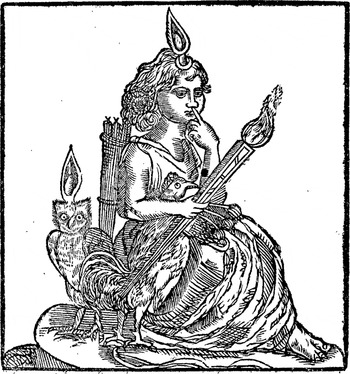
Harpocrates, in Kircher's Oedipus Aegyptiacus, vol. 3, p. 590. Courtesy K.U.Leuven, Maurits Sabbebibliotheek.

Secrecy seems intrinsically paradoxical.Footnote 7 The informant who is telling a secret either directly or tacitly makes the claim that the information he speaks is not to be spoken. Kircher also plays with such paradoxes. In the 1650s, Harpocrates, the infant god who raises his finger to his lips, starts to appear in Kircher's oeuvre (Figure 1).Footnote 8 The tension between secrecy and openness in Kircher's work is captured in the image of this ‘Egyptian’ god who is enjoining silence. The image bears the enigmatic caption ‘With this one I disclose secrets’ (Hoc uno arcane recludo). In it, the enjoining of silence is conjoined or even identified with the disclosing of secrets; hiding and revealing are inseparably intertwined. For current purposes, I propose to interpret the image of Harpocrates as an emblem of the paradoxical intertwinement of secrecy and openness, which serves as a guiding principle for this paper.
Part I: Openness and secrecy
Secrecy versus openness
Historians are usually not in the business of defining concepts. This makes it sometimes difficult to know what the exact meaning is of the categories they use. In the straightforward, traditional analyses of openness and secrecy, it is clear that they are usually considered to be negations of each other: if something is not open, it has to be secret, and vice versa.Footnote 9 Recent historical research has studied secrecy and openness in much more detail, resulting in a much richer and complex picture, which also implies that the meaning of the basic terms has become more difficult to fix. For our purposes, however, we are lucky that recent historiography of secrecy has drawn inspiration from the philosopher Sissela Bok. Pamela Long has broached questions of terminology, based on Bok's analysis, and given explicit definitions of openness and secrecy. Karel Davids has approvingly cited Long's analysis, and other historians did not object to Long's characterization of openness and secrecy, so that her definitions can stand as a proxy here. This gives us the advantage of having some explicit definitions to work with.Footnote 10
Bok defined keeping a secret from someone as ‘to block information about it or evidence of it from reaching that person, and to do so intentionally’.Footnote 11 Long adopted this definition of secrecy as ‘intentional concealment’, and she also follows Bok in distinguishing secrecy from privacy, ‘the condition of being protected from unwanted access by others’, and from unknown things such as ‘secrets of nature’. Long defines openness, in contrast with secrecy, as ‘the relative degree of freedom given to the dissemination of information or knowledge which involves assumptions concerning the nature and extent of the audience. It implies accessibility or lack of restrictiveness with regard to communication’.Footnote 12 Long's definitions are subtle and qualified. She recognizes that the notion of openness involves ‘assumptions concerning the nature and extent of the audience’. The same qualification should be made for secrecy. For both openness and secrecy, it is important to specify the by whom and for whom, lest the terms be meaningless.
When we look at specific cases, however, it is often unclear how we can apply the general concepts of openness and secrecy, or if they are applicable at all. Is a secret kept by a group of more than a hundred people still a secret? Should a personal conversation between two people or a classroom discussion with ten people present be characterized as open?Footnote 13 Sometimes this is also unclear to the participants. It is well known that Isaac Newton communicated some of his mathematical and theological ideas – orally or in manuscript form – only to a select group of initiates, students or expert colleagues.Footnote 14 It was normal practice that Newton's manuscripts were handed on between friends, but Newton could also feel betrayed if some of his ideas were communicated to others without his knowing. Although Newton sometimes explicitly warned against making his work public (‘Pray let none of my mathematical papers be printed without my special licence’Footnote 15), the secret or public status of Newton's manuscripts and oral pronouncements was not always clear.Footnote 16
What presuppositions about access or control are involved if we talk about openness or secrecy? Newton had different strategies of publicizing his work, from oral communication, the writing of letters, lectures at the university, and manuscript dissemination, to the formal publication of his main works.Footnote 17 These types of circulation, though not impervious, allowed Newton different kinds of control and containment, which made different kinds of access possible for those interested in Newton's work. This dynamic of access and control cannot straightforwardly be classified in a dichotomy of ‘open’ or ‘secretive’. Similarly, meetings of many scientific societies, such as the Royal Society, were accessible only to selected members. These meetings were not secretive – often even minutes or transactions were published – but they cannot be called fully public either. Even if an event is ‘open’ to the general public, if no one knows about it, it might turn out to be a rather closed gathering. Similarly, Newton's lectures on algebra were deposited in Cambridge University Library in 1684, and in principle they became public, but these notes were not easily accessible. Should we not say that these lectures would have been more open, had they been more widely announced and advertised, or even published?
With the aforementioned arguments in mind, it seems to make sense to interpret openness and secrecy as gradational categories. Something can be open or secret to different extents. One might think of a range of gradations between full openness and extreme secrecy. This might also allow for a certain area between secrecy and openness, which could be considered neutral. Many actions are directed at neither publicizing nor hiding something, and could therefore be seen as neutral with regard to the questions of secrecy and openness. If we compare different degrees of openness, it is of course not just the number of people that are reached that has to be taken into account. Issues about access and publicity can be more important and judgements about degrees of openness can be very complex. The importance of these contextual factors also makes clear the limited comparative use of the general categories of openness and secrecy, especially in longue durée historical research. Indeed, ‘openness’ can mean something very different in each context and time frame.
Many more questions are important for determining what kind of openness or secrecy is at stake. What was the purpose of restricting or publicizing something? How should we specify the kind of limited access that characterizes secrecy? There might also be a time element involved. Someone's last will is secret until disclosed by the notary after the person's death. Some kinds of authorship, intellectual property or patents might be protected for a number of years, before being opened up to the public.Footnote 18 Newton took into account a different element of time: only when his manuscripts started to circulate beyond his control, when his competitors came too close to his results, or when his priority was in question, could he be persuaded to open up some of his work.
Another view one often encounters is that openness or secrecy are privative. The OED's principal definitions of openness refer to ‘absence of dissimulation, secrecy, or reserve’, and ‘lack of secrecy’. Secrecy is considered to be nothing other than the lack of openness, in a similar way that darkness is nothing other than a lack of light.Footnote 19 This lack occurs because of some impediments, such as financial interests, esoteric beliefs, geographical barriers or class distinctions, without which openness would be prevalent. In Bok's definition, for instance, secrecy is the obstruction of the circulation of information, i.e. of openness. It is interesting to note that in Long's definitions we can also find the alternative view. Openness is characterized as a lack of restrictiveness. Openness, for her, is not exactly the privative of secrecy (intentional restrictiveness), but it comes close, as it is the lack of a more general restrictiveness. This means that there can be phenomena that are neither open nor secret, such as those that arise from a non-intentional restrictiveness (such as forgetfulness or accident).Footnote 20 This also means that her definitions do not allow for phenomena that are at the same time open and secret.Footnote 21
Long's definition is parallel to the liberal definition of freedom, which is negative or privative, as a lack of restrictions to what one wants to do.Footnote 22 There is another, positive definition of freedom, however, as the fulfilment of the possibility conditions to realize one's potential.Footnote 23 In analogy to this view, I think it is useful to consider a positive notion of openness as well as of secrecy. Openness is not just the lack of obstacles to the circulation of information. Discussions, writings or practices are not open just because they take place in an accessible space. These events are neutral. To be open, their circulation has to be positively promoted. They have to be publicized and the appropriate channels have to be used. For Newton, to publish his work in a European journal might have been relatively invisible to his English peers, and one can imagine that it might have been interpreted by some of them as a ‘secretive’ way of establishing priority, while a targeted manuscript circulation between the right persons might have been considered a more open strategy.Footnote 24 To create maximal openness, one needs to find the appropriate channels that ensure maximal reception by the relevant audience (e.g. the relevant scientific journals).Footnote 25
Many questions still remain. Does it matter for openness or secrecy how far the actual dissemination goes? Kircher's huge folios were disseminated all over the world, from the Americas to China, thanks to the efficient Jesuit network. But a secret society might also be spread over the whole world. The question is, who had actual access to Kircher's books?Footnote 26 To answer this question, we have to know who had the means to buy expensive folios, or who had the right social relations so he could borrow them from others. Note that the reading and borrowing practices in place in a certain context suddenly become crucial to assess relative openness or secrecy.Footnote 27 And who could read Kircher's convoluted Latin? What was the rate of literacy? And for which languages? This is a question especially pertinent for the early modern period: is a text published in the vernacular or in Latin, and what did this imply about access and readership, about openness and secrecy? It is known that Huygens's and Newton's books on optics were published in the vernacular, probably because they thought their results did not meet their high expectations of mathematical certainty (which they required for a publication in Latin). A book in the vernacular would enjoy a different, more local readership. In a certain sense, it would stay ‘closer’ to the author, part of only a relatively limited national culture of specialists, which allows for more control by the author through a local network. The book would also be read with a different attitude.
In another book on optics written in the vernacular, Johann Christoph Kohlhans gave some interesting remarks on openness and secrecy in relation to language use. At the end of many pages of detailed descriptions of optical techniques and instruments, Kohlhans suddenly remembered a traditional injunction of secrecy from the craft traditions. He thus objects to himself: if he discloses (offenbahren) all these things to others, ‘then these things would become common and the art contemptible [verächtlich]’.Footnote 28 His reply is enlightening, for he simultaneously denies and affirms the need for secrecy, and he recognizes openness as a religious obligation. First, he argued that most would have no optical ingenium and would not be able to replicate these instruments, minimizing the actual circulation of knowledge, even if he disclosed the techniques in print. Second, he argues that it would be unchristian and ungrateful to God not to communicate these inventions (found because of God's grace) to others. Third, he figures that he can disclose exceptional inventions to a select group of people by secretive techniques. In this case, he decides to disclose two secreta optica only to the learned by veiling them in foreign languages, in a mixture of Arabic, Hebrew, Greek, Latin and Syrian.Footnote 29 Kohlhans therefore discloses his secrets to an elite public, to those who both are skilled in optics and know this panoply of foreign languages. He is able to consider this as openness (following the religious injunction to openness, to the glory of God) and as secrecy (he follows the injunction to secrecy and does not debase his ‘optical secrets’) at the same time.
Secrecy and openness
The most persistent view in the historiography is to treat openness and secrecy as opposites, and most of the foregoing analysis is still consistent with such a view. There are, however, instances in which openness and secrecy do not seem to exclude one another.Footnote 30 Indeed, Kohlhans seemed to think that his strategy was at the same time open and secretive. Another example is the publication and circulation of a coded text. Around the year 1500, Trithemius wrote the Steganographia, a book on cryptography presented in a magical framework, which was circulated in manuscript form. When Charles de Bovelles saw it in 1504, he immediately accused Trithemius of demonic magic. For long, the question was whether the book's theme was cryptography, disguised as magic, or whether it was a book on magic, disguised as cryptography. Only in 1606 was the Clavis, containing the key to the ciphers of Books 1 and 2, published together with the Steganographia, thus publicly establishing the cryptographic nature of the book. From then on the coded information could be decoded by all. For Book 3, however, the key to the code was not revealed. This is a case in which the material text is widely available in printed form, while the information content of the text is concealed.
To better understand the example of a published coded text, we can distinguish between two levels of communication. There is the material circulation (manuscript or printed text) and the circulation of information (which is restricted because of the code).Footnote 31 We have openness on the one level and secrecy on the other, because the material text might be freely available while the code restricts access to the information content.Footnote 32 Nevertheless, a code often does not provide full secrecy and the possible audience is open-ended, because in many cases it might be possible to crack the code. (Furthermore, in some cases of cryptography, the code is hinted at in diverse ways and is meant to be found by perceptive readers in a play of hiding and revealing.) Indeed, that is what happened in the case of Book 3. Until recently, it was accepted that Trithemius's Book 3 was a genuine book of magic. Nevertheless, Jim Reeds was able to decipher the coded message in 1998.Footnote 33 In such a case, we do not have a determined set of people who know the secret (the code), as in a secret society. Instead, it presents a case of an elite form of secrecy in which only those with the necessary skills have access to the secret.Footnote 34 The secret is intentionally concealed, but it is knowable for those smart enough to figure it out. Secrecy is often not watertight, and can therefore become a challenge.
Newton's publication strategy is another example of how openness and secrecy, as positive categories, can be combined. Newton did not close himself in an ivory tower but used ‘scribal publication’, as Niccolò Guicciardini explains.Footnote 35 He intentionally disseminated his ideas by means of private conversation, letters and manuscripts. Simultaneously, by this strategy, Newton also attempted to control the dissemination of his work with the intention to restrict access for competing mathematicians such as Leibniz. Scribal publication allowed Newton intentionally to spread his ideas and to restrict the circulation of those ideas, effectively combining openness and secrecy. Many practices involve this double intentionality, of dissemination and restriction, often directing each aspect at different groups of people.
Maybe the best example that shows that openness and secrecy are not necessarily oppositional is the notion of the ‘public secret’ or the ‘open secret’. An open secret is that which is generally known, but is not or cannot be recognized publicly, for a diversity of possible reasons. A public secret is often intentionally concealed, is not explicitly confirmed in public, and is sometimes explicitly denied; yet it can be actively communicated and publicized along all kinds of channels. An excellent example is again Newton, who was widely known for his heretical beliefs. Although Newton restricted his theological exchanges to a very select circle, by 1710, as Stephen Snobelen has shown, word had got out and it had become an open secret. Newton never publicly recognized being a heretic, but his strategies of avoiding a direct confrontation inevitably fed the rumour mill.Footnote 36 Typically, public secrets are not publicly recognized because of moral impropriety, or fear of persecution or retaliation, and to create mystery, to keep a surprise or to play with the dynamics of secrecy.Footnote 37 Interestingly, a public secret can be very open and secret at the same time: it can be intentionally concealed and generally known and discussed.Footnote 38 These examples suggest that openness and secrecy are not necessarily opposites and can go together in a positive way.Footnote 39
A provisional conclusion: both openness and secrecy are the results of intentional attitudes and practices (intentional concealment or dissemination), and in order to be realized they have to be actively pursued. They are neither each other's negation nor privation. Within the sphere of openness and secrecy, there exist different gradations, as something can be more or less publicized or hidden respectively. In fact, many practices are ‘neutral’ with respect to openness and secrecy, as they are not specifically directed at publicizing or concealing. We can find some examples of this in close historical analyses, but the opposition between openness and secrecy has not been questioned. Neither have such cases been taken up by the historiographical discourse on openness and secrecy. Recognizing the problematic nature of the opposition between openness and secrecy helps us to open up a discursive field with alternative historiographical categories, to make us more sensitive to a diversity of related actors' categories, and to open up more phenomena as relevant for discussions of scientific openness and secrecy.
Part II: Three kinds of early modern secrecy
Kinds of secrecy
The concepts ‘openness’ and ‘secrecy’ do not have a clear counterpart in different languages, and also the way openness and secrecy are contrasted depends on linguistic, historical and contextual factors.Footnote 40 As I have shown above, the analytical opposition between openness and secrecy is unstable and, in practice, there exist cases in which openness and secrecy merge or become indistinguishable. Sometimes, whether a practice is considered open or secretive depends on the perspective of the actors or the historian.Footnote 41 Therefore it is important not to reduce practices to ‘open’ or ‘secretive’, but to look at broader semantic fields and wider cultural developments relating to dynamic forms of openness and secrecy. This also means that it becomes virtually impossible to compare ‘openness’ and ‘secrecy’ as such throughout the ages. These categories should be historicized: they acquire a different character and a different meaning in other times and contexts, and their mutual relation changes.
Early modern secrecy is located between changing earlier and later cultural practices of secrecy. In the Middle Ages, a certain amount of prudence, discretion and dissimulation seems to have been the norm.Footnote 42 Certain events, such as the institution of a regular obligatory confession in 1215, or the adoption of the printing press in the 1440s, are seen as key moments that radically changed existing attitudes and practices.Footnote 43 In contrast, the modern structures of openness, the Öffentlichkeit of Enlightenment civic society, were very different. This restructuring of openness also had consequences for new and different relations with changing forms of secrecy in the sciences, specifically with respect to early modern or ‘baroque’ forms of secrecy. Jon Snyder has characterized this period as a culture of dissimulation.Footnote 44 William Eamon has studied the metaphor of the venatio for the discovery of nature's secrets,Footnote 45 and also the Neoplatonic metaphor of the veil was commonplace in the seventeenth century.Footnote 46 As Kircher put it, the veil represents the secretive workings of nature.Footnote 47 Studying such metaphors can help us to understand the fine structure of secrecy of a certain period. Here I would like to elaborate on the episode I presented in the introduction to this essay, and focus on three modes of secrecy that are manifest in Kircher's work.
To make the spectacle for the elector–archbishop effective, Kircher hid the machinery and the philosophical principles behind the special effects, and the public was taken in. When Kircher unveiled his devices for an elite audience after the play, behind the scenes a new show in another kind of theatre was performed. Kircher unveiled exactly how these machines caused the wonderful effects displayed on the stage, without any need for demonic invocations. On similar occasions, Kircher would also explain their workings at a deeper philosophical level. Skilled artificers were much in demand, but it is clear from the example that Kircher only unveiled his devices to an elite, at a moment when he could have been accused of witchcraft, or when social opportunities were involved. How we evaluate his attitude as regards openness depends on the scientific and religious stakes involved, on the social context and on our analytic perspective as historians.
Kircher's attitudes towards openness and secrecy remained ambiguous throughout his career. His museum was relatively open to visitors, provided they had standing and the right recommendations; his scholarly network had a worldwide scope, but he also had to deal with censorship and with a controversial reputation. Sometimes Kircher refused to give more information; at other times he rushed into print with inventions made by others. Kircher was very well versed in esoteric traditions, but, as we can see from the introductory episode, he mastered the play of hiding and revealing in a broader sense too. This theatricality would remain present in all his later work, heightened by symbolical plays, allusive meanings and allegorical illusionism.
In the following, I want to focus on esoteric traditions, the theatricality of secrecy and the secretive aspect of allegory and symbolism. These cases represent three attempts to characterize complex forms of secrecy in different ways. First, esoteric traditions present a diachronic approach to secrecy, focusing on the long-term existence of specific traditions. These traditions codify specific norms of secrecy. Second, theatrical secrecy is a way to think about synchronic secrecy: in this case, a kind of secrecy that is particularly apt to characterize secretive practice in baroque culture. Allegorical secrecy is a practice that was under attack in the seventeenth century, and can be studied as an important phase in changing attitudes towards secrecy. Each of these three forms of secrecy had a particular significance in the baroque period.Footnote 48
Esoteric traditions
The idea that early modern esoteric traditions were characterized by secrecy, in contrast to science, which was essentially open, has been challenged by revisionist historians in the last two decades.Footnote 49 On the one hand, both alchemists and early chemists (or chymists) dabbled in secrecy, and clear distinctions between them cannot be drawn.Footnote 50 Practices of famous natural philosophers were also characterized by exchanges of secrets, in order to protect state interests, to respect artisans' demands for secrecy, or to try to secure priority. Alchemists, natural magicians, artisans and natural philosophers all seemed to meddle in many forms of secrecy.Footnote 51
On the other hand, authors from esoteric traditions sometimes strived for openness. Agrippa Von Nettesheim actively strived for an open discussion, for instance. He defended the authorship of his works and tried to publish widely. In contrast, he also urged secrecy and argued that magic would be destroyed by publicity. He claimed that he himself had used several strategies of concealment in his books and that he withheld the key needed to interpret his work.Footnote 52 It was necessary to be personally guided by the master in order to understand his work.
We could conclude from such analyses that both sciences and esoteric traditions are characterized by a mixture of openness and secrecy. As Pamela Long writes, ‘these sources demonstrate an intricate mixture of openness and secrecy, exoteric and esoteric orientations. Open dissemination and articulation of the value of openness exist side by side with secrecy and the defence of esoteric knowledge’.Footnote 53 However, the same conclusion can be drawn for many practices if they are scrutinized in detail. Concretely, in this case, the problem is that we cannot use secrecy or openness any more to draw useful distinctions between the sciences and esoteric traditions. Of course, some sciences might be esoteric; that is not the point. The problem is to find a characterization of esoteric traditions that does not simply refer to ‘secrecy’ – because the sciences and many other non-esoteric practices are also secretive.
One way of characterizing esoteric traditions is to take their nature as ‘traditions’ seriously.Footnote 54 Indeed, in esoteric traditions one can find a similar inveighing against openness repeated over and over again. Sometimes, it was specified that publicizing secrets would debase them by their exposure to the vulgar multitude;Footnote 55 at other times, simple admonitions for concealment, vows of secrecy or warnings for betrayers are expressed. Interestingly, these are like fixed formulas, endlessly repeated in different books and contexts, which suggests that their function is ritual and rhetorical, and independent of the content they supposedly protect. ‘Do not cast pearls for the swine’ is a traditional injunction to esoteric behaviour. Such formulas can serve as markers that allow us to recognize an esoteric tradition or lineage.
The maxim marked on the entrance of Plato's Academy, ‘Let no one ignorant of geometry enter here’, repeated in many sixteenth-century books (including the title page of Copernicus's De Revolutionibus), represents another kind of secrecy: an elitism reminiscent of esoteric initiation practices.Footnote 56 Certain traditional formulas can also be reinterpreted and appropriated in a different context. The biblical phrases ‘I have yet many things to say unto you, but you cannot bear them now’, (John 16:12) and ‘I have given you milk to drink, and not meat to eat: for hitherto you were not able’ (1 Corinthians 3:1–2), are interpreted by Augustine to argue against esoteric traditions but used by Newton for justifying his esoteric behaviour.Footnote 57
In many cases, the content of the secret is not the most important aspect; instead, the rhetorical and social dynamics are central. As a genre, esoteric formulas create a certain identity and tradition, which is increased by the specific dynamics of secrecy, all about inclusion and exclusion. Esoteric practices are often characterized by specific social institutions, such as secret societies and initiation rituals. The ‘do not divulge it’ label implies a specific rhetoric that plays with the psychodynamic and social characteristics of secrecy that we described in the Introduction to this special issue, and the circulation of confidential information shapes and differentiates specific social relationships between artisans, adepts, virtuosi and natural philosophers.Footnote 58
William Eamon expresses his wonder at the fact that early modern ‘Europe had been inundated with scores of treatises that professed to reveal the “secrets of nature” to anyone who could read’.Footnote 59 To understand such phenomena, it is important not to be misled by the actors' categories and not to take the rhetoric of secrecy at face value. There is nothing paradoxical, per se, in the dissemination of secrecy or the values of secrecy, and many of the secrets transmitted in the books of secrets were ‘open secrets’ that were already widely known and applied. Finally, as in Kircher's emblem of Harpocrates, in saying that one keeps a secret one may actually communicate that one wants to unveil it. Cunning use of the rhetoric of secrecy was a powerful means of building a reputation, by advertising that one has a secret as widely as possible and at the same time carefully controlling access to the content of the secret. This was how many secrets were exchanged between clients and patrons, how the first ‘academies of secrets’ functioned, and how alchemists as well as natural philosophers vied for the patronage of powerful princes.
A study of esoteric traditions most clearly shows the limits of the traditional conceptual apparatus. If we do not think of openness and secrecy as opposites, however, but as positive states that can coexist, new possibilities to describe esoteric traditions open up. A secret is only worth something if someone knows you have a secret, and esoteric traditions play with the dialectic of lure and withdrawal in advertising their secrets. Esoteric writing constitutes a specific genre with similar formulaic and stylistic characteristics. The skilful use of obscurity and mystification, blending obliqueness and opacity – combined forms of secrecy and openness – is also central. Esoteric traditions are therefore better described as a play of veiling and unveiling, a simultaneous partial revelation and partial concealment, and close attention to the rhetorical, psychological and social aspects of this dynamic needs to be paid.
Theatrical forms of communication
Kircher's youthful elaboration of a stage play, as well as the later theatricality of his technical, mathematical and philosophical contributions, show that he was a born dramaturge, an aptitude that never left him. The theatricality of his displays of natural and artificial wonders at the Collegio Romano, his performance of tests and demonstrations, the sumptuous presentation of his oeuvre, can be interpreted in many ways. On the one hand, these practices could be characterized as instances of open ‘scientific’ demonstration, in which mathematical operations and philosophical results are communicated to the public, similar to the lectures and demonstrations of Renaudot, Rohault and later 'sGravesande. On the other hand, Kircher's staging of wonderful effects could be compared to a stage magician or to the professors of secrets, who were steeped in a so-called ‘culture of secrecy’.
These opposite characterizations indicate again the spuriousness of the opposition between ‘open science’ and ‘secretive magic’. At the same time, such theatrical events show that a strict distinction between ‘openness’ and ‘secrecy’ is impossible to uphold. Indeed, the ‘theatrical’ at the same time both refers to a public event and includes practices of concealment, illusion and deception. To what extent natural philosophy could be theatrical was a central question at the time. Jan Golinski has shown the tensions within the Royal Society, between the Baconian ideal of openness and the practical need for secrecy. The Royal Society could not become too open, some argued, because it might be perceived as mere theatre and entertainment.Footnote 60 At the same time, however, the world became progressively more conceptualized as a theatre. In the words of Richard Alewyn and Karl Sälzle: ‘Every epoch creates its image through which it gives its answer to the question of the meaning of life and in which it delivers the key to its secret. The answer of the Baroque is: The world is a theatre.’Footnote 61
The baroque was a theatrical time. The development of techniques of the self, allowing one to hide one's secrets and to read the secrets of others, had been perfected since the Middle Ages. In a courtly culture of simulation and dissimulation, of pleasing and seducing patrons and opponents, these techniques were necessary to survive in a charged social setting.Footnote 62 Courtiers learned how to form and present their ‘self’ to the outside world.Footnote 63 Religious intolerance forced even celebrated philosophers such as Newton to develop elaborate strategies to dissimulate their beliefs.Footnote 64 The techniques of Nicodemism and Jesuit Casuistry flourished even as they were attacked by polemicists such as Calvin and Pascal.Footnote 65 The triumph of Sigalion, the god of secrecy, was celebrated in Jesuit ballets (and critics remarked that the Jesuits worshipped him as an idol).Footnote 66 Everyone was wearing a mask, and as Shakespeare, Calderón, Molière and many other authors remarked, we all play our different roles on the stage of the world. The dynamics of baroque openness and secrecy, of hiding and revealing, have to be understood in these theatrical terms.
Not only the world and the self, but also knowledge became understood in terms of performance. Secretum had been replaced by theatrum. The medieval secreta mulierum, the literature on women's matters, for instance, had now become a theatrum mulierum.Footnote 67 If we only look at the book titles published in the late sixteenth and the seventeenth centuries, we find Theatrum anatomicum, Theatrum naturae, Theatrum animalium, Theatrum botanicum, Theatrum chimicum, Theatrum machinarum, Theatrum orbis terrarum, even a Theatrum sympatheticum auctum, and many more. The theatre metaphor came to stand for the orderliness, the unlocking and accumulation of knowledge. It promulgated the openness of knowledge, which was staged as a festive spectacle and promised a complete synoptic access to the world. At the same time, however, the theatre metaphor could be used for stressing the illusionary nature of appearances, or the veiled nature of knowledge, which never arrived at the true substance of things. The theatre metaphor referred to the complex dynamic and the interlocking of openness and secrecy involved in knowledge and knowledge practices.Footnote 68
Inversely, the psychodynamics of secrecy are also crucial for understanding performativity and theatrical phenomena. To captivate the public, one should not disclose too much at a time. In order to incite the imagination and to give the public a sense of wonder, hidden things should be gradually unveiled, building up the tension and slowly increasing the fascination. This play between veiling and unveiling was an important aspect of natural and artificial magic, but it was also part of demonstrations in experimental philosophy. The apparent ambiguities in openness and secrecy are actually constitutive of Kircher's approach. Depending on the public, Kircher meticulously veiled or explained the causes behind his wondrous demonstrations. Different kinds of wonder and theatricality were appropriate and could help in attracting patronage. The beholders could be delighted or thrilled by the optical or mechanical illusions, or they reacted with anxiety if they feared demonic involvement. In a very different kind of theatre, uncovering the hidden techniques and natural principles aroused the interest and admiration of the précieux. Sometimes, however, Kircher even misled the most prominent of spectators …Footnote 69
The practices of secrecy in early modern mathematics were theatrical too. François Viète made a habit of dissimulation in his work, while Roberval pretended to have the solutions of many mathematical problems, but refused to show them.Footnote 70 Others published brilliant but only partial solutions to a problem, leaving the readers in the dark about the full proof. Secrecy and the appropriation of results in mathematical practice sometimes even led to a comedy of errors: Beaugrand suggested to Galileo that he had found solutions that in fact came from Mersenne and Roberval. When Torricelli found these papers in Galileo's estate, he published them under his own name, although in France everyone knew the real authors.Footnote 71 Such an analysis of ‘the theatrical’ should be extended to texts and their readers, as Dominique Descotes has done. He described the presentation of mathematical results – the way Pascal tried to convince his readers, the disposition of his material, the hiding and revealing of partial results and the suspension of a key technique in his mathematical texts – as conforming to the composition of Corneille's theatrical plays.Footnote 72
There is often a remarkable contrast between what authors write and what they do. If they really wanted to keep their solutions or doctrines secret, why publish? Why stir up controversies? Why admit to having secrets? Openly indulging in secrecy is like a theatrical performance. The rhetoric of secrecy communicates not facts but certain expectations, attitudes and feelings – it creates a fascination, a certain thrill – and invites certain behaviour. Augustine already knew the trappings of secrecy: ‘By such secrecy profane teachers give a kind of seasoning to their poisons for the curious, that thereby they may imagine that they learn something great, because counted worthy of holding a secret.’Footnote 73 As Georg Simmel has shown, secrecy also promotes the social cohesion of the initiates, inviting a master–adept structure and granting a specific kind of prestige to the sage. Leibniz accused Descartes of wanting to found a sect by his strategies of secrecy and dissimulation,Footnote 74 even suggesting that Descartes had learned this from the Jesuits.Footnote 75
In some cases, the rhetoric of secrecy and the theatre's dialectic of veiling and unveiling also literally coincided. To sell their secrets, mountebanks climbed the stage to sing their praises, and Eamon argues that this is the cradle of the commedia dell'arte. Della Porta's natural magic resembled in certain respects the stage plays he conducted.Footnote 76 A different mode of theatricality went on in Kircher's museum at the Collegio Romano. Like esotericism, theatricality serves well as a test case for the traditional openness/secrecy distinction. Kircher's example is not meant to be representative for all scientific practices, but it has a broader relevance. It crystallizes important aspects that show the necessity of invoking concepts at the crossroads of openness and secrecy. If openness and secrecy are seen as positive states that are actively pursued simultaneously, it becomes clear that they can even reinforce each other in a theatrical play of hiding and revealing. The historiographical study of ‘theatricality’ particularly suits the baroque period, but can also be applied to other contexts and periods. Of course, the dramaturgies of the commedia dell'arte, a charlatan advertising his recipes, a Corneille play, a mathematical proof, a Jesuit religious theatre or someone playing the buffoon are all very different. Therefore different modes of theatricality and secrecy should be distinguished and further studied in their historical and contextualized instantiations.Footnote 77
Allegory: symbolism, illusion, allusion and the constitution of meaning
Avancini's Pietas Victrix, a 1659 Jesuit theatre play, re-enacted the 312 AD battle for Rome between the tyrant Maxentius and Emperor Constantinus, invoking magi, dragons, demons, ghosts and an apparition of the Virgin Mary in the clouds. The magus summoned a dragon for Maxentius, but it was defeated by the Habsburg eagle, which stood as a symbol for piety. The moral is clear, and the Habsburg eagle symbolically transposed the scene into the 1659 reality of the Counter-Reformation. Jesuit theatre and Jesuit practices of natural and technical enquiry were infused with marvellous techniques as well as with allegories and symbols referring to deeper religious truths. Kircher's machinery in his 1625 theatre play displayed similar themes, and even his mathematical and philosophical oeuvre hid diverse political, moral, religious and philosophical layers of meaning.Footnote 78
Secrecy and symbolism went together in many ways in the early modern period. Cryptography, extensively studied in the seventeenth century, aimed at a rather straightforward coding and decoding of content, although it was embedded in a complex culture of secrecy. Kircher imagined that he could decipher the allegorical language of ancient Egypt, concealed in the hieroglyphs. Alchemy, with its complex methods of symbolism, Decknamen and concealment, was seen as the epitome of a secretive science. Although Elias Ashmole saw the ‘hieroglyphic’ character of alchemy as a sign of wisdom, hiding its secrets in ‘Vailes and Shadows, as in other parts of the Mistery’, Francis Bacon argued that professors of these practices veiled their errors ‘by enigmatical writings … and such other devices to save the credit of impostures’.Footnote 79
From the mid-sixteenth century, allegorical interpretations of myths became very popular, and interpreters looked for physical, moral, political and sometimes theological meanings. In his Mythologia (1581), Natale Conti describes the ‘covered dissemination’ that characterized allegorical myth: the ancients ‘did not disseminate philosophical doctrine openly [apertè], but in obscure [obscurè] terms behind certain coverings [integumentis]’.Footnote 80 Francis Bacon, whose mythographical practice was based on Conti, also pointed out the confluence of openness and secrecy in allegory.Footnote 81 Allegory, Bacon wrote, ‘is of double use [ambigui] and serves for contrary purposes; for it serves for an infoldment [involucrum]; and it likewise serves for illustration [illustrationem]. In the latter case the object is a certain method of teaching, in the former an artifice for concealment [occultandi artificium]’.Footnote 82 Allegory disseminates and conceals at the same time. The ancients used allegory to teach their philosophy, something Bacon explored in his De Sapientia Veterum (1609), but at the same time allegory was about things ‘the dignity whereof requires that they should be seen as it were through a veil [velo]; that is when the secrets and mysteries [occulta et mysteria] of religion, policy, and philosophy are involved in fables or parables’.Footnote 83
Physical interpretations of myth and the role of allegory and symbolism in natural philosophy were hotly contested in the seventeenth century. Although Bacon discovered his own natural philosophy in the ancient myths, he scolded the alchemists, who ‘sottishly’ projected their own theories and experiments onto the works of the ancient poets. Henry Reynolds urged in his Mythomystes (1632) that the hidden meaning of the ancient myths – in contrast to modern poets – could not be obvious moral lessons but that they should be read as covert statements of a secret natural philosophy.Footnote 84 Kircher also believed in the prisca sapientia and thought that the Egyptian myths and hieroglyphs contained traces of an original divine knowledge.Footnote 85 In contrast, the Royal Society would take a clear stance against allegorical expressions, as is clear from Thomas Sprat's remarks on scientific discourse in the History of the Royal Society (1667). Sprat also dismissed allegorical interpretations: ‘The Wit of the Fables and Religions of the Ancient World is well-nigh consum'd: They have already serv'd the Poets long enough; and it is now high time to dismiss them; especially seing … that there were only fictions at first.’Footnote 86 Boyle and many other naturalists argued even against the use of mathematics and mathematical symbolism in natural philosophy because of its esoteric and elitist character.Footnote 87 By 1689, Philip Ayres only gave moral explications of Aesop's fables in his Mythologia Ethica. Nevertheless, in a lecture for the Royal Society, Robert Hooke still ventured to give a physical interpretation of Ovid's myth. Hooke did not believe that Ovid was divinely enlightened or transmitted some prelapsarian ancient wisdom, but he thought it plausible that the poet would codify geological hypotheses or a prehistorical memory in his fables.Footnote 88
In the early modern period, nature herself hid her secrets, and some natural philosophers played along. While naturalists tried to hunt these secrets out, or even tried to get to them by torture, Nature often made fun of them, confounding the inquirer, giving hints and allusions, showing and hiding God's footprints in the world. As Bacon wrote,
Whereas of the sciences which regard nature, the divine philosopher declares that, ‘it is the glory of God to conceal a thing, but it is the glory of the King [or natural philosopher] to find a thing out.’ Even as though the divine nature took pleasure in the innocent and kindly sport of children playing at hide and seek.Footnote 89
Medieval secrets had become allusive jokes. In The serious jokes of nature and art, by Kircher's pupil, Gaspar Schott, we can see that the world was full of allusions, intelligible only for those who shared the joke.Footnote 90 In his Sigalion, or Mythical Wisdom, appended to works on allegoric exegesis and emblematics, the Jesuit Juan Eusebio Nieremberg wrote a long allegory about the God of Secrecy, who had to select true wisdom among gods and quarrelling philosophical sects. Sigalion (or Harpocrates) awarded the nymph Echo, because the truly wise keep silent unless asked to speak, and if they speak, they just return what has been said.Footnote 91
Harpocrates raises his finger to his lips. The root of the English word ‘mystery’ and the Latin word mysterium is a Greek verb, muein, which means to close the mouth. This indicates the silence and secrecy that is often related to ancient mysteries; it refers to that which cannot be talked about. Sometimes, if you try to formulate the ‘mystery’, or to make it explicit, it disappears, like a poem that cannot bear explicit analysis of its evocative power. Something similar is true for early modern natural philosophy and magic, intertwined with religious and esoteric traditions. What is forgotten in a simple analysis of openness and secrecy is that communication cannot be reduced to discrete bits of ‘information’. Complex political, moral or religious meanings were attached to almost every object and text. Like tacit knowledge, the complex modes of veiling and unveiling in early modern natural philosophy, spiritual alchemy, natural magic and religion constituted meanings that could not otherwise be expressed. Metaphors, emblems and hieroglyphs showed in an allusive, indirect way, and permeated the whole of early modern culture.Footnote 92 For the church fathers, the theatre was the epitome of falseness, but this traditional attitude was reversed by the Jesuits, for whom the theatre became a place where truth was shown. In Kircher's oeuvre, theatricality, illusions and allusions merged, and pointed to something beyond.
Again, it is important to stress the social aspects of these subtle forms of veiling and unveiling. Especially in seventeenth-century courtier culture, knowledge and control of these dissimulations and symbolic representations was vital. Shared allegorical secrets and ways of interpretation, reserved for elites only, constituted tight social groups and were a way of expressing political, religious and philosophical values. Policing the boundaries of these groups, the flow of information, meaning and trust constituted power. A study of the distribution of secrecy tells us a lot about where and how power is active. Studies guided by crude concepts of secrecy are only able to reflect the most blatant presences of authoritative power. A more subtle account of openness and secrecy will help to uncover the fine structures of more diffuse kinds of power.Footnote 93
It is especially in situations where openness and secrecy are brought together, where secrecy is veiled in openness, and vice versa, that power might be at its most subversive. Kircher sometimes used this power for his own purposes, but his theatre plays as well as his mathematical and philosophical works were also a subtle means to disseminate Jesuit power. Their public nature, popularity and wide audience were combined with a control of information and a play of veiling and unveiling in support of cultural, political and religious values. As with tacit and embodied knowledge, the effect of embodying religious doctrine by means of implicit associations and allusions is so much the stronger. It was a much subtler way of exercising power as compared to brute censorship or suppression.
Coda
In the first part of this paper, I have argued that ‘openness’ and ‘secrecy’ should be understood as positive categories that do not necessarily stand in opposition to each other. This allows us to see certain historical practices in a different light. In the second part of this paper, I have called for a historicization of the concepts of ‘openness’ and ‘secrecy’. Actors' categories and emblematic forms reveal a rich taxonomy related to openness and secrecy. From the medieval occulta cordis, divided into mysterium (that which only God can know), secretum (that which is nobody else's business) and inhonestum (that which has to be hidden discretely for social reasons),Footnote 94 to Immanuel Kant's distinction between arcana (the secrets of nature), secreta (the secrets of state) and mystera (the secrets of religion),Footnote 95 secrecy was conceptualized and taxonomized in different ways. The concrete and context-specific interactions between these terms and the practices they imply should be studied. We need distinctions between the kinds of secrecy and openness that prevailed in certain periods and contexts. Such a study will show that openness and secrecy can have many faces.
In this paper, I have concentrated on esoteric traditions, on the theatrical aspects of secrecy and on secretive allegory that was a central part of early modern culture. These practices are also test cases, because they cannot be analysed with oppositional categories of ‘openness’ and ‘secrecy’. What do you want to say when you make explicit that you have a secret? It is a signpost, already the first step to its unveiling. It is also a successful technique for attracting and captivating your spectators or readers. This might be one of the meanings of Kircher's Harpocrates. On the one hand, the image of a god admonishing silence, openly showing that there is secrecy involved, is the best way to spur your readers on, to fascinate them. Alluding to secrecy might be the best way to disseminate your ideas. On the other hand, Harpocrates refers to a mystery, unspoken and unspeakable. Harpocrates' serious joke, the paradoxical conjoining of two seeming opposites, openness and secrecy, makes meaning perpetually evasive. But in that paradox, a deeper truth is revealed, which can illuminate Kircher's oeuvre as well as the historiography of openness and secrecy.