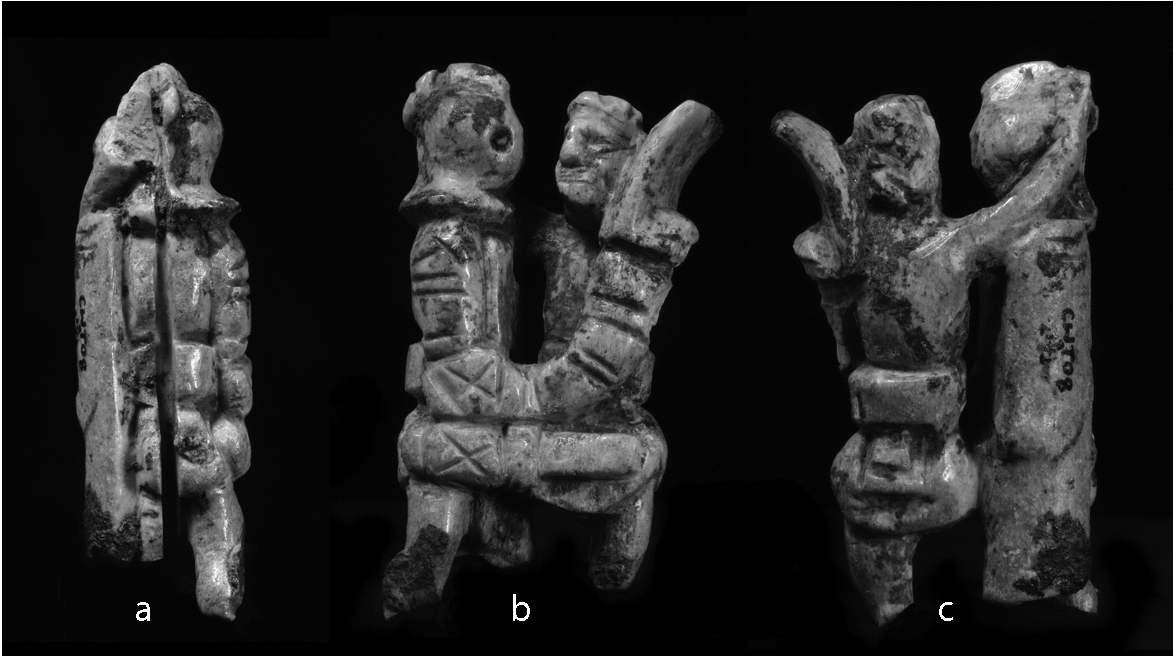
Dávid Bartus and Jessica M. Grimm write: An excavation by Channel 4’s Time Team in the Roman town of Caerwent (Venta Silurum) in 2008 produced a highly decorated ivory handle of a clasp-knife. The object was found in Insula XIV in redeposited demolition layers and cannot, therefore, be closely dated. The handle depicts two fighting gladiators, a rare form in Britain and, indeed, in the rest of the Roman world, and merits publication in its own right.
Insula XIV lies in the centre of the Roman town. Previous excavations have revealed the baths in Insula XIII to the west and a temple and shops in Insula IX to the north. The demolished buildings in Insula XIV were probably also shops.
The scene on the handle depicts two types of gladiators fighting. The object is probably made of ivory since no bone or antler cancellous structures could be detected on the surface, as would have been the case if bone or antler had been used for such intricate carving. The ivory may have come from an Asiatic or African elephant, and would have been available through the Roman Empire trading network. The object measures 48 by 28 mm and has a maximum thickness of 14 mm.
A vertical groove on the back of the helmeted figure indicates that the object was originally part of a clasp-knife (fig. 4a). The old breaks (and one fresh) at the bottom of the piece (across the legs of the figures) indicate that the carved scene was no longer functional as a knife when buried. It is possible that this skilfully crafted piece of art had some value in its own right.
Caerwent knife handle: (a) showing groove for the knife blade; (b) front depicting secutor on the left and retiarius on the right; (c) reverse. Scale 1:1. (Photos: Elaine Wakefield, Wessex Archaeology)

The figure on the left side (fig. 4b) depicts a heavily armed secutor. He wears a helmet with a dorsal ridge said to resemble a fish.Footnote 29 The helmet has a flared neck-guard and round eyeholes. His right sword arm is thickly padded (manica), as indicated by two sets of double horizontal lines. A loin cloth (subligaculum) with broad armoured belt (balteus) is also detailed. The chest and stomach area also seem to have been protected by some sort of rectangular shielding with two shallow holes, one in the right upper corner and one in the left lower corner. These holes were either purely decorative or it is possible that they were used to secure a thin layer of metal to the object. The gladiator’s back is probably bare. His right hand is protected by a glove which is held in place by leather straps, as indicated by carved crossed lines. This simplified representation of leather straps can be seen on other similar knife handles.Footnote 30 The hand holds a short straight-bladed sword, a gladius (tip broken off, fresh). The left arm is protected (not visible) by the curved rectangular shield, decorated at the top with two horizontal lines. The surviving part of the right leg (to the knee) seems to have been bare.
The other figure is the adversary of the secutor, the much lighter armed retiarius or net fighter.Footnote 31 This type of gladiator wears no helmet and the carving suggests shoulder-length hair held in place by a hairband. The eyes, nose and a grim-looking mouth are detailed. The left side of the neck and shoulder are protected by a rectangular, curved-upward shield (galerus; displaying new damage). The left arm is padded in similar fashion to that of his adversary (new damage). The gloved hand grips the right hand of the secutor around the wrist in order to fend off a thrust with the gladius. The bare right arm is extended and grips the back of the helmet of his adversary. Although a small part of the hand is missing (thumb indicated), it is unlikely that the retiarius held one of his traditional weapons in it: the trident, the net or a small dagger. Apart from the thick belt and the loincloth, the retiarius fights naked. A small rectangular pouch dangles from his waist on the right buttock (fig. 4c). The right upper thigh is bare and the left leg is missing. The fighting scene seems to depict a winning secutor and a desperate retiarius who has lost his weapons and has to resort to fighting with his bare hands. Alternatively, the scene could depict a drawn competition. Such an outcome is identifiable on a second-to-third-century terracotta medallion from Cavillargues, France,Footnote 32 which depicts a secutor and a retiarius having fought to a draw, with the inscribed phrase ‘stantes missi’.Footnote 33
The fighting scene depicted on the Caerwent knife handle can be found on other objects. A second-to-third-century tin-coated bronze fibula from Germany (find spot unknown) depicts a murmillo (the secutores developed out of this older class of gladiators) against a retiarius. The retiarius lies on the ground with his unprotected arm raised against the shield of the murmillo, who is standing with his gladius in hand, ready for the final blow.Footnote 34 The famous ‘Colchester vase’ depicts a fight between a secutor and a retiarius who raises his right hand as a sign of surrender.Footnote 35 A mosaic from Nennig, Germany, shows a fighting scene between a secutor and a retiarius,Footnote 36 the postures of the two gladiators being identical to those on the Cavillargues medallion.Footnote 37 A similar scene is also found on a mosaic in the archaeological museum of Tripoli, Libya.Footnote 38 Depictions of single gladiators are more common. For instance, terracotta figurines of gladiators, which were probably presented as small gifts on the New Year feast of the Saturnalia, have been found in Pompeii. They represent gladiators of the thraex and hoplomachus type.Footnote 39
Knife handles in the shape of gladiators are also not uncommon. More than thirty pieces are known,Footnote 40 some of them from Britain. Excavations at the villa of Piddington, Northants., recovered a clasp-knife with a copper-alloy handle and a folding iron blade. The handle depicts a gladiator of the secutor type and dates to a.d. 200–250.Footnote 41 Another copper-alloy clasp knife depicting a secutor has been found at Corbridge, Northumberland, but it is not securely dated.Footnote 42 Two unprovenanced knife handles, one copper-alloy and the other bone, both depicting a secutor, are held by the British Museum.Footnote 43 A clasp-knife handle made of ivory from the Roman fort at South Shields depicts a gladiator standing behind his rectangular shield and is dated to the late second/third century a.d.Footnote 44 Another ivory handle has been found in Lexden, with a depiction of a murmillo, dating from the first to second century a.d.Footnote 45
The only other known ivory knife handle that depicts two gladiators comes from Avenches (Aventicum), Switzerland. The scene is the same as on the knife handle from Caerwent with a secutor and retiarius in similar poses.Footnote 46 Three bronze knife handles from France also depict exactly the same fighting scene: one from Épône,Footnote 47 one from Moselle,Footnote 48 and another one with unknown provenance, from the department of Loir-et-Cher.Footnote 49
The five analogous knife handles are of very different quality. The Aventicum knife is one of the finest Roman knife handles; even the small details are carefully elaborated. The example from Caerwent is also of high quality, but somewhat poorer in detail compared with that from Aventicum. The bronze pieces are generally less detailed and of lower quality than the ivory ones, owing to the fact that they are cast. However, the example from Moselle is relatively rich in detail, compared with the other two bronzes, which are of very low quality and show local influence, especially the face of the retiarius on the knife handle from Loir-et-Cher.Footnote 50
This raises the question as to whether there is any connection between these five knife handles. The main aspects to consider are the possible centres of production and a common prototype. Although we lack any data on the production of the objects, differences in quality indicate that most of the recovered knife handles were produced in separate workshops. The exceptions to this are the knives from Moselle and Loir-et-Cher which are very similar in almost every detail. They are probably from the same workshop, though not from the same mould. The similar composition of the fighting scene and the identical posture of the gladiators indicate that the five knife handles could have had a common prototype, which may have been inspired by a drawing in a so-called ‘pattern-book’, rather than by a sculpture.Footnote 51
On stylistic grounds, the attractively carved knife handle found at Caerwent suggests a third-century date. All the other datable knife handles depicting secutores are also from the second to third century. Fights between a secutor and a retiarius are a favourite theme in third-century Roman art; it is not known if the scene depicted on the Caerwent knife handle records a famous fight between two well-known gladiators or is just a general fighting scene.
ACKNOWLEDGEMENTS
We are very grateful to Jörn Schuster, Wessex Archaeology, for providing some of the references and identifying the gladiatorial scene. Sabine Deschler-Erb, University of Basle, provided references for the knife from Aventicum.