Introduction
Frankliniella schultzei Trybom (Thysanoptera: Thripidae), known as the common blossom thrips (CBT), is a key crop pest causing worldwide economic loss (Kakkar et al., Reference Kakkar, Seal, Jha and Bagnall2014). The pest causes direct damage during feeding and oviposition, and indirect damage as a vector of tospoviruses (Sakimura, Reference Sakimura1969). Frankliniella schultzei is one of the major insect pests affecting French bean production in Kenya (Nyasani et al., 2010; Reference Nyasani, Meyhöfer, Subramanian and Poehling2012).
Frankliniella schultzei is distributed in two colour forms: dark and pale. The dark form is mainly distributed south of the Equator, while the pale form is mainly found north of the Equator (Sakimura, Reference Sakimura1969). The two forms of CBT coexist in the same habitat with overlapping host ranges in India, the Philippines, New Guinea, Northern Australia and East Africa (Mound, Reference Mound1968; Sakimura, Reference Sakimura1969). Overlapping habitats, host ranges and similar morphological features apart from the differences in colour, suggest their grouping as one species. Hence, the pale form which was originally described as Frankliniella sulphurea (Schmutz, Reference Schmutz1913) was synonymized with F. schultzei (Mound, Reference Mound1968).
Most thrips species reproduce both sexually and parthenogenetically (Moritz, Reference Moritz and Lewis1997). Although mixed colonies of both colour forms have been reported on some host plants (Mound, Reference Mound1968), no official reports on the possibility of interbreeding between the two forms are available, and differences between the two forms are not well established at morphological and molecular levels.
The colour forms are known to differ in their vector competence with the dark form considered to be a good vector of at least four tospoviruses, whereas the pale form is a weak vector of only two (Sakimura, Reference Sakimura1969; Cho et al., Reference Cho, Mau, Hamasaki and Gonsalves1988; Wijkamp et al., Reference Wijkamp, Almarza, Goldbach and Peters1995; Nagata and de Ávila, Reference Nagata and de Ávila2000). On the contrary, the pale forms are good vectors of Maize chlorotic mottle virus when compared to the dark forms (Nyasani et al., Reference Nyasani, Kusia and Subramanian2015).
Therefore, the current study aimed to resolve the taxonomic status of the two colour forms of F. schultzei through combined assessment of morphological, molecular, biological and ecological differences as suggested by Sakimura (Reference Sakimura1969). Physical features were compared morphometrically, and molecular differences were assessed using ITS-RFLP and sequence analysis. Interbreeding experiments were conducted, and host and ecological preferences of the two colour forms determined. This study emphasizes the importance of ‘integrative taxonomy’ in accurate species identification and nomenclature (Dayrat, Reference Dayrat2005), which is critical in quarantine pest diagnostic and management (Garza et al., Reference Garza, Ruiz and Ciomperlik2007).
Material and methods
Thrips rearing
The study was conducted at the International Centre of Insect Physiology and Ecology (icipe), Nairobi, Kenya. Isolated colonies of the two colour forms of F. schultzei were reared in icipe’s Animal Rearing and Containment Unit. The dark forms of F. schultzei originated from a population on Malvaviscus grandiflorus Kunth from Kasarani, Nairobi Province (GPS coordinates: −1.221, 36.897) and has been in culture for approximately 100 generations. The pale form of F. schultzei originated from a population on Phaseolus vulgaris (Linnaeus) in Kitui, Eastern Province (GPS coordinates: −1.298, 37.944) and has also been in culture for approximately 100 generations. Both colour forms were reared in ventilated plastic jars (1 litre) with thrips-proof nets covering the top. The two colour forms were reared on surface-sterilized French bean (P. vulgaris (L.) var. samantha) pods as described earlier by Niassy et al., (Reference Niassy, Maniania, Subramanian, Gitonga and Ekesi2012).
Biological characterization – interbreeding
To generate virgin parents, larvae of the different colour forms were transferred individually into 90 mm Petri dishes lined with a paper towel and fed with a piece of French bean pod (about 7 cm long) until adult emergence. Emerged adults were sexed and utilized in interbreeding experiments. Twenty dark and 20 pale F. schultzei females were placed individually in 10 ml glass vials for mating with dark males in a female to male ratio of 1:4 for 3 days. After mating, all females were placed in separate Petri dishes containing sterile French bean pod for oviposition. Recently emerged larvae (F1) were transferred to separate Petri dishes and fed as described above until adult emergence. Concomitantly, control treatments of virgin dark or virgin pale females were conducted with 20 females of each colour form held in the absence of males. The experiment was replicated three times. We could not undertake the interbreeding of pale males with dark females as pale males were not observed in the colony. Twenty parental specimens of both forms (dark and pale) and their respective F1 offspring (virgin dark female, virgin pale female, dark male × dark female and dark male × pale female) were cleared, dehydrated and mounted on slides with Canada balsam using methods outlined by Moritz et al. (Reference Moritz, Brandt, Triapitsyn and Subramanian2013).
Morphological characterization
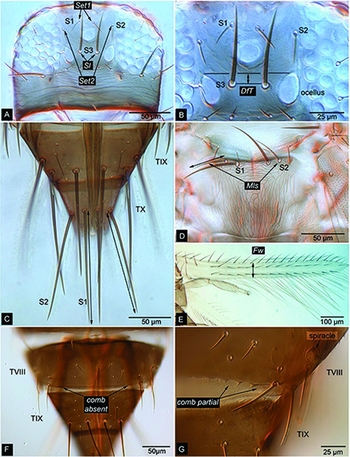
The identity of the specimens mounted on the slides was confirmed as F. schultzei using morphological features outlined in the Lucid key on ‘Pest thrips of East Africa’ (Moritz et al., Reference Moritz, Brandt, Triapitsyn and Subramanian2013). Eight morphological features were selected for further characterization of the specimens based on previous literature (Johansen, Reference Johansen2002; Hamodi and Abdul-Rassoul, Reference Hamodi and Abdul-Rassoul2004; Retana-salazar et al., Reference Retana-salazar, Cambero-campos and Sánchez2010; Wang et al., Reference Wang, Lin, Chiu and Shih2010; Subramanian et al., Reference Subramanian, Kumm, Nyasani, Waiganjo, Muchemi and Moritz2012; Moritz et al., Reference Moritz, Brandt, Triapitsyn and Subramanian2013). The features selected included the length of third ocellar setae (Sl), the distance of the third ocellar setae from the tangent of the anterior margin of the hind ocellar (DfT), the lengths of first ocellar setae (Set1), second ocellar setae (Set2), metanotal lateral setae (Mls), major setae on tergite X (TX), width of the forewings (Fw) and the appearance of posteromarginal comb of microtrichia on tergite VIII (Comb) (Fig. 1). Morphometric measurements were made on the specimens using a Leica DM LB® microscope fitted with Leica EC3® camera and Leica Application Suite Version 3.0.0 software (Leica Microsystems, Switzerland).
Morphological features used in morphometric study. (A) Set1, Set2 and Sl, first, second and third ocellar setae length, respectively; (B) DfT, distance of third ocellar setae from tangent of anterior margin of hind ocellar; (C) TIX and TX, Tergite 9 and 10, respectively; S1 and S2, TX major setae length (S=seta); (D) Mls, metanotal lateral setae length; (E) Fw, forewing width; (F–G) Comb, absence of comb and presence of partial comb, respectively; TVIII, tergite 8.

The length of third ocellar setae (Sl) and distance of the third ocellar setae from the tangent of the anterior margin of the hind ocellar (DfT), which are among the significantly different character states between the parents (Subramanian et al., Reference Subramanian, Kumm, Nyasani, Waiganjo, Muchemi and Moritz2012) were further used to characterize the F1 offspring from dark male × dark female and dark male × pale female crosses.
Molecular characterization
Individual specimens of F. schultzei stored in 95% ethanol were removed from 1 ml Eppendorf tubes and allowed to air dry for 2 min. Each specimen was then placed on a sterile microscope slide and their abdomen dissected using a sterile surgical blade. Total DNA was extracted from the dissected abdomen using ISOLATE II Genomic DNA Bioline Kit, following the manufacturer's instructions, with a slight modification of eluting the DNA in 30 µl elution buffer. The remaining body parts that consisted of head, thorax and a section of the abdomen were cleared and mounted on slides for morphological identification as described earlier.
The Internal Transcribed Spacer region (ITS2) was amplified from the DNA obtained using the primer pair ITS2 F 5′-CGAGTATCGATGAA- GAACGCAGC- 3′ (Despres et al., Reference Despres, Imbert-Establet and Monnerot1993) and ITS2 R 5′-AATGCTTAAATTTAGGGGGTA- 3′ (Campbell et al., 1994). Amplification was performed in 30 μl total reaction volumes, comprising 3 μl of genomic DNA solution, 10 pmol of each primer, 10mM dNTPs, 1.2 5mM MgCl2, 5X Phusion HF buffer, 100% DMSO and 5 units of Phusion DNA Polymerase. The amplification was carried out in an Arktik Thermo Scientific® Thermocycler. The DNA was initially denatured at 98 °C for 1 min and 10 s followed by 35 cycles of denaturation for 20 s at 98 °C, annealing for 40 s at 57.2 °C and elongation for 45 s at 72 °C. The last cycle was followed by a 10-min incubation period at 72 °C to complete any partially synthesized strands. The amplification products were separated by electrophoresis in 1% agarose gel containing ethidium bromide. Amplified DNA products were purified using ISOLATE II PCR and the Gel Bioline Kit and samples were sent for sequencing.
ITS2 fragments obtained from amplification using ITS2F-ITS2R primer pair were subjected to Restriction Fragment Length Polymorphism (RFLP) analysis using four restriction enzymes; AluI, HinfI, RsaI and HaeIII (Thermo Scientific, Inc). Each enzyme reaction was conducted separately. The reactions were done in 18 μl reaction volumes, comprising 10X Fast Digest green buffer, 2 units of restriction enzyme and 5 μl purified PCR products. The DNA was first digested at 37 °C for 14 h and then the reaction was stopped by denaturing the enzyme at 65 °C for 5 min. The restricted fragments were separated by electrophoresis in 2% agarose gel containing ethidium bromide at 70 V for 1.5 h and visualized under the UV imaging system.
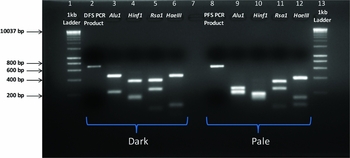
Due to the absence of pale F. schultzei males in the colony, it was essential to confirm their presence in the wild. Male F. schultzei were collected from Ipomoea setosa Ker-Gawl flowers which hosted both pale and dark F. schultzei. All males were treated as tentative candidates. DNA was extracted from individual male F. schultzei, the ITS2 regions amplified and the fragments digested using Alu1 restriction enzyme as described above. Since Alu1 generated distinct markers among the parents (Fig. 2), it was selected for screening of the males from the wild population. Twenty of the males collected from I. setosa were also mounted on slides as described above and their morphometrics measured, based on the eight variables previously stated.
ITS2-RFLP banding profile of dark and pale forms of Frankliniella schultzei. (Lanes 1 and 13) 1Kb ladder; (lanes 2 and 8) ITS2 PCR Product of dark and pale forms, respectively; (lanes 3−6 and 9−12) restriction of ITS2 region of dark and pale forms, respectively using restriction enzymes Alu1, Hinf1, Rsa1 and HaeIII.

Ecological characterization
Host plant and ecological preferences of the two colour forms were assessed by analysing the geo-referenced database maintained in the Biosystematics Unit, icipe. A total of 1383 F. schultzei specimens were sampled between August 2008 and July 2009 from over 88 locations in Kenya. At each location, sampling was undertaken at random from 10 × 20 plants/location using the standard ‘Plant tapping method’ (Pearsall and Myers, Reference Pearsall and Myers2000; Mfuti et al., Reference Mfuti, Subramanian, van Tol, Wiegers, de Kogel, Niassy, du Plessis, Ekesi and Maniania2016). The geo-referenced database includes information on the global positioning system (GPS) coordinates of each sampling location, host plant records, dates of collection and thrips species information.
Data analysis
Analysis of data obtained from the morphometrics study was performed using R version 3.1.3 (R Core Team, Reference Core Team2015). Normality of data was checked using the Shapiro–Wilk test. Multiple comparisons of mean of the morphometric features between parents (dark and pale) and respective F1 off spring (dark male × dark female and dark male × pale female) were made using ANOVA in Microsoft® Excel 2007/XLSTAT©-Pro (Version 6.1.9, 2003, Addinsoft, Inc., Brooklyn, NY, USA). The level of significance was fixed at 95%. Principal component analysis (PCA) was then conducted using R 3.1.3 (R Core Team, Reference Core Team2015) to determine the relationship between dark and pale F. schultzei parental populations, as well as between dark F. schultzei males from the colony and F. schultzei males from I. setosa. This was determined, based on the clustering of the eight morphometric variables measured. ITS2 DNA sequences were analysed by first editing and aligning them using Geneious® version 8.0.2 (Kearse et al., Reference Kearse, Moir, Wilson, Stones-Havas, Cheung, Sturrock, Buxton, Cooper, Markowitz, Duran, Thierer, Ashton, Meintjes and Drummond2012). Consensus sequences were deposited in the GenBank and accession numbers were obtained. Homology searches of the ITS2 sequences against DNA databases were performed using nBLAST (http://www.ncbi.nlm.nih.gov/blast). Multiple sequence analysis of both dark and pale F. schultzei parental ITS2 sequences were conducted using Clustal W2 (Larkin et al., Reference Larkin, Blackshields, Brown, Chenna, Mcgettigan, McWilliam, Valentin, Wallace, Wilm, Lopez, Thompson, Gibson and Higgins2007). Pairwise sequence divergence was calculated using the Kimura two parameter model (Kimura, Reference Kimura1980) in MEGA 6 (Tamura et al., Reference Tamura, Stecher, Peterson, Filipski and Kumar2013). To visualize the patterns of divergence, a neighbour-joining tree (Saitou and Nei, Reference Saitou and Nei1987) was constructed from the evolutionary distances using a bootstrap of 1000 replicates and complete deletion option. The genetic distances were also used to generate a principal component plot using GenAlEx 6.41 (Peakall and Smouse, Reference Peakall and Smouse2006). The descriptive statistical analysis on host plant and geographic preference were performed using Microsoft® Excel 2007/XLSTAT©-Pro (Version 6.1.9, 2003, Addinsoft, Inc., Brooklyn, NY, USA).
Results
Biological characterization – interbreeding
Virgin dark F. schultzei produced only male F1 offspring. Virgin pale F. schultzei produced only female F1 offspring. The dark male × dark female produced dark F1 offspring, both male and female at a ratio of 1:1. Pale male × dark female produced only pale female F1 offspring (Table 1).
Interbreeding of Frankliniella schultzei colour forms

Morphological characterization
Multiple comparison of mean of morphometric features
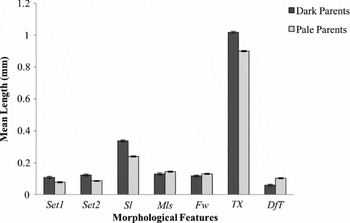
Analysis of the parents revealed that there was significant difference between the two colour forms for Set1 (F1,38 = 32.29, P < 0.0001); Set2 (F1,38 = 87.60, P < 0.0001); Sl (F1,38 = 187.38, P < 0.0001); Terg10 (F1,38 = 51.53, P < 0.0001); DfT (F1,38 = 115.06, P < 0.0001); Mls (F1,38 = 29.31, P < 0.0001) and Fw (F1,38 = 21.30, P < 0.0001). Post-hoc comparison using the Tukey HSD test indicated that the dark F. schultzei parents had significantly longer Set1 (0.108 ± 0.004), Set2 (0.123 ± 0.003), Sl (0.337 ± 0.005), Terg10 (1.019 ± 0.012) as compared to the pale parents Set1 (0.078 ± 0.005), Set2 (0.086 ± 0.004), Sl (0.240 ± 0.007) and Terg10 (0.900 ± 0.017). It was observed that the dark parents had significantly shorter Mls (0.130 ± 0.002), Fw (0.117 ± 0.002) and DfT (0.059 ± 0.003) as compared to the pale parents Mls (0.145 ± 0.003), Fw (0.130 ± 0.003) and DfT (0.103 ± 0.004) (Fig. 3).
Mean length of seven quantitative morphological features of parental populations of the two colour forms of Frankliniella schultzei.

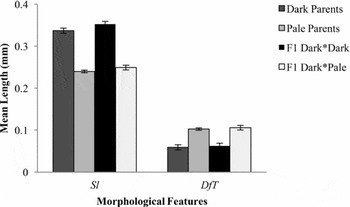
Further analysis of parents compared to their F1 offspring revealed significant differences amongst the parents and F1 for Sl (F3, 91 = 74.85, P = < 0.0001) and DfT (F3,91 = 20.80, P = < 0.0001). Post-hoc comparison using the Tukey HSD test indicated that Sl of dark parents (0.337 ± 0.005) was significantly longer than that of the F1 offspring of dark male × pale female cross (0.249 ± 0.012). Pale parents (0.240 ± 0.007) had significantly shorter Sl compared to F1 offspring of the dark male × dark female cross (0.353 ± 0.009). Sl was also significantly longer in the F1 offspring of the dark male × dark female cross (0.353 ± 0.009) than those from the dark male × pale female cross (0.249 ± 0.012). No significant differences were found in Sl between dark parents (0.337 ± 0.005) and dark male × dark female F1 offspring (0.353 ± 0.009) as well as between pale parents (0.240 ± 0.007) and dark male × pale female F1 offspring (0.249 ± 0.012) (Fig. 4). The DfT was significantly shorter in dark F. schultzei parents (0.059 ± 0.003) as compared to the F1 offspring from the dark male × pale female cross (0.106 ± 0.009). Pale parents (0.103 ± 0.004) had significantly longer DfT than the F1 offspring of the dark male × dark female cross (0.062 ± 0.007). Dark male × dark female offspring (0.062 ± 0.007) had significantly shorter DfT than dark male × pale female F1 offspring (0.106 ± 0.009). No significant difference in DfT was found between dark parents (0.059 ± 0.003) and F1 offspring of the dark male × dark female cross (0.062 ± 0.007) or between pale parents (0.103 ± 0.004) and F1 offspring of the dark male × pale female cross (0.106 ± 0.009) (Fig. 4).
Mean length of third ocellar setae (Sl) and distance of the third ocellar setae from the tangent of the anterior margin of the hind ocellar (DfT) of parental populations of the two colour forms of Frankliniella schultzei compared to their F1 offspring.

Appearance of Comb in the dark form was either absent or incomplete with one or two pairs of marginal microtrichia while the pale form had an incomplete marginal Comb with three pairs of microtrichia (Fig. 1).
Principal component analysis of morphometric data
The first two principal components contributed to 94.1% of the total variance (PC1 = 86.9 and PC2 = 7.2). The scatter plot developed using the loadings generated by PC1 and PC2 showed significant differences between dark and pale F. schultzei as the two forms separated into two distinct clusters (Fig. 5). The four most different contributing features were the length of the major setae at tergite 10, length of the third ocellar setae, second ocellar setae length and distance of third ocellar setae from tangent of anterior margin of hind ocellar, each contributing 79, 52.5, 19.3 and 18% towards the distinct clustering of the colour forms, respectively.
Principal component analysis of morphometric character states of dark and pale forms of Frankliniella schultzei.

Molecular characterization
ITS2-RFLP analysis
The ITS2 region of both dark and pale F. schultzei parents produced fragments of ~700 bp. Digestion of their respective amplicons using Alu1, Hinf1, Rsa1 and HaeIII restriction enzymes yielded differences in banding patterns and fragment sizes between the two colour forms (Fig. 2). Restriction by Alu1 produced two bands in both colour forms, with a common ~200 bp band but the dark form had a second ~500 bp band, while the second band for the pale form was ~250 bp. There were also differences in the bands produced by Hinf1 and Rsa1 in both colour forms, with both colour forms having similar first bands of ~150 bp and ~250 bp in these two enzymes, respectively. However, restriction with Hinf1 resulted in a second band of ~350 bp for the dark form, while the pale form had a second band of ~200 bp. Similarly, in Rsa1, the dark form had a second band of ~400 bp while the pale form had a second band of ~350 bp. Restriction with HaeIII resulted in a distinct band of ~150 bp for the pale form which was absent in the dark form.
Nucleotide sequence variation
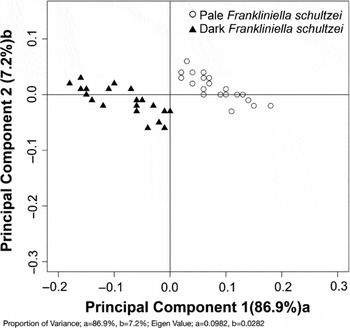
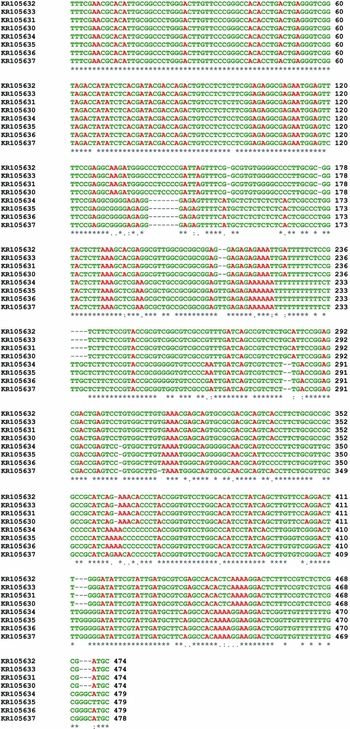
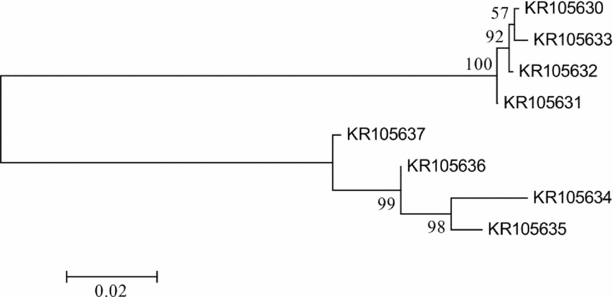
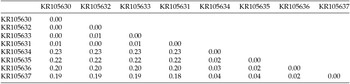
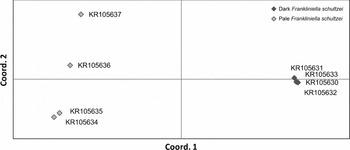
The sequences obtained in this study were deposited in the GenBank; accession numbers KR105630−KR105633 for dark forms and accession numbers KR105634−KR105637 for pale forms. Multiple alignments of sequences from the dark and pale forms of F. schultzei in Clustal W2 showed consistent nucleotide differences between the two forms (Fig. 6). Distance estimates from the sequences obtained were used to generate a neighbour-joining tree which separated the dark and pale F. schultzei into two clades (Fig. 7). The genetic distance between the two colour forms ranged between 0.18 and 0.23. The average distance between the individuals within the same colour form was estimated between 0.00 and 0.01 among the dark forms and 0.00 and 0.04 among the pale forms, respectively (Table 2). The PCA of the genetic distances resulted into two distinct clusters of the two colour forms (Fig. 8).
Multiple sequence alignment of a 498 bp section from the ITS2 region. Dark (KR105630 – KR105633) and pale (KR105634 – KR105637) Frankliniella schultzei sequences.

Unrooted neighbour-joining tree of Frankliniella schultzei constructed from Kimura two-parameter distance model. Dark (KR105630 – KR105633) and pale (KR105634 – KR105637).

Genetic distances of Frankliniella schultzei ITS2 sequences. Dark (KR105630 – KR105633) and pale (KR105634 – KR105637)

Principal component analysis of genetic distances between dark and pale forms of F. schultzei. Dark (KR105630 – KR105633) and pale (KR105634 – KR105637) Frankliniella schultzei.

Confirmation of the absence of pale F. schultzei males in the environment
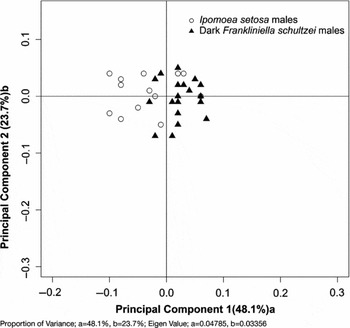
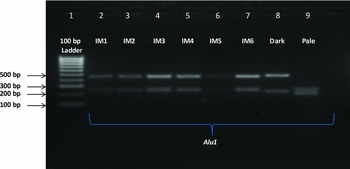
PCA conducted on specimens collected in the wild showed that there was no significant difference between males from the colony of dark F. schultzei and those found in I. setosa flowers, the two populations clustered together (Fig. 9). These results were also supported by comparison of the ITS2-RFLP banding pattern produced by restriction of the ITS2 region of males collected from I. setosa flowers and males from the dark F. schultzei colony by restriction enzyme Alu1 (Thermo Scientific, Inc). All wild males had banding patterns identical to those of dark males in the laboratory colony (Fig. 10).
Principal component analysis of morphometric characters of males from Ipomoea setosa and dark Frankliniella schultzei males from the laboratory colony.

ITS2-RFLP banding profile of males from Ipomoea setosa. (Lane 1) 100 bp ladder; (lanes 2–7) Restricted ITS2 region of males from Ipomoea setosa digested using restriction enzyme Alu1; (lane 8) dark F.schultzei male from colony; (lane 9) pale F. schultzei female from colony.

Ecological characterization
Host plant and geographical preference
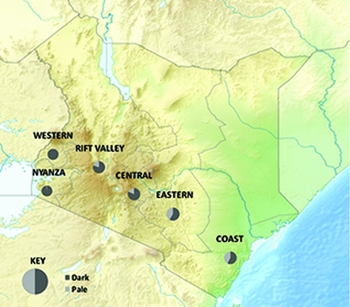
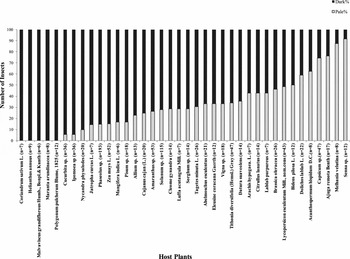
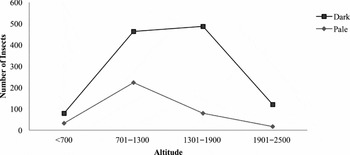
Among the 1383 F. schultzei specimens observed from the thrips collections at icipe, the proportion of dark F. schultzei (68%) exceeded that of the pale F. schultzei form (32%). The dark colour form was predominant in Western and Nyanza provinces, which are dry to sub-humid mid-altitude regions in the Lake Victoria basin. The proportion of pale F. schultzei population increased gradually towards the coast with highest proportions in the low altitude hot and humid coastal province followed by the warm and dry medium altitude region in the Eastern Province (Fig. 11). The host plants with the highest proportion of dark F. schultzei were Phaseolus sp., Cucurbita sp. and Ipomoea sp. while those with the highest populations of pale forms were Capsicum sp., Senna sp. and Ajuga remota Benth (Labiatae). Host plants that had nearly equal proportions of both colour forms of F. schultzei were Bidens pilosa L. 1753, Brassica oleracea L., Citrullus lanatus (Thunb.) Matsum. & Nakai and Solanum lycopersicum L. (Fig. 12). The population of the dark colour form increased with altitude and is most prominent at altitudes of 700−1900 m. Above 1300 m, the population of the pale colour form decreased as altitude increased (Fig. 13).
Proportion of dark and pale Frankliniella schultzei in different provinces of Kenya.

Proportion of dark and pale forms of Frankliniella schultzei collected from different host plants in Kenya.

Numbers of dark and pale forms of Frankliniella schultzei collected from different altitudinal classes in Kenya.

Discussion
Thysanopterans are a highly diverse group of organisms with over 5200 recognized species (Moritz et al., Reference Moritz, Delker, Paulsen, Mound and Burgermeister2000). Within the group, subtle variations in the morphological character states delineate differences in species (Mound, Reference Mound2002). Within thrips species, a high degree of variability in morphological character states have been reported in Frankliniella occidentalis (Pergande) (Chumak, Reference Chumak2014; Cluever et al., Reference Cluever, Smith, Funderburk and Frantz2015) and Scirtothrips dorsalis Hood (Rugman-Jones et al., Reference Rugman-Jones, Hoddle, Mound and Stouthamer2006; Hoddle et al., Reference Hoddle, Heraty, Rugman-Jones, Mound and Stouthamer2008a ; Dickey et al., Reference Dickey, Kumar, Hoddle, Funderburk, Morgan, Jara-Cavieres, Shatters, Osborne and McKenzie2015). Similarly populations of some thrips species have been shown to differ in their modes of reproduction and host associations, as has been shown for Thrips tabaci (Jenser and Szénási, Reference Jenser and Szénási2004; Jenser et al., Reference Jenser, Lipcsei, Szénási and Hudák2006; Westmore et al., Reference Westmore, Poke, Allen and Wilson2013; Nault et al., Reference Nault, Kain and Wang2014). The CBT, F. schultzei also exhibits a high degree of variability in terms of morphological characters (Johansen, Reference Johansen2002; Cavalleri and Mound, Reference Cavalleri and Mound2012) and populations have been grouped into pale and dark colour forms (Mound, Reference Mound1968). However, the taxonomic status of the two colour forms of F. schultzei has been a subject of debate among thrips biologists. Some biologists, e.g., Bhatti et al. (Reference Bhatti, Alavi, zur Strassen and Telmadarraiy2009), considered the pale form of F. schultzei as a separate species, F. sulphurea (Schmutz, Reference Schmutz1913). Others consider the two colour forms as one species since they occur sympatrically with overlapping host plants (Mound, Reference Mound1968; Hoddle et al., Reference Hoddle, Heraty, Rugman-Jones, Mound and Stouthamer2008b ). Apart from the differences in colour, analysis of eight morphometric character states undertaken in this study revealed significant differences between the two colour forms. The length of the major setae at tergite 10, length of the third and second ocellar setae and distance of third ocellar setae from the tangent to the anterior margin of hind ocellar were key character states that differentiated the two colour forms.
In addition to differences for morphological character states, the two colour forms of F. schultzei exhibited significant variations at molecular level with genetic distances of up to 23% between them, grouping them into two distinct clades. Considering the fact that the ITS region has a high inter-specific variability and low intra-specific variability (Moritz et al., 2001), the high level of molecular differences between the two colour forms of F. schultzei in the ITS regions argues strongly that they are two different species. The non-coding and highly evolving ITS2 region has been used to identify closely related thrips species (Toda and Komazaki, Reference Toda and Komazaki2002; Rugman-Jones et al., Reference Rugman-Jones, Hoddle, Mound and Stouthamer2006; Farris et al., Reference Farris, Ruiz-Arce, Ciomperlik, Vasquez and Deleón2010).
The pale and dark forms of F. schultzei have an allopatric distribution (Sakimura, Reference Sakimura1969) with Kenya, Uganda, Sudan, India, New Guinea and Puerto Rico as regions where both colour forms are found (Mound, Reference Mound1968; Kakkar et al., Reference Kakkar, Seal, Jha and Bagnall2014). In allopatric populations, genetic divergence usually leads to evolution of barriers (Gavrilets, Reference Gavrilets2004) which in turn could become a hindrance to interbreeding and reproductive isolation, therefore, contributing to speciation (Bush, Reference Bush1975). Our study did not find evidence of pale F. schultzei males either in the colony or in the wild. The absence of males needs to be further confirmed in other host plants and regions. Circumstantial evidence for absence of males in F. schultzei is given by Wijkamp et al. (Reference Wijkamp, Almarza, Goldbach and Peters1995), where the population of pale F. schultzei used for transmission studies had only females, while the population of dark F. schultzei had both males and females. The absence of pale males and emergence of female progenies from virgin pale female indicates a thelytokous form of parthenogenetic reproduction in pale F. schultzei. On the other hand, emergence of male progenies from virgin dark females indicates an arrhenotokous form of parthenogenetic reproduction in dark F. schultzei. Endosymbionts such as Wolbachia spp. (Kumm and Moritz, Reference Kumm and Moritz2008) are known to influence parthenogenetic reproduction. This needs to be further investigated with the two colour forms of F. schultzei. Emergence of female progenies similar to the female parent in dark male × pale female crosses indicates the existence of barriers to interbreeding between the colour forms and further strengthens the evidence for thelytokous reproduction in pale F. schultzei. The allopatric distribution of the two colour forms might have created differences in their mate-choosing response systems, creating a pre-mating barrier and eventually preventing interbreeding within the same ecosystem (Templeton, Reference Templeton, Otte and Endler1989; Grant and Grant, Reference Grant and Grant2009) as observed in this study. In recent studies with F. occidentalis, Rugman-Jones et al., (Reference Rugman-Jones, Hoddle and Stouthamer2010) found evidence of reproductive isolation in biologically and morphologically diverse sympatric populations of F. occidentalis. This was based on differences in nuclear as well as mitochondrial gene sequences, inferring that the diverse populations could be two cryptic species.
From an ecological perspective, the distribution of two colour forms appears to be influenced by the climate and host plant. Pale forms were more prevalent in the low altitude, hot and humid regions of the coast and warm and dry mid-altitudes of Eastern Province of Kenya, while the dark forms were prevalent in the high altitude, cool and wet regions of Central Province and in the warm and humid medium altitude regions of Western and Nyanza provinces of Kenya. The differences in agroecological preferences of the two colour forms could be related to their host plant preference. Host plants such as beans (Phaseolus sp.) and cucurbits (Cucurbita sp.) that are widely grown in high altitude regions with cool temperatures are predominantly infested by dark forms. Plants such as Capsicum sp., Senna sp. and Ajuga remota Benth, which thrive well in the low altitudes with warm and humid conditions were predominantly infested by the pale forms. Differences in prevalence of pale and dark F. schultzei might be related to variations in temperature in the different agroecologies. Temperature and colour of the insects influenced the body temperatures and thereby the insect physiology and their abundance. For instance, Murai and Toda (Reference Murai and Toda2001) reported that at lower rearing temperatures, T. tabaci adults were darker as compared to paler thrips when reared at higher temperatures. Similarly, in montane areas often characterized by cool temperatures, the dark forms of F. occidentalis were frequently observed (Hoddle et al., Reference Hoddle, Heraty, Rugman-Jones, Mound and Stouthamer2008b ). Dark forms of F. occidentalis were more abundant during the cooler months, while pale forms were abundant during the warmer months (Elimem et al., Reference Elimem, Harbi and Chermiti2011).
The morphometric, molecular, ecological and host plant differences between the dark and pale forms of F. schultzei (together with their inability to interbreed) lead us to conclude that the colour forms represent distinct species. Further investigation on the presence/absence of pale F. schultzei males in different regions and host plants, factors influencing the modes of parthenogenetic reproduction, differential response to climatic variables, and vector competence could provide valuable insights into the divergence of the two species. This study also highlights the importance of the integrative taxonomic approach for conclusively resolving the species status of closely related population of thrips. Effective management of insect pests begins with their unambiguous and accurate identification.
Acknowledgements
This study was funded by BMZ (The German Federal Ministry for Economic Cooperation and Development) through GIZ (Deutsche Gesellschaft für Internationale Zusammenarbeit) funded project entitled ‘Implementation of integrated thrips and tospovirus management strategies in small-holder vegetable cropping systems of Eastern Africa’ (Project no.11.7860.7-001.00, contract no. 81141840). We are grateful to Levi Ombura and Benard Muia for technical support. We also thank Dr Jandouwe Villinger for assistance in bioinformatics analysis.