


Individual behavior is increasingly salient in the context of rights abuses. Human rights monitors look harder for abuse, find abuse in more places, and classify different types of abuse as human rights violations (Fariss Reference Fariss2014). As those violations are more broadly monitored and classified, holding individuals accountable is becoming a norm (Sikkink Reference Sikkink2011). The U.S. #BlackLivesMatter movement, reacting to police brutality against black citizens, both exemplifies the growing movement towards accountability and reflects the individual-level link between discrimination and other rights abuses. Nevertheless, the global rights community has far to go in battling racial injustice and other rights abuses at the level of the individual, whether directed at Dalits in India, individuals of Haitian descent in the Dominican Republic, or members of any other marginalized group. Human rights scholars rarely systematically gather individual-level data about human rights behaviors to link them to broader human rights institutions. By examining efforts to eliminate individual-level discrimination which itself often results in further rights abuses, this article aims to provide insights into macro- and microlevel processes that potentially lead to positive human rights outcomes.
Using the context of discrimination against the Roma in Slovenia and Croatia, I test the ground-level effectiveness of two strategies. The first strategy is a top-down combination of incentives and norm promotion; I ask if it affects individual behavior. I then test the same ground-level effectiveness of the second strategy, a local NGO-led effort to improve contact between those who discriminate and those who are targets of discrimination. In testing the first strategy, I conduct a border study of two closely matched towns in Croatia and Slovenia. The EU accession process provides incentives and norm promotion in Croatia, but not in Slovenia. In examining the second, I perform a within-country comparison of two closely matched Slovene towns. One has an NGO effort to improve contact and the other does not. I measure discrimination at the individual level in an experimental setup, using the trust game (Berg et al. Reference Berg, Dickhaut and McCabe1995).Footnote 1
The top-down rights improvement strategy does not appear to reduce discrimination on the ground, but the bottom-up NGO effort does. The findings suggest that incentive-based and traditional norm-promoting strategies, while powerful at the state level, may not have effects that reach individual behavior. The results further suggest that in targeting individuals, a human rights strategy that is experiential and not merely persuasive might be particularly effective.
Human rights scholarship tends to examine the two components of the first strategy separately. Incentive-based mechanisms are generally aimed at state actors, and affect rights practices through rights conditionality in exchange for benefits like preferential trade privileges (Hafner-Burton Reference Hafner-Burton2005; Simmons et al. Reference Simmons, Dobbin and Garrett2008). Norm promotion addresses states and individuals alike, and affects rights practices and public opinion chiefly by naming and shaming (Brysk Reference Brysk1993; Davis et al. Reference Davis, Murdie and Steinmetz2012; Hafner-Burton Reference Hafner-Burton2008; Hendrix and Wong Reference Hendrix and Wong2012; Keck and Sikkink Reference Keck and Sikkink1998; Khagram et al. Reference Khagram, Riker, Sikkink, Khagram, Riker and Sikkink2002; Sikkink Reference Sikkink1993). While these two types of strategies are quite distinct, they are sometimes linked in practice. When a state commits to rights improvements in exchange for externally granted benefits or when such benefits are suspended in light of rights violations, norm entrepreneurs use the opportunity to mobilize. In fact, suspension of benefits may in part be due to naming and shaming. Human Rights Watch, for example, reports extensively on inadequate uses of the African Growth and Opportunity Act (AGOA) conditionality in improving rights practices in various African countries (Kasambala Reference Kasambala2014). When the United States revoked Swaziland’s AGOA status due to insufficient protections of workers’ and human rights, the decision accordingly received much attention (Hughes Reference Hughes2014). The two strategies, while chiefly operating at state and international levels, at least partly rely on domestic audiences to mobilize in favor of rights change (Keck and Sikkink Reference Keck and Sikkink1998; Simmons Reference Simmons2009). An individual actor observing or participating in public discourse, however, might not distinguish between incentives and norm promotion, but simply perceive that rights should be changed. In studying individuals, then, the effects of two strategies that often appear together ought to be considered together as well.
An alternative strategy to change discriminatory behavior, much smaller in scope than the approaches just mentioned, stems from NGO efforts that encourage contact between the majority population and the marginalized group in order to foster inclusion. While the merits of intergroup contact remain contested, laboratory-based scholarship in psychology strongly suggests that intergroup contact reduces prejudice and discriminatory intent (Allport Reference Allport1954; Dovidio et al. Reference Dovidio, Gaertner, Nier, Kawakami, Hodson and Miller2004; Miller Reference Miller2002; Pettigrew Reference Pettigrew1998; Pettigrew and Tropp Reference Pettigrew and Tropp2006; Wagner et al. Reference Wagner, Christ and Pettigrew2008). Recent evidence from field experiments offers additional support; when white children (Green and Wong Reference Green, Wong, Borgida, Federico and Sullivan2009) or college students (Boisjoly et al. Reference Boisjoly, Duncan, Kremer, Levy and Eccles2006; Laar et al. Reference Laar, Levin, Sinclair and Sidanius2005) are randomly assigned to diverse groups for short-term or extended interactions, they show lower levels of prejudice. Efforts on the part of NGOs to increase contact between those who transgress and their targets at the individual level may, then, decrease prejudice and discrimination at that level as well. Most research on intergroup contact is conducted in the American context, predominantly examining prejudice of whites towards blacks; by studying discrimination in Europe, this article offers a departure from this tradition.
I conduct a test of the intergroup contact strategy and the combination of incentives and norm promotion in the context of discrimination against the Roma in Slovenia and Croatia. The Roma, commonly referred to by the disfavored term “Gypsies” (Hancock Reference Hancock2002), are the largest ethnic minority in Europe. Historically, the Roma have been variously enslaved, deported, forcibly assimilated, and subjected to genocide (Barany Reference Barany2002). Today, many remain segregated and face discrimination in schools, on the job market, in hospitals, in police stations, and on the street (European Roma Rights Centre (ERRC) 2004). This study examines the Roma because they are a clear case of a minority that has suffered discrimination, abuse, and exclusion for centuries. In such a seemingly intractable case, identifying interventions that promote inclusion would show promise for studying and curtailing marginalization in various other communities that historically have been denied or have themselves resisted inclusion.
My empirical strategy involves two approaches: a border study and a within-country design. I use a border study to examine the combination of incentives and norms. The EU accession process is arguably the strongest mechanism of human rights conditionality, and is deemed particularly powerful in the context of Roma rights (Schimmelfennig et al. Reference Schimmelfennig, Engert, Knobel, Schimmelfennig and Sedelmeier2005). To gain membership, EU candidate states must enact legislative and policy changes that protect Roma rights, at state and local levels. Conditionality demands are accompanied by norm advocacy and naming and shaming, via NGOs and official EU channels. I leverage this process and measure discrimination against the Roma in two towns, one in Croatia and one in Slovenia, that match closely on 43 Roma and human rights related factors at state, regional, and local levels. At the time of investigation, Croatia was at the height of the EU accession process and thus faced enormous pressures to improve its treatment of the Roma. In contrast, Slovenia had been an EU member for eight years and faced no pressure to improve Roma rights.
I test the intergroup contact strategy in the context of discrimination against the Roma in two towns in Slovenia that match exceptionally well on 12 local/regional Roma and human rights-related factors, but differ in type of NGO action. Action in the first town is inclusive—targeting both Roma and non-Roma—and promotes intergroup contact. NGO action in the second town is not inclusive and focuses on service provision to Romani settlements. Accordingly, roughly half of randomly sampled non-Roma from the first town are familiar with the NGO; in the other town, the same holds for only two percent. NGO leaders’ personal idiosyncrasies completely define the organizations’ foci. This mitigates the endogeneity concern that the two types of NGOs developed because of beliefs that their types would be particularly effective in their respective environments.
To test the two hypotheses, I use simple games intended to capture other-regarding behavior, which map remarkably well onto the stereotype that motivates anti-Roma sentiment. Discrimination against the Roma is largely motivated by the belief that the Roma are cheaters and thieves. The trust game (Berg et al. Reference Berg, Dickhaut and McCabe1995) played with money elicits behavior by non-Roma that demonstrates distrust towards the Roma; given the strong link between distrust and discrimination in this particular case, the method likely captures discriminatory behavior.
I find no support for the hypothesis that a high-level combined strategy of incentives and norm promotion affects individual behavior. At the height of the EU accession process, Croats discriminated against the Roma, while Slovenes just across the border, under no pressure to improve their treatment of the Roma, did not. I find support, however, for the intergroup contact hypothesis. Slovenes from a town with inclusive NGO action treated Roma no differently than non-Roma, whereas Slovenes from a town with noninclusive NGO action discriminated against the Roma.
My findings suggest that (1) while powerful at the state level, incentive-based and traditional norm promoting strategies inherent in the EU accession process may not necessarily have effects that reach the individual, and (2) NGOs promoting intergroup contact between Roma and non-Roma can help reduce discrimination. In the context of changes at the individual level, then, microlevel strategies that engage individuals as participants in normative behavior may be preferable to (otherwise powerful) macrolevel strategies that merely advocate for it.
Quantitative human rights scholarship tends to view rights violations in a top-down manner, with the state as an abuser and the citizen a victim. Some cases of abuse are not as clear-cut. State actors may be the primary perpetrators, but their behavior may reflect the general tenor of the environment. For example, citizens may implicitly or explicitly support abuse. In India, government food security programs are often situated in locales that exclude Dalits; if not, Dalit children are often chased away from schools when they try to take advantage of the midday meal scheme to which they are entitled (Thorat and Lee Reference Thorat and Lee2005). Actions of parents, teachers, and local administrators are intertwined; parents mobilize in favor of Dalit exclusion (Thorat and Lee Reference Thorat and Lee2005), while the officials curb the children’s right to food. Further, citizens can themselves become state actors. Consider American juries. In murder cases of white victims, black defendants are significantly more likely than white defendants to receive the death sentence (Baldus et al. Reference Baldus, Woodworth, Zuckerman, Weiner and Broffitt1998), particularly so if they look more stereotypically black (Eberhardt et al. Reference Eberhardt, Davies, Purdie-Vaughns and Johnson2006). Some cases of human rights violations, then, demand that we examine individual actors, both state and nonstate, if we aim to understand and improve human behavior. This article offers a small contribution to that effort.
In what follows I first introduce the Roma. Next, I present the two strategies of human rights change along with expectations about their efficacy at the level of the individual. The empirical strategy, results, and a broader discussion of implications follow. The last section concludes.
WHO ARE THE ROMA AND WHY USE THEIR CASE HERE?
The Roma are the largest ethnic minority in Europe. Population counts are unreliable; conservative estimates report that as many as 9 million Roma currently reside in Europe (Polzer-Srienz Reference Polzer-Srienz, Klopčič and Polzer2003). The Roma first arrived in Europe at the end of the 13th century, having emigrated from north-western India centuries before (Courthiade Reference Courthiade, Klopčič and Polzer2003). Contrary to romanticized popular perceptions, they are generally no longer itinerant (Matras Reference Matras2000)—some groups, in fact, were never peripatetic.Footnote 2 Until very recently many engaged in traditional economic activities which primarily defined their tribal identities.Footnote 3 While modernization rendered many of those crafts obsolete, tribal diversity survives and to a large extent characterizes Romani individuals. The largest concentration of Roma in Eastern Europe is in Romania, followed by Hungary. Historically, the Roma have been variously enslaved,Footnote 4 deported,Footnote 5 forcibly assimilated,Footnote 6 and subjected to genocide (Djurić Reference Djurić2007).
While today many Roma have integrated into their respective majority populations, most remain segregated. The segregated populations are generally socially disadvantaged and bear the brunt of discrimination. In many states, Roma children are schooled in remedial special schools for mentally disabled, whether or not they have actual disabilities (Cahn Reference Cahn2002). Roma face significant barriers in accessing employment, frequently live without electricity or sewerage, generally receive substandard health care, and are often deemed undeserving of social welfare. Many do not have personal documents and are effectively stateless; they are more likely than non-Roma to be abused by the police in general, while in detention, and while in prison (ERRC 1997). These marginalized populations are therefore predominantly poor, unemployed and undereducated. To survive, numerous Roma are forced to engage in illicit activities that range from small-scale theft of scrap metal to usury and transnational trafficking in weapons, drugs, and humans (Anonymous 2012). Criminality fuels the already existing intolerance and discrimination and, in a downward spiral, strengthens the barriers that drive the Roma to crime in the first place.
HYPOTHESIS I: THE EU ACCESSION PROCESS
The EU accession process is a prime example of a process that aims to influence rights through a combination of incentives and norm promotion (Kelley Reference Kelley2004). EU conditionality is a powerful incentive-based mechanism (Hafner-Burton Reference Hafner-Burton2005; Vachudova Reference Vachudova2005). The requirements are generally non-negotiable, the benefits substantial, and the costs of exclusion considerable (Schimmelfennig et al. Reference Schimmelfennig, Engert, Knobel, Schimmelfennig and Sedelmeier2005). Although citizen support for accession varies considerably, eligible states typically choose to accede (Tucker et al. Reference Tucker, Pacek and Berinsky2002). States receive financial support from the EU to implement the changes required (Phare 2005), face yearly evaluations by the European Commission, and do not receive membership until they have sufficiently complied with the conditions. The process itself is not without challenges. Bulgaria and Romania, for example, gained membership with outstanding commitments and face postaccession monitoring in the areas of judicial reform, corruption, and organized crime (Vachudova Reference Vachudova2009). For Roma rights, however, there is arguably no stronger top-down mechanism of change.
Accession requirements strongly reflect EU’s increasing concern for the Roma. In addition to adopting comprehensive antidiscrimination legislation, candidate states must also make changes to policy and practice. When evaluating compliance, the EU Commission visits Romani settlements and interviews local Roma as well as Roma rights experts regarding progress (Anonymous 2014). The visits and the resulting reports are crucial to both strategies of rights improvement. In the context of incentives, the reports evaluate compliance with the conditions, detailing the changes required before membership can be granted. In the context of norm promotion, they amplify reputational concerns by offering official praise or criticism by the Commission (Finnemore and Sikkink Reference Finnemore and Sikkink1998; Kelley Reference Kelley2004). The information they provide is then available to third parties to further apply normative pressure.
Norm promotion of course extends beyond shaming strategies. The EU organizes numerous Roma rights initiatives (Baluh Reference Baluh2012; European Commission 2012b), actively engages with Roma rights advocacy networks (European Commission 2012b), and puts Roma issues on national, regional, and local agendas of candidate states. Activists describe the accession period as an “opening of space,” in which Roma rights become a part of a much larger international agenda and thus gain much needed legitimacy (Balažek Reference Balažek2012; Tudija Reference Tudija2012). Incentive-based and norm promoting strategies are therefore intertwined, and generally, scholars find the improved treatment of minorities in Eastern Enlargement states a success (Gelazis Reference Gelazis2004; Kelley Reference Kelley2004; Pridham Reference Pridham2008; Tesser Reference Tesser2003; Vachudova Reference Vachudova2005).
Why EU Accession may Influence Individuals
Accession requirements include efforts to reduce individual-level discrimination against the Roma. Of 47 EU Commission reports on Bulgaria, Romania, Slovakia, Czech Republic, Hungary, Slovenia, and Croatia, 36 explicitly discuss discriminatory attitudes among citizens (European Commission 2014). Pressured to reduce ground-level discrimination, states and municipalities, generally with EU financing, engage in programming on antidiscrimination awareness and advocacy (Anonymous 2014). The “Police and Citizens” project, successfully carried out in Osijek-Baranja and Vukovar-Sirmium in Croatia and evaluated by the EU Commission, is one example of such programming (Ministarstvo unutarnjih poslova 2006); countless others resulting in posters, ads, and brochures make EU’s efforts quite visible on the ground.Footnote 7
In addition to responding to programming, citizens may directly respond to EU’s expectations regarding minority protections. Accession to the EU is an extremely salient political issue. Immediately before Croatia closed accession negotiations, for example, 75 percent of 100 randomly sampled Croats knew that human rights were among the conditions for entry, and 44 percent pointed out minority rights specifically.Footnote 8 In fact, respect for human rights was identified more times than any other negotiation chapter; justice, freedom and security came as a close second, with 69 percent of participants identifying it as a requirement. Whether in response to programming or public discourse more generally, Croats knew that rights play a role in EU accession.
Postaccession Backsliding
Roma rights experts claim that the accession process only temporarily reduces discrimination, which returns once the process is complete and the state named a member of the EU (Daniel Reference Daniel2010; Jovanović Reference Jovanović2010; Oravec Reference Oravec2010; Tichy Reference Tichy2010). While findings regarding backsliding on accession reforms diverge (Dimitrova and Toshkov Reference Dimitrova, Toshkov, Schimmelfennig and Trauner2009; Hollyer Reference Hollyer2010; Levitz and Pop-Eleches Reference Levitz and Pop-Eleches2010; Meyer-Sahling Reference Meyer-Sahling2008; Pridham Reference Pridham2008), the EU neither systematically monitors its member states with respect to Roma rights protection nor enforces the standards it sets for candidate states (De Witte Reference De Witte and Cremona2003; Vachudova Reference Vachudova2005). At the level of the individual, support for reforms and the resulting lack of backsliding is linked to the exposure of citizens to the desired policies in place in Western European countries (Levitz and Pop-Eleches Reference Levitz and Pop-Eleches2010). Such positive exposure is much less likely in the context of Roma rights, however; instead of observing exemplary rights protection, citizens witness rights violations that range from refusing state entry to Roma visitors (United Kingdom) (ERRC 2001) to razing of settlements (Italy) (ERRC et al. 2008) and forced deportations (France) (Erlanger Reference Erlanger2010).
With the absence of previously strong conditionality and evidence of discrimination in old EU member states, new members likely backslide in their respect for rights. The first hypothesis is therefore as follows:
H1: A state actively undergoing the EU accession process has lower levels of ground-level discrimination than a state not undergoing the process.
HYPOTHESIS II: INCLUSIVE NGO ACTION
NGO action that aims to eliminate discrimination by promoting intergroup contact (Allport Reference Allport1954) is a mechanism that is neither as expansive nor as frequently used as incentives and norm promotion. Scholarship from psychology and political science, however, suggests that Roma/non-Roma interaction could help reduce prejudice and discriminatory behavior by non-Roma. Further, bottom-up efforts to eliminate deeply entrenched abusive practices can be successful where top-down measures fail (Mackie Reference Mackie1996).
Work on intergroup contact originally intended to capture the effects of contact on racial and ethnic prejudice and focused predominantly on the interactions between white and black Americans (Deutsch and Collins Reference Deutsch and Collins1951). A seminal study from the American South, for example, paired racially prejudiced white young adults to work with a black and a white co-worker on a railroad management project for a month (Cook Reference Cook1971). After the study, the treated participants rated their black co-workers highly in competence, likeability, and attractiveness; several months later, the treated participants also expressed less racial prejudice than control subjects did.
Contemporary studies in psychology tend to be laboratory-based and generally suggest that intergroup contact reduces prejudice, often by reducing feelings of intergroup anxiety (Blair et al. Reference Blair, Park and Bachelor2003; Blascovich et al. Reference Blascovich, Mendes, Hunter, Lickel and Kowai-Bell2001; Brown and Hewstone Reference Brown and Hewstone2005; Mendes et al. Reference Mendes, Blascovich, Lickel and Hunter2002). Psychologists also show that prejudice leads to discriminatory behavior (Dovidio et al. Reference Dovidio, Gaertner, Nier, Kawakami, Hodson and Miller2004; Schütz and Six Reference Schütz and Six1996), and that an increase in intergroup contact results in a decrease in both prejudice and discriminatory intent (Wagner et al. Reference Wagner, Christ and Pettigrew2008). Moreover, intergroup contact effects tend to generalize beyond participants in the immediate contact situation; people who experience contact may change their attitudes towards the entire outgroup, outgroup members in other situations, and even outgroups not involved in the contact situation at all (Pettigrew and Tropp Reference Pettigrew and Tropp2006).
Findings on intergroup contact are not conclusive, however. For example, whites’ affect towards blacks changes more easily than their beliefs about them (Jackman and Crane Reference Jackman and Crane1986). In addition, socioeconomic status appears to offset race-based status differential, rendering whites’ attitudes less negative when their black friends have a higher than equal socioeconomic status. Elsewhere, higher levels of contact with black and Asian peers over four years led white students at a liberal arts university to solidify stereotyped perceptions of those minorities (Rothbart and John Reference Rothbart, John, Sniderman, Tetlock and Carmines1993).
Recent experimental evidence challenges these findings. First-year college students who were randomly (and nonrandomly) assigned minority roommates show lower levels of prejudice, both short- and long-term. The effects persist across various combinations of ethnic groups, including those of only minorities (Boisjoly et al. Reference Boisjoly, Duncan, Kremer, Levy and Eccles2006; Laar et al. Reference Laar, Levin, Sinclair and Sidanius2005). Another study randomly assigned white teenagers to racially homogenous and heterogeneous camping expedition groups. A month after the 2–3 week trip, the participants were surveyed over the telephone; the white teenagers assigned to the heterogeneous group described themselves as less prejudiced than participants from the homogeneous group did, and reported significantly lower levels of antiblack and antigay sentiment (Green and Wong Reference Green, Wong, Borgida, Federico and Sullivan2009).
Although evidence in favor of intergroup contact is not consistent and much of it is laboratory-based—and thus at risk of being too far removed from every-day interactions (Paluck and Green Reference Paluck and Green2009)—the findings strongly suggest that Roma/non-Roma contact could lead to reducing prejudice at the level of the individual.
NGOs present one possible environment for activities that facilitate Roma/non-Roma interaction. While many Roma rights NGOs came into existence during and after transition in Central and Eastern Europe, few actively promote intergroup contact. Chiefly, NGOs focus on service provision; their second most likely focus is Roma rights advocacy. As Romani communities are in want of both services and rights advocacy, NGOs aiming to promote intergroup contact face challenges in obtaining funding (Anonymous 2013).Footnote 9 Lab-based evidence and extant experimental work, however, suggest that it is precisely those efforts that can lead to a decrease in prejudice and discrimination at the level of the individual. The second hypothesis is therefore as follows:
H2: Effective ground level organizing aimed at improving Roma/non-Roma relations reduces discrimination against the Roma.
It was impossible to test the two hypotheses without collecting original data. To avoid ethnic stereotyping, most Eastern European states no longer collect data based on ethnicity; if they do, the data are not available to the general public (Daniel Reference Daniel2010; Hojsik Reference Hojsik2010; Ripka Reference Ripka2010; Tichy Reference Tichy2010). Even the most basic population counts of Roma are grossly inconsistent: while rights activists tend to overestimate population counts, official estimates are often too low, resulting in gaps as wide as 2.5 million people (Romania, Barany Reference Barany2002). Since systematic and reliable cross-time quantitative data on individual-level discrimination against the Roma are unavailable, I constructed a measure of discrimination, described after the section on case selection.
CASE SELECTION
I measured discrimination levels in two overlapping pairs of towns, one pair per hypothesis. While differing on the crucial covariate—EU accession process or inclusive Roma NGO activity,—the two town pairs match closely on a set of factors that may influence human and Roma rights, at state, regional, and town levels. To select the towns I performed nearest neighbor matching (Ho et al. Reference Ho, Imai, King and Stuart2007a, Reference Ho, Imai, King and Stuart2007b; Nielsen Reference Nielsen2014),Footnote 10 using seven covariates, on all towns in Slovenia and Croatia that did not experience war violence in the Yugoslav wars in the early 1990s (The Central Intelligence Agency 2002) and have a Roma population of at least 50.Footnote 11 I excluded locations that experienced war violence in order to control for the aftermath of ethnic contention that may have been more, though not uniformly, present in certain Croatian locations.Footnote 12
Of the seven covariates used in matching, town population, Roma inhabitants as proportion of total population, and ethnic majority as proportion of total population were used to achieve balance in town sizes and their ethnic compositions. Proximity to Slovene/Croat border and a triborder region dummy (Hypothesis I) were included as an additional control for variation in proximity to outgroups. People from borderlands are significantly more likely than inlanders to have contact with people across the border (Mirwaldt Reference Mirwaldt2010), which may increase the saliency of ingroup sentiment (Branton et al. Reference Branton, Dillingham, Dunaway and Miller2007; Mirwaldt Reference Mirwaldt2010). Ingroup favoritism can, in turn, give rise to intergroup discrimination irrespective of attitudes toward specific outgroups (Brewer Reference Brewer, Kruglanski and Higgins2007). Controlling for increased proximity to a border therefore accounts for a potential source of variation in intergroup discrimination more generally.
A regional capital dummy was included as a proxy for resources and institutional capabilities at the municipal level, both general and those pertaining to the Roma. Of the 24 Slovene municipalities in which Roma live, for example, only four have a municipal strategy for addressing the needs of their respective Roma communities (Vlada RS 2014). Both regional capitals in the sample have such a strategy. Finally, dummies for the EU accession process (Hypothesis I) and inclusive Roma NGO action (Hypothesis II) selected for the two main categories tested.
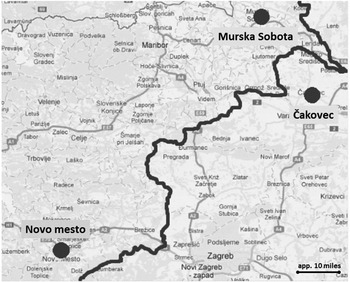
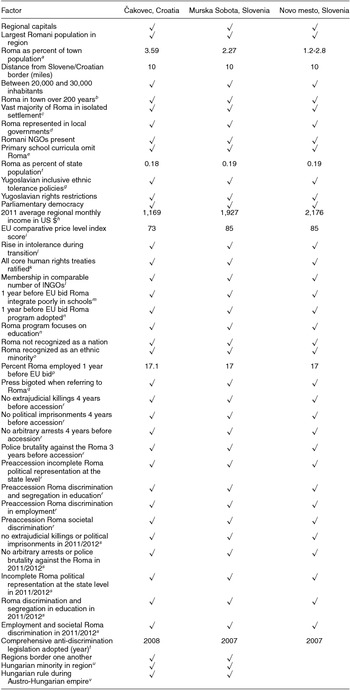
The pair of towns used to test Hypothesis I was selected first; the pair used to test Hypothesis II was selected second. To test the two hypotheses with the lowest possible number of subjects, participants were recruited from three towns; data from one town is therefore used to test both hypotheses. Matching singled out Čakovec in Croatia and Murska Sobota in Slovenia as the best pair to test Hypothesis I; Murska Sobota and Novo mesto, also in Slovenia, were selected as the best pair to test Hypothesis II (see Figure 1 for a map). Beyond the factors used in matching, the locations match on 38 additional relevant characteristics. The remainder of this section first discusses how the towns differ on the crucial covariates, and then lists the shared characteristics.
A Map of the Three Towns

Hypothesis I: The EU Accession Process
A meaningful study of discrimination in the context of EU accession and membership would necessarily span several years if limited to one country. To test Hypothesis I within a short time span, I looked at cross-sectional snapshots of discrimination in towns of which one was undergoing the accession process and the other had already completed it. As Roma rights experts strongly emphasized that any beneficial effects of the accession process were short lived, I constructed Hypothesis I and chose the towns with the aim of evaluating that claim. Conclusions drawn from this test will therefore speak to levels of discrimination in the context of EU accession and membership, but will not speak to discrimination in the preaccession stage.
At the end of June 2011, the EU closed negotiations for membership with Croatia (European Commission 2011). Chapter 23, the negotiation chapter most relevant to Roma rights, was among the last three to be closed (European Commission 2010); in early summer 2011, when Croatia was still reminded of the challenges faced by the Roma minority in the context of accession negotiations, this project was already in place. I was therefore able to capture people’s attitudes towards the Roma during a particularly critical period: when Croatia’s treatment of Roma rights was among the last few things keeping Croatia from the EU.Footnote 13 For reasons listed below, the cleanest and most compelling cross-national comparison to a town in Croatia is a town in its northern neighbor, Slovenia. Slovenia acceded to the EU in 2004 and, since accession, has experienced little pressure, if any, to improve its treatment of the Roma (Vachudova Reference Vachudova2005).
Hypothesis II: Inclusive NGO Action
Testing Hypothesis II, on the other hand, utilizes a within-country design. Novo mesto and Murska Sobota in Slovenia see different types of Romani NGO action.
Roma NGO activity in Murska Sobota aims to improve Roma/non-Roma relations and is inclusive: it effectively engages the non-Roma just as much as it engages the Roma. For example, fairly early in its tenure Romani Union–Zveza Romov in Murska Sobota began organizing events that would improve local awareness and relations between Roma and non-Roma. Initially, it was challenging to convince local non-Roma that the events are intended for all, but the organization succeeded in 1992 with Ciganska noč (“Gypsy night”), an annual concert of Romani music and dances that traditionally evolves into a lively party (Horvat-Muc Reference Horvat-Muc2010; Sandreli Reference Sandreli2012). Once that barrier was breached, non-Roma began attending book launches, plays, workshops and the Romani summer camps as well. A sister organization runs a Romani radio, Radio Romic, and there, too, non-Roma listeners are invited to tune in. Connecting Roma and non-Roma through culture and awareness is the organizations’ chief objective, which they have apparently attained.Footnote 14 Not only do Roma and non-Roma attend the events together, but the number of non-Roma among event participants and radio listeners recently surpassed the number of Roma (Sandreli Reference Sandreli2012). As it connects Roma and non-Roma in a friendly, nonthreatening context, Romani Union likely lowers Roma/non-Roma anxiety—doing precisely what recent literature on contact, intergroup anxiety, and prejudice finds particularly effective (Davies et al. Reference Davies, Tropp, Aron, Pettigrew and Wright2011; Page-Gould et al. Reference Page-Gould, Mendoza-Denton and Tropp2008).
Romano Veseli in Novo mesto, in contrast, is a service provision NGO and generally does not address relations between Roma and non-Roma. The organization has a very strong presence in the Romani communities and focuses on socioeconomic aid provision and efforts related to education of both Romani children and adults (Tudija Reference Tudija2012). Aside from an occasional volunteer, non-Roma are not involved in the organization’s activities. The leading activist is well known and respected among the Roma in Novo mesto, however; every randomly sampled Romani subject who participated in the study was able to identify her by name and many profusely praised her efforts. The organization in Novo mesto is of somewhat lower capacity than that in Murska Sobota, but is growing.
Identification
As neither was randomly assigned, expansive inclusive organizing in Murska Sobota and somewhat less expansive non-inclusive organizing in Novo mesto suggest an omitted variable bias, namely the possibility that any difference in discrimination today and the scope and type of organizing in each town could be related to a difference in respect for Roma rights prior to organizing. The possibility of bias is weakened, however, by several decades of Yugoslav policies on minorities and, more importantly, of equality in employment imposed upon all citizens (Baluh Reference Baluh2012; Šiftar Reference Šiftar1989). Before Romani organizing began in Murska Sobota in early 1991 (Horvat-Muc Reference Horvat-Muc2010), the Romani experience—ranging from kindergarten (Balažek Reference Balažek2012; Horvat-Muc Reference Horvat-Muc2011a; Tancer Reference Tancer, Tišljar and Širec1997) and primary school attendance (Šiftar Reference Šiftar1989; Tancer Reference Tancer, Tišljar and Širec1997) to a severe drop in employment (Balažek Reference Balažek2012; Klopčič Reference Klopčič2012; Šiftar Reference Šiftar1989)—in the two towns was as similar as ever.
Further, the nonrandom assignment of the type of organizing in Murska Sobota and Novo mesto also suggests a possible endogeneity problem, namely that the activists from both towns might have chosen their foci because they believed that those would be effective while any others would be ineffective in their respective towns. Extensive interviews with the leading activists, however, suggest that this is not the case. Activists in Murska Sobota focus strongly on Roma/non-Roma relations because they are themselves passionate about the issue and have been so from the very start (Horvat-Muc Reference Horvat-Muc2011a; Sandreli Reference Sandreli2012). Likewise, activists in Novo mesto focus on providing socioeconomic and educational aid because they believe it to be by far the most important cause (Tudija Reference Tudija2012). The choice of focus appears entirely driven by the idiosyncracies of the NGO leaders’ personalities and preferences, rendering the assignment of inclusive organizing almost “as if” random. This substantially mitigates endogeneity concerns.
To establish the extent to which the non-Roma population of each town is familiar with local Romani organizing, I asked 100 randomly sampled non-Roma from each town to identify it. Forty-six percent of randomly surveyed individuals in Murska Sobota were familiar with local Romani NGO action.Footnote 15 In Novo mesto, only two percent were familiar with the same. This finding confirms the expectation from comparing types of organizing in Murska Sobota and Novo mesto: activism in Murska Sobota reaches almost every other individual from the non-Roma population, whereas activism in Novo mesto—understandably—reaches only a few. In testing the effectiveness of inclusive organizing at the ground level, Novo mesto is therefore a suitable counterpart to Murska Sobota.
Factors Common to the Test Locations
While the towns differ on the crucial covariates, they match very closely on the state, regional, and local characteristics that most strongly influence human rights generally and Roma rights specifically, ranging from average income to bigotry in the media. National and EU laws regarding Roma rights are self-evidently the same in Novo mesto as in Murska Sobota, as are state level factors that may have historically shaped the relationship between Roma and non-Roma. The match of Murska Sobota and Čakovec at the state level, in turn, is very close. Most importantly, the locations match on the level of Roma rights protections, both before accession and while I collected data for this project (2011/2012). Before accession, police brutality against the Roma was observed a few years prior to accession in both states (Slovenia 2000, Croatia 2010).Footnote 16 Discrimination in education, employment, difficulties in housing, and societal maltreatment were consistently present in both states—before accession (Slovenia 2000-2003, Croatia 2009-2012), right after (Slovenia 2005, Croatia 2014), and during data collection (Slovenia 2011/2012, Croatia 2011).14 Table 1 lists the factors common to the locations.
Factors Common to the Test Locations

a Mesojedec (Reference Mesojedec2012), Republika Hrvatska - Državni Zavod za Statistiku (2001), Statistični urad Republike Slovenije (2002); b Horvat-Muc (Reference Horvat-Muc2011a), Klopčič (Reference Klopčič2012), Vugrinčić and Siladi (Reference Vugrinčić and Siladi2008); c Ajdič (Reference Ajdič2008), Šlezak (Reference Šlezak2009); d Bajrić (Reference Bajrić2012), Horvat-Muc (Reference Horvat-Muc2011b), Tudija (Reference Tudija2012); e Karba (Reference Karba2010), Vican and Litre (Reference Vican and Litre2006); f Republika Hrvatska - Državni Zavod za Statistiku (2001), Statistični urad Republike Slovenije (2002); g Kenrick (Reference Kenrick and Guy2001); h Kolaković (Reference Kolaković2013), Statistični urad Republike Slovenije (2011); i Eurostat (2015). EU average is 100.; j Barany (Reference Barany2002); k See entries on Slovenia and Croatia at The University of Minnesota Human Rights Center (2011); l See Hafner-Burton and Tsutsui Reference Hafner-Burton and Tsutsui2007; m Klopčič (Reference Klopčič2007), Tancer (Reference Tancer, Klopčič and Polzer2003); n Klopčič (Reference Klopčič2007); o Polzer-Srienz (Reference Polzer-Srienz, Klopčič and Polzer2003); p Pokos (Reference Pokos and Štambuk2005), Tancer (Reference Tancer1994); q Erjavec et al. (Reference Erjavec, Hrvatin and Kelbl2000), Kanižaj (Reference Kanižaj2004); r See US State Department Human Rights Reports, Slovenia (2000-2003) and Croatia (2009-2012); s See US State Department Human Rights Reports, Slovenia (2011-2012) and Croatia (2011); t European Commission (2009), RS Urad za Narodnosti (Reference RS Urad za2015); u Vratuša (Reference Vratuša, Klopčič and Vratuša2008); v Šiftar (Reference Šiftar1970).
MEASUREMENT
Games
Between the summers of 2011 and 2012, I collected data to construct a measure of discrimination at the ground level dimension of everyday relationships between Roma and non-Roma in Čakovec, Murska Sobota, and Novo mesto. Common transgressors—police officers, bureaucrats and teachers—are individuals whose anti-Roma sentiment may manifest itself differently based on the circumstances of their interaction with Roma. As directly recording rights violations that Roma may experience in seeking employment or health care, in detention or in prison is not possible, the measure instead targets the root of discrimination. It casts a wider net and aims to capture the basic, visceral, and quotidien discrimination upon which such various violations are frequently based.
Data on discrimination were collected through simple games that have been shown to demonstrate risk preferences and other-regarding behavior. The games measured (1) risk preferences (lottery) (Holt and Laury Reference Holt and Laury2002), (2) altruism (dictator game) (Hoffman et al. Reference Hoffman, McCabe, Shachat and Smith1994), (3) trust in one’s community members (trust game) (Berg et al. Reference Berg, Dickhaut and McCabe1995), and (4) trustworthiness with respect to one’s community members (trust game). The chief rationale for using the games was the difficulty of measuring individual levels of discrimination. People may not admit to racist preferences if asked directly; in fact, participants in both Croatia and Slovenia often agreed to participate on the grounds that no personal questions would be asked, but did not mind the game setup.Footnote 17
In the trust game subjects were assigned to play the role of a sender or a receiver and were then randomly and anonymously paired with a partner. Both sender and receiver began the game with an identical endowment. The sender chose how much of the endowment to share with the receiver, knowing that the amount sent would be doubled and that the receiver would have the chance to return to the sender a portion of his total amount. The doubled amount was then given to the receiver. The receiver decided how much of his total amount—that is, his initial endowment plus the doubled amount—to send back. The amount sent was used as a measure of trust and the amount returned as a measure of trustworthiness.
Subjects were randomly paired to play the trust game with an anonymous randomly chosen Roma or non-Roma partner from their community. The treatment was delivered in person: subjects were told that their partner was randomly chosen and anonymous, either Roma or non-Roma, and that there would be no direct interaction with the partner. Whether the participant received a treatment or a control condition was determined beforehand with a coin toss. Subjects’ decisions were confidential and made in private.
The trust game played for a monetary sum is exceptionally suitable as a measure of discrimination because negative stereotypes and general dislike of the Roma are largely based on distrust regarding money.Footnote 18 Roma are universally stereotyped as cheaters and thieves (Scicluna Reference Scicluna2007; Šiftar Reference Šiftar1989). Historically, they have been wrongfully accused of stealing even children (Hancock Reference Hancock2002); today, people still say “I feel gypped” and frequently think nothing of it. Exploiting this sentiment, the trust game elicits a gut response, from a non-Roma, to not send money to a Roma partner because that partner would not send anything (or enough) back. Accordingly, the primary quantity of interest was the difference between the trust that non-Roma exhibited in interactions with Roma and that which they exhibited in interactions with non-Roma.
This method was well received in Romani communities from Slovenia, Croatia, and Romania.Footnote 19 Numerous activists were disinclined to trust answers given by non-Roma in response to survey questions on discrimination, but enthusiastically endorsed the trust game. They found that it appropriately captures the sentiment that motivates discrimination they experience in their daily interactions with non-Roma, and appreciated its ability to elicit a discriminatory response without directly asking a non-Roma whether or not she discriminates.
The lottery and the dictator game were included to control for characteristics that likely influence subjects’ responses in the trust game and might confound the results. A highly altruistic person may, for example, offer more money in the trust game, but not necessarily because she trusts her potential partner (Cox Reference Cox2004). Likewise a risk-loving person might offer a large sum because of the thrill, not trust (Eckel and Wilson Reference Eckel and Wilson2004; Schechter Reference Schechter2007).
Non-Roma subjects participated individually, in their homes.Footnote 20 Roma subjects participated individually in several central locations, including an NGO common room, a kindergarten, and several homes. Participation generally lasted between 10 and 20 minutes.
Participation began with reading and signing the consent form, continued with the three games, and concluded with a short exit survey. The survey asked general questions concerning the age, gender, education, income bracket, the nationality and ethnicity of the participant, as well as two questions on the EU accession process. Participants were asked if they had heard about this study or the games before; if they answered yes, they were asked to specify when and in what context. If they heard about the games from a person who had participated, they were removed from the sample.Footnote 21
Stratified Random Sampling
The random population sample consisted of 202 subjects from each town.Footnote 22 Simple random sampling was used to draw participants from the two strata, the non-Roma general population and the Roma general population. The Roma community was oversampled because it is substantially smaller. All streets in the town or the Romani settlement were numbered and re-ordered based on a random number sample. Participants were recruited from the chosen streets—one person from each house, with a systematic iteration between genders. Any individual over the age of 18 was eligible to participate in the study. The response rate was approximately 60 percent.Footnote 23 In total, 606 people from the general population participated in the games, 202 from each town.Footnote 24
RESULTS
The results can be summarized as follows. First, non-Roma from the EU candidate town discriminated against the Roma, while non-Roma from the EU member town just across the border did not. Second, non-Roma from the town with inclusive organizing did not discriminate against the Roma, but non-Roma from the town with noninclusive organizing did.
As this article discusses levels of discrimination against the Roma in Slovenia and Croatia, I focus on the behavior of the subjects who were senders in the trust game—in total, 303 randomly chosen individuals. The main quantity of interest—the dependent variable in the model—is the amount participants sent to their respective partners in the trust game. As the currencies in which participants were playing were not the same, the relevant variables are coded as proportions of total endowment.Footnote 25
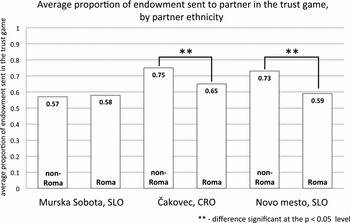
Figure 2 presents the average proportion of total trust game endowment that senders in each town sent to Roma and non-Roma partners. The figure shows a negligible average treatment effect in the case of the EU member (Murska Sobota), where senders on average sent 57 percent of their endowment to non-Roma and 58 percent to Roma partners, a statistically insignificant difference-in-means. The average treatment effect in the EU candidate (Čakovec), on the other hand, is statistically significant (p < 0.05). Senders there sent 75 percent of endowment to non-Roma and 65 percent to Roma partners.
The Average Proportion of Total Endowment Sent to Partner in the Trust Game, by Town and Partner’s Ethnic Identity

Figure 2 also shows that senders from the non-inclusive NGO town (Novo mesto) on average sent 73 percent of endowment to non-Roma and 59 percent to Roma partners (the average treatment effect is statistically significant at p < 0.05). In contrast, senders from the inclusive NGO town (Murska Sobota) on average sent almost the same proportion of their endowment to Roma and non-Roma partners.
Regression analysis provides further insight. The appropriate specification for a model in which the dependent variable is a proportion is a generalized linear model with the binomial variance and the logit link function (McDowell and Cox Reference McDowell and Cox2004; Papke and Wooldridge Reference Papke and Jeffrey1996).Footnote 26 To estimate the treatment effect, the model includes interaction terms between the control function and the treatment variable (Roma) (Morton and Williams Reference Morton and Williams2010). Since partner ethnicity in the trust game was randomly assigned within each town, the observations were accordingly weighted.Footnote 27
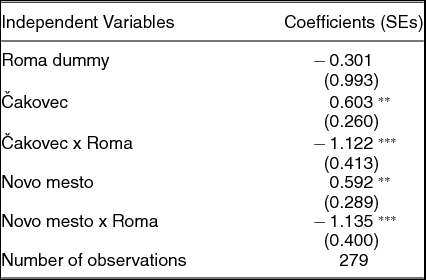
Table 2 presents results from the model that includes the lottery chosen, the proportion of the endowment sent to the family in need in the dictator game, town dummies, and the main population controls—age group, gender, education level, and income bracket—as well as the interaction terms between these covariates and the treatment (Roma) as independent variables.Footnote 28
Effect of Game Partner Ethnicity (Roma or non-Roma) in Croatia and Slovenia on the Amount Sent in the Trust Game: Generalized Linear Model with Weighted Data

* p < 0.1; ** p < 0.05; *** p < 0.01; standard errors in parentheses.
Table listing the coefficients and standard errors of control covariates is in the Online Appendix (Table 5).
Conditional marginal effects demonstrate the effect on the predicted mean proportion of the total endowment sent in the trust game as partner ethnicity changes from non-Roma to Roma.Footnote 29 The marginal effect for Murska Sobota is not statistically significant: essentially, there is no evidence that a randomly chosen sender from Murska Sobota would send any less or any more to a Roma partner than she would to a non-Roma partner. In Čakovec, on the other hand, the change in the proportion of the endowment sent is statistically significant (p < 0.01). A randomly chosen sender from Čakovec (EU candidate) would send about 30 percent less to a Roma partner than to a non-Roma partner. The marginal effect is also statistically significant in the case of Novo mesto (non-inclusive NGO). There, too, a randomly chosen sender would on average send 30 percent less to a Roma partner (p < 0.01).Footnote 30
Curiously, senders from Čakovec and Novo mesto on average sent more to their partners than did senders from Murska Sobota.Footnote 31 They also sent substantially more to non-Roma receivers, clearly exhibiting in-group favoritism (Hewstone et al. Reference Hewstone, Rubin and Willis2002). In-group favoritism is a manifestation of discrimination generally seen as a milder form of bias when not connected to outright out-group derogation (Brewer Reference Brewer1999). In the case of study participants from Novo mesto and to a lesser extent from Čakovec, however, out-group derogation was present as well.
Unexpectedly, participants offered unsolicited statements regarding the Roma. In most cases the statements were given after or during the exit survey; a few participants commented on the Roma during the trust game. One participant, tellingly, mistook a research team for a pair of Roma going door to door asking for money. We received comments from senders paired with Roma and non-Roma alike; whether or not they were assigned the treatment had no effect on the substance of the comments. Thirty-six percent of senders from Novo mesto made comments; one percent was positive, 11 percent were neutral, and 24 percent were negative. The most remarkable comment included a half-joking threat that “we will send a couple of bus-loads of our Roma to your hometown and you’ll see what it’s like.” Unsolicited statements were not nearly as common in the other two towns. In Murska Sobota, one subject remarked upon receiving the treatment that she did not see why it would matter that her partner was a Roma or a non-Roma. In Čakovec we received three negative comments; the most remarkable, “The hell will he send,” referred to the possibility that a Romani partner may return some of the endowment to his partner in the trust game.
A concern arises in light of these findings. Senders from Čakovec and Novo mesto might have sent less to Roma partners because the Roma in Čakovec and Novo mesto are actually less likely to reciprocate in such a context, compared to the Roma in Murska Sobota. A comparison of responses by Romani receivers, however, indicates that this is not the case. There is no statistically significant difference between what the Roma from all three locations returned to their partners, as a proportion of the total pot. The Roma played consistently.
These findings have three implications. First, the EU accession process does not necessarily lower discrimination such that it will be lower in an accessing state than in an EU member. Second, discrimination can be remarkably low, even absent, in an EU member state. Third and finally, inclusive organizing that aims to improve Roma/non-Roma relations helps reduce ground level discrimination.
A few caveats are in order. Crucially, the findings do not assess the absolute ground level effect of the EU accession process. The sample does not include observations from a location that has not yet been affected by the accession process or one that is entirely outside the purview of the EU. Without such a baseline, an evaluation of the efficacy of the process as a whole is nearly impossible to make. Therefore, while the findings demonstrate that the EU accession process does not necessarily lower ground level discrimination below that in an EU member, they do not address the claim that the EU accession process as a whole is ineffective in reducing ground level discrimination against the Roma.
Next, while the results demonstrate that discrimination can be remarkably low in an EU member state, this is not universally the case. It is abundantly clear that many Roma who live in EU member states, Eastern and Western, do not consistently enjoy enviable rights and equal treatment. At the state level, French deportations of immigrant Romani populations are self-evidently intolerant (Erlanger Reference Erlanger2010), as are Italy’s efforts to destroy makeshift dwellings in settlements outside Milan (ERRC et al. 2008). Hateful acts inspired by personal bigotry range from creating fictional administrative barriers that impede obtaining social benefits (State Department 2009a) to participating in impromptu (State Department 2009b) or planned (State Department 2007) demonstrations that usually take place in Romani settlements and frequently involve Molotov cocktails (Tkach Reference Tkach2010). To this collection of specific events, this study adds statistically significant evidence that ground-level discrimination can still exist within EU member states, and that it varies within countries, likely at the town level.
Finally, the results do not ensure that we would observe the same effect of inclusive Roma organizing throughout the EU space or beyond it, or that we would observe the same if inclusive organizing were randomly assigned. They also do not speak conclusively to the degree of a direct link between the EU and Roma organizing. Roma issues are a high priority within the EU space (European Commission 2015). In the context of violence against women, the combination of local autonomous feminist activism and regional or international normative mechanisms is remarkably effective at spurring change (Htun and Weldon Reference Htun and Weldon2012). Drawing on that, and considering the depth of EU involvement in the transnational Roma advocacy network, possible EU effects cannot be ruled out. Activists and experts from across Slovenia, however, are divided on the depth and importance of the EU in local organizing (Tahirović Reference Tahirović2011). Some claim that the EU plays a strong role in motivating activists (Balažek Reference Balažek2012; Klopčič Reference Klopčič2012), while others maintain that its role is negligible (Horvat-Muc Reference Horvat-Muc2011a; Rošer Reference Rošer2011). Whether or not the EU, in any form, is the primary driver behind the observed lack of discrimination is at present uncertain, and more work is required to clarify that relationship.Footnote 32 In the meantime, the absence of animus in Murska Sobota is striking.
This finding speaks to a facet in the literature on the promotion of human rights norms (Brysk Reference Brysk1993; Keck and Sikkink Reference Keck and Sikkink1998; Khagram et al. Reference Khagram, Riker, Sikkink, Khagram, Riker and Sikkink2002; Sikkink Reference Sikkink1993) that focuses on softening the public mood (Amenta et al. Reference Amenta, Caren, Chiarello and Su2010). The result thus contributes to scholarship that establishes the necessity of a local presence in norms promotion (Htun and Weldon Reference Htun and Weldon2012; Murdie and Davis Reference Murdie and Davis2012), and offers a clarification: not just any type of organizing will do. That does not mean that the only type of local action that helps improve human rights is inclusive organizing; rather, it means that local action ought to be tailored to its target audience. In targeting individuals from Murska Sobota, inclusive organizing appears to be appropriate.
Focusing on the behavior of individuals, this finding also bears upon literature in psychology on contact, prejudice, and discrimination. Crucially, and unlike those in many psychological studies, the subjects in this study were not treated with direct contact during the course of participation. The study instead offers an assessment of long-term intergroup contact—as it develops naturally on the ground—as a measure intended to reduce discrimination, and so provides a link between scores of convincing results from intergroup interactions in laboratory settings and theories of human rights norm promotion.
CONCLUSION AND FUTURE DIRECTIONS
The main contribution of this article lies in its original microlevel data about human rights behaviors, and its exploration of how that data link to broader human rights institutions. This study finds no support for the idea that a macrolevel combination of incentives and norms, in the form of EU accession, temporarily reduces individual-level discrimination against the Roma. It does, however, provide support for the hypothesis that ground level organizing geared towards improving Roma/non-Roma relations, a microlevel process, helps reduce discrimination.
Questions remain. Is the effect of ground level organizing observed in Murska Sobota generalizable? Would we observe a similar effect if the treatment of local level organizing or a simulation thereof were randomly assigned? Would non-Roma from a town entirely outside the purview of the EU discriminate against the Roma? Would non-Roma from such a town exhibit nondiscriminatory attitudes if the town had strong local level organizing like that in Murska Sobota? Do these findings generalize to other groups that face discrimination, elsewhere?
These unresolved questions urge us to dig deeper. Much research remains to be done on the effects of macro- and microlevel processes on human rights outcomes. Recent focus on police brutality in the U.S. and in Brazil demands research in which individual abuses, individual perpetrators, and institutions intended to curb them are systematically examined. As human rights monitors recognize more types of violations as abuse, scholars must examine them as well. We might explore if and how human rights institutions lead to improved prison conditions, or how they reduce the number of hate crimes. We might ask: do individuals respond differently to nascent human rights norms based on how many people support them? Are local advocacy groups more successful at persuasion than established international NGOs? In answering some of these questions, gathering original data and taking advantage of natural or quasi experiments might help scholars overcome the natural scarcity of human rights data.Footnote 33
With respect to the Roma, this study helps illuminate the relationships between people of Europe’s largest ethnic minority and of two European nationalities. The findings suggest that Roma inclusion strategies ought to include those that aim to promote friendly contact between Roma and non-Roma. Most current groups focus justifiably on improving Romani access to education, employment, healthcare, and eliminating various other injustices; there are very few organizations that focus on intergroup contact. Discrimination at the level of the individual, however, is at the heart of many violations; barriers to employment or access to social services can often be traced to bigoted individuals acting with impunity. Intergroup contact offers one avenue towards eliminating individual bigotry; coupled with other interventions, contact strategies could lead to sustainable improvement. Developing and funding such strategies is therefore an obvious next step in Roma inclusion efforts.



Comments
No Comments have been published for this article.