


Introduction
Social anxiety disorder (SAD) is a common and persistent mental disorder with a low probability of recovery in the absence of treatment. The psychological mechanism of this persistence was proposed in Clark and Wells’ (Reference Clark, Wells, Heimberg, Liebowitz, Hope and Schneier1995) cognitive model of SAD. The model suggests that experiencing a negative and distorted self-image, self-focused attention, somatic and cognitive symptoms, and safety behaviours produces a vicious cycle in SAD.
Recent studies have suggested a causal role for negative self-image in the maintenance of SAD (Hirsch et al., Reference Hirsch, Clark, Mathews and Williams2003; Hirsch et al., Reference Hirsch, Mathews, Clark, Williams and Morrison2006; Makkar and Grisham, Reference Makkar and Grisham2011). Patients with SAD often have negative, distorted self-images in which they see their worst moment being realized (e.g. anxiety symptoms becoming obvious, running out of words in a presentation and being seen as incompetent, and saying the wrong things and being laughed at). Therefore, one of the keys to treating SAD is to address the self-image and help patients view themselves realistically. Hackmann et al. (Reference Hackmann, Clark and McManus2000) suggested that self-image often comes to mind throughout social situations and is usually linked to earlier aversive social experiences in individuals with SAD.
Wild and colleagues showed that updating the meaning of a socially aversive memory by rescripting images of those memories improved SAD symptoms (Wild et al., Reference Wild, Hackmann and Clark2007; Wild et al., Reference Wild, Hackmann and Clark2008). The technique used in their study is known as imagery rescripting (IR), and recent studies examining IR in SAD have also reported positive results for this technique in randomized control trials (RCTs; Lee and Kwon, Reference Lee and Kwon2013; Nilsson et al., Reference Nilsson, Lundh and Viborg2012; Reimer and Moscovitch, Reference Reimer and Moscovitch2015) and a case series (Frets et al., Reference Frets, Kevenaar and van der Heiden2014). In addition to this effectiveness for symptoms of SAD, studies have also shown several powerful advantages of IR, such as brief intervention (Lee and Kwon, Reference Lee and Kwon2013; Nilsson et al., Reference Nilsson, Lundh and Viborg2012), long-lasting effectiveness (Frets et al., Reference Frets, Kevenaar and van der Heiden2014; Lee and Kwon, Reference Lee and Kwon2013), and shifts in negative core beliefs, which can be notoriously difficult to change (Reimer and Moscovitch, Reference Reimer and Moscovitch2015).
Despite an increase in positive results and interventional advantages regarding IR for patients with SAD from both researchers’ and practitioners’ perspectives, to our knowledge, no study has investigated both the advantages and disadvantages of IR based on patients’ perspectives. Given that IR as part of a CBT programme is a relatively new method for SAD, therapists are not familiar with reactions from their patients. Thus, it will be helpful to know what kinds of aversive memories are often reported and what kinds of beneficial or negative experiences patients have in IR sessions.
For patients’ experiences in imagery work including IR, Napel-Schutz et al. (Reference Napel-Schutz, Abma, Bamelis and Arntz2011) interviewed patients with borderline personality disorder regarding their perspective of specific imagery exercises in the early stages of schema therapy (i.e. diagnostic imagery and imagery of a safe place), which is usually included in the IR protocol. In their study, participants with borderline personality disorder experienced imagery exercises as effective; however, they also found them invasive, tiring, hard, confrontational, emotional, stressful, and energy-consuming. As patients with SAD often have a highly avoidant coping style, and some are very sensitive to showing emotions such as anxiety or shame to others, we should consider the possibility that they might have difficulty confronting and discussing the most distressing memories with their therapists. Therefore, it is important to understand how patients with SAD experience IR sessions to improve the method according to the characteristics of the disorder.
The present study aimed to learn from patients’ experiences, especially regarding both the advantages and disadvantages of IR, by exploring patients’ perspectives on IR as an adjunct to a standard CBT programme for SAD. Understanding patients’ experiences can enable therapists to better meet their needs and expectations, as well as to offer more effective ways to address this relatively new intervention.
Method
Participants
Participants were enrolled in an RCT conducted to examine the effectiveness of CBT as an adjunct to usual care for patients with SAD who were resistant to anti-depressants (Yoshinaga et al., Reference Yoshinaga, Niitsu, Hanaoka, Sato, Ohshima, Matsuki and Shimizu2013; Yoshinaga et al., Reference Yoshinaga, Matsuki, Niitsu, Sato, Tanaka, Ibuki and Shimizu2016). The IR session was conducted as a part of individual, weekly full CBT sessions comprising a 16-session course. The one or two IR sessions were conducted in the final stage of the 16 CBT sessions, depending on the progress of each case (around 13 to 15 sessions).
Twenty-five participants (nine women and 16 men) met the criteria for SAD according to Axis I of the Structured Clinical Interview for the Diagnostic and Statistical Manual of Mental Disorders IV (First et al., Reference First, Spitzer, Gibbon and Williams1997) and underwent evaluation by a psychiatrist (E.S.) and a principal RCT investigator (N.Y.). To ensure that our study setting was similar to usual clinical settings, comorbidities were permitted if they were clearly secondary (i.e. the most severe issue causing the greatest impairment was SAD). Exclusion criteria included psychosis, anti-social personality disorder, mental retardation, autism spectrum disorders, substance abuse/dependence within the 6 months prior to enrolment, current high risk of suicide, or any unstable medical condition.
Participants’ age ranged from 20 to 48 years, with a mean age of 32.08 years (SD = 8.76). The age of onset for SAD ranged from 8 to 44 years, with a mean age of 17.76 years (SD = 7.44). The mean duration of the disorder was 14.32 years (SD = 9.55). Their mean score for the Japanese version of the Liebowitz Social Anxiety Scale (LSAS; Asakura et al., Reference Asakura, Inoue, Sasaki, Sasaki, Kitagawa, Inoue and Matsubara2002; Liebowitz, Reference Liebowitz1987) was 82.64 (SD = 19.08), and their mean score for the Japanese version of the Beck Depression Inventory II (Beck et al., Reference Beck, Steer and Brown1997; Kojima et al., Reference Kojima, Furukawa, Takahashi, Kawai, Nagaya and Tokudome2002) was 19 (SD = 9.56). Some participants had comorbid axis-I disorder: major depressive disorder (n = 3), panic disorder (n = 2), and bipolar disorder II (n = 2).
Procedure
Our treatment manual for the IR sessions was based on that used by Wild et al. (Reference Wild, Hackmann and Clark2007, Reference Wild, Hackmann and Clark2008) and contained information regarding imagery interviews, cognitive restructuring, and the three steps of the IR phase, based on the model developed by Arntz and Weertman (Reference Arntz and Weertman1999). The IR session was conducted by seven therapists (four clinical psychologists, one psychiatrist, one nurse, and one psychiatric social worker) as part of a full CBT programme. All of the therapists had completed the Chiba Improving Access to Psychological Therapies project: Chiba-IAPT CBT training course (Kobori et al., Reference Kobori, Nakazato, Yoshinaga, Shiraishi, Takaoka, Nakagawa and Shimizu2014). They were trained to deliver our IR protocol by the first author (R.T., a licensed clinical psychologist) and supervised by a senior supervisor (E.S., an experienced psychiatrist) on a weekly basis. The one or two IR sessions lasted approximately 90 minutes each. The number of sessions depended on patients’ needs and capacity to understand the instructions for IR. The IR procedure was conducted by the same therapist who conducted the CBT sessions, and it consisted of three stages, as follows.
Imagery interview stage
Prior to the interview, participants were asked to complete the Short Fear of Negative Evaluation Scale (SFNE; Sasagawa et al., Reference Sasagawa, Kanai, Muranaka, Suzuki, Shimada and Sakano2004). Thereafter, semi-structured interviews, developed by Hackmann and colleagues (Reference Hackmann, Clark and McManus2000), were conducted to identify recurrent images, related early aversive memories, and their meanings. If participants had several memories linked to the imagery, patients and therapists collaborated to choose one memory based on participants’ preferences. Participants were also asked to rate the vividness and distress of images, memories and encapsulated belief percentages (see detailed measures). This interview lasted about 30 minutes.
Cognitive restructuring stage
After imagery interviews, therapists initiated cognitive restructuring of the encapsulated belief using a whiteboard (approximately 30 minutes). The cognitive restructuring aimed to prepare for IR by establishing a different perspective of the aversive event. Participants were asked to examine the validity of the encapsulated belief by listing incongruent evidence. They were also encouraged to remember results of video feedback and behavioural experiments offered in CBT sessions attended prior to the IR session.
IR stage
After cognitive restructuring, therapists initiated the IR procedure, which consisted of three phases and lasted approximately 30 minutes. In the first phase, participants were asked to relive the aversive memory at the age at which the event had occurred. They were asked to describe the event in the present tense and experience it as a current event, with instructions such as, ‘Close your eyes and tell the therapist about the memory in the first person, present tense, as if you are experiencing the event right now, at the age you were then’. In the second phase, participants described the same scene at their current ages, as if they were currently observing the event happening to themselves at a younger age, with instructions such as, ‘Let the aversive event reappear, but this time observe what your younger self experienced as your current self, as if you were in the same room with your younger self’. In the third phase, participants were asked to relive the event at the age at which it occurred but allow themselves to participate in the event as their current adult selves. The adult self in the scene was encouraged to offer the younger self the new perspectives. They were also encouraged to offer advice (e.g. ‘be assertive and express feelings and thoughts’) to the younger self, based on the new perspective. The current adult self was also allowed to intervene and talk to people who hurt, humiliated, misunderstood or bullied the younger self. The instruction given in the third phase was ‘Re-experience the socially aversive event, but this time you, as a wiser and older self, are with your younger self, and you can intervene in the event or offer advice’. For some patients, therapists had to support them in more direct ways by offering effective advice for both the current and past self. For other patients, meanwhile, therapists did not have to actively intervene because the patients could rescript by themselves, utilizing the new perspective obtained in the prior cognitive restricting. Weekly supervision took place, covering the possible interventions for each patient, including how and to what extent the therapist should intervene in the rescripting phase. When all procedures were complete, participants were asked how they felt, to confirm that their attention had returned to the therapy room. At the end of the IR procedure, participants were again asked to rate the vividness and distress of images, memories and encapsulated belief percentages, and then completed the Japanese SFNE. Participants who completed two sessions conducted these measures after the second session was completed.
Measures
Social anxiety
The SFNE was used to assess fear of negative evaluation by others, which is a core cognition in SAD. The original scale, the Fear of Negative Evaluation Scale (FNE) developed by Watson and Friend (Reference Watson and Friend1969), has been widely used for clinical and research purposes and consists of 30 true/false statements. The Japanese version of the SFNE was developed by Sasagawa et al. (Reference Sasagawa, Kanai, Muranaka, Suzuki, Shimada and Sakano2004) for clinical convenience and consists of 12 items. Responses for each item are provided on a scale ranging from 1 (strongly disagree) to 5 (strongly agree). The Japanese SFNE has demonstrated good reliability and clinical validity (Sasagawa et al., Reference Sasagawa, Kanai, Muranaka, Suzuki, Shimada and Sakano2004). Participants completed the SFNE prior and subsequent to the IR session.
Vividness and distress ratings on images and memories and encapsulated belief percentage
Participants were asked about recurrent images in social situations, related memories and summaries of their meanings in imagery interviews prior to IR. They were then guided to dwell on the images and memories with their eyes closed for a short period and rated their vividness, distress and the extent to which they considered the belief true on a scale ranging from 0 (not at all) to 100 (extremely) in imagery interviews and following IR.
Survey of participants’ perspectives of IR sessions
Upon completion of the IR procedure, we asked participants to complete survey forms concerning their experiences and opinions of IR. On the survey, participants rated items concerning the impressiveness and effectiveness of the IR session from 1 (not at all) to 5 (extremely). The survey also asked participants to describe their perspectives of the impression and effectiveness of the IR session. By asking about patients’ impressions of IR, we aimed to investigate their emotional reactions to it, including positive and negative experiences. By asking about its effectiveness, we tried to explore how IR works as an effective intervention.
Plan for analysis
Because data in the current study were not normally distributed, we used IBM SPSS Statistics for Windows, version 22 (IBM, Armonk, New York, USA) to perform a non-parametric Wilcoxon signed ranks test to compare baseline and post-intervention SFNE scores, image ratings, memory ratings and encapsulated belief percentages. Bonferroni correction was performed to correct for multiple comparisons, and the alpha level of significance was set at .008. We also calculated effect sizes (r = Z/√n). For the analysis of the survey of participants’ perspectives on IR sessions, we followed the inductive and data-driven approach, as little is known about the participants’ experience of IR sessions, and we did not have a pre-existing theoretical framework on which to code. The analysis in this study followed thematic analysis (Braun and Clarke, Reference Braun and Clarke2006). At the beginning of the analysis, the first author (R.T.) read and re-read the survey to become familiar with what was written by participants. Second, the first author gave codes to each text fragment in the sentences. The first author and the last author (E.S.) held meetings to discuss the validity of the codes the first author had made in advance. Then, the first author and the last author conducted a comparative investigation of all the codes. Finally, they clustered those codes into subthemes and main themes according to the similarity of the meaning of each code. Through these processes, it was necessary to revisit the original sentences on the survey form frequently.
Results
Comparisons of measures pre- and post-IR sessions
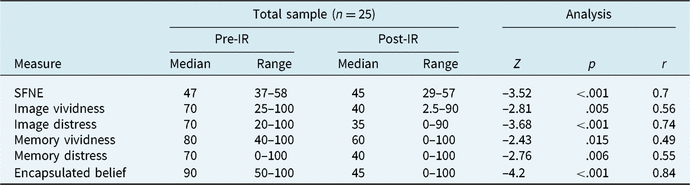
Table 1 shows the median and range for each score, Z-score, p-value and effect size (r). All post-IR scores, except for those for memory vividness, were significantly lower relative to pre-IR scores. All effect sizes were large. Post-IR memory vividness was lower relative to pre-IR memory vividness, but the difference was non-significant with Bonferroni correction. Nine patients had one session, and 16 patients had two sessions. There was no difference in IR effectiveness (SFNE, vividness and distress for images and memories, and encapsulated belief percentage) between the 1-session cases and the 2-session cases according to Bonferroni correction, set at .008 (p ≧ .09).
Median and range of pre-IR and post-IR scores for SFNE, image vividness, image distress, memory vividness, memory distress and encapsulated belief

IR, imagery rescripting; SFNE, Short Fear of Negative Evaluation Scale.
Contents of recurrent images and linked memories
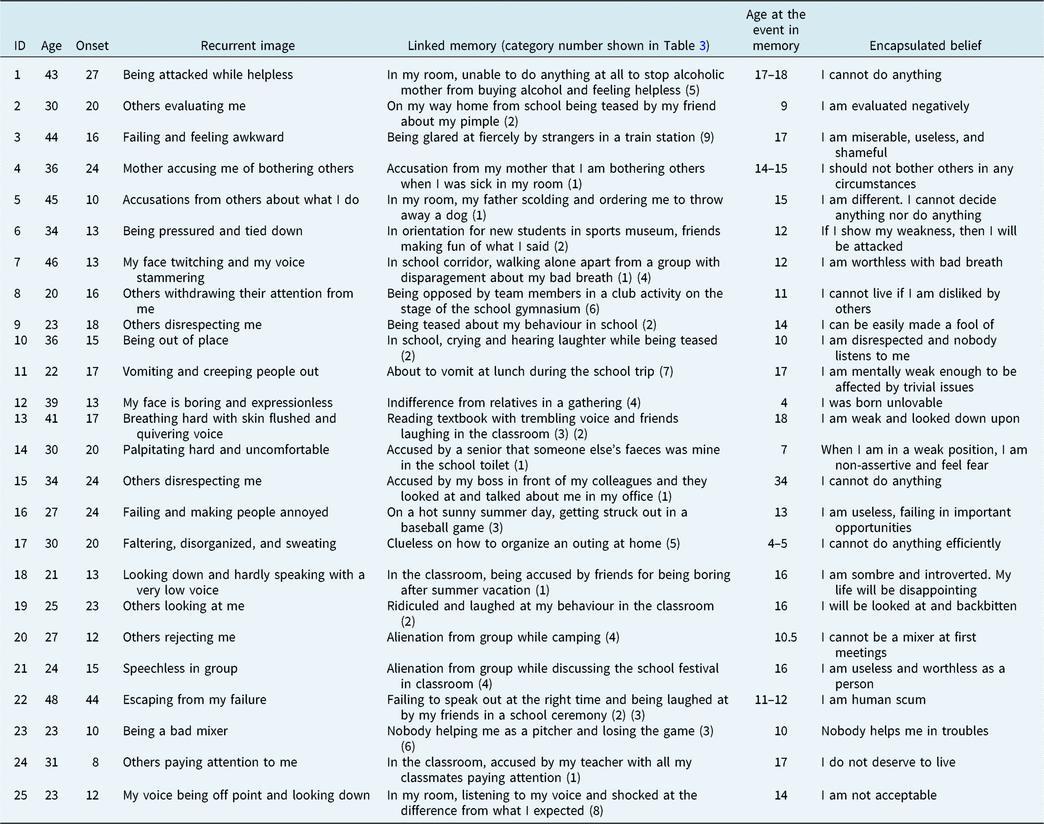
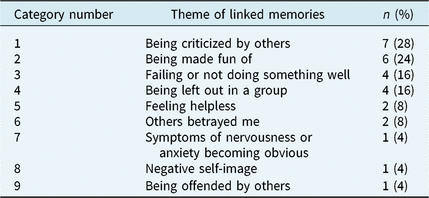
Table 2 provides a summary of the recurrent imagery in social situations, linked memories and encapsulated beliefs of each participant. The mean age at the event in the linked memory was 13.62 years (SD = 5.66). One clinical psychologist (R.T.) and one psychiatrist (E.S.) classified linked memories according to the similarity of the contents as shown in Table 3. The linked memories to the negative self-image were categorized into nine groups according to the content. The common memories were ‘Being criticized by others’ (n = 7, 28%), ‘Being made fun of’ (n = 6, 24%), ‘Failing or not doing something well’ (n = 4, 16%), and ‘Being left out in a group’ (n = 4, 16%).
Recurrent image and linked memory in participants

Themes of linked memories

Participants’ perspectives on IR sessions
Three participants did not submit the survey forms on their experience with IR, and they did not offer any reasons for their failure to file the form; therefore, only 22 of 25 survey forms concerning participants’ perspectives of IR sessions were completed. There was no difference in effectiveness (SFNE, vividness and distress for images and memories, and encapsulated belief percentage) between those who submitted and those who did not with Bonferroni correction, which was set at .008 (p ≧ .036).
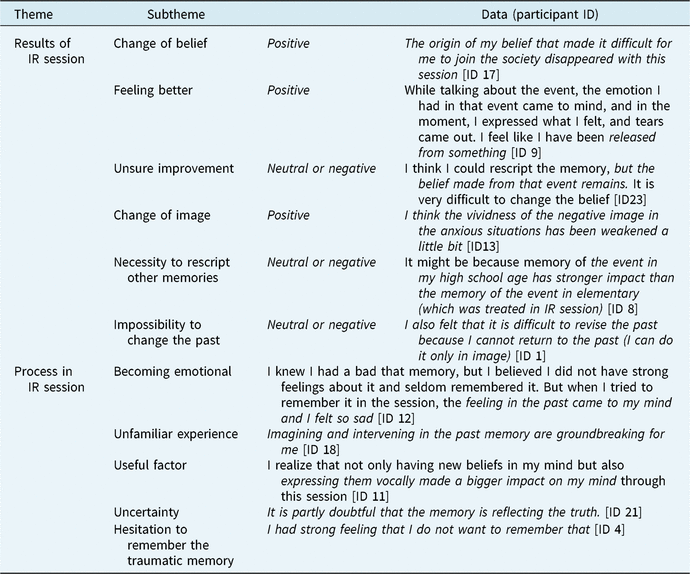
The median score for the question that asked participants how impressive they found the IR session was 4 (range: 2–5). Eighteen participants (82%) rated the session with a score of 5 (extremely impressive; n = 9) or 4 (relatively impressive; n = 9). On the other hand, three participants rated the session with a ‘3’ (neutral), and one rated it with a ‘2’ (relatively not impressive). The median score for the question about effectiveness was also 4 (range: 2–5). Thirteen participants (59%) rated the effectiveness with score 5 (extremely effective; n = 2) or 4 (relatively effective; n = 11). On the other hand, six participants rated the effectiveness with a ‘3’ (neutral), and three answered with a ‘2’ (relatively not effective). Table 4 shows the themes and subthemes of their opinions about their impressions and the effectiveness.
Themes of perspectives on impressions and effectiveness in image rescripting (IR)

Phrases related to the theme and the subtheme are shown in italics.
Themes of reasons of impressiveness and effectiveness were categorized as ‘Results of IR session’ and ‘Processes of IR session’. ‘Results of IR session’ included six subthemes and ‘Processes of IR session’ included five subthemes.
Results of IR session
Nineteen participants gave reasons for their opinions about impressiveness and effectiveness from the point of views of the outcomes of the IR session, including 37 codes of text fragments of the participants’ sentences. This theme named ‘Results of IR session’ included positive results such as ‘Change of belief’, ‘Feeling better’ and ‘Change of image’ as subthemes. This theme also included neutral or negative results such as ‘Unsure improvement’, ‘Necessity to rescript other memories’ and ‘Impossibility to change the past’.
Positive results
Twelve participants (55%) mentioned ‘Change of belief’ (consisting of 19 codes) including beliefs disappearing, new thoughts and getting insights. An example of patient comments categorized in this subtheme is, ‘I feel like I could straighten out my thinking and realize that it happened in the past’ [ID 2]. Five participants (23%) indicated ‘Feeling better’ (consisting of five codes) such as the release and organization of feelings; an example of a patient’s comments was ‘While talking to my past self, I felt better gradually’ [ID 11]. The subtheme ‘Change of image’ (consisting of five codes) was mentioned by four participants (18%), including such topics as remembering a good image and the weakening of a vivid negative image. One participant whose comment was categorized in this subtheme described his experience on IR as ‘I want to talk to myself with the words with which I talked to my past self in the session together with the good images I remembered’ [ID 16].
Neutral or negative results
Five participants (23%) mentioned ‘Unsure improvement’ (consisting of six codes), including uncertain effectiveness for SAD and difficulty in changing belief. An example of an ‘unsure improvement’ was ‘The session was not effective for the social anxiety, but I feel better, and my sadness lessened’ [ID 14]. ‘Necessity to rescript other memories’ contained two codes from two participants (9%), different memory having a stronger impact and coping with another trauma. An example of this theme was shown in this participant’s statement, ‘I feel like coping with another traumatic memory, especially the traumatic memory about family issue’ [ID 14]. ‘Impossibility to change the past’ (consisting of two codes) from two participants (9%), including impossibility to return to the past, and an example of a participant comment was ‘It is important to understand I can do something about the aversive event as the person who I am now, but what matters to me more is the fact that I cannot change the past’ [ID 4].
Process in IR session
Seventeen participants with 26 codes shared their opinions about impressions and effectiveness from the point of view of the process in the IR session such as, ‘Becoming emotional’, ‘Unfamiliar experience’, ‘Useful factor’, ‘Uncertainty’ and ‘Hesitation to remember the aversive memory’. Ten codes from nine participants (41%) were categorized in ‘Becoming emotional’, and they reflected feeling sad, hard, ashamed or emotional in the process of IR. An example of ‘Becoming emotional’ was ‘I cried after the aversive memory was rescripted. I was surprised to realize that I was so sad that I cried in front of another person’ [ID 13]. Other opinions included uniqueness of remembering the aversive memory in detail, categorized as ‘Unfamiliar experience’. This subtheme contains six codes from six participants (27%), such as epochal and first-time experience, and included such comments as ‘It was the first time for me to remember the aversive event intentionally’ [ID 11]. Five participants (23%) also mentioned ‘Useful factors’ in the IR session, including codes such as saying the new beliefs out loud and the therapist commenting on the aversive memory. ‘Uncertainty’ contained three codes from three participants (14%) which indicated participants’ unsure feelings or understanding of the process of IR, such as doubt about the link between the event and problem and unsure memory. An example comment of ‘Uncertainty’ was ‘I suspect whether the event is the cause (of the belief)’ [ID 19]. Two participants (9%) expressed ‘Hesitation to remember the aversive memory’ with two codes, including the participant’s comments regarding of unwillingness of remembering the trauma such as, ‘It was impressive because I did something different, but I don’t want to remember it’ [ID 19].
Discussion
The current study was the first to investigate patients’ perspectives of IR for early aversive memories as part of a full CBT programme in individuals with SAD. Patients with SAD in our study improved their scores on the SFNE; vividness and distress in image ratings, distress in memory ratings, and negative beliefs concerning images and memories decreased after the IR session. In addition, most of the patients (82%) reported that the IR session was impressive, and more than half of the patients (59%) reported that the IR session was effective. Participants’ experiences were categorized into two themes: ‘Results of the IR session’ and ‘Processes of IR session’. While some patients’ perspectives indicated disadvantages such as ‘getting emotional (e.g. sadness, difficulty, or shame)’, some gave positive responses, such as ‘change of belief’, ‘feeling better’ and ‘change of image’.
Although the results of recent studies on the effectiveness of IR for patients with SAD are promising (Frets et al., Reference Frets, Kevenaar and van der Heiden2014; Lee and Kwon, Reference Lee and Kwon2013; Nilsson et al., Reference Nilsson, Lundh and Viborg2012; Wild et al., Reference Wild, Hackmann and Clark2007, Reference Wild, Hackmann and Clark2008), using IR in CBT sessions can sometimes be daunting for therapists (Wheatley and Hackmann, Reference Wheatley and Hackmann2011). One of the reasons for therapists’ hesitation to use this new method might be that, although IR causes strong emotions, especially in reliving of aversive events, therapists may be unfamiliar with the reactions of patients in IR and may be afraid of the negative impact on them. In our study, we presented images and memories that the patients reported in the IR session, which can be used as a framework to prepare practitioners to use IR. As for patients’ experiences, nine participants answered that their impression of IR involved ‘becoming emotional (e.g. sad, difficult, shameful)’. This could be a disadvantage of the IR process that the patients had to confront, but it seems that their moods recovered afterwards. Examples of patients’ comments included ‘The IR session was hard because it was based on the past painful memory. That memory lasted as pain, but through this session, I felt better about it’ [ID 23] and ‘Although during the process of remembering the memory, the discomfort and bad feeling came back, now I don’t feel anything about it, so I believe I could organize the thought and feeling’ [ID 2]. Participants in our study did not report any negative influence from the strong emotions, and therapists did not observe negative effects during or after the IR session. They also came back to reality from their imagery on their own under instructions from the therapist. Thus, therapists did not need to use the grounded technique, which is used when patients lose control of their emotions in imagery work. The process of how negative emotions were overcome during or after IR should be investigated in more detailed interviews.
We followed the procedure conducted in previous studies on IR for SAD (Clark et al., 2006; Lee and Kwon, Reference Lee and Kwon2013; Nilsson et al., Reference Nilsson, Lundh and Viborg2012; Wild et al., Reference Wild, Hackmann and Clark2007). Wild and Clark (Reference Wild and Clark2011) note that, although there are several therapeutic interventions in this IR procedure (e.g. cognitive restructuring, repeated evocation of the socially traumatic memory, and compassionate imagery), it is unclear which are the most effective and whether all add to the value of the procedure. In our qualitative data, we found five codes indicating effective factors of IR for patients’ experiences included in the category called ‘useful factors’ (see details in Results section). Those patients’ experiences regarding effectiveness cover a broad range of factors; thus, we assume that the most effective factor or mechanism of effectiveness differed for each patient. However, this needs to be tested more precisely though detailed interviews with a larger sample in future research.
In our survey, three of 22 participants (14%) considered IR to be ineffective, rating it a ‘2’ for effectiveness (relatively not effective). Reasons given, as part of the patients’ experiences in our survey, included that it is impossible to change the past, failure to choose the most influential memory, and effect on mood but not social anxiety. It is important to learn from these experiences of patients to improve the results of this relatively new intervention. One patient who thought IR was not effective because of the impossibility to change the past posited that, although she understood that she had good ability to cope with an aversive event as an adult and admitted the importance of realizing that ability, impossibility to change the past itself mattered more to her. She also stated that she did not want to remember that event. Her comment indicates that she could obtain mastery sense over the aversive event, but that mastery was not enough to make the IR session effective for her. Wheatley and Hackmann (Reference Wheatley and Hackmann2011) reported their clinical observation of IR for patients with depression and suggested that the best time to end IR is when the patient can access and experience the feeling of compassion rather than feelings of mastery, with reference to the work of Gilbert (Reference Gilbert2008). This patient may have benefited from a more compassionate image of the past self to overcome the aversive past. Another patient who also found IR ineffective had a more aversive memory than the one treated in IR, which shows the importance of and difficulty in choosing the right memory to target during IR. Although Wild and Clark (Reference Wild and Clark2011) indicated that socially aversive memories would have a similar theme, such as rejection or humiliation, and the effect of the work with one memory can be generalized to the others, this does not necessarily follow for all cases. Therapists should check carefully whether there are other memories patients want to rescript before the IR session ends. Finally, the patient who reported an effect on mood but not social anxiety as part of the patients’ experiences in our survey, might have had an effect of IR on symptoms of SAD not immediately after IR. These effects might be observed after a while through social experiences with better moods and a new self-image rescripted in the session. The position we evaluated for effectiveness might not have been the best position for the following reasons. As the participants noted, IR requires emotionally and cognitively demanding efforts, including becoming emotional, going though unfamiliar experiences, sensing uncertainty in imagining the aversive memory as clearly as possible, and finding the intervention from new perspectives in the memory. Thus, the effectiveness of IR might only become apparent after some time. The possible processes whereby IR’s effectiveness for SAD symptoms could gradually become most apparent can be investigated in future research using temporally sequenced longitudinal designs accompanied by follow-up assessments of moods and symptoms.
This study has some limitations. First, as there was no control group, it is impossible to discuss the causal relationship between the different measures (symptoms of SAD, vividness and distress of the images, and memories and degree of belief) and IR. Second, as the sample size was relatively small, saturation of the data, or the point at which no more information is added and the same data occur repeatedly, could not be reached in our qualitative study on the perspectives of patients regarding IR sessions. Third, IR in this study was conducted as an adjunct to the CBT session. O’Toole et al. (Reference O’Toole, Watson, Rosenberg and Berntsen2018) found a decrease in the perceived centrality of negative memories after 10 sessions of CBT, even though CBT did not include any intervention for the negative memory. Thus, our results could have partly come from the previous CBT sessions. Fourth, we chose SFNE to measure social anxiety. This was because SFNE is the shortest measure of social anxiety available that has good reliability and clinical validity. Although it would be desirable to use other measures, such as Social Phobia Scale and Social Interaction Anxiety Scale, to examine IR’s effectiveness from multiple perspectives, we prioritized clinical and patient convenience. Finally, in our survey form from the patients’ perspective, we had no way to clarify and elaborate what patients meant. Semi-structured interviews in which patients can express their experiences with IR sufficiently and the researcher can obtain details on patients’ perspectives through questions are required in further studies. Furthermore, comparisons between more detailed quantitative data or quantified data about patients’ experiences and qualitative data on IR effectiveness should be studied to implement this technique. For example, it may be useful for practitioners to know the characteristics of patients who find IR to be effective. With this information, practitioners may be able to guide their patients to have certain experiences that lead to good results from sessions.
Acknowledgments
We would like to thank Editage (https://www.editage.jp/) for the English language review.
Conflicts of interest
Rieko Takanashi received a speaking honorarium from Mitsubishi Tanabe Pharma and writing honoraria from Chugai-Igakusha. Naoki Yoshinaga received a speaking honorarium from the Japanese Psychiatric Nurses Association, Eisai, Meiji Seika, Yoshitomi and writing honoraria from Medical Friend Co. Ltd, Igaku-Shoin, Nihon-Hyouronsha, and Sogensha. Eiji Shimizu received speaking honoraria from Astellas, Eisai, Eli Lilly, GlaxoSmithKline, Janssen, Meiji Seika, Mochida, MSD, Otsuka, Pfizer and Yoshitomi, and royalties from Igaku-Shoin, Seiwa Shoten, Koudan-Sha, and Nanzan-Dou. Keiko Oshiro, Satoshi Matsuki, Mari Tanaka, Hanae Ibuki, Fumio Ohshima, Yuko Urao and Daisuke Matuzawa have no conflicts of interest with respect to this publication.
Ethical statements
This study abided by the Ethical Principles of Psychologists and Code of Conduct as set out by the APA. Ethical approval for the study was granted by an institutional review board (reference number: 1422), and all participants provided written informed consent.
Financial support
This work was supported by a Grant-in-Aid for Scientific Research from the Japanese Ministry of Health, Labour and Welfare (E.S., grant number 201419032A), and JSPS KAKENHI Grant Number JP16K10243. The funding sources played no role in the design and conduct of the study; collection, management, analysis, and interpretation of the data; preparation, review, or approval of the manuscript; or decision to submit the manuscript for publication.



Comments
No Comments have been published for this article.