Introduction
Where do individuals' preferences and values come from? Why do people like or want what they do? The origin of individual preferences and values is one of the remaining theoretical puzzles in social and behavioural sciences (Kanazawa, Reference Kanazawa2001).
Recent theoretical developments in evolutionary psychology may suggest one possible explanation (Kanazawa, Reference Kanazawa2010b). On the one hand, evolutionary psychology (Symons, Reference Symons1990; Tooby & Cosmides, Reference Tooby and Cosmides1990; Crawford, Reference Crawford1993) posits that the human brain, just like any other organ of any other species, is designed for, and adapted to, the conditions of the ancestral environment (very roughly the African savanna during the Pleistocene Epoch), not necessarily to those of the current environment. It may therefore have difficulty comprehending and dealing with entities and situations that did not exist in the ancestral environment (Kanazawa, Reference Kanazawa2002, Reference Kanazawa2004a). On the other hand, an evolutionary psychological theory of the evolution of general intelligence proposes that general intelligence may have evolved as a domain-specific adaptation to solve evolutionarily novel problems, for which there are no predesigned psychological adaptations (Kanazawa, Reference Kanazawa2004b, Reference Kanazawa2008).
The logical conjunction of these two theories, the Savanna-IQ Interaction Hypothesis (Kanazawa, Reference Kanazawa2010a), implies that the human brain's difficulty with evolutionarily novel stimuli may interact with general intelligence, such that more intelligent individuals have less difficulty with such stimuli than less intelligent individuals. In contrast, general intelligence may not affect individuals' ability to comprehend and deal with evolutionarily familiar entities and situations.
Evolutionarily novel entities that more intelligent individuals are better able to comprehend and deal with may include ideas and lifestyles that form the basis of their preferences and values; it would be difficult for individuals to prefer or value something that they cannot truly comprehend. Hence, applied to the domain of preferences and values, the Hypothesis suggests that more intelligent individuals are more likely to acquire and espouse evolutionarily novel preferences and values that did not exist in the ancestral environment than less intelligent individuals, but that general intelligence has no effect on the acquisition and espousal of evolutionarily familiar preferences and values that existed in the ancestral environment.
There has been emerging evidence for the Hypothesis as an explanation for individual preferences and values. First, more intelligent children are more likely to grow up to espouse left-wing liberalism (Deary et al., Reference Deary, Batty and Gale2008; Kanazawa, Reference Kanazawa2010a), possibly because genuine concerns with genetically unrelated others and willingness to contribute private resources for the welfare of such others – liberalism – may be evolutionarily novel. Even though past studies show that women are more liberal than men (Shapiro & Mahajan, Reference Shapiro and Mahajan1986; Wirls, Reference Wirls1986; Lake & Breglio, Reference Lake, Breglio, Ries and Stone1992), and blacks are more liberal than whites (Sundquist, Reference Sundquist1983; Kluegel & Smith, 1989), the effect of childhood intelligence on adult liberalism is twice as large as the effect of sex or race.
Second, more intelligent children are more likely to grow up to be atheists (Kanazawa, Reference Kanazawa2010a), possibly because belief in higher powers, as a consequence of over-inference of agency behind otherwise natural phenomena, may be part of evolved human nature (Guthrie, Reference Guthrie1993; Boyer, Reference Boyer2001; Atran, Reference Atran2002; Kirkpatrick, Reference Kirkpatrick2005; Haselton & Nettle, Reference Haselton and Nettle2006), and atheism may therefore be evolutionarily novel. Even though past studies show that women are much more religious than men (Miller & Hoffmann, Reference Miller and Hoffmann1995; Miller & Stark, Reference Miller and Stark2002), the effect of childhood intelligence on adult religiosity is twice as large as that of sex.
Third, more intelligent boys (but not more intelligent girls) are more likely to grow up to value sexual exclusivity (Kanazawa, Reference Kanazawa2010a), possibly because humans were naturally polygynous throughout evolutionary history (Leutenegger & Kelly, Reference Leutenegger and Kelly1977; Alexander et al., Reference Alexander, Hoogland, Howard, Noonan, Sherman, Chagnon and Irons1979; Harvey & Bennett, Reference Harvey, Bennett, Ghesquiere, Martin and Newcombe1985; Pickford, Reference Pickford, Pickford and Chiarelli1986; Kanazawa & Novak, Reference Kanazawa and Novak2005). Either under monogamy or polygyny, women are expected to be sexually exclusive to one mate; in sharp contrast, men in polygynous marriages are not expected to be sexually exclusive to one mate, whereas men in monogamous marriage are. So the expectation of sexual exclusivity may be evolutionarily novel for men, but not for women.
Fourth, more intelligent children are more likely to grow up to be nocturnal, going to bed and waking up later (Kanazawa & Perina, Reference Kanazawa and Perina2009), possibly because nocturnal life was rare in the ancestral environment where our ancestors did not have artificial sources of illumination until the domestication of fire. Ethnographies of contemporary hunter-gatherers suggest that our ancestors may have woken up shortly before dawn and gone to sleep shortly after dusk. Night life may therefore be evolutionarily novel.
Fifth, more intelligent children grow up to consume more alcohol more frequently, smoke more tobacco (but only in the US) and use more illegal drugs (Kanazawa & Hellberg, 2010). This is possibly because the human consumption of such psychoactive substances is evolutionarily novel, all originating less than 10,000 years ago.
Finally, criminals on average have lower intelligence than the general population (Wilson & Herrnstein, Reference Wilson and Herrnstein1985; Herrnstein & Murray, Reference Herrnstein and Murray1994). This is consistent with the Hypothesis because, while much of what we call interpersonal crime today is evolutionarily familiar, the institutions that control, detect and punish such behaviour are evolutionarily novel (Kanazawa, Reference Kanazawa, Walsh and Beaver2009). Murder, assault, robbery and theft were probably routine means of intrasexual male competition for resources and mates in the ancestral environment. We may infer this from the fact that behaviours that would be classified as criminal if engaged in by humans are quite common among other species (Ellis, Reference Ellis1998), including other primates (de Waal, Reference de Waal1989, Reference de Waal, Nishida, McGrew and Marler1992; de Waal et al., Reference de Waal, Luttrell and Canfield1993). However, there was very little formal third-party enforcement of norms in the ancestral environment, only second-party enforcement (by victims and their kin and allies) or informal third-party enforcement (ostracism).
It therefore makes sense from the perspective of the Hypothesis that men with low intelligence may be more likely to resort to evolutionarily familiar means of competition for resources (theft rather than full-time employment) and mating opportunities (rape rather than computer dating) and not to comprehend fully the consequences of criminal behaviour imposed by evolutionarily novel entities of law enforcement. It also explains the ‘exception that proves the rule’, why more intelligent individuals are more likely to consume illegal drugs (Kanazawa & Hellberg, Reference Kanazawa and Hellberg2010). Unlike most interpersonal and property crimes, the consumption of such substances is evolutionarily novel. It's not legality per se that matters, but evolutionary novelty of the behaviour.
Most evolutionary psychologists and biologists concur that humans have not undergone substantial evolutionary changes in the last 10,000 years, since the end of the Pleistocene Epoch, as the environment during this period has not provided a stable background against which natural and sexual selection can operate over many generations. This is the assumption behind the Savanna-IQ Interaction Hypothesis. More recently, however, some scientists have voiced opinions that human evolution has continued and even accelerated during the Holocene Epoch (Evans et al., Reference Evans, Gilbert, Mekel-Bobrov, Vallender, Anderson and Vaez-Azizi2005; Cochran & Harpending, Reference Cochran and Harpending2009). While these studies conclusively demonstrate that new alleles have indeed emerged in the human genome since the end of the Pleistocene, the implications and importance of such new alleles for evolutionary psychology are not immediately obvious. In particular, with the sole exception of lactose tolerance, it is not clear whether these new alleles have led to the emergence of new physical or psychological adaptations in the last 10,000 years.
In this paper, I apply the Savanna-IQ Interaction Hypothesis to one domain of life – sexual behaviour – and explain why, regardless of their genetic predisposition, more intelligent individuals may be more likely to engage in homosexual behaviour than less intelligent individuals. I test my prediction with data from three large, nationally representative samples (two of which are prospectively longitudinal) from the United States and the United Kingdom. Consistent with the Hypothesis, my analyses show that more intelligent individuals are more likely to identify themselves as homosexual, experience homosexual attraction, engage in homosexual behaviour and have more homosexual cohabitation partners than less intelligent individuals.
Definitions and measures of homosexuality
Mustanski et al. (Reference Mustanski, Chivers and Bailey2002, pp. 122–127) and Wilson & Rahman (Reference Wilson and Rahman2005, pp. 13–16) enumerate four different measures of sexual orientation:
1. Self-identified labels (‘homosexual,’ ‘bisexual,’ ‘heterosexual’)
2. Actual sexual behaviour (with whom individuals have sex)
3. Self-reported sexual feelings (fantasies and desires)
4. Genital or brain responses (physiologically measured arousal to male or female images)
Wilson & Rahman (Reference Wilson and Rahman2005, pp. 13–16) note that self-identified labels can be influenced by politics and cultural climate (many homosexuals throughout history have been forced to remain in the closet due to social pressure and threat of legal punishment), and that actual sexual behaviour can be influenced by opportunities and circumstances (heterosexual men often have sex with other men while in prison due to the complete absence of potential female sexual partners). In contrast, sexual feelings and physiological measures are more stable and closer to individuals' ‘true’ sexual orientation; for example, self-identified heterosexual men who are openly homophobic may nonetheless show genital response of arousal to sexual images of other men (Adams et al., Reference Adams, Wright and Lohr1996). Wilson & Rahman (Reference Wilson and Rahman2005, p. 15) also note that ‘homosexual fantasies are quite common in heterosexual men and women as a form of “mental explorations”,’ and that measuring homosexuality with reported sexual fantasies and desires assumes that survey respondents are completely honest. All in all, Wilson & Rahman conclude that physiologically measured arousal (genital or brain responses to sexual images of men or women) is probably the most accurate measure of true sexual orientation, and the other three measures may correlate poorly with it and may deviate from their true sexual orientation, especially among women (Chivers et al., Reference Chivers, Seto and Blanchard2007), although most homosexual men tend to be exclusively homosexual (Bell et al., Reference Bell, Weinberg and Hammersmith1981).
Given that an individual's true sexual orientation, at least for men, may be prenatally determined, either by genetic or prenatal hormonal factors (Ellis & Ames, Reference Ellis and Ames1987; Bailey & Pillard, Reference Bailey and Pillard1991; Kirk et al., Reference Kirk, Bailey, Dunne and Martin2000), it is not likely that more intelligent individuals are more likely to be truly homosexual. There is a possibility, however, that the (as yet undiscovered) genes for intelligence are somehow linked to the (as yet undiscovered) genes for homosexuality, as genes for both intelligence and homosexuality appear to be located on the chromosome Xq28 (Hamer et al., Reference Hamer, Hu, Magnuson, Hu and Pattatucci1993; Turner, Reference Turner1996). Given that the first three measures of sexual orientation are more malleable and subject to conscious choice and self-presentation, it may also be possible that more intelligent individuals are more likely to appear homosexual by these measures, that is, if homosexual identity and behaviour are evolutionarily novel. Regardless of their true sexual orientation, more intelligent individuals may identify themselves as homosexual, engage in homosexual behaviour or report homosexual fantasies and desires.
Evolutionary novelty of homosexual identity and behaviour
In order to ascertain the extent to which our ancestors might have engaged in homosexual behaviour, I have consulted ethnographic records of traditional societies throughout the world. While contemporary hunter-gatherers are not exactly the same as our ancestors in the ancestral environment, they are the best analogues that we have available for close examination and are thus often used for the purpose of making inferences about our ancestral life.
The ten-volume compendium The Encyclopedia of World Cultures (Levinson, Reference Levinson1991–1995), which extensively describes all human cultures known to anthropology (more than 1500), mentions male homosexuality in seven different cultures (Foi, Gebusi, Kaluli, Keraki, Kiwai, Marind-anim and Sambia). However, these are phylogenetically closely related tribes all in Papua New Guinea, and all practices of homosexuality in these Papua New Guinean cultures occur largely as part of initiation rites for boys. So, for example, ‘Gebusi believe boys must be orally inseminated to obtain male life force and attain adulthood. Insemination continues during adolescence and culminates in the male initiation (wa kawala, or ‘child becoming big’) between ages 17 and 23,’ (Levinson, Reference Levinson1991–1995, Vol. 2, p. 79). And among the Sambia, ‘Male maturation requires homoerotic insemination to attain biological competence. Initiation rituals thus involve complex homosexual contact from late childhood until marriage, when it stops,’ (Levinson, Reference Levinson1991–1995, Vol. 2, p. 285). Such homosexual practices in Papua New Guinea appear highly ritualized and culturally mandated. There appears very little individual choice involved and, as such, homosexuality does not appear to be an individual-difference variable (where some people practise it while others don't). It therefore appears quite different from what we normally mean by ‘sexual relations,’ which involve choice, emotions and attachment. At any rate, it is very difficult to suggest that homosexuality was routine part of our ancestors' life if its present-day practice among traditional societies is limited only to one island in the South Pacific far outside of the ancestral environment of sub-Saharan Africa.
In addition, I have consulted the following extensive (monograph-length) ethnographies of traditional (hunter-gatherer, pastoral and horticultural) societies around the world: Yanomamö (Chagnon, Reference Chagnon1992); From Mukogodo to Maasai: Ethnicity and Cultural Change in Kenya (Cronk, Reference Cronk2004); Ache Life History: The Ecology and Demography of a Foraging People (Hill & Hurtado, Reference Hill and Hurtado1996); The !Kung San: Men, Women, and Work in a Foraging Society (Lee, Reference Lee1979); and Sacha Runa: Ethnicity and Adaptation of Ecuadorian Jungle Quichua (Whitten Jr, Reference Whitten1976). In all of these ethnographies, there is no mention of explicit homosexual relationships among the members of the societies under study. The only potential exception is the panegi among the Ache (Hill & Hurtado, Reference Hill and Hurtado1996, pp. 276–277; emphasis added).
Some men in our sample never had any children and others never acquired a wife. One category of men in Ache society opts out of the male mating pool altogether. These men, called panegi, take on a female socioeconomic role (the word pane means unsuccessful or unlucky at hunting). Men who are panegi generally do not hunt, but instead collect plant resources and insect larvae. They weave baskets, mats and fans, and make tooth necklaces, bowstrings and other female handicrafts. They spend long hours cooking, collecting firewood or water, and caring for children. Most informants stated that ‘panegis’ did not ever engage in homosexual behavior (oral or anal) prior to first contact. A few informants said they were not sure, but had never heard of such behavior.
Now given that panegis are apparently small in stature (Hill & Hurtado, Reference Hill and Hurtado1996, p. 277) and, at least in North America, homosexual men are shorter than heterosexual men (Blanchard & Bogaert, Reference Blanchard and Bogaert1996; Bogaert & Blanchard, Reference Bogaert and Blanchard1996), the panegis among the Ache might have been genetically and hormonally predisposed to homosexuality. But Hill & Hurtado make it clear that they nonetheless do not engage in homosexual behaviour.
In a recent in-depth ethnographic study of Aka foragers and Ngandu farmers in central Africa, Hewlett & Hewlett (Reference Hewlett and Hewlett2010) report that homosexuality is unknown or rare in both populations. The Aka have difficulty understanding the concept of homosexuality and do not have a word for it. The Ngandu are familiar with the concept but have no word for it and maintain that it does not exist in their population.
Even comprehensive surveys of homosexuality make little reference to it in traditional societies. Crapo (Reference Crapo1995) distinguishes four different types of homosexuality: 1) pederasty or mentorship, ‘in which there is a significant age difference between the partners,’ (Crapo, Reference Crapo1995, p. 184); 2) pathecism, ‘in which the non-dominant partner undergoes a role change (including, e.g. transvestism or other forms of gender mixing),’ (p. 184); 3) homophilia, ‘in which adult partners of equivalent age both maintain the gender roles that are usually assigned to those of their biological sex,’ (pp. 184–185); and 4) youthful experimentation, ‘in which adolescents are involved in homosexual relationships prior to their entry into adult status when they are expected to begin a heterosexual marriage career,’ (p. 185). What Crapo calls ‘homophilia’ is closest to what I mean by homosexuality in this paper, yet Crapo's extensive survey of homosexuality in traditional societies in the Standard Cross-Cultural Sample is entirely about the first two types of homosexuality and does not at all discuss the latter two.
In a 500-page compendium and encyclopedic review of all instances of homosexuality in recorded human history throughout the world, Murray (Reference Murray2000) devotes only four pages to ‘egalitarian female homosexualities’ (pp. 359–360) and ‘egalitarian male homosexualities’ (pp. 363–365) in tribal societies in sub-Saharan Africa, enumerating only four instances of homosexuality reported by four ethnographers. Given that Murray's book is otherwise truly comprehensive and includes hundreds of examples, the near total absence of any mention of homosexual behaviour in sub-Saharan Africa is remarkable.
Nash (Reference Nash and Bevan2001) claims that homosexual acts are depicted in some Mesolithic cave art. However, his evidence comes solely from two cave paintings, one from Norway and the other from Spain. These paintings appear to depict acts of sexual intercourse in the rear-entry position and fellatio, respectively. They are therefore not unambiguous depictions of homosexual behaviour. In fact, it appears that Nash is the only person who interprets these paintings as depicting homosexual behaviour:
Two of the human figures are locked in ‘rear-entry’ sexual intercourse and have previously been interpreted as being male and female by Hallström. The smaller figure may possibly have breasts, but, equally, the two lines here could well be a pair of arms…. The position of the penis suggests that penetration is via the anus. Gustave Hallström, however, regards the area of penetration as the vulva.
(Nash, Reference Nash and Bevan2001, pp. 47–48)Nash declares, without any logic or evidence, that the figure performing the fellatio in the Spanish painting is male. However, I do not see (and Nash does not provide) any reason why this figure must necessarily be male. The art could very well depict a heterosexual act of fellatio. In fact, Nash himself notes: ‘Images of sexuality within prehistory are not uncommon, while, in contrast, scenes depicting homosexuality and bestiality, particularly on rock art, are rare,’ (Nash, Reference Nash and Bevan2001, p. 44). I may therefore surmise that homosexual behaviour in the ancestral environment was correspondingly rare.
It is very important to point out, however, that even very extensive ethnographies, based on long-term field work by very experienced anthropologists familiar with the local culture, may not always detect instances of homosexuality, especially if it is condemned and negatively sanctioned in the local culture. So the absence of references to homosexuality in these ethnographies is not by itself conclusive evidence of its absence in traditional societies.
However, the same ethnographers and anthropologists have nonetheless been adept at uncovering evidence of other negatively sanctioned and concealed behaviour like murder, theft, infanticide and extramarital affairs. So the near total absence of any documentation of homosexual behaviour as an individual choice may suggest that it may be relatively rare in such societies. It may also suggest that widespread practice of homosexual behaviour may have been rare in the ancestral environment, and it may therefore be evolutionarily novel.
While some form of homosexuality is observed in many species (Bagemihl, Reference Bagemihl2000), the basic biological design of all species is heterosexual reproduction, and exclusive and predominant homosexuality is rare in nature. Kirkpatrick's (Reference Kirkpatrick2000) survey of homosexuality in traditional societies throughout the world also suggests that virtually all instances of homosexuality were concurrent with heterosexual behaviour. Most importantly, we are not descended from ancestors who were exclusively homosexual, so it is unlikely that homosexual orientation has been part of human nature throughout evolutionary history.
Some disagree, however, and suggest that homosexual behaviour may have been adaptive in the ancestral environment. Kauth (Reference Kauth2000), Kirkpatrick (Reference Kirkpatrick2000) and Muscarella (Reference Muscarella2000) all variously argue that homosexual attraction and behaviour might have facilitated same-sex coalitions and affiliations, which may have been crucial to our ancestors' survival and reproductive success. My contention that homosexual behaviour is evolutionarily novel is also inconsistent with evidence that suggests that homophobia – negative attitudes toward homosexuals – may be an evolved psychological mechanism (Gallup, Reference Gallup1995).
If homosexual identity and behaviour are evolutionarily novel, then the Savanna-IQ Interaction Hypothesis would predict that, regardless of their true sexual orientation, more intelligent individuals may be more likely to identify themselves as homosexual, report homosexual feelings and desires, and engage in homosexual behaviour than less intelligent individuals. I test this prediction below with three large, nationally representative samples (two of which are prospectively longitudinal) from the United States and the United Kingdom.
Weinrich's (Reference Weinrich1978) meta-analysis of the relationship between sexual orientation and intelligence shows that homosexuals are generally more intelligent than heterosexuals, except in some samples of prisoners. Tuttle & Pillard (Reference Tuttle and Pillard1991) studied a small sample of homosexual and heterosexual men and women and conclude that there is no difference in intelligence between homosexuals and heterosexuals. Arabsheibani et al. (Reference Arabsheibani, Marin and Wadsworth2005) find that homosexuals in the United Kingdom earn more than heterosexuals, although gay men make less than straight men once their human capital is controlled. Their study does not measure individuals' intelligence, however. Rahman et al. (Reference Rahman, Bhanot, Emrith-Small, Ghafoor and Robertsin press) show that there are no statistically significant differences in estimated full-scale IQ among straight men, straight women and gay men. However, among heterosexuals, they find that recalled childhood gender non-conformity is positively associated with adult intelligence. More masculine girls and more feminine boys grow up to have higher intelligence as adults than their more gender-conforming counterparts.
In his recent survey of the causes and correlates of sexual orientation, LeVay (Reference LeVay2010, pp. 113–114) discusses only one study (Weinrich, Reference Weinrich1978) on the association between intelligence and sexual orientation. In addition, LeVay notes, ‘It seems very possible, however, that those early studies suffered from “volunteer bias”, such that only relatively intelligent gay people were available for study.’ In order to avoid such sample selection bias, I use nationally representative samples in all of my studies below.
Study 1
Method
Data: National Longitudinal Study of Adolescent Health (Add Health)
The National Longitudinal Study of Adolescent Health (Add Health) is a prospectively longitudinal study of a large, nationally representative sample of American youths. A sample of 80 high schools and 52 middle schools from the US was selected with unequal probability of selection. Incorporating systematic sampling methods and implicit stratification into the Add Health study design ensures this sample is representative of US schools with respect to region of country, school size, school type and ethnicity. A sample of 20,745 adolescents were personally interviewed in their homes in 1994–1995 (Wave I) and again in 1996 (Wave II; n=14,738). In 2001–2002, 15,197 of the original Wave I respondents, now aged 18–28, were interviewed in their homes. My sample consists of Wave III respondents.
Dependent variable
I use two different measures of homosexuality. Both measures are used in Wave III when the respondents are in their early adulthood. First, Add Health asks its respondents: ‘Please choose the description that best fits how you think about yourself: 1=100% heterosexual (straight) (n=13,466); 2=mostly heterosexual (straight), but somewhat attracted to people of your own sex (n=1017); 3=bisexual – that is, attracted to men and women equally (n=245); 4=mostly homosexual (gay), but somewhat attracted to people of the opposite sex (n=96); 5=100% homosexual (gay) (n=131).’ I call this variable a measure of adult sexual identity, and analyse it with an ordinal regression model.
Second, Add Health asks its respondents two questions: ‘Have you ever had a romantic attraction to a female?’ and ‘Have you ever had a romantic attraction to a male?’ From these questions, I construct a binary variable adult expressed homosexual attraction, which is 1 if the respondent expresses ever having had a romantic attraction to a member of the same sex, and 0 if otherwise. Of the Add Health respondents, 9.3% (n=1416) report having ever had a romantic attraction to members of the same sex. I analyse this dependent variable with a binary logistic regression model. These two measures of homosexuality in Add Health correspond to self-identified labels and self-reported sexual feelings in Wilson & Rahman (Reference Wilson and Rahman2005). Actual sexual behaviour will be analysed in Studies 2 and 3 below, as Add Health unfortunately does not ask its respondents about homosexual behaviour, only heterosexual behaviour.
Independent variable: childhood intelligence
Add Health measures respondents' intelligence with the Peabody Picture Vocabulary Test (PPVT). The raw scores (0–87) are age-standardized and converted to the IQ metric, with a mean of 100 and a standard deviation of 15. The PPVT is properly a measure of verbal intelligence, not general intelligence. However, verbal intelligence is known to be highly correlated with (and thus heavily loads on) general intelligence. Miner's (Reference Miner1957) extensive review of 36 studies shows that the median correlation between vocabulary and general intelligence is 0.83. Wolfle (Reference Wolfle1980) reports that the correlation between a full-scale IQ test (Army General Classification Test) and the GSS synonyms measure (which is used later in Study 2) is 0.71. As a result, the GSS synonyms measure has been used widely by intelligence researchers to assess trends in general intelligence (Huang & Hauser, Reference Huang, Hauser and Neisser1998).
In order to establish the direction of causality more clearly, I use the measure of intelligence taken in Wave I (in 1994–1995 when the respondents are in junior high and high school) to predict their adult homosexuality in Wave III (in 2001–2002 when the respondents are in their early adulthood). Despite the fact that the correlation between measures of intelligence at Waves I and III (taken seven years apart) is not extremely high (r=0.5844, p<0.0001, n=13,943), all the substantive conclusions remain exactly the same if I use Wave III measure of intelligence, or a latent factor for childhood general intelligence extracted from the Wave I and Wave III measures.
Control variables
In the multiple regression analysis, I control for the following variables: age (even though there is very little variance in it given that these are cohort data); sex (1 if male); race (with three dummies for Asian, black and Native American, with white as the reference category); marital status (1 if currently married); parental status (1 if parent); education (years of formal schooling); earnings (in US$1K); religion (with four dummies for Catholic, Protestant, Jewish and other, with none as the reference category); religiosity (‘How important is religion to you?’: 0=no religion, 1=not important at all, 2=fairly unimportant, 3=fairly important, and 4=very important); and political attitudes (‘In terms of politics, do you consider yourself conservative, liberal, or middle-of-the-road?’: 1=very conservative, 2=conservative, 3=middle of the road, 4=liberal, and 5=very liberal).
Results
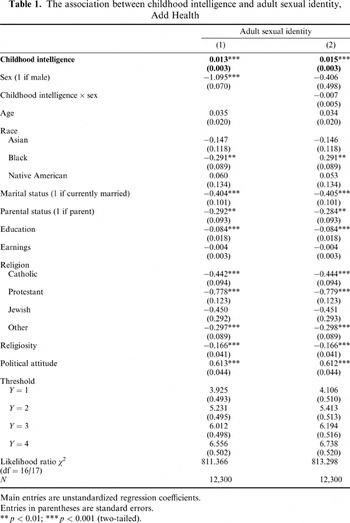
Table 1, column (1), presents the results of ordinal regression analysis of Add Health respondents' adult sexual identity. They show that, net of sex, age, race, marital status, parental status, education, earnings, religion, religiosity and political attitude, childhood intelligence is significantly (p<0.001) positively associated with adult sexual identity; the more intelligent Add Health respondents are in their childhood, the more homosexual they are in their adult sexual identity. Men are significantly less homosexual in their adult sexual identity, as are blacks. As expected, currently married individuals and parents are significantly less likely to be homosexual, as are more educated individuals. Relative to atheists and agnostics, those with religious affiliations (except for Jews) are significantly less likely to identify themselves to be homosexual. Religious individuals are significantly less homosexual in their adult sexual identity, and liberals are significantly more homosexual than conservatives.
The association between childhood intelligence and adult sexual identity, Add Health

Main entries are unstandardized regression coefficients.
Entries in parentheses are standard errors.
**p<0.01; ***p<0.001 (two-tailed).
It is instructive to note that, while education and childhood intelligence are significantly positively correlated (r=0.3320, p<0.0001, n=14,429), education and childhood intelligence have opposite associations with adult sexual identity; more intelligent individuals are more likely to identify themselves to be homosexual, while more educated individuals are less likely to do so. Even though an earlier study shows that childhood general intelligence is significantly positively associated with adult liberalism and significantly negatively associated with adult religiosity (Kanazawa, Reference Kanazawa2010a), childhood intelligence is still significantly positively associated with adult sexual identity even net of liberalism and religiosity.
Because the association between childhood intelligence and adult sexual identity may differ by sex, a childhood intelligence x sex interaction term is entered into the equation. Table 1, column (2), shows that the interaction term is not significant. It suggests that childhood intelligence has a similar association with both men's and women's adult sexual identity.
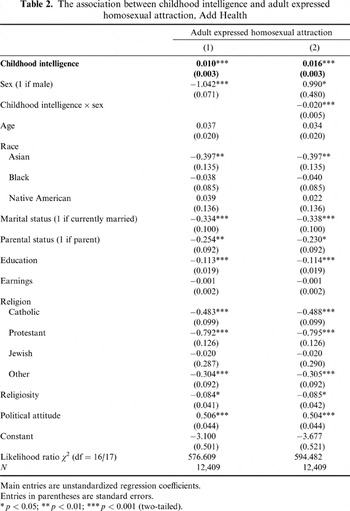
Table 2 presents the results of binary logistic regression analysis of adult expressed homosexual attraction. They show that, net of the same control variables as before, childhood intelligence is significantly positively associated with adult expressed homosexual attraction. The associations of control variables with adult expressed homosexual attraction are naturally similar to their associations with adult sexual identity, except for race; it is Asians, not blacks, who are significantly less homosexual when measured by adult expressed homosexual attraction. One standard deviation increase in childhood intelligence (15 IQ points) is associated with greater odds of expressed adult homosexual attraction by 16% (e (0.010×15)=1.1618).
The association between childhood intelligence and adult expressed homosexual attraction, Add Health

Main entries are unstandardized regression coefficients.
Entries in parentheses are standard errors.
*p<0.05; **p<0.01; ***p<0.001 (two-tailed).
Consistent with earlier findings of their greater sexual fluidity (Diamond, Reference Diamond2008), women are significantly and strongly more likely to express having experienced adult homosexual attraction; women have nearly three times the odds of expressing it as do men (1/e −1.042=2.8349). Both currently married individuals and parents are significantly less likely to express having experienced adult homosexual attraction, as are more educated individuals and all religious individuals (except for Jews). As with adult sexual identity in Table 1, adult expressed homosexual attraction is negatively associated with religiosity and positively associated with liberal political attitude, but childhood intelligence is still significantly positively associated with adult expressed homosexual attraction net of these confounds.
Table 2, column (2), includes a childhood intelligence by sex interaction term. Its significantly (p<0.001) negative association suggests that the association between childhood intelligence and adult homosexual attraction is significantly stronger among women than among men. Net of the same control variables, childhood intelligence is significantly positively associated with adult expressed homosexual attraction among women (b=0.017, SE=0.003, p<0.001), but not among men (b=−0.006, SE=0.004, ns).
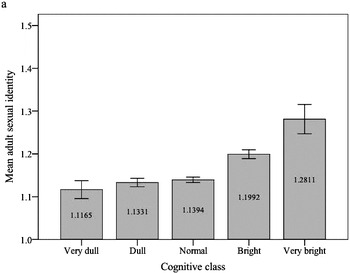
For the purpose of graphic presentation in Fig. 1 only, the Add Health sample is divided into five ‘cognitive classes’ (Herrnstein & Murray Reference Herrnstein and Murray1994) by childhood intelligence: ‘very dull’ (IQ<75); ‘dull’ (75<IQ<90); ‘normal’ (90<IQ<110); ‘bright’ (110<IQ<125); and ‘very bright’ (IQ>125). Figure 1a depicts the bivariate association between cognitive class and adult sexual identity, treating the ordinal measure of the latter as interval. It shows that there is a monotonic positive association between childhood intelligence and mean adult sexual orientation; the more intelligent Add Health respondents are as children, the more homosexual they become as adults. However, only the differences between ‘normal’ and ‘bright’ and between ‘bright’ and ‘very bright’ are statistically significant.
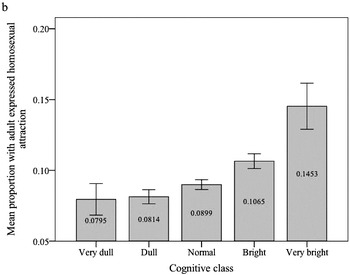
Bivariate associations between childhood intelligence and homosexuality. (a) Mean adult sexual identity by cognitive class. (b) Mean proportion with adult expressed homosexual attraction by cognitive class. Error bars represent the standard error for the mean.


Figure 1b depicts the bivariate association between cognitive class and expressed adult homosexual attraction. It shows that there is a monotonic positive association between childhood intelligence and the mean proportion with adult homosexual attraction. Nearly twice as many ‘very bright’ children as ‘very dull’ children grow up to experience homosexual attraction (0.15 vs. 0.08). However, only the differences between ‘normal’ and ‘bright’ and between ‘bright’ and ‘very bright’ are statistically significant.
Study 2
Method
Data: General Social Surveys (GSS)
The Add Health data are very suitable for my purposes here because they are prospectively longitudinal and measure intelligence in childhood and the outcome measures in early adulthood. Nevertheless, they have one shortcoming: they only measure adult sexual identity (straight–bisexual–gay) and adult expressed homosexual attraction; they do not measure actual homosexual behaviour, only heterosexual behaviour. I therefore use the General Social Survey (GSS) data to supplement the analysis of the Add Health data, to examine whether intelligence increases homosexual behaviour as well as identity and attraction.
The National Opinion Research Center at the University of Chicago has administered the GSS either annually or biennially since 1972. Personal interviews are conducted with a nationally representative sample of non-institutionalized adults in the US. The sample size is about 1500 for each annual survey, and about 3000 for each biennial one. The exact questions asked in the survey vary by the year.
Dependent variable: lifetime numbers of homosexual and heterosexual partners
In many survey years, the GSS asks its respondents how many men and women they have ever had sex with since their 18th birthday. These variables are used to construct the lifetime numbers of homosexual and heterosexual partners. Of the GSS respondents, 5.5% report at least one lifetime homosexual partner, and 3.7% report more than one. These measures correspond to the second definition of homosexuality – actual sexual behaviour (with whom individuals have sex) – by Wilson & Rahman (Reference Wilson and Rahman2005). Because the lifetime number of both homosexual partners (M=0.80, s 2=186.70) and heterosexual partners (M=9.10, s 2=810.71) are count measures that suffer from extreme overdispersion, I use the negative binomial regression to analyse it (Hilbe, Reference Hilbe2007).
Independent variable: verbal intelligence
The GSS measures the verbal intelligence of its respondents by asking them to select a synonym for a word out of five candidates. Half of the respondents in each GSS sample answer 10 of these questions, and their total score (the number of correct responses) varies from 0 to 10. The raw score is then transformed into the standard IQ metric, with a mean of 100 and a standard deviation of 15. As mentioned above, verbal intelligence is known to be highly correlated with general intelligence (Miner, Reference Miner1957; Wolfle, Reference Wolfle1980; Huang & Hauser, Reference Huang, Hauser and Neisser1998). It is important to note that, unlike the Add Health data above and the NCDS data below, the GSS respondents' intelligence is measured at the same time as their number of sexual partners. It is therefore impossible to establish the causal order unambiguously. However, it would be very difficult to imagine how the number of homosexual and heterosexual partners can affect one's intelligence, when the latter is largely heritable and stable across life after the age of 10 or 11 (Deary et al., Reference Deary, Whiteman, Starr, Whalley and Fox2004).
Control variables
In the negative binomial regression equation, I control for the respondent's sex (1 if male), age (in years), race (1 if black), social class (1=lower class, 2=working class, 3=middle class, 4=upper class), education (years of formal schooling), earnings (measured by 12–25 equidistant ordinal categories here treated as interval), whether currently married (1 if yes), whether ever married (1 if yes), number of children, religion (measured by four dummies for Catholic, Protestant, Jewish and other, with none as the reference category), religiosity (1=no religion, 2=somewhat strong, 3=not very strong, 4=strong), political attitude (1=extremely conservative, 2=conservative, 3=slightly conservative, 4=moderate, 5=slightly liberal, 6=liberal, 7=extremely liberal) and survey year.
Results
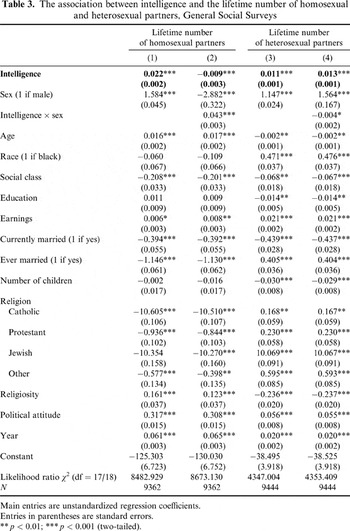
Table 3, column (1), presents the results of a negative binomial regression analysis of the lifetime number of homosexual partners. They show that, net of sex, age, race, social class, education, earnings, whether currently married, whether ever married, number of children, religion, religiosity, political attitude and survey year, more intelligent individuals have more lifetime homosexual partners than less intelligent individuals (b=0.022, p<0.001). It is interesting to note that, while women are far more homosexual than men in their sexual self-identity and expressed attraction, men nonetheless have significantly more homosexual partners in their lifetimes than women do. This may be due to the fact that women on average come out later in life than men do (Grov et al., Reference Grov, Bimbi, Nanín and Parsons2006) or that men are relatively more unrestricted in their sociosexual orientation than women and as a result homosexual men are far more sexually promiscuous than homosexual women (Gallup & Suarez, Reference Gallup and Suarez1983, pp. 317–318).
The association between intelligence and the lifetime number of homosexual and heterosexual partners, General Social Surveys

Main entries are unstandardized regression coefficients.
Entries in parentheses are standard errors.
**p<0.01; ***p<0.001 (two-tailed).
As expected, individuals who are currently married and who have ever been married have significantly fewer lifetime homosexual partners. Older individuals, individuals in lower social classes, and liberals have had more homosexual partners than younger individuals, individuals in higher social classes and conservatives. Relative to atheists and agnostics, all religious individuals (except for Jews) have had fewer homosexual partners. Very interestingly, controlling for religious affiliation, religiosity is significantly positively associated with the number of homosexual partners. Net of all the control variables, more strongly religious individuals have had more homosexual partners than less strongly religious individuals. The significantly positive association of survey year means that, during the 35-year history of the GSS, respondents in more recent years have had (or admit to) more homosexual partners.
Once again, because the association between intelligence and homosexual behaviour may differ by sex, an intelligence×sex interaction term is included in the negative binomial regression equation, presented in Table 3, column (2). Its significantly (p<0.001) positive association suggests that the association between intelligence and the number of homosexual partners is significantly stronger among men than among women. In fact, net of the same control variables, intelligence is significantly negatively associated with the number of homosexual partners among women (b=−0.008, p<0.01), while it is very strongly and significantly positively associated with the number of homosexual partners among men (b=0.037, p<0.001). The comparison of the unstandardized coefficients reveals that the positive association among men is nearly five times as strong as the negative association among women.
Table 3, column (3), presents the results of a negative binomial regression analysis of the lifetime number of heterosexual partners. They show that, contrary to the prediction of the Hypothesis, intelligence is significantly positively associated with the number of heterosexual partners. Because heterosexual behaviour is eminently evolutionarily familiar, the Hypothesis cannot explain the positive association between intelligence and the number of heterosexual partners in the GSS.
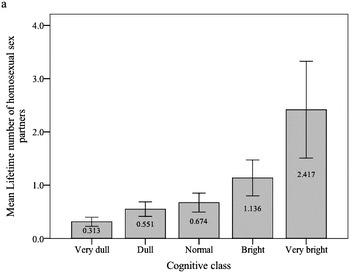
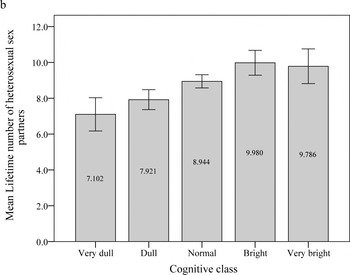
However, the association between intelligence and the number of homosexual partners is twice as strong as its association with the number of heterosexual partners (b=0.022 vs. 0.011). As Fig. 2 shows, the association between intelligence and the lifetime number of homosexual partners is monotonic and very strong, whereas its association with the lifetime number of heterosexual partners is not monotonic and is much weaker. ‘Very bright’ individuals (with IQ>125) have had eight times as many homosexual partners as ‘very dull’ individuals (with IQ<75) (2.42 vs. 0.31). In sharp contrast, ‘very bright’ individuals have had less than 40% more heterosexual partners than ‘very dull’ individuals (9.79 vs. 7.10). In fact, ‘bright’ individuals (with 110<IQ<125) have had more heterosexual partners than ‘very bright’ individuals.
Bivariate associations between childhood intelligence and adult cohabitation. (a) Mean lifetime number of homosexual sex partners by cognitive class. (b) Mean lifetime number of heterosexual sex partners by cognitive class. Error bars represent the standard error for the mean.


The interaction effect between sex and intelligence on the number of heterosexual partners is statistically significantly (p<0.05) negative, which suggests that the positive association between intelligence and the number of heterosexual partners is significantly stronger among women than among men. In fact, net of the same control variables, intelligence is twice as strongly associated with the number of heterosexual partners among women (b=0.014) as among men (b=0.007) (both p<0.001).
Study 3
Method
Data: National Child Development Study (NCDS)
Add Health and GSS have one important shortcoming for the purposes of this study: they only have measures of verbal intelligence, not general intelligence. Further, their samples are limited to contemporary Americans. In order to make sure that the association between childhood intelligence and adult homosexuality is limited neither to verbal intelligence nor contemporary Americans nor the specific measures of sexual behaviour employed, I now use a different measure of homosexuality with data from another nation, which have a very strong measure of general intelligence.
The National Child Development Study (NCDS) is a large-scale prospectively longitudinal study which has followed a population of British respondents since birth for more than half a century. The study includes all babies (n=17,419) born in Great Britain (England, Wales and Scotland) during one week (3rd–9th March 1958). The respondents were subsequently re-interviewed in 1965 (Sweep 1 at age 7; n=15,496), in 1969 (Sweep 2 at age 11; n=18,285), in 1974 (Sweep 3 at age 16; n=14,469), in 1981 (Sweep 4 at age 23; n=12,537), in 1991 (Sweep 5 at age 33; n=11,469), in 1999–2000 (Sweep 6 at age 41–42; n=11,419) and in 2004–2005 (Sweep 7 at age 46–47; n=9534). There are more respondents in Sweep 2 than in the original sample (Sweep 0) because the Sweep 2 sample includes eligible children who were in the country in 1969 but not in 1958 when Sweep 0 interviews were conducted. In each sweep, personal interviews and questionnaires were administered to the respondents, to their mothers, teachers and doctors during childhood, and to their partners and children in adulthood.
Nearly all (97.8%) of the NCDS respondents are Caucasian. There are so few respondents in other racial categories that, if I control for race with a series of dummies in generalized linear models, it often results in complete separation of data, and the maximum likelihood estimation becomes impossible. I therefore do not control for respondents' race in the analysis of the NCDS data. Including a race dummy (white vs. others) very slightly strengthens the association between childhood intelligence and homosexuality reported below, but otherwise does not alter my substantive conclusions.
Dependent variable: lifetime number of homosexual and heterosexual cohabitation partners
For a measure of homosexuality, the number of same-sex cohabitation partners that the respondents have ever had in their life is used, defined as someone of the same sex with whom the respondents have lived ‘as married’ and shared an accommodation for 6 months or longer. Of the respondents, 0.5% (n=94) report at least one lifetime homosexual cohabitation partner. Because the lifetime number of same-sex cohabitation partners is a count measure with overdispersion (M=0.022, s 2=0.067), I use negative binomial regression to analyse it (Hilbe, Reference Hilbe2007).
Given that homosexual men often have a very large number of sex partners, even while they are in committed relationships (Bell & Weinberg, Reference Bell and Weinberg1978), the number of cohabitation partners is not the ideal measure of homosexuality. I use the NCDS data for the strength of the measure of the independent variable (general intelligence), not for the strength of the measure of the dependent variable (homosexuality).
As a comparison, I also use the number of opposite-sex cohabitation partners that the respondents have ever had in their life. Because the lifetime number of opposite-sex cohabitation partners is a count measure without overdispersion (M=2.907, s 2=1.090), I use Poisson loglinear regression to analyse it (Hilbe, Reference Hilbe2007). Both dependent variables are measured at age 47.
Independent variable: childhood general intelligence
The NCDS respondents take multiple intelligence tests at ages 7, 11 and 16. At age 7, the respondents take four cognitive tests (Copying Designs Test, Draw-a-Man Test, Southgate Group Reading Test and Problem Arithmetic Test). At Age 11, they take five cognitive tests (Verbal General Ability Test, Nonverbal General Ability Test, Reading Comprehension Test, Mathematical Test, and Copying Designs Test). At age 16, they take two cognitive tests (Reading Comprehension Test and Mathematics Comprehension Test). I first perform a factor analysis at each age to compute their general intelligence score for each age. All cognitive test scores at each age load only on one latent factor, with reasonably high factor loadings (age 7: Copying Designs Test=0.671, Draw-a-Man Test=0.696, Southgate Group Reading Test=0.780 and Problem Arithmetic Test=0.762; age 11: Verbal General Ability Test=0.920, Nonverbal General Ability Test=0.885, Reading Comprehension Test=0.864, Mathematical Test=0.903, and Copying Designs Test=0.486; age 16: Reading Comprehension Test=0.909, and Mathematics Comprehension Test=0.909).
The latent general intelligence factors at each age are converted into the standard IQ metric, with a mean of 100 and a standard deviation of 15. Then I perform a second-order factor analysis with the IQ scores at three different ages to compute the overall childhood general intelligence score. The three IQ scores load only on one latent factor with very high factor loadings (age 7=0.867; age 11=0.947; age 16=0.919). I use the childhood general intelligence score in the standard IQ metric as the main independent variable.
Control variables
In addition to childhood general intelligence, I control for the following variables in the regression equations: sex (0=female, 1=male; measured at birth), whether currently married (1=yes; measured at 47), whether ever married (1=yes; measured at 47), whether ever a parent (1=yes; measured at 47), education (age at which the respondent left formal schooling, measured at 42), earnings (in GBP, measured at 47), religion (in four dummies – Roman Catholic, Anglican, other Christian and other religion – with none as the reference category; measured at 42), frequency of church attendance (1=never or very rarely, 2=less than once a month, 3=more than once a month, 4=once a week or more, measured at 42).
Results
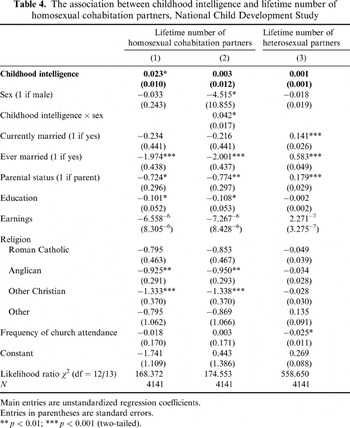
Table 4, column (1), shows that, net of sex, whether currently married, whether ever married, whether ever a parent, education, earnings, religion and frequency of church attendance, more intelligent individuals in the United Kingdom have had significantly (p<0.05) more same-sex cohabitation partners in their lifetimes than less intelligent individuals. The more intelligent they are before the age of 16, the more same-sex partners they have before the age of 47. Quite predictably, those who have ever been married and those who have ever had children have significantly (p<0.001 and p<0.05, respectively) fewer same-sex cohabitation partners, as do Anglicans and those who subscribe to non-Christian religions (p<0.01 and p<0.001, respectively) compared with atheists. Replicating the analyses above of Add Health data (presented in Tables 1 and 2), while more intelligent individuals are more homosexual judged by the lifetime number of homosexual cohabitation partners, more educated individuals are less homosexual by the same measure.
The association between childhood intelligence and lifetime number of homosexual cohabitation partners, National Child Development Study

Main entries are unstandardized regression coefficients.
Entries in parentheses are standard errors.
**p<0.01; ***p<0.001 (two-tailed).
Table 4, column (2), shows that the interaction term between childhood general intelligence and sex is statistically significant (p<0.05). It suggests that the effect of childhood intelligence on adult homosexuality is significantly stronger among men than among women. Childhood general intelligence is significantly positively associated with lifetime number of homosexual cohabitation partners among men (b=0.049, SE=0.015, p<0.01) but not among women (b=0.002, SE=0.014, ns).
Table 4, column (3), shows that, in comparison with the lifetime number of homosexual cohabitation partners, childhood general intelligence is not significantly associated with the lifetime number of heterosexual cohabitation partners. Net of the same control variables as before, more intelligent individuals do not have more heterosexual cohabitation partners in their lifetimes than less intelligent individuals. Since heterosexual unions are eminently evolutionarily familiar, this is consistent with the prediction of the Hypothesis.
Discussion and Conclusions
The Savanna-IQ Interaction Hypothesis, derived from a logical conjunction of the Savanna Principle and a theory of the evolution of general intelligence, suggests that more intelligent individuals may be more likely to acquire and espouse evolutionarily novel preferences and values than less intelligent individuals, while general intelligence may have no effect on the acquisition and espousal of evolutionarily familiar preferences and values. Several earlier studies have empirically supported the Hypothesis in various domains of life (political ideology, religiosity, sexual exclusivity, circadian rhythm and consumption of psychoactive substances). In this paper, I have extended the Hypothesis to sexual identity, expressed desires and behaviour. While individuals' true sexual orientations are probably determined prior to birth, their sexual identity, desires and behaviour may deviate from their true sexual orientation, and the Hypothesis suggests a role of general intelligence in them.
A survey of ethnographies of traditional societies shows that exclusively or predominantly homosexual identity and behaviour were probably rare in the ancestral environment and may thus be evolutionarily novel. The Savanna-IQ Interaction Hypothesis therefore predicts that more intelligent individuals are more likely to identify themselves to be homosexual and engage in homosexual behaviour than less intelligent individuals.
Three large, nationally representative samples (two of which are prospectively longitudinal) from two different nations converge to support my prediction. This study's analysis of Add Health data (Study 1) suggests that, net of age, sex, race, marital status, parental status, education, earnings, religion, religiosity and political attitude, childhood intelligence is significantly positively associated with adult homosexual identity and expressed adult homosexual attraction. More intelligent children are more likely to grow up to be adults who identify themselves to be homosexual and express homosexual attraction than less intelligent children. The analysis of the General Social Surveys (Study 2) suggests that more intelligent individuals have had significantly more homosexual partners in their lifetimes than less intelligent individuals. While intelligence is also associated with the lifetime number of heterosexual partners, the association is twice as strong with homosexual partners as with heterosexual partners. The analysis of the National Child Development Study (Study 3) shows that more intelligent children (before the age of 16) have significantly more same-sex cohabitation partners than less intelligent children 30 years later. In contrast, more intelligent individuals do not have more opposite-sex cohabitation partners in their lifetimes.
Limitations of the current studies
There are several important limitations to my current empirical studies. First, while my data analyses in three studies are consistent with the predictions from the Hypothesis, the empirical support is not entirely unequivocal. In particular, the analysis of the GSS data shows that intelligence is associated with not only the lifetime number of homosexual partners (consistent with the Hypothesis) but also with the lifetime number of heterosexual partners (contrary to the Hypothesis). Further, in Study 1, childhood intelligence is not associated with adult expressed homosexual attraction among men; in Study 3, childhood general intelligence is not associated with the lifetime number of homosexual cohabitation partners among women.
Second, because all of the samples are nationally representative and because homosexuality is relatively rare in the general population, the dependent measures have very low frequencies. For example, in Study 1, 90% of Add Health respondents identify themselves as ‘100% straight’. In Study 3, only a very small proportion (0.5%) of the NCDS respondents have ever had any homosexual cohabitation partners. The small incidence of homosexuality in the measures may influence the stability of the estimates.
Third, even when the results unequivocally support the prediction of the Hypothesis, the magnitude of the association between intelligence and homosexuality is often very small. For example, in Study 1, ‘very bright’ individuals and ‘very dull’ individuals are separated by less than one-sixth of a point on a five-point scale of adult sexual identity or less than 7% in the probability of ever experiencing adult homosexual attraction, although the latter represents nearly doubling of the probability. In Study 2, ‘very bright’ individuals have had merely 2.11 more homosexual partners in their lifetimes than ‘very dull’ individuals, although it does represent an eightfold increase.
Practical importance
I emphasize that my scientific interest in homosexual behaviour in this paper is strictly theoretical. Homosexual behaviour represents yet another domain in life where some individuals may choose to acquire and espouse evolutionarily novel preferences and values. The Hypothesis has previously been tested in many other domains, and in every case more intelligent individuals have been shown to be more likely to acquire and espouse evolutionarily novel preferences and values in each domain. Homosexual behaviour simply represents yet another domain of life where some individuals may choose evolutionarily novel behaviour (homosexuality) while others may choose evolutionarily familiar behaviour (heterosexuality), and gives me an opportunity to examine its association with childhood general intelligence.
Small statistical associations between intelligence and homosexuality that I find in my studies support the prediction of the Hypothesis. However, I emphasize that my findings have absolutely no practical importance. It is not like we can now use someone's intelligence to assess their homosexuality accurately. My approach to science is decidedly basic, not applied (clinical or medical). I am entirely driven by the desire to discover knowledge, not by its potential applications or implications.
My paper represents one of the most comprehensive empirical attempts to establish the association between intelligence and homosexuality, using large, prospectively longitudinal and nationally representative samples from two different nations. While other studies have noted a potential empirical association between intelligence and homosexuality, to the best of my knowledge, the Hypothesis provides the only theoretical explanation for why we may expect such an association to exist at all. It explains why more intelligent children may grow up to identify themselves as homosexual, express homosexual attraction, have more homosexual sexual and cohabitation partners than less intelligent children.
Interaction between general intelligence and sex
For the most part, the Hypothesis does not make sex-specific predictions. It predicts that both more intelligent men and more intelligent women are more likely to acquire and espouse evolutionarily novel preferences and values than their less intelligent counterparts. As a result, the Hypothesis is unable to account for the statistically significant interactions between sex and general intelligence found in Tables 2, 3 and 4. It is obvious that many factors influence an individual's propensity to engage in homosexual behaviour, and general intelligence is only one of them. It is likely that some of the other factors – such as social and cultural influences on homosexual behaviour and its acceptability for men or women in society – may influence why more intelligent men or more intelligent women are more likely to engage in homosexual behaviour. This appears especially to be the case, because the direction of the significant interaction depends on the particular measure of homosexual behaviour. More intelligent women are more likely to express adult homosexual attraction than more intelligent men, but more intelligent men are more likely to have more homosexual partners and homosexual cohabitation partners than more intelligent women. It is therefore likely that no single factor can explain all of the significant sex interaction effects that I find, if they are indeed robust.
Alternative explanations
An earlier study (Rahman et al., Reference Rahman, Abrahams and Wilson2003) shows that gay men have superior verbal fluency than straight men. Given that my measures of intelligence in Studies 1 and 2 are largely verbal, this can potentially explain why more intelligent boys may grow up to be more homosexual as adults. However, since lesbians have the opposite profile to gay men, having lower verbal fluency than straight women, Rahman et al.'s (Reference Rahman, Abrahams and Wilson2003) findings cannot explain why more intelligent girls also grow up to be more homosexual as adults. Further, I use a genuine measure of general intelligence in Study 3.
Another possibility is that more intelligent individuals, rather than being truly more homosexual in their sexual identity, expressed attraction, and sexual behaviour, are more likely openly to admit that they are homosexual than less intelligent individuals. It may also be that more intelligent individuals are more self-aware and less self-deceptive than less intelligent individuals. If so, then more intelligent individuals are more likely to be aware of their homosexual desires and fantasies than less intelligent individuals. I note, however, that self-awareness and self-deception must have deep evolutionary origin (Trivers, Reference Trivers2000), so the Hypothesis would predict that the capacity for self-awareness is unrelated to general intelligence.
There is no way for me to discover whether respondents may be misrepresenting themselves in my data; just like any other user of these survey data, I am at the mercy of their recorded responses. However, if more intelligent individuals are indeed more likely openly to admit that they are homosexual, then one would think that more educated individuals are equally more likely to be so candid. This alternative hypothesis therefore cannot explain why education has a significantly negative association with homosexuality in Studies 1 and 3 and no association at all in Study 2.
But then why are education and homosexuality negatively associated? Higher education was entirely free in England and Wales until 1998, when the NCDS respondents were completing their education, and it is still free in Scotland today, so it is unlikely that the negative association between education and homosexuality stems from parents' reluctance to pay for college for their gay children. One possibility is that the stress and stigma associated with being gay and coming out make it more difficult for gay children and adolescents to pursue higher education.
The present study represents only the most recent attempt to use the Savanna-IQ Interaction Hypothesis to explore and explain the origin of individual values, preferences and tastes. Even though I provide supportive empirical results, future studies are necessary to establish the association between general intelligence and homosexual behaviour more firmly. In addition, more empirical work is clearly necessary, both to test the Hypothesis rigorously in other value domains and to investigate the origin of individual values, including sexual behaviour.
Acknowledgments
This research uses data from Add Health, a programme project designed by J. Richard Udry, Peter S. Bearman and Kathleen Mullan Harris, and funded by a grant P01-HD31921 from the Eunice Kennedy Shriver National Institute of Child Health and Human Development, with cooperative funding from seventeen other agencies. Special acknowledgment is due to Ronald R. Rindfuss and Barbara Entwisle for assistance in the original design. Persons interested in obtaining data files from Add Health should contact Add Health, Carolina Population Center, 123 West Franklin Street, Chapel Hill, NC 27516-2524, USA (addhealth@unc.edu). No direct support was received from grant P01-HD31921 for this analysis. I thank David de Meza, Patrick M. Markey, Qazi Rahman, Diane J. Reyniers and anonymous reviewers for their comments on earlier drafts.