

Veto points, defined as institutional venues that offer opportunities to block policy change (Immergut Reference Immergut, Castles, Leibfried, Lewis, Obinger and Pierson2010), have received significant attention in Latin American democracies. Several studies have described the activation of high courts to challenge public policies (Taylor Reference Taylor2008; Kapiszewski Reference Kapiszewski2012). Others have explored the use of direct democracy mechanisms by organized interests to oppose public policies that affected them (Altman Reference Altman2011; Zovatto Reference Zovatto, Zovatto and Díaz2006). However, the joint analysis of these phenomena and their determinants has received less attention, probably because the use of both institutional venues has been rare in the regional context.
Among Latin American democracies, Uruguay is the only country that consistently uses referendums to block policy change (Breuer Reference Breuer2011). It is well established from a variety of studies that Uruguay is “the most prodigious user of citizen-initiated mechanisms of direct democracy in the global south” (Altman Reference Altman2011, 27; see also Lissidini Reference Lissidini, Cameron, Hershberg and Sharpe2012), and referendums have been successful in overturning important laws, such as the privatization of public enterprises in 1992.
At the same time, Uruguay has also been regarded as a nonlitigious setting with a weak judicial review process when compared with other Latin American democracies, such as Brazil, Colombia, and Costa Rica, where courts are much more accessible and powerful (Brinks and Blass Reference Brinks and Blass2017; Gloppen et al. Reference Gloppen, Wilson, Gargarella, Skaar and Kinander2010). However, recent studies have shown that the use of judicial review in Uruguay increased considerably in the mid-2000s (Antía and Vairo Reference Antía and Vairo2019) and that this use has been effective in protecting the interests of certain economic elite segments, such as those of media owners affected by media regulation laws, among other important cases.Footnote 1
Nevertheless, this phenomenon has not been adequately explained. The use of both institutional venues—referendums and judicial review—renders Uruguayan democracy quite singular in comparative perspective and therefore interesting to study. Along with this uniqueness, Uruguay is considered exceptional in the region for its level of political development, having a consolidated democracy, high levels of support for the regime, and an institutionalized party system (Mainwaring et al. Reference Mainwaring, Bizzarro and Petrova2018; Joignant et al. Reference Joignant, Morales and Fuentes2017).
This article aims to fill the gap in understanding Uruguay’s system by analyzing the causal process that leads to the use of different institutional venues to oppose public policies. Under what conditions do organized interests activate referendums or judicial review to contest public policy? Which actors use which veto points to amplify their voice and gain leverage over policy change?
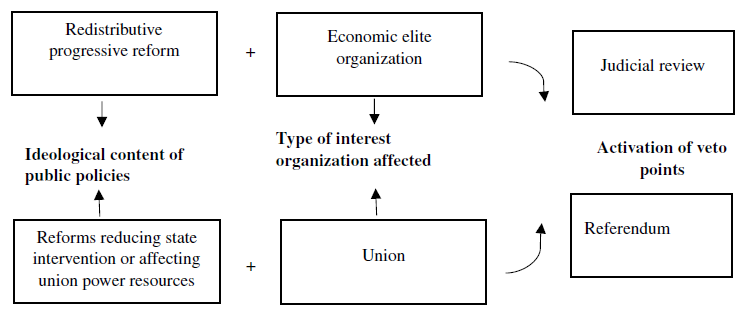
This research makes three major contributions to the literature. First, it theorizes the causal process that leads organized interests to activate different institutional venues (referendum vs. the courts) after a law has been enacted. We argue that the activation of veto points can be explained by a combination of two factors: the ideological content of the public policies adopted by different governing coalitions and the type of interest organization affected by those policies. Center-right and center-left coalitions adopt different public policies, which impose costs on different specific organized interests. This scenario requires that democracies have programmatic party systems; that is, parties organized along relatively coherent programmatic lines (see Kitschelt et al. Reference Kitschelt, Hawkins, Luna, Rosas and Zechmeister2010). Meanwhile, the type of resources and linkages available to the affected organized interests shapes their capacity to mobilize opposition to policies via direct democracy mechanisms or the judicial arena.
Second, this study offers an overview of the within-case variation in veto point use in Uruguayan posttransition democracy through a quantitative comparison over three periods, with referendums dominating when center-right coalitions rule and judicial contestation prevailing when a left-leaning party governs. In the 1990s and early 2000s, direct democracy mechanisms frequently were used to oppose different market-oriented reforms, while litigation in court was rare. By the mid-2000s, during the “left turn,” court use predominated, regularly activated by members of the economic elite to contest redistributive policies. In this scenario, the Court went from being a second-best to first-best veto point. An ongoing third period, initiated in 2020 during the center-right government, is characterized by referendum use and, thus far, a decline in the use of the courts to challenge policy.
The third contribution is to illustrate the causal argument by tracing the politics of court and referendum activation during the two most recent periods.Footnote 2 We first focus on the analysis of court activation by organized elite interests to challenge a tax on large rural property that a left-wing government adopted in 2011. In this case, the congress repealed the law after the court declared it unconstitutional. We then process-trace the referendum triggered by unions and the center-left opposition to contest some provisions of an omnibus bill adopted by a center-right government in 2020. Promoters gathered the required number of signatures and the referendum took place, but it failed by a narrow margin. Even though the law targeted by the referendum remained in force, the referendum had a broader impact on the political system, signaling to the government that the promoters’ position had ample support among the population.
Our approach helps to bridge the gap between comparative politics research on direct democracy, on the one hand, and judicial politics research, on the other hand, providing a unified framework. It also helps to specify the political conditions under which different organized interests influence policy change. In this way, it advances our understanding of alternative ways of channeling social interests in representative democracies by jointly considering how direct democracy and judicial review are drawn into the policy game and which organized interests use which institutional venues to advance their political objectives.
The rest of the article proceeds as follows. It begins by defining veto point activation and identifying the changing patterns of veto point use in Uruguay in comparative perspective. Then it discusses the literature concerning the political drivers of court and referendum use and introduces the explanation of the conditions and mechanisms under which organized interests activate different veto points to challenge a government’s decision. It justifies the case selection and presents the process-tracing design; then it presents the two case studies. The article concludes by discussing the contribution of the results and exploring the applicability of the findings to other contexts.
The Outcome: Veto Point Activation
According to the literature, veto points are “institutional venues that permit political actors to exercise or threaten to exercise a veto over policy” (Taylor Reference Taylor2008, 76). More specifically, they are “points of strategic uncertainty where decisions may be overturned,” resulting from the interaction of institutional rules and electoral results (Immergut Reference Immergut1992, 27). This perspective provides insight into the dynamics of policy change and the opportunities affected groups have to influence the policy process (Immergut Reference Immergut, Castles, Leibfried, Lewis, Obinger and Pierson2010).Footnote 3
Our dependent variable is the activation of veto points by organized interests after legislation has been enacted.Footnote 4 It thus refers to institutional venues used by different groups in an effort to preserve the status quo in response to a policy change, with a focus on referendums and judicial review.Footnote 5 The two mechanisms are similar in that they offer citizens and organized interest groups options to contest a public policy that threatens their interests. Also, they are devices that shift the locus of decisionmaking from the parliamentary and executive arenas to the electoral or judicial camps.
However, judicial review is a countermajoritarian procedure that appeals to constitutional principles, through which the court decides whether a certain law is unconstitutional. Referendums, by contrast, are majoritarian devices that enable the public to vote directly on a proposed policy decision, such as striking down a law (see Miller Reference Miller2009). The effects of these mechanisms heavily depend on the specific institutional design, including how binding and universal are decisions undertaken in the electoral or judicial arena.
The Characteristics of Veto Points in Uruguay
The institutional design of veto points has remained stable in Uruguayan posttransition democracy. Referendums and judicial review offer two venues that differ in several respects, including the procedure used to activate each mechanism, the issues at stake, and the consequences of the decision.
Regarding the procedure, the activation of a referendum against a law entails considerable mobilization to force a ballot vote. A referendum may be initiated through a “long path,” which requires the submission of the signatures of 25 percent of registered voters within one year of the promulgation of the law that is being challenged. Alternatively, it can be initiated by a “short path,” which needs the signatures of only 2 percent of registered voters to propose a prereferendum vote to gauge support for the consultation. If the prereferendum vote yields at least 25 percent support, an actual referendum takes place (Altman Reference Altman2011). Uruguay has relatively accessible referendum procedures when compared to other Latin American cases (Breuer Reference Breuer2011).Footnote 6
Meanwhile, the activation of the Supreme Court to challenge a law’s constitutionality requires that an individual, group, or institution whose interest is directly and personally affected ask the court to rule on the law’s constitutionality. Only the “interested party” or a judge who understands the matter can ask for a ruling on the constitutionality of a law. In Uruguay, standing rules, which determine who can bring claims before the Supreme Court, are rather restrictive in comparison to other Latin American high courts (Brinks and Blass Reference Brinks and Blass2017).
As for the matters that can be subject to veto, referendums cannot be used to challenge laws that involve taxes or that fall within the “exclusive initiative” of executive power, including spending provisions. In the case of judicial review, no specific issues are excluded, but claimmaking has to be framed in terms of the violation of a constitutional provision.
The final difference relates to the effect of the referendum or court decision. The referendum may result in the revocation of a law, with a binding and universal effect. Therefore, referendums may have stronger veto power and capacity to preserve the status quo. In judicial review, the Supreme Court cannot invalidate a law for unconstitutionality. Instead, the effect of its decision is limited to not applying the law in a particular case (inter partes). However, the court’s ruling usually has indirect political effects, such as leading the executive and legislative branches to opt to modify the law in response to the court’s decision of unconstitutionality (Antía and Vairo Reference Antía, Vairo, Bidegain, Freigedo and Zerbriggen2021).
Beyond these differences, both review and referendum use may have significant broader consequences on policies and politics (Papadopoulos Reference Papadopoulos2001). The most obvious effect occurs when either of these mechanisms succeeds in challenging a certain piece of legislation, resulting in a return to the status quo ante. But even in a case in which the referendum or court challenge is unsuccessful, the decision can have a legitimizing effect on policy change. Also, the use of both venues may have further effects on the decisions of governments, which may anticipate the use of these mechanisms and adapt the content of public policy to these eventual restrictions.
The Changing Uses of Veto Points in Uruguay in Comparative Perspective
As noted above, Uruguay is considered a case of extreme referendum use in Latin America (Altman Reference Altman2011; Welp Reference Welp and Soldevilla2020). Although six other countries in the region have referendum provisions, Uruguay is the only one that has used them (Breuer Reference Breuer2011; see also C2D 2022). Uruguay also has been portrayed as exceptionally nonlitigious, given its restrictive access to the Supreme Court and low level of court power when compared with other Latin American countries, such as Brazil, Argentina, Colombia, or Costa Rica (Brinks and Blass Reference Brinks and Blass2017; Skaar Reference Skaar2011; Taylor Reference Taylor2008; Gloppen et al. Reference Gloppen, Wilson, Gargarella, Skaar and Kinander2010).Footnote 7
However, these accounts fail to acknowledge the changing pattern of veto point use during the posttransition period. After an initial period of intense use of direct democracy devices during center-right governments (1985–2004), the use of judicial review skyrocketed in the mid-2000s during the center-left administrations (2005–19) (see below).
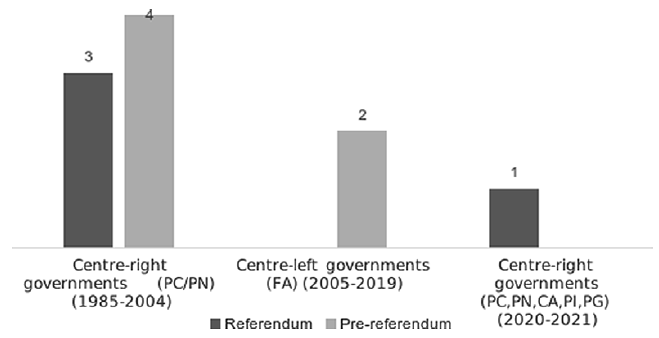
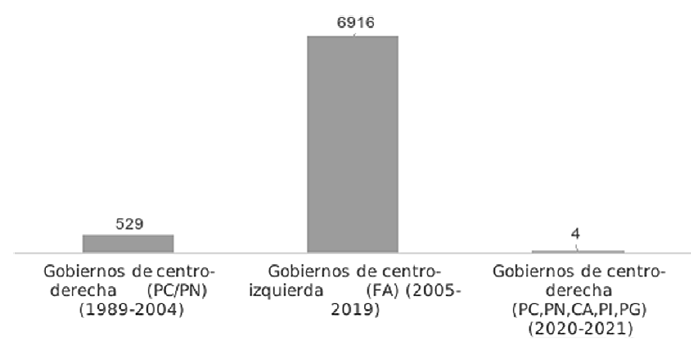
This makes Uruguay an exceptional case in Latin America by exhibiting frequent use of both venues to oppose public policies, but this phenomenon has been little noted in the extant literature. Indeed, the existing research has focused mainly on the first phase of intense use of direct democracy devices, when the unions and the leftist opposition (Frente Amplio, FA) initiated several referendums against laws passed by the center-right governments, led by the Partido Colorado (PC) and Partido Nacional (PN) (figure 1). Some of these direct democracy actions effectively challenged laws that regulated public companies’ ownership and economic governance (Bergara et al. Reference Bergara, Pereyra, Tansini, Garcé, Chasquetti, Buquet and Moraes2006; Monestier Reference Monestier2007; Altman Reference Altman2011; Lissidini Reference Lissidini, Cameron, Hershberg and Sharpe2012; Kay Reference Kay1999). During this period, judicial review was rarely used to oppose public policy; only 529 petitions were filed with the court, challenging 63 laws promulgated by center-right governments (figure 2).
Activation of Referendums and Prereferendums in Uruguay, 1989–2021
Source: Authors, based on Altman Reference Altman2011; Monestier Reference Monestier2007; and press accounts.

Activation of Supreme Court Through Judicial Review, 1989–2021
Note: Our dataset ranges from January 1989 (when the petitions became available online) to October 2021. We compute the number of admissible petitions filed in court against each law adopted by center-right and center-left coalitions in power. Accordingly, when considering a petition that opposes two different laws, we count it as two different observations.
Source: Database created by the authors.

We add to the literature by identifying a second and an ongoing third phase of veto point activation. In the second phase, which began in 2005 when the FA became the ruling party, ending 175 years of electoral dominance by the country’s traditional parties, the pattern of veto point use dramatically changed. The activation of referendums declined; in the rare instances when attempts were made to hold a referendum, they failed to obtain the necessary public support to reach the voting stage (Bidegain and Tricot Reference Bidegain, Tricot, Joignant, Morales and Fuentes2017). Specifically, some legislators of the PN promoted two prereferendums—one against the laws that legalized abortion and one against the establishment of rights for the transgender population—but neither of them obtained sufficient support to call a referendum.
By contrast, our findings show that in this second phase the activation of the court to contest policies adopted by center-left governments sharply increased. In particular, 6,916 petitions were filed in court to contest 105 laws promulgated by FA governments, an amount 13 times greater than in the previous period (figure 2). Although they were not the only plaintiffs, individuals and organized interest groups affected by redistributive or regulatory measures went to court in an effort to preserve the status quo. For instance, petitions were filed to oppose laws that increased taxes on high-income retirees and landowners, regulated the media, settled labor disputes in favor of workers, or mandated the use of electronic means of payment (Antía and Vairo Reference Antía, Vairo, Bidegain, Freigedo and Zerbriggen2021).
A third phase began in 2020 during the center-right government formed by a new multiparty coalition, headed by the PN. Some provisions of the main law approved by this government have been challenged by a referendum in 2022, triggered by unions in alliance with the FA. Concurrently, the judicial contestation of policies adopted by the government seems to have declined (figure 2), although it may be too early to know whether this trend will hold in years to come.
Explaining the Activation of Different Veto Points
What accounts for the pattern of referendum and constitutional review activation in Uruguay during the three periods? Scholars claim that the activation of veto points responds to the institutional and political context (Immergut Reference Immergut1992). In particular, “the combination of electoral results and constitutional rules in creating veto points means that the number and locations of veto points in a particular political system change as the political configuration changes” (Immergut Reference Immergut, Castles, Leibfried, Lewis, Obinger and Pierson2010, 7). This interesting perspective allows us to conceive of judicial review and the referendum as institutional venues political actors can use to exercise a veto over policy change.
Nevertheless, beyond this general perspective, there are specific streams of the literature that focus on the politics of judicial review and referendum use, which may provide better tools for understanding the use of each of these veto points. For example, regarding the politics of referendum use, there are three main accounts (Breuer Reference Breuer2011) but no unified theory (Altman Reference Altman2011). One explanation focuses on the legal provisions that affect the likelihood that groups or citizens call for a referendum (Gerber Reference Gerber1999; Breuer Reference Breuer2011). Another perspective addresses the strength of civil society organizations and their strategic action preferences (Della Porta Reference Della Porta2020). A third account refers to the importance of political parties and, specifically, their integration of mechanisms of citizen participation in their repertoire of actions and their linkages to social movements for the mobilization of support (Altman Reference Altman2011; Uleri Reference Uleri2002).
On the other hand, studies that have sought to explain the activation of courts by organized interests emphasize the importance of the characteristics of the political opportunity and the legal opportunity (Hilson Reference Hilson2002; Vanhala Reference Vanhala2012; Wilson and Rodríguez Cordero Reference Wilson and Rodríguez Cordero2006; see also Kitschelt Reference Kitschelt1986). Political opportunity refers to the access different groups have to conventional political arenas and the political receptivity to the claims being made (Hilson Reference Hilson2002). Legal opportunities consist of the rules regulating access to the courts, the costs of litigation, and courts’ receptivity to the claims made. The argument posits that organized interests may turn to litigation when facing unfavorable political opportunities in the legislative or executive arena (Hilson Reference Hilson2002).
Other analysts, focusing on interest group litigation, claim that the characteristics and resources of the group, coupled with its members’ perception of the political context, may lead the interest group to bring its case to court (Epstein et al. Reference Epstein, Kobylka, Stewart and Nagel1995). Similarly, others note that “the degree to which the judiciary is activated to contest policy will depend greatly on a policy’s salience to potential plaintiffs,” which, in turn, “is determined by how costs and benefits of public policies are spread” (Taylor Reference Taylor2008, 48).
In sum, these different strands of research point to the importance of the opportunities arising from the political context, the institutional rules that affect how costly it is to initiate a referendum or access the court, and the resources available to interest organizations. Despite these commonalities, the motives that prompt organized groups to use one route or the other generally have been analyzed separately. Also, the literature reveals a blind spot by not integrating how the ideological orientation of the government stimulates the use of different veto points.
Building on these insights, we specify the factors and mechanisms driving the activation of veto points by organized interests in democracies where referendum and judicial review provisions are available. We build and improve on the studies that see the content of public policies, the political opportunities, and the resources of organized interests as important factors to account for veto point use. However, we do not incorporate the alternative explanation that focuses on institutional change, because referendum and court access provisions have remained stable in Uruguay.
Specifically, we argue that the content of public policies adopted by left- and right-leaning governments imposes costs on different types of organized interests. Because these groups have distinctive resources, they opt to use different veto points to oppose the public policies. These two factors combine to generate alternative political processes triggering the activation of different veto points (figure 3).
Causal Mechanisms for Activation of Veto Points

Ideological Content of Public Policy Adopted by Different Governmental Coalitions
The content of public policy approved by different coalitions imposes costs on different organized interests, which seek to protect their interests by contesting policy through distinct institutional channels. According to partisan accounts, left- and right-wing parties advance different agendas, which may impose costs on different social actors (Hibbs Reference Hibbs1997; Korpi Reference Korpi1983; Huber and Stephens Reference Huber and Stephens2012). The decisive difference is that left-leaning parties have a commitment to reduce social and economic inequality (Levitsky and Roberts Reference Levitsky and Roberts2011), while right-wing parties consider that “the main inequalities between people are natural and outside the purview of the state” (Luna and Rovira Kaltwasser Reference Luna and Rovira Kaltwasser2014, 4; see also Bobbio Reference Bobbio1995). Accordingly, progressive redistribution is championed by the political left and opposed by the political right. Moreover, the left frequently prefers the expansion of state intervention in the economic and social realm, while right-wing parties favor market incentives and less state intervention.
In Uruguay, since the 1990s, the PC and PN realigned as center-right parties competing with the left-wing party, the FA, on the state-market divide (Luna Reference Luna2014). Thus, the Uruguayan party system has been aligned in two programmatic blocs, a center-right bloc and a center-left one (Buquet and Piñeiro Reference Buquet and Piñeiro2014). When in government, both blocs adopted an array of public policies, some of them certainly matching the description found in partisan literature. Governments based on a coalition between the PC and PN attempted first to privatize public companies and, later on, to associate public enterprises with private capital in some strategic areas (Bergara et al. Reference Bergara, Pereyra, Tansini, Garcé, Chasquetti, Buquet and Moraes2006). The governing coalitions of the FA enacted redistributive polices, such as tax reforms that targeted different segments of the economic elite, regulating the functioning of the media, or promoting the expansion of unions and their power resources (Lanzaro Reference Lanzaro2011). Subsequently, the initial agenda of the multiparty center-right governing coalition inaugurated in 2020 was advanced both in an omnibus bill modifying several policies in the areas of security, labor, education, and fiscal rules and in a budget law that aimed to reduce the government’s fiscal deficit through a cut in public spending (Rossel and Monestier Reference Rossel and Monestier2021).
These different policy agendas generated costs that jeopardized the core interests of different groups and triggered their efforts to use veto points to oppose the policies. Reforms that deregulate labor markets and privatize public utilities threaten the core interest of unions. Redistributive or regulative reforms, adopted by center-left governments, that increase taxes on high-income sectors or regulate media ownership affect the core interests of the economic elite.
This environment shapes the type of organized interest affected by public policy, creating incentives for an interest group to challenge public policy change. However, it cannot fully account for the use of different institutional venues. We also need to consider the resources available to different organized interests.
Type of Interest Organization Affected
Interest organizations differ in the resources they possess, shaping the possibilities of using different institutional venues to challenge policy. We specifically focus on those sources of power that shape the ability of organized interests to use veto points after a law has been approved. In the case of referendums, these actions aim at majority building, which entails campaigning to gather signatures and votes, as well as fostering coalitions with other social and political organizations to mobilize support. In the case of the judicial venue, actions may involve obtaining legal services and mobilizing organization members to file suits alleging unconstitutionality.
On the one hand, the power of unions arises from the number of members, their cohesion, and their organizational capacity, as well as from the creation of coalitions with other social and political actors (Korpi Reference Korpi1983; Schmalz et al. Reference Schmalz, Ludwig and Webster2018). In this sense, one of the main power resources of unions is the capacity to mobilize a large number of activists, which is critical for gathering signatures to trigger direct democracy mechanisms and mobilize voters. Another important source of power arises from partisan linkages, which can range from organic connections to more fluid ties. Political parties that can mobilize intense grassroots-level activism are better able to deploy labor-intensive campaigns than are electoral-professional parties.
In Uruguay, the organizations that have been most active at initiating referendums have been the unions of publicly owned companies (Monestier Reference Monestier2007; Altman Reference Altman2011), which are part of the PIT-CNT (Inter-Union Workers Plenary–National Workers Convention), a unique central union. In the typical scenario, a public union initiates the signature gathering required to trigger a referendum, and subsequently, the FA (and on some occasions, factions of other parties) decides to support that initiative (Monestier Reference Monestier2007). The “organic connection” between the FA and the PIT-CNT (Anria et al. Reference Anria, Bentancur, Rodríguez and Rosenblatt2021) has been critical to the activation of referendums. Furthermore, the FA is a mass organic party; it has a vibrant grassroots activist structure with high mobilization capability (Pérez Bentancur et al. Reference Pérez Bentancur, Rodríguez and Rosenblatt2019), which enables it to gather the large number of signatures needed to initiate a referendum.
On the other hand, one of the most important sources of power needed to access the judicial venue is money, which is essential for procuring expensive legal advice and representation. This is a prerequisite for legal claimmaking and litigation (Epstein et al. Reference Epstein, Kobylka, Stewart and Nagel1995), especially in the absence of support structures for legal mobilization (Epp Reference Epp1998). Economic elite organizations, such as business associations—but also some unions—have the economic resources required to activate a legal challenge in the courts. Moreover, in the case of business associations, having a cohesive, encompassing organization enhances the capacity to mobilize members to file unconstitutionality actions.
Uruguay has a long tradition of encompassing sectoral business organizations (Caetano Reference Caetano1992) that have the economic resources to activate the judicial process and the organizational capacity to mobilize their affiliates to file unconstitutionality actions.
In sum, we argue that an interest organization’s sources of power shape its actions to contest policy after the government has adopted a policy. The type of organized interest may create incentives favoring the use of particular institutional venues—for example, unions opting for referendums and economic elite organizations opting for the judicial venue—but the path is not determined automatically. In this regard, we expect that some unions may make use of both the judicial venue and the referendum option to contest a policy that challenges their core interests. Conversely, we do not expect economic elite organizations to call frequently for a referendum to contest policy, due to their lack of adequate mobilization capacity.
Case Selection and Method
This analysis sheds light on the conditions under which organized interests rely on a direct democracy or judicial mobilization strategy to preserve the status quo. To test our theoretical claims, we conducted two process-tracing studies in Uruguay, a carefully selected case featuring an intense use of both venues after the enactment of legislation (a positive case; see Goertz and Mahoney Reference Goertz and Mahoney2012). A critical advantage of this case is that it exhibits a varying pattern of veto point use within a single institutional and partisan environment.
Our primary focus is to conceptualize and illustrate the causal mechanism that leads to the activation of the veto point that has been underexplored in Uruguay: the Supreme Court of Justice. We also trace the political process that led to the activation of the most recent referendum, which allows us to analyze whether the causal mechanism that previous authors identified remains present and vital. Thus, we aim to explore within-case changing patterns of veto point use and to contrast the mechanisms leading to the different veto points.
We selected two politically salient laws that imposed costs on organized interests and triggered the activation of different veto points. Within the set of redistributive policies adopted by the FA governments with a comparable impact on economic elites (Antía and Vairo Reference Antía, Vairo, Bidegain, Freigedo and Zerbriggen2021), we focus on a tax levied on large rural property, which aimed to reduce the concentration of land ownership. The Impuesto a la Concentración de Inmuebles Rurales (Tax on Land Concentration, ICIR) was adopted in 2011, during the second center-left government. For our referendum case, we selected the process to contest the omnibus bill approved in 2020 by the multiparty center-right coalition, Ley de Urgente Consideración (LUC, Urgent Law). In contrast to previous referendums in Uruguay, the referendum contesting the LUC has not yet been analyzed.
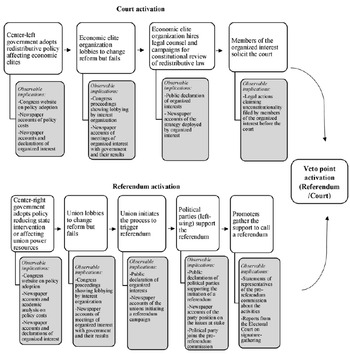
We employ a mechanistic process-tracing approach (Beach and Pedersen Reference Beach and Pedersen2016). We unpack the theorized causal process in constituent parts and describe the evidence we expect to find if the causal mechanism is present. We then trace each part empirically, linking each piece of evidence to the specific step in the theorized causal processes (see Bennett et al. Reference Bennett, Fairfield and David Sofier2019). The assessment of the evidence entails considering whether we have found a given piece of evidence (“certainty of evidence”), and if found, whether there are any plausible alternative explanations for finding the empirical material (“uniqueness of evidence”) (Beach and Pedersen Reference Beach and Pedersen2016, 184).
The mechanisms are presented in figure 4, which further disaggregates the process depicted in figure 3 (see Pavone and Stiansen Reference Pavone and Stiansen2021). We draw on different types of evidence, including legislative records and press accounts, documents and declarations by organized interests, reports by the Electoral Court, and decisions of the Supreme Court. We built an original database based on Supreme Court rulings that includes all sentences from 1989 through 2021.
Causal Mechanisms for Activation of Veto Points

Court Activation in Uruguay
The cause: redistributive policy affecting economic elites and resources of an organized interest
In 2011, José Mujica’s center-left government presented to Parliament the creation of the ICIR, a new tax on land tenure. Based on the diagnosis that the value of the land had greatly increased and was concentrated among a few landowners, the government sought to discourage the concentration of land and update the contribution that landowners made to finance government expenditures (Statement of the purpose of the bill).
The ICIR levied a progressive tax on land holdings greater than two thousand hectares, adjusted by the productivity unit. The resources collected by this tax, equivalent to approximately 0.1 percent of GDP, would be directed to investments in the maintenance of roads in rural areas, under the administration of the regional governments. According to official estimates, the ICIR would affect approximately “1,200 rural producers or companies, out of a total of 47,300, that is, 2.5 percent of the total, who own 36 percent of the total land area.” Accordingly, “97.5 percent of the producers or companies, who own 64 percent of the land, are left out of the tax.” (p. 10) (Statement of the purpose of the bill) (Congress 2011).
Although the individuals and companies affected by the ICIR were few, they had resources to voice their opposition. During the parliamentary debate over the initiative, the two main rural business associations, the Rural Association of Uruguay (ARU) and the Rural Federation of Uruguay (FRU), lobbied in the meetings with Finance Commission members, arguing that the tax burden on agriculture was already high and that the ICIR would slow down production (Law 18876: Proceeding 1183 of the Finance Commission 2011). They also criticized the bill, arguing that “the proposed tax affects the legal security of investors who carried out their productive projects on the basis of an existing legislation” (FRU 2011).
Both business associations have a long tradition of organizing to defend the interests of rural producers (Fernández and Piñeiro Reference Fernández, Piñeiro, Chiappe, Carámabula and Fernández2008). However, during the FA governments, both associations were limited in their ability to influence tax policy because they lacked favorable relationships with the executive branch. The ARU and FRU did have strong ties with the representatives of the center-right traditional parties, which allowed them to promote their interests in the legislative arena, but the center-right parties had too few seats in the legislature to halt the reform (Antía Reference Antía, Bentancur and Busquets2016).
The government and the congress dismissed producers’ claims, and the ICIR was approved on December 28, 2011 with the support of the FA representatives; the opposition parties voted against it.
Ultimately, the ICIR was a modest tax in terms of the amount of revenue it would yield, but it threatened the core interests of ARU and FRU members. It was precisely this aspect, and the cohesion of rural producer organizations, that facilitated the coordination of actions to challenge the new tax in the judicial venue.
The reaction of those associations seems to have been shaped by the perception that the government would continue adopting reforms that would adversely affect their interests. In a public declaration, the FRU posited that “if this mechanism prospers, we are sure that in the short term we will see new proposals with the same approach” (FRU 2011). Coincidently, a government official argued that business associations “overreacted” in their opposition to the tax in order to prevent possible future reforms (Interview with a senior Oficina de Planeamiento y Presupuesto official, 2014).
The mechanism: coordinated legal strategy by an organized interest
Having been thwarted in other policymaking arenas, producer associations turned to the judicial venue to challenge the ICIR. Initially, producers individually contested the tax in the Supreme Court, but later on, they pursued a concerted strategy led by the FRU and ARU, which obtained legal counsel and mobilized rural landowners to solicit the court.
For example, on June 12, 2012, FRU and ARU held a press conference in which they recommended to their associates that they file an appeal against the ICIR and assured them that the law was unconstitutional (Montevideo Portal 2012). In addition, both associations obtained the legal counsel of Dr. Gonzalo Aguirre Ramírez, a constitutional lawyer and former vice president of the republic during the 1990–95 PN government, who had already sponsored several legal actions against the ICIR (Rómboli Reference Rómboli2012) and eventually filed 130 lawsuits (Aguirre Reference Aguirre2013). Similarly, on December 4, both associations organized an academic event titled “ICIR: Is Politics Above the Constitution?” (Sociedad Uruguaya Mírate 2012).
The outcome: rural owners contest policy in court
From 2012 to 2013, hundreds of similar cases involving the interests of important segments of the economic elite were filed contesting the ICIR. The first to solicit the Supreme Court on the constitutionality of the ICIR was a forestry company (la diaria 2012). In the following months, other rural owners also challenged the ICIR in court, bringing the total number of unconstitutionality lawsuits filed to 168 (Authors’ database).
Economic interests were “dressed up” as a constitutional claim. The main argument advanced to challenge ICIR was that it overlapped with an already existing tax and consequently violated the provisions of Article 298 of the constitution, which prohibits the creation of a tax whose taxable event is the same as another (Law 18.876, Art. 1). Moreover, they argued that this provision violated the principle of legality and freedom by not precisely defining the taxable event and by not identifying whom the ICIR would affect (Articles 1 and 2). The petitioners also contended that the law violated the autonomy of local authorities in tax matters (Article 10 and 11), in particular the provisions of the preamble of Article 297 of the constitution (see, e.g., sentences 17/2013 and 30/2013).
The majority of the court judges decided, on 168 occasions, that Articles 1 and 2 of the law were unconstitutional because they embodied a case of tax overlap. Most of the decisions affirmed this precedent.
Facing more than one hundred adverse rulings, the government decided to comply with the court’s decision and repealed the contested law. Although, at first, President Mujica raised the possibility of making constitutional changes to avoid legal obstacles to this and other reforms (El Espectador 2013), the government later decided to repeal the ICIR and replace it by modifying an existing tax, the wealth tax (Law 19088). The new tax was also contested in the judicial venue, but the court determined that it was constitutional (see, e.g., Sentence 738/2014).
Referendum Activation in Uruguay
The cause: public policy affecting unions’ interests and the resources of organized interest groups
In 2020, the political landscape changed in Uruguay when, after three leftist mandates, Luis Lacalle Pou of the PN won the presidency, supported by an alliance of five parties that had been in opposition to the previous governments. The strategy to promote the center-right coalition’s program consisted of quickly passing a far-reaching law in the first months of the government using Uruguay’s “urgent consideration” process. This legislative process imposes a short deadline—one hundred days—for Congress to pass a bill. If neither chamber rejects the bill by a simple majority, or if the assembly of both chambers fails to reject it, the bill becomes law in this short period.
The omnibus bill, known as the Urgent Consideration Law (LUC), adopted reforms in several areas, including citizen security, labor rights, education, health, housing, social security, environment, and fiscal rules. Some reforms affected the core interests of unions. In particular, in the area of labor rights, the LUC establishes the right of nonstrikers to access companies and the right of firm management to enter the workplace in the context of a labor dispute, thereby limiting striking workers’ right to occupy workplaces, which previously was viewed as an aspect of the right to strike. In addition, the law modified education governance by reducing the participation of teachers’ representatives in the entities responsible for governing the different levels of education.
The PIT-CNT rejected the bill even before it was sent to Parliament and requested that the government not use the urgency mechanism in the legislative process (El País 2020). In the following months, the PIT-CNT organized demonstrations against the bill, and some unions, such as the public oil company workers’ union, raised the possibility of triggering a referendum against the law (Federación ANCAP 2020).
During the legislative debate, the FA opposed most of the contents of the bill and questioned both the use of the urgency mechanism and the timing of the bill in the context of the COVID-19 pandemic. Nevertheless, the FA did not have a majority in Congress to block the bill, so it negotiated modifications of some of the provisions it considered most harmful, as part of a “damage control strategy”. As a consequence, it supported almost half the articles in the bill but maintained its opposition to the bill in general (Law 19889: Proceeding 145885 of the Parliament 2020). The law was enacted on July 9, 2020, about 11 weeks after the bill was sent to Parliament.
The mechanism: coordinated strategy by union and left-wing party
In the PIT-CNT, the idea of promoting a referendum against the LUC gained momentum after the law was approved. That path was confirmed on October 17, 2020 by the Intersocial, a roundtable that brings together various social organizations in addition to the PIT-CNT. The Intersocial participants decided to form a “national prereferendum commission,” with a mandate to consult different social and political organizations on whether they would help gather signatures (la diaria 2020).
The other natural ally was the FA. Initially, the party was reluctant to promote a referendum. After the enactment of the LUC, the president of the FA, Javier Miranda, stated that his party did not prioritize the direct democracy path (la diaria 2020). However, this began to change once the PIT-CNT decided to favor a referendum. Although some FA leaders argued that promoting a referendum could eventually prove a political error (Búsqueda 2020), on October 19, the National Plenary of the FA decided to support the campaign. It also requested that the party’s Political Board adopt a resolution on the procedure to be used and the articles whose repeal would be promoted, in dialogue with the Intersocial (FA 2020).
The articulation of both issues was controversial and required complex negotiations between the partners. They finally decided to initiate the referendum via the “long path,” which required them to gather the signatures of 25 percent of the country’s registered voters in support of the initiative within a year. They also decided that the referendum would seek to nullify 125 articles (26 percent of the articles in the law), including 5 provisions that FA legislators had supported.
With their strong mobilization capacity, both the PIT-CNT and the FA had a critical resource for gathering signatures to trigger a referendum. Also, through its organic connection with the FA, the PIT-CNT could harness the resources of FA’s grassroots activist structure to mobilize support to activate the referendum.
The campaign was difficult and demanding, especially since it was undertaken during a pandemic, when the mobility of the population was restricted due to the public measures adopted to prevent the spread of the Coronavirus. The different organizations involved deployed a large number of activists, leveraging vibrant grassroots networks. As a result, they succeeded in collecting the required number of signatures—57 percent were contributed by the FA and 43 percent by the PIT-CNT and other social organizations (Silva Reference Silva2021)—enabling the referendum to occur.
The outcome: unions, social organizations, and FA trigger a referendum
On July 8, 2021, almost eight hundred thousand signatures were submitted to the Electoral Court to call a referendum against 135 articles of the LUC. The number of signatures exceeded 25 percent of the country’s registered voters, the statutory requirement for calling a referendum. This event marked a political milestone for the unions and the opposition party, which succeeded in bringing to referendum the most significant law adopted by the government.
The referendum vote took place on March 27, 2022, and the promoters of the derogation of the law received the support of 48.8 percent of valid voters, which was nearly but not quite sufficient to repeal the law. Although the law remained in force, the referendum had a broader impact on the political system, resulting, for example, in a temporary halt to government reforms and the strengthening of the opposition’s position.
Conclusions
This article, has advanced a unified framework for understanding the activation of different veto points by organized interests to contest public policy. It has studied Uruguay, an exceptional case in the Latin American context that has used referendum and judicial review as effective ways to oppose to public policies. In contrast to the dominant narrative, which exclusively focuses on the politics of direct democracy, this study incorporated the analysis of the surge in the use of the judicial venue, which had received little scholarly attention. Accordingly, this is the first research to identify the study of the judicial venue as crucial to advancing understanding of the mechanisms that channel organized interest demands in Uruguayan democracy.
Our results yield three main contributions. First, they provide a unified framework for analyzing the reasons that lead organized interests to use different institutional venues to oppose public policies in democracies that have programmatic party systems and referendum and judicial review provisions. Using the veto points perspective, we have attempted to bring together aspects of the literatures on court and referendum use, which generally have developed separately. We argued that each ideological governing coalition adopts policies that impose costs on the core interests of different types of organized interest groups, inclining them to channel discontent through different institutional venues. In particular, we have provided a mechanistic approach by unpacking the processes that prompt interest groups to channel their opposition through various institutional channels.
Second, this study developed better descriptive inferences regarding the nature of veto point use in Uruguay. This case exhibits intertemporal variation in the activation of veto points, with referendums dominating when center-right coalitions rule and judicial contestation prevailing when a left-leaning party governs.
Third, the analysis conducted thorough empirical testing of this mechanism by tracing the politics of court and referendum activation in two prominent cases, providing strong empirical evidence that lend support to our framework. The use of multiple veto points is a new feature that adds to other distinctive characteristics of Uruguayan democracy, such as regime consolidation and the country’s institutionalized and programmatic party system, all of which make it exceptional in the region.
The study’s findings suggest that the activation of referendum and court veto points seems to supplement representative democratic politics by opening new institutional avenues for channeling the discontent, representing the interests of groups, and offering “sporadic safety valves for political pressure” (Altman Reference Altman2011, 5). The use of one path or the other to oppose left- or right-wing reforms seems to have a moderating effect on policy change. Nevertheless, both veto points amplify the voices of different organized interests, entailing biases in the interests they channel. Those inputs can potentially make the polity more accountable and representative, but may also generate biases that tilt the balance toward certain organized interests.
In sum, this study increases researchers’ analytical leverage, helping to bridge the gap between, on the one hand, comparative research on direct democracy, and on the other, judicial politics research by providing a unified framework.
As we have noted, our argument is not easily applied to other Latin American countries, given that no other Latin American democracies frequently use both venues to oppose policies in those contexts. Additionally, in a broader comparative setting, the explanation does not travel to other countries that routinely use referendums, such as Switzerland and the United States, since the former does not have a system of judicial review of federal laws (Linder and Mueller Reference Linder and Mueller2021), and the latter, where the judicial contestation of laws is frequent, has referendums only at the state level (Miller Reference Miller2009).
Nevertheless, the theoretical argument developed here may be applicable to other instances of consolidated democracies where both institutional venues are regularly used by organized interests to check on public policies. In Italy, for example, referendums have been used a total of 66 times to challenge laws on a wide range of issues, including water privatization, labor rights, and the development of nuclear energy (Uleri Reference Uleri2002; Chiaramonte and D’Alimonte Reference Chiaramonte and D’Alimonte2012, C2D 2022). Furthermore, the judicial venue has often been activated in Italy to contest the constitutionality of a wide variety of laws, some of them affecting economic elite interests, such as taxation of energy companies (Bergonzini Reference Bergonzini2016).
Slovenia is also an interesting case of frequent use of referendum and judicial review to contest public policies in a recent but stable democracy. Indeed, together with Italy, it has one of “the most developed systems of direct democracy in Europe” (Žuber and Kaučič Reference Žuber and Kaučič2019). Between 2007 and 2021, citizens and organizations initiated 11 referendums against laws regulating insurance, pension systems, and labor, among others (based on C2D 2022). Moreover, Slovenia has a well-developed system of judicial review (Žuber and Kaučič Reference Žuber and Kaučič2019), which has been activated by individuals and organized interests on issues such as the cost of bank loans (Ralev Reference Ralev2022) or the COVID emergency measures adopted by the government (Teršek et al. Reference Teršek, Dragan, Pavlin, Nastran and Vražič2021).
Future studies should address the generalizability of the argument advanced here to account for veto point use in other democracies. They could be helpful in elucidating, for instance, whether the explanation proposed here accounts for Italy’s or Slovenia’s frequent use of both institutional venues, especially during the periods when their party systems were programmatically structured. Similarly, further work is needed to explore the reasons these mechanisms have not been used in countries whose institutional rules allow for referendums and judicial review of laws. Such a study might help advance understanding of whether this observation is attributable to the absence of some elements of the proposed causal mechanism; for example, organized interests’ lacking the necessary links and resources to promote referendums. Additionally, further work is needed to fully understand the implications of the economic elite’s use of litigation to oppose policy change and the increasingly political role of high courts in representation and democratic governance.