Family photograph albums are among the most tantalizing and frustrating finds a historian can hold in her hands. Bursting with people, domestic interiors, cityscapes, and often captions, they offer a detailed and intimate glimpse into the past. But they are also almost always anonymous and without context, their subjects identified at best by first names or family relationship, addresses and dates unknown. Usually it is at street markets or antique stores that family albums come to light, divorced from any identifying information, to say nothing of extensive archival records. If albums do reach an archive, archivists often extract the images and catalogue them separately, thereby not only rendering analysis of those albums impossible, but also making the task of situating intact albums within the genre much more difficult. To discover even one well-preserved album within a collection of family papers is uncommon. The three photograph albums of the well-known German Jewish Wassermann family preserved and filed among their papers in the Leo Baeck Institute archives in New York offer, therefore, an unusual opportunity for reflection on the use of family albums as historical sources and the making of photograph albums as a practice.Footnote 1 Just as significant, analysis of these albums, dating from 1912, 1929, and the early 1930s, allows one to approach old questions of how German-Jewish relations under the Kaiserreich, Weimar Republic, and the early Third Reich may be best conceptualized from a new angle.
The Wassermann family, one of the wealthiest and most accomplished in Germany from the mid-nineteenth century until 1933, counted among its members numerous bankers, government advisors, writers, and scientists. Although the family's documented history dates to their move to the town of Bamberg in the late eighteenth century, we enter their story in the 1880s, when two brothers, Angelo (1834–1914) and Emil (1842–1911), founded the A.E. Wassermann bank there. The family was already prosperous, but the bank's founding marked the beginning of its rise from regional to national (and European) prominence. The A.E. Wassermann bank became one of the largest private banks in this period and Emil's son, Oscar Wassermann (1869–1934), played a central role in economic policy making during the Weimar Republic. Oscar's cousin, August Paul von Wassermann (1866–1925), was the bacteriologist for whom the standard diagnostic test for syphilis was named, while Jakob Wassermann (1873–1934) made his mark in Jewish literature. Not only were the Wassermanns prominent in German finance, science, and letters, but members of the family also took on leadership roles in German Zionism, as well as in Jewish religious, philanthropic, educational, and organizational life.Footnote 2 Their contributions to German society did not, of course, spare them the fate shared by German Jewry; starting in 1933, the Wassermanns were first forced out of their professional positions and then driven into exile.
As members of what one might term a “super-elite,” the Wassermanns were anything but sociologically representative of German Jewry, but they shared a doubled history and identification with those much less privileged than they.Footnote 3 Building on a generation of scholarship that argues that understanding German Jewish life requires moving beyond debates over terms—assimilation, acculturation, integration, subcultures, and symbiosis—this essay uses the photograph albums created by the family, in conjunction with the written record, to suggest an alternative interpretive framework for understanding the complexity of German-Jewish lives in the first third of the twentieth century.Footnote 4 Rethinking this history through a close analysis of photographs and photograph albums is particularly productive because even if photography and album-making were ubiquitous practices throughout the twentieth century, the special affinity of Jews for photography has been well-documented.Footnote 5 Their paradoxical historic experience—including ghettoization and forced migration, on the one hand, and powerful feelings of “at-homeness” in their various diasporic dwelling-places, on the other, in combination with the specificities of Jewish religious practice—has given Jews a particular relation to time and to place, a relation sometimes made manifest in photography. That relation is, furthermore, historical, changing with each context in which Jews found themselves living.
Analysis of the three Wassermann albums requires, therefore, first an explanation of how and for what purpose albums were made in this period, followed by a close reading of the albums themselves in the context of the family itself and of German Jewish history more broadly. This article demonstrates that analyzing the method as well as the content of this genre affords special insight into the lives narrated between the covers of those albums.Footnote 6
Photography and Photograph Albums as Practice and Historical Source
By 1912, the date of the earliest album studied here, photography was an everyday practice and the family photograph album was a thoroughly established genre. Cultural theorists and historians have been preoccupied with analyzing the consequences of photography's objectivity-effect, particularly when contrasted with the seemingly greater subjectivity of older media—drawing, printmaking, or painting—in which the maker's hand was more obviously present.Footnote 7 More significant here, however, is photography's relation to time.Footnote 8 From its start with daguerreotypes in 1839 and intensifying through the technical improvements of the next century, photography had a unique capacity to capture and represent people and places at a fixed moment in time. A photograph is taken literally in a flash, whereas a drawing, print, or painting take much longer to bring to life. The time taken to produce a photographic image is brief not only in comparison to these other genres, but also to its potential existence. Photography's paradoxical relation to time—an image quickly taken, yet freezing a moment forever—is heightened by the practice of presenting photographs in albums. Photograph albums both physically preserve the images for posterity and combine isolated, fragmented moments into a consecutive narrative intended to be intelligible to future viewers.
European and North American households became avid consumers and producers of photograph albums in the 1860s with the diffusion of albums composed of studio-produced carte de visite-style portraits. The invention of the portable Kodak camera in 1888 made snapshots possible and the broad distribution of the Leica in the mid-1920s further expanded the possibilities.Footnote 9 Germans—at least urban Germans—were especially avid album makers, a role that complemented German society's elaborated culture of commemorative celebration.Footnote 10 From the period of the Kaiserreich, milestone events such as birthdays, graduations, promotions, retirements, and anniversaries of all kinds were marked with particular intensity, involving many activities that crossed the boundary between the public and private. This was most common for family events, but trade or professional organizations, as well as associations (Vereine) also regularly organized festivities that were very often photographed and subsequently narrativized and immortalized in an album.
The ubiquity of photography and photograph albums created a robust and competitive market for photography studios, as well as for camera retailers, album makers, and published guides for taking pictures and composing albums.Footnote 11 Albums correspondingly took many forms.Footnote 12 Some were assemblages of amateur snaps while others were produced professionally. Some covered decades, some only a summer vacation. Some were intensely peopled, some only sparsely. Some were put together to commemorate a given event, some simply to record the family's trajectory through time and space. Some were captioned and annotated, while in others, the images were left to speak for themselves. The boundary between the scrapbook and photograph album was, moreover, fluid. Album makers might include letters, bus tickets, menus, birth certificates, or ribbons alongside photographs.
Albums were, in other words, composed and constructed objects, even if their makers might not have necessarily been able to articulate why they chose one image rather than another, or why they put them in a particular order. The choices that determined the shape of an album were often made at the moment of acquisition of the constituent photographs. If the family's means allowed it, they could hire a professional photographer, who would either photograph the family in the studio or at a site of their own choosing. By the 1890s, family members could also take the pictures themselves and many preferred to do so, using the albums not only to preserve events and faces but also their own photographic practices. Some album makers combined studio shots, postcards, and their own snapshots. Sometimes pictures were taken explicitly to make into an album, but considerable time often elapsed before the album was made. Families accumulated large collections of individual, unmounted photographs that could be inserted into albums composed years after they were taken. Picture formats also varied, ranging from the very tiny snapshot to ten-by-ten-inch studio portraits. After the images were in hand, however, and whenever acquired, one needed to find an appropriate album.
Albums were produced in all prices and qualities. The least expensive had cardboard or paper covers and thin paper; beautiful leather, cloth, or even silver bindings enhanced high-end albums. The most elegant ones might be professionally customized and include some printed sheets or even a whole published album in which the family photos were printed on glossy paper rather than glued onto or slotted into existing pages. Many albums left little choice concerning the placement of the photographs on the page, while others offered a blank slate, allowing for the crowding or overlapping of the photographs or for the isolation of a single image.
Some albums anticipated captioning, while others made this emotionally weighty practice difficult, since to include a caption was to acknowledge the reality of the passage of time, with the sense of loss that might entail: loss of memory first of all—even the person who put an album together would someday forget where a scene took place or who someone was—but, most distressingly, loss through death.Footnote 13 The act of captioning or including a list of images identifying even those that would have been unforgettable for the creator of an album, signified a desire to create an intelligible record for posterity—as opposed to a memory book for the present and near future. The pleasure of a memory book lay in recognizing oneself or others in the images. When the protagonists were identified by name and addresses put on houses and places of businesses, the album became a work of History.
Once a decision had been made concerning who would produce the photographs, what album would house them, how they would be placed, and whether and how they would be captioned, album makers had to choose and arrange the images. While the selection of images to include and exclude posed the greatest challenge when the album was first purchased to accommodate an accumulated stash of heterogeneous images, even if the photographs were professionally commissioned the consumer had to decide what images would be selected and which discarded. That was the first step in the crucial decision about what and who would be remembered. As many theorists of photography and visual culture have argued, photographs entail a particular kind of forgetting.Footnote 14 They do record on paper, but, paradoxically, these materialized, externalized images often diminish people's capacity to remember in their mind's eye. What an album left out would thus be more readily forgotten than it would have been in an age before cameras had rendered photographs ubiquitous. Album makers knew that excluded people, moments, or places would be forgotten, charging all such choices with emotion.
Selected images were then put into a sequence that would determine which story—of the many possible—the album would tell. Social historians of photography have noted that these albums were a way of narrativizing family history, simultaneously standardized and individualized. The narrative is not necessarily temporal—it can be spatial or thematic—but the composer of an album virtually always intended the viewer to look at them in a certain order, just as one reads a book.Footnote 15 An album adds up, therefore, to a great deal more than the sum of the photographs it contains, and must be analyzed in its entirety with attention to both its materiality and its narrative structure.
Although actually assembling an album was often a solitary task, the process as a whole was intensely social. By the first thirty years of the twentieth century, many norms and models for albums were being conveyed through published guides, by professional photographers, through the albums of relatives and intimate friends, and through those inherited from previous generations. The layout of commercially available albums also structured their contents —how many images would fit, of what size—and sometimes their placement. One could choose to emulate or deviate, but existing models necessarily shaped the choices.Footnote 16
Just as important as the existing models for photograph albums was the composer's vision of that particular album's public. Albums were created to serve as both memory prompts and archives, to bring the past into the present or to preserve the present for the future. An album's past could be, in part or in whole, quite distant. Some albums—ones that assembled historic photographs—contained only the deep history of a family, providing the occasion to talk about dead relatives or past events. Some preserved the present moment for the near, middle, and distant future. A two-year-old would be fascinated by an album of her first two years of life, and wedding pictures could give pleasure within months of the event itself. Some album makers, by contrast, were clearly thinking about the very distant future, composing a volume for the benefit of as-yet-unborn grand- or great-grandchildren. Many combined these temporalities by including images from several points in the family's timeline. In virtually all cases, albums are conceptualized as prompting memory through interaction among viewers, as well as between them and the album. In the early twentieth century, people usually kept their albums exposed in the relatively public spaces of the home (e.g., parlor, salon, family room), left out for perusing, but also to encourage collective storytelling. Albums worked in tandem with oral accounts, written texts, and material culture. They embodied the implicit hope of ensuring transmission of the family history they contained, as well as the desire to consolidate the family by inspiring collective conversation.Footnote 17
This emotional and memory work performed by albums for their makers is an important part of their value as a historical source.Footnote 18 Albums tell historians what (and whom) their makers considered important and worth remembering, what they feared to forget, and how they ordered their life stories. The quality of the photographs and the albums, read in relation to what one knows about a family's income, yield information about how much its members chose to invest in commemorative acts in general, as well as in particular events or experiences. The nature of the captioning and other textual material they included enables one to determine what the family thought needed to be recorded in words—and what in images.
The photographs contained in albums also yield, however, a very different, documentary kind of knowledge about the family. Album photographs allow historians to put faces on names, to see what people did in their leisure time, to know where they went on vacation. They constitute, in other words, crucial sources of information about everyday life in all the complex meanings of that term.Footnote 19 Images of both the exterior and interior of homes grant historians access to the stylistic framing of the family's domestic life. The furniture, rugs, curtains, and wallpaper, as well as the paintings, prints, or photographs on the walls—and their arrangement—may provide historians with knowledge of where family members shopped, what they inherited, and how taste differed among members of the household.Footnote 20 When these images mirror—or deviate from—the styles that decorating magazines, as well as department and specialty stores, were promoting at the time, they convey a sense of the sources of influence on a family's stylistic choices.
The information yielded by photographs of homes goes far beyond matters of style. The books and magazines incidentally shown in the photographs reveal, for example, the inhabitants' reading habits. Religious objects provide clues to devotional practice. In this period, the presence (or absence) and placement of musical instruments, music stands, radios, or gramophones can provide important information about the role of music in the household, and sometimes even about the type of music the family enjoyed in its leisure time. Clothing, and how it was worn, shoes, jewelry, eyeglasses, and haircuts are all revealing of the family's behavior as consumers. They can show generational difference, income levels, political inclination, and the influence of advertising or films. In another register, the body language of those featured in the photographs, whether posed or not, may communicate a great deal about family relations or sense of self. None of this is usually information that the family sought to record, or was even conscious of preserving, but rather was an unintended side effect of commemorating family life.
Family albums are, then, extraordinarily rich sources for historical research, both for what their makers intentionally displayed in them and for what they accidentally reveal. Extracting their full meaning requires attentiveness to all elements of the albums: the material form of the album and the photographs; the selection, ordering, and placement of the images; the content of the images; and the presence or absence of captions. Finally, the possibilities and constraints of the medium mean that albums sometimes complement and sometimes contradict the stories one might otherwise tell—as the Wassermann albums, to which we now turn, illustrate well.
Fractals: Public/Private and German/Jewish in The Wassermann Albums
The three extant Wassermann family albums—the first composed in 1912, the second in 1929, and the third in the 1930s—are each different from one another in form, content, and purpose. The first two have beautiful bindings (the second, in fact, a luxurious one), the last does not. The second is intensely peopled; the first is a “home portrait” in which humans are completely absent; the last documents the family's banking business. Only the second makes explicit the occasion for its creation: Oscar Wassermann's sixtieth birthday. The birthday album is the only one, also, that provides a key identifying the photographs. But there are also similarities: none is captioned and all are narratively structured. Each album starts off with a series of images whose logic seems apparent to the viewer—but that sequence is then broken at some point, thus complicating the story being told. Taken individually and collectively, they nuance what we know about the changing relationship between the Germanness and Jewishness of the Wassermann family, and of many other German Jews, in the first thirty-five years of the twentieth century.
The Kaiserreich Home Portrait: Commemorating German Jewishness
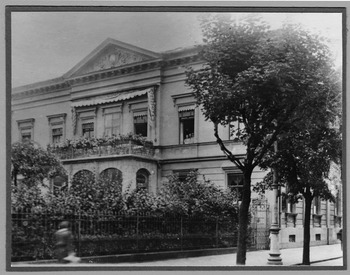
The first of the three Wassermann albums features Emil's and Emma's home in Bamberg, where they lived from 1884 to 1889, and where Emil continued to reside after Emma's death and until his own in late 1911 (Figure 1). This was their second home in that city, the house in which their younger children were raised and to which Emil's mother came to Shabbat dinner every Friday, a tradition which Emil's and Emma's children, Oscar, Gutta, Ernst, Julius, and Albert, maintained as adults when they were in town. It was also the place where the Wassermanns celebrated the domestic moments of all the other Jewish holidays: Rosh Hashanah, Yom Kippur, Sukkot, Shemini Atzeret, Simchat Torah, Channukah, Passover, and Shavu'ot.Footnote 21 The house on Am Zwinger was the extended family's home—in the strongest sense of that word—for over a quarter of a century.
Photograph of the front of Emil and Emma Wassermann's home from 1884 to 1912, located at Am Zwinger 2, Bamberg. This image was not included in the 1912 Home Portrait/Memorial Album, but clearly dates from the same period. It may also be seen in the album from the 1930s (Figure 20).

The 1912 album should be read on three levels: first of all, it provides documentation of the home's exterior and interior style; second, the quality and content of the photographs and the album suggest which aspects of the home the family sought to record for posterity; and, last, the choices made in the composition of the album, its format and ordering, yield information about how the Wassermanns inhabited that space. Read with the written archive, it also offers insight into how both Emil and Emma, and their children, structured their relationship to Jewishness and Germanness. Although the three threads (or levels) may be separated analytically, they are woven together in the album; it is the resulting fabric that provides the rich historical source.
The “home portrait” album is beautifully bound in solid brown leather with subtle gold highlighting and beautiful modernist endpapers.Footnote 22 Each page is of good quality and holds a single photograph. Despite the elegance of the binding and paper, the album is awkwardly made. Rather than use a large enough format that would have accommodated both landscape- and portrait-oriented images, the album's maker chose a horizontal rectangle scarcely bigger than the photographs it contains. In order to view the vertically-oriented images, the viewer is therefore obliged to turn the album ninety degrees, and sometimes (if both images are oriented vertically) back 180 degrees to see the two images on facing pages. The photographs themselves are also jarring: although the album is luxurious and the home portrayed is clearly that of a very wealthy family, the images are not well composed and many are badly lit.Footnote 23 As a result, this album challenges the viewer from the first moment of handling, forcing her to try to reconcile the evident investment and commitment to certain aesthetic norms with the poor quality of some of the photographs and the lack of attention paid to the viewer's comfort.Footnote 24
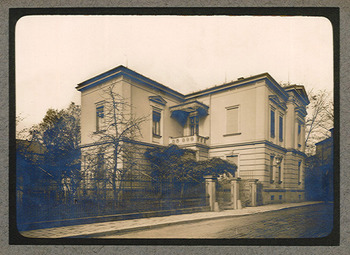
The puzzle is not resolved by delving more deeply into the album. The pictures are completely unpeopled and uncaptioned, and the album contains no identifying list. One is greeted by a photograph of the side—not the main—entrance of the family's home (Figure 2), despite the availability of an image of the elegant main façade (shown in Figure 1). The second image is of the garden; the third, of the back of the house. The album seems to be taking us into the property, through the garden, and into the house (although we never actually come up the front steps). The viewer proceeds through more paired photographs, constantly flipping the book right and left, before reaching a bookend to the first image—the garage. Despite the villa's scale, it is not presented to maximize its beauty; the first three photographs look like they were taken in late autumn—there are leaves on the ground and some of the trees are bare—and the light is not particularly kind. The album willfully offers, in other words, a rather unglamorous introduction to the estate.
(Color online) First photograph in the 1912 Home Portrait/Memorial Album of Emil and Emma Wassermann's home in Bamberg. This image, which sits on the right side of the album as one opens it, had a blank sheet to its left. It shows a side view of the same house shown in Figure 1.

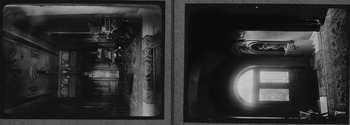
Having been brought into the property as if after a long day at work, the viewer climbs two stone steps, her tread softened by an oriental carpet, into the elegant front hall, illuminated by a chandelier (Figure 3, left side). She could, if need be, take a pause in the rustic Louis XIV-style upholstered chair while admiring the entry hall table. The composition of this first image is banal but unproblematic, which makes the inclusion of a second photograph of the anteroom—taken from the inside facing back toward the front door, through which light is streaming (Figure 3, right side)—all the more surprising. The light here is too bright, overexposing the photograph, and throwing parts of it into complete obscurity. Paradoxically, the poor quality of this second view of the front hall makes one more attentive to it. What was so important about that shot that necessitated its inclusion despite the evident technical problems? Did the album's designer, in fact, intentionally choose the uncanny lighting for this image? Did the person who commissioned it require a view out of as well as into the house? Was it crucial to record the statue in the niche? Such questions linger as the pages lead the viewer into the formal salon/music room.
Second pair of images (the first pair, following the solo image of the house in Figure 2, are of the garden) in the 1912 Home Portrait/Memorial Album. These two photographs show the front entry of Emil and Emma Wassermann's home in Bamberg. On the left is the view of the front hall as a visitor would have seen it coming up into the house. On the right is the view the visitor would have had when seated in the chair shown in the image on the left. In order to view these images properly, one must turn the album 90 degrees.

This room, in which guests were received and the family gathered to play and listen to music, was furnished and decorated in variations of French Louis XV furniture and German Rococo, with miniature portraits and oil paintings of rural landscapes on the wall. The ornate plaster casts decorating the ceiling are matched by the chandelier, carpet, and center table.Footnote 25 The room is presented first in a broad shot, and then by two separate images focusing in on two of the room's four corners (Figures 4 and 5). One of the corner views (Figure 5) provides details of porcelain (very likely Meissen) pastoral figures displayed on the buffet and an array of Jewish ritual objects—including a spice box used in the Havdalah ceremony ushering out the Sabbath, two silver pointers (yads) used when reading the Torah, a silver scroll case (for Purim), and an etrog holder (used at Sukkot), as well as silver beakers from which wine was drunk at Passover—stationed on a three-tiered table right next to the buffet. The presence of these objects in this room requires explanation, since Emma and Emil would have considered them sacred, not decorative, objects. It is likely that they were gathered here to be recorded in the album. The other corner features more porcelain figures and an elegant eighteenth-century mantel clock. The detail photographs in particular, like the second front hall image, convey a sense of documentary urgency: it was somehow important to record these spaces and the objects they contained, as well as the religious objects regularly used within the home if not in that space. The sense of an impulse to immortalize the family's everyday life is reinforced by the fact that the piano is shown with its keyboard exposed, music left open as if it had just been played, with a fresh flower arrangement on the room's center table.
(Color online) Left-hand image of the third pair of photographs in the 1912 Home Portrait/Memorial Album of Emil and Emma Wassermann's home in Bamberg. This pair features the formal salon/music room. This photograph provides a general view of the room. Viewing this image required rotating the album 90 degrees.

(Color online) Right-hand image of the third pair of photographs in the 1912 Home Portrait/Memorial Album of Emil and Emma Wassermann's home in Bamberg. This photograph provides detail of the right-hand corner of the formal salon/music room. Note the two silver Torah pointers (yad) hanging on either side of the étagère as well as the silver scroll case, which likely holds the Megillah, or story of Esther, read on the holiday of Purim. The silver object on the left is a spice box used for the Havdalah ceremony ending the Sabbath; on the right is an etrog holder used for the festival of Sukkot, and on the shelf are the beakers also seen in Figure 7. Porcelain figurines are seen on the sideboard, next to which sits an armchair in Louis XIV style. Viewing this image required rotating the album 90 degrees.

The viewer's path through the house continues with both a general view and a detail of the breakfast room. This room is decorated in a much more informal and contemporary style, including a day bed covered with a throw, a bentwood reclining chair, as well as a cozy (modern corner couch). It, too, has many paintings, including some portraits (perhaps of family members), small bronze figurines, and a bookcase housing an elegantly bound set of books. The aesthetic choices seen to this point in the house—an eclectic, cosmopolitan mix of oriental carpets, representational paintings, historicist German and French porcelain, metalwork and furniture, a few modernist/contemporary pieces in the less formal room—were not unusual for a family of this wealth and social position. The unremarkable nature of the furnishings and art makes it clear that the purpose of this album was not to document an important collection, as was sometimes the case; the next three images reinforce the sense that the maker's goal must be sought elsewhere.
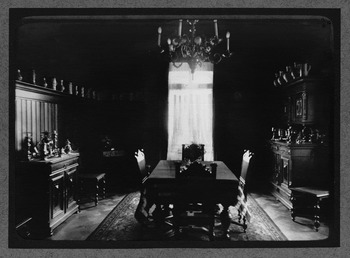
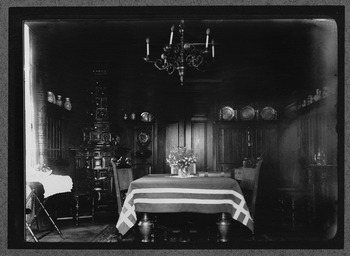
The room shown on the following paired pages of the album marks a stylistic break (Figures 6 and 7): while the furnishings in the entry hall and formal and informal salons are eclectic if not cosmopolitan, the dining room as we see it here twice—once looking toward the window, once away—is in a homogeneous Bavarian rustic style. From the dark, heavy (most likely oak) paneling, dining table, and chairs to the pewter tankards and chargers decorating the walls and crowding the sideboards—along with the choice of style for the stove in the corner—this room consistently, even relentlessly, evokes a Bavarian rural tradition and is thus difficult to reconcile with the other parts of the house. Why did the Wassermanns opt for emphatic stylistic regionalism for their dining room? If they wanted a German dining room, why not Biedermeier, which would have melded better with the cosmopolitan-eclectic style that characterized the public space of the house? The next page of the album puts these questions into even sharper relief.
Left-hand image of the sixth pair of photographs in the 1912 Home Portrait/Memorial Album of Emil and Emma Wassermann's home in Bamberg. This is the view taken toward the window of the dining room in its everyday “German” dress. Note the style of the furniture, the wood paneling, and the pewter tankards. This image was properly oriented in the album.

Right-hand image of the sixth pair of photographs in the 1912 Home Portrait/Memorial Album of Emil and Emma Wassermann's home in Bamberg. View taken toward the entry door of the dining room in its everyday “German” dress. Note the pewter and pottery plates and jugs, as well as the tiled stove in the corner and the rustic style of the tablecloth. This image was properly oriented in the album.

The decoration and the position from which the photograph was taken in the album's next image minimizes the “Germanness” of the room (Figure 8). The pewter now competes with silver in a very different style, and the table is covered with an elegant white, lacy tablecloth. Not only has the stylistic regionalism of the room been muffled, but it has also become Jewish. To anyone acquainted with the practice, the dining room now appears at first glance to have been dressed for a Passover Seder. Haggadot, the texts used for the ritual preceding the meal, have been laid out and pillows provided to allow participants to recline as the haggadah mandates; each place setting is laid with a silver wine beaker ready for the obligatory four glasses of wine consumed during the Seder.Footnote 26 But if one looks more closely, the Passover Seder table interpretation becomes implausible: there may or may not be a Seder plate—the photograph is too blurry to tell—no matzah is visible, and the table is not actually set for a meal. Most saliently, a number of ritual objects associated with other Jewish holidays appear to have snuck into the room. On the front left of the table are the two Havdalah spice boxes and midway down the table is a silver etrog case, a luxurious accessory for the festival of Sukkot previously encountered in the salon. Here, however, they are on center stage. It is as if the room had been equipped with signs indicating that Seders and other Jewish celebrations were held there, rather than recording a specific event. The emphatic, almost stereotyped Bavarianess and Germanness has, in other words, been overlaid with an equally emphatic, exaggerated Jewishness.
(Color online) Left-hand image of the seventh pair of photographs in the 1912 Home Portrait/Memorial Album of Emil and Emma Wassermann's home in Bamberg. View taken toward the window of the dining room in its Passover/Jewish dress. Note the pillows on one chair, the haggadot, the beakers, and the Jewish ritual objects, including what may be a Seder Plate. This image was properly oriented in the album.

Also puzzling at first is the placement of a photograph of a small, informal study on the page facing the dining room in its Jewish “dress.” The room is almost closet-like in size and eclectic to the point of incoherence. The space is devoured by a desk, upon which sits a bejeweled lamp that would have been more at home in a boudoir. An ungainly telephone attached to the wall catches the viewer's eye, particularly since it is juxtaposed with two framed assemblages of captured butterflies. But it turns out that the desk faces a wall of books on which, in addition to the portrait of a rabbi, a picture of Emil's wife (long dead in 1912) has been hung in a prominent position. One cannot read their spines, but the books could easily be sets of Talmud and rabbinic commentaries. It has the feel of a place to which Emil retreated to study or pray. The juxtaposition in the album of the drab study and the elegant dining room in its Jewish persona makes sense, in fact: both were spaces in which Emil's, and the family's, Jewish life had an important place.
With these images we leave the ground floor and move up to the bedrooms, where the viewer is taken through a now familiar oscillation between images that seem to record spontaneous everyday life, with open pianos, fresh flowers, and ungainly telephones, to ones that seem staged as if to assure that significant aspects (or moments) of life be remembered.
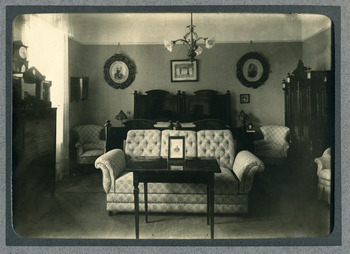
The master bedroom, the first of the five bedrooms shown in the album, had clearly been rearranged for the photographer (Figure 9). Photographic portraits of Emil and Emma are displayed on the back wall over the head of the bed, surrounding a framed copy of their ketubah, or Jewish marriage contract. These, and the armoires flanking the massive bed, appear to be a record of the room as it was lived, but other parts of the room were clearly not as they had been when the room was occupied. In the foreground, a table too high to be a coffee table sits too close to a sofa facing the photographer. The sofa, which matches two armchairs that have been stuffed into the corners of the room, would never have been located there when the room was in use. One imagines that there had been another half to the room, or perhaps an anteroom, in which the sofa faced the chairs to create a comfortable seating area. A decision must have been made that that ensemble was not worth a photograph of its own, but that it was nonetheless important to include those furnishings in the album—despite the visual awkwardness of the resulting image. A black-bordered photograph placed in the middle of the table reinforces the sense of this photograph as a memento mori, a staging of the couple's intimate life for posterity. The image leaves an aftertaste of uncanniness and melancholia.
(Color online) Left-hand image of the eighth pair of photographs in the 1912 Home Portrait/Memorial Album of Emil and Emma Wassermann's home in Bamberg. This image shows the master bedroom. Note the Ketubah (marriage contract) above the bed, flanked by two portraits, and the awkward location of the two armchairs, the sofa, and the table. This image was properly oriented in the album.

The next photograph in the album shows two connecting rooms (Figure 10). In contrast to the previous image, this one does not seem staged but instead documentary. Like the hallway picture seen earlier in the album, the lighting is problematic and the composition chaotic; it is as if the photographer had been told just to make sure he got it in. The third bedroom, by contrast, feels barren: a massive Bavarian armoire looms in front of a lumpy-looking brass bed in an otherwise empty room. The fourth looks like it could have been inhabited; it is adequately furnished and conveys a lived-in feeling. A mourning photograph has reappeared, along with a vase of cut flowers, in the fifth bedroom. The final upstairs photograph reinforces the hint provided by the bouquet of a world beyond the home and family: a landscape shot from one of the upstairs rooms or the veranda. It is not particularly picturesque; the only reason to have photographed that view would have been to ensure that it not be lost from memory. It is an image that situates the house in the surrounding community and landscape, providing a social and geographic context for the now dispersed family.
(Color online) Right-hand image of the eighth pair of photographs in the 1912 Home Portrait/Memorial Album of Emil and Emma Wassermann's home in Bamberg. This view shows two connected bedrooms. Note the awkwardness of the composition and the lighting. This image was properly oriented in the album.

The viewer is then abruptly brought to a room with a long table, dressed for the harvest festival of Sukkot (Figure 11). Jewish law mandates that the household use the fruits of the harvest to build a shelter in which they eat and, ideally, sleep during the weeklong holiday. Precise dimensions are given for the hut, or sukkah, and it is required that its construction allow the stars to be seen through the roof. Given the practical difficulties of such a building project in urban Europe, a not uncommon compromise for observant Jews who lacked outdoor space to build a sukkah—or who were afraid of marking themselves so publicly as Jews, or who simply did not want to face the rigors of eating outside in the northern European autumn—was to decorate the dining room ceiling as if it were a sukkah. This image would seem to indicate that the Wassermanns followed this practice and yet we know from the memoirs of Emil's daughter, Gutta, that this was generally not the case.Footnote 27 The family had a substantial outdoor stone sukkah equipped with a stove and a removable roof. Given that the holiday fell during the second week of October in 1911, when Emil was already ill (he died a month later), it is not implausible that the family decided to celebrate indoors that year.
Left-hand image of the eleventh pair of photographs in the 1912 Home Portrait/Memorial Album of Emil and Emma Wassermann's home in Bamberg. This is an image of the indoor sukkah/Memorial Chamber. Note the wall hangings, the small portrait, and the ceiling decorations. In order to properly view these images, one must turn the album 90 degrees.

It appears that this room was decorated for Sukkot shortly before Emil fell ill, and that a decision was made, after his death, to turn the room into a memorial chamber by adding the wall hangings and the portrait photograph. These hangings were almost certainly curtains (parochet) used for the ark that held the Torah scrolls in the Bamberg synagogue.Footnote 28 Embroidered on the parochet in Hebrew is a list of names, including that of Emil and his father, and, in some cases, a number likely indicating a monetary contribution to the synagogue. Emil had been a major donor to the synagogue, giving not only money but also a Torah scroll and its silver ornaments.Footnote 29 These were all kept at home and carried to the synagogue on Shabbat and other holidays, merging family and religious space. At the time of Emil's death, the parochet seem to have been removed from the ark and hung in the memorial chamber to remind visitors of Emil's honored place in the synagogue.
The room thus documented in the album served a double purpose: it simultaneously recorded the family's Judaism, in terms of both observance and its support of the Jewish community, and the patriarch's death. This was particularly appropriate since practicing Jews commemorate anniversaries of deaths (Jahrzeits), like holidays, according to the Jewish, not the secular (Christian) calendar. The calendar that governs religious life, and often familial and social life as well, is different in myriad ways from the Gregorian calendar that marked non-Jewish German time. Months in the Jewish calendar are lunar, whereas years are solar, which means that Jewish holidays fall from year to year on different dates in the Gregorian calendar. Holidays begin and end at sunset and the weekly day of rest is Saturday, not Sunday. The Jewish Sabbath was a regular German school and workday in this period and major holidays often fell during the workweek. During the Kaiserreich observant Jews—or even Jews who did not practice but came from a family familiar with the ritual—necessarily lived a dual temporality. This was often a stressful experience, raising fears of an antisemitic reaction or discrimination at the workplace. Given the full commitment of most Jews to German state and society, the incompatibility between these two calendars was therefore a significant factor in encouraging many, including some members of the Wassermann family, to abandon regular religious practice.Footnote 30 Emil would certainly have felt very strongly about having his Jahrzeit remembered annually on the date he died according to the Jewish calendar: 21 Cheshvan (exactly five weeks after the first day of Sukkot on 15 Tishri), not the date it happened to fall on in 1911, i.e., November 12. (A decade after his death in 1922, for example, 21 Cheshvan would have fallen a full ten days later than in 1912—i.e., on November 22.) Emil's children, mindful both of the patriarch's attachment to Jewish religious practice, including the celebration of holidays and Jahrzeits, and of the weakening of those commitments even in their own generation, may have sought a means of reminding Emil's grandchildren and great-grandchildren of their obligations. Making the dining room/sukkah into a memorial room to be photographed and included first in this album, and available for future albums, was a way of trying to assure that his descendants would place Emil's death within the Jewish annual cycle.
The penultimate image, paired with the sukkah, takes the viewer out of the house altogether and into Emil Wassermann's office in the headquarters of the bank he had founded (Figure 12).Footnote 31 This photograph leaves no doubt about the bank's prosperity, but also underscores the fact that it was indeed a family bank in which conventions associated with public and private space were brought together. The desk, desk lamp, and calendar are fixtures appropriate to a working environment, but much of the other furniture is domestic and the family portraits provide a genealogy for Emil Wassermann and his bank. Business requiring a writing surface could be done at the round table, while coffee could be served and informal discussion fostered with the client comfortably seated on the couch. Clearly this was a room in which private clients were received, a room in which they could feel at home.
(Color online) Right-hand image of the eleventh pair of photographs in the 1912 Home Portrait/Memorial Album of Emil and Emma Wassermann's home in Bamberg. This image shows Emil Wassermann's private office at the A.E. Wassermann Bank on Sophienstrasse in Bamberg. Note the mezuzah on the left lintel in the doorway, the family portraits on the wall, and the seating area. This image was properly oriented in the album.

The mezuzah on the entrance door adds a religious element to the commercial and familial ones cohabiting in this room. The mezuzah is a small container holding two handwritten passages from Deuteronomy. By Jewish law, it is to be posted on the right side of every doorpost into, or within, a Jewish home or public place. As one passes the threshold, one kisses one's fingers and touches the mezuzah with them in order to remind oneself that God is everywhere. By the early decades of the twentieth century, many German Jewish households had either dispensed with this ritual entirely, or limited its use to the front door of the home. The presence of this mezuzah is therefore noteworthy, but so, too, is its location. The structure of the room allowed for—even required—a compromise analogous to the indoor sukkah. The mezuzah was, as it should be, on the right-hand side of the doorframe as one entered the office from the anteroom (therefore on the left in the photograph). But Mezuzot are also supposed to be placed so that they are visible from outside the room that they serve. In this case, when the door was shut, the mezuzah would have been fully inside Emil Wassermann's office, invisible from the adjacent room. Only those invited into his private space within the public space of the bank would know it was there. This image, incongruous in an album otherwise devoted to the home, was included because Emil's bank office, in its publicness and privateness, its secularness and religiosity, instantiated a refusal to separate entirely the German and the Jewish, the professional and the domestic. After offering this brief glimpse into Emil Wassermann's semiprivate space within the semipublic space of his bank, the album returns the viewer to Emil's home, closing with another banal view of the coach house, which marked departure from the house.
The Seder, sukkah, and bank office photographs raise challenging questions about the temporality of Germanness and Jewishness, both in practice and in representation. What are the implications of a room passing from a German to a Jewish state and then back again? Does the Jewish manifestation leave an afterimage in the mind's eye? We can deduce from the spice box, and be sure from other sources, that Emil and Emma did, in fact, host a family dinner on Friday nights, a dinner for which the room was also dressed, though more lightly than it was for these other holidays. It seems likely that the Wassermanns decorated the room in such an emphatically “German” style in order to compensate for its shift into “Jewishness” on a regular basis. By the same token, the image of Emil's office at the bank was included within this “home portrait” because the bank was, in many ways, an extension of the home. Even as it grew to be international in scale, it was a family bank, a space from which neither domesticity nor religion was excluded. These rooms seem, in other words, to have been helping the family navigate between the time and space of Jewishness and Germanness.
Feminist linguist and anthropologist Susan Gal has argued that we should not think of the relation between the public and the private as dichotomous, but rather as both relational and nested concepts (in spatial terms—thus the reference to fractals in the title of this section).Footnote 32 There were public spaces—like the dining room—within private ones (the home), and there were private spaces—like Emil Wassermann's office—within the public space of the bank. Extending Gal's construct, it is equally helpful to conceptualize spaces as temporally nested and relational. Not only could there be a public space within a private one, but that space could also sometimes be secular/German and sometimes Jewish, but neither would ever completely lose the trace of the other. The everyday dining room must therefore be read in relation to the rest of the house, in relation to the norms of dining rooms for homes of that date, location, and class, and in relation to the way it would be dressed on the Sabbath and other holidays.
Three ruptures in the narrative flow of the album reinforced this movement between “German” and “Jewish” time. The dominant dynamic of this home portrait is the trajectory one might have taken through the house—crossing the garden, entering the front door, walking through the public rooms, up to the bedrooms, and back out to the garage—but Emil's descendants found it necessary to disrupt that spatial logic. The first break is with the second dining room image, when it was dressed for the Passover Seder. The second occurs when the viewer is suddenly taken from the second floor back to a room dressed for Sukkot. A third rupture occurs with the inclusion of a room that is not even in the house: Emil Wassermann's office at the bank. Each of these ruptures is occasioned by an image that attests to Emil's—and the family's—Jewish practices.
Of the ten annual holidays celebrated by the family, Passover and Sukkot may have been represented in the album because they are significant within the Jewish liturgical calendar and because both holidays are based in the home, rather than in the synagogue. The family had literally dressed the dining room for Passover—and added ritual objects from other holidays that were normally kept elsewhere in the home—before the photographer arrived. This should not be interpreted as a “dressing up” or “performance” covering for an absence of real observance.Footnote 33 All the photographs in this album are postmortem, staged to record life as it had been but had since ceased to be. In some cases, as in the music room/salon with its open piano and cut flowers, the emphasis of the staging was on life. In others, like the master bedroom, it was on life's end. The Wassermanns seem to have staged this “Jewish dining room” to permit recollection of the many Jewish moments passed in the room. The Sukkot image, by contrast, was used to tie firmly the patriarch's death to the Jewish calendar.
Both the style chosen for the family home and the construction of the album elucidate some of the dynamics of inhabiting Germanness and Jewishness simultaneously in the years before World War I. The contrast between the eclecticism of the rooms in which the family's national and religious identities went unmarked, and the almost caricatured Germanness of the public dining room in which the family's Jewish life was most intensively lived, suggests a tension between the two positions. The fact that the most “Jewish” room of the house was also the most “German,” and that the mezuzah in Emil's office was hidden behind a door, further underscore that tension. Yet, it is also striking that the mezuzah was in Emil's office at all and that the family made no effort to disguise its religious affiliation. The photographs marking the family's religious practice were particularly important to them; they are among the few to have been included in two of the three extant family albums. The choice to make Emil Wassermann's memorial album a completely unpeopled portrait of his home in the last decades of his life is indicative of the strong association between the house and the man. Given the appearance of portrait photographs from the nineteenth and early twentieth centuries in the later albums, it is clear that the family had access in 1912 to a large stock of photographs from which they could have made a family portrait album, or one showing important sites and moments in Emil's life.
The few people present in this album are doubly absent, represented in mourning photographs that were taken while they were alive, but displayed in a way that marks the fact that they were dead at the time the album was made (see Figure 9). These mourning portraits within the home portrait bring to mind the phenomenon noted by Geoffrey Batchen, namely of daguerreotype portraits taken showing the person holding a daguerreotype case, by which the photographer marked the presence of death in life.Footnote 34 Emil's children needed the home itself, with all its complex spaces, as a memory prompt, as a visual narrative to recount to their children and grandchildren. It is as if the meaning of this phase of the family's life was incarnated in their home marked by Jewish religious practice, not in a series of family portraits or records of events. With Emil's death, the family lost that home: the villa was be sold and Emil's son Oscar would leave the family bank altogether.
This close reading of the 1912 Wassermann album confirms Marion Kaplan's finding about the centrality of the home to bourgeois Jews' Jewishness in Imperial Germany.Footnote 35 It also suggests, however, that while Germanness and Jewishness coexisted in the truly private of the private space of the home—the bedroom—they alternated in the public space within the private home: the dining room. The ketubah was never taken off the bedroom wall, but the dining room was sometimes German and sometimes Jewish. Furthermore, in the private space within the family's public space—Emil's office in the family bank—Jewishness was present but obscured. By forcing us to reflect on time, space and performance, this photograph album provides the possibility of adding further nuance to the extant historiography on elite German Jewish life in this period. The album produced in the next phase of the family's life under Weimar reveals how the contours of that life would change.
Celebrating German-Jewish/Jewish-German Life during Weimar
Almost a generation later, in 1929, Oscar's siblings commissioned an album in honor of his sixtieth birthday, thereby renewing the tradition of creating a photograph album to commemorate important moments in the life of the family.Footnote 36 This album, however, figures time and place and Jewishness and Germanness differently than does the mourning album of 1912. The 1929 album is divided sharply in half: the first fourteen pages present a chronologically organized sequence of decontextualized portraits of the family. The next sixteen take the viewer on a tour through significant places in Oscar's life, from infancy to the present, before concluding with a group family photograph.
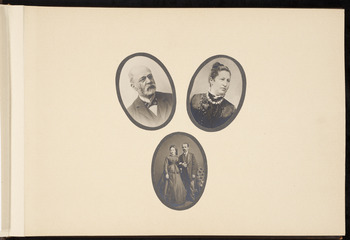
The album opens with images of Oscar's maternal and paternal grandparents (Figure 13), followed by portraits of the subsequent generations. Despite the passion for amateur photography in this period, these are all formal, professional studio photographs, cropped to fit the oval or rectangular insets on the album pages. Most are individual head and shoulder shots, but there are also some family groupings and full-length portraits. The awkwardness of the memorial album is absent here; the subjects are artfully lit and carefully posed, their heads turned to the most flattering angle. This is a record of the family's march through time, captured in a series of still faces and bodies, detached from their surroundings. In terms of the formal aesthetic qualities of the portraits included in the album, there is nothing to distinguish one taken in 1929 from one taken eighty years earlier. The passage of time—from the founding generation to the moment of the album's creation—is, however, very noticeable in the clothing and hairstyles.
(Color online) First page of photographs in the 1929 Photograph album titled “Einst und Jetzt (Unserem lieben Bruder Oscar—Von den Geschwistern mit Familien zur Erinnerung an die Schöne Jugendzeit…).” These are photographs of Oscar Wassermann's maternal and paternal grandparents. Note the hair styles and clothes, as well as the uniformity of the formal quality of the images. They are set into inserts in the album.

Max Oppenheimer, Oscar's maternal grandfather, wears a hat and a beard appropriate to his religious practice, while Samuel Wassermann's clean shaven face and bare head reflect his distance from certain Jewish traditions. The photograph leaves ambiguous their wives' decision to wear a wig or reveal their own hair (interdicted in some Orthodox practice). Oscar's parents, Emil and Emma, display no visible markings of Judaism (Figure 14) despite their Orthodoxy, and his daughters are pictured in fashionable dresses and with bobbed hair (Figure 15). The clothing and hairstyles index, in complex ways, the family's changing practice of Judaism and their relation to the dominant society in which they lived.
(Color online) Second page of photographs in the 1929 photograph album titled “Einst und Jetzt.” These are photographs of Oscar Wassermann's parents, Emil and Emma Wassermann. They are set into inserts in the album.

(Color online) Seventh page of photographs in the 1929 photograph album titled “Einst und Jetzt.” These are photographs of Oscar, his wife, and his two daughters. They are set into inserts in the album.

The historicity of the images is belied, however, by their mise-en-scène in the album. The pages are austere, each with a single portrait or with a few carefully framed images. This type of arrangement was an anachronism by 1929, when many albums were being composed of glued snapshots accompanied by handwritten captions. Here the family's complex temporality is revealed in the ambiguity of its location in historical time rather than in the oscillation of the dining room—as in the 1912 album—between Germanness and Jewishness over the course of a year. The style of the photographs and the archaism of the pages' aesthetic anchor the album in the past, whereas the album's very binding, as well as the clothing and haircuts it showcases, situate it in a modern present. All the elements of the binding—the lettering, the image, the color scheme, and the border graphics of the cover—are, in fact, in a thoroughly modernist (if rather eclectic or hybrid) aesthetic (Figure 16). The lettering is in French Antiqua (not German Fraktur) type, referencing both art deco and Bauhaus, and that is the style, too, of the water carrier figure.Footnote 37 In this part of the album, Oscar's siblings connected him vertically and horizontally to the extended family, reminding him of the past, present, and future of the clan and his place in it. There is little hint in these images of the family's relation to either religion or nation; it is the individuals who composed the family who matter here: individuals and a family simultaneously moving through—and frozen in—time.
(Color online) Cover of 1929 photograph album titled “Einst und Jetzt.” Note the typeface, the graphic design, the quality of the binding, and the water-carrier figure.

The second half of the album is a complete departure from the first, with a print of the city of Bamberg marking the narrative turn. In both its content and form, it echoes the 1912 memorial album: it is unpeopled and its pages are crowded. Here, too, many of the images are perpendicular to the binding, requiring the viewer to manipulate the album, giving a sense that these photographs are to be noted but not studied or pored over. Most of the images are of the family's and Oscar's homes and businesses in Bamberg and Berlin. Pride of place among the professional images is given to the same photograph of Oscar's father's private bank office that figures prominently in the 1912 album. Interrupting the series of interior and exterior shots of sites of dwelling and work are three photographs of schools. The secular Volkschule and the Protestant school Oscar attended in Bamberg are recorded on a single page; the Jewish religious school where he went after school to master Hebrew and Talmud, like Emil's office with the mezuzah, is not only given a whole page to itself but also properly oriented (Figure 17). The album further underscores the family's Jewish life by reproducing photographs of the ancestral dining room dressed for Passover and Sukkot from the memorial album. Oscar's siblings clearly did not think it important to assure the memory of the “Bavarian/German” version of the room, which is nowhere present in the album. It is the family's Jewish past that matters. These images fall in the middle of a series of photographs (and one more print of Bamberg) that locate the family in space. The album then concludes with four images of Oscar's professional and personal spaces in Berlin, as well as a contemporary family portrait and a descriptive key to the images. As in the 1912 album, Oscar Wassermann's worlds do not divide neatly into a Jewish family world and a secular, German professional world. Both appear to have moments of both, but there are crucial differences between the two albums.
(Color online) Eighteenth image from “Einst und Jetzt.” This is an image of the Jewish religious school that Oscar attended as a child. It is set into an insert in the album and occupies a full page.

Many factors shape this album's form and content: the date, 1929 not 1912; the place that Oscar Wassermann occupied in German and Jewish life; the album's function, not as a memorial, but as a birthday gift given by a group of siblings to their older brother. The album is luxuriously crafted: it is beautifully bound in leather; its embossed, gilded borders are marked at each corner with a cabochon cut lapis lazuli stone; the style of the decoration is markedly modernist; the interior paper is heavy and smooth (Figure 16).
At first glance, this appears to be an obvious and perfect gift for one of Germany's most influential bankers, economic advisors, and members of the Jewish elite. At sixty, Oscar was at the height of his power, prestige, and wealth; five years earlier he had moved into a new, thirty-six room home in Berlin at the fashionable address Tiergartenstrasse 7/8. At the same time, he purchased a country estate on the exclusive Insel Schwanenwerder in Wannsee, the summer refuge of other elite families.Footnote 38 This seems an appropriate offering for a beloved older brother who has made good.
Another look at the cover forces one to rethink this assessment, however. It is adorned with the silhouette of a man, straight-backed and broad-shouldered, carrying two buckets as he wades into a river. The choice again seems self-explanatory: Oscar's last name, Wassermann, means “water man.” But in the Hebrew Bible, which Oscar and his siblings knew intimately, the water-carrier is a very humble figure, one in service to others (e.g., Joshua 9:21, 23, 27).Footnote 39 This is not, therefore, the first allegory one would associate with a man of Oscar Wasserman's standing. Many other images could have been selected to illustrate the cover. The figure representing humility and lowly status suggests that Oscar's siblings may have thought that he would benefit from a bit of humbling. Although the archival and secondary sources underscore the closeness of family relations, this more critical view is supported by the text on the next page, which reads: “To our dear brother Oscar, from his siblings and their families, in order to remember the good times of youth, and our parents and grandparents.” It continues in smaller letters: “An encouragement/incitement to nurture family spirit and faithful togetherness.”Footnote 40 There is some ambiguity here: his siblings may be representing Oscar as modest and loyal despite his worldly achievements. But, at the same time, they may be cautioning him, in his success, not to forget his family and his obligations.
In 1912, just after his father died and his first daughter was born, Oscar left the family business, an international, private Jewish bank, to join the national, public Deutsche Bank. The move to the Deutsche Bank deepened his engagement in German affairs. He became the head of its mortgage and investment branch and it was from that position that, a few years later, he became heavily involved in advising the Weimar government on financial matters. Although they certainly note and appreciate his professional success—they included a photograph of his sumptuous private office at the Deutsche Bank—Oscar's siblings chose to put far more emphasis in this album on the family's past, present, and future. The album includes more images of the family bank in Bamberg, where Oscar worked only very briefly, and of its Berlin branch, than of the Deutsche Bank where he was enjoying an illustrious career. One wonders if they felt that his professional trajectory had taken him away from them, or was at risk of doing so. This ambivalence emerges much more clearly in the photograph album than in the textual evidence.Footnote 41
Although Oscar's decision to join the Deutsche Bank detached him from the Jewish banking world, and although it seems he had ceased attending synagogue (at least on a regular basis), one knows from the archival record that he had not distanced himself from Judaism. He maintained his excellent Hebrew and Aramaic, and he participated in Talmud study for most of his adult life. Oscar was, in fact, sufficiently at ease in and committed to Hebrew that he took the trouble to write Jewish New Year's cards to his family in German transcribed into Hebrew script. His explanation for this exercise was that even those members of the younger generation who were dedicated to Judaism could no longer do more than read the Hebrew letters, and he wanted to encourage them to maintain at least that level of knowledge.Footnote 42
Oscar also continued to support organized Judaism in Germany. As early as 1898, he joined the Gesellschaft der Freunde, an organization that brought together Berlin's Jewish elite, and occupied a place among its leadership from 1925 to 1933.Footnote 43 He was involved in founding the Hochschule für die Wissenschaft des Judentums in 1919 and was elected president of the German branch of the central Zionist fundraising organization, Keren Hayessod, in 1922. He joined the Jüdischer Friedensbund seven years later.Footnote 44 There is no question, then, but that Oscar Wassermann was deeply engaged in both Jewish and German politics and education until the end of his life. His siblings chose not to document this adult commitment to Judaism, but to focus rather on his childhood, when his religious practice was centered in the family rather than in institutions.
Paired with its 1912 predecessor, this album poses a challenge to the image of uncomplicatedly close family relationships provided by the manuscript evidence. More significant, it opens a window onto new ways of thinking about German-Jewish relations to time, space, and place. Oscar Wassermann's Judaism, unlike that of his father, seems to have been focused on his very active organizational life. There are hints of this not only in this album, but also in the contents of the seventy-six obituaries that appeared in the European press after his death.Footnote 45 This is not a story of assimilation or of Oscar denying his commitment to Judaism. It is, rather, the story of a particular relationship between Jewishness and Germanness. In Oscar's father's home, the public room of the house—the dining room—oscillated between being a Bavarian/German and Jewish space, and his office in the family bank he cofounded was marked by a (semi-hidden) mezuzah. Jewishness and Germanness coexisted in space, even if not always in time. Oscar Wassermann, by contrast, seems to have had a different relationship to both the times and places of Judaism and Germanness, as well as to privacy and publicity. His biography makes clear that he saw himself as a part of both the German and the Jewish nations: he was an engaged Zionist who simultaneously worked for the German government. He was also committed to both German and Jewish culture and education. But it does not appear that there was much overlap between the two. Emil Wassermann's dining room never entirely lost the trace of either its German or its Jewish self; Oscar Wassermann, by contrast, moved between German and Jewish institutional life, keeping the two apart. Oscar was far from being the only German Jew who chose this path during the 1920s. It was, in part, this very phenomenon that incited some members of the younger generation to seek a return to a more “authentic” form of Judaism.Footnote 46 Participants in this Jewish Renaissance sought the reintegration of Judaism and everyday life, hoping to find an alternative to both the oscillations that characterized Emil's and Emma's German/Jewish dining room and the separation between the non-Jewish German and Jewish lives that Oscar constructed. Oscar's siblings were not centrally involved in that movement, but in the 1929 birthday album, they seem to have been trying to remind him of the possibility of integration, of the importance of family, and of his place in a lineage in which domestic Jewish practice had been important. When the last of the albums was assembled a few years later, these concerns—which had been very significant during Weimar—had become irrelevant.
Documenting Belonging in The Third Reich
We enter a new phase with the third and final Wassermann album. This much smaller album, which is not dated but, given the furnishings, was most likely composed in the 1930s, is altogether different in nature from the earlier two. It opens with a close-up of the grandiose entrance to the family bank (Figure 18).Footnote 47 A large brass plaque set to the left of a pair of massive neoclassical bas-relief doors announces “WASSERMANN” in Antiqua type. Slightly higher, on the inside doorframe, the viewer can discern a shiny brass doorbell. The solidity and elegance of this business is underscored, but so also is its discretion: it does not even identify itself as a bank. The entry is flanked by two very large lamps—most likely gas-fueled, rather than electric. Despite their size, they would have shed a gentle light on the entry during the many somber hours of a Berlin winter. In daylight, the entry foyer would have been illuminated by the expansive glass transom; its transparent surface, which reflects the neighboring trees in the photograph, conveyed a sense of security, stability, and privacy. The bank quietly claims its place within the urban environment. Given that the album must have been contemporaneous with Oscar Wassermann's forced departure from the Deutsche Bank in May 1933, this visual assertion of rights takes on a particular meaning.
(Color online) First image from the A.E. Wassermann Bank and Family Residence Album. This is a detail of the façade of the bank building in Berlin, c. 1933. Note the importance given to the bank's entrance.

This declaration of belonging is reaffirmed, in a different valence, on the album's following pages, each of which offers images of the family's banking establishments and dwellings (which often shared the same building) from the mid-nineteenth century to the present. On the second page, a drawing or print (Figure 19) of the first A.E. Wassermann building is paired with a structure that served as one of the bank's Bamberg headquarters until 1905 (it was located at Langestr. 26). The three photographs stacked on the last page of exterior images provide another narrative (Figure 20): at the top is Emil Wassermann's home in Bamberg; in the middle, the bank's Berlin headquarters at Burgstr. 21; and at the bottom, the full façade of the building occupied by the bank in the 1930s. The façade image allows the viewer to see in context the doorway with which the album opened: the building to which it provides entry is a massive, three-and-a-half-story urban structure. These images confirm the bank's—and the family's—long history and firmly German roots.
(Color online) Print of the first A.E. Wassermann bank building paired with the Langestr. 26 building in Bamberg that served as the bank's headquarters until 1905. These are featured in the A.E. Wassermann Bank and Family Residence Album.

(Color online) Three photographs (top to bottom): Emil and Emma Wassermann's home at Am Zwinger 2, Bamberg; the A.E. Wassermann bank headquarters in Berlin at Burgstr. 21; and a full façade image of the building the bank occupied in Berlin in the 1930s. These are each one full page in the A.E. Wassermann Bank and Family Residence Album.

The viewer then enters the establishment, stepping first into one of the bank's private spaces. In general, the solidity, history, and tasteful opulence of the interior is of a piece with the exterior. The first image is of a large, elegant office reassuringly equipped with “timeless” furnishings, including two desks placed in front of a pair of massive windows, with landscape oil paintings adorning the walls. Other spaces unobtrusively combine historicism and modernism. This antechamber to a board room is equipped with conservative furnishings set in a neoclassical interior frame, but the light fixtures would have been at home in the reception space; the chairs and table seen through the doorway are also modernist. The room that follows this one is smaller, almost domestic, and thoroughly historicist. The series then concludes with a formal waiting room, in which modern furniture is framed by walls enhanced with Louis XV-style woodwork upon which large photographic portraits of the business Wassermann lineage hang (Figure 21).
(Color online) Historicist reception room with family portraits shown in the A.E. Wassermann Bank and Family Residence Album.

One image startles, however: an explicitly commercial space decorated in a thoroughly modernist style—Bauhaus, in fact. Counters are labeled “stocks,” “cash desk,” and “foreign currency” in the sans-serif, block capitals made popular by designer Paul Renner.Footnote 48 The room's angles are all sharp, its surfaces made of reflective steel and glass, smooth leather, and flat veneer. Marcel Breuer's ultracontemporary Cesca chairs (first produced in 1928) offer a place for clients to wait (Figure 22). Both the spaces in which deals were brokered and the room where money was actually handled were given identifiably German aesthetic frames, but very different ones: whereas the former were historicist, creating a linkage with Germany's past, the latter were modernist, looking toward Germany's future—a future in which neither Breuer nor the Wassermanns would have a place. The school of design where Breuer had worked when he designed the Cesca chair was shut down in the spring of 1933, foreshadowing both the bank's—and Oscar's—fate.
(Color online) Bauhaus-style room with Cesca chairs shown in the A.E. Wassermann Bank and Family Residence Album.

The architectural space on display in this album is, with the exception of the photographic portraits of the Wassermann bankers, completely bereft of people. On one level, this absence is surprising. Photographing the bank during business hours would have been perfectly possible, and images of a bustling human presence would have underscored a sense of the bank's importance and place in German society. The architectural focus does echo, however, the equally depopulated 1912 home portrait album. As in that album, the family is only present in photographs within the photographs. In the home portrait, however, the emphasis is on family: pictures of Emil and Emma are hung on the wall of their bedroom, as are mourning pictures in several other locations. In the 1930s bank album, the portraits establish the place of the Wassermann men in the family business; there are no clients here and no employees, just the Wassermann men looking down from the walls. The form of the portraits, common in publicity materials of the period, and the Wassermanns' proper German business dress, reinforces the architectural message that it is not only a family business but also, emphatically, a modern German business. Unless read with hindsight, the absence of people in the album does not, therefore, convey melancholia and absence, as the 1912 album does, but rather a resolute claim to a place in Germany's past, present, and future.
Like the earlier album, then, this last one is documentary and commemorative, but of a very different moment and for a very different purpose. It is probable that by the time this album was made, Oscar Wassermann had already been forced off the board of the Deutsche Bank. His resignation was announced on May 20, 1933, in advance both of his planned retirement at the end of 1933 and of the regular annual meeting planned for June 1.Footnote 49 It was claimed that he had resigned because of ill health, and indeed his health was not good, but that claim was clearly false. Given this, in a context of building antisemitic legislation and propaganda, the family may well have been anticipating the “Aryanization” of the family's business, Bankhaus A.E. Wassermann, which would indeed occur on April 25, 1938.Footnote 50 Like other Jewish families throughout Germany facing an uncertain future, the Wassermanns would have set about documenting their possessions. This written and visual documentation served both memorial and pragmatic ends. In the first place, the very act of writing and photographing or sketching helped to preserve memories.Footnote 51 The lists and images would also prove vital when survivors or their heirs filed restitution claims years or decades later; exact descriptions of the contents of homes and workplaces were essential to the construction of effective legal cases. The family's prominence made them both particularly vulnerable and particularly privileged. Oscar's removal from his position at the Deutsche Bank in 1933 gave them early warning of what was to come, but they had the financial means and connections to leave Germany.Footnote 52 It is striking that this last album bears no trace of the family's religious commitments, but is rather a memorial to a determinedly German business, a business that would be stolen from the family along with the rest of their property. The survivors sought restitution years later, from their new homes in Israel, South Africa, and the United States, and they did receive some financial compensation. But they never returned to Germany.
Photography and Jewish Times and Spaces—German Times and Spaces
Reading the textual materials in the Wassermann Family Collection and the existing secondary literature on the family, one gets the sense that, until 1933, the Wassermanns moved unproblematically between the times and spaces of Judaism and Germanness.Footnote 53 From a founding generation still ensconced in communal life in Bamberg to the next generation, the family had ascended to central positions of power within German economic and intellectual life and become more detached from Jewish religious practice. Yet, its members were still intensely engaged in Jewish politics and philanthropy, as well as cultural and intellectual life.
Emil, the patriarch of the family during the Kaiserreich, practiced modern orthodoxy all his life. He not only prayed at home and in the synagogue, but also studied Jewish texts and gave substantial time and financial support to the Jewish community. He did not, however, wear a beard or habitually cover his head. It is not clear if he obeyed the dietary laws, wore tzitzit (a fringed ritual undergarment), or prayed with tefillin (phylacteries worn on the head and upper arm), though he may well have done so when at home. Emil also clearly lived the life of a prosperous and influential German banker, moving into homes befitting his status, wearing the correct clothes, and attending the appropriate cultural events. His emotional and social life was largely endogamous, however, and his attraction to Zionism may indicate that he was not fully sanguine about a Jewish future in Germany, or that he considered the country not to be his exclusive home.
A close examination of Emil's dwelling, through the medium of the postmortem house portrait, both confirms and complicates this image. The contents and arrangement of the home reveal how Emil saw and positioned himself. The choice of such a Bavarian dining room—the room that was most central to regular Jewish religious practice—was far from anodyne, but rather a kind of hypercorrection. Such an overemphatic claim to Germanness suggests that Emily may have had greater anxiety about his cohabitation of Germanness and Jewishness than the written record suggests.
The way the house was staged in the first album is equally revealing of how the next generation navigated both time and place. The album's designers took great care to assure that all that had mattered to the patriarch was represented: from the piano to the Seder and other Jewish rituals, to his butterflies and books, to the bedroom he had shared with his wife and those occupied by his children. The hangings in the sukkah/memorial chamber attest to Emil's importance to the synagogue, and the choice to include a mezuzah-equipped room in the album memorialized his melding of Judaism and banking. Emil's children—by making their mourning album for their father and for the family's life in Bamberg so demonstratively a home portrait, and by structuring the temporality of the album as one of oscillation between Jewishness and Germanness (not the past and present)—reveal that in their generation, too, it was not clear how German and Jewish time and space could coexist.
Those same people—but now in their role as Oscar's siblings rather than as Emil's children—constructed the 1929 birthday album to remind Oscar of the vision of Jewishness seen at moments in Emil's home and in certain images in the home portrait: a Jewishness rooted in family as much as in organizational life. It was as if they hoped that the series of family portraits and reminders of family and childhood spaces would call Oscar back from his new world. The modernist aesthetic of the binding and the inclusion of the photographs of the Deutsche Bank and his current home in the album indicate that they were cognizant of Oscar's full engagement in the 1929 present—looking toward the future, not the past. Their embedding of the past (the Jewish images from childhood) in a framework of the new (the modernist form of the album) mirrored Oscar's life. His Judaism, like that of many other Jews during the Weimar Republic, had come to be framed in largely modern terms, with little impact on his everyday life—but it retained elements of traditional practice. The Jewish organizations to which he belonged were modern in form, but he continued to study Talmud. Oscar Wassermann, like his father, did not hide his commitment to Judaism, but it existed next to, rather than being integrated into, his engagement with the (non-Jewish) German society and polity in which he was embedded. The final album, from just a few years later, seems to have abandoned all but the Wassermanns' public, commercial place, a place they would lose, of course, under the Third Reich—along with their homes.
Moving beyond the albums to the photographs they contain, connections may be made among time as it was experienced by German Jews, the relation of that sense of time to Jewish religious practice, and the particular temporality of photography. The dissonance between the Jewish and Gregorian calendars was not only mobilized as an excuse for the marginalization of Jews, but was also experienced by Jews as a challenge long after emancipation. Even those whose religious practice had become minimal would find themselves resisting invitations on Friday evenings, preferring, without articulating why, to spend that night of the week at home. Like the Wassermanns, they continued to celebrate the anniversary of their parents' death on the date specified in the Jewish calendar, and many would not work on the Jewish New Year and Day of Atonement.Footnote 54
Place also had a particular resonance for German Jews. European Jews of this period knew, or had direct experience, of the Pale of Settlement and had acquired transmitted memories of the ghettos and restrictions on property ownership in both eastern and western Europe.Footnote 55 For example, Gutta Wassermann Rosenbacher, Oscar's sister, was clearly cognizant of the quotas placed on Jewish inhabitants in the cities of the pre-Emancipation German lands. She noted in her memoirs that when her grandparents had tried to move to Bamberg, they were obliged to wait until someone died because there were already three families residing there and no more were allowed.Footnote 56 Furthermore, because observant Jews would not use any form of transportation on the Sabbath and other holidays, they had to live within walking distance of the synagogue.Footnote 57 Thus, while all Europeans were constrained in their choice of dwelling place by their economic means, Jews lived under other limitations as well. To that particular Jewish relationship with place should be added the liturgical, as well as the political, literary, and folk-cultural emphasis on life in the diaspora and the imaginary—when not concrete—project of a “return” to Zion. Zionism attracted many German Jews in this period, even if few, including Oscar Wassermann, planned to emigrate themselves to Palestine.Footnote 58 Even without a concrete emigration project, a Zionist engagement required the imaginative ability to inhabit more than one space at a time, just as enacting Jewishness and Germanness required living two temporalities at once. Their religious practices, along with their experience as a minority diasporic people in states and cultures often hostile to them, situated Jews in a particular relationship with time and place. This relationship to time and place may explain the well-documented and striking attraction of Jews to photography in the early twentieth century. Photography and photograph albums offered an opportunity to freeze time and capture space, and then to transform both into narratives suited to the particularly Jewish set of minority, diasporic experiences. The broader theoretical arguments about photography and the photograph album discussed in the introduction to this article, in combination with the close empirical study that followed, shed light on the extent and limits of Jewish acculturation into modern society, even well beyond the moment of emancipation and integration.