Introduction
Family care of frail elderly people has been linked to significant negative consequences for caregivers’ mental health. Outcome variables such as burden and depression have been widely analyzed, with many research studies demonstrating that caregivers as a group, especially if they are caring for relatives with Alzheimer's disease and other dementias, show higher scores on depression and stress than non-caregivers (e.g. Pinquart and Sörensen, Reference Pinquart and Sörensen2003). Other negative emotional outcomes in caregiving, such as anger or anxiety, have received more attention in recent years (Coon et al., Reference Coon, Thompson, Steffen, Sorocco and Gallagher-Thompson2003; Cooper et al., Reference Cooper, Katona, Orrell and Livingston2008). There remain, however, some emotions, such as guilt, which have not received adequate attention in the research literature, even though they are frequently observed in caregivers (Yaffe, Reference Yaffe1988).
Guilt has been described as “the dysphoric feeling associated with the recognition that one has violated a personally relevant moral or social standard” (Kugler and Jones, Reference Kugler and Jones1992). Guilt has also been suggested as a factor potentially contributing to depression and distress in non-dementia caregivers (Boye et al., Reference Boye, Bentsen and Malt2002; Spillers et al., Reference Spillers, Wellisch, Kim, Matthews and Baker2008) and non-caregiving samples (Ghatavi et al., Reference Ghatavi, Nicolson, MacDonald, Osher and Levitt2002) and some research considers it as a main emotion for caregivers, which may exacerbate their burden (e.g. Brodaty, Reference Brodaty2007). The association between guilt and burden or depression may be either direct or indirect, that is, mediated or moderated by other relevant variables in caregiving, such as social support or frequency of and satisfaction with leisure or pleasant activities.
Despite the fact that researchers have called for the analysis of guilt in both community and long-term care (e.g. Hamel, Reference Hamel1995; Ankri et al., Reference Ankri, Andrieu, Beaufils, Grand and Henrad2005), the number of studies analyzing guilt in dementia caregiving remains small.
Gonyea et al. (Reference Gonyea, Paris and Zerden2008) analyzed guilt by rating answers to an open-ended question posed to 66 caregivers of elderly relatives (“Some women tell us that they feel guilty about their caregiving: how guilty would you say you feel about it?”). Drawing upon the stress and coping model, these authors found that guilt contributed to the explanation of a significant proportion of burden, even when other significant variables were controlled for (e.g. basic and instrumental activities of daily living).
Guilt has also been analyzed in dementia caregiving as one of the components (factors) of burden. Through principal component analysis of the Zarit Burden Interview (ZBI; Zarit et al., Reference Zarit, Reever and Bach-Peterson1980), Ankri et al. (Reference Ankri, Andrieu, Beaufils, Grand and Henrad2005) obtained a factor made up of four items, which they called “guilt”, as most of these items assessed a general sense of inadequacy as a caregiver (e.g. “Do you feel that you should be doing more for your relative?” or “Do you feel you could do a better job in caring for your relative”). They found this subscale to be significantly related to the patient's behavioral problems (e.g. verbal aggressiveness and sadness). In a study with caregivers of children with intellectual disabilities, Gallagher et al. (Reference Gallagher, Phillips, Oliver and Carroll2008) found that guilt, as assessed with the ZBI, was the strongest predictor of caregiver anxiety. However, even though the ZBI's guilt factor may function as a good indicator of a general sense of guilt in caregivers, we consider this feeling to be a rather complex one, since as well as this general feeling of inadequacy as a caregiver there may be different types of guilt specifically associated with different sources or situations potentially affecting a caregiver's emotional state; for example, interactions with the care recipient, role conflict, devoting time to themselves, etc. The analysis of the specific type of guilt or the diverse sources contributing to the generation of this emotion may be very helpful for clinicians working with the population in question.
To our knowledge, there is only one instrument that has been specifically developed for measuring guilt in dementia caregivers, namely, the Caring Guilt Scale developed by Martin et al. (Reference Martin, Gilbert, McEwan and Irons2006). This scale focuses on feelings of regret and sense of responsibility (e.g. “If I did not spend my time caring for my relative I know I would feel deep regret”). Martin et al. (Reference Martin, Gilbert, McEwan and Irons2006) analyzed the relationship between guilt and depression in a sample of 70 dementia caregivers, finding no significant association between the two variables. It is important to note, however, that the six items making up the Caring Guilt Scale are written in conditional terms (e.g., “I would worry about my relative if I did not care for them as I do”), so that the answers may be reflecting not the current situation, but rather an imagined one. Also, the psychometric data the authors provided for the scale were scarce.
Considering that (a) guilt is an important feeling for caregivers, (b) improving our knowledge about this variable will increase our ability to understand the factors contributing to caregiver distress, and (c) there are few instruments available for measuring this construct, the aim of this study is to develop a measure for assessing guilt in dementia caregivers and to assess its psychometric properties.
Methods
Population
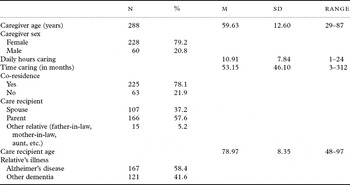
Participants were caregivers of relatives with dementia living in the community. All caregivers were recruited through social and health care centers in Madrid (Spain) between September 2005 and May 2009. Once located, an initial interview was carried out by telephone in order to confirm that volunteers were the primary caregivers of family members with dementia. In order to participate in the study, caregivers were required to identify themselves as the primary source of help for their relatives, and to report devoting more than one hour per day to caregiving duties for more than three months during the assessment period. Two-hundred-and-ninety caregivers were called for the assessment interview. Two of them quitted the interview referring to lack of time due to caregiving duties. The sample characteristics of the final sample (288 caregivers) are shown in Table 1. Caregivers gave their consent to participate in the study, and approval for the research was obtained from both the Spanish Ministry of Education and the Ethics Committee at the Rey Juan Carlos University (Madrid).
Sample characteristics

Measures
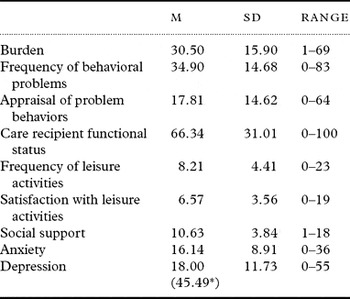
Face-to-face interviews were carried out by trained psychologists with each of the caregivers at the participating social and health centers. The interviews lasted approximately 90 minutes, and included the following variables (means, standard deviations and range for the assessed variables are shown in Table 2):
Means, standard deviations and range for the assessed variables

*Percentage of caregivers above clinical cut-off for depression.
Sociodemographic information. This comprised the caregiver's and care recipient's age, gender and kinship, time spent caring (in months), and number of hours per day devoted to care.
Guilt. Following a review of the literature, and based on the clinical experience of the authors and three other experts consulted for this purpose, we developed an initial pool of 34 items measuring guilt. All the items were originally created for the development of the Caregiver Guilt Questionnaire and no initial domains or factors were hypothesized, given the limited literature in this area. Response options range from 0 (“never”) to 4 (“always or almost always”) (see Appendix).
Burden. The Zarit Burden Interview (Zarit et al., Reference Zarit, Reever and Bach-Peterson1980) was used, and the ZBI guilt factor obtained by Ankri et al. (Reference Ankri, Andrieu, Beaufils, Grand and Henrad2005) was used to analyze convergent validity. Because the burden scale was included in the latter stages of the study, data for this instrument are only available for 166 caregivers. The internal consistency found in this study for this scale was 0.90 (Cronbach's α).
Frequency and appraisal of behavioral problems. The Revised Memory and Behavior Problems Checklist (Teri et al., Reference Teri, Truax, Logsdon, Uomoto, Zarit and Vitaliano1992) was used to assess these variables. It includes 24 items which, through two subscales, assess both the frequency of behavioral problems and the appraisal of these behaviors as being irritating or upsetting for the caregivers. In this study, the internal consistency found for the frequency scale was 0.82, and for the appraisal scale was 0.88 (Cronbach's α).
Functional status. The care recipient's functional status was assessed with the Barthel Index (Mahoney and Barthel, Reference Mahoney and Barthel1965). Higher scores on this measure are indicative of better physical functioning of the relative. Internal consistency of this scale was 0.92. (Cronbach's α).
Frequency of and satisfaction with leisure. Satisfaction with leisure time was rated using the Stevens et al. (Reference Stevens2004) Leisure Time satisfaction measure. This instrument consists of six items measuring the level of satisfaction felt by caregivers with regard to the amount of time spent on leisure activities over the past month (quiet time for yourself, engaging in hobbies, etc.). It was measured on a three-point Likert-type scale (0 = “not at all”; 2 = “a lot”). Frequency of leisure activities was measured using an adaptation of the Leisure Time satisfaction measure. Caregivers were asked to report the extent to which they had participated in the assessed activities over the previous month. This was measured on a five-point Likert-type scale (0 = “not at all”; 4 = “a lot”). Internal consistency indices in the present study were 0.83 for the satisfaction scale and 0.73 for the frequency scale (Cronbach's α).
Social support. The Psychosocial Support Questionnaire (PSQ; Reig et al., Reference Reig, Ribera and Miguel1991) was used. This scale has six items (e.g. “My friends and/or relatives pay me visits at home”) that were used to assess caregivers’ perceptions of the frequency of support they receive. Response options range from 0 (“never”) to 3 (“very often”). In the present study we found an internal consistency index for this scale of 0.78 (Cronbach's α).
Anxiety. The Tension-Anxiety subscale from the Profile of Mood States (POMS; McNair et al., Reference McNair, Lorr and Droppleman1971) was used. It consists of nine items (e.g. “tense”), and caregivers are asked to rate on a Likert-type scale (0 = “not at all”; 4 = “extremely”) how they felt during the previous week. Internal consistency for this scale in this study was 0.85 (Cronbach's α).
Depression. Depression was assessed by means of the Center for Epidemiological Studies-Depression Scale (CES-D; Radloff, Reference Radloff1977), a 20-item measure that assesses depressive symptomatology (e.g. “I felt sad”), with response options ranging from 0 (“rarely or none of the time [less than one day per week]”) to 3 (“most or all of the time [5–7 days perweek]”). Scores of 16 or higher may be indicative of clinical depression (Radloff and Teri, Reference Radloff, Teri and Brink1986). Cronbach's α coefficient for this scale was 0.90.
Results
Factorial validity of the Caregiver Guilt Questionnaire
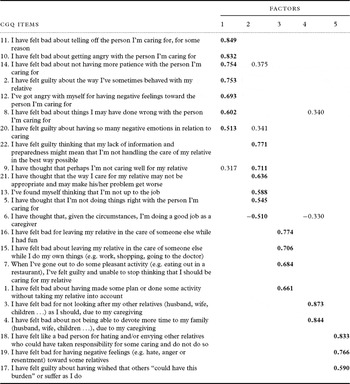
Following the usual procedures for the development of assessment instruments, a principal components analysis of the 34 initial items of the scale was carried out using varimax rotation, in order to maximize the orthogonality of the factors. Five factors were obtained with eigenvalues higher than 1.0. The ten items showing the lowest factor loadings (<0.45) on the corresponding factor were removed. In subsequent analysis, five factors explained 56.58% of the variance. Next, another two items with the lowest factor loadings on the corresponding factor (<0.45) were deleted. The resulting 22 items loaded on five factors (eigenvalues from 4.08 for the first factor to 1.77 for the fifth factor) explained 59.25% of the variance. Factor loadings are shown in Table 3.
Factor loadings of the CGQ items

Note: Numbers in bold in each column represent items clustered to the corresponding factor. Items <0.30 are not shown.
The first factor includes seven items referring to caregivers’ feelings of guilt associated with negative feelings, emotions or acts towards their relative (e.g. “I have felt bad about getting angry with the person I'm caring for”). This factor, of which all items are positively scored, was labeled guilt about doing wrong by the care recipient. The six items of the second factor mainly reflect caregivers’ feeling that, in general, they could be doing a better job as a caregiver (e.g. “I have thought that perhaps I'm not caring well for my relative”). This factor was labeled guilt about failing to meet the challenges of caregiving. All items are positively scored except item number 6, which is inversely scored. The third factor contains four items regarding caregivers’ negative feelings about looking after themselves and taking part in activities other than caring for their relative (e.g. “I have felt bad for leaving my relative in the care of someone else while I had fun”). This factor was labeled guilt about self-care, and all its items are positively scored. The fourth factor is made up of two items reflecting caregivers’ negative feelings associated with the fact of not being able to devote as much time as they would wish to their other relatives (e.g. “I have felt bad for not looking after my other relatives [husband, wife, children, etc.] as I should”). This factor was labeled guilt about neglecting other relatives, and all its items are positively scored. The fifth and final factor includes three items about caregivers’ negative feelings related to having had negative emotions or feelings towards other people who do not devote time and effort to caregiving duties as they should, or who do not have such responsibilities. This factor was labeled guilt about having negative feelings towards other people, and all its items are positively scored.
Scores for the resulting guilt subscales are determined by computing the sum of the scores of the items belonging to the corresponding scale, with item number 6 being first reversed. The total score on the Caregiver Guilt Questionnaire (CGQ) consists of the sum of the scores of all the subscales. A higher score reflects greater guilt.
Reliability
Acceptable to good reliability indices were obtained for the CGQ factors and the full scale. Specifically, a Cronbach's α of 0.88 was obtained for the total scale, 0.89 for the guilt about doing wrong by the care recipient factor; 0.76 for the guilt about failing to meet the challenges of caregiving factor; 0.69 for the guilt about self-care factor; 0.86 for the guilt about neglecting other relatives factor; and 0.61 for the guilt about having negative feelings towards other people factor.
Associations with demographic variables
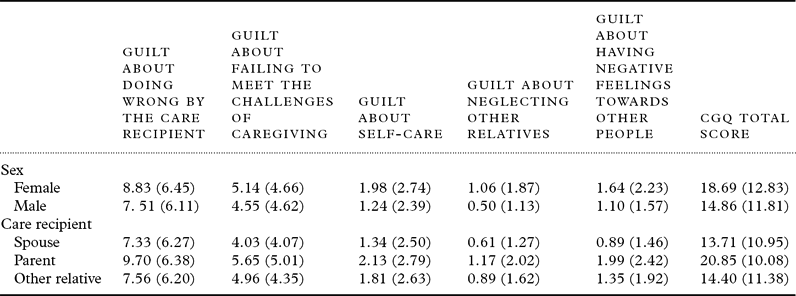
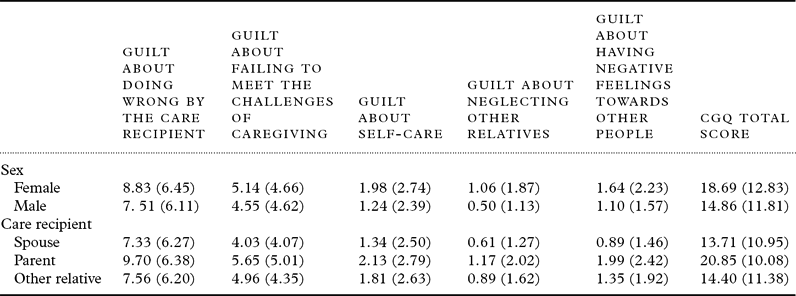
Mean differences in the CGQ factors and total score across sex and kinship (spouses and children) were analyzed through t tests. The results of these analyses are shown in Table 4. Female caregivers scored significantly higher than male caregivers on the factors guilt about neglecting other relatives (t = −2.94; p < 0.01) and guilt about having negative thoughts towards other people (t = −2.15; p < 0.05). Female caregivers also obtained higher CGQ total scores (t = −2.16; p < 0.05). Significant differences in CGQ score and all the factors were also found on considering kinship. Spouses obtained lower CGQ total scores than those caring for a parent, and scored lower in all CGQ factors: guilt about doing wrong by the care recipient (F = 5.44; p < 0.01), guilt about failing to meet the challenges of caregiving (F = 5.51; p < 0.01), guilt about self-care (F = 5.84; p < 0.01), guilt about neglecting other relatives (F = 3.02; p < 0.05) and guilt about having negative thoughts towards other people (F = 12.43; p < 0.01).
Guilt mean scores (and standard deviations) across sex and kinship
Convergent and criterion validity
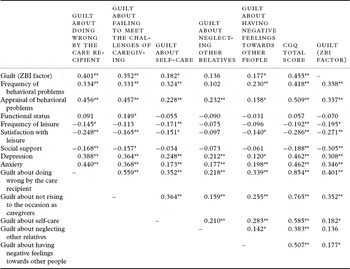
Correlations between CGQ factors and total score are shown in Table 5. Convergent validity was assessed through the correlation between CGQ factors and total score, and guilt as measured by the ZBI guilt factor (Ankri et al., Reference Ankri, Andrieu, Beaufils, Grand and Henrad2005). As it can be seen, significant correlations were found between the ZBI guilt factor and CGQ factors and total score, except in the case of the factor Guilt about neglecting other relatives. No significant differences were found in guilt scores between those caregivers who completed the ZBI and those who did not except for the factor Guilt about neglecting other relatives. Caregivers who completed the ZBI had higher scores (M = 1.15; SD = 1.01) in this factor than those who did not (M = 0.71; SD = 1.38)(t = −2.21; p < 0.05).
Correlations and intercorrelations between guilt and other variables

p < 0.05; ** p < 0.01
Significant associations between CGQ factors and total score and appraisal of problem behaviors, depression and anxiety were also found. Caregivers with higher CGQ scores also scored higher on appraisals, depression and anxiety. Similar findings were obtained for frequency of behavioral problems, except that the association between this variable and the CGQ factor guilt about neglecting other relatives was not significant. Functional status was found to be significantly associated only with guilt about failing to meet the challenges of caregiving factor: caregivers who report higher functional status of their care recipients also score higher scores on this CGQ factor. Caregivers who are less satisfied with their leisure time score higher on the CGQ and all its factors, except for the factor guilt about neglecting other relatives. Similar findings were found on analyzing frequency of leisure activities: those caregivers who report taking part in more leisure activities score lower on guilt about doing wrong by the care recipient, guilt about self-care and CGQ total score. Caregivers with higher scores on social support present lower scores on guilt about doing wrong by the care recipient, guilt about failing to meet the challenges of caregiving and CGQ total score.
Similar associations to those found with the CGQ were found between the ZBI guilt factor and all the other variables assessed: all associations were significant, except that with functional status.
Discussion
The main aim of this study was to examine the psychometric properties of a new scale for measuring guilt among dementia caregivers, namely, the Caregiver Guilt Questionnaire (CGQ). Through principal component analysis, 22 items were found to be represented by a five-factor structure. The factors were labeled guilt about doing wrong by the care recipient, guilt about failing to meet the challenges of caregiving, guilt about self-care, guilt about neglecting other relatives and guilt about having negative feelings towards other people. A significant proportion of variance of the guilt construct is explained by these factors, and reasonable internal consistency indices were found for all the factors and for the total questionnaire.
The convergent validity of the CGQ was supported by the substantial correlations found between the CGQ (total score and some of its factors) and the ZBI guilt factor (Ankri et al., Reference Ankri, Andrieu, Beaufils, Grand and Henrad2005), especially with the first two factors, guilt about doing wrong by the care recipient and guilt about failing to meet the challenges of caregiving. This result is not surprising if we consider that the content of the items included in these two factors is similar to that of the items included in the ZBI guilt factor: guilt associated with a general sense of not being a good caregiver. The low, though significant, correlations between the ZBI guilt factor and the CGQ factors guilt about self-care and guilt about having negative feelings towards other people, on the one hand, and the non-significant association with the factor guilt about neglecting other relatives, on the other, suggest that the CGQ measures dimensions of guilt which are not tapped by the ZBI guilt factor. Furthermore, the low to moderate intercorrelations between the CGQ factors, together with the different patterns of associations found between the CGQ factors and the other variables analyzed in the study, reveal that guilt may be better conceived as a multidimensional and domain-specific experience. However, this should not necessarily be taken as an argument against the usefulness of a total CGQ score, which is supported by the interesting correlations found between this global score and the variables included in the study.
In this regard, similar results to those found by Ankri et al. (Reference Ankri, Andrieu, Beaufils, Grand and Henrad2005) with the ZBI guilt factor were obtained. Caregivers looking after their parents had higher guilt scores than spouses in CGQ total score and all its factors. This result could be explained by the fact that adult children giving care, especially daughters, may have more sources of guilt, as they are more likely to experience conflict between their multiple roles (caregiver, mother or father, worker, etc.) and to perceive interference of their caregiving role with work and family (Yee and Schulz, Reference Yee and Schulz2000). In this regard, adult children caregivers have been found in some studies to admit potentially harmful behaviors (e.g. verbal aggression, ignoring) towards their care recipients to a greater extent than spouse caregivers (Sasaki et al., Reference Sasaki, Arai, Kumamoto, Abe, Arai and Mizuno2007). Such behaviors are likely to generate guilt in caregivers.
In this study, guilt has also been found to be significantly associated with behavioral problems in the care recipient. As Pagel et al. (Reference Pagel, Becker and Coppel1985) argue, caregivers facing more behavioral problems may make stronger attempts to control their relative's behaviors. Given the difficulty of controlling such behaviors, their attempts may be frustrating and/or unsuccessful, thus generating feelings of guilt.
In a similar way to what has been found for other distress-related variables in caregiving research (e.g. Pinquart and Sörensen, Reference Pinquart and Sörensen2003), female caregivers scored significantly higher than male caregivers, specifically in the factors guilt about neglecting other relatives and guilt about having negative feelings towards other people. Caring for others is a more central element in their identity than it is for men, and female caregivers are usually more involved than male caregivers in the roles of assisting and nurturing all family members, besides the care recipient. Given that women usually perceive more responsibility for caring for all family members, they are likely to be more vulnerable to guilt associated with the perception that they are neglecting other relatives due to caregiving. In fact, female caregivers have been found to report more role conflict, more caregiving costs and more interference with family and leisure time than do men (Ingersoll-Dayton and Raschick, Reference Ingersoll-Dayton and Raschick2004). The finding that female caregivers report more guilt than men about having negative feelings towards other people could be explained by the fact that female caregivers report greater role strain than male caregivers (Ingersoll-Dayton et al., Reference Ingersoll-Dayton, Starrels and Dowler1996) and receive less formal and informal support (Yee and Schulz, Reference Yee and Schulz2000). These differences between male and female caregivers may be related to different coping styles, but also to different internalized norms about caring and nurturing responsibilities, with women more liable to assume caregiving as a moral (filial) responsibility they have to bear, that is, as “the normal way” they should behave according to social and family expectations (Ingersoll-Dayton and Raschick, Reference Ingersoll-Dayton and Raschick2004). As suggested by Gonyea et al., (Reference Gonyea, Paris and Zerden2008), role theory can provide interesting insights for understanding the emergence of guilt feelings among adult children caregivers, especially women. These gender differences may explain why female caregivers have been systematically found in the caregiving literature to report more burden, anxiety, depression and health problems than male caregivers (Pinquart and Sörensen, Reference Pinquart and Sörensen2003; Yee and Schulz, Reference Yee and Schulz2000). These negative emotional outcomes may facilitate the generation of negative thoughts or feelings towards other people, such as irritability or resentment.
The results of this study are consistent with those of previous studies suggesting the relevance of guilt in caregiving outcomes. Strong associations were found between guilt and important outcome variables such as depression or anxiety, suggesting a significant relationship between guilt feelings and caregiver distress. Similarly, Gallagher et al. (Reference Gallagher, Phillips, Oliver and Carroll2008) found guilt, as measured with the ZBI guilt factor, to be associated with greater anxiety in caregivers of children with intellectual disabilities. It is our hypothesis that caregiver guilt contributes to the generation and exacerbation of depression and burden. However, the cross-sectional nature of this study precludes us from drawing any conclusions about causal links between guilt and other negative emotional outcomes in caregiving.
Another relevant finding of this study that endorses the need to take guilt feelings into account on analyzing caregiver distress are the significant associations between guilt and other variables pertaining to key dimensions in theoretical models such as the stress and coping model (e.g. Knight et al., Reference Knight, Silverstein, McCallum and Fox2000). For example, caregivers who report having guilt feelings about doing wrong by their care recipient or failing to meet the challenges of caregiving report low scores on leisure (frequency and, to a greater extent, satisfaction with leisure) and social support. Once again, the cross-sectional design of the study does not permit us to make causal inferences in this regard, but it would be really interesting for future studies to analyze whether guilt feelings have any influence on the reduction of time devoted to leisure or of social support levels.
Some other limitations of this study should be acknowledged. With regard to random error, although internal consistency of the scale (and its factors) has been found to be reasonable, no test-retest assessment of guilt has been made, so data on the stability over time of CGQ scores are not available. With regard to potential sources of systematic error, some of these can be addressed. For example, regarding content validity, other domains or experiences that may be sources of guilt for caregivers (e.g. thoughts about placing the care recipient in a nursing home) are not tapped by the CGQ, even though they may influence caregiver distress. Furthermore, as several empirical studies have shown in recent years, there are substantial differences in caregivers’ experience of distress across cultures (e.g. Knight et al., Reference Knight, Silverstein, McCallum and Fox2000), and guilt is considered to be a culturally sensitive emotion, strongly influenced by cultural perspectives and social norms (Bierbrauer, Reference Bierbrauer1992). In order to test the cross-cultural content validity of the CGQ, it seems necessary to apply this instrument in other cultures so as to confirm the findings of the present work. Finally, the convenience-based nature of the sample limits its representativeness and, in consequence, the generalizability of the results.
As has been already noted, the construct of guilt has not yet been adequately integrated into empirically based models of personality and/or emotion (Kugler and Jones, Reference Kugler and Jones1992). Currently, solid theoretical accounts of this emotional experience are still lacking, especially in caregiving research, where this variable has started to be analyzed only very recently. Hence, there is a clear need for empirical studies, such as that presented here, which may contribute to improve our understanding of the psychological and behavioral implications of guilt, and the dynamic of its relationships with caregivers distress and coping behaviors. These studies may eventually help us to develop more comprehensive caregiving models which include this variable and thus describe more accurately caregivers’ subjective experiences. The main contributions of the present study to the literature on guilt may be summarized as follows: it provides evidence on (a) the multidimensional and domain-specific nature of guilt; (b) the association between guilt and caregivers’ distress; and (c) potential behavioral implications of guilt (frequency of and satisfaction with leisure), which may mediate its relationship with distress. It is clear that there are many questions regarding guilt which deserve further attention, such as the relationship between guilt and caregivers’ values (e.g. familism), moral or religious beliefs, or dysfunctional thoughts about caregiving. These questions could be explored in future studies which would provide important insights into the nature of guilt and its role in the caregiving stress process.
The practical implications of our findings are evident: they indicate the importance of addressing guilt feelings in interventions and helping caregivers to acknowledge and manage them, as a way of reducing their distress and of promoting more adaptive ways of coping with caregiving. In this regard, helping caregivers to review and adjust their expectations and standards in relation to their obligations and capacities, to accept their limitations and weaknesses, and to acknowledge their needs, might facilitate a reduction in their guilt feelings which, in turn, could lead to the development of more adaptive behaviours, such as increasing their leisure activities or seeking social and instrumental support, which constitute important targets in cognitive-behavioral interventions (e.g. Coon et al., Reference Coon, Thompson, Steffen, Sorocco and Gallagher-Thompson2003). Even when this study has focused on the measurement of guilt in dementia caregivers, this emotional phenomenon is considered to be a key experience in many different caregiving experiences, and it has been found to be associated with psychosocial maladjustment in caregivers (e.g. Spillers et al., Reference Spillers, Wellisch, Kim, Matthews and Baker2008). In this sense, it might be interesting to explore the usefulness of the CGQ to assess guilt in caregivers of people suffering from other chronic conditions (e.g. terminal illnesses such as cancer).
In conclusion, the CGQ presents acceptable psychometric properties, and may contribute to the development of sensitive and conceptually valid outcome measures for psychosocial intervention research (Moniz-Cook et al., Reference Moniz-Cook2008). It is our hope that future studies using this instrument in our context and in other countries will permit further analysis of its utility for getting closer to our shared objective of improving our ability to help caregivers.
Conflict of interest
None.
Description of authors' roles
Andrés Losada and María Márquez-González both worked on the design of the study and its implementation, the development of the CGQ items, the data analysis and the writing of the paper. Cecilia Peñacoba collaborated on the development of the CGQ items. Rosa Romero-Moreno worked on the study implementation and the writing of the paper.
Acknowledgments
The authors would like to thank Nancy Pachana, Ph.D., from the University of Queensland, for her help with the CGQ back-translation. This study was partially funded by grants from the Spanish Ministry of Education (SEJ2006–02489/PSIC) and from the Spanish Ministry of Science and Innovation (PSI2009-08132/PSIC).
Appendix: Caregiver Guilt Questionnaire (CGQ)
Below is a list of some feelings and thoughts. Please tell us how often you have had these feelings and thoughts during the past few weeks using the following options:
0 = never; 1 = rarely; 2 = sometimes; 3 = several times; 4 = always or almost always
1. I have felt bad about having made some plan or done some activity without taking my relative into account [Me he sentido mal por haber hecho algún plan o actividad sin contar con mi familiar].
2. I have felt guilty about the way I've sometimes behaved with my relative [Me he sentido culpable por la forma en que me he comportado en ocasiones con mi familiar].
3. I have felt bad for not looking after my other relatives (husband, wife, children . . .) as I should, due to my caregiving [Me he sentido mal por no atender a mis otros familiares (marido, mujer, hijos. . .) como debería, debido al cuidado].
4. I have felt bad about not being able to devote more time to my family (husband, wife, children. . .), due to my caregiving [Me he sentido mal por no poder dedicar más tiempo a mi familia (marido, mujer, hijos . . .) como debería, debido al cuidado].
5. I have thought that I'm not doing things right with the person I'm caring for [He pensado que no estoy haciendo las cosas bien con la persona a la que estoy cuidando].
6. I have thought that, given the circumstances, I'm doing a good job as a caregiver [He pensado que, teniendo en cuenta las circunstancias, estoy haciendo bien mi tarea como cuidador/a].
7. When I've gone out to do some pleasant activity (e.g. eating out in a restaurant), I've felt guilty and unable to stop thinking that I should be caring for my relative [Cuando he salido a hacer alguna actividad agradable (p.ej., ir a cenar a un restaurante), me he sentido culpable y no he dejado de pensar que debería estar cuidando o atendiendo a mi familiar].
8. I have felt bad about things I may have done wrong with the person I'm caring for [Me he sentido mal por cosas que quizá había hecho mal con la persona a la que estoy cuidando].
9. I have thought that perhaps I'm not caring well for my relative [He pensado que quizá no estoy cuidando bien].
10. I have felt bad about getting angry with the person I'm caring for [Me he sentido mal por haberme enfadado con la persona a la que estoy cuidando].
11. I have felt bad about telling off the person I'm caring for, for some reason [Me he sentido mal por haber regañado por alguna razón a la persona a la que estoy cuidando].
12. I've got angry with myself for having negative feelings toward the person I'm caring for [Me he enfadado conmigo mismo/a por tener sentimientos negativos hacia la persona a la que cuido].
13. I've found myself thinking that I'm not up to the job [Me he encontrado pensando que no estoy a la altura de las circunstancias].
14. I have felt bad about not having more patience with the person I'm caring for [Me he sentido mal por no tener más paciencia con la persona a la que estoy cuidando].
15. I have felt bad about leaving my relative in the care of someone else while I do my own things (e.g. work, shopping, going to the doctor) [Me he sentido mal por dejar a mi familiar al cuidado de otra persona mientras yo hacía mis tareas (p.ej., trabajo, compra, ir al médico, etc.)].
16. I have felt bad for leaving my relative in the care of someone else while I had fun [Me he sentido mal por dejar a mi familiar al cuidado de otra persona mientras yo me divertía].
17. I have felt guilty about having wished that others “could have this burden” or suffer as I do [Me he sentido culpable por desear que a otros “les toque esta cruz” o sufran lo mismo que yo].
18. I have felt like a bad person for hating and/or envying other relatives who could have taken responsibility for some caring and do not do so [Me he sentido mala persona por odiar y/o envidiar a otros familiares que podrían hacerse responsables parcialmente del cuidado y no lo hacen].
19. I have felt bad for having negative feelings (e.g., hate, anger or resentment) toward some relatives [Me he sentido mal por tener sentimientos negativos (p.ej., odio, enfado o rencor) hacia algunos familiares].
20. I have felt guilty about having so many negative emotions in relation to caring [Me he sentido culpable por el hecho de tener tantas emociones negativas en relación al cuidado].
21. I have thought that the way I care for my relative may not be appropriate and may make his/her problem get worse [He pensado que la forma en la que cuido de mi familiar podría no ser adecuada y contribuir a que su problema vaya a peor].
22. I have felt guilty thinking that my lack of information and preparedness might mean that I'm not handling the care of my relative in the best way possible [Me he sentido culpable al pensar que mi falta de información y preparación podría hacer que no estuviera manejando el cuidado de mi familiar de la mejor forma possible].
Note: The Spanish items are shown in square brackets.