


Introduction
The United States and its partners will defeat terrorist organizations of global reach by attacking their […] leadership; command, control [….]
—US National Strategy for Combating Terrorism 2003(emphasis in original)Targeting terrorist leaders has become a commonly used US counterterrorism policy since September 11. According to the US National Strategy for Counterterrorism 2018, “targeting key terrorists” remains the number one priority action. This policy is also referred to as targeted leader killing or “cutting off the head of the snake”—implying that if one does so, the body dies. As illustrated by the above quote, the underlying goal of this policy is to undermine control within terrorist organizations: the ability of terrorist leaders to determine what others in the organization do.
Terrorist leaders are primarily targeted using armed drones, or Unmanned Aerial Vehicles. These unmanned airplanes can surveil and identify individual targets and kill them. There have been over 6,700 US drones strikes worldwide to date.Footnote 1 Drone technology is spreading rapidly: 28 other countries have acquired weaponized drones in the last 10 years.Footnote 2
The prominence of targeted leader killing and the proliferation of drones invite the question whether this policy works to decrease terrorist violence. This paper addresses that research question. More precisely, it investigates how drone strikes killing terrorist leaders, thereby undermining control within terrorist organizations, affect terrorist attacks.Footnote 3
The effect of killing a terrorist leader on terrorist violence is theoretically ambiguous, and it depends on whether terrorist groups are modeled as unitary actors or not. Theoretical models that consider the terrorist group as unitary—as a single organism as the snake analogy would suggest—predict that killing a leader decreases the capacity of the group to commit attacks, and thereby terrorist violence (Powell Reference Powell2007; Sandler and Arce Reference Sandler and Arce2003).
However, other theoretical models predict an increase in terrorist attacks after a drone hit on a terrorist leader. A first family of models treats the terrorist group as nonunitary and subject to problems of control. Principal-agent models by Shapiro (Reference Shapiro2013) and Abrahms and Potter (Reference Abrahms and Potter2015) suggest that leader killing undermines control of the new leader over the organization’s operatives, which could lead to increased terrorist violence if operatives have a greater preference for violence than the leader. Other families of models also suggest that targeted leader killing may increase (the frequency of) terrorist violence: terrorist groups may respond to a loss in capacity by substituting infrequent “big” attacks by frequent “small” attacks, leader killings that result in civilian casualties may create backlash if they spur terrorist recruitment, and terrorist organizations may commit more terrorist attacks after their leader has been killed to signal strength.
Ambiguous theoretical predictions leave an empirical question. However, investigating the causal effect of counterterrorism on terrorist violence empirically is challenging. Although counterterrorism may well affect terrorist violence, it is equally possible that terrorist violence invites counterterrorism.
To overcome this problem, this paper exploits a natural experiment provided by drone strikes “hitting” and “missing” terrorist leaders in the Federally Administered Tribal Areas (FATA) of Pakistan, which is inspired by Jones and Olken (Reference Jones and Olken2009) and shares similarities with an analysis by Abrahms and Mierau (Reference Abrahms and Mierau2017). I construct a new dataset of drone strikes targeting terrorist leaders, executing several cross-checks to safeguard data quality. This dataset captures variation across time and terrorist organizations. I argue that conditional on a drone strike targeting a terrorist leader, drone “hits” and “misses” are quasi random. Drone hits and misses are not statistically significantly different from one another on an extensive range of characteristics, including pretrends in terrorist violence. Narratives of why drones miss also suggest that misses are largely driven by chance. This enables a difference-in-difference design, investigating changes in attacks by a terrorist organization before and after a drone hit on its leader, compared with before and after a miss.
Results indicate that a drone hit on a terrorist organization’s leader is associated with an increase in the number of terrorist attacks by this organization compared with a miss. Estimates are statistically significant for 3 out of 6 months after a hit, and the increase in terrorist attacks worldwide varies between 47.7% and 70.3% for these months. This result cannot be explained by terrorist organizations “speeding up” the timing of attacks or by a decrease in the lethality of attacks. The result is robust to an extensive battery of robustness checks.
The paper proceeds to tests auxiliary hypotheses derived from theoretical models emphasizing problems of control, capacity, signaling, and backlash. It finds more evidence in favor of hypotheses relating to problems of control than for those derived from alternative theoretical explanations. After a drone hit on a leader, those types of terrorist attacks for which we have theoretical and empirical reason to believe that they are not preferred by terrorist leaders increase most. These include attacks against civilian and private targets, echoing results by Abrahms and Mierau (Reference Abrahms and Mierau2017), but also attacks by operatives that the organization does not publicly claim responsibility for. Furthermore, the effect of drone strikes on terrorist attacks is stronger for terrorist organizations and leaders that rely more strongly on central control. Finally, a drone hit is associated with terrorist infighting and a proxy for group splintering. However, evidence is also found to support some, but not all, hypotheses derived from signaling models. After a drone hit, some types of terrorist attacks that send a strong signal about the group’s continued resolve increase, such as attacks on military targets and attacks the group claims responsibility for.
A considerable number of existing studies investigate empirically the impact of targeted killing of leaders of terrorist organizations, yet results are mixed. Some authors conclude that targeted leader killing is effective because it speeds up the decline of terrorist organizations (Price Reference Price2019) or diminishes the number or intensity of terrorist attacks (Jaeger and Paserman Reference Jaeger and Paserman2009; Johnston Reference Johnston2012). Others conclude that it has no effect or an adverse effect (Abrahms and Mierau Reference Abrahms and Mierau2017; Abrahms and Potter Reference Abrahms and Potter2015; Hafez and Hatfield Reference Hafez and Hatfield2006; Jordan Reference Jordan2019; Kaplan et al. Reference Kaplan, Mintz and Mishal2006; Mannes Reference Mannes2008). Existing studies offer several theoretical explanations for success or failure of targeted leader killing. The former commonly revolve around the importance of leadership for terrorist groups’ survival and capacity to commit attacks (Jaeger and Paserman Reference Jaeger and Paserman2009; Price Reference Price2019). The latter emphasize martyrdom effects, revenge, or the effect of drone strikes on terrorist recruitment (Hafez and Hatfield Reference Hafez and Hatfield2006; Kaplan, Mintz, and Mishal Reference Kaplan, Mintz and Mishal2006; Price Reference Price2019). Several authors develop theoretical arguments explaining why targeted leader killing would be effective against some terrorist groups, but not others, depending on for example their organizational structure (Jordan Reference Jordan2019; Price Reference Price2019).
The above studies encounter some combination of three challenges. Most of these studies cannot empirically distinguish between competing theoretical explanations for their results, and they do not refer to principal-agent theory as a possible explanation. A notable exception is work by Abrahms and Mierau (Reference Abrahms and Mierau2017), to whom this paper is indebted for pioneering the study of targeted leader killing by drone in Pakistan from a principal-agent perspective. However, Abrahms and Mierau (Reference Abrahms and Mierau2017) only test one implication from principal-agent theory, that relating to civilian targeting. Empirically, studies of targeted leader killing struggle to convincingly demonstrate its causal effect. A handful of studies employ a similar “hit-or-miss” design as in this paper (Abrahms and Mierau Reference Abrahms and Mierau2017; Jaeger and Paserman Reference Jaeger and Paserman2009; Johnston Reference Johnston2012), but the data used lacks either variation across terrorist groups or over time. Specifically, Abrahms and Mierau (Reference Abrahms and Mierau2017), are forced to consider all terrorist groups in the Afghanistan-Pakistan area as one. Hence, results hinge on the assumption that the probability of a hit is not related to trends in violence over time or across groups. These conditions could be violated in many plausible circumstances, and this paper provides evidence that the probability of a hit indeed displays a strong time trend. Unlike other studies, the present study can control for trends over time and differences across terrorist groups by including group and time-fixed effects, substantially improving causal identification.
Hence, this paper contributes to existing literature on terrorism by testing a rich set of predictions from principal-agent theory. Furthermore, it contributes to the literature on targeted leader killing by using a more rigorous identification strategy.
Finally, this paper contributes to the literature on drone strikes by providing evidence on their medium-term impact on terrorist violence, across geographical areas where targeted terrorist groups are active. There is a small but growing literature on the effectiveness of drone strikes in Pakistan (Johnston and Sarbahi Reference Johnston and Sarbahi2016; Mir and Moore Reference Mir and Moore2019), generally concluding that they decrease terrorist violence in FATA. Johnston and Sarbahi (Reference Johnston and Sarbahi2016) argue that the week-to-week timing of drone strikes is quasi random due to factors such as the weather; consequently, the data can only reveal the short-term impact of drone strikes. Mir and Moore (Reference Mir and Moore2019) compare areas in FATA where US drones were and were not allowed to fly over time. Given their empirical set up, these studies cannot address the impact of drone strikes on violence outside FATA. This effect is arguably the more interesting one, as drone strikes explicitly target terrorist organizations “of global reach.”
Background
This study focuses on drone strikes in Pakistan.Footnote 4 A drone strike is a strike by an Unmanned Aerial Vehicle, an unmanned airplane with both surveillance and strike capability. Up to September 2015, when the Pakistani government acquired armed drones, the US was the only actor conducting drone strikes on Pakistani territory—over 400 strikes to date.Footnote 5 The Central Intelligence Agency (CIA) conducts these strikes, with the consent of the Pakistani government until this was withdrawn in 2013 (Byrne Reference Byrne2016). Drone strikes target terrorist leaders, both high and low level, as well as named or anonymous militants. There are no confirmed instances of conventional airstrikes by the US in Pakistan.
All but a handful of drone strikes have taken place in the Federally Administrated Tribal Areas (FATA), an area of Pakistan that borders Afghanistan. Although the Pakistani military conducts operations in FATA, there has historically been little civilian government oversight. Until it was merged into an adjacent province in 2018, FATA was administrated outside of the framework of the Pakistani constitution.Footnote 6 The region is known as a sanctuary for numerous terrorist organizations, which operate in Pakistan and transnationally. Al-Qaida and the Taliban are the best-known organizations.
Terrorist organizations in FATA are prone to splintering. Infighting between three leaders of the Tehrik-i-Taliban Pakistan (TTP) led to a split of the organization in 2009 (Crenshaw Reference Crenshaw2012). Pakistani newspaper Dawn regularly reports on the formation of new TTP splinter factions, such as Jamaat Al-AhrarFootnote 7 or Jundullah.Footnote 8
There is a fierce and unresolved debate about the number of civilian casualties that drone strikes cause, which is of limited relevance to this paper, since the main analysis uses data on named leaders whose relationship to terrorist groups is not disputed. A well-cited study put the civilian casualty rate at 32% between 2004 and 2010 (Bergen and Tiedemann Reference Bergen and Tiedemann2011). There are good reasons to doubt these and other claims. There is a tendency on the part of US officials to assume that all military-aged male casualties are militants (Byman Reference Byman2013), terrorist groups often cordon off the area of a drone strike and do not allow witnesses that might confirm or deny reports, and Pakistani media commonly publish unsubstantiated and high civilian casualty counts (Taj Reference Taj2010).
Regardless of the actual number of civilian casualties, terrorist organizations can use drone strikes hitting civilians as a propaganda tool. Al-Qaida propaganda materials portray drone strikes as causing mainly civilian deaths and as an indication of the US government’s attitude vis-a-vis “ordinary” Muslims (Cronin Reference Cronin2013; Ludvigsen Reference Ludvigsen2018). This dynamic is one reason for Cronin (Reference Cronin2013) to conclude that drone strikes are an unsuccessful counterterrorism policy.
Insights from Theory and Hypotheses
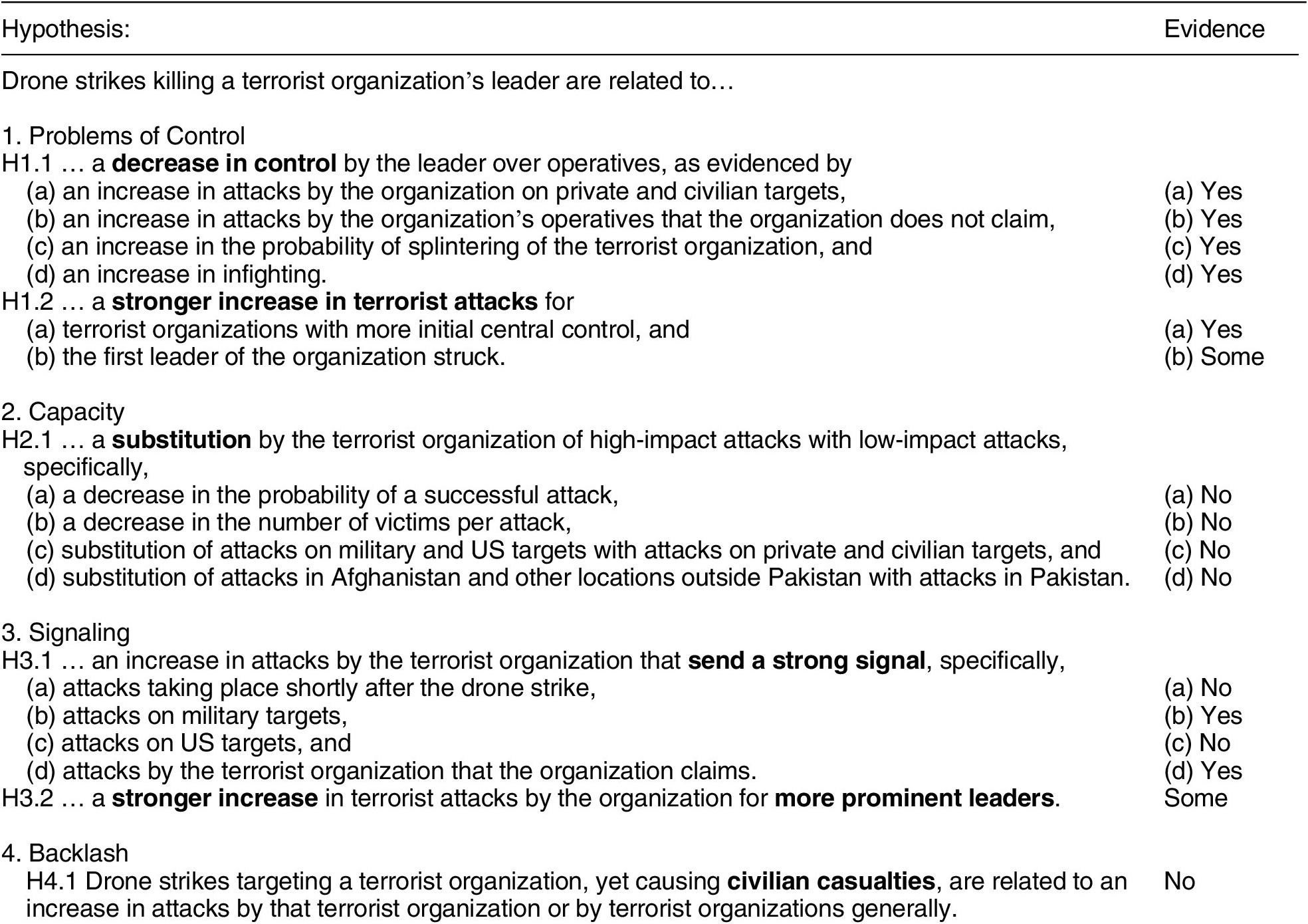
Four families of theoretical models provide hypotheses on how drone strikes killing a terrorist group’s leader might affect terrorist attacks, through problems of control, terrorist capacity, backlash, and signaling. According to all four of these, it is possible that a drone hit on a terrorist leader is associated with increased terrorist violence. To empirically distinguish between these theoretical models, I derive a set of auxiliary hypotheses. An overview of these hypothesis can be found in Table 1. For a more comprehensive overview of game theory and terrorism, see Sandler (Reference Sandler2011) and Sandler (Reference Sandler2015).
Hypotheses

Principal-Agent Problems and Control
This section discusses principal agent theories of terrorist groups. According to such theories, counterterrorism threatening to expose a terrorist leader may diminish leaders’ control over their operatives. Depending on the preferences of leaders and operatives, this could increase terrorist violence.
Both Shapiro (Reference Shapiro2013) and Abrahms and Potter (Reference Abrahms and Potter2015) model terrorist groups as nonunitary organizations, subject to principal-agent problems. Principal-agent problems arise because leaders and operatives within terrorist organizations have different preferences regarding how many and what type of terrorist attacks to commit. Unless the leader can exert control over operatives, operatives might not act as the leader wants. Control refers to efforts by the leader to determine the actions of operatives, specifically, (1) communication—the leader telling operatives what to do—and (2) punishment—the leader penalizing operatives that do not follow orders or rewarding those that do (Shapiro Reference Shapiro2013).
Counterterrorism that threatens to expose the terrorist leader is predicted to decrease the degree of control a leader is able or willing to exert (Shapiro Reference Shapiro2013). Engaging in communication and punishment makes a leader more vulnerable to detection by counterterrorism agencies, so leaders may opt to exert less control as scrutiny by counterterrorism agencies intensifies. Mir (Reference Mir2018) illustrates qualitatively how drone strikes affect control within terrorist organizations in FATA: to avoid detection by drones, leaders eschewed use of communication devices, quit meetings, and were out of contact with operatives for months. A drone strike that hits a terrorist leader plausibly decreases control more steeply than a drone strike that misses a terrorist leader. The new leader is likely less capable of exerting control, at least initially. If the new leader were better than the old leader at exerting control, presumably he would already be the leader. The new leader may also be less willing to exert control. The old leader evidently revealed enough information about themselves to be killed by drone. The new leader might not yet have, giving them an incentive to trade off control for secrecy.
The predicted effect of a decrease in control on terrorist violence is ambiguous: this depends on the relative preferences of the leader and the operative (Shapiro Reference Shapiro2013). If the operative has a greater preference for violence than the leader, decreasing the leader’s control within the terrorist group is predicted to lead to more violence.
There are theoretical reasons to believe that terrorist operatives indeed have a greater preference for violence than terrorist leaders. The main theoretical argument is that leaders, having had longer tenure within the organization, know better that particular terrorist attacks harm the group’s long-term prospects by decreasing public support (Abrahms and Potter Reference Abrahms and Potter2015; Shapiro Reference Shapiro2013). Attacks that are harmful in the long term likely include attacks on civilians (Abrahms Reference Abrahms2012; Fortna Reference Fortna2015). Alternative theoretical arguments include a selection effect—operatives are selected for their tendency towards violence—whereas leaders have other qualities (Shapiro Reference Shapiro2013)—or greater benefits to violence for operatives—for example in the form of pillage or promotion within the organization (Abrahms and Potter Reference Abrahms and Potter2015).
Empirical evidence also suggests that terrorist leaders prefer less violence than operatives, especially violence against civilians. In a study of over 1,300 individual members of radical groups in the US, Jasko and LaFree (Reference Jasko and LaFree2019) find that leaders have a lower propensity for violence than followers. Anecdotal evidence and qualitative case studies suggest a similar pattern. Intercepted letters from Al-Qaida suggest that its leaders repeatedly admonish subsidiary groups to commit less violence against Muslim civilians (Crenshaw Reference Crenshaw2012). Al-Qaida in Iraq in particular ignored orders to halt beheadings and other tactics that eventually eroded its popular support base (Price Reference Price2019; Jordan Reference Jordan2019). Price (Reference Price2019) details how the imprisonment of a Hamas leader eroded checks on who could execute suicide bombings, resulting in more attacks. Abrahms and Mierau (Reference Abrahms and Mierau2017) provide a detailed case study of how leaders of the Taliban tried but on various occasions failed to stop lower level members from perpetrating indiscriminate violence against civilians. The death of TTP leader Hakimullah Mehsud reportedly sparked a debate within the group about whether civilians were legitimate targets, and terrorist attacks by the TTP spiked (Crenshaw Reference Crenshaw2012). Leaders of the TTP and Haqqani network publicly denied involvement in attacks that members of their respective organizations likely did commit, including attacks after TTP had signed a peace agreement with the Pakistani governmentFootnote 9 and an attack on a funeral.Footnote 10
The latter examples illustrate that leaders who cannot exert sufficient control to prevent operatives from executing attacks harmful to the group’s long-term interests may still try to do damage control by not claiming these attacks. See Abrahms and Conrad (Reference Abrahms and Conrad2017) for a formal theory of such strategic credit claiming.
Principal-agent models thus give the following hypotheses. Drone strikes that kill terrorist leaders are predicted to lead to a decrease in control of leaders over operatives (H1.1). A decrease in control may be expressed empirically by an increase in terrorist attacks on civilian and private targets (H1.1a) or an increase in terrorist attacks committed but not claimed by the organization (H1.1b).
The degree of control leaders exert affects the organizational structure of terrorist groups. Abrahms and Potter (Reference Abrahms and Potter2015) note that group structure is a standard proxy for leadership control. Groups with higher degrees of control are more centrally organized—that is, have more ties between leaders and operatives. Robustness of central control is one of two defining characteristics in Staniland’s (Reference Staniland2014) classification of armed group organizational structure. A group with robust central control has an effective bureaucracy to discipline members and socialize them into the “party line.”
This gives us a further set of hypotheses. Drone strikes undermining control may lead to a change in organizational structure: if all ties between terrorist leaders and operatives break down, parts of the group may form splinter groups (H1.1c) or fight among each other (H1.1d). Furthermore, groups that rely more on central control may be affected more strongly by drone strikes than groups that do not (H1.2a). If a group has no central control to begin with, control cannot be further undermined by killing its leader, and we would expect drone strikes to have little effect.
Finally, the effect of drone strikes on violence may be stronger for the first leader killed (H1.2b). The first leader targeted decided how much information to reveal about themselves prior to the existence of drones, and it may be too late to hide this information through decreasing control. The subsequent leader is possibly better able to trade off control for secrecy. Hence, we may expect the drop in control to be greatest after the first leader of each group is killed.
Capacity
A drone strike can be considered an example of a proactive counterterrorism policy aiming to eliminate terrorist capacity: resources needed for the execution of terrorist attacks. Consider a production function of terrorist attacks. Several resources can be inputs to this production function, for example, leadership, financial capital, or operatives’ labor. Assume that terrorist groups maximize the number of terrorist attacks committed subject to their resource constraints. Drone strikes eliminating leadership tighten this resource constraint, leading to a predicted decrease in the frequency of terrorist attacks (see for example Powell Reference Powell2007; Sandler and Arce Reference Sandler and Arce2003).
However, capacity models considering that terrorist groups may choose between different types of attacks can predict an increase in the frequency of terrorist attacks as a result of proactive counterterrorism (Enders and Sandler Reference Enders, Sandler and Silke2004). Imagine that terrorist groups maximize the political impact of their attacks. They can commit some number of low-impact attacks (requiring fewer resources) or high-impact attacks (requiring more resources). If proactive counterterrorism policies disproportionately eliminate terrorist resources that are required for high-impact attacks, terrorist groups may substitute away from high-impact attacks into low-impact attacks. If the increase in the number of low-impact attacks is larger than the decrease in the number of high-impact attacks, the frequency of terrorist attacks increases, despite lower capacity and lower political impact of the terrorist group.
Hence, capacity models predict that a decrease in terrorist group capacity due to a drone hit on its leader may lead to a substitution of high-impact with low-impact attacks (H2.1). This could manifest in more “failed” terrorist attacks, smaller terrorist attacks in terms of number of victims, or substitution of attacks on military targets and US citizens or attacks abroad, with attacks on private and civilian targets or attacks in Pakistan.
Signaling
A drone strike that hits a terrorist leader may introduce uncertainty about a terrorist group’s ability or resolve to continue terrorist attacks, which in turn may give terrorist groups an incentive to commit more attacks in the periods after the drone strike by way of a signal. Imagine a government must decide whether to make concessions to a terrorist group but is uncertain about the resolve or resources commanded by the terrorist group. Terrorist groups then have an incentive to commit more or larger terrorist attacks in the period soon after this uncertainty arises, in an attempt to convince the government of their strength or resolve and induce concessions (Arce and Sandler Reference Arce and Sandler2007; Lapan and Sandler Reference Lapan and Sandler1993).
Signaling models thus hypothesize that a drone strike hitting a terrorist leader leads to an increase in terrorist attacks that send a strong signal (H3.1). The strongest signal arguably consists of terrorist attacks that immediately follow the drone strike hitting a terrorist leader that hit a “hard” target, such as a military target or a US citizen, and that are claimed by the terrorist organization. Furthermore, we might hypothesize that these effects are stronger for more prominent leaders (H3.2): the more prominent the leader killed by drone, the stronger the signal required to convince others of the organization’s resolve.
Signaling as a theoretical explanation is difficult to empirically distinguish from revenge or retaliation. If a terrorist group wishes to avenge the death of its leader, the resulting pattern of terrorist attacks is plausibly similar to that suggested in H3.1 and H3.2.
Backlash and Recruitment
Proactive counterterrorism policies may cause “backlash” if they result in civilian collateral damage, thereby spurring terrorist recruitment. Conceptually, backlash is distinct from the effect of targeted leader killing, but in practice the two might be related if operations killing leaders disproportionately kill civilians. In this respect, drone strikes are distinct from other methods of targeted leader killing, such as special operations, which may present a lower risk of civilian casualties.
Backlash could occur if terrorist organizations use civilian casualties to foment ideological opposition (Bueno de Mesquita Reference Bueno de Mesquita2005). Alternatively, Kalyvas (Reference Kalyvas2000) suggests that those facing indiscriminate violence by the hands of one party to a violent conflict may protect themselves by joining the other. If violence is completely indiscriminate, joining does not pose additional risk, but provides the new recruit with information on when and where such indiscriminate violence might occur. A fully informed government may still wish to engage in counterterrorism creating backlash—if it trades off an increase in future attacks for a decrease in current attacks (Jacobson and Kaplan Reference Jacobson and Kaplan2007) or if it does not fully internalize the global costs of proactive counterterrorism because this increases recruitment, but displaces terrorist attacks to softer foreign targets (Rosendorff and Sandler Reference Rosendorff and Sandler2004).
Backlash need not remain limited to the terrorist organization subject to proactive terrorism policies; it may extend to terrorist groups generally. Siqueira and Sandler (Reference Siqueira and Sandler2007) provide a model in which proactive counterterrorism measures against one terrorist group trigger reprisal attacks by other groups.
Theoretical models considering backlash predict that drone strikes that hit civilians may lead to increased terrorist attacks by the terrorist organization that was the target of the drone strike or by terrorist groups in general (H4.1).
Data and Methods
Data
This paper uses a newly constructed panel dataset of successful and failed targeted leader killings, capturing variation across 13 terrorist groups over a period of 12 years (2004–2015). The unit of observation is the group-month. Various cross-checks have been carried out to make this dataset arguably less subject to reporting bias compared with relying on a single data source. Balance checks substantiate the assertion that drone hits and misses are quasi random.
Drone Strikes
To construct a dataset of successful and failed targeted killings of terrorist leaders, I code 443 narratives about individual drone strikes between 2004 and 2015, collated by the Bureau of Investigative Journalism (BIJ),Footnote 11 and cross-check these with data from the New America Foundation (NAF)Footnote 12 and information on terrorist leaders from the Mapping Militants Project at Stanford University (Crenshaw Reference Crenshaw2012).
For each drone strike reported by the BIJ, I code whether a terrorist leader was targeted and whether this leader died. The terrorist group(s) the drone strike targeted is also recorded. This results in 379 strikes for which the group targeted can be determined from BIJ reports,Footnote 13 including 137 targeting a named individual designated by BIJ reports as “leader.” For full coding rules, see Appendix A2.
The resulting data on terrorist leaders was cross-checked with data from the NAF. This organization also provides information on terrorist leaders targeted by drone, which was used by previous studies (e.g., Abrahms and Mierau Reference Abrahms and Mierau2017; Johnston and Sarbahi Reference Johnston and Sarbahi2016). These data have substantial downsides. The NAF for unknown reasons does not report unsuccessful strikes on leaders between 2012 and 2015 and is extremely broad-brushed when classifying terrorist groups. For example, the Afghan Taliban, local (Pakistani) Taliban, Tehrik-i-Taliban Pakistan (TTP), and the Punjabi Taliban are all coded as “Taliban.” This forces authors using NAF leaders data to consider all groups targeted as a single unit and truncate the data in 2011 (Abrahms and Mierau Reference Abrahms and Mierau2017), creating a single short time series. By contrast, coding BIJ narratives results in information on 13 different terrorist groups, forming a panel dataset covering a longer period. An overview of these 13 groups can be found in Appendix A1. Note that two of these 13 groups do not exist for part of the research period.
Cross-checking data between the BIJ and the NAF gives insight into how information from single data sources might be biased. Although both BIJ and NAF are nonpartisan and construct their data on the basis of (often the same) reputable news sources, when reading between the lines, the NAF appears to have a more positive outlook on use of drones than the BIJ. This gives the NAF a stronger tendency to portray those killed by a drone strike as a leader. I cross-check all named individuals the NAF classifies as “leaders killed.” Deaths of all but one of these individuals are also found in the BIJ data, within 2 days of the NAF-recorded data. However, the BIJ does not always classify these individuals as “leaders.”
To mitigate bias in the interpretation of who is a leader, I cross-check data coded with leaders mentioned by the Stanford Mapping Militants project. United States counterterrorism agencies have an incentive to inflate the importance of individuals once they are killed by drone strike, which affects both NAF and BIJ data, as these are based on strike reports. By contrast, the Mapping Militants project creates profiles of terrorist groups independent of drone strikes, based on open-source information it selects to “maximize veracity and reliability.” Names of the group’s leaders are a fixed element of each profile.
Confirming the suspicion that the importance of individuals is inflated by drone strike reports, the “leader” as classified by BIJ is only recognized as such by the Mapping Militants Project for approximately one-third of strikes (45 out of 137). In the preferred specification, only the 45 strikes involving leaders who are considered as such by the Stanford project are coded as a drone strike targeting a leader. Fifteen of these succeeded in killing the target. Ten leaders were both missed and hit (see Appendix A3 for details). Results using the BIJ definition, giving 137 drone strikes targeting a leader, are included as a robustness check.
Note that it is the rule rather than the exception for the death of a leader, especially those leaders recognized by the Stanford project, to be confirmed by both sources in the US government and the terrorist organization. Terrorist organizations commonly publish statements about the death of their leader, put out eulogies, or place online pictures of his funeral. This does not hold for those marked as “leaders” by the NAF or BIJ only, who are sometimes only identified by some less-than-unique nickname.
It is possible that a terrorist group has leaders that are not publicly known. These would not be included in reports by BIJ, NAF, or Mapping Militants, which are all based on open-source information. Drone strikes on these individuals are counted as strikes not involving a group’s leader in the present analysis. As results are driven by the difference between drone hits and misses on a leader, this is not likely to bias the analysis.
I supplement the dataset of terrorist leaders with information on the importance of a leader within a terrorist group. Two metrics are used. The first is an indicator equaling 1 if the Stanford Mapping Militants Project indicates an individual was ever “first in command” or similar of a terrorist group. The second is the maximum reward amount offered for information on a terrorist leader by the US Department of State’s Reward for Justice Program.
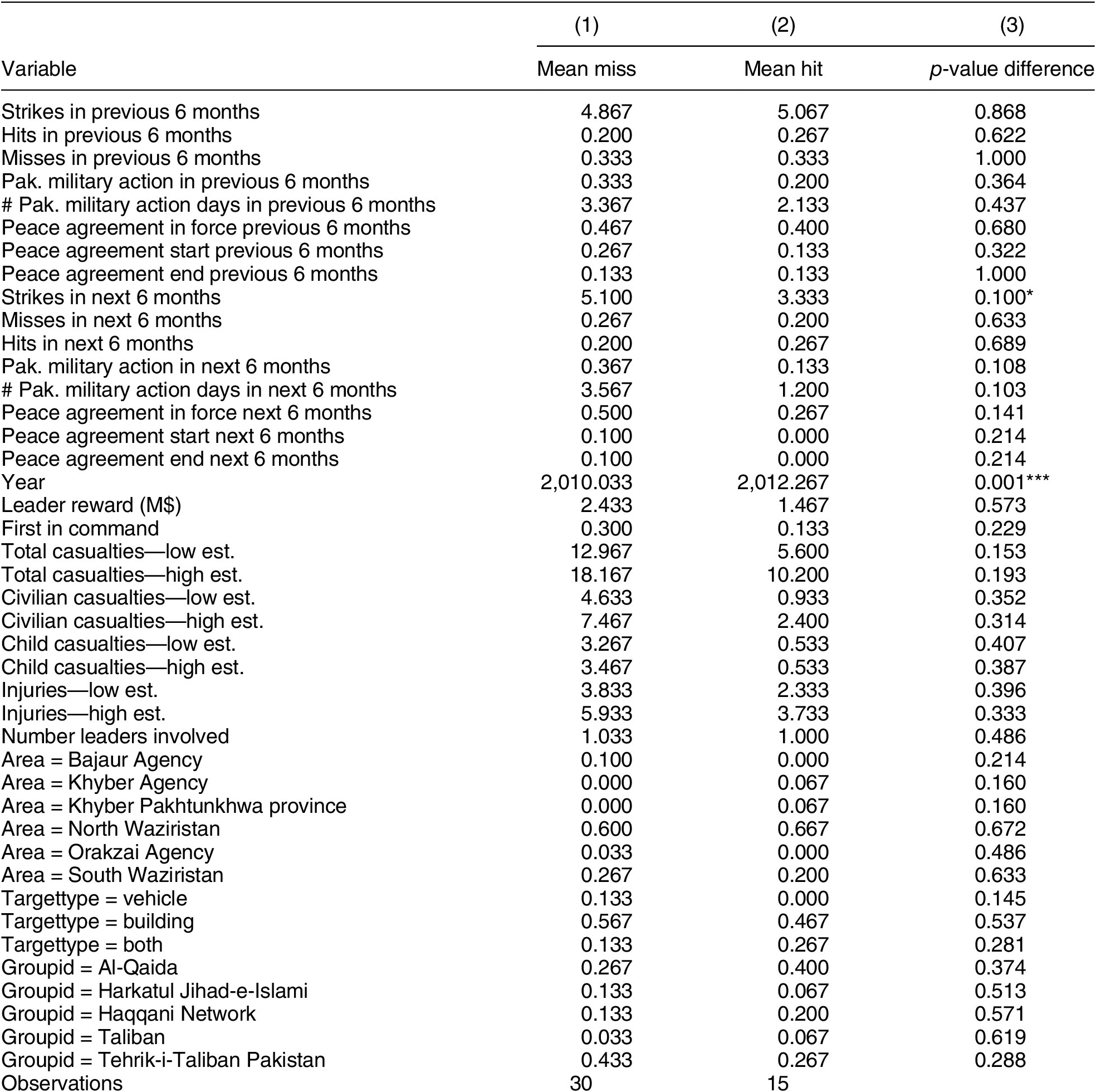
The identification strategy of this paper relies on the quasi randomness of hits and misses: indeed, there is virtually no evidence that there is a pattern to hits and misses. Table 2 displays the mean of a large set of variables for group-months with a drone hit and a drone miss, respectively, and the
 $ p $
-value for a
 $ t $
-test of the difference between both. Results indicate that the probability of a hit is not driven by prior drone activity, Pakistani military action, or peace agreements between the terrorist groups and the Pakistani government, all of which could reveal information about terrorist leaders and make a hit more likely. Table 2 also finds no evidence that the probability of a hit is statistically significantly different when Pakistani military action or a peace agreement might be anticipated. The probability of a hit does not significantly differ by importance of the leader, number of leaders involved, district, target type, or terrorist group. Hits do not cause a significantly higher or lower number of (civilian) casualties. There is some evidence that terrorist groups are less likely to be the target of a drone strike after a drone hit on their leaders. Therefore, all specifications will control for drone strikes not targeting leaders. There is strong evidence that the probability of a hit increased over time. This highlights the importance of including time-fixed effects, which will be included in all specifications.
Difference between Group-Months with a Drone Hit and a Drone Miss
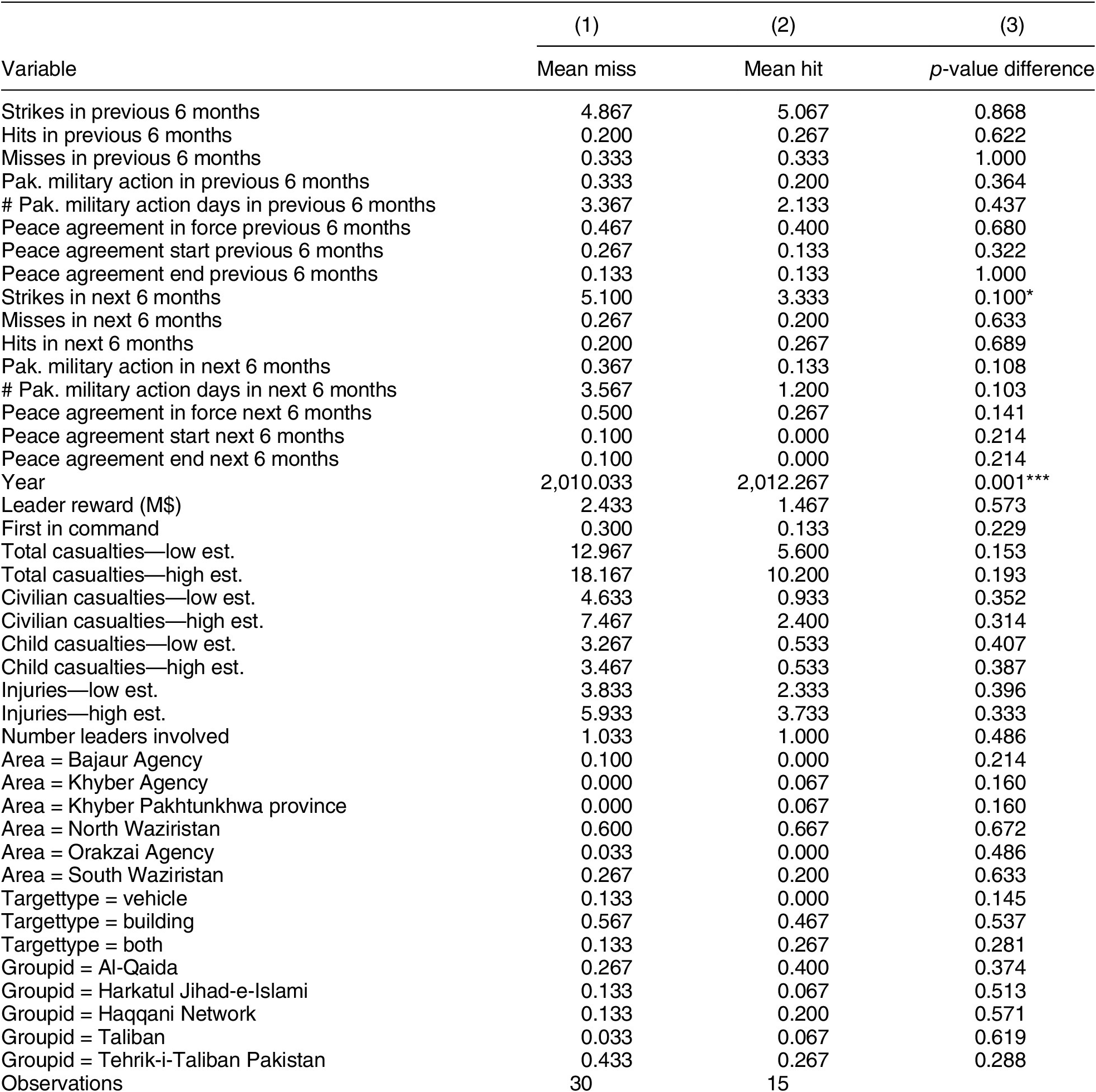
Anecdotally, drone misses seem to be mostly driven by chance. They fall into three broad categories: drone strikes hitting locations where the targeted leader is not yet or no longer present, instances when the targeted leader is merely wounded, and instances when reports of a leader’s death are credible enough to be taken up by reputable news sources only for the leader to later show up alive. To mitigate concerns that misses are underreported, results using an alternative definition of a “miss” will be presented as a robustness check.
Terrorist Violence and Other Data
Data on drone strikes targeting the 13 terrorist groups mentioned by BIJ is linked to data on terrorist attacks by these groups from the Global Terrorism Database (GTD). The GTD relies on open-source media accounts of terrorist attacks, and attributes terrorist incidents to a group based on these accounts where possible. Hence, unclaimed terrorist attacks are attributed to a group if media reports name the group as perpetrator, and “lone wolf” attacks claimed by some terrorist group are not attributed to this group if open-source media accounts judge this claim not to be credible. The GTD also records instances of infighting—terrorists fighting other terrorists.
Relying on open-source reports introduces possible biases, but simulations suggest that the extent of these biases would have to be substantial to completely drive this paper’s main results. First, bias could arise if media are more likely to report terrorist attacks by a group in the 6 months after a hit on its leader, compared with after a miss. Appendix B.2.1 suggests that, if drone hits in fact had no effect on terrorist violence, media would have to report all terrorist attacks by a group for 6 months after a drone hit on its leader and only approximately 65% of attacks after a drone miss to obtain a single statistically significant coefficient with 95% certainty. The actual analysis obtains three significant coefficients. Secondly, measurement error might bias the analysis, as attacks committed by an unknown perpetrator are excluded from the analysis. This may introduce bias if there is a group-specific time trend in the likelihood that GTD ascribes an attack to a particular group that correlates to the probability of a drone hit. Appendix B.2.2 shows that drone hits are uncorrelated to the logged number of unattributed terrorist attacks. Furthermore, it gives results of simulations that attribute attacks by unknown perpetrators to the groups in the main dataset: 88% of simulated regressions still give at least one statistically significant coefficient.
The main dataset is restricted to the 13 groups subject to drone strikes, because the identification strategy in this paper hinges on comparing groups that had their leader hit and missed at different times. Including terrorist groups not subject to drone strikes in the sample does not contribute to the identification of the coefficients of interest, but it does artificially inflate the sample size and introduce needless heteroskedasticity. Appendix B.5 illustrates that, unsurprisingly, including all terrorist groups that committed more than one attack in Afghanistan or Pakistan in the sample does not affect the main results.
To investigate group splintering, I identify all terrorist groups (other than the included 13) in the GTD that ever committed a terrorist attack in Afghanistan or Pakistan. Using a web search, I code these as having an affiliation to one or more of the 13 terrorist groups in the drone strike dataset or as unaffiliated (see Appendix A.4 for details). These groups have typically committed a small number of terrorist attacks (median 2), and anecdotally many of these groups are splinter groups of the main terrorist groups. The first attack by such a terrorist group recorded by the GTD is taken as a proxy for splintering.
Data on peace agreements between the Pakistani government and terrorist groups and Pakistani military action against particular terrorist groups up to March 2013 were collected by Staniland, Mir, and Lalwani (Reference Staniland, Mir and Lalwani2018).
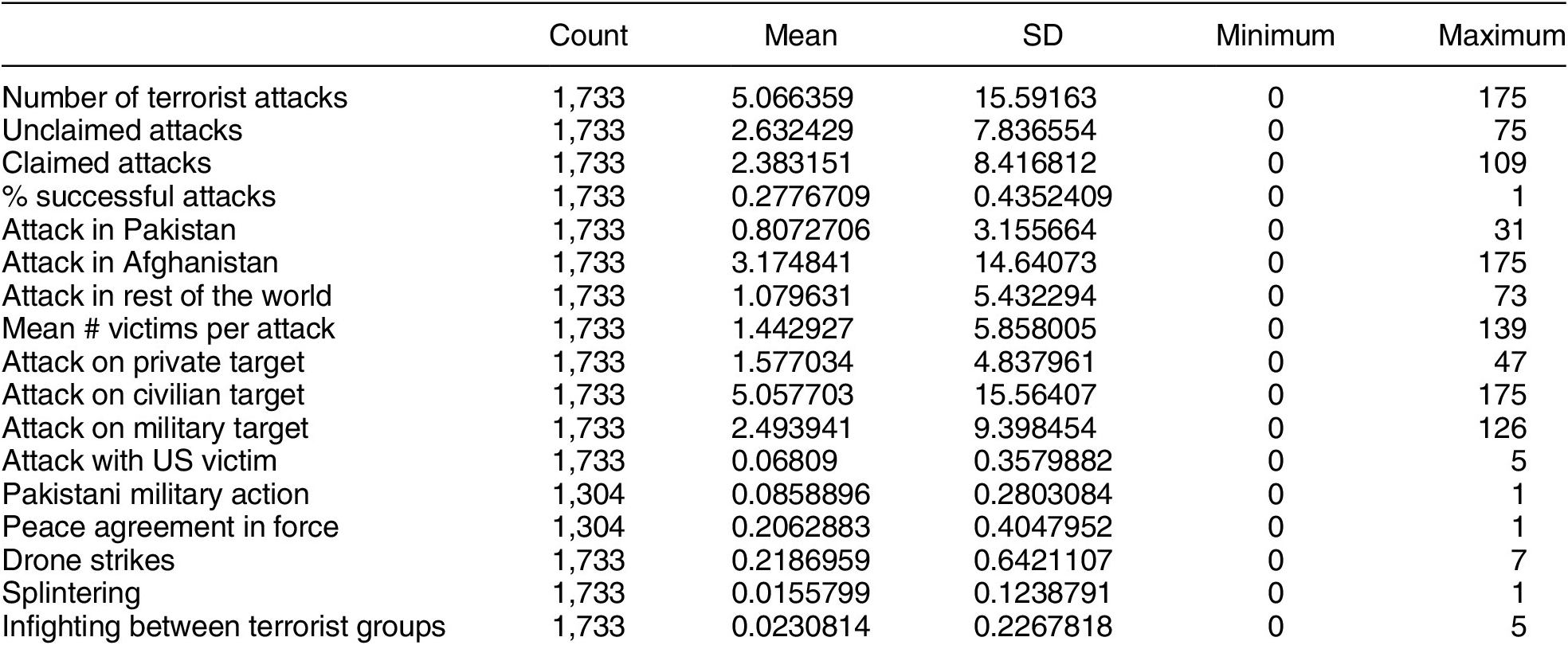
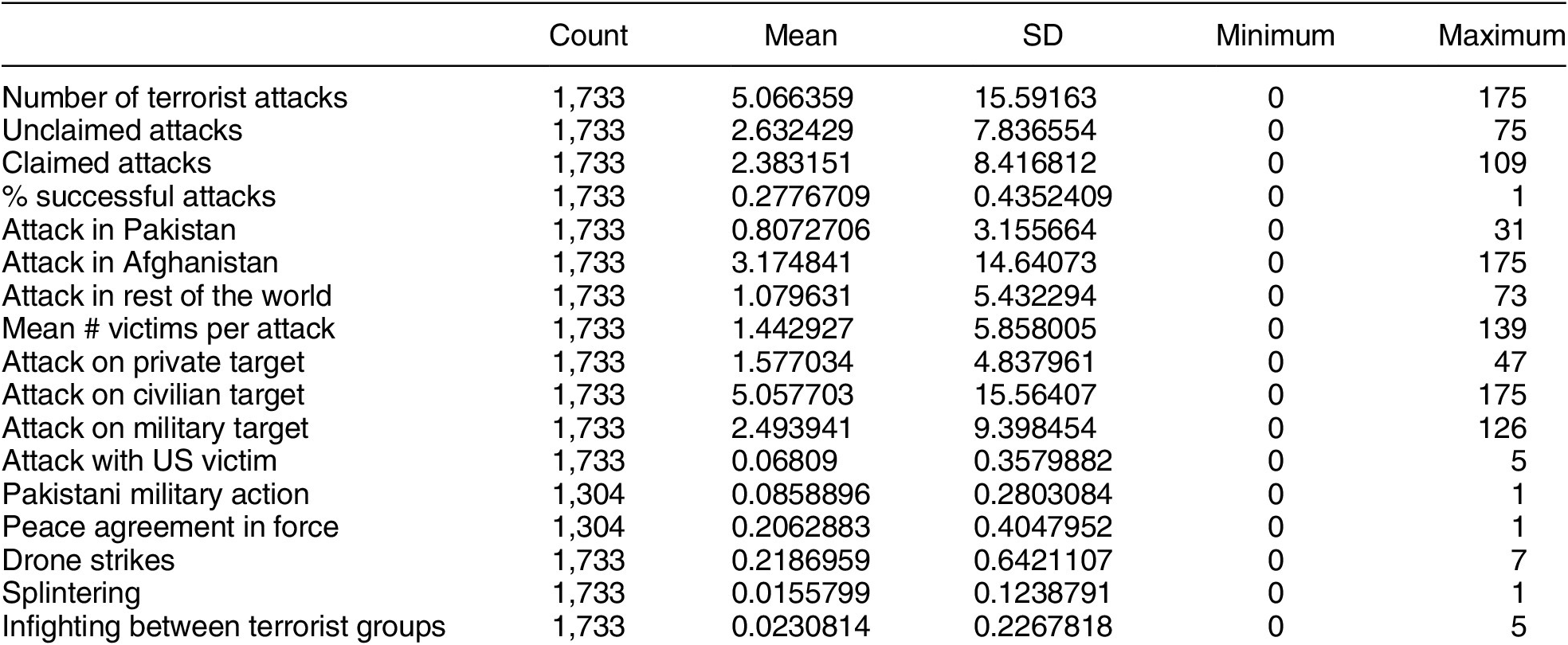
Table 3 provides descriptive statistics for the main outcome variables of interest at the group-month level. For ease of interpretation, it displays counts of terrorist attacks. In the main analysis, all count outcome variables are logged. Note that the number of observations included in the main analysis is smaller than that in Table 3, due to the inclusion of leads and lags of variables. Appendix B.1 plots terrorist attacks and drone hits and misses by group over time. Terrorist attacks fluctuate strongly over time, and no definitive pattern can be discerned by eye-balling the resulting graphs.
Descriptive Statistics
Empirical Strategy
The main specification of interest is the following:
 $$ {Y}_{it}=\sum \limits_{k=-6}^6{\beta}_{i,t-k}{hit}_{i,t-k}+\sum \limits_{k=-6}^6{\delta}_{i,t-k}{targeted}_{i,t-k}+\sum \limits_{k=-6}^6{\gamma}_{i,t-k}{X}_{i,t-k}+{\mu}_i+{\theta}_t+{\varepsilon}_{it}, $$
where subscript
 $ t $
indicates a month and subscript
 $ i $
a terrorist group,
 $ {Y}_{it} $
is the outcome variable of interest, most commonly a logged count (
 $ \mathit{\ln}\left( count+1\right) $
) of the number of terrorist attacks, and
 $ hit $
is an indicator equaling 1 if a group’s leader was targeted by drone and killed. The variable
 $ targeted $
equals 1 if a leader was targeted by drone and killed or if a leader was targeted by drone and survived, and
 $ X $
denotes any group-specific control variables. All specifications unless otherwise indicated control for the number of drone strikes on a group regardless of whether they targeted a leader, and
 $ {\mu}_i $
and
 $ {\theta}_t $
are vectors of group and month-fixed effects, respectively. Standard errors are Newey-West standard errors with bandwidth 12, although Appendix B.5 investigates the robustness of results to using different standard errors and bootstrapping test statistics using randomization inference.
Specification 1 is estimated using an ordinary least squares (OLS) model. As OLS assumes normally distributed standard errors to determine the level of statistical significance of coefficients, Appendix B.4 shows that residuals obtained using specification 1 are indeed approximately normally distributed. Alternatively, negative binomial models are commonly used in the literature to analyze unlogged counts of terrorist attacks (e.g., Reese, Ruby, and Pape Reference Reese, Ruby and Pape2017). This is not the model of choice here, as results from negative binomial models are inconsistent and subject to bias in the presence of a large number of fixed effects (Allison Reference Allison2012; Hilbe Reference Hilbe2011). However, as the extent of this bias in the present case is unclear, Appendix B.5 also presents alternative results using two fixed-effect negative binomial models.
The individual coefficients on the lags of
 $ hit $
—and the
 $ p $
-value from a Wald test of their joint significance—are the main coefficients of interest. These reflect the effect of a drone hit on a terrorist leader compared with that of a drone miss.Footnote
14 In experimental terms, group-months for which
 $ hit=1 $
and
 $ targeted=1 $
are the treatment group, and group-months for which
 $ hit=0 $
and
 $ targeted=1 $
form the control group. The coefficients on the lags of
 $ targeted $
reflect the effect of a drone miss.Footnote
15
To credibly identify the causal impact of targeted leader killing, the probability of a hit must not be driven by prior trends in the outcome variable. This would, for example, be the case if counterterrorist organizations would accept a higher or lower probability of a hit for terrorist groups that commit an increasing number of terrorist attacks. To verify the parallel trends assumption, each specification includes six leads of
 $ targeted $
and
 $ hit $
, in addition to six lags. If the coefficients on the leads of
 $ hit $
are statistically significant, this provides evidence that the parallel trends assumption has been violated. The
 $ p $
-values for the joint significance of leads of
 $ hit $
will be provided for all regressions.
Main Results
Main results suggest that the number of attacks committed by a terrorist group increases in the 6 months after a drone strike hits one of its leaders, whereas no change in terrorist violence can be detected after a strike that targets but misses a leader.
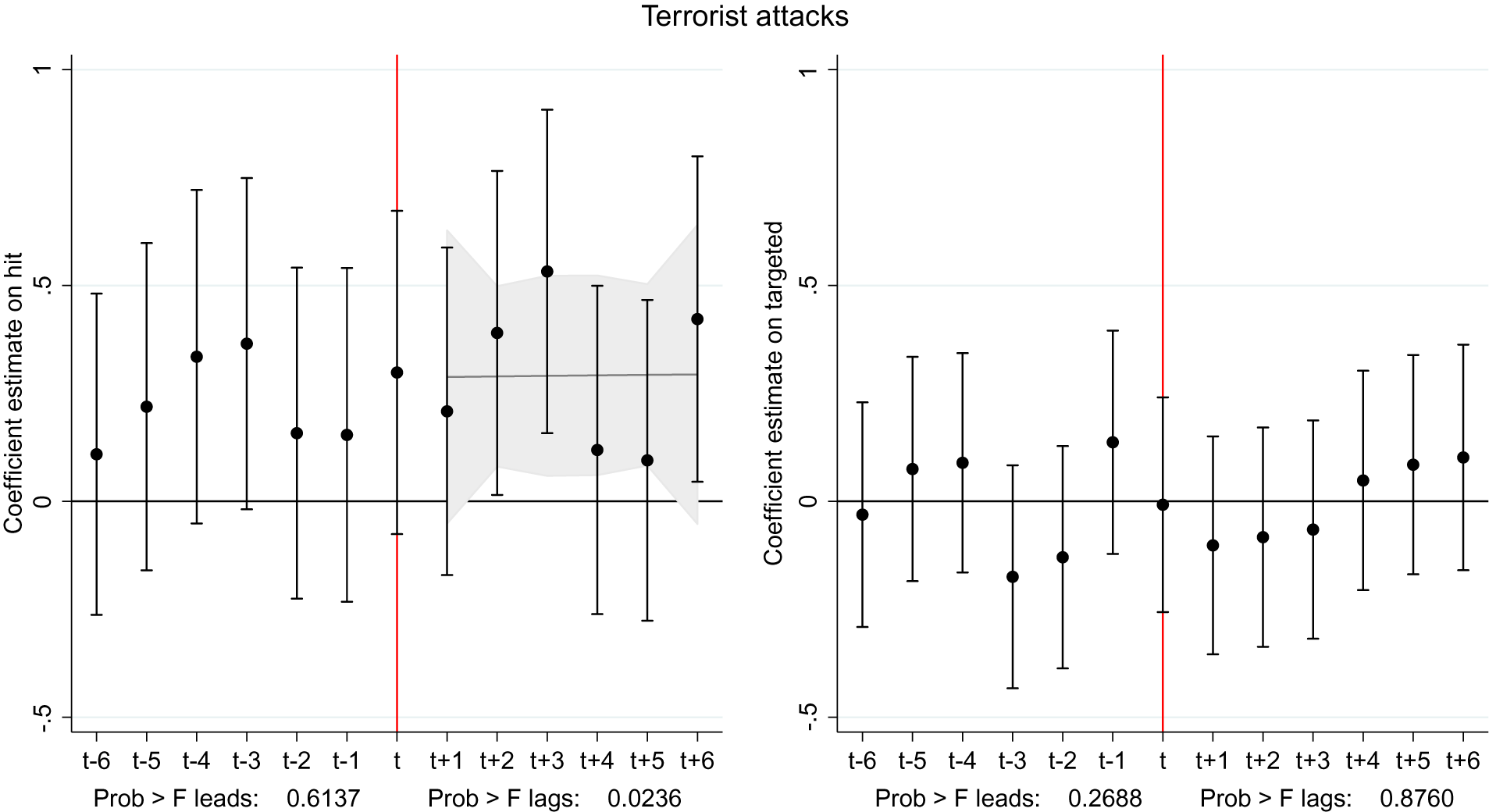
Figure 1 displays the results from specification 1. These results are also reproduced in Table 5, column 1. It displays the coefficient estimates and 95% confidence intervals for six leads and lags of the variables
 $ hit $
(left panel) and
 $ targeted $
(right panel). It also displays a quadratic trend for the six lags of
 $ hit $
and its 95% confidence interval. Recall that coefficients on the lags of
 $ hit $
reflect the effect of a drone hit compared with that of a miss, that coefficients on
 $ targeted $
reflect the effect of a miss, and that group and period fixed effects and control variables are included in this specification.
Main Results

Results suggest that the number of terrorist attacks increases after a leader has been hit compared with when he has been missed. This increase is statistically significant at the 5% level for the second, third, and sixth lag of a hit, and the coefficients on all lags of
 $ hit $
(indicated by
 $ t+k $
) are jointly statistically significant at the 5% level. The increase in the number of terrorist attacks is substantial: the three significant lags suggest a respective 47.7, 70.3, and 52.5% increase in terrorist attacks globally by a group that had its leader killed by drone, over an average of seven attacks per month in the 6 months after a drone miss. There is no evidence that the trend in the number of terrorist attacks was already different prior to a hit compared with prior to a miss: coefficient estimates on leads of
 $ hit $
(indicated by
 $ t-k $
) are individually and jointly insignificant.
The right panel of Figure 1 suggests that drone strikes that target but miss a leader have no statistically significant effect on the number of terrorist attacks over the next half year. Coefficients on all leads and lags of
 $ targeted $
are individually and jointly insignificant.
Further results suggest that the effect of a drone hit on terrorist attacks can be detected up to 6 to 7 months thereafter. The analysis in Appendix B.7 varies the number of lags of all variables in specification 1 between four and 15. None of the coefficients on
 $ hit $
is statistically significant beyond 7 months in any of the models.
Robustness
Speed-Up of the Timing of Terrorist Attacks
The main results presented would not necessarily imply an increase in terrorist attacks overall if terrorist groups merely change the timing of already planned attacks after a drone strike has hit their leader so that attacks are concentrated in the 6 months after the strike. I find some evidence of this, but the effects are not statistically significant and too small to explain the main results.
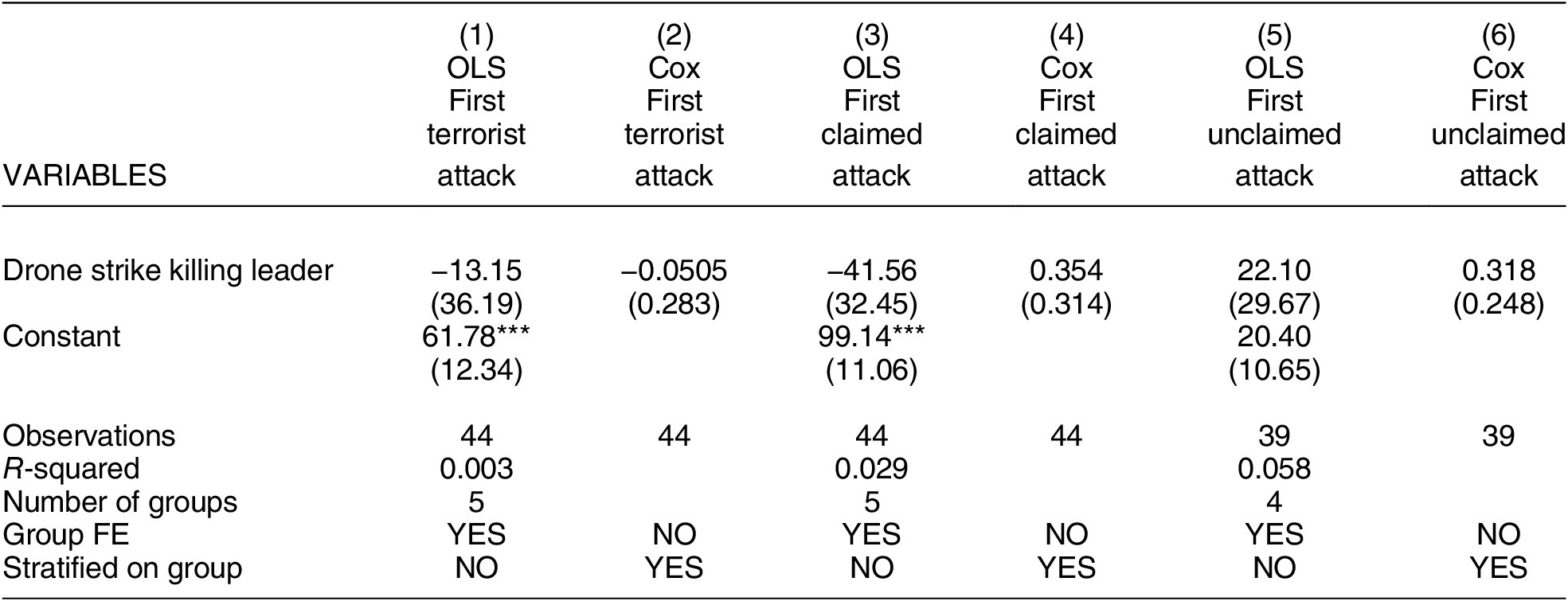
There is no evidence that terrorist groups commit their next attack substantially sooner after a drone hit on their leader compared with after a miss (Table 4). If the duration to the first terrorist attack after the drone strike is decreased, this effect is small: point estimates suggest the first attack occurs about 13 days earlier after a hit compared with after a miss (column 1). The Cox hazard model presented in column 2 similarly suggests that the hazard of a first attack occurring is not significantly higher after a drone hit compared with after a drone miss.
Duration in Days to First Terrorist Attack
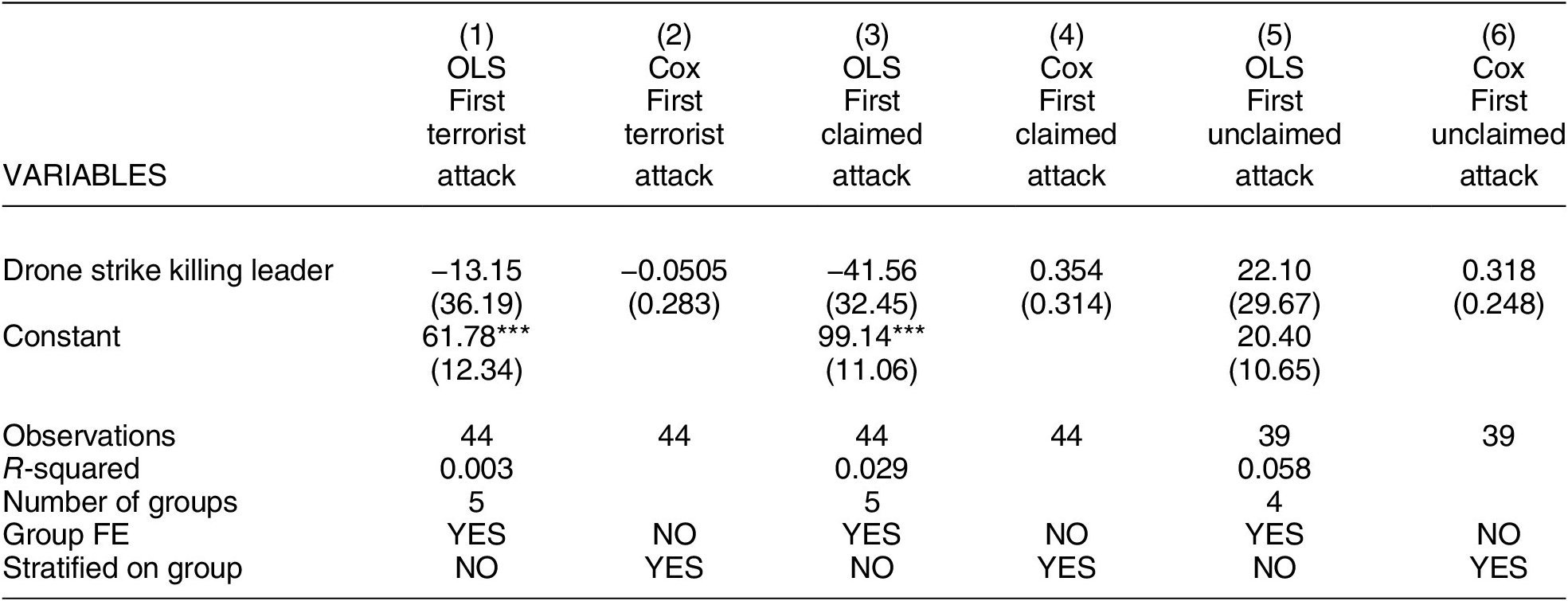
Note: Clustered (group) standard errors in parentheses; *p < 0.1, **p < 0.05, ***p < 0.01.
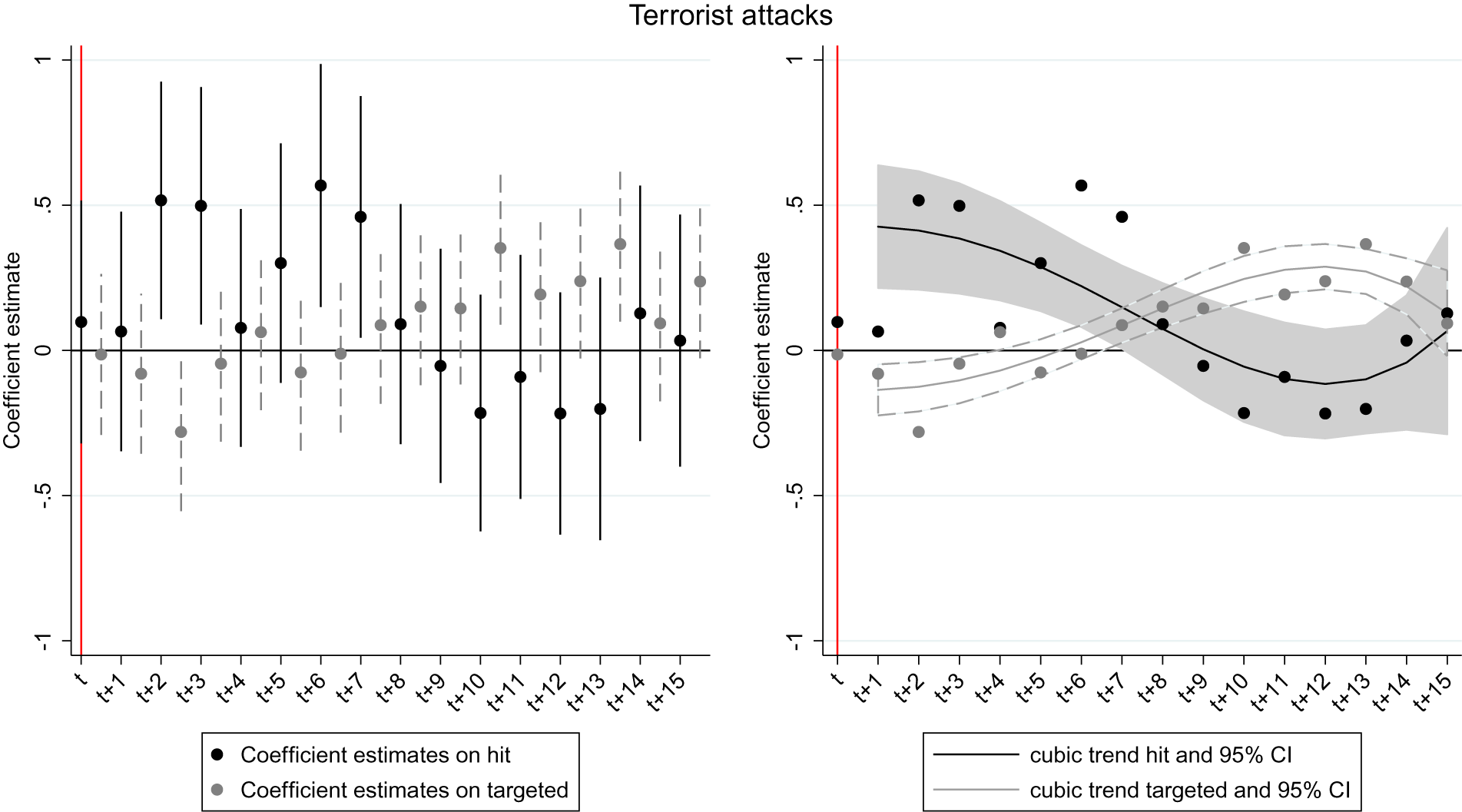
On a longer time scale, there is some evidence of displacement of terrorist attacks over time, but this effect is not statistically significant for drone hits on a terrorist leader. Figure 2 displays results from specification 1, including 15 leads and lags of all variables. For readability, only the coefficients on the lags of
 $ hit $
and
 $ targeted $
are displayed, in addition to a cubic trend and 95% confidence intervals. Results suggest that the number of terrorist attacks is somewhat lower in earlier and higher in later months after a drone miss compared with similar periods not preceded by a drone strike aimed at a leader. Coefficients are significant for months 3, 10, and 13. Although coefficients on
 $ hit $
follow the opposite trend, there is no statistically significant decline in the number of terrorist attacks in months 8 to 15 after a drone hit on a terrorist leader, as we might expect if terrorist attacks planned for later periods were committed earlier in response to the hit. On average, the 15 coefficients in the extended model still suggest a 17% increase in terrorist attacks after a drone
 $ hit $
.Footnote
16
Timing of Terrorist Attacks

Alternative Econometric Specifications
Main results are robust to including leader-fixed effects, omitting control variables, including several additional control variables, and estimating
 $ p $
-values for lags of
 $ hit $
through randomization inference. Similar but somewhat weaker results are also obtained when employing an alternative definition of “leader.” Main results are sensitive to varying which Al-Qaida branches are considered part of Al-Qaida but not to other alternative treatments of terrorist groups.
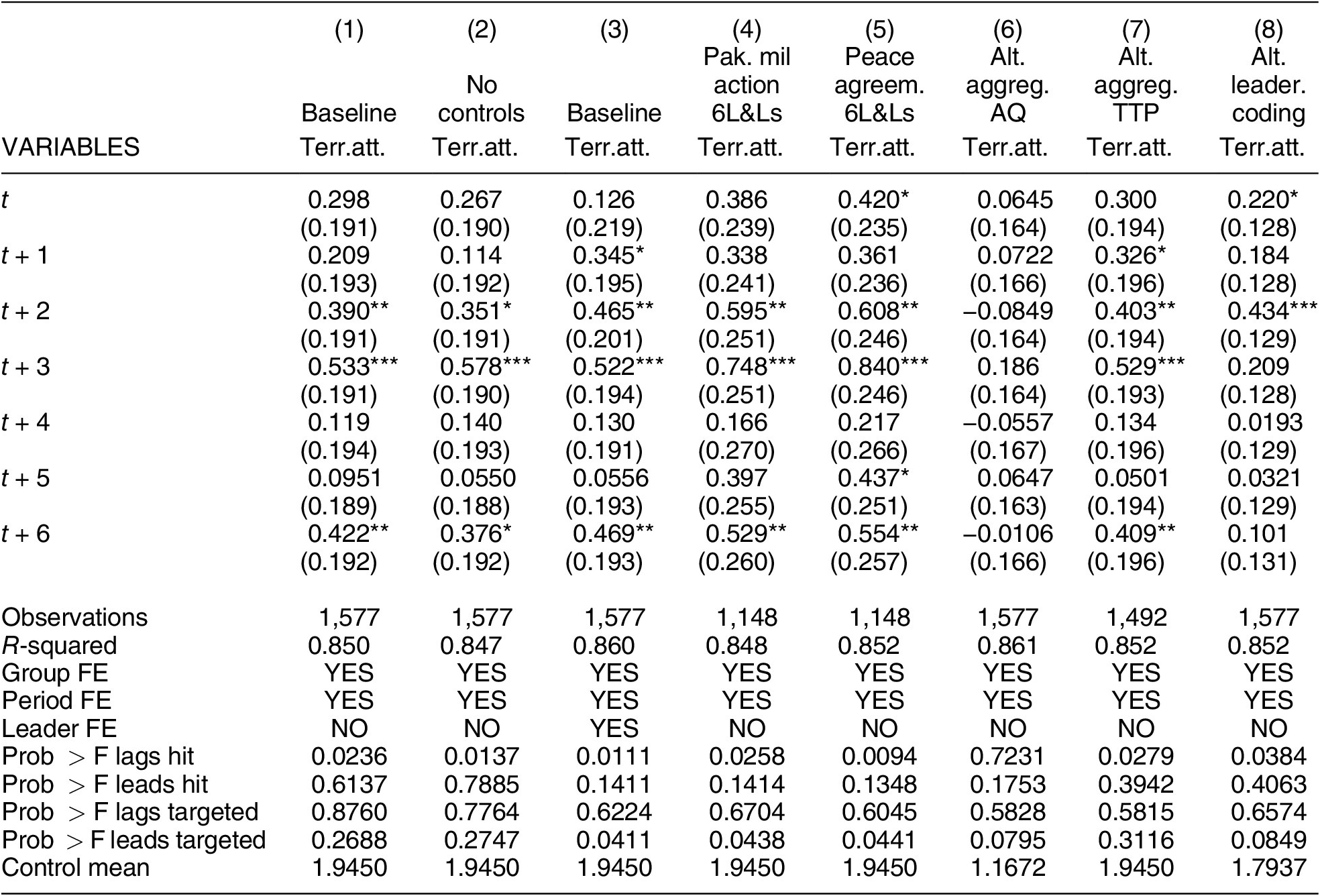
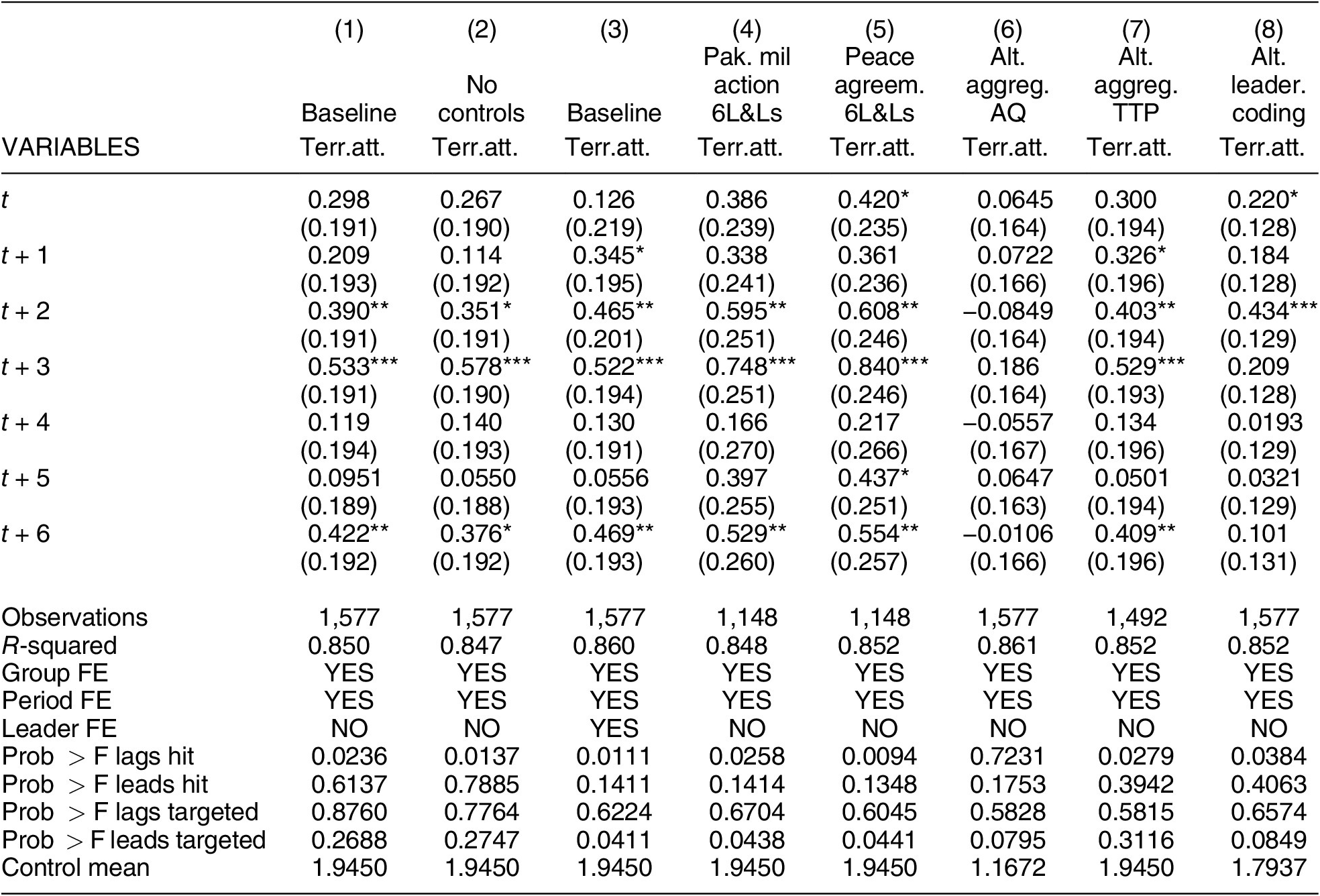
Table 5 investigates the robustness of the main results, which are reproduced in column 1. Only lags of the variable of interest are presented to promote readability.
Robustness of Main Results
Note: Newey-West standard errors in parentheses; *p < 0.1, **p < 0.05, ***p < 0.01.
Omitting the number of drone strikes targeting a terrorist group as a control variable does not meaningfully affect the main results (column 2). Results are robust to including leader-fixed effects (column 3) and to controlling for six leads and lags of an indicator for Pakistani military action against a terrorist group and the existence of a peace agreement between the terrorist group and the Pakistani government (columns 4 and 5). The latter two variables are only available up to March 2013, leading to a substantial loss in observations, so these variables are not included in the baseline specifications.
The next columns of Table 5 investigate the sensitivity of main results to alternative ways of aggregating terrorist groups. The dependent variable for Al-Qaida in the baseline specification is an aggregation of terrorist attacks by all Al-Qaida branches.Footnote 17 I argue that this is the most appropriate set-up to analyze Al-Qaida terrorist attacks for several reasons. First, leaders of several of these branches are at times present in FATA. Presence of leaders of Al-Qaida in Iraq, Al-Qaida in the Arab Peninsula, and Al-Qaida in the Indian Subcontinent in FATA is recorded by the BIJ.Footnote 18 Second, Al-Qaida leaders based in FATA at least attempt to control its branches (Crenshaw Reference Crenshaw2012; Shapiro Reference Shapiro2013). Third, reducing attacks by branches is one motivation for drone strikes against Al-Qaida. The 2018 US counterterrorism strategy explicitly mentions that targeting key terrorists will “disrupt, degrade and prevent reconstruction of terrorist networks.”Footnote 19 Nevertheless, column 6 presents results obtained if only attacks by Al-Qaida proper and Al-Qaida in the Indian Subcontinent are “counted” as Al-Qaida terrorist attacks. Main results are clearly sensitive to this alternative treatment of Al-Qaida branches. The reader unconvinced by the arguments above may have to conclude that drone strikes on a terrorist group’s leader do not affect the number terrorist attacks this group commits. However, considering Al-Qaida branches as independent organizations affiliated to Al-Qaida only strengthens the results obtained in Appendix C.1, indicating that drone strikes hitting a terrorist group’s leader increase the number of terrorist attacks committed by this group’s affiliates.
Main results are robust to recoding “local Taliban” as TTP from December 2007 onwards. The GTD appears to code all terrorist attacks by the Taliban in Pakistan after this date as committed by TTP, whereas the BIJ distinguishes the TTP from the “local Taliban.” This recoding does not affect the main results (column 7).
Lastly, column 8 presents results when using an alternative coding rule for who constitutes a terrorist leader. Under this alternative rule, all individuals marked by the BIJ as “leader,” “commander,” “senior figure,” or similar are considered leaders. This coding rule plausibly considers as drone hits strikes on some individuals whose status as leader was exaggerated in the media after they have been hit. Despite this, the second lag of
 $ hit $
remains individually and all coefficients on
 $ hit $
jointly significant. Although the observed effect is somewhat weakened, which may be unsurprising if the alternative coding rule counts as “hits” strikes on some individuals who may in reality not have a leading role, it is still in evidence.
Appendix B.3 suggests that the lack of statistical significance of individual leads and lags of
 $ hit $
in the main results is not an artifact of small sample size, implying that the first, fourth, and fifth lag of
 $ hit $
, as well as all leads of hit, are indeed null. Simulations thus suggest that the sample size would have to be radically expanded to make a meaningful difference to the main results.
Appendix B.5 furthermore shows that results are robust to restricting the analysis to periods within 6 months of a hit or a miss, using a group-time trend instead of period-fixed effects, using Discroll-Kraay standard errors, dropping two small terrorist groups, including all terrorist groups that have committed more than one attack in Afghanistan or Pakistan in the sample, and restricting the period under analysis to periods prior to Pakistan acquiring its own drone capability. Results are also robust to using alternative counterfactuals that are less subject to measurement error. To investigate concerns that results are driven by trends over time specific to world regions terrorist groups are active in, Appendix B.5 also shows results from region-group-month-level regressions, including region-fixed effects, region-group fixed effects, and region-period fixed effects, respectively. Results are somewhat sensitive to using HAC instead of Newey-West standard errors.
However, calculating the main test statistic using randomization inference leaves results qualitatively unchanged (Appendix B.6). As randomization inference necessitates no assumptions regarding the distribution of the standard errors, this further mitigates the concern that statistically significant coefficients in the main result are an artifact of nonnormally distributed residuals. Although there are doubts about whether these are consistently estimated (Allison Reference Allison2012; Hilbe Reference Hilbe2011), Appendix B.5 provides results from two fixed effects negative binomial models. In these models, most individual coefficients lose statistical significance, but the coefficients on the lags of
 $ hit $
are still jointly significant.
Theoretical Explanations for Main Results
This section explores which theory most plausibly explains the main results by testing the hypotheses derived from theoretical models of problems of control, capacity, backlash, and signaling (or revenge). Most evidence found favors problems of control as an explanation, although there is also some evidence in favor of signaling. Table 1 provides an overview of the hypotheses and evidence found.
Problems of Control
Principal-agent models of terrorist organizations suggest that the main results may be driven by a loss of control of terrorist leaders over operatives. I find evidence in favor of most hypotheses derived from theoretical models of problems of control.
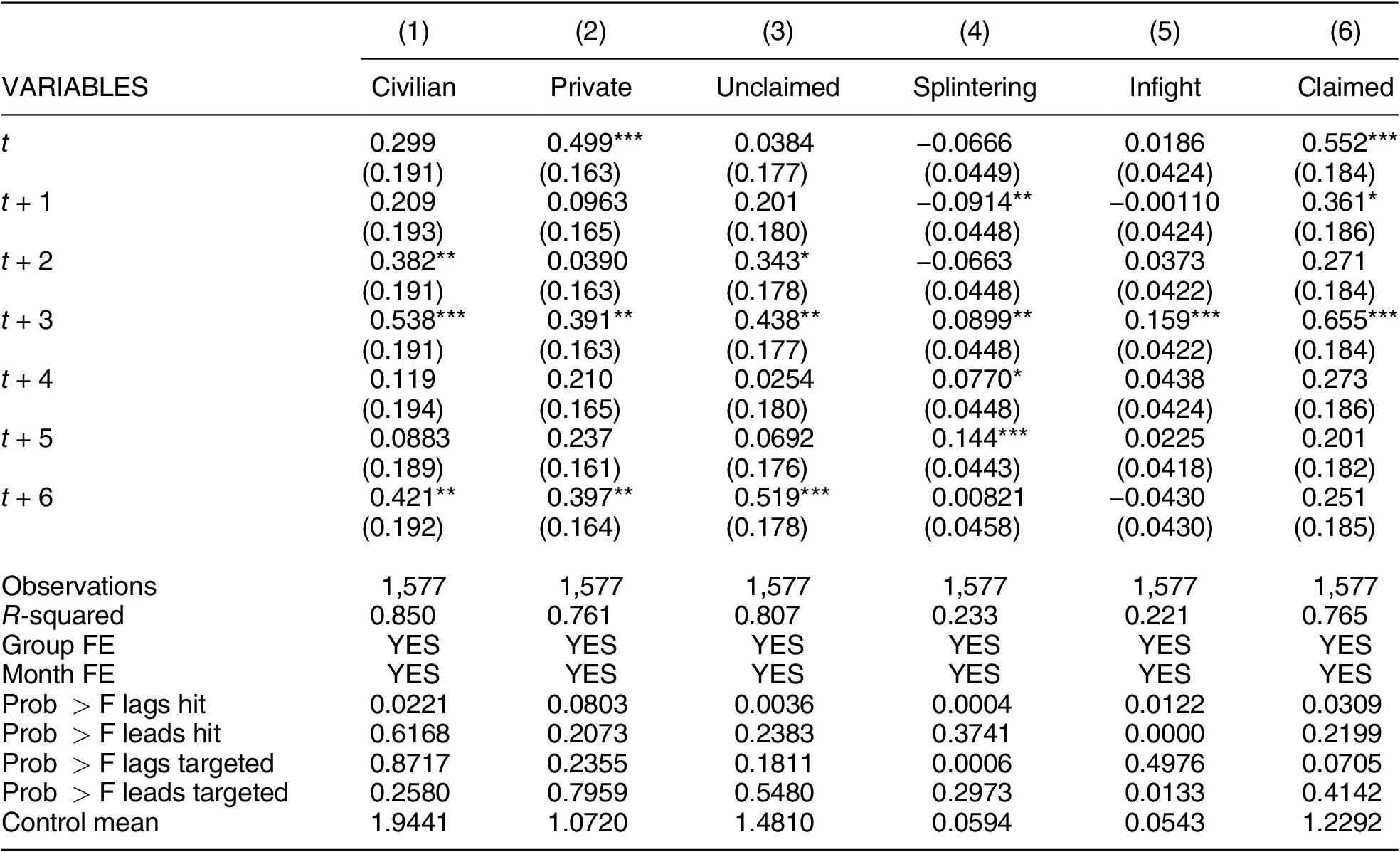
The increase in terrorist attacks after a drone hit on a leader is driven by those types of attacks that leaders plausibly do not favor. Consistent with the idea that terrorist operatives may have a greater preference for violence against civilians than the leader (H1.1a), the number of attacks against civilian and private targets is statistically significantly higher after a drone hit on a leader compared with after a drone miss (Table 6, columns 1 and 2). This result echoes that obtained by Abrahms and Mierau (Reference Abrahms and Mierau2017). Furthermore, the number of unclaimed attacks increases significantly for 3 out of 6 months after a drone hit (column 3). This is consistent with the idea that leaders may strategically not claim attacks by operatives that they fear will have negative repercussions for the terrorist group’s long-term goals (H1.1b).
Effects on Attack Type and Organizational Changes

Note: Newey-West standard errors in parentheses; *p < 0.1, **p < 0.05, ***p < 0.01.
A decrease in control may also be expressed in a change in the organizational structure of the terrorist group. If all ties between leaders and operatives break down, a terrorist group may splinter (H1.1c) or operatives may start fighting among themselves (H1.1d). Indeed, a drone hit is associated with an increase in the third and fifth lag of a proxy for group splintering (Table 6, column 4). If the first attack by a small affiliated group in Afghanistan and Pakistan is a credible indicator for splintering of the parent group, terrorist groups are more likely to splinter after a drone hit on their leader. Finally, a drone hit is associated with an increase in infighting (column 5). These results should be treated with some caution for two reasons. First, infighting is rare, there are only forty instances of infighting in 26 periods. Second, in this specification, leads of
 $ hit $
are also strongly jointly statistically significant. However, Appendix B.8 shows that this is driven by a single coefficient and not necessarily by consistently differing trends between a hit and a miss prior to the drone strike.
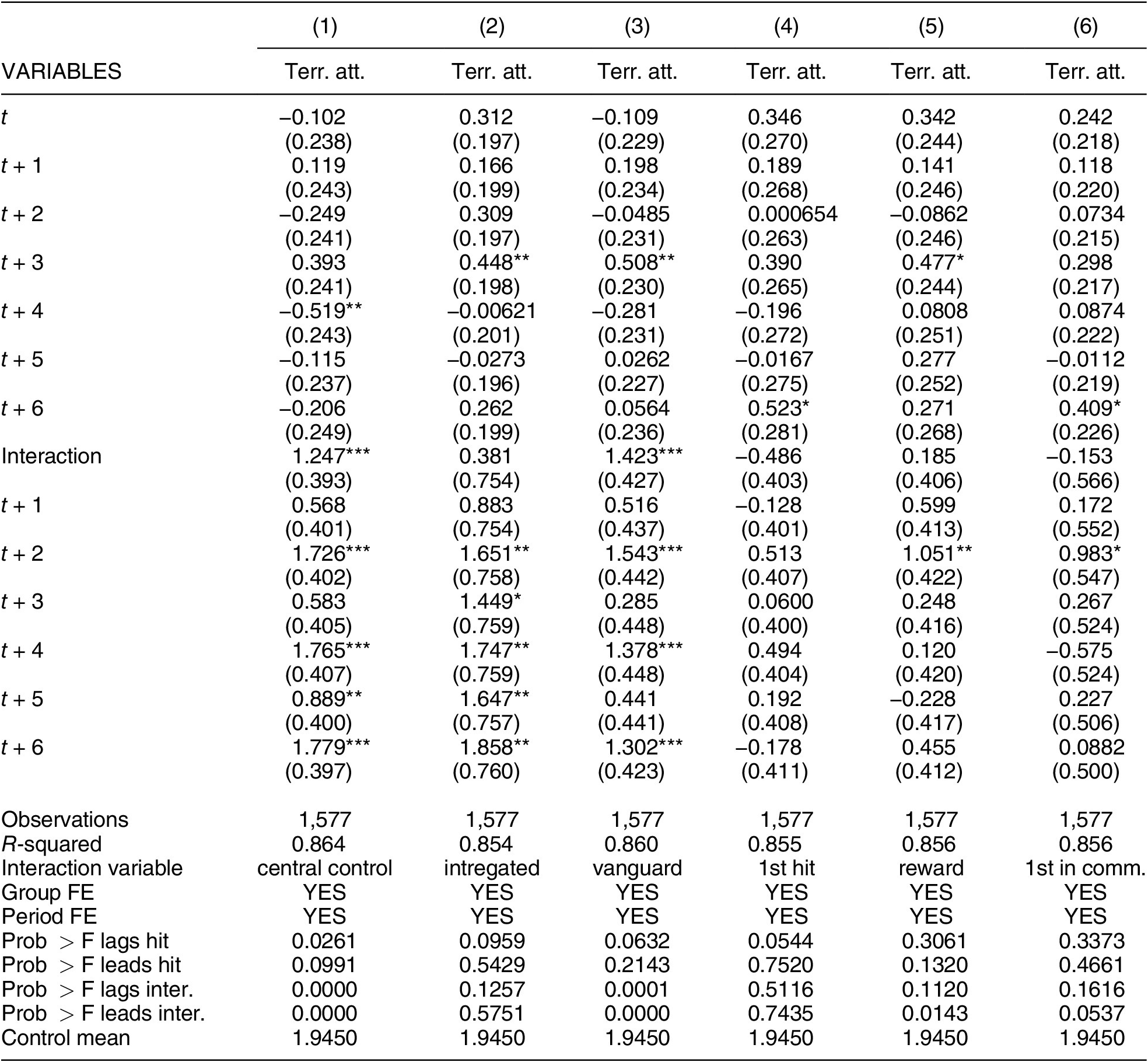
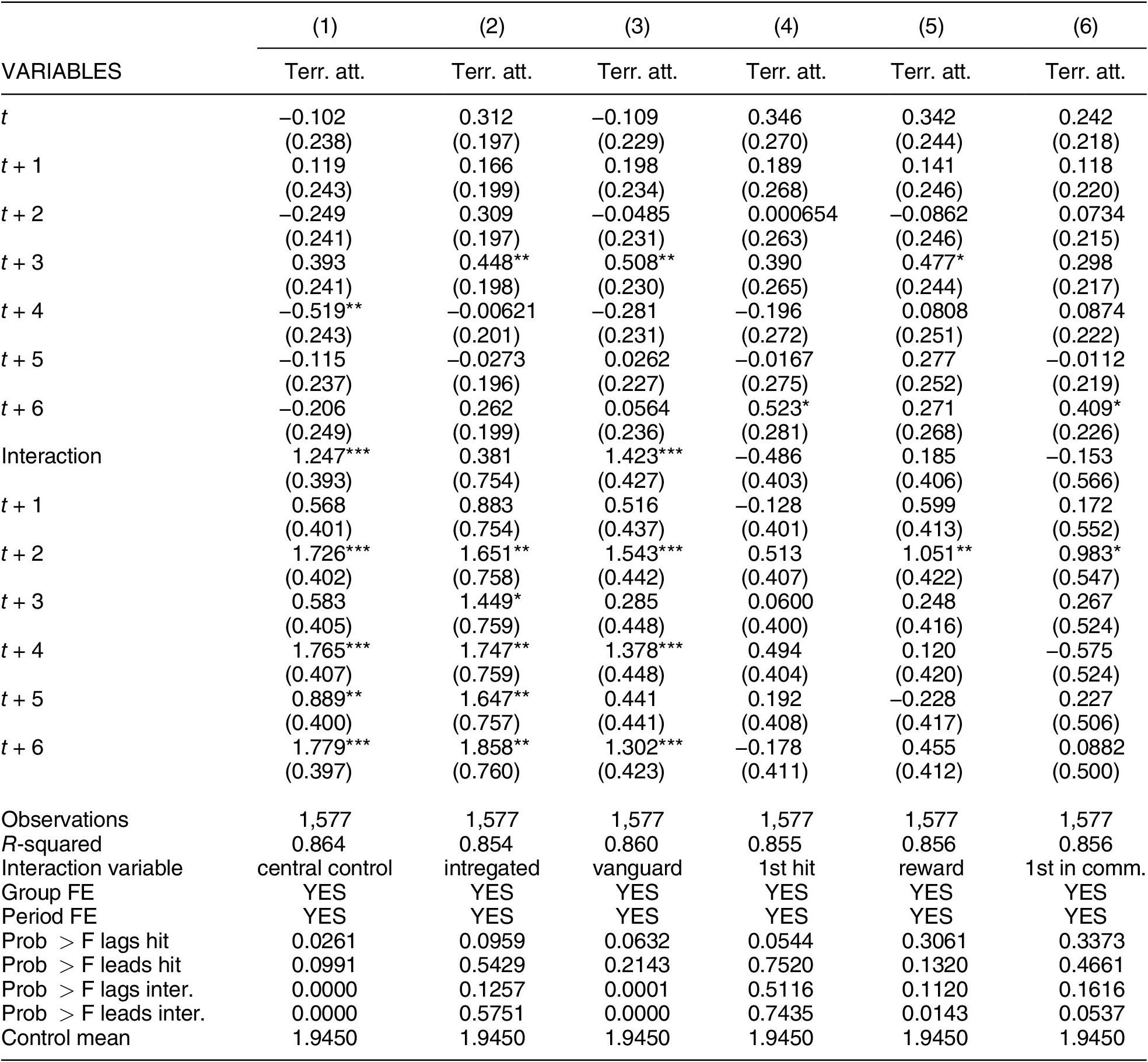
If the main results of these study are due to aggravated problems of control, we may furthermore observe heterogeneous effects across terrorist groups and leaders. Specifically, terrorist groups that rely more strongly on central control may be more strongly affected (H1.2a), and the drop in control may be largest for the first leader killed, as they were initially not subject to incentives to trade off control for secrecy (H1.2b). Results on heterogenous effects, displayed in Table 7, should be interpreted with some caution: given the limited number of drone strikes targeting a terrorist leader and limited number of groups, statistical power to detect any interaction effects may be lacking.
Heterogeneous Effects
Note: Newey-West standard errors in parentheses; *p < 0.1, **p < 0.05, ***p < 0.01.
Keeping this in mind, the first three columns of Table 7 suggest that the effect of a drone hit on a terrorist leader is greater for terrorist groups that rely more strongly on central control. I employ a classification by Staniland (Reference Staniland2014), in which integrated and vanguard terrorist groups have strong central control. Staniland considers the Taliban an integrated group (140). Al-Qaida is not explicitly classified, but its strategy of making alliances closely resembles Staniland’s (Reference Staniland2014) description of a vanguard group (44–46). No other groups subject to drone hits and misses on their leaders are classified by Staniland as having strong central control.Footnote 20 Column 1 reveals that the effect of a drone hit on terrorist attacks is indeed stronger for these two organizations. This heterogeneous effect holds both for the Taliban, the one integrated organization (column 2), and for Al-Qaida, the only vanguard organization (column 3).
Lastly, column 4 of Table 7 provides some very tentative support for the hypothesis that the effect of a drone hit is stronger for the first leader hit. Coefficients on the second to fifth lag of the interaction term are positive and of substantial size compared with their noninteracted counterparts. They are not individually or jointly statistically significant however.
Capacity
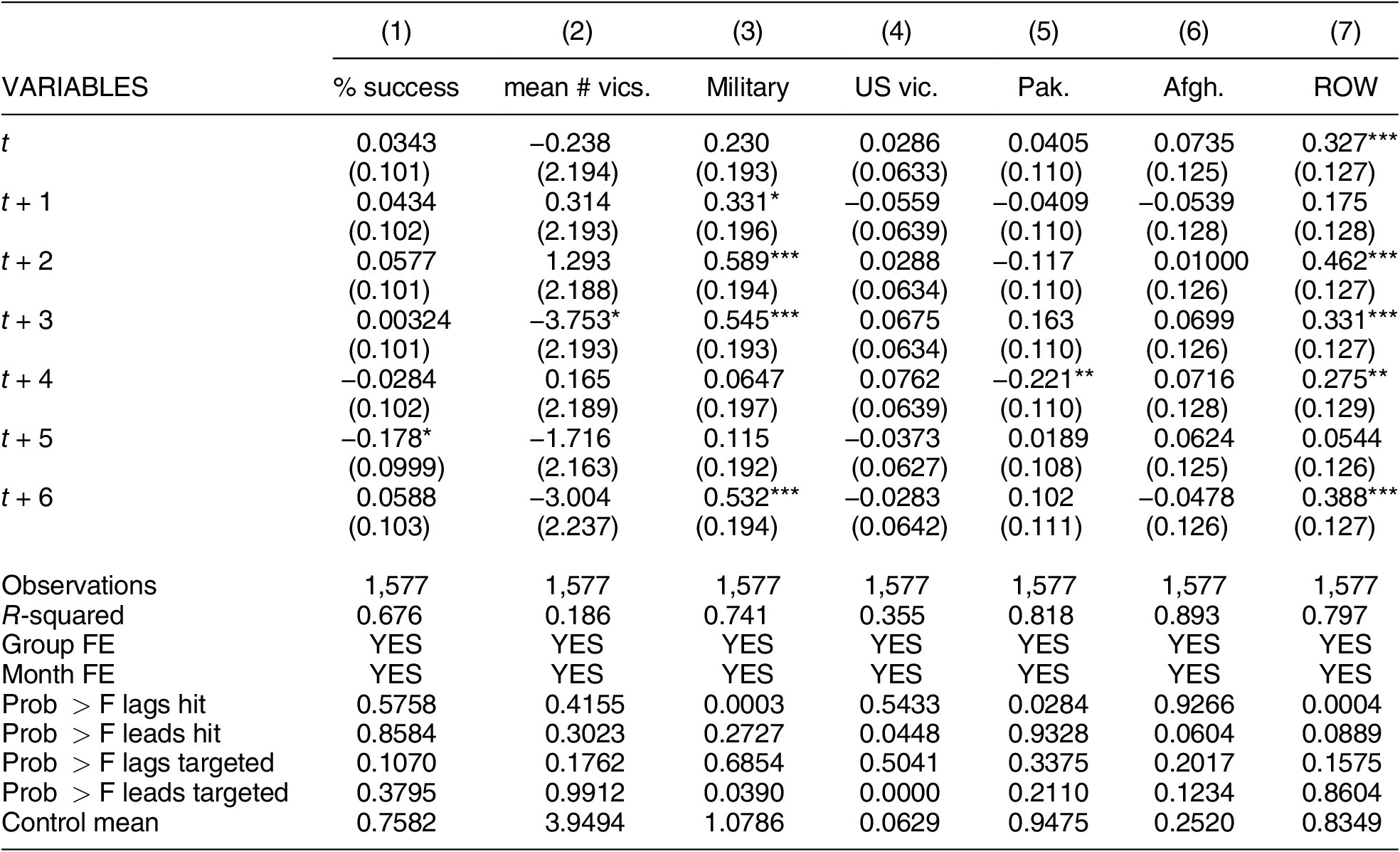
There is no evidence that terrorist groups, in response to a drone strike hitting their leader, substitute a small number of high-impact attacks with a large number of low-impact attacks, as capacity models would suggest (H2.1).
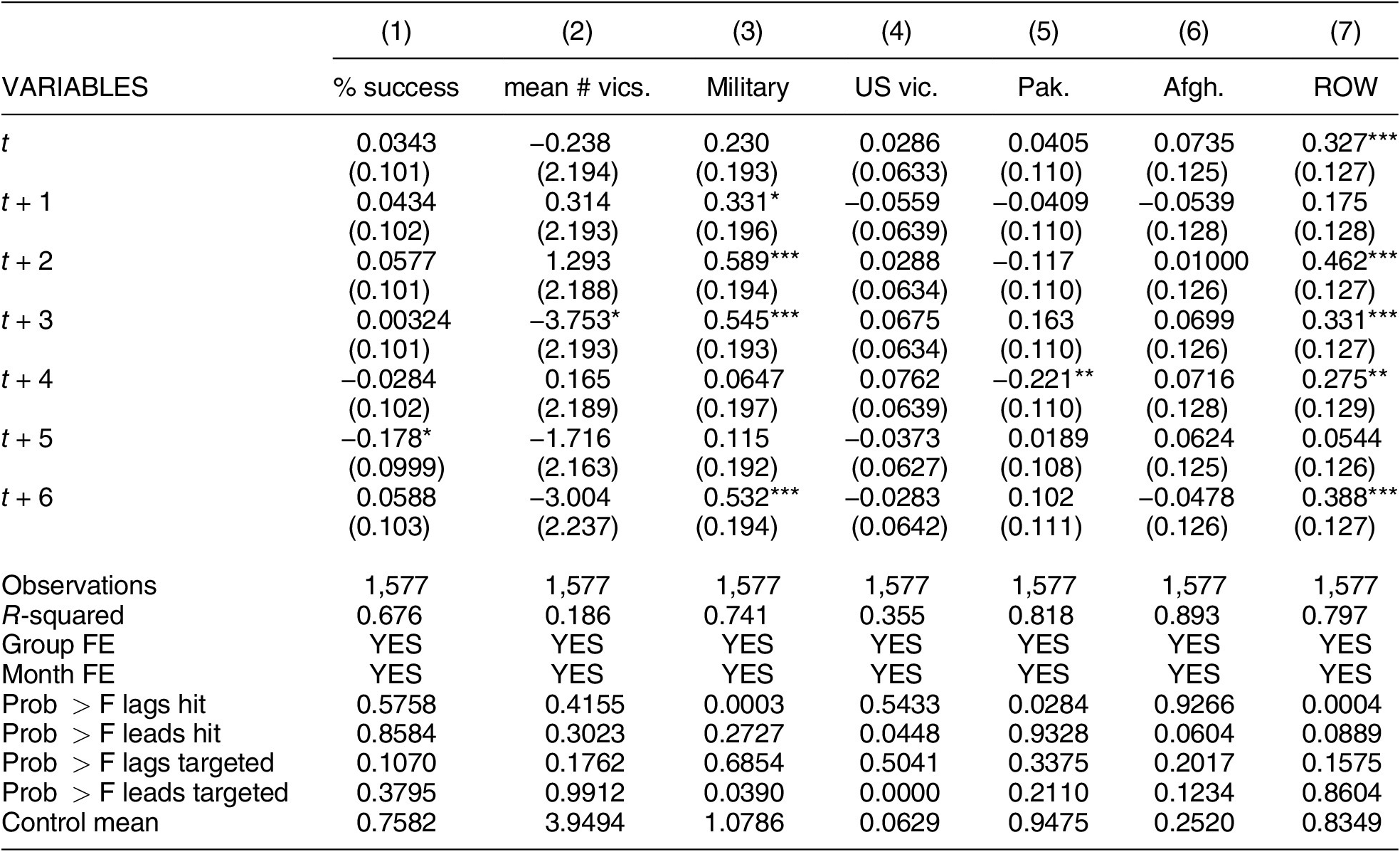
A low-impact attack might be an “unsuccessful” terrorist attack—that is, the planned attack type was foiled or an attack with a small number of victims (H2.1a and H2.1b, respectively). Table 8 provides no evidence that these attack types increase after a drone hit on a terrorist leader. If anything, the percentage of “successful” terrorist attacks (column 1) is lower for some individual months after a hit.
Substitution of Terrorist Attack Types
Note: Newey-West standard errors in parentheses; *p < 0.1, **p < 0.05, ***p < 0.01.
Furthermore, there is no evidence that terrorist groups substitute attacks against “softer” targets for attacks against “hard” targets (H2.1c). Even though the number of attacks against civilian or private targets does increase (Table 6), Table 8 shows no significant decline in the number of terrorist attacks against military targets (column 3) or attacks with US casualties or injured (column 4).Footnote 21
Finally, Table 8 provides no evidence that terrorist groups are concentrating their attacks in their “homebase” of Pakistan at the expense of attacks in Afghanistan or the rest of the world (excluding Western Europe, the US, and Australia) after a drone hit on their leader (H2.1d). In fact, the main results are driven by terrorist attacks in the rest of the world (ROW, column 5).Footnote 22 Although it would be interesting to investigate the effect of a drone hit on terrorist attacks in “the West,” there have been only eight such attacks over the research period, making this impossible.
The observation that the increase in terrorist attacks after a drone hit is concentrated in the rest of the world rather than in Pakistan or Afghanistan is interesting in light of the other three families of theoretical models. We might speculate that a new leader taking the place of a leader killed by drone has greater trouble exerting control over far-away operatives than operatives close to home. This contrasts with the backlash or signaling perspective. From either of those perspectives, we might expect a stronger reaction in Pakistan, as most civilians killed are Pakistani and because operatives closer to the leader killed may have a greater incentive to signal strength.
Signaling
There is some evidence that a drone hit on a terrorist leader induces terrorist groups to signal their strength and resolve by committing an increasing number of attacks (H3.1).
Attacks that send a strong signal may include attacks that quickly follow the drone strike, are claimed, and hit high-profile targets. From the main results, the timing of the increase in terrorist attacks is not obviously consistent with the signaling mechanism: statistically significant increases in the number of terrorist attacks are only observed from 2 months after the drone hit onward (Figure 1). Table 8 furthermore shows no increase in terrorist attacks on US citizens, which would be a high-profile target.
Consistent with the signaling mechanism however, Column 6 of Table 6 does show a statistically significant increase in the number of claimed terrorist attacks in months 1 and 3 after a drone hit compared with after a drone miss. Coefficients are jointly statistically significant. Furthermore, Table 8 column 3 also shows a significant increase in attacks on military targets, also high-profile, after a drone hit.
Lastly, the incentive to signal strength may be greater after the death of more prominent leaders (H3.2). The final columns of Table 7 explore this hypothesis. Results in these columns provide some tentative support in favor of this hypothesis. Terrorist attacks are significantly higher in the second month after a drone hit on a leader who is designated “first in command” according to the Stanford project (column 6) or for whom the US Department of Justice ever offered a reward (column 5). However, lags on neither set of interaction terms are jointly statistically significant.
In sum, there is evidence in favor of some hypotheses following from the signaling mechanism. Alternatively, we might think that patterns observed arise out of terrorist groups’ desire for revenge. However, not all hypotheses are supported with evidence and this mechanism cannot explain the results on unclaimed attacks, group splintering, or infighting.
Backlash
There is no evidence that drone strikes killing civilians are associated with an increase in terrorist attacks, as backlash would suggest (H4.1).
Even if drone strikes cause backlash, this effect does not necessarily coincide with the effect of targeted leader killing. Backlash would affect the analysis only if drone hits on a leader killed more civilians than drone misses, and Table 2 does not provide any evidence for this. There is also no evidence that terrorist organizations specifically use drone strikes on terrorist leaders in their recruitment propaganda: propaganda refers to drone strikes as a “failing” policy and does not emphasize hits on terrorist leaders (Ludvigsen Reference Ludvigsen2018).
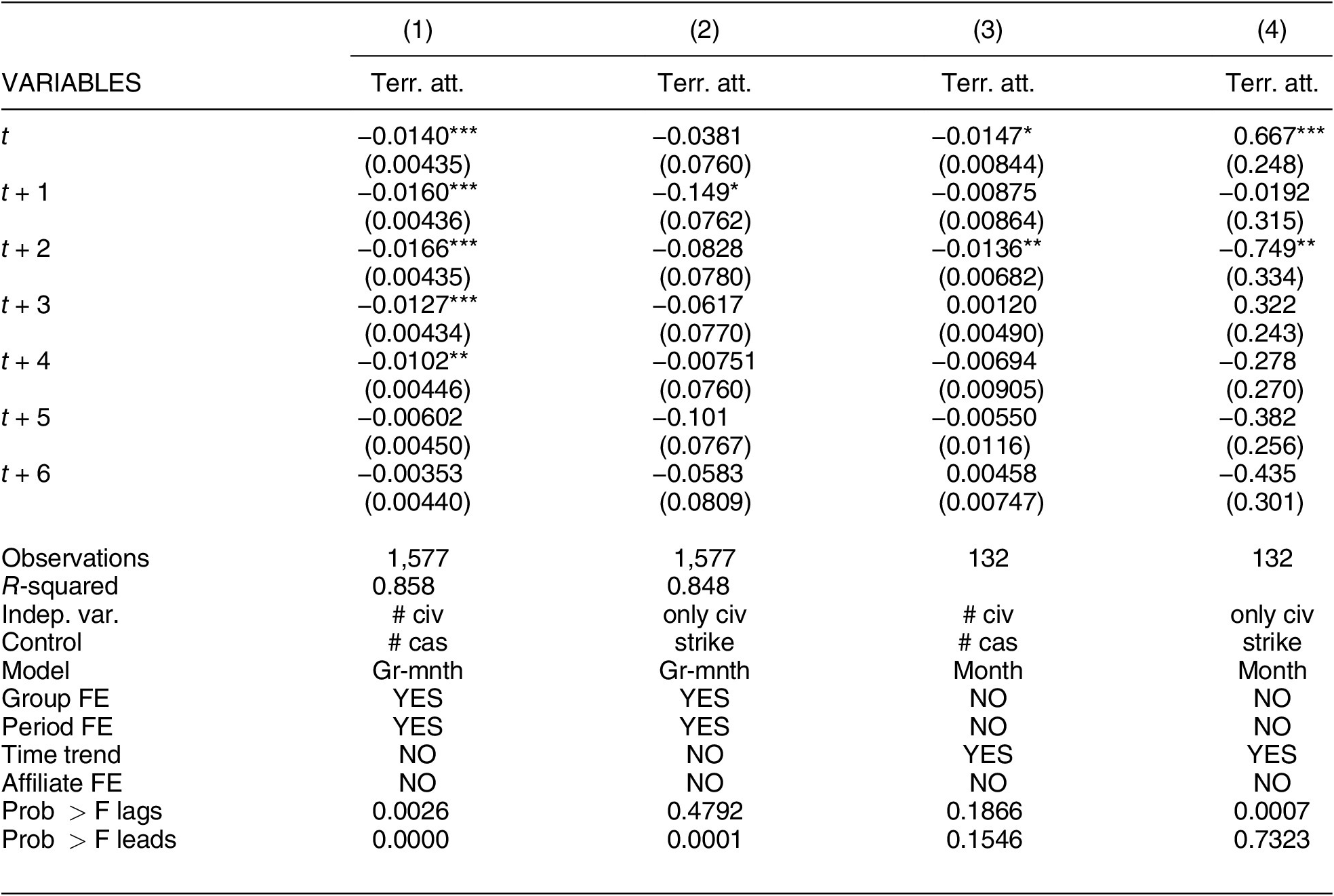
Nevertheless, I test whether drone strikes killing civilians are associated with an increase in terrorist attacks. To do so, I estimate two variations on Equation 1. The first variation replaces
 $ {hit}_{it} $
with the number of civilian casualties from drone strikes targeting group
 $ i $
in month
 $ t $
and
 $ {targeted}_{it} $
with the total number of casualties from drone strikes in month
 $ t $
on group
 $ i $
. The second variation replaces
 $ {hit}_{it} $
with an indicator that equals 1 if some drone strike in month
 $ t $
targeting terrorist group
 $ i $
instead killed only civiliansFootnote
23 and
 $ {targeted}_{it} $
with an indicator for any drone strike in month
 $ t $
on group
 $ i $
. These specifications do not control for the total number of drone strikes to avoid multicolinearity. The BIJ provides maximum and minimum casualty estimates. Table 9 shows results from maximum casualty estimates, but similar results are obtained when using minimum casualty estimates (not shown).
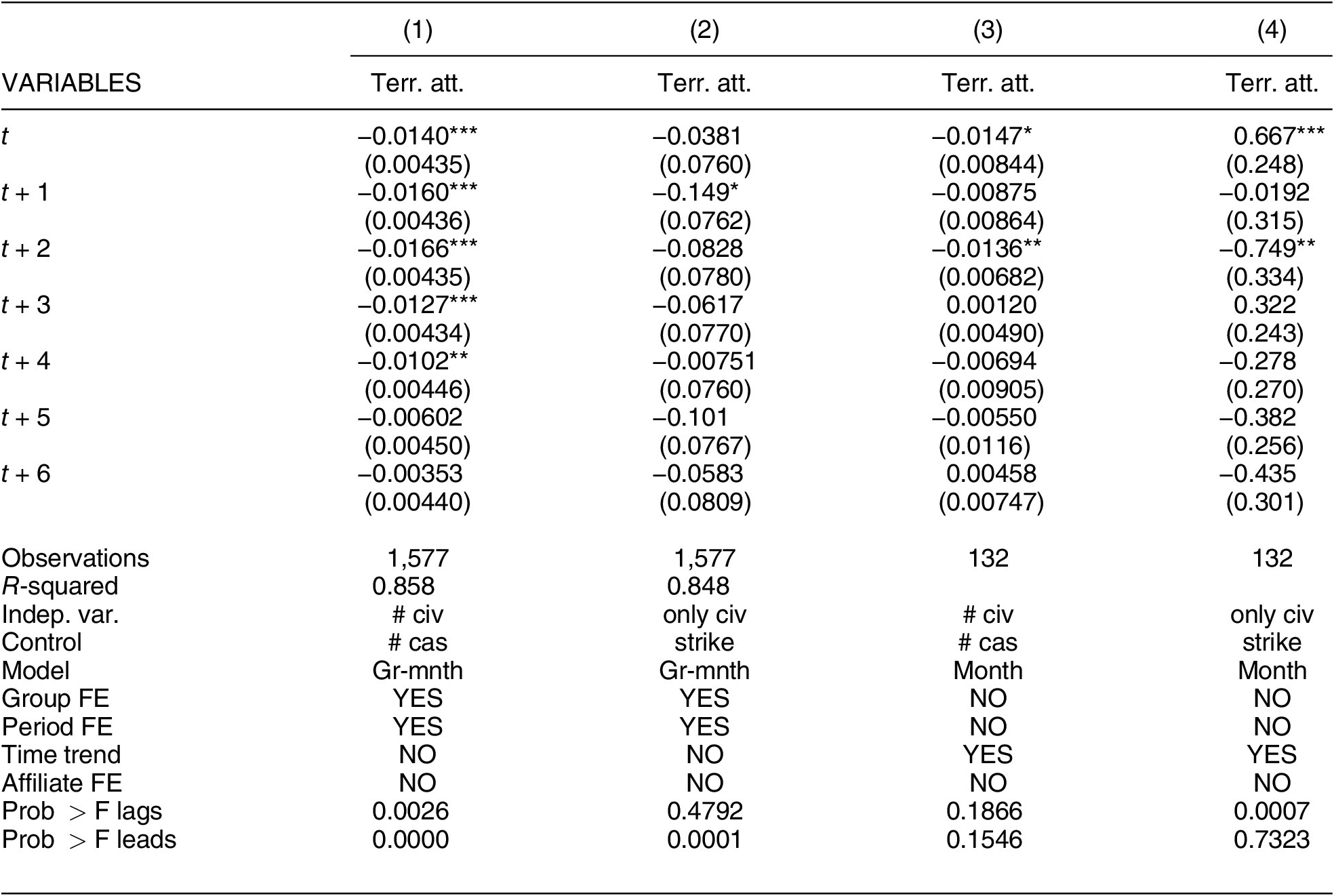
Drone Strikes with Civilian Casualties
Note: Newey-West standard errors in parentheses; *p < 0.1, **p < 0.05, ***p < 0.01.
Table 9 provides no evidence that drone strikes hitting only civilians, or done strikes hitting many civilians, are associated with an increase in terrorist attacks compared with other drone strikes (H4.1). If anything, it shows a decrease in the number of terrorist attacks, by the terrorist group itself and by an aggregation of all terrorist groups in the study.Footnote 24 The sign on virtually all coefficients is negative, although coefficients on the lags of the dependent variable of interest are not jointly statistically significant in each instance.
This study by no means convincingly shows that drone strikes causing civilian casualties decrease terrorist violence. In two of the specifications shown, the leads of the dependent variable are jointly statistically significant. As this provides evidence that the parallel trends assumption is violated, these results should be interpreted with due caution. The sole purpose of this exercise is to show the lack of evidence in favor of backlash.
Conclusion
Exploiting a natural experiment provided by drone strikes hitting and missing terrorist leaders in FATA, Pakistan, this paper investigates how drone strikes killing terrorist leaders—and undermining control within terrorist organizations—affect terrorist attacks. It suggests that such counterterrorism policies can backfire and that terrorist groups whose leader is killed increase the number of attacks they commit in 3 out of 6 months after the drone hit by between 47.7% and 70.3%.
This paper suggests that the most likely explanation for this result is that the new leader is less able or willing to exert control over the group’s operatives, following theoretical models by Shapiro (Reference Shapiro2013) and Abrahms and Potter (Reference Abrahms and Potter2015). Although unable to measure control within terrorist organizations directly, this paper provides evidence in favor of six hypotheses indirectly testing whether drone strikes undermine control. We have theoretical and empirical reasons to expect that leaders exert control to limit indiscriminate violence against civilians and that leaders strategically leave attacks they did not sanction unclaimed. This paper provides evidence that drone strikes killing terrorist leaders lead to more terrorist attacks targeting civilians (echoing results obtained by Abrahms and Mierau [Reference Abrahms and Mierau2017]) and more unclaimed terrorist attacks. Less control of terrorist leaders over operatives might also translate into changes in the organizational structure of terrorist groups. This paper finds drone hits to be related to terrorist group splintering and infighting. Finally, the effect of a decrease in control is predicted to be larger for those groups and leaders that relied more strongly on central control to begin with.
Some evidence is also found in favor of signaling (or revenge) as a theoretical explanation. In some of the 6 months after a drone hit on a terrorist leader, the number of terrorist attacks on military targets and claimed terrorist attacks increases.
Two caveats to these results are in order. First, this paper is only able to capture the medium-term effect (6 to 15 months) of targeted leader killing. It has been suggested that terrorist organizations, specifically Al-Qaida, are in the process of disintegration partially because their leaders have been consistently killed or captured, and that increased violence may be the organization’s “death throws” (Cronin Reference Cronin2006). Although I cannot exclude the possibility that this may happen in the future, the number of attacks by the terrorist organizations studied in this paper currently shows no sign of decreasing. In fact, the number of attacks has increased over eightfold between 2004 and 2015. Secondly, this paper investigates the effect of drone hits relative to drone misses. It cannot comment on the effect of the threat of drone strikes—that is, the number of terrorist attacks in the current state of the world relative to a counterfactual world in which terrorist leaders were never targeted by drone. Similarly, it cannot comment on individuals’ willingness to join terrorist groups in a world with and without drone strikes risking civilian casualties. Hence, results do not directly translate into an assessment of the overall impact of the use of drone technology.
The conclusion that drone strikes may undermine control within terrorist groups has important policy implications beyond counterterrorism in the arenas of law and diplomacy. Legal scholars suggest that the lawfulness of drone strikes under International Humanitarian Law (IHL) depends on an armed group’s level of internal organization (Heyns et al. Reference Heyns, Akande, Hill-Cawthorne and Chengeta2016). For IHL to apply to drone strikes, they must take place in the context of a noninternational armed conflict. The level of organization of parties to the conflict, including the existence of a command structure, is one of two criteria used to determine whether a situation is thus classified (Heyns et al. Reference Heyns, Akande, Hill-Cawthorne and Chengeta2016). The results presented in this paper suggest that drone strikes, by virtue of their own “success” in killing leaders and undermining terrorist command structure, may contribute to making themselves unlawful.
Undermining leaders’ control over a terrorist organization may furthermore undermine the prospect of peace talks. Peace agreements between the Pakistani government and terrorist groups are common: Staniland, Mir, and Lalwani (Reference Staniland, Mir and Lalwani2018) document 24 individual peace deals. However, anecdotal evidence suggests that leader killing by drone may impede such agreements. For example, TTP leader Hakimullah Mehsud was reportedly ready to participate in peace talks, but following his death by drone, TTP splintered over the question of whether to engage in such talks and TTP attacks spiked (Crenshaw Reference Crenshaw2012). Future research may investigate the impact of drone strikes, or other counterterrorism policies, on terrorist group splintering and peace agreements in greater detail.
Supplementary Materials
To view supplementary material for this article, please visit http://dx.doi.org/10.1017/S0003055420000908.
Replication materials can be found on Dataverse at: https://doi.org/10.7910/DVN/MNRIEP.









Comments
No Comments have been published for this article.