Introduction
Earth supports such a large number of species that it is not possible for a single person to study them all. Instead, ecologists restrict their work to a smaller number of taxa. Studies of marine meiofauna have likewise been selective, workers typically examining only a restricted range of usually related species (i.e. a single taxocene) or a range of taxocenes but excluding smaller organisms (e.g. Dommasnes, Reference Dommasnes1968, Reference Dommasnes1969; Metaxas et al., Reference Metaxas, Hunt and Scheibling1994; Mettam, Reference Mettam1994; Bertness & Leonard, Reference Bertness and Leonard1997; Ríos & Mutschke, Reference Ríos and Mutschke1999; Wallenstein & Neto, Reference Wallenstein and Neto2006; Burrows et al., Reference Burrows, Moore and Hawkins2009). Ecological relationships between unrelated taxocenes are thus as yet only poorly appreciated. This is true of examinations of epiphytes on the calcareous alga Corallina officinalis Linné, the type species of the genus Corallina Linné, Subfamily Corallinoideae (see Brodie et al., Reference Brodie, Walker, Williamson and Irvine2013). Calcareous epiphytes belonging to six taxocenes on this alga in Cardigan Bay, Wales, are the subject of this paper.
A medium-sized, typically red but occasionally bleached, coralline alga (Hardy & Guiry, Reference Hardy and Guiry2003), C. officinalis has an articulated calcareous upright system with a fishbone-like arrangement of thalli (Wells, Reference Wellsn.d.). It is common in intertidal rock-pools around the North Atlantic Ocean (Hardy & Guiry, Reference Hardy and Guiry2003), but has been recorded worldwide and occurs also as an understorey plant in the shallow subtidal (Sumi & Scheibling, Reference Sumi and Scheibling2005). The alga's structural complexity makes it a popular epifaunal habitat, such as for the following calcareous taxocenes: spirorbids, foraminifera, gastropods, bryozoans, ostracods and ophiuroids. Aspects of the distributions of these taxocenes are examined and compared here.
Bussell et al. (Reference Bussell, Lucas and Seed2007) identified 123 different epiphytal taxa on C. officinalis along the coastline of North Wales, UK. They found the polychaete Spirorbis corallinae De Silva & Knight-Jones, which constructs a calcareous tube to dwell in, dominated the epiphytic community. It was associated with small mussels (Mytilus edulis Linnaeus). They found the invertebrate assemblage to differ with depth in tide pools, with higher diversity and richness at shallower depths nearer the pool rims, where the alga is more compact and shorter than at greater depths.
Despite the range of taxa recorded by Bussell et al. (Reference Bussell, Lucas and Seed2007), studies of the calcareous meiofauna on C. officinalis have been taxonomically selective, both around Wales, elsewhere in the British Isles, and at other sites worldwide. Foraminifera and Ostracoda, though abundant, have been studied in isolation from other taxocenes. Several examples illustrating this selectivity are presented here.
Foraminifera are unicellular protists, some benthic species of which secrete tests of calcium carbonate. The calcareous walls may either look glassy (hyaline) or like glazed pottery (porcellaneous). Foraminifera occur in all marine and marginal marine environments where, with the exception of adherent species, they are most common on or within soft sediment. Some species, both free (vagile) and attached (sessile), have adopted an epiphytic mode of life (Langer, Reference Langer1993). The vagile species propel themselves using a complex network of reticulapodia that they extrude from their tests into the surrounding environment. Suspension feeding species capture their prey using an array of these reticulapods extended into the water column.
Hedley et al. (Reference Hedley, Hurdle and Burdett1967) found a foraminiferal association of 63 species on C. officinalis thalli around New Zealand. They considered the species recorded to be hardy forms, finding no indication of a noteworthy change in the foraminiferal fauna over the 1000-mile latitudinal range they studied. Hayward (Reference Hayward1979) found all Hedley et al.'s (Reference Hedley, Hurdle and Burdett1967) species, plus Bulimina marginata d'Orbigny, in a New Zealand rock-pool. Although Hayward (Reference Hayward1979) reported members of other taxocenes elsewhere in the pool, he did not quantify their abundance on the alga.
Atkinson (Reference Atkinson1969) recorded foraminifera living on C. officinalis in November 1966 in two rock-pools in the eulittoral zone of south Cardigan Bay, Wales. His one litre algal samples yielded a small total recovery from both the higher pool (26 living specimens, 78 dead) and the lower one (10 live, 25 dead). This recovery was dominated by Elphidium crispum (Linnaeus) with lesser E. excavataum (Terquem) (recorded as E. selseyense (Heron-Allen and Earland)) and Ammonia beccarii (Linnaeus). He recorded ostracods also, but did not quantify their abundance. He did not note the occurrence of any other taxocenes.
Debenay et al. (Reference Debenay, Bénéteau, Zhang, Stouff, Geslin, Redois and Fernandez-Gonzalez1998) suggested that adult A. beccarii s.s. might be epiphytic, being abundant on C. officinalis at Yeu Island and the Bay of Bourgneuf, on the French Atlantic coast. They did not, however, examine any other taxocenes.
The Ostracoda is a Class of the Crustacea. Ostracods are typically ~1 mm in size. Their laterally flattened bodies and appendages are protected by a bivalved calcareous carapace, to which they are attached by muscles (especially adductor muscles that open and close the carapace). The more-or-less complex hinge between the valves is along the dorsal region of the body. They are classified using gross carapace morphology, hinge type, internal muscle-scar patterns, and ornament.
Studies of ostracods on C. officinalis have, like those of foraminifera, been largely exclusive of other taxocenes. In a study of ostracods associated with the polychaete Sabellaria alveolata (Linnaeus) at Blue Anchor, Somerset, UK, Horne (Reference Horne1982a) found an associated 125 ml tuft sample of C. officinalis to contain ‘an abundant meiofauna, including amphipods, isopods, copepods, molluscs, foraminifera and halacarids’ and 148 ostracods. He did not, however, provide any quantitative details for taxocenes other than the ostracods. Horne (Reference Horne1982b) studied the ostracod community from 125 ml samples of C. officinalis from various levels within the intertidal zone at Gore Point, Bristol Channel, UK. He found 28 species, of which the most abundant were Heterocythereis albomaculata (Baird), Hirschmannia viridis (O.F. Muller), and Paradoxostoma variabile (Baird). He did not, however, note whether any foraminifera were present in his samples. Among the five levels Horne sampled, on one occasion one level yielded only 29 individuals. This extreme paucity of ostracods he ascribed to wave action focused on the pool by the topography of the surrounding bedrock shore. The repeated wave impacts and the resulting excessive turbulence he thought to have rendered the pool environment inhospitable to any free-living organisms, despite the rich flora of Corallina.
Trier (Reference Trier, Whatley and Maybury1990) examined ostracods on algae from Pembrokeshire, S.W. Wales. He did not enumerate the communities on the different species of algae, but noted that his total recovery across all algae was dominated by H. albomaculata (25.5%), P. variabile (20.6%), Cythere lutea Mueller (10.3%) and H. viridis (9.4%). Hull (Reference Hull1997) collected monthly replicate samples of C. officinalis to investigate the changes in ostracod species abundance, richness and diversity over a 12 month period. She found C. lutea to reproduce in early spring and demonstrated positive covariation in population density with H. viridis, which in turn demonstrated positive covariation in population density and had similar life cycles to H. albomaculata. Hull (Reference Hull1999) collected replicate samples of C. officinalis from either side of five large mid-shore pools on three shores in NE England (Ravenscar, Filey Brigg and Flamborough) to examine variations in the abundances of different ostracod species and in assemblage structure over a range of spatial scales. Using an MDS plot generated from a Bray–Curtis similarity matrix, Hull (Reference Hull1999) showed that the Flamborough samples formed a discrete cluster, while there was some overlap between the Filey and Ravenscar sample sets. She thus noted the algal epifauna to be geographically variable. In these papers, however, neither Trier nor Hull mentioned taxocenes other than ostracods.
It appears that this separation of studies of foraminifera and ostracods from other taxocenes has arisen because the study of ostracods and foraminifera is seen as being a separate discipline (micropalaeontology). Thus, when Dommasnes (Reference Dommasnes1968, Reference Dommasnes1969) recorded the meiofauna on C. officinalis at three localities with different wave exposure south of Bergen, Norway, he noted foraminifera and ostracods to be present at all sites but neither distinguished species of them nor quantified their total abundance. Crisp & Mwaiseje (Reference Crisp and Mwaiseje1989) examined the meiofauna on samples of C. officinalis 20–30 g wet weight from four intertidal pools, including two in north Wales. They noted especially a relationship between C. officinalis and S. corallinae ( $\bar{x}$ = 9.12 individuals per gram wet weight). Their paper does not, however, indicate what size of epiphytes was examined. Nor does it record either foraminifera or ostracods.
As is often the case with other taxocenes, scientists studying foraminifera rarely study ostracods, and vice versa. The high species richness of the foraminiferal and ostracod communities might encourage this separation between work on the two taxocenes, it being challenging to master recognition of all extant species and knowledge of their ecology (see, for example, Murray, Reference Murray2006). Murray (Reference Murray1971) illustrated 121 species of nearshore foraminifera from around the British Isles, while Haynes (Reference Haynes1973) recorded and illustrated 165 species in Cardigan Bay, offshore Wales, alone. Species of ostracods around the British Isles are similarly numerous (Athersuch et al., Reference Athersuch, Horne and Whittaker1989). Whittaker (Reference Whittaker1988) recorded the ostracods associated with a mixture of green, red (mostly Corallina) and brown algae with sand, shell-sand and mussel-beds at Great Cumbrae Island, in the Firth of Clyde, Scotland. Of the live species found, he concluded Cythere lutea, Hirschmannia viridis, Xestoleberis aurantia (Baird), Semicytherura nigrescens (Baird), Callistocythere badia (Norman), Paradoxostoma variabile (Baird) and Cytherois pusilla Sars to be epiphytal. Athersuch et al. (Reference Athersuch, Horne and Whittaker1989) recorded 116 species of ostracod from marine and brackish water around the British Isles, while Cabral & Loureiro (Reference Cabral and Loureiro2013) illustrated 178 ostracod species from nearshore Portugal, many of which occur around the British Isles. The existence of such monographs makes these taxocenes accessible to study. Likewise, other taxocenes (including gastropods, bivalves, bryozoans) around the British Isles have been rendered more accessible to study following the publication of the handbooks by Hayward & Ryland (Reference Hayward and Ryland1990, Reference Hayward and Ryland2017), which illustrate and describe 1500 species from various taxocenes – although not foraminifera and few ostracods.
Here we examine occurrences of some epiphytal calcareous taxocenes (spirorbid worms, bryozoans, gastropods, foraminifera, ostracods, bivalves, ophiuroids) on C. officinalis. We report the distributions of, and associations between, these taxocenes on C. officinalis along the coastline of Ceredigion, Wales, examining in particular differences between the epiphytal associations on the alga on bedrock and boulder-field coastlines. We interpret the taxocene distributions in terms of community ecology.
Regional overview
The coastline of Ceredigion, from Ceinewydd (New Quay) north to Aberystwyth, comprises patchy outcrops of the Silurian, turbiditic Aberystwyth Grits Group. On these bedrock patches, the inter-turbidite shales have been eroded out to produce rock-pools between beds of sandstone. Depending on the bedding direction (known as ‘strike’ to geoscientists), the rock-pools may be either perpendicular to the direction of wave travel (so that breaking waves plunge into them), at an angle to it, or parallel to it (such that waves break and are funnelled along the length of the rock-pool).
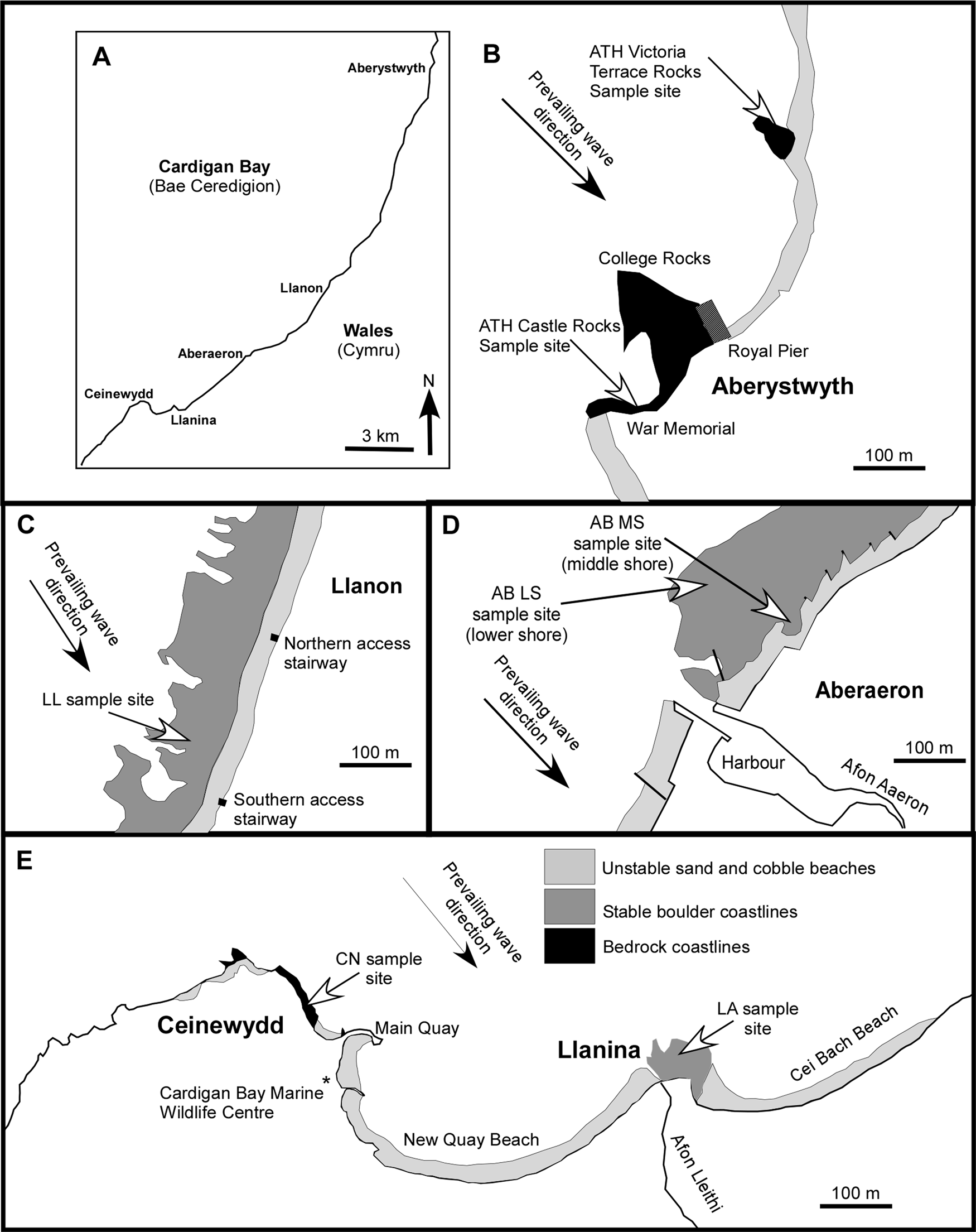
This bedrock is overlain by more-or-less thick developments of eroding Pleistocene boulder clay. The shoreline is thus a patchwork of solid bedrock exposures (as at Ceinewydd and Aberystwyth; Table 1, Figures 1B, E) and stable boulder-fields (as at Llanina, Llanon and Aberaeron, Figures 1C–E) derived from the boulder clay. These are separated by sandy and unstable, sometimes cobble-rich beaches. The bedrock and boulder-field shorelines, being characterized by rock-pools with a rich algal flora not found elsewhere along the Ceredigion coast, act as virtual island habitats (cf. Morin, Reference Morin1999), the fragments of stable shoreline being separated by unstable areas. Variations in the macroflora and sabellariid worm colonies indicate these virtual island habitats to differ in their wave exposure, which is low at Ceinewydd (Wilson & Hayek, Reference Wilson and Hayek2019) and high at Llanina through Aberystwyth. High wave exposure is reflected in the development of thick reefs of S. alveolata at the latter sites (Walton, Reference Walton1913; Williams, Reference Williams1964; Caroline Maybury, personal communication 2018). Burrows et al. (Reference Burrows, Harvey and Robb2008) found C. officinalis to prefer shorelines with moderate to high wave fetch and exposure (see also Burrows et al., Reference Burrows, Moore and Hawkins2009).
Locations of the study areas. (A) Inset map of the northern Ceredigion coastline showing sampled sites. (B) Aberystwyth, showing the location of the studied bedrock sites at Victoria Terrace Rocks and Castle Rocks. (C) Llanon, showing the two access stairways down the cliffs and the position of the sampled rock-pool in the stable boulder-field. (D) Aberaeron, showing the sampled lower and middle shore sites, both in stable boulder-fields. F. Ceinewydd and Llanina, showing the sampled bedrock site at the former and the stable boulder-field site at the latter. North at top in all maps.

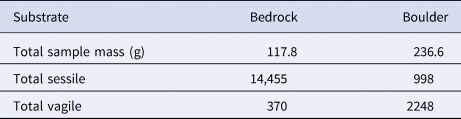
Total sample mass (dry weight) of the alga Corallina officinalis collected from bedrock and boulder-field shorelines of the Ceredigion coastline, together with the numbers of sessile and vagile meiofaunal specimens collected from each coastline

The sample sites are here described from north to south. Aberystwyth is an ancient market town and holiday resort in the county of Ceredigion, Wales, located near the confluence of two rivers, the Afon Ystwyth and the Afon Rheidol. Aberystwyth's westward-facing shore is cobble-rich with limited areas of sand (Figure 1A, B). However, the unstable cobbles do not support macroalgae. These instead grow on four areas of exposed bedrock (the Castle, College and Victoria Terrace Rocks, and Constitution Hill). For this study, samples were taken from the lower shore at Castle Rocks and Victoria Terrace Rocks, both of which supported F. vesiculosus and sparse A. nodulosum in their middle shore parts, and F. serratus in their lower shore. Sabellaria alveolata was not found at Victoria Terrace Rocks, but formed thick and abundant colonies at Castle Rocks.
Aberystwyth is exposed and noted for being impacted by strong winter storms. Wilson & Hayek (Reference Wilson and Hayek2019) noted that 10 named storms impacted the Ceredigion coastline between September 2017 and June 2018 alone. Anonymous (2013) and Pritchard (Reference Pritchard2016) shot videos of storm waves near Victoria Terrace Rocks, illustrating how the waves here propagate perpendicular to the shore. Corallina officinalis is abundant at Victoria Terrace Rocks, ~10% of pool floors being covered in rock-pools elongate parallel to the direction of wave propagation, the waves being channelled along them. The C. officinalis tufts here are stunted (~1.5 cm long), and the alga often has a pitted surface not seen elsewhere. We ascribe both the stunting and the pitting to high wave energy and storm damage (see Dommasnes, Reference Dommasnes1968). The tufts at Castle Rocks are longer (~3 cm) than at Victoria Terrace Rocks, reflecting greater protection at the former site, which is shielded by a headland and at which the rock-pools are elongated perpendicular to the direction of wave propagation, such that waves break across the rock-pools rather than being funnelled along them.
The shore at the village of Llanon comprises material eroded from boulder-clay cliffs (Figure 1C), with an unstable cobble field along the cliff bases, succeeded westward by a stable boulder-field with patches of rippled sand and shallow (max. ~30 cm) pools. Sabellaria officinalis are abundant here, but only one patch of C. officinalis was found, which was associated with F. serratus and thus of lower shore aspect.
Aberaeron is a small fishing town at the mouth of the Afon Aeron and built adjacent to a sheltered harbour (Figure 1D). The lower shore (Aberaeron LS) on the north side of the Afon Aeron is comparable with that at Llanon, being a moderately exposed boulder-field with F. serratus and abundant C. officinalis. The middle shore (Aberaeron MS), with abundant F. vesiculosus, is protected by groynes perpendicular to shore. At the time of sampling, the Aberaeron MS rock-pools contained abundant terrestrial plant leaves and seeds, washed in during a recent storm. Their presence attests to the protected nature of these Aberaeron MS pools, which are sufficiently calm to encourage the development of long (~5 cm maximum) tufts of C. officinalis.
The northward facing boulder-field at Llanina (Figure 1E) is situated ~1 km east of Ceinewydd (New Quay), but is more exposed than the Ceinewydd shore, as reflected by thick and extensive developments of S. alveolata and by beds of the mussel M. edulis (Grainger, Reference Grainger2013). Nevertheless, some protection is provided by the orientation of the boulder-field relative to the SE-propagating waves, as seen on Google EarthTM. Boulders here range from 0.3–0.75 m in diameter. The C. officinalis tufts here are abundant and have bound little sediment among their holdfasts. The boulder-field ranges between the lower shore, with F. serratus, and middle shore, with F. vesiculosus. The western edge of the Llanina boulder-field coincides with the Afon Lleithi, a stream ~4 m wide. The streambed at Llanina is rich in the green, opportunistic, filamentous alga Enteromorpha, which favours sites rich in organic matter such as derived from sewage (Bat et al., Reference Bat, Akbuliut, Sezgn and Ulha2001). This alga might indicate an enhanced nutrient supply coming from farms upstream. Enteromorpha was not found in such abundance in other streams examined in the study area, including narrow ones flowing across the sandy beach between Ceinewydd and Llanina.
Ceinewydd (Figure 1E) is a fishing port situated in an embayment east of a headland on the Ceredigion coastline and protected from the prevailing south-westerly winds (Walton, Reference Walton1913) but impacted by waves propagating towards the south-east, parallel to the shore, as shown on Google EarthTM. The macro-algae Pelvetia canaliculata, Fucus spp. and A. nodosum are abundant here, as at the time of sampling were washed up Laminaria digitata and Saccharina latissimi. Wilson & Hayek (Reference Wilson and Hayek2019) used this macroflora to characterize the bedrock shore here as being moderately sheltered. Bedding, however, strikes perpendicular to the shoreline. Thus, the rock-pools are elongated perpendicular to the direction of wave travel, such that breaking waves topple into them. Due to the comparatively low energy of the wave impacts on the rocky section of the Ceinewydd coastline, the bedrock supports only thin, marginal, patchy developments of the worm Sabellaria alveoloata (see Wilson & Hayek, Reference Wilson and Hayek2019), which captures suspended sand grains to construct its worm tubes and thus prefers sites with moderate to high turbulence (Gruet, Reference Gruet1984, Reference Gruet1986). Rock-pools here contain few C. officinalis (at the lower shore level, associated with F. serratus), which further support the interpretation of the Ceinewydd shoreline as having limited wave exposure. The C. officinalis tufts are long (up to 5 cm), which indicates little breakage by wave action, even during storms. Their holdfasts at Ceinewydd bind much silty-sand.
Materials and methods
Twenty-eight samples (four per site) of C. officinalis were collected from the seven localities between Ceinewydd and Aberystwyth (Figure 1, Table 1). Seasonal population dynamics might change the ratios between taxocenes if samples from different sites are collected at different times of year. To minimize such an impact, the samples were all collected at low tide during the second week of August, 2019. The tidal range at Ceinewydd is ~2.3 m. To reduce any complications that might arise from an altitudinal zonation on the coastline, all but one set of replicates were taken from the lower shore, which extends from approximately mean sea level to the extreme low water spring tide and is characterized by the macroalga F. serratus. A replicate set was taken also from the Aberaeron middle shore (Aberaeron MS), the lower and middle shore sites here being sampled to provide a baseline against which to assess the impact of a proposed major groyne development. Our aim was to compare the epiphytal communities on C. officinalis on bedrock shorelines and boulder-field shores, so sites were selected accordingly. The sites were either in pools on the bedrock shorelines (Ceinewydd, Aberystwyth Castle Rocks and Victoria Terrace Rocks), or between boulders on boulder-field shores (Llanina, Aberaeron (MS and LS), Llanon). All replicates were taken from shallow water around the pool rims to minimize any possible effects from water depth.
Where possible the replicates were taken by placing the weed within a 6 × 8 cm Ziploctm bag and then cutting the thalli. This avoided loss of specimens of the epiphytal community. However, at Aberystwyth the short (~2.5 cm) turfs could not be sampled this way. The algal samples there were cut from the rock with a knife while holding the algae firmly between thumb and finger of the opposite hand, and then transferring them to the Ziploctm bag. This technique minimized the loss of specimens not firmly attached.
Where necessary, closely adjacent algal tufts were taken to form a sufficiently large sample. Where the growth volume of C. officinalis around a particular pool rim was small, the replicates were built up by taking material from the rims of adjacent pools, rather than from deeper within the original pool. At sites where the alga had bound quantities of sediment among the holdfasts (Ceinewydd and Aberaeron MS), only the distal thalli tips, without bound sediment, were sampled. The bags containing the plants were filled with seawater before transport to the senior author's home for processing.
The replicates (including any material washed from the samples during transport) were soaked in a solution of rose Bengal (1 g l−1) for >24 h to distinguish live specimens from dead. Schönfeld et al. (Reference Schönfeld, Alve, Geslin, Jorissen, Korsun and Spezzaferri2012) recommended that samples be soaked in the stain for 2 weeks, but we have found one day to be sufficient (Wilson & Hayek, Reference Wilson and Hayek2019). The stained samples were washed over a 63 μm mesh to remove silt and clay-sized particles, then dried in an oven at 80°C for 2 hours, Murray (Reference Murray1971) having found stained specimens difficult to distinguish in samples dried at higher temperatures. This drying rendered the alga crumbly, it breaking along its articulations. Each dried replicate was stored in a fresh Ziploctm bag pending examination.
The dried residue of material washed from the alga and the thalli themselves was sieved over 2000 μm, 425 μm and 150 μm meshes, and the 63–150 μm, 150–425 μm and 425–2000 μm fractions were spread over a picking tray and picked clean of stained gastropods, ophiuroid bodies (but not the broken-off arms), foraminifera, ostracods and bivalves. Attached spirorbid worms and bryozoan colonies were counted in situ.
Practice was required to identify stained spirorbids, their tubes being thick walled. After prising a few spirorbids from the thalli with a dissecting needle, it was found that the worms' soft parts had been reduced to a brightly stained rind. With sufficiently bright lighting, it was possible to discern this rind in live specimens without removing the worm tubes from the thalli.
Many specimens of the foraminifer Miliolinella subrotunda (Montagu) were encased in thick capsules of mud, as noted for M. circularis (Bornemann) by Hofker (Reference Hofker1930), and had to be scraped from the thalli with a dissecting needle. Most Rosalina and Cibicides, attached genera of foraminifer, likewise had to be scraped from the thalli. Almost all specimens of all taxocenes examined had taken the stain, indicating the thanatacoensis to be small.
The specimens were identified using illustrations in the following publications:
(1) Spirorbid worms – Hayward & Ryland (Reference Hayward and Ryland1990), Rzhavsky (Reference Rzhavsky1994) and Rzhavsky et al. (Reference Rzhavsky, Kupriyanova, Sikorski and Dahle2014).
(2) Bivalves – Hayward & Ryland (Reference Hayward and Ryland1990).
(3) Gastropods – Graham (Reference Graham1971), Hayward & Ryland (Reference Hayward and Ryland1990) and de Kluijver et al. (Reference de Kluijver, Ingalsuo and de Bruynen.d.).
(4) Ophiuroids – Hayward & Ryland (Reference Hayward and Ryland1990).
(5) Bryozoans – Hayward & Ryland (Reference Hayward and Ryland1990) and Porter (Reference Porter2012).
(6) Foraminifera – Murray (Reference Murray1971, Reference Murray1979), Gabel (Reference Gabel1971), Haynes (Reference Haynes1973) and Darling et al. (Reference Darling, Schweizer, Knudsen, Evans, Bird, Roberts and Austin2016).
(7) Ostracods – Athersuch et al. (Reference Athersuch, Horne and Whittaker1989), Horne (Reference Horne1982a, Reference Horne1982b), Whittaker (Reference Whittaker1988) and Cabral & Loureiro (Reference Cabral and Loureiro2013).
Bryozoans were only counted as colonies, though these ranged from 1 to ~50 individuals. Almost all these colonies were recovered from the 425–2000 μm fraction, having overgrown and made solid the articulations of the algal thalli. The colonies were all Electra pilosa (Linnaeus).
Excepting bryozoans, for which the number of colonies was counted, the number of individuals in each species was counted. The mass of C. officinalis examined was measured to the nearest 0.1 g, allowing the number of individuals per gram (termed ‘density’) to be used as an independent variable. Each taxon was assigned to having either a sessile or a vagile mode of life. Although Langer (Reference Langer1993) thought the Miliolinella group to be vagile, we regard M. subrotunda (including Pateoris hauerinoides (Rhumbler)) as being sessile, it requiring time to accumulate the muddy cyst that covers the test. Cushman (Reference Cushman1908) found the co-generic M. circularis ‘in great numbers attached to the stems of hydroids’, while Hofker (Reference Hofker1930, p. 79) found encysted specimens of M. circularis living ‘attached to weeds’. Langer (Reference Langer1993) having reported that Elphidium crispum (Linnaeus) can move at 0.4–0.5 cm h−1 (maximum 1.8 cm h−1 at 20°C), we place it and other elphiids in our vagile group. Specimens morphologically comparable to E. cripsum but with variably developed spines around the periphery we refer to as E. aculeatum d'Orbigny, following Atkinson (Reference Atkinson1969).
Diversity per replicate was assessed using species richness S and the Shannon Index  $H({ = \ndash \sum {p_i\cdot \ln p_i} } $, in which pi is the proportional abundance of the ith species). Dominance was quantified using the Berger–Parker Index max(pi) of Berger & Parker (Reference Berger and Parker1970), which is the proportional abundance of the commonest species. Normality was tested using normal quantile plot-tests for non-normality, and homogeneity of variance using Hartley's F max test. Where suitable, means were compared using analysis of variance (ANOVA). The correlation between the densities of the sessile and vagile groups was examined using Pearson's product moment correlation coefficient, r, following the transformation ln(density + 1). All statistical tests were accepted as significant at P ≤ 0.05.
Results
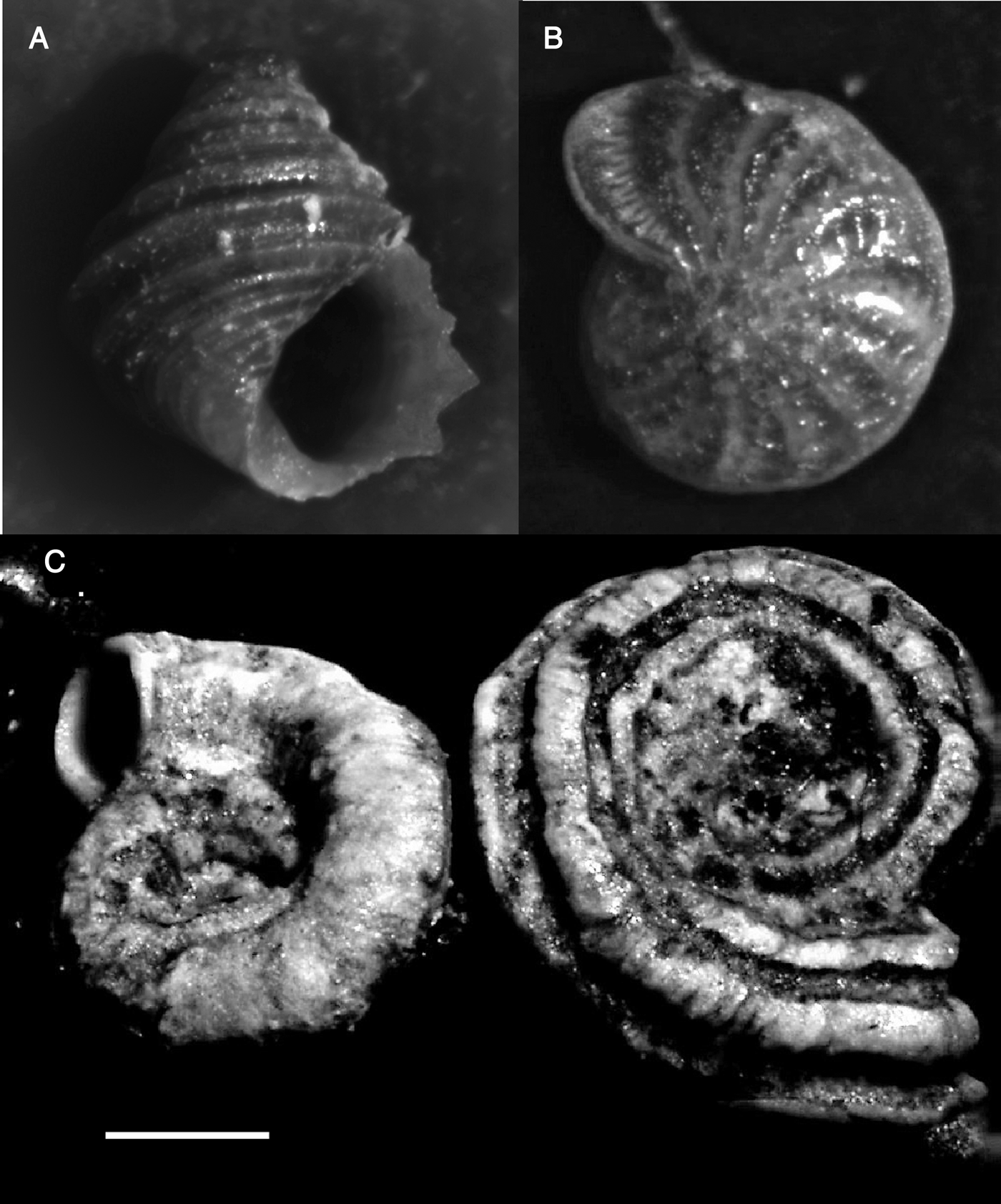
Figure 2 shows selected taxa recovered from C. officinalis on the Ceredigion coastline. See the online Supplementary Material File 1 for our raw data. Regarding replicates and coastline type (bedrock vs boulder-field), 117.8 g dry weight of C. officinalis came from the bedrock coastlines (3 sites, 12 replicates,  $\bar{x}$ = 9.8 g alga per replicate), while 236.6 g was taken from boulder-field coastlines (4 sites, 16 replicates,
 $\bar{x}$ = 14.8 g alga per replicate). A total of 18,701 calcareous epiphytes across all studied taxocenes was recovered from these replicates. Of these specimens, 15,443 (85.5%) had a sessile mode of life (spirorbids, bryozoans, byssate bivalves, attached foraminifera). The remaining 2618 specimens had a vagile mode of life (gastropods, free-living (unattached) foraminifera, ostracods, ophiuroids). Despite the lower number of bedrock coastline samples, and the lower mean mass per replicate, these yielded 14,455 (93.5%) of the sessile specimens recovered. In contrast, the boulder-field coastline replicates yielded 2248 (85.9%) of the vagile specimens.
Selected epiphytes recovered from Corallina officinalis on the Ceredigion coastline. (A) Trichotropis borealis (gastropod), Llanina. (B) Elphidium margaritaceum (foraminifer), Llanon. (C) Circeis amoricana (left) and Janua heterostropha (right) (spirorbids), Ceinewydd. Scale bar for all = 100 μm.

The density of sessile epiphytal organisms in our samples ranged from 1.6–433.4 ( $\bar{x}_\rho $ = 60.0, SD = 117.7) specimens per gram of dried alga, at Llanon (boulder-field coastline) and Ceinewydd (rocky coastline) respectively. In comparison, the density of vagile epiphytes ranged from 0.1–34.9 (
 $\bar{x}_\rho $ = 6.7, SD = 7.8) specimens per gram of dried alga, at Aberystywth Castle Rocks and Llanon, respectively. The mean densities of sessile and vagile organisms thus differed by an order of magnitude. The densities of sessile and vagile taxocenes were significantly and negatively correlated (r = –0.51, P = 0.005, N = 28), reflecting a preference for bedrock patches by the sessile organisms and the boulder-field coastlines by vagile ones.
Of the 66 species recovered, 27 (40.9%) were rare, being represented by ≤4 specimens, while 17 (25.8%) of the 66 species were singletons. Species richness per replicate ranged from S = 3–28, at Aberystwyth Castle Rocks and Llanina, respectively. However, S was positively and significantly correlated with replicate mass (r = 0.66, P = 0.0002, N = 28). The number of species per gram of dry weight C. officinalis was therefore used to compare species richness between the bedrock and boulder-field coastlines. This ranged between 0.40–2.23 species per gram ( $\bar{x}$ = 1.24, SD = 0.43), at Aberystwyth Castle Rocks and Llanon, respectively. These data being normally distributed and having equivalent variances, the difference in the means was examined using Student's t-test. This test showed that there was no significant difference in mean S per gram between the rocky shorelines (
 $\bar{x}_S$ = 1.21) and the boulder-field shorelines (
 $\bar{x}$ = 1.26; t = 0.35, P = 0.73, df = 26).
The Shannon Function H for the entire epiphyte fauna ranged between 0.13–2.59 on the Ceinewydd bedrock coast and Llanina boulder-field coast, respectively. The mean H across all 28 replicates was  $\bar{x}_H$ = 1.34. Across the 12 bedrock coastline replicates,
 $\bar{x}_H$ = 0.66 (SD = 0.53), whereas across the 16 boulder-field coastline replicates
 $\bar{x}_H$ = 1.85 (SD = 0.45). Hartley's F max test showed that the boulder-field and bedrock coastlines had equivalent variances. The mean H for the boulder-field coastline was significantly different from and greater than that for the bedrock coastline (t = 6.43, P < 0.0001, df = 26). ANOVA did not find any difference in
 $\bar{x}_H$ at any of the three bedrock shoreline sites (F 2,9 = 3.92, P = 0.06). It did, however, show a significant difference in
 $\bar{x}_H$ between at least two sites on the boulder-field coastline (F 3,12 = 22.03, P > 0.0001), the mean at Llanina (
 $\bar{x}_H$ = 2.41, SD = 0.12) being significantly different from and greater than that on the boulder-field shoreline at Aberaeron MS (
 $\bar{x}_H$ = 1.31, SD = 0.22).
The Berger & Parker (Reference Berger and Parker1970) index of dominance, max(pi), ranged from 0.18–0.98 at Llanina and Ceinewydd, respectively. Across all 28 replicates,  $\bar{x}_{\max \lpar p_i\rpar }$ = 0.59. Student's t-test showed that
 $\bar{x}_{\max \lpar p_i\rpar }$ for the bedrock coastline (
 $\bar{x}_{\max \lpar p_i\rpar }$ = 0.82) was significantly different from and greater than that for the boulder-field shoreline (
 $\bar{x}_{\max \lpar p_i\rpar }$ = 0.43; t = 5.54, P < 0.0001, df = 26). ANOVA did not find any significant difference in
 $\bar{x}_{\max \lpar p_i\rpar }$ across the three bedrock shoreline sites (F 2,9 = 4.01, P = 0.06). It did, however, discern a significant difference between at least two boulder-field shoreline sites (F 3,12 = 8.68, P = 0.003). The mean at Aberaeron MS (
 $\bar{x}_{\max \lpar p_i\rpar }$ = 0.63) was significantly different from and greater than that at Llanina (
 $\bar{x}_{\max \lpar p_i\rpar }$ = 0.25). The mean on the Aberaeron LS (
 $\bar{x}_{\max \lpar p_i\rpar }$ = 0.36) was significantly different from and less than that for the Aberaeron MS, but did not differ significantly from that at Llanon (
 $\bar{x}_{\max \lpar p_i\rpar }$ = 0.46).When ANOVA was run across all bedrock sites and the Aberaeron MS, however, it did discern a significant difference between at least two values of
 $\bar{x}_{\max \lpar p_i\rpar }$ (F 3,12 = 4.47, P = 0.03).
As taxocenes, total recovery was dominated by spirorbid worms (sessile, 76.7%), with lesser foraminifera (admixed sessile and vagile, 15.0%). Bivalves (sessile) formed 3.2% of the total recovery, while bryozoan colonies (sessile) formed 3.0%. The remaining taxocenes (gastropods, ostracods, ophiuroids) together thus formed only 2.1% of the total recovery. The single most abundant species recovered was the spirorbid Janua heterostropha (Montagu) (75.9% of total recovery), while the foraminifera Elphidium margaritaceum Cushman (6.6%) and E. aculeatum (3.4%) ranked second and third. Taxocene distributions are here described in rank order of abundance.
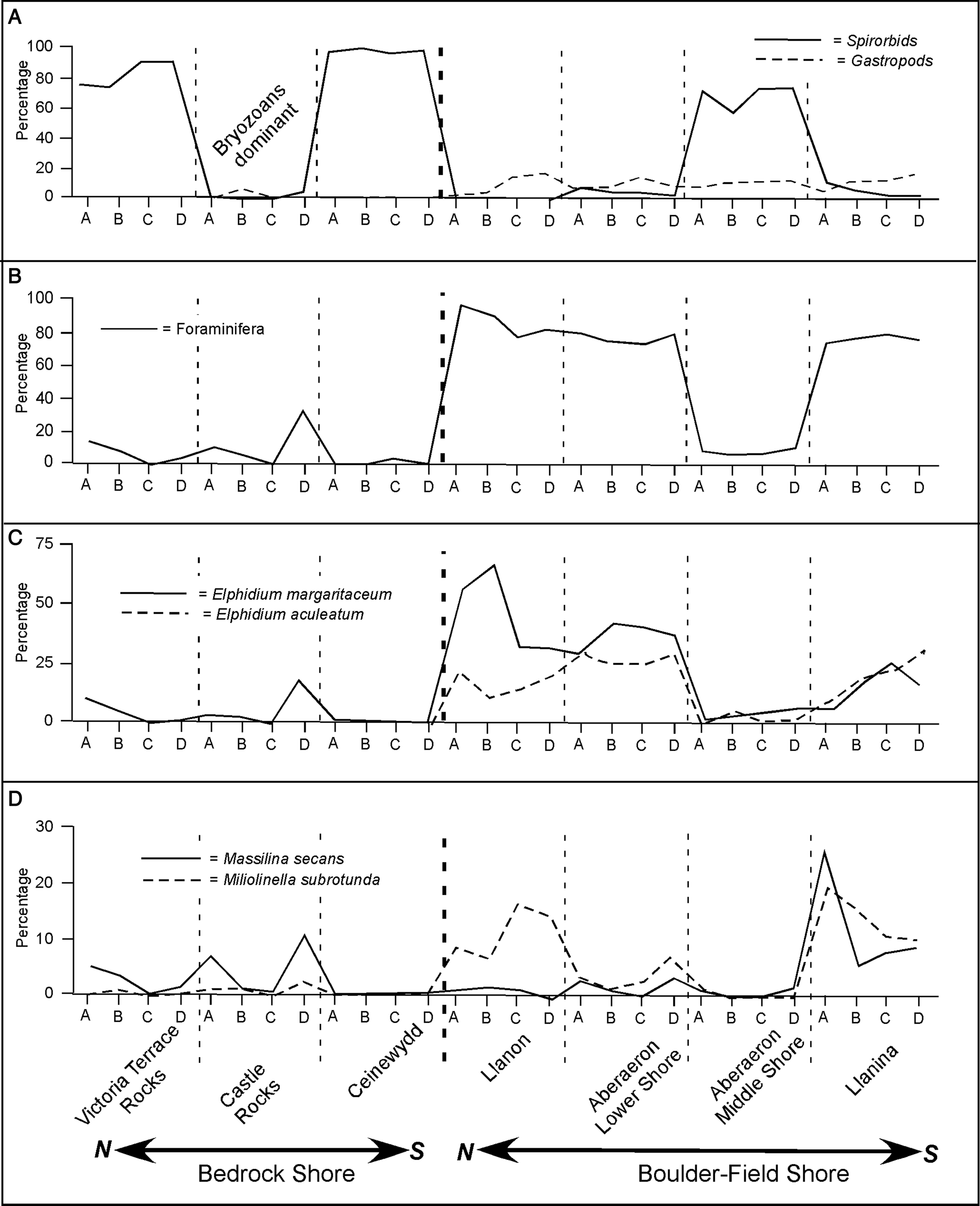
Spirorbid worms were recovered mostly from the bedrock shores at Ceinewydd (94.7–98.1% per replicate) and Aberystwyth (Victoria Terrace Rocks, 75.2–90.9% per replicate) (Figure 3A). They were, however, rarer at Aberystwyth Castle Rocks (0–4.0% per replicate). They were found also on the boulder-field at Aberaeron MS, where they were in absolute terms less abundant than at bedrock sites by an order of magnitude, but comprised 46.1–73.3% of recovery per replicate.
Graphs showing the percentages of the entire epiphytal community as selected taxocenes and taxa on bedrock and stable boulder-field coastlines. Sites arranged from north to south within the two coastline types. (A) Spirorbid worm and gastropod taxocenes. (B) Foraminiferal taxocene. (C) The foraminifera Elphidium margaritaceum and Elphidium aculeatum. (D) The foraminifera Massilina secans and Miliolinella subrotunda.

Total (sessile + vagile) foraminifera were recovered mainly from the boulder-field coasts at Llanon, Aberaeron LS and Llanina (Figure 3B). The proportional abundances of epiphytes as total foraminifera and spirorbids were significantly negatively correlated (r = –0.76, P < 0.0001, N = 28). Of 1606 vagile benthic foraminifera recovered, only 285 (17.7%) were recovered from the bedrock shorelines. Even allowing for the smaller number of replicates from bedrock shorelines, this result reflects a decided preference for boulder-field areas. Over all 28 replicates, the mean number of foraminifera per gram of alga dry weight was  $\bar{x}_{{\rm dry}}$ = 6.93 specimens. On the rocky shore this measure was only
 $\bar{x}_{{\rm dry}}$ = 2.79 specimens, while on boulder-field shore
 $\bar{x}_{{\rm dry}}$ = 10.0. This preference for boulder-field shores is reflected in the Student's t-test (t = 2.45, P = 0.02, df = 26). Sessile foraminifera showed a similar distribution. Of 472 specimens recovered, only 72 (15.3%) were recovered from rocky shorelines. The two most abundant foraminifera were the unattached Elphidium margaritaceum Cushman and E. aculeatum, both with hyaline walls. Across all taxocenes, E. margaritaceum was proportionally most abundant on the boulder-field coastlines at Llanon and the Aberaeron LS (Figure 3C). Elphidium aculeatum was proportionally abundant not only at these sites, but at Llanina also (Figure 3C). The proportional abundances of these two species were thus significantly and positively correlated (r = 0.76, P < 0.00001, N = 28). The porcellaneous walled foraminifera Miliolinella subrotunda (attached) and Massilina secans (d'Orbigny) (vagile) were both widespread though both were proportionally abundant at Llanina (Figure 3D). Their proportional abundances were significantly and positively correlated (r = 0.54, P = 0.003, N = 28). While the proportional abundances of M. subrotunda were significantly and positively correlated with those of E. margaritaceum (r = 0.46, P = 0.013, N = 28) and E. aculeataum (r = 0.56, P = 0.002, N = 28), no significant correlation was found between M. secans and either species of Elphidium.
Of the 560 specimens of the most abundant bivalve, Modiolus modiolus (Linnaeus), 339 (60.5%) were recovered from bedrock shorelines. The mean number of M. modiolus per gram of alga dry weight was  $\bar{x}_{{\rm dry}}$ = 1.73 specimens. The greater value of this measure on the rocky shore (
 $\bar{x}_{{\rm dry}}$ = 2.90 specimens) compared with the boulder-field shore (
 $\bar{x}_{{\rm dry}}$ = 0.86) suggests a preference for the former (t = 5.44, P < 0.0001, df = 26). Ostrea edulis, with a total of 22 specimens, was recovered primarily from Aberystwyth Victoria Terrace Rocks (20 specimens), and so showed a preference for some bedrock shorelines. Despite the preference for bedrock shorelines by bivalves, and for boulder-field shorelines by foraminifera, the numbers per gram of alga as these two taxocenes were not significantly correlated (r = −0.05, P = 0.82, N = 28).
Bryozoan colonies were found primarily at Aberystwyth Castle Rocks (19.7–95.3% per replicate), being virtually absent elsewhere. The proportional abundances per replicate of bryozoan colonies and spirorbids were not significantly correlated (r = –0.33, P = 0.08, N = 28), as was also the case for total foraminifera and bryozoans (r = –0.31, P = 0.11, N = 28). There was no significant correlation between the proportional abundances of sessile foraminifera and bryozoans (r = –0.28, P = 0.15, N = 28) or between vagile benthic foraminifera and bryozoans (r = –0.30, P = 0.12, N = 28).
Among gastropods (total 275 specimens, 11 species), the most abundant were Rissoa parva (de Costa) (~30% of the gastropod community) and Trichotropis borealis (Broderip & G. B. Sowerby I) (~29%). The numbers per gram of dry alga as R. parva and T. borealis were not significantly correlated (r = –0.02, P = 0.91, N = 28). However, neither species showed a preference for either type of shoreline.
Eleven species of ostracod were recovered, being represented in total by 105 specimens. The most abundant were Cythere lutea (~30% of the ostracod community) and Heterocythereis albomaculata (~28%). In view of their scarcity, little can be written regarding their distributions. However, C. lutea was not recovered from either the bedrock shore at Ceinewydd or the boulder-field shore at Aberaeron MS. In contrast, H. albomaculata was widespread, being recovered from both bedrock and boulder-field shorelines.
Ophiuroids were represented by only eight specimens of Amphipholis squammata (Delle Chiaje). Of these, six were collected from the two Aberystwyth bedrock shorelines. However, these numbers are considered too few for us to conclude that this species and taxocene has a preference for either shoreline type.
Discussion
Our sites were almost all on the lower shore, characterized by Fucus serratus, but one site at Aberaeron came from the middle shore (Aberaeron MS). These sites differ not only in their nature (bedrock vs boulder-field), but also in their exposure to wave and storm energy, which is lowest at Ceinewydd and greater at other sites, and in their bedding strike relative to the direction of wave propagation. Video evidence (Anonymous, 2013; Pritchard, Reference Pritchard2016) suggests that peak wave energy might be greatest at the Aberystwyth Victoria Terrace Rocks, the sampled area of Aberystwyth Castle Rocks being somewhat protected by the war memorial-castle headland (Figure 1B). The form and abundance of the calcareous alga Corallina officinalis varies along the Ceredigion coastline, apparently in response to rock-pool orientation, wave exposure and storm damage. The alga was stunted and pitted at the Aberystwyth Victoria Terrace Rocks, apparently due to high-energy storm damage. It was long (up to 5 cm) and sediment binding at the sheltered Ceinewydd bedrock site.
Dommasnes (Reference Dommasnes1968) examined the variation in selected meiofauna as epiphytes on C. officinalis at sites with differing exposure around Norway. He concluded that wave exposure affects both the growth form of the alga and the composition of the meiofauna. The latter was controlled indirectly through the effect of waves on algal growth form, and directly through the effect of water motion on the species themselves; only species able to occupy their habitat in very strong surf occur at sites with high exposure. Among amphipods and isopods, he found that species at his most exposed sites have shorter legs and stronger terminal claws than those at less exposed sites, and so are able to grasp the substrate more firmly. In Ceredigion, the C. officinalis were stunted and pitted but profuse at Aberystwyth Victoria Terrace Rocks. Pitting was not noted elsewhere.
At a most basic level, we assigned the calcareous epiphytes to two modes of life – sessile organisms and vagile ones. Sessile taxa were more abundant by far on C. officinalis growing on bedrock coastlines, and vagile taxa on boulder-field coastlines. It might be argued that this reflects greater wave exposure at bedrock sites, but this seems unlikely. The bedrock site at Ceinewydd is protected by a headland, as is the Castle Rocks site at Aberystwyth. We suggest instead that the irregular nature of the boulder-fields encourages a predominantly vagile assemblage on C. officinalis. Boulder-fields might absorb breaking wave energy and induce relatively low energy turbulence (Nott, Reference Nott2003; Grass, Reference Grass2006) suited to, for example, the relatively weak reticulopoda of the foraminifera, which formed the second most abundant taxocene recovered. Horne (Reference Horne1982b) suggested that the severity of wave impacts affected the ostracod taxocene, greater impacts promoting a smaller community. In our study, it is challenging, given the orientation of the Aberystwyth Victoria Terrace Rocks (bedrock) and Llanon and Aberaeron LS (both boulder-fields), to discount the impact of shoreline type as an influence on the composition of the epiphytal community on C. officinalis. However, given the differences among the bedrock site communities, further work is needed to assess the possible impact of bedrock strike along the Ceredigion coastline.
Vine & Bailey-Brock (Reference Vine and Bailey-Brock1984) suggested that the development of a spirorbid community may be discouraged in areas of low energy where tubes become clogged with sediment. However, this appears an unlikely explanation for the rarity of spirorbids on the boulder-field coastlines. On those coastlines even juveniles, such as might be expected to be struggling to survive, were rare. We suggest instead that some members of the vagile association might predate on any settling sessile larvae at boulder-field sites, discouraging the development of a large sessile community.
The very sizeable difference in abundances between the sessile and vagile groups might reflect differences in their feeding behaviours. Dommasnes (Reference Dommasnes1968, p. 30) wrote that ‘Corallina is very heavily calcified, and it cannot be possible for any of the animals I have found to feed on it, except perhaps between the joints’. Vagile epiphytes instead forage the biofilm living on the alga, and bacteria have been shown to be indispensable for some foraminifera (Muller & Lee, Reference Muller and Lee1969; Langer & Gehring, Reference Langer and Gehring1993), diatoms also being widely consumed (Jauffrais et al., Reference Jauffrais, LeKieffre, Koho, Tsuchiya, Schweizer, Bernhard and Geslin2018). These vagile organisms might need to forage over a relatively large area to obtain sufficient nutrition. In contrast, sessile organisms such as spirorbids and bryozoans have small attachment areas and are active suspension feeders that, though they consume whatever resources current and wave action bring to them, are capable of enhancing this supply by inducing their own, local feeding currents also (Goldstein, Reference Goldstein and Sen Gupta2003). Those foraminifera that are suspension feeders, however, must do so passively, being unable to induce their own feeding currents.
There was no significant difference in species richness per gram of alga between the rocky and boulder-field shorelines, but complexities emerge at the taxocene level. In view of the sessile group's abundance, we discuss it first, despite its lower diversity in our samples (13 sessile taxa vs 57 vagile taxa). On the bedrock shores, the Ceinewydd and Aberystwyth Victoria Terrace Rocks, associations were dominated overwhelmingly by the spirorbid worm Janua heterostropha, although the population density per gram dry weight of alga at Ceinewydd ( $\bar{x}_\rho $ = 319.7 specimens per gram) was nearly six times larger than that at the Aberystwyth Victoria Terrace Rocks (
 $\bar{x}_\rho $ = 55.8 specimens per gram). We did not find the sinistral spirorbid Spirorbis corallinae, even though this has elsewhere been recorded living primarily on C. officinalis (Rzhavsky et al., Reference Rzhavsky, Kupriyanova, Sikorski and Dahle2014). The oyster Ostrea edulis was recovered from Victoria Terrace Rocks but not from either Castle Rocks or Ceinewydd. Meanwhile, J. heterostropha was almost absent from the Aberystwyth Castle Rocks, where the assemblage was dominated by the bryozoan Electra pilosa. All three of these species – J. heterostropha, E. pilosa and O. edulis – are suspension feeders (Enright et al., Reference Enright, Newkirk, Craigie and Castell1986; Larsen & Riisgård, Reference Larsen and Riisgård2002), such as might benefit from enhanced wave action. It might be argued that the differences in communities might reflect differences in wave action and strength. It is thus possible that Aberystwyth Castle Rocks, with its E. pilosa, is the lowest energy of these three sites. Spirorbids were also recovered from the Aberaeron MS, but in small numbers (
 $\bar{x}_\rho $ = 5.3 specimens per gram). Nevertheless, they dominated the epiphytal assemblage at this boulder-field coastline site. There is thus not a clear association between spirorbids epiphytal on C. officinalis and bedrock sites. Sessile foraminifera showed a preference for boulder-field shorelines, despite their permanently attached nature.
At Aberaeron, the middle shore (Aberaeron MS) yielded a largely sessile assemblage while the lower shore (Aberaeron LS) yielded primarily a vagile foraminiferal assemblage. Kelaher et al. (Reference Kelaher, Chapman and Underwood2001) found a comparable difference in macrofauna associated with coralline turf on lower and middle shores around Sydney, Australia. It is not certain, however, that the difference at Aberaeron is associated simply with position relative to mean sea level. Though the middle and upper shores at Aberaeron are sheltered by groynes, it is unclear how their wave energies compare with that of the unprotected and more exposed lower shore.
Grahame & Hanna (Reference Grahame and Hanna1989) found the proximity to low energy water in rock-pools around Filey Brigg, Yorkshire, to be a greater predictor of the density of spirorbids on C. officinalis than was C. officinalis frond density. The reason for the difference in population densities of spirorbids on the bedrock sites at Ceinewydd and Aberystwyth Victoria Terrace Rocks might, therefore, be related to the strike of the bedding. Strike in turn affects the orientation of the pools and might impact on the distribution of wave energy throughout the pool. At Ceinewydd the pools are perpendicular to the direction of wave travel, such that waves plunge into the pools. At Aberystwyth Victoria Terrace Rocks the pools are elongated parallel to the direction of wave propagation, the waves being funnelled along the pools.
Despite the dominance of spirorbids and bryozoans at different sites, they are at the site level not entirely mutually exclusive. Stebbing (Reference Stebbing1973) suggested competition for space between sessile animals on the seashore to be an important factor in their ecology. He thought this competition to be more severe than that between vagile organisms, sessile creatures being unable to move away from their competitors. Best & Thorpe (Reference Best and Thorpe1986) examined competition between three epiphytal bryozoan species on intertidal Fucus serratus around the Isle of Man, UK. Competition occurred where the periphery of one colony touched that of another. Furthermore, differing feeding-current velocities within the lophophores of competing colonies indicated that the superior competitor adversely affected adjacent colonies' feeding. Best & Thorpe (Reference Best and Thorpe1986) concluded that competition among the bryozoan community on F. serratus for food and for space are closely linked, both being major components of bryozoan interspecific competition.
It appears, however, that some factors other than competition for space and food are controlling the within-thallus distribution of sessile epiphytes (spirorbid worms, bryozoan colonies, Modiolus modiolus), on C. officinalis on the Ceredigion bedrock shore. No examples were found of competing bryozoan colonies, and few of bryozoans overgrowing spirorbid worm-tubes. No spirorbids were found overgrowing bryozoan colonies. This exclusion on individual algal thalli occurs despite these taxocenes being abundant throughout the year (Gee, Reference Gee1967; Williams, Reference Williams1996). That overgrowths are few suggests that these taxocenes might occupy different parts of the C. officinalis plant. There have not yet been any studies to corroborate this suggestion. However, Williams (Reference Williams1996) found bryozoans to dominate the lower fronds on F. serratus, while Grahame & Hanna (Reference Grahame and Hanna1989) noted that spirorbids on C. officinalis are not concentrated towards the base of the bushy alga (but see Knight-Jones et al., Reference Knight-Jones, Knight-Jones and Al-Ogily1975).
Vagile organisms (principally foraminifera), though less abundantly recovered than sessile ones, dominated the communities on C. officinalis on the lower shore boulder-field sites at Llanina, Aberaeron and Llanon. Their relative scarcity might reflect a greater dependence by vagile organisms on biofilm on C. officinalis as a source of food, rather than the suspended matter used by spirorbids and bryozoans. The carrying capacity of the biofilm might be low.
The nutrient enrichment evident in the Afon Lleithi at Llanina might have influenced the vagile association there. The abundance of the foraminifer Miliolinella subrotunda, which prefers to live in areas with relatively high mud and organic matter contents (Bergamin et al., Reference Bergamin, Romano, Gabellini, Ausili and Carboni2003), might reflect enhanced nutrient levels in and adjacent to the river. It is also possible that the M. subrotunda were responding to variable salinities due to the freshwater outflow from the river. However, this appears unlikely. This foraminiferal species was recovered in comparable densities from the lower shore at Llanon, where there are no appreciable streams, and was rarer at Aberaeron LS, which lays at the mouth of the much larger River Aeron.
The reason for the encystment of the M. subrotunda is unclear. Hofker (Reference Hofker1930) thought encystment in M. circularis to be associated with reproduction, but Heinz et al. (Reference Heinz, Geslin and Hemleben2005), in an examination of cyst formation among various foraminifera (Rosalina bradyi, Melonis barleeanum, Gavelinopsis praegeri, Ammonia beccarii, Veleroninoides wiesneri, Trochammina sp.) found only one clear example of sediment encystment associated with reproduction. Thus, while there might be an association between encystment and reproduction among our M. subrotunda, this seems unlikely. Many different sizes of M. subrotunda were found within cysts, and very few lacking cysts. Stefanoudis & Gooday (Reference Stefanoudis and Gooday2016) reported comparable encystment among abyssal Sphaeroidina bulloides, and suggested this to be associated with the provision of food, bacterial growth being enhanced within the cyst (Linke & Lutze, Reference Linke and Lutze1993). It is possible that the cysts in our M. subrotunda are associated with bacterial farming.
We recorded abundant specimens of the vagile foraminiferal genus Elphidium. The sources of their nutrition are mixed. Species of this genus sequester chloroplasts (kleptoplasts) from consumed diatoms throughout their cytoplasm (cf. Jauffrais et al., Reference Jauffrais, LeKieffre, Koho, Tsuchiya, Schweizer, Bernhard and Geslin2018; Tsuchiya et al., Reference Tsuchiya, Chikaraishi, Nomaki, Sasaki, Tame, Uematsu and Ohkouchi2018). Save for the development of small peripheral spines, E. aculeatum is morphologically similar to E. crispum. Though the latter species is known to capture other protozoa and micro-crustaceans (Lister, Reference Lister1895), the majority of its nutrition comes from kleptoplasts (Tsuchiya et al., Reference Tsuchiya, Chikaraishi, Nomaki, Sasaki, Tame, Uematsu and Ohkouchi2018). Elphidium crispum has been suggested to capture its prey by living suspended between coralline algal thalli and expanding a tough and thread-like granulo-reticulopodial net into the water (Lipps, Reference Lipps, Tevesz and McCall1983; Kitazato, Reference Kitazato1988; Tsuchiya et al., Reference Tsuchiya, Chikaraishi, Nomaki, Sasaki, Tame, Uematsu and Ohkouchi2018). However, the possibility that E. cripsum consumes part of the biofilm encrusting the alga cannot be entirely dismissed. This vagile species might move to occupy more favourable sites for suspension feeding within the algal thalli, and it is possible that it ingests some of the biofilm while doing so, Jepps (Reference Jepps2009) having described E. crispum as grazing on lawns of cultured diatoms. Kitazato (Reference Kitazato, Takayanagi and Saito1992) and Tsuchiya et al. (Reference Tsuchiya, Chikaraishi, Nomaki, Sasaki, Tame, Uematsu and Ohkouchi2018) found the miliolid Quinqueloculina yabei Asano off Japan to live among sediment trapped at the base of coralline algae, while E. crispum lives within the algal thalli. These distributions show that foraminifera are not scattered evenly throughout the alga, but occupy different microhabitats within it. They also obtain their nutrition from different sources.
Our study examined only calcareous-walled benthos, although soft-walled meiofauna (amphipods, isopods, decapods) were present in our samples. Some remarks can nevertheless be made regarding the community ecology of the taxocenes examined.
The communities may be in a constant state of secondary succession, such as occurs after a natural disaster (storms, fires) (Morin, Reference Morin1999; Wilson, Reference Wilson2010). Although the calcareous meiofauna developed at our sites is dependent on (a) the supply of planktonic larvae with which all the taxa examined reproduce, and (b) biotic factors such as competition, mutualism and predation, the role of storms cannot be ruled out, especially for vagile taxa. These storms, which occur almost annually, might reset the vagile association, disrupting any seasonal succession such as that noted among ostracods by Athersuch et al. (Reference Athersuch, Horne and Whittaker1989). It might be suggested that long-term monitoring of the C. officinalis meiofauna will reveal the extent of the storm impacts, but the success of such monitoring in revealing longer-term (interannual) successions might be limited, the alga preferring sites subject to strong wave action (Burrows et al., Reference Burrows, Harvey and Robb2008, Reference Burrows, Moore and Hawkins2009).
The foraminifera and the sessile spirorbid + bryozoan communities are virtually exclusive, even though some foraminifera are sessile. There are three major biofacies categories:
(1) Foraminifera dominated (Llanina, Aberaeron LS, Llanon).
(2) Spirorbid dominated (Aberystwyth Victoria Terrace Rocks, Aberaeron MS, Ceinewydd).
(3) Bryozoan dominated (Aberystwyth Castle Rocks).
The primary factor controlling these biofacies appears to be (abiotic) storms, the impact of which is least at Ceinewydd, where C. officinalis are rare but with long thalli, and greatest at Aberystwyth, where C. officinalis, though abundant, is stunted and pitted.
Grahame & Hanna (Reference Grahame and Hanna1989) suggested that Janua pagenstecheri (Quatrefages) (=J. heterostropha) is found only at very sheltered sites. However, we recorded J. heterostropha not only from our most sheltered site (Ceinewydd), but also from our most exposed (Aberystwyth). This implies that J. heterostropha is a generalist with a wide fundamental niche, at least with respect to wave exposure and factors associated with it. In contrast, the spirorbid Circeis armoricana St. Joseph and bryozoan colonies were more restricted, and so may have narrower tolerances for wave and storm energy. The vagile foraminifer Massilina secans was recorded at all sites, suggesting that this might have a similarly wide tolerance for wave energy as J. heterostropha. Wilson & Hayek (Reference Wilson and Hayek2019) had already commented on the apparently wide niche of this foraminifer.
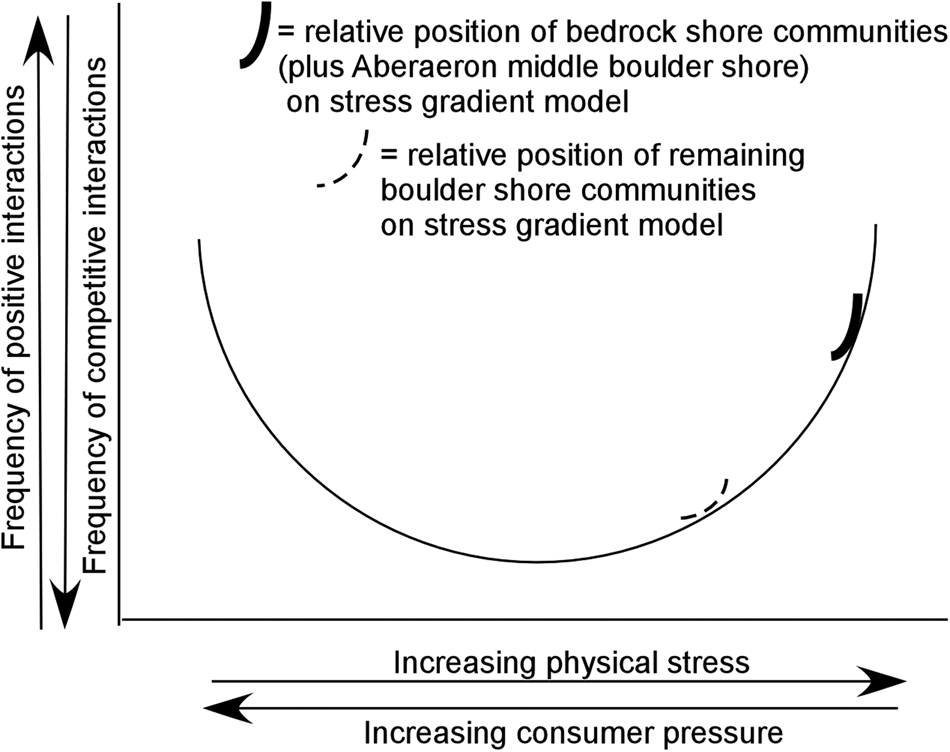
Bertness & Leonard (Reference Bertness and Leonard1997) suggested that, if positive interactions between species are characteristic of stressful environments, then they should be ‘generally important’ in intertidal environments, which have pronounced physical gradients. Maestre et al. (Reference Maestre, Callaway, Valladares and Lortie2009) predicted from the stress-gradient hypothesis (SGH) that the frequencies of facilitative and competitive interactions vary inversely across abiotic stress gradients, facilitation being more common in conditions of high abiotic stress relative to more benign abiotic conditions (see also He et al., Reference He, Bertness and Altieri2013). Hart & Marshall (Reference Hart and Marshall2013) applied the SGH to bryozoans, while Kawai & Tokeshi (Reference Kawai and Tokeshi2007) applied it to goose barnacles (Capitulum mitella) and mussels (Septifer virgatus). Acknowledging that most empirical evidence for the SGH had come from plant communities and sessile marine organisms, Barrio et al. (Reference Barrio, Hik, Bueno and Cahill2013) applied it to terrestrial herbivores, and found no evidence of competition dominating in harsh environments. It is not possible using our observational data to assess the occurrence of such mutually beneficial relationships between species in our dataset. We do not know the microhabitat preferences for the calcareous meiofauna on the alga. Thus, although we have recorded some positive correlations between sessile, vagile and both sessile + vagile taxa, we cannot say if these were due to mutualism, in which both species thrive because of the beneficial effects of the other (see Morin, Reference Morin1999). Nor can we exclude the possibility that these positive correlations were due to the impact of selective predation by a predator that is not part of our dataset, or a superior competitor, this allowing the persistence of an inferior competitor (cf. Paine, Reference Paine1969, Reference Paine1974). However, Bertness & Callaway (Reference Bertness and Callaway1994) presented a conceptual framework for the relative frequencies of positive and negative species interactions with increasing physical stress. They indicated disturbance, such as by storms, among their stressors (Bertness & Callaway, Reference Bertness and Callaway1994, Table 1). We are thus able to suggest the positions of our sampled sites on their conceptual model (Figure 4). This positioning suggests that Ceinewydd, Aberaeron MS and Aberystwyth Victoria Terrace Rocks, the spirorbid-dominated meiofauna of which suggests they might subject to the highest levels of disturbance, should have the greatest frequencies of positive, mutualistic interactions. In contrast, Llanina, Aberaeron LS and Llanon, where there were diverse foraminiferal communities, should have the greatest frequencies of competitive interactions.
The relative positions of sampled sites along the stress gradient as hypothesized from our data.

Conclusions
Our study is the first to examine spirorbid, foraminiferal, bryozoan and other calcareous taxocenes on Corallina officinalis. It thus notes associations not previously detected. The sessile and vagile communities live preferentially at different sites. The abundance of the sessile community is an order of magnitude greater than that of the vagile community.
Sessile organisms were found to be at their most abundant on C. officinalis at bedrock sites. In contrast, vagile organisms were most abundant at boulder-field sites. We suggest that this might reflect differences in wave energy, the boulder-fields disrupting waves to induce lower energy turbulence. The sessile association was much more abundant than the vagile one. This may reflect the different modes of life. Sessile creatures have a small attachment area and obtain their nutrition through suspension feeding. In contrast, at least some of the vagile community obtain nutrition by grazing, whether on the biofilm on the alga, or on other sessile creatures. This will give the vagile community members larger ecological footprints, hence limiting this community's carrying capacity.
There were differences between the bedrock site communities, two sites supporting primarily spirorbid worms, and a third supporting bryozoans. We suggest that this might reflect differences in wave energy, although indirect effects due to the variable nature of the alga cannot be ruled out. There is no simple, linear relationship between densities of the vagile and sessile communities, whereby one simply replaces the other as wave-storm energy increases. Instead, we found three distinct biofacies:
(1) Dominantly firmly cemented spirorbid worms at two lower shore bedrock sites and one middle shore boulder-field coastline site.
(2) Dominantly firmly cemented bryozoans at one lower shore bedrock site.
(3) Dominantly sessile and vagile foraminifera on three lower shore boulder-field sites.
The results of this study have potential applications. First, monitoring of the foraminiferal community at Llanina, especially adjacent to the Afon Lleithi, could be used to assess the efficacy of any attempts to improve water quality there. Second, the Ceredigion coastline has seen efforts to mitigate the effects of storm damage and longshore drift, as evidenced by the groynes at Aberaeron and Aberystwyth. Given the almost annual storms experienced at Aberystwyth, and the associated high costs of damage repairs, it is likely that further attempts will be made to mitigate wave impacts there. Monitoring the densities and community compositions of calcareous epiphytes on C. officinalis is one tool whereby the effectiveness of such efforts can be assessed.
Supplementary material
The supplementary material for this article can be found at https://doi.org/10.1017/S0025315420001174.
Acknowledgements
BW would like to thank the staff at the Cardigan Bay Marine Wildlife Centre, Ceinewydd (Sarah Perry, Laura Evans, Aline Denton) and Caroline Maybury for directing him to suitable sample sites and for discussions. John Murray provided much of the foraminiferal literature cited. Thanks are due to the anonymous reviewer.
Financial support
This research received no specific grant from any funding agency, commercial or not-for- profit sectors.