Introduction
The Baoshan Block in western Yunnan, China is known as a Gondwana-derived continental block that was located in the northern margin of Gondwana during the Early Permian (Wang, Reference Wang1983; Jin, Reference Jin1994; Metcalfe, Reference Metcalfe1996, Reference Metcalfe2002; Wopfner and Jin, Reference Wopfner and Jin2009). The paleogeographic and paleoclimatic evolution of this block thus is important in relation to the historical changes of Gondwana dispersion and Asian accretion. Fusulinidae, as a Paleozoic environmentally sensitive marine taxon and index fossil group for Permo-Carboniferous biostratigraphy, offers unique insights into the paleogeographic and paleoclimatic reconstruction of the Baoshan Block.
Previous studies on fusulinids of the Baoshan Block were more focused on early Permian (Cisuralian) occurrences than on middle Permian (Guadalupian) ones. Only a few middle Permian genera have been described or illustrated until recently (Shi et al., Reference Shi, Yang and Jin2005; Wang et al., Reference Wang, Ueno, Mizuno and Sugiyama2001; Ueno, Reference Ueno2001, Reference Ueno2003). Due to the lack of reliable illustration, Ueno (Reference Ueno2003) considered that the Baoshan Block was devoid of neoschwagerinids and verbeekinids, and thus lay in temperate-water region during the middle Permian. The first detailed work on fusulinid biostratigraphy of the Baoshan Block was conducted by Huang et al. (Reference Huang, Jin, Shi and Yang2009). That work also confirmed the presence of neoschwagerinids and verbeekinids, which tend to suggest a tropical/subtropical warm-water condition.
Subsequently, many specimens belonging to Verbeekina Staff, Reference Staff1909 have been found in an outcrop above the Xiaoxinzhai section, which was initially measured in 2005 (Huang et al., Reference Huang, Jin, Shi and Yang2009). In 2005, the Verbeekina-bearing bed was covered by part of a corn field. This discovery is significant for an update on fusulinid biostratigraphy of the Baoshan Block. More importantly, this assemblage is dominated by typically warm-water taxa on the one hand, and with relatively low total diversity on the other hand. Such compositional features signify certain environmental stress, and furnish clues for better understanding the thermal condition of the middle Permian seawater of the Baoshan Block. The purpose of this paper is to describe this new Verbeekina assemblage and discuss its paleoclimatic implications.
Geological setting
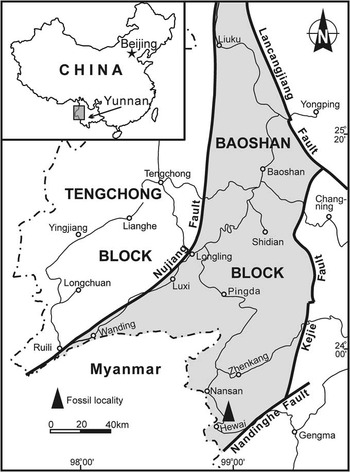
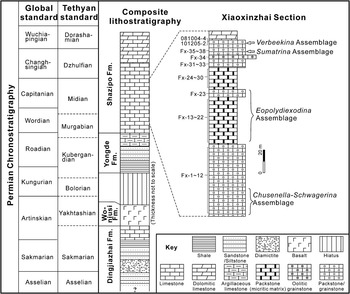
The Baoshan Block in western Yunnan, southwest China, is confined on the east by the Lancangjiang, Kejie, and Nandinghe faults, and on the west by the Nujiang Fault (Fig. 1). The Permian in the southern Baoshan Block can be divided, in ascending order, into the Dingjiazhai, Woniusi, Yongde, and Shazipo formations (Fig. 2). The Dingjiazhai Formation is usually less than 200 m thick and represents a transgressive sequence comprised of diamictite, pebbly mudstone, sandstone, siltstone, shale, and limestone. These diamictites have been interpreted as glacio-marine deposits and are prominent in the northern Baoshan Block, but much less developed in its southern part (Wang, Reference Wang1983; Fan and Fang, Reference Fan and Fang1992; Jin, Reference Jin1994, Reference Jin2002). Fossils in this formation are characterized by cool-water taxa with Gondwanan affinity, including brachiopods, small solitary corals, and spores and pollen (Fang, Reference Fang1994; Fang and Fan, Reference Fang and Fan1994; Gao, Reference Gao1998; Fang et al., Reference Fang, Wang, Shi, Zhou and Xiao2000; Shi et al., Reference Shi, Fang and Archbold1996; Shen et al., Reference Shen, Shi and Zhu2000; Wang et al., Reference Wang, Ueno, Mizuno and Sugiyama2001). According to these sedimentary and paleontological data, the Baoshan Block has been well accepted to be located at the northern margin of Gondwana in the early Permian (Wang, Reference Wang1983; Jin, Reference Jin1994; Wopfner, Reference Wopfner1996; Wang et al., Reference Wang, Ueno, Mizuno and Sugiyama2001; Metcalfe, Reference Metcalfe2002). Brachiopods from this formation are of Asselian to Artinskian age (Shi et al., Reference Shi, Fang and Archbold1996; Shen et al., Reference Shen, Shi and Zhu2000), whereas spores and pollen are of Asselian to early Sakmarian (Tastubian substage) age (Gao, Reference Gao1998; Fang et al., Reference Fang, Wang, Shi, Zhou and Xiao2000). Fusulinids from the limestones in the top of this formation are dominated by Eoparafusulina Coogan, Reference Coogan1960 and Pseudofusulina Dunbar and Skinner, Reference Dunbar and Skinner1931, and suggest a Sakmarian age, probably late Sakmarian (Sterlitamakian substage) (Fang et al., Reference Fang, Wang, Shi, Zhou and Xiao2000; Shi et al., Reference Shi, Huang, Jin and Yang2011); conodonts tend to indicate a middle Artinskian age (Ueno et al., Reference Ueno, Mizuno, Wang and Mei2002; Ji et al., Reference Ji, Yao, Jin, Yang, Wang, Yang and Wu2004). Upwards, basalts of the Woniusi Formation (400–700 m) interrupt the normal marine sedimentation. The eruption of these basalts probably denotes the inception of rifting of this block from Gondwana (Wopfner, Reference Wopfner1996; Shi and Archbold, Reference Shi and Archbold1998). Some sedimentary intercalations occur in the basalts and contain similar fossils to those from the top part of the Dingjiazhai Formation (Jin, Reference Jin2002; Wang et al., Reference Wang, Shi and Sugiyama2002; Jin et al., Reference Jin, Huang, Shi and Zhan2011). The Yongde Formation (~380 m thick) disconformably overlies the Woniusi basalts and consists of variegated siliciclastic sediments in its lower part and medium-bedded argillaceous limestone in its upper part. Three assemblages of brachiopods have been reported from its lower part and are believed to span from latest Artinskian to Wordian in age (Shen et al., Reference Shen, Shi and Fang2002). The upper argillaceous limestones are fossilliferous and bear a Cyathaxonia coral fauna and a Waagenites-Costiferina brachiopod fauna, suggesting a Wordian–Capitanian age (Shi and Archbold, Reference Shi and Archbold1998; Wang et al., Reference Wang, Shi and Sugiyama2002). The Yongde Formation is succeeded by the Shazipo Formation (300–400 m thick), which mainly is comprised of thick-bedded to massive limestone with dolomitic limestone to dolomite in its upper part. We have previously studied three Middle Permian fusulinid assemblages, characterized by Chusenella Hsu, Reference Hsu1942 emend. Chen, Reference Chen1956, Eopolydiexodina Wilde, Reference Wilde1975, and Sumatrina Volz, Reference Volz1904, respectively, from the Shazipo Formation of the Xiaoxinzhai Section (Huang et al., Reference Huang, Jin, Shi and Yang2009), which is exposed near Hewai Village and about 50 km west of Gengma Town in the southern Baoshan Block (Fig. 1). The new Verbeekina assemblage occurs a short distance above the beds containing abundant Sumatrina in the Xiaoxinzhai Section (Fig. 2). According to field observations, the outcrop containing this new assemblage is an upward extension of the measured Xiaoxinzhai Section.
Locality map of the Xiaoxinzhai section in southern Baoshan Block in western Yunnan, China.

Composite stratigraphic column of the Permian and fusulinid distribution in the Shazipo Formation of the Xiaoxinzhai Section in southern Baoshan Block in western Yunnan, China. Permian chronostratigraphy of global and Tethyan standard is based on Jin et al. (1997) and Leven (Reference Leven2004), respectively. The dashed lines in the column of Tethyan standard indicate where the correlation between the global and Tethyan standard remains uncertain.

Verbeekina assemblage
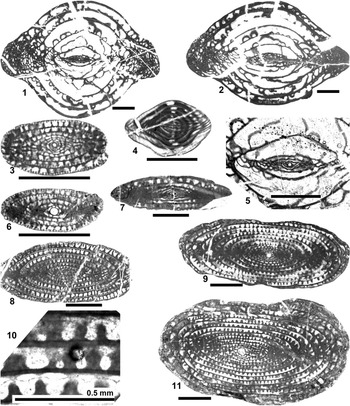
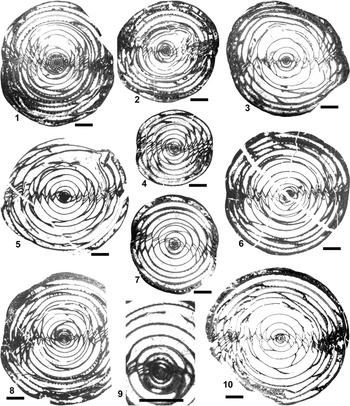
The newly discovered Verbeekina assemblage consists of 11 species belonging to six genera (Figs. 3, 4): Verbeekina verbeeki (Geinitz, 1876); V. americana Thompson, Wheeler and Danner, 1950; V. aff. americana; V. sp., Pseudodoliolina pseudolepida (Deprat, Reference Deprat1912); P. cylindrica Skinner and Wilde, Reference Skinner and Wilde1966; Sumatrina annae brevis Leven, Reference Leven1967; S. aff. annae minima Nie and Song, Reference Nie and Song1983; Xiaoxinzhaiella subrotunda Huang, Reference Huang2010; ?Rugosochusenella Skinner and Wilde, Reference Skinner and Wilde1965; and an undetermined species of Yangchienia Lee, Reference Lee1933. Among them, species of Verbeekina and Pseudodoliolina Yabe and Hanzawa, Reference Yabe and Hanzawa1932 are significant in biochronology. Verbeekina verbeeki, as an advanced species of this genus, is diagnostic of the Murgabian to Midian strata throughout the Tethyan region (e.g., Thompson, Reference Thompson1936; Sheng, Reference Sheng1963; Skinner and Wilde, Reference Skinner and Wilde1966; Leven, Reference Leven1967; Toriyama et al., Reference Toriyama, Kanmera, Kaewbaidhoam and Hongnusonthi1974; Kahler and Kahler, Reference Kahler and Kahler1979; Leven and Okay, Reference Leven and Okay1996; Ueno, Reference Ueno1996; Kotlyar et al., Reference Kotlyar, Baud, Pronina, Zakharov, Vuks, Nestell, Belyaeva and Marcoux1999; Kobayashi, Reference Kobayashi2011, Reference Kobayashi2012a). V. americana was first reported in the Verbeekina-Neoschwagerina Yabe, Reference Yabe1903 zone from Twin Lakes of Washington State, US (Thompson et al., Reference Thompson, Wheeler and Danner1950), and later found in Murgabian–Midian limestones of north Afghanistan (Leven, Reference Leven1997). Pseudodoliolina pseudolepida in this assemblage has large size and differentiated spirotheca in outermost volutions (Fig. 3.10). These morphological characteristics are evolutionarily advanced in the Pseudodoliolina lineage (Zhu, Reference Zhu1998), and resemble P. gravitesta (Kanmera, Reference Kanmera1954) in the Lepidolina Lee, Reference Lee1933 fauna from Sichuan Province, China (Rui, Reference Rui1983). As to its stratigraphic distribution, Pseudodoliolina pseudolepida was initially identified from Yunnan of China and the Pong-Oua limestone of Laos in association with Neoschwagerina and Sumatrina (Deprat, Reference Deprat1912). Subsequently, it has been widely reported in the Neoschwagerina zone to Yabeina Deprat, Reference Deprat1914 zone from South China, Turkey, central and northeast Thailand, Kitakami Massif, and Akiyoshi Limestone of Japan (Thompson and Foster, Reference Thompson and Foster1937; Hanzawa and Murata, Reference Hanzawa and Murata1963; Sheng, Reference Sheng1963; Kahler and Kahler, Reference Kahler and Kahler1979; Toriyama and Kanmera, Reference Toriyama and Kanmera1977, Reference Toriyama and Kanmera1979; Ueno, Reference Ueno1996). Also notable is the occurrence of Xiaoxinzhaiella Shi, Yang, and Jin, Reference Shi, Yang and Jin2005, which was separated from Rugososchwagerina Miklukho-Maklay, Reference Miklukho-Maklay1959 by Shi et al (Reference Shi, Yang and Jin2005). In their opinion, Xiaoxinzhaiella distinctly differs from Rugososchwagerina by its plane septa in the juvenarium (Fig. 3.5) and spans from Murgabian to Midian in age, because it is often accompanied by Eopolydiexodina afghanensis (Thompson, Reference Thompson1946) and E. darwasica (Dutkevich, Reference Dutkevich1939). Rugososchwagerina xanzensis Wang, Sheng, and Zhang, Reference Wang, Sheng and Zhang1981 from the Murgabian strata in the Lhasa Block of Tibet (Wang et al., Reference Wang, Sheng and Zhang1981) and the Abadeh region of Central Iran (Kobayashi and Ishii, Reference Kobayashi and Ishii2003), and at least some specimens of R. altimurica Leven, Reference Leven1997 (Leven, Reference Leven1997, pl. 5, fig. 7) from Midian deposits of South Afghanistan have unfluted septa in innermost whorls, and thus should be reallocated under Xiaoxinzhaiella. These elements in this Verbeekina assemblage altogether suggest a Murgabian to Midian age. Furthermore, the Verbeekina assemblage rests above the Sumatrina assemblage in the Xiaoxinzhai Section (Fig. 2). The Sumatrina assemblage was dated as Midian in age (Huang et al., Reference Huang, Jin, Shi and Yang2009), mainly on the presence of Sumatrina longissima Deprat, Reference Deprat1914, which is a typical Midian species of Sumatrina with a large form ratio and well-developed septula system (Leven, Reference Leven1996, Reference Leven2004) and characteristic in the Midian strata of South China, Japan, and Iran (Douglas, Reference Douglas1950; Sheng, Reference Sheng1956; Ueno, Reference Ueno1996; Kobayashi, Reference Kobayashi2012b). Taking all these into account, the Midian (approximately Capitanian) age of the Verbeekina assemblage is inferred.
Representatives of the Verbeekina assemblage from the Shazipo Formation of the Xiaoxinzhai Section in southern Baoshan Block in western Yunnan, China, part 1. (1, 2, 5), Xiaoxinzhaiella subrotunda Huang, Reference Huang2010, Cat. Nos. 081004-4-23, 081004-4-27, (5) is the enlargement of Figure 3.1, showing the plane septa in the innermost volutions; (3, 6), Sumatrina aff. annae minima Nie and Song, Reference Nie and Song1983, cat. nos. 101205-2-1-7, 101205-2-1-4; (4), Yangchienia sp., cat. no. 101205-2-4-5; 7, ?Rugosochusenella Skinner and Wilde, Reference Skinner and Wilde1965, cat. no. 101205-2-2-1; (8), Sumatrina annae brevis Leven, Reference Leven1967, cat. no. 101205-2-4-12; (9), Pseudodoliolina cylindrica Skinner and Wilde, Reference Skinner and Wilde1966, cat. no. 101205-2-4-4; (10, 11), Pseudodoliolina pseudolepida (Deprat, Reference Deprat1912), cat. no. 101205-2-6-1-2; (10) is the enlargement of Figure 3.11, showing the relatively thick and differentiated spirotheca with texture of indistinct vertical lines in the outermost volutions. Scale bar represents 1 mm unless otherwise indicated.

Representatives of the Verbeekina assemblage from the Shazipo Formation of the Xiaoxinzhai Section in southern Baoshan Block in western Yunnan, China, part 2. (1), Verbeekina aff. americana Thompson, Wheeler and Danner, 1950, cat. no. 101205-2-6-7; (2–4, 7), Verbeekina americana, cat. nos. 101205-2-6-10, 101205-2-5-5, 101205-2-1-19, 101205-2-1-8; (5), Verbeekina sp., cat. no. 081004-4-8. (6, 8–10), Verbeekina verbeeki (Geinitz, 1876), cat. nos. 081004-4-18, 081004-4-12, 081004-4-16; (9) is the enlargement of Figure 4.8, showing the well-developed parachomata in juvenile volutions and absence of parachomata in transitional volutions. Scale bar=1 mm.

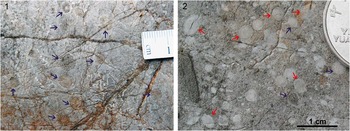
This Verbeekina assemblage bears two compositional features that are unusual: low total diversity and overwhelming dominance of Verbeekina. The generic and specific diversities of this assemblage are relatively low, compared with coeval fusulinids from South China that represent a paleo-tropical setting. Even taking account of the underlying Sumatrina assemblage, the Midian fusulinids in the Xiaoxinzhai Section yield only 24 species of ten genera. In contrast, Midian fusulinids include up to 16 genera in sections from South China, e.g., in the Sazhi Section or Houchang Section of Guizhou Province; the number of Midian species in each of these two sections is over 35 (Xiao et al., Reference Xiao, Wang, Zhang and Dong1986). Meanwhile, many characteristic Midian fusulinids in the Tethyan region have hitherto not been found in the Xiaoxinzhai Section, e.g., Yabeina, Lepidolina, Neoschwagerina, Codonofusiella Dunbar and Skinner, Reference Dunbar and Skinner1937, Dunbarula Thompson, Reference Thompson1942, and Reichelina Erk, Reference Erk1941 (Leven, Reference Leven1996, Reference Leven2004). It is enigmatic that Neoschwagerina is absent in this Verbeekina assemblage (Fig. 5.1) because these two genera usually constitute a typical middle Permian association throughout the Tethyan region, e.g., South China (Fig. 5.2).
Comparison of outcrops yielding the Verbeekina assemblage in the Baoshan Block in western Yunnan, China (1) and Guizhou Province, South China (2). Blue and red arrows indicate Verbeekina and Neoschwagerina, respectively. Note the dominance of Verbeekina and absence of Neoschwagerina in the left and both abundant Neoschwagerina and Verbeekina in the right.

Also noteworthy is the overwhelming dominance of Verbeekina in terms of both specimen abundance and specific diversity. The great abundance of Verbeekina individuals are easily discerned on the outcrop (Fig. 5.1). In thin sections, over 70% of the fusulinid individuals belong to Verbeekina. Individuals of Sumatrina and Pseudodoliolina are less common, while those of the remaining genera are sporadic. In contrast, the individual abundance of Verbeekina, Neoschwagerina, and Pseudodoliolina are more or less comparable in most coeval assemblages in South China. Verbeekina is most diverse with four species, followed by Pseudodoliolina (two species) and Sumatrina (two species) in the studied Verbeekina assemblage. The former two genera belong to Verbeekinidae and the third to Neoschwagerinidae. The associated fusulinids of other families are less diversified and restricted to Xiaoxinzhaiella subrotunda and ?Rugosochusenella (Schwagerinidae), and Yangchienia sp. (Fusulinidae). On the contrary, Schwagerinidae is more predominant and constitutes over half of the Murgabian species richness in this same Xiaoxinzhai Section (Huang et al., Reference Huang, Jin, Shi and Yang2009).
Carbonate facies
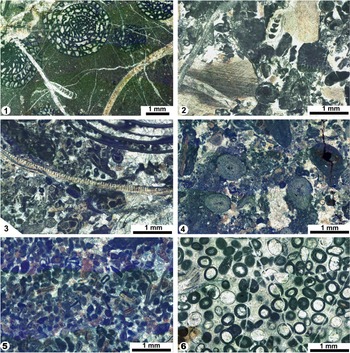
The outcrop containing the Verbeekina assemblage occurs close to the top of the limestone portion of the Shazipo Formation in the Xiaoxinzhai Section (Fig. 2). Forty samples were consecutively collected from the bottom of the Shazipo Formation to the level of the Verbeekina assemblage (Fig. 2). Results of X-ray diffraction of these samples reveal that most beds are devoid of siliciclastic content and only a few levels contain minor amounts of quartz (maximum 3.4%). These limestone samples are largely classified into two facies types: (1) packstone with micritic matrix, and (2) packstone to grainstone with mainly sparitic matrix (Fig. 6). Sample Fx-13~22 and Sample Fx-24~30 belong to Facies 1 (Fig. 6.1). In this facies type, relatively monotonous allochems are scattered in micritic matrix. Skeletal grains consist of fusulinids, smaller foraminifera, and fragments of calcareous green algae, bryozoans, and echinoderms, whereas non-skeletal grains are not contained. These facies characters signify a calm, shallow-marine environment.
Photomicrographs of carbonate facies of the Shazipo Formation of the Xiaoxinzhai Section in southern Baoshan Block in western Yunnan, China. (1), packstone with micritic matrix; note absence of non-skeletal allochems; (2), packstone with sparitic matrix, containing echinoderms, green algae and smaller foraminifera; (3, 4), packstone to grainstone with sparitic matrix, containing abundant bryozoans in (3) and problematica (Ungdarella) in (4), respectively; (5), peloidal packstone to grainstone with sparitic matrix; (6), oolitic grainstone, the concentric lamination is well preserved in a few ooids, but more or less leached in others.

Facies 2 differs from Facies 1 in the sparitic matrix as well as diverse allochems (Fig. 6.2–6.6). Fossil groups are diverse in this facies and comprise fusulinids, smaller foraminifera, green algae, problematica (Tubiphytes), brachiopods, echinoderms, bryozoans, and corals. In terms of the non-skeletal grains, this facies can be further divided into two subtypes. In subtype 1, lithoclasts are evident in addition to rare peloids, but ooids and aggregate grains are absent (Fig. 6.2). Sample Fx-1~12 in the lower part of this measured section (Fig. 2) are assigned to the subtype 1. Subtype 2 is characterized by common presence of peloids, ooids, and aggregate grains (Figs. 6.3–6.6). Ooids first appear in Sample Fx-23 and, together with aggregate grains and peloids, become gradually abundant upward. In Sample Fx-34, well-sorted concentric ooids are so abundant to form oolitic grainstone (Fig. 2, Fig. 6.6), and skeletal grains are impoverished with just fusulinids and algal fragments. These lines of evidence suggest that the Facies 2 was deposited in an open, shallow-marine environment with relatively high water energy and the oolitic grainstone, especially, formed in a platform sand shoal.
The host rocks (Sample 081004-4, 101205-2) of the Verbeekina assemblage belong to the subtype 2 of Facies 2 (Figs. 6.3–6.4). Bioclastic grains in these rocks are diverse and more or less abraded, comprising fusulinids, smaller foraminifera, algae, brachiopods, echinoderms, bryozoans, and phylloid algae. Among them, fusulinids and smaller foraminifera are predominant; problematica (Ungdarella) and fragments of bryozoans are also abundant, while green algae are rare. Non-skeletal grains mainly consist of peloids, aggregate grains, and intraclasts, mostly sand-sized. All these allochems are subrounded in shape, closely packed, poorly sorted, and mainly cemented by blocky calcite spar. These features of carbonate facies indicate that the Verbeekina assemblage lived in open, shallow-marine water with moderate agitation.
Paleoclimatic interpretation
The discovery of the new Verbeekina assemblage furnishes critical material to better understand the middle Permian paleoclimate of the Baoshan Block. The Family Verbeekinidae and Neoschwagerinidae have been acknowledged as typically warm-water taxa (Gobbett, Reference Gobbett1967; Ross, Reference Ross1982, Reference Ross1995; Stevens, Reference Stevens1985; Ozawa, Reference Ozawa1970; Ueno, Reference Ueno2003) because they abound in limestone with abundant green algae (e.g. Mizzia, Gymnocodium) and reef-building corals (e.g. waagenophyllids) (Gobbett, Reference Gobbett1967; Ozawa, Reference Ozawa1970), and have test architecture similar to that of extant alveolinids, which live in the neritic zone of the tropical and subtropical Indo-Pacific (Gobbett, Reference Gobbett1967). The presence of these two families was confirmed by Huang et al. (Reference Huang, Jin, Shi and Yang2009) in the Murgabian strata of the Xiaoxinzhai Section. This indicates that the water temperature of the Baoshan Block has been notably ameliorated during the middle Permian compared to the early Permian, when glaciogenic diamictites and cool-water brachiopods and corals were deposited. The dominance of these two families in the studied Verbeekina assemblage suggests that the water temperature of the Baoshan Block probably became even warmer in the Midian than in the Murgabian. Such inference is also corroborated by the occurrence of oolitic grainstone immediately below the Midian Sumatrina assemblage because ooids are characteristic in warm-water carbonate facies (James, Reference James1997; Flügel, Reference Flügel2010).
On the other hand, the composition of the Verbeekina assemblage still indicates somewhat stressful conditions. The comparison in previous section has demonstrated that this assemblage has rather abundant Verbeekina specimens and relatively low total diversity, compared with coeval fusulinids from South China, which maintained its position near paleo-equator during the Permian (Metcalfe, Reference Metcalfe2002; Scotese, Reference Scotese2004). Low overall diversity and abundance of rather few taxa of a foraminiferal assemblage are generally interpreted to indicate certain environmental stress (Belasky, Reference Belasky1996; Dixon and David, 2004; Jones, Reference Jones2014). The majority of fusulinid genera thrived in open, shallow, warm-water carbonate-dominated environments without significant siliciclastic input (Ozawa, Reference Ozawa1970; Sheng et al., Reference Sheng, Zhang and Wang1988; Ross, Reference Ross1995; Davydov and Arefifard, Reference Davydov and Arefifard2007). Accordingly, a stressful environment for fusulinids could result from siliciclastic sedimentation, low water temperature, and restricted circulation with varying salinity (Pitakpaivan, Reference Pitakpaivan1965; van Ginkel, Reference Van Ginkel1973; Zhou and Sheng, Reference Zhou and Sheng1994; Forke, Reference Forke2002; Baranova and Kabanov, Reference Baranova and Kabanov2003; Ueno, Reference Ueno2003; Della Porta et al., Reference Della Porta, Villa and Kenter2005). Specifically, Verbeekina has long been believed to live in warm, clear, and agitated shallow-marine water with normal salinity and in association with green algae and corals (Gobbett, Reference Gobbett1967; Ozawa, Reference Ozawa1970; Ross, Reference Ross1982). Dawson and Racey (Reference Dawson and Racey1993), however, stated that Verbeekina could also inhabit more restricted inner lagoon environments, based on the analysis of carbonate facies and fusulinids from the Rat Buri limestone near Sara Buri area of central Thailand. Nevertheless, the Verbeekina assemblage in the Xiaoxinzhai Section occurs in a pure limestone succession and the carbonate facies analysis has unraveled that this assemblage lived in an energetic, open-marine environment. Therefore, either siliciclastic impairment or restricted circulation can be easily excluded. The most likely scenario would be that the Baoshan Block was still located in a subtropical setting during the Midian and hosted warm, but not as optimal, water masses as tropical South China for the diversification of fusulinids. The rareness of green algae and abundance of bryozoans (Figs. 6.3–6.4) in association within the Verbeekina assemblage seems consistent with this interpretation.
Systematic paleontology
Classification in this paper follows the scheme of Loeblich and Tappan (Reference Loeblich and Tappan1988) and Sheng et al. (Reference Sheng, Zhang and Wang1988). All samples and thin sections are housed in the Institute of Geology, Chinese Academy of Geological Sciences.
Family Verbeekinidae Staff and Wedekind, Reference Staff and Wedekind1910
Genus Verbeekina Staff, Reference Staff1909
Verbeekina verbeeki (Geinitz, 1876)
1876 Fusulina verbeeki Geinitz, p. 399–400.
1992 Verbeekina verbeeki; Ueno, p. 1045, pl. 5, figs. 1–6, pl. 6, figs. 1–5 [see for synonymy].
1993 Verbeekina verbeeki; Ueno and Sakagami, p. 286, pl. 4, figs. 1–5 [see for synonymy].
1996 Verbeekina verbeeki; Leven and Okay, pl. 5, fig. 1.
1996 Verbeekina verbeeki; Ueno, pl. 4, figs. 1–3.
2011 Verbeekina verbeeki; Kobayashi, p. 492, pl. 17, figs. 34–36, pl. 20, figs. 1–13, pl. 21, figs. 1–5.
2012a Verbeekina verbeeki; Kobayashi, p. 340, pl. 1, figs 8–10.
Description
Test spherical with slightly depressed umbilici. 12–14 volutions, 6.94–7.66 mm long, 7.27–7.78 mm wide, and form ratio 0.95–0.98:1. Proloculus unseen, inner volutions discoidal with round periphery, later whorls gradually become spherical. Parachomata absent in transitional volutions and well developed in mature stage. Foramina round and numerous.
Occurrence
Widespread in Murgabian-Midian deposits of West Sumatra, western Yunnan of southwest China, South China, Lhasa Block of Tibet, central and eastern Thailand, Pamir, Akiyoshi and Akasaka Limestone in Japan, Sicily of Italy, Turkey, Iran, and exotic limestone blocks in southern Crimea.
Verbeekina americana Thompson, Wheeler and Danner, 1950
1950 Verbeekina americana Thompson, Wheeler and Danner, p. 57, pl. 5, figs. 1–6.
1997 Verbeekina americana; Leven, p. 75, pl. 21, fig. 10.
Description
Test spherical with form ratio 0.86–0.98:1. 9–13.5 volutions, 3.92–6.9 mm in length and 4.36–6.92 mm in width. Proloculus ~0.09 mm in diameter. No distinct parachomata in juvenile and transitional volutions; triangular, small, and low parachomata present in outer volutions.
Occurrence
Murgabian-Midian deposits of western Yunnan of southwest China, northwest United States, and northern Afghanistan.
Remarks
This species closely resembles Verbeekina verbeeki, but has fewer volutions and less well-developed parachomata.
Verbeekina aff. americana Thompson, Wheeler and Danner, 1950
Description
Test spherical with form ratio 0.89:1. Seventeen volutions, 6.59 mm long and 7.42 mm wide. Proloculus unseen. Parachomata poor in juvenarium, absent in transitional volutions. Small and low parachomata present in later stage.
Remarks
This specimen is similar to Verbeekina americana, but with more volutions and a larger size.
Verbeekina sp.
Description
Test spherical with flat umbilici. 10–15.5 volutions, 4.97–6.93 mm long, 5.38–7.09 mm wide, and form ratio 0.81–1.04:1. Proloculus unseen, but could not be large in diameter. Initial volutions discoidal with round periphery, irregularly coiled. Parachomata distinct and triangular in innermost volutions, could be half as high as respective chamber, absent in transitional volutions. Small and low parachomata sporadically present in outer volutions. Circular foramina could be observed. Spirotheca relatively thick in juvenarium (e.g., 0.051 mm), so thin in following whorls (e.g. 0.029 mm) that sometimes seems undifferentiated, become obviously thicker (e.g. 0.171 mm) in adult stage and composed of tectum and very fine keriotheca and inner tectorium.
Remarks
These specimens are similar to Verbeekina verbeeki, but they have thicker spirotheca in the juvenarium and less developed parachomata in outermost volutions.
Genus Pseudodoliolina Yabe and Hanzawa, Reference Yabe and Hanzawa1932
Pseudodoliolina pseudolepida (Deprat, Reference Deprat1912)
1912 Doliolina pseudolepida Deprat, p. 46, pl. 5, figs. 6–9, pl. 6, fig. 4.
1992 Pseudodoliolina pseudolepida; Ueno, p. 1049, pl. 7, figs. 1–10 [see for synonymy].
Description
Test fusiform with form ratio 1.96 to over 2.13:1. 13–14 volutions, 6.36 mm to over 7 mm long, and 3.25–3.47 mm wide. Proloculus 0.21–0.31 mm diameter. Parachomata well developed, broad in shape, and could be over three-fourths the height of respective chamber. The spirotheca relatively thick and differentiated into a dark tectum and less dense inner layer with indistinct vertical lines in mature stage (Fig. 3.10). Such lines seem to be similar to, but much less distinct than the alveolar structure of the keriotheca.
Occurrence
Murgabian–Midian strata of western Yunnan of southwest China, South China, Turkey, central and northeast Thailand, and Kitakami Massif and Akiyoshi Limestone of Japan.
Pseudodoliolina cylindrica Skinner and Wilde, Reference Skinner and Wilde1966
1966 Pseudodoliolina cylindrica Skinner and Wilder, p. 34, pl. 27, figs. 1–7, pl. 28, figs. 1–3.
Description
Test fusiform with form ratio 2.07–2.28:1. 10.5–12 volutions, 4.86–5.46 mm long, and 2.32–2.42 mm wide. Proloculus 0.16–0.21 mm in diameter. Parachomata well developed. Many parachomata are high and narrow, and could reach the ceiling of the respective chamber. Spirotheca very thin and with only tectum, becomes slightly thicker in outermost two or three volutions.
Occurrence
Murgabian–Midian of western Yunnan in southwest China and northwest America.
Remarks
This species is similar to Pseudodoliolina chinghaiensis Sheng, Reference Sheng1958, but it differs from the latter in larger form ratio and higher parachomata.
Family Neoschwagerinidae Dunbar and Condra, Reference Dunbar and Condra1927
Genus Sumatrina Volz, Reference Volz1904
Sumatrina annae brevis Leven, Reference Leven1967
1904 Sumatrina annae Volz, p. 98–100, figs. 27–31.
1967 Sumatrina annae brevis Leven, p. 201, pl. 37, figs. 4–5.
Description
Test fusiform with form ratio 2.09–2.36:1. 7.5–8 volutions, 3.54–4.30 mm long, and 1.69–1.82 mm wide. Proloculus 2.09–2.36 mm in diameter. Parachomata high and narrow, connecting the primary spiral septula. Usually, two secondary spiral septula between a pair of primary spiral septula. The ends of septula clearly swollen.
Occurrence
Late Murgabian to Midian deposits in Pamir and western Yunnan, southwest China.
Remarks
Specimens examined here are identical with Sumatrina annae brevis in all essential morphological characters, although they are with slightly larger form ratio.
Sumatrina aff. annae minima Nie and Song, Reference Nie and Song1983
Description
Test fusiform with form ratio 1.95-2.63:1. 4–7.5 volutions, 1.44–1.62 mm long, and 0.55–0.83 mm wide. Proloculus spherical and 0.07–0.17 mm in diameter. Parachomata narrow and high, connecting primary spiral septula. Two secondary spiral septula can be discerned between a pair of primary ones. Ends of septula slightly swollen.
Remarks
These specimens are similar to Sumatrina annae minima Nie and Song, Reference Nie and Song1983, although they have much smaller proloculus.
Family Fusulinidae Möller, Reference Möller1878
Genus Yangchienia Lee, Reference Lee1933
Yangchienia sp.
Description
Only an oblique section available. Test inflated fusiform with probably 7 volutions, 1.75 mm long, and 1.14 mm wide. Proloculus and innermost volutions unseen. Chomata large and asymmetric in shape, steep in the tunnel side and extend to the polar regions with gentle slope. Tunnel becomes gradually wide through ontogeny.
Family Schwagerinidae Dunbar and Henbest, Reference Dunbar and Henbest1930
Genus Xiaoxinzhaiella Shi, Yang and Jin, Reference Shi, Yang and Jin2005
Xiaoxinzhaiella subrotunda Huang, Reference Huang2010
2010 Xiaoxinzhaiella subrotunda Huang, p. 108, pl. 14, figs. 1–3.
Description
Test subspherical with convex median portion and blunt poles. The lateral slope somewhat concave near the polar region. Eight to 10 volutions, 6.86–7.45 mm long, 4.58–5.29 mm wide, and form ratio 1.37–1.57:1. Proloculus spherical, 0.06–0.09 mm in diameter. Innermost 3–4 volutions very tightly coiled in slender fusiform shape with plane septa. Following 2–3 whorls, gradually expand outward in fusiform shape and outer ones expand into subspherical shape. The coiling of the last volution becomes relatively tight again. Septa plane in juvenarium, become fluted in the interim fusiform volutions and somewhat irregularly fluted in adult stage, forming meshwork in polar ends. Septal folds round and not high. Chomata not obvious.
Occurrence
Midian strata in western Yunnan of southwest China.
Remarks
Shi et al. (Reference Shi, Yang and Jin2005) erected a new genus Xiaoxinzhaiella, based on materials previously identified as Rugososchwagerina from the Xiaoxinzhai area of the Baoshan Block in western Yunnan, southwest China. They argued that Xiaoxinzhaiella differs from Rugososchwagerina in the unfluted septa in juvenarium and such difference is of phylogenetic significance. The specimens examined here show clearly plane septa in innermost tight volutions, but differs from Xiaoxinzhaiella densa and X. xanzensis by its relatively larger form ratio.
Genus Rugosochusenella Skinner and Wilde, Reference Skinner and Wilde1965
?Rugosochusenella
Description
Test elongate fusiform with form ratio 3.54:1. 5.5 volutions, 3.9 mm long, and 1.1 mm wide. Proloculus 0.11 mm in diameter. Inner volutions very tight, outer ones gradually expand outward. Septa plane in juvenarium and fluted in outer whorls. Axial filling present in polar region. Some areas of the spirotheca are obviously rugose.
Remarks
Although the rugosity is not prominent in all test walls, this feature could be observed in restricted local areas of the spirotheca. Besides, this specimen has very few volutions. It is thus assigned to Rugosochusenella with reservation.
Conclusions
The newly discovered Verbeekina assemblage from the Xiaoxinzhai Section provides significant supplementary materials for the fusulinid biostratigraphy of the Baoshan Block. Systematic study shows that this assemblage comprises 11 species of six genera, i.e. Verbeekina, Pseudodoliolina, Sumatrina, Yangchienia, Xiaoxinzhaiella and ?Rugosochusenella. A Midian age is likely for this assemblage, based on the presence of Verbeekina verbeeki, Pseudodoliolina pseudolepida, and its stratigraphic level above the Midian Sumatrina assemblage.
Moreover, the unusual composition of this assemblage offers valuable information for refining the middle Permian paleoclimate of the Baoshan Block. The dominance of verbeekinids and neoschwagerinids in this assemblage indicates that the seawater of the Baoshan Block was warmer in the Midian than in the Murgabian. On the other hand, the Verbeekina assemblage is characterized by relatively low total diversity and overwhelming dominance of just one genus, compared with their counterparts in equatorial South China. Such remarkable distinction suggests that the Baoshan Block was probably located within a subtropical area during the Midian, and its water temperature was still not as ideal for fusulinid diversification as that of tropical water masses.
Acknowledgments
We are indebted to Prof. C. H. Stevens, Prof. F. Kobayashi and associate editor B. T. Huber for their constructive reviews on this paper. We also thank Profs. E. C. Rankey and E. Ja. Leven for their comments on the initial manuscript. Prof. P. H. Muller and Dr. H. C. Forke are appreciated for their discussion about the ecology of foraminifera and controlling factors of carbonate facies. Financial support from National Science Foundation of China (No. 41102007, 41272043), Ministry of Science and Technology (No. J1105), and China Geological Survey (12120113013900) are gratefully acknowledged.