That contemporary dancers know something is not in question. There is little abstract debate about this in the rehearsal studio and in most of the professional networksFootnote 1 that contemporary dance circulates in. That these networks are professional is in part because they rely on contemporary dancers having expert knowledge – the “sine qua non of professional work,” according to social scientists Elizabeth Gorman and Rebecca Sandefur.Footnote 2 Gorman and Sandefur published an article in Work and Occupations surveying changes in the sociological study of professions since the mid-1900s. One of the changes they indicate is the new attention that contemporary social science pays to “the distinction between abstract, formal knowledge and tacit, experiential knowledge.”Footnote 3 According to their article, in the category of professional expertise, knowing what to do is likely to rely on tacit, experiential knowledge to support reasoning when “inference and judgement” is required to resolve various problems. The several studies that they cite look at how this occurs within the professional practices of lawyers, technicians, and physicians. Turning the lens on to contemporary dance as a professional practice with its own area of expertise presents an interesting case for thinking about relations between forms of knowledge.
This article specifically explores the possibility that dance is a field of expert knowledge that can be studied from the perspective of a form of literature created and disseminated by contemporary dance artists. This literature is created with the aim of sharing processes, methods, techniques, and ideas using a variety of formats to circulate what dancers know to a wide readership. One of the questions addressed here is to what extent does this literature communicate the experiential knowledge acquired through dancing and to whom? The question ‘to whom’ draws attention to the uniqueness of dance as a vehicle to discuss ownership and cultural property. There is a particular connection to Hetty Blades’s contribution, which explores some of the implicit rules that govern the sharing and circulation of contemporary dance. Her main focus is on the “slippage between works and processes,” which leaves open the question about the circulation of experiential knowledge in dance practice that this article takes up.Footnote 4
Contemporary dance is a field in which much of the knowledge is acquired through experience in the context of training, rehearsing, and creating. This does not mean, to make use of the Gorman and Sandefur’s terminology, that abstract, formal knowledge is not present but, rather, that it may be entangled with the tacit and experiential in ways that are particularly difficult to separate. For the purpose of clarification, this article does not make the distinction between the practices of dancing and choreographing but, rather, assumes both to rely on experiential knowledge coming into contact with formal knowledge or conceptual thinking. This should become clear in the following examples and is why it is interesting to take into consideration developments in the dance field over the last 20 years that have been drawing attention to the presence of expert knowledge in dance. These developments include a number of artist-led initiatives using digital media to share their creation processes, methods, and techniques with each other and with the wider world. Circulation of this kind of know-how has not been new as dance artists have always shared these processes in various ways. But shifts in the cultural milieu during this 20-year period, such as developments in digital technology as others in this collection address, established a change in the conditions of artistic creation and production that makes it possible to foreground questions about dance knowledge, transmission, and ownership in fresh ways.
Some of these changes have been explored in the newly published edited collection, Performing Process: Sharing Dance and Choreographic Practice. This collection examines the question of “how and why the processes and practices of choreography are increasingly being shared or performed.”Footnote 5 The editors, Hetty Blades and Emma Meehan, introduce the idea that before the twenty-first century there was a history of dance artists performing and sharing process with each other via journals such as Movement Research’s Performance Journal. Footnote 6 However, they describe a shift taking place in the 2000s as evidenced by a growing number of books being published by choreographers, as well as how recorded materials started to become much easier to share online. They posit that a discourse started to evolve around creative process – in particular, around various working scores and notebooks.
Blades and Meehan also highlight the tendency, particularly in a handful of interdisciplinary, artist-initiated, research projects, to disseminate choreography and dance processes as forms of knowledge. Most of these various projects step outside of the traditional norm of artistic valuation focused on the result of a creative process, by emphasizing the potential and value of studying processes in themselves. They are not just a means to learn about and understand how to better appreciate the end product – the performance. Blades and Meehan align their edited collection with “current discourse in dance studies that is frequently concerned with theorizing from ‘inside’ the form, foregrounding the experiences of practice arising from dance and choreography” and reflecting on the “types of knowledge” that this generates.Footnote 7
Having played a role in developing some of the research projects that Blades and Meehan describe, and contributing a chapter to their edited volume, I am familiar with this concept of dance as a form of knowledge that can be made, via some kind of publication, accessible, shared, or transmitted (as was often the term used). In 2013, I wrote and published an article aiming to set the framework for a new discourse emerging from dance practice. Looking back, that article, titled “Publishing Choreographic Ideas,”Footnote 8 assumed too much about the particular conditions from which this discourse would emerge. This assumption leads me now to ask some fundamental questions about what this knowledge is, and what happens with attempts to transmit it, outside of the context of the studio (or other spaces) where it normally circulates from body to body?
In part building on, but also departing from, studies that emphasize and critique the desire to communicate dance knowledge outside the field,Footnote 9 I wish to address the artists’ publications, books, and websites that Blades and Meehan reference in their introduction with the idea of them being dance’s trade literature. By trade literature, I mean something written by someone with knowledge of the field for others with knowledge of the field. Trade literature is often associated with professional areas in industry and business and includes product descriptions and advertising. They often use “the specialized vocabulary of the profession they serve,”Footnote 10 and definitions of trade literature as a category of publication are commonly found in libraries, where collections of trade literature are often stored.Footnote 11 My aim in using the term here is not to compare dance with other professions at this point. The important distinction for this article is between writing that is done by, or in close collaboration with, dance practitioners with the aim of drawing out what they know versus writing about dance in interpretive ways that does not focus on dancers’ expertise.
Here, I find parallels with the work of philosopher and performance scholar Susan Melrose, who makes the frequent observation that “mastery in performance making – along with expertise, professionalism and discipline … is relatively speaking under-theorized in performance studies … and largely absent from the weighty body of performance studies writing.”Footnote 12 Melrose does point toward books published on actor training as a form of trade literature, which is an interesting comparison to be made at a later point.Footnote 13 However, the lack of attention to “expert practitioner-centred modes of knowledge,”Footnote 14 in the context of scholarly dance literature,Footnote 15 is worth further exploration, which is something that recognition of dance’s trade literature might support.
My argument is that the goal of this kind of literature for dance is to communicate something that dance practitioners know – their “expert knowledge” – without oversimplification and at the level of sophistication that they, their peers, and their professional networks, including audiences to an extent, have come to expect. The emphasis is variously on describing, revealing, instructing, critiquing, reflecting, and, particularly where media is used, making visible. Often self-understanding is stated as an aspect of the author/practitioner’s motivation. In the handful of artist-initiated research projects that I was involved with, it was seen to be a move to draw in a wider public, including specialists from other knowledge areas. What has been generally missing from any analysis of this trade literature is a problematizing of what it means to share this knowledge, from the perspective of understanding that some knowledge cannot be made explicit. The question is how do we manage this problem? Do we address this as an explicit/implicit distinction in the context of how dance practitioners communicate what they know? Do we embrace the “inside” knowledge that Blades and Meehan discuss in their introduction as the opposite of outside? The renowned choreographer William Forsythe, in discussing the graphic visualizations used in his online publication Synchronous Objects, stated that this is how “ideas that are inside the choreography can be communicated without using language.”Footnote 16 In the following, I will address these questions by considering some specific examples drawn from dance’s trade literature.
My notion of this trade literature in dance relies on written texts and the use of language, but it considers film/video recordings and interactive multimedia. My first example of this literature is Dance Techniques 2010,Footnote 17 a book dedicated to the question “what do we know when we dance?”Footnote 18 The content of this publication revolves around the practice of seven individual dance artists – Alan Danielson, Anouk van Dijk, Barbara Passow, Daniel Roberts, Gill Clarke, Jennifer Buller, and Lance Gries – selected because of their international reputation as accomplished and skillful dance teachers. The editors of this volume, Ingo Diehl and Friederike Lampert, tell us that “contemporary dance is characterized by many styles and ways of working” and that “dance teachers can source a hybrid network of dance forms and body-work techniques, along with presentation methods and teaching forms.”Footnote 19 In the dance field, many of these forms and techniques are named after the artists to whom they are attributed, such as Merce Cunningham, Kurt Jooss, Sigurd Leeder, Doris Humphrey, or José Limón.
What Diehl and Lampert recognize in their publication is that a “dance educator’s role cannot be reduced to a simple passing-on of a ‘pure’ technique. … The way in which a dance technique is taught, and passed on, is influenced by personal background, evolving cultural situations, as well as by the crossover and fusion of materials and methods.”Footnote 20 They attempt to address this complexity through engaging each of the seven dance teachers in a research process involving extensive and systematic interviews and filming classes and workshops that are edited and included in DVD format, attached to the volume’s back cover. The result in terms of text is one substantial chapter per artist, each divided into seven sections: Interview, Introduction, Historical Context, Concept/Ideology, Understanding the Body/Movement, Teaching Principles/Methodology, and Literature/Links.
These structured research projects are designed to provide certain insights into the contemporary and modern dance world and, above all, to be employed as prompts and tools (materials and methods) in both practical and theoretical contexts. The aim is to make knowledge available to dancers, educators, dance academics, students, and other interested parties.Footnote 21 By privileging the voice of the practitioner – from autobiographical narration and explanations of sources of influence to studio-based filmed recordings of them teaching where verbal guidance plays a key role – Dance Techniques 2010 highlights and exemplifies the “expert practitioner-centred modes of knowledge” to which Melrose refers.Footnote 22
My second example is A Choreographer’s Handbook by the English choreographer and dancer Jonathan Burrows, published by Routledge in 2010.Footnote 23 Burrows established his choreographic signature in the 1990s with a number of works that toured internationally. He began a series of talking workshops for dancers in the 2000s and attributes the writing of his book to this experience during which he had collected many thoughts about “how and why dance worked or didn’t work.” As he reported in a 2012 interview, this inspired him to write “a book for younger artists, which reflected the multiplicity of ways of working which we now use in dance.”Footnote 24 In his preface, Burrows acknowledges that his notes from these workshops were the starting point for the book. He writes: “In dance, we work now with a multiplicity of techniques: physical, improvisational, compositional and performative. The number of approaches open to us is unprecedented in the history of the art form. These questions which have motivated me are a response to having found myself sometimes overwhelmed.” He explains that he does not think the book will teach one to choreograph but, rather, that one should just “go on doing what you are going to do anyway,” perhaps helped by the book “only in so much as it gives you something against which to argue.”Footnote 25
There are no images in the book, save for a single photograph in the front of his mother, as a child, dancing. Burrows writes: “There are no pictures, because pictures risk setting in stone an image of dancing that would only get in the way of your peculiarities.” This relatively small book is separated into roughly 52 titled sections, with subsections with names like Repetition, Breaking the Rules, Endings, Rate of Change. The text itself combines single sentences between slightly longer paragraphs with lots of empty space on the pages. His first sentence: “Let us begin with the idea you know how to dance.” The second sentence: “Training is only sometimes a bonus.”Footnote 26 Often Burrows presents an idea then questions it. He sometimes repeats a statement and covers topics such as lighting, scores, stealing, and ownership. On the final pages, the heading reads: “who owns, what.”Footnote 27 The book has sold more than 15,000 copies since its publication.
My third example from the trade literature emerged from experimentation with improvisation done by William Forsythe in the 1980s with his company Ballet Frankfurt. Motivated by a need to quickly transmit the improvisation principles that he had developed, he turned to digital multimedia with the aim of creating a training platform for the company in collaboration with the Centre for Media Arts (ZKM) in Karlsruhe, Germany. Early versions included recordings of performance works from several angles alongside short lectures from Forsythe augmented by “graphic overlays” or video annotation.Footnote 28 After several iterations, a version was published in 1999 as a CD-ROM under the title Improvisation Technologies: A Tool for the Analytical Dance Eye. Footnote 29 The annotations are drawn directly on top of a video image of Forsythe performing demonstrations of these principles for the camera.
The result is a collection of nearly 65 short demonstrations, most using annotation to map out spatial relationships in and around his body as he moves. These are organized into four main sections: Lines, Writing, Reorganizing, and Additions, with further subsections under each section. For example, to explicate something named Isometries (which is under the Reorganizing section), Forsythe is recorded on the video saying: “One of the most important things in this technology is called isometries. And isometries are relationships between forms. And this, for example, is an isometry.”Footnote 30 The combination of movement demonstration, verbal description, and annotation appears to make these ideas explicit, showing how conceptual or mental parameters can shape the force and trajectory of a movement. And it draws the viewer’s attention to something that is normally unseen in the studio and in performance. In an interview published in the booklet that accompanies the CD-ROM, Forsythe explains what the moving experience is like:
You make a voluntary decision; you let yourself move into space, and then gravity and velocity and several other factors are going to affect that decision and force you into another one. It might be an intuitive reaction – that your body intuitively reacts and protects you from hurting yourself. Or you make a decision consciously, and then you have another reaction that is either internal or again modified by your intentions, your will, so to speak.Footnote 31
He is also asked if he feels he may be “giving away your secrets by publishing all this information?” to which he replies: “[W]ork doesn’t need to be kept secret. It won’t disappear just because we communicate.”Footnote 32 Well before its publication, William Forsythe was renowned internationally for his experimentation with dance and, in particular, with ballet. The CD-ROM, which became a DVD-ROM, could be purchased on the Internet, and roughly 9,000 copies were sold.Footnote 33 William Forsythe’s interactive multimedia publication caused a stir, in part because of the visibility of his experimental work and in part due to the collaboration with the ZKM. The combined high quality and visibility of the CD-ROM won it several prizesFootnote 34 and inspired the dance field to consider that digital media had something unusual to offer contemporary choreographers who wished to communicate and share their processes, their thinking, their understanding, and their knowledge.
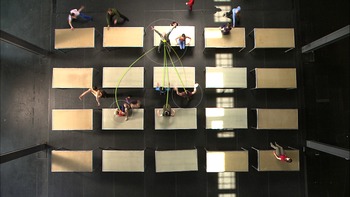
In 2005, Forsythe initiated another project using computer-aided design to show the choreographic structures in a dance titled One Flat Thing, Reproduced (2000). In collaboration with Ohio State University and an interdisciplinary team of designers, animators, and researchers, including architects and geographers, the project was developed over a period of four years eventually launching as an online publication in 2009 with the title Synchronous Objects (see Figure 1). A few other high-profile dance artists and their companies had embarked by that time on similar research projects, meaning that there was for a period significant resources dedicated to exploring what digital media and interdisciplinary exchange could offer for the publication of choreographic ideas and the articulation of movement knowledge.Footnote 35
Cueing system: still from annotated video illustrating the complex system of cueing in One Flat Thing (reproduced from Synchronous Objects Project, Ohio State University and Forsythe Company).

In 2008, four of these projects were brought together in the same investigative framework with social scientists for a series of workshops under the title Choreographic Objects: Traces and Artefacts of Physical Intelligence. These workshops directly engaged choreographic research and publication initiatives with theories of knowledge transfer and production for the first time.Footnote 36 These four projects and several othersFootnote 37 eventually were featured in a book edited by performance and media scholar Maaike Bleeker, Transmission in Motion: The Technologizing of Dance. Footnote 38 The book was intended for an academic readership and aimed to make connections between practice-based research, constituted by the featured projects (Part 1) and current social and intellectual issues through contextual contributions by the other invited authors (Part 2). For Part 1, the projects were “presented ‘from the inside’, that is by authors who were closely involved in developing them.”Footnote 39
What this book does not present is the trade literature itself. The hybrid books/video combinations, interactive installations, and DVD-ROMs and software are described in in-depth analysis in Part 1 and referenced by some of the authors in Part 2. Only James Leach and Sally Jane Norman took up the issue of dance knowledge and its transmission. Leach, a social anthropologist and coordinator of the Choreographic Objects research network mentioned previously, brought extensive prior experience to his reflection on the challenges facing dance if it becomes recognized as knowledge producing/circulating in the current political economy of knowledge. While Leach acknowledges the artists’ concerns with having their abilities, practices, labor, and contributions to society more highly valued, he also points out that there is a “seduction of ‘knowledge’ rendered by the knowledge economy as something alienable from its source.”Footnote 40
Norman, a performance studies scholar and historian, addresses the documentation of embodied movement, taking into account notation systems and motion capture technology to pose questions about the “implicit/explicit tangle.” Bleeker’s own focus on transmission, as used in the title, derives more from media theory and the concept of “technogenesis: the co-evolution of humans and technology.”Footnote 41 She also references Brian Rotman’s work on the impact of technology on movement’s role in communication.Footnote 42 Despite the attention that Bleeker’s edited volume brought to the outcomes of these various choreographic research projects, I wonder if the concerted efforts made “from the inside” of these projects to document and transmit embodied knowledge in dance have not fully and collectively grappled with the challenges of this transmission.
Transmission in Motion was intended for an academic readership, as was Blades and Meehan’s Performing Process. While the three trade publications described (by Diehl and Lampert, Burrows, and Forsythe) may have had this ambition, my perspective on these being part of a trade literature for dance suggests that they were not written for an academic audience. Recall what I wrote previously about trade literature – that it is written by someone with knowledge of the professional field for others with similar knowledge. In other words, dance’s trade literature is intended to communicate something that dance practitioners know without oversimplification and at the level of sophistication that they, their peers, and their professional networks, as a community, have come to expect. Returning to Gorman and Sandefur’s ideas about professional expertise, when accessing this trade literature – for example, Forsythe’s CD-ROM – dancers have the requisite tacit, experiential knowledge, and the abstract, formal knowledge of dance and from dancing to do so. In other words, they know what to do with the contents of the publication in ways that academics, without the tacit, experiential knowledge, do not. This statement is an over-generalization. Various forms of hybrid artistry/scholarship already exist that bring performance expertise into the context of academic literature. However, the point to be made here is that, in this concept of dance’s trade literature, we have a material object in circulation potentially in the absence of the dance artist who created it that might be said to communicate experiential knowledge when the communal conditions are right.
Something sitting along the side of this concept of trade literature is how video or film recordings of dance have become a key component of dance archives and library collections. Archives relate to cultural heritage, which is also a topic of this special issue, but, in most instances, dance archives and collections privilege the choreographed products, the created artworks captured on camera. Some other archival efforts are ongoing, motivated by a conversation about how the dancer’s body itself might be the archive, and, here, the reliance on tacit, experiential knowledge and dance expertise comes back into the picture.Footnote 43 However, referring back to Melrose’s concerns about the absence of performance expertise in scholarly literature, much of this conversation is to be found in more academic interpretive writings about dance.Footnote 44
There is an understudied phenomenon in dance practice – that is, the use of words or the practical use of language in the dance studio. I have recently published an article on this topic with a more in-depth analysis,Footnote 45 but I will refer to one touchstone here before my final example of trade literature that refers to a dance artist with a long history of using words in the studio. In his 1974 essay “Feeling into Words,” Seamus Heaney talks about how words, used in the right way, can offer access to life’s experience and make it available to the creative process. Heaney writes that this “entails the watermarking of your essential patterns of perception, voice and thought into the touch and texture of your lines; it is that whole creative effort of the mind’s and body’s resources to bring the meaning of experience within the jurisdiction of form” and to discover ways out of “normal cognitive bounds” in order to “raid the inarticulate.”Footnote 46 In 2015, I published a short essay in a book published by the University for the Arts Berlin on the “value of artistic processes.” The essay is titled “The Utility of Words (the Poet’s Technique),” and it takes up Heaney’s essay in a discussion of the use of language in the studio of three choreographers “who use words in very specific ways in the studio to skilfully elicit creative responses from their performers.”Footnote 47
To explore where language becomes entangled in the experiential knowledge that it may or may not be making explicit in some way for someone, I am going to continue with a description of the work of the American choreographer Deborah Hay, whose approach to making dances involves a unique relationship to writing and language. This relationship cuts across all parts of her creative work and has been a part of her practice for four decades, beginning in the 1970s as a “long period of reflecting on how dance is transmitted and presented.”Footnote 48 In response to a request in the mid-1980s for documentation, she began to write down her dances in prose form. This led to the score writing that has become a crucial element in her creation process. She has described the interplay between dancing as non-linear and writing as linear and how it helps her discover things “about the dance I didn’t know.”Footnote 49 Another essential relationship to language comes through her articulation of core concepts and principles such as “the continuity of discontinuity” and “noticing feedback” from an ever-increasing number of cells in the body.Footnote 50 However, it is her refinement of the use of words in the studio to elicit creative responses by targeting “the potential of the body” that connects most with our implicit/explicit tension.Footnote 51
Curator and critic Jim Drobnick describes this process as having begun 30 years ago when Hay began to make large group works in Austin, Texas: “It is in the context of these workshops that Hay’s performance terminology has been most deliberately formulated, for these long-term, intensive engagements invariably involve a mix of trained and untrained performers for whom a shared vocabulary cannot be assumed.”Footnote 52 In Hay’s book My Body the Buddhist, there is chronological list of these “performance practices” such as “I invite being seen whole and changing. You remind me of my wholeness changing.”Footnote 53 Early on, these practices come in the form of statements; later, they become questions, which Hay describes as constantly available to “guide me through a dance.”Footnote 54 Asked about when she started to work with them, she says: “[T]he questions were always part of my daily practice. I used the questions to interest me in the sequence of … movements. Those questions began to give meaning to that movement, or provide some interest in doing the movement in the first place.”Footnote 55 The presence of these questions lies at the foundation of Hay’s methods and techniques of working; they are essential to how her choreography is discovered and made manifest through the body. They emerge and multiply as new dances are created. The words chosen and the sentences or questions made from them are extremely specific, composed to confound or trick the practitioner into paying attention in a particular way to the “choreography of perception” versus movement of the body in time and space.Footnote 56
As Hay says, “[i]t is a different relationship to language, it is not something that takes place, but is a way to trick myself and others to make use of this whole thing, as opposed to thinking things out.”Footnote 57 The experienced choreographer/performers who have worked regularly with Hay, such as Jeanine Durning and Ros Warby (whose first adaptation with Hay Was Fire in 2000), constitute an expert ensemble of performers, now trained in Hay’s technique. Their work with Hay involves the creation of adaptations of the scores she has written, normally requiring three months of daily practice to develop. The articulation of Hay’s methods can be found in how they describe developing and performing their adaptations – for example, Durning describing her work on Hay’s 2000 solo No Time to Fly: “In No Time to Fly, there’s hardly anything to hold on to except these tools, choreographically. The tools that you have are these essential questions, and it’s also a choreography of perception, attention, and relationship to space and time. The more I can actually allow myself to trust those two tools, the more I [am] allowing the choreography to unfold.”Footnote 58 Warby describes how important the language is:
The language that supports you in navigating a pathway to being in that place is really specific. It’s so specific. And Deborah’s language, choreographic or feedback or questions, really screw with your idea of yourself, language, everything all at once. And some language really works … some questions work for each of us differently, at different times. And we’re often working with, or spending more time with a different question each, depending on what is supporting us as the dancer, to be functioning in that really … what’s the word … awake state, really stimulated state, where you don’t have to search for the movement or the dance.Footnote 59
The final example of trade literature in dance is the Motion Bank publication of Hay’s online score/website titled Using the Sky,Footnote 60 based on the above-mentioned solo and written score of No Time to Fly (2010).Footnote 61 The performers Jeanine Durning, Juliette Mapp, and Ros Warby were each invited to adapt this score as an individual solo. Each of these solos was filmed seven times and provides the main recorded data for the web publication. The site also takes the score for the website’s “tempo,” and the 29 sections of the score are aligned with the annotated video recordings. One part of the website is based on and titled “Performer Insights.” This gives the reader a chance to view a solo adaptation alongside the written score and a running “languaging” commentary of the performer.Footnote 62 As should be clear from the above, Hay’s written score does not offer the performer precise movement instructions, so this commentary gives the reader insight into how the written score is translated into movement by the performers. Hay would refer to this as when the “body encounters language” in her work.Footnote 63
To conclude, it is worth mentioning that there are no annotations drawn on top of the recorded video of No Time to Fly as with Forsythe’s projects, in part because Hay’s specific choreographic approach resists such visual representations. But it is very much, in these textual transcriptions – the connections between them and the reference video – what expert knowledge in dance “looks like.” Hay’s practice with language is well worked out and offers an example that we can grasp, but this is common practice in the dance studio – namely, that words can be embodied in these unexpected ways. Sometimes, these words, if accessed out of context, may appear confusing as long as we do not grasp or understand how language is being used, which in the case of expert dance practitioner-centred knowledge may mean having insight into what that expertise is. As explored so far, this necessary insight is more likely to be there when the individual involved is a member of the professional dance community, with access to specialized ways of knowing how to do things.
With this in mind, one might revisit the earlier trade literature examples and think about working over in the imagination the hybrid network of dance forms and body-work techniques in Dance Techniques 2010, the motivating questions and lack of pictures in Burrows Choreographer’s Handbook, and how gravity and velocity effect decisions in Forsythe’s Improvisation Technologies. Conceptualizing these resources as part of a trade literature particular to the dance profession is in part a move to position this as a form of literature alongside, but also outside, the circulation of knowledge in the context of academic publishing, which involves in general writers referring to other writers and/or writers referring to writings by other writers.
Bleeker’s organization of the contents of Transmission in Motion into Part 1 and Part 2 makes a distinction by separating those who are doing the work to create these documents (which should transmit dance knowledge) and those who are invited to write reflections related to this doing. However, as pointed out earlier, the material in Part 1 is not the trade literature itself but, rather, a kind of derivation based on descriptions of various processes undertaken to make other processes explicit. Drawing a line around trade literature for dance is a conscious swerve away from this focus on what can be rendered explicit as abstract, formal (academic) knowledge, in order to look more closely at what cannot be made so but is nevertheless an essential part of knowing.Footnote 64 That contemporary dancers know these things is not in question, and the examples of trade literature described in this article show evidence of this knowledge.
The question that becomes interesting in the context of this special issue is what does this concept of dance’s trade literature do for this discussion of ownership of different forms of knowledge? As I have theorized here, the full range of knowledge in this trade literature is not accessible to everyone, but it is to some. There are those who possess the requisite skills, training, and background to access it and those who do not. As is addressed by many of the articles in this special issue, the fact that this knowledge is both embodied and communal complicates conventional approaches to ownership and property. As expressed in Leach’s introductory article, the discussions in this special issue have also been motivated by the idea that there are “knowledge forms that cannot and or perhaps should not be separated from the bodies and processes of their production.”Footnote 65 That is where dance’s trade literature, as a material object in circulation often in the absence of the bodies that created it and yet accessible to a particular community, suggests an additional alternative to take into consideration.
Appendix 1
The following excerpts are from the Performer InsightsFootnote 66 on Deborah Hay’s Motion Bank score.
The “work” section of the score, written by Hay used by the performers for their adaptations:
If the sparsely singing turn is like a lock unlocking, then work is my deliverance into space after 1 minute. Work is a variation on a 2-part spontaneous movement used to cross stage one time. Work is also how I manage the choreographic tools I need to maintain both my interest and that of the audience. Those tools are the perception of my movement as music, my perception of space, the use of stillness and duration, and the perception of joy and sorrow to deepen my practice of performance.
Jeanine Durning’s comment, which accompanies her performing the ‘work’ section on video:
Work is kind of terrifying … because you have these really mundane actions that have to repeat themselves over and over again. And again it’s a trick for you to constantly remind yourself that it’s not about what you’re doing. It’s about how you’re perceiving space and time. You really have to kick up your choreographic tools, that space and time thing, how you’re choreographing those two elements. Work just reminds you that you have to use these other elements and it’s not just about what your body is capable of doing, but how you’re using these other perceptions.
Ros Warby’s comment, which accompanies her performing the ‘work’ section on video:
It’s the notion of work that is carried with you in whatever movement you set up. The … what it is to work. Not showing work. And over time, I allowed the timing between the two movements to be more simultaneous, or it wasn’t. I didn’t construct how those two movements played out against each other. And that became much more useful to me. If I put too much attention on the movement, I’m in trouble. So the work to just bring my attention more toward what is it to work, in the framework of this movement, is much more interesting. It actually gives me more room to move, to be anywhere, than paying attention to the shape of the movement or anything like that.
Video Link no. 1: Online Video Clips, Forsythe, 1999, https://www.youtube.com/channel/UCvzEl4d5_SdUe3B6ElTEFSA (accessed 14 November 2020).
Video Link no. 2: Deborah Hay Online Motion Bank Score, Using the Sky, Performer Insights, 2013, http://scores.motionbank.org/dh/#/set/jeanine-ros-insights. (accessed 14 November 2020).