Introduction
The current outbreak of Ebola virus disease (EVD) in West Africa has claimed over 5,100 lives and has raised international health concerns; this highlights that despite being uncommon, infectious diseases with high mortality rates represent a major threat for health care systems at local, national, and international levels. 1 Chemical, biological, radiological, or nuclear (CBRN) contamination presents similar risks, whether due to natural disasters or a deliberate release of chemical warfare agents (such as sarin, in Matsumoto, Tokyo, and lately in Syria).Reference Malich, Coupland, Donnelly and Baker 2 - 6
In today’s world, with population movements often over long distances, increasing use of industrial and nuclear technology, and the potential for terrorist action, preparedness for CBRN incidents is essential. These events occur rarely with forewarning. Early recognition of CBRN-contaminated people, effective triage systems, and knowledge about the use of personal protective equipment (PPE) is required to prevent transmission, to maintain services, and to ensure health care workers are not afraid to provide patient care.
Previous studies assessing first responders’ knowledge of PPE requirements have highlighted their poor knowledge and substantial need for further training in CBRN management and appropriate PPE selection.Reference Brinker, Prior and Schumacher 7 , Reference Gould, Kerr and Prophet 8 Since these surveys were conducted, the Department of Health (London, UK) has undertaken National Health Service (NHS) staff-training initiatives to respond to major incidents, including CBRN incidents. 9
As specialist registrars, doctors in Anesthesiology, Intensive Care Medicine (ICM), and Emergency Medicine (EM) are likely to be amongst the front-line staff treating CBRN-exposed patients in respiratory or cardiac failure;Reference Gould, Kerr and Prophet 8 , Reference Baker 10 - Reference Clarke, Chilcott, Wilson, Kamanyire, Baker and Hallett 12 thus, it was decided by the authors of this study to repeat the previous survey conducted in 2009Reference Brinker, Prior and Schumacher 7 to assess whether training initiatives had led to increased levels and range of knowledge about PPE.
Methods
Ethical approval for this survey was granted by the National Institute for Health Research’s Guy’s and St Thomas’ NHS Foundation Trust//King’s College London Biomedical Research Centre (London, United Kingdom), and approval was given by Guy’s and St. Thomas’ NHS Foundation Trust’s clinical audit department.
Between September 2013 and January 2014, a standardized and validated questionnaireReference Brinker, Prior and Schumacher 7 (Supplemental Material; available online only) was given by hand to 98 specialist registrars (ST3-7) working in Anesthesiology (n=51), ICM (n=26), and EM (n=21) in London, UK. The questionnaire was designed to evaluate the level of knowledge of recommended respiratory, eye, and skin protection requirements when providing Advanced Life Support to a hypothetical patient contaminated with a CBRN agent (CBRN patient). The Guy’s and St. Thomas’ NHS Foundation Trust institution oversees approximately 120 trainees in the south Thames area. The response rate of the individually approached doctors was 100%; however, absences at regional training days due to holidays or sick leave meant that 20% of all possible respondents were not able to take part in the survey.
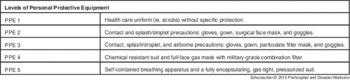
Participants were required to state specifically which level of PPE (Table 1) was required in case of exposure to a patient with the following biological hazards: EVD, severe acute respiratory syndrome (SARS), inhalational anthrax, plague, and smallpox; and the following biochemical hazards: sarin, hydrogen cyanide, phosgene and “mustard gas” (Di-chlor-diethyl sulfide).
Levels of Personal Protective Equipment

Abbreviation: PPE, personal protective equipment.
The questionnaires were collected anonymously and the answers were compared with the current UK recommendations, including the Control of Substances Hazardous to Health (COSHH; Health and Safety Executive; Bootle, Merseyside, England) regulations. 13 , 14 The authors classified a knowledge level of 100% as competent, 70%-99% as good, 50%-69% as fair, and <50% as poor.
Results
The level of knowledge regarding PPE requirements varied considerably between participants. The mean percentage of correct answers from each clinician cohort was used to determine the level of knowledge of PPE requirements for each CBRN agent surveyed.
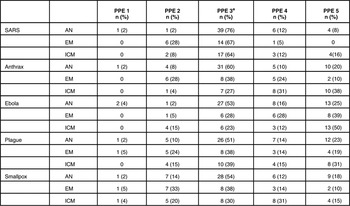
Regarding biological agents, knowledge within all cohorts was greatest for SARS, with correct responses given by specialist registrars in Anesthesiology at 76%, in EM at 67%, and in ICM at 64% (Table 2). The recommended level of PPE for SARS was over-estimated by registrars in Anesthesiology by 20%, by 5% of the EM cohort, and by 28% of the ICM cohort. Under-estimates were made by registrars in Anesthesiology at 4%, in EM at 28%, and in ICM at 8%.
Knowledge about Biological Hazards

Abbreviations: AN, specialty registrars in Anesthesiology (n=51); EM, specialty registrars in Emergency Medicine (n=21); ICM, specialty registrars in Intensive Care Medicine (n=26); PPE, personal protective equipment; SARS, severe acute respiratory syndrome.
a current recommendation of precautions for first receivers.Reference Clarke, Chilcott, Wilson, Kamanyire, Baker and Hallett 12 , 13
Fair knowledge, with mean correct answers of 40%-60%, for PPE requirements was found for anthrax, EVD, plague, and smallpox. A further 20%-60% of clinicians over-estimated the levels of PPE required, and 5%-40% under-estimated requirements. The most over-rated PPE requirement was for EVD (EM=67%, ICM=62%, and Anesthesiology =41% over-rated). The highest level of under-ratings was for smallpox (EM=38%, ICM=24%, and Anesthesiology =16% under-rated responses).
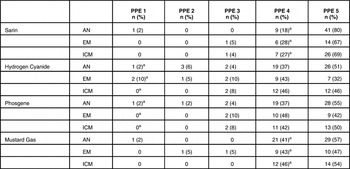
Knowledge regarding use of PPE for chemical warfare agents was weaker. For the organophoshorous nerve agent, sarin, only 20%-40% of participants stated the correct level of PPE (EM=28%, ICM=27%, and Anesthesiology =18% correct responses; Table 3). Most participants (70%-80%) over-rated the recommended level of PPE. Regarding the non-persistent agents, phosgene and hydrogen cyanide, nearly all participants (90%-100%) over-rated the recommended level of PPE. Personal protective equipment requirements for the treatment of sarin-contaminated casualties were over-rated by 80% of participants, which was an increase of 20% from 2009. Regarding chemical warfare agents, the greatest levels of knowledge in all groups was for mustard gas (ICM=46%, EM=43%, and Anesthesiology =41% correct responses).
Knowledge about Chemical Hazards

Abbreviations: AN, specialty registrars in Anesthesiology (n=51); EM, specialty registrars in Emergency Medicine (n=21); ICM, specialty registrars in Intensive Care Medicine (n=26); PPE, personal protective equipment.
a current recommendation of precautions for first receivers.Reference Clarke, Chilcott, Wilson, Kamanyire, Baker and Hallett 12 , 13
There was no significant difference in knowledge between the examined groups of medical first responders when compared to the results from 2009.
Discussion
Despite national and local training initiatives in the UK, this survey showed that first responders had similar levels of knowledge regarding PPE requirements as compared to previous publications.Reference Brinker, Prior and Schumacher 7 , Reference Gould, Kerr and Prophet 8 Participants were more likely to use the correct type of PPE for biological agents, but not for persistent and non-persistent chemical warfare agents, or for agents that are absorbed transcutaneously.
Participants had a good knowledge regarding SARS, but relatively little knowledge regarding anthrax, EVD, or smallpox. This may, in part, be due to widespread media coverage following the SARS epidemic in 2002 and 2003. Conversely, the relative infrequency of infection with EVD in the UK, and the belief that smallpox has been eradicated, may have led to less interest or retention of knowledge of PPE requirements for these disorders. The last case of smallpox occurred at the University of Birmingham in England in 1978.Reference Foege 15 The last major EVD outbreaks (at the time of the survey) with fatalities in the region of 200 to 250 people occurred in 2000 in Uganda,Reference Okware, Omaswa and Zaramba 16 and in 1976 and 1995 in the Democratic Republic of Congo/Zaire.Reference Khan, Tshioko and Heymann 17 , 18
Selecting the correct PPE for any given situation requires awareness of the possibility of the condition presenting, the recognition and an assessment of the suspected or known hazards, as well as the possible impact of those hazards. Wherever possible, CBRN casualties should be decontaminated before arriving at treatment facilities. However, for infectious diseases, or where immediate and life-saving treatment is required, decontamination may not be possible,Reference Baker 10 , Reference de Jong 11 , 19 and PPE selection is paramount. The first responder should select a type of PPE that meets or exceeds the minimum safety requirements. Reassuringly, most responders over-rated rather than under-rated PPE requirements. While this may be a safe approach, this approach could lead to increased costs and might increase the physical strain on the clinician, leading to early fatigue and impaired performance.Reference Brinker, Prior and Schumacher 7 , Reference Baker 10 , Reference de Jong 11
Airborne biological agents are transmitted via the respiratory route. To provide protection, a correctly fitted, highly-efficient particulate filter mask is necessary, alongside splash precautions. Non-airborne biological agents require splash precautions only, such as goggles, gown, and gloves.
With regard to EVD specifically, transmission may occur by aerosol inhalation from symptomatic persons, direct contact with bodily fluids, or indirect contact through contact with environments that have been exposed to such fluids, and inadequately decontaminated objects. 20 As such, EVD transmission may occur during common anesthetic procedures, such as endotracheal intubation, bronchoscopy, airway suctioning, positive-pressure ventilation, central line insertion, and diagnostic sputum induction or suction. Filter masks, in addition to splash precautions, are therefore required.
For chemical warfare agents, respirator use is essential.Reference Wetherell and Mathers 21 These agents exert their most rapid effects via the respiratory system and are not removed by conventional filter masks.Reference Wetherell and Mathers 21 , Reference Martyny, Glazer and Newman 22 This seems to be known to the majority of the participating medical first receivers, as it was found that 75%-100% chose a military-grade respirator or a breathing apparatus to protect themselves from secondary inhalational exposure to the named chemical warfare agents. Some chemical warfare agents can also penetrate skin, for which a chemically resistant over-garment is also required to protect the clinician.
Respiratory protection suitable for toxic environments is classified as either air-supplying or air-purifying. Air-supplying devices provide the highest degree of protectionReference Martyny, Glazer and Newman 22 and work by providing uncorrupted air from a pressurized tank; however, their use is limited by complexity of operation, weight, and by the inherently limited size of the tank. Air-purification respirators (APRs), which work by purification of outside air via an absorbent filter on inspiration,Reference Wetherell and Mathers 21 , Reference Martyny, Glazer and Newman 22 are the most common respirator devices. Depending on the selectivity and capacity of the filter, APRs can remove gases, vapors, and aerosols from inhaled air.Reference Wetherell and Mathers 21 , Reference Martyny, Glazer and Newman 22 In simulated CBRN scenarios, modern APRs have been found to be well-tolerated by anesthesiologists and paramedics.Reference Brinker, Gray and Schumacher 23 , Reference Schumacher, Runte, Brinker, Prior, Heringlake and Eichler 24
Excellent resources have been published by the British Health Protection Agency (HPA; London, England), 13 which succinctly outline how to recognize, triage, isolate, and select PPE in the event of CBRN exposure. These HPA resources should be promoted in all departments and circulated to all health care workers likely to be first responders, in addition to existing NHS Foundation Trust protocols on CBRN events. An excellent synopsis for health care workers on PPE has also been published by Weinstein and Alibek.Reference Weinstein and Alibek 25
Limitations
The limitations of the study include the relatively small sample size, limited geographical location of participants, and the timing of the survey, which was completed just before the current EVD epidemic commenced. Given the intense media coverage and pan-NHS initiatives regarding the EVD epidemic and PPE requirements, different results regarding this agent may be found if the survey was repeated today.
Conclusion
From the results of the survey, the authors concluded that despite training and teaching efforts, the current knowledge regarding chemical warfare agents remains very limited. It is assumed that the current seminar teaching might not show sustained learning results, and therefore, it is recommend that further training efforts should be made in a high-fidelity simulation setting. This would also allow familiarization with more unusual PPE equipment, decontamination procedures, and triage training.
Supplementary material
To view supplementary material for this article, please visit http://dx.doi.org/10.1017/S1049023X15004690