Implications
Increasing feed intake during lactation is an effective way to improve reproductive performance of sows. This study showed that feeding konjac flour during gestation increased lactation feed intake of sows and tended to improve litter performance. The results suggest that feeding sows with dietary fiber of high hydration properties and fermentability during gestation is beneficial for increasing lactation feed intake and improving sow reproductive performance.
Introduction
The reproductive performance of sows is an important feature that affects the economic benefits of pig farms. Maximizing feed intake during lactation is critical to improving overall sow performance, including productivity and longevity. It is well known that overfeeding gestation sows reduces feed intake of sows during the subsequent lactation (Eissen et al., Reference Eissen, Kanis and Kemp2000; Shurson et al., Reference Shurson, Lubal, Crenshaw, Hamilton, Fisher, Koehler and Whitney2003). Therefore, restricted feeding during gestation is widely adopted in pig farms. However, growing evidence shows that restricted feeding during gestation has a negative effect on the welfare of sows, which in turn affects their reproductive performance (Douglas et al., Reference Douglas, Cunnick, Pekas, Zimmerman and von Borell1998; Sekiguchi and Koketsu, Reference Sekiguchi and Koketsu2004). Previous studies have shown that high-fiber diets could be used to increase the feeling of satiety of gestating sows without providing them with too much energy (Robert et al., Reference Robert, Bergeron, Farmer and Meunier-Salaun2002), thereby increasing their lactation feed intake and improving reproductive performance (Guillemet et al., Reference Guillemet, Hamard, Quesnel, Pere, Etienne, Dourmad and Meunier-Salaun2007; Quesnel et al., Reference Quesnel, Meunier-Salaun, Hamard, Guillemet, Etienne, Farmer, Dourmad and Pere2009). However, lactation feed intake responses to dietary fiber are inconsistent, depending heavily on fiber source (Holt et al., Reference Holt, Johnston, Baidoo and Shurson2006; Darroch et al., Reference Darroch, Dove, Maxwell, Johnson and Southern2008), fiber types (Darroch et al., Reference Darroch, Dove, Maxwell, Johnson and Southern2008) and the duration sows receive the fibrous diet (Veum et al., Reference Veum, Crenshaw, Crenshaw, Cromwell, Easter, Ewan, Nelssen, Miller, Pettigrew and Ellersieck2009).
Konjac flour (KF) is obtained from the tubers of various species of Amorphophallus, a plant that belongs to the Araceae family and is native to warm subtropical to tropical eastern Asian countries, from Japan and South China to Indonesia. Depending on the species, dried crude KF contains 49% to 60% glucomannan, 10% to 30% starch, 5% to 14% CP, 3% to 5% soluble sugars and 3.4% to 5.3% ash (Li et al., Reference Li, Xia, Wang and Xie2005; Chua et al., Reference Chua, Baldwin, Hocking and Chan2010). KF has been consumed as rubbery jelly, noodles and other food products by humans in Asia for centuries. Primary components of the tuber mainly contain konjac glucomannan (KGM), which is composed of glucose and mannose residues at a molar ratio of 2 : 3 with β-1-4 linkages (Onishi et al., Reference Onishi, Kawamoto, Suzuki, Santo, Aki, Shigeta, Hashimoto, Hide and Ono2007) and has high swelling capacity, water-holding capacity and fermentability (Chua et al., Reference Chua, Baldwin, Hocking and Chan2010). The swelling capacity and water-holding capacity of fiber have important functions in increasing the feeling of satiety after feeding (Miquel et al., Reference Miquel, Knudsen and Jorgensen2001). Fiber fermentability is involved in the long-term feeling of satiety (De Leeuw et al., Reference De Leeuw, Jongbloed and Verstegen2004). KGM also has very strong viscosity, which modifies the digesta passage rate and thereby reduces nutrient digestibility in the small intestine of chickens and piglets (Bedford, Reference Bedford1996; Owusu-Asiedu et al., Reference Owusu-Asiedu, Patience, Laarveld, Van Kessel, Simmins and Zijlstra2006). Therefore, we aimed to investigate the effects of KF inclusion in gestation diets on the nutrient digestibility, lactation feed intake and reproductive performance of sows.
Material and methods
All procedures and the use of animals in this experiment were carried out in accordance with the Huazhong Agricultural University Animal Care and Use Committee guidelines.
Animals, diets and housing
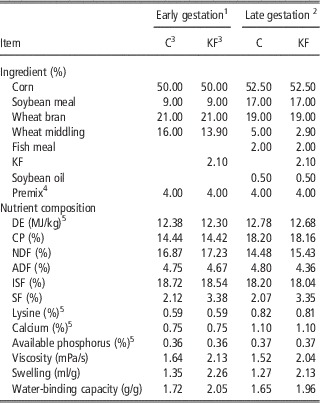
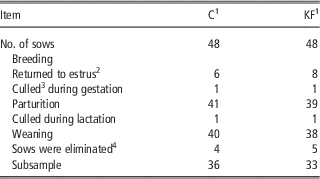
A total of 96 multiparous sows (48 Landrace×Yorkshire (LY) sows and 48 Yorkshire sows) and average parity of 3.9 were assigned to the study. After breeding, sows of mixed parity were separated into two groups based on breed, parity and BW. During the experimental period, 14 sows returned to estrus within the estrus cycle. 4 sows were culled because of lameness or sickness during gestation and lactation. Two isoenergetic (digestible energy (DE)) and isonitrogenous diets were formulated (Table 1): the control diet and the KF-supplemented diet containing 2.1% KF. Both diets had the same NDF and insoluble fiber (ISF) levels, but the KF diet had higher soluble fiber (SF) level. Restrict-fed during gestation, the diet was supplied twice a day (0700 and 1430). All sows in both gestation treatments were fed the same diet during lactation to provide sows 12.8 MJ of DE/kg, 18.2% CP and 0.82% Lys. The lactation diet was supplied three times a day (0700, 1100 and 1730) to ensure sows ad libitum access to feed. Water was freely available to sows and piglets throughout the experimental period. During gestation, sows were housed individually in gestation stalls (2.2×0.7×1.1 m) that had 1.2 to 1.6 m of solid concrete in front and 0.6 to 1.0 m of slotted concrete in the back. Sows were moved from the gestation stalls to the farrowing rooms on day 108±2 of gestation and then kept in individual farrowing crates with stalls (2.2×0.7 m) in pens that provided space on both sides of the stall (2.2×0.5 m) for the pigs after birth.
Ingredient and nutrient composition of gestation diets (as-fed basis)

KF=konjac flour; mPa∙s=millipascal seconds; ISF=insoluble fiber; SF=soluble fiber.
1 Early gestation: from day 0 to day 79 of gestation.
2 Late gestation: from day 80 of gestation to the day that sows were moved to farrowing room.
3 C and KF, the control diet and the KF diet containing 2.1% konjac flour, respectively.
4 Provided per kg of diet: Cu 10 mg; Fe 112 mg; Zn 25 mg; Mn 32 mg; vitamin E 28 IU; vitamin A 10 000 IU; vitamin D 1440 IU; vitamin K1.2 mg; vitamin B1 1 mg; vitamin B2 2 mg; vitamin B6 1 mg; vitamin B12 0.014 mg.
5 Calculated chemical concentrations using values for feed ingredients from the NRC (1998), and the DE value of konjac flour was calculated according to the prediction equation of Noblet and Perez (Reference Noblet and Perez1993).
Performance measurement
BW and backfat thickness of sows were measured and recorded on days 0 and 108 of gestation, within 24 h after farrowing and at weaning. Backfat was measured at the last rib (P2) using ultrasound (PIGLOG105, SFAK-Technology, A Mode Scanner, SFK Technology A/S Helver, Denmark). Within 12 h after farrowing, the number and the weight of live and dead piglets born per litter were recorded. Cross-fostering was complete within 24 h after farrowing and within dietary treatment. Litters were cross-fostered to adjust litter size to about 10.04±1.2 piglets per sow, and there were no differences in the number of piglets after cross-fostering between control and 2.1% KF diet groups (10.03 v. 10.06). In our study, piglets were not provided with creep feed during lactation. At weaning, the number of live pigs per litter, total litter weight and weaning-to-estrus interval were recorded for each sow and litter. The daily feed intake of sows during lactation was measured each morning by weighing daily feed refusals.
Nutrient digestibility determination
On day 60 of gestation, 20 sows (10 LY sows and 10 Yorkshire sows) were used in a nutrient digestibility trial. The parities for these sows were 3.9±1.1. Sows were fed their respective diets (diet of early gestation) containing 0.3% chromic oxide as an exogenous marker, chromic oxide was added during nutrient digestibility trial. We made a specific batch for this feed, and the diet was fed for an adjustment period of 7 days, followed by a collection period of 3 days. Faecal samples were collected twice daily at 0800 and 1600 h, pooled, placed in plastic bags and frozen at −20°C. At the end of collection, faeces were dried in a force-draft oven (60°C) for three consecutive days. Dried faeces were ground through a 1 mm screen and a subsample was retained for dry matter (DM), CP, gross energy (GE), crude fiber (CF), NDF and ADF determination. Nutrient digestibility was calculated as follows:
 $${\rm Digestibility}\;{\rm of}\;{\rm T}\;\left( {\,\%\,\;{\rm of}\;{\rm intake}} \right)\,=\,[{\rm 1}\,{\minus}\,({\rm Cr}_{{\rm 2}} {\rm O}_{{{\rm 3}\,({\rm diet})}} {\times}\,{\rm T}_{{({\rm feces})}} )\,/\,({\rm Cr}_{{\rm 2}} {\rm O}_{{{\rm 3}\,({\rm feces})}} \,{\times}\,{\rm T}_{{({\rm diet})}} )]\,{\times}\,{\rm 1}00,$$
where T is the concentration of specific nutrients or energy in the diet and the feces materials.
Chemical analyses
According to the method described by Association of Official Analytical Chemists (AOAC, 1999), chemical analyses were conducted for the determination of DM (Method 934.01), CP (Kjeldahl method 955.04, N×6.25) and CF (Method 962.09) from selected samples. The GE of samples was determined by bomb calorimetry using a Parr 1261 adiabatic calorimeter (Parr Instruments Co., Moline, IL, USA). NDF and ADF analyses were conducted following the procedure of Van Soest et al. (Reference Van Soest, Robertson and Lewis1991). Chromic oxide was determined using the method of Schürch et al. (Reference Schürch, Lloyd and Champton1950). Soluble dietary fiber (SF) and ISF were determined by AOAC Method 991.4. Viscosity, swelling and water-binding capacity of two diets were analyzed in triplicate, according to procedure described by Serena et al. (Reference Serena, Jorgensen and Bach Knudsen2008).
Statistical analyses
We sampled 69 sows (33 KF sows, 36 C sows) that the number of piglets per litter after cross-foster was 9 to 12 from the original data set in order to establish a subsample, which has been selected to achieve similar litter sizes and piglet weights at the start of lactation. The number of sows during the experimental period was presented in Table 2.
The number of sows during the experimental period

KF=konjac flour.
1 C and KF, the control diet and the KF diet containing 2.1% konjac flour, respectively.
2 Sows returned to estrus within the estrus cycle.
3 Sows were culled because of illness, serious lameness, death and reproductive failure.
4 Sows that the number of piglets per litter after cross-foster<9 or >12.
The data from this subsample were analysed by the GLM procedure (SAS 8.0; SAS Institute Inc., Cary, NC, USA). All response variables were analyzed for the fixed effects of dietary treatment during gestation and genotype. Number of total piglets born was used as a covariate in the analysis of piglet birth weight and total litter weight at birth. The piglet weight and litter weight on day 21 of lactation were subjected to analysis of covariance with the piglet weight and litter weight after cross-foster as the covariate. There was no interaction of genotype with treatments therefore, the effects of genotype are not presented. Date were given as means and s.e.m. Differences were considered significant at P<0.05.
Results
Digestibility
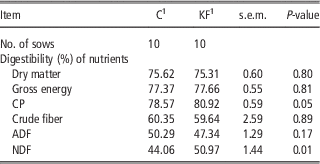
The results in Table 3 showed that the dietary treatments had no effects on the digestibility of DM, GE, CF and ADF. However, sows fed the KF diet had higher NDF digestibility (P<0.05) compared with those fed the control diet. Besides, the inclusion of KF in gestation diets tended to increase the digestibility of CP (P=0.05).
Effect of inclusion of konjac flour in gestation diet on digestibility of nutrients

KF=konjac flour.
1 C and KF, the control diet and the KF diet containing 2.1% konjac flour, respectively.
Sow performance
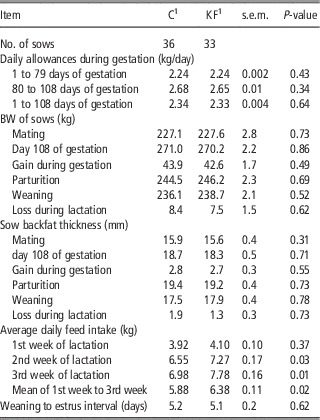
As presented in Table 4, dietary treatment during gestation had no effect on BW and backfat gain during gestation, lactation weight, backfat loss or weaning-to-estrus interval of sows. Effect of inclusion of KF in gestation diet on lactation feed intake of sows are also shown in Table 4. The addition of KF to gestation diets increased sow feed intake in the second week of lactation (7.27 v. 6.55 kg/day, P<0.05), in the 3rd week (7.78 v. 6.98 kg/day, P<0.05) and over the entire lactation period (6.38 v. 5.88 kg/day, P<0.05).
Effect of inclusion of konjac flour in gestation diet on sow BW and backfat thickness during gestation and lactation, lactation feed intake and weaning-to-estrus interval of sows

KF=konjac flour.
1 C and KF, the control diet and the KF diet containing 2.1% konjac flour, respectively.
Piglet’s performance
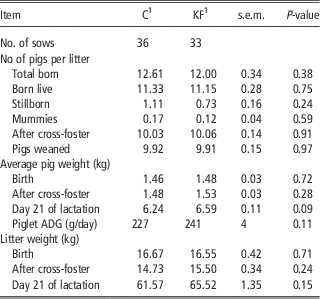
The effects of dietary treatment during gestation on piglet performance were shown in Table 5. The mean numbers of total piglets born, liveborn, stillborn, mummified and weaned did not differ between the two treatments. Piglet weights at birth, mean weight or total litter weight and piglet average daily gain (ADG) were no differences between two groups. However, sows fed with KF diet tended to show increased average piglet weights on day 21 of lactation (6.59 v. 6.24 kg, P=0.09) and litter weights on day 21 of lactation increased by 3.95 kg compared with sows fed the control diet (not different).
Effect of inclusion of KF in gestation diet on litter performance

KF=konjac flour.
1 C and KF, the control diet and the KF diet containing 2.1% konjac flour, respectively.
Discussion
The results of this study show that the gestation diets have no effects on changes in sow weight and backfat during gestation and lactation or weaning-to-estrus interval. However, addition of KF to the sow gestation diet increased lactation feed intake of sows and tended to improve piglet performance. By properly managing the energy intake of sows during gestation, subsequent lactation feed intake can be maximized and improvements in the reproductive performance of sows may be observed (Eissen et al., Reference Eissen, Kanis and Kemp2000; Shurson et al., Reference Shurson, Lubal, Crenshaw, Hamilton, Fisher, Koehler and Whitney2003; Lewis and Bunter, Reference Lewis and Bunter2011). Researchers have added dietary fiber of low energy density to gestation diets to improve the welfare and reproductive performance of sows without providing excess energy(Meunier-Salaün et al., Reference Meunier-Salaün, Edwards and Robert2001; De Leeuw et al., Reference De Leeuw, Bolhuis, Bosch and Gerrits2008; Veum et al., Reference Veum, Crenshaw, Crenshaw, Cromwell, Easter, Ewan, Nelssen, Miller, Pettigrew and Ellersieck2009). In our study, we fed sows fiber diets containing wheat bran and KF. During gestation, the average daily DE intakes of the control and KF diet groups were 29.41 and 29.25 MJ, respectively, lower than the nutrient requirement recommendations of the NRC (1998) for gestating sows. Thus, we controlled the energy intake of sows during gestation. In the present experiment, sows fed KF diet during gestation showed greater feed intake during subsequent lactation. Although the levels of CF, ADF and NDF did not differ between control and KF diets, KF diet had higher viscosity, swelling capacity, water-holding capacity than the control diet (Table 1). We believe that the increased lactation feed intake of sows is probably a response to the change in physicochemical properties of the gestation diet induced by addition of KF, but further research is needed to explore the potential mechanism.
Dietary fiber affects the process of digestion and absorption of nutrients, gastrointestinal health and whole body metabolism. Previous research has indicated that fiber of high hydration properties could reduce the rate of gastric emptying (Bach Knudsen, Reference Bach Knudsen2001). Slower gastric emptying rates present several nutritional advantages by increasing feelings of satiety and decreasing feelings of hunger (Bindelle et al., Reference Bindelle, Leterme and Buldgen2008). On the other hand, dietary fiber are fermented in the large intestine by microbes under anaerobic conditions to produced short-chain fatty acids. These fatty acids are available as a source of energy when the glucose supply from the gut decreases, which can stabilize long-term blood glucose levels after feeding (De Leeuw et al., Reference De Leeuw, Jongbloed and Verstegen2004) and thereby reduce feelings of hunger. The transition from gestation to lactation is characterized by physiological and metabolic changes, such as a progressive decrease in insulin sensitivity during late gestation and lactation (Pere et al., Reference Pere, Etienne and Dourmad2000; Pere and Etienne, Reference Pere and Etienne2007). During lactation, insulin resistance is negatively correlated with the feed intake of sows (Van der Peet-Schwering et al., Reference Van der Peet-Schwering, Kemp, Binnendijk, den Hartog, Vereijken and Verstegen2004; Mosnier et al., Reference Mosnier, Le Floc’h, Etienne, Ramaekers, Seve and Pere2010). Several studies have shown that soluble dietary fiber can improve insulin sensitivity in mice or rats (Song et al., Reference Song, Sawamura, Ikeda, Igawa and Yamori2000; Isken et al., Reference Isken, Klaus, Osterhoff, Pfeiffer and Weickert2010). The inclusion of KF in gestation diet increased the level of SF in present study (Table 1). Therefore, increased lactation feed intake of sows may be caused by improved insulin sensitivity.
In the present study, the KF-supplemented gestation diet increased the lactation feed intake of sows, and tended to improve piglet performance (Table 5). Previous research has reported a 20% increase in the growth rate of piglets when gestating sows were fed a fiber diet compared with sows fed a control diet but this effect was observed during the second cycle of lactation and not the first (Matte et al., Reference Matte, Robert, Girard, Farmer and Martineau1994). Therefore, additional research directed at feeding KF diets to gestating sows could entail an evaluation of the effects of KF on sows for more than one reproductive cycle. The KF diet has very high viscosity (Table 1). Previous research has demonstrated that dietary fiber increases digesta viscosity in both piglets and poultry thus reduces nutrient digestibility (Bedford, Reference Bedford1996; Owusu-Asiedu et al., Reference Owusu-Asiedu, Patience, Laarveld, Van Kessel, Simmins and Zijlstra2006). The effects of KF on nutrient digestibility were measured in the present study. Addition of KF to the gestation diet showed no negative effects on the digestibility of nutrients (Table 3). The volume capacity of the gastrointestinal tract of sows is several folds higher than those of infant pigs and chickens. Sows also drink large amounts of water daily, which may result in dilution of the digesta viscosity and reductions in the anti-nutritive effects of fiber viscosity.
Conclusions
This study showed that sows fed KF diet during gestation increased subsequent lactation feed intake of sows and tended to improve the performance of piglets. The mechanism underlying the positive effects of feeding the KF diets during gestation on lactation feed intake of sows need to be further investigated.
Acknowledgments
This work was supported by the Science and Technology Plan Research and Development Projects of Hubei Province in the Twelfth Five-year Plan Period (No. YJN0135), Hubei Provincial Creative Team Project of Agricultural Science and Technology (No. 2007-620), Fundamental Research Funds for the Central Universities (No. 2011PY019) and Fundamental Research Funds for the Central Universities (No. 2012MBDX010). We would like to thank Mr. Wanqing Lin and Mrs. Hongzhen Yan at Jinlin Pig Farm for their support during the feeding trial. We also thank Hubei Jinlin Animal Husbandry Limited Company for providing sow feeding facilities.