Welfare state reform continues to capture the imagination of scholars across the world and considerable advances have been made during the past decade on the likelihood and nature of such reforms. Following the new institutionalist approach of Pierson (Reference Pierson1994; Reference Pierson2000), the theoretically best understood and empirically most surveyed type of change is by far path-dependent reforms, i.e. incremental change. A great deal of work has been produced in the attempt to grasp the multiple ways welfare states may alter via ‘cumulative, but transformative’ change (e.g., Hacker Reference Hacker2004; Thelen Reference Thelen2004; Lessenich Reference Lessenich2005; Streeck and Thelen Reference Streeck and Thelen2005; Clegg Reference Clegg2007). As noted by Peters et al. (Reference Peters, Pierre and King2005), we know far less about abrupt changes, which mostly end up in a residual category of exogenous factors outside the scope of the theories.
Punctuated equilibrium theory provides a corrective to the new institutionalism, which has dominated welfare state literature the past decade. The key argument of the theory is that decision making is characterized by long periods of stability punctuated by radical change. This allows us to better understand why big reforms sometimes occur even on very entrenched areas. The theory also introduces a novel conceptualization of institutions, which is viewed as friction inhibiting quick and big change in one way or the other. In the punctuated equilibrium theory institutional friction, or veto points, will slow down change for a period, but will eventually also cause even larger bursts of change than in settings with less institutional friction (Baumgartner and Jones Reference Baumgartner and Jones1993; Jones and Baumgartner Reference Jones and Baumgartner2005).
The welfare state literature is characterized by its high level of area specialization, but also by the fact that it to a rather limited extent relies on insights from more general public policy theories like the punctuated equilibrium theory, which is one of the most well-known theories in public policy analysis today (John Reference John2006). The aim of the paper is to introduce the punctuated equilibrium theory to the welfare state literature by showing how the lessons from the punctuated equilibrium theory can help us explain important dynamics in modern welfare states: Why do big reforms sometime occur and why are veto points not only slowing change down, but at certain times actually enhancing it. These are crucial questions to answer – not because large-scale alterations happen often, but because they almost by definition matter a lot when they actually occur.
The first section discusses the achievements of the existing welfare state literature, but also points to its shortcomings. The next two sections present the punctuated equilibrium theory and then turn to the potential benefits of taking in some of the insights from the punctuated equilibrium theory. The paper argues that there are no inherent reasons why the theory should not apply and that there in fact are important lessons to learn. The paper sets out to show this on data specifically related to the welfare state, which so far have not been used in analyses of the punctuated equilibrium theory. The data used captures policy decisions in 18 Western welfare states between 1971 and 2002 on two classic welfare programmes, namely old-age pensions and unemployment insurance. This also allows us to probe how well the punctuated equilibrium theory works on two areas that have been argued to host quite distinct temporal dynamics (Jensen Reference Jensen2007).
The study shows, first and foremost, that overall policy change follows the pattern expected by the punctuated equilibrium theory. Second, it also shows that institutional friction enhances the non-incremental nature of policy development, but not nearly as much as expected. It turns out that the programme type is more important than the institutional friction, but that the two factors in fact enhance each other: Old-age pension systems are clearly more incremental than unemployment insurance schemes, but combined with low institutional friction the pension systems become even more incremental. Unemployment insurance schemes, conversely, become even less incremental in countries with high levels of institutional friction. These findings are clearly unexpected from the perspective of the new institutionalist welfare state literature.
Incrementalism in the welfare state literature
The path dependency argument of the new institutionalist welfare state literature was originally, and to some extent also most consistently, formulated by Pierson (Reference Pierson1994). The basic thrust of the original argument is that vote-seeking politicians are caught between the need for fiscal discipline on the one side and the preferences for expansion held by the electorate and vested interests on the other. The schism is solved by sticking to the existing policies and only introducing changes on the margins, leading to highly path-dependent, or incremental, policy development.
While Pierson's original formulation has become very popular, it has also been criticized for entailing that policies must remain at status quo (for reviews, see Green-Pedersen and Haverland Reference Green-Pedersen and Haverland2002; Starke Reference Starke2006).Footnote 1 This, however, is not the case: Change is perfectly possible, but it will be incremental change, change on the margins (Pierson Reference Pierson2000; Reference Pierson and Pierson2001). The notion of incremental change has been pursued by a number of scholars. Hacker (Reference Hacker2004), for example, has shown how the American welfare state gradually drifts towards a privatization of risks as new social risks are being ignored by the political system. Lessenich (Reference Lessenich2005) and Clegg (Reference Clegg2007) focus on Continental Europe and argue that even these ‘frozen’ welfare states have been able to introduce reforms on the margin, leading to the emergence of new pathways. Thelen (Reference Thelen2004), too, in her study of vocational systems shows how institutions may slowly evolve into something entirely different than the initial configuration as new policies are added on top of the old ones. The edited volume by Streeck and Thelen (Reference Streeck and Thelen2005), finally, contains a number of analyses along these lines, and the introductory chapter famously outlines five different types of ‘cumulative, but transformative’ change that modern-day welfare states may undergo. It is fair to say that this line of research by now constitutes the mainstream of welfare state research.
One reason for this success is presumably that the expectation of incremental change taps the generalized theory of path dependence presented by Pierson (Reference Pierson2000). The key mechanism ensuring incremental change is, according to Pierson, that both individuals and organizations will experience increasing returns as a policy is adopted and entrenched. It is therefore logical that none of the vested interests will appreciate radical change, even if they might want, or cannot entirely stop, slow alterations on the margins. So far, conversely, no matching theory in the welfare state literature can explain why non-incremental change should ever happen.
A few voices have been raised against the overwhelming focus on incremental change in the literature. As they note, not all change happens incrementally; sometimes very dramatic reforms are actually introduced (Peters et al. Reference Peters, Pierre and King2005). One recent illustrative puzzle in this respect is the Hartz IV reform of Germany. Germany is often depicted as one of Europe's slow-moving ‘elephants’, a country where radical reforms appear unlikely and where only incremental change on the margins can succeed (Esping-Andersen Reference Esping-Andersen and Esping-Andersen1996). In the early months of February 2002, however, the Federal Audit Office presented a report revealing how the public employment service had manipulated statistics. The disclosure, which happened in an election year, led to a public scandal and the Chancellor pledged that he would commit himself to a thorough reform of the entire unemployment system. The subsequent reform stands as one of the most ground-breaking in the history of the modern German welfare state (Dyson Reference Dyson2005; Fleckenstein Reference Fleckenstein2008). Such a reform is clearly an unexpected event to the incrementally oriented theories of the welfare state mainstream. Yet, this does not entail that no other line of research can account for it, or that the important insights of slow-moving change must be discarded.
The basic model of punctuated equilibrium
The punctuated equilibrium theory is a theory about how so-called disproportionate information processing leads to long periods of stability, punctuated by dramatic bursts of change. The starting point is the limited attention capacity, which all organizations are subject to, and which entails that only a limited number of issues can be dealt with at any given point in time (Simon Reference Simon1997 [1947]). A consequence of the limited attention capacity is that decision making must necessarily be serial in nature. That is, rather than dealing with all relevant issues at once, it is necessary to handle one (or a few) before moving on to the next (Jones Reference Jones1994; Reference Jones2001; Jones and Baumgartner Reference Jones and Baumgartner2005).
Just like Pierson's original work, the punctuated equilibrium theory expects politicians to be motivated by re-election. This means that if an issue grabs the attention of the public and/or media, politicians are likely to turn their attention to the issue in order to solve it. As a consequence, the normal expertise on the policy area – bureaucrats, interest organizations, and independent experts – are likely to be pushed aside by politicians eager to be seen as ‘doing something’. According to the punctuated equilibrium theory, this will often lead to an overreaction where the energy spent dealing with the issue does not match the actual size of the problem – and sometimes the problem may actually grow because the steps taken are ill advised (Baumgartner and Jones Reference Baumgartner and Jones1993; Jones and Baumgartner Reference Jones and Baumgartner2005).
The basic expectation of the punctuated equilibrium theory is therefore that a policy area will be characterized by long periods of stability as political attention is elsewhere. At certain points in time, however, attention may shift onto the area due to focusing events, for instance because of a ‘scandal’, leading to dramatically increased political activity that may potentially upset the balance on the area. Arguably, this is what happened in Germany in February 2002, leading to the Hartz IV reform. The theory does not tell when such attention shifts will happen, but it does inform us of the likely effect of the attention shift – and that effect is evidently very different from the incrementalism expected by the mainstream welfare state literature.
The punctuated equilibrium theory has been tested empirically a number of times with convincing results. The original piece focused on a few policy areas in a US setting (Baumgartner and Jones Reference Baumgartner and Jones1993), but later research has expanded the scope considerably. In a large-scale study of political processes in the US Congress (hearings, executive orders etc.) it turns out that these are in fact highly punctuated and not at all incremental (Jones et al. Reference Jones, Sulkin and Larsen2003; Jones and Baumgartner Reference Jones and Baumgartner2005). On the output side Jones, Baumgartner and True (Reference Jones, Baumgartner and True1998) have shown how public spending in the US is generally characterized by a lot of stability interrupted by big punctuations. The same result has been found in a number of European countries at both national and local level (John and Margetts Reference John and Margetts2003; Mortensen Reference Mortensen2005; Baumgartner et al. Reference Baumgartner, Foucault and François2006; Breunig Reference Breunig2006).
Institutional friction and punctuations
The basic model of the punctuated equilibrium theory is not sensitive to the context in which the political processes take place. Yet, recently more attention has been paid to the institutional set-up. The argument posits that hierarchical institutions, i.e. institutions endowed with formal power in the legislative process, constitute friction that blocks input into the policy process, including rising public concern with specific issues, alarming reports of social problems etc. Given that a legislative chamber like the Senate is able only to deal with a certain amount of information it effectively becomes a bottleneck that bars the influence of new information in the policy process. The more bottlenecks in a system, the less responsive the system will be to changes in the environment. The US with its checks and balances provides a good example of a system with numerous bottlenecks, i.e., the President, the Senate, the House, etc. Institutional friction is likely to stop input for some time, but at some point the barrier may break due to the accumulation of societal problems, entailing a rapid shift in political attention. According to the punctuated equilibrium theory such attention shifts may lead to even stronger punctuations (following longer periods of stability) because the problems have had longer time to build up than they would with less institutional friction (Jones and Baumgartner Reference Jones and Baumgartner2005).
This notion of institutions and institutional friction diverge from the welfare state literature. In the welfare state literature the common denominator of institutions is that they have a tendency to slow down, or altogether block change. This may happen in a number of different ways and the literature has gone to great lengths to study the many varying forms such institutional friction may have in real life, yet as emphasized by Streeck and Thelen (Reference Streeck and Thelen2005) the key point is that the presence of institutions entails that change will happen incrementally; dramatic change will only happen if institutions break down and disappear. The punctuated equilibrium theory adds to this by arguing that an additional feature of hierarchical institutions is that they eventually will lead to even bigger changes than would have happened if input was introduced into the political system more gradually.
The institutional friction amendment to the original punctuated equilibrium theory has been tested in the US system where it has been shown empirically that the policy process becomes less and less incremental the further into the political cycle one looks. That is, elections are less punctuated than hearings, and hearings are less punctuated than budgets (Jones et al. Reference Jones, Sulkin and Larsen2003; Jones and Baumgartner Reference Jones and Baumgartner2005). The argument has also been tested cross-nationally looking mostly at public spending. Here again it turns out that where institutional friction is highest, measured as the presence of veto points, policy development will be most punctuated. Conversely, in countries with low levels of institutional friction policy development will be much more incremental (Jones et al. Reference Jones, Baumgartner, Breunig, Wlezien, Soroka, Foucault, François, Green-Pedersen, Koski, John, Mortensen, Robinson, Varone and Walgrave2009).
Punctuated equilibrium and the welfare state
The punctuated equilibrium theory provides a thorough theoretical account of stability and change in public policy as well as a series of encompassing empirical tests. The question remains, of course, whether it is a relevant analytical tool for the welfare state literature. Because interest often centres on the more spectacular punctuations that the theory predicts, it might, first of all, be important to stress that the punctuated equilibrium theory expects that stability will be prevailing most of the time. It is not a theory of change; it is a theory of stability and change. This way it fits well with the major empirical insight of the past decade of welfare state research, which highlights how policies seem to become very entrenched in modern welfare societies.
A potential problem of the punctuated equilibrium theory is that it so far mostly has been tested on the macro-level, i.e. all hearings, all spending and so on. However, welfare politics is not like all other policy areas. Most notably, the electorate is often the direct beneficiary on welfare policy areas, meaning that the risk of losing the next election becomes imminent for politicians. Interestingly, this in fact suggests that politicians might be even more sensitive to shifts in the public agenda on welfare issues than on other issues. If this is correct, then welfare policies should be characterized by at least as much punctuated development as other policy areas. Importantly, however, the alternative argument might also apply: welfare policy areas may be so entrenched due to their popularity among the public and other vested interests that sudden policy punctuation is ruled out. It may, in fact, not be entirely accidental that most single area studies relying on the punctuated equilibrium theory have analyzed policy areas like telecommunication (MacLeod Reference MacLeod, Baumgartner and Jones2002) and environmental issues (Baumgartner and Jones Reference Baumgartner and Jones1993). On such areas the public may be outraged by a ‘scandal’ following a focusing event, leading to calls for dramatic change. Such calls for change might be less likely on areas where the public themselves are the primary beneficiary. Whether or not this is the case is essentially an empirical question.
The welfare state furthermore comprises different policy areas, which may very well have different logics. Given that the punctuated equilibrium theory has not been developed to deal with such specific policy areas it cannot account for all their particularities, but neither can the more general theories of the mainstream welfare state literature. Instead, these theories should be used to gain analytical leverage and as a starting point for more context-sensitive analysis. Recently, this process has begun within the punctuated equilibrium literature where a number of case studies have proven the value of the theory ‘on the ground’ (Green-Pedersen and Wilkerson Reference Green-Pedersen and Wilkerson2006; Walgrave and Varone Reference Walgrave and Varone2008). While this article presents a large-N study because our aim is to show the potential scope of the punctuated equilibrium theory, case studies may, hence, prove very fruitful in future studies. In short, there appears to be a number of good reasons to expect that the welfare state literature might benefit from the insights of the punctuated equilibrium theory.
Measuring punctuations in welfare policy
This section presents the methodological aspects of how to assess whether change comes about incrementally, as suggested by the new institutionalist welfare state literature, or whether it happens as long periods of stability punctuated by big shifts, as suggested by the punctuated equilibrium theory. We first discuss how to measure incrementalism versus punctuated development (or leptokurtic as its proper statistical name is). The discussion is a little involved and the logic likely to be novel to many readers. In the findings section the measurements will therefore be discussed again in relation with the concrete results, making the intuition behind it easier to comprehend.Footnote 2 After this we turn to the concrete measures of welfare state policies.
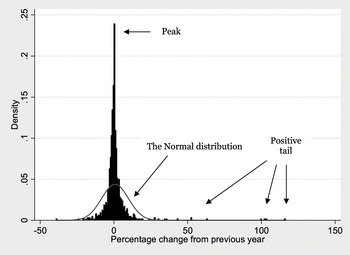
Measuring the degree of incrementalism is difficult, but the punctuated equilibrium literature has come up with an ingenious method. Building directly on the mathematical proofs in Padgett (Reference Padgett1980), a series of studies document that incremental change must have a Normal distribution. The reason is that this year's policy is composed of last year's policy plus a small random error, which is made up of a lot of more or less independent factors. It follows from the Central Limit Theorem that the sum of many independent factors will be normally distributed. Importantly, even if there is a general upward drift in the incrementalism, the distribution will still be Normal as long as the drift is proportional to the baseline of the previous year. So even if the vested interests are able to push the average budget upwards as time goes, the argument still applies. As Figure 1 below illustrates, the Normal distribution looks like the bell curve with a fairly big bulk of very small changes (some practically zero), a smaller bulk of medium changes and no really big changes.
In the event that the development is characterized by long periods of stability and few violent bursts of change, the distribution will be leptokurtic. Leptokurtosis is when the distribution contains more observations at the centre and at the extremes than Normal distributed observations. Such a distribution will have a very high peak, indicating almost zero changes, and ‘fat’ tails, indicating big changes. This distribution will look like a squeezed bell curve as can be gauged from Figure 1 (Jones et al. Reference Jones, Baumgartner and True1998; John and Margetts Reference John and Margetts2003; Jones et al. Reference Jones, Sulkin and Larsen2003; Jones and Baumgartner Reference Jones and Baumgartner2005; Mortensen Reference Mortensen2005; Breunig Reference Breunig2006).
Sceptics might argue that the welfare state literature too expects much more stability than change, even if this change is incremental. That is, some may claim that the welfare state literature also leads to an expectation of high peaks around the centre. While, in our reading, this is in fact not the argument of the newest institutional welfare state literature, which emphasizes continuing drift, conversion, layering etc, this is not critical to the test performed. The reason is that it remains the punctuated equilibrium theory only that expects the extreme outliers in the tails of the distribution. Hence, finding a high peak and fat tails at the same time continues to constitute a verification of this theory and an anomaly to the welfare state literature.
Various techniques exist to measure the degree of leptokurtosis relative to the Normal distribution. The most simple is to look visually at the distribution, which will be used in the next section to make the logic easier to understand. Yet, better than this somewhat arbitrary assessment are some of the numeric techniques, including most notably the L-kurtosis measure, which has become popular in the punctuated equilibrium literature in recent years (Baumgartner et al. Reference Baumgartner, Foucault and François2006; Breunig Reference Breunig2006; Jones et al. Reference Jones, Baumgartner, Breunig, Wlezien, Soroka, Foucault, François, Green-Pedersen, Koski, John, Mortensen, Robinson, Varone and Walgrave2009). If a distribution obtains a value of approximately .123 it is said to be Normal. The measure is particularly valuable because, first, it is robust to very extreme observations and, hence, is a conservative measure. Second, it is also more robust to small-N samples than alternative measures. As documented by Hosking (Reference Hosking1990), the L-kurtosis statistic can easily be applied to samples smaller than 100. This is important currently because we are going to analyze a sample of around 1,000 observations compared to the much bigger datasets often used in the literature. The L-kurtosis statistic is also scale-free and therefore allows for the comparison of different variables. We stick to the emerging convention and use the L-kurtosis, which allows us to directly compare the distributions with that of new research in the literature.
The next question is how to measure welfare policy. In both strands of research the most common measure is public spending, although not least the welfare state literature is acutely aware that spending does not really measure policy decisions the way we are interested in them, because a large proportion of change will be semi-automatic due to socio-economic fluctuations. Especially when applying the techniques that the punctuated equilibrium theory does, it is important to correct for these factors from the outset. The analysis is therefore based on the new dataset by Scruggs (Reference Scruggs2004), who has collected data on replacement rates between 1971 and 2002 for 18 Western countries. The data has the great advantage of being immune to automatic changes because it measures the formal replacement rate rather than budgeted or actual outlays. The reliability of the data is high since it has been collected by a single team of researchers, which is important because we want to be certain that punctuations are caused by actual policy change and not breaks in the data series, etc. In line with the mainstream welfare state literature, we select old-age pensions and unemployment insurance for the average production worker as representative measures of the welfare state (cf. Esping-Andersen Reference Esping-Andersen1990; Korpi and Palme Reference Korpi and Palme1998). By relying on data from 18 nations the study effectively also becomes the most encompassing cross-national study of the theory of punctuated equilibriums.
The total level of replacement rates may alter over time and does not have a fixed ceiling. This is because replacement rates are calculated as relative to the income of the average production worker and may be either lower or higher than this yardstick; often it will be below, but there is no certainty in this. This basic feature of the data entails that we should use the percentage-count method when calculating change. The alternative method of calculation, the percentage-percentage method, assumes that the total level is fixed (Jones and Baumgartner Reference Jones and Baumgartner2005).
As noted above, it is an open question whether the punctuated equilibrium theory is sensitive towards different welfare policy areas. One way to test this is to look closer at old-age pensions and unemployment insurance individually. As argued by Jensen (Reference Jensen2007), these two areas in modern-day welfare states represent very different policy logics because old-age pensions meet needs that are fixed, i.e., time-invariant, while the need for unemployment insurance will fluctuate with the economy. Jensen suggests that this difference should entail that old-age pensions will be more incremental than unemployment insurance: Due to the negativity bias of the vested interests, politicians will be highly motivated to refrain from inducing change even after dramatic attention shifts. This is essentially in line with the punctuated equilibrium theory in the sense that changes are often expected to happen because politicians are seeking to woo the electorate by taking popular action after a focusing event. Yet if action implies changing consistently popular welfare programs, it might be the case that politicians will abstain from taking radical initiatives that may offend a core constituency. While surely other distinctions between programmes exist (e.g., programmes aimed predominantly at poor versus the middle class), this distinction allows us to use the data available in the Scruggs dataset to present the punctuated equilibrium with a relatively hard first test of its ability to explain change across different welfare programmes.
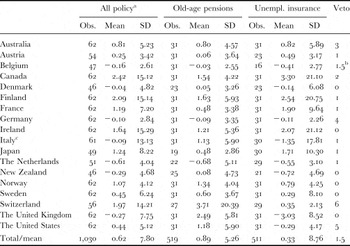
Institutional friction is operationalised as the number of veto points, which is in accordance with recent welfare state studies (e.g., Huber and Stephens Reference Huber and Stephens2001). Following Huber and Stephens, an additive index is created with federalism (none, weak, strong), presidentialism (absent, present), bicameralism (absent, weak, strong), and the use of popular referenda as a normal feature of the political process (absent, present). While in principle the index runs from 0 to 6, very few countries contain that many veto points (Switzerland, USA, and Germany being among the top with six, five, and four, respectively). Countries with more than 1 veto point in total are therefore said to host high levels of institutional friction because 1 is the median value allowing enough countries categorized as having high friction to perform a fair test. The data is taken from Huber et al. (Reference Huber, Ragin, Stephens, Brady and Beckfield2004). Table 1 presents summary statistics on all the variables.
Year on year percentage change in policies, 1971–2002

Note: Replacement rates are calculated as the ratio of net unemployment insurance/old-age pension benefit to net income for an unmarried single person earning the average production worker (APW) wage.
a Combination of old age pensions and unemployment insurance.
b Belgium changed its constitution in 1993 and became much more federal. The mean value of Belgium is 1.53 and it has been coded as a country with high levels of institutional friction.
c The observation for unemployment insurance in 1989 for Italy is deleted because it had an unrealistically high value.
6. Findings
The logic of Normal and leptokurtic distributions is important, but also difficult to grasp at first. We therefore start out by looking at the real-life distribution for all year-to-year changes between 1971 and 2002 in Figure 1. The x-axis measures the percentage change and the y-axis measures the number of observations at any given point on the x-axis. The Normal distribution has been superimposed to facilitate comparison. The first thing that immediately catches the eye is the very high peak around the centre, which is much higher than the Normal distribution. This indicates that most of the time, almost nothing happens. The next thing one notices is the outliers that lie way beyond the boundaries of the Normal distribution. 74 of all the observations have changed more than 10 per cent from one year to the next and 15 observations have changed more than 25 per cent. This, quite obviously, cannot in anyway be said to be incremental alterations.
Sceptics might argue that the distribution of Figure 1 in fact appears almost Normal. To see whether this is the case the L-kurtosis statistic is calculated. If the distribution is Normal it will have the approximate value of .123. It turns out that the L-kurtosis value is .449, i.e. clearly non-Normal (a Shapiro-Wilk W test confirms this as it does for all subsequently reported L-kurtosis values). Based on this finding it is fair to conclude that the basic punctuated equilibrium model can be confirmed.
Distribution of changes in welfare policy in western countries, 1971–2002.
N = 1,030. L-kurtosis = .449

The basic model is context-free so in order to add realism we, first, look for differences between countries with high and low levels of institutional friction, and, next, see if the two different types of welfare programmes perform differently. This way we ought to gain a better understanding of at least some of the variation that Jensen (Reference Jensen2007) suggests will exist. Having introduced the logic of Normal and leptokurtic distributions we now focus on the more exact L-kurtosis measure. Table 2 reports the values for countries with high and low institutional friction, and old-age pension and unemployment insurance, respectively.
Institutional friction and programme type (L-kurtosis)

It, first of all, turns out that institutional friction indeed leads to less incrementalism and more leptokurtic developments. This supports the general finding of the punctuated equilibrium literature that countries with a lot of friction will see extended periods of stability, punctuated by dramatic changes. It is, however, at the same time necessary to stress that the difference between the two L-kurtosis values is slight, especially compared with the programme type. Whether this is due to the way institutional friction is measured is difficult to tell, but the results presented in a moment indicate that this is not the case.
The last two rows in Table 2 document the variation in leptokursis between the two welfare programmes. It is evident that old-age pensions are much closer to the incrementalism expected by the welfare state literature than unemployment insurance. This is a noteworthy finding because especially old-age pensions are used by Pierson to support his theoretical argument of path-dependent change (Myles and Pierson Reference Myles, Pierson and Pierson2001). This is interesting because it indicates how the insights of the two strands of literature do not have to be mutually exclusive. At the same time, of course, the much more punctuated development of unemployment insurance shows where the incremental argument comes up short: 50 times have changes exceeded 10 per cent and 13 times 25 per cent. This is very significant, but fits with Jensen's observation (2007) that unemployment insurance generally is easier to reform than old-age pensions because the need for unemployment insurance fluctuates more over time than the need for pensions. Given the fluctuations in public need the political costs of introducing reforms after focusing events becomes much reduced on average, whereas the political costs of reforming old-age pensions remains constantly high. If attention shifts direct the attention of politicians, the electoral costs of introducing reforms in old-age pension systems will make politicians refrain from taking any action, whereas the average electoral costs will be much smaller when it comes to unemployment insurance.
Whatever the reason for the difference between programme types, it is possible to use this variation in combination with the level of institutional friction to get a more nuanced view at policy changes. This is done in Table 3. The foremost thing to note is that the two factors do not cancel each other out; in fact, the importance of institutional friction is enhanced. The consequence is that it is possible to locate four clusters each characterized by a different degree of incrementalism. The one extreme is old-age pensions in countries with low institutional friction. This category is not far from being truly incremental (in the statistical sense), and only one time out of the 334 time points in this cluster did the change exceed 25 per cent. The other extreme is unemployment insurance schemes in countries with high levels of institutional friction, which comes out in the top with an L-kurtosis value of .566. It is interesting to note how the Hartz IV reform mentioned earlier may in fact be an illustration of this category: a very abrupt reform of unemployment insurances after a long period of stability, in a country with high levels of institutional friction.
Composite effect of institutional friction and programme type (L-kurtosis)

These results are obviously interesting and point to the new insight that can be gained by critically adopting the punctuated equilibrium perspective to welfare state analysis. It becomes possible to get a – theoretically informed – starting point for asking more detailed questions about the real-life reform patterns in modern welfare states. Why do old-age pensions perform so differently from unemployment insurances? Is it really correct that institutional friction has a tendency to cause comparably bigger reforms in unemployment insurance schemes? In what ways does the institutional friction at macro-level interact with the presumably sector-level characteristics of the individual welfare programmes?
Conclusion
The mainstream welfare state literature has provided a great deal of insight with its emphasis on how change will happen incrementally, often via institutional adjustments on the margin (Pierson Reference Pierson2000; Streeck and Thelen Reference Streeck and Thelen2005). This contribution should, however, not hide the fact that change does not always happen this way. So far there has been a tendency in the literature to view such big changes as contingent, or exogenous, indicating that they are outside the scope of the theory and to some extent also outside the area of interest. Yet, big and sudden reforms do happen and welfare state researchers should be interested in this type of change too; not because they occur frequently, but because they almost by definition matter a lot the few times they actually occur.
The punctuated equilibrium theory can help us get a better grip on why policies are mostly stable, but from time to time punctuated by big reforms. The basic model emphasizes universal features of all organizations, which must lead to long periods of non-attention to issues, followed by periods of intense attention. These shifts are arguably the fundamental cause of the non-incrementalism found above. At the same time the basic model allows for extensions making it more context-sensitive. First, as suggested by the literature itself, institutional friction may play a role, but the model can also be extended by disaggregating all welfare policies into the individual areas. Doing so gives an indication of just how many analytical possibilities the punctuated equilibrium theory offers the researcher.
There are limits, of course, to the benefits that can be derived from the new perspective. It has already been noted that the theory cannot explain why attention shifts happen, only what happens after the event. This is clearly a shortcoming and more research is needed on why and when punctuations are triggered. Given the detailed knowledge of welfare state researchers in their particular fields, it will likely be from the welfare state literature that sound answers to this question will arise. Similarly with the distinction between old-age pensions and unemployment insurance that proved so important. To understand this diverse performance ought to arouse the interest of scholars within the field.
Acknowledgements
The article has benefitted from the helpful comments of Christoffer Green-Pedersen and Peter Bjerre Mortensen