Vancomycin-resistant Enterococcus faecium (VRE) are an important cause of healthcare-associated infections.Reference Cattoir and Leclercq1 Vancomycin resistance among E. faecium bloodstream isolates has increased in the United States from 57% in 2000 to >80% in 2010.Reference Arias, Mendes, Stilwell, Jones and Murray2 The odds of death from enterococcal bloodstream infection are more than doubled if the isolate is vancomycin resistant.Reference DiazGranados, Zimmer, Klein and Jernigan3 With increasing reports of resistance to additional antibiotics, infection control efforts must focus on preventing nosocomial spread of VRE.Reference Arias, Panesso and McGrath4, Reference Diaz, Kiratisin, Mendes, Panesso, Singh and Arias5
Factors contributing to colonization with VRE include prolonged hospital stay, immunosuppression, hematologic malignancy, residence in long-term care facilities, invasive procedures, proximity to colonized or infected patients, occupying a room vacated by a VRE-colonized patient, and use of third-generation cephalosporins, intravenous vancomycin, or antianaerobic antibiotics.Reference Murray6–Reference Ford, Lopansri and Haydoura9 The likelihood of developing a bloodstream infection after VRE colonization is highest among immunosuppressed patients.Reference Weinstock, Conlon and Iovino10 Infection control measures to prevent the spread of VRE include active microbiological surveillance and contact precautions.
Patients at the National Institutes of Health (NIH) Clinical Center, a 200-bed hospital, are enrolled in research studies. Most patients are immunosuppressed from their underlying illnesses or from therapy, including chemotherapy, hematopoietic stem cell transplantation (HSCT), and immunotherapy. Patients who have VRE colonization or infection are placed in contact isolation, which is discontinued when the patient appears to be “decolonized,” that is, after 3 consecutive negative surveillance cultures at least 1 week apart.Reference Siegel, Rhinehart, Jackson and Chiarello11, Reference Banach, Bearman and Barnden12 One challenge in the subsequent management of VRE is the patients’ dynamic state of colonization, which affects clinical care and isolation status. Recent literature on the natural history of VRE recolonization is sparse.Reference Bhalla, Pultz, Ray, Hoyen, Eckstein and Donskey13–Reference Lee, Park, Jin and Park15 Whether the same risk factors that promote initial colonization also encourage recolonization with VRE is not well understood. Antibiotic exposure after decolonization could apply selective pressure in the setting of low-level persistent colonization, or it could alter the intestinal microbiome in a manner conducive to recolonization. Here, we present descriptive epidemiology and natural history of VRE colonization and infection as well as the results of our investigation of whether receipt of inpatient antibiotics is associated with time to VRE recolonization.
Methods
Patients and setting
All patients who had VRE infection or colonization identified from active surveillance or clinical cultures between January 2007 and December 2015 were included in the study. Starting in July 2009, surveillance perirectal swabs were collected on admission and then weekly from all patients receiving HSCT and on medical oncology wards (regardless of diagnosis), except those already known to be colonized with VRE. The institutional review board waived approval for this study.
Definitions
Patients met criteria for VRE infection if VRE grew in culture from a clinical specimen other than urine. Patients who had positive perirectal cultures or PCR for VRE or who had VRE grown from urine were considered colonized. Patients off antibiotics ≥4 weeks who had 3 consecutive negative perirectal swabs at least 1 week apart were considered decolonized. After they were decolonized, patients were classified as recolonized if they later had clinical cultures or surveillance swabs positive for VRE. Decolonized patients who had no further microbiological evidence of VRE were considered to have remained decolonized.
The primary exposure variables were total antibiotic and antianaerobic antibiotic days. An antibiotic day was defined as receipt of at least 1 inpatient antibiotic per 24-hour period. Outpatient antibiotics were excluded because we were unable to confirm administration definitively. Antibiotics most likely to be prescribed for intra-abdominal infections were included in the group of antianaerobic antibiotics. Ampicillin/sulbactam, amoxicillin/clavulanate, meropenem, imipenem, ertapenem, metronidazole, and piperacillin/tazobactam were classified as antianaerobic antibiotics. Because clindamycin is not recommended as a first-line antibiotic for these infections, it was not included.
Possible confounding variables were selected based on literature review and clinician experience and included age at the time of VRE decolonization, race, gender, and inpatient hospitalization days.
The primary outcome variable was VRE recolonization. The at-risk period was the duration of VRE decolonization, defined as the number of days between the first negative perirectal culture and the date of recolonization or the last known negative culture.
VRE screening and clinical cultures
Throughout the study period, clinical specimens were inoculated onto selective media (bile esculin azide agar containing 6 μg/mL vancomycin). From July 2009 to July 2010, perirectal swabs were also inoculated onto selective media. Starting in July 2010, swabs were first tested by rapid VanA/VanB PCR (Cepheid), which, due to low positive predictive value, was replaced in December 2010 with rapid VanA PCR (Cepheid). Swabs with positive PCR results were inoculated onto selective media. Colonies were identified using matrix-assisted laser desorption/ionization time-of-flight mass spectroscopy (MALDI-TOF MS) and underwent automated antimicrobial susceptibility testing using the Phoenix (Becton Dickinson, Franklin Lakes, NJ) and Vitek (bioMèrieux, Marcy-l’Étoile, France) systems.
Statistical analysis
To standardize antibiotic exposure during the at-risk period, the median proportions of total antibiotic days per VRE decolonized days and antianaerobic antibiotic days per VRE decolonized days were calculated for each patient and analyzed in regression models. The median proportions of antibiotic days per VRE decolonized days were then analyzed separately in survival analyses as binary variables either above or below the respective medians. The proportion of inpatient days per VRE decolonized days was calculated for each patient then analyzed as a binary variable either above or below the respective subcohort (n = 72) median.
We used Stata version 13.1 statistical software (StataCorp, College Station, TX) for all analyses. Baseline characteristics were compared using the Student t test for means and the Fisher exact test and the Pearson χ2 test for categorical values. Percentage of median total antibiotic days, antianaerobic antibiotic days, and inpatient hospital days were compared using the median Fisher exact test. Hazard ratios and significance determinations were calculated using Cox proportional hazards models with time-fixed covariates and robust estimation. Statistical significance was defined as a 2-sided P value < .05. The Kaplan-Meier survival curve P values were calculated using log-rank tests.
Results
Overall cohort results
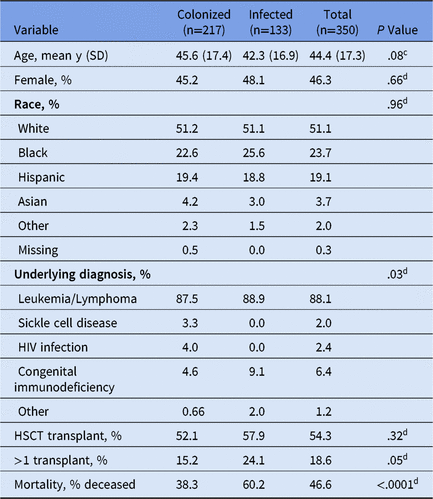
Between 2007 and 2015, 350 patients were identified as either colonized or infected with VRE. Most patients had an underlying diagnosis of leukemia or lymphoma (88%), and 54% had undergone HSCT. Patients with a VRE infection had a higher mortality rate than those who were colonized (60% vs 38%). Patient characteristics and comparisons are summarized in Table 1 and Table 2.
Baseline Characteristics of Patients With VRE Colonization and/or Infection

Note. SD, standard deviation; IQR, interquartile range; HIV, human immunodeficiency virus; HSCT, hematopoietic stem cell transplant.

Note. VRE, vancomycin-resistant Enterococcus; SD, standard deviation.
a VRE growth in culture from a clinical specimen other than urine.
b VRE detection/growth in surveillance or urine culture.
c Student t test.
d Fisher exact test.
Active surveillance results
Surveillance perirectal swabs identified VRE colonization in 230 of the 350 patients (66%): 146 had positive VRE PCR and culture (PCR+/Cx+), and 84 had positive VRE PCR but negative culture (PCR+/Cx−). No patients had negative PCR and positive culture (PCR−/Cx+).
Clinical culture results
Clinical cultures growing VRE were the first manifestation of VRE acquisition in 120 patients: 54 (45%) in urine, 28 (23%) in blood, 25 (21%) in wounds and 13 (11%) other sources.
PCR-positive/Culture-negative analysis
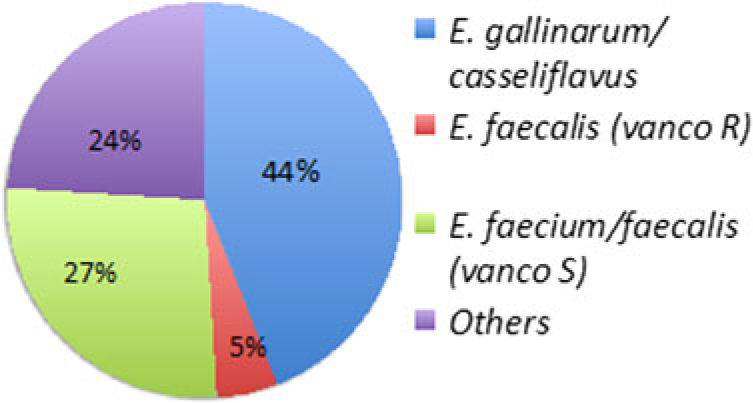
Among the 84 PCR+/Cx− patients, 75 had subsequent swabs collected. Only 23 (30%) of these 75 patients ever grew VRE in culture. The remaining patients’ PCR+/Cx− swabs grew 41 other isolates (Fig. 1). PCR had a positive predictive value of 39%, and 95% of the identified organisms were not VRE.
Organisms cultured from swabs that were PCR positive and culture negative (PCR+/Cx−) for VRE (n = 75). Among 84 patients whose surveillance swabs were PCR+/Cx−, 75 had subsequent swabs collected. Of these 75 patients, 23 (30%) later grew VRE in culture from surveillance swabs, while the remaining patients’ swabs (n=52) grew 41 other isolates: vancomycin-susceptible (vanco S) E. faecium/faecalis (27%), vancomycin-resistant (vanco R) E. faecalis (5%), E. gallinarum/casseliflavus (44%), and others (24%).

VRE infection
Of the 350 patients included in this study, 133 developed a VRE infection. A significantly higher rate of infection was observed in patients whose initial detection was from a positive clinical culture (67%) or PCR+/Cx+ swab (32%) than in patients with PCR+/Cx− swabs (8%).
Subcohort analysis of VRE recolonization
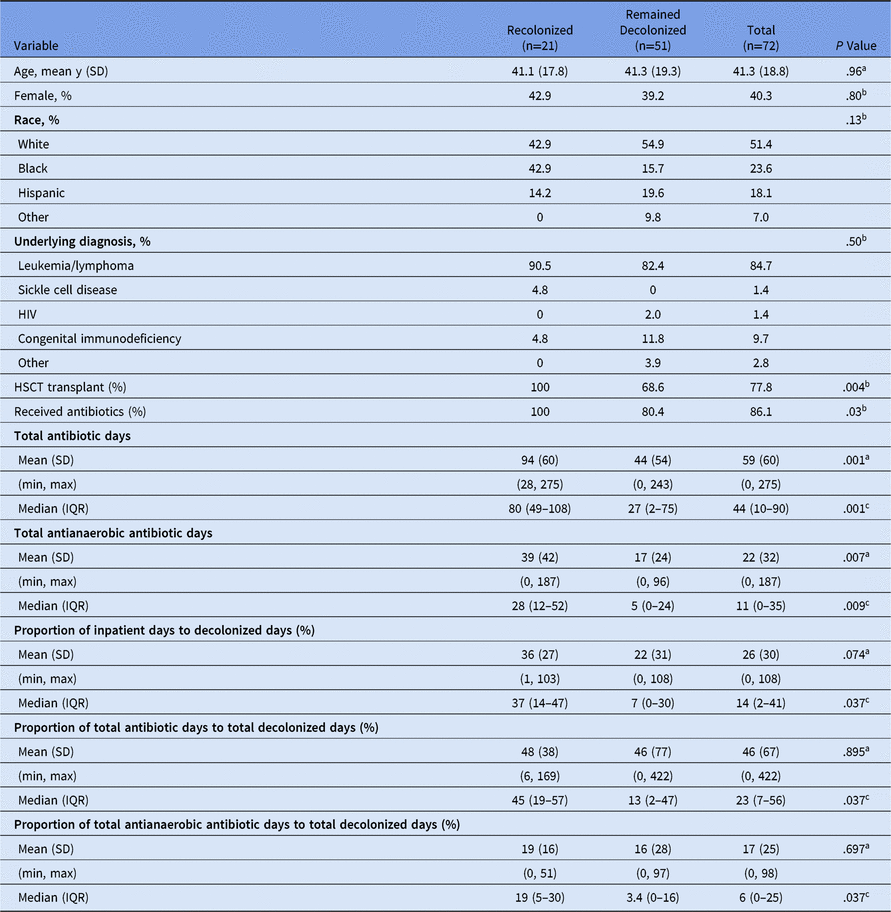
Among the 350 patients, 72 (23%) eventually met decolonization criteria, but 21 (29%) later became recolonized with VRE. Most recolonized patients had leukemia or lymphoma, and the majority had undergone HSCT (Table 3).
Baseline Characteristics and Comparative Antibiotic Exposure of Decolonized Patients Who Became Recolonized With VRE or Remained Decolonized

Note. SD, standard deviation; HIV, hum immunodeficiency virus; IQR, interquartile range.
a Student t test.
b Fisher exact test.
c Median Fisher exact test.
Nearly all patients received inpatient antibiotics in the interval after VRE decolonization (Table 3). Median total antibiotic days per VRE decolonized days and median antianaerobic antibiotic days per VRE decolonized days were 3.5 and 5.6 times higher, respectively, in recolonized patients than among those who remained decolonized.
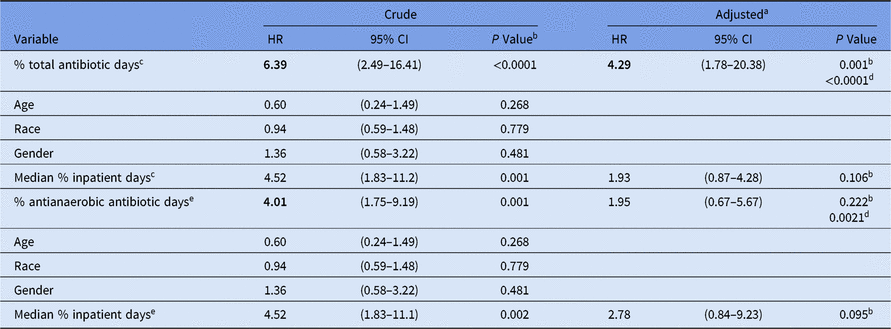
Crude and adjusted hazard ratios of time to VRE recolonization are presented in Table 4. After adjusting for median percentage of inpatient days in the final model, the hazard of VRE recolonization was 4.3-fold higher (P = .001) in patients whose percentage of total antibiotic days was higher than the subcohort median. These relationships are graphically represented in Kaplan-Meier curve estimates in Figure 2.
The Relationship of Antibiotic Exposure per VRE Decolonized Days and Time to VRE Recolonization

Note. VRE, vancomycin-resistant Enterococcus; HR, hazard ratio; CI, confidence interval.
a Based on Cox proportional hazards with robust estimation, adjusting for median percentage of inpatient days.
b Based on significance level of P < .05.
c Calcuated during each patient’s VRE decolonization period; analyzed as binary variable above and below cohort median % of total antibiotic days (median, 23; IQR, 7–56).
d Based on the log-rank test for equality of survivor functions.
e Calcuated during each patient’s VRE decolonization period; analyzed as binary variable above and below cohort median % of total antianaerobic days (median, 6; IQR 0–25).
Kaplan-Meier estimates of VRE decolonized state by proportion of total antibiotic days (left) and antianaerobic antibiotic days (right). The hazard of VRE recolonization was 4.29-fold higher (P = .001) in patients who received a higher proportion of total antibiotic days than the subcohort median (median, 23; IQR, 7–56). The hazard of VRE recolonization was 1.95 times higher (P = .222) in patients who received a higher proportion of antianaerobic antibiotic days than the subcohort median (median, 6; IQR, 0–25).

Discussion
Our cohort of patients with VRE infection and colonization largely comprised patients who had underlying hematologic malignancies and/or had undergone HSCT, similar to previous reports.Reference Kamboj, Chung, Seo, Pamer, Sepkowitz, Jakubowski and Papanicolaou16 Only 15% of 350 patients appeared to become decolonized over the course of this study; this finding underscores the tenacity of VRE colonization. In our population, higher rates of VRE infection were seen in culture-positive colonized patients than culture-negative colonized patients, consistent with studies evaluating colonization as a risk factor for VRE bacteremia.Reference Ford, Gazdik and Lopansri17, Reference Hefazi, Damlaj and Alkhateeb18
When comparing the characteristics of patients with and without VRE infection, increased mortality appeared to be associated with VRE infection, although unmeasured confounding may have contributed to this finding.Reference DiazGranados, Zimmer, Klein and Jernigan3
The link between VRE colonization and infection in immunosuppressed patients is an important consideration, particularly for infection prevention practices. Detectable colonization appears to be transient, and VRE may persist in the intestinal flora below the threshold of detection of PCR testing. The vacillation of PCR and culture detection over time creates a practical challenge for determining when a patient may be removed from contact isolation. As others have shown, 3 negative weekly VRE PCR tests or cultures are insufficient to conclude that patients are no longer colonized with VRE.Reference Donskey, Chowdhry and Hecker19–Reference Henard, Lozniewski, Aissa, Jouzeau and Rabaud21 However, as shown in our study, the low positive predictive value of PCR testing may be influenced by detection of VanA genes in other intestinal flora and likely results in unnecessary isolation of some patients. The limitations of existing surveillance testing illustrate that a better understanding of the dynamics of VRE colonization is essential for reducing its prevalence in hospitalized patient populations.
The relationship between VRE colonization and gut microbiome disruption following antibiotic exposure has been previously reported.Reference Bhalla, Pultz, Ray, Hoyen, Eckstein and Donskey13, Reference Donskey, Chowdhry and Hecker19, Reference Stiefel, Pultz, Helfand and Donskey22, Reference Ubeda, Taur and Jenq23 Our data show that the risk of VRE recolonization is significantly associated with receiving antibiotics on a higher proportion of days following decolonization. Similar to Donskey et al.,Reference Donskey, Hoyen, Das, Helfand and Hecker14 our results provide evidence for the impact of antimicrobials on the risk of VRE recolonization and the importance of antimicrobial stewardship in immunosuppressed patients. Our results suggest that decolonized patients receiving antibiotics should be screened for asymptomatic recolonization. Identifying these patients quickly could prevent transmission and improve clinical care.
Whether recolonization represents recrudescence or new acquisition of VRE in our cohort is uncertain without genomic analysis. Even with whole-genome sequencing, analysis of single colonies may miss the heterogeneity of colonizing strains. Recent studies suggest that VRE transmission is more complex than previously thought. Sequencing of E. faecium isolates within one facility revealed numerous clusters of highly related isolates, indicating multiple introductions with subsequent clonal expansion.Reference Raven, Gouliouris and Broderick24 The presence of genetically diverse VRE combined with persistence and transmission over time could explain the findings of Ford et al.,Reference Ford, Gazdik and Lopansri17 in which typing of VRE isolates from recolonized HSCT patients revealed that in 55% of patients the newly detected strains differed from the original strains.
Even without genomic evidence, the supposition that some patients in our cohort were truly decolonized seems reasonable. Overall, 86% of our decolonized subcohort received antibiotics during their decolonized periods, yet 51 patients did not become recolonized, suggesting that these patients effectively cleared intestinal VRE carriage. The natural history of VRE recolonization most likely involves other factors in addition to antibiotic exposure and bacterial transmission.
The results of this study may not be generalizable to all patient populations. Additional factors associated with initial VRE colonization such as immunosuppressive medications, proximity to other VRE patients, and invasive procedures were not evaluated. The variability of antibiotic administration could have influenced study outcomes. Changes in VRE testing procedures and targeted surveillance could have introduced selection bias.
In summary, VRE colonization is tenacious and increases the likelihood of VRE infection in immunocompromised patients. Infection control measures are essential, but their effectiveness is diminished by testing limitations and the complexity of nosocomial acquisition of VRE. We have shown that higher total antibiotic days as a proportion of VRE decolonized days is associated with shorter time to VRE recolonization. VRE decolonization is a fragile state during which monitoring antimicrobial usage metrics could aid in screening and isolation decisions among patients who appear to have become decolonized.
Author ORCIDs
Heather Y. Hughes, 0000-0002-9733-3172
Acknowledgments
We thank the staff of the NIH Clinical Center Microbiology Service for their critical contributions to this project.
Financial support
This research was supported by the NIH Clinical Center, and the intramural research program of the National Institute of Allergy and Infectious Diseases.
Conflicts of interest
Dr Milstone reports grants from Sage Products outside the submitted work. All other authors report no conflicts of interest relevant to this article.