INTRODUCTION
Sleep disturbance is common among family caregivers of patients with advanced illness (Carter, Reference Carter2002; Hearson et al., Reference Hearson, McClement and McMillan2011; Rausch et al., Reference Rausch, Baker and Boonmee2007; Carter & Chang, Reference Carter and Chang2000; Berger et al., Reference Berger, Parker and Young-McCaughan2005). Although sleep disturbance can have negative consequences for caregiver health, well-being and caregiving capacity (Carter, Reference Carter2002; Hearson & McClement, Reference Hearson and McClement2007), relatively little research on caregiver burden has focused on the contribution of sleep disturbance, particularly during the terminal phase of a patient's disease. Caregivers may be especially vulnerable to sleep disturbance during the terminal phase, due to an increase in the patient's physical and emotional needs in addition to the anticipatory grief of losing their family member. Furthermore, inadequate sleep may result in increased vulnerability to stress-related disorders (Meerlo et al., Reference Meerlo, Sgoifo and Suchecki2008), which could lead to poorer long-term outcomes among caregivers.
The few studies addressing caregiver sleep during the terminal phase have focused on home-based palliative care; all conclude that night respite is essential for addressing the significant sleep disturbance of family caregivers (Steele & Fitch, Reference Steele and Fitch1996; Hearson et al., Reference Hearson, McClement and McMillan2011; Kristjanson et al., Reference Kristjanson, Cousins and White2004; Bramwell et al., Reference Bramwell, MacKenzie and Laschinger1995). Admission to residential hospice would seem to reduce the family caregiver's responsibilities and provide adequate opportunities for rest and recovery, yet no study has evaluated caregiver sleep in a residential hospice setting. A recent study of Alzheimer's patients found that nursing home placement had no effect on sleep among spousal caregivers (von Kanel et al., Reference von Kanel, Mausbach and Ancoli-Israel2012), suggesting that caregivers experience sleep disturbance regardless of patient placement.
The caregiver's relationship to the patient (e.g., partner/spouse or other family member) has received some research attention, but findings have been inconsistent (Williams & McCorkle, Reference Williams and McCorkle2011). The caregiver-patient relationship could impact caregiver sleep and needs to be better understood to provide effective supportive services for different types of caregivers. Thus, the purpose of this pilot study was to examine the feasibility of conducting a sleep study of family caregivers for patients in hospice and report preliminary results. We hypothesized that family caregivers would have high rates of clinically significant sleep disturbance (based on objective and subjective measures) and that partners would experience poorer sleep than other family caregivers.
METHOD
This cross-sectional study reports baseline findings from a longitudinal pilot study of caregivers for patients admitted to Lovisenberg Hospice in Oslo, Norway. Data were collected January to June 2012 from hospice patients and their primary caregivers; only data from caregivers are included in this report. The study was approved by the Regional Medical Research Ethics Committee of Health East of Norway (reference # 2011/1273), and Lovisenberg Diakonale Hospital. Informed written consent was obtained from all patients and their caregivers.
PARTICIPANTS
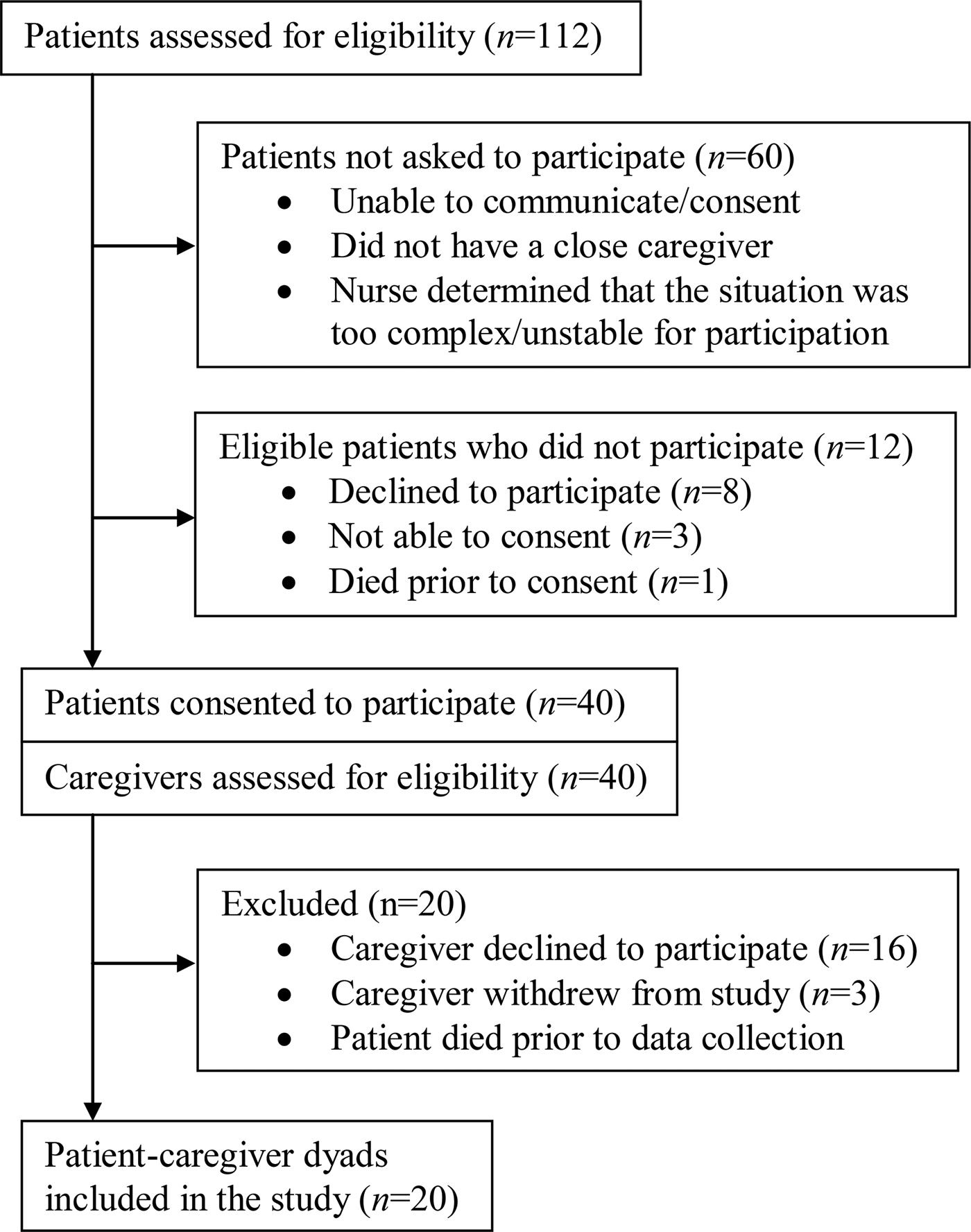
Consecutive patients were recruited if they met the following inclusion criteria: (1) admitted for 24-hour hospice care within past week, (2) evaluated by their health professional to be in the terminal stage of their disease (3) ≥18 years, (4) could specify a primary caregiver and (5) had the cognitive and verbal capacity to comprehend Norwegian verbal cues. All hospice patients had advanced cancer. Each patient who consented to participate specified their primary caregiver who was also recruited for participation. Caregivers who were ≥18 years and consented to participate were included (see Fig. 1).
Flowchart showing the recruitment of patient-caregiver dyads.

MEASUREMENTS
Perceived Sleep Quality
Caregivers' sleep quality during the prior month was assessed with the 19-item Pittsburgh Sleep Quality Index (PSQI; (Buysse et al., Reference Buysse, Reynolds and Monk1989). Total scores can range 0–21, higher scores represent poorer sleep quality, and scores >5 are considered clinically significant (Buysse et al., Reference Buysse, Reynolds and Monk1989). The PSQI has seven components: sleep quality, sleep onset latency, sleep duration, habitual sleep onset efficiency, sleep disturbance, sleep medication use, and daytime dysfunction. Component scores range 0–3, with higher scores reflecting worse sleep. Internal consistency and test-retest reliability for the original (Beck et al., Reference Beck, Schwartz and Towsley2004) and Norwegian (Pallesen et al., Reference Pallesen, Nordhus and Skelton2005) versions are satisfactory.
Sleep-Wake Pattern
Sleep quantity and quality were estimated with the Motionlogger Actigraph (AA-32 Ambulatory Monitoring Inc., Ardsley, NY, USA), a valid and reliable instrument for assessing sleep-wake behavior over several nights and days (Ancoli-Israel et al., Reference Ancoli-Israel, Cole and Alessi2003). It is worn like a wristwatch and records movement in 1-minute intervals to estimate sleep and wake time. Its correspondence with polysomnography is 91%–93% in healthy people (Ancoli-Israel et al., Reference Ancoli-Israel, Cole and Alessi2003). In this study, actigraphs were worn for four nights and three days. Actigraphs recorded in zero-crossing mode, and activity counts were analyzed with the Cole-Kripke algorithm from ActionW software program, version 2.4 (Ambulatory Monitoring Inc.). Sleep diaries facilitated actigraphy scoring. Night-time sleep parameters were based on standard intervals from 21:00PM to 08:59AM and included total night sleep, mean number of awakenings and mean wake after sleep onset (WASO). WASO was reported in total minutes and as a percentage standardized by time in bed. Daytime sleep quantity was estimated as the number of minutes asleep between 09:00AM and 20:59PM. Total sleep quantity during each 24 hour period was calculated as the sum of night and day sleep. Mean values across the four nights and three days were used for analyses.
Data Analysis
Data were analyzed using SPSSTM Version 18.0. Descriptive statistics summarized demographic characteristics and sleep outcome variables. Group differences were assessed using Chi-square tests of independence and independent sample t-tests. Group differences on potential covariates were accounted for using analysis of covariance. Significance of p < 0.05 was used for all analyses. Effect sizes of eta-squared values >0.04 and phi values >0.2 were considered clinically relevant (Ferguson, Reference Ferguson2009).
RESULTS
Descriptive Statistics
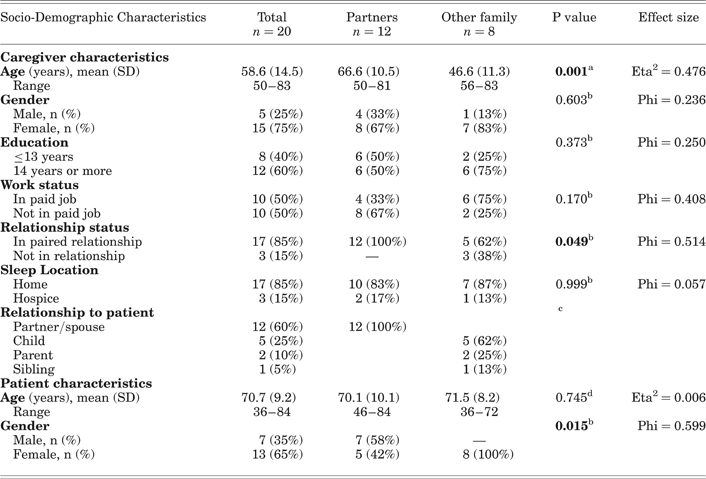
Twenty caregivers completed the baseline assessment without difficulty and were included in analyses (Fig. 1). Socio-demographic characteristics are shown in Table 1. Partners (n = 12) were older and more likely to be in a relationship and to be caring for a male patient than other family caregivers (n = 8). Although not statistically significant in this small sample, there were clinically relevant group differences in gender, education, and work status.
Socio-demographic characteristics for the pilot sample by caregiver's relationship to the patient (N = 20)
Note: Statistically significant differences are indicated with p-values in bold type.
aF(1,18) = 16.4
bFisher's Exact
cno analyses since groups differ by definition
dF(1,17) = 0.34.
Sleep Differences between Partners and Other Family Caregivers
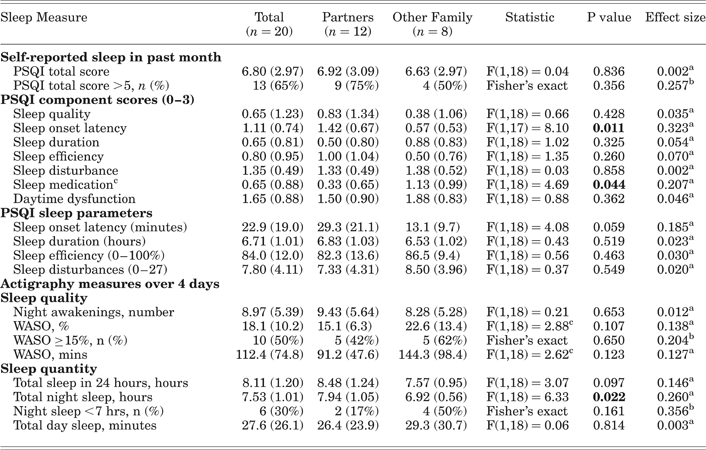
All 20 caregivers completed the PSQI. Overall, caregivers reported poor sleep in the last month; most scored above the PSQI's clinical cut-point (Table 2). Difficulty falling asleep, wake during the night, and daytime dysfunction were the most commonly reported sleep problems. Compared to other family caregivers, partners reported more trouble falling asleep, and less use of sleep medication.
Unadjusted sleep measures by caregiver's relationship to the patient mean (standard deviation)
Note: PSQI = Pittsburgh Sleep Quality Index; WASO = wake after sleep onset, a measure of sleep disruption. The PSQI assessed sleep during past month prior to the patient entering hospice, while actigraphy measures assessed sleep once the patient was admitted to hospice. Statistically significant results are indicated with p-values in bold type.
aEta squared
bPhi
cunequal variances
All 20 caregivers wore the actigraph for at least three of the four nights, and there were no actigraph equipment failures. Actigraphy data indicated that partners obtained more night sleep than other family caregivers once the patient was admitted to hospice. Six caregivers averaged <7 hours of sleep per night and 10 had clinically significant sleep disruption (WASO ≥ 15%).
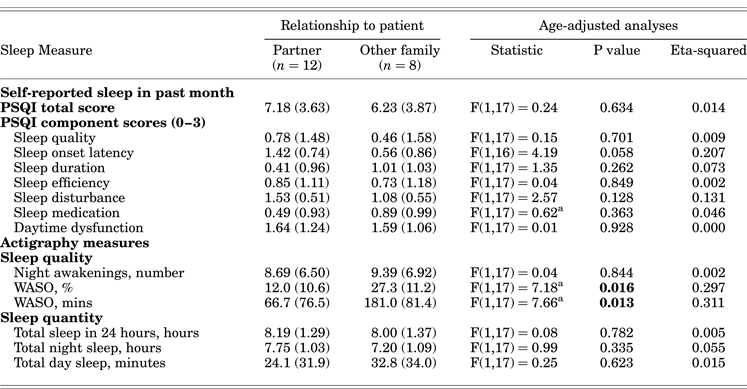
Because the partners were significantly older than the other caregivers, age-adjusted analyses were conducted (Table 3). Although this small sample had limited statistical power for age-adjusted analyses, partners had less sleep disruption (WASO) than other family caregivers once the patient entered residential hospice. In both unadjusted and age-adjusted analyses, several outcomes did not reach statistical significance but suggest clinically relevant differences based on caregiver-patient relationship.
Sleep measures by caregiver's relationship to the patient and adjusted for caregiver age, marginal means (standard deviation)
Note: PSQI = Pittsburgh Sleep Quality Index; WASO = wake after sleep onset, a measure of sleep disruption. The PSQI assessed sleep during past month prior to the patient entering hospice, while actigraphy measures assessed sleep once the patient was admitted to hospice; marginal means estimate group differences at the mean age of 58.7 years. Statistically significant results are indicated in bold type.
aunequal variances
DISCUSSION
To our knowledge, this is the first study to use both subjective and objective measures to describe sleep of family caregivers for patients newly admitted to hospice. This pilot study demonstrated protocol feasibility, with 20 caregivers completing baseline data collection. During the patient's hospice stay, caregivers generally obtained the recommended 7–8 hours of sleep, but sleep was considerably disrupted. Another study (Hearson et al., Reference Hearson, McClement and McMillan2011) of caregivers providing palliative care at home reported less sleep at night, but also less WASO than observed in this study. These results should be interpreted with caution given the small sample, but suggest that caregivers experience sleep disturbance even after the patient is admitted to residential hospice.
Because the PSQI assesses sleep in the past month, PSQI scores in this study likely reflect caregiver sleep prior to the patient's hospice admission. However, these PSQI scores, while high, were substantially lower than prior reports of caregivers providing end-of-life care (Carter, Reference Carter2002; Hearson et al., Reference Hearson, McClement and McMillan2011). One possible explanation for this difference is the additional support provided through home-based health care, which is provided free of charge in Norway, but may be less common in other countries. Partners reported more difficulty falling asleep, but were also less likely to use sleep medication. This finding may be due to concern that sleep medication would interfere with their ability to provide care during the night and needs to be explored in further research.
Contrary to expectation, partners had less sleep disruption (WASO) than other family caregivers after hospice admission. These findings differ from prior studies, which did not find differences by caregiver type (Carter, Reference Carter2002; Chang et al., Reference Chang, Tsai and Chang2007). The non-partner caregivers in this sample were younger and more likely to be employed than the partner caregivers, and thus, may have had work and other family responsibilities that interfered with sleep and were not reduced by hospice admission. It is also possible that the hospice admission allowed the partner to increase their sleep time for recovery from the chronic sleep debt experienced while the patient was at home.
These results should be considered in light of some limitations. Many potential study participants were not approached, which may have resulted in a sampling bias toward less distressed families. If so, these findings may underestimate sleep disturbance in this population. In addition, the small sample precluded analysis of the effects of sleep location and other caregiver and patient characteristics (e.g., gender) which may have influenced caregiver sleep. Such factors need examination in future studies.
In conclusion, family caregivers of hospice patients experience poor sleep quality. Future research is warranted to identify strategies for reducing the impact of their sleep disturbance prior to hospice admission. Identifying caregiver needs by their relationship to the patient would enhance research on tailored intervention strategies for this vulnerable population.
ACKNOWLEDGEMENTS
The study was funded from Lovisenberg Diakonale University College and Lovisenberg Diakonale Hospital. The authors report no conflicts of interests.