Adolescent alcohol use is a prevalent health and social problem (Institut de la statistique du Québec, 2009; Johnston, O'Malley, Bachman, & Schulenberg, Reference Johnston, O'Malley, Bachman and Schulenberg2013) with several short- and long-term consequences (Newbury-Birch et al., Reference Newbury-Birch, Walker, Leah, Beyer, Brown and Jackson2009). Studies have found that temperament (Wennberg & Bohman, Reference Wennberg and Bohman2002; Willem et al., Reference Willem, Bijttebier, Claes, Sools, Vandenbussche and Nigg2011) and parental practices (Cablova, Pazderkova, & Miovsky, Reference Cablova, Pazderkova and Miovsky2014; Ryan, Jorm, & Lubman, Reference Ryan, Jorm and Lubman2010) were associated with adolescent alcohol use and that they interacted to predict risk for alcohol use (Armstrong et al., Reference Armstrong, Ruttle, Burk, Costanzo, Strauman and Essex2013; Burk et al., Reference Burk, Armstrong, Goldsmith, Klein, Strauman and Costanzo2011; Stice & Gonzales, Reference Stice and Gonzales1998). While previous research considered temperament as a vulnerability factor leading to higher alcohol use in the context of adverse environments, recent theoretical work suggests temperament could also be indicative of individuals' susceptibility to environmental factors such as parenting (Belsky & Pluess, Reference Belsky and Pluess2009, Reference Belsky and Pluess2013): some temperamental characteristics would be both disadvantageous in adverse environments and advantageous in favorable environments. Thus, the purpose of this study is to examine the interaction between temperament and parenting variables in the prediction of adolescent alcohol use while considering theoretical models that could explain those interactions.
Temperament and Alcohol Use
Temperament refers to early emerging individual differences regarding reactivity, which refers to the speed and intensity of emotional arousal, attention, and motor activity (e.g., impulsivity, emotionality, and activity level), and self-regulation, which refers to the strategies that modify reactivity (e.g., inhibitory control and attentional control). These differences are relatively stable and have some genetic foundation (Rothbart & Bates, Reference Rothbart, Bates and Eisenberg2006).
Research shows that several dimensions of temperament are related to alcohol use (Caspi, Moffitt, Newman, & Silva, Reference Caspi, Moffitt, Newman and Silva1996; Colder & Chassin, Reference Colder and Chassin1997; Giancola & Mezzich, Reference Giancola and Mezzich2003; Hartman, Hopfer, Corley, Hewitt, & Stallings, Reference Hartman, Hopfer, Corley, Hewitt and Stallings2013; Tubman & Windle, Reference Tubman and Windle1995; Wennberg & Bohman, Reference Wennberg and Bohman2002; Willem et al., Reference Willem, Bijttebier, Claes, Sools, Vandenbussche and Nigg2011; Windle, Reference Windle1991). Of note, early inhibition has been associated with alcohol use (Caspi et al., Reference Caspi, Moffitt, Newman and Silva1996). Research shows that some inhibited children later develop high anxiety levels (Degnan, Almas, & Fox, Reference Degnan, Almas and Fox2010; Degnan & Fox, Reference Degnan and Fox2007) and other internalizing symptoms, which are in turn associated with alcohol use (Hussong, Jones, Stein, Baucom, & Boeding, Reference Hussong, Jones, Stein, Baucom and Boeding2011; Saban & Flisher, Reference Saban and Flisher2010), suggesting that those children could be using alcohol as a self-medicating strategy to reduce negative affect (Weinberger & Bartholomew, Reference Weinberger and Bartholomew1996). Early impulsivity has also been shown to be associated with later alcohol use (Colder & Chassin, Reference Colder and Chassin1997; Willem et al., Reference Willem, Bijttebier, Claes, Sools, Vandenbussche and Nigg2011), through increased risk for antisocial behavior (Clark, Reference Clark2005), an important risk factor for substance use (Conner & Lochman, Reference Conner and Lochman2010; Swadi, Reference Swadi1999).
Parental Practices and Alcohol Use
Several dimensions of parental practices have been found to be associated with adolescent alcohol use and could interact with inhibition or impulsivity to predict alcohol use. Among those, parental monitoring has been repeatedly associated with alcohol use (e.g., Abar, Jackson, Colby, & Barnett, Reference Abar, Jackson, Colby and Barnett2014; Barnes, Reifman, Farrell, & Dintcheff, Reference Barnes, Reifman, Farrell and Dintcheff2000; Clark, Shamblen, Ringwalt, & Hanley, Reference Clark, Shamblen, Ringwalt and Hanley2012; DiClemente et al., Reference DiClemente, Wingood, Crosby, Sionean, Cobb and Harrington2001; Duncan, Duncan, Biglan, & Ary, Reference Duncan, Duncan, Biglan and Ary1998; Kaynak et al., Reference Kaynak, Meyers, Caldeira, Vincent, Winters and Arria2013; Steinberg, Fletcher, & Darling, Reference Steinberg, Fletcher and Darling1994; Tornay et al., Reference Tornay, Michaud, Gmel, Wilson, Berchtold and Suris2013). A possible mechanism to explain this association is that poorly monitored youths tend to associate with more deviant peers (Ary, Duncan, Duncan, & Hops, Reference Ary, Duncan, Duncan and Hops1999; Lloyd & Anthony, Reference Lloyd and Anthony2003; Pinchevsky et al., Reference Pinchevsky, Arria, Caldeira, Garnier-Dykstra, Vincent and O'Grady2012), an important correlate of adolescent substance use (Leung, Toumbourou, & Hemphill, Reference Leung, Toumbourou and Hemphill2014; Marschall-Lévesque, Castellanos-Ryan, Vitaro, & Séguin, Reference Marschall-Lévesque, Castellanos-Ryan, Vitaro and Séguin2014).
Coercive parenting is another parenting variable that has been shown to predict adolescent alcohol use (Aquilino & Supple, Reference Aquilino and Supple2001; Barnes & Farrell, Reference Barnes and Farrell1992; Fergusson & Lynskey, Reference Fergusson and Lynskey1997) and is also related to externalizing problems (Burnette, Oshri, Lax, Richards, & Ragbeer, Reference Burnette, Oshri, Lax, Richards and Ragbeer2012; Gartstein & Fagot, Reference Gartstein and Fagot2003), which co-occur highly with substance use (Castellanos-Ryan & Conrod, Reference Castellanos-Ryan and Conrod2011; Krueger et al., Reference Krueger, Hicks, Patrick, Carlson, Iacono and McGue2002). Coercive parenting could lead to alcohol use by increasing conduct problems in childhood, which are associated with rejection from the normal peer group and academic failure, and would, in turn, increase the likelihood of adolescents joining a deviant peer group (Patterson, DeBaryshe, & Ramsey, Reference Patterson, DeBaryshe and Ramsey1990).
Temperament, Parenting, and Alcohol Use
Although studies have found direct effects of both temperament and parenting on adolescent alcohol use, it has been suggested that an interaction between temperament and the environment (i.e., parenting), could lead to alcohol use as a result of their joint influence on proximal adolescent factors (e.g., academic competence and peer affiliation; Wills & Dishion, Reference Wills and Dishion2004). Only three studies have focused on the interplay between temperament and parenting in the prediction of adolescent alcohol use, and how parental practices may exacerbate or dampen the risk conveyed by temperamental characteristics. The earliest study was cross-sectional and found that impulsivity at ages 12 and 13 years was positively associated with more frequent alcohol use, and this association was greater at low levels of paternal support (Stice & Gonzales, Reference Stice and Gonzales1998). The other two studies assessed the link between childhood predictors (temperament and parenting practices) and adolescent alcohol use in the same prospective cohort. The first one (Burk et al., Reference Burk, Armstrong, Goldsmith, Klein, Strauman and Costanzo2011) found that boys scoring high on temperamental disinhibition at age 4 years had higher levels of alcohol use in Grade 10 only when exposed to low levels of authoritative parenting in childhood, which is characterized by clear rules and monitoring that still allowed child independence. The second study (Armstrong et al., Reference Armstrong, Ruttle, Burk, Costanzo, Strauman and Essex2013) found that girls and boys high in temperamental disinhibition at ages 3.5 and 4.5 years who were exposed to low authoritative parenting in childhood had higher levels of Grade 9 alcohol use. In contrast, authoritarian parenting, characterized by control, criticism, and punishment, predicted growth of alcohol use from Grade 9 to Grade 12. Boys and girls low in disinhibition at ages 3.5 and 4.5 years exposed to low authoritarian parenting showed a steeper increase in their alcohol use at the beginning of high school that then leveled off, while those exposed to high authoritarian parenting had less alcohol consumption initially but increased more rapidly by Grade 12. Whereas boys high in disinhibition all had a steep increase in alcohol use from Grade 9 to Grade 12, authoritarian parenting may have had a protective effect on girls high in temperamental disinhibition, for whom the increase in alcohol consumption leveled off by Grade 12.
Personal Characteristics × Environment Interactions: Theoretical Models
Most of the research on interactions between personal characteristics, such as temperament, and the environment, such as parenting, is based on the diathesis–stress model (Monroe & Simons, Reference Monroe and Simons1991; Zuckerman, Reference Zuckerman1999), which posits that vulnerable individuals (e.g., impulsive or inhibited children) are more likely to be affected negatively by an environmental stressor. Thus, according to this theory, highly impulsive and inhibited children are “vulnerable” and would have higher levels of adolescent alcohol use than “resilient” children without those temperamental characteristics when exposed to adverse parental practices. This vulnerability is only observed in adverse environments; vulnerable and resilient children would develop similarly in the absence of adverse parental practices.
A more recent and complementary theory challenges this conception. The differential susceptibility model posits that, in addition to being affected adversely by negative environmental conditions, individuals with certain susceptibility factors may also benefit more from good environmental conditions or from the absence of adversity (Belsky, Reference Belsky, Ellis and Bjorklund2005; Belsky, Bakermans-Kranenburg, & van IJzendoorn, Reference Belsky, Bakermans-Kranenburg and van IJzendoorn2007; Belsky & Pluess, Reference Belsky and Pluess2009, Reference Belsky and Pluess2013; Ellis, Boyce, Belsky, Bakermans-Kranenburg, & van IJzendoorn, Reference Ellis, Boyce, Belsky, Bakermans-Kranenburg and van IJzendoorn2011). This theory hypothesizes that the susceptibility factor would be rooted in a nervous system that is more “plastic and malleable” (Pluess & Belsky, Reference Pluess and Belsky2009, Reference Pluess and Belsky2010). Thus, rather than being vulnerable to adverse environments, children with so-called difficult temperament characteristics could be “susceptible” to both negative and positive parental practices. Therefore, susceptible impulsive and inhibited children would have lower levels of alcohol use than nonimpulsive and noninhibited children when exposed to positive parental practices in addition to having higher levels of alcohol use when exposed to adverse parenting. Impulsivity and inhibition would no longer be conceived exclusively as risk factors; they would also hold the promise of greater benefits from positive environments.
These two models may be distinguished empirically by careful analyses of the patterns of statistical interaction. Statistical support for the diathesis–stress model comes from a pattern where an individual characteristic is related to an outcome and an ordinal (fan-shaped) interaction is found (Belsky et al., Reference Belsky, Bakermans-Kranenburg and van IJzendoorn2007). Support for the differential susceptibility model is demonstrated when a disordinal (crossover) interaction is found, with the slope of the association between the environmental factor and the outcome for the susceptible group being significantly different from zero and significantly steeper than the slope for the nonsusceptible group. Finally, the susceptibility factor should not be related to the environmental factor or to the outcome (Belsky et al., Reference Belsky, Bakermans-Kranenburg and van IJzendoorn2007; Belsky & Pluess, Reference Belsky and Pluess2009). Once these criteria have been met, two additional steps designed to test the significance of the crossover interaction have been proposed that go beyond simple appraisal of the plots (Roisman et al., Reference Roisman, Newman, Fraley, Haltigan, Groh and Haydon2012; Widaman et al., Reference Widaman, Helm, Castro-Schilo, Pluess, Stallings and Belsky2012). A model fitting test has recently been proposed to more directly compare interaction patterns representing “weak” and “strong” versions of the diathesis–stress and differential susceptibility models without requiring a significant statistical interaction, making this approach more liberal (Belsky, Pluess, & Widaman, Reference Belsky, Pluess and Widaman2013).
The majority of previous studies examining interactions between temperament and parenting as well as other family factors in the prediction of adolescent alcohol use and other outcomes were conducted within a diathesis–stress frame of reference. However, recent studies found gene–environment interactions in the prediction of substance use that support the differential susceptibility model (Daw et al., Reference Daw, Shanahan, Harris, Smolen, Haberstick and Boardman2013, Reference Daw, Boardman, Peterson, Smolen, Haberstick and Ehringer2014; Laucht et al., Reference Laucht, Blomeyer, Buchmann, Treutlein, Schmidt and Esser2012; Park, Sher, Todorov, & Heath, Reference Park, Sher, Todorov and Heath2011). Furthermore, Belsky and Pluess (Reference Belsky and Pluess2009, Reference Belsky and Pluess2013) reexamined prior published studies to determine the extent to which they supported the differential susceptibility model. Potential support for the model was found with temperament and family measures in the prediction of externalizing problems (Bradley & Corwyn, Reference Bradley and Corwyn2008; Lengua, Reference Lengua2008; Leve, Kim, & Pears, Reference Leve, Kim and Pears2005; Pitzer, Jennen-Steinmetz, Esser, Schmidt, & Laucht, Reference Pitzer, Jennen-Steinmetz, Esser, Schmidt and Laucht2011; Pluess & Belsky, Reference Pluess and Belsky2009; Poehlmann et al., Reference Poehlmann, Hane, Burnson, Maleck, Hamburger and Shah2012; Smeekens, Riksen-Walraven, & van Bakel, Reference Smeekens, Riksen-Walraven and van Bakel2007; van Aken, Junger, Verhoeven, van Aken, & Dekovic, Reference van Aken, Junger, Verhoeven, van Aken and Dekovic2007), depression symptoms (Lengua, Wolchik, Sandler, & West, Reference Lengua, Wolchik, Sandler and West2000), attachment security (Velderman, Bakermans-Kranenburg, Juffer, & van IJzendoorn, Reference Velderman, Bakermans-Kranenburg, Juffer and van IJzendoorn2006), and other outcomes. It is possible that this may also be the case for adolescent alcohol use, which should be examined specifically and a priori.
The Present Study
The first objective of this study was to examine whether child temperament and parenting characteristics interact in the prediction of alcohol use at 15 years. It is hypothesized that high coercive parenting in early childhood and/or low parental monitoring in adolescence will be associated with a higher frequency of adolescent alcohol use for children high in impulsivity and/or low in inhibitory control. The second objective was to examine whether low coercive parenting and/or low parental monitoring will also be associated with a lower frequency of alcohol use for children high in impulsivity and/or low in inhibitory control, which would support the differential susceptibility model.
Method
Participants
Participants for this study come from a longitudinal study aiming to better understand the social, psychological, and cognitive development of children in Québec. One thousand families from all socioeconomic backgrounds were randomly selected from urban areas in the Québec birth registry in 1996–1997 (Santé Québec, Jetté, Desrosiers, & Tremblay, Reference Santé Québec, Jetté, Desrosiers and Tremblay1997), with 572 francophone (90%) and anglophone (10%) families participating at the first assessment when the children were 5 months old. This urban sample differed slightly from a larger population-based sample of Québec 5-month-old children born 2 years later (Tremblay et al., Reference Tremblay, Nagin, Seguin, Zoccolillo, Zelazo and Boivin2004). Parents in the urban sample were more likely to have finished high school (90% vs. 84%) or have postsecondary education (57% vs. 50%) compared to parents in the larger population. Mothers in the sample were also older than in the larger population at the birth of the participants (29.9 vs. 28.8 years). There were no differences between the urban and population samples regarding fathers' age (32.3 vs. 31.8 years) and proportion of family income under Can$30,000 (26% vs. 29%).
The participants were followed annually. Due to attrition, loss to follow-up, and year-to-year variations in participation rates, 209 participants (52% girls) participated at age 15 years for the present study. This final subsample did not differ significantly from the remainder of the urban sample on parenting at 6 years (p = .41; n = 363) and temperament at 6 years (p = .10; n = 273) as well as sex (p = .80; n = 572) and family income at 5 months (p = .18; n = 538). The University of Montreal, the Hôpital Louis Hippolyte Lafontaine, and the CHU Sainte-Justine Research Center ethics committees approved this project.
Measures
Temperament
Child temperament was assessed at 6 years using the Children's Behavior Questionnaire (Rothbart, Ahadi, Hershey, & Fisher, Reference Rothbart, Ahadi, Hershey and Fisher2001), rated by the mother using 7-point scales with (1 = extremely inaccurate, 7 = extremely accurate). Two scales were used: six items on impulsivity (speed of response initiation; e.g., has a habit of jumping into an activity without much prior thought; M = 26.89, SD = 5.58; skewness = –0.28; kurtosis = 0.20), and six items on inhibitory control (capacity to plan and to suppress inappropriate responses under instructions or in novel situations; e.g., when told that a place is dangerous, he/she goes there slowly and carefully; M = 30.28, SD = 5.58; skewness = –0.39; kurtosis = –0.16). The Cronbach αs for both scales were 0.78 (Rothbart et al., Reference Rothbart, Ahadi, Hershey and Fisher2001).
Parental practices
Coercive parenting was assessed at 6 years using questions based on the Parent Practices Scale (Strayhorn & Weidman, Reference Strayhorn and Weidman1988) and on the first cycle of the National Longitudinal Survey of Children and Youth (Statistics Canada, 1995). Mothers reported on seven questions (e.g., how often do you raise your voice, scold, or yell at him/her?). Each item was rated on a 5-point scale (1 = never, 5 many times each day, or all the time), depending on the question asked (M = 14.99, SD = 2.98; skewness = 0.58; kurtosis = 0.66). Cronbach α for this scale was 0.71 (Statistics Canada, 1998).
Parental monitoring was assessed by adolescent report when the participants were 14 years old with two items asking “Do your parents know where you are when you go out?” and “Do your parents know with whom you are when you go out?” Answers for these questions were given on a 5-point scale ranging from never to always (M = 3.37, SD = 0.78; skewness = –0.89; kurtosis = –0.19). These questions were sensitive in other studies (e.g., Brendgen, Vitaro, Tremblay, & Lavoie, Reference Brendgen, Vitaro, Tremblay and Lavoie2001; Haapasalo & Tremblay, Reference Haapasalo and Tremblay1994).
Alcohol use
Adolescents reported on their substance use when they were 15 years old. Alcohol use frequency was assessed with a question based on the Québec Survey on Tobacco, Alcohol and Drug Use and Gambling in Secondary School Students (Institut de la statistique du Québec, 2007) and asking participants at what frequency they had consumed alcohol in the last 12 months. Answers for this question were given on a 7-point Likert scale ranging from I have never used alcohol to every day (M = 2.27, SD = 1.90; skewness = 0.08; kurtosis = –1.30).
Data analyses
In order to test main and interaction effects of age 6 and age 14 parental practices and age 6 temperament in the prediction of age 15 adolescent alcohol use, a series of linear regressions (path analysis) were conducted using Mplus version 7.0 (Muthén & Muthén, Reference Muthén and Muthén1998–2012) and following guidelines provided by Cohen, Maiersperger, Gower, and Turner (Reference Cohen, Maiersperger, Gower and Turner2003) and Frazier, Tix, and Barron (Reference Frazier, Tix and Barron2004). We included sex, the two predictors (age 6 coercive parenting and age 14 parental monitoring) and the two moderators (age 6 impulsivity and inhibitory control) in the first model, and the interaction terms between the predictors and the moderators were included in the second model. All predictor and moderator variables were standardized before computing interaction terms and entering variables in the analysis. Full information maximum likelihood was used to account for missing data. Three-way interactions with sex were also tested and were not significant. When significant interactions were found, the effect of the predictor was plotted as a function of the moderator and followed by simple slope tests to determine the nature of the interaction.
To determine if the differential susceptibility model was supported, significant interactions were examined according to the four criteria previously mentioned. Following the examination of those criteria, additional steps have been proposed (Roisman et al., Reference Roisman, Newman, Fraley, Haltigan, Groh and Haydon2012), which include the identification of the regions of significance using the Johnson–Newman technique. While this method has been used in most recent studies examining the differential susceptibility model, it can lack power in small samples and when the environmental variable does not cover the entire range, from very enriched to very adverse (Belsky et al., Reference Belsky, Newman, Widaman, Rodkin, Pluess and Fraley2014; Dick, Reference Dick2011; Duncan & Keller, Reference Duncan and Keller2011; Lei, Simons, Edmond, Simons, & Cutrona, Reference Lei, Simons, Edmond, Simons and Cutrona2014). A new procedure that addresses these power issues was used in this study and can determine statistically if the interaction is disordinal (Widaman et al., Reference Widaman, Helm, Castro-Schilo, Pluess, Stallings and Belsky2012). With this procedure, the crossover point and its confidence interval are estimated: an interaction is disordinal and supports the differential susceptibility model when the confidence interval of the crossover point falls within the observed range of the predictor (i.e., parenting). If the crossover point is outside the observed range of the predictor, the interaction is ordinal and supports the diathesis–stress model.
Results
Descriptive statistics
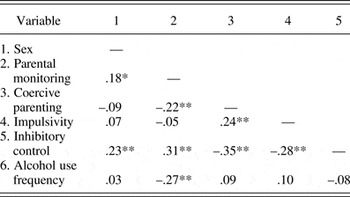
Table 1 presents correlations between the variables that were used in regression analyses. There was a small correlation between sex and parental monitoring at 14 years, and between sex and inhibitory control at 6 years; girls reported more monitoring from their parents and had higher levels of inhibitory control. Inhibitory control at 6 years was mildly negatively correlated with impulsivity at 6 years. Coercive parenting at 6 years and parental monitoring at 14 years were mildly and negatively correlated with each other. Coercive parenting at 6 years was negatively associated with inhibitory control and positively correlated with impulsivity, both assessed at 6 years, while parental monitoring at 14 years was only associated positively with inhibitory control at 6 years. There were no correlations between alcohol use scores at 15 years and temperament scores at 6 years, but alcohol use frequency at 15 years was mildly negatively correlated with parental monitoring at 14 years.
Correlations among sex, parenting scales, temperament scales, and alcohol use

*p < .05. **p < .01.
As noted previously, the differential susceptibility model requires the predictor and moderator to be independent from each other. However, coercive parenting was mildly associated with both impulsivity and inhibitory control at age 6. Because this could be due to shared method variance and could complicate the interpretation of interactions, coercive parenting was regressed on impulsivity and inhibitory control, and the residual coercive parenting score was used in the analyses to control for any correlation, as is often done in other studies testing the differential susceptibility model (Nederhof, Belsky, Ormel, & Oldehinkel, Reference Nederhof, Belsky, Ormel and Oldehinkel2012; Ramchandani, van IJzendoorn, & Bakermans-Kranenburg, Reference Ramchandani, van IJzendoorn and Bakermans-Kranenburg2010). The findings did not change whether the original or residual score were used. The following results are from the analysis using the residual score.
Main and interaction effects
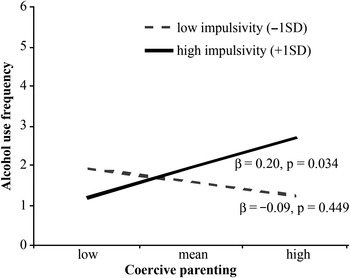
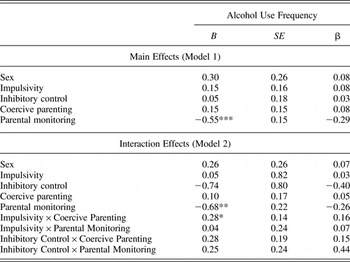
As shown in Table 2, only one significant main effect was found in the first step of the model. Low levels of parental monitoring at 14 years were associated with higher levels of alcohol use frequency at 15 years (R 2 = .10). One significant interaction effect was found in the second step of the analysis: an interaction between impulsivity and coercive parenting at 6 years positively predicted alcohol use frequency at 15 years (ΔR 2 = .04). Simple slope analyses showed that the effect of coercive parenting at 6 years was significant when impulsivity at 6 years was high, but not when it was low (see Figure 1). Relative to children low in impulsivity, children high in impulsivity had both higher levels of alcohol use frequency at 15 years when exposed to high coercive parenting at 6 years and lower levels of alcohol use frequency at 15 years when exposed to low coercive parenting at 6 years.
Age 6 coercive parenting by impulsivity interaction predicting adolescent alcohol use frequency at 15 years. Sample size: low impulsivity (below –1 SD) = 37, mean impulsivity (between –1 SD and +1 SD) = 101, and high impulsivity (above +1 SD) = 32.

Main and interaction effects of temperament at 6 years, coercive parenting at 6 years, and parental monitoring at 14 years on alcohol use frequency at 15 years

Note: Model fit: Model 1: χ2 = 1.281, df = 1; comparative fit index = 0.978; root mean square error of approximation = 0.037; standardized root mean square residual = 0.019. Model 2: χ2 = 1.278, df = 1; comparative fit index = 0.980; root mean square error of approximation = 0.036; standardized root mean square residual = 0.017.
*p < .05. **p < .01. ***p < .001.
Support for the differential susceptibility model
According to the plotted data and the simple slope tests, the interaction met criteria for the differential susceptibility model. It was a disordinal (crossover) interaction. The estimate for the crossover point (C = –0.86, SE = 0.14, 95% confidence interval = –1.13, –0.59), fell just below the standardized sample mean. In addition, the confidence intervals of the crossover point fell well within the observed standardized values of coercive parenting (min = –2.22, max = 2.64). The slope for the children high in impulsivity at 6 years differed significantly from zero. The slope for the children high in impulsivity at 6 years was steeper than the slope for the children low in impulsivity, which was not significantly different from zero. Finally, impulsivity at 6 years was not related to alcohol use frequency at 15 years or to residuals of coercive parenting at 6 years.Footnote 1
Discussion
The objectives of this study were twofold. The first objective was to determine if temperamental and parenting dimensions that predicted substance use through main effects in previous studies could interact to predict adolescent alcohol use. A second objective was to examine if such interactions could be interpreted according to a diathesis–stress or a differential susceptibility model. The main findings of this study first indicate that low parental monitoring in adolescence was associated with a higher frequency of alcohol use. Second, we found that not only did child impulsivity and coercive parenting interact to predict adolescent alcohol use but also that this interaction supports the differential susceptibility model. This suggests that, with regard to adolescent alcohol use, early impulsivity may be a key marker of plasticity, which confers risk under certain conditions and a clear advantage under other conditions.
Joint contribution of temperament and parenting to adolescent alcohol use
After examining whether childhood temperament (i.e., impulsivity and inhibitory control) interacted with parental practices (i.e., coercive parenting in childhood and monitoring in adolescence) in the prediction of adolescent alcohol use, we found that higher levels of age 6 impulsivity were associated with more frequent alcohol use at 15 years when children were also exposed to coercive parenting at 6 years. These findings are consistent with and extend those of other studies showing that impulsive temperament traits interacted with parental practices in the prediction of substance use. As reviewed above, interactions were found in the prediction of alcohol use with impulsivity and parental support (Stice & Gonzales, Reference Stice and Gonzales1998) as well as with temperamental disinhibition and authoritative parenting (Armstrong et al., Reference Armstrong, Ruttle, Burk, Costanzo, Strauman and Essex2013; Burk et al., Reference Burk, Armstrong, Goldsmith, Klein, Strauman and Costanzo2011). Interactions with impulsivity and coercive parenting were also found in the prediction of externalizing problems (Leve et al., Reference Leve, Kim and Pears2005).
While we found that early childhood temperament and parenting could predict adolescent alcohol use, other variables could come into play across developmental periods. The interaction we observed between impulsivity and coercive parenting in childhood could lead to adolescent alcohol use through its contribution to other late childhood or early adolescent variables (Wills & Dishion, Reference Wills and Dishion2004). Thus, future studies could investigate a mediated moderation model (Muller, Judd, & Yzerbyt, Reference Muller, Judd and Yzerbyt2005) where one could test whether the interaction between early impulsivity and coercive parenting is mediated by more proximal variables in adolescence that have been shown to predict adolescent alcohol use (e.g., peer affiliations; Leung et al., Reference Leung, Toumbourou and Hemphill2014; Marschall-Lévesque et al., Reference Marschall-Lévesque, Castellanos-Ryan, Vitaro and Séguin2014; and conduct problems; Castellanos-Ryan, Séguin, Vitaro, Parent, & Tremblay, Reference Castellanos-Ryan, Séguin, Vitaro, Parent and Tremblay2013; Clark, Reference Clark2005).
Whereas coercive parenting and impulsivity at 6 years interacted to predict alcohol use at 15 years, coercive parenting did not interact with inhibitory control at 6 years. Several factors could account for this difference across temperament dimensions. First, although these two temperamental dimensions were mildly correlated, they are quite different in that impulsivity is a measure of reactivity and inhibitory control is a measure of self-regulation. Impulsivity represents spontaneous and quick reactions to the environment, whereas inhibitory control represents the conscious decision-making process involved in suppressing inappropriate dominant responses (Rothbart et al., Reference Rothbart, Ahadi, Hershey and Fisher2001). Thus, in this sample, the tendency at 6 years to have quick spontaneous reactions seems more important in the prediction of early adolescent alcohol use than the absence of the conscious regulation of reactions when faced with exterior demands. Second, our hypothesis was based on reported links between early “inhibition” with substance use (Caspi et al., Reference Caspi, Moffitt, Newman and Silva1996; Hussong et al., Reference Hussong, Jones, Stein, Baucom and Boeding2011). However, by using the term inhibition, it is unclear to which of attentional, motivational, cognitive, and motor dimensions of inhibition these studies are referring (Nigg, Reference Nigg2000). In this study, we measured inhibitory control, a self-regulatory measure implicating decision making. It is possible that alcohol use is associated with other temperamental measures of “inhibition,” such as measures that focus on the behavioral dimensions of inhibition. Future studies comparing different measures of inhibition could test this hypothesis.
A main effect of parental monitoring at 14 years was also found, showing that lower levels of monitoring at 14 years were associated with more frequent alcohol use at 15 years, which is consistent with the results of previous studies (e.g., Barnes et al., Reference Barnes, Reifman, Farrell and Dintcheff2000; Clark et al., Reference Clark, Shamblen, Ringwalt and Hanley2012; DiClemente et al., Reference DiClemente, Wingood, Crosby, Sionean, Cobb and Harrington2001; Duncan et al., Reference Duncan, Duncan, Biglan and Ary1998; Kaynak et al., Reference Kaynak, Meyers, Caldeira, Vincent, Winters and Arria2013; Steinberg et al., Reference Steinberg, Fletcher and Darling1994; Tornay et al., Reference Tornay, Michaud, Gmel, Wilson, Berchtold and Suris2013). Although coercive parenting in childhood interacted with concurrent impulsivity in predicting adolescence alcohol use, the interactions of parental monitoring in adolescence with childhood impulsivity or inhibitory control did not predict alcohol use. This suggests that the interplay between parenting and temperament on adolescent alcohol may change across development, and that parental monitoring during adolescence may be beneficial to all adolescents in reducing risk for alcohol use. In contrast, that childhood temperament interacted with concurrent parental practices, but not with parenting in adolescence, could be explained methodologically, because reports were not only obtained from different informants but also measured different facets of parental practices. To determine whether this difference between these statistical interactions in childhood and adolescence was due to developmental or measurement differences, future studies could examine whether temperament measured in adolescence interacts with parenting in adolescence, examine the same parenting dimension in childhood and adolescence, or use the same informant for parenting in childhood and adolescence.
Support for the theoretical models and implications
The significant interaction between impulsivity and coercive parenting was examined to determine whether it supported the diathesis–stress model or the differential susceptibility model, a question that had not been tested in previous studies of temperament and parenting in the prediction of alcohol use. The interaction met the four key criteria for support of the differential susceptibility model. When exposed to low coercive parenting, children with higher levels of impulsivity at 6 years had less frequent alcohol use at 15 years than did children with low levels of impulsivity. Because this sample came from a normal urban population and the coercive parenting variable was normally distributed, a mean level of coercion represented the norm. Consequently, a low level of coercive parenting represented mothers that were particularly skillful at avoiding coercive strategies to supervise and socialize their child. In other words, it was a markedly low level of coercion from the mother that may have been beneficial for 6-year-old children high in impulsivity. Whereas impulsivity is mostly seen as a risk factor, the possibility that it could be an advantage is less commonly evoked. Under the skillful guidance of meaningful adults, impulsivity may confer an advantage because of the novelty-seeking aspect of this temperamental dimension, which could lead impulsive children to development opportunities. The spontaneity linked to impulsivity could bring these children to reveal themselves more readily to their noncoercive parents, leading to better parent–child communication, which is also important in the prediction of alcohol use (Ryan et al., Reference Ryan, Jorm and Lubman2010). Potential support for the differential susceptibility model was also previously found with impulsivity and coercive parenting in the prediction of externalizing problems but had not been tested a priori. Consistent with the interactions between impulsivity and coercive parenting found in the present study, a secondary analysis of an interaction between impulsivity and coercive parenting at age 5 in the prediction of girls' externalizing problems at 17 years (Leve et al., Reference Leve, Kim and Pears2005) showed that this interaction supported the differential susceptibility model (Belsky & Pluess, Reference Belsky and Pluess2009). Because substance use is considered a subtype of externalizing problems (Castellanos-Ryan & Conrod, Reference Castellanos-Ryan and Conrod2011; Krueger et al., Reference Krueger, Hicks, Patrick, Carlson, Iacono and McGue2002), our results provide further support for the relevance of differential susceptibility in the case of substance use and, potentially, externalizing behaviors in general.
With further studies determining which individual characteristics and environmental conditions interact following a diathesis–stress or differential susceptibility pattern, the prevalent conception of individual vulnerability factors would need revising in order to include susceptibility/plasticity factors in developmental models. Both the diathesis–stress and the differential susceptibility models support targeting children for prevention based on their temperament characteristics. Both models show that adverse environments negatively affect children with a “difficult” temperament, making such combinations important targets of prevention and intervention programs. However, support for the differential susceptibility model for some early markers, such as impulsivity, could change the expectations regarding the outcomes of interventions. Parents, teachers, and practitioners might then develop higher, and more optimistic, expectations regarding the potential of children currently described as having a difficult temperament. Considering impulsivity as a risk factor, and children with this temperamental disposition as vulnerable, does not take into account the fact that their temperament could lead to aptitudes that go beyond the absence of a problem when combined with the right environment (Belsky & Pluess, Reference Belsky and Pluess2009; Bradley & Corwyn, Reference Bradley and Corwyn2008; Pluess & Belsky, Reference Pluess and Belsky2009, Reference Pluess and Belsky2010; Stright, Kelley, & Gallagher, Reference Stright, Kelley and Gallagher2008).
Applying a differential susceptibility model clinically could have an impact not only in childhood but also later in life. There is also evidence of differential susceptibility in early adulthood (Aron & Aron, Reference Aron and Aron1997). Aron (Reference Aron2010) recommends personalizing clinical interventions in adulthood according to the degree of “sensitiveness” of the client, a concept closely related to the degree of susceptibility or openness to environmental influences. From a clinical perspective, Aron (Reference Aron2010) adds that while sensitive people may be more vulnerable, sensitivity is not only a liability but also may confer advantages. Thus, the main challenge for future studies of various temperamental characteristics is to determine which are vulnerability versus susceptibility factors and under which environmental conditions.
Experimental research is also needed. There are already various parenting interventions that can help reduce alcohol use and could be used in experimental studies. One recent meta-analysis shows that parenting programs based on social learning and cognitive–behavioral principles are the most effective in reducing problem behaviors in children and adolescents (Dretzke et al., Reference Dretzke, Davenport, Frew, Barlow, Stewart-Brown and Bayliss2009). Randomized controlled trials testing the effects of parenting and familial interventions in the prediction of both alcohol use (Beach, Brody, Lei, & Philibert, Reference Beach, Brody, Lei and Philibert2010; Brody, Chen, & Beach, Reference Brody, Chen and Beach2013; Brody et al., Reference Brody, Chen, Beach, Kogan, Yu and DiClemente2014; Cleveland et al., in press) and externalizing problems (Albert et al., in press; Bakermans-Kranenburg, van IJzendoorn, Mesman, Alink, & Juffer, Reference Bakermans-Kranenburg, van IJzendoorn, Mesman, Alink and Juffer2008; van den Hoofdakker et al., Reference van den Hoofdakker, Nauta, Dijck-Brouwer, van der Veen-Mulders, Sytema and Emmelkamp2012) have shown support for genetic differential susceptibility, with clear support for dopamine-related genes (see Bakermans-Kranenburg & van IJzendoorn, Reference Bakermans-Kranenburg and van IJzendoorn2015, for a meta-analytic review). Intervention studies using measures of temperament to classify children have also shown support for differential susceptibility in the prediction of attachment security (Cassidy, Woodhouse, Sherman, Stupica, & Lejuez, Reference Cassidy, Woodhouse, Sherman, Stupica and Lejuez2011) and oppositional behavior (Scott & O'Connor, Reference Scott and O'Connor2012). Future research could test whether the impact of interventions targeting parental practices on substance use is moderated by the impulsivity levels of children and adolescents. To test the differential susceptibility model, these studies would have to randomize the parenting intervention, but temperament can be a fixed factor (Bakermans-Kranenburg & van IJzendoorn, Reference Bakermans-Kranenburg and van IJzendoorn2015). For example, coercive parents of children or early adolescents could be randomly assigned to a parenting intervention and control condition to then examine whether the intervention effects observed on substance use levels later in adolescence differ between the children low in impulsivity and those high in impulsivity. If the children high in impulsivity have better outcomes than those low in impulsivity, it would provide further support for the differential susceptibility model by demonstrating greater susceptibility to positive environments.
Strengths and limitations
Only three studies before this one had examined the interactions between temperament and parental practices in the prediction of alcohol use (Armstrong et al., Reference Armstrong, Ruttle, Burk, Costanzo, Strauman and Essex2013; Burk et al., Reference Burk, Armstrong, Goldsmith, Klein, Strauman and Costanzo2011; Stice & Gonzales, Reference Stice and Gonzales1998), with mostly Caucasian samples from the United States. Two of them were from the same laboratory and used the same sample, including measures from childhood to adolescence in a prospective design (Armstrong et al., Reference Armstrong, Ruttle, Burk, Costanzo, Strauman and Essex2013; Burk et al., Reference Burk, Armstrong, Goldsmith, Klein, Strauman and Costanzo2011), a strength that the present study shares. Using a prospective design allowed the examination of the predictive relationships of temperament and parental practices from a developmental perspective. In addition, the present study extends previous research by (a) looking at parenting and temperamental variables that were shown to be related to alcohol use before but not studied in interaction with each other; (b) using a mostly French-speaking Canadian sample, which, although mostly Caucasian, adds to the generalizability of findings across North American samples; and (c) being the first study of temperament, parenting, and adolescent alcohol use outcomes that contrasts two important theoretical models of person–environment interactions. Still, some limitations should be noted. The rate of substance use in the sample was lower than in the general adolescent population of Quebec. Sixty-six percent of the sample had used alcohol at least once by the age of 15, while the rate in the general population at this age is 80% (Institut de la statistique du Québec, 2009). It should also be noted that the sample is urban, which limits the generalization of results. The alcohol use data was also obtained through self-report, which is susceptible to bias, notably social desirability. However, self-reports are often used and considered reliable in assessing substance use (Clark & Winters, Reference Clark and Winters2002). In addition, parenting was assessed with mothers only, and the effect might be different with fathers. Thus, it would be important to conduct research with father-reported parenting practices to see if the results are invariant across parents, though this recommendation must take into account the high rate of children who may not be raised by the same parents over time. Although sex was included as a covariate, other predictors of adolescent alcohol use (e.g., deviant peer affiliations, Leung et al., Reference Leung, Toumbourou and Hemphill2014; parental alcohol use, Sher, Reference Sher1991; internalizing problems, O'Neil, Conner, & Kendall, Reference O'Neil, Conner and Kendall2011; pubertal timing, Castellanos-Ryan, Parent, Vitaro, Tremblay, & Séguin, Reference Castellanos-Ryan, Parent, Vitaro, Tremblay and Séguin2013; Hummel, Shelton, Heron, Moore, & van den Bree, Reference Hummel, Shelton, Heron, Moore and van den Bree2013) were not included. Thus, this study did not show whether parental monitoring, coercive parenting, and impulsivity were still predictive of adolescent alcohol use when taking into account its more proximal predictors. However, because these variables were shown to predict alcohol use and externalizing problems in other studies (e.g., Abar et al., Reference Abar, Jackson, Colby and Barnett2014; Leve et al., Reference Leve, Kim and Pears2005), we could expect the results to be robust to other predictors. Finally, the participation rate from childhood to adolescence in this sample may limit generalizability to the originally sampled population, although attrition has an impact mostly on means and not on the associations between variables (Graham, Reference Graham2009; Gustavson, von Soest, Karevold, & Roysamb, Reference Gustavson, von Soest, Karevold and Roysamb2012). Nonetheless, full information maximum likelihood was used to account for missing data, and as shown, the initial childhood and final adolescent samples were comparable on the main variables of interest.
Conclusion
Results of the present study showed that early temperament and parental practices interact in the prediction of alcohol use. Six-year-old children exposed to coercive parenting had more frequent alcohol use at 15 years when they were also impulsive at 6 years. Of greater significance, children high in impulsivity also had less frequent alcohol use than children low in impulsivity in the absence of coercive parenting, which supported the differential susceptibility model. Results also showed that low parental monitoring at 14 years was associated with a higher frequency of adolescent alcohol use at 15 years but did not interact with age 6 years temperament. With several studies on gene–environment interactions in the prediction of alcohol use now supporting the differential susceptibility model, more studies should examine which temperamental factors are vulnerability or susceptibility factors for alcohol use and with which environmental factors they interact. The differential susceptibility model could lead to changes in our conception of certain individual factors as vulnerability factors. In turn, this could change the expectations we have concerning what children with a difficult temperament can achieve and help determine which preventive interventions work better while considering individual temperamental differences.