Introduction
Although the speculation that mass extinctions of biological species are caused by extra-terrestrial (ET) inputs to the Earth was published as early as 1978 (Hoyle & Wickramasinghe Reference Hoyle and Wickramasinghe1981), it was the discovery of the iridium (Ir) spike in the middle of the K/T boundary layer that provided key evidence that was interpreted by Alvarez et al. (Reference Alvarez, Alvarez, Asaro and Michel1980) as an asteroid impact. The enhanced Ir levels in the boundary clays both before and after the Ir spike indicate that lesser amounts of ET material continued to reach the Earth for some 105 yr. This was interpreted by Wickramasinghe & Wallis (Reference Wickramasinghe and Wallis1994) as the result of the break-up of a giant comet (greater than 100 km) originating from the inner Oort cloud of trans-Neptunian objects (TNOs), fragmenting further, owing to close encounters with Jupiter, into objects with diameters ranging from 10 km down to dust grains. This debris flooded the inner Solar System, and was swept up by the Earth and other planets over a timescale of 105 yr.
The same boundary clays showing the enhanced Ir levels are also remarkable for the unusual amino acids α-aminoisobutyric acid (Aib) and isovaline (Engel & Nagy Reference Engel and Nagy1982). These are not in the standard 21 or 22 amino acids of the genetic code, involved in proteins. Both were known to be abundant in extracts from the Murchison meteorite and the chiral isovaline (Iva) was nearly racemic in the sediments, leading Zhao & Bada (Reference Zhao and Bada1989) to conclude that the unusual amino acids are remnants of ET material.
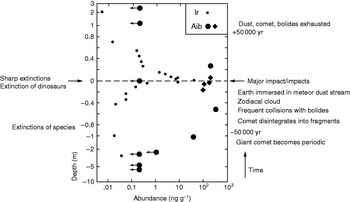
Subsequent studies (Brisman et al. Reference Brisman, Engel and Macko2001) confirmed the enhanced levels of Aib in the K/T marine boundary clays at Stevns Klint. These authors also studied samples from the non-marine Raton Basin in Colorado and New Mexico. Aib was found in the Colorado site only above the Ir spike and not at all in the New Mexico clays. When one takes into account the likely degradation of sedimentary organic matter and the solubility of amino acids, these new data are consistent with those from the Danish site (Stevns Klint). The data from Stevns Klint are shown in Fig. 1 along with the Ir data. In the layers above and below the impact, Aib is enhanced by at least a factor of 103 above the detection threshold. The Aib:Ir ratio in the K/T clays is highly variable – between lower than 10 and ~104.
Interpretation of the K/T boundary record (Wickramasinghe & Wallis Reference Wickramasinghe and Wallis1994). Ir and Aib data in K/T marine boundary sediments at Stevns Klint are from Zhao & Bada (Reference Zhao and Bada1989) where the small and large circles represent Ir and Aib, respectively, and Brisman et al. (Reference Brisman, Engel and Macko2001) where diamonds represent Aib. Sediments vary around the planet – Brisman et al. also analysed the amino acids in the non-marine K/T sediments of Raton Basin in Colorado and in New Mexico. Aib was found in the Colorado site only above the Ir spike and not at all in the New Mexico clays.

One needs to ask how accurately does the Ir profile correspond to the instantaneous ET arrival rate. Anbar et al. (Reference Anbar, Wasserburg, Papanastassiou and Andersson1996) have studied Ir's global cycle, finding a residence time of 2000–20 000 yr in the oceans, which would explain the post-impact shoulder on the peak (Fig. 1). However, pre-impact abundance is approximately 10 times the ‘normal’ level (0.05 ppb) to a depth of approximately 0.1 m (shown more clearly in data of Vajda & McLoughlin (Reference Vajda and McLoughlin2004) ) and as minimum levels are approximately 0.01 ppb in Fig. 1, a pre-impact source can be traced down to at least 35 cm (20 kyr) and a post-impact source to 60 cm. Unlike Stevns Klint, the Raton Basin was non-marine, and its Ir was likely scavenged by oxic sediments (Anbar et al. Reference Anbar, Wasserburg, Papanastassiou and Andersson1996). Terrestrial sources of Ir can be significant: Greenland ice-core studies have revealed a steady Ir deposition over the last 10 kyr and also a high non-ET source during the preceding Ice Age (Gabrielli et al. Reference Gabrielli2004). This is thought to reflect wind-borne dust Ir arising from the exposed continental shelf during the recession of the oceans due to polar cap growth.
In the absence of a global climatic upset (a slow climate cooling of approximately 3°C is reported), it is clear that the Ir data do show an extended ET source for tens of kyr before and after the 65.0 Myr impact. There is evidence that the decimation of Cretaceous species was ongoing in the 100 kyr before the impact. Keller's review (Reference Keller2001) lists extinctions of rudists and strong decreases in bivalves, ammonites, palynoflora and planktic foraminifera, but it also lists earlier signs of species extinction. The review also reports lower biological productivity with blooms of the disaster species Guembelitria, which may reflect climate cooling. The light helium isotope 3He, deriving from the Solar wind, is potentially a direct indicator of ET dust sources. Although no enhancement is found in marine carbonates, carbonaceous dust particles (distinct from mineral asteroidal particles) may lose any 3He when landing in the atmosphere or transformed pre-sedimentation.
Accepting that there could be a rain of ET particles through tens of millennia, the physical and material inputs would have scarcely affected the biosphere. A poisonous effect of the Aib and other ET amino acids was proposed (Ramadurai et al. Reference Ramadurai, Lloyd, Wallis and Wickramasinghe1995), but this hypothesis is undermined if the Aib is actually terrestrial. The total abundance of Aib in the boundary clay might be explained as ET if Aib constituted 100 ppm of cometary dust (roughly 10 times that found in Murchison) and if little loss via degradation had occurred (Wickramasinghe & Wallis Reference Wickramasinghe and Wallis1994). However, the absence of some compounds such as n-alkanes implies extensive microbial reworking of the organic matter (Brisman et al. Reference Brisman, Engel and Macko2001) and thus Aib degradation. Modern biology certainly does have enzymes capable of degrading Aib and Iva (Keller et al. Reference Keller, Baurick, Rutt, O'Malley, Sonafrank, Reynolds, Ebbesson and Vajdos1990), so the high abundance of Aib makes it unlikely to be of ET origin.
Is the ET-connection of Aib a false trail?
It was a surprise to find that the carbonaceous components of chondritic meteorites are rich in amino acids, as detected in acid-hydrolysed extracts. The discovery that Aib and Iva abundances in the Murchison meteorite are similar to its glycine (Gly) and alanine (Ala) (the most common amino acids) abundances dates from the early 1980s (Engel & Nagy Reference Engel and Nagy1982). So Zhao & Bada (Reference Zhao and Bada1989) readily saw meteoritic Aib to be the ‘most reasonable explanation’ for the source of the extraordinary levels of Aib in K/T sediments.
Ehrenfreund et al. (Reference Ehrenfreund, Glavin, Botta, Cooper and Bada2001) found that C1 chondrites (Orgeil and Ivuna) contain little if any Aib and Iva, unlike Murchison and other CM chondrites. In C1's, Gly and β-amino acids dominate and an origin via synthesis with aqueous alteration is hypothesized. Zahnle & Grinspoon (Reference Zahnle and Grinspoon1990) argued that Aib and Iva arrived within cometary dust particles small enough (less than 50 μm) to suffer only limited atmospheric frictional heating, but Ehrenfreund et al. (Reference Ehrenfreund, Glavin, Botta, Cooper and Bada2001) judge that CM meteorites and meteoritic dust of Aib-rich material are unlikely to have originated from comets. Brisman et al. (Reference Brisman, Engel and Macko2001) found Aib levels in K/T boundary organics to be approximately 2–6% of Gly and Ala, comparable to the less common amino acids, and the abundance tracks Gly and Ala rather than Ir. Further evidence comes from C-isotope analysis. The 13C:12C isotope ratios for some of the more abundant amino acids (included in Aib peptides) were measured by Brisman et al. (Reference Brisman, Engel and Macko2001) to be terrestrial-biological and depleted in 13C compared to mean terrestrial carbon, while the Murchison and Orgueil carbon are enriched in 13C (Ehrenfreund et al. Reference Ehrenfreund, Glavin, Botta, Cooper and Bada2001).
Therefore the puzzle remains – how can one explain the high abundances of Aib for over 50 kyr pre-impact and over 15 kyr post-impact (Fig. 1), at levels of over 1000 times the upper limits outside this period? In a previous paper (Wallis Reference Wallis2003) the author proposed that Aib is terrestrial and a relic of exotic biology that flourished across the K/T transition.
A clue to Aib's role in biology is given by its occurrence in a range of polypeptides possessing anti-biotic properties, including efrapeptins that attack insects' nervous systems. It is a very rare amino acid, occurring naturally in only a few microfungi. The long-chain Aib peptides are significant enough to be classed as ‘peptaibols’ (meaning peptide containing Aib with alcohol terminator).
The exotic biology hypothesis may be tested by the absence of Aib in sediments prior to the K/T boundary. A search back to 80 Myr has excluded levels above the detection limit of 0.2 ng g−1. The non-detection of Aib pre-impact in the Raton Basin data (Brisman et al. Reference Brisman, Engel and Macko2001) suggests that it may not have held sway globally – or that degradation in inland waters was more effective than in marine waters. A second test may lie in molecular biological evidence of peptaibol-degrading organisms and enzyme structures. One known example is that Aib and Iva switch on a gene for 2,2 dialkylglycine carboxylase (a gene of Pseudomonas cepacia DNA) whose structure is unique, similar to an aminotransferase (Keller et al. Reference Keller, Baurick, Rutt, O'Malley, Sonafrank, Reynolds, Ebbesson and Vajdos1990).
Molecular and genetic connections
Proteins are long chains using the 21 or 22 amino acids common to life with, in general, about 20 monomers in the chain. Peptides are the wider class including peptaibols that contain non-protein amino acids. Aib is the simple amino acid NH2—C(CH3)2—COOH (α-aminoisobutyric acid), one of the few symmetric (non-chiral) amino acids, with structure as pictured. Iva has a side chain CH2—CH3 so is chiral with left- and right-handed enantiomers.

Iva is found in similar anti-biotic fungi to Aib and occurs with Aib in some peptaibols, although with lower frequency. This corresponds to its lower abundance in Murchison, by two to four times. Less is known about Iva, but both of its enantiomers are produced by rare fungi. Bada's (Reference Bada1991) argument that Iva cannot naturally racemise but is near racemic (approximately 0.8:1) is therefore not conclusive of an ET origin. Indeed, meteorite Iva and other amino acids depart from racemic (Cronin & Pizzarello Reference Cronin and Pizzarello1997).
Peptaibols have a high propensity to form helical structures. Helical structures make up some 30% of structural elements in proteins, but peptaibols tend to form tighter 3/10 helices. This property enables relatively short peptaibols to form ion-conducting channels, which when attached to cell walls cause leakage through the wall in, for example, gram positive bacteria (e-negative polymer wall). Thus peptaibols' anti-biotic action lies in penetrating cells and transporting interior ions away. A 6-Aib peptaibol is depicted by Pispisa et al. (Reference Pispisa, Stella, Venanzi, Palleschi, Viappiani, Polese and Toniolo2000), illustrating cross-linkages in the Aib cluster that create the helical structure.
The formation of peptaibols by the rare microfungi presumably requires particular enzymes encoded by a special set of genes, which would be characteristic of those fungi alone. Their genetic advantage for attacking cells depends on attachment (to receptors) and the absence of defence mechanisms (specialized receptors or inhibiting enzyme production). Their rareness nowadays implies that defences are effective and genetic traces have largely disappeared. The gene for 2,2 dialkylglycine carboxylase that requires an Aib switch (Keller et al. Reference Keller, Baurick, Rutt, O'Malley, Sonafrank, Reynolds, Ebbesson and Vajdos1990) may be a relic.
Fungi as virulent pathogens
Although major fungal species long predate the Cretaceous period, it is not known whether early members of the fungal kingdom contained peptaibols. The spike in fungal spores seen in the K/T boundary (Vajda & McLoughlin Reference Vajda and McLoughlin2004) is very narrow and thought to reflect the abundant dead matter available for sacrophytic organisms for a few years (until the rise of ferns).
Microfungal species are found to be virulent pathogens in insects, amphibians and plants, but rarely in immunologically intact mammals. Dutch Elm disease is a plant example; aspergillus fumigata is a Class 1 pathogen for immune-compromised humans (HIV/Aids sufferers, neonates etc.; see www.aspergillus.man.ac.uk). In birds, fungi are relatively common pathogens, but these are a few thermo-tolerant species (Casadevall Reference Casadevall2005). Casadevall argues that higher body temperature is a major reason for the fungal resistance of endothermic vertebrates, while an organism's anti-fungal immune defence also offers protection. He postulates that resistance to fungal disease was a powerful selective mechanism for endothermy. The argument reinforces the idea that fungal resistance was a factor in the survival of mammals through the K/T boundary, whether or not dinosaurs were warm-blooded (a subject that is still under debate).
Conclusions
The present thesis is that the Aib in the boundary sediments is not ET, but a relic of Aib microfungi that flourished early on in the K/T transition and attacked species – including dinosaurs – that lacked defence mechanisms. Through their novelty, Aib fungi had a strong competitive advantage and spread fast, stimulating an upsurge in the evolutionary process as well as forcing the collapse of some species. Species (including mammals) that possessed or developed effective defence mechanisms won through in the early Tertiary-period flowering of new species.
If fungi tipped the balance from dinosaurs to mammals, one can ask why it did not happen earlier? Major fungal lineages date back to approximately 1000 Myr (Casadevall Reference Casadevall2005) while the major divergence of mammals, reptiles and amphibians occurred at 300–400 Myr. This supports the concept of fungi gaining new virulence from the ability to synthesize Aib peptides (peptaibols). How could the Aib microfungi have obtained the complex of genes which encode the enzymes that synthesize the Aib peptides? It is possible that the Aib genes evolved by natural selection, an issue that could be examined by modern genomics. However, statistical arguments against such a complex system evolving by chance still hold (Hoyle & Wickramasinghe Reference Hoyle and Wickramasinghe1981).
It is argued here, however, that the coincidence in the boundary record between Aib peptides and the rise of Ir is indicative of the Aib blueprint arriving from space, in agreement with the Genes-are-Cosmic hypothesis (Hoyle & Wickramasinghe Reference Hoyle and Wickramasinghe1981). As in terrestrial life, Aib biology may be rare in space. The lack of Aib in C1 chondrites (associated with comets) might imply that a specialized giant body among the TNOs, the progenitor of the CM chondrites of more highly transformed material, was the source of the K/T transition.
The present hypothesis indicates that peptaibols are not just of interest for anti-biotic properties. It will, hopefully, stimulate genetic studies on modern Aib fungi and associated enzymes. Whether cosmic Aib genes arrived in viroids, in some carrier-organism or in microfungi is probably not a significant issue. They would presumably have integrated into existing fungi via horizontal gene transport to produce the newly virulent strains. Evidence may be found in chondrite samples. Further investigations of Aib in Cretaceous sedimentary rocks, in other locations and earlier than the 80 Myr could, in principle, negate the hypothesis.