Introduction
Medical and technological advances have brought greater life expectancy for sick people. Too often, the excessive use of health care can result in incompatibility between the needs or desires of patients and what is actually achieved in clinical practice (Prata, Reference Prata2017).
Advance care planning (ACP) can provide a means to improve this incompatibility, directing more appropriate care to patients, especially at the end of life (Halpern et al., Reference Halpern, Pastores and Chou2011). ACP is a decision-making process for future health care for patients undergoing treatment that includes the effective participation of physicians, family members, and other people considered important in this treatment. It aims to ensure that patients’ desires are respected when they are no longer able to make decisions (Scott et al., Reference Scott, Mitchell and Reymond2013).
ACP provides the possibility for patients to be involved in and decide about treatments that he or she wants or does not want at the end of life, in addition to electing a family member or people closer to him or her who can make decisions in a shared manner, ultimately recording their decisions by means of advance directives (ADs) of will or through Physician Orders for Life-Sustaining Treatment (POLST) (Waldrop and Meeker, Reference Waldrop and Meeker2012).
Health decision-making about the end of life has evolved in recent years as a result of technological advances that prolong life. There is a discourse both from the public sector and from the private sector about the benefits and burdens of life-sustaining treatments; such discourses have emphasized the importance of identifying the goals and preferences of patients. However, there is still a discrepancy between the desires of patients and their experiences at the end of life (Waldrop and Meeker, Reference Waldrop and Meeker2012).
ADs are important mechanisms for helping people express, document, and ensure the fulfillment of their desire for care at the end of life. However, communication among patients, family members, and health professionals about options for medical interventions at the end of life and desired treatments remains ineffective (Waldrop and Meeker, Reference Waldrop and Meeker2012).
ADs are written instructions that help guide the patient's medical care and are applied in certain situations, such as terminal cases. A living will (LW) is a type of directive that defines which medical treatments are or are not desired at the end of life. These treatments may include items such as cardiopulmonary resuscitation (CPR), mechanical ventilation, medications, feeding tubes, artificial nutrition, dialysis, and intravenous fluids. Another common directive is to appoint a power of attorney, which involves choosing a trusted individual to make decisions about medical care (Thompson, Reference Thompson2015).
In a study conducted in Toronto, Canada, at the Princess Margaret Cancer Center, the vast majority of patients knew of ADs, but less than half had one in place [the most frequent was the appointment of power of attorney, and least frequent was “do not resuscitate” (DNR) orders (Halpern et al., Reference Halpern, Pastores and Chou2011)].
ADs may have an important effect on the care received at the end of life. Every human being has the right to participate in the decision-making processes that affect his or her life, given that the patient is endowed with dignity and should be respected.
The implementation of protocols involving ADs in clinical practice has been a reality in many places, such as Canada, the United States, Australia, and some European countries, and has proven to be a viable measure to meet the goals of patients in relation to the end of life (Dadalto et al., Reference Dadalto, Tupinambás and Greco2013).
Aggressive measures in cancer patients were identified and evaluated in a study by Earle et al. (Reference Earle, Park and Lai2003) through a literature review and with focus groups composed of cancer patients and family members as well as a panel of experts (a modified Delphi approach). Three main concepts were found: new anticancer therapies or continuation of treatments very close to death; high number of emergency room visits, hospital admissions or intensive care unit (ICU) stays near the end of life; and low admission to hospice (Earle et al., Reference Earle, Park and Lai2003).
There are systematic reviews about the importance of the various modalities of ACP at the end of life, but not specifically on the ADs and the reduction of aggressive measures in cancer patients at the end of life (Chan et al., Reference Chan, Sim and Zimmermann2016; Bestvina and Polite, Reference Bestvina and Polite2017; Landefeld and Incze, Reference Landefeld and Incze2020).
The objective of this study was to analyze the influence of ADs on reducing aggressive end-of-life care measures for cancer patients.
Methods
Study design
A systematic literature review.
Search strategy
Four databases were searched: Web of Science, PubMed, LILACS, and Embase. The following terms were used: “advance directives,” “living wills,” “terminal care,” “palliative care,” “hospice care,” and “neoplasms” as well as their synonyms. Searches, subject headings, and keywords were tailored to each database by a medical research librarian (MFS). All comparative and noncomparative studies on ADs in cancer patients were evaluated. The complete search strategies in each database are included (Supplementary Material SI).
Selection of studies
To perform this research, the following question was asked: What is the effect of ADs on decreasing aggressive measures in terminal life situations?
As aggressive measures, those described by Earle et al. (Reference Earle, Park and Lai2003) were considered:
• Chemotherapy and/or target therapy received within 14–30 days before death;
• More than one visit to the emergency department within 30 days of death;
• More than one hospitalization within 30 days of death;
• More than 14 days of hospitalization;
• At least one admission to the ICU within 30 days before death;
• Death at the hospital; and
• No reference to palliative care (PC).
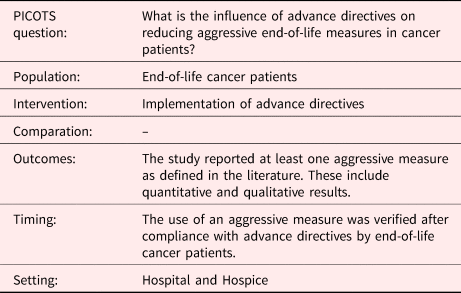
The study population included end-of-life cancer patients. The intervention studied was the implementation of ADs. A comparison group was not needed. The following outcome was required: at least one aggressive measure should be reported, as defined in the literature. These results included quantitative and qualitative results. The following timing was considered: the use of the aggressive measure was verified after compliance with an advance directive by end-of-life cancer patients. The setting was in hospital and in hospice (Table 1).
PICOTS eligibility criteria

A database was prepared and archived in EndNote software (Version X7), and article quality was assessed using study quality assessment tools from the Department of Health and Human Services (National Heart, Lung, and Blood Institute, 2019). The following eligibility criteria were adopted: (1) studies published until March 2018; (2) studies without restriction of age and type of cancer treatment; (3) studies without language restrictions; (4) studies that included some type of AD involving a patient during any stage of treatment, for any type of cancer; (5) studies that analyzed, at least, the outcomes for patients resulting from the completion of and compliance with an AD; and (6) studies that addressed an outcome with a focus on reducing aggressive measures at the end of life. Gray literature (i.e., without peer review), case series, case studies, nonsystematic reviews, qualitative studies, conference abstracts, and published protocols were excluded.
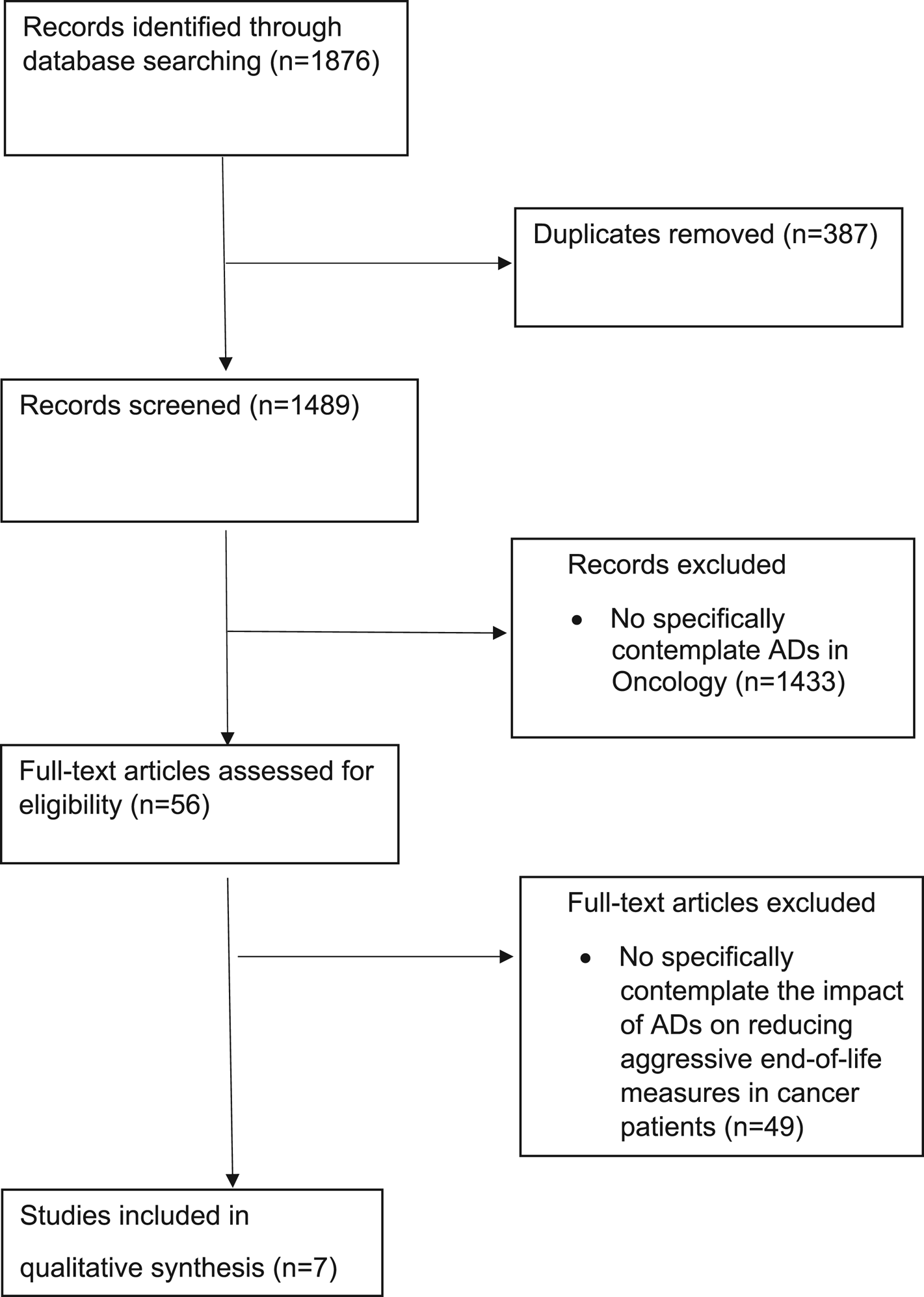
The PRISMA recommendation was used, a checklist with 27 items (Supplementary Material SII) and the PRISMA flow chart, that describes the flow of information through the different phases of a systematic review. It maps the number of identified, included and excluded records, and the reasons for exclusions and is being used in this review (Moher et al., Reference Moher, Liberati and Tetzlaff2009; Figure 1).
Study flow chart.

Step 1: records identified through the database search
The studies were independently identified by titles and abstracts by two reviewers (BSRP and LPSM). Studies that did not specifically address ADs in oncology were excluded. Disagreements were resolved by consensus, and noncompliant cases were reviewed and decided on by a third reviewer (CEP). For agreement between observers, the Kappa test was adopted (Landis and Koch, Reference Landis and Koch1977). Duplicate studies were removed.
Step 2: full-text articles assessed for eligibility
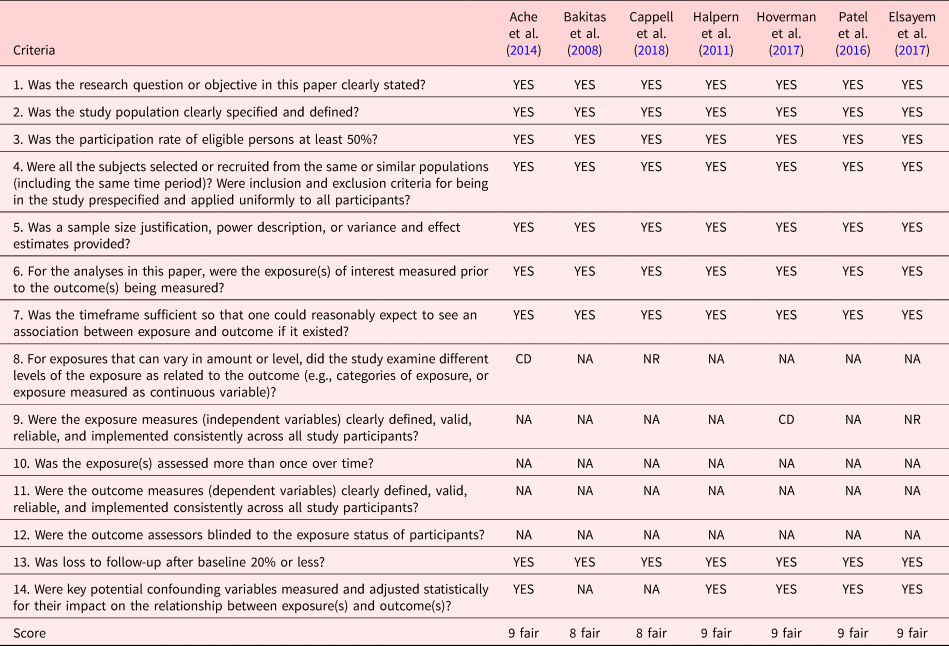
Studies selected according to the eligibility criteria were read in full, and a quality assessment of the reviewed articles, using study quality assessment tools available from the US Department of Health and Human Services, was conducted (Table 2).
Application in the Quality Assessment Tool for Observational Cohort and Cross-Sectional Studies (U.S. Department of Health & Human Services)

Legend: YES = 1; CD, cannot determine = 0; NA, not applicable = 0; NR, not reported = 0.
Throughout the selection process, uncertainties were discussed among the authors until a consensus was reached. Regarding the flow of information generated through the different phases of a systematic review, regarding eligibility, studies that did not specifically address ADs in oncology were excluded.
Step 3: studies included in the qualitative synthesis
The number of records identified, screened, assessed for eligibility, and included in this review were recorded, as were the reasons for excluding identified records. The characteristics (e.g., location, design, sample size, methods, outcomes, and conclusions) of each study were recorded and summarized.
Because the study methodology and reported outcome measures varied markedly, we decided to focus on describing the studies, their results, and their limitations and on a qualitative synthesis rather than combing the data in a meta-analytic statistical approach.
Data were analyzed using descriptive statistics through IBM SPSS software (v.21.0).
Results
A total of 1,876 records were identified in the databases: 61 (Web of Science), 681 (Embase), 227 (Pubmed), and 7 (Lilacs). After excluding 387 duplicate records, we screened the remaining 1,489 records for eligibility. A total of 1,433 studies were excluded because they did not meet the stated inclusion criteria (Figure 1).
Of the remaining 56 (2.98%) full-text articles assessed for eligibility, 49 (87.5%) were excluded because they did not specifically address the impact of ADs on reducing aggressive end-of-life measures in cancer patients: one study addressed the impact of ADs on costs; one addressed ADs and requests for CPR; one addressed ADs and ethnicity; one addressed AD and positive religious coping; one studied nonintubation orders; one studied videos for CPR; one investigated cancer-specific ADs rather than general ADs; one addressed physician compliance but not necessarily impact; two studied hospice and end-of-life quality; two studied code status documentation; two investigated the impact of ADs but not restricted to cancer patients; two studied POLST; three studied the importance of end-of-life PC; three investigated DNR orders; three investigated time to perform ADs; four studied the number of ADs, LWs, and DNR orders without measuring impact; and 20 addressed the importance of ACP, whether formal (documented) or informal (through discussion and education in the hospital), as a major factor responsible for better end-of-life quality.
The seven studies that were included analyzed a total of 7,545 patients (mean). All the studies included were analyzed using the Quality Assessment Tool for Observational Cohort and Cross-Sectional Studies (U.S. Department of Health & Human Services) and had sufficient information to determine that the risk of allocation bias was low (Table 2).
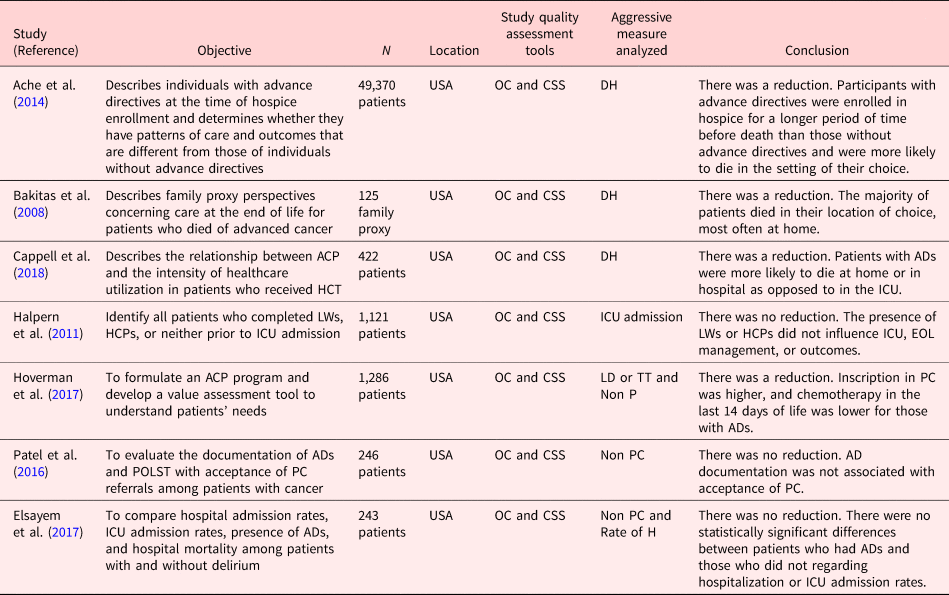
This study evaluated the effect of ADs on decreasing aggressive measures at the end of life, and four studies (57.1%) identified such an association. One study (14.3%) demonstrated the impact of ADs on decreased chemotherapy and/or target therapy received within 14–30 days before death and, at the same time, on referral to PC, and three studies (42.9%) demonstrated the impact of ADs on reductions in in-hospital deaths (Table 3).
Characteristics and summary of the included studies

Legend: AD: advance directive; ACP: advance care planning; HCT: allogeneic hematopoietic cell transplantation; ICU: intensive care unit; EOL: end of life; LW: living will; HCP: health care proxy; PC: palliative care; POLST: physician orders for life-sustaining treatment.
Discussion
According to the characteristics of the seven articles included, one study demonstrated the impact of ADs on decreased chemotherapy and/or target therapy received within 14–30 days before death and, at the same time, on referral to PC, and three studies demonstrated the impact of ADs on reductions in in-hospital deaths. One study concluded that ADs had no impact on ICU admission, one study showed that ADs had no impact on referrals to PC, and one study did not associate ADs with hospitalization.
A study conducted in the United States of America through the Cancer Care Outcomes Research & Surveillance Consortium (CanCORS) to identify to what extent the characteristics of the discussion about end of life are associated with aggressiveness of care received near death showed that almost half of 1,231 patients received at least one aggressive care measure. In turn, patients who had discussions with their physicians before the last 30 days of life received less aggressive measures, including chemotherapy, acute care, or any aggressive treatment, and received more PC (Mack et al., Reference Mack, Cronin and Keating2012).
In our systematic review, we found that it is challenging to determine the influence of ADs on reducing aggressive end-of-life measures in cancer patients. Most of the studies (71.4%) were published in the last 5 years, with varied populations, interventions, and findings. Across interventions, there was no universally reported outcome. The few commonly assessed outcomes were the impact of ADs on reductions in in-hospital deaths (Bakitas et al., Reference Bakitas, Ahles and Skalla2008; Ache et al., Reference Ache, Harrold and Harris2014; Cappell et al., Reference Cappell, Sundaram and Park2018), the impact of ADs on decreased chemotherapy, and/or target therapy received within 14–30 days before death and on referral to PC (Hoverman et al., Reference Hoverman, Taniguchi and Eagye2017). Overall, the studies were heterogeneous regarding results and study design.
Individuals with ADs at the time of hospice enrollment have patterns of care and outcomes that are different from those of individuals without ADs; participants with ADs were enrolled in hospice for a longer period of time before death than those without and were more likely to die in the setting of their choice (Ache et al., Reference Ache, Harrold and Harris2014).
This is consistent with previous literature (Gomes et al., Reference Gomes, Calanzani and Gysels2013; Zimmermann et al., Reference Zimmermann, Swami and Krzyzanowska2014; Siegel et al., Reference Siegel, Miller and Jemal2017), indicating that one of the measures for assessing quality of death is the choice of the place where last care is provided and death occurs; most people prefer to be cared for and die at home. The justifications revolve around variables such as physical and emotional support, privacy, and a greater chance of controlling the environment.
The other prominent outcomes found in this review consist of describing family proxy perspectives concerning care at the end of life in patients who died of advanced cancer. The majority of patients died in their location of choice, most often at home (Bakitas et al., Reference Bakitas, Ahles and Skalla2008).
There is a relationship between ACP and intensity of healthcare utilization in patients receiving HCT. Patients with ADs were more likely to die at home or in hospital as opposed to in the ICU (12). ACP programs and value assessment tools to understand patients’ needs led to higher PC admission and less chemotherapy in the last 14 days of life for those with Ads (Hoverman et al., Reference Hoverman, Taniguchi and Eagye2017).
In our findings, we also identified three studies that showed that ADs did not have an impact on aggressive measures during end-of-life treatment. All patients who completed LWs and health care proxies (HCPs) and those who did not complete any document prior to admission to the ICU were analyzed, and the presence of an LW or HCP did not affect admission to the ICU, management of end-of-life care, or other outcomes in the institution (Halpern et al., Reference Halpern, Pastores and Chou2011). Another study evaluated ADs and POLST documentation and referral to PC, and in relation to patients with ADs, there was no association with PC acceptance (Patel et al., Reference Patel, Bhattacharya and Asch2016). The hospital admission rate, ICU admission rate, presence of an AD, and in-hospital mortality among patients with and without delirium were compared, and no statistically significant differences were found between patients with and without ADs in relation to the hospitalization rate or admission to the ICU (Elsayem et al., Reference Elsayem, Bruera and Valentine2017).
In particular, there is a lack of outcomes examining ADs and the impact on end-of-life care. Moving forward, studies should examine how ADs influence aggressive measures performed during the end-of-life treatment for cancer patients.
Although not included in the qualitative analysis, 20 (Becker et al., Reference Becker, Sarhatlic and Olschewski2007; Ganti et al., Reference Ganti, Lee and Vose2007; Pautex et al., Reference Pautex, Herrmann and Zulian2008; Bailey et al., Reference Bailey, Allen and Williams2012; Mack et al., Reference Mack, Cronin and Keating2012; Blechman et al., Reference Blechman, Rizk and Stevens2013; Foo et al., Reference Foo, Zheng and Kwee2013; Ford et al., Reference Ford, Koch and Ray2013; Kizawa et al., Reference Kizawa, Tsuneto and Hamano2013; Labrant et al., Reference Labrant, Rimel and Walsh2013; Loggers et al., Reference Loggers, Maciejewski and Jimenez2013; Alvarez et al., Reference Alvarez, Samala and Gupta2014; Heavey et al., Reference Heavey, Benn and Revta2014; Lyon et al., Reference Lyon, Jacobs and Briggs2014; Roeland et al., Reference Roeland, Benn and Heavey2014; Narang et al., Reference Narang, Wright and Nicholas2015; O'Connor et al., Reference O'Connor, Ngamphaiboon and Groman2015; Hong et al., Reference Hong, Kwon and Kim2016; Curtin et al., Reference Curtin, Watson and Wang2017; Bond et al., Reference Bond, Kim and Franciskovich2018) of the 56 studies that were analyzed in their entirety demonstrated the importance of ACP, either formally (documented) or informally (through discussions and education in the hospital setting), as the major factor responsible for improving quality at the end of life. This is an expected association. However, it had not yet been adequately investigated through a systematic review. This finding emphasizes the need for more research to better characterize the influence not only of aggressive end-of-life measures but of ACP, which when incorporated into clinical practice can guide patients’ end-of-life care and better guide family members who are caregivers (Scott et al., Reference Scott, Mitchell and Reymond2013).
Implementation in health practices is important, an example of this is guiding professionals about ACP — an educational process — considering that the professionals themselves have knowledge about the topic. Interactive training of health professionals significantly improved confidence to initiate ACP discussions which has been identified as a barrier to timely ACP (Chan et al., Reference Chan, Sim and Zimmermann2016). The primary care physician can help provide with guidance and resources to prepare the advance directive (Landefeld and Incze, Reference Landefeld and Incze2020).
ACP not only produces a document that reduces aggressive measures and enables better quality end of life but also allows involvement of the patient, family, and health team in health decisions.
Although the extensive search in the databases was not restricted to the USA, this country represented the majority of researches. All types of ACP are well established in some places in the USA, unlike other countries, such as Latin America (Pastrana et al., Reference Pastrana, De Lima and Eisenchlas2012; Soto-Perez-de-Celis et al., Reference Soto-Perez-de-Celis, Chavarri-Guerra and Pastrana2016).
This study had some limitations. It is a systematic review; while the main search strategy was broad, our selection criteria may have missed articles. We excluded gray literature, case studies, commentary pieces, and protocols. Furthermore, studies discussing ADs were excluded if they did not mention neoplasms or end-of-life care, and this may have resulted in our review representing a subset of the literature surrounding the expansive area of ACP.
Conclusion
Evidence found indicates that AD is one — of the possible ways — to reduce aggressive measures at the end of life. Additional studies are needed to confirm this discovery and explore the use of existing document types within the context of ACP. More studies are needed to better characterize the role of ADs in reducing aggressive measures at the end of life of cancer patients.
Supplementary material
The supplementary material for this article can be found at https://doi.org/10.1017/S1478951520000838.
Acknowledgments
We thank the Center for Epidemiology and Biostatistics (NEB, for its acronym in Portuguese) and the Program for Researcher Support and Incentives (PAIP, for its acronym in Portuguese).
We also thank Dr Raphael Leonardo Cunha de Araujo for his contributions to the preliminary research project.
Funding
No funding.
Conflict of interest
There is nothing to disclose, and there are no conflicts of interest.
Data availability
All data relevant to the study are included in the article or uploaded as supplementary information.
Contributors
Design of study: B.S.R.P., L.P.S.M., C.E.P., M.F.S.N.
Drafting and reviewing studies: B.S.R.P., L.P.S.M., C.E.P., J.P.M.
Analyzing data: B.S.R.P., L.P.S.M., C.E.P.
Writing the manuscript: B.S.R.P., L.P.S.M., C.E.P., M.F.S.N., J.P.M.