To make a government requires no great prudence. Settle the seat of power, teach obedience, and the work is done. To give freedom is still more easy. It is not necessary to guide; it only requires to let go the rein. But to form a free government, that is, to temper together these opposite elements of liberty and restraint in one consistent work, requires much thought, deep reflection, a sagacious, powerful, and combining mind.
Edmund Burke, Reflections on the Revolution in France Footnote 1
I
At the turn of the twentieth century, Paul Wittichen solved a riddle. He was a historian of ideas and, like many of his peers in fin de siècle Germany, had long puzzled over Immanuel Kant's (1724–1804) curious relation to the French Revolution. Though Kant was an admirer of the Revolutionaries from the beginning of their campaign—at the proclamation of the First French Republic he is said to have effused, “Lord let thy servant depart in peace, for I have seen the day of salvation!”Footnote 2 —he was reluctant to endorse the movement publicly in its early years. “When powerful men of affairs are drunk with rage,” he told a friend, “a soft-skinned pygmy should not insert himself into their fray, even if persuaded gently and reverently.”Footnote 3 In 1793, however, Kant broke his silence and published “On the Common Saying: That May Be Correct in Theory but Does Not Apply in Practice” in the Berlinische Monatsschrift, in which he confirmed his respect for the Revolutionaries’ ideals but raised doubts about their violent tactics.Footnote 4 Two years later, he reiterated his support for the republican cause in Perpetual Peace (1795).Footnote 5 It was this abrupt volte-face, and its odd timing in particular, that vexed Wittichen. Why would Kant remain silent at the beginning of the Revolution—during the optimistic years of liberté, égalité, and fraternité—only to offer the movement his imprimatur as it descended into the anarchy and chaos of Robespierre's Terror? Why would he defend the principles of a crusade now associated with the spectre of the guillotine, the barbarism of the sans-culottes, and regicide?
Reflecting on these questions a century later, Wittichen speculated that shortly before Kant wrote “Theory and Practice,” some opponent—an interlocutor in Königsberg, perhaps, or in print—goaded him into abandoning his silence. When Wittichen turned to the text of Kant's article, he found apparent confirmation of this thesis. In his essay's introduction, Kant complained about a certain “worthy gentleman” who blamed philosophers for the violence of the Revolution. According to Kant, this “gentleman” and his allies relish
attacking the academic, who theorizes on their behalf and for their benefit; presuming that they understand things better than he, they seek to confine him to his school (illa se iactet in aula!) as a pedant who, useless in practice, only stands in the way of their more experienced wisdom.Footnote 6
Such philistinism was both theoretically misguided and dangerous in practice, Kant argued. In order to judge the moral status of existing regimes, statesmen require a universal, absolute standard of justice. But if this “gentleman” were right—if political norms were not accessible via pure reason, but instead resided in the realm of phenomenal experience—it would not be possible to differentiate just governments from unjust ones, and the Revolutionaries’ attempt to theorize and then implement a just constitutional order would be futile. And so in “Theory and Practice” Kant set out to prove that philosophical reason does, in fact, furnish universal principles to guide the practice of politics.
But who was this enigmatic interlocutor? How did he induce Kant to enter the debate over the Revolution? According to Wittichen, Kant placed a clue in his essay that, upon close inspection, revealed his “gentleman” as none other than the British statesman Edmund Burke. In 1790, Burke's Reflections on the Revolution in France attacked philosophical “speculatists” who indict governments that do not “quadrate with their theories.” These men, Burke wrote,
despise experience as the wisdom of unlettered men . . . they have wrought underground a mine that will blow up, at one grand explosion, all examples of antiquity, all precedents, charters and acts of parliament. They have “the rights of men.” Against these there can be no prescription, against these no agreement is binding; these admit no temperament and no compromise . . . I have nothing to say to the clumsy subtilty of their political metaphysics. Let them be their amusement in the schools. Illa se jactet in aula Aeolus, et clauso ventorum carcere regnet. But let them not break prison to burst like a Levanter to sweep the earth with their hurricane and to break up the fountains of the great deep to overwhelm us.Footnote 7
As Wittichen noted, the same Latin verse that Burke cited in his critique of metaphysics also appeared in the introduction to Kant's essay.Footnote 8 Burke used it to insinuate that just as Neptune imprisoned Aeolus for insubordination in Virgil's Aeneid, speculative political philosophers should be quarantined, lest their idealistic proselytizing incite rebellion beyond the borders of France. Wittichen reasoned that just before Kant wrote “Theory and Practice,” he must have read the Reflections, taken offence at Burke's scorn for “political metaphysics” and resolved to rescue his own philosophical system from exile. In 1904 Wittichen submitted a brief, excited note to the Historische Zeitschrift to announce his discovery:
To characterize the opinions of this “gentleman,” . . . Kant cited a strange half-verse: illa se iactet in aula. This citation only becomes intelligible in light of its complement: aeolus et clauso ventorum carcere regnet. Together, these comprise a familiar verse from Virgil, one which the greatest opponent of the French Revolution—indeed, one of the great political thinkers of the modern era—Edmund Burke, directed against propagandistic natural rights theorists in his Reflections on the Revolution in France.Footnote 9
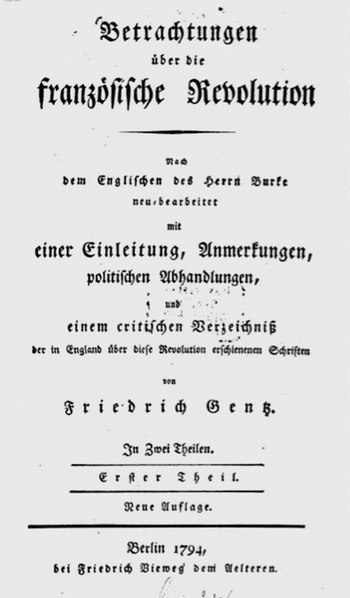
Circumstantial evidence lent weight to this interpretation, too. In January 1793, eight months before Kant published “Theory and Practice,” his former student Friedrich Gentz (1764–1832) released a new translation of Burke's Reflections in Berlin (see Fig. 1).Footnote 10 Wittichen reasoned that since Burke's arguments threatened the public authority of political philosophy, Kant was hesitant to attack him directly. “For this reason Kant eschewed an explicit critique of the Reflections and resigned himself to a terse, opaque gibe.”Footnote 11 A century later, the only evidence of this esoteric argument was Kant's indirect nod to his unspoken nemesis.
The title page of the second edition of Gentz's translation of Burke's Reflections. Friedrich Gentz, Betrachtungen über die französische Revolution, 2nd edn, 2 vols. (Berlin, 1794).

For Wittichen, this debate between Kant and Burke inaugurated a broader nineteenth-century struggle between the opposing forces of rationalism and traditionalism. Kant stood as a veritable embodiment of the German Enlightenment, a principled philosopher who sought to bring regimes into alignment with the normative demands of reason. Burke, contrariwise, argued that political norms are not accessible through abstract theoretical analysis but inhere in the mores, customs and traditions of particular nations. As such, he revered and sought to preserve the same timeworn institutions that Kant scorned. According to Wittichen, “Kant's attack on Burke marks the arrival of an antagonism that has framed Prussian politics into the modern era [die Neuzeit].”Footnote 12
In the years since Wittichen named Burke as Kant's “worthy gentleman,” his reading of “Theory and Practice” has exerted a strong influence among Kant scholars. While not all historians are persuaded that Kant had the Reflections in mind while penning his argument—the conservative writers Justus Möser and August Wilhelm Rehberg have also been aired as potential opponents—there nevertheless exists a broad consensus that Kant intended this essay as a defence of political rationalism against the scepticism of his traditionalist critics. According to Reidar Maliks, what united these “conservative critics” was their shared desire to dethrone the primacy of reason in politics: they “defended the existing order, partly from fear of social dissolution and partly from a conviction that morals result from traditions.”Footnote 13 Scholars as diverse as Allen Wood, Dieter Henrich and Frederick Beiser have all offered similar appraisals of this debate.Footnote 14
But what this simple dichotomy overlooks—what Wittichen missed in his analysis, and what scholars have continued to neglect since—is the crucial role that Gentz played as a mediator between Kant, his erstwhile teacher, and Burke. If Kant did, in fact, write “Theory and Practice” after encountering Gentz's edition of the Reflections, then his understanding of Burke would have been contingent on the accuracy of Gentz's translation. So how faithful was it? How did it colour Kant's arguments? And why did Gentz's translation, in particular, prompt him to come to the Revolutionaries’ aid? On the assumption that Gentz's critique of the Revolutionaries was identical to Burke’s, generations of scholars have ignored these questions.Footnote 15 But as a close reading of at Gentz's version of the Reflections shows, this text presented a case against the Revolution that was, in principle, Kantian. Far from offering a sceptical critique of political rationalism or the rights of man, Gentz's translation articulated a critique of the Revolutionaries that was essentially distinct from, and far more nuanced than, the conservatism defended in Burke, Rehberg or Möser.Footnote 16
In his version of the Reflections, Gentz explicitly rejected Burke's “nonsensical” idea that normative political principles might be located in the realm of phenomenal experience.Footnote 17 With Kant he insisted that only a priori reason, unsullied by the dictates of tradition, custom or precedent, could describe the conditions of a rightful constitution. Where Gentz diverged from Kant, however—and where he agreed quite emphatically with Burke—was in arguing that just principles are not, in and of themselves, sufficient for political practice. “What was most absurd in the proceedings of those who sought to root the new French constitution in the so-called rights of man was not their search for these rights and their respect for them,” he argued, “but that they thought these rights sufficed—that they hoped to build a state with these mere rights when, in fact, it calls for different materials as well.” To make normative rights concrete in the contingent world of historical particularity, statesmen must possess not only sound principles, but also more practical tools: they must respect the universal “rules of morality” and attend to the situational “demands of prudence [Klugheit].”Footnote 18 Because the Revolution's leaders ignored such practical considerations, their movement was doomed to failure.Footnote 19
Gentz, in other words, articulated a modified Kantian strategy for the rationalization of politics. His version of the Reflections charted a via media between a naive, impractical idealism and a dogmatic, anti-metaphysical realism. Revisiting his critique of the Revolution offers, in turn, a new lens for tracing the evolution of Kant's politics throughout the 1790s. It seems incontrovertible, as others have noted, that the traditionalism of Rehberg and Möser was on Kant's mind while writing “Theory and Practice.” Against these sceptics, Kant had to show that a priori reason could, in fact, furnish normative principles for political practice. But if Wittichen were correct—if Gentz's Reflections were the text, or even one of the texts, that provoked Kant in 1793—then another, perhaps more interesting, debate can be uncovered in the pages of “Theory and Practice.” Kant's debate with Gentz was a debate within the German Enlightenment: a debate not over whether to enlighten, but how.
At stake in this debate was whether theoretical reason and political prudence should, or even could, work in concert. In “Theory and Practice,” Kant voiced scepticism about such a union. If the Revolution had faltered, he argued, the fault lay not in its leaders’ imprudence, but in their misapprehension of reason's demands; as he saw it, they had “not enough theory.”Footnote 20 Upon reading this rebuttal, Gentz set out to convince his teacher otherwise. Over the next two years—in a response to Kant published in the Berlinische Monatsschrift, and in two in-depth analyses of the Revolution—Gentz argued that an empirical approach to politics was a prerequisite for the realization of Kantian Enlightenment.Footnote 21 Without a practical means of implementation, a sole concern for principle is stillborn and indeed dangerous, threatening to engender resentment and undermine public order. Philosophers, therefore, have a duty to consider both the ends and the means of political progress:
We have debated specific aspects of government . . . and illuminated what was flawed in the old anciens régimes. But this was just half of our task. In addition, we must establish the real (not merely ideal) possibility of better constitutions, and provide tools for their realization.Footnote 22
When Kant responded to this argument in Perpetual Peace, he remained intractable. While he admitted that an alliance of reason and prudence was conceivable in principle, Kant was reluctant to endorse Gentz's more pointed claim that a priori political theories are, of themselves, insufficient in practice. Reading Kant vis-à-vis Gentz, therefore, leads to a perhaps more critical view of his mature politics than scholars have traditionally offered. Given the choice of theory or practice, Kant's intransigent defence of reason has seemed principled and noble. But for Gentz, this dichotomy presupposed a false choice. Throughout the early 1790s, he beckoned Kant to a moderated vision of prudential Enlightenment, one that sought to unite theoretical reason and practical statesmanship into a coherent programme for real, tangible progress. But even as France smouldered, Kant's response was unflinching: “fiat iustitia, pereat mundus”—let justice be done, though the earth should perish.Footnote 23
II
Like Kant, Gentz greeted initial news of the French Revolution with anticipation. “The spirit of the age stirs strong and quick within me,” he told his friend Christian Garve in 1790. “Now is the time for the human race to awake from its long slumber. I am young, and the universal striving for freedom that has overcome our age fills me with sympathy and warmth.”Footnote 24 Like most of his peers, Gentz saw the Ancien Régime as sclerotic and corrupt, and welcomed the apparent willingness of Louis XVI to reform his nation's constitution. Gentz's faith in what he called “the good cause” was further reinforced by the publication of the Declaration of the Rights of Man and of the Citizen in 1789.Footnote 25 This document, he believed, held the potential to liberate France from its heteronomous obedience to the demands of tradition, setting out a rational framework for the construction of a just constitution.Footnote 26 From his education under Kant in the mid-1780s, Gentz was convinced that all men possess inherent dignity as self-governing moral agents, and that this unique status confers on them certain intrinsic rights that all governments must respect. “I would regard the failure of this revolution as one of the worst disasters ever to befall the human race,” he told Garve. “It is the first practical triumph of philosophy, the first example of a government that is based on principles and a coherent, consistent system.”Footnote 27
Gentz's view of the Revolution soon soured, however, as the once-noble movement degenerated into a maelstrom of violence and disorder in the early 1790s. The confiscation of private estates and church properties, the factionalism of the Assemblée nationale, the rise of seditious revolutionary cabals in Paris—all of these developments convinced him that the Revolutionaries had broken faith with the true cause of Enlightenment. Instead of encouraging concrete moral progress, their crusade had given rise to a new and strange fanaticism which, like the religious enthusiasms of earlier eras, furnished a pretext for savage acts of barbarism. Gentz's disillusionment was so profound that in the aftermath of the September Massacres of 1792 he was describing active resistance to the Revolution as a “holy duty for the enlightened friend of mankind [aufgeklärten Menschenfreundes].”Footnote 28
Since the early nineteenth century, the ex post facto alignment of Enlightenment and the Revolution has made it difficult for readers to see the force of Gentz's claim. But given the vision of progress that Kant sketched in “What Is Enlightenment?”—published in 1784, while Gentz was his student in Königsberg—Gentz's notion of an anti-revolutionary Enlightenment had a certain prima facie plausibility.Footnote 29 Kant had described Enlightenment as a slow process that must be undertaken with care and moderation. “A public can only reach enlightenment over time,” he wrote:
A revolution might put an end to despotism or an acquisitive and domineering oppression, but it will never lead to true reform in men's ways of thinking; instead, new prejudices, like the old, will serve as the controlling leash of the great unthinking mob.Footnote 30
According to Kant, men are best able to free themselves from their “self-imposed immaturity” and achieve moral self-government in a robust public sphere, infused with “a spirit of rational respect for the worth of each man.”Footnote 31 But rational civil discourse is impossible in an chaotic state of nature. It followed, therefore, that the prospects for Enlightenment are dependent on the existence of stable political order. Statesmen must balance the flowering of public reason with the need for state stability. When this tension is deftly managed—as was the case, Kant argued, in Frederick the Great's Prussia—then as subjects slowly become capable of rational self-government, the need for a paternalistic regime will wane. But if this balance is upset, if emancipated subjects begin to question the authority of their governments and embrace sedition or rebellion, then the flourishing of public rationality will undermine the state and, ipso facto, destabilize the public sphere. Enlightenment, in other words, would dissolve the conditions of its own existence.
But how, precisely, could this transition from despotism to liberalism be facilitated? How should a just constitution be structured? And what fundamental rights should it protect? Though Kant's preference for orderly progress was clear, “What Is Enlightenment?” gave little attention to these practical questions of implementation. After Gentz left Königsberg in the 1780s for a post in the civil service in Berlin, they came to dominate his thinking. He befriended many of the luminaries of the German Enlightenment in the city's famed salons—men such as Alexander and Wilhelm Humboldt, Ludwig Tieck, Friedrich Schlegel, Moses Mendelssohn and Johannes von Müller—and, at Kant's behest, began attending the public lectures of Johann Gottfried Kiesewetter, one of Berlin's leading reformers.Footnote 32 Though Gentz shared this coterie's vision of a liberalized Prussia, he grew worried that neither Kant nor his allies were attuned to just how complex the mechanisms of eighteenth-century government were, and just how fraught the path to Enlightenment would be. At the suggestion of his friend Garve, he turned to foreign sources for guidance—to Montesquieu, Hume, Ferguson and Smith.Footnote 33 Gentz's initiation into this Anglophilic tradition led him to appreciate the ways in which the rise of commerce, the refinement of manners, the development of statesmanship and the science of constitutionalism had helped bring about the ordered liberty that modern Britain enjoyed.Footnote 34 He came to see the Glorious Revolution of 1688 as a paradigm for successful political reform, and the British constitution as a model for “the enlightenment of mankind.”Footnote 35
In 1789, Gentz was hopeful that the French would follow the example of the British, reviving their long-dormant representative institutions and crafting a balanced constitutional monarchy. As he argued in the preface to his edition of Burke's Reflections, the prospects for such reforms were auspicious in the years leading up to the Revolution:
In this period of regeneration, every step along the path of learning was a decisive gain that sooner or later permeated all social classes. The powerful were made gentle and mild through the increase of knowledge, while the small became self-sufficient and corrigible. That which pleased citizens also strengthened governments [Regierungen]. The scourge could rest as reason gripped the sceptre, and enlightened citizens [aufgeklärte Bürger] were truer subjects than unknowing slaves.Footnote 36
Before the Revolution, in other words, the slow diffusion of public reason across Europe had conduced to a process of a gradual, yet real, liberalization. Gentz lamented that as a result of the Revolution, the public sphere had been politicized and the fragile moral progress of the eighteenth century had been swept away in a torrent of fanaticism. Just as Kant warned, new prejudices simply eclipsed the old:
The despotic synod of Paris, upheld internally by its inquisitorial courts and externally by its thousands of willing missionaries, has denounced each and every departure from its maxims as heresy and anathema, with an intolerance not witnessed since the doctrine of papal infallibility . . . Rather than careful systems of government, slowly infused with wisdom and experience, liberté and egalité have now taken up the sceptre of the world, and tyrants and their allies, along with all religion, science and art . . . have been banished into the night of an eternal oblivion.Footnote 37
The Revolutionaries had commandeered and perverted the idea of Enlightenment. Rather than “non-partisan reason,” moral improvement and public order, Kant's vision was now associated with paranoid fanaticism, civil insurrection and political violence.Footnote 38
Gentz took it upon himself to distinguish Kant's true, reformist Aufklärung from the false imitation espoused by the Revolutionaries.Footnote 39 Using his translation of Burke's Reflections as a platform, he outlined a strategy for political liberalization that differed radically from the Jacobins’—one that, he claimed, could successfully reconcile the demands of reason with the exigencies of political practice. Gentz called this programme his “complete theory of the anti-revolutionary system.”Footnote 40 As he saw it, Burke's central argument was not his scepticism about the Revolutionaries’ metaphysics.Footnote 41 For Gentz, rather, Burke was prescient because he saw that in the day-to-day arena of political decision-making, a solely philosophical grasp of what is right will be insufficient for practice. Augmenting his translation with an extensive apparatus of interpretive essays and exegetical notes, Gentz held up Burkean statesmanship as the epitome of an enlightened political practice.
The philosophical crux of Gentz's interpretation came in a footnote inserted towards the middle of the Reflections, some eleven pages after Burke's suggestion that “speculatists” should be quarantined—the same passage to which Kant alluded in “Theory and Practice.” In the original version of his text, Burke complained that the philosophes were more concerned with philosophical rigour than with the practical realities of governing. “The pretended rights of these theorists are all extremes; and in proportion as they are metaphysically true, they are morally and politically false.”Footnote 42 In a note attached to this sentence, Gentz fixed upon Burke's threefold distinction between metaphysics, morals and politics. “There are three discernible gradations that pervade all Burkean reasoning but that are never distinguished with adequate sharpness: principles of right, questions of moral warrant [moralische Befugnisse] and rules of prudence.” Gentz explained that Burke used the term “metaphysical right” to denote “what we Germans . . . are accustomed to calling strict right [strenge Recht]”—that is, moral injunctions derived from synthetic a priori precepts. But what Burke called “moral” and “political right” did not, in fact, denote normative claims, but referred rather to the tools needed to implement reason's demands in everyday practice.Footnote 43 The point of Burke's sentence, according to Gentz, was that although the Revolutionaries may have been principled, their movement was neither moral nor prudent and failed for these reasons. This insight was the hinge upon which Gentz's “theory of the anti-revolutionary system” turned. And it was the same claim to which Kant responded in “Theory and Practice” some eight months later.
Gentz elucidated his point with a metaphor. Just as the captain of a ship must set his course vis-à-vis the North Star, political movements require normative orientation in order to make progress.
But if [the captain] ends his preparation here, if he begins his trip around the world in an empty boat with nothing but a foolish faith in his preliminary knowledge, without a rudder or compass or oars or charts, he will be scorned as an idiot and chastised as a reckless adventurer.
Likewise, though just principles are vital in politics, they must be coupled with moral virtue and political prudence to be successfully enacted. “The rights that these theorists chimerically take for everything are nothing but extremes,” Gentz argued. “Since there are many other important considerations in the moral world and many other rules in the political world, these rights are insufficient [unzureichend] for him who wishes to erect a constitution, and will produce bad results when taken as his sole principle.”Footnote 44
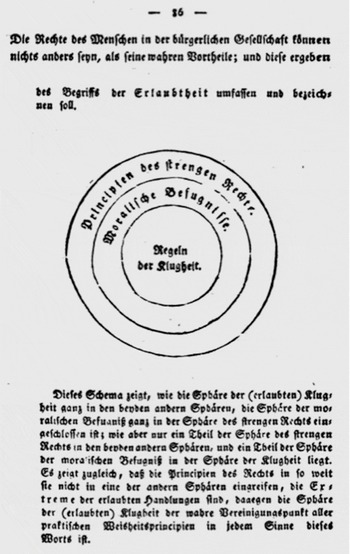
Gentz's understanding of the relation between metaphysics, morals and politics was rather technical, and he included a diagram to help readers see the logical dependencies that pertain between them (see Fig. 2). A sound theoretical grasp of what is right is a prerequisite for moral action, he argued. One cannot enact a just state of affairs without understanding, at a conceptual level, what justice is. Second, a rightful aim and a moral plan of action are both preconditions for the exercise of circumstantial prudence. Thus, as Gentz's diagram indicated, “the logical spheres of these three concepts become progressively smaller”:
Gentz's illustration of the “whole realm of the concept of permissiveness.” Gentz, Betrachtungen, 2nd edn, 1: 86.

Every conceivable action that accords with the rules of prudence . . . must be compatible with the laws of moral order and with the principles of strict right . . . But the converse does not hold—that everything that transpires in line with the principles of right also complies with the demands of morality or, far less, the rules of prudence; or that all actions that satisfy the moral law also satisfy the rules of prudence.Footnote 45
Gentz explained that the rules of morality are normative and universally binding, regardless of circumstance. An actor is moral if his means are congruent with his (just) ends, and he is immoral if he seeks to bring about a just world through unjust means. Such an incongruence between means and ends often stems from excessive zeal, Gentz argued. The Revolutionaries were an ideal case in point. “If begun with the arrogance of Icarus, man's loftiest flights into unexplored regions will end with the downfall of Icarus. The human race can only progress toward the attainment of that which is sublime gradually, step-by-step.”Footnote 46
Like morality, Gentz's notion of prudence was also practical—that is, concerned with the implementation of right. But whereas moral considerations are rational and universal, the demands of prudence are contingent and historical, dependent on the unique circumstances in which an actor is imbedded. Since prudence is a situational concept, it demands an empirical grasp of one's immediate surroundings. Before a statesman sets out to reform an institution, he must apprehend how it is interwoven with the habits, mores, customs and traditions of the nation it governs. Therefore, Gentz argued, “if a particular nation invited a wise statesman to assemble a plan for the expansion of its political liberty and vested him with great power, he would not consent to their wishes at once”:
He would first observe the character, customs, passions, degree of education, circumstances, needs and history of the people for whom he is legislating; he would compare the results of his investigation with the degree of freedom that they have hitherto enjoyed, and the amount that they now demand . . . It is just as unreasonable to hope that in an instant, a people can be converted from the slaves of a Sultan into a state of British enlightenment . . . as it is foolish to seek to transform a Turkish constitution into a British one at once.Footnote 47
Similarly, Gentz's notion of prudence required that statesmen have a sound understanding of history. Unlike the principles of justice, one cannot learn the demands of prudence through a priori reflection. Echoing Aristotle, Gentz defined prudence as a practical skill that can only be learned by emulating the examples of wise, judicious statesmen throughout history. The prudent politician will, in a moment of crisis, compare his potential course of action to similar situations in the past. If the lessons of experience indicate that his plans are feasible, he can pursue them with confidence; if not, he can revise his strategy, or abort it altogether. This comparative form of reasoning thus ensures a high likelihood of success. “If ever a constitution of pure reason [reinen Vernunft] should be realized somewhere, then it will be time to depart from the wisdom of experience,” Gentz argued. “But until then . . . reason and duty both dictate that the safest path lies along the well-travelled coast of experience.”Footnote 48
Whereas morality demands congruence between ends and means, prudence demands consonance between means and context. When these three factors are brought into alignment, the gap between theory and practice becomes passable. Such was the case, Gentz explained, in the Glorious Revolution of 1688 and, more recently, the American Revolution of 1776.Footnote 49 But as the example of the French Revolution demonstrated, principles without morality and prudence are of little practical use. Because the Revolution's leaders were unable to enact the rights outlined in their Declaration, this document only engendered resentment and violence. As a result, “the rights of men have never, in any age of history, been so terribly, obscenely, and thoroughly disgraced as in the last three years, in a nation where they should have been respected and venerated.”Footnote 50
III
In the months after Gentz released his translation, the situation in France deteriorated further. In January 1793 a Revolutionary tribunal ordered the execution of Louis XVI, prompting Austria and Britain to join the Prussian war against France. In Paris, Robespierre assumed power, instituting martial law and ushering in the horrors of his infamous Terror. These developments shocked the German reading public, and propelled Gentz's Reflections to a position of prominence in political discourse. Throughout 1793, his translation provoked a heated debate over whether the normative demands of pure reason are compatible with the practical exigencies of politics.Footnote 51 Gentz defended a moderate position, arguing that reason's dictates are indeed practicable if coupled with morality and prudence. But the debate quickly radicalized. August Wilhelm Rehberg insisted that philosophical reason has no place in politics.Footnote 52 Johann Gottlieb Fichte took up the opposite position, arguing that all regimes be brought into alignment with reason, no matter the cost.Footnote 53
Kant was not insulated from the turmoil that Gentz's translation provoked. In March, the bookseller Carl Spener wrote to him from Berlin, begging him to respond to the growing scepticism about the Revolution. “Is it not your duty to alleviate with a small drop of oil this terrible friction that threatens to crush hundreds of thousands?” he asked.Footnote 54 Similar petitions continued to arrive over the coming months.Footnote 55 Kiesewetter wrote to Kant in June, noting that “there is much to be said about the principles of the French Republic and their agreement with reason” and urging him to come the Revolutionaries’ aid.Footnote 56 In September, Kant relented, submitting “Theory and Practice” to the Berlinische Monatsschrift as a contribution to the debate that now raged over the political authority of a priori reason.
In all likelihood, Kant knew that his former student had incited this debate. Gentz's letters from the mid-1780s suggest that the two men forged a close personal relationship in Königsberg.Footnote 57 They were in direct correspondence as late as 1790, when Kant asked Gentz to edit a draft of his Critique of Judgement.Footnote 58 And Kant was attentive to Gentz's rising political fortunes throughout the 1790s as well.Footnote 59 It seems almost certain, then, that Kant would have read Gentz's translation of Burke in 1793, and would have been alert to its effects on German public opinion. At the same time, however, Kant would also have known that Gentz's edition of the Reflections had attracted the praise of Prussia's monarch regnant, Friedrich Wilhelm II, and that Gentz had been named to the king's council of advisers in mid-1793. Kant had good reason to pen an esoteric argument against Gentz, one that his student would recognize but that granted him plausible innocence before the Prussian censors.Footnote 60 When all this evidence is placed alongside the textual clue that Wittichen uncovered in Kant's essay, a neat prima facie case emerges to suggest that Gentz's Reflections was, in fact, the source that inspired Kant to write “Theory and Practice.”
Kant framed his appraisal of the Revolution generally, vis-à-vis the “common saying” that an idea “may be correct in theory but does not apply [taugt . . . nicht] in practice.”Footnote 61 In one sense, this was a plausible restatement of Gentz's argument. In order to implement an ideal theory of justice, Gentz argued, statesmen must possess a moral plan of action and pay prudent attention to their circumstances; otherwise, what is “correct in theory” will be impracticable. With this schematic argument, Gentz meant to vindicate Kant's pre-Revolutionary idea of Enlightenment: to show how, precisely, the transition from despotism to self-government could be achieved without falling into the anarchy of the Revolution. But when Kant encountered this argument in 1793, it worried him. Gentz's emphasis on prudence, especially, seemed little more than a shrewd attempt to rationalize a bankrupt Ancien Régime and to provide intellectual cover for the Revolution's critics. At the prodding of his radical allies Kant decided to push back against Gentz—the “would-be expert who admits the value of theory for teaching purposes . . . but argues that matters are quite different in practice”—and set out to prove that a priori reason was, in fact, wholly sufficient for the practice of politics.Footnote 62
Kant's introduction contained a précis of this argument. He conceded that, sometimes, theory and practice seemed incongruent. But could circumstantial prudence reconcile them? Kant acknowledged that “between theory and practice there is required . . . an act of judgement through which the practitioner decides whether . . . something is a case of the rule.” But such situational judgement could not guarantee a successful implementation of right, Kant argued. Assume that a statesman possessed perfect judgement: in every situation presented to him, he would be able choose a set of principles appropriate to his context. Even with such prudence, this statesman would not be able to make all theories practicable, for the obvious reason that “even where this natural talent is present, there can still be a deficiency in premises; that is, a theory can be incomplete.” If this wise statesman chose a theory that was underdeveloped, his aims would be unrealizable. “In such cases it is not the fault of theory if it was of little use in practice, but rather of there having been not enough theory.”Footnote 63 Kant elaborated this point with a metaphor from Newtonian physics:
Now if an empirical engineer tried to disparage general mechanics, or an artilleryman the mathematical doctrine of ballistics, by saying that whereas the theory of it is nicely thought out it is not valid in practice since, when it comes to application, experience yields quite different results than theory, one would merely laugh at him (for if the theory of friction were added to the first and the theory of the resistance of air to the second, hence if only still more theory were added, these would accord very well with experience).Footnote 64
To reconcile the expected and actual results of these experiments, prudential judgement would be of no use; rather, “more theory” was needed. Kant intimated that just as it would be premature to abandon mathematical physics after one failed ballistics experiment, it would be unwise to reject a priori reason as the final source of political norms, or to infer that its dictates are impracticable, after the Revolutionaries’ halting attempts to enact them. “Theory and Practice,” in other words, inverted Gentz's argument: if the Revolution had faltered, it suffered from a dearth, not an excess, of theoretical reason.
Kant divided his argument into three parts, and the substance of his response to Gentz appeared in his second section, “on the relation of theory to practice in the right of a state.”Footnote 65 He began by registering his enthusiastic support for the rights defended in the Revolutionaries’ Declaration, outlining three conditions “in accordance with which alone the establishment of a state is possible in conformity with pure rational principles of external human right:
-
1. The freedom of every member of the society as a human being.
-
2. His equality with every other as a subject.
-
3. The independence of every member of a commonwealth as a citizen.”Footnote 66
When Kant spelled out the implications of these rights, his Revolutionary sympathies became clear. He defined freedom as the right of each citizen to pursue his own vision of happiness, and censured paternalistic governments that seek to impose their own ideas about flourishing onto their subjects. It is immoral, Kant argued, to treat grown adults “like minor children who cannot distinguish between what is truly useful or harmful to them.” Second, Kant's notion of equality demanded the end of aristocratic privileges and the formation of a meritocratic society. “Every member of the commonwealth must be allowed to attain any level of rank . . . to which his talent, his industry and his luck can take him; and his fellow subjects may not stand in his way by means of a hereditary prerogative.” Finally, his concept of “independence” entailed a right to political representation. Under absolutist governments, subjects’ rights are contingent on the benevolence of their sovereigns. Only under a constitution grounded in the “general (united) will of the people,” therefore, are the rights of man secure.Footnote 67
In its original context, Kant's catalogue of rights amounted to a clear endorsement of the French vision of a nation conceived in liberté, égalité, and fraternité. At the same time, however, he was still sensitive to the dangers that political tumult posed to the enlightened public sphere, and was reluctant to endorse the worst tactical excesses of the Revolution:
If a people now subject to a certain actual legislation were to judge that in all probability this is detrimental to its happiness, what is to be done about it? Should the people not resist it? The answer can only be that, on the part of the people, there is nothing to be done but to obey.Footnote 68
Yet it was unclear how Kant could hold this position. If revolutions were categorically barred—if peoples had no right to cast off their existing governments in order to create better ones—then what practical use were his republican principles? This objection could be turned around and posed from a conservative angle. Earlier in his essay, in a rejoinder to Christian Garve, Kant suggested that a theoretical grasp of what is right necessarily compels moral action.Footnote 69 If this were so, and if the principles of the Revolution were just, then was Kant not committed to the radical claim that Revolutionaries’ violent tactics were, in fact, permissible?
To circumvent this dilemma, Kant might have turned to Gentz's concept of prudence. He could have argued that the French people were not suited for republican self-government, or that the Revolutionaries faltered because they were not sufficiently attuned to their unique circumstances. But he did not. Kant saw that if he were to fall back onto what he would later call “enlightened concepts of political prudence,” he would have to acknowledge that what is true in theory is, in certain circumstances, impractical.Footnote 70 If this were so, moral norms would be conditional, not universal:
All is lost when empirical and therefore contingent conditions of carrying out the law are made conditions of the law itself, so that a practice calculated with reference to an outcome probable in accordance with previous experience is given authority to control a self-sufficient theory.Footnote 71
Circumstantial prudence, therefore, was incompatible with the concept of right. If politicians could rightfully invoke mitigating empirical conditions to rationalize their own inaction, the whole force of the moral law would be suspended. Justice would be a mirage.
Rather than turning to prudence, Kant argued that the Revolutionaries’ principles were partially deficient. Their defence of human rights was laudable, but their concept of the state was misguided. Even in the most favourable conditions, prudence could not render certain revolutions permissible, since the very concept of a rightful revolution was nonsensical. If subjects had a right to overthrow their governments, this right would have to be grounded in a universalizable maxim. This would be equivalent to a law that licenses lawlessness, which is absurd.Footnote 72 Thus for Kant, “any resistance to the supreme legislative power, any incitement to have the subjects’ dissatisfaction become active, any insurrection that break out in rebellion, is the highest and most punishable crime within a commonwealth, because it destroys its foundation.”Footnote 73 In an essay “On the Morality of Political Revolutions” included in his edition of the Reflections, Gentz had argued that in certain narrow circumstances nations have recourse to an extra-constitutional right of resistance; such was the case in the Glorious Revolution of 1688, for instance.Footnote 74 When Kant answered Gentz in “Theory and Practice,” he used the same example to arrive at the opposite conclusion:
If those uprisings by which . . . Great Britain won its constitution . . . had failed, those who read the history of them would see in the execution of their now celebrated authors nothing but the deserved punishment of great political criminals . . . The people did wrong in the highest degree by seeking their rights in this way; for this way of doing it (adopted as a maxim) would make every rightful constitution insecure and introduce a condition of complete lawlessness (status naturalis), in which all rights cease . . . to have effect.Footnote 75
Gentz's suggestion that in certain circumstances revolution might be a moral, even wise, course of action was therefore confused.
In the constitution of Great Britain—where the people carry on about their constitution as if it were the model for the whole world—we nevertheless find that it is quite silent about the authorization belonging to the people in case the monarch should transgress the contract of 1688 . . .
The reason for this silence was obvious. “That a constitution should contain a law for such a case authorizing the overthrow of the existing constitution . . . is an obvious contradiction.”Footnote 76
For Kant, then, the Revolutionaries’ problem was not that they were imprudent; rather, like the engineers in his metaphor, they had “not enough theory.” They had strayed past the limits of reason, presuming a right to overthrow their government that they did not, in fact, possess. This fundamental theoretical error led them to embrace the same political paradigm as their Ancien Régime nemeses:
The cause of their actions is, in part, the common mistake . . . of substituting the principle of happiness for [the principle of right] in their judgments . . . Here it is obvious what evil the principle of happiness . . . gives rise to in the right of a state, just as it does in morals, despite the best intentions of those who teach it. The sovereign wants to make the people happy in accordance with his concept and becomes a despot; the people are not willing to give up their universal human claim to their own happiness and become rebels. Had it first been asked what is laid down as right (where principles stand firm a priori and no empiricist can bungle them), then the idea of the social contract would remain in its incontestable authority . . . as a rational principle for appraising any public rightful constitution.Footnote 77
For Kant, the Revolutionaries’ occasional missteps did not prove reason's inadequacy; instead, they illustrated the terrible results that follow when its sovereignty is ignored. And if what is true in theory is necessarily true in practice, prudence need not be brought into account.
IV
When Gentz encountered “Theory and Practice” in the Monatsschrift, he must have felt dejected. The strident rationalism that Kant used to evaluate the Revolution must have seemed wholly separate from the moderate, reformist vision of Enlightenment that he defended in the 1780s. Why, he wondered, would Kant reject the prudentialist agenda for political progress outlined in his Reflections? Gentz reasoned that Kant must have misread his argument, and decided to restate it in a “Response to Herr Prof. Kant's Reasoning on the Relation between Theory and Practice,” which he submitted to the Monatsschrift in late 1793.Footnote 78 Prudence, he hoped to show, did not threaten the authority of pure reason but was consonant with, and indeed presupposed by, Kant's normative theory of justice.
Gentz began his article by distancing himself from the anti-theoretical scepticism of Rehberg and his allies:
If the saying “that may be true in theory but does not apply in practice” is intended to mean that something could be true in theory but nevertheless false in practice, then it is a thoroughly wrongheaded notion and deserves the full severity with which Prof. Kant, in his noteworthy and profound essay on the subject, reveals its emptiness.—Sometimes, however, it only means “that may be true in theory but is not sufficient [zureichend] for practice” . . . Pure logic and well-constituted reason argue that what has been proven and established in theory cannot be overturned in practice. But there is another, much more complicated, interesting and fruitful question to be asked. At what point does practice cease to be a mere echo of theory? At what point does it earn the right to speak for itself, and indeed for theory as well?Footnote 79
Kant had shown that philosophical reason was necessary for politics. But had he proven that it was sufficient? As Gentz observed, the argument of “Theory and Practice” was ambiguous. Sometimes Kant objected to the strong claim that what is true in theory is “invalid” (ungültig) in practice. But elsewhere he seemed concerned to refute the more limited claim that what is true in theory is “not suited” (taugt nicht) for practice.Footnote 80 These statements are not equivalent. While Gentz was unwilling to defend the former, he thought that the latter was plausible and deserved further consideration.
“At first glance,” he explained, “one might be tempted to think that all theories that are grounded rationally upon a priori principles must be counted among those that are sufficient in and of themselves.”Footnote 81 But further examination proves that this is not the case. In the sphere of interpersonal moral duties—or what Gentz called “relations of pure obligation” (bloßen Pflichtbegriff)—pure reason is wholly sufficient. Neither historical knowledge nor situational prudence is needed in order to recognize and follow the demands of morality. But matters are essentially different in politics: the relation between the sovereign and his subjects is not one of reciprocal moral obligations. “What is essential about the civil condition . . . is that it secures the rights of men through compulsory public laws.”Footnote 82 As Kant's own critique of the Revolution showed, the rights of man cannot be made effective in an anarchic state of nature. If they are to be realized in practice, there must exist stable, well-ordered governments that can compel subjects to respect their neighbours’ rights. Yet as Gentz pointed out, pure reason is not able to explain how constitutions should be organized, how sovereign power is best wielded, or how state stability can be best preserved. In order to enact the rights of man in practice, statesmen need an empirical account of how order is constructed and maintained. In a Europe littered with failed and failing states, simply decrying rebellion was not enough.
Gentz was prepared to meet Kant halfway. In his rendering of Burke's Reflections, he depicted prudence as a practical virtue learned through habituation and historical observation. But if, as Kant suggested, this sort of Aristotelian judgement could not span the gap between theory and practice, then perhaps prudence might be reconceived as a series of generalizable maxims, gleaned from empirical observation, that explain how state order is best maintained. Returning to Kant's ballistics metaphor, Gentz explained that just as “a pure theory of mathematics cannot be made practicable unless it is augmented with a second, derivative theory formed by observing the resistance that projectiles encounter as they pass through air,” so, too, Kant's normative theory of right must to be paired with a practical account of politics, or what Gentz called his “new empirical theory.”Footnote 83 Just as scientific experiments cannot bring the laws of mathematics into question, Gentz was quick to insist that empirical maxims about how to preserve state order cannot undermine reason's dictates. Rather, his “empirical theory” aimed to secure the necessary conditions for the enactment of Kantian principles:
In order to create a just constitution, an understanding of the rights of man is indispensable, but merely preliminary. If the statesman is to uncover a way to realize these rights, he must go beyond his theory. The best-developed system of rights will always remain only a noble ideal without the practical substance [Stoff] that experience alone . . . offers. In every just constitution, sovereignty must be vested somewhere. Where should this power be located? How should it be wielded? What are its limits? How should it be safeguarded? To these exceedingly important questions, a pure theory of right can offer no answers. An understanding of men, of individuals and groups; a knowledge of human abilities, inclinations, passions, and weaknesses; prolonged observation; a comparison of man's many climates and circumstances; investigation of his social relations; a prolonged series of trial and error—only these can provide answers.Footnote 84
If reason furnishes the ends of politics, experience teaches its means. Because “Theory and Practice” offered only an ideal account of justice, Kant had ignored essential questions about how to reconcile order and liberty. “If he only meant to establish the principles upon which rational constitutions must be founded, this oversight would be unproblematic,” Gentz wrote. “But it is curious that Kant neglected [the lessons of experience] in an essay on theory and practice.”Footnote 85
This oversight led Kant to misjudge the Revolutionaries, according to Gentz. Liberty, equality and independence are indeed foundational principles of the social contract. “But this contract is a mere norm, a guide for legislative reason,” not a practical plan for how to build a stable polity.Footnote 86 Just as projectiles do not fly through air at the speed predicted by physicists, the normative rights of man cannot be enacted unconditionally without casting nations into a state of anarchy. But this is what Kant had recommended. “Theory and Practice” defined liberty, for instance, as the antithesis of paternalism. But while a nation undergoes the slow process of Enlightenment, is not a well-intentioned paternalistic regime vital for the orderly expansion of subjects’ rights? Indeed, was this not Frederick the Great's central achievement? Similarly, Kant argued that since all men must be equal before the law, feudal honours and privileges must be abolished. But look to the example of modern Britain, Gentz countered. Here, in the most liberal nation in Europe, a virtuous nobility was necessary for maintaining public order and keeping royal authority in check. If the relation between a sovereign and his subjects was rightfully unequal (as Kant admitted), why could the sovereign not delegate his authority to the vassals and allies who helped him uphold the peace? Was this not the rationale behind aristocracies? Though Gentz posed these questions rhetorically, his point was clear. Theories of justice are meaningless in a pre-political state of anarchy. To ignore the empirical question of order, then, is to consign philosophy to irrelevance.
As if to describe what, exactly, his empirical political approach entailed, Gentz spent the next two years compiling an in-depth account of the rise and fall of the Revolution. He centred his efforts on two French sources, which he translated and annotated for his German readers—Jean Joseph Mounier's Investigations into the Causes which Prevented the French from Becoming Free, and Jacques Mallet du Pan's Considerations on the Nature of the Revolution in France.Footnote 87 Gentz admired these authors because, unlike his peers in Berlin—“a learned class which has remained loyal to the Revolution from a position of order, comfort and peace, and which longs for the success of a movement that has decimated the moral progress of the past three centuries”—Mounier and Mallet du Pan witnessed the Revolution first-hand, and rooted their “non-partisan” judgements in an empirical grasp of its course rather than in an ideal vision of its promise.Footnote 88 Like Gentz, both men were moderates who initially cheered the Revolution—Mallet du Pan as editor of the reformist Mercure du France, and Mounier as the deputy of the monarchien faction within the tiers état. But when the Revolution fell under the control of radical democrats in late 1789, they were forced to flee. While in exile, Mallet du Pan and Mounier published their analyses of the Revolution, seeking to explain how a movement that began with such promise could have ended in such disaster.
As Gentz translated their histories of the Revolution, he underscored their lessons in comments scattered throughout his translations. Broadly, he identified three precepts that all prudent statesmen will heed. First, simple forms of government are intrinsically unstable and inevitably devolve into chaos. This was the case, according to Gentz, in Louis XVI's regime and the Revolutionary government that succeeded it. As the “enlightened” Montesquieu knew, only a “mixed constitution” (Staatsverfassung des Gleichgewichts) can effectively check the destabilizing effects of concentrated power and guarantee a durable liberty.Footnote 89 Second, Gentz observed that if subjects have a duty to obey their sovereigns, then rulers must have an equal duty to prevent revolutionary turmoil by addressing their subjects’ legitimate concerns. With Mallet du Pan, he faulted the intransigence of Louis XVI for exacerbating the Revolutionary crisis. Instead of negotiating a moderate settlement with the tiers état, the king and his allies simply ignored “the character of the age” and “pored over old adages.”Footnote 90 Finally, Mounier and Mallet du Pan's analyses illustrated how ill-prepared for republican self-government the French people were in 1789. Whereas prudence demands gradual reform, the Revolutionaries demanded radical liberties that were entirely incommensurate with their compatriots’ moral development. “Reason, wisdom and virtue always follow a middle path, but foolishness and wickedness call from beyond this middle path, towards an unhappy alternative.”Footnote 91 Because the Revolutionaries hoped to condense the slow process of Enlightenment into a single instant, their principles became self-defeating. As Mallet du Pan put it, “the Revolution, like Saturn, devoured its own children.”Footnote 92
With his essay in the Monatsschrift and his translations of Mounier and Mallet du Pan, Gentz hoped to vindicate the reformist vision of Enlightenment that Kant had defended in the 1780s. Wise political leadership; a well-balanced constitution; a moral, self-governing people—these, Gentz insisted, are prerequisites for implementing the rights of man in practice. Throughout the mid-1790s, reports from abroad seemed to prove his point. In Paris, the toll of guillotined ennemis du peuple continued to rise, while across Europe Revolutionary armées du libération wrought havoc upon France's neighbors. The Revolutionaries’ conquest of the Netherlands in early 1795 intimidated the Prussian government, and prompted it to agree to an armistice with France at the Peace of Basel in April. Kant saw this entente as a chance to clarify his stance on the Revolution, and responded to his critics in a tract entitled Perpetual Peace. As in “Theory and Practice,” Kant did not explicitly cite Gentz as his interlocutor in this essay, but the surviving evidence indicates that Gentz was among his chief targets. It is certain that Kant read Gentz's “Response to Herr Prof. Kant,” which the editor of the Monatsschrift mailed him in 1794.Footnote 93 Just as “Theory and Practice” contained an allusion to Gentz's translation of the Reflections, Kant placed a conspicuous reference to Mallet du Pan's Considérations in Perpetual Peace.Footnote 94 Perhaps most tellingly, however, he dedicated a substantial portion of his essay to the relation between philosophical reason and political prudence. Throughout the 1790s, none of his interlocutors made this relation more central to their political thought than Gentz.Footnote 95
In Perpetual Peace, Kant reiterated his support for the revolutionaries’ principles—“a constitution based upon the principle of the freedom of the members of a society . . . their common dependence upon a shared legal authority . . . and their mutual equality [is] the only constitution that proceeds from the pure idea of the original contract”—and applauded their attempt to craft a rational constitution for their nation.Footnote 96 But his essay also made an important concession to Gentz. In 1793, Kant had rejected Gentz's case for a union of pure reason and prudential statecraft as self-contradictory. But in the aftermath of the Terror, he was prepared to admit the possibility of a “moral politician . . . who takes the principles of political prudence in such a way that they can coexist with morals.” With clear reference to the Revolutionaries, he voiced concern about “despotizing moralists” whose principles are just but “who offend in various ways against political prudence.”Footnote 97 These passages mark the first positive references to prudence (Klugheit) in Kant's corpus. With Gentz, he was now willing to admit that since “severing the bond of civil . . . union even before a better constitution is ready to take its place is contrary to all political prudence,” statesmen must be allowed to wait to reform their nation's constitution “until the people [is] fit to legislate for itself.”Footnote 98 It is rational, in other words, to act prudently.
Kant contrasted the idea of a “moral politician” with the image of a “political moralist who frames morals to suit the statesman's advantage” and who invokes “sophistical maxims” to elide his moral duties.Footnote 99 This distinction reflected almost verbatim a passage from Gentz's article in the Monatsschrift. Here, Gentz had decried “empirical charlatans” who appeal to prudence to excuse injustice. “No constitution,” he wrote, “can contradict [Kant’s] theory of politics, which is wholly rooted in the concept of duty”:
The statesman who renounces this theory . . . is not only a despicable politician, but also consigns himself to grasp eternally at unstable, superficial and elusive precepts of governance, since he has foolishly abandoned the one idea that can offer him safety on his dangerous path.Footnote 100
Kant and Gentz agreed, in other words, that if the purpose of the state is the protection of its subjects’ rights, the exigencies of political prudence cannot override the normative demands of reason: the state must be preserved so that subjects’ rights can be upheld. But how, exactly, were the dictates of prudence to be determined? On this question, Gentz and Kant diverged. For Gentz, prudence demands a historical understanding of how, in practice, political order functions. The lessons that such historical study generates will, in turn, dictate the conditions under which the normative rights of men can be enacted: a nation's constitution must be well balanced, its people must be morally responsible, the transition to liberty must be gradual, and so on. For Gentz, in other words, pure reason requires an empirical, external check on its normative, totalizing demands in order to be made practicable. Blindly following reason's dictates will only undermine the state and lead to anarchy.
As Kant made clear in Perpetual Peace, this was a vision of reason that he would not endorse. “Morality is . . . a sum of laws commanding unconditionally . . . how we ought to act. It would be absurd to grant this concept of duty its rightful authority, but then claim that we cannot fulfil it. That would remove the concept of duty from morality altogether.”Footnote 101 What role, then, did Kant afford prudence in his political thought? As in “Theory and Practice,” he sidestepped Gentz's historicism by arguing that the basic lessons of prudence are not derived from experience, but are accessible to all rational agents a priori. Embedded in the structure of moral reason, he explained, there exist “permissive laws of reason” that “allow a situation of public right afflicted with injustice to continue until everything has either . . . become ripe for a complete overthrow or has been made almost ripe by peaceful means.” Is it not obvious, he argued, that “some form of a rightful constitution . . . is better than no constitution at all, which is the inevitable result of premature reforms?”Footnote 102 Though Kant said little about how statesmen should distinguish between “mature” and “premature” conditions for reform, he was confident that recognizing this difference did not require the comprehensive historical study that Gentz demanded. Moderation, for Kant, was rooted in a conceptual grasp of the demands of reason. “Political wisdom urges itself upon us of its own accord, so to speak, is clear to everyone, and puts all artifices to shame,” he wrote; “moreover it leads straight to the end, but with the reminder of prudence not to draw toward it precipitately by force but to approach it steadily as favourable circumstances arise.”Footnote 103 Unlike Gentz, Kant saw prudence as a principle internal to reason, not one that needed to be foisted upon it from outside. This gave him a convenient rationalization of the Terror: if Robespierre and the Jacobins had been acting rationally, the republicanization process in France would have been considerably more moderate and judicious.
This faith in the inherent moderation of reason helps explain Kant's dismissive stance toward Gentz's version of Mallet du Pan's Considérations. In this work, Gentz had expended considerable effort to show that state order can only be truly secured by wise rulers who are sensitive to their subjects’ needs. But in Kant's mind, this argument was self-evident a priori. Was it really necessary to observe the course of the Revolution, he asked sarcastically, to see that good states will be guided by good statesmen?
In his pompous but empty language, Mallet du Pan boasts of having at last, after many years of experience [Erfahrung], discovered the truth of Pope's famous saying: “For forms of government let fools contest; whate’er is best administered is best.” If this means that the best-administered government is the best-administered, Mallet du Pan . . . has cracked a nut that rewarded him with a worm. If he means that the best-administered government is also the best government—i.e., the best constitution—then it is entirely false . . .Footnote 104
At the same time, Kant's attempt to sublimate prudence up into his rationalist political vision helps explain his announcement, at the end of Perpetual Peace, that the final touchstone of a just political practice is the adage “fiat iustitia, pereat mundus.”Footnote 105 Since the early nineteenth century, Kant's detractors have cited this passage as evidence of his idealistic, utopian and ultimately destructive approach to politics.Footnote 106 While there is a kernel of truth in this argument—Kant clearly intended this citation as a provocative statement of his political rationalism—in its original context, his intended meaning was less polemical than ironic. If statesmen are truly pursuing justice, Kant believed, the contingent world of politics will not, in fact, perish. Regressing into an anarchic state of nature contradicts the most basic demands of reason. This meaning is clear from his odd, non-literal translation of the Latin maxim: “let justice reign, even if all the rogues [Schelme] in the world should perish.”Footnote 107 These rogues, and only these rogues, would perish, according to Kant, because prudence is intrinsic to a rational approach to politics. In order to realize the demands of justice in practice, all that is necessary is fidelity to principle.
V
In one sense, Kant saw Enlightenment as a necessarily prudential process. At a deeper level, however, his facile understanding of prudence ignored the thrust of Gentz's critique. Gentz's point was simple: Kant's a priori account of right presupposed state order, but it offered him few resources for explaining how such order could be constructed and maintained in practice. In the happy years of Frederick the Great's reign, this incongruity was inconspicuous. But in the early 1790s, as Kant's worries about the destabilizing potentialities of Enlightenment were vividly realized, the practical impotence of his theory became more pronounced. For Gentz, the very survival of Enlightenment depended on the preservation of state order. This meant that political theorists needed to turn their attention away from abstract questions of right, towards the empirical conditions for political stability. Absent such a turn, the rights of man would remain at best an empty ideal, and at worst a goad to further violence and suffering.
What Gentz perceived, in other words—and what made Kant's endorsement of the Revolutionaries’ naive republicanism so disconcerting to him—was that Enlightenment is a process that is necessarily more complex than simply deducing, then enacting, a normative catalogue of rights. Such a moralized political practice will lead not to a just state, but to the injustice of a stateless anarchy. Political theorists, therefore, must balance the demands of justice against the need for order. As Gentz put it in his “Response to Herr Prof. Kant,”
To combine a steadfast commitment to respect the sovereign's authority, even if this power should be found in the worst possible hands, with a diligent and steadfast zeal for the improvement of one's nation, a zeal that does not falter . . . even after unsuccessful attempts at reform—this is the true character of enlightened patriots [aufgeklärten Patrioten] in every nation, in every age, and in every stage of civilization.Footnote 108
In the wake of Kant and Gentz's debate, the challenge of reconciling liberty and order came to occupy a central place in early nineteenth-century political thought. Even Fichte, perhaps Kant's most radical student, would concede by 1807 that while “the doctrine of the rights of man and liberty and natural equality are the eternal and immutable foundation of all [just] social order,” a “mere grasp” of these principles hardly licenses a political theorist “to found or administer a state.”Footnote 109 A century later, Weimar political theorists turned to Gentz for an antidote to the excesses of liberalism in their own day. Hannah Arendt, for instance, admired him as an exponent of the conservative wing of the Prussian Enlightenment. Carl Schmitt's Political Romanticism offered a similarly positive review of Gentz, painting him as a critic of both naive, idealized liberalism and effete, reactionary sentimentalism.Footnote 110 As both Arendt and Schmitt recognized, Gentz's vision of a prudential Enlightenment amounted to an attempt to disentangle Kant's political vision from the tainted legacy of the Revolution, and to overcome the gap between morality and politics that the Terror had so shockingly exposed. Yet sadly, this was a vision of Enlightenment which, in the last analysis, Kant left Gentz to defend alone.