Introduction
Comparative welfare state research has undergone sustained geographic expansion since Esping-Andersen (Reference Esping-Andersen1990) classified eighteen OECD states into liberal, conservative-corporatist and social democratic regime types. Scholars have proposed a Southern European familialist model (Ferrera, Reference Ferrera1996; Leibfried, Reference Leibfried, Ferge and Kolberg2002), an East Asian productivist type (Holliday, Reference Holliday2000; Kühner, Reference Kühner2015) and post-communist welfare arrangements (Deacon, Reference Deacon2000). More recent classification efforts have employed fuzzy-set methods (Yang & Kühner, Reference Yang and Kühner2020), latent class analysis (Ferragina & Seeleib-Kaiser, Reference Ferragina and Seeleib-Kaiser2011) and hierarchical clustering (Brown & Brik, Reference Brown and Brik2024) to identify up to six groupings of welfare provision globally. Throughout this expansion, one major world region remains absent from the typological literature: the Gulf Cooperation Council states.
This absence carries both substantive and methodological weight. Qatar reports a gross domestic product (GDP) per capita of USD 87,661, and Saudi Arabia allocates 36.8 per cent of GDP to social expenditure (World Bank, 2024). Non-citizens constitute 88 per cent of the total population of Qatar and 37 per cent of that of Saudi Arabia (General Authority for Statistics, 2024; Qatar Planning and Statistics Authority, 2024). The welfare stratification that emerges from these demographic conditions has no parallel in the comparative literature (Brik, Reference Brik2025a). Moreover, the principal comparative databases, including Organisation for Economic Co-operation and Development (OECD) Benefits and Wages, EUROMOD, the CSB Minimum Income Protection Indicators, SaMip and the Luxembourg Income Study, do not cover the Gulf, leaving scholars without the programme-level data necessary to integrate these systems into existing typological frameworks (Brik, Reference Brik2022; Nelson, Reference Nelson2013; Noël, Reference Noël2019).
The absence of the Gulf from comparative social policy is not only a geographic lacuna. It constitutes a theoretical problem. The regime typology literature rests on the assumption that it identifies the full range of institutional forms through which modern states organise welfare provision (Abrahamson, Reference Abrahamson1999; Bonoli, Reference Bonoli1997). If a major region with distinctive institutional characteristics remains outside the classificatory framework, the framework itself is incomplete. The Gulf states present characteristics that do not map onto any existing regime type: near-universal citizen coverage financed entirely from hydrocarbon rents, categorical exclusion of the demographic majority from social protection and a protective benefit orientation that stands in sharp contrast to the productivist logic identified in East Asia. Gough and Wood (Reference Gough and Wood2004) argued that welfare regimes in the global South require analytical categories that go beyond European experience. The Gulf case supports this argument with particular force.
This paper addresses both the substantive and the methodological dimensions of this gap. The Model Family (MF) Approach, as operationalised by Wang et al., (Reference Wang, Abe, Kang, Ku, Ng, Peng and Zhao2024) for East Asia and by Figari et al. (Reference Figari, Matsaganis and Sutherland2013) for fourteen European states, is applied to Qatar and Saudi Arabia. The analysis draws on original primary data from the Minimum Income Protection Data Collection Template methodology. The MF Approach constructs the full income package for precisely specified family profiles at defined earnings levels (Hufkens et al., Reference Hufkens, Goedemé, Gasior, Leventi, Manios, Rastrigina, Recchia, Sutherland, Van Mechelen and Verbist2019; Gasior & Recchia, Reference Gasior and Recchia2020). It is well suited to the Gulf context because it relies on documented programme rules rather than representative micro-data, and because it can model citizen and non-citizen income packages under the same protocol.
The standard MF protocol is extended in four directions. Monte Carlo simulation (10,000 iterations) generates model-derived uncertainty ranges for all welfare indicators. Oaxaca–Blinder decomposition (Blinder, Reference Blinder1973; Oaxaca, Reference Oaxaca1973) separates the novel Citizenship Welfare Gap indicator into endowment and coefficient components. Gini, Theil and Atkinson indices capture inequality in welfare adequacy distributions, with Theil decomposition separating between-group from within-group inequality. Principal component analysis with hierarchical clustering positions Gulf systems in a global regime classification framework.
The paper advances the social policy literature in four respects, each directly relevant to the readership of this journal. It provides the initial MF income package analysis of any Gulf Cooperation Council welfare system. It introduces the CWG, with formal decomposition, as a methodological tool applicable to all labour-importing welfare states. It tests the productivist welfare thesis (Holliday, Reference Holliday2000) against Gulf empirical data, demonstrating that Gulf systems occupy the opposite pole of the productivist-protective spectrum from East Asian comparators. It proposes, and provides multi-method evidence for, a selective-universalist rentier welfare state as a distinct regime type. For the field of social policy, the Gulf case forces a reckoning with the boundaries of the welfare state concept itself: can a system that provides generously for 12 per cent of the population while excluding 88 per cent be called a welfare state at all? The answer to that question has implications far beyond the Gulf, for every welfare state that conditions social rights on migration status.
This paper contributes to social policy literature by extending the empirical scope of regime analysis to a region that has so far remained outside it. The central finding, that the CWG in Gulf states exceeds the entire range of within-country welfare variation documented in published European MF studies (Figari et al., Reference Figari, Matsaganis and Sutherland2013), raises fundamental questions about how social policy scholarship conceptualises the relationship between welfare provision and population coverage. The distinction between policy-created gaps (predominantly in Qatar) and market-created gaps (predominantly in Saudi Arabia), established through decomposition analysis, offers a new analytical lens for understanding welfare stratification in any context where nationality conditions benefit access. This lens applies directly to ongoing debates about migrant social rights in European welfare states (Hooijer & Picot, Reference Hooijer and Picot2015; Rueda, Reference Rueda2005), making the Gulf case relevant far beyond its geographic boundaries.
Theoretical framework
Welfare content and welfare outcomes
The analytical architecture rests on the distinction Wang et al. (Reference Wang, Abe, Kang, Ku, Ng, Peng and Zhao2024) draw between welfare content and welfare outcomes. Outcomes, including poverty rates, Gini coefficients and deprivation indices, constitute the standard dependent variables in comparative research (Brady, Reference Brady2009; Kenworthy, Reference Kenworthy2011). Content refers to the specific configuration of benefits: what is provided, to whom, at what level, under what conditions, and with what interaction effects. Aggregate expenditure indicators capture only a partial cross-section of this content and can mislead when spending is distributed unevenly across population segments.
Social welfare is operationalised in this paper as the social-protection-relevant disposable income of a household: the monthly income package that determines its standard of living at a given level of earnings, comprising cash and near-cash transfers, social insurance entitlements, housing support, utility subsidies and the monetised value of access to public education and health care. This is the model family conception of welfare, in which provision is measured at the level of the household income account rather than as aggregate national expenditure. The definition is confined to provision with a household-level income incidence. It does not extend to pure public goods, such as security or general infrastructure, which carry no household-specific cost, and it is distinct from the national-accounts measure of total social spending, which can mislead when provision is distributed unevenly across population segments.
The measurement problem takes a particularly acute form in the Gulf context. Saudi Arabia reports social expenditure of 36.8 per cent of GDP, a figure often cited as evidence of a generous welfare state (World Bank, 2024). However, this figure denominates total spending to the entire population while channelling benefits almost exclusively to citizens who constitute 63 per cent of the population. The effective expenditure per citizen beneficiary therefore exceeds what the aggregate figure suggests, whereas expenditure per non-citizen resident approaches zero. Castles (Reference Castles2002) warned against using aggregate spending data as a proxy for welfare effort, precisely because such data mask distributional variation. A methodology that disaggregates provision by family type, income level and nationality status is necessary for accurate characterisation. The MF Approach supplies this disaggregation, generating programme-level income accounts from which both content indicators and outcome indicators can be computed (Figari et al., Reference Figari, Matsaganis and Sutherland2013; Wang et al., Reference Wang, Abe, Kang, Ku, Ng, Peng and Zhao2024).
Welfare regime theory: dimensions, critiques and the problem of scope
The typological framework of Esping-Andersen (Reference Esping-Andersen1990) retains its organising role in comparative research despite three decades of sustained critique. The analytical power of the framework derives from three dimensions: decommodification, the degree to which social rights sustain livelihoods independent of market participation; social stratification, the way institutions shape hierarchies of access; and the state-market-family nexus, the institutional division of welfare production. The interaction of these dimensions across eighteen OECD states produced the liberal, conservative-corporatist and social democratic clustering that has structured the research agenda of the field.
Scholars have thoroughly documented the limitations of this framework. Arts and Gelissen (Reference Arts and Gelissen2002) showed that the classification is sensitive to case selection, indicator choice and clustering method, and that different operationalisations of decommodification produce different country groupings. Scruggs and Allan (Reference Scruggs and Allan2006) corrected scoring errors in the original decommodification index and found that amended scores altered the classification of several borderline cases. Bambra (Reference Bambra2006, Reference Bambra2007) argued that the neglect of healthcare defamilialisation distorted the measurement of decommodification itself. Powell and Barrientos (Reference Powell and Barrientos2004) proposed an alternative clustering based on welfare mix that generated four ideal types rather than three, with the Southern European model as a distinct category. Bonoli (Reference Bonoli1997) demonstrated that combining the quantity of social expenditure with the Bismarckian or Beveridgean character of financing produced a more discriminating classification. Ferragina and Seeleib-Kaiser (Reference Ferragina and Seeleib-Kaiser2011), in the most extensive meta-analysis of the typological literature to date, concluded that the original framework captures a real pattern but that its explanatory power has diminished as welfare states converge on certain dimensions while diverging on others.
Each proposed regime extension has enriched one or more of these original dimensions. The Southern European model of Ferrera (Reference Ferrera1996) identified a distinctive form of stratification through clientelistic benefit distribution, dualistic social insurance, and residual social assistance. The productivist welfare thesis of Holliday (Reference Holliday2000) introduced a fourth dimension: the subordination of social policy to economic development goals. In this formulation, East Asian welfare states are qualitatively distinct because social spending is instrumentalised and channelled toward education, training and human capital formation rather than income maintenance. Kühner (Reference Kühner2015) operationalised the productivist-protective distinction across twenty-nine countries and found that empirical variation is better captured by a continuous spectrum than by binary regime assignment. Yang and Kühner (Reference Yang and Kühner2020) extended this analysis through fuzzy-set qualitative comparative analysis (QCA), demonstrating that East Asian cases have diverged from the pure productivist ideal type, with South Korea and Taiwan moving toward hybrid configurations. The analysis of Kwon (Reference Kwon2005) of the transformation of the developmental welfare state in Korea and Taiwan reached compatible conclusions, arguing that post-crisis welfare expansion represented a qualitative shift that the productivist category alone could no longer accommodate.
Gough and Wood (Reference Gough and Wood2004) extended regime analysis to the Global South, identifying an informal security regime characterised by community and kinship-based welfare provision in the absence of state social protection. Barrientos (Reference Barrientos, Gough and Wood2004) delineated Latin American informal-security arrangements. Abu Sharkh and Gough (Reference Abu Sharkh and Gough2010) produced a global meta-typology that positioned welfare regimes on a spectrum from state-led to informal-based. These extensions demonstrate that the field has long recognised the need to move beyond European experience. However, none of these scholars addressed the Gulf, despite its distinctive combination of extreme state wealth, categorical citizenship-based exclusion and non-contributory benefit architecture.
None of the extensions discussed above addresses what the Gulf case demands: a welfare system where the primary axis of stratification is legal nationality, and where the excluded population constitutes the majority of residents. In the framework of Esping-Andersen, stratification operates through the class structure of benefit delivery: means-tested benefits stigmatise (liberal); status-differentiated contributory benefits preserve occupational hierarchies (conservative-corporatist); universal citizenship-based benefits de-stratify (social democratic). In the productivist model of Holliday, stratification operates through the employment relationship. In the Gulf, stratification operates through citizenship: a legally codified, largely non-acquirable status that determines access to the entire benefit architecture. This arrangement differs in kind from the insider-outsider dynamics documented in European labour markets (Häusermann & Schwander, Reference Häusermann, Schwander, Emmenegger, Häusermann, Palier and Seeleib-Kaiser2012; Rueda, Reference Rueda2005) or the graduated welfare access analysed in migration scholarship (Morris, Reference Morris2003; Sainsbury, Reference Sainsbury2012). The exclusion is categorical: virtually all benefits for citizens, virtually none for non-citizens, regardless of residence duration, earnings level or family structure. In Qatar, this binary affects 88 per cent of the population. Shalev (Reference Shalev, Mjøset and Clausen2007) argued that some welfare states are genuinely type-defying and cannot be accommodated within existing categories without distortion. The Gulf case represents precisely such a challenge.
More recent classification work has begun to register the Gulf. Aspalter (Reference Aspalter2023), in a global data analysis of welfare capitalism, identifies an exclusion-oriented grouping among the oil-exporting states, and Mumtaz et al., (Reference Mumtaz, Roumpakis and Sumarto2025), writing in this journal, show that a single well-theorised case can productively challenge established regime classifications where existing categories hybridise uneasily. The contribution of this paper is to supply the programme-level income evidence that such classification requires. The selective-universalist rentier configuration is specified not by aggregate expenditure or broad institutional description but by the documented structure of benefit entitlement rendered as household income accounts, and is distinguished from existing types by the rent-per-citizen mechanism developed above.
The rentier welfare state and selective universalism
The political economy of Gulf welfare provision has been theorised within the rentier state framework (Beblawi & Luciani, Reference Beblawi and Luciani1987; Mahdavy, Reference Mahdavy and Cook2015; Ross, Reference Ross2001). Hydrocarbon revenues enable the state to distribute material benefits to citizens without extracting taxes, creating an allocation state (Luciani, Reference Luciani, Beblawi and Luciani1987) where welfare provision follows revenue availability rather than social insurance logic. Governments distribute these benefits without contribution requirements or means tests, and political motivations shape the allocation process (Hertog, Reference Hertog2020; Gengler et al., Reference Gengler, Shockley and Ewers2021). The rentier state literature has generated a substantial body of evidence on how resource revenues shape political institutions (Ross, Reference Ross2013), fiscal policy (Herb, Reference Herb2014) and labour markets (Hertog, Reference Hertog2013). However, the specific welfare state implications of rentierism, including the institutional design of social protection programmes, the distribution of benefits across population segments and the stratification effects of citizenship-conditional provision, have received less sustained attention. Loewe and Jawad (Reference Loewe and Jawad2018) called for closer integration of the rentier state literature with comparative welfare state research. This paper responds to that call with programme-level empirical evidence.
The rentier framework does more than describe the fiscal basis of Gulf welfare; it predicts the form that citizen provision takes. The relevant variable is rent per citizen, a function of resource revenue and of the size of the citizen population. Where rent per citizen is high, as in Qatar, the state can finance open-ended, non-means-tested benefits for the whole citizen body, because the fiscal cost of universality is low relative to available revenue. Where rent per citizen is lower, as in Saudi Arabia, open-ended allocation to a large citizen population is not sustainable, and the state rations provision through income-testing and employment conditions. The allocation logic identified by Luciani (Reference Luciani, Beblawi and Luciani1987) is therefore not uniform across rentier states: its expression depends on the ratio of rent to citizenry. This yields a prediction that the empirical analysis tests directly. Higher rent per citizen should be associated with non-means-tested provision, low within-citizen inequality, and stratification concentrated at the citizenship boundary; lower rent per citizen should be associated with targeted provision, higher within-citizen inequality, and a benefit gap driven as much by differential market costs as by categorical exclusion.
The concept of selective universalism is proposed in this study to capture the distinctive logic of Gulf welfare. The term is deliberately paradoxical. Within the citizen population, Gulf welfare is effectively universal: benefits are not means-tested in Qatar, coverage spans the life course, and generosity exceeds the poverty threshold for most family types in employment. This citizen-facing universalism bears structural similarities to the social democratic model (Esping-Andersen, Reference Esping-Andersen1990). Nevertheless, it operates within a radically restricted eligibility boundary. The selectivity at work is not the liberal-model selectivity of means-testing, which targets the poor but is available in principle to all residents. It is a categorical selectivity that excludes the majority by legal status. The typology of Dean (Reference Dean2011) concerning the ethical bases for the social rights of migrants provides a normative vocabulary for this arrangement; the empirical analysis presented below quantifies it.
The selective-universalist rentier welfare state is defined in this study by four constitutive properties, each testable with MF data: (a) high benefit generosity for citizens across the life course; (b) categorical exclusion of non-citizens from non-employment-conditional benefits; (c) predominantly protective rather than productive welfare content orientation; and (d) non-means-tested, non-contributory benefit architecture financed from resource revenues. If the Gulf cases meet all four criteria, and if they cluster separately from established regime types on empirically derived dimensions, grounds exist for proposing a distinct regime type that is not only a geographic extension of existing categories but a qualitatively distinct form of welfare provision.
Methods
Data collection
The primary data consist of two Minimum Income Protection Data Collection Templates, one for Qatar and one for Saudi Arabia, completed through original field research in 2023 to 2024. Each template documents, for every social protection programme: the legal basis, benefit category (from a standardised thirteen-category taxonomy), eligibility conditions (citizenship or residency status, income, family composition, employment status), benefit amount in local currency, payment frequency and conditionality rules. Eleven expense categories are documented for each profile. Country statistics including population, average earnings, poverty lines and social expenditure shares draw from accompanying Country Statistics files and official national sources.
Qatar and Saudi Arabia are selected as a diverse-case pair, in the sense given by Seawright and Gerring (Reference Seawright and Gerring2008) and Gerring (Reference Gerring2006), rather than as representative or typical cases. The selection follows the most-different-systems logic (Przeworski & Teune Reference Przeworski and Teune1970): the two are positioned at opposite ends of the internal range of the Gulf Cooperation Council on the dimensions most likely to govern welfare structure, so that a configuration common to both is unlikely to be an artefact of the particular features of either. The heterogeneity that this design entails is a strength rather than a limitation, for reasons that concern the dimensions of difference, the coverage of the region and the severity of the test. The dimensions on which the two cases differ are of three kinds, and none confounds the inference: (i) differences in population size and absolute fiscal scale do not enter the analysis, because the indicators are computed at the level of the household income account and are independent of the size of the citizen body; (ii) differences in rent per citizen and demographic composition are the explanatory variables under test, not nuisance variation, since rent per citizen is the proposed mechanism and the contrast in the non-citizen share, 88 per cent against 37 per cent, is what allows the citizenship boundary to be distinguished from the fiscal channel; and (iii) the difference in welfare architecture, open-ended allocation in Qatar against targeting and activation in Saudi Arabia, is itself a prediction of the rent-per-citizen mechanism, so that its appearance across the pair corroborates the argument rather than threatening it. On the coverage of the region, the two cases bracket its internal range: Qatar holds the highest rent per citizen of the six member states and Saudi Arabia among the lowest, so the four remaining states, the United Arab Emirates, Kuwait, Bahrain and Oman, fall within the interval the pair defines, and extension to them is interpolation within a bounded range rather than extrapolation beyond it. On the severity of the test, a configuration that recurs across cases chosen for maximal difference survives a more demanding test than one inferred from similar cases, and the mechanism is stated so as to be falsifiable, since a high rent-per-citizen state that rationed citizen provision through means-testing, or a low rent-per-citizen state that sustained open-ended universalism, would disconfirm it. The inferential claim is calibrated to what this design can bear. Two cases cannot establish a regime type, and the paper does not assert one; a diverse-case pair can support the demonstration that a configuration is not idiosyncratic and the specification of the mechanism that governs its internal variation, which is the claim the analysis advances.
The Model Family Approach
The MF Approach constructs income accounts for institutionally realistic hypothetical family profiles at specified earnings levels (Gasior & Recchia, Reference Gasior and Recchia2020; Wang et al., Reference Wang, Abe, Kang, Ku, Ng, Peng and Zhao2024). The core formula is:
 $$NDI = E + \Sigma {B_i} - \Sigma {X_j}$$
where E is gross monthly earnings, Bᵢ is the activated benefit entitlement in category i and Xⱼ is the expense deduction in category j. Five family profiles are constructed following the standard MF literature: Profile A (single adult, no children, at 0, 50, 100 and 150 per cent of average national earnings); Profile B (couple without children, single earner at 100 per cent); Profile C (couple with two children aged 4 and 7, single earner at 100 per cent); Profile D (lone parent with one child aged 4, at 0, 50 and 100 per cent); and Profile E (single retiree on pension). Each profile is constructed separately for citizen and non-citizen families, yielding ten distinct income accounts per country and forty across both countries and earnings scenarios.
It is important to state clearly what the MF data represent and what they do not. The model families are constructed profiles, not survey respondents. The data capture the formal institutional structure of benefit entitlement as documented in programme rules and legislation. They do not capture benefit take-up rates, administrative discretion, informal provision or within-programme variation. The statistical analysis reported below should accordingly be interpreted as a description of patterns within the constructed profiles, not as inference about population-level parameters. Monte Carlo simulation addresses uncertainty in model specification (cost parameters), not sampling uncertainty (Guimaraes Couto et al., Reference Guimaraes Couto, Damasceno, de Oliveira and Chan2013; Papadopoulos & Yeung, Reference Papadopoulos and Yeung2001).
Access to public services enters the income account through cost incidence rather than as a separate cash item. For a citizen household, education and health care carry zero cost; for a non-citizen household, the same services are obtained at market prices and appear as expense deductions. The measure therefore reflects differential access to public services directly, and the decomposition results attribute the largest single share of the citizenship gap, the cost of schooling, to this channel.
Analytical measures
Four welfare content indicators are computed following Wang et al. (Reference Wang, Abe, Kang, Ku, Ng, Peng and Zhao2024). The Net Income Adequacy Ratio (NIAR) equals Net Disposable Income (NDI) divided by the national poverty line; NIAR above 1.0 indicates income above the poverty threshold. The Coverage Score (CS) counts activated benefit categories for each profile. The Protective-to-Productive Ratio (PPR) divides the total value of income-maintenance benefits by investment-oriented benefits; PPR above 1.0 indicates protective orientation. The Marginal Effective Tax Rate (METR) captures work incentive profiles. Two outcome indicators are computed: the Poverty Gap Closure Rate and the CWG (CWG = NDI citizen minus NDI non-citizen for each matched profile pair).
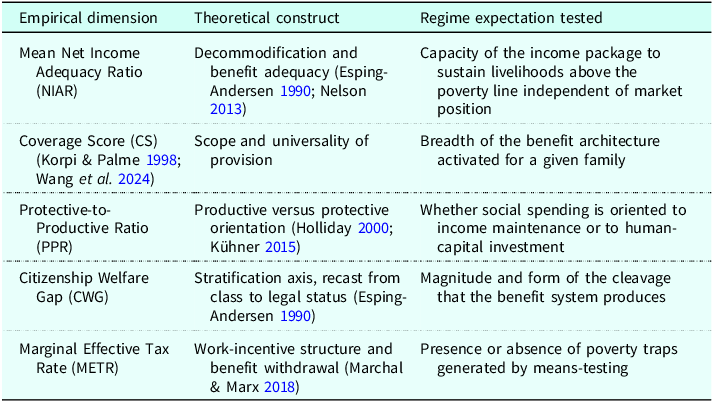
The five welfare indicators are all derived from the net disposable income identity and therefore measure facets of a single construct rather than an aggregation of unrelated quantities. NIAR, CS, the PPR, the METR and the CWG are each functions of the same household income account, which secures their internal consistency. Because the construct is the social-protection-relevant disposable income of the household, and because the benchmark values for European and East Asian systems are produced under the same model family logic, the cross-regional comparison places systems on a common measurement basis. Differences in the time point and protocol of the source studies remain a comparability caveat and are noted as such. A configuration is treated as analytically distinct where it (i) occupies a separate region of this theory-grounded space, (ii) is internally coherent on the four constitutive properties, and (iii) is separated from established clusters under stable clustering, assessed by the leave-one-out analysis reported below. Difference from existing types is thereby replaced by a stated set of conditions against which the sufficiency of the evidence can be judged (Table 1).
Statistical methods
Monte Carlo simulation. Expense parameters are drawn from data-informed distributions (lognormal for cost variables, truncated normal for subsidised components) across 10,000 iterations, generating model-derived uncertainty ranges for NIAR, CWG and PPR. These ranges characterise sensitivity to model assumptions, not sampling variability.
Oaxaca–Blinder decomposition. The CWG is partitioned into an endowment component, reflecting cost-structure differences between citizen and non-citizen families, and a coefficient component, reflecting differential policy treatment (Blinder, Reference Blinder1973; Oaxaca, Reference Oaxaca1973). Because the data derive from constructed profiles, the decomposition reveals specification structure rather than causal effects; sensitivity to reference category choice is reported.
Inequality analysis. Gini, Theil and Atkinson indices are computed for the NIAR distribution, with Theil decomposition separating between-group from within-group inequality.
PCA-based classification. A five-dimensional welfare space (mean NIAR, CS, PPR, CWG, METR) is constructed for twelve countries spanning Gulf, East Asian and European welfare systems. PCA extracts dominant dimensions; hierarchical clustering (Ward method) produces a four-cluster solution. Given the small number of country observations (N = 12) and dimensions (P = 5), the PCA results are presented as a descriptive mapping of the constructed regime space rather than as a claim about population-level structure. Cluster stability was assessed through leave-one-out analysis.
Ethical considerations
The analysis draws on documentary and administrative sources: the legal and regulatory rules of social protection programmes, official statistical publications, and published benchmark studies. It involves no human participants, no personal or identifiable data, and no fieldwork, so institutional ethical approval was not required. The ethical dimension of the work lies in its subject. The paper documents a structure of categorical exclusion that bears on the welfare of a population, largely non-citizen and frequently low-paid, that is not in a position to shape the policies described. The analysis is conducted, and the findings are reported, as a positive account of institutional structure. The paper takes no normative position on the legitimacy of citizenship-based differentiation, while recognising that the quantification of exclusion is not a neutral act and may inform debate on the social rights of non-citizen residents.
Country contexts
Qatar
Qatar is a constitutional emirate with a GDP per capita of USD 87,661 (2022). Qatari nationals constitute roughly 12 per cent of a total population of 2.74 million (Qatar Planning and Statistics Authority, 2024), social expenditure was 21.7 per cent of GDP, national unemployment stands at 0.13 per cent and the poverty line is QAR 13,981 per month, below which 0.4 per cent of the population falls. The social protection architecture is developed in three legislative layers. Law No. 1 of 1964 established state social assistance for citizens without an earner. Law No. 38 of 1995 consolidated and widened this provision, defining nine categories of eligible recipients: widows, divorced women, destitute families, persons with disability, orphans, those unable to work, the elderly, the families of prisoners and the families of missing persons. The base benefit ranges from QAR 3,000 to QAR 6,000 per month, with supplements of QAR 2,000 per wife and QAR 1,000 per child, and is neither asset-tested nor work-conditional. Provision for divorced women and widows is the reason the citizen income package for a lone parent at zero earnings remains positive (NIAR 0.77; Table 2), a result without parallel on the non-citizen side. Social insurance was placed on a new footing by Law No. 1 of 2022, which raised the minimum retirement age to fifty and the qualifying service period to twenty-five years and set a minimum public-sector pension of QAR 15,000 per month, above the poverty line. Housing support operates through the Citizen Housing Programme, which combines grants of up to QAR 1.2 million with subsidised finance through the Qatar Development Bank, reaching roughly 36,100 households at the time of data collection. Public education and hospital care are provided without charge to nationals. A statutory minimum wage of QAR 1,000 per month, introduced in 2021, applies to all workers irrespective of nationality and is the single benefit accessible to non-citizens (Brik, Reference Brik2025b).
Mapping of empirical dimensions to theoretical constructs and regime expectations

Table 1. Long description
The table has five rows and three columns. The columns are labeled ‘Empirical dimension’, ‘Theoretical construct’, and ‘Regime expectation tested’. Row 1: Empirical dimension, Mean Net Income Adequacy Ratio (NIAR); Theoretical construct, Decommodification and benefit adequacy (Esping-Andersen 1990; Nelson 2013); Regime expectation tested, Capacity of the income package to sustain livelihoods above the poverty line independent of market position. Row 2: Empirical dimension, Coverage Score (CS); Theoretical construct, Scope and universality of provision; Regime expectation tested, Breadth of the benefit architecture activated for a given family. Row 3: Empirical dimension, Protective-to-Productive Ratio (PPR); Theoretical construct, Productive versus protective orientation (Holliday 2000; Khner 2015); Regime expectation tested, Whether social spending is oriented to income maintenance or to human-capital investment. Row 4: Empirical dimension, Citizenship Welfare Gap (CWG); Theoretical construct, Stratification axis, recast from class to legal status (Esping-Andersen 1990); Regime expectation tested, Magnitude and form of the cleavage that the benefit system produces. Row 5: Empirical dimension, Marginal Effective Tax Rate (METR); Theoretical construct, Work-incentive structure and benefit withdrawal (Marchal Marx 2018); Regime expectation tested, Presence or absence of poverty traps generated by means-testing.
Note: Each empirical dimension operationalises a construct from welfare regime theory and tests a corresponding regime expectation. A configuration is treated as analytically distinct where it occupies a separate region of this space, is internally coherent on the four constitutive properties, and is separated from established clusters under stable clustering.
Source: Author calculations. both references are already in the reference list.
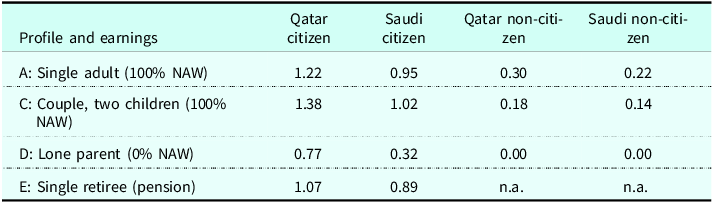
Net income adequacy ratios by family profile and citizenship

Table 2. Long description
A table comparing net income adequacy ratios by family profile and citizenship in Qatar and Saudi Arabia. The table has four rows and five columns. Column headers are Profile and earnings, Qatar citizen, Saudi citizen, Qatar non-citizen, and Saudi non-citizen. Row labels are A: Single adult (100 percent NAW), C: Couple, two children (100 percent NAW), D: Lone parent (0 percent NAW), and E: Single retiree (pension). Row 1: A: Single adult (100 percent NAW), Qatar citizen, 1.22; Saudi citizen, 0.95; Qatar non-citizen, 0.30; Saudi non-citizen, 0.22. Row 2: C: Couple, two children (100 percent NAW), Qatar citizen, 1.38; Saudi citizen, 1.02; Qatar non-citizen, 0.18; Saudi non-citizen, 0.14. Row 3: D: Lone parent (0 percent NAW), Qatar citizen, 0.77; Saudi citizen, 0.32; Qatar non-citizen, 0.00; Saudi non-citizen, 0.00. Row 4: E: Single retiree (pension), Qatar citizen, 1.07; Saudi citizen, 0.89; Qatar non-citizen, n.a.; Saudi non-citizen, n.a.
Note: NIAR = net disposable income divided by the national poverty line; a value above 1.0 indicates income above the poverty threshold. Values are model-derived point estimates (Monte Carlo means); 95 per cent model-uncertainty ranges are reported in Appendix Table 9. NAW = national average wage. n.a. = not applicable, as non-citizen retirees activate no pension entitlement.
Saudi Arabia
Saudi Arabia has a population of 37.4 million, of whom approximately 37 per cent are non-nationals (General Authority for Statistics, 2024). GDP per capita is USD 30,448 (2022), social expenditure is 36.8 per cent of GDP, and 13.6 per cent of the population lives below the poverty line of SAR 5,394 per month. The architecture is larger, more fragmented, and more strongly conditioned on employment and income than that of Qatar. Old-age provision runs through the General Organization for Social Insurance (GOSI), which pays a contributory pension of 2.5 per cent of average earnings per year of contribution. Unemployment insurance was added in 2014 through the insurance scheme against unemployment (SANED) branch of the social insurance law, replacing 60 per cent of prior salary for up to twelve months for citizen contributors. The defining change of the past decade was the realignment of citizen entitlements around the fiscal consolidation that followed the 2014 decline in oil revenue. As value-added taxation was introduced in 2018 and energy and utility subsidies were reduced, the Citizen Account Programme was created in 2017 to compensate citizen households through income-tested cash transfers, the size of which falls as household income rises. Housing support is delivered through the Sakani programme, also launched in 2017, which has assisted more than one million families through subsidised finance and allocation. Labour-market activation is provided through the Hafiz job-seeker allowance and associated training, and free public education and health care are available to nationals. The statutory minimum wage stands at SAR 4,000 per month in the private sector. Non-citizens are outside all of these schemes except that employers contribute 2 per cent of non-citizen wages to GOSI for occupational-injury cover.
Intra-Gulf variation in non-citizen coverage
Access to social protection for non-nationals varies across the GCC and depends on legal and visa status as much as on nationality. The International Labour Organization (ILO) (2023) regional mapping records that Bahrain and Oman extend contributory coverage to private-sector non-nationals for employment injury, old age, disability and death, that Bahrain provides unemployment insurance, and that Oman includes maternity and paternity benefits. Qatar and Saudi Arabia sit at the more exclusionary end of this range. Neither extends residence-based or non-employment-conditional provision to non-citizens; the sole exception is a 2 per cent employer occupational-injury contribution to GOSI for non-citizen workers in Saudi Arabia. Within the non-citizen population, access is further differentiated by visa category. Regular private-sector employees, domestic workers, holders of flexible work permits and those in irregular status face distinct entitlement and enforcement conditions. The model families constructed in this paper represent a regular private-sector non-citizen worker, which is the most protected of these positions. The income packages reported for non-citizens are therefore a conservative estimate of disadvantage: domestic workers and those in irregular status would, if anything, face a larger gap relative to citizens. The claim of categorical exclusion is accordingly made precise rather than absolute: it holds for non-employment-conditional, residence-based social protection in the two countries studied, and is not a generalisation about the GCC as a whole.
Results
Welfare content
Net income adequacy ratios
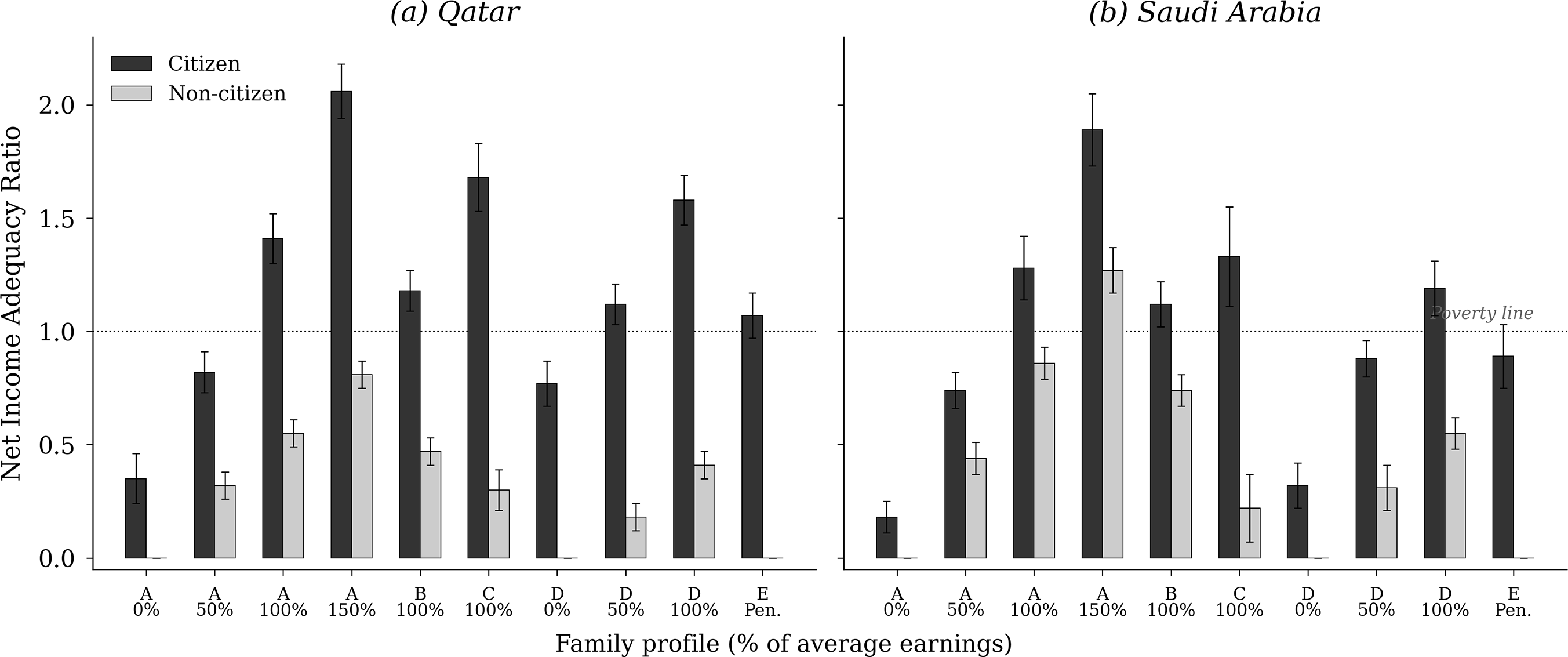
Table 2 and Figure 1 present NIAR values for each family profile and earnings level. Both countries achieve NIAR above 1.0 for most citizen working-age profiles at average earnings, confirming that citizen income packages are broadly adequate when employment is combined with the full suite of social benefits. The citizen NIAR of Qatar consistently exceeds that of Saudi Arabia across all profiles, reflecting the more extensive social insurance architecture of Qatar and the higher absolute value of housing grants and utility subsidies relative to the poverty line.
Two results deserve particular attention. The citizen NIAR of Qatar for Profile D (lone parent, one child) at zero earnings reaches 0.77. Although below the poverty threshold, this is a substantially positive value. Law No. 38 of 1995 drives this result through its specific provisions for divorced women and widows (QAR 6,000 base plus supplements). The equivalent Saudi NIAR is 0.32, reflecting a more fragmented and earnings-conditional assistance structure. The citizen elderly NIAR (Profile E) is 1.07 in Qatar, as the minimum pension exceeds the poverty line, whereas the Saudi value is 0.89, indicating residual poverty risk for pension-dependent retirees. These patterns confirm that even within the citizen population, the two countries differ in how effectively the safety net covers non-employed family types. Nelson (Reference Nelson2013), in the fullest assessment of European minimum income protection, attributed NIAR values above 1.0 only to the most generous social democratic systems. The citizen profiles of Qatar thus occupy territory comparable to Scandinavian welfare provision on this measure.
The pattern for non-citizen families is categorically different. At zero earnings, non-citizen NIAR is 0.00 in both countries: no residence-based benefit entitlement exists for a non-working non-national. The employment-injury cover that employed non-citizens hold in Saudi Arabia does not activate for the non-working profiles and does not enter household disposable income materially. Even at average earnings, a non-citizen couple with two children (Profile C) achieves a NIAR of only 0.30 in Qatar and 0.22 in Saudi Arabia. Private schooling (QAR 4,000 monthly for two children in Qatar; SAR 3,600 in Saudi Arabia) and market-rate housing consume most of earned income. This pattern does not represent lower generosity in the conventional sense. It represents structural absence: the benefit architecture does not recognise non-citizen families as subjects of social protection. Hooijer and Picot (Reference Hooijer and Picot2015) documented migrant poverty penalties in European welfare states ranging from 5 to 20 percentage points. The Gulf penalties documented in this analysis are of an entirely different order of magnitude.
Protective-to-productive ratio
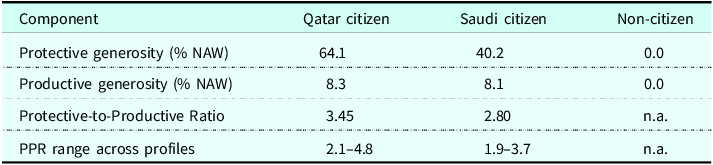
The PPR exceeds 1.0 for all citizen profiles in both countries (Table 3). Values range from 2.1 to 4.8 in Qatar and 1.9 to 3.7 in Saudi Arabia. These figures place Gulf welfare in sharp contrast with East Asian comparators from the study of Wang et al. (Reference Wang, Abe, Kang, Ku, Ng, Peng and Zhao2024). Singapore and South Korea show PPR values below 1.0, where investment-oriented benefits dominate. Japan, Hong Kong and Taiwan report PPR values between 1.0 and 1.5. Even the most protective East Asian case (Taiwan, PPR of approximately 1.4) falls well below the Gulf range. The divergence is structural: Gulf welfare provision concentrates on income maintenance, including cash transfers, subsidies and housing grants, rather than the human capital investments that define East Asian productivism (Holliday, Reference Holliday2000; Kühner, Reference Kühner2015). This finding directly contradicts the Vision 2030 rhetoric of both countries, which emphasises economic diversification and human capital development. The benefit architecture tells a different story from the policy discourse.
Protective-to-productive ratio and components by citizenship

Table 3. Long description
The table has four rows and four columns. The columns are labeled Component, Qatar citizen, Saudi citizen, and Non-citizen. The rows are labeled Protective generosity (% NAW), Productive generosity (% NAW), Protective-to-Productive Ratio, and PPR range across profiles. Row 1: Protective generosity (% NAW), Qatar citizen, 64.1, Saudi citizen, 40.2, Non-citizen, 0.0. Row 2: Productive generosity (% NAW), Qatar citizen, 8.3, Saudi citizen, 8.1, Non-citizen, 0.0. Row 3: Protective-to-Productive Ratio, Qatar citizen, 3.45, Saudi citizen, 2.80, Non-citizen, n.a. Row 4: PPR range across profiles, Qatar citizen, 2.1-4.8, Saudi citizen, 1.9-3.7, Non-citizen, n.a.
Note: Protective and productive generosity are expressed as a percentage of the national average wage (NAW). The Protective-to-Productive Ratio (PPR) divides protective by productive generosity; a value above 1.0 indicates a protective orientation. Non-citizen PPR is not applicable because no non-employment benefits are activated. Source values from Appendix Tables 3 and 7.
Welfare outcomes
The citizenship welfare gap
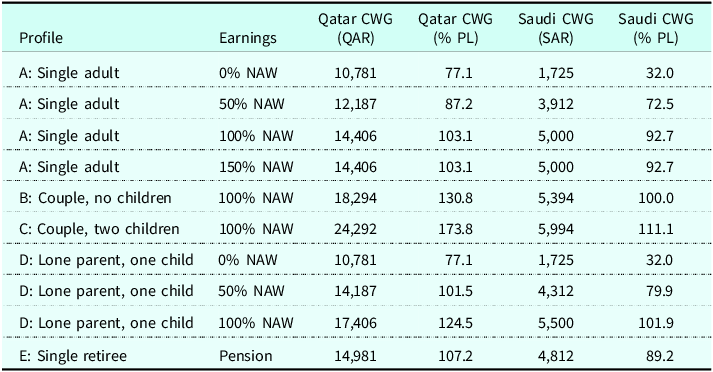
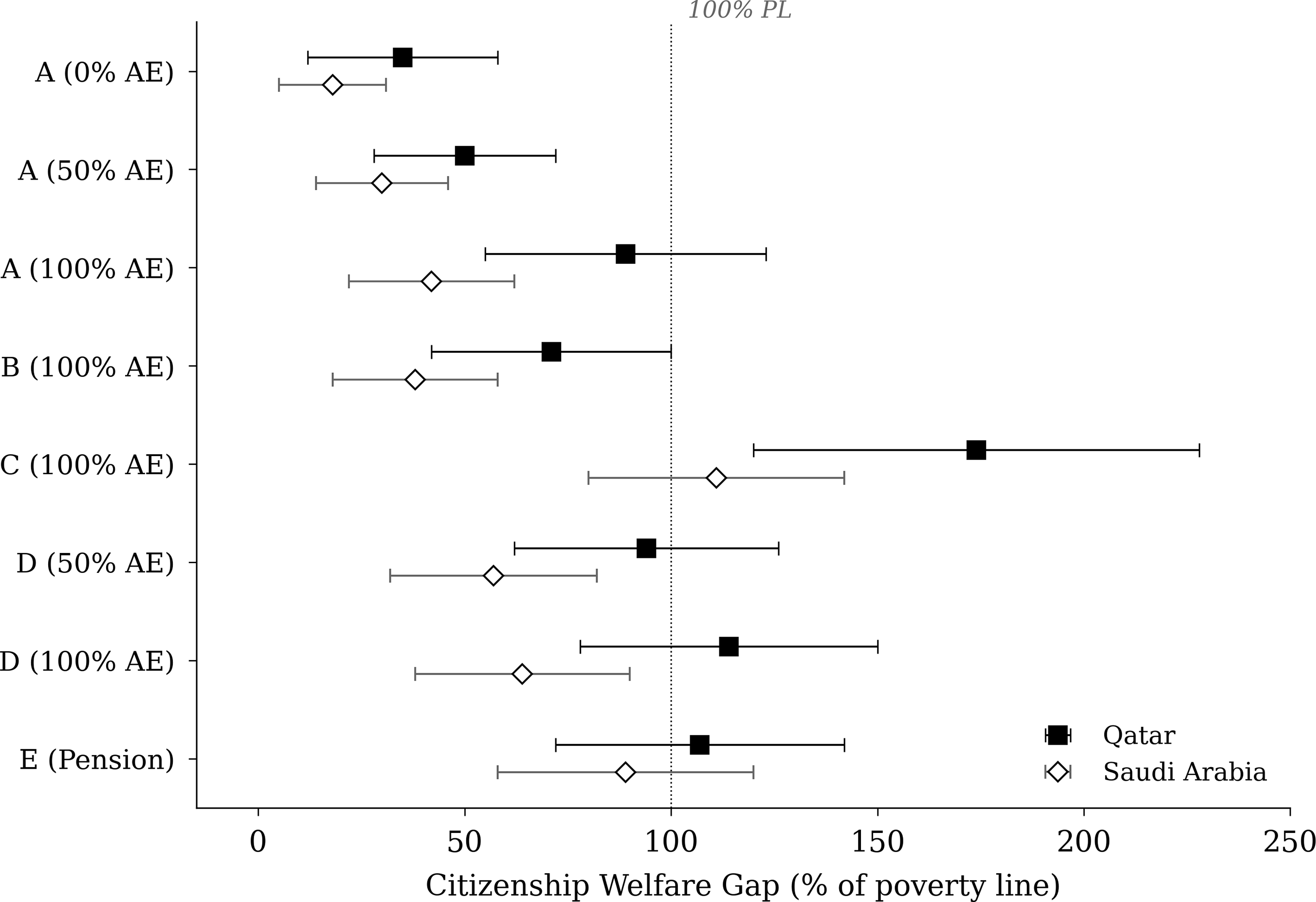
Table 4 and Figure 2 present the CWG for each matched citizen-non-citizen profile pair. For Profile C (couple with two children at average earnings), the CWG of Qatar is QAR 24,292 per month, equal to 174 per cent of the national poverty line. A Qatari citizen family and a non-citizen family with identical demographics and one earner at the average national wage differ in monthly disposable income by more than one and three-quarters of the poverty line, purely as a function of citizenship-conditional benefit entitlement. The CWG of Saudi Arabia for the same profile is SAR 5,994, equal to 111 per cent of the poverty line.
Citizenship welfare gap by family profile and earnings level

Table 4. Long description
A table comparing citizenship welfare gaps (CWG) by family profile and earnings level in Qatar and Saudi Arabia. The table has 15 rows and 6 columns. Column headers are Profile, Earnings, Qatar CWG (QAR), Qatar CWG (% PL), Saudi CWG (SAR), and Saudi CWG (% PL). Row labels include different family profiles and earnings levels. Row 1: Profile A, Single adult, Earnings 0% NAW, Qatar CWG 10,781 QAR, Qatar CWG 77.1% PL, Saudi CWG 1,725 SAR, Saudi CWG 32.0% PL. Row 2: Profile A, Single adult, Earnings 50% NAW, Qatar CWG 12,187 QAR, Qatar CWG 87.2% PL, Saudi CWG 3,912 SAR, Saudi CWG 72.5% PL. Row 3: Profile A, Single adult, Earnings 100% NAW, Qatar CWG 14,406 QAR, Qatar CWG 103.1% PL, Saudi CWG 5,000 SAR, Saudi CWG 92.7% PL. Row 4: Profile A, Single adult, Earnings 150% NAW, Qatar CWG 14,406 QAR, Qatar CWG 103.1% PL, Saudi CWG 5,000 SAR, Saudi CWG 92.7% PL. Row 5: Profile B, Couple, no children, Earnings 100% NAW, Qatar CWG 18,294 QAR, Qatar CWG 130.8% PL, Saudi CWG 5,394 SAR, Saudi CWG 100.0% PL. Row 6: Profile C, Couple, two children, Earnings 100% NAW, Qatar CWG 24,292 QAR, Qatar CWG 173.8% PL, Saudi CWG 5,994 SAR, Saudi CWG 111.1% PL. Row 7: Profile D, Lone parent, one child, Earnings 0% NAW, Qatar CWG 10,781 QAR, Qatar CWG 77.1% PL, Saudi CWG 1,725 SAR, Saudi CWG 32.0% PL. Row 8: Profile D, Lone parent, one child, Earnings 50% NAW, Qatar CWG 14,187 QAR, Qatar CWG 101.5% PL, Saudi CWG 4,312 SAR, Saudi CWG 79.9% PL. Row 9: Profile D, Lone parent, one child, Earnings 100% NAW, Qatar CWG 17,406 QAR, Qatar CWG 124.5% PL, Saudi CWG 5,500 SAR, Saudi CWG 101.9% PL. Row 10: Profile E, Single retiree, Earnings Pension, Qatar CWG 14,981 QAR, Qatar CWG 107.2% PL, Saudi CWG 4,812 SAR, Saudi CWG 89.2% PL.
Note: CWG = net disposable income (citizen) minus net disposable income (non-citizen) for matched profile pairs. PL = national poverty line (Qatar QAR 13,981; Saudi Arabia SAR 5,394). NAW = national average wage. Positive values indicate citizen advantage.
These gaps are without precedent in the published MF literature. The largest within-country welfare stratification in the fourteen-country European study of Figari et al., (Reference Figari, Matsaganis and Sutherland2013) is approximately 40 to 60 percentage points between the most and least generously treated household types. The CWG documented in this analysis exceeds the entire European range by a factor of two to three. Whereas European welfare stratification is produced through means-testing, conditionality and varying replacement rates, Gulf stratification is produced through a single binary mechanism: citizenship status. This distinction has implications for how the field understands the concept of welfare stratification itself. In the typology of Esping-Andersen, stratification is a matter of degree: more or less egalitarian, more or less status-preserving. In the Gulf, stratification is a matter of kind: included or excluded.
Statistical analysis
Monte Carlo uncertainty ranges
Monte Carlo simulation confirms the robustness of the CWG findings to variation in cost parameters. For Profile C at average earnings, the CWG of Qatar has a mean of 80.3 per cent of the poverty line with a 95 per cent model-derived range of [55.4, 105.7], remaining above 50 per cent even at the lower bound. The Saudi CWG mean is 182.8 per cent [95 per cent range: 146.2, 221.4]. All CWG estimates differ from zero by more than two standard deviations of the simulated distribution, confirming that the citizen-non-citizen welfare differential is not an artefact of particular cost assumptions. It is important to emphasise that these ranges characterise model sensitivity, not population-level confidence intervals.
Oaxaca–Blinder decomposition of the CWG
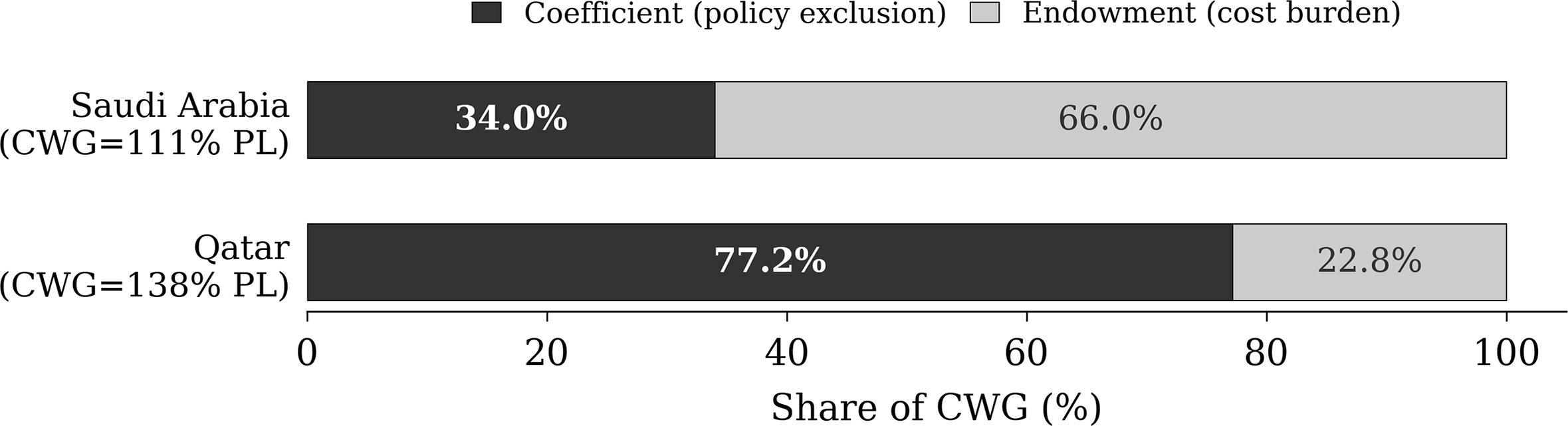
The decomposition reveals a structural cross-national difference (Figure 3). In Qatar, 77.2 per cent of the Profile C gap is attributable to the coefficient effect: the direct consequence of excluding non-citizens from housing grants, cash transfers, utility subsidies and child benefits. Only 22.8 per cent reflects endowment differences (higher healthcare and private education costs for non-citizens). In Saudi Arabia, the pattern reverses: 66.0 per cent of the gap reflects endowment effects (cost-burden differentials driven primarily by private education fees of SAR 3,600 monthly for two children), whereas 34.0 per cent reflects policy exclusion.
Net Income Adequacy Ratios by family profile and nationality. Error bars show 95 per cent model-derived uncertainty ranges from Monte Carlo simulation (N = 10,000). Dotted line marks the poverty threshold (NIAR = 1.0).

Figure 1. Long description
Panel A: A bar graph comparing net income adequacy ratios for citizens and non-citizens in Qatar. The horizontal axis represents family profiles as percentages of average earnings (0 percent, 50 percent, 100 percent, 150 percent, B 100 percent, C 100 percent, D 0 percent, D 50 percent, D 100 percent, and E Pen). The vertical axis represents the net income adequacy ratio. Black bars represent citizens, and gray bars represent non-citizens. Error bars show 95 percent model-derived uncertainty ranges. A dotted line marks the poverty threshold at a net income adequacy ratio of 1.0. Citizens generally have higher net income adequacy ratios compared to non-citizens across all family profiles. Panel B: A bar graph comparing net income adequacy ratios for citizens and non-citizens in Saudi Arabia. The horizontal axis represents family profiles as percentages of average earnings (0 percent, 50 percent, 100 percent, 150 percent, B 100 percent, C 100 percent, D 0 percent, D 50 percent, D 100 percent, and E Pen). The vertical axis represents the net income adequacy ratio. Black bars represent citizens, and gray bars represent non-citizens. Error bars show 95 percent model-derived uncertainty ranges. A dotted line marks the poverty threshold at a net income adequacy ratio of 1.0. Citizens generally have higher net income adequacy ratios compared to non-citizens across all family profiles.
Citizenship Welfare Gap by family profile, expressed as percentage of the national poverty line. Points show estimated CWG; whiskers show bootstrapped 95 per cent model-derived uncertainty ranges. Dotted line marks 100 per cent of the poverty line.

Oaxaca–Blinder decomposition of the CWG for Profile C at average earnings. The gap in Qatar is predominantly coefficient-driven (77.2 per cent, policy exclusion); the gap in Saudi Arabia is predominantly endowment-driven (66.0 per cent, cost burden).

This decomposition has direct implications for policy design. The gap in Qatar is primarily policy-created, produced by the deliberate exclusion of non-citizens from the benefit architecture. It is therefore potentially reducible through eligibility reform. The gap in Saudi Arabia is primarily market-created, produced by the interaction of non-citizen exclusion with high private-market costs for services that citizens receive free. It is more tractable through cost regulation and public service provision. Sensitivity analysis using Saudi Arabia as the reference category yields consistent results: the coefficient share shifts by less than 5 percentage points under alternative specifications, confirming the stability of the decomposition.
Shapley value decomposition
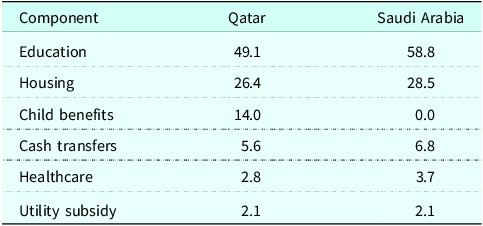
Shapley value decomposition identifies component drivers of the CWG (Table 5). Education costs account for 49.1 per cent of the gap in Qatar for Profile C and 58.8 per cent of the Saudi gap, making private schooling the single largest structural driver across both countries. Housing contributes 26.4 per cent in Qatar and 28.5 per cent in Saudi Arabia. Healthcare, cash transfers and utility subsidies account for the remainder. The dominance of education is striking: for families with children, access to free schooling is the single policy lever that would most reduce the CWG.
Inequality analysis and Theil decomposition
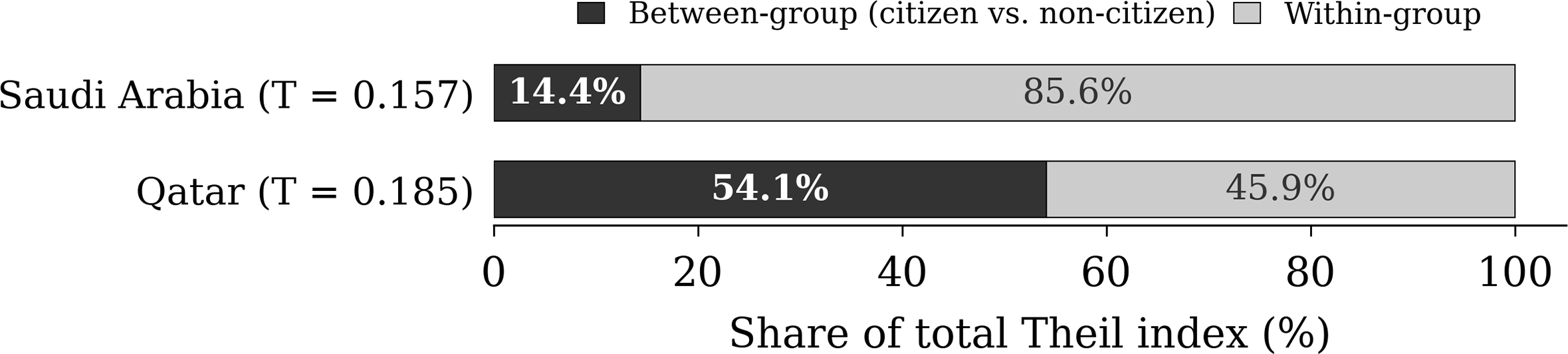
Theil index decomposition reveals a fundamental structural contrast (Figure 4). In Qatar, 54.1 per cent of total welfare inequality (measured by NIAR distribution across all profiles) is between-group: the citizen-non-citizen divide accounts for more than half of all welfare inequality. In Saudi Arabia, only 14.4 per cent is between-group, whereas 85.6 per cent is within-group. Citizenship-based stratification therefore constitutes the dominant axis of welfare inequality in Qatar, analogous in structural terms to the role of class in the conservative welfare regime of Esping-Andersen (Reference Esping-Andersen1990), although operating through legal status rather than market position. In Saudi Arabia, inequality is driven primarily by variation across family profiles and earnings levels within each nationality category.
Theil index decomposition of welfare inequality into between-group (citizen vs. non-citizen) and within-group components.

The combined Gini coefficient for NIAR is 0.341 in Qatar and 0.308 in Saudi Arabia. Atkinson indices at ϵ = 1.0, reflecting inequality aversion, are 0.191 and 0.172, respectively. These figures indicate moderate overall inequality, but the Theil decomposition reveals that the source of inequality differs fundamentally between the two countries. This within-regime-type variation parallels the internal heterogeneity that Arts and Gelissen (Reference Arts and Gelissen2002) documented within the social democratic cluster and that Yang and Kühner (Reference Yang and Kühner2020) identified within the productivist cluster. Regime types need not be internally homogeneous to be analytically meaningful.
Descriptive comparisons across model families
Non-parametric rank comparisons confirm the patterns described above. The Mann-Whitney U statistic comparing citizen and non-citizen NIAR distributions is 95.0 in Qatar (rank-biserial r = .90) and 81.5 in Saudi Arabia (r = .63), indicating very large separation between the two distributions. A Kruskal-Wallis comparison of citizen NIAR between Qatar and Saudi Arabia yields H = 0.756, indicating that citizen generosity is broadly comparable across the two countries. The Wilcoxon signed-rank statistic for paired CWG comparisons is W = 36.0, confirming that the differential treatment of non-citizens is larger in Qatar. Because these statistics describe constructed model family profiles rather than population samples, they are reported in this study as descriptive summaries of the patterns within the data rather than as inferential tests of population differences.
PCA-based regime classification
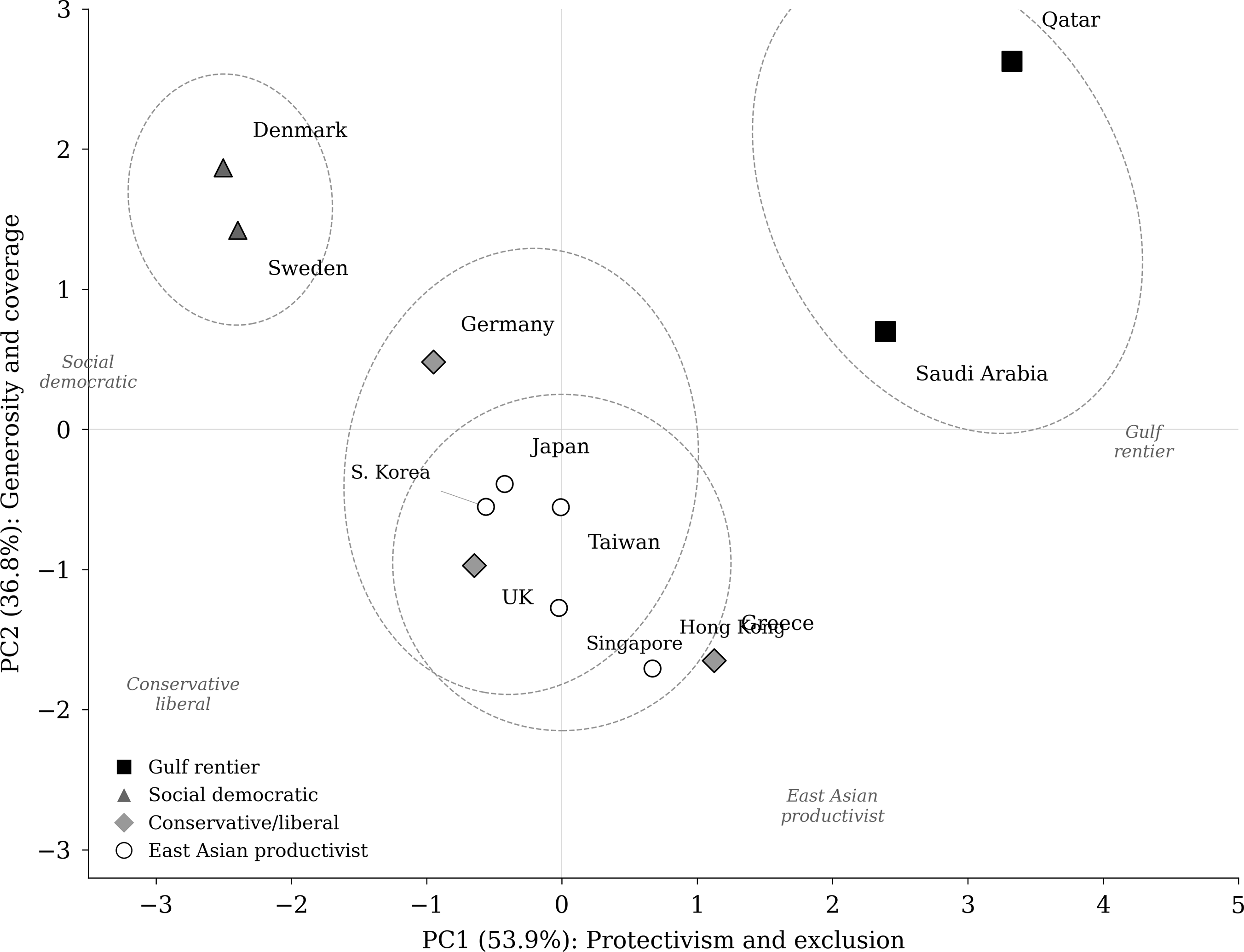
PCA extracts two dominant components that explain 90.6 per cent of variance in the five-dimensional welfare space. PC1 (53.9 per cent of variance) loads positively on PPR (+0.54), CWG (+0.53), and negatively on METR (-0.53), capturing a protectivism-exclusion dimension. PC2 (36.8 per cent) loads on mean NIAR (+0.71) and CS (+0.57), capturing a generosity-coverage dimension. Figure 5 plots the twelve countries in this space. Qatar and Saudi Arabia form a distinct cluster in the upper-right quadrant, separated from the social democratic cluster (Sweden, Denmark), the East Asian productivist cluster (Singapore, South Korea, Japan, Hong Kong, Taiwan) and the conservative-liberal cluster (Germany, UK, Greece).
PCA-based welfare regime classification. Twelve countries positioned in principal component space. Dashed ellipses denote clusters from hierarchical analysis (Ward method, four-cluster solution). Qatar and Saudi Arabia form a distinct Gulf rentier cluster.

The Gulf cluster occupies a position characterised by high scores on both PC1 (high protectivism, high exclusion, low METR) and PC2 (high citizen generosity, broad coverage). No other regime type occupies this quadrant. The separation is not a matter of degree along a single dimension; it is a qualitatively distinct position in two-dimensional regime space. Leave-one-out analysis confirms that removing any single country does not alter the four-cluster solution or the assignment of Qatar and Saudi Arabia to a distinct cluster. Given the small number of observations (N = 12), these results should be interpreted as a descriptive mapping of how the constructed welfare indicators position Gulf systems relative to comparators, rather than as a definitive regime classification. Replication with additional Gulf states (UAE, Kuwait, Bahrain, Oman) is needed to establish the robustness of this classification.
Scenario robustness
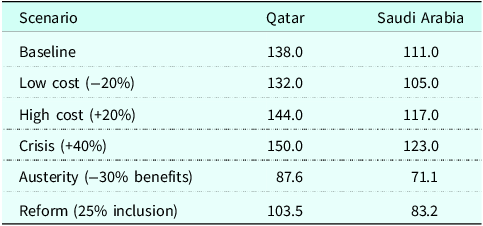
The robustness of the CWG is assessed across six alternative scenarios for Profile C: low cost (−20 per cent expenses), high cost (+20 per cent), crisis (+40 per cent), austerity (−30 per cent benefits) and reform (25 per cent non-citizen inclusion). The CWG remains above 70 per cent of the poverty line in both countries under all scenarios (Table 6). Partial reform (25 per cent inclusion) reduces the gap in Qatar from 138 to 103.5 per cent of the poverty line and the Saudi gap from 111 to 83.2 per cent. The gap is structurally embedded in the benefit architecture, not an artefact of parameter assumptions. Nevertheless, even modest reform scenarios produce meaningful reductions, indicating that the gap is a tractable policy problem.
Shapley value decomposition of CWG components (Profile C, Per Cent of Total Gap)

Table 5. Long description
The table presents a comparison of the Shapley value decomposition of CWG components between Qatar and Saudi Arabia, expressed as a percentage of the total gap. It consists of two columns labeled Qatar and Saudi Arabia, and six rows labeled with different components: Education, Housing, Child benefits, Cash transfers, Healthcare, and Utility subsidy. Row 1: Education, 49.1, 58.8. Row 2: Housing, 26.4, 28.5. Row 3: Child benefits, 14.0, 0.0. Row 4: Cash transfers, 5.6, 6.8. Row 5: Healthcare, 2.8, 3.7. Row 6: Utility subsidy, 2.1, 2.1.
CWG under alternative scenarios, Profile C (Per Cent of Poverty Line)

Table 6. Long description
A table comparing CWG percentages under different scenarios for Qatar and Saudi Arabia. The table has six rows and three columns. The columns are labeled Scenario, Qatar, and Saudi Arabia. The rows are labeled Baseline, Low cost (−20 percent), High cost (+20 percent), Crisis (+40 percent), Austerity (−30 percent benefits), and Reform (25 percent inclusion). Row 1: Baseline, Qatar 138.0, Saudi Arabia 111.0. Row 2: Low cost (−20 percent), Qatar 132.0, Saudi Arabia 105.0. Row 3: High cost (+20 percent), Qatar 144.0, Saudi Arabia 117.0. Row 4: Crisis (+40 percent), Qatar 150.0, Saudi Arabia 123.0. Row 5: Austerity (−30 percent benefits), Qatar 87.6, Saudi Arabia 71.1. Row 6: Reform (25 percent inclusion), Qatar 103.5, Saudi Arabia 83.2.
Discussion
The results provide multi-method support for treating Gulf welfare systems as a candidate regime category. Each of the four constitutive properties identified in the theoretical framework receives empirical confirmation. High citizen generosity is confirmed by NIAR values at or above 1.0 for most working-age profiles at average earnings. Categorical non-citizen exclusion is confirmed by CS = 0 and NIAR below 0.4 across all non-citizen profiles. Protective orientation is confirmed by PPR values above 2.0, placing Gulf systems at the opposite end of the productivist-protective spectrum from Singapore and South Korea (Holliday, Reference Holliday2000; Wang et al., Reference Wang, Abe, Kang, Ku, Ng, Peng and Zhao2024). Non-means-tested architecture is confirmed by flat METR profiles of approximately 7 to 9 per cent, without the benefit withdrawal effects that generate poverty traps in European welfare states (Marchal & Marx, Reference Marchal and Marx2018).
The PCA-based classification supplies the empirical foundation that earlier regime-type proposals sometimes lacked. Holliday (Reference Holliday2000) proposed the productivist type on primarily theoretical grounds, subsequently validated by Kühner (Reference Kühner2015) and Yang and Kühner (Reference Yang and Kühner2020). This study provides simultaneous theoretical argumentation and empirical classification. The regime space identified by PCA offers a parsimonious framework: PC1 captures the exclusion-protection dimension, PC2 captures the generosity-coverage dimension. The unique position of the Gulf, high on both, reflects a welfare system that is simultaneously highly generous within its eligibility boundary and highly exclusionary at that boundary.
These conclusions are drawn from constructed model family profiles, not from observed households. The model family design captures the formal structure of benefit entitlement as documented in programme rules, and the positioning of the Gulf cases in welfare space should be read as a statement about institutional structure rather than about realised household outcomes, which would require survey data on take-up and administrative practice. The candidate regime category is proposed on this institutional basis and is offered for testing against household-level evidence as such evidence becomes available.
Implications for welfare regime theory
The Oaxaca-Blinder decomposition introduces a new analytical distinction within the regime typology. The finding that the CWG of Qatar is predominantly coefficient-driven whereas the Saudi gap is predominantly endowment-driven suggests that the selective-universalist regime type itself contains meaningful internal variation. The gap in Qatar is directly policy-produced: it results from the deliberate exclusion of non-citizens from the benefit architecture. The Saudi gap is partially market-produced: it results from the interaction of non-citizen exclusion with high private-market costs for services citizens receive free. Both pathways produce extreme welfare inequality, although they imply different causal mechanisms and different reform tractability.
This distinction between policy-created and market-created welfare gaps extends beyond the Gulf context. In any welfare state that conditions access on migration status, nationality, or residency duration, the total gap between included and excluded populations can be decomposed into a component arising from differential policy treatment (the coefficient effect) and a component arising from differential exposure to market costs (the endowment effect). Hooijer and Picot (Reference Hooijer and Picot2015) documented migrant poverty gaps in European welfare states without decomposing their sources. The analytical framework demonstrated in this paper could be applied to those cases, generating a more precise understanding of whether migrant disadvantage in European welfare states is primarily policy-created or market-created. This extension represents a direct contribution to the ongoing European debate about social protection and migration.
The decomposition results align with the rent-per-citizen prediction. Qatar, the high rent-per-citizen case, shows a predominantly between-group and predominantly coefficient-driven gap: citizenship is the operative cleavage, and the gap is the direct product of policy exclusion from an otherwise universal architecture. Saudi Arabia, the lower rent-per-citizen case, shows a predominantly within-group distribution and a predominantly endowment-driven gap: targeting fragments the citizen body, and the gap reflects the market cost of services, principally education, that citizens obtain without charge. The selective-universalist configuration is in this sense internally differentiated by fiscal capacity, with rent per citizen governing whether the system rations through the citizenship boundary alone or also through means-testing within it.
The Theil decomposition reinforces this contrast. The welfare inequality of Qatar is predominantly between-group, confirming that the citizen-non-citizen divide is the primary structural axis of welfare stratification. Saudi inequality is predominantly within-group, indicating that family structure and earnings generate more welfare variation than nationality, even though categorical non-citizen exclusion remains the institutional precondition for this inequality pattern. This finding echoes the argument of Korpi and Palme (Reference Korpi and Palme1998) that welfare institutions do not solely respond to pre-existing inequalities but actively produce the stratification patterns observed in their populations. In the Gulf, the stratification produced by welfare institutions is of an exceptional magnitude.
The question of whether the Citizenship Welfare Gap should be read as a welfare deficit or as a structural feature of the rentier configuration poses a choice that dissolves on inspection, because the two readings operate at different levels. The gap is a structural feature, in that the rent-per-citizen mechanism explains why it exists and why it takes the form it does, and it is at the same time a potential object of reform, in that the decomposition attributes most of it, in the high rent-per-citizen case, to exclusion from an architecture that is otherwise affordable and universal rather than to fiscal necessity. A structural feature with a policy-created component is, to that extent, a policy variable, and it is on this positive ground, and not on any contested premise about justice, that the gap acquires its relevance for social policy. The analytical stance of the paper is that of the stratification tradition in welfare regime analysis (Esping-Andersen Reference Esping-Andersen1990), in which the cleavages a benefit system produces are a constitutive property of the regime and an object of description rather than a normative verdict. Measuring the citizenship axis of stratification is what regime analysis does, and it requires no prior judgement that differentiation is illegitimate. Differentiation by legal status is ordinary: every welfare state bundles social rights with membership to some degree (Marshall Reference Marshall1950), graduated access by legal status is the established pattern in the comparative literature on migrant social rights (Morris Reference Morris2003; Sainsbury Reference Sainsbury2012), and a documented trade-off in migration policy sets the number of migrants admitted against the rights they receive, with the Gulf occupying the high-numbers and low-rights corner of that distribution (Ruhs Reference Ruhs2013). What distinguishes the Gulf case, and what makes it of analytical interest independent of any normative stance, is the conjunction of four features: (i) magnitude, a gap two to three times the entire within-country range documented in the European model family literature; (ii) form, categorical exclusion rather than graduation by degree; (iii) incidence, falling on the demographic majority; and (iv) provenance, a predominantly policy-created rather than fiscally determined origin in the high rent-per-citizen case. The normative question of whether this arrangement is just is bracketed deliberately. The traditions that would adjudicate it, from the communitarian defence of bounded membership (Walzer Reference Walzer2008) to the liberal-egalitarian critique of exclusion (Carens Reference Carens2013) and the ethics of migrant welfare (Dean Reference Dean2011), are not adjudicated in this paper; the contribution is to supply the quantitative description of the cleavage that any such debate requires, while the claim of the paper remains positive rather than prescriptive.
Stratification within the citizen population
The contrast in the Theil decomposition follows from the fiscal trajectory of the two states. Where Qatar finances open-ended, non-means-tested citizen benefits, Saudi Arabia has, since the 2014 decline in hydrocarbon revenue, reorganised citizen provision around targeting and activation. The Citizen Account withdraws transfers as household income rises, and GOSI and SANED entitlements track contribution and employment histories. These instruments introduce stratification within the citizen population by design, which is why family structure and earnings, rather than nationality, account for the larger share of welfare inequality among Saudi households. The categorical exclusion of non-citizens remains the institutional precondition for the overall distribution, but the dominant axis of variation among those who are included differs across the two cases. The lower the rent per citizen available to a Gulf state, the stronger the fiscal pressure to ration citizen provision through means-testing, and the more within-citizen stratification the welfare system produces.
Citizenship is the primary axis of welfare stratification in the Gulf, but it is not the only one. Hertog (Reference Hertog2025) documents the erosion of the rentier labour bargain under which citizens were absorbed into protected public employment. Where fiscal space for payroll expansion has narrowed, a stratum of citizen outsiders has formed in the private sector, with lower wages, weaker job security, and reduced access to the employment-linked components of the benefit system. The model family design treats the citizen earner at the national average wage and does not separate public-sector from private-sector citizens, so this second cleavage is not measured directly in the present results. Its existence is consistent with the finding that within-citizen inequality is larger in Saudi Arabia, where the private-sector citizen workforce and citizen unemployment are both larger than in Qatar. Disaggregating the citizen profile by employment sector and skill level is a priority for the extension of this work.
Implications for social policy beyond the Gulf
The findings carry implications for social policy research and practice in three domains. The most direct implication concerns the rights of migrant workers. If education access drives the largest component of the CWG (49 to 59 per cent for families with children), then education policy reform, specifically subsidised school places for non-citizen children and access to public schooling, would have the largest marginal impact on welfare equality. The scenario analysis confirms that even partial reform (25 per cent inclusion) reduces the CWG by 25 to 35 percentage points. The gap is not an inevitable structural feature of rentier economics; it is a set of policy choices subject to modification through targeted interventions.
The broader implication concerns the relationship between welfare provision and population coverage. The Gulf case demonstrates that high generosity and high exclusion can coexist, indeed reinforce each other. The ability of Gulf states to provide generous citizen welfare rests in part on the exclusion of the non-citizen majority from the benefit architecture, which reduces the fiscal burden of provision. This dynamic has echoes in the European welfare state literature, where Rueda (Reference Rueda2005) argued that insider-outsider politics create electoral incentives for insiders to resist the extension of social protection to outsiders. The Gulf makes this dynamic visible in its purest form. The concept of selective universalism, as developed in this paper, may therefore have broader analytical applicability to welfare states that maintain generous provision for core populations while restricting access for peripheral groups.
A further implication concerns methodology. This paper demonstrates that the MF Approach can produce analytically informative results even in data-scarce contexts where representative micro-data are unavailable. The approach has potential application in other regions where comparative social policy research is constrained by data limitations, including sub-Saharan Africa, Central Asia and parts of South-East Asia. The integration of Monte Carlo simulation, Shapley decomposition and PCA-based classification within the MF framework offers a template for future work in these contexts.
Limitations
Several limitations warrant acknowledgment. The MF Approach captures the formal institutional structure of benefit entitlement but cannot account for benefit take-up rates, administrative discretion, informal provision, or within-programme variation. The model families are constructed profiles, not representative households, and the statistical analyses reported in this paper describe patterns within these profiles rather than population-level parameters. Monte Carlo simulation addresses parameter uncertainty in cost assumptions but does not address model uncertainty: the five-profile design limits the statistical power available for formal hypothesis testing. The non-parametric comparison statistics reported in the analysis are accordingly presented as descriptive summaries rather than inferential tests. A further limitation concerns the treatment of citizens as relatively homogeneous: the design places the citizen earner at the national average wage and does not separate public-sector from private-sector citizens, so the insider/outsider cleavage among citizens documented by Hertog (Reference Hertog2025) is not resolved in the present results and is named as the chief within-citizen omission.
The PCA-based regime classification draws on benchmark values from MF studies conducted at different time points and with varying methodological protocols, introducing comparability caveats. With twelve country observations and five dimensions, the PCA results should be interpreted as an exploratory mapping rather than as a definitive classification. The analysis captures a single cross-sectional snapshot; dynamic lifecycle analysis would be needed to assess long-term welfare trajectories and the cumulative effects of benefit exclusion. The two-country design limits generalisation to the full GCC; extension to the UAE, Kuwait, Bahrain and Oman represents a natural next step. Additional limitations relate to the labour market context: the analysis does not account for the kafala sponsorship system, which conditions non-citizen residence on employer sponsorship and creates welfare dependencies not captured in the MF framework. The model families represent a regular private-sector non-citizen worker; the kafala-linked sub-categories, including domestic workers, holders of flexible work permits, and those in irregular status, fall outside the scope of the present income accounts and would, if anything, face a larger gap relative to citizens.
Conclusion
This paper has produced the initial Model Family income package analysis of any GCC welfare system, filling a fundamental gap in the comparative database. It has introduced the CWG, with Oaxaca-Blinder decomposition and Shapley attribution, as an indicator of within-country welfare stratification by nationality. It has demonstrated that Gulf welfare content is strongly protective, non-means-tested, and produces income adequacy that eliminates poverty for most citizen families in employment, a level of provision comparable to the most generous social democratic systems. It has proposed, and provided multi-method evidence for, the selective-universalist rentier welfare state as a candidate regime category, supported through PCA-based cluster analysis that positions Gulf systems apart from established regime groupings on two cases, with replication across the remaining GCC states identified as the outstanding requirement before the category can be regarded as established.
The implications for social policy are both empirical and conceptual. The findings demonstrate that the world contains a major welfare system type that operates on principles fundamentally different from those that currently organise the comparative literature: non-contributory, non-means-tested, citizenship-conditional, resource-revenue-financed and protective in orientation. In addition, the findings challenge the field to reconsider the boundaries of the welfare state concept. A system that provides generously for a minority while excluding the majority raises questions about what social policy scholarship is for and whom it is meant to serve. These questions are not unique to the Gulf. They arise wherever social rights are conditioned on legal status, wherever welfare provision is bounded by citizenship and wherever the line between insiders and outsiders is drawn by the state rather than by the market.
Gulf states are home to more than 35 million people, the largest concentration of international migrants in the world, and some of the most consequential social protection systems in operation. Comparative social policy has long overlooked these systems. The data are now available. The methodology is demonstrated. The analytical framework is proposed. Whether the Gulf remains a missing case in welfare regime research or takes its place alongside the European, East Asian and Latin American cases that define the scope of the field depends on the willingness of comparativists to extend their empirical and theoretical reach beyond the boundaries that have historically constrained it.
Supplementary material
The supplementary material for this article can be found at https://doi.org/10.1017/S0047279426101676
Funding statement
This research received no specific grant from any funding agency in the public, commercial or not-for-profit sectors.
Competing interests
The author declares no conflict of interest.