Population-based screening programs are often faced with a noncompliance issue among screen-positive waiting for confirmatory examination similar to the scenario seen in most of phase III clinical trials (Reference Cuzick, Edwards and Segnan1). It is, therefore, of great interest to identify factors associated with the causes of noncompliance (Reference Duffy, Cuzick and Tabar2–Reference Siddiqui, Patel and Huerta4). Take colorectal cancer (CRC) screening with fecal immunological test (FIT) for example, whether to comply with colonoscopy examination among those FIT positives is a thorny issue and identifying factors associated with noncompliance is worthy of investigation.
However, in addition to the compliance issue, the subsequent waiting time (WT) for those complying with colonoscopy is also a great concern, as it is an indicator for the quality assurance of organized service screening. The longer the WT, the more likely the quality of screening program would be compromised due to the occurrence of interval cancers and also the influence of increasing patient's anxiety (Reference Yu, Hopman and Paterson5;Reference Denters, Deutekom, Bossuyt, Fockens and Dekker6).
It is customary to deal with noncompliance and WT in two separate processes. The conventional binary model, such as logistic regression model, is often used for noncompliance, whereas the simple Poisson regression model or Cox proportional hazards regression model is used to model the WT process. It should be noted that both noncompliance and its related WT issues are correlated, the higher compliance rate, the greater number of positive cases to be referred to undergo confirmatory examination, and the longer WT for confirmatory diagnosis would be expected.
The application of methodology to considering noncompliance and WT simultaneously, which has been barely addressed, is, therefore, required. One of candidate models is the use of a hurdle Poisson regression model to elucidate the factors responsible for noncompliance and WT for undergoing confirmatory diagnosis i.e. colonoscopy. The hurdle regression model proposed by Mullahy (Reference Mullahy7) has been widely used in health care to solve the problem of heterogeneity in evaluation of hospital visits and healthcare expenditures in relation to zero cost resulting from censoring or no requirement for visit (Reference Winkelmann8;Reference Deb and Norton9) and also in the assessment of healthcare use with respect to whether to be hospitalized and the subsequent length of stay for hospitalization (Reference Langsetmo, Kats and Cawthon10).
It is, therefore, interesting to make better use of hurdle Poisson regression model, taking two issues into account, to ascertain contextual factors in association with the infrastructure of health care, geographic area, and individual characteristics to predict whether and when is the probability of complying with the procedure of undergoing confirmatory diagnosis. The proposed model was illustrated with the empirical data from a Taiwanese nationwide population-based CRC screening program.
Methods
Study Framework of Hurdle Model for Referral to Confirmatory Diagnosis
In a population-based cancer screening program, the eligible subjects pursuant to inclusion and exclusion criteria, such as age, are invited to have the uptake of screen with an appropriate screening modality. Some would have the uptake of screen, whereas others would refuse to take it. This is the first level of a compliance issue in population-based screening, but we are not tempted to deal with this issue in the current study.
After the uptake of screening, attendees are classified into positive and negative results. Both those who have positive results and those who have negative results but have a family history of CRC (defined as high-risk subjects) were referred to undergo confirmatory diagnosis such as colonoscopy, sigmoidoscopy, or barium enema, but colonoscopy was the primary confirmation tool for CRC in our program. We, therefore, only focused on this instrument. Confirmation with colonoscopy defined by a binary outcome is the second level of compliance with the referral of undergoing confirmatory diagnosis, yielding noncomplier and complier corresponding to the hurdle part and nonhurdle part. The overall study framework is shown in Supplementary Figure 1.
Taiwanese Nationwide CRC Screening Program
We demonstrated the application of the proposed hurdle model by using a Taiwan nationwide CRC screening program with FIT. In brief, the program was offered for subjects aged 50 to 69 years biennially. After being detected as positive cases, screenees would be referred for confirmatory diagnosis. Details about the program have been described previously (Reference Chiu, Chen and Yen11). The study was certified as exempt from institutional review board review by the Research Ethics Committee of the National Taiwan University Hospital (201511034W).
Study Subjects
All the subjects who had ever attended this nationwide screening program between 2004 and 2013 with positive FIT results and the high-risk group as defined above were enrolled in this study. Those who undertook at unspecified screening unit or nonqualified laboratory, received unknown kit to evaluate test characteristics, had missing fecal hemoglobin concentration, or had been referred for confirmation diagnosis with noncolonoscopy modality were excluded from the study. As a result, there were 294,469 referrals either due to FIT positives or high-risk subjects used in the following analysis.
Study Variables and Definition
Individual characteristics include gender and age at entry of screen. Contextual factors include calendar periods, round of screening, geographic areas (northern, central, southern, eastern, and offshore islands of Taiwan), type of screening units (hospital, public health center of health bureau in individual municipality, or local clinic), and level of urbanization (metropolitan, sub-metropolitan, and nonmetropolitan). In the inaugural 5 years (2004–09) of the screening program, we offered screening service mainly at the public health center of the health bureau in the individual municipality. Public health nursing staffs helped the referral of subjects to go for confirmatory colonoscopy at the hospitals. From 2010 onward, for the purpose of increasing coverage rate, hospitals and local clinics joined to actively invite people for FIT and underwent colonoscopy at hospitals among referrals. Due to the change of screening policy, calendar periods were divided into inaugural period (2004–09) and rolling-out period (2010–13). Besides, screenees with positive FIT for first-time screening were defined as “prevalent screen” and those for later screening rounds were defined as “subsequent screen.”
Study Endpoints and Statistical Analysis
To accommodate the noncompliance of undergoing colonoscopy (noncomplier) and also WT for undergoing colonoscopy among the compliers, we proposed the hurdle Poison model to consider both the noncomplier and the WT distribution for the complier. Note that the time waiting for the appointment with colonoscopy administered by a gastroenterologist was also included in the calculation of WT until the date of confirmatory diagnosis. The WT for colonoscopy here was defined as the time from the date of reporting the FIT result to the date of confirmatory diagnosis with colonoscopy. Because the change in the structure of the screening program might result in heterogeneity between the inaugural period and rolling out period, we also evaluated the interaction between factors and periods of screening program.
The hurdle model, proposed by Mullahy (Reference Mullahy7), consists of two components: the binary part is to measure whether the response crosses over the hurdle or not, and the truncated Poisson part is to elucidate the response above the hurdle. These two components tackle both zeros and the positively skewed nonzero counts (Reference Neelon, Ghosh and Loebs12). The hurdle part is the application of logistic regression model to identify factors affecting noncompliance with colonoscopy, and the nonhurdle (the progressive) part is modeled by the truncated Poisson regression model given the count greater than one to identify factors affecting WT for undergoing colonoscopy. In the zero part of truncated hurdle Poisson model, it consists of two types of subjects, illustrated by Supplementary Figure 2. One type is those who are not willing to undertake the confirmatory examination, such as subject B, and the other type is those who are still waiting for confirmatory examination in a queue at 30th day (censoring) while the final WT is 37 days for subject A.
In addition, Supplementary Figure 2 accounts for why we need to use hurdle Poisson regression model instead of simple Poisson regression model and logistic regression model. Let the WT start from the date of positive FIT until the referral of colonoscopy examination. Suppose the WT for colonoscopy for subject A is 37 days and subject B is a noncomplier, namely the infinity of WT, which cannot be captured by simple Poisson model or even negative binominal model. Thus, regarding the WT at 30th day, the waiting status for subject A cannot be distinguished from that of subject B, although both are distinct. The zero of subject A is captured by the truncated Poisson regression, and the zero of subject B is captured by the logistic regression, both of which form hurdle Poisson regression model. Therefore, if we use the traditional Poisson regression model, we cannot identify what sort of zero is derived from given time t and which factors will affect their health behavior of noncompliance.
Therefore, in our screening scenario, the hurdle was for those with FIT positive test results or positive family history to determine whether he/she received the follow-up confirmation diagnosis. After passing through the hurdle, the subsequent truncated model dealt with how many subjects undertook the confirmatory examination given a specific period of time so that it can identify which factors are responsible for the WT for confirmatory examination. Details and the likelihood function for estimation of parameters are illustrated in the Supplementary Materials. All the statistical analyses were performed with SAS 9.4 software (SAS Institute, Cary, NC).
Results
From 2004 to 2013, a total of 3,030,454 subjects participated in at least one FIT CRC screening. During the inaugural period, there were 1,258,560 screening tests and 46,235 referrals, of whom 41,591 underwent colonoscopy. In the rolling-out period, there were 3,723,789 screening tests and 270,700 referrals, of whom 252,878 underwent colonoscopy.
Compliance Rate and Median Waiting Time for Colonoscopy
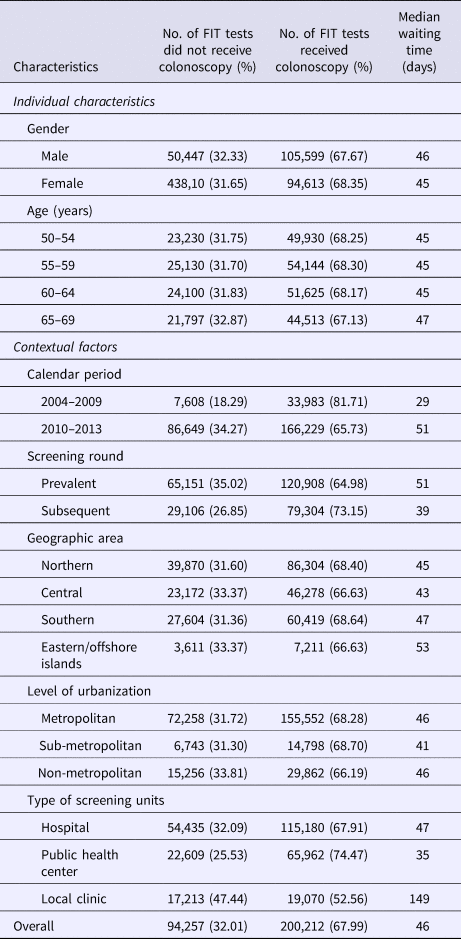
Table 1 indicates most of attendees would undergo confirmatory colonoscopy after being detected as positive FIT. The compliance rate with colonoscopy was around 68 percent, and the median WT for colonoscopy was 46 days. Individual characteristics had small influence on the compliance rate or the median WT, although males and the elderly had slightly lower compliance rate and longer median WT.
Comparison of Referral Rate and Median Waiting Time for Colonoscopy in Inaugural and Rolling Out Period

Significant contextual factors included calendar periods, round of screening, and type of screening units. Screenees attending screening at the inaugural period had better compliance rate (82 percent) and shorter median WT (29 days). Subsequent cases had higher compliance rate and shorter median WT than prevalent screen cases. Among type of screening units, attendees undergoing screening at public health centers had the best compliance rate and only needed to wait 35 days for colonoscopy. The differences across geographic areas and level of urbanization were not substantial.
Univariate and Multivariate Analysis of Hurdle Model
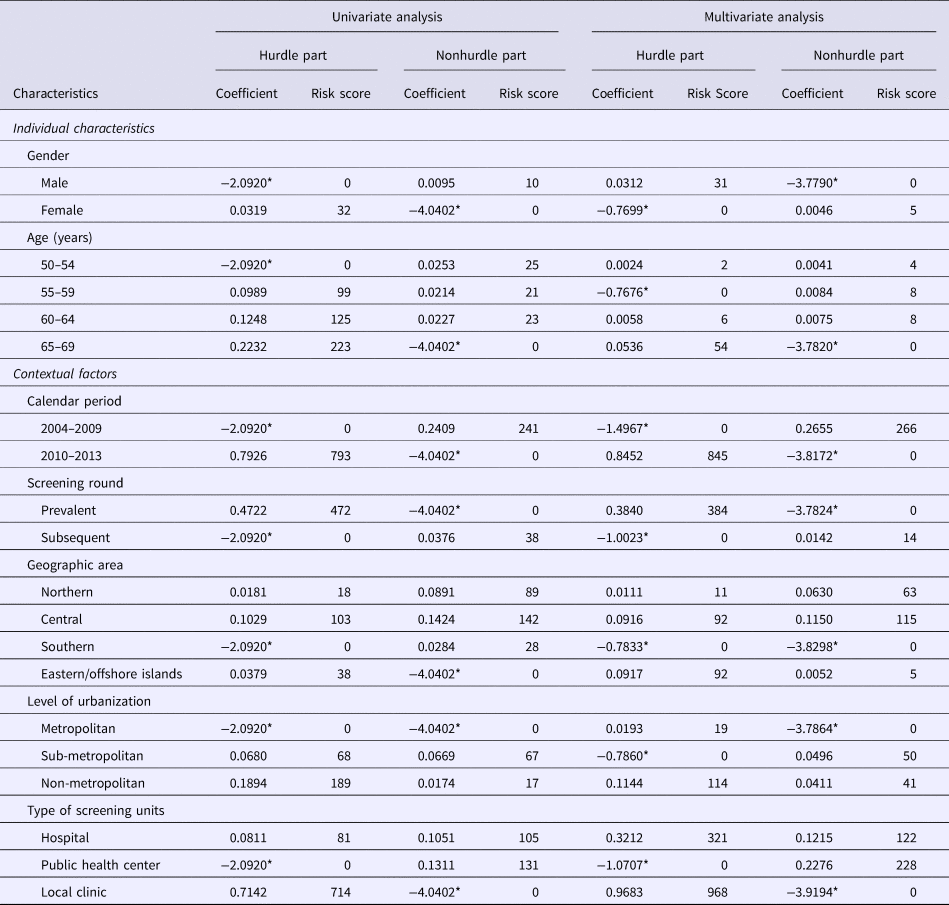
We used the regression coefficients of the hurdle model to form the scores in association with compliance with and the WT for colonoscopy. In the hurdle part, the higher the score, the higher the odds of refusing to take colonoscopy. In univariate analysis, the results of the hurdle part in Table 2 show males and the elderly people had higher score among individual characteristics; those taking part in the rolling-out period, prevalent cases, central or eastern or offshore islands residents, nonmetropolitan people, and local clinic among contextual factors had higher scores.
Univariate and Multivariate Analysis of the Hurdle Part on Factors Affecting Noncompliance for Colonoscopy and Nonhurdle Part on Factors Affecting Waiting Time for Undergoing Colonoscopy

* Represents intercept.
In the nonhurdle part, the higher the score, the shorter the WT for undergoing colonoscopy was. The results of the nonhurdle part indicate both individual characteristics among compliers were not associated with the WT for colonoscopy. Among contextual factors, those participating in screening at the inaugural period, subsequent cases, central Taiwanese, sub-metropolitan residents, and public health center had higher scores, which means they had shorter WT for colonoscopy.
In the comparison between multivariate analysis and univariate analysis, the results of individual characteristics indicate females had higher scores for noncompliance, whereas male had higher risk score with short WT. The elderly had higher scores of noncompliance, and the youngest had the highest scores with short WT. Among contextual factors, the results were similar to those in univariate analysis on calendar periods, round of screening, and type of screening units. In addition, it shows central Taiwanese had the highest score in both parts. People dwelling at less urbanized areas had higher scores of noncompliance. Sub-metropolitan residents had the highest scores with short WT compared with other levels of urbanization.
Because the change in the structure of screening program between the inaugural period and rolling out period, we further evaluated the interaction between factors and periods of the screening program. The results of model selection reveal that the effect of the period of the screening program was modified by geographic areas and type of screening units in the hurdle part. In addition to these two factors, level of urbanization was also included in the nonhurdle part (see Supplementary Table 1).
Risk Stratification
Based on the regression coefficients of the multivariate hurdle model, we computed the score based on the trained regression coefficients multiplied by the covariates of interests, depending on the risk groups classified by the underlying covariates. The hurdle β-score1 represents the risk score in association with noncompliance with colonoscopy. The higher the β-score1 value was, the higher the odds of refusing to take colonoscopy. The WT β-score2, stands for the rate of taking colonoscopy. The higher the β-score2 value, the shorter the WT for undergoing colonoscopy was.
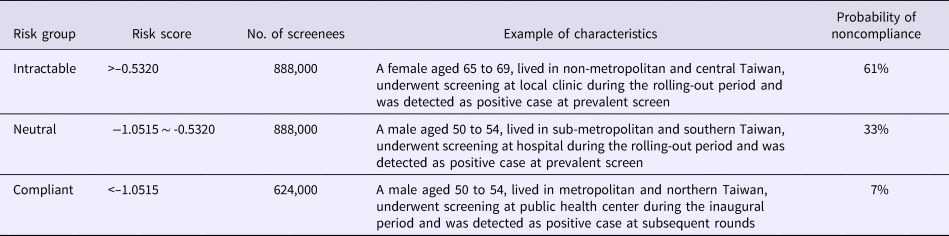
To predict whether and when screenees comply with the procedure of receiving colonoscopy given contextual factors and individual characteristics, we, therefore, classified the β-score1 into three groups according to the cutoff of its first quartile value (Q1) and the third quartile value (Q3), and β-score2 into five groups according to the cutoff of its 20th, 40th, 60th, 80th percentile value. In the hurdle part, if β-score1 was higher than -0.5320 (Q3), termed as the intractable group, more than 37 percent had the probability of not complying with colonoscopy; if β-score1 was lower than -1.0515 (Q1), termed as the compliant group, 26 percent had the chance of not complying with the uptake of colonoscopy; the middle category was the neutral group.
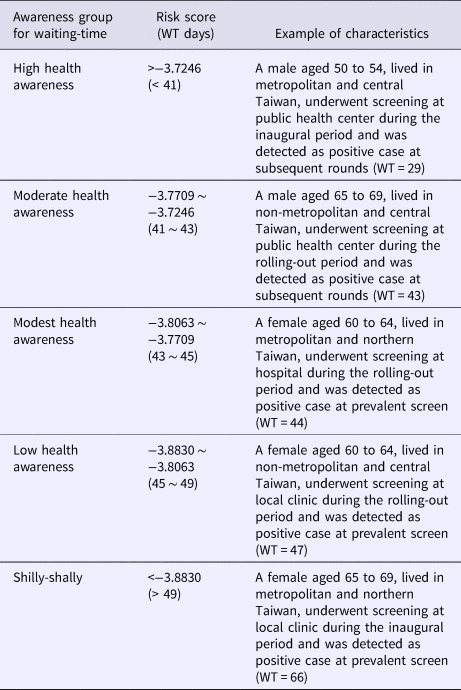
In the nonhurdle part, those with β-score2 higher than -3.7246, corresponding to the WT for colonoscopy shorter than 41 days, could be considered as high health awareness group; those with β-score2 between -3.7709 and -3.7246, corresponding to the WT for colonoscopy between 41 to 43 days, were moderate health awareness group; those with β-score2 between -3.8063 and -3.7709, corresponding to the WT for colonoscopy between 43 and 45 days, were modest health awareness group; those with β-score2 between -3.8830 and -3.8063, corresponding to the WT for colonoscopy between 45 and 49 days, were low health awareness group; those with β-score2 lower than -3.8830, corresponding to the WT for colonoscopy longer than 49 days, were shilly-shally group.
Assuming there are 4,000,000 eligible subjects attending a nationwide population-based CRC screening, approximately 2,400,000 of them will have positive FIT results. In Table 3, the results of prediction show around 888,000 attendees are the intractable group, 888,000 are the neutral group, and 624,000 are the compliant group. An example of characteristics representing the intractable group is shown by those females aged 65 to 69, who live in nonmetropolitan and central Taiwan, underwent screening at local clinic during the rolling-out period, and were detected as positive case of prevalent screen. Her β-score1 would be 0.4578 with 61 percent of probability of noncompliance with colonoscopy.
Example of Characteristics Related to Compliance Groups

Similar applications to the neutral and the compliant groups are described in Table 3. In Table 4, we also give an example of different WT groups. Referrals at subsequent rounds of those male aged 50 to 54, living in metropolitan and central Taiwan, undergoing screening at public health center during the inaugural period would be classified as high health awareness (β-score2 = −3.3546), and the predicted WT for colonoscopy would be 29 days. Similar applications to other WT groups are described in Table 4.
Example of Characteristics Related to Waiting-Time Groups

WT, waiting time.
Discussion
The hurdle Poisson regression model is applied to tackling the issue of both compliance and WT while undergoing confirmatory diagnosis of positive screenees that is the routine procedure of second stage in population-based cancer screening program. To discuss why certain factors predispose to noncompliance and long WT is particularly meaningful for the contextual factors elucidated in the current model. First, for those prevalent screen cases, their behavior might think they were not positive cases, so they were not willing to undergo the following confirmatory colonoscopy; conversely, for those subsequent screen cases, they might have higher health consciousness, so that they would undergo screening again and receive colonoscopy after being detected as positive case.
Second, the Taiwan nationwide screening policy has changed since 2010. Before 2010, we offered screening service mainly at the public health center, and during the rolling-out period, hospitals joined to actively invite peoples for FIT. Therefore, we could find that screenees participating in the place of hospital were more willing to undergo colonoscopic exam after entering into the rolling-out period; besides, their WT for colonoscopy also shortened with an increase in manpower in the hospital. Although local clinics joined to actively invite peoples for FIT during the rolling-out period as well, their compliance for colonoscopy was still low and they needed to wait the longest time for colonoscopy compared with other institutions.
Third, most hospitals and clinics are concentrated on northern Taiwan, and in eastern or offshore islands, their medical resources are deficient. As a result, eastern or offshore islands residents had higher probability of noncompliance for colonoscopy compared with northern Taiwanese, and their WT for colonoscopy was longer as well. It is an urgent task for the screening organizer to have a remedy for the shortage of endoscopic capacity to meet the demand.
Finally, metropolitan people might have more health information, so they had lower probability of noncompliance for colonoscopy compared with nonmetropolitan residents. Although metropolitan area had more medical resources and capacity of colonoscopy, its number of positive cases was too many to provide colonoscopic exam immediately, so they still needed to wait longer time.
The proposed model may be worthy of being compared with other previously proposed models (Reference Brown and Ibrahim13;Reference Cheung14). In terms of statistical property, there are several similar statistical models proposed to deal with the issue. In contrast to the cured rate model applied to susceptible and nonsusceptible subjects, the proposed hurdle model estimates the parameters governing the hurdle part on the basis of the observed information, whereas the cured model estimated the nonsusceptible analogous to the hurdle part in the way of latent variable.
In addition, there are other models that have the similar concept with the hurdle model called the zero-inflated model that have been dealt with count responses with excess zeros by COM-Poisson and generalized Poisson model (Reference Conway and Maxwell15;Reference Consul and Famoye16). The zero-inflated model can deal with zero part (noncomplier) as well, but it is not appropriate to apply to screen data because most of invited subjects are willing to undergo colonoscopy. The essence of this hurdle model is to consider the hurdle part as the noncompliance with the referral using a dichotomous variable (yes/no) and the nonhurdle part as how long it would take to receive confirmatory diagnosis in terms of WT distribution assuming follow the Poisson regression model.
Factors associated with the hurdle part can be modeled through logistic regression model, whereas factors affecting the WT are modeled by the truncated Poisson regression model as the counts of event are positive. The main advantage of using the proposed hurdle model is to reduce the heterogeneity of the outcome of interest by introducing a mixture of two outcomes corresponding to the logistic regression model and the truncated Poisson regression model, because the former captures the mass function at zero point and the latter part captures the WT of complying with confirmatory diagnosis using the WT distribution.
The other advantage is that, compared with the use of two independent models, the simple Poisson regression model for WT and the logistic regression model for complier and noncomplier, the hurdle model can accommodate the correlation between compliance (hurdle) and WT as indicated earlier. In our example, the heterogeneity (overdispersion) of using the Poisson regression model can be reduced by using the proposed model. The Akaike information criterion (AIC) has been greatly reduced from 839,432 to 362,771. In addition, it contains two types of people in the zero part: one is noncomplier (subject B), and the other is those who are still waiting for confirmatory examination (subject A) that is regarded as censoring cases (Supplementary Figure 2). If we use the traditional Poisson regression model, we cannot identify which zero given time t is derived from and which factors will affect their health behavior of noncompliance.
The current study still leaves something desired. If the data can provide other information such as social-economic status, income, or education level, the model may be more explainable and can predict well. Although the current model is better than the Poisson model, overdispersion may still exists, which means variability still cannot be explained due to correlation and heterogeneity.
Nevertheless, the problem of overdispersion dealt with in this study is not entirely due to correlated outcome or the heterogeneity beyond the explained covariates but the mixture of two outcomes, compliance with and WT for colonoscopy that may lead to the identifiability problem without using the hurdle model. This accounts for why we did not use negative binomial regression model in our study as it may suffer from such a problem, although the heterogeneity in terms of AIC may be improved with the incorporation of two parameters in negative binomial model rather than one in Poisson model. However, if the truncated Poisson regression cannot be explained by covariates or correlated WT, one may attempt the hurdle negative binomial regression model under the framework of a generalized mixed regression model, which may be the subject of an ongoing research.
In conclusion, we proposed the hurdle Poisson regression model to evaluate the compliance with and the WT for complete confirmatory diagnosis among referrals at first stage of screen. This model was successfully applied to evaluating individual attributes and contextual factors associated with factors related to the compliance and the WT distribution of undergoing colonoscopy, which was further developed into a useful clinical assessment model for quantifying the probability of complying with and the rate of taking colonoscopy given different individual attributes and contextual factors.
Supplementary material
The supplementary material for this article can be found at https://doi.org/10.1017/S0266462319000047.
Conflicts of interest
The authors have nothing to disclose.