INTRODUCTION
Incirrate octopods of the family Octopodidae are typically benthic cephalopods that live in crevices and caves where they hide from predators, including conspecifics (Roper et al., Reference Roper, Sweeney and Nauen1984; Aronson, Reference Aronson1986). Common prey items for most species include clams, snails, fish and crustaceans and it may include up to 55 different species as reported for Octopus bimaculatus Verrill 1883 (Ambrose, Reference Ambrose1984). Thus, octopuses have been considered generalist predators of the third or fourth trophic level in marine communities (Guerra, Reference Guerra1978; Ambrose & Nelson, Reference Ambrose and Nelson1983; Summers, Reference Summers and Russell-Hunter1983; Rodhouse & Nigmatullin, Reference Rodhouse and Nigmatullin1996).
Some studies have shown that the trophic habits of octopuses vary among geographical locations. For example, the diet of O. vulgaris Cuvier 1797 from Portugal shows that fish are the common prey in two of the three locations studied, while crustaceans are more important in the other location (Rosa et al., Reference Rosa, Marques, Nunes, Bandarra and Reis2004). This shows that shifts in the diet of octopuses may occur over a relatively small geographical scale even in different locations with similar habitats. As an additional case, O. vulgaris from South Africa change their diet between closer locations (Smith, Reference Smith2003).
Some octopus species show ontogenetic changes in their diets, where juveniles of Octopus bimaculatus feed mainly on small crustaceans, while adults consume a wide variety of benthic invertebrates (Ambrose, Reference Ambrose, Lang and Hochberg1997). Smale & Buchan (Reference Smale and Buchan1981) reported similar ontogenetic variations in the diet of Octopus vulgaris from the coasts of South Africa. In this case, juveniles feed mainly on the bivalve Perna perna (Linnaeus, 1758), whereas larger individuals feed on crustaceans and other molluscs. This demonstrates that prey diversity increases in relation to body size of octopuses (Smale & Bucham, Reference Smale and Buchan1981; Smith, Reference Smith2003).
Generally, female incirrate octopuses attach their eggs to the roof of caves and care for them until hatching and during this period they do not feed (Roper et al., Reference Roper, Sweeney and Nauen1984; Cortez et al., Reference Cortez, Castro and Guerra1995; Rocha et al., Reference Rocha, Guerra and González2001). Moreover, Cortez et al. (Reference Cortez, Castro and Guerra1995) reported that differences in diet between mature females and males of Octopus mimus Gould 1852 may be due to differences in nutrient and energetic requirements.
Enteroctopus megalocyathus (Gould, 1852) is distributed along the southern coasts of South America, in both the Pacific and Atlantic Oceans. The range extends from Chiloé Island (~42°S) in the Pacific (Rocha, Reference Rocha1997), to the Gulf of San Matías in the Atlantic (42°S) (Ré, Reference Ré and Boschi1998). The species can be found in hard-bottom habitats from the lower intertidal zone to 140 m depth (Ré, Reference Ré and Boschi1998), and still much about their biology and ecology remains unknown. The fishery of this species in southern Chile is carried out by free-diving fishermen who capture the octopus with gaffs (Rocha & Vega, Reference Rocha and Vega2003). Octopus catches in southern Chile began to be recorded in 1991, with a maximum of 765 tons recorded in 2003 (SERNAPESCA, 2003). At present, the E. megalocyathus catch in southern Chile is approximately 500 tons per year (SERNAPESCA, 2002, 2003, 2004).
In this study we examined: (a) the composition in the diet of E. megalocyathus from different fishing areas with similar habitats; (b) potential changes in the diet composition in relation to body size; and (c) differences in the diet as a function of sex.
MATERIALS AND METHODS
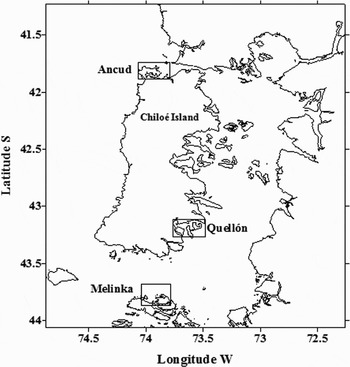
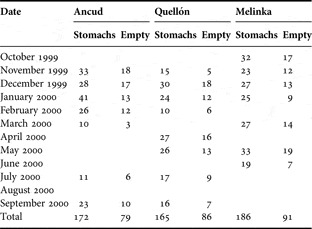
Samples were obtained from three principal sites of landings in southern Chile around Chiloé Island: Ancud (41°47′S 74°28′W), Quellón (43°07′S 73°37′W) and Melinka (43°50S 74°28′W; Figure 1). Samples were not taken at the same time in all locations and the information is summarized in Table 1. The octopuses were collected by commercial divers, at depths between 20–30 m, using surface air supply (HOOKA), and brought frozen to the laboratory for further analysis. In the laboratory sex determination was performed and the dorsal mantle length (DML, cm), total length (TL, cm) and total weight (TW, g) were recorded. The digestive tracts were removed and frozen (−15°C) for diet analysis.
Map showing the study area and the locations where octopuses were collected (indicated by squares).

Number of stomachs with food contents (Stomachs) and empty stomachs of Enteroctopus megalocyathus at three sampling locations from southern Chile, from October of 1999 to September of 2000.

As octopuses only ingest small pieces of their prey, gut analysis only revealed the hard parts of the gastric contents. The difficulty in identifying individual prey prevented us from determining all prey items to species level, but all prey were identified to the lowest taxonomic level. We estimated the frequency of occurrence of a prey species (O%): the ratio (%) between the numbers of stomachs with a specific type of prey present divided by the total number of digestive tracts with any type of food present (Hyslop, Reference Hyslop1980). Number of prey (N%) was calculated as the percentage of a specific prey type divided by the total number of prey in all food categories (Hyslop, Reference Hyslop1980). To ascertain the number of a specific prey type present in a single stomach we considered otoliths for fish, beaks for octopuses, and chelae and/or eyes for crustaceans. Weight of prey (W%) is the total weight of a prey item as a percentage of the total weight of all prey present in a sample (Hyslop, Reference Hyslop1980).
Dietary composition was described by means of an ordination carried out on the presence–absence matrix of prey–predators, with a detrended correspondence analysis (DCA; Jongman et al., Reference Jongman, Ter Braaka and Van Tongeren1995) following Muñoz et al. (Reference Muñoz, Valdebenito and George-Nascimento2002) and Pardo-Gandarillas et al. (Reference Pardo-Gandarillas, Garcías and George-Nascimento2004). This method allows the simultaneous display of samples and species in a reduced space (Jongman et al., Reference Jongman, Ter Braaka and Van Tongeren1995). Prey whose frequencies of occurrence were less than 5% in the whole sample were not included in the analysis, because the DCA is sensitive to species that occur only in a few stomach contents and modified the scores of the ordination (Jongman et al., Reference Jongman, Ter Braaka and Van Tongeren1995). Compositional gradients of this ordination are expressed as standard deviation units (×100) of replacement of taxa along the gradient. A total of 218 specimens were considered in the analyses, after discarding those whose mantle and organs were destroyed (without sex and size data) by the fishing method (gaff hooks) (see Tables 1, 2 and Figure 2).
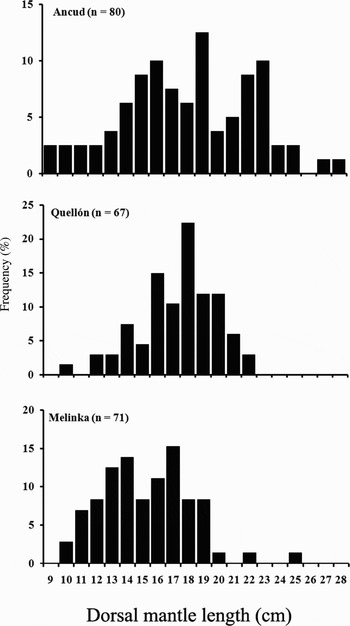
Size–frequency distribution of octopus dorsal mantle length (cm) in each location.

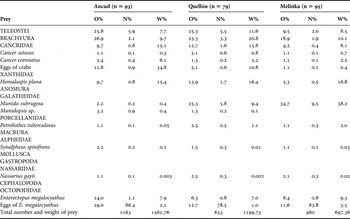
Prey items found in Enteroctopus megalocyathus stomach contents at three sampling locations from southern Chile, considering the whole sample.

O, occurrence; N, number; W, weight; n, number of stomachs with food.
Generalized linear models (GLMs; Agresti, Reference Agresti2002) were used to analyse variations in the diet composition (DCA axis) and the relative importance of different variables in explaining those variations. The differences of octopus sizes between locations were tested by means of ANOVA, and Tukey a posteriori tests (Zar, Reference Zar1984). Two-way ANOVAs on the scores of the DCA were carried out with sampling locations and sex as factors (Zar, Reference Zar1984). A one-way ANOVA on the residuals of the regression between DCA scores with DML was carried out to test the statistical significance of dietary differences between locations, in order to correct for the eventual effect of the octopuses' size on the diet composition.
RESULTS
Fifty-two per cent out of 523 octopuses examined had food contents in their digestive tracts. The DML, of octopuses that had food contents, ranged from 8 to 28 cm (39 to 130 cm TL) and total weight (TW) varied between 304 and 5537 g. The DML was different between locations (ANOVA, F(2, 215) = 13.94, P < 0.001; Figure 2), mainly because octopuses from Ancud were larger in DML than at Melinka (Tukey test, P < 0.001).
The diet of E. megalocyathus consisted predominantly of crustaceans, molluscs, and teleost fish (Notothenioidei) (Table 2). The high presence of both eggs and body parts of conspecifics indicates an important degree of cannibalism (Table 2). In the stomach contents of E. megalocyathus we often found one (72%) and two (23%) prey species and rarely they feed on three (4%) or four (1%) prey species. When the octopuses fed on two prey species these were principally fish and crabs. In some cases we found octopus crops full of eggs of crabs with or without fragments of Homalaspis plana, for this reason we considered the eggs of crabs as another prey. The more important prey (>25%) in terms of occurrence were Teleostei, Brachyura and eggs of octopus in Ancud; Teleostei, Brachyura and Munida subrugosa in Quellón; and M. subrugosa in Melinka (Table 2). In the three fishing areas eggs of octopuses were the more important prey in number (>75%) (Table 2), while in terms of weight eggs of crabs, Brachyura and M. subrugosa (>20%) were the principal prey in Ancud, Quellón and Melinka, respectively (Table 2).
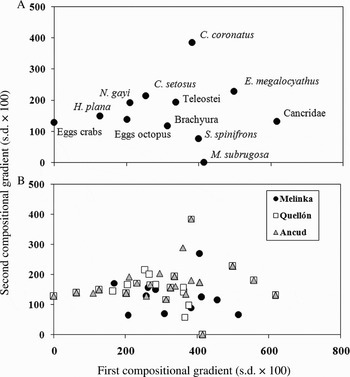
Eigenvalues of DCA ordination of fourteen prey taxa and 218 octopuses were λ1 = 0.89, λ2 = 0.74 and λ3 = 0.32 from the first to the third axis (compositional gradients) respectively. The two first compositional gradients account for 24.39% of the total inertia, a measurement of the association among the predators and prey. For this reason the information was insufficient to find a significant association (χ22398 = 2158.03, P = 0.99), indicating that in light of the available information, the analysed octopuses form a very homogeneous feeding group. Some patterns, however, were identified from the dimensional graphs, because some prey were positioned at the extremes of the first compositional gradient, but other prey were positioned at the extremes of the second compositional gradient (Figure 3A). Simultaneous display of the composition of octopuses from the three fishing areas (Figure 3B) revealed more variation between fishing areas in the second compositional gradient than in the first.
Position of twelve prey taxa (A) found in stomach contents of Enteroctopus megalocyathus in a two-dimensional space according to a detrended correspondence analysis (DCA) carried out in 218 predators (B). The units of DCA axes are standard deviations (×100) of the turnover rate of taxa in the gradient.

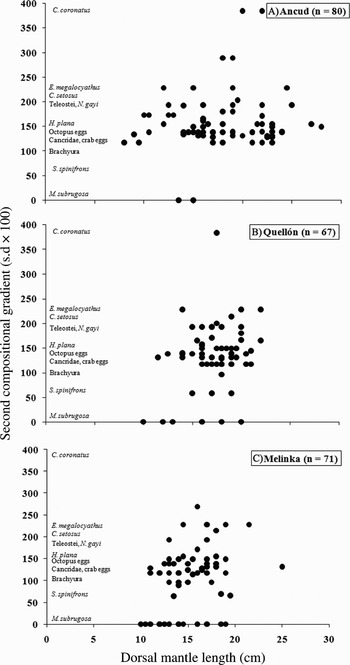
There were no significant changes in first compositional gradient in the regression analyses, according to DML in the whole data set (first DCA axis, r2 = 0.01, F(1, 216) = 3.22, P = 0.07). Along the second DCA axis we found significant differences according to DML in dietary composition (r2 = 0.10, F(1, 216) = 24.50, P < 0.001), which explained 16% of the variance, because some octopuses fed on rare prey (Figure 4). In Ancud the largest octopuses fed on large crabs Cancer coronatus and conspecifics, and the smallest fed on Homalaspis plana, eggs of crabs and eggs of octopuses (Figure 4A). In Quellón and Melinka small octopuses fed mainly on small crustaceans Synalpheus spinifrons (Milne-Edwards, 1837) and Munida subrugosa, while the largest fed on crabs and conspecifics (Figure 4B, C).
Relationship between prey scores and octopus dorsal mantle length (cm) on the second compositional gradient of detrended correlation analysis from three locations of southern Chile: (A) Ancud, (B) Quellón and (C) Melinka.

A two-way ANOVA on the residuals of the regression between second DCA scores with DML showed differences between locations (second DCA axis, F(2, 215) = 7.38, P = 0.0008), which explained 6% diet composition variation. Munida subrugosa was found in the gastric contents of octopuses from Melinka 30 times more than it was in octopuses from Ancud and Quellón (Table 2). There were no significant changes in dietary composition in relation to octopuses sex (second DCA axis, F(1, 216) = 2.89, P = 0.09), and with the interaction between octopuses sex and locations (second DCA axis, F(2, 215) = 0.0, P = 0.99).
DISCUSSION
The diet of E. megalocyathus consisted of benthic organisms including brachyuran and anomuran crabs, nassarid snails, octopuses and fish, similar for other species. The DML of octopuses proved to be a better predictor of the variance in the diet composition (16%) than the fishing zone (6%). These low percentages are due to these octopuses forming a very homogeneous feeding group.
The significant differences in the diet composition of E. megalocyathus among the three locations, was presumed due to the variations in occurrence of some prey items among locations, like Munida subrugosa. This variation could be due to differences in prey abundance between sites, but unfortunately no information on this is available for our study area. The diets of Enteroctopus dofleini (Wülker, 1910) and O. bimaculatus are influenced by food preferences and availability in the environment (Ambrose, Reference Ambrose1984; Vincent et al., Reference Vincent, Scheel and Hough1998). Rare prey were excluded from the analyses because they modified the scores of the ordination (see Materials and Methods). Including rare prey could show more differences among locations, but can bias the scores of the ordination too.
Enteroctopus megalocyathus showed significant changes in its diet in relation to body size. The smallest octopuses fed on small crustaceans while the largest fed on large crabs and conspecifcs in all locations. However, further studies with a wider range of octopus sizes, including juvenile octopuses (<5 cm DML), are needed to determine whether prey composition changes with size or age. On the other hand, the sex of octopuses had no effect on the diet variations of E. megalocyathus, because male and female octopuses fed on the same prey organisms and at a similar rate, moreover females during their incubation period fed on fish, crabs and octopus eggs.
The gastric contents of E. megalocyathus show that this species is cannibalistic, as a large number of conspecific eggs and juveniles were found in the gut analysis. This is not unusual for octopuses and has been recorded in several species. An extreme case of cannibalism was reported for O. maorum Hutton 1880 from Tasmania, where the largest prey biomass (211.9 g) was represented by clusters of eggs and small individuals of the same species (Anderson, Reference Anderson1999; Grubert et al., Reference Grubert, Wadley and White1999). Cannibalism may be beneficial for survival of the individual in periods of food scarcity, and may reduce competition when resources are limited (Calow, Reference Calow1998). It appears to be a density-dependent effect that increases when the abundance of adult octopuses increases raising the per capita rate of cannibalism (Aronson, Reference Aronson1986). Conspecific eggs are an important prey item in the diet of E. megalocyathus. This behaviour has also been reported in females of O. tehuelchus, O. mimus and O. maorum (Ré & Gómez-Simes, Reference Ré and Gómez-Simes1992; Cortez et al., Reference Cortez, Castro and Guerra1995; Grubert et al., Reference Grubert, Wadley and White1999). In the deep-sea octopus Bathypolypus arcticus maintained in aquaria, feeding was observed on non-viable (unfertilized) eggs (Wood et al., Reference Wood, Kenchington and O'Dor1998).
Given the range of prey items consumed by E. megalocyathus and their large body size (up to 100 cm TL) and high abundance, it appears to be an important predator in subtidal communities around the southern tip of South America. In some cases, octopus predation has been shown to have demonstrable effects on community structure in the subtidal zone (Ambrose & Nelson, Reference Ambrose and Nelson1983; Ambrose, Reference Ambrose1986), but octopuses are generally not considered important predators in intertidal and shallow systems. Our results indicate that E. megalocyathus should be considered as an important part of the guild of subtidal predators in southern Chile.
ACKNOWLEDGEMENTS
We thank M. George-Nascimento, Mrs M.C. Pardo-Gandarillas and M. Canals for their help with the statistical analysis and valuable comments, and R.D. Sepúlveda, C. González and J.B. Wood for comments on the manuscript. This work was partially funded by the Fondo de Investigación Pesquera, FIP 99-20 to Javier Chong. C.M. Ibáñez was supported by a CONICYT doctoral fellowship.