Background
Dementia diagnosis requires the objective assessment of key cognitive domains, such as memory, language, executive, and visuospatial abilities (McKhann et al., Reference McKhann2011). Several cognitive tools have been developed aiming to assess these domains briefly and reliably. The original Addenbrooke's Cognitive Examination (ACE) was a 100-point bedside test battery designed to assess six cognitive domains in order to detect mild dementia and differentiate Alzheimer Disease (AD) from frontotemporal dementia (FTD) (Mathuranath et al., Reference Mathuranath, Nestor, Berrios, Rakowicz and Hodges2000). It was found to have a higher sensitivity and predictive value than the Mini-Mental State Examination (MMSE) to discriminate AD from FTD. A revised version of the battery Addenbrooke's Cognitive Examination – Revised (ACE-R) was later published by Mioshi et al. (Reference Mioshi, Dawson, Mitchell, Arnold and Hodges2006) who reported high internal consistency, good correlation with the Clinical Dementia Rating scale, high dementia, and mild cognitive impairment diagnostic accuracy. It provides an MMSE (Folstein et al., Reference Folstein, Folstein and McHugh1975) score and five sub-scores for attention and orientation (18 points), memory (26), letter and category verbal fluency (14), language (26), and visuospatial ability (16). The total score is obtained by summing all of the sub-scores, ranging from 0 to 100, of which 30 correspond to the MMSE score. Since then, this battery has been translated into several languages and validated to be used in different cultures (Pigliautile et al., Reference Pigliautile2011; dos Santos Kawata et al., Reference Dos Santos Kawata2012; Muñoz-Neira et al., 2012; Raimondi et al., Reference Raimondi2012; Wong et al., Reference Wong2013; Fang et al., Reference Fang2014; Menon et al., Reference Menon, Lekha, Justus, Sarma and Mathuranath2014; Gonçalves et al., Reference Gonçalves2015). The ACE-R has been used to detect the cognitive impairment associated with different neurological diseases, such as Parkinson's disease (Rittman et al., Reference Rittman2013), multiple sclerosis (Connick et al., Reference Connick, Chandran and Bak2013), Huntington's disease (Begeti et al., Reference Begeti2013), sub-cortical vascular disease (Gonçalves et al., Reference Gonçalves2015), and stroke (Burton et al., Reference Burton and Tyson2015).
Dementia prevalence is expected to rise in the next decades more significantly in middle to low-income nations (Prince et al., Reference Prince, Bryce, Albanese, Wimo, Ribeiro and Ferri2013). In Latin America, a higher prevalence of dementia has been identified among younger older adults (Nitrini et al., Reference Nitrini2009) and this finding is thought to be associated with lower educational levels and cognitive reserve more commonly found in this region of the world. In Brazil, particularly, epidemiological studies have reported that dementia prevalence is significantly higher among those who are illiterate or have had limited exposure to formal education. Therefore, in countries such as Brazil cognitive tools that can identify dementia in the context of heterogeneous educational backgrounds are extremely necessary.
The ACE-R has been translated into Brazilian Portuguese and adapted to Brazilian culture (Carvalho and Caramelli, Reference Carvalho and Caramelli2007). The cut-off scores for AD were reported for seniors with less than 11 years of education and 11 or more years (Carvalho et al., Reference Carvalho, Barbosa and Caramelli2010). In a later study, normative data were published only for seniors who have four or more years of education (Carvalho and Caramelli, Reference Carvalho and Caramelli2012) with no illiterates. Therefore, the use of the ACE-R in clinical practice and research studies with seniors with low or no education (approximately 20% illiterate and 50% with one to five years of education, Neri et al., Reference Neri2013) has been hampered by the lack of appropriate normative data for this segment of the population. Therefore, the first aim of the present study was to provide ACE-R norms for seniors with a wider schooling range, including illiterates and those with less than four years of education. The impact of age, education, and sex on ACE-R scores was evaluated. An additional aim was to assess the accuracy of the ACE-R to detect dementia and CIND.
Methods
Participants
This study was a cross-sectional epidemiological study, in which home visits were carried out in the municipality of Tremembé, located in the State of São Paulo, about 140 km from the state capital. The primary objective of the study was to estimate the prevalence of cognitive impairment. Twenty percent of the households with individuals aged 60 years or more were randomly selected from each census sectors. In all, 701 individuals living in urban areas and 37 living in rural areas participated. More details regarding sampling and testing can be found in Cesar et al. (Reference César2016). The ACE-R was one of the instruments used in this study.
The sample for the present study included 630 seniors, with 385 being classified as cognitively normal (CN), 135 as CIND, and 110 as having dementia. Among patients with dementia, seven were not able to complete the ACE-R. Therefore, for this group in some analyses, the sample was reduced to 103 participants.
Assessment
This was a single-phase cross-sectional survey, in which the entire assessment included history taking, physical and neurological examination, cognitive assessment, psychiatric and functional evaluation. The protocol was completed in a single visit. The Brazilian version of ACE-R was applied as part of the cognitive assessment in all participants. We acknowledge that a newer version of this instrument has recently been proposed (ACE-III), yet, it was not available when the study was planned and until this date it has not been validate for use in Brazil (Hsieh et al., Reference Hsieh, Schubert, Hoon, Mioshi and Hodges2013). Education was defined by the number of years of education attained, and individuals were considered illiterates when they described themselves as illiterates or had less than one year of education, and in both cases were also unable to read the phrase “close your eyes” of the MMSE.
Diagnoses
The diagnoses were established in consensus meetings by two neurologists specialized in cognitive neurology. Participants were classified as CN, CIND, or dementia.
Dementia was diagnosed based on clinical criteria updated by the National Institute on Aging (NIA) according to criteria of McKhann et al. (Reference McKhann2011) for the diagnosis of all-cause dementia and on the recommendations of the Brazilian Academy of Neurology (Frota et al., Reference Frota2011). For the diagnosis of dementia, the individual should have cognitive complaint, clinical history consistent with cognitive decline, cognitive tests below education-adjusted cut-off scores in at least two domains (two cognitive domains or one cognitive plus behavioral), and high scores in the Informant Questionnaire on Cognitive Decline in the Elderly (IQCODE) (Jorm, Reference Jorm1994; Perroco et al., Reference Perroco2009) and in the Functional Activities Questionnaire (FAQ) (Pfeffer et al., Reference Pfeffer, Kurosaki, Harrah, Chance and Filos1982). The cognitive tests that were considered for diagnoses were the MMSE (Folstein et al., Reference Folstein, Folstein and McHugh1975; Brucki et al., Reference Brucki, Nitrini, Caramelli, Bertolucci and Okamoto2003), the delayed recall of the Figure Memory Test of the Brief Cognitive Screening Battery (Nitrini et al., Reference Nitrini1994), and the semantic verbal fluency test (Caramelli et al., Reference Caramelli, Carthery-Goulart, Porto, Charchat-Fichman and Nitrini2007). Individuals who scored below cut-off scores in the Clock Drawing Test were also discussed in the consensus meetings.
The criterion diagnosis of CIND was based on medical history, performance in cognitive tests (memory and/or other cognitive domains) below education-adjusted cut-off scores – irrespective of the presence of a cognitive complaint – and absence of functional impairment (normal scores in both FAQ and IQCODE) (Petersen, Reference Petersen2011). Therefore, the ACE-R scores were not considered for diagnostic establishment.
This study was approved by the University of São Paulo Ethics Committee (protocol 0378/09) and it was in accord with the Helsinki Declaration of 1975. Moreover, the authors have no conflict of interest with any commercial or other associations in connection with the submitted paper.
Statistical analysis
Statistical analysis was performed using SPSS (Statistical Package for the Social Sciences) version 17.0. The ANOVA test was used to compare ACE-R means for the total score and its subtests with the sample stratified into groups of age, education, and sex. The MMSE scores were also compared using ANOVAs. Significance was set at p < 0.05. Diagnostic accuracy was assessed with receiver operating curve (ROC) analyses, which provided scores for the area under the curve, sensitivity, and specificity scores. The ACE-R scores were also divided according educational level: more or equal than five years or less than five years. To obtain the cut-off scores, the highest mean, calculated between sensitivity and specificity values according to Youden-Index (it determines the point for which (sensitivity + specificity) is maximal), was chosen.
Results
Normative data
Of the 630 participants of this study, 385 were classified as CN and were included in the present analyses. In the total sample, there was a higher prevalence of women (65.7%), older adults between 60 to 69 years (48.3%), and low educational level (four to seven years) (34.4%). In Table 1, ACE-R mean scores are presented according to age, education, sex with the sample stratified into diagnostic groups. ACE-R total scores varied significantly according to age, education, and sex.
ACE-R mean scores according to age, education, sex with the sample stratified into diagnostic groups from the Tremembé epidemiological study

CN = cognitively normal; CIND = Cognitive impairment not dementia; SD = Standard Deviation; y = years; n= number of participants; ACE-R = Addenbrooke Cognitive Examination-Revised; p value refers to ANOVAs, * all groups differ = p < 0.001.
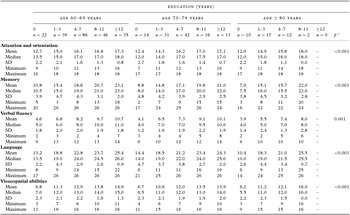
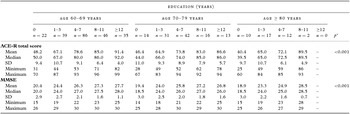
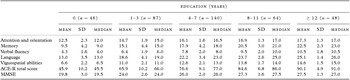
Table 2 presents norms for ACE-R sub-test scores stratified into education and age groups. Sub-test scores varied significantly according to the educational level of the sample. Table 3 presents ACE-R and MMSE total scores stratified into education and age groups, and they varied significantly according to education. Table 4 presents total and sub-domain scores for the ACE-R and the total scores for the MMSE, with the sample stratified in different levels of education.
Scores on the Brazilian Addenbrooke cognitive examination-revised, by age and education

SD = Standard Deviation; ACE-R = Addenbrooke Cognitive Examination-Revised; *ANOVA.
Brazilian addenbrooke cognitive examination-revised: total scores and MMSE scores, by age and education

SD = Standard Deviation; ACE-R = Addenbrooke Cognitive Examination-Revised; MMSE = Mini-Mental State Examination; *ANOVA.
Addenbrooke cognitive examination-revised scores, by education

SD = Standard Deviation; y = years; ACE-R = Addenbrooke Cognitive Examination-Revised; MMSE = Mini-Mental State Examination.
Accuracy data
ROC analyses revealed that the ACE-R has high accuracy to discriminate CN from dementia with high sensitivity (91%) and specificity (76%) in the total sample. When the sample was stratified into two educational levels (< or ≥ five years), accuracy was higher for the group with more education. ACE-R diagnostic accuracy was lower to distinguish CN from CIND, with higher sensitivity (73%) than specificity (65%) even in the group with higher education (see Table 5).
Addenbrooke cognitive examination-revised cut-off scores according diagnostic groups and education level

CN = cognitively normal; CIND = Cognitive impairment not dementia; AUC = area under curve; ACE-R = Addenbrooke Cognitive Examination-Revised; PPV = positive predictive value; NPV = negative predictive value.
Discussion
This study aimed to provide normative data for the ACE-R total and sub-domain scores for a wider range of schooling, including illiterates. A second aim was to investigate diagnostic accuracy for this instrument in a heterogeneous sample of older adults. Results indicated that ACE-R scores are significantly influenced by age, education, and sex. ROC analyses revealed that the ACE-R has high accuracy to identify dementia and moderate accuracy to distinguish normal elderly from CIND.
The normative results highlight the importance of stratifying norms according to these variables. Considering that most Brazilian seniors have four or less years of education, providing norms for this population segment is extremely useful for clinical and research purposes. Inspection of the norms for CN denotes that illiterates may perform 40 points lower than seniors with 12+ years of education. This effect can be observed in all ACE-R sub-domains.
The ACE-R has been shown to be an accurate instrument for dementia and AD diagnosis in different cultures (Pigliautile et al., Reference Pigliautile2011; dos Santos Kawata et al., Reference Dos Santos Kawata2012; Muñoz -Neira et al., Reference Muñoz-Neira, Henríquez, Ihnen, Sánchez, Flores and Slachevsky2012; Raimondi et al., Reference Raimondi2012; Wong et al., Reference Wong2013; Fang et al., Reference Fang2014; Menon et al., Reference Menon, Lekha, Justus, Sarma and Mathuranath2014; Gonçalves et al., Reference Gonçalves2015). It can be easily applied and corrected by trained health professionals and it may play an important role in the early diagnosis of dementia. The ACE-R has a clear advantage over other dementia screening instruments as it includes a more detailed language assessment, due to the fact that it was designed originally to differentiate AD from FTD (Mathuranath et al., Reference Mathuranath, Nestor, Berrios, Rakowicz and Hodges2000). This characteristic makes this instrument more sensitive to the cognitive changes that are present among non-AD dementias. In fact, in a recent meta-analysis (Tsoi et al., Reference Tsoi, Chan, Hirai, Wong and Kwok2015), the ACE-R was identified as one of the three most sensitive and specific instruments for dementia diagnosis. An earlier study (Larner and Mitchell, Reference Larner and Mitchell2014) suggested that the ACE-R has superior diagnostic accuracy when compared to the MMSE, being recommended for use in both modest and high prevalence settings.
In Brazil, the ACE-R was found to be highly accurate for AD diagnosis (Carvalho and Caramelli, Reference Carvalho and Caramelli2012). Yet, in this accuracy study, the sample size was relatively small and median schooling was high (approximately ten years) for Brazilian standards. Present results confirm the high accuracy of this instrument for dementia diagnosis even among seniors with low education. The ACE-R also proved to be an appropriate instrument for CIND diagnosis, although the instrument seems to have lower accuracy, in particular, specificity parameters, to differentiate CIND from healthy controls. Positive and negative predictive values suggest that the patient is highly likely to be cognitively preserved when ACE-R scores are above cut-off scores; however, positive scores may need to be confirmed by additional cognitive or functional testing.
As to normative data, until now, norms were only available for seniors with four or more years of education. In the present study, we complemented the available normative data for the Brazilian version of the ACE-R, with a larger sample including participants with less than four years of schooling and illiterates. For this reason, we chose to follow the same age and schooling sub-divisions used by Carvalho et al. (Reference Carvalho and Caramelli2012).
As the ACE-R was designed in a high income country, some of its items require elementary schooling such as reading complex words, drawing a clock and a cube, naming exotic animals such as rhino and penguin. Therefore, it was necessary to demonstrate its applicability and diagnostic accuracy among illiterates and those with low schooling. In the present study, despite the fact that the ACE-R was affected by schooling, results demonstrated that performance of illiterate elderly was distant from floor effects and retained considerable variance. These results suggest that it remains a viable instrument for lower levels of education, as long as education adjusted norms are used as a reference for normal performance.
The present study has limitations. Among them, we cite the fact that some age and education ranges were under-represented, for instance, seniors 80 years and older with more than 12 years of education. Additionally, cognitive normality was based on clinical and cognitive parameters, in the absence of laboratory and neuroimaging information. On the other hand, among the merits of the study, we highlight the fact that the sample accurately represented the socio-demographic characteristics of the population in Tremembé, and the study offers information regarding understudied education groups (illiterates). In addition, in the original epidemiological study, the prevalence of cognitive impairment was higher than in previous Brazilian studies (17.5% for dementia and 19.5% for cognitive impairment without dementia). This fact reinforces the confidence in the cognitive normality status of the present sample.
In sum, this study extends previous available normative and diagnostic accuracy data regarding the Brazilian version of the ACE-R. Furthermore, it offers normality parameters and cut-off scores for seniors with lower education, less frequently investigated in previous studies. We hope the present data may aid in the early dementia diagnosis, as well as the correct classification of cognitive impairment in future research studies.
Conflict of interest
None.
Description of authors’ role
Cesar KG and Yassuda MS designed the study and wrote the paper. Cesar KG was responsible for the data collection. Porto FHG was responsible for carrying out the statistical analysis. Brucki SMD and Nitrini R assisted with writing the paper and they gave some important suggestions.
Acknowledgments
We are grateful to the Brazilian Institute of Geography and Statistics (IBGE) for the support and to the elderly population of Tremembé for their commitment. The epidemiological study of Tremembé was supported by the FAPESP (Fundação de Amparo a Pesquisa do Estado de São Paulo) grant number 2012/04815-6.