Introduction
The music of the old Beneventan rite is preserved in sources that are notated, for the most part, in campo aperto – without staff lines or clefs to indicate the pitch or placement of the semitone. The absence of a fixed reference point for the pitch and frequent inconsistencies in the diastematic orientation of the neumes presents serious challenges for scholars wishing to engage with questions of pitch and modality, for editors wishing to propose transcriptions, and for performers wishing to give voice to this ancient repertory.
Although there is a significant body of scholarly work on the Beneventan chant, the musical substance of much of the repertory remains largely inaccessible and is not currently available in either a scholarly or a performing edition.Footnote 1 A transparent understanding of the pitch of the Beneventan chant (i.e., how to transcribe the melodies in the absence of a staff line, and how to explain and verify the pitch choices) is a necessary precondition for a critical editing of the chant and for further study of mode and melodic structure in the repertory.
Despite the limitations of the notation, it is possible to discern a great deal about the pitch of the Beneventan chant. This article proposes a systematic overview of the pitch structure of the Beneventan repertory through a study of the formulaic construction of the melodies and a comparative examination of the small number of exemplars of Beneventan chant preserved in pitch-specific notation. This study will focus primarily on the music of the Beneventan Mass Propers, preserved in an early twelfth-century gradual, Benevento, Biblioteca capitolare, MS 40.
Thomas F. Kelly has published numerous commendable transcriptions of Beneventan melodies, representing an important but incomplete view of the music of the repertory. In his discussion of pitch and modality in the Beneventan chant, he proposes that transcription is possible through careful comparative study of the sources.Footnote 2 There are also transcriptions of Beneventan melodies for Holy Week and a substantial discussion of issues of diastematy and formulaic construction in Paléographie musicale XIV.Footnote 3
Kelly's transcriptions are based on the study of repeated melodic formulas that appear throughout the repertory, and facilitated by his key observation that Beneventan chant ‘generally employs a single pitch-level for a recurrent formula or phrase’.Footnote 4 In what follows, I build on Kelly's observations. I offer a detailed study that identifies numerous examples of repeated material or formulas in the Mass Propers, illustrates how these formulas relate to each other throughout the repertory, and demonstrates the placement of the system of formulas on a staff line and clef based on the examination of several pitch-specific exemplars contained in sources from the late twelfth and early thirteenth centuries.
The Beneventan repertory is an important witness to a regional musical practice prior to the imposition of the Romano-Frankish repertory, and a complete view of the musical materials of the chant provides an important window on an early melodic and modal practice, as well as on the performance and formal processes of formulaic or ‘centonate’ chant.
Historical background and sources
The Beneventan chant was the liturgical repertory of southern Italy at the time of the arrival of the Romano-Frankish or Gregorian chant in the region. It was associated with the political and ecclesiastical power of the Lombard dukes whose influence was felt in southern Italy between the sixth and eleventh centuries. Although this southern Lombard repertory appears to share an ancient lineage with the liturgy of Milan, it sustained an independent liturgical and musical development and became a repertory in its own right with a unique textual and musical tradition.Footnote 5 The scribes at Benevento and Montecassino referred to the local rite as ‘Ambrosian’, but the liturgy and music is distinct from that of Milan and is referred to today as ‘Beneventan’.Footnote 6
Like most regional repertories, the Beneventan chant was replaced by the Frankish Roman repertory as a result of the Carolingian drive for liturgical uniformity. The Beneventan repertory appears to have coexisted with the Gregorian for a time, at least until the eleventh century when the local repertory was actively suppressed under the pressure of papal reform and the political upheaval of the Norman invasion. While the Beneventan rite eventually disappeared from use, the repertory is partially preserved in sources dating from the tenth to thirteenth centuries.Footnote 7 The survival of the Beneventan chant into the age of music notation allows us to identify a significant corpus of melodies that provides a window into a regional musical practice at a time when local traditions were ceding to the central repertory. Among the early chant dialects, the Beneventan chant is significant in that it survived long enough to be notated with several exemplars in pitch-specific notation, and with many more melodies notated in campo aperto with enough heightening to present the possibility of gaining access to the pitch material.
The principal repository of music for the Old Beneventan rite is the manuscript Benevento, Biblioteca capitolare (hereafter Ben), 40. Ben 40 is a gradual with tropes and sequences from the first half of the eleventh century, probably from Santa Sofia in Benevento.Footnote 8 This manuscript contains eighteen sets of Mass Propers for the Old Beneventan rite as well as a significant corpus music (antiphons, responsories and tracts) for the ceremonies of Holy Week.
Benevento 40 and the doublet Masses
Although Ben 40 was compiled primarily as a record of the Frankish Roman repertory, we can identify within it many pieces of local provenance. Most of the Beneventan music in MS 40 is preserved as ‘doublet Masses’ – sets of unique Mass Propers placed next to the Gregorian Propers for the same feast. The eighteen doublet Masses are the principal record of the Beneventan repertory and preserve a stylistically unified repertory of chant, distinct from the Gregorian Mass Propers with which they are paired.Footnote 9 They also contain several liturgical features that identify them as Beneventan, including the opening chant of each Mass,which is labelled ‘ingressa’ rather than ‘introit’ as found in the Frankish Roman liturgy.Footnote 10
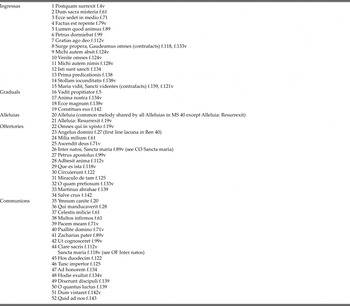
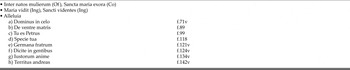
The Mass Propers transmitted in the doublets (ingressae, graduals, alleluias, offertories, and communions) contain fifty-two unique melodies. The melodies considered in this study are listed in Table 1. There are several contrafacts, in which multiple texts share virtually identical melodies, and the alleluias, with one exception in Ben 40, share a common melody. For the purposes of the study of pitch and formulaic structure, I have considered the common alleluia melody and the contrafacts as a single melody.
Melodies for the Beneventan Mass Proper in Benevento 40

Includes all melodies considered in this study, listed by genre and manuscript order.
I have excluded the antiphons and responsories of Holy Week from this study even though they are transmitted in Ben 40, focusing exclusively on the Mass Propers. The music for Holy Week appears to contain music of mixed provenance, including melodies of Greek origin that do not consistently share the distinctive formulaic structures of the Mass Propers.Footnote 11 Although there are several additional sources of Beneventan music, this study focuses exclusively on Ben 40, the largest single repository of Beneventan music for the Mass, in order to mitigate the vagaries of multiple scribal hands, and eliminate chronological differences in the melodies considered. I refer to concordances when they contribute to understanding of a given formula or passage (especially Ben 38, which contains concordances for seven of the Mass Propers from Ben 40), but do not consider unica in concordant sources in the context of this study.
Beneventan musical style
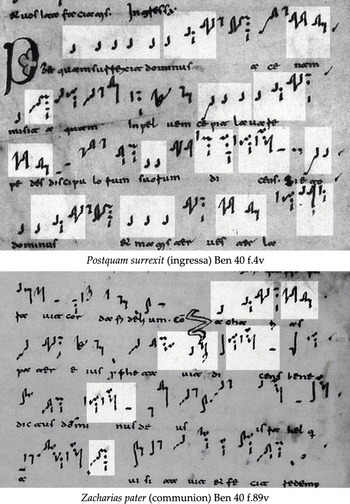
The music of the Beneventan Mass Propers has a highly unified and characteristic musical style marked by a prolix and repetitive surface detail. The music is distinguished by numerous distinctive melodic phrases that recur throughout the repertory with a formulaic regularity. Example 1 illustrates some common figures in excerpts from the Beneventan Mass Propers and highlights several distinctive patterns that recur multiple times within each piece. There are numerous examples of each of these shapes in the two short excerpts illustrated here, and, indeed, these shapes can be found on almost any page of the Beneventan Mass Propers. When this study of recurrent figures is expanded across the repertory of Mass Propers, we can identify over one hundred distinctive patterns that occur in numerous iterations throughout the repertory.
Beneventan musical style: common figures shown in excerpts from the Beneventan Propers.

The Beneventan style is characterised by a remarkable interconnectedness of musical material.Footnote 12 The most common patterns or formulas occur in numerous different contexts, and can be roughly categorised according to their typical formal function in the phrases of the chant – as opening figures, mid-phrase passages, or as part of a repertory of standard cadence figures.
Because of its regularity and the distinctive character of the melodic formulas, Beneventan music is immediately recognisable. Although there are occasional minor differences in the way a pattern of notes is notated, the scribe of Ben 40 is generally consistent in the calligraphic rendering of the formulas.Footnote 13 Furthermore, many of the complex and compound neumes appear only in the sections of Beneventan chant, and not in the Gregorian Propers. As a result, the complex neumes and formulaic patterns mark a musical style that is unique to the Beneventan chant. This repertory is easily recognisable and obviously distinct from the central repertory of Gregorian chant, and the Ambrosian repertory of Milan. The melodic material that is employed in this formulaic music is drawn from a common fund that is shared by all genres of the Beneventan Mass Propers.Footnote 14
Repetition
The pervasive repetition of musical material ultimately provides the key to transcribing the chant: repetition affords us the opportunity to compare multiple iterations of distinctive melodic material at the level of the formula, the phrase and even entire melodies. This comparison allows us to demonstrate consistent patterns in the diastematy that enable the transcription of melodies even in the absence of pitch-specific notation. We can distinguish four categories of repetition in the Beneventan Mass Propers:
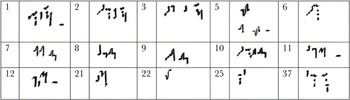
1 Formulas: these are musical figures that occur in identical patterns in different contexts. Example 2 illustrates fifteen distinctive patterns that occur in multiple contexts in the Mass Propers (i.e., they are preceded or followed by different material in multiple iterations across the repertory). In addition, these patterns, consisting of between five and thirteen notes, are notated with an identical succession of neumes, ligatures and complex neume groups.Footnote 15 They can be identified visually and contribute to the unique surface detail and immediately recognisable calligraphic appearance of the Beneventan melodies. In the Beneventan Mass Propers, these formulas operate consistently at the same pitch level at each iteration – an important stylistic trait that will be discussed below. For the purpose of this study, I will illustrate only the most common formulas, those that occur in at least four pieces of the Mass Propers. The most common formula (a cadence figure – F1) occurs at least seventy-five times in twenty-five of the fifty-two melodies. Cadence figures tend to fit this definition of formula most closely, confirming observations made about stereotyped melodic procedures in the study of the Gregorian repertory.Footnote 16 Most of the figures that are identified here as formulas have a cadential function. There are also numerous distinctive patterns shared by only a few pieces, as well as patterns that recur several times within individual pieces but do not appear to be part of a larger fund of formulas.
Ex. 2Fifteen common formulas.
Numbering refers to list of figures in Appendix 1.

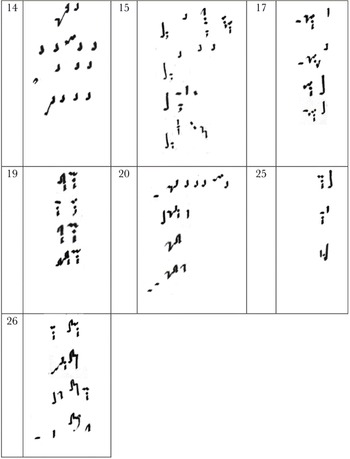
2 Complexes of material: a second category of repeated material can be defined as complexes of material consisting of common groups of neumes or modes of procedure. These patterns are not exact iterations of stock material, but are loose aggregates of neumes that operate around a similar group of pitches in similar formal contexts. For example, certain figures tend to occur almost exclusively as opening figures, and others as mid-phrase procedures. In comparison to formulas, they exhibit a greater degree of variation in the ways in which they are notated, but nonetheless do share a distinctive sequence of neumes or a distinctive complex neume shape that allow them to be identified visually based on unique calligraphic elements. Several examples of complexes are illustrated in Example 3. In illustrating these examples, I show several variants of a single complex rather than attempting to reduce them to a single ‘ur’ figure. Although these figures are not identical at every iteration, they are similar to the formulas discussed above in that they all feature a distinctive calligraphic element – a complex neume form, or a similar succession of figures. In this sense, the distinction between category 1 (formulas) and category 2 (complexes) is not strictly necessary, but I have made a distinction to avoid the impression that the melodic surface of the chant is made up solely of exact iterations of unchanging material. For the purposes of the study of pitch, ‘formulas’ and ‘complexes’ function in much the same way – they are distinctive groupings of pitches that appear to operate consistently at the same pitch level in each iteration across the repertory.
Ex. 3Some common complexes of neumes.
Numbering refers to list of figures in Appendix 1.
It should be noted that it is not always obvious whether to categorise a given figure as a formula or complex – in most of the complexes I have identified, it would be possible to excise a single distinctive complex neume and categorise it instead as a formula, but in most instances a larger formal context is necessary in order to identify the material. In the analysis of formulaic chant, the distinction often depends on an arbitrary decision of where a formula begins or ends, or how much material from the larger context to include in the illustration of the figure. The challenges in distinguishing between ‘formulas’ and ‘complexes’ tell us much about the formal processes of the music. This is not music composed from a menu of pre-existent immutable formulas, but rather music that was created from a flexible process that includes common formal procedures, loose aggregates of distinctive material, as well as some stereotyped and highly stable formulaic material. To highlight this, I have included one figure in both categories. On the one hand, figure 25 functions as a formula, with sixteen distinct iterations in nine of the melodies considered. On the other hand, there are several closely related writings of a similar melodic shape that suggest this figure should be considered as a complex. Nonetheless, the distinction between exact repetitions and complexes of material is useful as we begin the process of identifying like material throughout the repertory of Mass Propers. It allows us to point to exact iterations of material in many instances, while also considering more general modes of procedure that result in similar aggregates of neumatic forms.
3 Formal concordances at the phrase or section level: the Mass Propers include numerous pieces that share significant formal concordances at the phrase or section level – a shared verse melody, a common concluding alleluia, or a common opening phrase that then diverges into new material. These examples do not share an exact melody with another piece (see the discussion of contrafacts below), but share enough material that the examination of pitch in one cannot proceed in isolation from the other. A selection of pieces with important formal concordances is listed in Table 2.
Table 2Melodies with significant similarities, shared material, or structural concordances
4 Identical melodies or contrafacts: the melodies of the Mass Propers in Ben 40 include a number of contrafacts that share virtually identical melodies. For the purposes of examining repeated material, I have considered each group of contrafacts as a single melody. Notwithstanding a few minor variants, mostly to do with syllabification, the melodies appear to be identical and can be considered as a single unique melody for the purposes of comparison and study of formulaic material across the repertory. The contrafacts are listed in Table 3. All the alleluias share a common melody with the exception of Alleluia: Posuisti (St Stephen) and Alleluia: Resurrexit tamquam. For the purposes of this study, the common alleluia and verse have been grouped as a single melody.
Table 3Contrafacts or type melodies


To these categories, we can also add concordances in Ben 38 and other sources. The concordant sources generally use the same distinctive neume groupings and complex neumes for each of the formulas and complexes discussed above, and seem to confirm that formulas and other repeated material were understood with a high degree of notational stability. Because the concordant sources are also notated in campo aperto, they do not add much useful additional information to our understanding of pitch.
Each of the instances of repetition discussed above provides us with multiple points of comparison for each formula, complex and phrase in the Beneventan Mass Propers, comparisons that are invaluable for demonstrating the pitch of the repertory.
Heightened notation in campo aperto
Although the melodies of the Mass Propers are preserved almost exclusively in notation that is not pitch-specific (in campo aperto), the scribe of Ben 40 notates much of the manuscript in more or less accurate heightening. In his study of the Beneventan trope repertories, John Boe describes the notation of Ben 40 as ‘approximately diastematic’.Footnote 17 Boe notes that the notation ‘suffers from erratic diastematic connections between phrases, irregular compressions of neumes when sufficient space above the text is lacking, and a slight upward bias as each line progresses’.Footnote 18
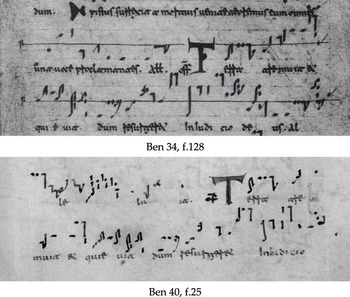
Since Ben 40 was compiled and copied primarily for the purpose of recording the Gregorian melodies, we are able to determine the accuracy of the heightening in the manuscript by comparing the scribe's heightening of the Gregorian melodies with pitch-specific exemplars in other south Italian sources. The accuracy (and inaccuracy) of the heightening of Ben 40 can be demonstrated with a comparison between the notation of the Gregorian offertory Terra tremuit in Ben 40 and the recension in Ben 34, a gradual from the early to mid-twelfth century copied at Benevento.Footnote 19 As shown in Example 4, a comparison between the pitch-specific exemplar and the notation in campo aperto reveals that while the note-to-note relationship in Ben 40 is generally accurate, the relative spacing in the manuscript is not always consistent with a horizontal axis across the page. In addition to the chronic upward drift of the scribal hand noted above (compare the punctum on ‘tremuit’ with the upper note of the podatus on ‘resurgeret’, which should be at the same pitch level), the horizontal axis seems in some instances to drift gradually up or down (compare the succession of the pitches A at the text ‘resurgeret in iudicio’ which would require an undulating staff line to create a horizontal axis for the notes). In addition, the heightening of large intervals is less accurate than that of smaller intervals: intervals of a fourth or more tend to be compressed in Ben 40 (compare especially the podatus at ‘In iudicio’). Leaving aside the larger intervals, the heightening appears to be accurate, at least at a local level. Intervals of a second or third are perfectly clear, and given a starting note, it would be possible to transcribe accurately much of the first few lines simply by following the heightening from note to note across the page.
Offertory Terra Tremuit in Ben 34 and Ben 40.

For the melodies of the Beneventan Mass Propers, we do not have the luxury of comparing the diastematy with a pitch-specific exemplar, and we must rely solely on the rich, albeit imperfect, record of the notation in campo aperto. If we trust the heightening in the sections of Beneventan music (at least to the same degree we do the heightening in sections of Gregorian chant, fully expecting occasional inconsistencies in diastematic orientation and large intervals notated with less specificity than small intervals), we can begin to examine the diastematic relationship of successive neumes, neume groups, and formulas.
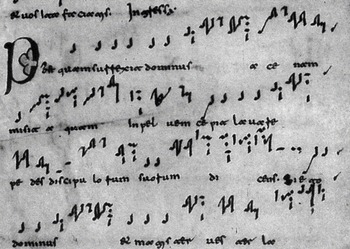
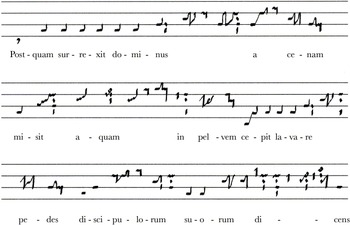
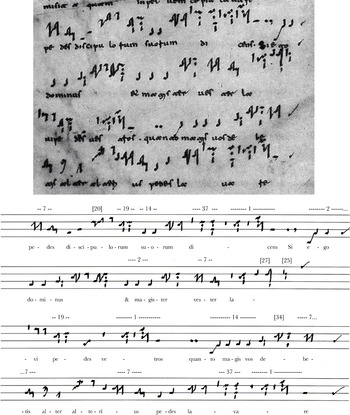
Example 5a shows the ingressa from the Beneventan Mass Propers for Maundy Thursday, Postquam surrexit. Although this example is notated in campo aperto, we can posit a hypothetical horizontal axis and use that to establish the relative height of each neume. Beginning with the repeated podatus figures in the first line, we can propose a diplomatic transcription of the first few lines of Postquam surrexit on a four-line staff without a clef (if the podatus represents a note and its upper neighbour, we can determine that the figure after that fills the space of a third, etc. – see Example 5b).
Postquam surrexit: A Beneventan ingressa.
Ben 40, f.4v, Maundy Thursday

Postquam surrexit transcribed on a four line staff.

The clarity of the heightening in this example makes the translation onto a staff line relatively easy.Footnote 20 Nonetheless, there are several passages that require further
comment.Footnote 21 The upward drift of the hand of the music scribe can be seen clearly in the first line of Postquam surrexit. If we were to transcribe the pitches in reference to a horizontal axis drawn across the page, the final note of the system might be several tones higher than indicated in the transcription. The comparison of several other passages highlights similar minor inconsistencies in the heightening. Compare, for example, the two figures in lines 1 and 2 (
 ). The figure at the end of the
second line takes up more space on the vertical axis (by almost a whole step), despite the evidence of the note-to-note diastematy, which suggests that both figures cover the span of a fourth. Despite the relatively clear heightening, it would not suffice simply to superimpose a ruled grid over the manuscript. Even in this example, selected to demonstrate the relative clarity of the heightening, the diastematic evidence is at times intractable.
Although there are inconsistencies in the heightening, the notation of Ben 40 does provide us in many instances with enough diastematic accuracy at a local level to develop a broad and consistent understanding of the relative heights of the formulas that characterise the Beneventan melodies. In what follows, I will concentrate first on demonstrating the relative heights of the most common Beneventan formulas, and discuss the challenges of inconsistency in the diastematy in greater detail below.
Repetition and relative heightening in a formulaic context: establishing the relative diastematic relationship of the formulas
In his study of the Beneventan repertory, Thomas F. Kelly observed that ‘the Beneventan chant generally employs a single pitch level for a recurrent formula or phrase’.Footnote 22 This observation is demonstrated in Example 6. In the excerpt of Postquam surrexit illustrated here, I have labelled six distinctive figures that recur multiple times in this short excerpt alone. Also labelled (in brackets) are three additional formulas and complexes that appear only once in this passage, but can be identified elsewhere in the Beneventan repertory.
Relative heightening of figures in Postquam surrexit.
Figures 1, 2, 7, 14, 19 and 37 appear multiple times in differing contexts at the same relative pitch level.

If we accept the accuracy of the heightening from note to note, this example appears to confirm that each iteration of like formulaic material occurs at the same relative pitch level. For example, the repeated podatus figure (figure 14) occurs consistently between the first space and the second line of the staff, and the two cadence figures (figure 1 and figure 7) occur at the same relative pitch level – a tone apart – in both iterations.
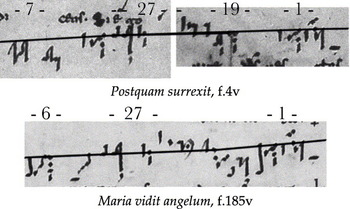
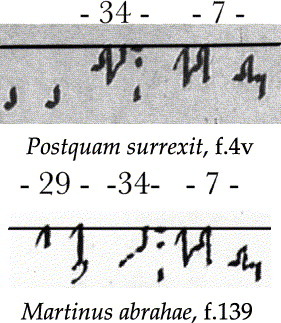
Because the Beneventan chant is made up of formulaic material that appears in numerous places in the repertory, we can compare the relative diastematic heights of the repeated formulaic patterns not only in a single piece but also in multiple contexts throughout the repertory. Taking the five formulas in Postquam surrexit as a starting point, Example 7 demonstrates the relative diastematic placement of four additional formulas/complexes. These examples juxtapose multiple iterations of repeated material in different contexts and an examination of the diastematy illustrates the relative height of each figure in relation to material illustrated in the preceding example. For the purpose of this demonstration, I have selected a few contexts for each figure; many more iterations of any of these figures can be compared to the surrounding material with comparable results. The formulasand complexes selected here were chosen because they are among the most commonly occurring figures in the melodies considered in this study. Each example demonstrates that these formulaic/neumatic complexes are notated at the same relative pitch level in different contexts.Footnote 23
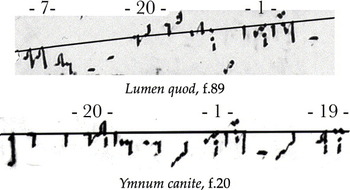
Complex 20 (compared to figures 1, 7 and 19).

Formula 27 (compared to figures 7, 19, 6 and 1).

Complex 34 (compared to figures 7 and 29).

Formula 6 (compared to figure 1).

Appendix 1 catalogues the occurrences of each of these figures, and provides a comprehensive index of all iterations of the forty-two most common figures that appear in the corpus of melodies considered by this study. (The two bottom rows of the table tabulate the total number of pieces in which each figure occurs, as well as the total number of iterations of each figure. This index facilitates the comparison of the diastematic relationships between the formulaic material in the sources.) The figures illustrated here provide us with over 150 anchor points for the comparison of relative diastematy in the melodies considered by this study.
Example 7d (figures 1 and 6) requires further comment. This example illustrates the two most common Beneventan cadence figures, and also represents the most common finals in the repertory. Because of the frequency of their occurrence, these two cadential formulas are important reference points when we translate or transcribe the neumes onto a staff line (figure 1 occurs seventy-five times in twenty-five of the fifty-two melodies; figure 6 occurs twenty-eight times in fifteen of the melodies).
There are of course entire lines of music that do not contain any of the formulas identified here. However, by developing a larger comparative system it is possible to establish many more points of reference in the repertory. An in-depth comparison of formulas or complexes in multiple contexts allows us to us establish the relative diastematy of the recurrent formulas that make up the melodic fabric of the Beneventan chant.
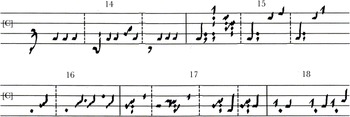
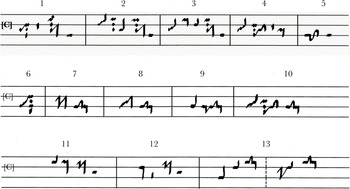
Example 8 illustrates the most common formulaic figures and complexes of the Beneventan melodic fund placed on a four-line staff, and provides a graphic illustration of the relative diastematic heights of the formulaic material. In this example, the figures have been arranged according to their typical formal function, as opening, mid-phrase or cadential patterns. (This example also has a hypothetical C-clef, the placement of which will be discussed below.)
Openings.

Ex. 8b Cadential formulas/complexes.

Ex. 8c Mid-phrase formulas/complexes.

Because formulas occur throughout the repertory in diverse contexts and combinations, the work of comparing the diastematic heightening of each figure to other formulas in the immediate proximity can only be done figure by figure, considering each iteration of a formula across the entirety of the Beneventan Mass Propers. The results of these comparisons are cumbersome to demonstrate. Examples 6 and 7 form a limited sample that illustrates a comparative methodology that can be applied for each appearance of a given formula across the repertory.Footnote 24
Once the relative heights of the formulas have been established, it remains to be determined how the system of formulas is to be placed on the diatonic gamut. The correct placement of the semitones can be illustrated in two ways: first, by an examination of the pitch structure of the formulaic material; and second, through the study of a small number of sources that preserve pieces of Beneventan chant in pitch-specific notation.
Placing the system of formulas in the diatonic gamut: common formulas and their transpositions
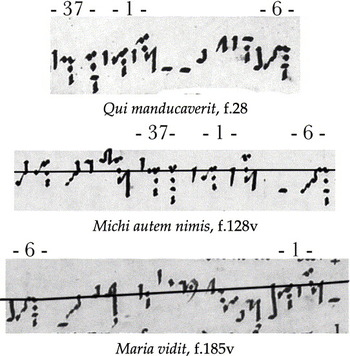
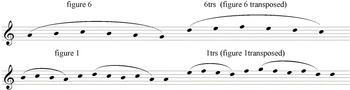
A placement of the system of formulas on the gamut is discussed by Kelly in reference to his transcription of the Easter ingressa, Maria vidit angelum. His examination of the pitch structure of the formulaic material in this piece leads him to conclude that, assuming the use of the ‘essentially diatonic gamut shared alike by all the known varieties of Western chant, we can by experimentation discover that there is only one pitch-level that accounts successfully for virtually all the repertory’.Footnote 25 This pitch placement is anchored by the cadence figure 1  on A and figure 6
 a tone lower on G. These cadences also represent the two finals present in the Beneventan repertory. The cadence formulas to A and G also occur in transposition a fourth higher than the finals, and are important in establishing the single pitch level at which this piece functions.
Formulas in transposition: extension into the upper tetrachord
In some of the more elaborate melodies, several of the formulas and complexes appear transposed a fourth above their usual place on the gamut as the range of the melody is extended into the upper tetrachord.Footnote 26
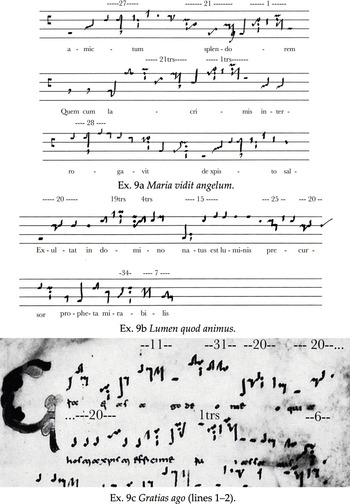
Several examples of this transposition are illustrated in Example 9 (figures appearing in the upper tetrachord are modified by the suffix ‘trs’ (transposed)). The transition from the upper to lower hexachord usually needs to be derived from context. This can easily be seen in an excerpt from Maria vidit angelum (Example 9a) in which two iterations of the cadence figure 1 appear in close proximity. The note-to-note diastematy between the figures clearly illustrates the ascent into the upper tetrachord, with the first cadence figure on A and the second a fourth higher on D.
In Lumen quod animus (Example 9b) the first line of the excerpt shows several figures in their upper transposition, while the cadence figure in the second line returns to the final of the lower tetrachord. The excerpt from Gratias ago (Example 9c) illustrates a clear juxtaposition of figure 1 in the upper tetrachord, with figure 6 notated at the level of the finals.Footnote 27
Formulas and neume complexes that appear at the level of the finals and transposed a fourth higher.

Cadence formulas in the upper and lower tetrachord
The most common cadence figures appear at two pitch levels: the level of the finals (A and G), and transposed a fourth higher to D and C. The most common cadences are illustrated in Example 10. The range of each of the cadence figures helps to define the tonal space of the upper and lower tetrachord, and provides some guidance as to the placement of the system of the gamut: there are only two places on the diatonic gamut that simultaneously allow a real transposition of the cadences F1/F1trs and cadence figure F5/F5trs without introducing melodic tritones. This relationship between the upper and lower transpositions suggests the transcription of the repertory with the finals A and G. (It is possible to render this particular constellation of formulas a tone higher; however, the resulting upward leap of a diminished fifth in figure 28 in the third line of example 9 argues against this solution.) Example 10 includes a hypothetical placement of the clef that results in thetwo most common cadence formulas appearing on A or one tone lower on G (D and a tone lower on C in transposition).
The most common cadence figures appear at two pitch levels – the level of the finals (A and G) and transposed a fourth higher to D and C.

In Examples 9b and 9c, the melodic complex figure 20 seems to function as a marker of the transition to the upper tetrachord. Throughout the repertory, this complex appears only in the upper transposition (or the lower border of the interlocking tetrachords). This complex, which features a distinctive complex neume that joins a clivis/podatus and is often followed by a repeated podatus recitation on c-d, could be classified as a transposed variant of figure 14 but the distinctive neume form (and a descent to the neighbour tone below C) gives it a specific meaning in the system.Footnote 28 The use of this figure suggests that formulas and neume shapes can have specific place markers for pitch, functioning in much the same way as a staff line.Footnote 29
Pieces of the Beneventan Mass Propers preserved with a staff line and clef
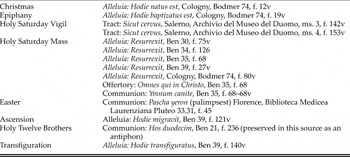
There are a small number of pieces of the Beneventan Mass Propers preserved in pitch-specific notation (sources notated with a staff line or to which a staff line has been added by a later scribe).Footnote 30 These exemplars generally confirm the understanding of pitch proposed above. The pieces of the Beneventan Mass Propers notated with a line and/or clef are listed in Table 4. They include nine alleluias (which share a common melody), three communions, one tract and one offertory.
The Beneventan alleluia melody is well represented in pitch-specific sources, with nine exemplars from five sources.Footnote 31 Pitch-specific notation is especially significant for the large-scale formulaic pieces of the Beneventan repertory, particularly the ingressae, graduals and offertories. Because we have been able to establish the relative diastematic heights of the formulaic material of the repertory, a clear understanding of the pitch placement of even one of these recurrent formulas should allow us to establish with accuracy the pitch of any Beneventan piece containing formulaic material.
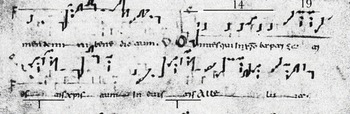
Of the formulaic chants of the Beneventan Mass Propers (generally the ingressae, offertories, graduals and to a lesser extent the communions), only a few exemplars are preserved with a staff line and clef. These include two items from the Holy Saturday Mass, the offertory Omnes qui in Christo (Ben 35, f. 68), and the communion Ymnum canite (Ben 35, f. 68r/v). Unfortunately, the evidence in these examples relies on a staff line that was added to the manuscript at some point after the initial copying.Footnote 32 The example is nonetheless of interest to this study because, if the placement of the staff line is to be believed, it contains examples of several formulas found widely throughout the Beneventan repertory. The formulaic material in Omnes qui in Christo is shown in Example 11. Note in particular the cadence figure 1. In this example, the final of this cadence figure is on A, confirming the theoretical pitch placement of the formulas proposed above.Footnote 33 Note also the repeated podatus figure on G, similar to the repeated figures in Postquam surrexit above.Footnote 34
Pieces from the Mass Propers preserved in pitch-specific sources

Assuming that this source presents a correct rendering of the pitch of the offertory (it appears to confirm the hypothetical placement proposed above), this source can be used as a sort of Rosetta stone from which we can anchor transcriptions of sources written without pitch-specific notation. Working from our understanding of both the relative diastematic relationship between recurrent material and the anchor points supplied by the pitch-specific sources, we have a foundation from which we can with some confidence propose pitch-specific transcriptions of numerous pieces preserved only in campo aperto.
The Beneventan melodic fund
With the addition of a hypothetical clef, the figures in Example 8 show both the relative diastematic heights of the formulas or complexes and the placement of the figures on the diatonic gamut. From this template a large portion of the Beneventan core repertory can easily be transcribed, simply by matching the formulaic material in the sources with the transcriptions proposed here. Almost all the pieces in the core repertory of the Beneventan chant draw on this common fund of melodic material and the pervasive repetition of melodic material provides the transcriber with an abundance of reference points for the pitch of each piece. In many instances, the formulas occur so regularly that we can identify multiple iterations of a given formula within a single piece of chant. In other instances, the occurrences are less frequent, but we can nonetheless observe that even the smallest and most unremarkable figures often turn up note for note at the same apparent pitch in several different contexts, commonly surrounded by, or joined to, other identifiable material. The regularity of the melodic material and neumatic representation suggests that even unremarkable connecting passages are not simply filler, but part of an intricate, subtly varied system of melodic construction that is based on the consistent repetition of material at a single pitch level.Footnote 35
Common Beneventan formulas with F and C clefs.
The formulaic material in Omnes qui in xpisto marked.

Transcription
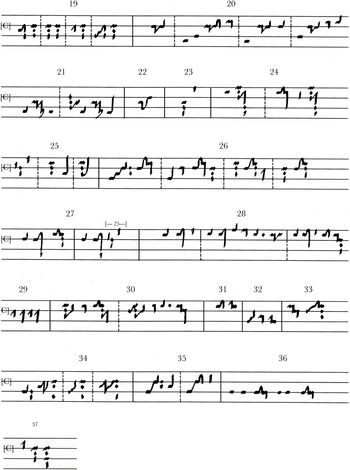
Using the formulas catalogued above as points of reference for the pitch, I have proposed a transcription of the Beneventan ingressa for St John the Baptist, Lumen quod animus (Appendix 2). In this transcription, each formula and complex has been labelled so that the reader can cross-reference the figures to Example 8 and Appendix 1, comparing their relative height to other occurrences in the repertory. The transcription is presented in a stylised Beneventan notation that provides a graphic illustration of the placement of the formulas on the staff line. Because the recognition of the figures in neumatic notation is central to the process of transcription, a diplomatic transcription that maintains as much of the original while adding a staff line seems to be the most appropriate format. Although we cannot account for every single figure in the transcriptions, we can demonstrate the pitch of significant portions of the musical line, and from this point are able to integrate the remaining material at a local level with relative ease.Footnote 36
Intractable diastematy
Any editor or performer who has attempted to transcribe or sing Beneventan chant knows well the frustration of coming upon a passage in which the pitch of a formula, or succession of formulas, does not adhere to what otherwise appears to be a consistent system operating at a single pitch level. As noted above, there are many cases in which the horizontal axis is uneven, the heightening of large intervals is inaccurate, and the diastematic space contracts when space is at a premium.Footnote 37 There are numerous places in the Beneventan Mass Propers where the horizontal orientation of the neumes appears to shift suddenly without any indication (such as a custos) to help re-orient the pitch, as though the scribe began writing again after a pause with little regard for the preceding material.
Most of these shifts of the horizontal axis involve a diastematic space of one step, although there are occasionally larger discrepancies. In Ben 40 the scribal tendency to adjust the diastematy upward or downward by a step seems indiscriminate, and shifts in both directions occur in a variety of contexts. In the melodies considered, a scribal shift upward by a tone is the most common adjustment (by a ratio of about 2:1) and suggests the possibility that this inconsistency may be related to the scribal tendency to drift upward in each line. An examination of concordances in Ben 38 is useful at these moments, although the results are not always conclusive. In some instances, the notation of Ben 38 confirms the expected diastematy of a given passage, but at the same time introduces a new set of inconsistencies or unexpected adjustments in diastematy not seen in Ben 40.
There are numerous places in the repertory where the editor is left with no choice but to adjust the melodic line, or move into the realm of sudden direct transpositions.Footnote 38 In some instances, it is difficult to ascertain exactly where the shifts in diastematic accuracy occur, but the transcriber must simply note the passages where editorial adjustment is necessary.Footnote 39
Pal Mus XIV discusses a particularly puzzling example of inconsistent diastematy in the communion for Holy Saturday, Ymnum canite.Footnote 40 In Ben 40 (and the concordant sources Ben 38 and Ben 35), the two iterations of an identical alleluia are notated in a manner that suggests they should be sung one tone apart. The editors chose to adjust the alleluia so that the melody is sung twice at the same pitch level, but in so doing, figure 1 (the cadence to A) becomes transposed down a tone to G, a solution which seems improbable given the stability of cadence formulas in the repertory as a whole.
It is worth considering that these moments of unclear diastematy are not errors or inconsistencies in the system, but are perhaps the inevitable by-products of a notational system that was more concerned with realising a succession of well-known material than with orienting each neume on a diastematically accurate horizontal axis. In proposing transcriptions, the editor must weigh the occasional inconsistencies against the overwhelming evidence that the formulas do operate consistently at a single pitch level.
Even when singers encounter uneven heightening, it is possible to recognise clearly the formulaic material, and from an understanding of the pitch material of the formulas posit and recreate the diastematic relationship between the figures in performance. Because of the consistency of Beneventan musical style, a singer familiar with the Beneventan repertory does not need perfect heightening to recognise and give voice to the formulas. It is interesting to note that in the manuscript Ben 38, a later scribe has added an F line in red ink to the sections of Gregorian chant, but not to the Beneventan doublet Masses, which remain in campo aperto. While this may be because the doublet repertory was no longer in use or no longer known to the scribe who added the staff line, it might also be that the line was simply unnecessary for singers familiar with the melodic fund of the Beneventan chant.Footnote 41 Even without a staff line, we know where to start (with reference to common opening figures), and can easily orient and re-orient ourselves along the way. Viewed in this light, the occasional inconsistencies in the diastematic orientation of the notation are perhaps not as significant as they might otherwise appear.
Pitch, transcription and the study of the Beneventan chant
The Benevantan chant occupies a unique position among the regional repertories that were displaced by the Carolingian imposition of the Romano-Frankish chant dialect. Unlike the Celtic repertory, whose survivals number no more than five or six pieces, and the Gallican, whose remnants are interspersed in the Gregorian repertory as hypothetical Gallican elements assimilated or adapted into the Gregorian melodies, Beneventan chant survives as a numerically significant and identifiably distinct repertory. In contrast to sources of the Mozarabic chant of Spain, moreover, this article has shown that the Beneventan manuscripts allow considerable access to the pitch of the repertory. In this context, the preservation of Beneventan chant is a remarkable historical accident, and the chant itself provides an important window onto the diversity of regional musical practice before the arrival of Gregorian chant in southern Italy. Furthermore, systematic study and comparison of the notational practices of Beneventan scribes give ample insights into their attitude towards the graphic realisation of melodies, and indeed their understanding of the musical structures they inscribed.
The evidence presented above illustrates that the ‘single pitch level’ theory is largely consistent across the extant repertory of Beneventan Mass Propers, and provides tools for the transcription of the repertory. The systematic description of the pitch and notation is an important step in our access to the complete repertory. Much work remains to be done on the Beneventan chant: studies in early modality, an understanding of the centonate or formulaic structures of the chant, and, of course, the performance of the music all depend on our ability to propose accurate transcriptions. The transparent access to the pitch material of the repertory is thus a vital precursor to our understanding of the Beneventan chant.
Appendix 1: Index of figures
Thirty-seven formulas and pitch/neume complexes that occur in at least four different pieces in the Mass Propers. Numbers in cells record the frequency of occurrences in each piece. The row at the bottom illustrates the total number of pieces in which the figure appears.

Appendix 2: Transcription of Lumen quod animus
Numbers above figures refer to the formulas and complexes in Example 8 and Appendix 1.
(1) One step higher in manuscript (compare opening to Surge propera, v. flores, f.118)

Lumen quod animus, Ben 40, f.89.