Palmer amaranth is a C4 Sonoran Desert annual indigenous to the southwestern United States and northern Mexico and the most successful Amaranthus species to establish itself as a weedy species in agroecosystems (Ehleringer Reference Ehleringer1983; Sauer Reference Sauer1957). Within 6 yr of being identified in South Carolina in 1989, Palmer amaranth became the most problematic weed in cotton (Gossypium hirsutum L.) in both North and South Carolina (Webster and Coble Reference Webster and Coble1997). By 2009 Palmer amaranth was ranked as one of the top 10 most troublesome weeds in corn (Zea mays L.), soybean [Glycine max (L.) Merr.], and cotton in several states of the southeastern United States (Webster and Nichols Reference Webster and Nichols2012). The evolution of herbicide resistance likely contributed to the spread and success of Palmer amaranth as a weedy species throughout most of the southern and Great Plains regions of the United States (Gossett et al. Reference Gossett, Murdock and Toler1992; Horak and Peterson Reference Horak and Peterson1995). While Palmer amaranth remains a major problem in those regions, it has recently spread into the Midwest (Sellers et al. Reference Sellers, Smeda, Johnson, Kendig and Ellersieck2003) and was first identified in Michigan in 2010 (Sprague Reference Sprague2011).
Palmer amaranth’s propensity to evolve resistance to different herbicides has perpetuated it as a problem weed. Herbicide resistance in Palmer amaranth is not new. The first reported case of herbicide resistance in Palmer amaranth was identified in South Carolina in 1989 (Gossett et al. Reference Gossett, Murdock and Toler1992). Populations from two South Carolina counties evolved resistance to trifluralin, a dinitroaniline (Group 3) herbicide. These populations had varying levels of resistance to five other dinitroaniline herbicides. By 1993 atrazine (Group 5) resistance was reported in a Texas population of Palmer amaranth (Heap Reference Heap2016), but triazine-resistant populations have been reported in only three other states since then. The inability of triazine-resistant Palmer amaranth to establish and become widespread may be due to reproductive fitness penalties often associated with triazine resistance in other Amaranthus species (Sibony and Rubin Reference Sibony and Rubin2003; Soltani et al. Reference Soltani, Vyn, Swanton, Weaver and Sikkema2008).
As Palmer amaranth expanded north in the mid-1990s, it rapidly developed resistance to the widely used acetolactate synthase (ALS)-inhibiting herbicides (Group 2), with resistant populations found in several states (Heap Reference Heap2016; Horak and Peterson Reference Horak and Peterson1995). In addition, the rapid adoption of glyphosate-resistant crops led to the abandonment of PRE herbicides and sole reliance on multiple glyphosate (Group 9) applications, leading to the evolution of glyphosate-resistant biotypes (Owen Reference Owen2008; Shaner Reference Shaner2000; Vencill et al. Reference Vencill, Nichols, Webster, Soteres, Mallory-Smith, Burgos, Johnson and McClelland2012; Young Reference Young2006). The first case of glyphosate-resistant Palmer amaranth was reported in Georgia in 2005 (Culpepper et al. Reference Culpepper, Grey, Vencill, Kichler, Webster, Brown, York, Davis and Hanna2006). This population survived applications of glyphosate in the field at 12 times (10 kg ha−1) the normal use rate.
In addition to its evolution of resistance to a single herbicide site of action, Palmer amaranth has now developed resistance to multiple herbicide sites of action. One of the most prevalent instances of multiple resistance in populations of Palmer amaranth is resistance to glyphosate and ALS-inhibiting herbicides. Populations of Palmer amaranth resistant to both glyphosate and ALS inhibitors have been identified in nine states, including Georgia, Mississippi, Tennessee, South Carolina, Arizona, Illinois, Florida, Delaware, and Michigan (Heap Reference Heap2016; Nandula et al. Reference Nandula, Reddy, Koger, Poston, Rimando, Duke, Bond and Ribeiro2012; Sosnoskie et al. Reference Sosnoskie, Kichler, Wallace and Culpepper2011). Other cases of multiple resistance reported in Palmer amaranth are: protoporphyrinogen oxidase (PPO) inhibitors (Group 14)+glyphosate (IL, TN), atrazine+4-hydroxyphenylpyruvate dioxygenase (HPPD)-inhibiting herbicides (Group 27) (NE), atrazine+glyphosate (NE), PPO inhibitors+ALS inhibitors (AR), ALS inhibitors+atrazine+HPPD-inhibitors (KS), and ALS-inhibitors+atrazine+glyphosate (GA) (Heap Reference Heap2016; Jhala et al. Reference Jhala, Sandell, Rana, Kruger and Knezevic2014; Salas et al. Reference Salas, Burgos, Tranel, Singh, Glasgow, Scott and Nichols2016). The evolution of resistance to multiple herbicide sites of action drastically limits the options for Palmer amaranth control.
The primary mechanisms by which weeds develop resistance to herbicides are categorized into five mechanisms: altered target site, metabolism based, reduced absorption/translocation, sequestration into vacuoles, and gene amplification (Heap Reference Heap2014). Altered target-site resistance is the most common mechanism of resistance for various herbicides in several weed species. In Palmer amaranth and other Amaranthus spp., the primary mechanism for resistance to ALS-inhibiting herbicides is an altered target site via amino acid substitution within the ALS enzyme (Foes et al. Reference Foes, Tranel, Wax and Stoller1998; Franssen et al. Reference Franssen, Skinner, Al-Khatib, Horak and Kulakow2001). Betha et al. (Reference Betha, Thompson, Peterson and Jugulam2015) reported that ALS resistance in a Kansas population of Palmer amaranth was attributed to a proline to serine change at site 197. An altered target site, due to an amino acid substitution of glycine for serine at position 264 of the D1 protein, has been reported to be the primary mechanism for atrazine resistance in smooth pigweed (Amaranthus hybridus L.), common waterhemp (Amaranthus rudis Sauer), kochia [Kochia scoparia (L.) Schrad.], and Powell amaranth (Amaranthus powellii S. Wats) (Diebold et al. Reference Diebold, McNaughton, Lee and Tardif2003; Foes et al. Reference Foes, Tranel, Wax and Stoller1998, Reference Foes, Liu, Vigue, Stoller, Wax and Tranel1999; Maertens et al. Reference Maertens, Sprague, Tranel and Hines2004). However, non–target site based triazine resistance has been reported for populations of tall waterhemp [Amaranthus tuberculatus (Moq.) Sauer] and velvetleaf (Abutilon theophrasti Medik.) (Anderson and Gronwald Reference Anderson and Gronwald1991; Patzoldt et al. Reference Patzoldt, Dixon and Tranel2003). To date, the only identified mechanism of glyphosate resistance in Palmer amaranth is the overproduction of the target enzyme 5-enolpyruvlshikimate-3-phosphate synthase (EPSPS) due to gene amplification (Chandi et al. Reference Chandi, Jordan, York, Milla-Lewis, Burton, Culpepper and Whitiker2013; Gaines et al. Reference Gaines, Zhang, Wang, Bukun, Chisholm, Shaner, Nissen, Patzoldt, Tranel, Culpepper, Grey, Webster, Vencill, Sammons, Jiang, Preston, Leach and Westra2010; Mohseni-Moghadam et al. Reference Mohseni-Moghadam, Schroeder and Ashigh2013; Ribeiro Reference Ribeiro2013). This means that at current label rates, glyphosate cannot saturate the system and stop normal enzyme function, resulting in plant survival.
The failure of atrazine to control a newly identified population of Palmer amaranth in Michigan that was suspected to be resistant to glyphosate and ALS-inhibiting herbicides in field experiments in 2013 led to the following research objectives: (1) confirm the presence of resistance to glyphosate, an ALS inhibitor (thifensulfuron), and atrazine in a single Palmer amaranth population; and (2) establish the molecular basis for resistance to these herbicide sites of action.
Materials and Methods
Seed Collection and Preparation
In fall of 2013, seed heads of the suspected multiply resistant (MR) Palmer amaranth treated with either 1.12 or 2.24 kgha−1 of atrazine were harvested from field research plots in Barry County, MI (42.702467°N, 85.524992°W) and threshed. Since Palmer amaranth is not native to Michigan, seed for the known susceptible (S) population was obtained from Larry Steckel (University of Tennessee). Seed from both populations were treated with a 50% sulfuric acid and water solution for 4 min, rinsed, and then exposed to gibberellic acid at a concentration of 0.15 g L−1 of water for 6 h to enhance germination.
Initial Screen for Three-Way Resistance
Fifteen seeds of the MR and S Palmer amaranth populations were planted 0.75-cm deep in separate 10×10 cm pots filled with potting media (Suremix Perlite, Michigan Grower Products, Galesburg, MI). Seedlings were grown in the greenhouse at 25±5 C, and sunlight was supplemented to provide a total midday light intensity of 1,000 µmol m−2s−1 photosynthetic photon flux at plant height in a 16-h day. After emergence, Palmer amaranth was thinned to 1 plant pot−1. Plants were watered and fertilized as needed to promote optimum plant growth. When plants were approximately 10-cm tall (6- to 8-leaf stage), a mixture of glyphosate (Roundup PowerMAX®, Monsanto, St. Louis, MO)+thifensulfuron (Harmony®, DuPont Crop Protection, Wilmington, DE)+atrazine (AAtrex® 4L, Syngenta, Greensboro, NC) was applied at 1.26+0.0044+1.12 kg ai ha−1 with a single-nozzle (8001E, TeeJet Technologies, Wheaton, IL) track sprayer calibrated to deliver 187 L ha−1 at 193 kPa of pressure. These rates represented 1 times the field use rates for these herbicides. Spray-grade ammonium sulfate (AMS) (Actamaster®, Loveland Products, Loveland, CO) at 2% w/w and 1% v/v of crop oil concentrate (COC) (Herbimax®, Loveland Products, Loveland, CO) were added to this treatment. Palmer amaranth control was evaluated 14 d after treatment (DAT) on a scale of 0 to 100, with 0 indicating no Palmer amaranth control and 100 indicating plant death. Aboveground biomass was harvested 14 DAT and dried at 60 C for 7 d and weighed.
Dose–Response Experiments
POST Herbicides
Palmer amaranth planting, greenhouse growing conditions, and herbicide application for this experiment were the same as described earlier. Herbicide applications of the isopropylamine salt of glyphosate (Buccaneer™, Tenkoz, Alpharetta, GA), thifensulfuron, and atrazine were made independently when Palmer amaranth averaged 10 cm in height. Application rates ranged from 1/32 to 2X the labeled rate for the S population and 1/4 to 32X the labeled rate for the suspected resistant MR population; nontreated control treatments were included for each population. The 1X rates for each herbicide were: 1.26 kg ha−1 of glyphosate, 0.0044 kg ha−1 of thifensulfuron, and 1.12 kg ha−1 of atrazine. Herbicide rates were selected to provide a range of responses from no control to plant death. All atrazine treatments contained 1% v/v COC. Glyphosate and thifensulfuron treatments each included non-ionic surfactant (NIS) at 0.5% v/v and AMS at 2% w/w. Palmer amaranth control was evaluated 14 DAT on a scale of 0 to 100. Aboveground biomass was harvested 14 DAT and dried at 60 C for 7 d and weighed.
PRE Atrazine
Twenty-five seeds of the MR and S Palmer amaranth populations were planted at a depth of 0.75 cm in separate 10×10 cm pots filled with a steam-sterilized Capac loam (fine-loamy, mixed, active, mesic Aquic Glossudalf) soil composed of 78.1%, 13.3%, and 8.6% sand, silt, and clay, respectively, with a pH of 7.6 and 2.7% organic matter. Prior to planting and herbicide application, pots were watered to near field capacity. Atrazine was applied to the soil surface at rates ranging from 1/8 to 8X for the S population and 1/2 to 32X for the MR population; nontreated control treatments were included for each population. The 1X use rate for atrazine applied PRE was equal to 1.12 kg ha−1. After herbicide application, pots were placed in the greenhouse (see greenhouse conditions listed earlier), and the soil surface for each pot was watered uniformly to incorporate the herbicide. To minimize herbicide leaching, all subsequent watering was done through subirrigation. A single application of 50 ml of a 20-20-20 (200 ppm N) (Peters Professional®, Everris, Geldermaslen, Netherlands) fertilizer solution was applied as a drench to the soil surface 14 DAT to maintain normal plant growth. Emergence counts were taken weekly, and aboveground biomass was harvested at 28 DAT. Biomass was dried at 60 C for 7 d and weighed.
Statistical Analysis
Each experiment was arranged in a randomized complete block design with six (initial screen and POST experiment) or seven (PRE experiment) replications and conducted twice. Dry weights from each experiment were converted to a percent of the nontreated control for each population (MR and S). Dry-weight data were used to determine the rate required to achieve a 50% growth reduction (GR50) for each herbicide. Data for each experiment were analyzed using nonlinear regression in SigmaPlot v. 11.0 (Systat Software, San Jose, CA). The herbicide dose required to reduce Palmer amaranth biomass (growth) by 50% (GR50) was then calculated for each population–herbicide combination using the log-logistic model (Burgos et al. Reference Burgos, Tranel, Streibig, Davis, Shaner, Norsworthy and Ritz2013) (Equation 1):
 $$y\, {\equals}\, c{\plus}{{d{\minus}c} \over {1{\plus}\left( {{x \over {{\rm GR}50}}} \right)^{b} }}$$
where d equals the upper limit, c is the lower limit, and b is the relative slope around the GR50. Deviations from the model are indicated by R2 values, and standard errors for the GR50 values are presented. Resistance factors (RFs) were calculated for each population–herbicide combination (Equation 2).
Resistance Factor
Greenhouse experiments were conducted to determine the RF (Equation 2) of the suspected MR Michigan Palmer amaranth population to POST applications of glyphosate, thifensulfuron, and atrazine, and to PRE applications of atrazine. The suspected MR Palmer amaranth population was compared with a known S population to determine the dose required for 50% growth reduction (GR50).
 $$ {\rm RF}\, {\equals}\, {{{\rm GR}_{{50}} {\rm resistant}} \over {{\rm GR}_{{50}} {\rm susceptible}}}$$
Molecular Basis for Resistance
Plant Material and DNA Extraction
Suspected MR and S Palmer amaranth plants were grown as described earlier for the POST experiment. When plants from the MR population reached 10 cm in height, atrazine was applied at 18 kg ha−1+1% v/v COC, or 16 times the normal use rate to select for atrazine-resistant plants. Glyphosate and thifensulfuron were not applied to these plants, since there was less variability in the whole-plant responses to these herbicides. Young newly emerging leaf tissue (approximately 150 mg) was harvested 21 d after atrazine was applied to the MR population from four individual plants from the MR and S populations. Harvested leaf tissue was immediately frozen in liquid nitrogen and stored at −20 C until extraction for genomic DNA (gDNA). Palmer amaranth gDNA was extracted for each individual plant using the Qiagen DNeasy Mini Kit (Qiagen, Valencia, CA) and quantified using a NanoDrop™ spectrometer (NanoDrop™ 2000c, Thermo Fisher Scientific, Waltham, MA).
ALS and psbA Gene Isolation and Sequencing
The ALS and psbA genes were isolated and sequenced to determine whether ALS and atrazine resistance in the MR Palmer amaranth population was conferred through nucleotide changes leading to amino acid substitution at the target site.
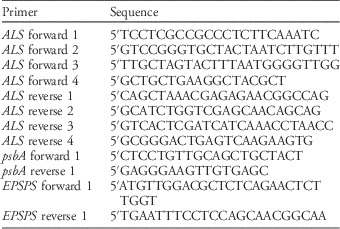
Primer selection and methods for polymerase chain reaction (PCR) and sequencing were based on previous research conducted by Betha et al. (Reference Betha, Thompson, Peterson and Jugulam2015), Mengistu et al. (Reference Mengistu, Christoffers and Lym2005), and Whaley et al. (Reference Whaley, Wilson and Westwood2007). Primers for amplifying an approximately 2-kb section of the ALS gene (Table 1) were designed by Whaley et al. (Reference Whaley, Wilson and Westwood2007) and based on the Amaranthus spp. sequence (GenBank Accession U55852). Primers used for amplification of the ALS gene in Palmer amaranth are listed in Table 1 as ALS forward 1 and ALS reverse 1. Amplification of a 576-bp region of the psbA gene was done with primers (Table 1) designed by Mengistu et al. (Reference Mengistu, Christoffers and Lym2005). Primers used for amplification of the psbA gene are listed in Table 1 as psbA forward 1 and psbA reverse 1. Each PCR reaction for both ALS and psbA amplification contained 2 µl of gDNA, 10 µM each of forward and reverse primers, 10 mM deoxynucleotide triphosphates (DNTPs), 0.5 µl Phusion® high-fidelity DNA polymerase (New England Biolabs, Ipswich, MA), 10 µl of supplied 5×buffer, and nuclease-free water to a final volume of 50 µl. Two separate thermoprofiles were designed for the amplification of the ALS and psbA genes. Reactions for the ALS genes were subjected to 30 s at 98 C, 34 cycles of 10 s at 98 C, 30 s at 60 C, 90 s at 72 C, and a final 10 min at 72 C. Reactions for the psbA genes were subjected to 30 s at 98 C, 34 cycles of 10 s at 98 C, 30 s at 55 C, 30 s at 72 C, and a final 10 min at 72 C. PCR products were quantified using gel electrophoresis. Prior to sequencing, PCR products were purified using the Wizard® SV gel and PCR clean-up kit (Promega, Madison, WI), and concentrations were measured using a NanoDrop™ spectrometer. Eight and four separate sequencing reactions were conducted for the ALS and psbA genes, respectively, for each of the four biological replicates for the MR and S Palmer amaranth populations. To ensure complete coverage and overlap of the 2-kb ALS region, ALS forward and reverse primers 1 to 3 were used (Table 1). Since the psbA region was only 576 bp, only a single set of forward and reverse primers was necessary (Table 1). Sanger sequencing (Applied Biosystems™ 3730 XL, Thermo Fisher Scientific, Waltham, MA) reactions contained 1 µl of 100 ng purified PCR product, 3 µl of forward or reverse primers, and biologically pure water brought up to a final volume of 12 µl. Sequences were aligned and compared using Sequencher™ v. 5.4.1 software (Gene Codes, Ann Arbor, MI). Additional sequence alignment was done with clustalW analysis, and peptide sequences and numbering were obtained with translation tools available through ExPASy (ExPASy: SIB bioinformatics resource portal, http://www.expasy.org).
Oligonucleotide primers used for PCR, gene sequencing, and qPCR of the ALS, psbA, and EPSPS genes.

EPSPS Copy Number
Real-time quantitative PCR (qPCR) was used to determine whether glyphosate resistance in the MR Palmer amaranth population was due to amplification of the EPSPS gene. Quantification of the EPSPS gene was determined by comparing the relative copy number of the EPSPS gene with the ALS gene. The primers used in the qPCR assay were identical to the ones described by Gaines et al. (Reference Gaines, Zhang, Wang, Bukun, Chisholm, Shaner, Nissen, Patzoldt, Tranel, Culpepper, Grey, Webster, Vencill, Sammons, Jiang, Preston, Leach and Westra2010) and Giacomini et al. (Reference Giacomini, Westra and Ward2014). These primers are listed as ALS forward and reverse 4 and EPSPS forward and reverse 1 in Table 1. Dilution series of the primers were not conducted, since previous research has shown high efficiencies with these primer sets (Gaines et al. Reference Gaines, Zhang, Wang, Bukun, Chisholm, Shaner, Nissen, Patzoldt, Tranel, Culpepper, Grey, Webster, Vencill, Sammons, Jiang, Preston, Leach and Westra2010; Giacomini et al. Reference Giacomini, Westra and Ward2014).
The reactions for qPCR were set up with 3 µl of gDNA (2 ng µl−1) from the two Palmer amaranth populations, 2×SYBR® Green Master Mix (Applied Biosystems™, Thermo Fisher Scientific), 10 µM of each forward and reverse primer, and distilled water to bring the final reaction volume to 15 µl. The negative controls contained 7.5 µl of the 2×SYBR® Green Master Mix and 7.5 µl of distilled water. All reactions for the four biological replicates of the MR and S populations were run in triplicate with the following thermoprofile on a QuantStudio™ 7 Flex real-time PCR system (Applied Biosystems™, Thermo Fisher Scientific): 10 min at 95 C, 40 cycles at 95 C for 30 s, and 1 min at 60 C, followed by melt curve analysis to check for primer dimers.
Threshold cycles (Ct) were calculated using QuantStudio™ real-time PCR software v. 1.2 (Applied Biosystems™, Thermo Fisher Scientific). Relative copy number of the EPSPS gene compared with the ALS gene was calculated using a modification of the 2−∆∆Ct method (Gaines et al Reference Gaines, Zhang, Wang, Bukun, Chisholm, Shaner, Nissen, Patzoldt, Tranel, Culpepper, Grey, Webster, Vencill, Sammons, Jiang, Preston, Leach and Westra2010; Livak and Schmittgen Reference Livak and Schmittgen2001). Estimated EPSPS copy number was determined by finding the change in Ct values (Equation 3), and calculating the 2∆Ct.
 $$\Delta {\rm Ct}\, {\equals}\, \left( {C{\rm t}_{{ALS}} {\minus}C{\rm t}_{{EPSPS}} } \right)$$
Results and Discussion
Initial Screen for Three-Way Resistance
The initial screen showed that the combination of glyphosate+thifensulfuron+atrazine failed to control the MR population of Palmer amaranth. Previous research has shown complete control of other Palmer amaranth populations with these herbicides applied alone, at or below the rates used in this experiment (Chandi et al. Reference Chandi, Jordan, York, Milla-Lewis, Burton, Culpepper and Whitiker2013; Horak and Peterson Reference Horak and Peterson1995; Norsworthy et al. Reference Norsworthy, Griffith, Scott, Smith and Oliver2008). Control with all three herbicides applied in combination was 55% and 93% at 14 DAT for the MR and S populations, respectively. Control of all of the S population replications was ≥90%, while 90% control was never achieved with any MR replicates. Biomass reduction from the combination was 7.15X greater in the S population compared with the MR population. The results from this initial screen in the greenhouse confirm preliminary observations from previous field trials of a lack of sensitivity in the MR population to glyphosate, ALS inhibitors, and atrazine. This multiple resistance of glyphosate, ALS inhibitors, and atrazine in Palmer amaranth is not widespread and has only been reported in one other population in Georgia (Heap Reference Heap2016). To date, there has been little published on the Georgia population.
Resistance Factor
ALS Resistance
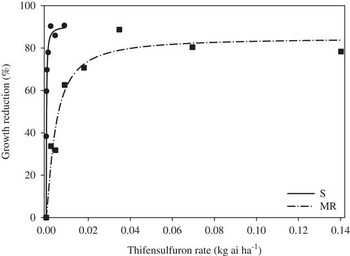
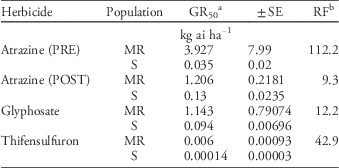
Thifensulfuron applied at half (0.002 kg ha−1) of the normal field use rate or more provided near-complete control of the S Palmer amaranth population (Figure 1). However, there were some plants that survived the higher application rates, indicating that this population may not be completely susceptible to thifensulfuron. Even with this minor variability in control of the susceptible population, the dose of thifensulfuron required to reduce biomass of the S population 50% was 0.00014 kg ha−1 (Table 2). The GR50 value for the suspected ALS-resistant population (MR) was 0.006 kg ha−1 of thifensulfuron, indicating the RF for the MR population to be 42.9X (Table 2). The level of resistance in this population is lower than what has been previously reported for other populations of ALS-resistant Palmer amaranth (Sprague et al. Reference Sprague, Stoller, Wax and Horak1997). The population investigated by Sprague et al. (Reference Sprague, Stoller, Wax and Horak1997) was highly resistant to ALS-inhibiting herbicides, with an RF>3,700 for thifensulfuron. There have been other reports of varying levels of ALS resistance between populations. For example, suspected ALS-resistant populations of Palmer amaranth from Mississippi and Georgia treated with pyrithiobac had RF values of 8 and 303X, respectively (Nandula et al. Reference Nandula, Reddy, Koger, Poston, Rimando, Duke, Bond and Ribeiro2012; Sosnoskie et al. Reference Sosnoskie, Kichler, Wallace and Culpepper2011). The difference in resistance levels may be attributed to the sensitivity of the S population to ALS-inhibiting herbicides used in the screening process or differences in the mechanism of resistance. Even though the MR population demonstrates a lower RF than has been previously reported, plant survival was observed when thifensulfuron was applied at 32X (0.14 kg ai ha−1) the normal use rate, with biomass only being reduced 70% at this rate (Figure 1).
Biomass growth reduction of Palmer amaranth populations in response to applications of thifensulfuron. Fitted lines were calculated with the three-parameter log-logistic model: S (susceptible), y=90.5/(x/0.14)1.08, R2=0.79; MR (suspected multiple resistance), y=84.8/(x/5.96)1.26, R2=0.77. Means for the S population are represented by filled circles and means for the MR population are represented by filled squares.

GR50 values, standard errors (±SE), and resistance factors (RF) for suspected resistant (MR) and susceptible (S) Palmer amaranth populations following PRE and POST applications of atrazine, glyphosate, and thifensulfuron.Footnote a

a GR50, required dose to reduce Palmer amaranth dry biomass 50%.
b
 $${\rm F}\; {\equals}\; {{{\rm GR}_{{50}} \,({\rm MR})} \over {{\rm GR}_{{50}} \,({\rm S})}}.$$
Glyphosate Resistance
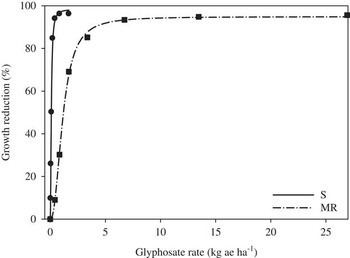
The dose–response analysis showed that the S Palmer amaranth population was more sensitive to glyphosate compared with the MR population (Figure 2). The 1X (1.26 kg ha−1) rate of glyphosate completely controlled the S population, while the 1X rate of glyphosate only reduced Palmer amaranth biomass 10% for the MR population. Glyphosate applied at 16X (13.5 kg ha−1) the labeled rate reduced Palmer amaranth biomass 95% for the MR population. The GR50 values were 0.094 and 1.14 kgha−1 for the S and MR populations, respectively (Table 2). The RF value of 12X for the MR population falls within the range of the RF values of 5 to 115X that have been previously reported for other populations of glyphosate-resistant Palmer amaranth (Culpepper et al. Reference Culpepper, Grey, Vencill, Kichler, Webster, Brown, York, Davis and Hanna2006; Norsworthy et al. Reference Norsworthy, Griffith, Scott, Smith and Oliver2008; Steckel et al. Reference Steckel, Main, Ellis and Mueller2008). These results demonstrate that the MR population is resistant to both glyphosate and the ALS-inhibiting herbicide, thifensulfuron. The first documented populations of Palmer amaranth resistant to both glyphosate and ALS inhibitors occurred in Georgia and Mississippi in 2008 (Nandula et al. Reference Nandula, Reddy, Koger, Poston, Rimando, Duke, Bond and Ribeiro2012; Sosnoskie et al. Reference Sosnoskie, Kichler, Wallace and Culpepper2011). Since then, several other Palmer amaranth populations have been documented as having multiple resistance to glyphosate and ALS-inhibiting herbicides.
Biomass growth reduction of Palmer amaranth populations in response to applications of glyphosate. Fitted lines were calculated with the three-parameter log-logistic model: S (susceptible), y=90.5/(x/0.14)1.08, R2=0.79; MR (suspected multiple resistance), y=84.8/(x/5.96)1.26, R2=0.77. Means for the S population are represented by filled circles and means for the MR population are represented by filled squares.

Atrazine Resistance POST
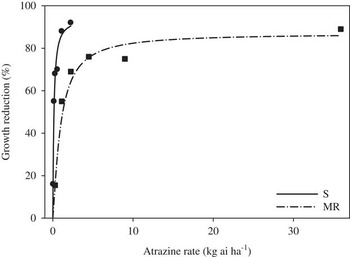
Atrazine applied POST at 1.12 kg ha−1 (1X) reduced Palmer amaranth biomass 89% for the S population (Figure 3). This dose falls in the range of rates that Jhala et al. (Reference Jhala, Sandell, Rana, Kruger and Knezevic2014) reported for the effective dose to reduce Palmer amaranth biomass 90% (ED90) in two atrazine-sensitive Palmer amaranth populations. To reduce Palmer amaranth biomass 90% for the MR population, atrazine needed to be applied at 32X (35.90 kg ha−1) the normal use rate (Figure 3). The GR50 values for the S and MR Palmer amaranth populations were 0.13 and 1.20 kg ha−1, respectively, resulting in an RF of 9X (Table 2). The RF value for the MR population is similar to RF values (9 to 14X) reported by Jhala et al. (Reference Jhala, Sandell, Rana, Kruger and Knezevic2014) in a Nebraska Palmer amaranth population resistant to atrazine. However, the RF for atrazine in the MR Palmer amaranth population is lower than what has been reported previously for triazine-resistant smooth pigweed and tall waterhemp, for which RFs were greater than 100X (Foes et al. Reference Foes, Tranel, Wax and Stoller1998; Maertens et al. 2004). The mechanism for atrazine resistance in these populations was reported as target-site mediated. The lower RF observed in the MR population indicates that the mechanism for resistance in this population may not be target-site based. Detoxification of atrazine has been reported as the mechanism of resistance in velvetleaf, Palmer amaranth, and common waterhemp (Amaranthus rudis L.) (Anderson and Gronwald Reference Anderson and Gronwald1991; Betha et al. Reference Betha, Thompson, Peterson and Jugulam2015; Patzoldt et al. Reference Patzoldt, Dixon and Tranel2003).
Biomass growth reduction of Palmer amaranth populations in response to postemergence (POST) applications of atrazine. Fitted lines were calculated with the three-parameter log-logistic model: S (susceptible), y=90.5/(x/0.14)1.08, R2=0.79; MR (suspected multiple resistance), y=84.8/(x/5.96)1.26, R2=0.77. Means for the S population are represented by filled circles and means for the MR population are represented by filled squares.

Atrazine Resistance PRE
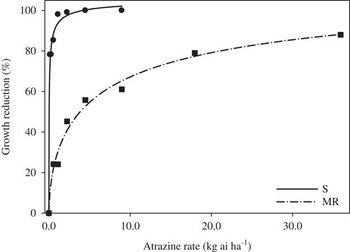
In addition to the MR population being less sensitive to atrazine applied POST, it was also less sensitive to atrazine applied PRE compared with the S population. The 1X (1.12 kg ha−1) rate of atrazine reduced biomass of the S Palmer amaranth population 98%, while 32X (35.90 kg ha−1) the normal use rate failed to reduce biomass in the MR population>60% (Figure 4). Atrazine applied PRE at 1.68 kg ha−1 has been shown to provide>95% control of Palmer amaranth 8 wk after application (Johnson et al. Reference Johnson, Chahal and Regehr2012). PRE applications of atrazine have also failed to control several other weed species, such as common groundsel (Senecio vulgaris L.), common lambsquarters (Chenopodium album L.), hood canarygrass (Phalaris paradoxa L.), rigid ryegrass (Lolium rigidum Gaudin), and blackgrass (Alopecurus myosuroides Huds.) that have evolved resistance to atrazine applied POST (Fuerst et al. Reference Fuerst, Barrett and Penner1986; Ryan Reference Ryan1970; Yaacoby et al. Reference Yaacoby, Schonfeld and Rubin1986). The GR50 values for atrazine applied PRE for the S and MR Palmer amaranth populations were 0.035 and 3.93 kg ha−1, respectively (Table 2). The RF for the MR population was 112.2X for atrazine applied PRE. This RF was 12 times greater than the RF for atrazine POST, showing that this population has a much higher level of resistance to PRE applications of atrazine than when it is applied POST. A possible explanation for the higher RF for atrazine PRE could be the rapid detoxification of atrazine via glutathione conjugation in the stem prior to movement into the leaves when atrazine is absorbed by the roots. This has been reported for velvetleaf, in which atrazine was metabolized at a higher rate in stem tissue compared with leaves. This detoxification of a photosystem II (PSII)-inhibiting herbicide in the stem has also been reported as an important mechanism for soybean tolerance to metribuzin (Fedtke and Schmidt Reference Fedtke and Schmidt1983; Gronwald et al. Reference Gronwald, Anderson and Yee1989). Since atrazine needs to be transported to the leaves for activity, detoxification of atrazine could occur at a higher rate prior to activity when applied PRE compared with POST.
Biomass growth reduction of Palmer amaranth populations in response to PRE applications of atrazine. Fitted lines were calculated with the three-parameter log-logistic model: S (susceptible), y=90.5/(x/0.14)1.08, R2=0.79; MR (suspected multiple resistance), y=84.8/(x/5.96)1.26, R2=0.77. Means for the S population are represented by filled circles and means for MR population are represented by filled squares.

Molecular Basis for Resistance
ALS Inhibitors
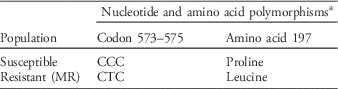
Previous research has shown that a single nucleotide change leading to amino acid substitution is responsible for the majority of ALS resistance in tall waterhemp, redroot pigweed (Amaranthus retroflexus L.), smooth pigweed, Powell amaranth, and Palmer amaranth (Diebold et al. Reference Diebold, McNaughton, Lee and Tardif2003; Foes et al. Reference Foes, Tranel, Wax and Stoller1998; Patzoldt and Tranel Reference Patzoldt and Tranel2007; Sibony et al. Reference Sibony, Michel, Haas, Rubin and Hurle2001; Whaley et al. Reference Whaley, Wilson and Westwood2007). This, paired with the level of resistance expressed by the MR Palmer amaranth population, prompted molecular analysis to establish the mechanism conferring resistance in this population. Resistance to ALS inhibitors in Amaranthus spp. have been well documented. Amino acid substitutions reported to cause resistance to the ALS inhibitors in Amaranthus spp. have been found at six locations within the ALS enzyme: Ala122, Pro197, Ala205, Asp376, Trp574, and Ser653 (Ashigh et al. Reference Ashigh, Corbett, Smith, Laplante and Tardif2009; Heap Reference Heap2016; Huang et al. Reference Huang, Chen, Zhang, Huang, Wei, Zhou, Chen and Wang2016; McNaughton et al. Reference McNaughton, Letarte, Lee and Tardif2005; Tranel and Wright Reference Tranel and Wright2002). All amino acid numbering was normalized to the Arabidopsis thaliana sequence. In the MR Palmer amaranth population, there were several nucleotide changes at multiple locations within the ALS enzyme. With one exception, all other polymorphisms were silent mutations, resulting in no amino acid changes. In the MR population there was a cytosine to thymine change at position 574 (Table 3). This change allowed for a Pro197Leu amino acid substitution relative to the Arabidopsis thaliana numbering. This mutation has not been identified in other ALS-resistant Palmer amaranth populations; however, the Pro197Leu substitution was previously reported to confer resistance to sulfonylurea herbicides (i.e., thifensulfuron) in redroot pigweed at similar levels as those observed here with the MR population (Heap Reference Heap2016; Sibony et al. Reference Sibony, Michel, Haas, Rubin and Hurle2001). The MR population was only screened with thifensulfuron, a sulfonylurea herbicide, for ALS resistance, so cross-resistance to other classes of ALS-inhibiting herbicides was not determined. However, the Pro197Leu substitution was reported to cause low to high resistance in redroot pigweed to the imidazolinone, triazolopyrimidine, and pyrimidinylthiobenzoic acid classes of ALS-inhibiting herbicides, in addition to the sulfonylurea herbicides (Sibony et al. Reference Sibony, Michel, Haas, Rubin and Hurle2001). This indicates a strong likelihood that the MR population would demonstrate cross-resistance to four of the five classes of ALS-inhibiting herbicides.
Nucleotide and amino acid polymorphisms conferring ALS resistance in the suspected multiply resistant (MR) Michigan population of Palmer amaranth.

a Polymorphisms are denoted by nucleotide position within the codon. Amino acid position numbering is normalized to Arabidopsis thaliana.
Glyphosate Resistance
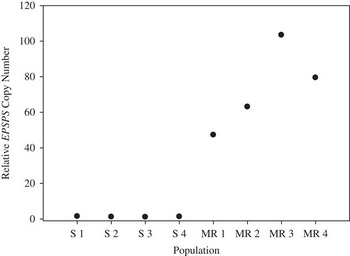
Weed resistance to glyphosate has been shown to be due to multiple mechanisms. In populations of horseweed [Conyza canadensis (L.) Cronq.] and rigid ryegrass, glyphosate resistance is conferred through reduced translocation and vacuole sequestration (Ge et al. 2010; Koger and Reddy Reference Koger and Reddy2005; Lorraine-Colwill et al. Reference Lorraine-Colwill, Powles, Hawkes, Hollinshead, Warner and Preston2002). Similar to other weeds that have evolved resistance to ALS inhibitors, populations of goosegrass [Eleusine indica (L.) Gaertn.], rigid ryegrass, and Italian ryegrass [Lolium perenne L. ssp. multiflorum (Lam.) Husnot] have expressed target-site resistance to glyphosate with amino acid substitutions at Pro106 (Perez-Jones et al. Reference Perez-Jones, Park, Polge, Colquhoun and Mallory-Smith2007; Powles and Preston Reference Powles and Preston2006; Wakelin and Preston Reference Wakelin and Preston2006). The novel mechanism of resistance that has been attributed to conferring resistance to glyphosate in Palmer amaranth populations from Georgia, North Carolina, and New Mexico is overproduction of the target enzyme EPSPS due to gene amplification (Chandi et al. Reference Chandi, Jordan, York, Milla-Lewis, Burton, Culpepper and Whitiker2013; Gaines et al. Reference Gaines, Zhang, Wang, Bukun, Chisholm, Shaner, Nissen, Patzoldt, Tranel, Culpepper, Grey, Webster, Vencill, Sammons, Jiang, Preston, Leach and Westra2010; Mohseni-Moghadam et al. Reference Mohseni-Moghadam, Schroeder and Ashigh2013; Ribeiro Reference Ribeiro2013). Since its identification in Palmer amaranth, overproduction of EPSPS has been documented as the mechanism of glyphosate resistance in Italian ryegrass and kochia (Salas et al. Reference Salas, Dayan, Pan, Watson, Dickson, Scott and Burgos2012; Wiersma et al. Reference Wiersma, Gaines, Preston, Hamilton, Giacomini, Buell, Leach and Westra2015). Based on these previous reports and the RF for the MR Palmer amaranth population, a molecular analysis was conducted to determine whether gene amplification was the mechanism of glyphosate resistance in this population. The qPCR results indicated that the S population had only one copy of the EPSPS gene (Figure 5), while the number of copies ranged from 47 to more than 100 copies of EPSPS enzyme relative to ALS enzyme in the MR population. The number of EPSPS copies in the MR population fell within the range of 5 to more than 160 genomic copies noted by Gaines et al. (Reference Gaines, Zhang, Wang, Bukun, Chisholm, Shaner, Nissen, Patzoldt, Tranel, Culpepper, Grey, Webster, Vencill, Sammons, Jiang, Preston, Leach and Westra2010), who also reported that shikimate accumulation was minimal, illustrating normal enzyme function with 65 or more copies of EPSPS in Palmer amaranth. Resistance to glyphosate increases as EPSPS copy number increases; however, only 30 to 50 copies are necessary to survive normal field use rates of glyphosate (Gaines et al. Reference Gaines, Shaner, Ward, Leach, Preston and Westra2011). Fewer copies of EPSPS (10 or more) are required to confer resistance to glyphosate in Italian ryegrass (Salas et al. Reference Salas, Scott, Dayan and Burgos2015). Differences in the posttranscriptional regulation of EPSPS resulting in differences of protein expression in Palmer amaranth and Italian ryegrass may lead to the differences in copy number required to confer resistance to glyphosate (Salas et al 2010; Vogel and Marcotte Reference Vogel and Marcotte2012). All of the Palmer amaranth plants tested from the MR population fell within or above the range described by Gaines et al. (Reference Gaines, Shaner, Ward, Leach, Preston and Westra2011), with 75% of the plants having more than 60 genomic copies of the EPSPS enzyme. The results from the qPCR and dose–response experiments confirmed that that MR population has moderate to high levels of resistance to glyphosate widely distributed within the population.
EPSPS copy number relative to ALS enzyme in susceptible (S) and suspected multiply resistant (MR) populations of Palmer amaranth. Relative copy number was determined using real-time qPCR with methods described by Gaines et al. (Reference Gaines, Zhang, Wang, Bukun, Chisholm, Shaner, Nissen, Patzoldt, Tranel, Culpepper, Grey, Webster, Vencill, Sammons, Jiang, Preston, Leach and Westra2010).

Atrazine Resistance
Target-site resistance with an amino acid substitution of Gly for Ser at position 264 of the D1 protein, has been reported as the primary mechanism for triazine resistance in smooth pigweed, common waterhemp, kochia, and Powell amaranth (Diebold et al. Reference Diebold, McNaughton, Lee and Tardif2003; Foes et al. Reference Foes, Tranel, Wax and Stoller1998, Reference Foes, Liu, Vigue, Stoller, Wax and Tranel1999; Maertens et al. Reference Maertens, Sprague, Tranel and Hines2004). This amino acid substitution, like most target site–based resistances, confers a high level of resistance to atrazine. For example, this substitution was reported in an atrazine-resistant common waterhemp population from Illinois that had an RF of 185 times (Foes et al. Reference Foes, Tranel, Wax and Stoller1998). There have been reports of other amino acid substitutions at Phe211, Val219, and Ala251 conferring resistance to the PSII-inhibiting herbicides (i.e., atrazine) at a lower RF than the Gly to Ser264 substitution (Devine and Shukla Reference Devine and Shukla2000; Mengistu et al. Reference Mengistu, Mueller-Warrant, Liston and Barker2000). The RF values reported for these other amino acid substitutions are similar to the one reported here for the MR population. Molecular analysis was conducted to determine whether an amino acid substitution was present within the region of the psbA gene, causing atrazine resistance in the MR population of Palmer amaranth. Evaluation of the psbA gene showed no nucleotide polymorphisms within the sequenced region. The absence of polymorphisms and the variability in expression of resistance indicate that the mechanism of resistance for atrazine is most likely non–target site based. Non–target site triazine resistance, possibly via glutathione-S-transferase conjugation, was recently reported in a Kansas Palmer amaranth population and in other Amaranthus spp. (Betha et al. Reference Betha, Thompson, Peterson and Jugulam2015; Ma et al. Reference Ma, Kaundun, Tranel, Riggins, McGinness, Hager, Hawkes, McIndoe and Riechers2013).
This research confirms that a Palmer amaranth population found in Michigan is resistant to three different herbicide sites of action: glyphosate (Group 9); thifensulfuron, an ALS-inhibiting herbicide (Group 2); and atrazine applied PRE and POST (Group 5). While this three-way resistance profile was documented in one other Palmer amaranth population in Georgia in 2010 (Heap Reference Heap2016), this is the first report of RF values and possible mechanisms of resistance for this three way–resistant population. The addition of atrazine resistance to the already widespread resistance to glyphosate and ALS-inhibiting herbicides will make management of Palmer amaranth a challenge in corn. Atrazine applied both PRE and POST has been an effective tool for Palmer amaranth management (Johnson et al. Reference Johnson, Chahal and Regehr2012; Norsworthy et al. Reference Norsworthy, Griffith, Scott, Smith and Oliver2008; Wiggins et al. Reference Wiggins, McClure, Hayes and Steckel2015). Without atrazine, glyphosate, or the ALS-inhibiting herbicides for Palmer amaranth control, farmers will rely heavily on HPPD-inhibiting (Group 27) herbicides both PRE and POST, the long-chain fatty acid inhibitors (Group 15) PRE, glufosinate (Group 10) POST, and the plant growth–regulating herbicides (Group 4) POST. The sole reliance on these herbicides applied alone is not a sustainable approach to management, especially since there are recently documented cases of HPPD resistance in Palmer amaranth (Heap Reference Heap2016; Jhala et al. Reference Jhala, Sandell, Rana, Kruger and Knezevic2014) and a case of tall waterhemp with reported resistance to five different herbicide sites of action (Evans et al. Reference Evans, Tranel, Riechers, Davis, Maxwell, Gonzini and Hager2015). Integrated approaches that include crop rotation, tillage, the use of both PRE and POST herbicide applications with overlapping residuals, tank mixtures of herbicides with multiple effective sites of action, and the incorporation cultural practices such as the use of cover crops will be needed to manage multiply resistant Palmer amaranth populations.
Acknowledgments
This project was funded by the Corn Marketing Program of Michigan and Michigan State University’s Project GREEEN (GR13-053). The authors would like to thank David Douches, Swathi Nadakuduti, and Dan Zarka from the Michigan State University Potato Breeding and Genetics Program for their assistance in the molecular analysis of this population. The authors would also like to thank Jeffrey Landgraf from the Research Technology Support Facility at Michigan State University for providing the equipment to conduct gene sequencing and qPCR.