

Introduction
Okra, Abelmoschus esculentus (L.) Moench (Malvaceae), is one of the most important vegetable crops grown throughout the tropical and temperate regions of the world with a global production of 6 million tonnes per year (FAO, 2007; Thanavendan and Jeyarani, Reference Thanavendan and Jeyarani2010). Okra has a high nutritional value: 100 g of edible okra comprises 1.9 g protein, 0.2 g fat, 6.4 g carbohydrate, 0.7 g minerals and 1.2 g fibre. It is a traditional vegetable crop under a considerable area of cultivation in Asia and Africa, and has huge socio-economic potential. It has been called ‘a perfect villager's vegetable’ because of its nutritional benefits, dietary fibre and seed protein balanced in tryptophan and lysine amino acids (Kumar et al., Reference Kumar, Dagnoko, Haougui, Ratnadass, Pasternak and Kouame2010). The attack of various insect pests, particularly the shoot and fruit borer Earias vittella (Fab.) (Lepidoptera: Noctuidae) at the seedling to the fruiting stages, is the major constraint to the production of okra (Rahman et al., Reference Rahman, Uddin and Shahjahan2013). Females of E. vittella lay eggs individually on leaves, floral buds and on tender fruits. The first and second larval instars bore inside the top shoot where they feed before fruit formation. As a result, the shoot wilts and dries and the damaged plant branches. Subsequently, the tunnelling reaches the fruits and the infested plants bear smaller and deformed fruits (Rahman et al., Reference Rahman, Uddin and Shahjahan2013). Earias vittella is reported to cause the most serious losses in okra compared to other pests (Kumar et al., Reference Kumar, Singh, Sachan, Bhatnagar and Singh2014).
In the present study, the efficacy of four insecticides – cypermethrin, imidacloprid, carbaryl and neem oil – was evaluated on the survival of E. vittella on okra. Cypermethrin, a synthetic pyrethroid, is a broad-spectrum insecticide, and is used in large-scale commercial agriculture to control ectoparasites of cattle, sheep and poultry, and to control cockroaches and tick infestations in dogs. It has high insecticidal activity with low avian and mammalian toxicity, and adequate stability in air and sunlight (Kaufman et al., Reference Kaufman, Russell, Helling and Kayser1981). Imidacloprid, a neonicotinoid, is systemic in action, acting on the central nervous system of insects (Boyd and Boethel, Reference Boyd and Boethel1998) with much lower mammalian toxicity, and has a mixed reputation regarding its safety to natural enemies of pests (James and Vogele, Reference James and Vogele2001). Carbaryl (1-naphthyl methylcarbamate) is one of the most widely used broad-spectrum insecticides to control a wide variety of pests, including moths and beetles, and residential and garden pests (EPA, 2004). It disrupts the normal function of the nervous system of pests, causing paralysis and death in 24–48 hrs (http://pdf.usaid.gov/pdf_docs/PA00K8N5.pdf, 2012). Neem oil is a commercial formulation consisting of 0.03% azadirachtin, which is a substance that belongs to the tetranortriterpenoids, is an active insecticidal component found in neem seeds and leaves (Butterworth and Morgan, Reference Butterworth and Morgan1968), and is the derivative from the neem tree, Azadirachta indica. Neem is used against more than 400 species of insect pests, and is confirmed to be one of the most promising biopesticides in IPM programmes (Schmutterer, Reference Schmutterer1995; Kraiss and Cullen, Reference Kraiss and Cullen2008; Hasan and Ansari Reference Hasan and Ansari2011; Ahmad et al., Reference Ahmad, Ansari and Ahmad2013a; Ahmad et al., Reference Ahmad, Ansari and Muslim2015). The active ingredient in neem, azadirachtin, acts as a repellant or antifeedant that causes death of the pests through starvation.
The combination of toxic and physiological effects in phytophagous insects after application of a toxicant helps protect the crops (Hasan and Ansari, Reference Hasan and Ansari2011; Ahmad et al., Reference Ahmad, Ansari and Muslim2015). When selecting an insecticide, the toxic effects should be considered along with mortality, because after exposure, some insects may be killed directly, but others may survive with numerous sub-lethal effects (Stark et al., Reference Stark, Vargas and Banks2007; Ahmad and Ansari, Reference Ahmad and Ansari2013; Ahmad et al., Reference Ahmad, Ansari and Ahmad2013a, Reference Ahmad, Ansari and Moraiet2013b). A number of toxic effects may occur in the surviving individuals after reaching reproductive age. These include lowered sensitivity of males to female sex pheromones (Holscher and Barrett, Reference Holscher and Barrett2003), continuous persistent effects (Butter et al., Reference Butter, Singh and Dhawan2003), failure in reproduction (Myers and Hull, Reference Myers and Hull2003), and reduction in life span (Stark and Rangus Reference Stark and Rangus1994; Ahmad and Ansari, Reference Ahmad and Ansari2013), fertility (Liu and Trumble, Reference Liu and Trumble2005), fecundity (Ansari et al., Reference Ansari, Ahmad, Ali and Gulrez2008; Ahmad et al., Reference Ahmad, Ansari and Hasan2012a; Ahmad et al., Reference Ahmad, Ansari and Ahmad2013a, Reference Ahmad, Ansari and Moraiet2013b) or ability to avoid predators (Butter et al., Reference Butter, Singh and Dhawan2003). Some insect species undergo high mortality but then re-establish because of high growth and fecundity rate, reduction in generation time, early onset of reproductive activity or a combination of these aspects, whilst other species are eliminated after exposure (Stark et al., Reference Stark, Vargas and Banks2007).
Insect biodemography is an important tool to analyse the complete life history of insects by means of life tables, mortality parameters and life span (Stark et al., Reference Stark, Vargas and Banks2007). When assessing the fate of an insecticide on the surviving population of an insect, the traditional exposure method fails to provide appropriate information on toxicity. Demography in the context of toxicology is the preferred method to study the overall effect of a toxicant on an exposed population. Stark and Wennergren (Reference Stark and Wennergren1995) compared the life table parameters of unexposed populations with those exposed to various concentrations of a pesticide. Stark et al. (Reference Stark, Banks and Acheampong2004, Reference Stark, Vargas and Banks2007) affirm that this provides a more accurate way to study the overall effect of a toxicant on an exposed population, because it gives a complete portrait of the life history of an insect.
Few studies have been published on the use of demography and analogous measures of population growth rate on the effect of toxicants on insects (Stark and Wennergren, Reference Stark and Wennergren1995; Stark and Banks, Reference Stark and Banks2003; Hasan and Ansari, Reference Hasan and Ansari2011; Ahmad et al., Reference Ahmad, Ansari and Hasan2012a, Reference Ahmad and Ansari2012b; Ahmad and Ansari, Reference Ahmad and Ansari2013; Ahmad et al., Reference Ahmad, Ansari and Muslim2015). However, in the current study, we combine demography and analogous measures of population growth rate with fitness parameters, and perform a number of experiments to determine the separate effect of insecticides on all the stages (egg, larva, pupa and adult) of E. vittella. This study aims to investigate the toxicity of four insecticides on E. vittella, to understand the survival, development and reproductive rates for this insect, and provide an improved management programme designed for the pest on okra.
Materials and methods
Collection and rearing of larvae
The experiment was conducted in the Faculty of Agricultural Sciences, Aligarh Muslim University, Aligarh, India in July 2012. Larvae of E. vittella were collected from an experimental field of okra and reared exclusively on okra fruits in rearing jars (25 × 20 cm) at 27 ± 2 °C, 70–75% RH and 14:8 hr L:D photoperiod. The tops of the jars were securely covered with muslin cloth. Fresh and green fruits of okra were given as food and changed on a daily basis up to pupation. After emergence, the adults were kept in separate glass jars (20 × 10 cm) covered with muslin. Jars were maintained at 27 ± 2 °C and 70–75% relative humidity. Fresh leaves and fruits of okra were kept in the jars for oviposition. A piece of cotton wool soaked in 5% honey solution was kept in the jars as food for adults and changed daily. Eggs were collected from the jars daily and kept for hatching. After hatching, the young larvae were transferred to the jars containing fresh fruits of okra. The faecal matter and dry fruits were removed from the jars daily and replaced with fresh fruits up to pupation. The culture was maintained up to F4 generation to raise a laboratory-adapted population for further bioassay studies.
Sexing of pupa
The males and females were identified at the pupal stage for pairing for further life table studies. We identified the male and female pupal cocoons by the well-developed knob in males (1.5–2.5 mm), which is directed forward and upward at the anterio-dorsal end. Female cocoons do not have a knob (Mahapatro and Gupta, Reference Mahapatro and Gupta1999).
Insecticides
Cypermethrin was obtained from M/S Dhanuka Agritech Limited, Mumbai, India, carbaryl and imidacloprid were obtained from Bayer Crop Science Ltd., Mumbai, and neem oil was obtained from the local market of Aligarh, India. Cypermethrin (Cypermethrin 2.5EC), imidacloprid (Confidor 17.8% SL), carbaryl (Sevin® 50WP) and neem oil (1% EC azadiractin) were applied on okra fruits at a concentration of 20 mg/L. Distilled water was used as control.
Bioassays
Slices of okra fruit were dipped in the aqueous solution of the insecticides for 2 min and then dried for 20 min at room temperature (33 °C). Impregnated slices of okra (5-cm long) were kept in separate plastic container (100 ml) and five sixth instar larvae of E. vittella introduced in each container and allowed to feed for 24 hr. For control, the okra slices were dipped in distilled water for 2 min and dried at room temperature for 20 min. After 24 hr, the larvae were transferred to glass jars (20 × 10 cm) containing fresh fruits of okra and allowed to feed until pupation. Dead and moribund larvae were counted and discarded whilst pupae were placed individually in separate containers until adult emergence. The experiment was replicated 15 times.
The influence of insecticides on the life table
One thousand eggs (10 cohorts of 100 eggs) of the same age group were collected from different pairs of adults that had emerged from the surviving larvae of the bioassay experiment for each insecticide. After hatching, 100 neonates were kept in glass jars (25 x× 10 cm) with the top securely covered with a muslin cloth, and fed daily on fresh okra fruits until pupation. To maintain freshness, the stalk of okra fruit was wrapped with a cotton plug and dipped in water in a 5 ml vial. The dead and moribund larvae were removed from the experimental jars, counted, and recorded daily. Upon pupation, pupae were harvested and placed individually in glass jars for adult emergence. The demographic table was constructed by the method of Deevey (Reference Deevey1947) and Southwood (Reference Southwood1978).
Female fecundity and life indices
Freshly emerged females and males (F1 generation) of E. vittella obtained from the above mentioned life table experiment were paired and kept in a separate glass jar (25 × 25 cm). A batch of 10 pairs, replicated 10 times for all treated and untreated experiments, were used and fed on 5% honey solution soaked in a cotton wick and provided with fresh fruits and leaves of okra for oviposition. The leaves were sorted out on a daily basis for eggs laid. Eggs were counted on a daily basis to obtain daily fecundity rate mx until all the adults had died.
Observations on the basis of live or dead forms (cohort–1000) were recorded daily on the parameter of age (X, in days), number of surviving individuals (eggs, larvae, pupae and adults) at the beginning of each interval ‘X’ out of 100 (Ix), number of dying individuals (eggs, larvae, pupae and adults) during the age interval ‘X’ out of 100 (dx), expectancy of life or mean life remaining of individual of age ‘X’ (ex) which was calculated by Tx/Lx, where Tx is total number of individuals of ‘X’ age unit and Lx is the number of individuals surviving between age ‘X’ and (X+1), and calculated by the equation Lx = Ix+I(X+1)/2. The life indices table was constructed by assuming that the survivorship rates are the same for both sexes and sex cannot be determined at the egg stage, so a sex ratio 1:1 was considered for each set of eggs to obtain the number of female births (mx) (Ahmad et al., Reference Ahmad and Ansari2012b; Ahmad et al., Reference Ahmad, Ansari and Ahmad2013a, Reference Ahmad, Ansari and Moraiet2013b). From these data, the life indices parameters were calculated; namely, potential fecundity (Pf = Σmx), net reproductive rate (Ro = Σlx.mx), intrinsic rate of increase (rm) (∑e−rm x.lx.mx = 1), finite rate of increase (λ = Anti loge rm), mean length of generation time (Tc = lx.mx.x / lx.mx), and doubling time (DT = loge 2/rm).
Evaluation of survival, fecundity, egg hatching and adult longevity of E. vittella with different pesticides
One pair of adults (replicated three times) emerging from the life table experiment was taken and paired in a glass jar (20 × 10 cm) and provided with 5% honey solution as food. Fresh leaves and fruits of okra were placed in the jars for oviposition. Fecundity of each female was recorded daily till death of the female. One hundred eggs of the same age group were taken at random from each pair of adult moths, and the numbers of hatched and unhatched eggs recorded. Eggs were considered as unhatched after 6 days of laying. The longevity of adults was recorded. Adults were provided with 5% honey solution. For the effect of insecticides on the survival of different stages, number of surviving individuals entering at each stage was recorded for each insecticide and the control. The first-day wet weight of pupa was recorded. Pupae were examined daily for eclosion and the numbers of emerged adults recorded. The numbers of eggs laid were counted daily for each pair to record the potential fecundity. The complete set of experiments was replicated 10 times.
Effect of insecticides on overall fitness index of E. vittella
Biological ‘fitness index’ (rI), was evaluated on the larval and pupal survival, development time and pupal weight. The parameters were used as an indicator of overall offspring performance as reported by Pretorius (Reference Pretorius1976) and Jallow and Zalucki (Reference Jallow and Zalucki2003). The rI was calculated by using the formula rI = pp*mp/(tl+tp), where pp is percentage pupation, mp is mean pupal mass (in grams), and tl and tp are the larval and pupal duration, respectively.
Statistical analysis
The life indices and life table data were subjected to one way analysis of variance (ANOVA) by using Minitab-15 for Windows software. Means were analysed using Fisher's least significant difference (Tukey's HSD) test. Generalized Linear Mixed Model (GLMM) was used to analyse all the percent data prior to further analysis using the programme R 2.10.1 developed by the R Development Core Team.
Results
Effect on age-specific parameters
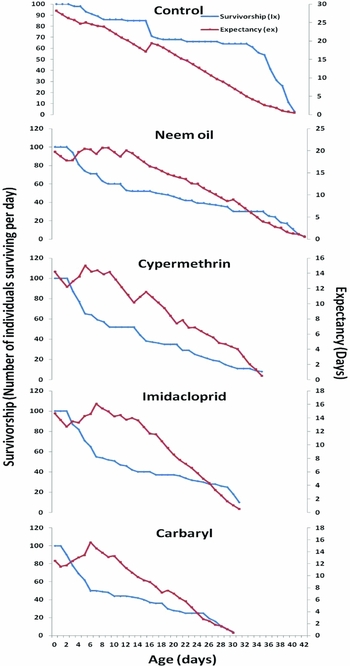
Survivorship (Ix) of E. vittella was highest with commencement of age and gradually decreased with progression of age in both treated and untreated groups. It was reduced to 30 days when E. vittella was treated with carbaryl and increased to 42 days when the insect was treated with neem oil as compared to 40 days in the control (Fig. 1). Expectancy of life (ex) was greatest in the beginning of the age and declined gradually with the advancement of age in both treated and untreated individuals.
Mean age of specific survivorship and expectancy of Earias vittella after exposure to insecticides in the previous generation.

Effect of insecticides on mortality of immature stages of E. vitella
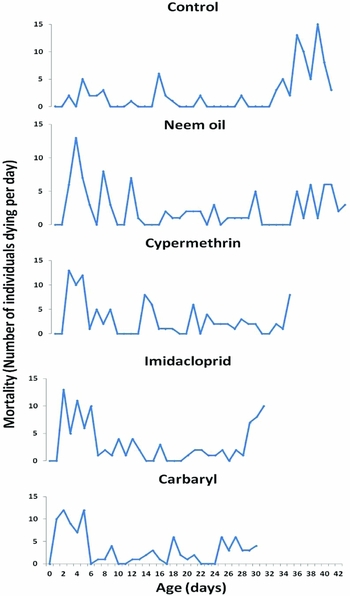
A significant difference was observed on the mortality of E. vittella in the F1 generation exposed to insecticides in the previous generation (Fig. 2). The highest percentage (17%) of unhatched eggs was recorded with imidacloprid and cypermethrin, whilst all the eggs hatched in the control groups (Pearson chi = 0.133, df = 4, P = 0.001). Larval mortality (dx) was uneven in relation to insecticides. Mortality was higher in first and second instars compared to fifth and sixth instars in the treated and untreated groups (F = 4.22; df = 4, 39; P < 0.05). The pupal mortality was significantly higher with imidacloprid than other insecticides or control groups (F = 12.34; df = 4, 39; P = 0.004).
Mean daily mortality of Earias vittella after exposure to insecticides.

Effect of insecticides on life indices E. vittella
Life indices of E. vittella varied significantly (P < 0.05) in treated and untreated individuals (Table 1). The net reproductive rate (Ro) was significantly reduced to 4.97 females/female/generation with cypermethrin, compared to 73.28 in the control groups (F = 310.42; df = 4, 39; P = 0.002). The minimum intrinsic rate of increase (rm) occurred with cypermethrin treatment (0.020 females/female/day) and the maximum (0.046) with the control (F = 1.90; df = 4, 39; P = 0.004). A significantly lower birth rate was observed with cypermethrin treatment (F = 14.11; df = 4, 39; P = 0.005), and 1.11 females/female/day were born in the control groups. Time taken by E. vittella to complete one generation (Tc) was 33.27 days in the control groups, was reduced to 26.78 days on carbaryl-treated discs, and increased to 37.5 days with neem oil (F = 122.55; df = 4, 39; P = 0.001). Corrected generation time (T) was significantly (P < 0.05) reduced to 31.54 days with imidacloprid treatment and was 40.53 days in the control. Earias vittella took a longer time (15.0 days) to double its population with cypermethrin treatment as compared to control groups (6.54 days) (F = 64.11; df = 4, 39; P = 0.001).
Effect of insecticides on life indices of Earias vittella

Means followed by different letters within the same column are significantly different (P < 0.05), one-way ANOVA, Tukey's HSD.
Effect of pesticides on fecundity of female E. vittella
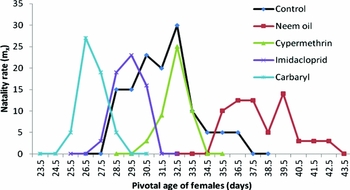
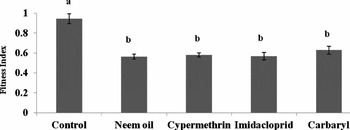
Insecticides significantly affected the fecundity of E. vittella in the first generation (Table 2). Females laid eggs during a definite period of pivotal age. The pre-oviposition period was delayed to 3 days on neem oil treated discs and 2 days on the other insecticides (including control). Peak egg production was observed on day 32.5 of pivotal age in the control females and delayed to day 39.5 with neem oil treatment (Fig. 3). The post-oviposition period, when egg laying does not take place, was not significantly different in the treated and untreated groups. Potential fecundity (number of eggs laid) was significantly reduced to 94 females/female/generation with cypermethrin treatment as compared to the control (256 eggs) (P < 0.05). Daily fecundity rate (mx) was significantly higher (30 offspring/day) in the control compared to 14 offspring/day with neem oil treatment (F = 137.28; df = 4, 39; P = 0.001). Insecticides caused significant reduction in overall fitness of E. vittella (F = 96.11; df = 4, 39; P < 0.05) (Fig. 4). The fitness performance was significantly higher in the control population as compared to insecticide treatment. However, the fitness was not significantly different between the insecticide treatments.
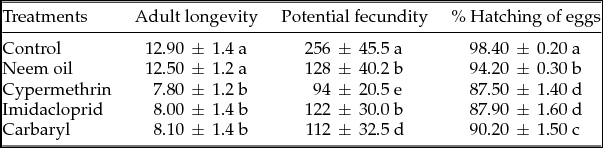
Effects of insecticides on biological parameters of Earias vittella

Means followed by different letters within the same column are significantly different (P < 0.05), one-way ANOVA, Tukey's HSD.
Mean natality of Earias vittella after application of insecticides in the previous generation.

Fitness index of Earias vittella after application of insecticides in the previous generation.

Effect insecticides on pupal development
Post-exposure effects were observed in pupae of the first generation when larvae had been exposed to insecticides in the parental generation. Insecticides significantly reduced the emergence of adults and survival of pupae from 97 to 60% with carbaryl treatment (Pearson chi = 0.533 = df = 4, P = 0.001). The developmental period of pre-pupa and pupa was significantly decreased with the insecticide treatments (P < 0.05) (Table 3). Similarly, pupal weight was also significantly decreased in the insecticide treated groups (F = 28.6; df = 4, 39; P = 0.006) and maximum reduction was observed when treated with carbaryl. The trend of decrease in pupal weight for each treatment was in the order: carbaryl<imidacloprid<cypermethrin<neem oil<control.
Effects of insecticides on pupae of Earias vittella

Means followed by different letters within the same column are significantly different (P < 0.05), one-way ANOVA, Tukey's HSD.
Effect of insecticides on larval survival of E. vittella
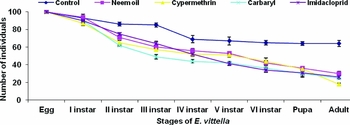
Insecticides significantly reduced the larval survival of E. vittella (Table 4). Mortality was high in the initial instars as compared to late instars. The survival of first instar larvae was significantly lower with carbaryl treatment (68.9%) (Pearson chi = 0.2190; df = 4; P = 0.001), followed by endosulfan, neem oil and imidacloprid, which were 73.56%, 75.53 and 81.60%, respectively. Survival was greatest in the control groups as compared to the treatments in all the instars. It was observed that 80% of the sixth instar larvae survived and transformed to pupae in the control groups (Pearson chi = 0.5434; df = 4; P = 0.001) whereas they were unaffected with imidacloprid. There was a constant decline in survival from one stage to another when treated with the insecticides as well as control (Fig. 5).
Effect of insecticides on the percent larval survival of Earias vittella

Means followed by different letters within the same column are significantly different (P < 0.05), one-way ANOVA, Tukey's HSD.
Mean stage-specific survival of Earias vittella after application of insecticide in the previous generation.

Discussion
Insecticides significantly affected the survival of larvae and pupae as well as the reproductive potential and fecundity of E. vittella. Survivorship and expectancy of life was also reduced when larvae were treated with insecticides as compared to control groups. The reduction in survivorship was also reported for Helicoverpa armigera treated with neem-based insecticides (Ahmad et al., Reference Ahmad, Ansari and Muslim2015), H. armigera with cypermethrin (Ahmad and Ansari, Reference Ahmad and Ansari2013), H. armigera with imidacloprid (Ahmad et al., Reference Ahmad, Ansari and Ahmad2013a), Plutella xylostella (Lepidoptera: Plutellidae) with spinosad (Yin et al., Reference Yin, Wu, Li, Zhang and Xu2009), P. xylostella with imidacloprid (Ansari et al., Reference Ansari, Ahmad, Ali and Gulrez2008) and Brevicoryne brassicae (Linn.) (Homoptrea: Aphididae) treated with imidacloprid (Lashkari et al., Reference Lashkari, Sahragard and Ghadamyari2007). Sub-lethal concentrations of spinosad caused a decrease in survival, suppressed weight gain of larvae and extended larval development of H. armigera (Wang et al., Reference Wang, Gong, Li, Qiu and Wang2009). Interestingly, the survivorship of P. xylostella was increased in a concentration dependent manner when treated with neemarin (Ahmad et al., Reference Ahmad and Ansari2012b), whilst survivorship of nymphs and adults of Acyrthosiphon pisum (Harris) exposed to Margosan-O decreased in a concentration related mode (Stark and Wennergren, Reference Stark and Wennergren1995).
Wang et al. (Reference Wang, Gong, Li, Qiu and Wang2009) reported that spinosad reduces hatchability of eggs of H. armigera exposed to sub-lethal doses. Similarly, egg hatching of P. xylostella was significantly reduced after exposure to neemarin (Ahmad et al., Reference Ahmad and Ansari2012b). In the present study, egg hatching was significantly reduced when treated with insecticides. However, contrary to these findings, sub-lethal concentrations of indoxacarb had no significant consequence on the hatching of eggs of P. xylostella (Mahmoudvand et al., Reference Mahmoudvand, Abbasipour, Garjan and Bandani2011). We observed that the mortality of immature stages was erratic in relation to the treatments, and higher with cypermethrin and imidacloprid as compared to other insecticides tested and untreated groups. Muthu et al. (Reference Muthu, Baskar, Kingsley and Ignacimuthu2010) revealed that a hexane extract of Atalantia monophylla produced significant larval mortality (85.3%) of E. vittella, and mortality of 78.7% and 69.3%, respectively by ethyl acetate and chloroform extracts of the same plant. A similar trend of mortality has been reported for P. xylostella after exposure with 5, 10, 15 and 20 mg/L of neemarin, and by imidacloprid on H. armigera (Ahmad et al., Reference Ahmad and Ansari2012b, Reference Ahmad, Ansari and Ahmad2013a). Post exposure effects of insecticides were also observed on pupal development and adult emergence of E. vittella. In our study, insecticides significantly reduced the emergence of adults, shortened adult longevity and reduced reproductive capacity and egg hatchability as well survival of the surviving individuals after exposure. Muthu et al. (Reference Muthu, Baskar, Kingsley and Ignacimuthu2010) reported that the adult emergence of E. vittella was drastically reduced when treated with different concentrations of A. monophylla compared to the control. Saber et al. (Reference Saber, Parsaeyan, Vojoudi, Bagheri, Mehrvar and Kamita2013) have shown that the longevity of adults of H. armigera that survived exposure to LC30 of methoxyfenozide and thiodicarb was significantly decreased in comparison to the control. Our findings correlate with the earlier findings of Srinivas et al. (Reference Srinivas, Raguraman and Rajendran2003) who reported that the pupation ratio and adult emergence of E. vittella were reduced significantly when treated with neem alone and combined with pongam and sweet-flag. The effects were similar on pupation and adult emergence of H. armigera (Wang et al., Reference Wang, Gong, Li, Qiu and Wang2009; Ahmad and Ansari, Reference Ahmad and Ansari2013; Ahmad et al., Reference Ahmad, Ansari and Ahmad2013a, Reference Ahmad, Ansari and Moraiet2013b), Spodoptera frugiperda (Cespedes et al., Reference Cespedes, Salazar, Martinez and Aranda2005), S. litura (Malarvannan et al., Reference Malarvannan, Murali, Shanthakumar, Prabavathy and Nair2010) and P. xylostella (Ahmad et al., Reference Ahmad and Ansari2012b).
Insect pests can acquire insecticide tolerance and may build up resistance after a relatively longer period of contact, by increasing the specific activities of their metabolic enzymes (Yin et al., Reference Yin, Wu, Li, Zhang and Xu2009). Insecticide hormoligosis is also known to occur in some insects and mites, which may sometimes result in resurgence of pests (Luckey, Reference Luckey1968). Fujiwara et al. (Reference Fujiwara, Takahashi, Yoshioka and Nakasuji2002) reported that the fecundity of P. xylostella females increased when larvae were exposed to LC25 of fenvalerate. After using spinosad, Elzen (Reference Elzen2001) reported increased fecundity of Orius insidiosus (Linn.) (Hemiptera, Anthocoridae). Walthall and Stark (Reference Walthall and Stark1997) have given the probable explanation for this, showing that surviving individuals maintain high reproductive potential that allows them to compensate for the losses in the population as a result of a toxicant, and act as reservoirs for future reproduction. In our study, we failed to observe hormoligosis in E. vittella when treated with insecticides. Fecundity of females in F1 generation was reduced after exposure to insecticides. Ahmad et al. (Reference Ahmad, Ansari and Moraiet2013b) reported similar findings with H. armigera after exposure to different doses of Neemazal. In our study, the performance of E. vittella was also significantly reduced after exposure to different insecticides. Larvae exposed to insecticide produced smaller pupae that were more likely to die and emerged adults showed less fecundity. Helicoverpa armigera showed low fecundity in the first generation after treatment with different insecticides as compared to an unselected population (Ramasubramanian and Regupathy, Reference Ramasubramanian and Regupathy2003). Likewise, fecundity of the untreated population of P. xylostella was significantly greater than that exposed to imidacloprid (Lashkari et al., Reference Lashkari, Sahragard and Ghadamyari2007; Ansari et al., Reference Ansari, Ahmad, Ali and Gulrez2008).
We focused on the toxicity of insecticides on reproductive rates (intrinsic and net reproductive rates) as the primary determinant of overall increase in population. According to Birch (Reference Birch1948), the comparison of two or more populations only by their net reproductive rates may be misleading until the mean length of generation time becomes the same. Two or more populations may have the same net reproductive rates, yet their intrinsic rate of increase may be quite different, because of the different lengths of generation time. For this reason, Stark et al. (Reference Stark, Vargas and Banks2007) observed that the intrinsic rate of natural increase and the finite rate of increase (or the population multiplication rate) are the most extensively used measures for the effect of a toxicant. Zero value of the intrinsic rate of increase (rm) indicates a stable population, positive value indicates increasing population and negative value represents diminishing population (Stark et al., Reference Stark, Vargas and Banks2007). It can be used as a guide of vigour, is a key indicator of population dynamics, and is considered a measure of capacity of a population to increase exponentially in unlimited environment, thus presenting an effective measure of insects life history traits (Dixon, Reference Dixon, Minks and Harrewijn1987). In the present work, the net reproductive rate and intrinsic rate of increase were significantly reduced when E. vittella was treated with insecticides, and were most reduced with cypermethrin as compared to untreated groups. Similarly, Ahmad et al. (Reference Ahmad, Ansari and Ahmad2013a) reported the reduction in the reproductive rate of H. armigera by treatment with different concentrations of imidacloprid.
Survival rate and average weight of larvae of E. vittella were much lower on leaves treated with Margosan-O, or exposed to its systemic effect, compared to control leaves (Meisner et al., Reference Meisner, Klein and Keren1990). Ahmad et al. (Reference Ahmad and Ansari2012b) obtained a similar result with P. xylostella. They demonstrated that the survival rate of first instar P. xylostella was most affected after ingestion of Neemarin-treated food compared to unexposed groups. Sub-lethal concentrations of spinosad have significantly extended the developmental time of surviving larvae and reduced larval wet weight of H. armigera (Wang et al., Reference Wang, Gong, Li, Qiu and Wang2009). In our study, application of insecticides reduced pupal weight and survival as compared to the control. Post-exposure effects were indicated by decreased pupation ratio and pupal weight, and prolonged pre-pupal and pupal periods, and decreased emergence ratio, fecundity and longevity of adults (Wang et al., Reference Wang, Gong, Li, Qiu and Wang2009). In field conditions, toxicity of insecticides may be somewhat different, but overall performance will be beneficial when applied at the most appropriate stage of the insect and time of crop development.
Conclusion
The insecticides tested were toxic on all stages of the surviving population of E. vittella and caused an adverse effect on the biological parameters in the successive generation in relation to reduction in population size, survivorship, pupation ratio, potential fecundity, and intrinsic and finite rate of increase. Moreover, reduction in larval, pre-pupae and pupae development may change the occurrence timing of this pest in relation to the crop; which, therefore, may escape pest damage. Consequently, when used efficiently and applied in a timely manner, insecticides may be incorporated in the integrated management of E. vittella on okra as a valuable component, to avoid development of resistance.